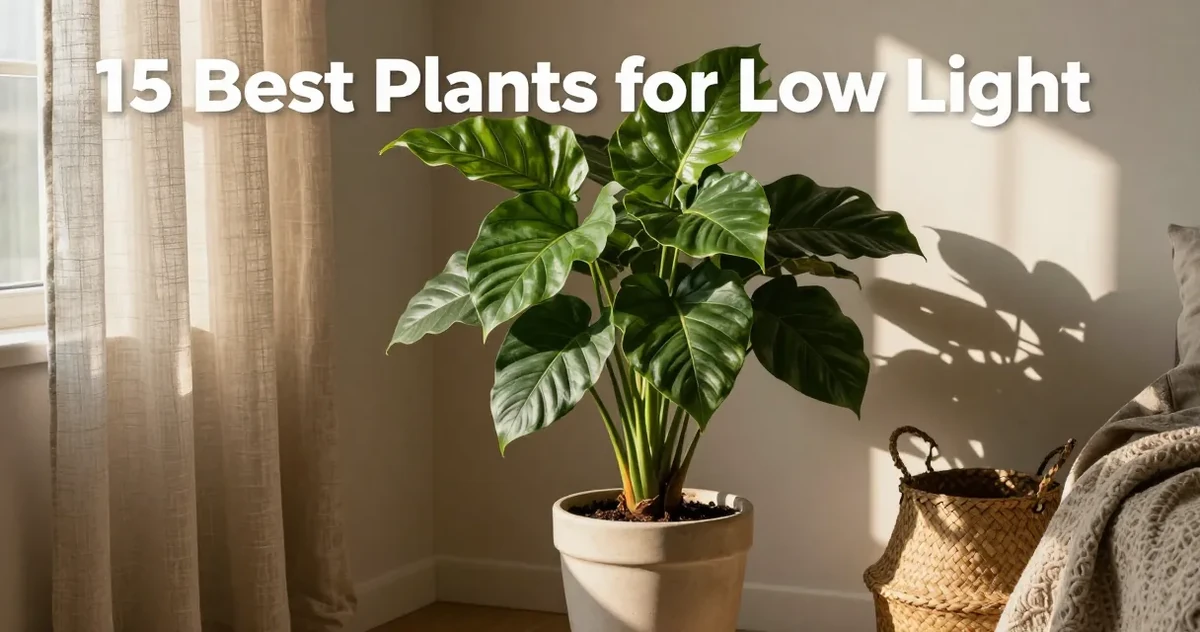
The best low-light indoor plants for a dim room with usable daylight are ZZ plant, snake plant, cast iron plant, and pothos. They grow slowly and still need light, but they hold their shape better than most houseplants when placed away from a bright window. For pet-safe rooms, start with cast iron plant, parlor palm, spider plant, or bird’s nest fern.
This guide compares 15 low-light houseplants by realistic light tolerance, watering forgiveness, and pet safety. It also separates a genuinely dim room from a windowless room, because no indoor plant can live indefinitely without natural or supplemental light.
Last updated: September 2026, with low-light care guidance cross-checked against extension sources and ASPCA safety references.
Identification Snapshot
Use this before you shop. The right plant depends less on the label and more on what your room is actually asking the plant to tolerate.
| Your real setup | Best-fit plants from this list | Higher-risk picks to treat cautiously |
|---|---|---|
| Dim room with a real window | Pothos, snake plant, ZZ plant, cast iron plant, peace lily | Rubber plant, variegated Chinese evergreen, thirsty ferns if the air is dry |
| Very dim room, but you can still read near the window | ZZ plant, snake plant, cast iron plant, pothos | Calathea, Boston fern, rubber plant |
| No window, fluorescent office light only | ZZ plant, cast iron plant, lucky bamboo, sometimes snake plant | Most trailing vines, ferns, and flowering plants without a grow light |
| Pet-safe low-light shortlist | Cast iron plant, spider plant, Boston fern, bird’s nest fern, parlor palm, calathea/prayer plant | Pothos, philodendron, snake plant, ZZ plant, peace lily |
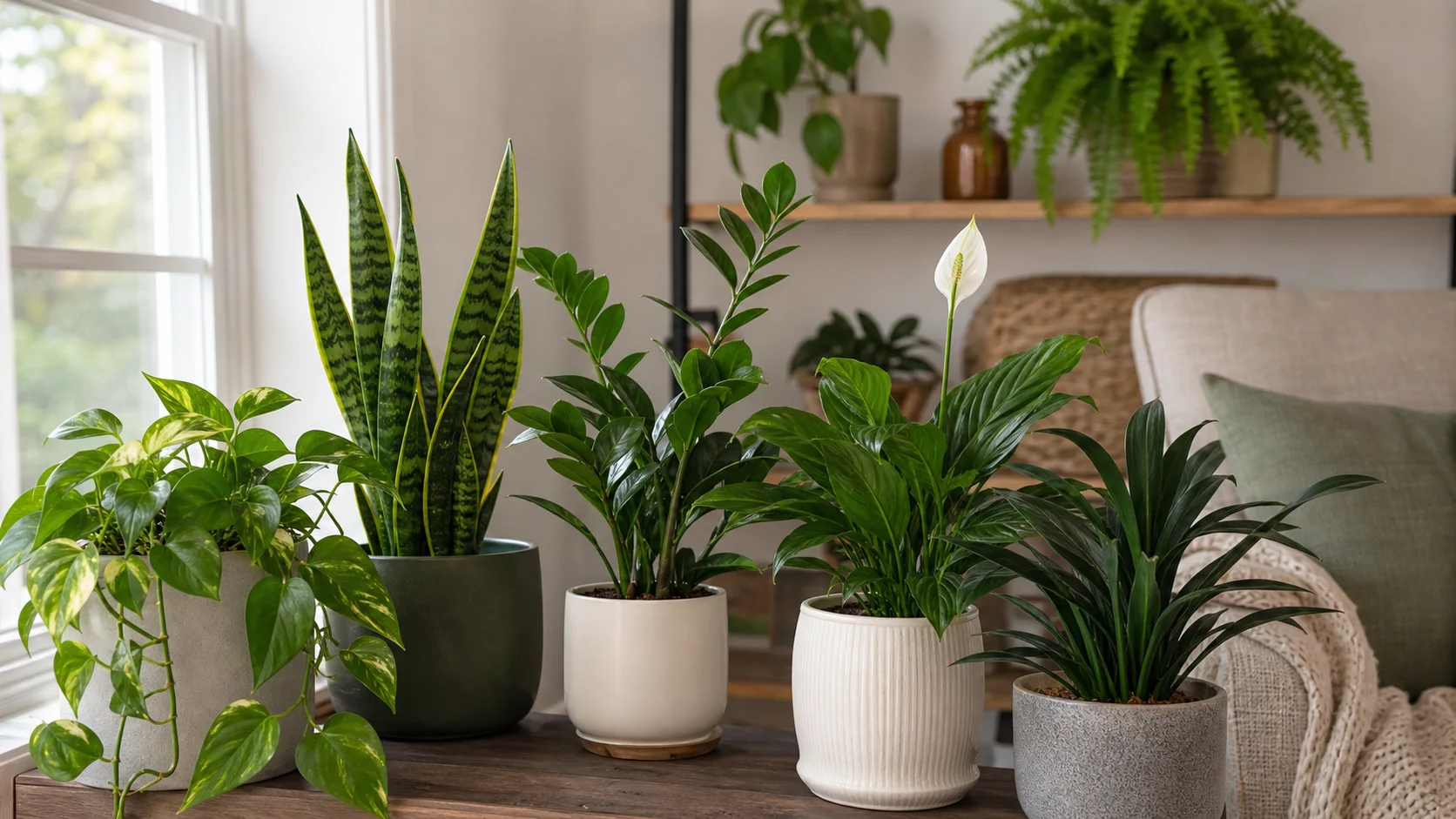
Compare the room’s usable daylight before choosing among pothos, snake plant, ZZ plant, peace lily, and other low-light options.
Best Plants for Very Low Light or Minimal Light
For the lowest-light rooms that still receive usable daylight, begin with ZZ plant, snake plant, and cast iron plant. Pothos is another strong choice, although its vines may stretch and its leaves may grow smaller as light drops.
In a minimal-light room, placement matters more than the label on the pot. Keep the plant in the brightest part of the room, slow down watering as growth slows, and rotate it occasionally. If the room has no window and is lit only when someone enters, add a grow light on a timer; even the most tolerant plant needs a dependable light source.
Lookalikes and Confused With
A lot of low-light disappointment comes from buying the right category name but the wrong version of the plant.
- Low light is not the same as no light. A north-facing or shaded window is workable. A windowless room is a separate problem that usually needs a grow light.
- Dark green Chinese evergreens usually cope better than pink, red, or cream-variegated cultivars, which often fade or stretch in dim rooms.
- Parlor palm is a true low-light option. Majesty palm gets sold beside it, but usually wants brighter conditions and declines much faster indoors.
- Bird’s nest fern and Boston fern both like indirect light, but Boston fern usually asks for more humidity and more consistent moisture.
What Most Low-Light Plant Guides Get Wrong
Here’s the split most roundups skip: they conflate “survives in dim light” with “looks good in dim light.” These are not the same outcome.
Penn State Extension notes that lower-light interiors call for plants with darker green foliage, because darker leaves contain more chlorophyll per unit area and can extract more energy from limited light. That’s the practical filter most “best of” lists ignore. Instead they often include colorful, variegated, or lighter-leaved plants that technically survive in shade but lose their color, grow leggy, and look tired within a few months.
The second gap is the windowless question. A dim room with a north-facing window is a genuine low-light environment. A room with no window and only fluorescent ceiling lights is a different situation. University of Minnesota Extension is direct about this: supplemental lighting can compensate for lack of natural sunlight, but the plant still needs a meaningful light source. If you’re placing plants in a genuinely windowless space, a grow light is not a nice-to-have – it’s the whole setup.
The practical first check: Can you comfortably read a book near the window without turning on a lamp? That’s genuine low light – you’re in good shape. Is it always dim regardless of time of day, with no window in sight? You need either supplemental light or a very different shortlist.
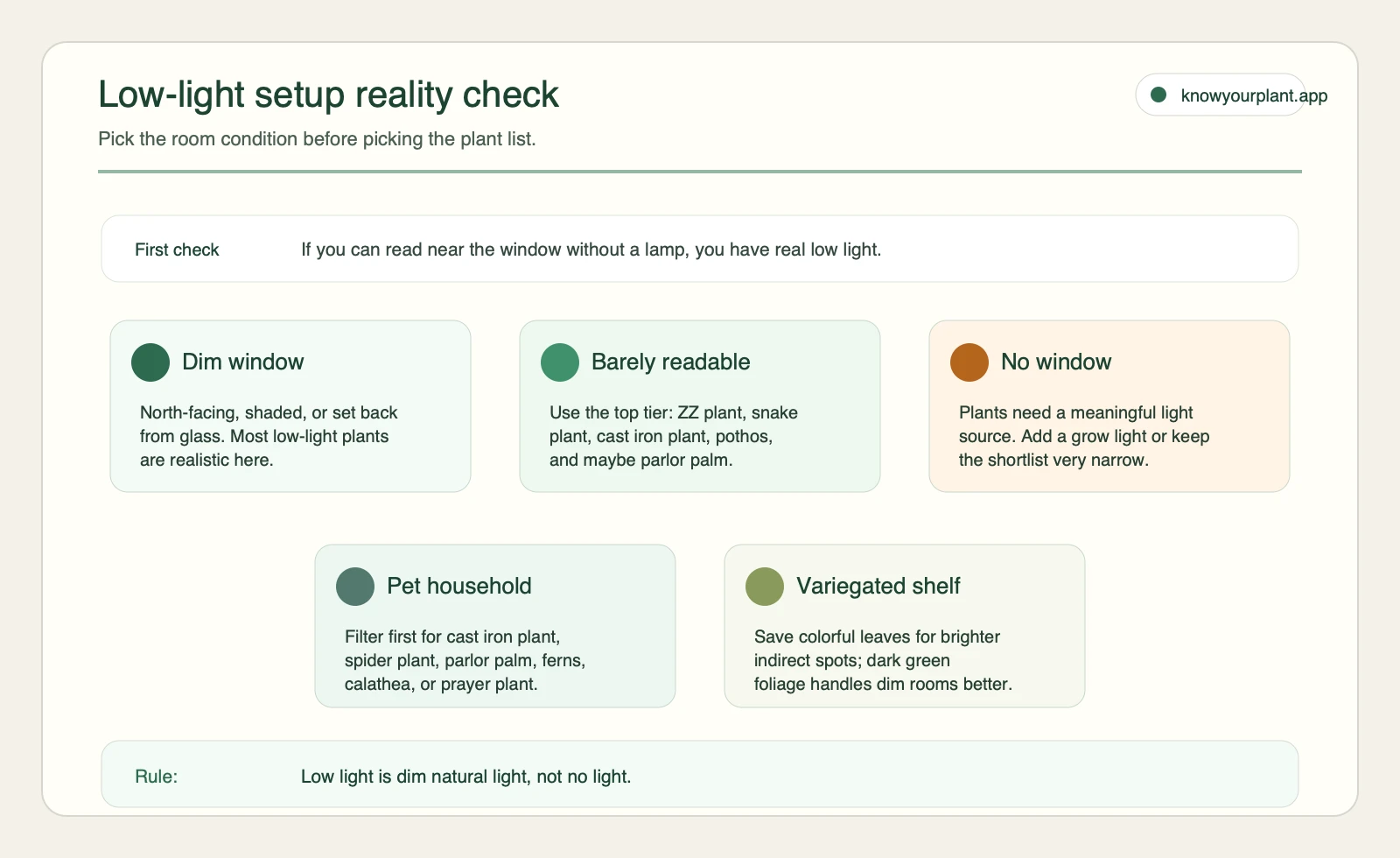
Use the setup reality check before picking a plant list: low light means dim natural light, not no light.
Which Setup Are You Working With?
Before picking a plant, identify which situation you’re actually in. The answer changes the list significantly.
Dim room with a window (north-facing, shaded, or set well back from the glass): This is classic low-light territory. All 15 plants below are realistic choices here, though some will thrive more than others depending on how dim the window actually is.
Small or obstructed window, barely enough light to read by: Stick with the top tier: ZZ plant, snake plant, cast iron plant, and pothos. They have the deepest low-light tolerance on this list. Peace lily and parlor palm are worth trying. Calathea is riskier.
Office with fluorescent ceiling lights only, no window: ZZ plant, cast iron plant, and lucky bamboo are your most realistic options. Snake plant can sometimes cope, but growth will be minimal. Everything else on this list will decline without natural light.
Pet household with dim rooms: Spider plant, cast iron plant, Boston fern, bird’s nest fern, parlor palm, and calathea or prayer plant are non-toxic per ASPCA. Full pet notes are in each entry and in the dedicated section below.
What “Low Light” Actually Means in Practice
As a working definition: low light is indirect natural light from a window that doesn’t receive direct sun, or a room where it’s dim but you can still distinguish shapes and colors clearly across the room. It is not the same as a windowless office or a basement with no windows.
University of Maryland Extension points out that most houseplants are lost to watering problems, not light problems – but light level directly affects how fast a plant uses water. In dim rooms, plants grow more slowly, photosynthesize less, and drink far less. That means your watering schedule needs to slow down with them.
One thing worth knowing before winter: in northern climates, dim rooms get significantly darker from October through February as the sun angle drops. A plant managing near a north window in July might struggle by December. This is when slow-growers stall completely and even forgiving species like pothos benefit from being moved a few feet closer to whatever light is available.
Care Cards
Care card: dim room with a window
- Best picks: Pothos, snake plant, ZZ plant, cast iron plant, heartleaf philodendron
- Watering rhythm: Wait for the soil to dry more than you would in bright light, especially in winter
- Watch for: Leggy growth if the plant is too far from the window
Care card: office or hallway with barely any natural light
- Best picks: ZZ plant, cast iron plant, snake plant, lucky bamboo
- Watering rhythm: Go slower than you think, because growth nearly stalls in these spots
- Watch for: Yellowing from wet soil that never dries all the way
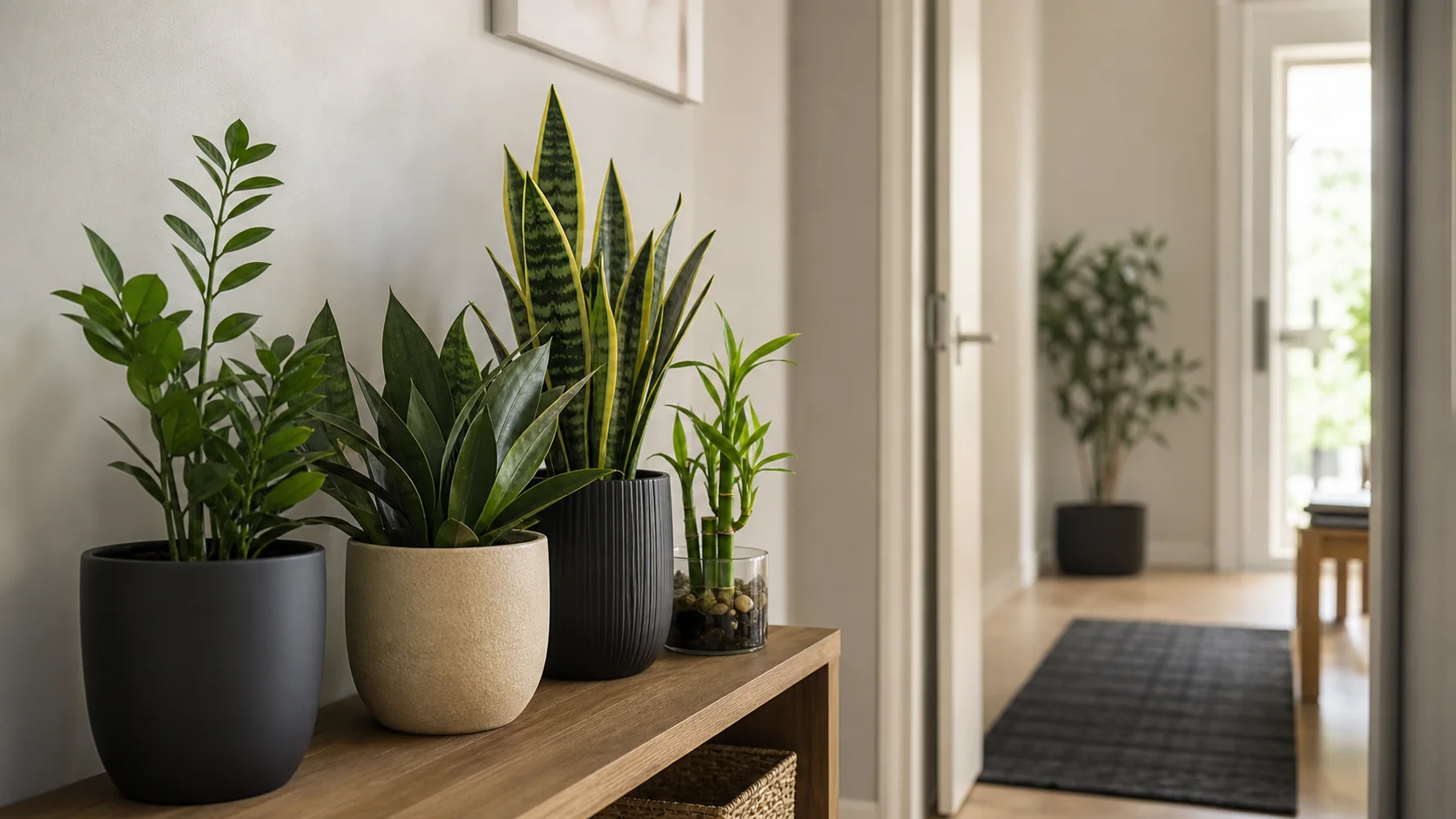
ZZ plant, cast iron plant, snake plant, and lucky bamboo suit a dim hallway when watering slows with their growth.
Care card: pet-safe low-light corner
- Best picks: Cast iron plant, parlor palm, spider plant, bird’s nest fern
- Watering rhythm: Ferns want more consistency, cast iron plant wants more patience
- Watch for: Mixed retailer labels that do not clearly mention toxicity
Low-Light Realism Scorecard
Before the full list, here’s how each plant rates across the dimensions that actually matter for dim-room placement. Tolerance = how well it handles genuinely dim natural light. Looks good = whether it maintains appearance (not just survives) in low light. Watering forgiveness = how badly it reacts to irregular watering.
| Plant | Low-Light Tolerance | Looks Good in Dim Light | Watering Forgiveness | Pet Safe? |
|---|---|---|---|---|
| Pothos | ★★★★★ | ★★★★ | ★★★★★ | No |
| Snake Plant | ★★★★★ | ★★★★★ | ★★★★★ | No |
| ZZ Plant | ★★★★★ | ★★★★★ | ★★★★★ | No |
| Cast Iron Plant | ★★★★★ | ★★★★ | ★★★★★ | Yes |
| Peace Lily | ★★★★ | ★★★★ | ★★★★ | No |
| Chinese Evergreen (dark) | ★★★★ | ★★★★ | ★★★★ | No |
| Heartleaf Philodendron | ★★★★ | ★★★★ | ★★★★ | No |
| Parlor Palm | ★★★★ | ★★★★ | ★★★ | Yes |
| Bird’s Nest Fern | ★★★★ | ★★★ | ★★★ | Yes |
| Dracaena | ★★★★ | ★★★ | ★★★★ | No |
| Spider Plant | ★★★ | ★★★ | ★★★★ | Yes |
| Calathea / Prayer Plant | ★★★ | ★★★★ | ★★★ | Yes |
| Boston Fern | ★★★ | ★★★ | ★★★ | Yes |
| Rubber Plant | ★★★ | ★★★ | ★★★ | No |
| Lucky Bamboo | ★★★ | ★★★ | ★★★★ | No |
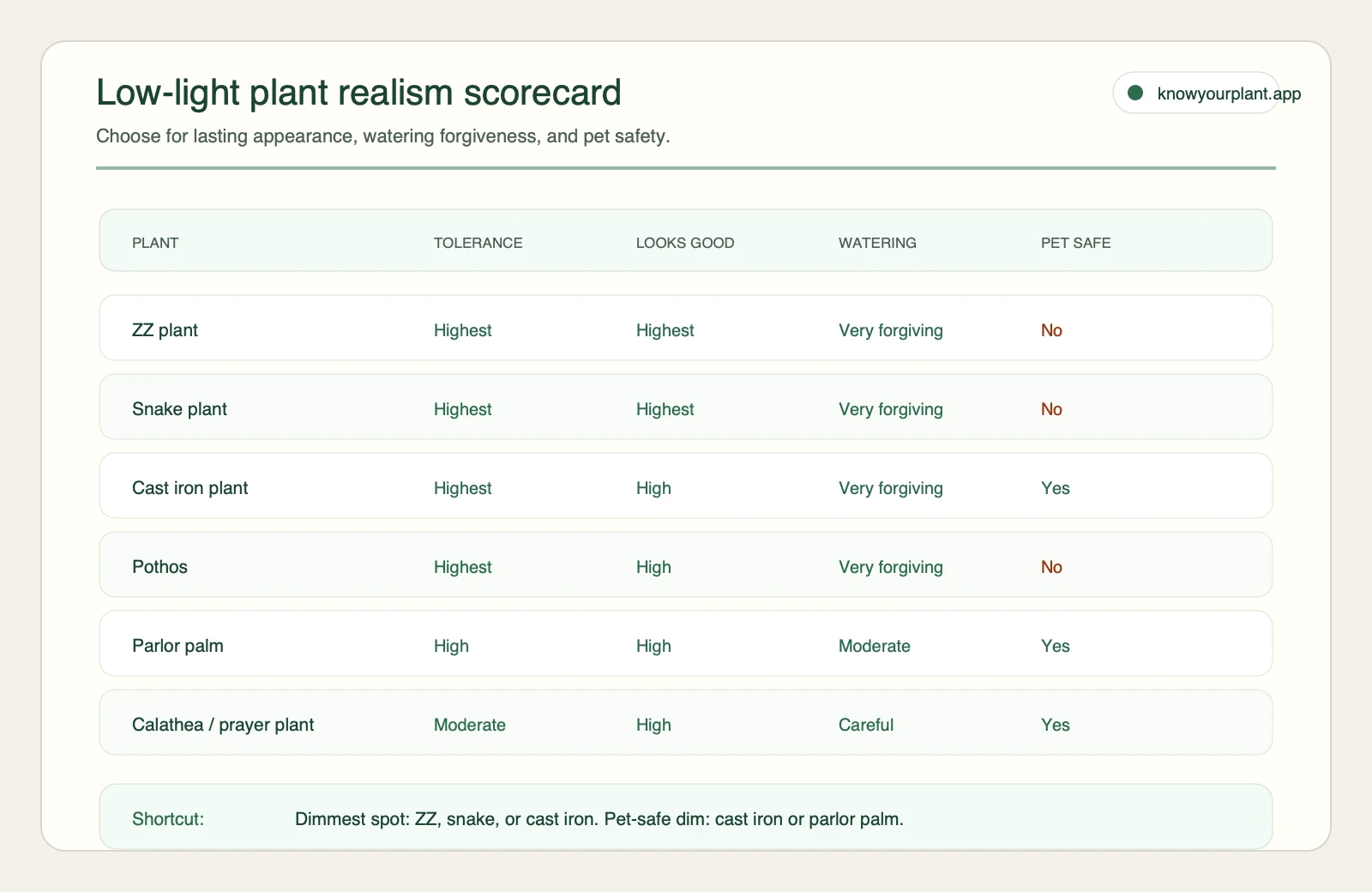
Use the realism scorecard to shortlist plants that still look good in dim rooms, not just plants that survive there.
The 15 Best Indoor Plants for Low Light
1. Pothos (Epipremnum aureum)
Pothos is the closest thing to a reliable, no-drama low-light plant that exists. It tolerates dim conditions better than almost anything else, keeps growing when neglected, and trails beautifully from shelves or hanging baskets. In lower light, leaves will be smaller and the vines less vigorous – that’s expected, and the plant stays healthy.
Let the soil dry out halfway between waterings. In a dim room, that means checking the soil rather than following a schedule; it might be ten days, it might be two weeks. Full care details in our pothos care guide.
Pet safety: Toxic to cats and dogs (ASPCA).
2. Snake Plant (Dracaena trifasciata)
Few plants are as unbothered by low light as the snake plant. It grows slowly in dim rooms – sometimes just one or two new leaves in a season – which is completely normal. Water only when the soil is completely dry all the way through. In low light, that can easily mean once a month or longer in winter.
Snake plants are one of the few houseplants that handle missed waterings without drama. More on this in our snake plant care guide.
Pet safety: Toxic to cats and dogs (ASPCA).
3. ZZ Plant (Zamioculcas zamiifolia)
The ZZ plant stores water in its thick rhizomes, which is how it handles both low light and irregular watering without complaint. Its glossy dark-green leaves actually look richer in lower light – the deep color indicates plenty of chlorophyll, exactly what Penn State Extension describes as ideal for shade conditions.
One of the best picks for dim corners where you genuinely forget to water. If you’re also noticing yellowing leaves on yours, see our ZZ plant yellow leaves guide.
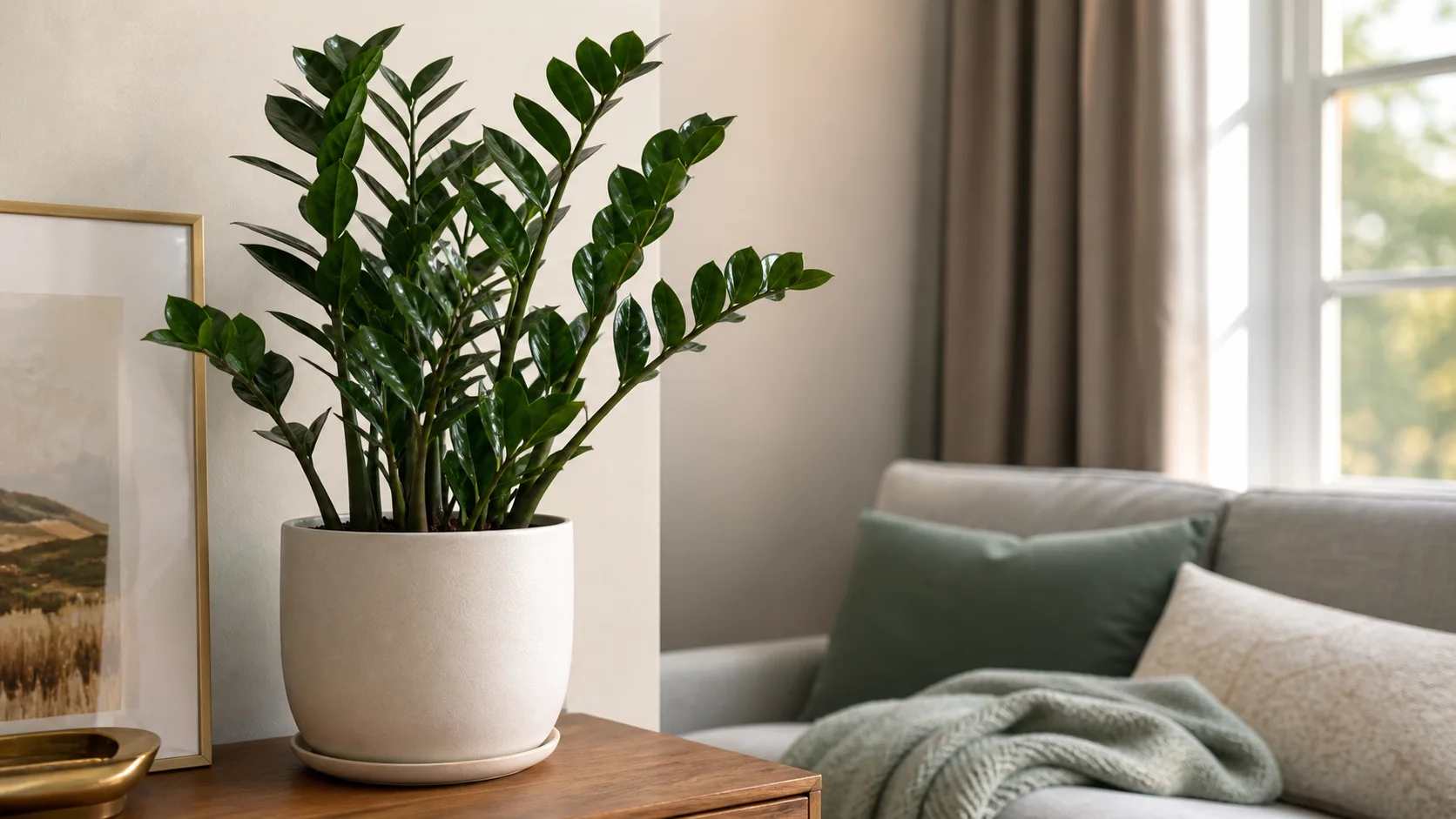
A ZZ plant’s glossy, chlorophyll-rich foliage keeps its form in a dim corner while growth and water use slow.
Pet safety: Toxic if ingested (ASPCA).
4. Cast Iron Plant (Aspidistra elatior)
This plant was built for dark Victorian parlors: minimal light, temperature swings, irregular watering, dry air. It grows slowly and will never be the showstopper of a bright room, but in a genuinely dim corner it holds its deep green form better than almost anything else on this list.
For a spot most other plants would give up on – the back of a north-facing room, a hallway with a single small window – this is the honest answer.
Pet safety: Non-toxic to cats, dogs, and humans (ASPCA). One of the safest picks here.
5. Peace Lily (Spathiphyllum)
Peace lilies are one of the only flowering plants that will bloom in low light. They’ll produce more flowers near a brighter window, but they’ll still bloom in dim conditions – almost nothing else on this list does that. They also droop dramatically when they need water, making them unusually easy to read.
That drooping is not an emergency. Water it and it recovers within a few hours. The care detail that matters most here: peace lilies prefer slightly moist soil, not bone dry between waterings. Find the full guide in our peace lily care guide.
Pet safety: Toxic to cats, dogs, and mildly to humans (ASPCA).
6. Chinese Evergreen (Aglaonema)
Here’s the selection nuance most guides skip: not all Chinese evergreens perform equally in low light. Darker green cultivars do genuinely well in dim rooms. The variegated varieties with pink, red, or cream markings need more light to maintain that color and will fade in dim conditions – sometimes reverting to mostly green, sometimes just looking washed out.
For a truly dim space, choose the darker green varieties. They’re forgiving with watering and handle dry indoor air well. Full breakdown in our Chinese evergreen care guide.
Pet safety: Toxic to cats and dogs (ASPCA).
7. Dracaena (Dracaena marginata, D. fragrans)
Dracaenas adapt well to low light and grow slowly enough that they suit most indoor spaces without constant trimming. The cane forms work well as floor plants in dim corners. In low-light rooms, let the soil dry out fairly thoroughly between waterings – a plant using less energy drinks much less.
More on symptoms and timing in our dracaena care guide.
Pet safety: Toxic to cats and dogs (ASPCA).
8. Heartleaf Philodendron (Philodendron hederaceum)
One of the most reliable trailing plants for low light. The heartleaf philodendron handles dim conditions well, grows steadily without direct sun, and propagates easily if you want to fill a hanging pot. Its main vulnerability is overwatering – in a dim room especially, the soil stays moist much longer than you’d expect, and roots sit in that wet soil without the plant actively processing it.
Water only when the top few centimetres are dry. For more, see our heartleaf philodendron care guide.
Pet safety: Toxic to cats and dogs (ASPCA).
9. Spider Plant (Chlorophytum comosum)
Spider plants are adaptable and easygoing in dim light. In lower-light rooms they produce fewer of their signature offshoots (the “spiderettes”), but the main plant stays healthy and keeps its arching form. One of the more pet-friendly picks on this list, which matters if you’re filtering for a cat- or dog-safe household.
More detail in our spider plant care guide.
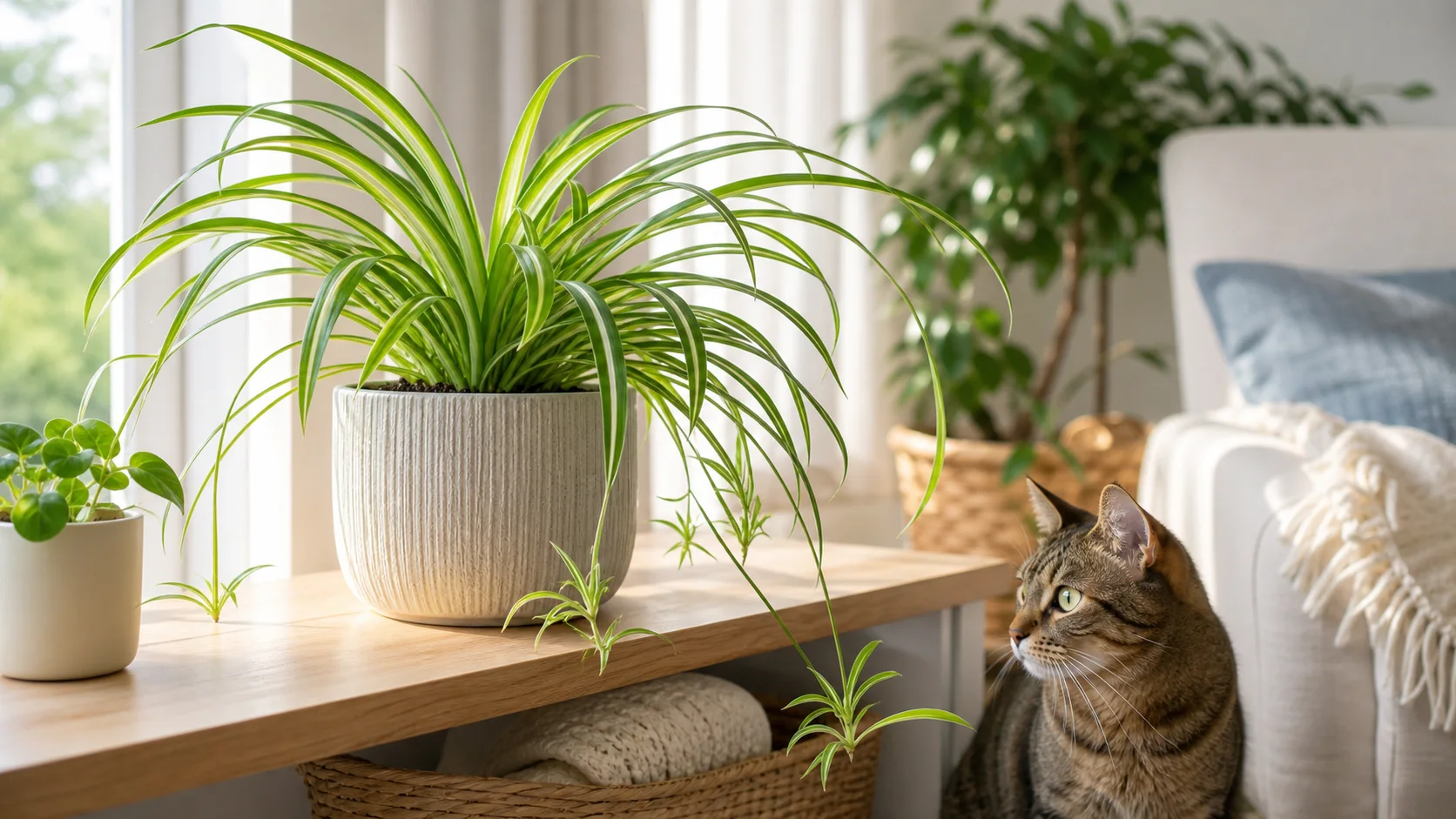
A healthy spider plant keeps its arching form with fewer runners in lower light and is a pet-friendly choice for cat households.
Pet safety: Non-toxic to cats and dogs (ASPCA).
10. Boston Fern (Nephrolepis exaltata)
Boston ferns prefer indirect light and higher humidity, which makes them a reasonable pick for dim bathrooms or kitchens where moisture is naturally present. They need more consistent care than the others here – humidity and soil moisture both matter – but they reward that attention with dense, lush growth.
In a dry room with inconsistent watering, they struggle. In a humid low-light space, they’re among the best on this list. Full care details in our Boston fern care guide.
Pet safety: Non-toxic to cats and dogs (ASPCA).
11. Bird’s Nest Fern (Asplenium nidus)
A lower-maintenance fern option than Boston ferns for most dim rooms. The broad, wavy fronds handle lower light without drying out as quickly, and the plant has a cleaner, more architectural form. Keep the soil lightly moist and avoid getting water into the central rosette, which can rot.
Pet safety: Non-toxic to cats and dogs (ASPCA).
12. Parlor Palm (Chamaedorea elegans)
Most palms need sun, but the parlor palm is a genuine exception. It evolved on the forest floor in Central America, meaning low-light conditions are its natural environment – not just a survival mode. It grows slowly and gracefully, and suits corners where you want some height without aggressive spread.
Pet safety: Non-toxic to cats and dogs (ASPCA).
13. Calathea / Prayer Plant (Calathea, Maranta)
Calatheas and prayer plants grow naturally under dense forest canopy, so lower light actually suits them. What they ask for in return is consistent humidity and careful watering – they dislike both bone-dry soil and waterlogged roots. Their dramatic leaf patterns hold up well in dim rooms, and several varieties do the nightly leaf-folding movement that makes them genuinely interesting to live with.
If you already have a calathea, our calathea care guide covers the watering nuances in detail.
Pet safety: Non-toxic to cats and dogs (ASPCA).
14. Rubber Plant (Ficus elastica)
Rubber plants prefer bright indirect light but adapt to lower-light conditions reasonably well. Growth slows significantly in dim rooms, and the leaves may become a deeper, more uniform green as burgundy tones fade in darker-leaf varieties. Water less frequently than you would in a brighter spot – in low light, a rubber plant can easily go two to three weeks between waterings.
More care detail in our rubber plant care guide.
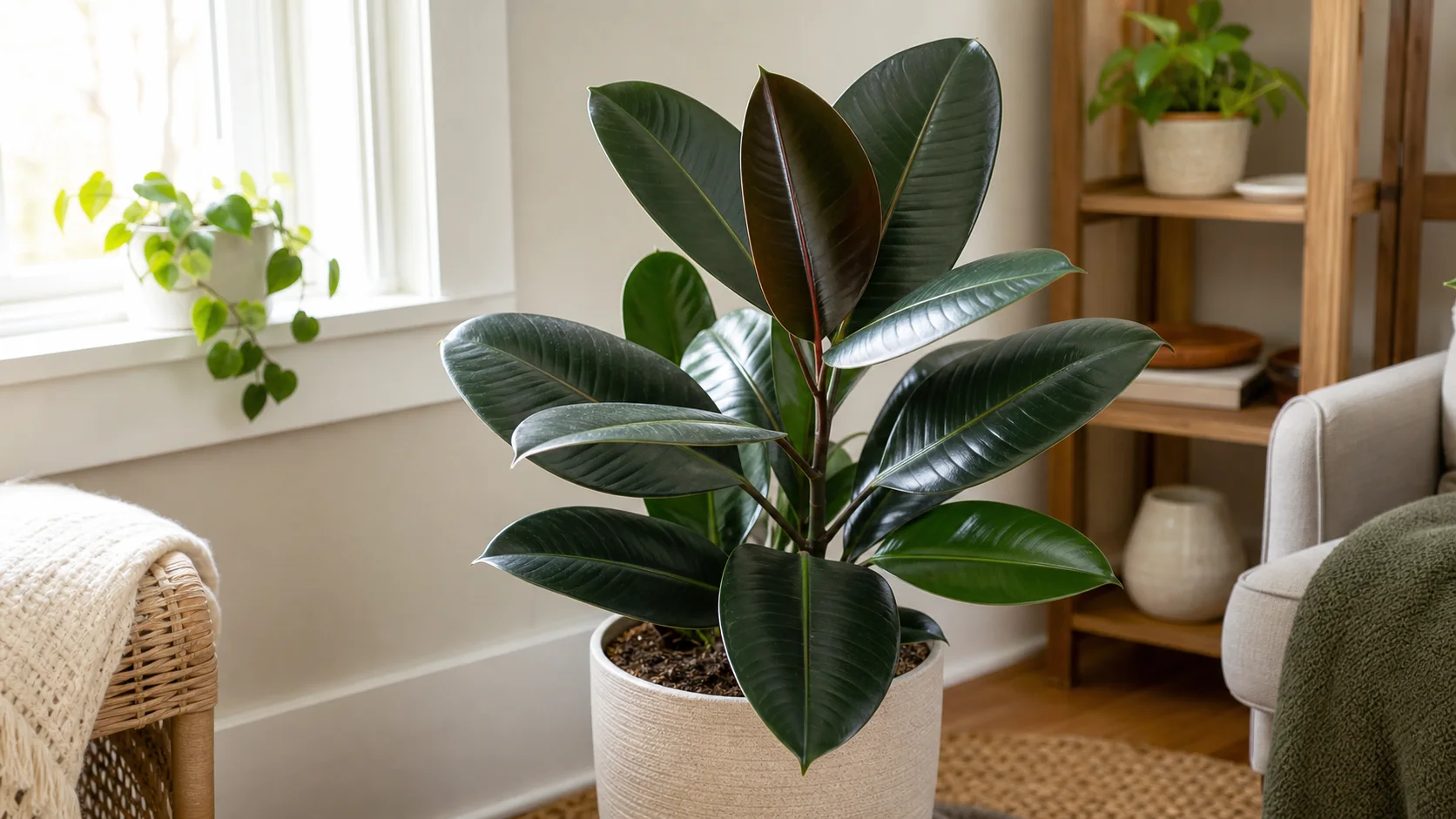
A lower-light rubber plant develops predominantly deep-green foliage and needs longer drying intervals between waterings.
Pet safety: Toxic to cats and dogs (ASPCA).
15. Lucky Bamboo (Dracaena sanderiana)
Typically grown in water rather than soil, lucky bamboo handles low light well and adds interesting texture to a desk or shelf. It needs indirect light and fresh water every couple of weeks – drain and refill rather than just topping up to prevent algae. Despite the name, it is not a true bamboo.
Pet safety: Toxic to cats and dogs (ASPCA). Often labelled harmless, but the ASPCA classifies it as toxic – keep it out of reach.
Six More Options by Growth Habit
The 15 plants above are the strongest all-around shortlist. These six alternatives from our former expanded list are useful when growth habit, shelf size, or foliage is the deciding factor. They tolerate lower light, but several keep better color and shape nearer a brighter indirect-light source. If your priority is a floor-sized specimen, compare the dedicated large low-light indoor plants guide before buying.
| Plant | Best fit | Low-light tradeoff | Water check | Pet note |
|---|---|---|---|---|
| Satin pothos | Silver trailing foliage for a shelf | Vines may stretch and silver markings can fade | Let the top 2 inches dry | Toxic if chewed |
| Green Tradescantia | Fast trailing growth and easy propagation | Purple or heavily variegated forms need more light for color | Water when the top inch dries | Sap can irritate pets |
| Nerve plant | Compact plant for a humid shelf or terrarium | Wilts quickly if the mix dries completely | Keep lightly moist, not soggy | Non-toxic per ASPCA |
| Monstera deliciosa | A larger floor plant where slow growth is acceptable | New leaves may stay small and lack splits | Let the top 2 inches dry | Toxic if chewed |
| Dieffenbachia | Broad foliage for medium-to-low indirect light | Variegation fades and stems may lean in deep shade | Let the top 1 to 2 inches dry | Toxic; keep away from pets and children |
| Peperomia | Compact, slow-growing plant for a dim shelf | Growth slows and colorful forms may fade | Let the mix become mostly dry | Many common species are non-toxic; verify the plant label |
Common Problems in Low-Light Rooms
| If you notice… | Most likely cause | What to do next |
|---|---|---|
| Yellow leaves and soil that stays wet for days | Overwatering in dim conditions | Pause watering, improve drainage, and check for root rot |
| Long gaps between leaves, stretched stems, washed-out color | Not enough usable light | Move the plant closer to the window or add a grow light |
| Brown crispy fern edges | Air is too dry or watering is inconsistent | Raise humidity and stop letting the root ball dry out fully |
| Variegation fading back to green | The plant is protecting itself in low light | Move it brighter, or switch to a solid-green variety for that spot |
| No growth for months in a windowless office | The plant is surviving, not thriving | Reduce expectations and add a timer-based grow light if you want real growth |
The One Care Rule That Changes in Low Light
No matter which plant you choose, one thing must shift when you move to a dim room: your watering habits.
Plants in low light grow more slowly, photosynthesize less, and drink far less water than the same plants in a bright spot. University of Maryland Extension notes that more houseplants are lost to overwatering than underwatering – and that risk multiplies in dim rooms, where the soil stays moist much longer and roots sit in wet conditions without the plant actively processing that moisture.
The fix is simple but requires breaking the “once a week” habit: check the soil before you water, every time. Push a finger an inch or two into the soil. Moist? Wait. Dry? Water thoroughly and let the pot drain completely. Never let a low-light plant sit in standing water – root rot in a dim room is slow, silent, and often fatal before you notice it. Our root rot treatment guide covers what to do if you catch it early.
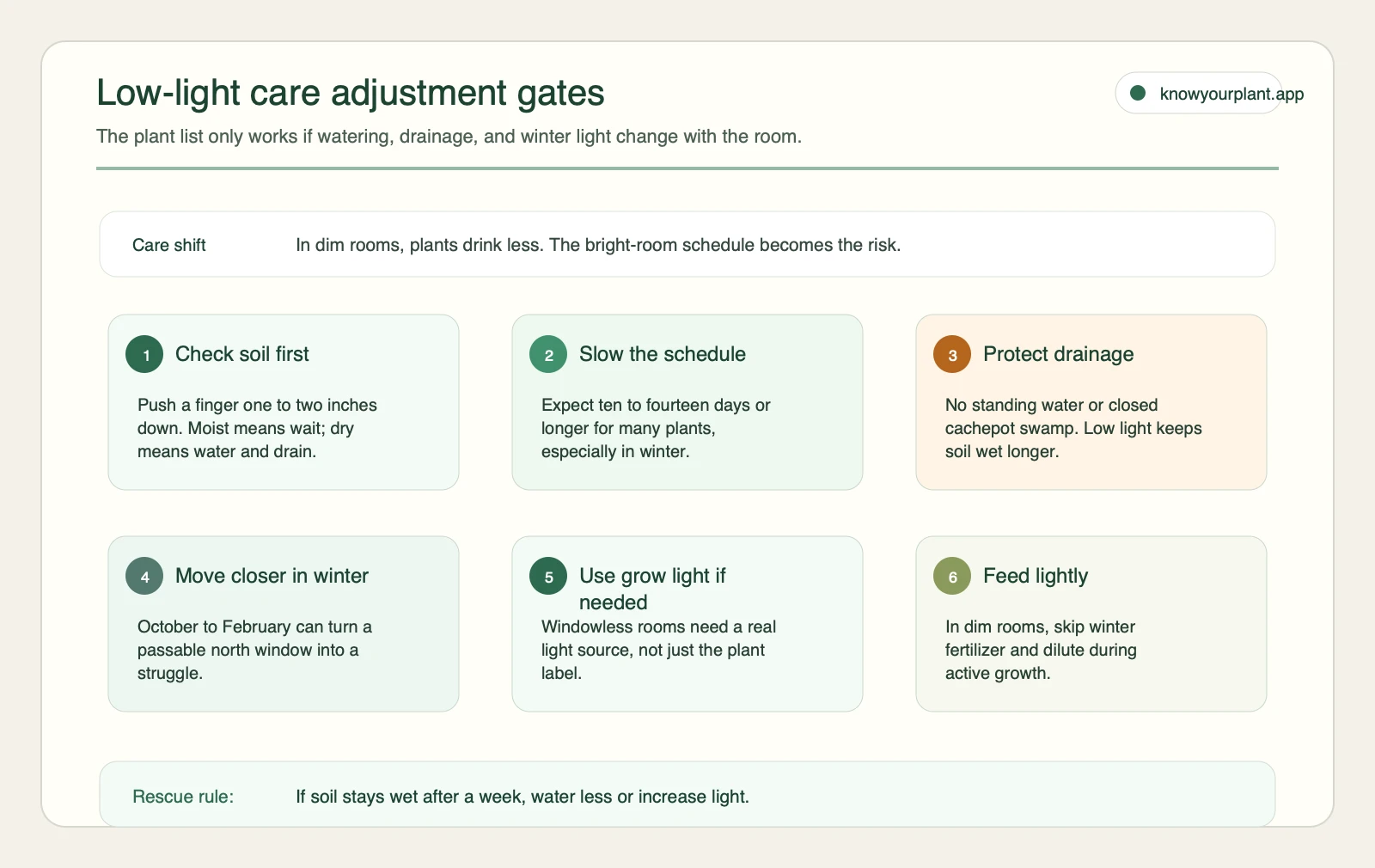
Use the care adjustment gates when a low-light plant keeps declining even though it is on the right shortlist.
Pet Households: The Short List
If you’re choosing plants for a home with cats or dogs, the safety filter matters before anything else. From this list, the genuinely non-toxic options per ASPCA are:
- Cast iron plant
- Spider plant
- Boston fern
- Bird’s nest fern
- Parlor palm
- Calathea and prayer plant
Everything else on this list is toxic to cats and/or dogs to some degree. Always cross-check with the ASPCA poison control database before bringing any new plant home – even plants commonly described as safe can cause mild gastrointestinal upset in sensitive animals. For a fuller guide, see our cat-safe indoor plants guide.
Common Mistakes in Low-Light Rooms
Even forgiving plants can struggle when the setup works against them. These are the patterns that come up most often in dim-room plant failures:
Watering on the same schedule as a bright-room plant. Low-light plants use water much more slowly. A pothos that needs water every five days near a sunny window might need water every ten to fourteen days in a dim corner. The schedule does not transfer.
Choosing variegated plants for the darkest spots. Variegated leaves have less chlorophyll than solid green leaves. In low light, they struggle to capture enough energy and often revert to plain green – or just become leggy and weak. Save the variegated varieties for your brightest indirect-light spots.
Ignoring drainage. In a dim room, a pot without drainage holes is a root-rot setup. Poor drainage is a problem everywhere, but in low-light conditions where the soil already dries slowly, standing water at the bottom of a pot is especially dangerous.
Expecting the same growth rate as a bright-room plant. A snake plant in low light might put out one or two new leaves a season. That is not a sign of a problem – it is a plant working with the light it has. If you want fast, dramatic growth, low light is not the environment for it.
Assuming “low light plant” means windowless room. All 15 plants on this list do best in rooms with at least some natural light, even if it is filtered or indirect. In a genuinely windowless room, even the most shade-tolerant plants will eventually decline without supplemental lighting.
Seasonal Low-Light Checklist
A dim room does not provide the same light all year. Use the plant’s drying speed and new growth as the trigger for care changes instead of following fixed calendar dates.
| Season | What changes | Practical adjustment |
|---|---|---|
| Spring | Days lengthen and active growth may resume | Recheck the plant’s position, begin feeding only after new growth appears, and repot only if roots have genuinely filled the pot |
| Summer | Brighter, longer days can reach farther into the room | Protect shade plants from sudden direct sun near south- or west-facing glass; water based on faster drying, not a preset interval |
| Autumn | Shorter days slow growth and soil drying | Increase the time between waterings and stop routine feeding as growth pauses |
| Winter | Window light is weakest and indoor heating dries leaf edges | Move the plant closer to usable indirect light or add a timer-based grow light; keep checking the root zone because cool soil can still stay wet for longer |
When to Add a Grow Light
If your room has no window at all, or the window is so small and obstructed that it barely registers, you have two options: a grow light or a very short list of extremely shade-tolerant species. ZZ plant, cast iron plant, and lucky bamboo are your best bets even in those conditions, but they will still grow more slowly than usual.
A grow light does not have to be complex or expensive. A simple LED panel set on a timer for 12 to 14 hours a day makes a real difference for plants in windowless spaces. See our grow lights for indoor plants guide for what to look for without overcomplicating it.
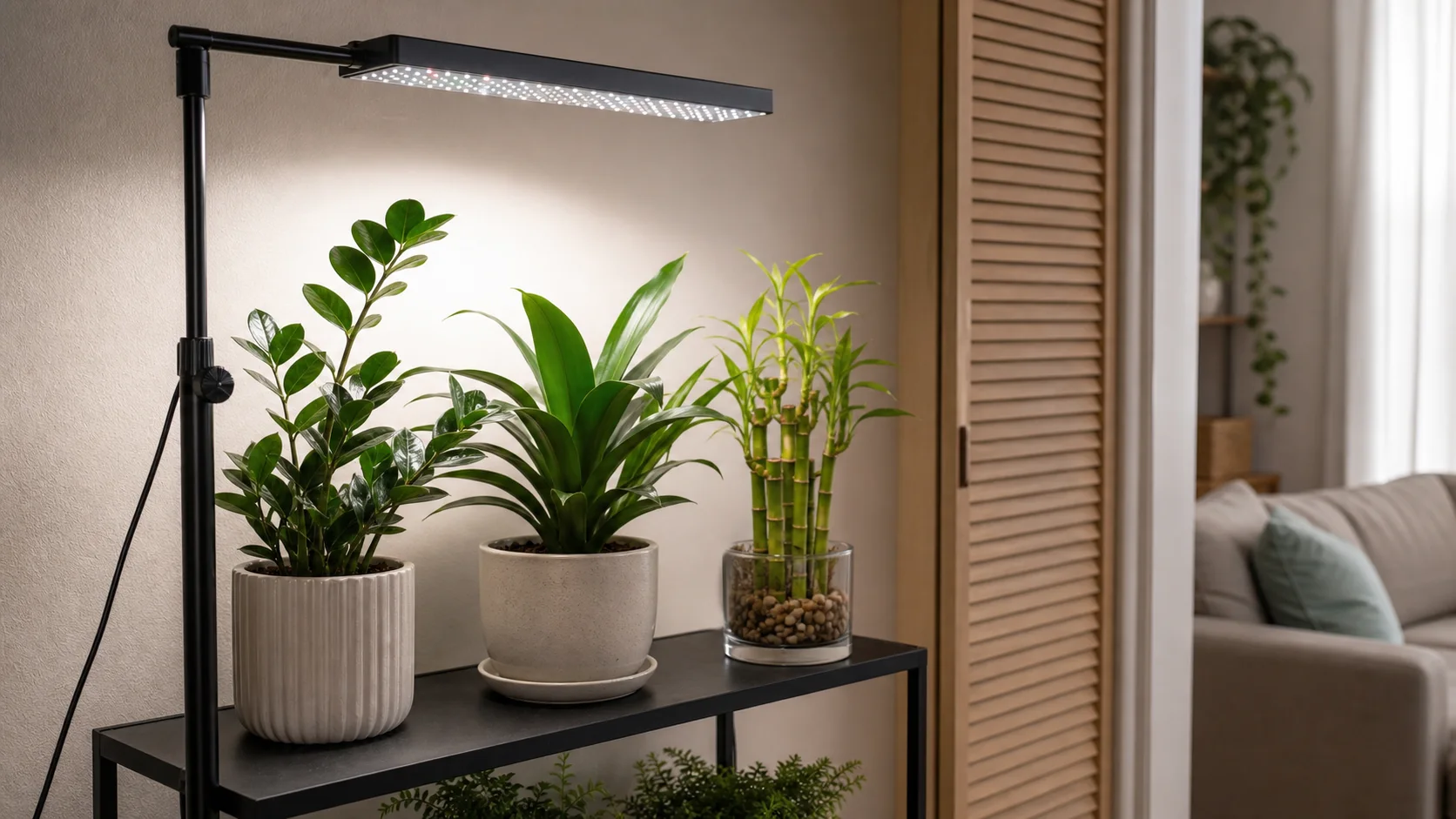
A simple LED panel gives ZZ plant, cast iron plant, and lucky bamboo usable light in a dark interior nook.
If you are troubleshooting another common plant symptom, see Majesty Palm Care Indoors: Light, Water, and Brown Tips for a focused diagnosis and recovery plan.
Real User FAQ
What is considered low light for houseplants?
Low light means a room where natural light is present but dim – typically away from windows, or near a window that faces north or is heavily shaded. A practical test: if you can comfortably read a book near the window without a lamp, but the room still feels noticeably dim, that is low light. It is not the same as no light.
Can plants survive in a room with no windows?
Most houseplants cannot thrive indefinitely in a truly windowless room without supplemental lighting. ZZ plants and cast iron plants are among the most tolerant of very low light, but even they will eventually slow growth to near-zero and may decline. A grow light on a timer is the most practical solution for genuinely windowless spaces.
Which low-light plants are safe for cats and dogs?
From this list: cast iron plant, spider plant, Boston fern, bird’s nest fern, parlor palm, and calathea or prayer plant are non-toxic per ASPCA. Always verify against the ASPCA poison control database, since individual animal sensitivity varies and even non-toxic plants can sometimes cause mild stomach upset.
Why is my low-light plant losing leaves or looking thin?
The most common causes in low-light setups are overwatering (soil stays wet too long and roots rot) and insufficient light (even for low-light species, there is a floor below which growth collapses). Check the soil first. If it is still wet a week after watering, you are watering too often. If growth has stalled completely and the plant looks leggy, consider moving it closer to a window or adding a grow light.
Do low-light plants need fertilizer?
In dim rooms, plants grow slowly and have limited ability to process nutrients. Fertilizing at the same rate as a bright-room plant can cause fertilizer salt buildup in the soil. During the growing season – spring and summer – a diluted, balanced fertilizer once every six to eight weeks is usually sufficient. Skip fertilizing entirely in winter when growth slows to almost nothing.
Why do variegated plants lose their color in low light?
Variegated leaves have reduced chlorophyll compared to solid-green leaves. In low light, a variegated plant cannot capture enough energy through its lighter sections and often responds by producing more solid-green leaves or by growing slowly and looking washed out. For the darkest spots, solid dark-green varieties always outperform variegated ones.
How often should I water plants in low-light rooms?
There is no single answer – it depends on pot size, soil type, temperature, and humidity. The reliable method is to check the soil before every watering by pressing a finger an inch into the soil. Moist? Wait. Dry? Water thoroughly and let the pot drain. University of Maryland Extension specifically advises against watering on a fixed schedule, since plant needs vary constantly with environmental conditions.
What is the best low-light plant for a pet-safe home?
The parlor palm is a strong pick. It is non-toxic to cats and dogs, genuinely adapted to low-light conditions rather than just tolerant of them, and has an attractive form that holds up well in dim rooms. Cast iron plant is the best choice for truly dim spots where you want something nearly indestructible. Spider plant works well in hanging pots where pets cannot easily reach the offshoots.
Methodology Note
We compared current low-light plant roundups with extension guidance and used recurring forum questions as qualitative language only, mainly around windowless rooms, pet safety, and overwatering confusion. Care claims in this guide were checked against Penn State Extension, University of Minnesota Extension, University of Maryland Extension, and the ASPCA database before being added here.
Freshness Note
The horticultural source review was completed in July 2026; query alignment, the minimal-light answer, and internal navigation were updated in September 2026. Recheck toxicity listings and cultivar-specific light needs when buying, because common names like snake plant, Chinese evergreen, and prayer plant often cover multiple forms with different tolerance for dim rooms.
Care guidance in this article is informed by Penn State Extension (low-light plant selection), University of Minnesota Extension (lighting for indoor plants), University of Maryland Extension (watering indoor plants), and the ASPCA Poison Control toxic plants database.
Download KnowYourPlant for personalized plant care reminders – set seasonal watering schedules, get care adjustments as light changes, and track what each plant needs without guessing. Available on iOS.