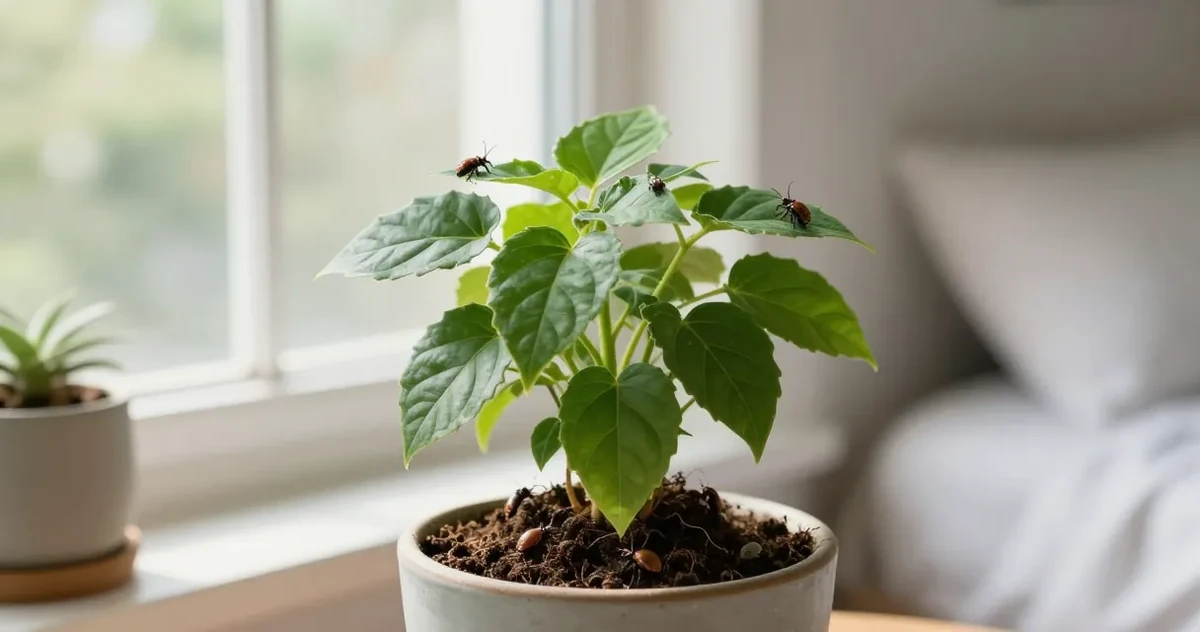
You pull back the leaves, glance at the soil, and see something moving. Something tiny. Something that was definitely not there last week.
Before you do anything, take a breath. Most tiny bugs in houseplant soil are either harmless or very fixable once you know what you are actually dealing with. The problem is that most people skip the identification step and reach for whatever spray or drench they have on hand. And the wrong treatment either does nothing, or stresses the plant while the real problem continues underground.
The adults or crawlers you see on the surface are often the last symptom of something already established in the root zone. Thirty seconds of observation before you treat will save you a lot of back-and-forth. Four common bugs. Four different situations. One soil.
By KnowYourPlant editorial research worker. Last updated June 17, 2026.
Identification Snapshot
Use this quick check before you reach for a spray or soil drench:
| If you see this | Most likely bug | What it usually means | First check |
|---|---|---|---|
| Tiny dark flies lifting slowly from the pot | Fungus gnats | Topsoil is staying damp long enough for larvae to develop | Let the top layer dry and watch whether adults thin out |
| Tiny insects that scatter or jump when you disturb the soil | Springtails | Moisture and decaying material are building up near the surface | Disturb the soil once and watch for the jump response |
| Tiny pale crawlers moving slowly on the soil or pot wall | Soil mites | Decomposer activity is high, usually because the mix is staying wet | Check drainage before treating |
| White cottony residue on roots or the inside of the pot | Root mealybugs | A true root-zone pest may be feeding below the surface | Unpot and inspect roots directly |
The point of the snapshot is not perfect taxonomy. It is to stop you from using the same treatment on four different problems.
If the insects are on stems or leaves rather than in the pot, continue with the houseplant pests guide instead of applying a soil treatment by default.
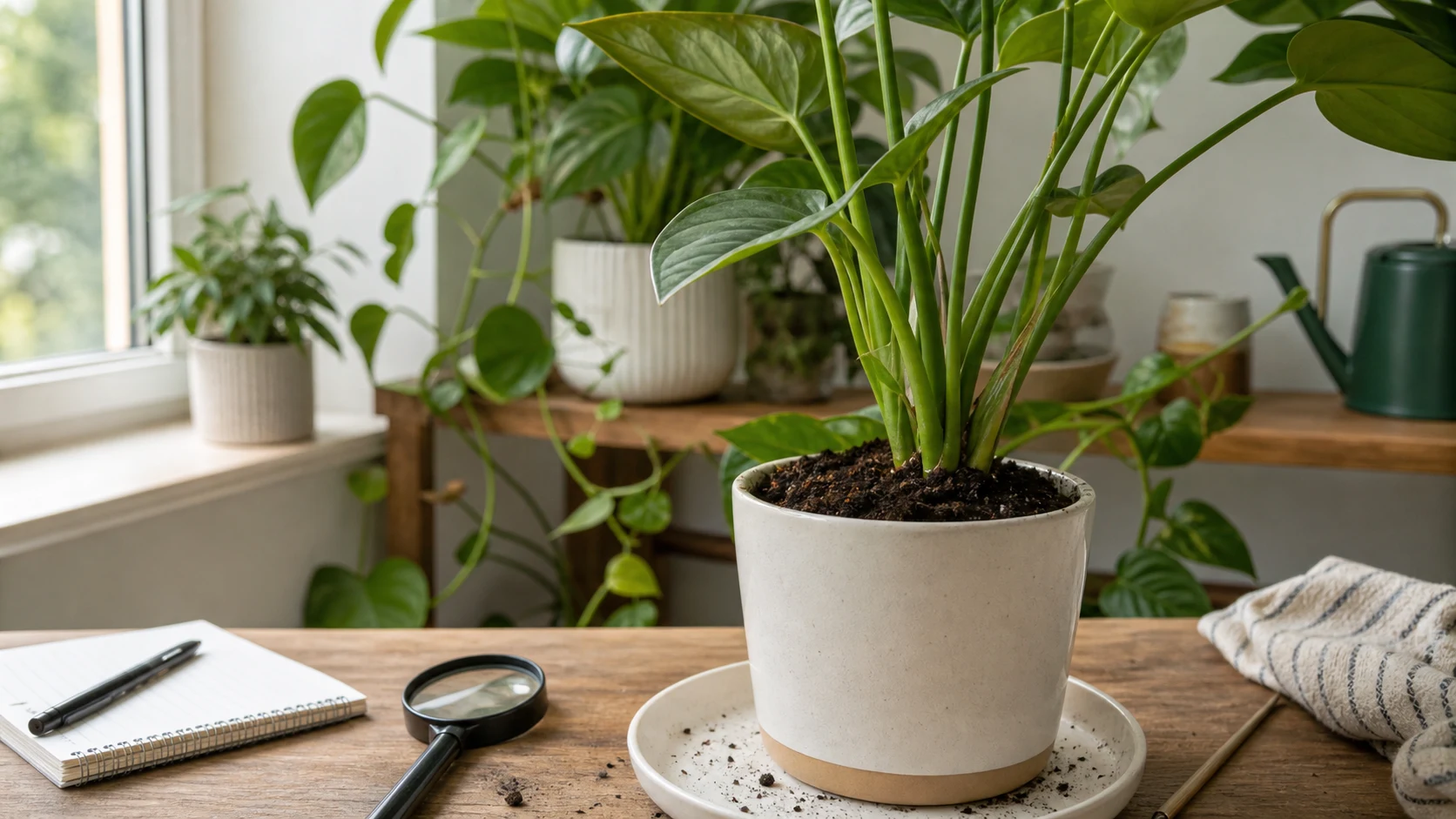
A loupe and a close look at the soil surface help separate a moisture signal from a pest that needs treatment.
What Most Pest Guides Miss
Most articles on small bugs in plant soil go straight to remedies: sticky traps, hydrogen peroxide drench, neem oil drench. The advice is not wrong, but it skips the step that determines whether any of it will actually work.
The common misdiagnosis: treating springtails like fungus gnats.
Springtails and fungus gnat adults look nearly identical on the soil surface – tiny, dark, moving fast. But springtails are not harmful. They feed on fungi and decaying matter in the soil, which means a springtail outbreak is almost always a moisture signal, not a pest crisis. If you hit a springtail colony with a pesticide drench, you have stressed your plant’s root zone for no reason at all.
The practical first check: watch what the tiny bugs do when you disturb the soil. Springtails jump – a sudden scatter in all directions when you poke the surface. Fungus gnat adults fly up slowly, hovering near the pot. That single behavior tells you which direction to go before you touch anything else.
The Four Most Common Soil Bugs
Fungus Gnats
Fungus gnats are the most frequent complaint. The adults are small, dark, slow-flying insects that hover near the soil surface or drift around the base of the pot. They look a little like miniature mosquitoes – long-legged and delicate. As adults they are mostly a nuisance. The real damage comes from their larvae, which live in the top few centimetres of soil and feed on root hairs and organic matter.
According to UW-Madison Extension, fungus gnat larvae can cause significant root damage in high populations, and seedlings and cuttings are far more vulnerable than established plants. A healthy mature pothos or snake plant can handle moderate larval pressure. A newly propagated cutting sitting in moist mix? That is a different situation, and worth treating more urgently.
The confirming sign: let the soil dry more than you normally would between waterings. If the flying adults thin out after a week of drier conditions, fungus gnats were almost certainly the culprit. They need consistently moist soil to complete their life cycle, and removing that moisture breaks the cycle without any treatment at all.
Springtails
Springtails are tiny, pale to dark gray, and scatter in fast bursts when disturbed. That jumping movement is their defining feature and the clearest way to tell them apart from fungus gnats. Unlike fungus gnats, they do not fly. They prefer moist organic matter and, according to Texas A&M AgriLife Extension, are generally harmless nuisances that feed on fungi, algae, bacteria, and decaying vegetation. Finding a springtail colony is more useful as a diagnostic than a call to action: your soil is staying too wet for too long.
Texas A&M notes that some springtail species can occasionally affect tender young plants or greenhouse seedlings, but for most established houseplants they are incidental. The fix is drainage and watering discipline, not pesticide.
Soil Mites
Soil mites are smaller than the others – almost too small to see clearly without a loupe – and they move in slow deliberate clusters. Usually white or pale brown. Most soil mite species are decomposers and pose no meaningful threat to a healthy houseplant. Occasionally a very dense population can stress tender root growth, but for the typical indoor plant they are not worth treating aggressively. Our full soil mites in houseplants guide explains when they are harmless and when damp soil conditions deserve a closer look.
If you are seeing fine pale specks moving slowly on the soil surface or along the interior of the pot wall, soil mites are a reasonable candidate. They do not fly, do not jump, and do not respond to fungus gnat treatments.
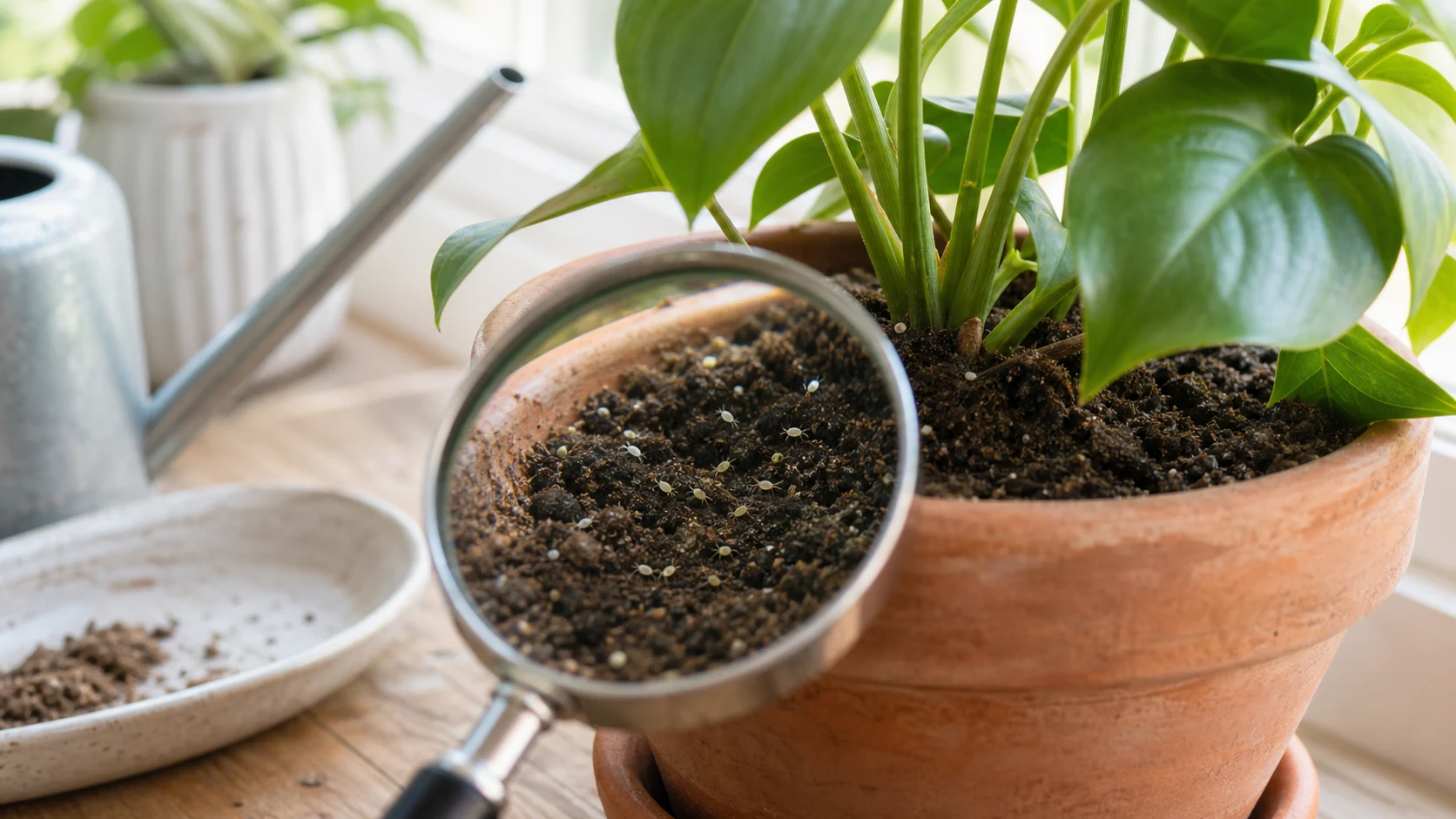
A loupe reveals the pale, slow-moving specks that distinguish soil mites from insects that fly or jump.
Root Mealybugs
Root mealybugs are the one on this list you most want to catch early. They live primarily underground, coating roots in a waxy white material that looks like dried cotton or small clusters of white fuzz. UC IPM notes that some mealybug species feed almost exclusively on roots, with ground mealybugs particularly damaging on potted plants – including common houseplants like African violets and other tropicals.
Surface adults are rarely the main sign. You typically discover root mealybugs when you unpot a plant and find white waxy clusters along the roots or the interior of the pot at soil level. If you have been watching slow unexplained decline, wilting that does not respond to water, or yellowing that does not match any obvious care issue – and nothing on the soil surface has made a difference – a root inspection is worth the disruption.
How to Tell Them Apart at a Glance
Before treating anything, spend thirty seconds observing. Here is what to look for:
| What you see | Behavior when disturbed | Most likely bug |
|---|---|---|
| Tiny dark insects near soil | Fly up slowly, hover | Fungus gnats |
| Tiny dark insects on soil | Jump in all directions | Springtails |
| Tiny pale specks on soil or pot wall | Move slowly, no flying or jumping | Soil mites |
| White waxy fuzz on roots or soil | Visible only when you unpot | Root mealybugs |
If the insect is slightly larger, moves on leaves or stems as well as the soil, or you find sticky residue on the leaves, you may be looking at something else entirely – such as aphids, spider mites, or a mealybug infestation that has spread beyond the roots.
Not sure what you are looking at? The KnowYourPlant app can help you identify the issue from a photo and suggest a calm next step before the problem spreads.
Lookalikes and Confused-With
A lot of treatment mistakes start because the bug on the trap or soil surface is not the bug the owner thinks it is.
| Often confused pair | Fast way to tell them apart | Why the distinction matters |
|---|---|---|
| Fungus gnats vs thrips | Fungus gnats hover near soil. Thrips spend more time on leaves and flowers and often leave silvery or scarred foliage. | Trap-only treatment helps fungus gnats, not a leaf-feeding thrips problem. |
| Fungus gnats vs shore flies | Fungus gnats look more mosquito-like and delicate. Shore flies are stockier and more fly-like. | Both show up around wet media, but larval risk and treatment logic differ. |
| Springtails vs soil mites | Springtails jump. Soil mites crawl slowly. | Springtails are usually a moisture signal, while soil mites are often harmless decomposers. |
| Root mealybugs vs harmless white residue | Root mealybugs look cottony and collect on roots or pot walls. Mineral residue forms crusts, not living clusters. | Washing salts does not solve a hidden root pest, and repotting for salts is different from treating an infestation. |
The most repeated confusion in gardener forums is trap-based ID. A tiny dark insect on a sticky card is not enough on its own. Check where it spends time, how it moves, and whether the roots show any white cottony residue before you commit to a treatment plan.
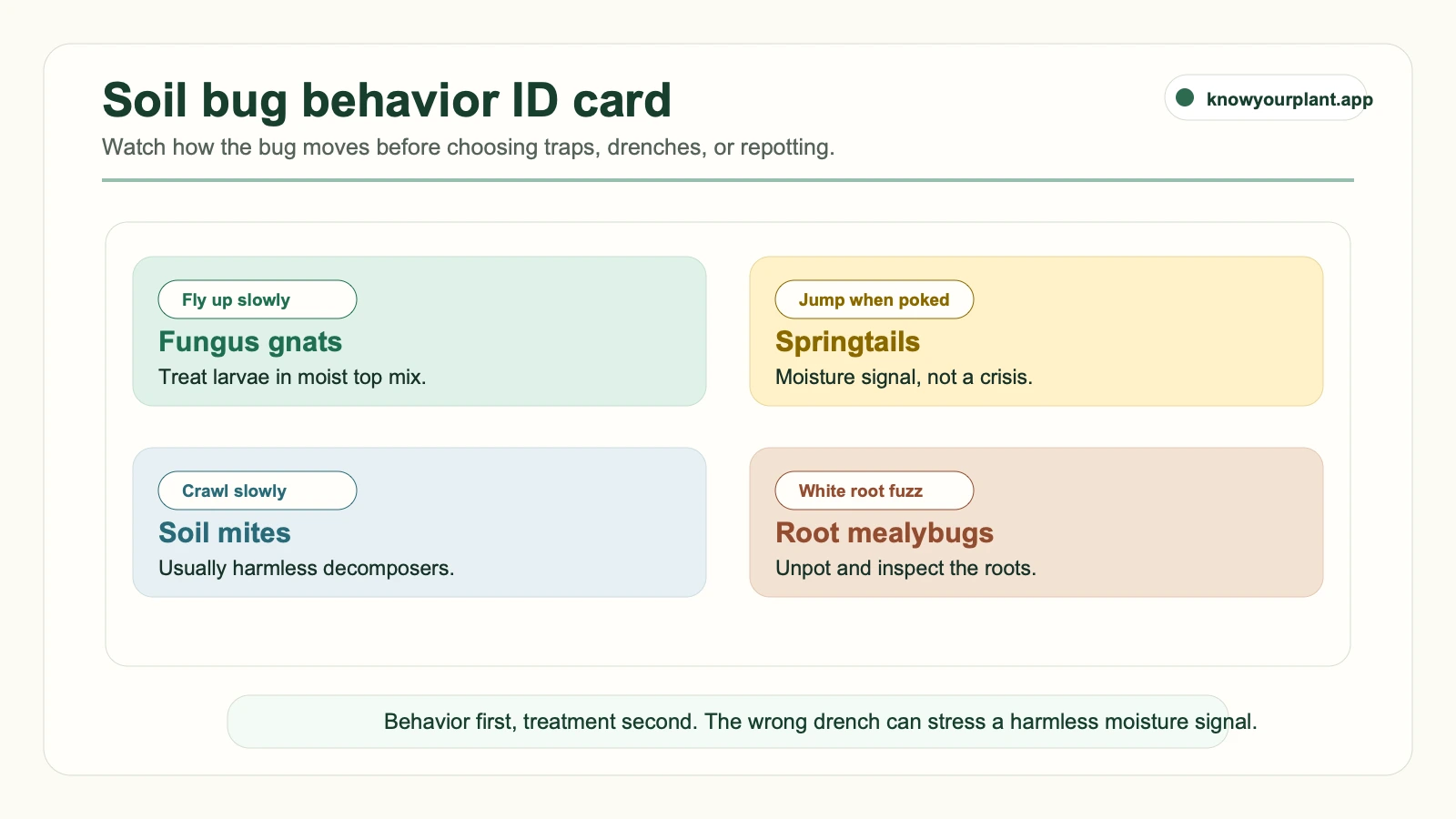
The fastest first split is behavior: flying, jumping, slow crawling, or white fuzz on roots points to a different next step.
The Moisture Connection
Almost all common soil bug problems share one root cause: too much consistent moisture in the top layer of soil.
Fungus gnats cannot complete their life cycle without wet conditions. Springtails congregate wherever it is persistently damp. Soil mites thrive in the organic matter that decomposes faster in wet soil. Even root mealybugs prefer root zones that never fully dry out between waterings.
Before changing anything about your treatment plan, look honestly at your watering habits and drainage first:
- Is the pot sitting in a saucer that holds water between sessions?
- Is the top two inches of soil still wet three or four days after watering?
- Does the pot have drainage holes, and are they actually clear?
A soil that dries more consistently between waterings is the most effective long-term prevention for almost everything on this list. Traps and drenches address what is already present. Moisture management prevents the next cycle from starting.
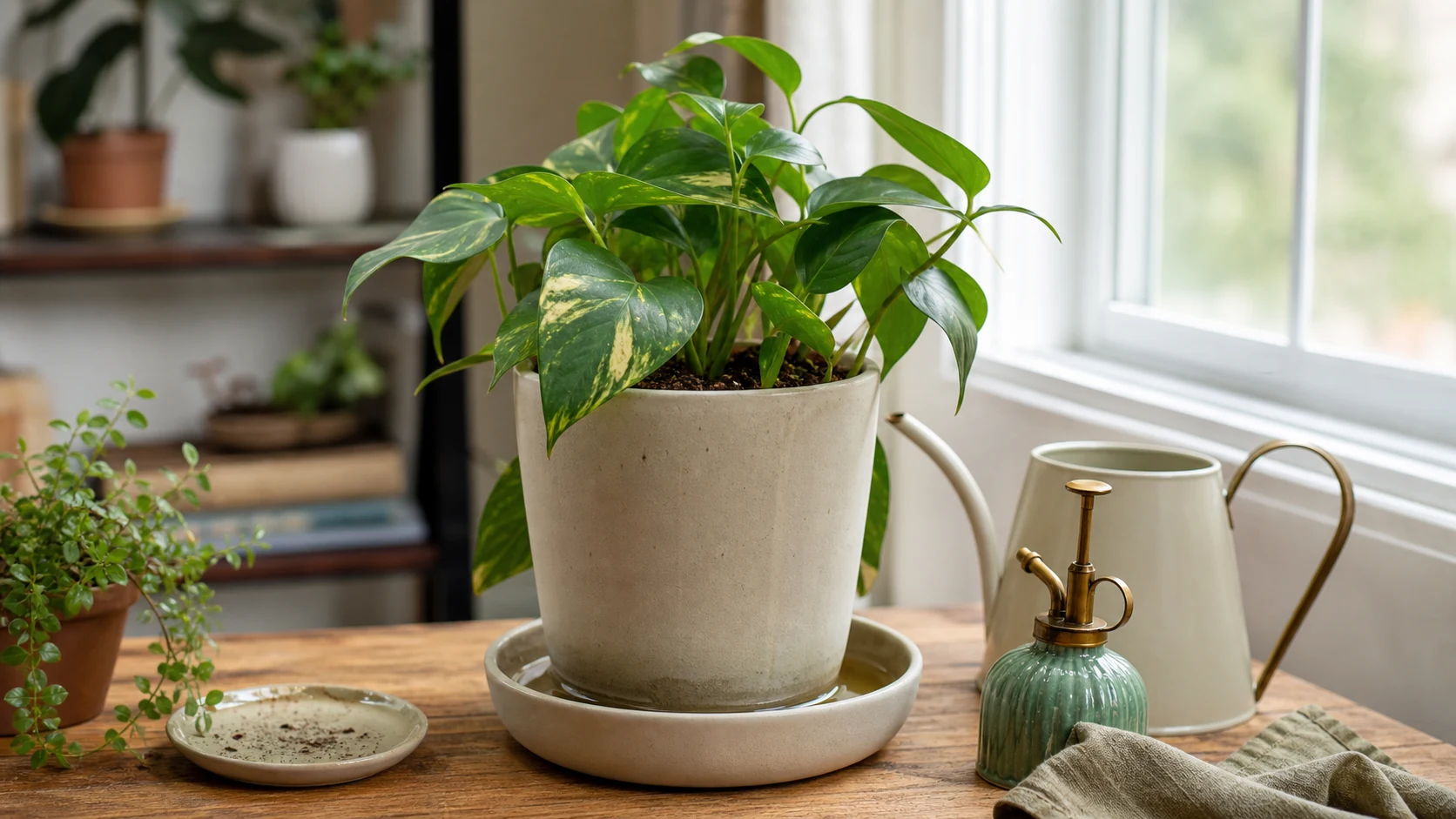
Standing water in a saucer keeps the root zone damp long after watering and creates ideal conditions for soil bugs.
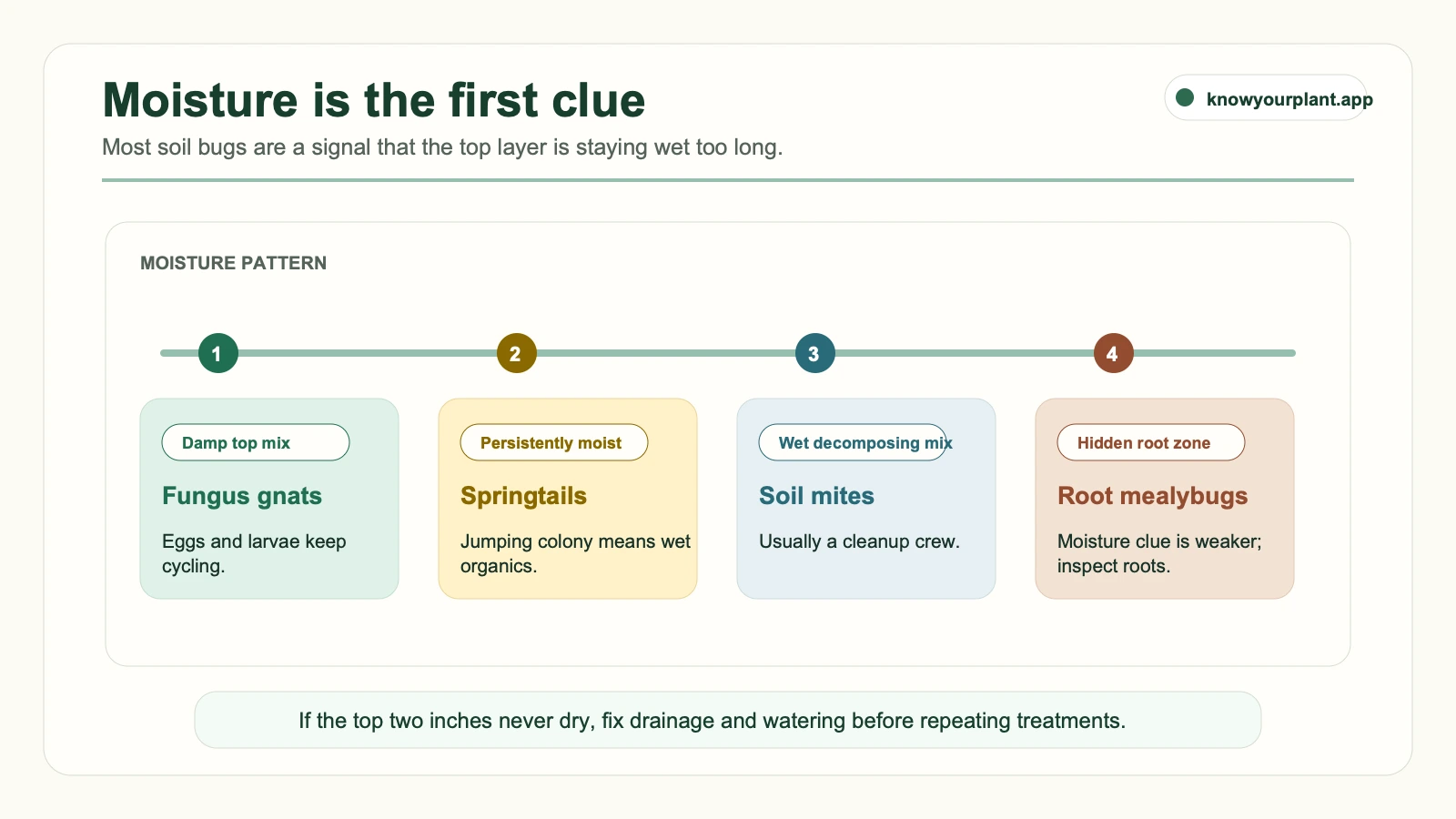
Drying the top layer solves more than it seems: it breaks fungus gnat cycles and makes springtails and soil mites less visible.
Care Cards by Pest Type
Fungus gnat care card
- Confirm: adults hover near the soil and larvae show up in wet topsoil.
- First move: dry the top layer more aggressively and add yellow sticky traps to track adult numbers.
- Avoid: treating adults only and keeping the same wet watering rhythm.
Springtail care card
- Confirm: they jump when the soil surface is disturbed.
- First move: improve drainage and let the mix dry more between waterings.
- Avoid: pesticide drenches for a population that is usually just a moisture signal.
Soil mite care card
- Confirm: pale, slow-moving specks on soil or along the pot wall with no flying or jumping.
- First move: reduce chronic dampness and watch whether the population settles on its own.
- Avoid: assuming every moving speck is a harmful pest.
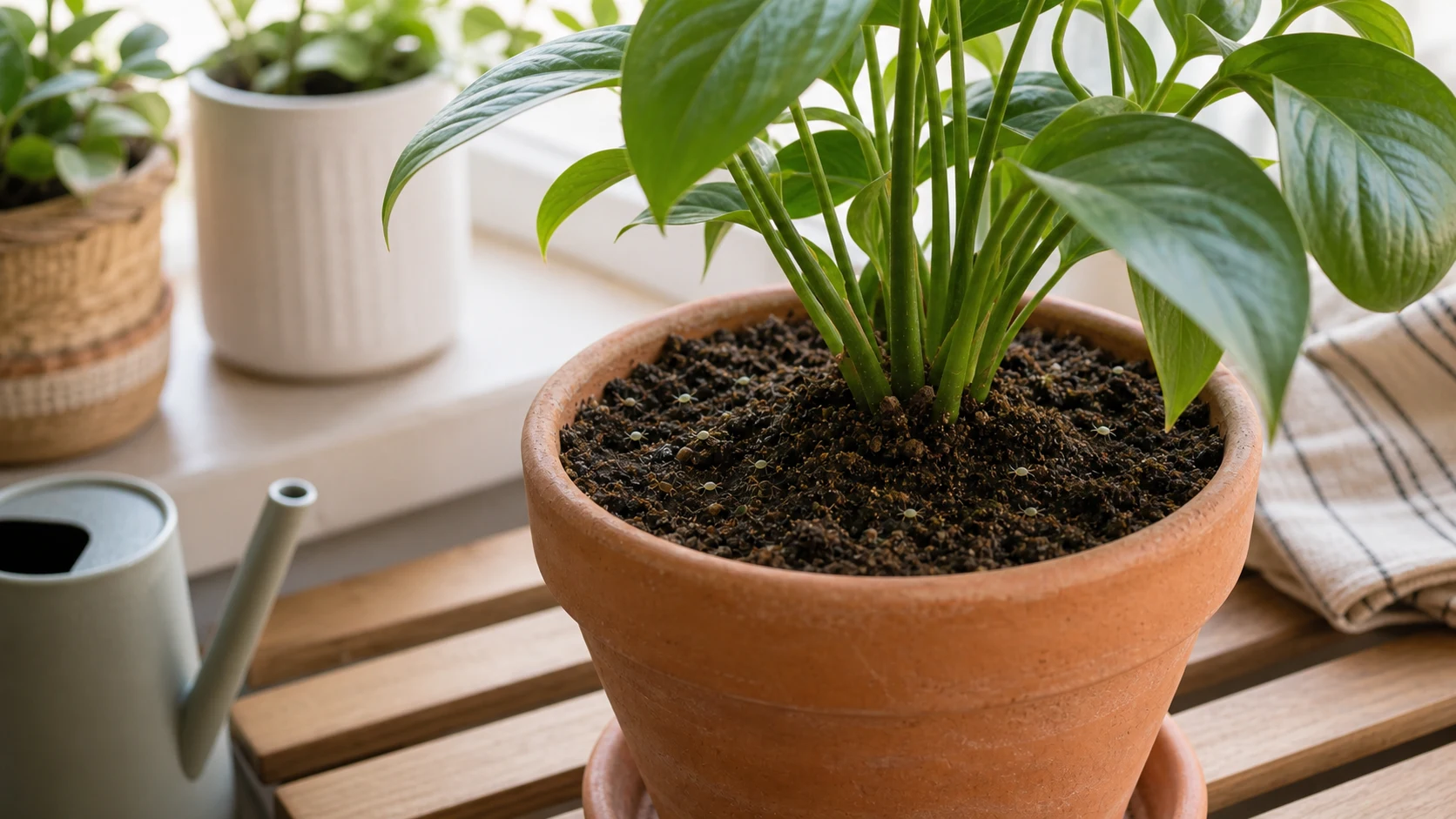
Pale crawlers on otherwise healthy, drying soil call for observation and moisture correction before aggressive treatment.
Root mealybug care card
- Confirm: cottony white clusters on roots or pot walls after unpotting.
- First move: isolate the plant, inspect the root ball, and repot into fresh sterile mix after removing visible colonies.
- Avoid: relying on surface sprays while the root colony stays in place.
What Each Remedy Actually Targets
This is where most generic guides go wrong. They recommend a treatment without explaining which life stage it hits, so readers end up treating adults while larvae continue undisturbed in the soil.
-
Yellow sticky traps catch adult fungus gnats. They reduce the flying population you can see, but they do nothing to the larvae already in the soil. Use them to monitor whether the adult population is shrinking, not as a standalone fix.
-
Diluted hydrogen peroxide drench (one part 3% H2O2 to four parts water) kills larvae on contact when it reaches the top layer of soil. It breaks down into water and oxygen within hours, so it does not harm roots at this dilution. See the hydrogen peroxide for plants guide for safe dilution ratios. It is not effective against root mealybugs because it cannot penetrate a dense root colony at a concentration safe for plants.
-
Bacillus thuringiensis var. israelensis (Bti) is a soil bacterium that kills fungus gnat larvae specifically. Products labeled for fungus gnats – such as Gnatrol or similar Bti-based drenches – are the most targeted larval treatment available. They do not affect springtails, soil mites, or mealybugs.
-
Letting the soil dry aggressively is the single most effective intervention for fungus gnats. It disrupts the larval life cycle without chemicals. This is harder on moisture-loving plants but straightforward for tropicals and succulents with moderate water tolerance.
-
Unpotting and root washing is the right response to root mealybugs. Surface treatments do not reach a root colony reliably. Remove the plant, shake off as much old soil as possible, rinse roots gently, remove visible white clusters manually, and repot into fresh sterile mix.
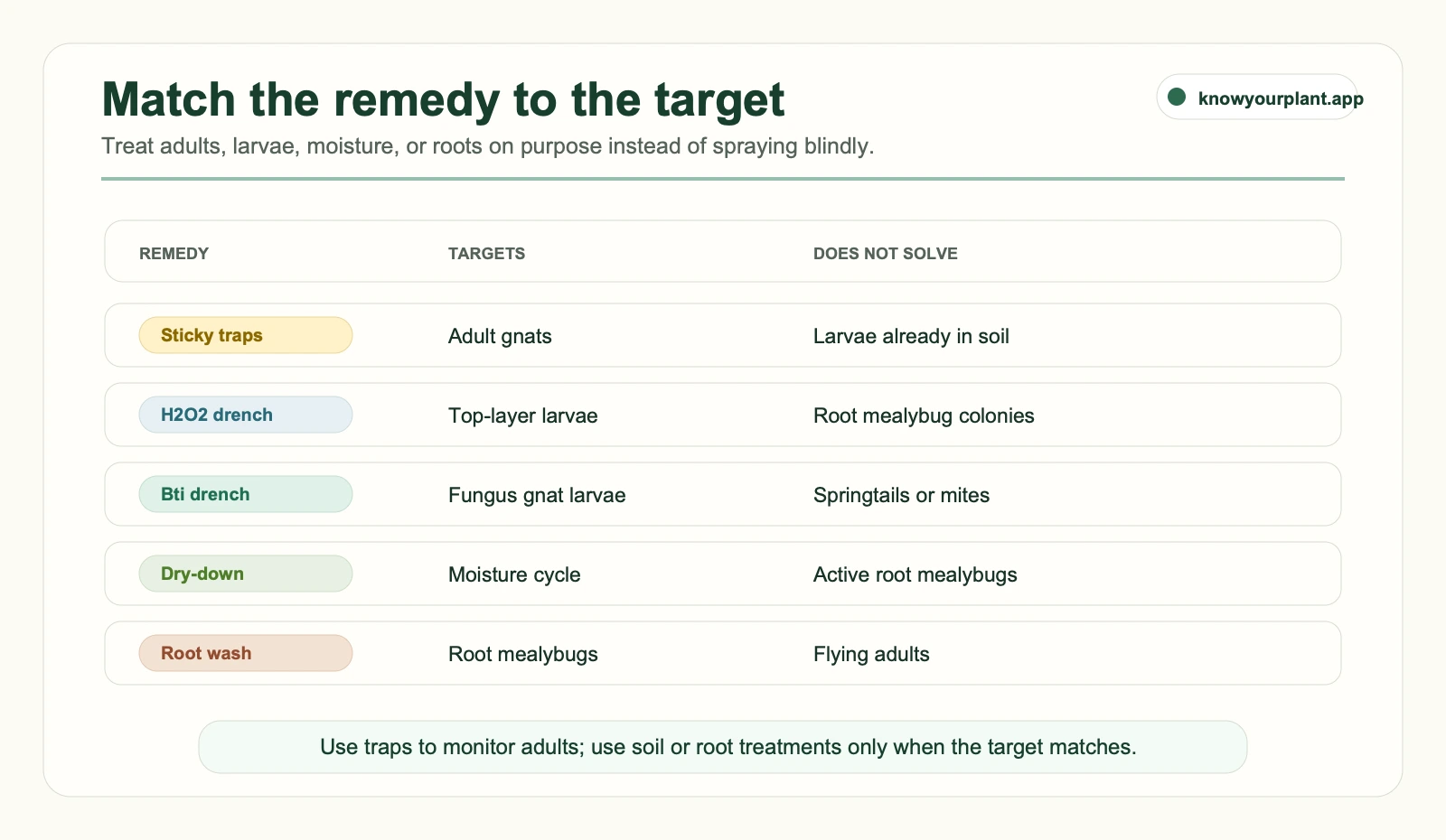
A remedy only works if it reaches the life stage or root-zone problem you actually have.
Common Problems and Mistakes That Make Soil Bugs Worse
Most people dealing with soil bugs for the first time make at least one of these. They are easy to fix once you know what is happening.
Treating with the wrong product because you skipped identification. The single most common mistake. Neem oil and hydrogen peroxide drenches do different things to different pests at different life stages. Using neem oil for a root mealybug infestation does not reach the colonies deeply enough to clear them. Using Bti for springtails is completely unnecessary because springtails are not a plant health threat. Thirty seconds of observation saves a lot of wasted effort.
Relying on sticky traps alone. Yellow traps catch adult fungus gnats. They are useful for monitoring but they do not address larvae in the soil, and larvae are what damage roots. If you are only catching adults, the next generation is still developing underground. Sticky traps plus soil drying is a full plan. Sticky traps alone is not.
Watering normally while treating. The most common treatments for fungus gnats work by drying out the larval environment. If you continue to water on your usual schedule during treatment, you are working against yourself. This is one situation where letting the soil get drier than usual is part of the fix, not a risk.
Treating visible bugs but not checking new plants. New plants brought home from a nursery are one of the most common ways soil bugs enter a home collection. Fungus gnats in particular are endemic in some commercial growing mixes. Letting a new plant dry down a little before placing it near other plants, and checking the soil surface before it comes inside, catches most introductions before they spread.
Seasonal Note
Fungus gnat populations tend to peak in autumn and winter, when indoor heating lowers air moisture and plant owners sometimes overcompensate by watering more frequently. Less evaporation combined with more watering creates exactly the persistently wet top-soil conditions fungus gnat larvae need. If you notice more small flies around your plants as the weather cools, this is usually why.
Springtails become more visible in spring when outdoor populations are high and can hitchhike in on garden soil or repotting mixes. If you repot in spring using outdoor compost or garden soil, expect springtails to appear in the first few weeks, then taper off as the soil dries between waterings.
Root mealybugs have no strong seasonal pattern. Because they are hidden underground, they are discovered year-round – usually only when something else prompts an unpotting.
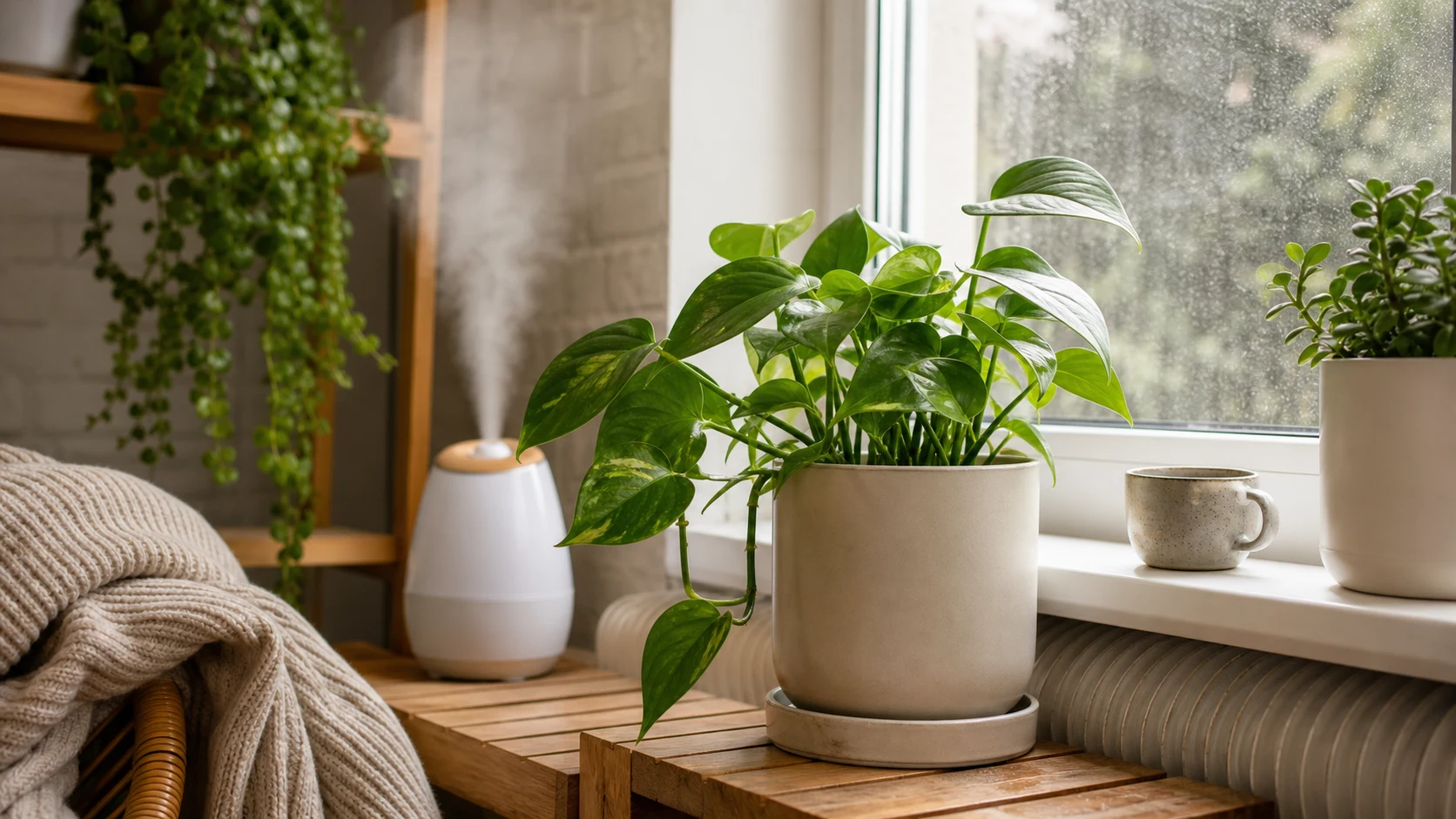
Indoor heating changes evaporation and watering habits, so cool-weather plant care needs a fresh moisture check.
Decision Tree: Which Bug, Which Fix
Step 1 – What are they doing?
- Flying slowly near the soil: go to fungus gnat treatment
- Jumping when you touch the soil: springtails; look at drainage first
- Moving slowly on the soil or pot wall: soil mites; usually no action needed
- White fuzz visible when you lift the plant: root mealybugs; unpot and inspect
Step 2 – How long has the soil been wet?
- Wet for more than four days consistently: moisture management is the first fix regardless of pest type
- Drying well between waterings: focus on targeted treatment
Step 3 – Are seedlings, cuttings, or newly rooted plants involved?
- Yes: treat more urgently; root damage from fungus gnat larvae or root mealybugs can be fatal to young plants before symptoms appear above soil
- No: a healthy established plant can tolerate moderate pressure while you adjust conditions
Pet Safety and Treatment Choice
The bugs themselves are usually less dangerous to pets than the treatment products people reach for in a panic. Keep sticky traps, soil drenches, insecticidal products, and freshly disturbed potting mix away from cats or dogs that chew leaves or dig in pots. If the plant itself is toxic to pets, check the plant-specific guide as well, because a pet issue may have nothing to do with the soil insects.
A cautious default is to isolate the plant while you treat, let the soil surface dry before putting it back in a shared room, and follow product labels exactly when you use anything stronger than moisture management or a root rinse.
What to Do Next
Once you have identified the bug, the treatment logic becomes much simpler:
- Fungus gnats: let soil dry more aggressively; use yellow sticky traps for adults; apply a hydrogen peroxide drench or Bti product to target larvae
- Springtails: adjust watering and drainage; no pesticide treatment needed in most cases
- Soil mites: usually no action needed; improve drainage if population is very high
- Root mealybugs: unpot, inspect roots, remove visible colonies manually, treat root zone, repot into fresh sterile mix
For a deeper look at fungus gnats – including how to break the larval cycle without harming your plant – see how to get rid of fungus gnats. If a root-zone inspection reveals mealybugs on stems or leaves as well, how to get rid of mealybugs covers the full treatment approach. And if you suspect the bug problem is connected to soil staying too wet for too long, the root rot treatment guide is worth reading before you repot.
The bugs are fixable. The bigger question is almost always what those bugs are telling you about the conditions in the pot.
Freshness Note
This guide was checked against UW-Madison, Texas A&M AgriLife, UC IPM, and public gardener Q&A reviewed on 2026-06-03. Community examples here show the kinds of mistakes people make and the questions they ask most often. They are useful for reader language and confusion patterns, not statistical prevalence.
Methodology
I checked exact-search intent, public gardener confusion threads, and extension or IPM sources before revising this guide. Verified directly: how high-trust sources describe fungus gnats, springtails, and root mealybugs, plus which life stages or conditions actually cause harm. Treated as qualitative signal: trap-color confusion, DIY trap behavior, seedling worries, and root-zone misdiagnosis from community threads.
Reliable identification combines source checking with direct observation of the plant, pot, and soil conditions.
Real User FAQ
Are the tiny bugs in my plant soil harmful to my plant?
It depends which bug you have. Fungus gnat larvae can damage root hairs and are particularly harmful to seedlings, cuttings, and newly rooted plants. Root mealybugs cause serious decline if left untreated. Springtails and most soil mites are harmless to healthy roots – they are moisture indicators, not plant predators. The first step is always identification, not treatment.
Why do I keep getting fungus gnats no matter what I do?
The most common reason is that the soil never gets dry enough to break the larval life cycle. Adult fungus gnats lay eggs in moist organic matter in the top layer of soil. If the soil stays wet, eggs hatch into larvae, larvae become adults, and adults lay more eggs. Yellow sticky traps reduce the adults you see but do nothing to the larvae. The cycle breaks when the top two inches of soil dry out completely between waterings.
Can springtails hurt my plants?
In most cases, no. Springtails feed on decaying organic matter and fungi, not living roots. Texas A&M AgriLife Extension classifies them as nuisance pests that become a problem under persistently moist, humid conditions. Some species can occasionally affect very tender seedlings or stressed plants, but for typical established houseplants they are harmless. Treat springtails as a moisture warning, not an infestation that needs treatment.
What does a root mealybug infestation look like?
Root mealybugs leave white waxy fuzz along the roots and along the inside walls of the pot at soil level. From the surface, you might notice unexplained wilting that does not improve with water, yellowing that does not match any obvious care issue, or very slow growth despite otherwise good conditions. The only way to confirm root mealybugs is to unpot the plant and inspect the root zone directly. White cotton-like clusters on the roots or pot wall are your confirmation.
Is neem oil drench effective for soil bugs?
Neem oil drench – using diluted neem oil applied to the soil – is used for fungus gnat larvae and some root pests, but results are inconsistent. It works better as a preventive than a cure for an established larval population. It is not the right primary treatment for root mealybugs, where manual removal and repotting into fresh soil is more reliable. For safe dilution ratios and application timing, see the neem oil for plants guide.
How do I tell fungus gnats apart from other tiny flying insects near my plants?
Fungus gnats are small, dark, and delicate – a bit like miniature mosquitoes. They fly slowly and hover near the soil surface rather than moving quickly across leaves. UW-Madison Extension describes them as having long legs and antennae, which distinguishes them from shore flies (more compact) and thrips (more elongated, found on leaf surfaces, and leave silvery streaking on foliage). If your flying insect rises lazily from the soil when disturbed and seems drawn to the pot rather than the leaves, fungus gnats are the likely candidate.
How do I prevent soil bugs from coming back?
The most reliable long-term prevention is managing moisture. Let the top two inches of soil dry between waterings, ensure pots have clear drainage holes, empty saucers so they do not hold standing water, and avoid overwatering in response to stress symptoms. When you repot, using fresh sterile potting mix reduces the organic matter that fungus gnats and soil mites need to establish. New plants from a nursery are a common introduction route, so let them dry down a little before placing them near your other plants.
Can I use cinnamon on the soil surface?
Cinnamon is sometimes suggested as a natural antifungal measure for the soil surface. It may help reduce the fungal growth that fungus gnats and springtails feed on, making conditions slightly less hospitable – but it does not kill larvae directly and is not an effective standalone treatment for an active infestation. Think of it as a minor supportive measure, not a replacement for moisture management or a targeted drench.
Download KnowYourPlant for personalized plant care reminders and step-by-step pest diagnosis tailored to your specific plant at knowyourplant.app.