You notice a faint dustiness on the leaves. Maybe some tiny yellow speckles, or a leaf that looks a little washed out. You lean in closer and see the faintest threads of webbing in the crook where the stem meets a leaf. That’s when you know: spider mites have found your plant.
Knowing how to get rid of spider mites is one of the most useful things you can learn as a plant person, because these pests move fast and they don’t announce themselves loudly. The good news is that if you catch them early, they’re very manageable. And even if the infestation has gotten ahead of you, there’s still a clear path back.
Symptom Diagnosis Card
Start with the pattern, not the first fix you remember. For spider mites on houseplants, the wrong treatment can make the plant worse because water, light, pests, and root stress can produce similar-looking decline.
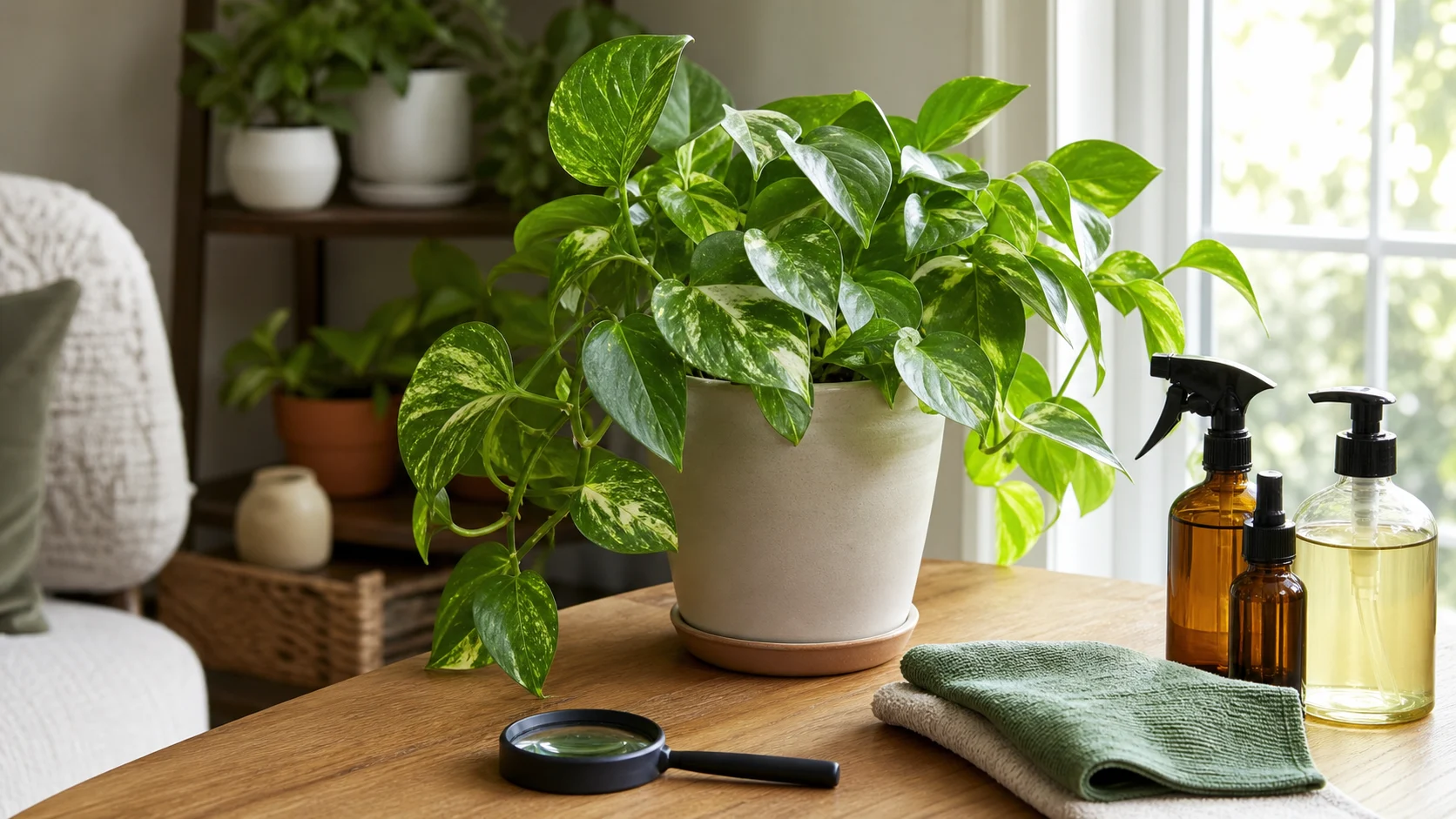
A magnifier, wiping cloth, and treatment bottles support careful inspection before choosing a spider-mite response.
| What you see | Check first | Next move |
|---|---|---|
| Fine webbing and stippled leaves | Likely spider mites | Isolate, rinse foliage, repeat treatment cycle |
| Soil mites only, no leaf damage | May not be spider mites | Confirm pest location before spraying |
| Low humidity and dusty leaves | Favorable mite conditions | Clean leaves and raise humidity where plant tolerates it |
Decision Tree
- Check whether the newest growth, oldest leaves, soil surface, root zone, or leaf undersides changed first.
- If the soil or roots are involved, fix drainage and watering rhythm before adding fertilizer or sprays.
- If pests are visible, isolate the plant and treat the pest life cycle, not just the visible damage.
- If the problem followed a move, repot, heat wave, grow light change, or winter heating, treat it as stress until the evidence says otherwise.
- Make one change, then observe for 7 to 14 days unless the plant has active rot or a spreading pest infestation.
Common Mistakes
- Watering again because leaves look thirsty while the root zone is already wet.
- Treating every brown or yellow mark as a nutrient deficiency.
- Spraying before checking leaf undersides, soil moisture, roots, and nearby plants.
- Repotting into a much larger pot, which can keep the root zone wet longer.
- Expecting damaged leaves to turn green again; recovery usually shows in new growth.
Seasonal Note
In winter or in air-conditioned rooms, growth slows and soil stays wet longer. In summer, brighter windows and faster drying can make the same care routine behave differently. Re-check light, watering interval, and humidity whenever the season or room conditions change.
Expert Note: Source Layer
The practical checks above are grounded in extension and safety sources, then cross-checked against qualitative plant-owner confusion patterns from forums:
- University of Minnesota Extension twospotted spider mites
- Penn State Extension twospotted spider mites
- Utah State University Extension spider mites
Methodology Note
This guide was refreshed after checking current search results, reading plant-owner discussions for the places people get stuck, and verifying diagnosis and treatment safety against university extension guidance. Forum examples here show real confusion patterns, but the treatment advice is grounded in extension and IPM sources.
Social Listening: Where Plant Owners Get Stuck
Across plant-owner threads, the same friction points show up again and again:
- people often notice spider mites only after stippling, dryness, or leaf drop has already started
- owners worry that nearby plants are already affected before they even confirm the pest
- fine webbing and low humidity create confusion about spider mites versus other pests or general stress
- treatment questions usually come down to how aggressive to be and how often to repeat the fix
Use those patterns as a reminder to inspect first, isolate early, and commit to a repeat cycle instead of doing one spray and hoping for the best.
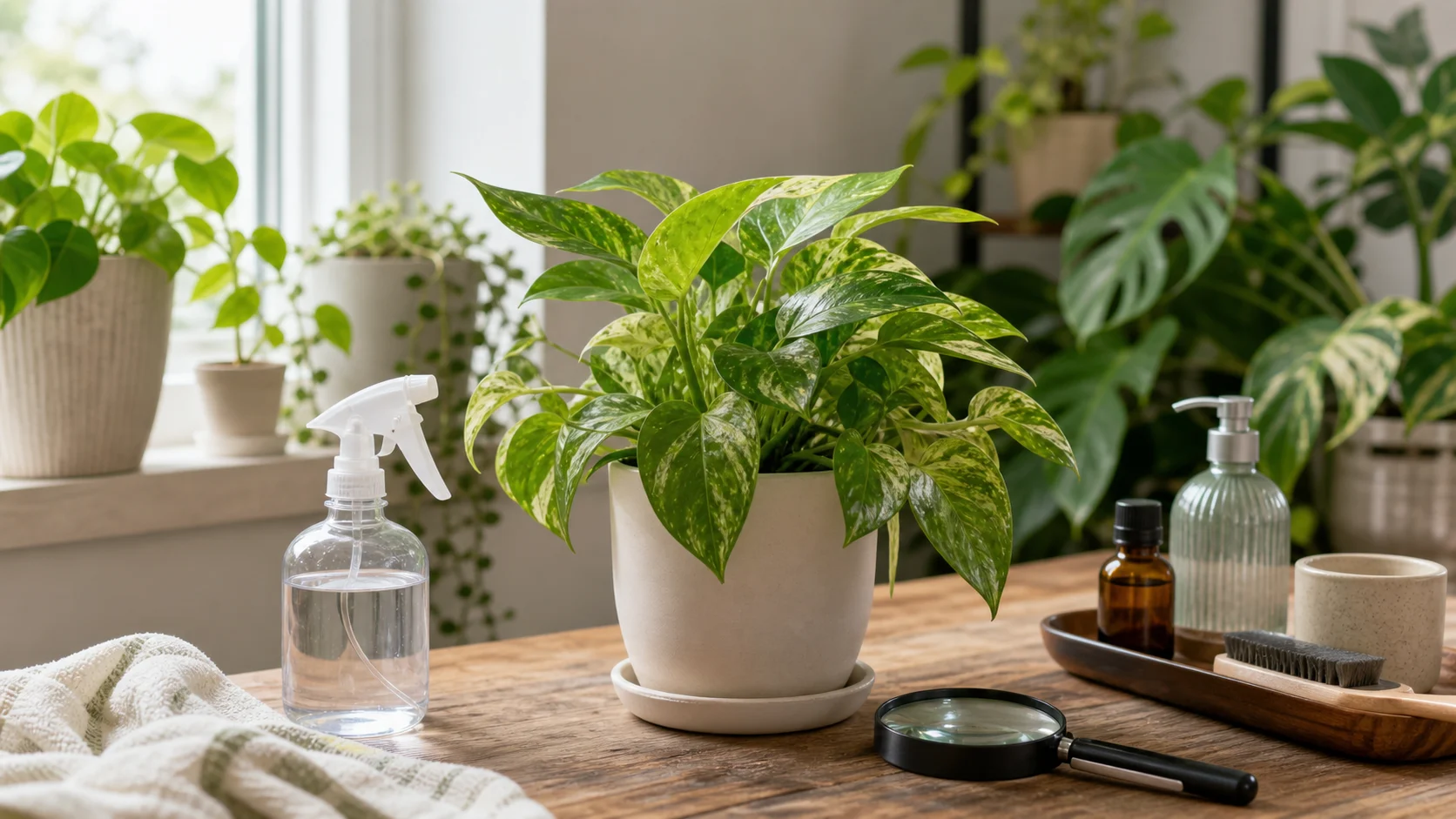
An isolated focal plant, neighboring pots, and inspection tools reflect the uncertainty that makes early spider-mite action difficult.
What Most Pest Guides Miss
Most guides about spider mites focus on the product to spray. The part that actually decides whether treatment works is the source of the problem and the follow-up schedule.
Before treating, separate three things:
- Pest identity: confirm what you are seeing before applying anything.
- Source: check new plants, nearby pots, soil surface, leaf joints, and hidden undersides.
- Repeat cycle: plan follow-up checks so eggs or missed insects do not restart the problem.
- Plant stress: fix weak light, soggy soil, or dusty leaves that made the plant easier to attack.
That sequence prevents the most common mistake: treating the visible bugs once while leaving the conditions that let them return.
What Are Spider Mites, Exactly?
Spider mites aren’t insects. They’re arachnids, tiny relatives of spiders and ticks, measuring less than a millimeter across. You usually can’t see individual mites without a magnifying glass, but you absolutely can see the damage they leave behind.
They feed by piercing leaf cells and sucking out the contents. That’s what creates the telltale stippling: hundreds of tiny pale dots where the cell has collapsed. At scale, this gives leaves a dusty, silvery, or bronze appearance, like the color has been slowly bleached out from the inside.
The webbing comes later, once the colony has grown large enough. By that point you’re dealing with a real infestation, not just a stray few.
Here’s why acting fast matters so much: a single female spider mite can lay up to 200 eggs over her lifetime, with eggs hatching in as few as 3 days under warm conditions (NC State Cooperative Extension). At peak summer temperatures, a new generation can be fully active within a week. That’s not a slow buildup. That’s an exponential problem.
Early Signs of Spider Mites
The earlier you catch them, the easier the fix. Here’s what to look for before the webbing stage.
Stippling on the Leaves
Hold the leaf up to the light and look at the surface. Tiny pale or yellowish pinprick dots, scattered unevenly, are the first visible sign. The dots appear where individual mites have been feeding. On a healthy dark green leaf, the contrast is easy to spot once you know what you’re looking for.
Faint Dustiness or Dullness
A leaf that was glossy last week and looks matte or slightly dusty this week is worth investigating. It’s easy to dismiss as dust or dry air, but run a finger across the surface. If it doesn’t feel like dust or wipe clean, look closer.
Small Moving Dots on the Undersides
Flip a leaf over and look at the underside, which is where spider mites prefer to feed and hide. If you see tiny dots that move, that’s them. A white piece of paper held under the leaf while you tap it gently can help: mites will fall onto the paper and you can see them crawling.
Fine Webbing in Leaf Joints
This is the later-stage sign, but it’s unmistakable. Thin gossamer threads between leaf stems, across leaf surfaces, or gathered in the joint where the leaf meets the stem. At this point the population is large, but treatment still works.
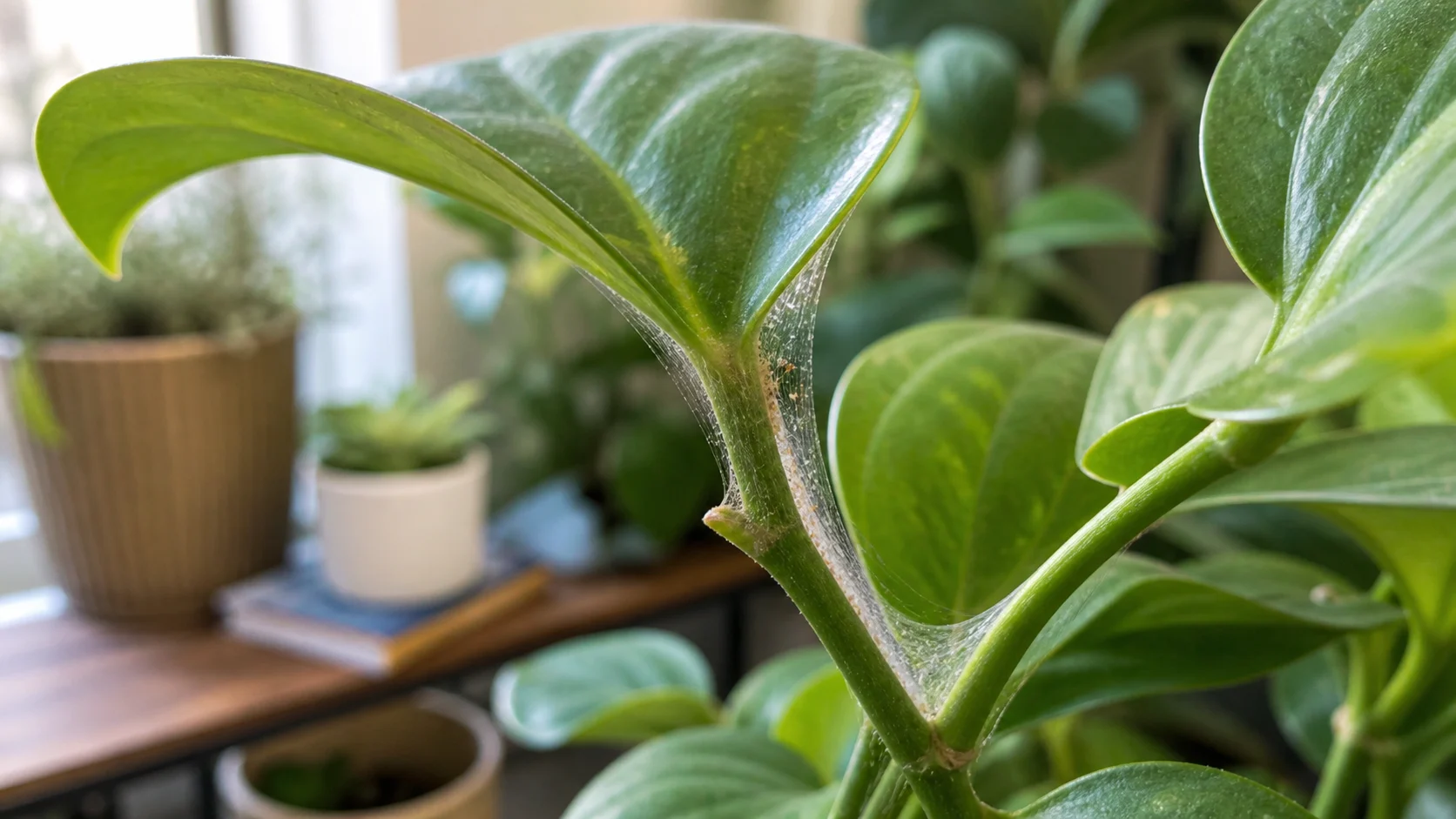
Fine gossamer strands gathered at the petiole joints show the later-stage webbing that confirms an active spider-mite population.
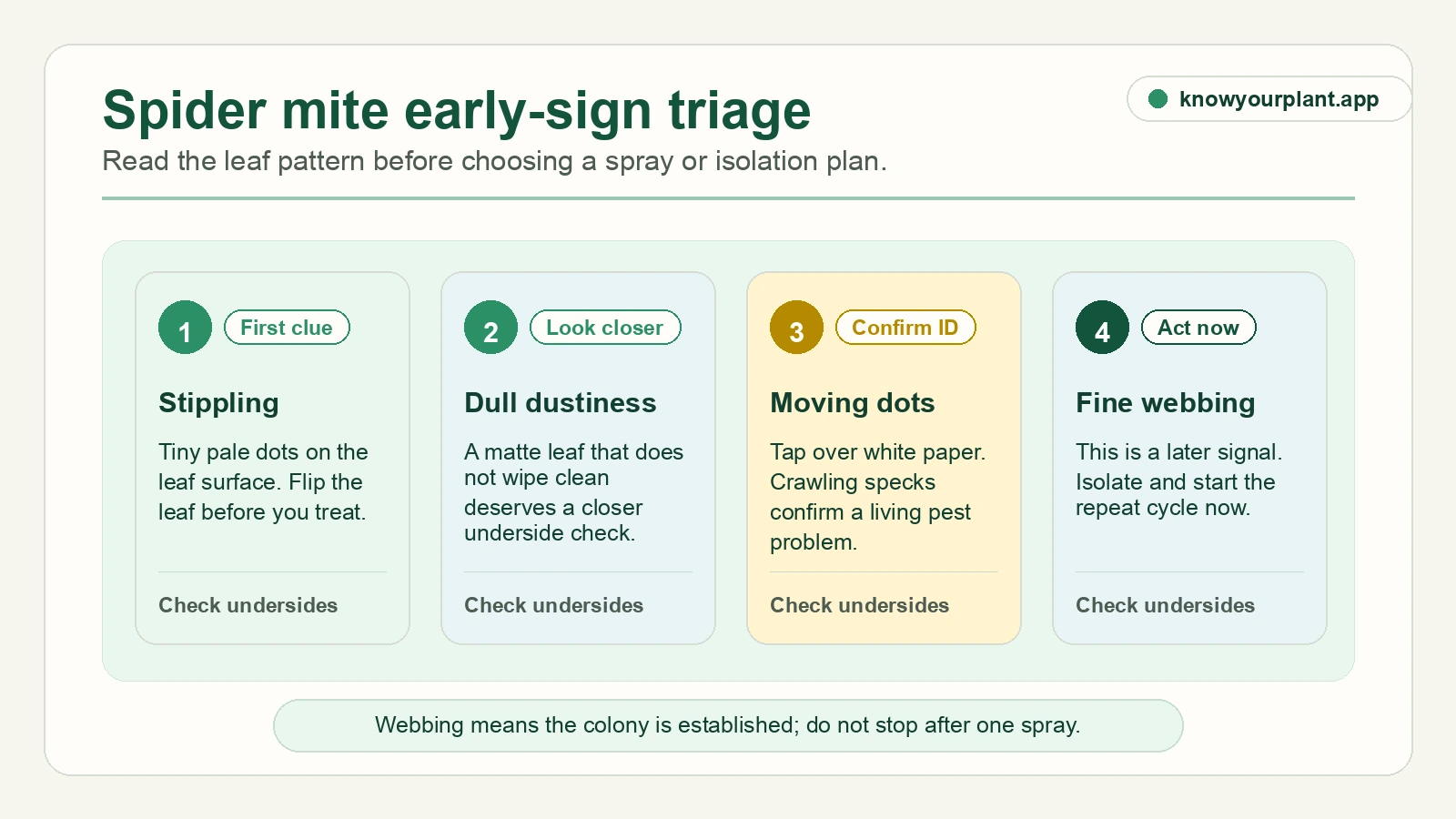
Use the first visible signal to decide whether to keep inspecting, confirm the pest, or isolate and begin treatment.
Why Your Plant Got Spider Mites
Spider mites thrive in hot, dry conditions. Low humidity is their best friend. Research from the University of Florida IFAS Extension shows that relative humidity above 60% significantly inhibits spider mite reproduction and colony establishment. This is why infestations tend to spike in winter, when indoor heating dries out the air, and in summer, when plants sit near hot windows or air conditioning vents.
Stressed plants are also more vulnerable. A plant that’s been underwatered, sitting in poor light, or struggling for any other reason has weaker cellular defenses and attracts mites more readily. If you’re growing plants that already prefer higher humidity, like calatheas or prayer plants, you’ll want to be especially vigilant. You can read more about their specific needs in the Calathea Care Guide and Prayer Plant Care Guide.
Certain species also seem to act as stepping stones. Spider mites can arrive on a plant you just bought, then spread to neighbors through air movement alone.
Spider Mite Risk by Season
Most spider mite advice treats this as a year-round problem with no variation. In practice, there are distinct risk windows, and knowing them means you can be watchful at exactly the right moments rather than maintaining a constant low-level state of alert.
Spring (March to May)
Risk level: Moderate
As heating systems wind down and windows open more often, indoor humidity starts recovering. But mites that survived winter on your plants are still active. Spring also brings a lot of new plant purchases, which is one of the main ways infestations arrive. Any plant you bring home deserves a careful inspection of the leaf undersides before it goes near your collection.
Fresh spring growth is also tender and more appealing to mites than older, tougher leaves. Check new leaves and unfurling growth weekly through this period.
Summer (June to August)
Risk level: High near windows and vents
Hot, dry air from air conditioning combined with intense sun through south or west-facing windows creates near-ideal conditions for mites. Plants positioned to catch summer light often end up sitting in exactly the kind of warm, dry microclimate spider mites prefer.
If you have plants on or near windowsills during summer, bump up your inspection frequency. A weekly check of leaf undersides takes two minutes and is worth building into the habit.
Autumn (September to November)
Risk level: Rising fast
This is the transition period most people miss. When the heat comes on for the first time in autumn, indoor humidity drops sharply. Any mites already present will begin reproducing more aggressively as the moisture leaves the air.
A practical habit: the first time you turn on your heating for the season, spend 10 minutes checking every plant in the house. You won’t regret it.

Checking leaf undersides beside a newly active radiator turns the autumn humidity drop into a practical inspection cue.
Winter (December to February)
Risk level: Highest
Heated indoor air in winter can drop to relative humidity levels well below 30%, especially in colder climates. This is peak spider mite season by a significant margin. If you’re not running a humidifier or have no other way to add moisture to the air, treat prevention as active practice, not passive hope, and inspect your plants weekly.
Calatheas, prayer plants, and other humidity-lovers are especially exposed in winter. They’re already under stress from dry air, which makes them easier targets. If you have any in your collection, these are the ones to check first.
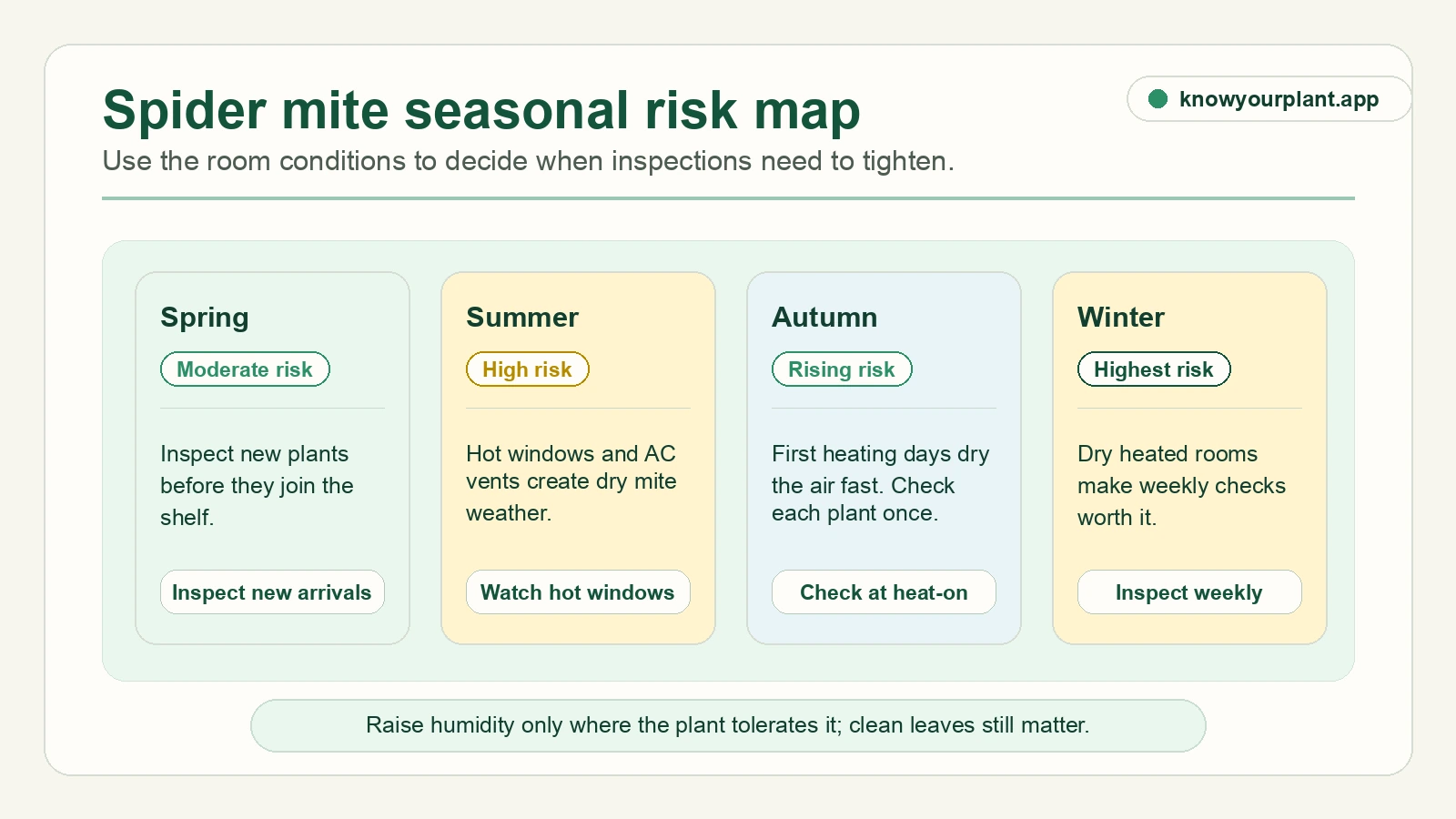
Match inspection frequency to the season and room conditions instead of waiting for webbing to appear.
How to Treat Spider Mites
Step One: Isolate the Plant
The moment you suspect spider mites, move the affected plant away from your others. Spider mites spread through air movement and direct contact between leaves. Isolation gives you time to treat without risking your whole collection.
Step Two: Wash Them Off
Before anything else, take the plant to the sink or shower and rinse the leaves thoroughly with water, paying special attention to the undersides. A gentle but firm stream dislodges mites and washes away webbing. This alone won’t eliminate an infestation, but it reduces the population significantly and makes your spider mite spray more effective.
Step Three: Choose Your Treatment
There are a few good options for spider mites treatment, and most people find success with at least one of them.
Neem oil is one of the most reliable. Mix it with a small amount of dish soap and water, shake well, and spray every surface of the plant, including the undersides of leaves. Neem disrupts the mites’ life cycle rather than just killing adults, which is why it works even when populations are dense. Kevin Espiritu of Epic Gardening puts it plainly: “Neem oil is my go-to for spider mites because it doesn’t just kill what’s there today. It interrupts reproduction, so you’re treating the problem, not just the symptom.” If you want the exact mix ratio, timing, and patch-test steps, the neem oil for plants guide breaks it down. Plan for reapplication every 5 to 7 days for at least three rounds.
Insecticidal soap works by breaking down the mites’ outer layer on contact. It’s gentle on most plants and effective when applied thoroughly. Like neem, it needs repeat applications, because it doesn’t affect eggs.
Rubbing alcohol diluted with water (about 70% isopropyl mixed with equal parts water) is useful for spot-treating concentrated areas or wiping individual leaves. Use a cotton ball or soft cloth. It kills on contact but leaves no residual protection.
For serious infestations, combining approaches works well: a thorough wash first, then insecticidal soap, then neem oil as a longer-term deterrent.
Matching Treatment to the Stage You’re At
Not every infestation calls for the same response. Here’s a rough guide based on what you’re seeing.
Early stage (stippling only, no webbing): Three rounds of insecticidal soap every 5 to 7 days is usually enough. Wash the plant first, then spray thoroughly, covering the undersides of every leaf. Check between treatments for any new activity.
Moderate infestation (light webbing in a few spots): Add neem oil to your rotation. Alternate between insecticidal soap and neem every few days for four to five rounds. Remove any leaves that are heavily stippled, since those cells are already lost.
Advanced infestation (heavy webbing across multiple leaves): Prune back the worst-affected growth first, then run a full neem plus soap protocol for at least six weeks. At this stage, don’t cut treatments short even when you think you’ve won. The eggs are still there.
Spider Mite Treatment Confidence Ladder
Use this as a calm escalation path instead of jumping straight to the strongest spray.
- Low-confidence diagnosis: inspect leaf undersides, tap leaves over white paper, and confirm stippling, webbing, or moving dots before treating.
- Early or light infestation: isolate the plant, rinse foliage, wipe leaf undersides, and recheck in 3 to 4 days.
- Confirmed active mites: use a labeled insecticidal soap, horticultural oil, or neem product only after spot testing and avoiding hot, direct sun.
- Heavy webbing or spread to nearby plants: clean the shelf or window area, inspect neighboring plants, and treat the whole exposure zone, not just the worst plant.
- Repeated recurrence: audit dry air, dusty leaves, skipped follow-up rounds, untreated neighbors, and whether one severely infested plant needs to leave the collection.
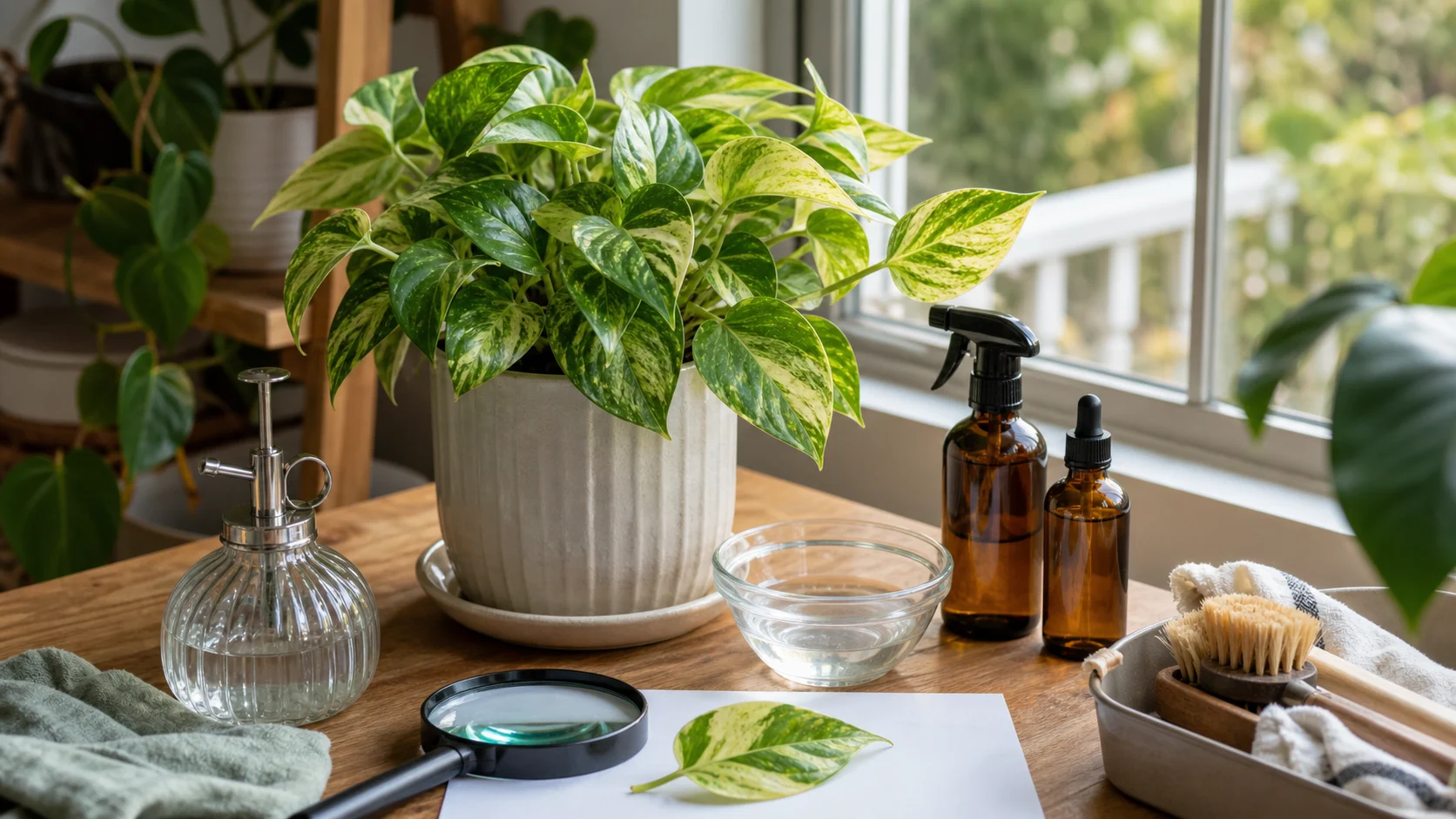
Inspection paper and magnifier sit beside rinse and treatment tools, mirroring a measured progression from confirmation to intervention.
Treatment Method Safety Matrix
| Method | Best for | Weakness | Plant safety note | Follow-up |
|---|---|---|---|---|
| Strong water rinse | Early knockdown, web removal, and reducing mite pressure before sprays | Does not kill eggs on its own | Support leaves so stems do not snap, and avoid blasting tender new growth | Repeat before each deeper treatment round |
| Leaf wipe or diluted alcohol spot clean | Small clusters on sturdy leaves and hard-to-reach joints | Easy to miss eggs or hidden mites on neighboring leaves | Spot test first and avoid overusing on thin or delicate foliage | Reinspect in 3 to 4 days |
| Insecticidal soap | Light to moderate infestations when you can coat undersides well | Coverage has to be thorough, and one spray is rarely enough | Do not spray a heat-stressed or wilted plant, and keep it out of direct sun until dry | Repeat every 5 to 7 days while mites remain active |
| Horticultural oil or neem | Rotation option when mites keep returning and webbing is protecting them | Oils can irritate sensitive leaves and still need repeat coverage | Patch test first, avoid hot bright windows, and do not spray a drought-stressed plant | Recheck in 3 to 4 days and repeat on schedule if mites are still active |
Step Four: Repeat (This Part Is Not Optional)
This is where most people stop too early. Mite eggs are resistant to almost every treatment available for home use. According to UC Cooperative Extension, spider mites can complete a full life cycle in as few as 5 to 7 days at temperatures above 27°C (80°F), which means you must treat consistently to stay ahead of hatching cycles. Whatever method you use, apply it every 5 to 7 days for at least three to four weeks. Check the plant between treatments. If you see new mites or fresh damage, treat again.
Seven-Day Spider Mite Follow-Up Calendar
- Day 0: isolate the plant, rinse or wipe foliage, inspect nearby plants, and clean the shelf, sill, or grow tent area.
- Day 3: inspect leaf undersides and leaf joints again. If you still see moving dots, repeat the physical wipe-down before the next spray.
- Day 7: apply the next labeled treatment round with full underside coverage.
- Day 10: run the white-paper tap test again and remove only the leaves that are heavily spent or still acting as mite shelters.
- Day 14: decide whether the plant is moving into prevention mode, needs another round, or is the source plant that should be discarded to protect the rest of the collection.
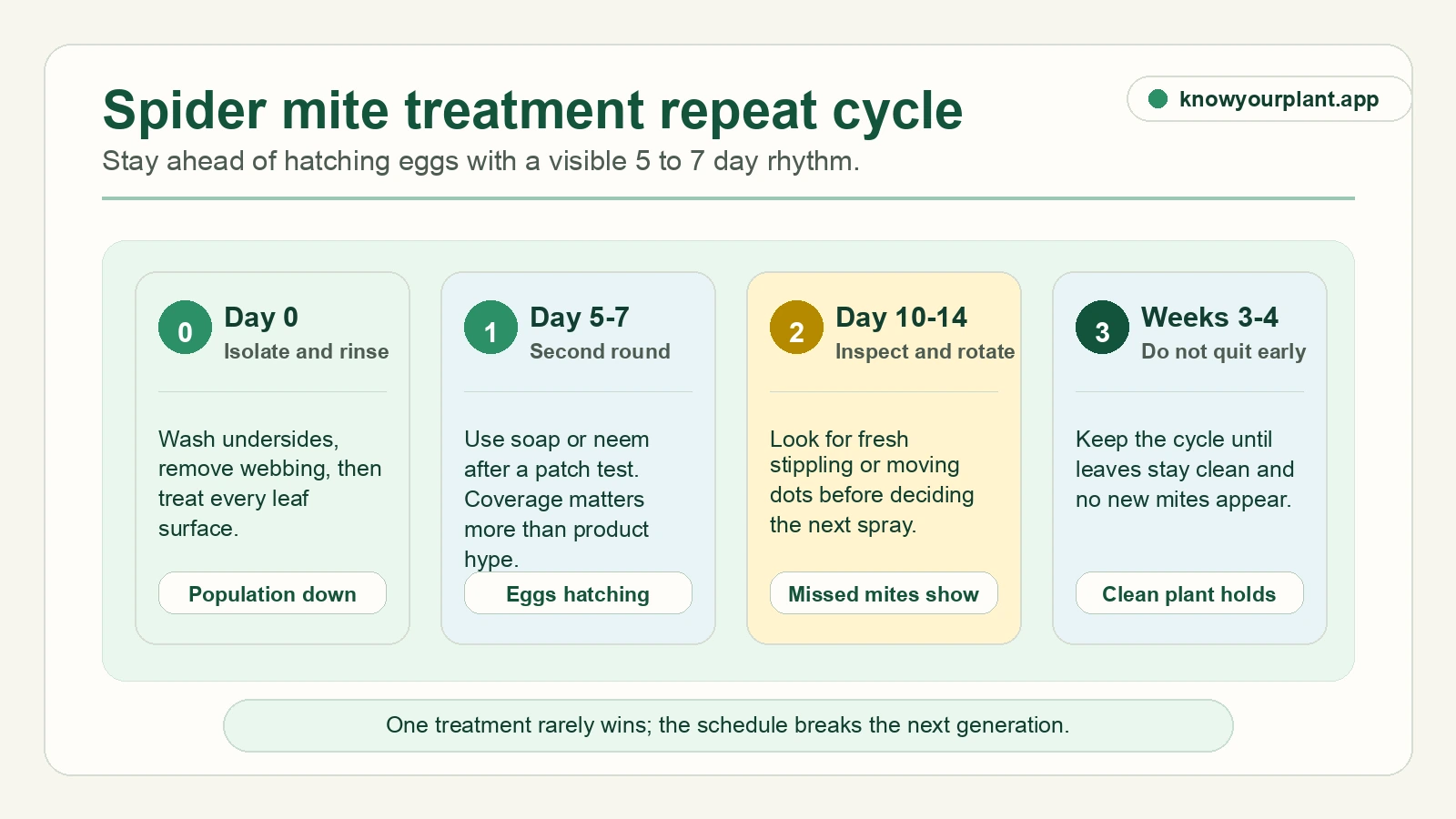
Plan the repeat cycle before you start, because eggs and missed mites are what usually restart the infestation.
Why Neem or Soap Sometimes Seems to Fail
A lot of frustrated plant owners are not actually using the wrong product. They’re running into the same four failure points: the undersides never got fully covered, eggs hatched between treatments, nearby plants were left untreated, or the plant was already heat-stressed when it was sprayed.
A quick reset usually helps:
- Recheck the diagnosis first. Tap a leaf over white paper and confirm moving dots, stippling, or webbing before starting another treatment round.
- Treat the whole exposure zone. If one plant has active mites, inspect the plants touching it, the shelf, and the window or grow tent area on the same day.
- Cover the hidden surfaces. Spider mites cluster on leaf undersides, petiole joints, and new growth, so a top-only spray often looks like a failed product.
- Respect plant safety limits. Insecticidal soaps and oils work better on a plant that is not already wilted, heat-stressed, or sitting in direct sun.
- Follow the calendar, not your mood. Day 3, Day 7, Day 10, and Day 14 checks catch the hatch cycle that restarts the infestation.
If the plant is rare, thin-leaved, or already stressed, start with a rinse and leaf wipe, then spot-test any soap or oil before treating the whole plant.
Preventing Spider Mites
Once you’ve dealt with an infestation, a few consistent habits make a real difference.
Raise the humidity. A humidity tray, a small humidifier nearby, or grouping plants together all help. Mites struggle to establish colonies in moist air. This is especially worth doing for humidity-loving plants during winter heating season.
Wipe leaves regularly. A weekly wipe-down with a damp cloth keeps surfaces clean and removes any mites or eggs before they can settle in. It also gives you a chance to spot problems early.
Inspect new plants before bringing them home. Most infestations arrive on a new plant. Check leaf undersides carefully before introducing anything to your collection, and consider a loose quarantine of a week or two for anything new.
Keep plants healthy. A plant in the right light, watered consistently, and given what it needs is simply harder for mites to take hold of. Darryl Cheng of House Plant Journal makes the point directly: “Pests and disease are usually downstream of a care problem. Fix the growing conditions, and the plant can defend itself.” If you’re still working out the basics, the Indoor Plant Care Guide for Beginners is a good starting point, and understanding grow lights can make a real difference if your plants are struggling in low light.
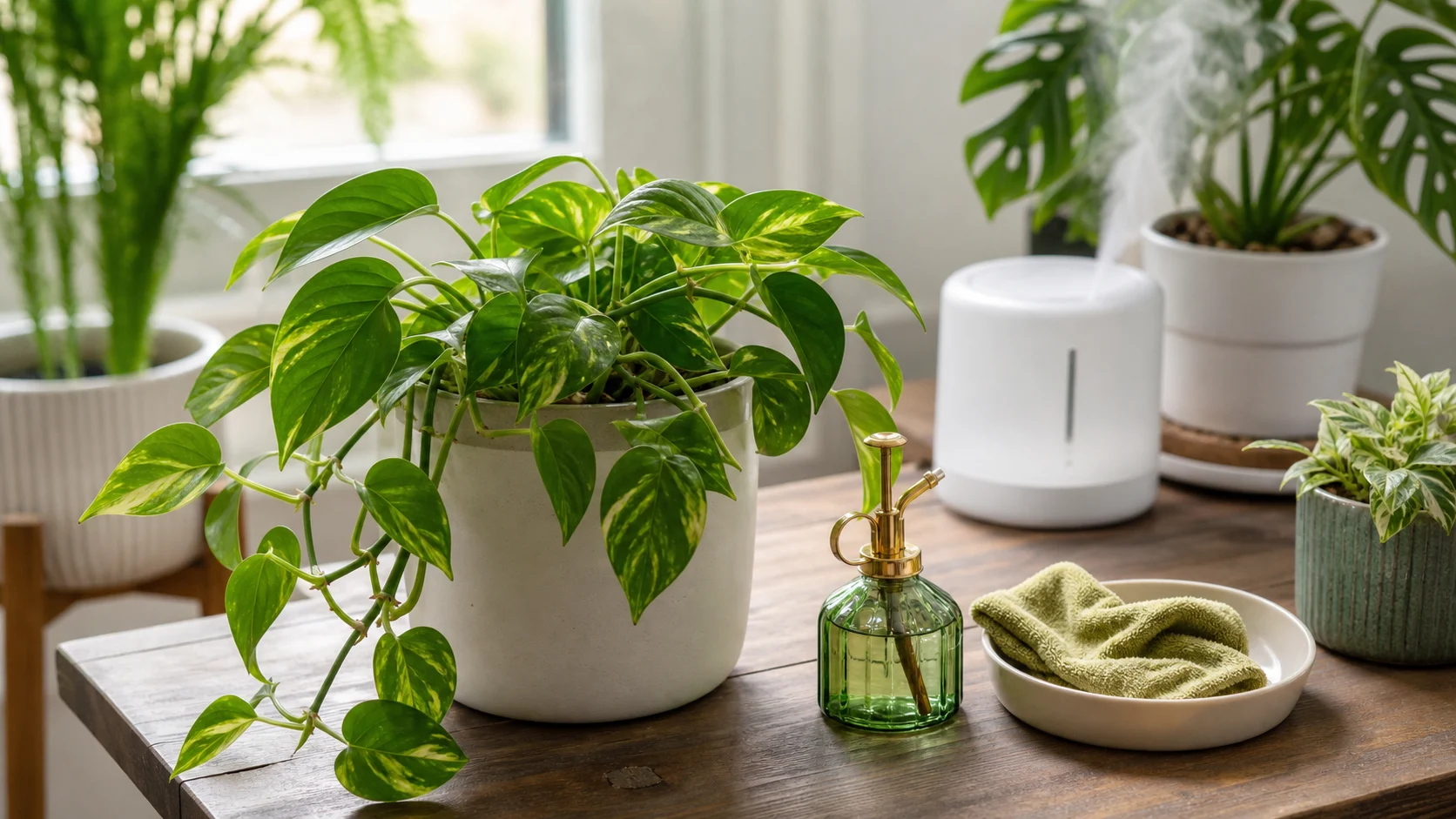
Grouped healthy plants, gentle humidity, and a damp wiping cloth turn spider-mite prevention into a repeatable care routine.
FAQ: Spider Mites on Houseplants
How do I know if it’s spider mites and not something else?
The combination of stippling (tiny pale dots on the leaf surface) and fine webbing in leaf joints is a strong indicator. Fungus gnats don’t leave webbing, mealybugs look cottony in leaf joints, scale insects leave sticky residue, and thrips leave silvery streaks rather than dots. If you see webbing plus stippling, it’s almost certainly spider mites.
Can spider mites live in soil?
Spider mites live and feed on leaf surfaces, not in soil. If you’re seeing problems in the soil, those are more likely fungus gnats or root pests. Spider mites need leaf material to feed on and don’t overwinter in potting mix the way some soil-dwelling pests do.
Will spider mites go away on their own?
Unlikely. They have no natural predators in an indoor environment, and the conditions indoors, especially in heated or air-conditioned spaces, are often ideal for them. Without intervention, populations tend to grow until the plant is severely damaged. Treat as soon as you see signs.
Is neem oil safe for all houseplants?
Neem oil is safe for most houseplants, but it’s worth testing on a single leaf first, especially with sensitive plants. Apply to one leaf and wait 24 hours before treating the whole plant. Some plants with delicate or waxy leaves can be sensitive to oil-based sprays. Always apply in the evening or in low light conditions to avoid leaf burn.
How long does it take to get rid of spider mites completely?
With consistent treatment every 5 to 7 days, most infestations are under control within 3 to 4 weeks. The key word is consistent: missing a round allows eggs to hatch and the population to recover. Don’t stop after one or two treatments even if you stop seeing mites.
Can spider mites spread to other plants in my home?
Yes, fairly easily. They travel through air movement and direct contact between leaves. That’s why isolation is the first step. Even after treatment, keep the plant separate for a few weeks until you’re confident the infestation is fully resolved.
Do spider mites bite humans?
The two-spotted spider mite, the most common houseplant species, does not bite humans or pets. They’re exclusively plant feeders. If you’re experiencing biting or skin irritation, a different pest is more likely responsible.
What plants are most vulnerable to spider mites?
Spider mites seem to prefer plants with thinner leaves and those already growing in dry conditions. Calatheas, peace lilies, pothos, and tropical plants in general can be affected. Thicker-leaved succulents and cacti are less commonly targeted, though not immune. If the main clue is sticky new growth with clusters on stem tips rather than webbing, compare the pattern with aphids.
Freshness Note
Last updated: 2026-07-12. This article was refreshed against current extension guidance and live plant-owner confusion patterns. If your plant symptoms do not match the pattern here, re-check the pest ID before repeating treatment.
There’s a particular satisfaction in checking a plant you treated three weeks ago and finding clean leaves, no stippling, no webbing. The key is not waiting when you see the first sign. Check your plants regularly, especially when the seasons shift and heating or cooling kicks in, and you’ll catch most problems before they become serious.
Download KnowYourPlant for personalized plant care reminders and pest alerts tailored to the specific plants you grow. https://knowyourplant.app