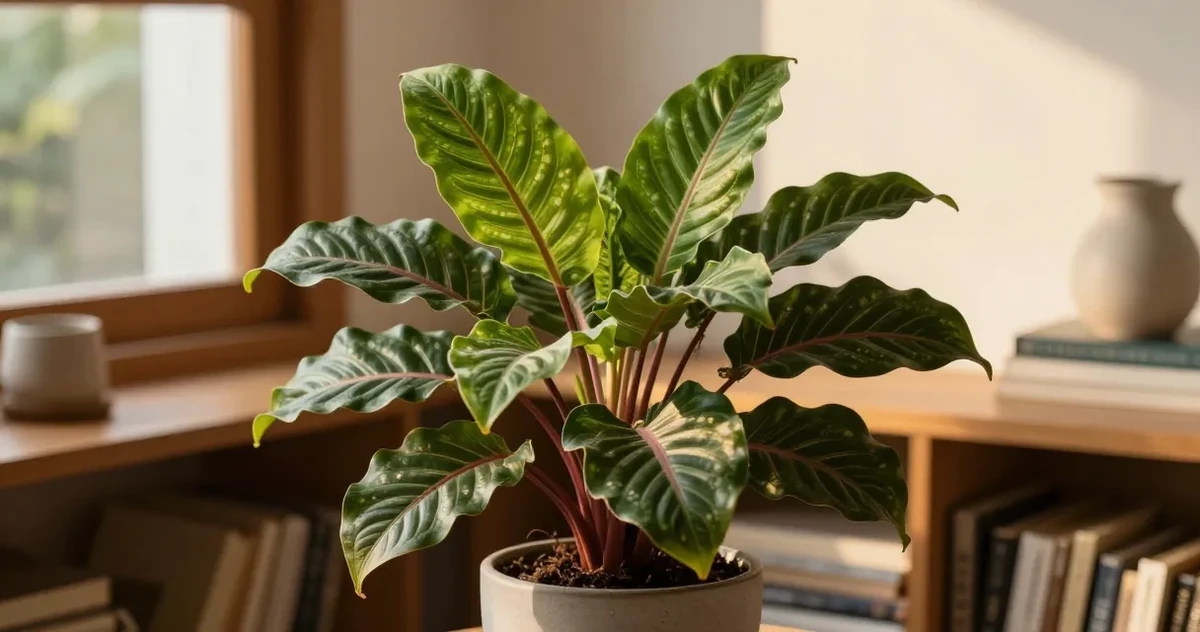
Calathea care has a reputation, and it’s earned. If you’ve found yourself staring at crispy brown edges, leaves curling inward like little scrolls, or a plant that looks sulky for no obvious reason, you’re in good company. Almost everyone who grows calathea goes through this.
Here’s the thing worth holding onto: calathea isn’t difficult because it’s fragile. It’s difficult because it’s specific. Once you understand what it actually needs, keeping one happy becomes a lot less mysterious.
A measured climate reference for calathea care
Calathea is a broad horticultural label, so this module uses one named species from the guide’s group: Goeppertia orbifolia, accepted by GBIF under its current genus.
The ranges below are the middle 50% (p25–p75), not recommended indoor setpoints.
| Reference taxon | POWO native range | Annual mean temperature | Annual precipitation | Relative humidity | Solar radiation | Evidence |
|---|---|---|---|---|---|---|
| Goeppertia orbifolia (calathea orbifolia) | eastern Brazil | 22.8–24.6°C | 1370–1870 mm/yr | 66–69% | 17.2–18.2 MJ/m²/day | 12 climate points; low confidence |
What this changes in this guide: The result is a species reference, not a genus-wide prescription. It supports cautious interpretation of humidity and temperature while leaving watering decisions to the actual pot and roots.
Sources and method: Goeppertia orbifolia in POWO and GBIF; CHELSA V2.1, 1981–2010. GBIF records are limited to POWO-native countries, then filtered for coordinates, establishment signal, licence, precision, and spatial duplication. No community or user-reported care data is used in this module.
What Most Care Guides Miss
Most guides about calathea describe the ideal care routine. Real homes are messier: light changes by season, pots dry at different speeds, and the same symptom can mean different things depending on where it appears.
Before changing care, check the plant in this order:
- Light: is the plant growing toward the window, fading, or scorching?
- Root zone: is the pot drying predictably, or staying wet in the middle?
- Leaf pattern: did the oldest leaves, newest leaves, tips, or stems change first?
- Recent change: new pot, new location, fertilizer, cold draft, heat vent, or pest exposure.
This keeps you from fixing the wrong problem. One clear adjustment is usually safer than a full care reset.
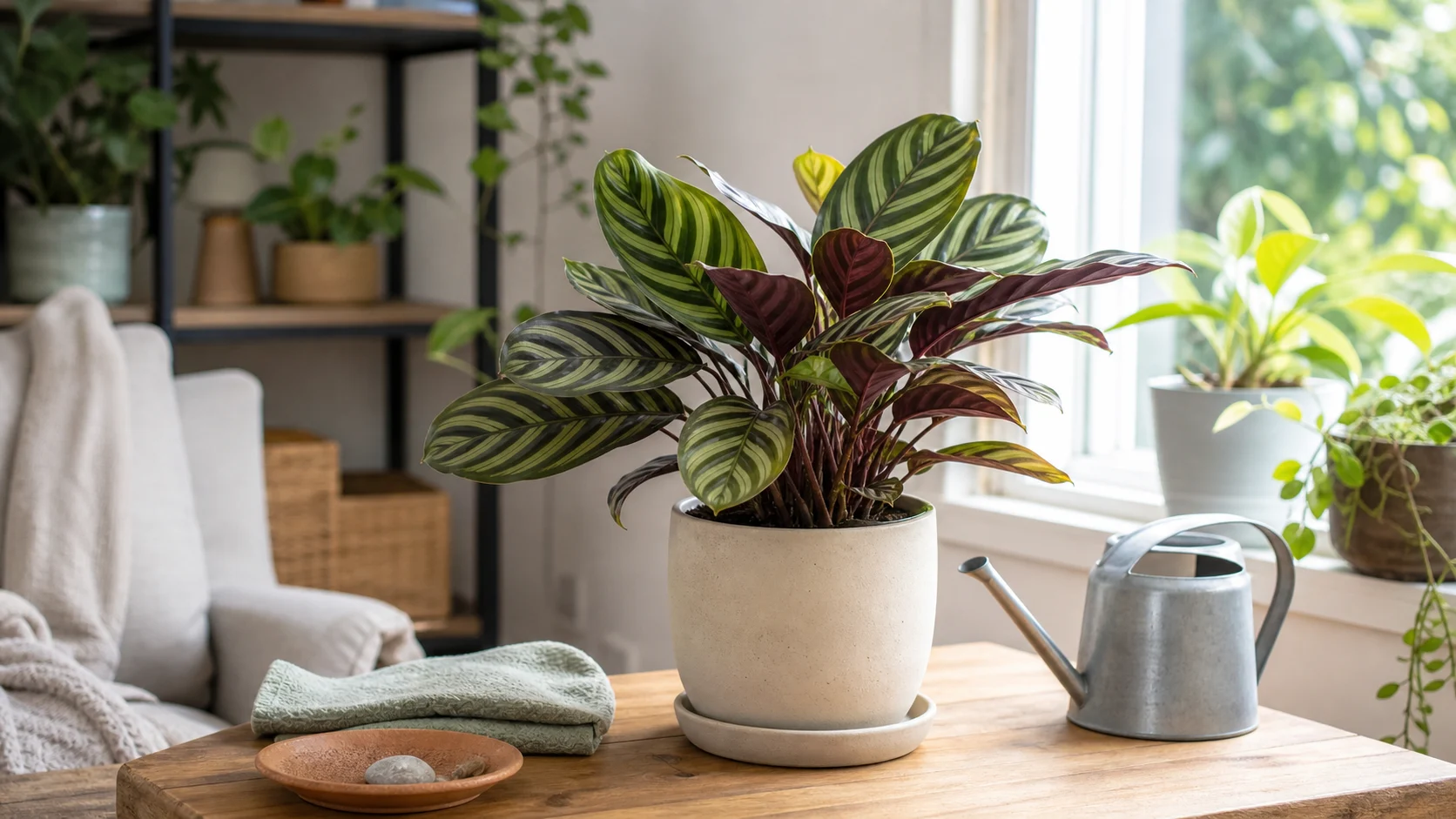
A real-home care check starts with the plant’s light, root zone, leaf pattern, and recent changes.
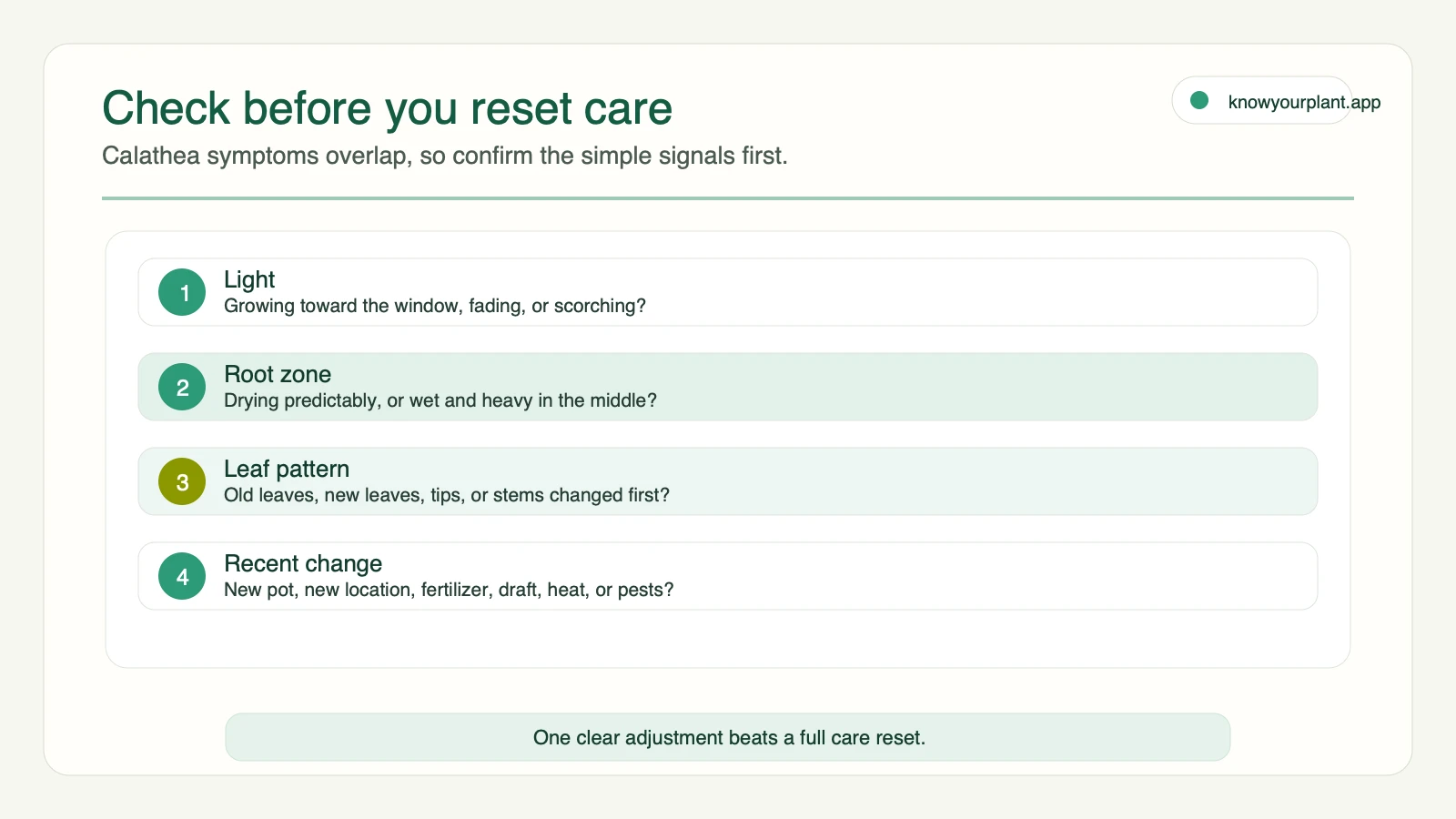
Run this first-check order before changing the whole routine; most calathea symptoms make more sense once light, root zone, leaf pattern, and recent changes are separated.
Identification Snapshot
- Best fit for this guide: common indoor calathea types grown for patterned foliage, including plants now labeled under Goeppertia in some references.
- Healthy baseline: crisp leaf pattern, steady unfurling of new leaves, and nightly movement without dramatic curling during the day.
- Typical failure pattern: brown edges plus curling often come from more than one issue at once, usually light distance, root-zone moisture, dry air, or water quality.
- Fast reality check: if new leaves are emerging smaller, browner, or stuck while the pot stays wet for days, treat light and drainage as the first suspects before buying supplements or changing fertilizer.
Care Cards
| Care card | What to aim for indoors | What to watch for |
|---|---|---|
| Light | Bright indirect light near an east window, or a few feet back from filtered south light | Faded pattern, slow unfurling, or a plant parked too far from usable window light |
| Water | Even moisture with the top 1 to 2 inches drying slightly before watering again | Bone-dry soil with curled leaves, or a pot that stays wet and heavy for too long |
| Humidity | Around 60% if possible, with a humidifier or plant cluster doing more than occasional misting | Crisp edges on new growth, especially in heated or air-conditioned rooms |
| Water quality | Filtered, distilled, rain, or rested tap water if your local supply is harsh | Brown tips that continue even after humidity improves |
| Temperature | Warm, draft-free placement away from cold windows, vents, and radiator blasts | Sudden curling, limp foliage, or damaged new leaves after a cold night |
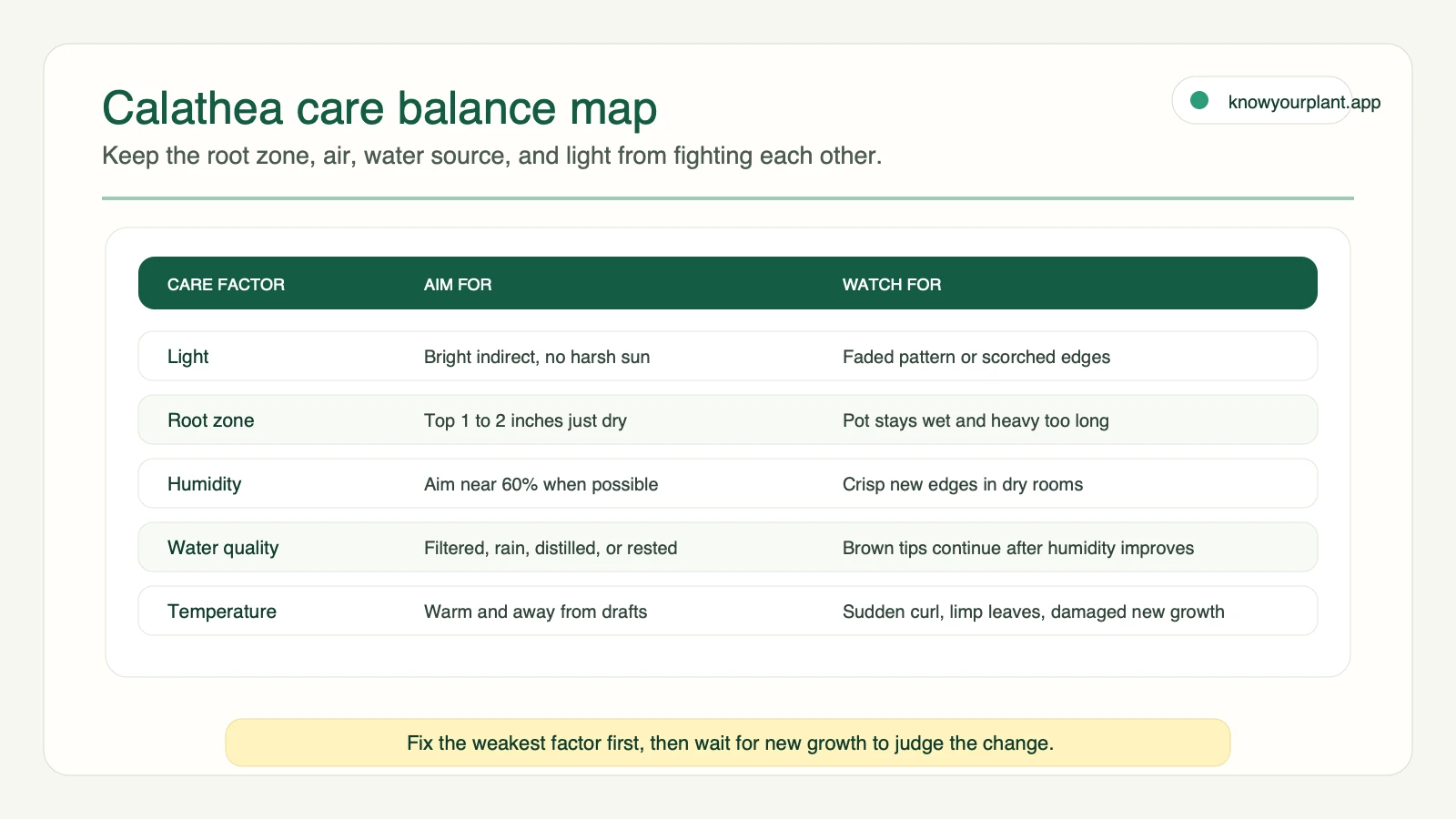
The balance map shows the five care factors that usually combine behind crispy edges, curling leaves, or slow unfurling.
Lookalikes and Confused With
Calathea is often grouped with prayer plants and other Marantaceae, which is fine for broad care, but it can hide a few practical differences.
- Prayer plant (Maranta): similar leaf movement, but usually lower and more trailing. Care overlaps, though marantas often forgive dry air a little more easily.
- Ctenanthe and Stromanthe: close relatives with similar foliage patterns and humidity preferences. If the care advice sounds nearly identical, that is why.
- Low-light damage mistaken for “fussy genetics”: growers sometimes assume a struggling calathea is just a dramatic plant, when the real issue is being several feet too far from a usable window.
Pet Safety
ASPCA lists calathea as non-toxic to dogs, cats, and horses. That makes it a safer foliage plant for pet homes, though chewed leaves can still leave you with a damaged plant.
Quick Answer: Is Calathea a Good Fit for You?
Calathea is a good fit if you have bright indirect light, can check the soil about once a week, and are willing to be a little picky about water and humidity. She is probably not the best first plant if you want something that can dry out for weeks, sit in harsh direct sun, or handle very dry indoor air without complaints.
Use this as your starting point:
- Water when the top 1 to 2 inches of soil are just starting to dry. In many homes, that means about every 7 to 10 days in warm months and less often in winter.
- Signs you are overdoing it: soil stays wet for days, lower leaves turn yellow, stems feel limp, or the pot smells musty.
- Signs she is too dry: leaves curl inward, soil pulls away from the pot edge, or brown tips show up while the soil feels dry.
- Best spot: near a bright window where the sun does not hit the leaves directly.
- Biggest routine need: consistent moisture, higher humidity, and filtered or rested water if your tap water is harsh.
What Kind of Plant Is Calathea, Really?
Calathea is a tropical plant native to the forest floors of South America, part of the Marantaceae family alongside prayer plants, which share many of the same care needs. In the wild, calathea lives under a dense canopy, where light is soft and filtered, humidity is constant, and the soil never fully dries out but never sits waterlogged either.
That context explains almost everything about calathea care. She isn’t dramatic for the sake of it. She’s just a plant that evolved in very specific conditions, and when those conditions aren’t met, she tells you.
The most recognizable trait of calathea is her leaves: bold patterns in deep green, silvery white, and burgundy that look almost painted on. Many varieties also move throughout the day, folding their leaves upward at night and opening them again in the morning in a process called nyctinasty. That daily rhythm is a good sign. When a calathea stops moving, it’s worth paying attention.
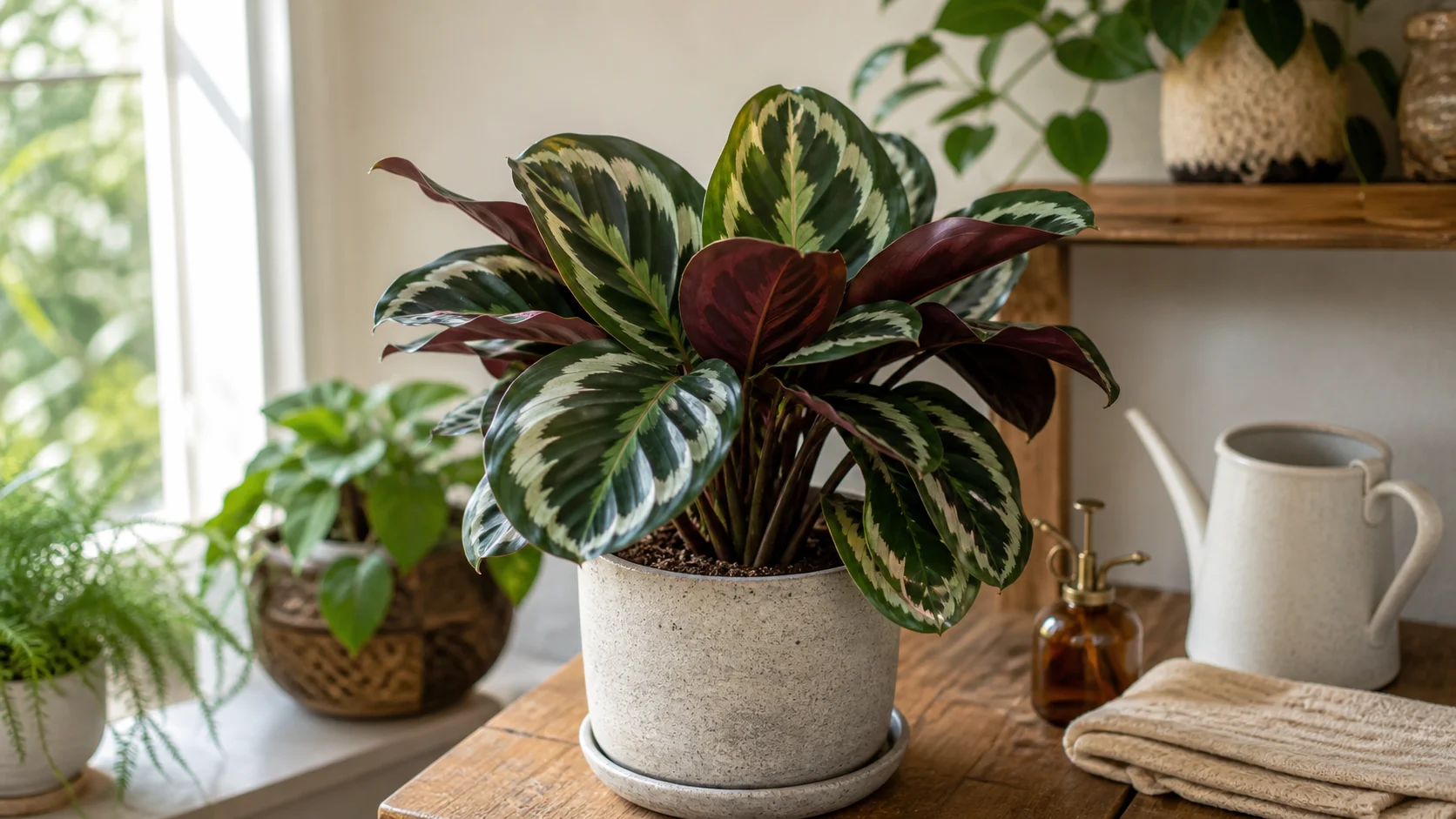
Bold patterned leaves and burgundy undersides reflect Calathea’s tropical forest-floor origins.
Light: Bright but Never Direct
Calathea belongs somewhere bright, but out of the way of direct sun. A few hours of harsh direct light will bleach her markings and leave the edges looking scorched. She does best near a window that gets good ambient light without the sun hitting the leaves directly.
North and east-facing windows often work well. West-facing is fine if you can pull her back from the glass a little. South-facing windows can work too, but she’ll need some distance or a sheer curtain to soften the light.
If her colors are fading or new leaves come in paler than expected, she may need a bit more light. If the edges are burning and the patterns are washing out, she’s probably getting too much. If your space is on the darker side, a grow light positioned a few feet away can give her the consistent brightness she needs without the intensity of direct sun.
Watering: The Part That Trips Most People Up
Watering is where most calathea problems start, and the tricky part is that both overwatering and underwatering can look similar at first. Curling leaves, crispy edges, yellowing – these symptoms overlap, which makes diagnosis frustrating.
How Often to Water
There’s no single schedule that works for every home or every season. Instead of counting days, check the soil. Push your finger into the top inch or two of potting mix. If it still feels moist, wait. If it’s just starting to dry out at that depth, it’s time to water.
Calathea doesn’t want to dry out completely between waterings. Her roots aren’t built for drought. But she also doesn’t want to sit in soggy soil. According to the University of Florida IFAS Extension, members of the Marantaceae family are among the more sensitive houseplant groups to both waterlogging and drought stress, with consistent moisture being the key factor for healthy root function. The sweet spot is even, reliable moisture, not feast and famine.
When you do water, water thoroughly until a little drains from the bottom, then empty the saucer. A small splash every few days keeps the top damp while the lower roots stay dry, which is not what calathea needs. A full soak followed by a real drying check is more reliable.
If you are not sure whether to water today, lift the pot. A dry pot feels noticeably lighter than a freshly watered one. Use that weight check together with the finger test, especially in winter when the surface can look dry while the lower soil is still wet.
Water Quality Matters More Than You’d Think
This is the detail that surprises most calathea growers: she’s sensitive to the minerals and chemicals in tap water. Fluoride, chlorine, and dissolved salts can cause the distinctive brown tips that look like crispy lace along the leaf edges. According to the University of Florida IFAS Extension, fluoride toxicity in Marantaceae plants manifests specifically as marginal and tip scorch, and is frequently mistaken for underwatering or low humidity.
If your tap water is heavily treated, let it sit out overnight before using it, or switch to filtered water or rainwater if you can. It’s one of those small changes that makes a noticeable difference over time.
Humidity: She Wants More Than Your Home Probably Has
Most homes sit somewhere between 30 and 50 percent relative humidity. Calathea would prefer 60 percent or higher. The Missouri Botanical Garden notes that the Marantaceae family originates from tropical regions where humidity consistently ranges between 70 and 90 percent. That gap between what your home offers and what she evolved in is one of the main reasons she struggles.
The good news is that you have options. If you have a bright, steamy bathroom, calathea is one of the few plants that often does better there than in a dry living room, which is why she shows up in our guide to the best bathroom plants.
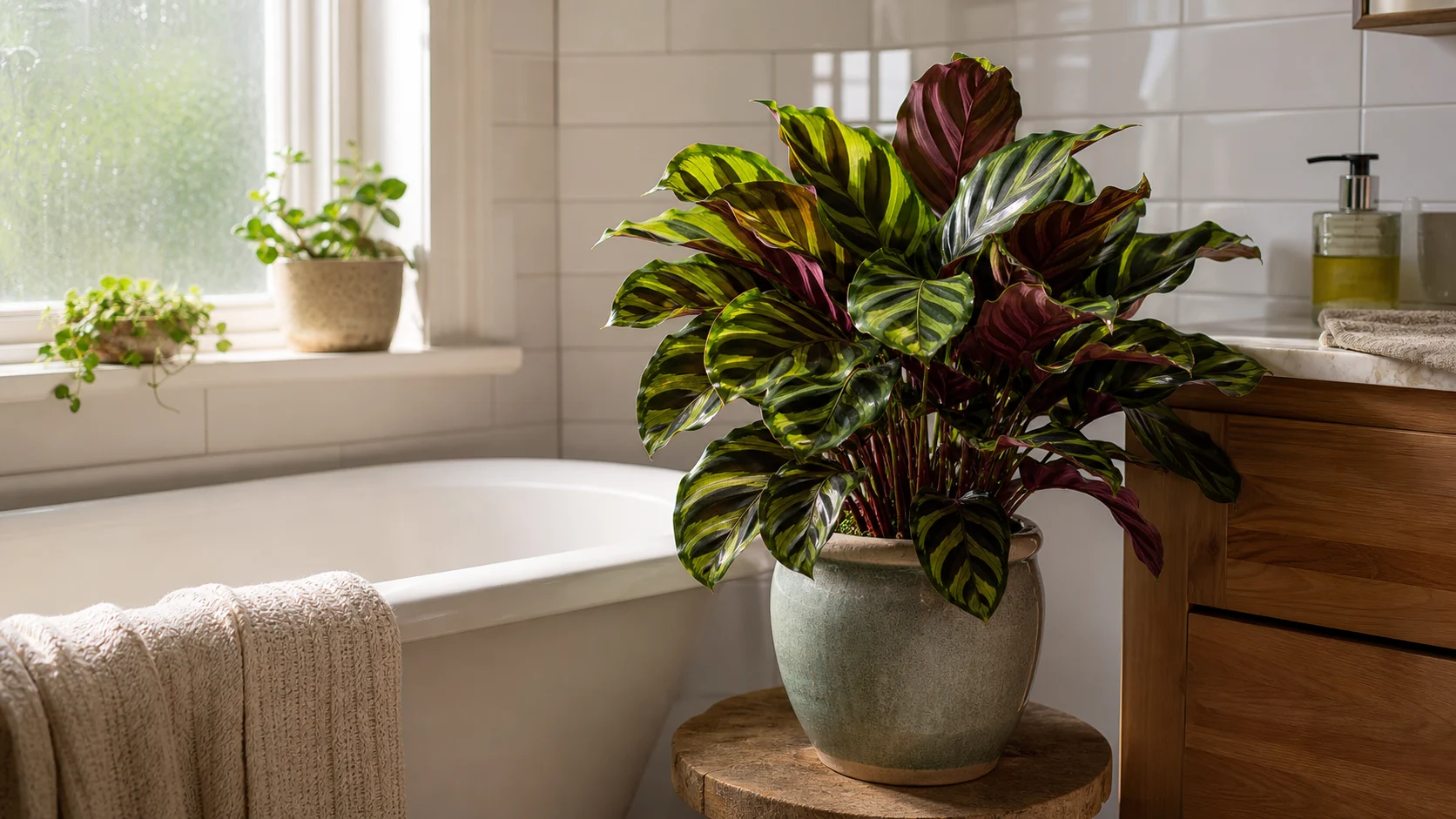
A bright, naturally humid bathroom can suit Calathea better than a dry living room.
Ways to Raise Humidity
A pebble tray works well: fill a shallow tray with pebbles, add water just below the surface of the stones, and set the pot on top. As the water evaporates, it lifts humidity around the plant without letting the roots sit in water. It sounds a little like an art installation, but it works.
Grouping plants together also helps. Plants release moisture through their leaves, so a cluster of tropical plants creates a slightly more humid microclimate than a single plant on its own. Pairing calathea with other humidity-loving plants like heartleaf philodendron is a natural fit.
A small humidifier placed nearby is the most effective solution if your home is particularly dry, especially in winter when heating systems pull moisture from the air.
Misting is often recommended but isn’t always helpful. Fine misting can raise humidity briefly, but if water sits on the leaves or gets into the crown of the plant, it can encourage fungal issues. A pebble tray or humidifier is more consistent and less risky.
Soil and Potting
Calathea does best in a mix that holds some moisture but still drains well. A standard indoor potting mix is a reasonable starting point, but you can improve drainage by mixing in a little perlite. The goal is soil that feels lightly moist throughout, not dense and wet.
Repot when you see roots circling the bottom of the pot or poking through the drainage holes. Calathea doesn’t need a huge pot – going one size up is usually enough. Too large a pot holds more moisture than the roots can use, which creates overwatering conditions even when you’re watering carefully.
Fertilizing
Calathea is not a heavy feeder. A balanced liquid fertilizer at half strength, applied once a month during spring and summer, is plenty. Skip fertilizing in autumn and winter when her growth slows and she doesn’t need the extra input.
Over-fertilizing is a real risk with calathea. Salt buildup from fertilizer can cause the same brown tip symptoms as fluoride or hard water. If you’ve been fertilizing regularly and the tips are still crisping up, flush the soil thoroughly with water to wash out any accumulated salts, then dial back the feeding frequency.
Calathea Through the Seasons
Calathea’s needs shift meaningfully across the year, and adjusting your care to match makes a real difference.
Spring (March to May)
Spring is when calathea comes back to life. Growth that slowed or stalled over winter starts picking up, and new leaves begin unfurling more regularly. This is the best time to repot if she’s outgrown her container, and the right moment to resume monthly fertilizing.
Watering frequency will increase as temperatures rise and the soil dries out faster. Keep checking the top inch of soil rather than watering on a schedule. If you’ve been running a humidifier through winter, continue until outdoor humidity picks up naturally.
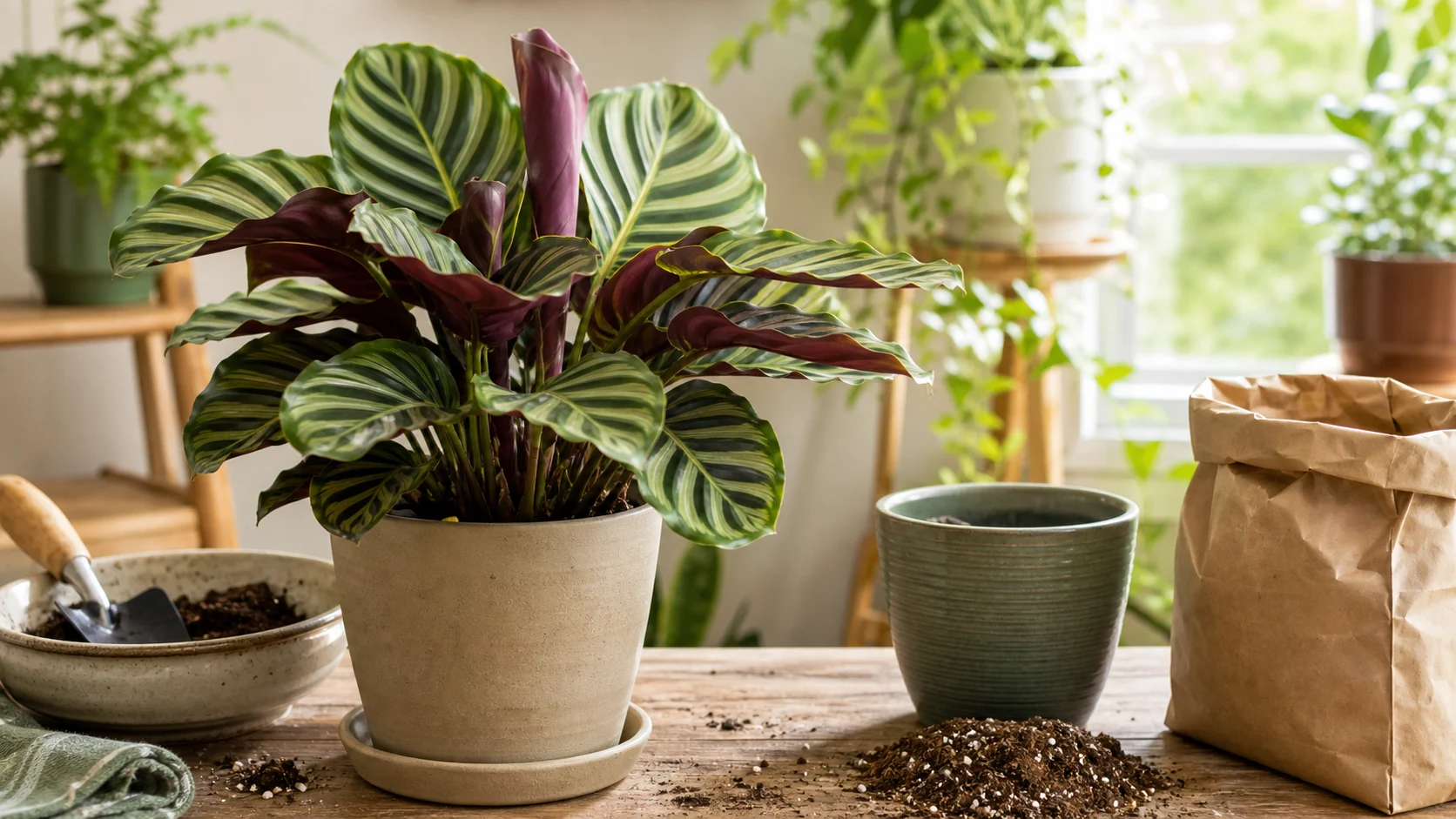
Fresh unfurling leaves and a prepared potting area signal the start of Calathea’s spring growth cycle.
Summer (June to August)
Peak growing season. Calathea will be at her most active, pushing out new leaves and responding quickly to good conditions. Consistent moisture matters most now. In hot weather, the soil dries out faster and she may need water more often than you expect.
Summer is also when spider mites become more likely, especially if the air is hot and dry. Check the undersides of leaves occasionally, particularly if you notice fine webbing or a dusty look on the leaf surface. If you spot early signs, follow our guide on how to get rid of spider mites before the infestation spreads. A damp cloth wiped across the leaves helps to clean them and deter pests at the same time.
Autumn (September to November)
Growth starts to slow as light levels drop and temperatures ease off. Taper fertilizing in September and stop completely by October. Watering frequency will naturally reduce as the soil stays moist longer.
The transition into autumn is also when indoor heating tends to kick in, and that’s one of the biggest threats to calathea. Central heating drops indoor humidity sharply. If you don’t already have a pebble tray or humidifier set up, now is the time. Watch for new leaf edges starting to crisp: that’s often the first sign the air has gotten too dry.
Winter (December to February)
The quietest season for calathea. Growth slows significantly, sometimes stopping entirely, and that’s normal. Resist the urge to fertilize or repot during this period.
Water carefully: the soil stays wet longer in winter because the plant is drinking less, and overwatering risk increases. Wait until the top inch or two is clearly dry before watering again. Keep her away from cold drafts, radiators, and exterior walls, which can get surprisingly cold at night. Stable, moderate warmth and consistent humidity are the two things that will carry her through until spring.
Common Problems and What They’re Telling You
Before you jump to one fix, sort the symptom by where it appears and what changed recently.
| Symptom | Most likely stack | Check first |
|---|---|---|
| Brown edges on older leaves | Dry air, harsh water, or inconsistent watering | Soil moisture pattern, then water source |
| Leaves curling inward by midday | Root zone too dry, dry air, or cold draft | Finger test 1 to 2 inches down, then nearby vent or window exposure |
| New leaves crisping before they open | Low usable light, dry air during unfurling, or roots staying too wet | Distance from window, humidity support, and drainage |
| One leaf yellows at a time | Normal aging, overwatering, or weak light slowing uptake | Whether it is the oldest leaf, and whether the pot is still heavy days after watering |
| Spots plus curling together | Leaf-wetting issues, watering imbalance, or pest stress | Undersides of leaves, recent misting, and soggy soil |
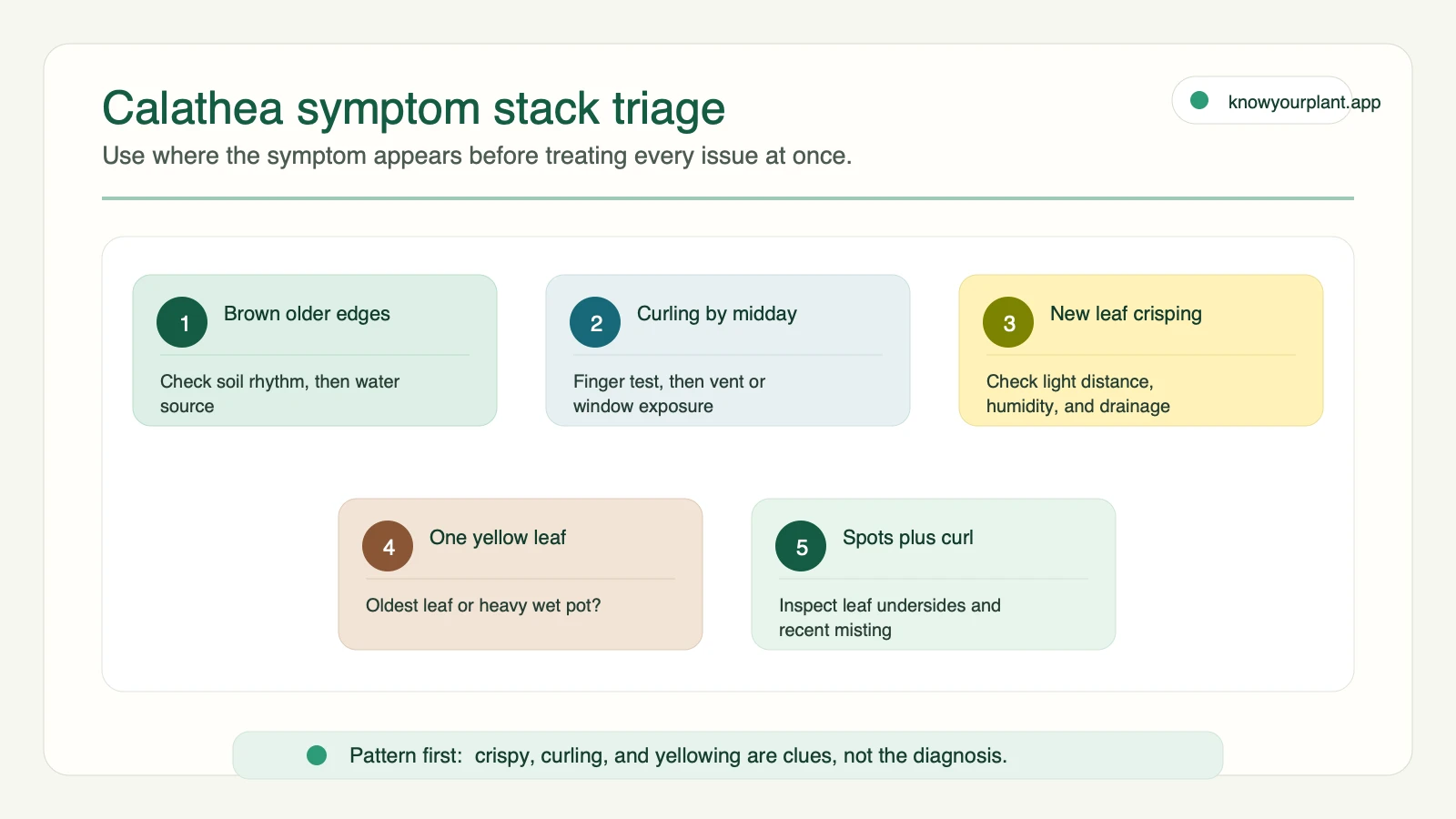
Use the symptom stack to choose the first check instead of treating brown edges, curling, spots, and yellowing as one generic problem.
Leaves Curling Inward
Curling is usually a stress response. The most common causes are low humidity, inconsistent watering, or cold drafts. Check all three. If the soil is dry and your home is particularly low humidity, address both at once. Darryl Cheng of House Plant Journal describes curling leaves in moisture-sensitive plants as “the plant reducing its surface area to slow down water loss” – a self-protective response that tells you she needs more humidity or water before the situation gets worse.
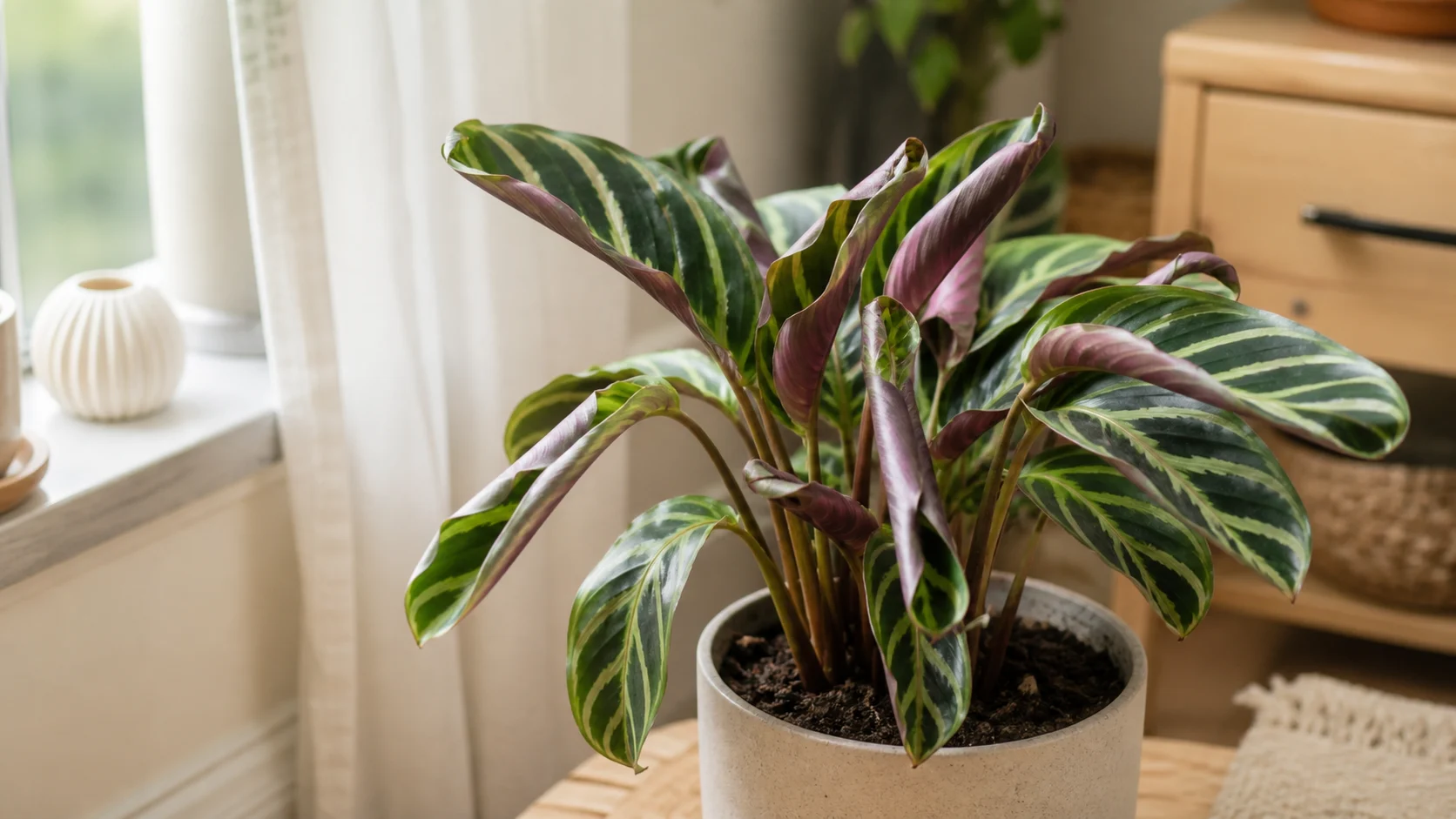
Inward-curling leaves reduce exposed surface area when a Calathea is short on moisture or humidity.
Brown, Crispy Edges
Crispy edges almost always point to humidity or water quality. Try switching to filtered water and boosting moisture in the air around her. It won’t fix the existing damage – those leaves stay damaged – but new leaves should come in cleaner once the conditions improve.
Yellow Leaves
Yellow leaves can mean overwatering, underwatering, or occasionally too much direct sun. Check the soil first. If it feels dense and wet and the pot has been sitting that way for a while, ease up on watering and make sure the drainage holes aren’t blocked. If you’re seeing persistent wilt in wet soil or a sour smell from the pot, work through our root rot treatment guide before watering again. If the soil is dry all the way down and the leaves feel thin or papery, water thoroughly and check again in a day.
If several lower leaves yellow at once, treat it as a watering or drainage problem first. If only one older leaf yellows while new growth looks healthy, it may simply be aging out.
Loss of Leaf Movement
When a calathea stops folding her leaves at night, it’s usually a sign of stress: too dry, too cold, or recently repotted. It’s not always cause for alarm, but it’s worth reviewing her conditions. A calathea that’s comfortable will move reliably.
Temperature and Drafts
Calathea prefers temperatures between 65 and 80 degrees Fahrenheit. She doesn’t tolerate cold well, and she particularly dislikes drafts from air conditioning vents, open windows in winter, or the cold air that collects near exterior walls. If you notice sudden leaf deterioration or rapid curling, check whether she’s in the path of a cold or hot air source. Moving her a few feet can make a significant difference.
Your Simple Calathea Care Plan
If you only do a few things, make them these:
- Today: check the top 1 to 2 inches of soil, move the plant out of direct sun, and trim only fully dead crispy edges with clean scissors.
- This week: switch to filtered, distilled, rain, or overnight-rested water if brown tips are showing up; add a pebble tray or humidifier if the air is dry.
- This season: adjust watering as light and temperature change. Water checks get more frequent in spring and summer, then slower and more cautious in autumn and winter.
Do not try to fix every symptom at once. Change one care factor, give the plant a week or two, and watch whether new growth comes in cleaner.
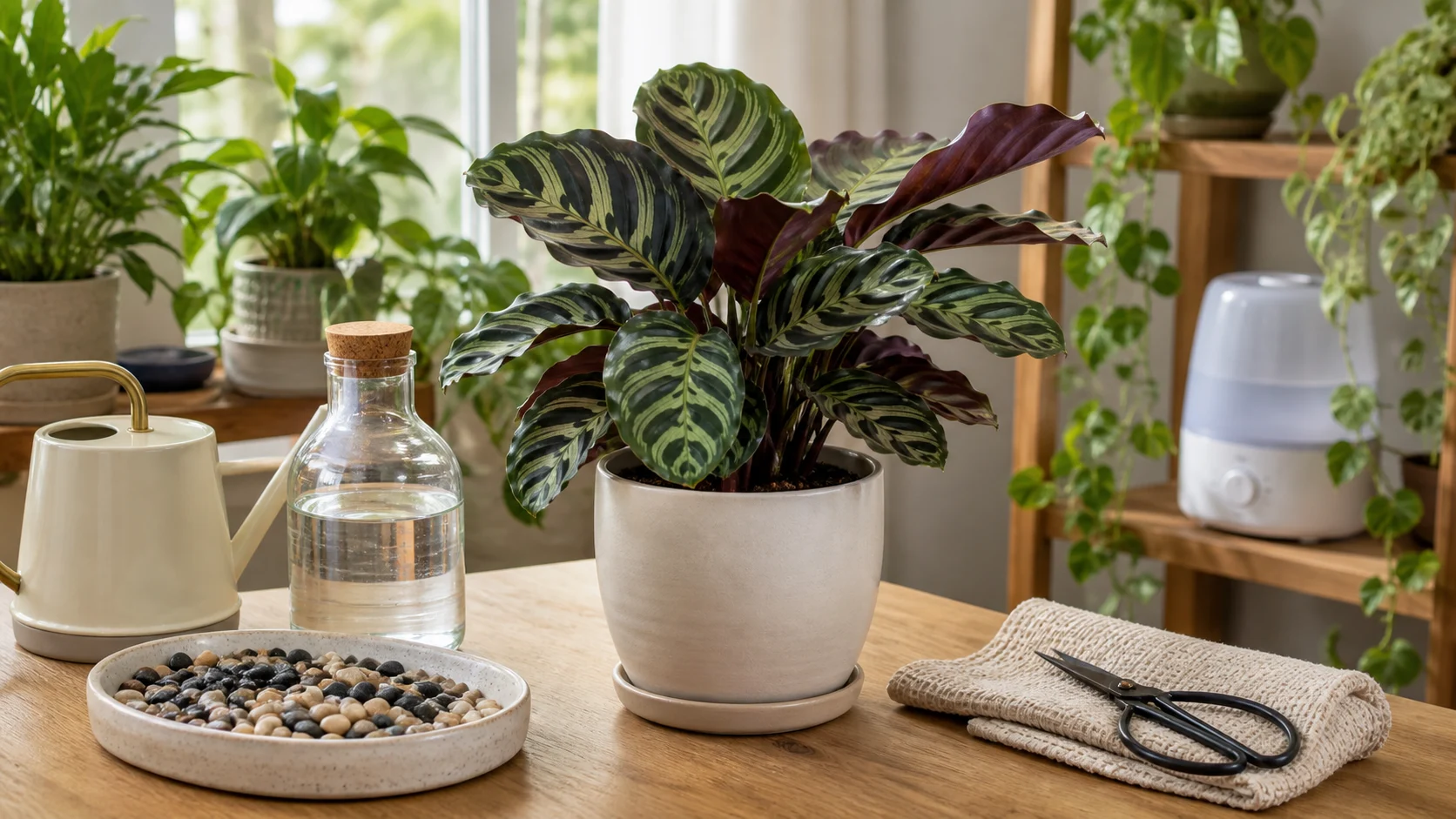
Filtered water, steady humidity, and careful trimming form a practical Calathea care routine.
Real User FAQ
How often should I water calathea? There’s no fixed schedule that works for everyone. The most reliable approach is to check the soil: when the top inch or two is just starting to dry out, water thoroughly until it drains from the bottom. In most homes, that means watering every 7 to 10 days in summer and less frequently in winter.
Why are my calathea leaves curling? Curling is almost always a response to stress, usually low humidity, underwatering, or cold drafts. Check the soil moisture first. If it’s dry, water her and move her somewhere more humid. If the soil is moist but the air is very dry, a pebble tray or humidifier will help. Cold air from a nearby vent or window is another common culprit.
Why does my calathea have brown tips? Brown tips are typically caused by water quality or low humidity, or both. Tap water with fluoride, chlorine, or dissolved salts is one of the most common triggers. Switching to filtered or distilled water and increasing humidity around the plant usually stops new damage from forming. Existing brown tips won’t recover, but new leaves should come in clean.
Is calathea safe for cats and dogs? Yes, calathea is considered non-toxic to cats and dogs by the ASPCA, making her one of the safer choices if you have pets at home. If pet safety is a priority in how you choose plants, it’s worth browsing our full list of cat-safe indoor plants.
Why has my calathea stopped moving its leaves? The folding and unfolding movement – called nyctinasty – is a sign of a healthy, well-adjusted plant. When it stops, it usually means she’s under stress: too dry, too cold, recently repotted, or in conditions that are too dark. Review her placement and conditions. Once she settles, the movement typically returns.
Can calathea grow in low light? She can tolerate lower light better than many tropical plants, but low light isn’t ideal. In very dim conditions her growth will slow significantly, her colors may dull, and she’ll be more prone to overwatering since the soil dries out more slowly. If you need varieties that genuinely handle darker rooms, browse our roundup of low light indoor plants. Bright indirect light gives her the best chance to thrive. If your space is dim, a simple grow light set to a 12-hour cycle can fill the gap.
Should I mist my calathea? Occasional misting won’t hurt her, but it’s not a reliable way to raise humidity. The moisture evaporates quickly and water sitting on the leaves or in the crown can lead to fungal spots. A pebble tray filled with water or a small humidifier nearby is more consistent and more effective.
When should I repot calathea? Repot when roots start circling the bottom of the pot or poking through drainage holes, which usually happens every one to two years. Spring is the best time, when she’s entering her active growing season. Move up just one pot size – a pot that’s too large holds excess moisture that can lead to root rot.
Calathea care isn’t about having a perfect setup from day one. It’s about learning to read her. The crispy edges, the curling leaves, the subtle changes in how she holds herself, they’re all communication. Once you start paying attention, the back-and-forth becomes intuitive. She’s worth the learning curve.
If you want help keeping track of when she last needed water or when to check in on her conditions, Download KnowYourPlant for personalized plant care reminders that adapt to your home and your plants.
Methodology Note
This guide was refreshed in June 2026 using live review of exact-keyword search results and close symptom queries such as calathea watering, leaves curling, and brown tips. Practical language from plant-owner forum threads was used to identify the most confusing symptom clusters, then cross-checked against North Carolina Extension, the Royal Horticultural Society, and ASPCA. Community discussions are qualitative signal only, not proof on their own.
Freshness Note
Last updated: 2026-06-14. If your calathea still declines after you fix water quality and humidity, re-check light distance and root-zone dry-down before assuming you have a rare disease problem.