Climate DNA for heartleaf philodendron
The heartleaf plant in this guide is tied to the accepted species Philodendron hederaceum, including the broad POWO native range from Mexico through tropical America.
The ranges below are the middle 50% (p25–p75), not recommended indoor setpoints.
| Reference taxon | POWO native range | Annual mean temperature | Annual precipitation | Relative humidity | Solar radiation | Evidence |
|---|---|---|---|---|---|---|
| Philodendron hederaceum (heartleaf philodendron) | Mexico to tropical America | 24.0–25.9°C | 1668–2787 mm/yr | 64–68% | 17.0–18.7 MJ/m²/day | 30 climate points / 783 usable records; medium confidence |
What this changes in this guide: A broad field envelope indicates ecological variation, not immunity to soggy potting mix. Use it to understand context while checking the indoor root zone directly.
Sources and method: Philodendron hederaceum in POWO and GBIF; CHELSA V2.1, 1981–2010. GBIF records are limited to POWO-native countries, then filtered for coordinates, establishment signal, licence, precision, and spatial duplication. No community or user-reported care data is used in this module.
Heartleaf Philodendron Care, Without the Guesswork
If you want a trailing houseplant that can handle normal indoor light and a busy routine, heartleaf philodendron is one of the easiest good fits. The main way people get into trouble is simple: watering too often.
The quick answer: water when the top 3-4 cm of soil feels dry. In many homes that means every 7-10 days in warm, bright months and every 12-14 days, sometimes longer, in winter. Yellow lower leaves plus wet soil usually mean you are overdoing it. Curling or limp leaves with very dry soil usually mean it is time to water.
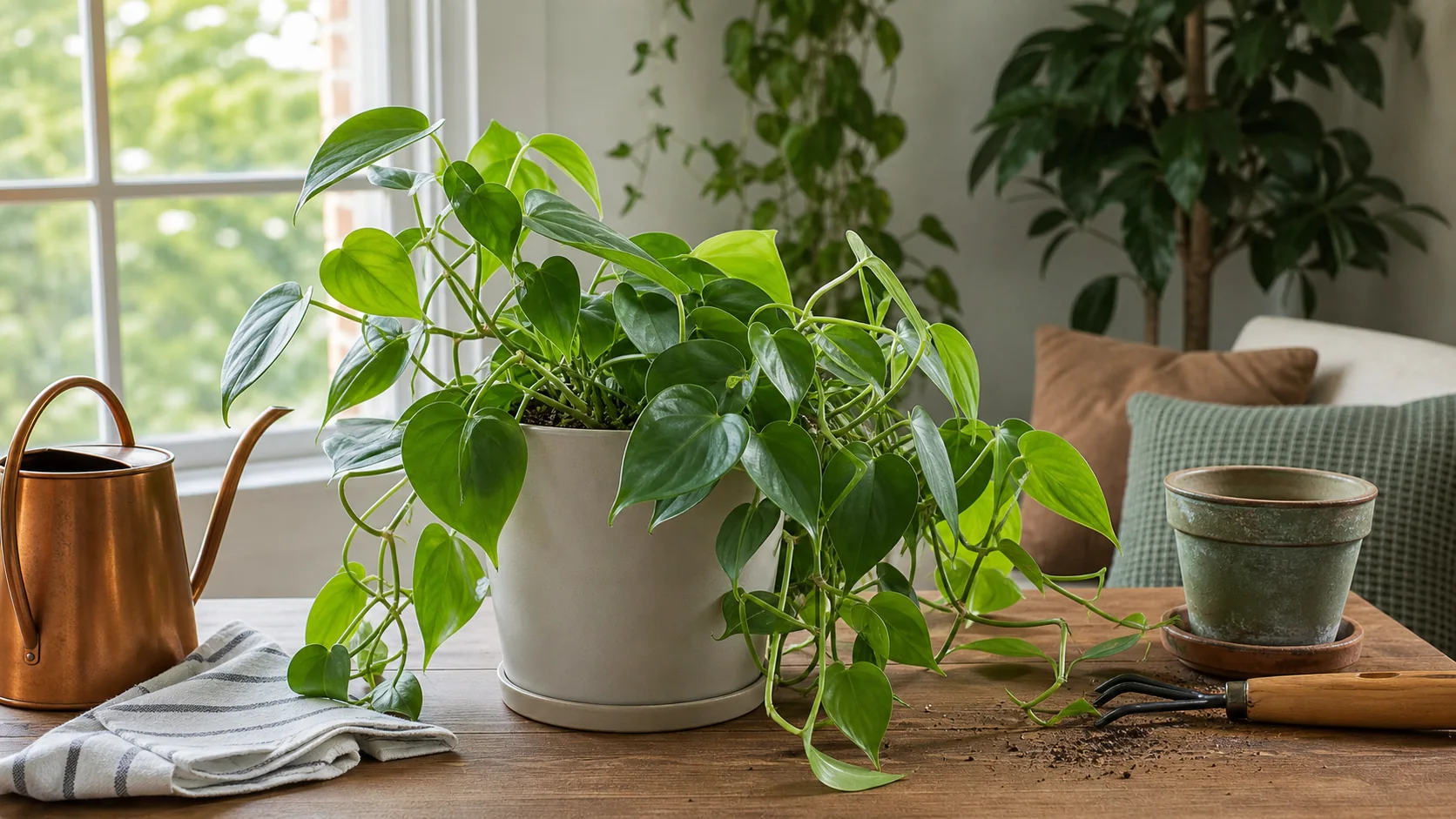
A moisture check, drainage-ready pot, and patient watering are the core of this forgiving vine’s routine.
The heartleaf philodendron (Philodendron hederaceum) is a fast-growing tropical vine with glossy, heart-shaped leaves that trail from shelves or climb a moss pole if you give it support. It is popular because the care is easy to check: light, soil moisture, and a few visible leaf clues tell you most of what you need to know.
NASA researcher Dr. B.C. Wolverton, whose 1989 Clean Air Study tested dozens of common houseplants, identified heartleaf philodendron as one of the top performers for removing formaldehyde from indoor air in controlled conditions. It’s not a miracle air filter, but it’s a nice bonus from a plant that’s already earning its spot on your shelf.
This is heartleaf philodendron care in one sentence: indirect light, a finger-test before watering, and a little patience. Everything else is details.
Identification Snapshot
| Detail | What to check |
|---|---|
| Botanical name | Philodendron hederaceum, usually sold as heartleaf philodendron |
| Growth habit | Trailing or climbing vine with soft, heart-shaped green leaves |
| Best light | Bright to medium indirect light for fuller growth and larger leaves |
| Water rhythm | Let the top 3 to 4 cm dry before watering again |
| Common confusion | Often mixed up with pothos because both trail and tolerate average rooms |
| Pet safety | Toxic if chewed, so placement matters in homes with cats or dogs |
Lookalikes and Common Confusions
| Plant | How to tell it apart | Why it matters |
|---|---|---|
| Heartleaf philodendron | Softer, thinner heart-shaped leaves and a more delicate vine | This guide fits here |
| Golden pothos | Thicker, waxier leaves, often with yellow variegation | Similar routine, but pothos usually tolerates a little more neglect before looking limp |
| Satin pothos | Silvery markings and a different species entirely | People borrow the name “pothos” and then copy the wrong symptom advice |
Care Cards
| Care card | Fast answer |
|---|---|
| Light | Low light is survivable, but bright indirect light keeps vines fuller and leaves larger |
| Water | Check the root zone, not just the top crust, before watering again |
| Soil | Use drainage holes and an airy mix so the roots do not stay wet for days |
| Growth habit | Trim leggy vines above a node if you want a bushier plant |
| First symptom check | Match the leaf problem with soil moisture, light, and recent changes before you reset care |
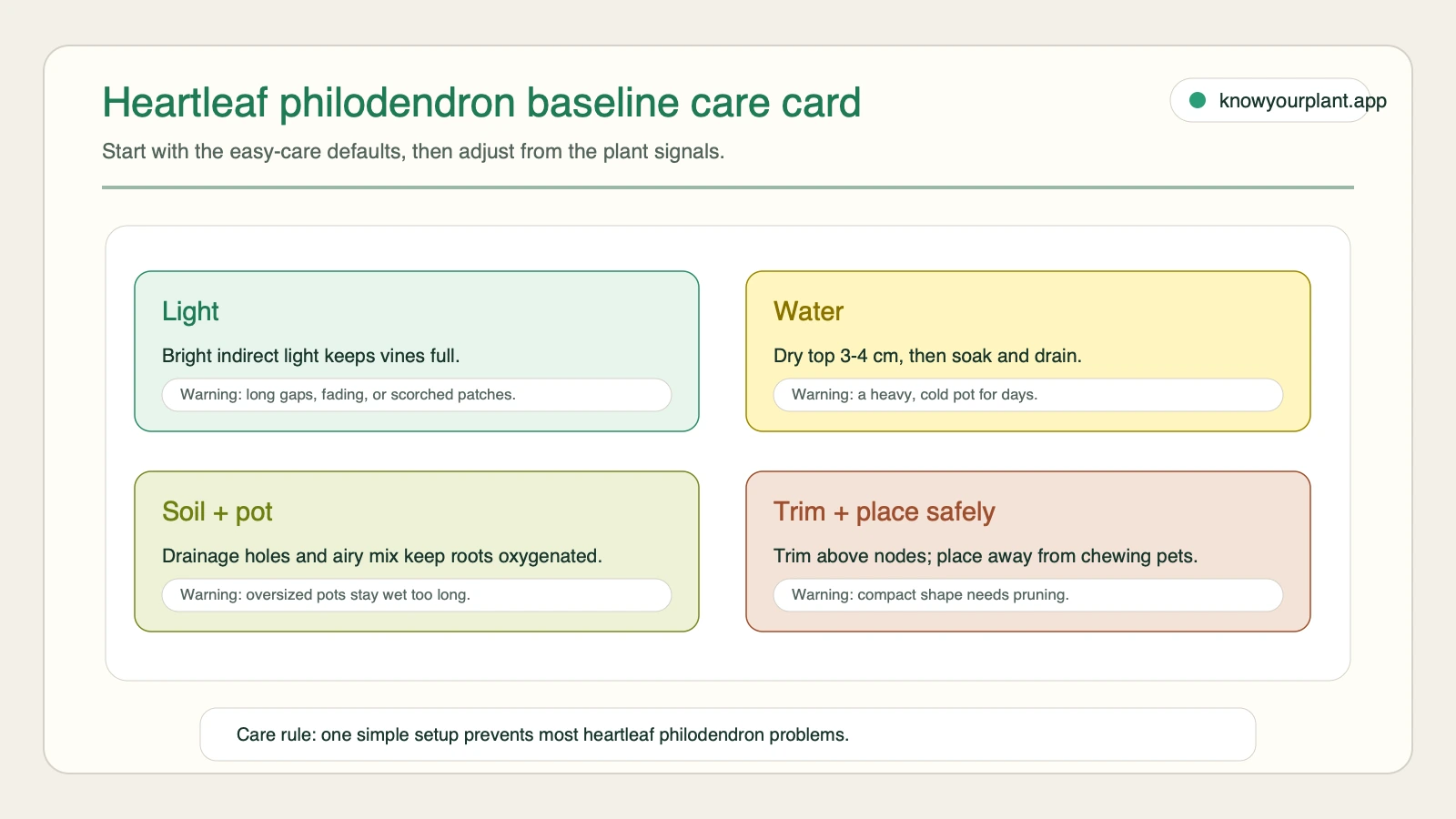
Use these defaults first, then adjust only when the plant gives a clear light, root-zone, or leaf signal.
What Most Care Guides Miss
Most guides about heartleaf philodendron Care describe the ideal care routine. Real homes are messier: light changes by season, pots dry at different speeds, and the same symptom can mean different things depending on where it appears.
Before changing care, check the plant in this order:
- Light: is the plant growing toward the window, fading, or scorching?
- Root zone: is the pot drying predictably, or staying wet in the middle?
- Leaf pattern: did the oldest leaves, newest leaves, tips, or stems change first?
- Recent change: new pot, new location, fertilizer, cold draft, heat vent, or pest exposure.
This keeps you from fixing the wrong problem. One clear adjustment is usually safer than a full care reset.
Light: Where She’ll Be Happiest
Heartleaf philodendron is genuinely flexible about light, which is part of what makes Philodendron hederaceum care so manageable. She’ll grow in a bright spot near a window, and she’ll also do just fine a few feet back from it.
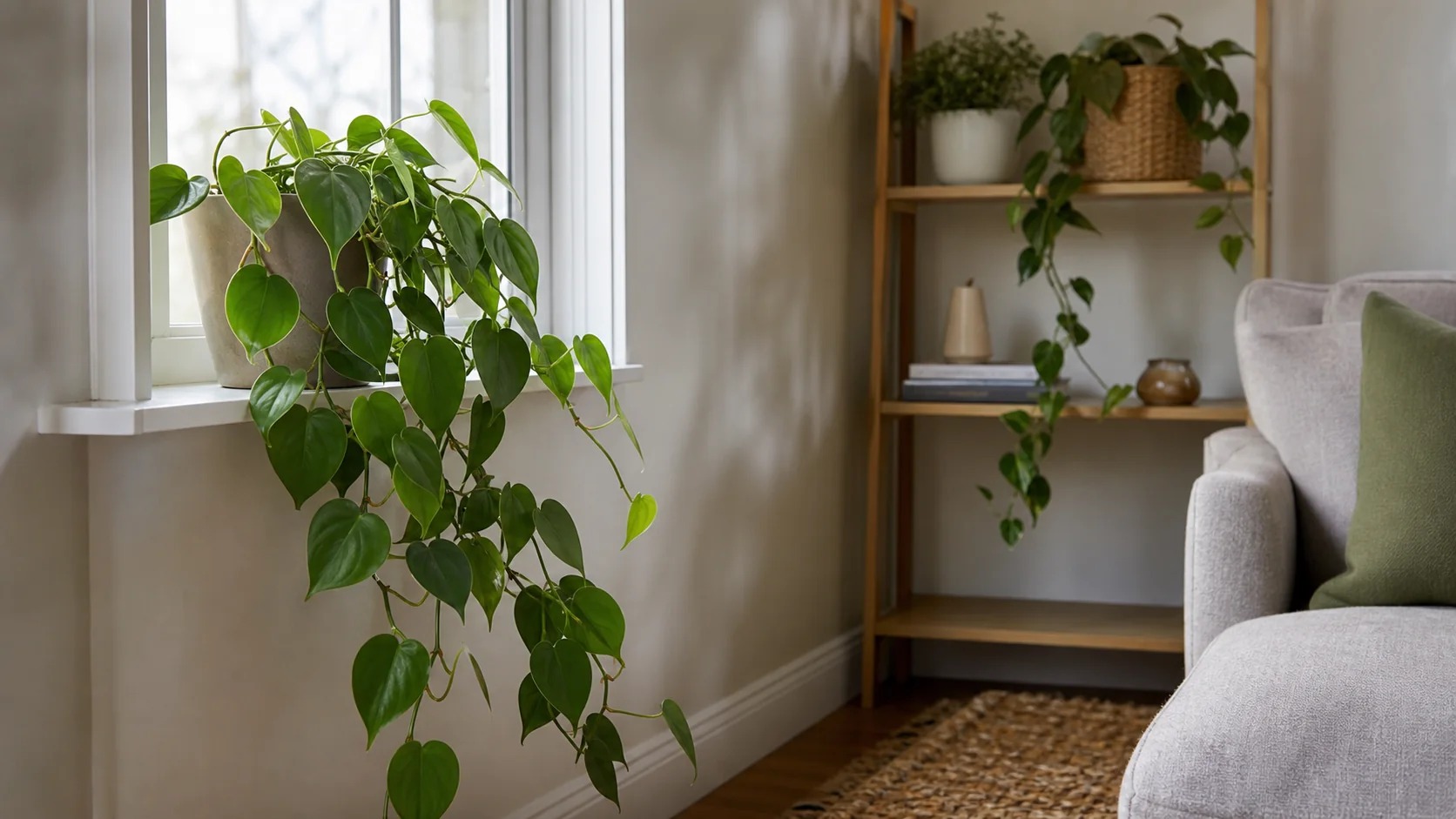
Bright indirect window light keeps heartleaf philodendron growth fuller, while the trailing shelf plant shows its tolerance for dimmer rooms.
What she likes: Bright to medium indirect light. A few feet from an east or north-facing window, or back from a south or west window where direct sun doesn’t hit the leaves.
What she’ll tolerate: Low light. She won’t grow as fast and the leaves may be smaller and spaced farther apart on the vine, but she’ll survive and still look decent. University of Florida IFAS Extension notes that heartleaf philodendron is among the best-adapted common houseplants for interior low-light conditions, making it one of the few plants that genuinely works in offices and rooms far from windows.
What she doesn’t want: Direct sun for long periods. It bleaches the leaves and can leave dry, papery patches that won’t recover.
One of the most common placements that works well: on a high shelf in a room with a window on the far wall. She trails down, the light is indirect, and everyone’s happy.
If you’re not sure whether your light levels are enough, our guide to grow lights for indoor plants has a simple brightness chart you can use to check.
Is It a Good Fit for Your Home?
Use this before you buy one, or before you decide where to put the plant you already have.
Good fit if:
- You have a room with a window, even if the plant will sit several feet away from it
- You can check the soil once a week with your finger
- You want a trailing plant for a shelf, hanging planter, or bookcase
- You sometimes forget a watering by a few days
Not the best fit if:
- The spot gets harsh direct afternoon sun for hours
- You want a plant that stays compact without trimming
- You have pets that chew leaves and cannot place the plant out of reach
- You prefer a plant that needs water on an exact calendar schedule
If your routine is busy, choose a pot with drainage, put it in medium indirect light, and check the soil every weekend. That simple setup prevents most heartleaf philodendron problems.
Watering: Less Than You Think
Most people water their heartleaf philodendron too often. It’s an understandable mistake: the plant is so lush and tropical-looking that it seems like it must be thirsty. It isn’t.
The rule that works: let the top 3-4 cm of soil dry out before watering again. Push your finger into the soil up to the first knuckle. If it still feels damp or cool, wait another day or two. If it feels dry, water thoroughly until water drains from the bottom.
In summer, that might mean watering every 7-10 days. In winter, when growth slows and the soil stays moist longer, it might stretch to every 12-14 days. The plant is the guide, not the calendar.
Darryl Cheng, author of The New Plant Parent, describes the principle well: “The goal isn’t to keep the soil moist. It’s to allow the soil to cycle between wet and dry. Plants need both water and oxygen at the roots.” Heartleaf philodendron thrives on that wet-dry rhythm. Constant moisture is what gets her into trouble.
Signs she’s getting too much water
- Lower leaves yellowing and dropping
- Stems soft or mushy near the base
- Soil that stays wet for more than 10 days
- A musty smell from the potting mix
Signs she needs water
- Leaves starting to curl or look slightly limp
- Soil completely dry several centimetres down
- New growth looking small or slow
- Pot feeling much lighter than usual
She’ll show you when something is off, and she bounces back fast once you correct it.
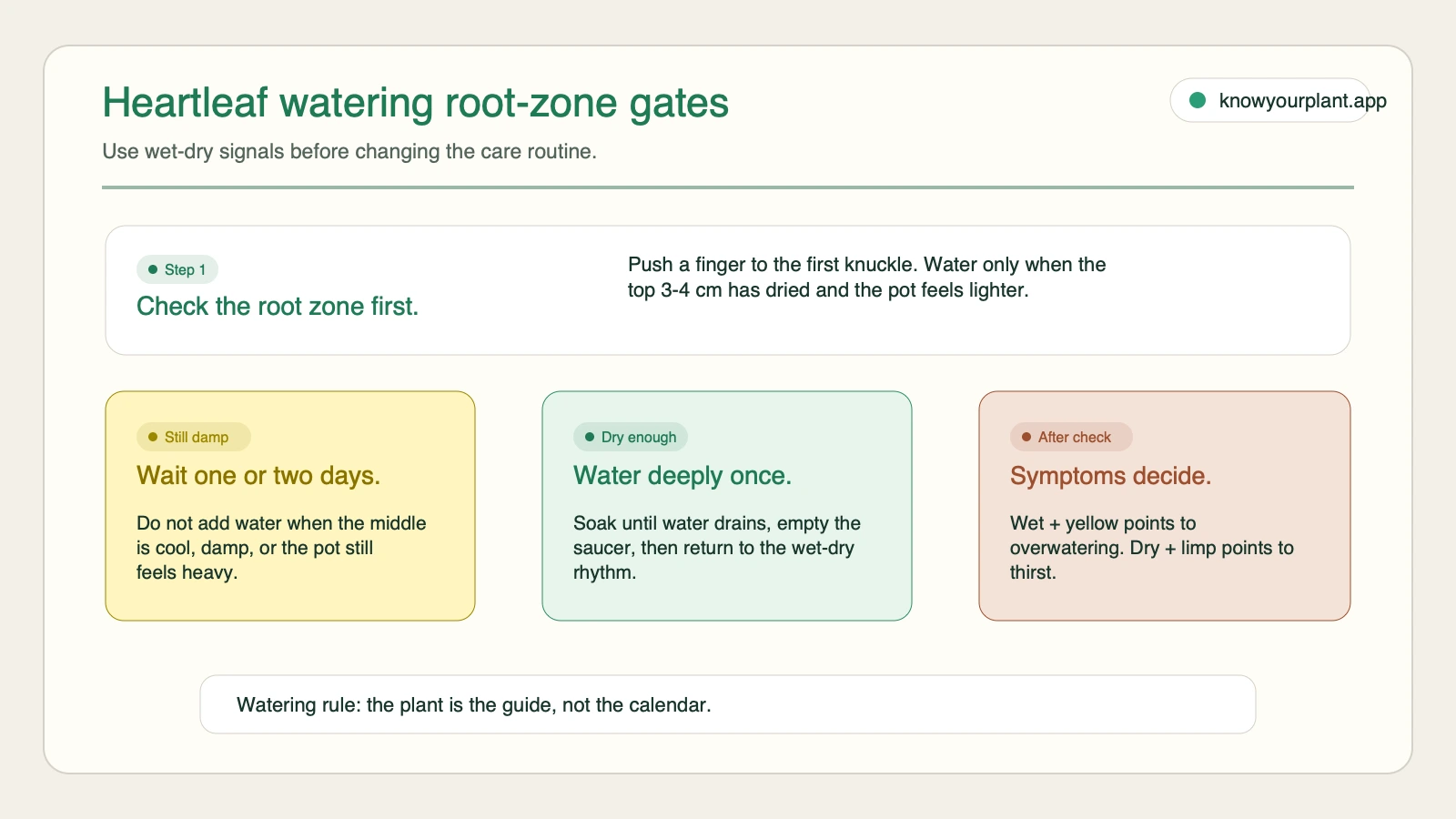
Use the root-zone check before watering, then let leaf symptoms confirm whether the plant was wet too long or simply thirsty.
Soil and Potting
Heartleaf philodendron does best in something that drains well rather than holding moisture for too long. A standard indoor potting mix works fine on its own. If your home tends to be cool and humid, mix in a small handful of perlite to help drainage.
She doesn’t need repotting often. When you see roots coming out of the drainage holes, or the plant seems to dry out within a day of watering even in summer, that’s your sign to go up one pot size. Don’t jump to a much larger pot: too much extra soil around the roots holds moisture she can’t use, which leads to problems.
Humidity and Temperature
She’s a tropical plant, so she appreciates some humidity, but she’s not demanding about it. Average home humidity around 40-50% is perfectly fine. If your home is very dry in winter, a pebble tray with water near the pot helps, but it’s not strictly necessary.
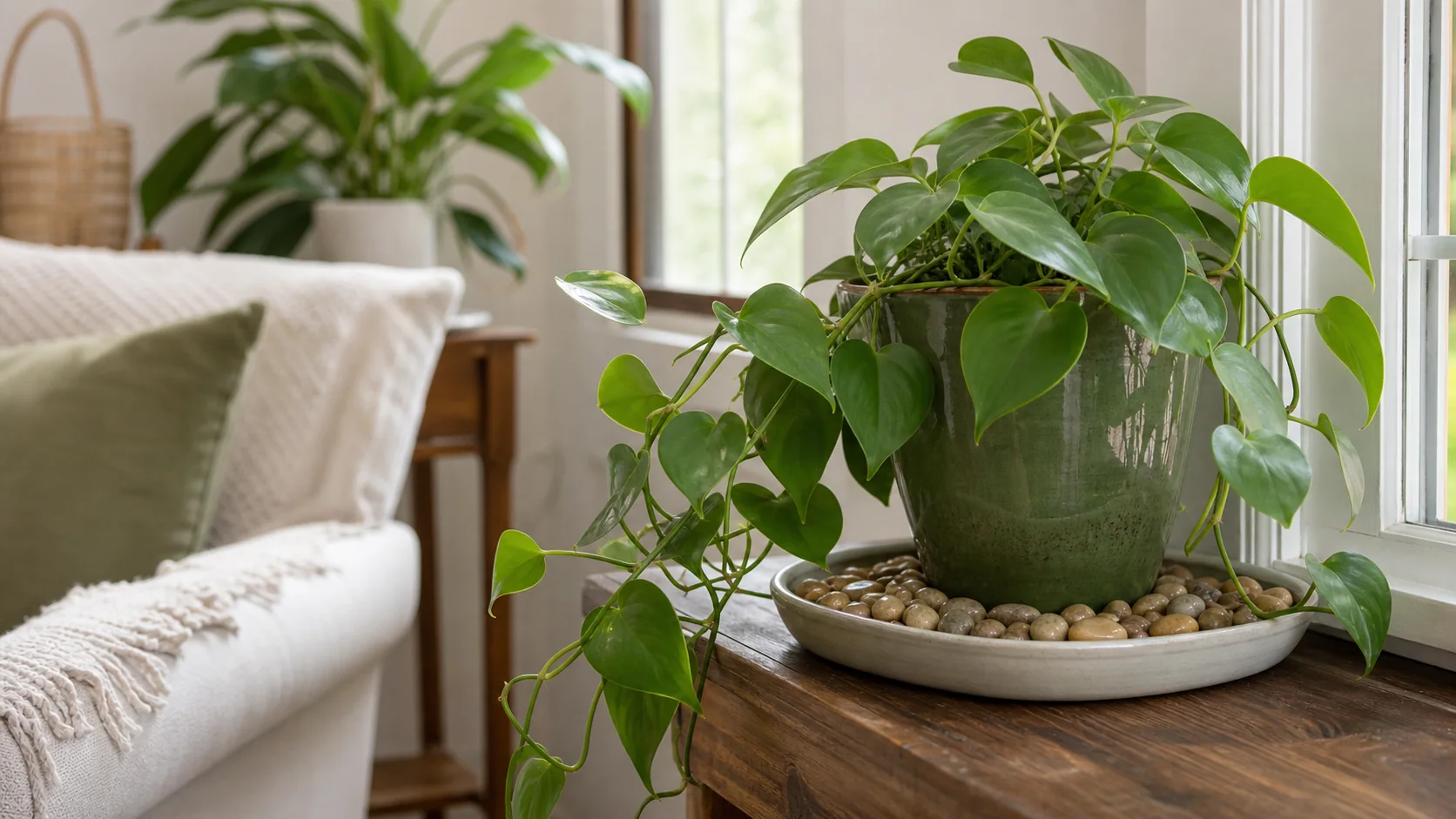
A simple pebble tray can add a little local humidity without placing the vine beside a heater or draft.
Temperature-wise, keep her away from cold drafts and heating vents. Anywhere between 16-29°C (60-85°F) suits her well. She won’t thank you for anything below 13°C (55°F).
Feeding
Heartleaf philodendron doesn’t need heavy feeding. A balanced liquid fertilizer once a month during spring and summer is plenty. Dilute it to half the recommended strength if the plant is in lower light: she’s not growing as fast there, so she doesn’t need as much.
Stop feeding in autumn and winter. She’s resting, not building new growth, and fertilizer she can’t use just builds up in the soil. For a plain-language explanation of what NPK ratios mean and which fertilizer types actually work, our plant fertilizer guide covers it without the jargon.
Seasonal Care Calendar
Most care guides treat heartleaf philodendron as a static object with fixed rules. She isn’t. Her needs shift noticeably through the year, and matching your care to the season is what keeps her consistently healthy rather than just surviving.
Spring (March-May)
This is when she wakes up. After a quiet winter, you’ll start to see new leaves unfurling and vines extending noticeably week by week.
- Watering: Increase frequency gradually as the soil starts drying out faster with warming temperatures and stronger light
- Feeding: Start monthly feeding in late March or April once you see consistent new growth. No new growth yet? Hold off a few more weeks
- Repotting: Spring is the ideal window if roots were circling the drainage holes last autumn. She’ll establish into fresh soil quickly as growth accelerates
- Pest check: Inspect the undersides of leaves and along stems. Pests that overwintered quietly tend to become active now
Summer (June-August)
Peak growth season. In good conditions she can put out several new leaves a month, and vines extend visibly in just a few weeks.
- Watering: Every 7-10 days as a starting point, adjusted by your home and the weather. Check the soil before every watering regardless
- Feeding: Once a month with a balanced liquid fertilizer at half strength
- Propagation: The best time of year for it. Warm temperatures and long days mean roots form faster and cuttings establish well
- Light: If she’s near a south or west window, watch for bleaching on the leaves from stronger afternoon sun
Autumn (September-November)
Growth begins to slow as daylight hours shorten. She’s not struggling; she’s shifting pace. The key mistake here is continuing summer care into autumn.
- Watering: Stretch to every 10-14 days as the soil holds moisture longer in cooler conditions. Keep checking with your finger before watering
- Feeding: Stop in late October or November. She can’t process fertilizer efficiently during slow growth, and salt buildup in the soil going into winter is worth avoiding
- Drafts: Move her away from windows that get cold air at night as temperatures drop
- Repotting: Skip it. She won’t establish new roots well in low-light, slow-growth conditions
Winter (December-February)
Rest season. The goal is maintenance, not growth. Don’t panic if new leaves stop appearing entirely for a few months.
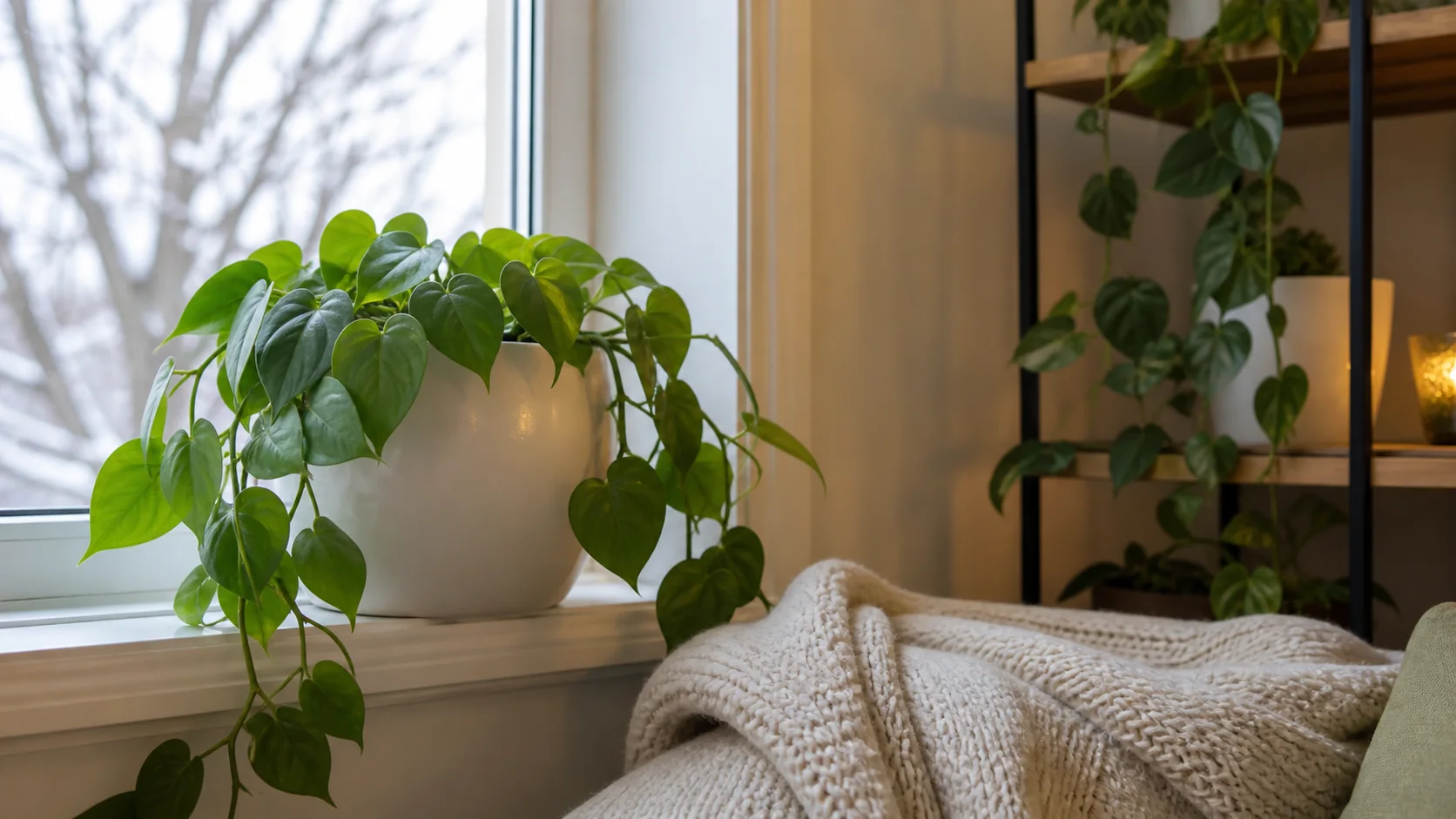
Healthy winter growth can pause while the vine rests in cooler, lower-light conditions away from direct heat.
- Watering: Every 12-14 days or longer. Some plants in cool, dim homes need water only once every three weeks in January. Let the soil be your guide, not the calendar
- Feeding: None until you see new growth resuming in spring
- Heat sources: Keep her away from radiators and heating vents. Forced hot air dries out the leaves and stresses the roots
- Expectations: Slow or absent growth is normal and healthy. She’s conserving energy, not dying
A note on transition periods: early spring and late autumn are when plants show the most confusion. A few yellow leaves during those weeks is often just the plant recalibrating, not a signal that something has gone wrong.
Want these seasonal shifts turned into reminders instead of another thing to remember? Save your heartleaf philodendron in KnowYourPlant and use the app’s watering and feeding prompts as a check-in, not a rigid schedule.
Propagation: The Easiest Way to Make More
Heartleaf philodendron propagation is one of the most beginner-friendly things you can do with a houseplant. The success rate is high, the method is simple, and it’s a satisfying use for the trimmings from a plant you’ve been growing.
University of Florida IFAS Extension notes that stem cuttings from heartleaf philodendron typically root within 3-4 weeks under warm conditions with adequate indirect light, making it one of the faster-rooting common houseplants available.
Water propagation (the simple way)
- Take a cutting just below a node: the small bump on the stem where a leaf meets the vine. Your cutting should have at least one node and ideally one or two leaves.
- Remove any leaves that would sit below the waterline.
- Place the cutting in a glass of water in a bright spot, out of direct sun.
- Change the water every few days to keep it fresh.
- Roots should appear within 2-3 weeks. Once they’re 3-4 cm long, pot the cutting into soil.
Soil propagation (slightly faster to establish)
Take the same kind of cutting and plant it directly into moist potting mix. Keep the soil consistently moist, not wet, for the first few weeks while roots form. Cover loosely with a plastic bag if you want to increase humidity around the cutting.
Both methods work well. Water propagation lets you watch the roots develop, which is reassuring if you’re new to propagating.
Common Problems
Yellow leaves: a 5-scenario guide
Yellow leaves are the most common concern with heartleaf philodendron, and they mean different things depending on the context. Work through these scenarios before drawing conclusions.
1. Old leaves at the base of long vines going yellow Natural aging. As vines extend, the oldest leaves at the base eventually shed. If the rest of the plant looks healthy and new growth is coming in green, there’s nothing to fix.
2. Multiple yellow leaves and soil that stays wet for more than 10 days Overwatering. Let the soil dry out more between waterings. If the soil smells musty or the stem feels soft near the base, check the roots: healthy roots are white or tan and firm. Brown and mushy roots mean rot has set in. Trim the damaged sections and repot into fresh, dry mix.
3. Yellow leaves and soil that’s completely dry Underwatering. Water thoroughly, let it drain fully, and then return to the normal wet-dry cycle. She recovers from drought faster than she recovers from overwatering, so don’t overcorrect.
4. Pale yellow leaves throughout and vines that are stretched or reaching A light problem. She’s not getting enough to photosynthesize properly. Move her closer to a window or add a grow light. The existing pale leaves won’t green back up, but new growth should come in healthier once light improves. Our grow lights guide covers options if you’re not sure what to look for.
5. Yellow with brown edges or tips and adequate soil moisture Dry air or a cold draft. Check whether she’s near a heating vent, an air conditioner, or a window that lets cold air in at night. A pebble tray helps with humidity. Moving her away from the draft usually resolves this within a few weeks.
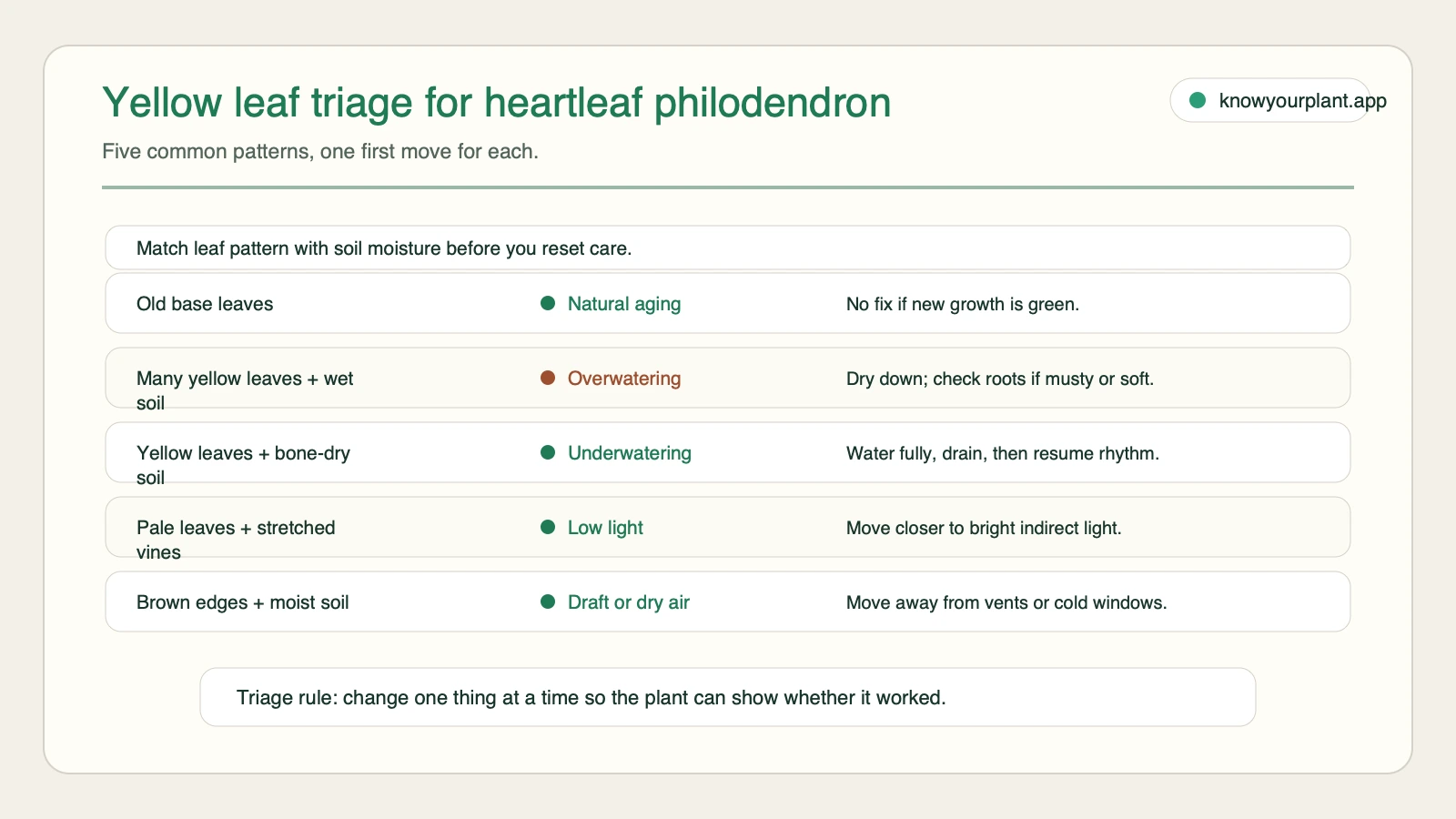
Match the yellow-leaf pattern with soil moisture first so you change one care variable instead of resetting everything at once.
Leggy vines with small leaves
Usually a light problem. She’s stretching toward whatever light she can find. Move her closer to a window and the new growth will come in larger and more closely spaced.
Brown leaf tips
Often dry air, fertilizer buildup, or inconsistent watering. First, check the easiest causes: is the plant near a heat vent, did the soil go bone-dry, or have you fertilized more than monthly? Trim the dry tips if they bother you, then water thoroughly next time instead of giving small sips.
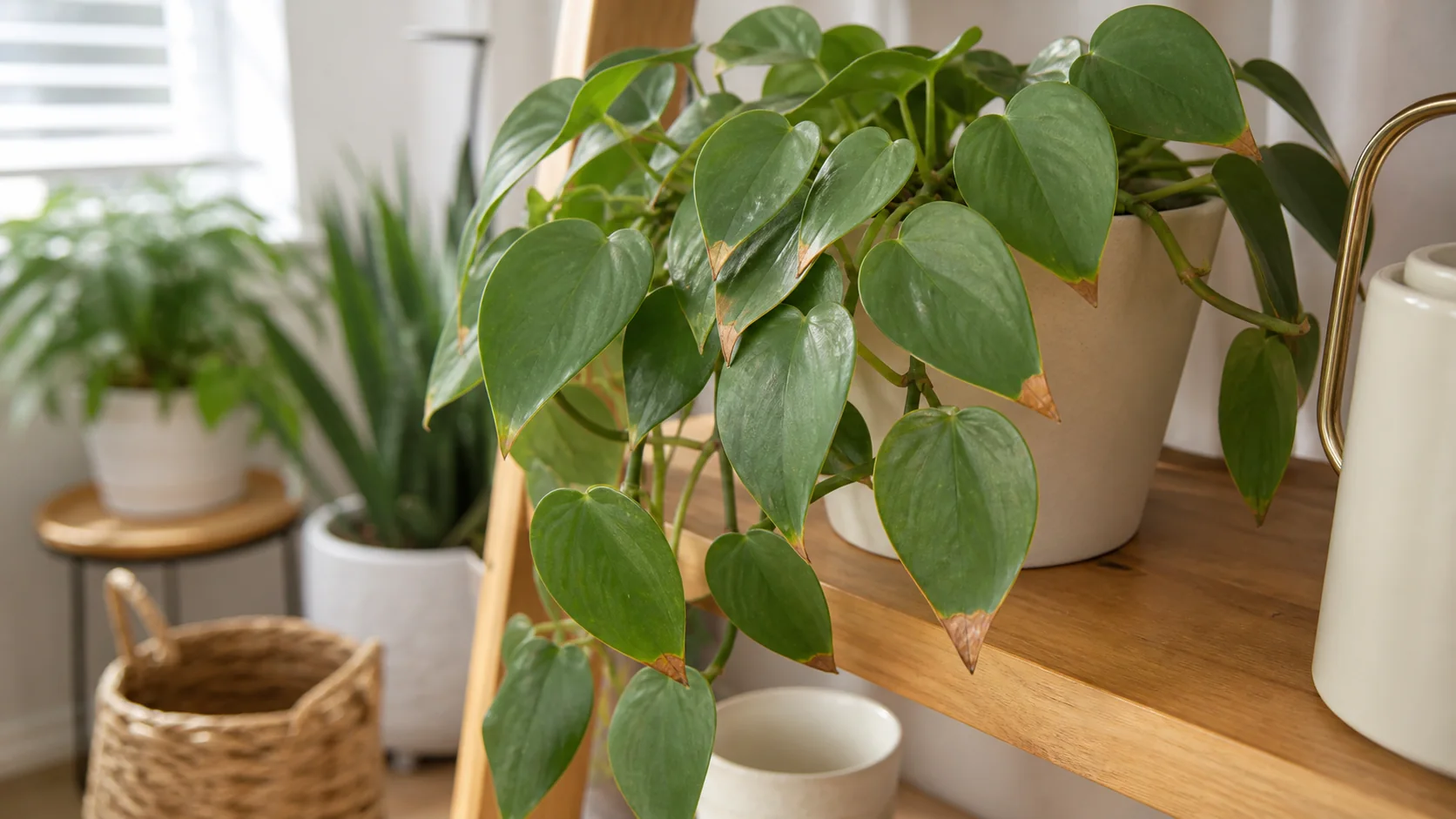
Dry brown tips call for checking humidity, fertilizer buildup, and watering consistency before changing the whole routine.
Curling leaves
Curling leaves are usually a moisture or temperature clue. Feel the soil first. If it is dry several centimetres down, water thoroughly and check again the next day. If the soil is wet, do not add more water; move the plant into brighter indirect light and let the pot dry down. Curling can also happen near cold windows, air conditioners, or heat vents.
What to do today
- If the soil is wet: skip watering, check that the pot has drainage, and move the plant into brighter indirect light if the room is dim
- If the soil is dry: water until it drains, empty the saucer, and check again in a week
- If leaves are yellowing: compare the soil moisture with the five yellow-leaf scenarios above before changing anything else
- If tips are brown: check for dry air, drafts, fertilizer buildup, and uneven watering
Is Heartleaf Philodendron Safe for Pets?
This is worth knowing before you bring one home. The ASPCA lists heartleaf philodendron (Philodendron hederaceum) as toxic to cats, dogs, and horses. The plant contains insoluble calcium oxalate crystals, which can cause oral irritation, excessive drooling, vomiting, and difficulty swallowing if chewed or ingested.
If you have curious pets who tend to nibble on leaves, place her somewhere out of reach: a high shelf, a hanging planter, or a room they don’t access. For a full list of houseplants that are genuinely safe around pets, our guide to cat-safe indoor plants is a good place to start. If you want the same trailing look but are still not sure whether the plant on your shelf is pothos or philodendron, use our pothos vs philodendron guide for a quick side-by-side check.
Real User FAQ
My plant has yellow leaves, brown spots, and sticky residue at the same time. Where do I even start?
Start with the root zone and the undersides of the leaves. Wet soil plus yellowing points to overwatering stress, while sticky residue can point to pests. Fixing the watering pattern first and checking for insects on the stems is usually more useful than treating the leaves blindly.
If heartleaf philodendron tolerates low light, why does mine look sparse and stretched?
Because low-light tolerance means survival, not pretty growth. In a dim corner the plant often keeps living but spaces its leaves farther apart and produces smaller new growth. Move it closer to bright indirect light if you want it to look full.
How do I know whether brown patches are sun stress or something worse?
Dry, papery patches on the side facing a strong window usually point to sun stress. Mushy, spreading dark spots with constantly wet soil are more concerning and should push you to inspect watering, airflow, and the root zone.
Do I need to repot right away if I bought it in a decorative cachepot?
Not automatically, but you do need to confirm that the inner pot drains and that water is not collecting unseen at the bottom. Decorative containers are a common reason beginners think they are watering correctly while the roots stay wet too long.
Methodology Note
This guide was refreshed using live search review and source checks completed on 2026-06-09. Practical symptom patterns were shaped by public Gardening Stack Exchange questions about yellow leaves, sticky residue, brown spots, and drainage confusion, then grounded with care and toxicity guidance from NC State Extension, ASPCA, Epic Gardening, and Houseplant101. Forum questions are used here as qualitative reader signal, not as proof of how often each problem occurs.
Frequently Asked Questions
How often should I water heartleaf philodendron? There’s no fixed schedule that works for every home. In summer, most plants need water every 7-10 days. In winter, it might stretch to every 12-14 days or longer. The only reliable method is checking the soil directly: push your finger in up to the first knuckle. Dry? Water thoroughly. Still damp? Wait.
Why are my heartleaf philodendron leaves turning yellow? Overwatering is the most likely cause. Let the soil dry out more between waterings and see if new growth comes in green. Less commonly, yellow leaves come from too little light, cold drafts near a window, or the natural shedding of older leaves at the base of long vines. One or two yellow leaves at the base of an otherwise healthy plant is usually nothing to worry about.
Is heartleaf philodendron the same as pothos? They look similar and are often sold side by side, but they’re different plants. Heartleaf philodendron (Philodendron hederaceum) has thinner, softer leaves with a matte finish that attach cleanly to the stem. Pothos (Epipremnum aureum) has thicker, waxier leaves with a slight indent where the leaf meets the stem. Care is similar for both, but they’re botanically distinct. If you’re not sure which you have, a plant identifier app can tell you in seconds.
Can I grow heartleaf philodendron in water permanently? Yes, she can live in water long-term, though she won’t grow as vigorously as she would in soil. Use a container that blocks light from reaching the roots to reduce algae growth, change the water once a week, and add a diluted liquid fertilizer every few weeks to compensate for the lack of soil nutrients.
How do I make my heartleaf philodendron fuller and bushier? Two things help most. First, move her to brighter indirect light: more light means shorter internodes (the spaces between leaves on the vine) and a fuller overall look. Second, pinch back long vines just above a node to encourage branching. The trimmed cuttings can go straight into water for propagation, so nothing goes to waste.
Is heartleaf philodendron toxic to cats? Yes. The ASPCA classifies it as toxic to cats and dogs due to insoluble calcium oxalate crystals. Keep her on high shelves or in hanging planters if you have pets who chew on plants. Our cat-safe indoor plants guide has a full list of pet-friendly alternatives if you need to swap her out.
How fast does heartleaf philodendron grow? In good conditions during spring and summer, she can put out several new leaves a month and vines can extend noticeably in just a few weeks. In low light or during winter, growth slows considerably. If you want a brighter, variegated version with similar care, our Philodendron Brasil care guide explains where the routine overlaps and where light matters more. If you want reminders timed to your plant’s actual growth pace, the KnowYourPlant app tracks seasonal changes and tells you when to act.
Heartleaf Philodendron Care: The Short Version
She wants indirect light, well-draining soil that gets to dry out a bit between waterings, and a temperature that stays comfortable for you too. She doesn’t need misting, doesn’t need special fertilizer, and doesn’t need repotting very often.
What she gives back: fast, lush growth, beautiful trailing vines, and the kind of easy companionship that makes a room feel more alive. For a beginner, she builds confidence. For an experienced plant person, she’s just a pleasure to have around.
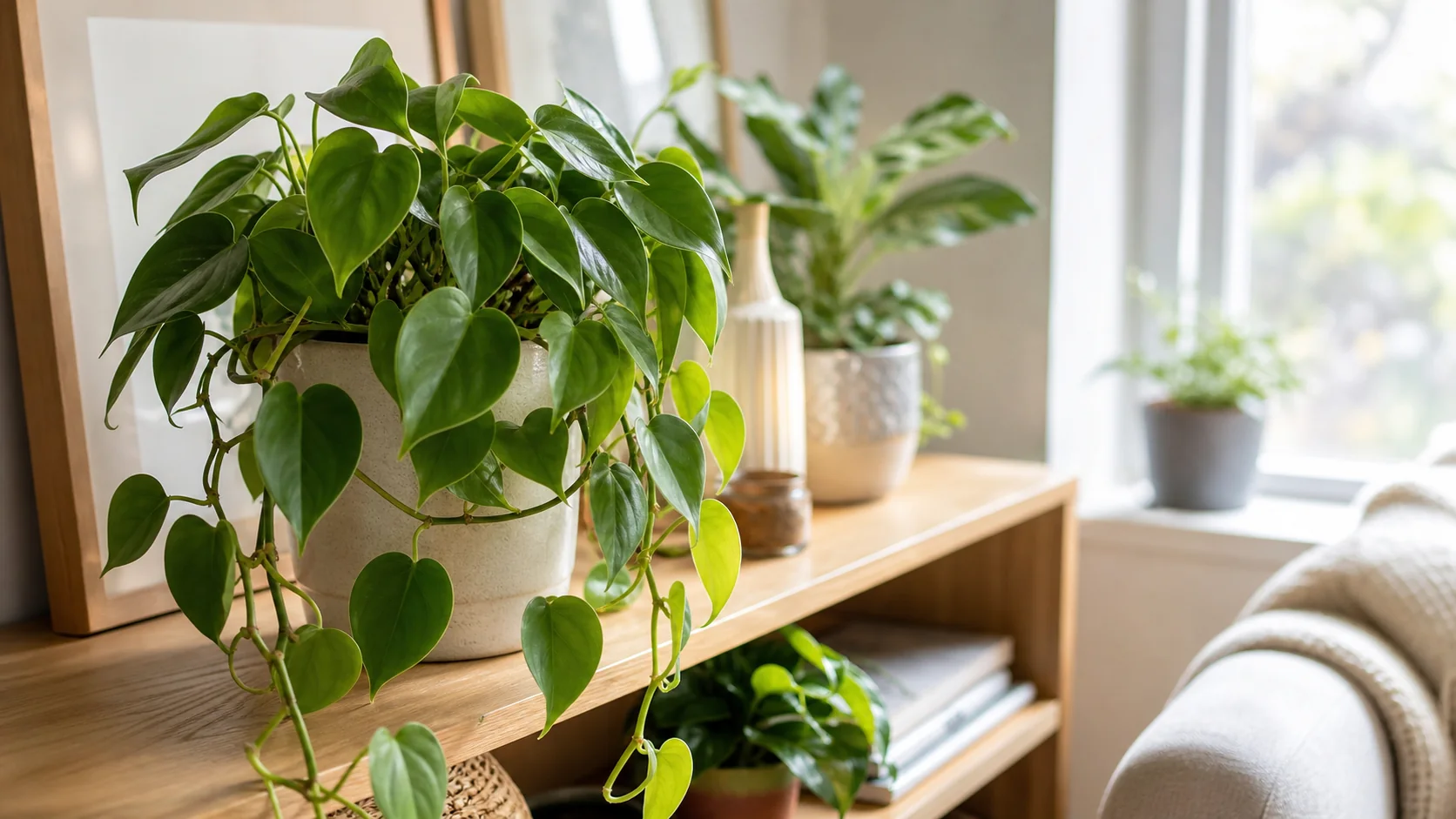
With indirect light and a sensible wet-dry cycle, heartleaf philodendron returns lush, easy trailing growth.
If you want a simple way to remember when to water, when to feed, and what to watch for through the seasons, download KnowYourPlant for personalized plant care reminders built around your plant’s actual needs.