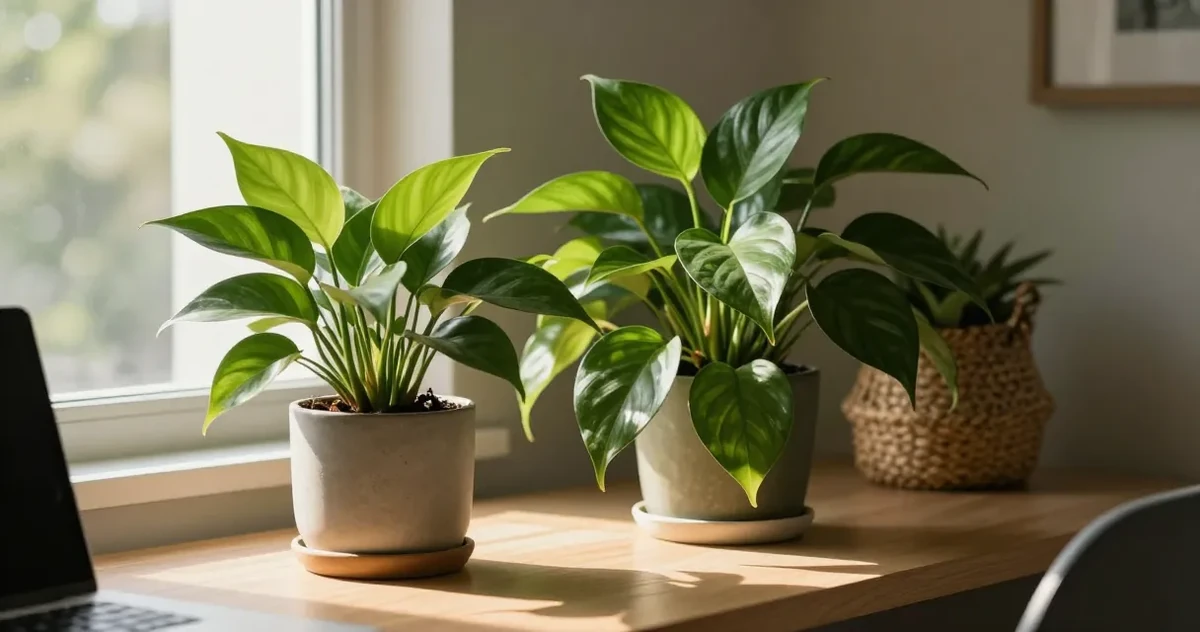
You’re standing in a garden center, or maybe scrolling through a plant shop online, and you see two plants side by side. Both have heart-shaped green leaves. Both trail beautifully. Both are labelled with names that don’t quite match what you remember. This is the pothos vs philodendron puzzle, and it trips up almost everyone at some point.
Here’s the useful part: you do not need a botany lesson to solve it. You need a few reliable checks for the plant in front of you, then a simple answer to the care question that usually follows: can you water it the same way, and which one fits your room better? Nurseries sometimes don’t help matters; mislabelling is common enough that you cannot always trust the tag in the pot. Once you know what to look for, though, you’ll never mix them up again.
Pothos and heartleaf philodendron: field evidence
These vines can look similar indoors, but Epipremnum aureum and Philodendron hederaceum are distinct accepted species with very different documented native-range breadth.
The ranges below are the middle 50% (p25–p75), not recommended indoor setpoints.
| Reference taxon | POWO native range | Annual mean temperature | Annual precipitation | Relative humidity | Solar radiation | Evidence |
|---|---|---|---|---|---|---|
| Epipremnum aureum (golden pothos) | Mo’orea in the Society Islands | 25.7–25.9°C | 2451–2644 mm/yr | 63–64% | 20.0–20.1 MJ/m²/day | 6 climate points; low confidence |
| Philodendron hederaceum (heartleaf philodendron) | Mexico to tropical America | 24.0–25.9°C | 1668–2787 mm/yr | 64–68% | 17.0–18.7 MJ/m²/day | 30 climate points / 783 usable records; medium confidence |
What this changes in this guide: The comparison strengthens the identification point: do not infer species from one care habit or one leaf shape, and do not force both plants onto an identical schedule.
Sources and method: Epipremnum aureum in POWO and GBIF; Philodendron hederaceum in POWO and GBIF; CHELSA V2.1, 1981–2010. GBIF records are limited to POWO-native countries, then filtered for coordinates, establishment signal, licence, precision, and spatial duplication. No community or user-reported care data is used in this module.
What Most Care Guides Miss
Most guides about pothos vs philodendron describe the ideal care routine. Real homes are messier: light changes by season, pots dry at different speeds, and the same symptom can mean different things depending on where it appears.
Before changing care, check the plant in this order:
- Light: is the plant growing toward the window, fading, or scorching?
- Root zone: is the pot drying predictably, or staying wet in the middle?
- Leaf pattern: did the oldest leaves, newest leaves, tips, or stems change first?
- Recent change: new pot, new location, fertilizer, cold draft, heat vent, or pest exposure.
This keeps you from fixing the wrong problem. One clear adjustment is usually safer than a full care reset.
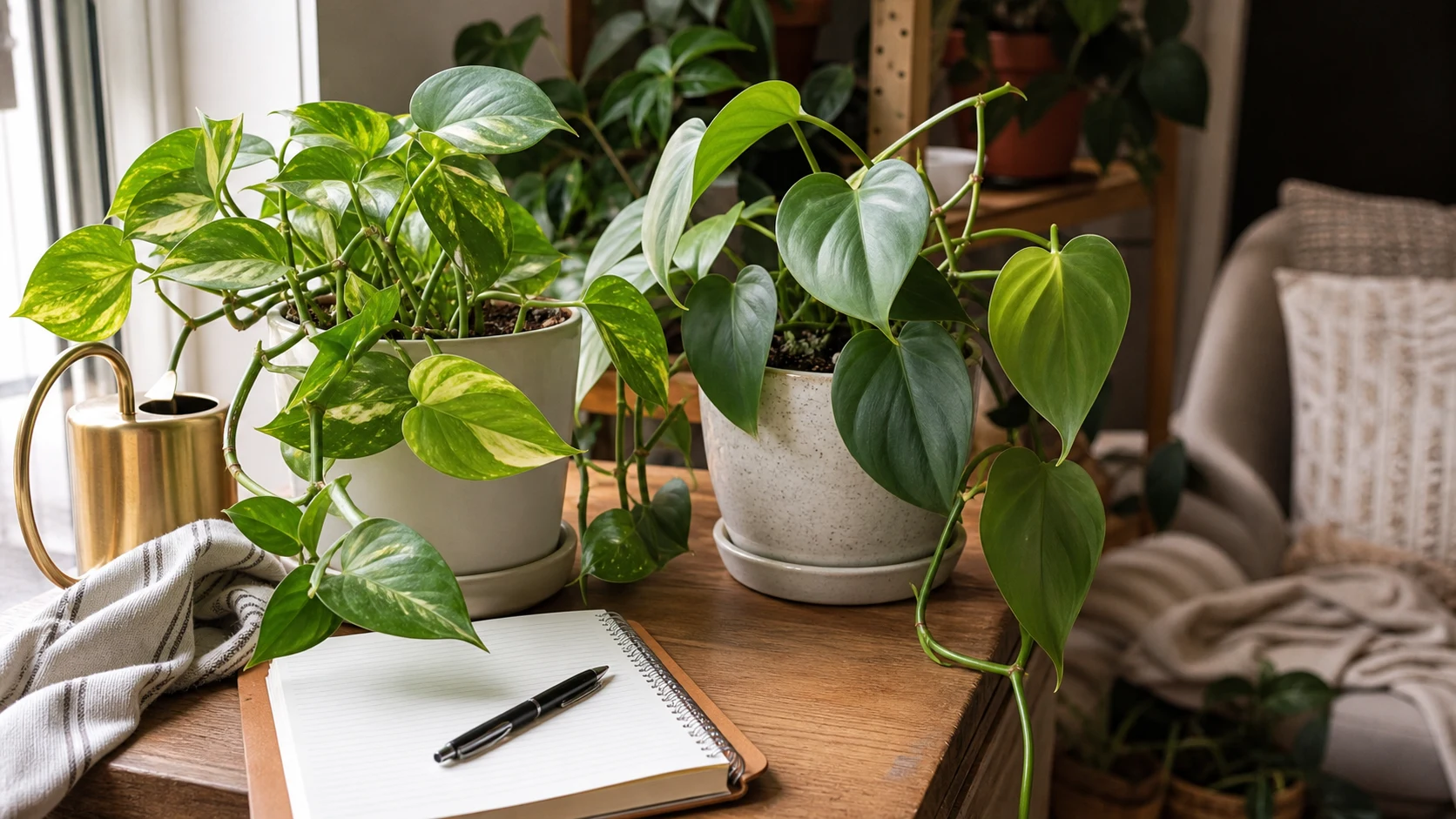
Compare light, soil moisture, leaf changes, and recent moves before resetting either plant’s care.
Fast Answer: Which One Fits Your Home?
If you are deciding before you buy, choose based on your light and routine first. The visual ID matters, but the day-to-day care difference is small.
- Pick pothos if the spot is a few feet from a window, you forget to water sometimes, or you want the tougher beginner plant.
- Pick heartleaf philodendron if the room has bright indirect light, you can check the soil weekly, and the air is not extremely dry.
- Water both only after the top 1 to 2 inches of soil feel dry. In many homes that means checking weekly, watering about every 7 to 10 days in warm bright months, and waiting 10 to 21 days in winter or low light.
- Signs you are overdoing it: soil stays wet for more than a few days, lower leaves turn yellow, stems feel soft, the pot smells sour, or fungus gnats appear.
- Signs it is too dry: leaves curl inward, vines droop while the soil is dry, or leaf edges turn crisp.
Your simple plan: today, check for papery sheaths and feel the soil before watering. This week, watch whether the newest leaves perk up or keep curling. This season, water less as light drops and only feed while the plant is actively growing.
Social Listening: Why This Comparison Keeps Confusing Beginners
The same beginner complaints repeat across plant forums and Reddit threads: shop tags are inconsistent, neon and plain-green varieties get mislabeled, and people often change watering before they have confirmed which plant they actually brought home. The useful pattern from those discussions is that color alone misleads. Structural checks, especially cataphyll residue and petiole shape, solve the ID problem faster.
That is also why this guide treats pothos vs philodendron as a buying-and-troubleshooting decision, not just a taxonomy note. If the label is fuzzy but the room is dim and your watering is forgetful, pothos is usually the safer beginner pick. If the plant will sit in brighter indirect light and you can check the mix more consistently, heartleaf philodendron is usually just as manageable.
Why They Look So Similar
Pothos (Epipremnum aureum) and heartleaf philodendron (Philodendron hederaceum) both come from tropical environments, both adapt well to low light, and both send out long trailing vines that look at home on a shelf or in a hanging basket. They fill similar ecological niches in the wild, which is part of why they’ve converged on such a similar shape.
But underneath that surface similarity, these are two distinct plants with different leaf structures, different textures, and slightly different care needs. The clues are there if you know where to look.
Once you have confirmed it is a philodendron, the philodendron types guide can narrow down the likely variety and growth habit.
Original Data: 30-Second Identification Snapshot
Use these checks in order. The first two are the most reliable for beginners.
| Check | Pothos usually shows | Heartleaf philodendron usually shows | Why this check matters |
|---|---|---|---|
| New growth residue | No papery sheath left behind | Papery cataphyll or free stipule residue on the stem | Best fast structural clue |
| Petiole shape | A noticeable groove or indentation | Smoother, rounder petiole | Helps when color is misleading |
| Leaf feel | Thicker, waxier, slightly stiffer | Thinner, softer, more fabric-like | Good backup when growth is mature |
| Leaf symmetry | Base often a little uneven | More even heart shape at the base | Helpful, but less reliable than node structure |
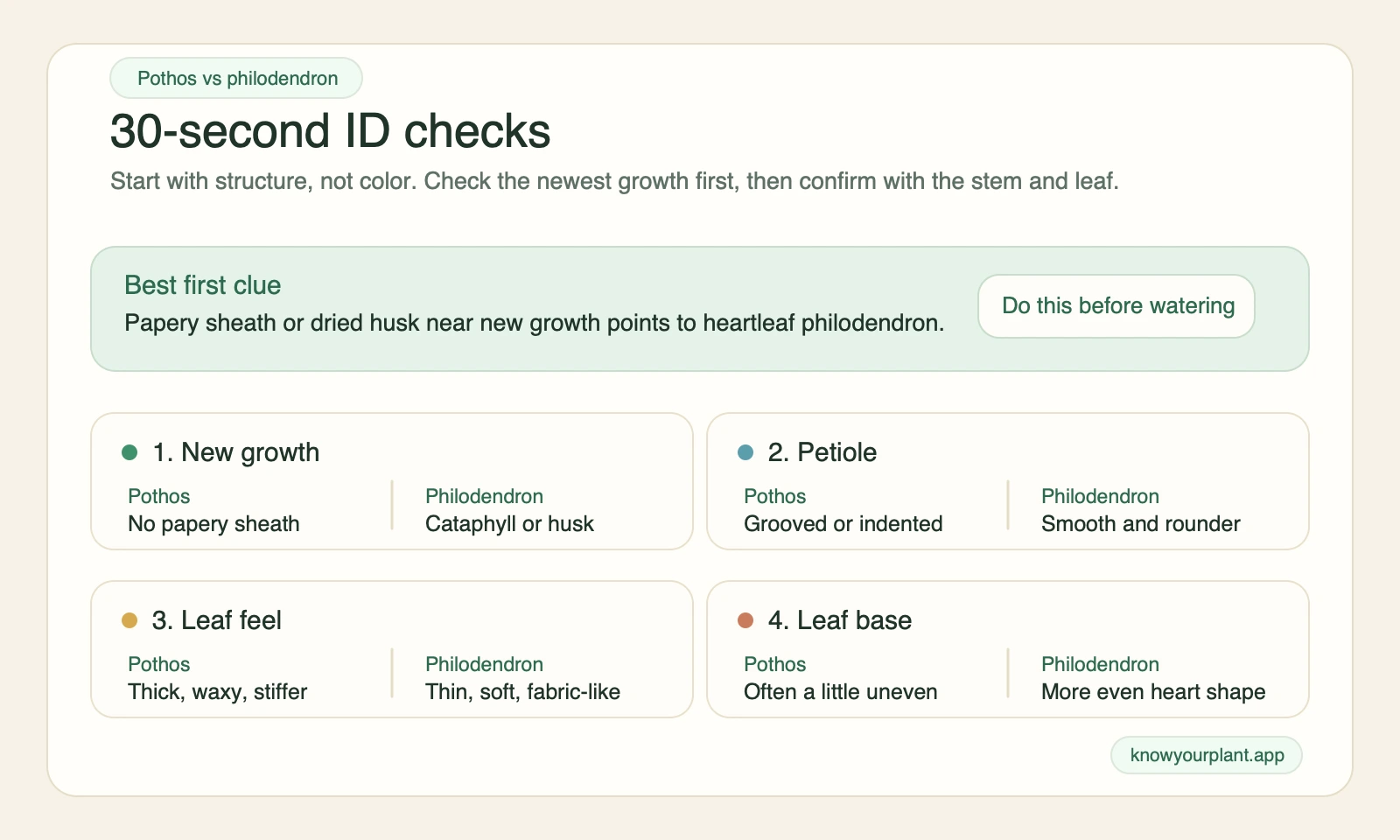
Use the ID checks in order: new-growth residue first, petiole shape second, then leaf feel and base symmetry as backup clues.
Room-Fit Scorecard
This scorecard is a practical buyer tool, not a botanical rule. Higher is easier for that condition.
| Home situation | Pothos | Heartleaf philodendron | Why |
|---|---|---|---|
| Dim room tolerance | 5/5 | 4/5 | Pothos usually stays happier a bit farther from the window |
| Forgetful watering tolerance | 5/5 | 4/5 | Pothos tends to shrug off slight dryness more easily |
| Humidity fussiness | 4/5 | 3/5 | Philodendron usually complains faster in very dry air |
| Beginner ID confidence | 4/5 | 3/5 | Philodendron is easier to misread when the tag is wrong |
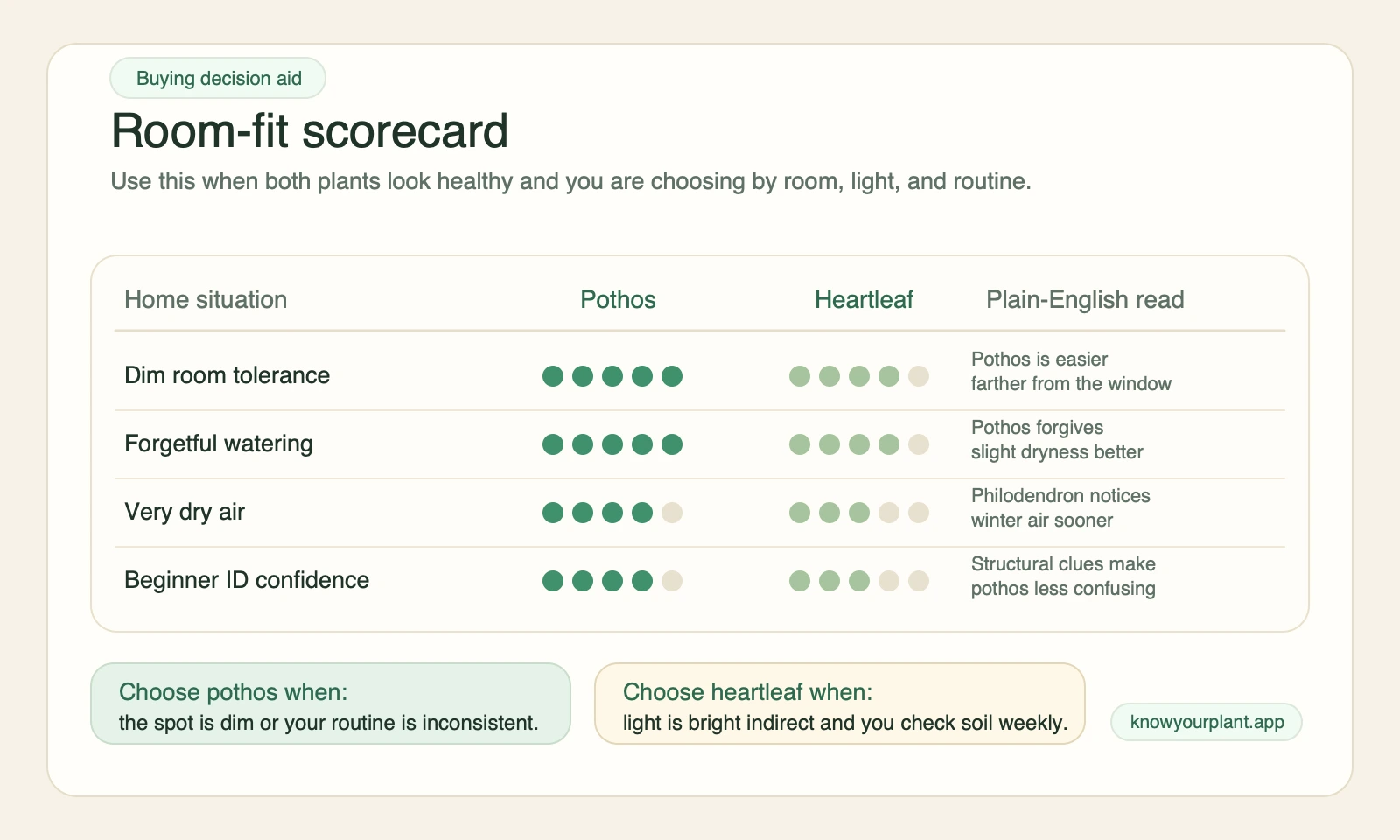
Use the scorecard as a buyer shortcut: pothos leans easier for dim rooms and uneven routines, while heartleaf philodendron suits bright indirect rooms with steady soil checks.
The Clearest Way to Tell Them Apart
Check for the Cataphyll First
This is the single most reliable test, and it works regardless of the plant’s age, lighting, or variety.
When a heartleaf philodendron puts out a new leaf, it emerges from a small brownish sheath called a cataphyll. The cataphyll wraps around the new growth like a tiny protective sleeve, then dries up and falls away as the leaf matures. You’ll often find these papery husks clinging to the stem even after they’ve dropped; they look a little like dried onion skin.
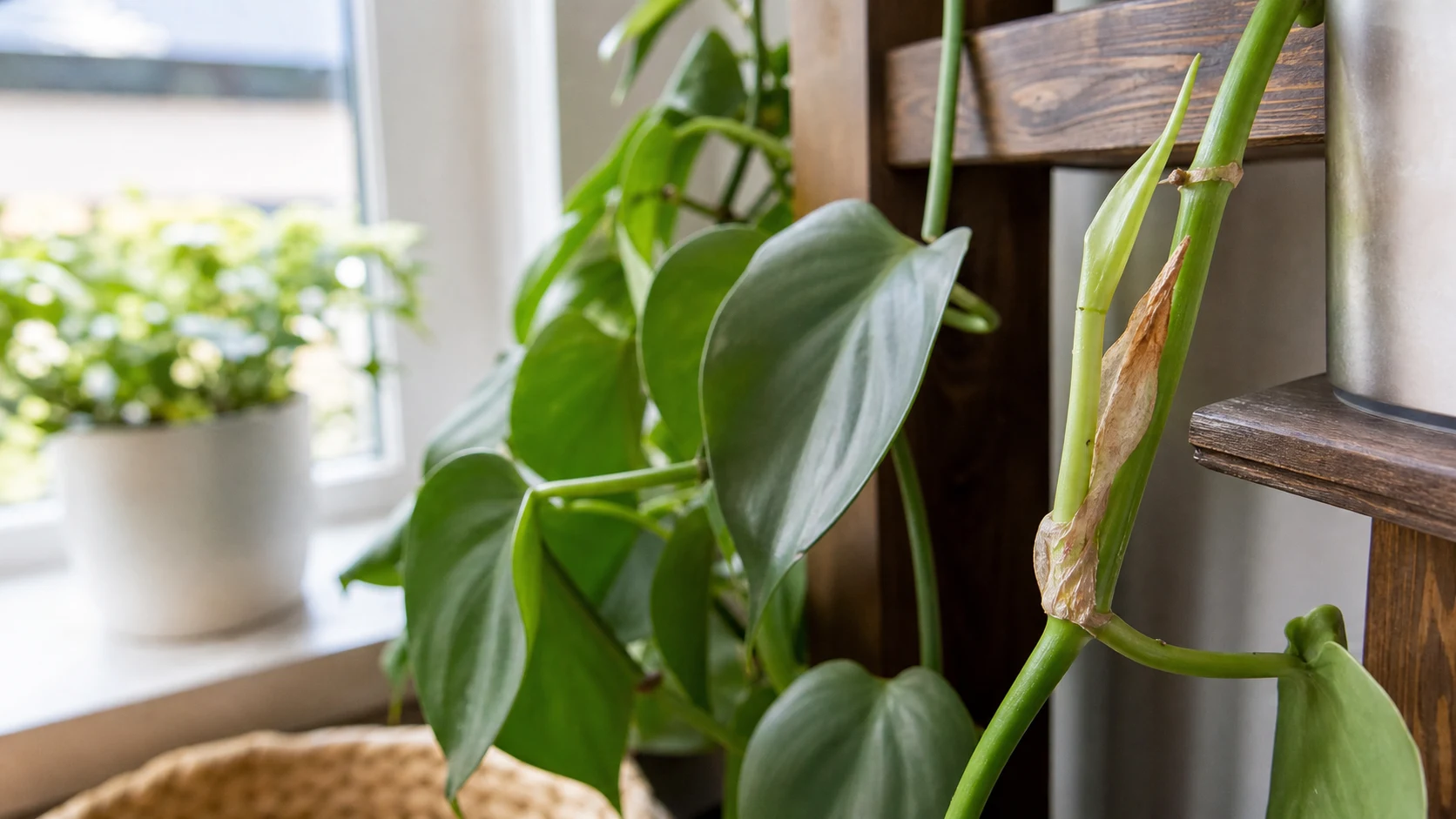
A papery cataphyll drying beside new heartleaf philodendron growth is the clearest structural clue.
Pothos do not have cataphylls. New pothos leaves simply unfurl directly from the growing tip, with no sheath involved. If you see those small papery wrappings anywhere on the stem, you’re looking at a philodendron.
The Missouri Botanical Garden lists cataphyll presence as a defining structural characteristic of the Philodendron genus, absent in Epipremnum. It is one of the rare cases where a field identification test and a botanically rigorous one happen to be the same thing.
This test works even when the plant isn’t actively growing. Just look along the stem for any sign of those dried sheaths, or wait for the next new leaf to appear and watch how it emerges.
Leaf Texture
Run your finger across the leaf. Pothos leaves feel thick, almost waxy, slightly stiff. Philodendron leaves feel thinner and softer, more like a piece of fabric than a coat of paint. This is probably the fastest single test you can do without waiting for new growth.
Leaf Shape
Look at the base of the leaf where it meets the stem. On a pothos, this base is slightly uneven, with one side appearing a little higher than the other. The overall leaf surface has a gently textured, almost quilted quality when you hold it up to the light.
On a heartleaf philodendron, the base forms a much more symmetrical heart shape, with both lobes curving in evenly. The surface is smoother and more uniform. The difference is subtle at first, but once you see it you’ll spot it every time.
The Petiole
The petiole is the short stalk connecting the leaf to the main vine. On a pothos, the petiole has a slight indentation or groove running along it, and it curves inward near where it connects to the leaf. On a philodendron, the petiole is rounder and smooth all the way along.
A Side-by-Side Summary
| Feature | Pothos | Heartleaf Philodendron |
|---|---|---|
| Leaf texture | Thick, waxy | Thin, soft |
| Leaf base | Slightly uneven | Symmetrical heart |
| New leaves | Unfurl directly | Emerge from cataphyll |
| Petiole | Grooved, indented | Smooth, rounded |
| Leaf surface | Slightly textured | Uniform, smooth |
Expert Note: What Botanists Use to Separate Them
North Carolina Extension describes pothos as lacking conspicuous free stipules on new growth and showing grooved petioles, while heartleaf philodendron shows conspicuous stipules on new growth and smoother petioles. Missouri Botanical Garden also notes that both are popular trailing indoor vines, but overly wet soil raises root-rot risk, especially when growers respond to yellow leaves by watering again instead of checking the root zone first.
Decision Tree: Pothos or Philodendron?
- See a papery sheath or dried husk on the stem where a leaf emerged? That points to heartleaf philodendron.
- No sheath visible? Feel the petiole. A groove or indentation points toward pothos, while a smoother round petiole points toward philodendron.
- Still torn? Check the room and watering habit. In a dimmer spot with slightly more neglect, pothos is usually the safer fit. In brighter indirect light with steadier moisture checks, heartleaf philodendron is often equally happy.
- Symptoms already showing? Use the common-problems table below before changing the entire care routine. Misidentification often leads to the wrong fix, especially when the soil is already too wet.
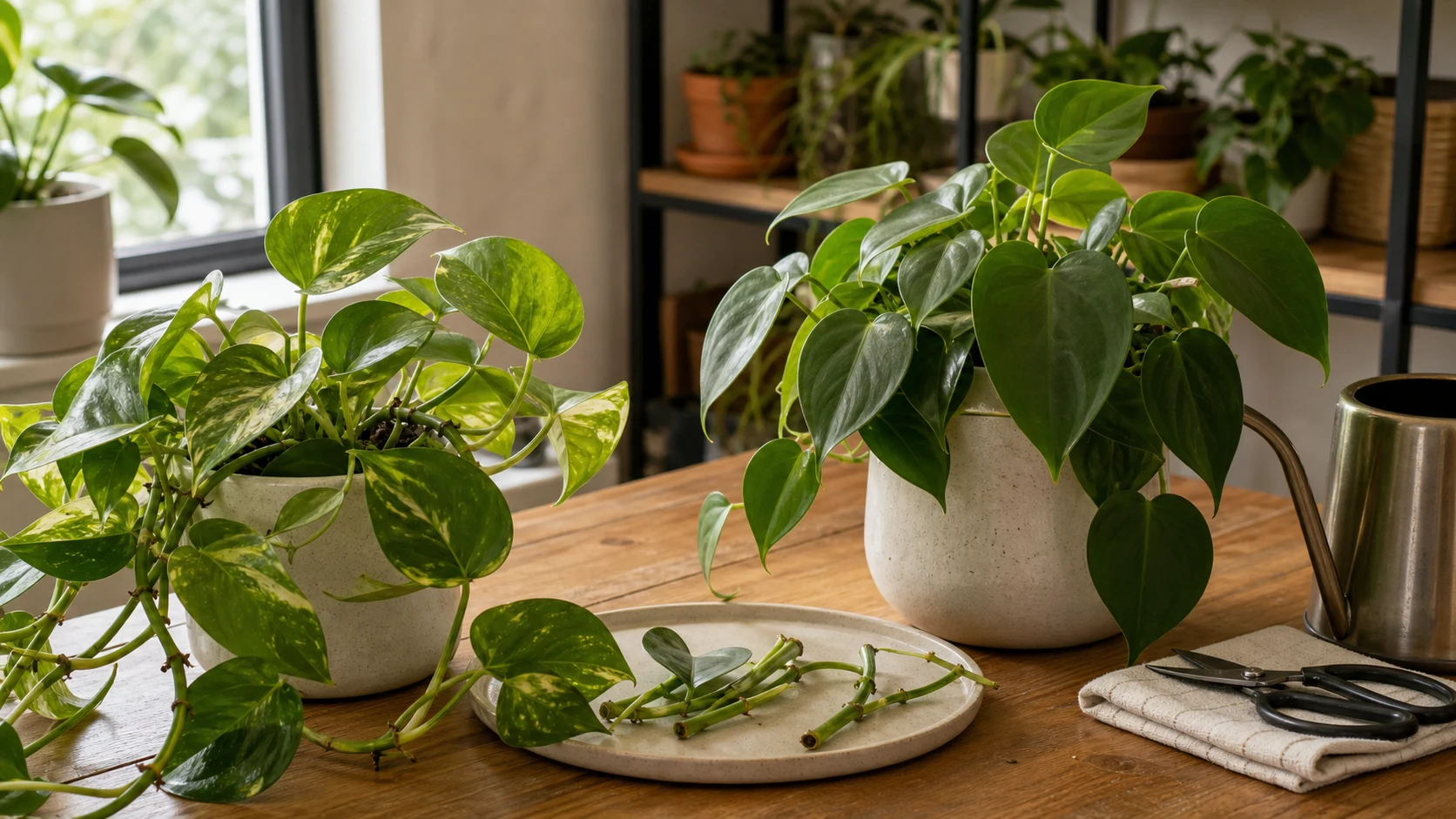
Compare stem nodes and petiole shape first, then use room conditions and soil moisture to guide care.
Does It Matter for Care?
Care Cards: Which One Fits Your Routine?
Pothos Care Card
- Best for: dimmer rooms, offices, shelves a few feet from the window, and people who sometimes forget to water.
- Watch for: pale stretched growth in very low light, yellowing from constantly wet soil, and cold-draft stress in winter.
- Simple rhythm: let the top 1 to 2 inches dry, then water thoroughly and drain the saucer.
Heartleaf Philodendron Care Card
- Best for: bright indirect light, plant owners who check soil weekly, and homes that are not extremely dry.
- Watch for: softer stems or yellowing when the mix stays wet too long, and crisp edges when dry air or hot vents are involved.
- Simple rhythm: follow the same dry-top-layer rule, but be a little more careful about stale wet soil and low winter light.
Mostly, no. Both plants are forgiving, both prefer indirect light, and both can go without water for a week without much complaint. But there are a few small differences worth knowing.
Light
Pothos handle lower light a little better than heartleaf philodendrons. According to NC State Extension, pothos can tolerate illuminance as low as 50 foot-candles, making it one of the most adaptable houseplants available for dim rooms. A heartleaf philodendron will manage in a shadier spot, but may grow more slowly and produce smaller leaves.
For a buying decision, make it simple: if the plant will live in a darker office, hallway, or shelf away from the window, choose pothos. If it will sit near a bright window with no harsh afternoon sun, either plant works. For a practical walkthrough on matching indoor plants to window strength and supplemental light, see the grow lights guide.
Watering
Both plants want you to let the soil dry out between waterings. Check once a week by pushing your finger 1 to 2 inches into the mix. If that top layer is dry, water until a little runs out of the drainage hole, then empty the saucer. If it still feels damp, wait a few more days.
In a warm, bright room, that often works out to watering every 7 to 10 days. In winter, low light, or a larger pot, it may be closer to every 10 to 21 days. The calendar is only a reminder to check; the soil decides.
The main sign you are overwatering is not one yellow leaf. It is a pattern: wet soil that stays wet, several lower leaves yellowing, soft stems, a sour smell from the pot, or fungus gnats hovering near the soil. If you see that pattern, pause watering, move the plant to brighter indirect light, and make sure the pot drains freely. Pothos tend to show thirst through slightly drooping or wrinkled leaves. Philodendrons often complain faster when they sit wet too long.
If you already know you have pothos and want the full species-specific routine, the pothos care guide goes deeper on watering, yellow leaves, and propagation. If the plant turns out to be a philodendron instead, the broader philodendron care guide is the best next read.
Darryl Cheng of Houseplant Journal puts it well: water to support the plant’s natural growth pace, not to keep the soil consistently moist. Both of these plants prefer to dry out a little between drinks.
Humidity
Philodendrons come from environments with higher ambient humidity. According to the University of Florida IFAS Extension, heartleaf philodendron performs best at 40 to 60 percent relative humidity. Most homes sit closer to 30 to 50 percent, especially in winter when central heating dries the air. Grouping your philodendron with other plants or placing it on a pebble tray with water makes a noticeable difference. Pothos are less fussy and handle average household humidity without complaint. Neither needs a humidifier to stay healthy, but the philodendron will reward you for the extra effort.
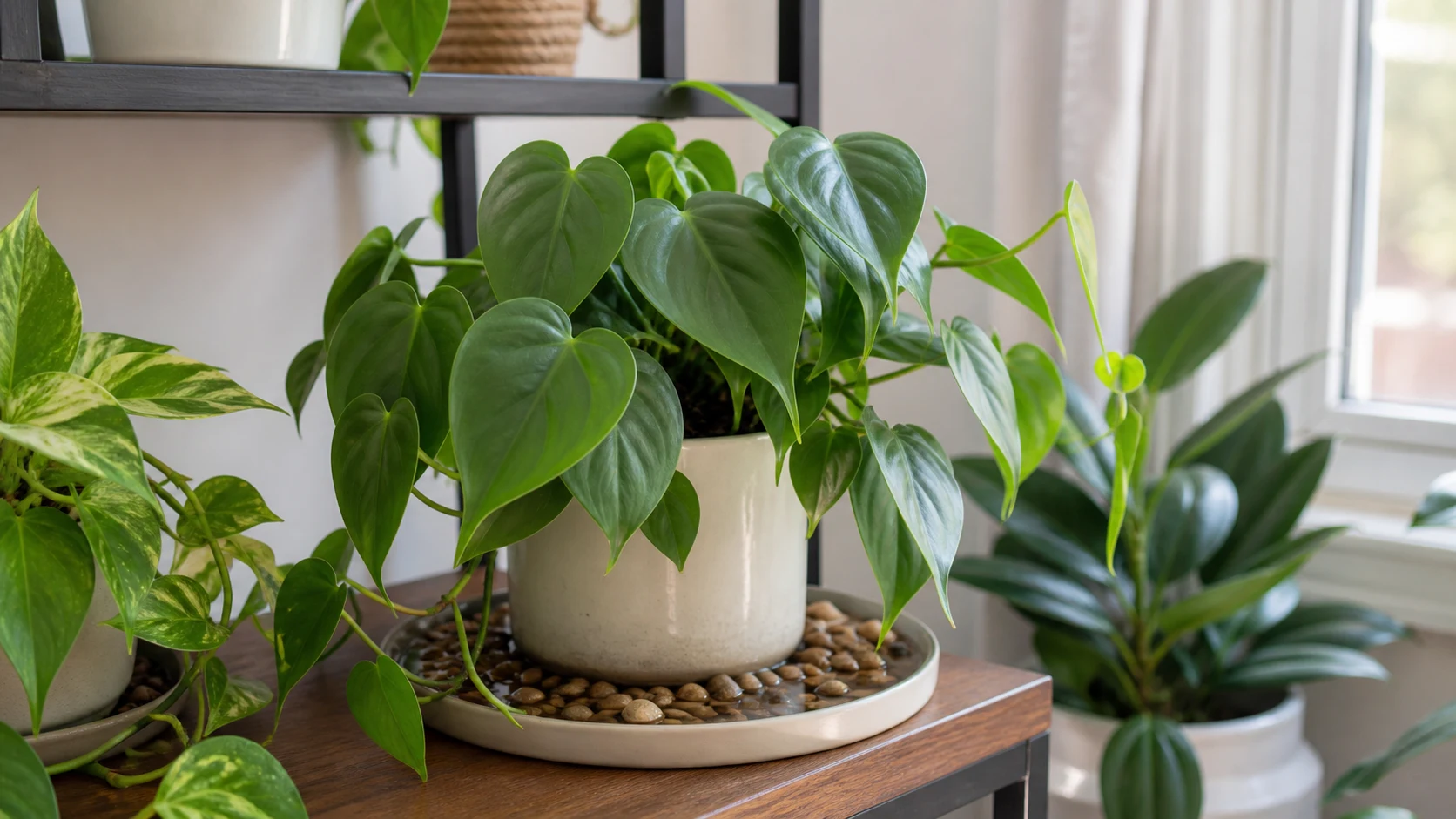
Grouping a heartleaf philodendron above a water-filled pebble tray can gently raise local humidity.
Growth Pattern
Pothos vines tend to be a bit stockier and the internodes (the spaces between leaves on the stem) are slightly shorter. Philodendron vines often look a little leggier, with more space between each leaf. For a deeper look at the different varieties and how they behave, the pothos varieties guide is a good place to start, and the heartleaf philodendron care guide shows what that softer growth habit looks like once you know which plant you actually have.
Common Problems: Curling, Yellowing, and Brown Tips
Most reader mistakes happen here: the symptom is real, but the first fix is wrong because the plant ID, soil wetness, or recent move never got checked. Start with the table, then change one variable at a time.
Most pothos and heartleaf philodendron problems come down to the same four checks: soil moisture, drainage, light, and pests. Start there before you add fertiliser or repot.
| Symptom | Most likely cause | What to do today |
|---|---|---|
| Leaves curling inward, soil dry | Too dry or too much heat | Water deeply, drain the saucer, and move away from hot glass or vents. |
| Leaves curling inward, soil wet | Roots staying too wet | Stop watering, increase bright indirect light, and check that the pot has drainage. |
| Several lower leaves yellowing | Overwatering or soil staying wet too long | Let the top 1 to 2 inches dry, remove soggy leaves, and water less often. |
| One older leaf yellowing | Normal ageing | Trim it off if it bothers you; do not change the whole care routine for one leaf. |
| Brown crispy tips | Dry air, irregular watering, or mineral buildup | Flush the soil next watering, avoid letting the pot sit bone-dry for long, and keep it away from vents. |
| Brown sun-scorched patches | Direct sun damage | Move the plant out of harsh afternoon sun; damaged spots will not turn green again. |
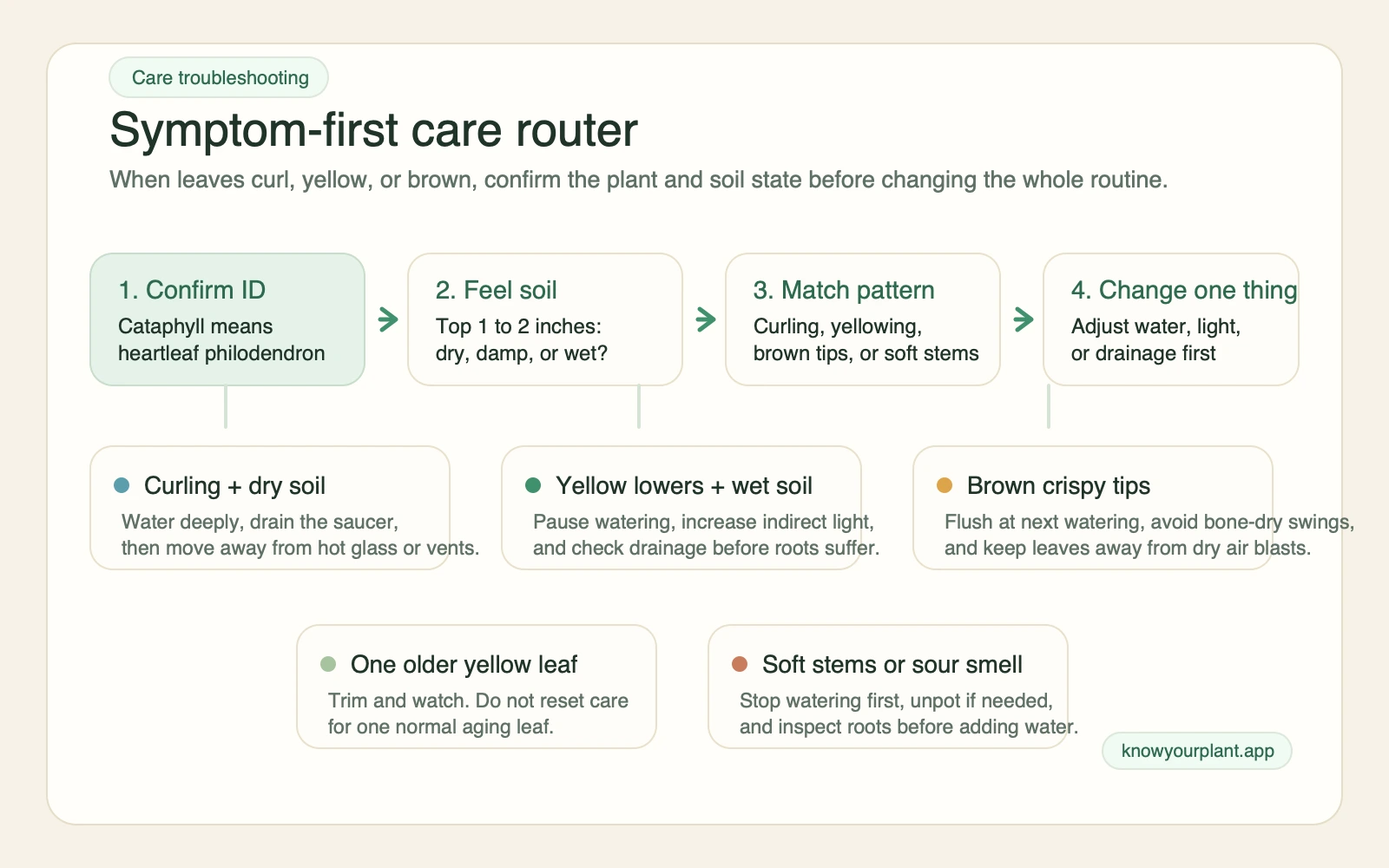
Route symptoms through plant ID and soil state before changing care so you fix the wet, dry, light, or airflow problem that is actually present.
If the plant is declining quickly, lift the nursery pot and smell the soil. A sour smell, mushy stems, or roots that are dark and slimy point to root rot risk. That is when you stop watering first and inspect the roots instead of hoping the next drink will help.
Common Mistakes Beginners Make
- Trusting the nursery label more than the stem. Mislabeled pots are common enough that node structure beats the tag.
- Using color as the main ID test. Neon, lime, variegated, and silver-toned cultivars make color one of the least reliable checks.
- Watering on a schedule after yellow leaves appear. Yellowing plus wet soil usually means pause and inspect, not water again.
- Changing light, fertilizer, and watering all at once. Make one adjustment first so you can see what actually helped.
Seasonal Care Calendar
Both plants follow the same broad rhythm across the year. Knowing what to expect from each season helps you stay ahead of problems rather than react to them.
Spring (March to May)
This is when both plants wake up. You’ll notice new growth appearing faster, and the leaves will look more alert. For pothos, spring is the right time to repot if roots have started poking through the drainage holes or circling the bottom of the pot. For heartleaf philodendron, spring is a good moment to check whether any leggy stems need trimming back; the cuttings root easily in water and make good gifts.
Start fertilising now if you stopped over winter. A balanced liquid fertiliser diluted to half strength, applied every four weeks, suits both plants well. For a deep dive into feeding schedules and what the numbers on fertiliser bottles actually mean, the plant fertilizer guide has the details.
Summer (June to August)
Peak growing season. Both plants will put on more growth than at any other time of year, especially in decent indirect light. Water more frequently as temperatures rise and soil dries out faster. Watch for signs of stress from air conditioning: dry, curling leaf edges on a philodendron usually mean the air is too dry or too cold for its liking. Move it away from vents if you can.
Pothos in bright spots may produce larger, more dramatic leaves. If you want fuller, bushier growth on either plant, pinch back the growing tips in summer to encourage branching. New shoots will appear at each node below the cut within a week or two.
Autumn (September to November)
Growth starts to slow as light levels drop. Ease back on fertilising from September; there’s no point pushing growth the plant can’t sustain in lower light. Both plants handle the transition well. What catches people out is continuing to water at the summer schedule: soil that dried out in three days during August may now take six. Stick to the finger test rather than the calendar.
Watch for pests as you bring outdoor plants inside for winter. Spider mites and fungus gnats often hitchhike in on neighbouring plants. Check the undersides of leaves before moving anything indoors.
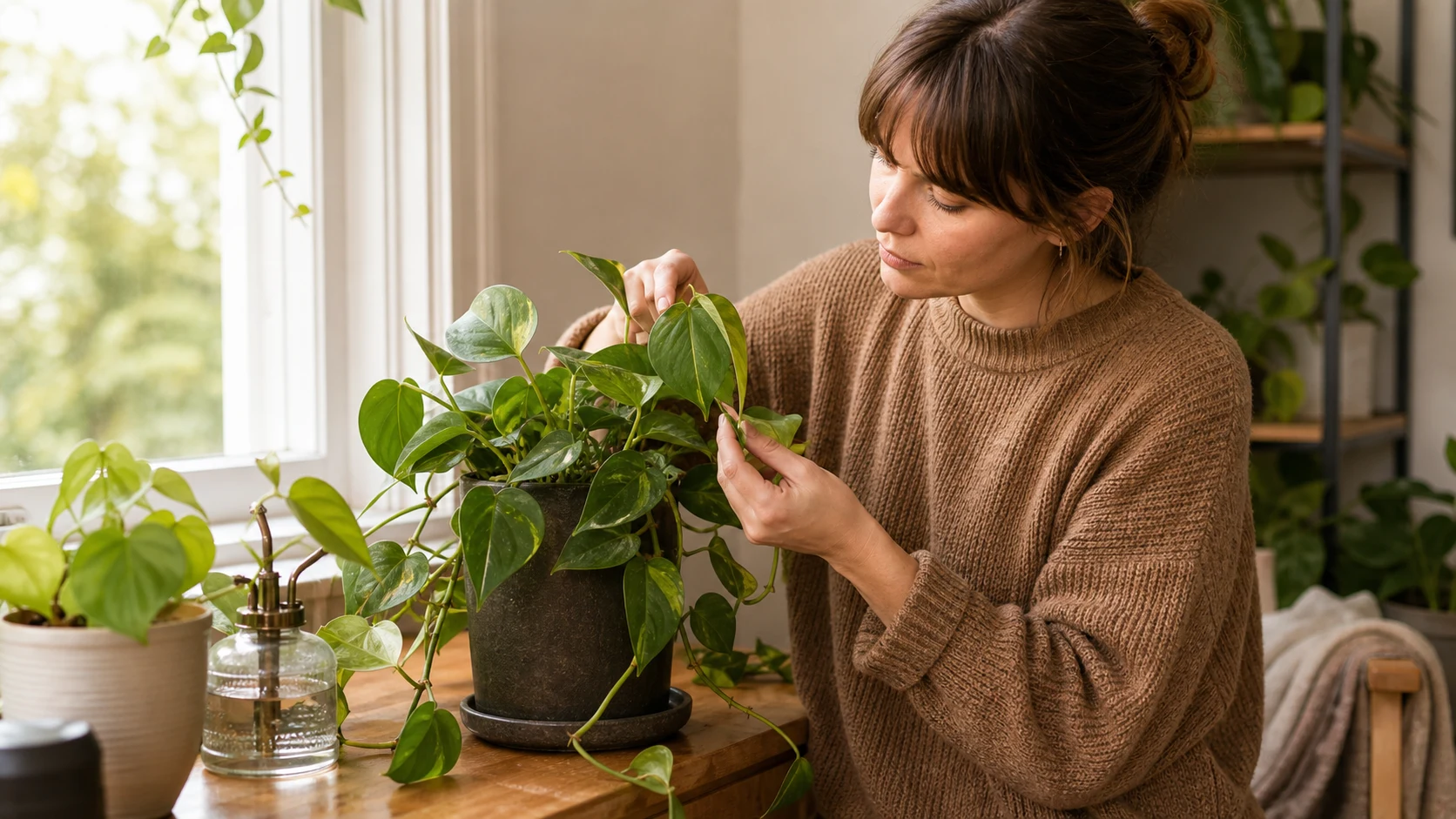
As autumn light fades, inspect leaf undersides for hitchhiking pests and water only after the soil dries.
Winter (December to February)
Both plants slow down significantly. Water sparingly, fertilise not at all, and resist the urge to repot until spring. A philodendron left in a cold room or next to a draughty window will sulk; move it somewhere stable, ideally above 60F (15C). Pothos is more tolerant of cooler temperatures but still dislikes cold draughts.
This is also when yellow leaves are most likely to appear, usually from a combination of overwatering and reduced light. Cut back on watering, give the plant the brightest spot you can find, and wait. Both will pick back up when the days start getting longer.
A Note on Toxicity
This matters if you share your home with cats or dogs. The ASPCA lists both Epipremnum aureum (pothos) and Philodendron hederaceum as toxic to cats and dogs, with ingestion potentially causing mouth irritation, excessive drooling, and vomiting. Neither plant is safe to chew on, regardless of which one you have. For a fuller list of pet-safe alternatives, the cat-safe indoor plants guide has options that are worry-free.
Lookalikes and Confused-With Plants
These are the pairings beginners mix up most often when tags, online listings, or inherited plant names are fuzzy.
Golden Pothos vs. Heartleaf Philodendron
This is the most common mix-up. Golden pothos shows variation through patches of yellow or cream scattered across the leaf surface. Philodendron Brasil, one of the most popular philodendron varieties, shows a lime green stripe running down the centre of the leaf rather than irregular patches. If your plant has yellow splashes, it’s almost certainly a pothos. If it has that vivid central stripe, that’s a Philodendron Brasil. Our Philodendron Brasil care guide is useful if that stripe pattern is what you are seeing in the pot.
Neon Pothos vs. Neon Philodendron
Both exist, and both glow. Neon pothos has that characteristic thick, waxy leaf with the grooved petiole. Neon philodendron leaves feel noticeably softer. If you’ve got a neon plant and aren’t sure which you’re looking at, the cataphyll test is your friend. For more on neon pothos specifically, the neon pothos care guide covers what this variety needs.
Marble Queen Pothos vs. Silver Philodendron
These two both show pale, silvery tones. Marble queen pothos has heavy white marbling across the entire leaf. Silver philodendron (Scindapsus pictus, technically not a true philodendron but often grouped with them) has smaller leaves with subtle silver spotting rather than full marbling. The cataphyll test will help here too.
If you own both plants, save each one separately in KnowYourPlant so watering checks, light notes, and seasonal reminders stay tied to the right pot.
Real User FAQ
Are pothos and philodendron the same plant? No. Despite looking similar, they belong to completely different genera. Pothos is Epipremnum aureum; heartleaf philodendron is Philodendron hederaceum. They share a family (Araceae), but that’s where the close relationship ends. Think of them as cousins from different branches of a large family rather than the same plant with different names.
Which is easier to care for? Both are easy to live with, which is part of why they’re so popular. If forced to choose, pothos edges ahead for beginners: it tolerates lower light, is a little less sensitive to overwatering, and tends to show stress signals early enough to correct before serious damage sets in. Heartleaf philodendron is also very forgiving, just slightly more appreciative of good humidity and consistent conditions.
Which grows faster? Heartleaf philodendron tends to put out new growth a little faster, especially in warm, humid conditions. In a bright spot with regular feeding during the growing season, it can produce a new leaf every week or two. Pothos grows steadily but often a touch more slowly, though both will slow down significantly in winter.
Is one more toxic than the other? Both are equally toxic to pets. The ASPCA lists both plants as toxic to cats and dogs due to insoluble calcium oxalate crystals, which cause mouth and throat irritation. If you’re choosing a trailing plant for a home with pets, neither is a safe option. The cat-safe indoor plants guide has alternatives that are worry-free.
Can I tell them apart without seeing new growth? Yes. The cataphyll test works by looking for the dried papery husks left on the stem after previous leaves emerged; you don’t have to wait for a new leaf. The leaf texture test (waxy and thick versus soft and thin) works at any time, and the petiole shape (grooved versus smooth) is visible on any mature vine.
My plant was labelled as pothos but I think it might be a philodendron. Does it matter? Mostly for knowing what to expect from your care routine. If you’ve been treating it as a pothos (less humidity, lower light) and it’s been thriving, keep doing what you’re doing. If it seems a little less happy than expected, try moving it somewhere with slightly better light and higher humidity. It may just prefer those philodendron conditions.
Can I keep them together in the same pot? You can, and some people do for the contrast in leaf texture. Their care needs are similar enough that they won’t compete in a harmful way. The main consideration is root space: both are vigorous growers and will eventually outcompete each other if the pot isn’t large enough. If you want to try it, choose a generous container and expect to repot sooner rather than later.
Methodology Note
This remediation pass reviewed live search results and repeated beginner confusion patterns around mislabeled pots, neon varieties, and watering tolerance. Community discussions from Houzz and Reddit were used as qualitative language and pain-point signals, not as taxonomic authority. Structural ID, root-rot risk, and toxicity claims were checked against North Carolina Extension, Missouri Botanical Garden, and ASPCA sources.
Freshness Note
Source checks for the Research Pack behind this update were refreshed on 2026-05-17. If a nursery tag conflicts with the plant in front of you, trust the node structure, petiole, and new-growth evidence over the label.
The One Thing to Remember
If you only take one thing from this: check for the cataphyll. That small papery sheath on new growth is the clearest, most reliable marker between these two plants. No amount of lighting, soil quality, or variety will change it. Cataphyll on the stem means philodendron. No cataphyll means pothos.
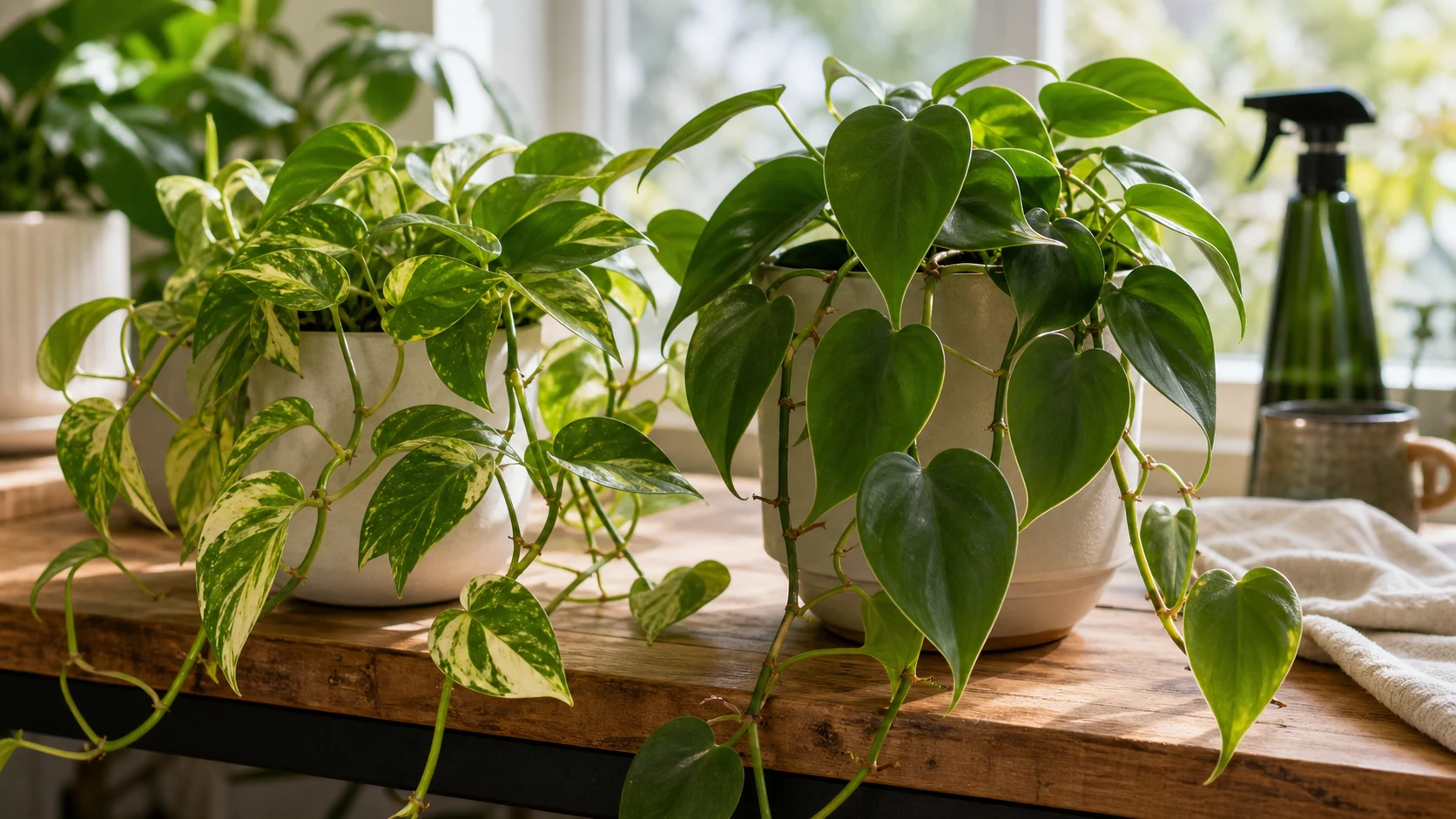
Papery sheath remnants on philodendron nodes separate it from pothos before the soil check guides watering.
Both plants are genuinely rewarding to grow. Both are easy to care for and hard to kill. Knowing which one you have just helps you give it exactly what it needs.
Use the cataphyll test for the name, then let the soil dryness decide watering. That combination solves most pothos-versus-philodendron confusion without turning plant care into homework.