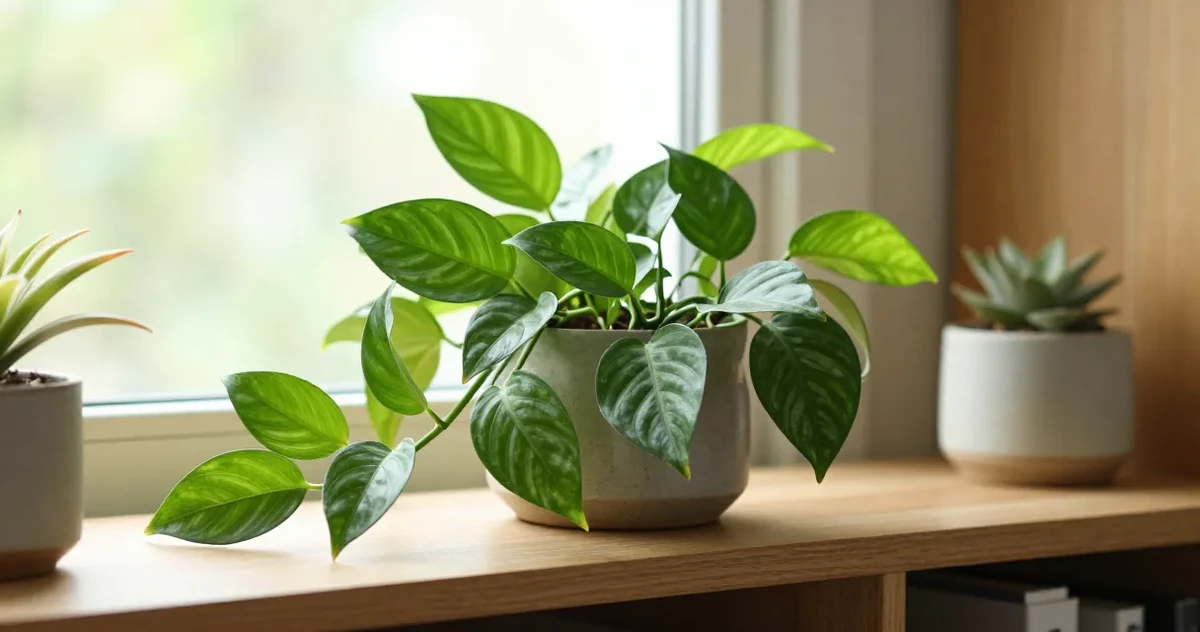
If you’ve ever stood in a garden center staring at trailing vines and wondered which pothos will actually survive in your home, start here. The right variety depends less on which leaf pattern you like and more on three everyday things: your light, your watering habits, and how much you want the plant to grow.
Pothos varieties are mostly members of the Epipremnum aureum species, with a few close relatives that stores sell under the same everyday name. They all trail, climb, and tolerate normal home conditions, but they are not identical. A jade pothos can handle a dim shelf and missed watering better than a snow queen. A marble queen needs brighter indirect light to keep its white pattern strong. A satin pothos often wants a steadier moisture routine than a golden pothos.
Pothos names mapped to accepted species
Common names blur taxonomy: golden, neon, and Marble Queen belong to Epipremnum aureum, while satin pothos is Scindapsus pictus. Keeping the rows separate prevents a false one-species comparison.
The ranges below are the middle 50% (p25–p75), not recommended indoor setpoints.
| Reference taxon | POWO native range | Annual mean temperature | Annual precipitation | Relative humidity | Solar radiation | Evidence |
|---|---|---|---|---|---|---|
| Epipremnum aureum (golden pothos) | Mo’orea in the Society Islands | 25.7–25.9°C | 2451–2644 mm/yr | 63–64% | 20.0–20.1 MJ/m²/day | 6 climate points; low confidence |
| Scindapsus pictus (satin pothos) | southeastern Bangladesh to western and central Malesia | 24.0–26.6°C | 2758–3377 mm/yr | 67–70% | 17.4–18.9 MJ/m²/day | 30 climate points / 52 usable records; medium confidence |
What this changes in this guide: Cultivar appearance is not climate data. Use the species mapping to understand background, then compare variegation, growth, and room response directly.
Sources and method: Epipremnum aureum in POWO and GBIF; Scindapsus pictus in POWO and GBIF; CHELSA V2.1, 1981–2010. GBIF records are limited to POWO-native countries, then filtered for coordinates, establishment signal, licence, precision, and spatial duplication. No community or user-reported care data is used in this module.
Identification Snapshot
| Field | What to look for |
|---|---|
| True pothos base | Most common pothos varieties are cultivars of Epipremnum aureum, especially golden, jade, neon, marble queen, pearls and jade, njoy, manjula, and jessenia. |
| Related species often sold beside them | Cebu Blue and Baltic Blue belong to Epipremnum pinnatum, while satin pothos belongs to Scindapsus pictus. |
| Leaf clue | Classic pothos leaves are heart-shaped, glossy, and trail quickly; pinnatum forms look narrower, and satin pothos has a softer matte finish with silver markings. |
| Best beginner match | Golden, jade, and neon are the easiest starting points if you want a fast grower that forgives a late watering. |
| Fast buying clue | The more white on the leaf, the more light and patience the plant usually needs to stay healthy and keep its pattern. |
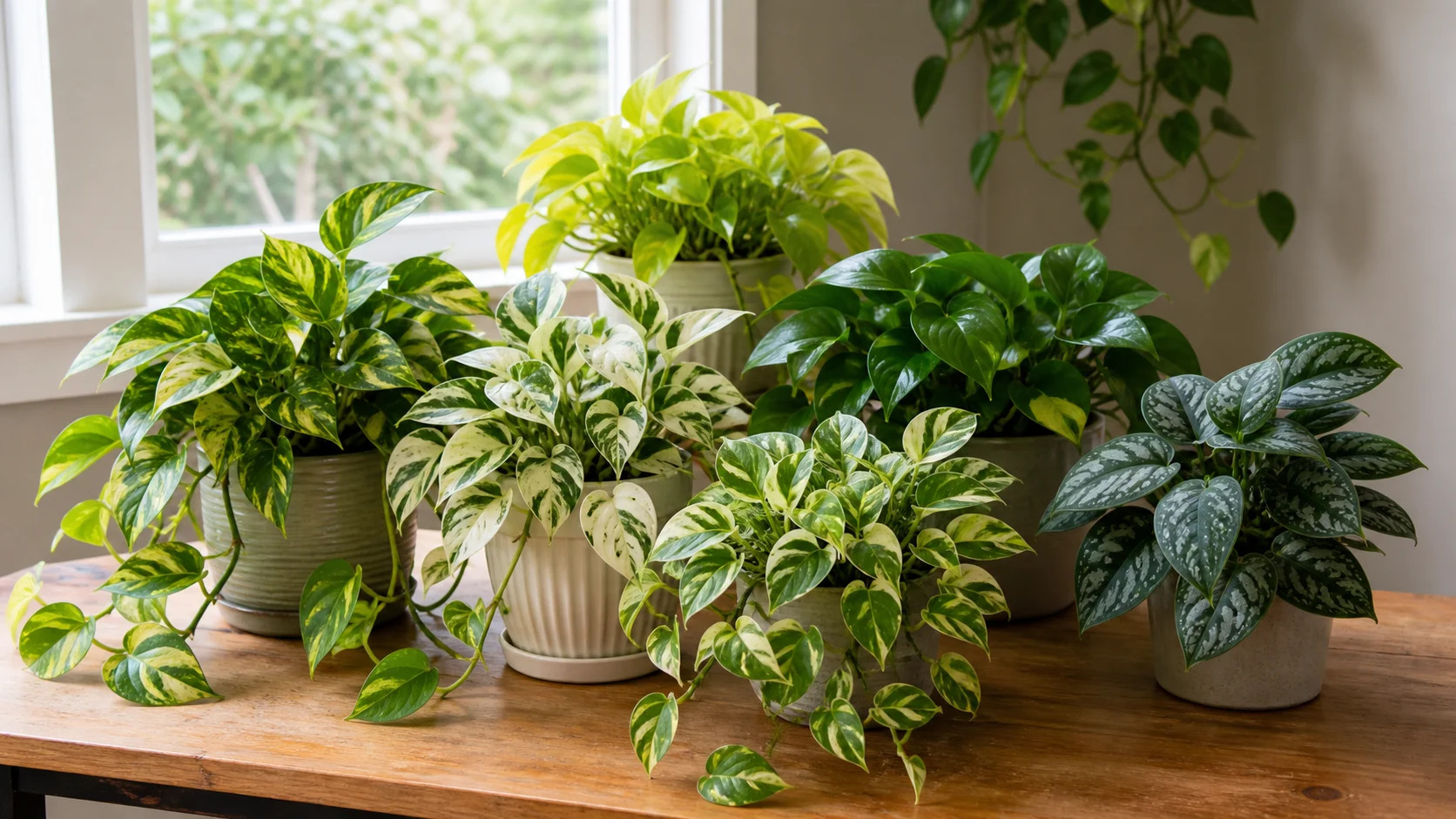
Golden, neon, jade, white-variegated, and satin pothos show the leaf clues that separate common forms.
Lookalikes and Commonly Confused Plants
| Plant or group | Why people lump it in with pothos | What actually matters for care |
|---|---|---|
| Golden, jade, neon, marble queen, njoy, pearls and jade, manjula | These are the core pothos most people mean, and they share the same trailing shape and basic care rhythm. | Bright indirect light is safest, but solid-green forms handle lower light better than heavily variegated ones. |
| Cebu Blue and Baltic Blue | Sellers often call them pothos because they trail the same way and belong to the same broader aroid family. | They are Epipremnum pinnatum forms, so the leaves look narrower and climbing maturity matters more if you want splits. |
| Satin pothos | The common name makes buyers assume it is just another pothos cultivar. | It is actually Scindapsus pictus, and it usually prefers slightly steadier moisture than a classic golden pothos. |
| Heartleaf philodendron | Young trailing philodendrons can look pothos-like from a distance. | Philodendrons have thinner leaves and a different stem feel, so use a separate care guide if the label is unclear. |
Expert Note: Start With the Species, Not Just the Shelf Label
The most useful expert shortcut is to separate true pothos cultivars of Epipremnum aureum from the other trailing aroids that stores casually sell beside them. The New York Botanical Garden’s pothos reference is a good anchor here: golden, jade, neon, marble queen, pearls and jade, njoy, manjula, and jessenia fit the usual pothos care pattern. Cebu Blue and Baltic Blue are closer Epipremnum pinnatum relatives, while satin pothos belongs to Scindapsus pictus.
That difference matters for two practical reasons. First, the label on the pot may be broad even when the plant is not. Second, the ASPCA lists golden pothos, Epipremnum aureum, as toxic to cats and dogs, so pet safety should be part of the buying decision, not an afterthought once the plant is already on the shelf at home.
What Collectors Keep Mixing Up
Plant-owner discussions tend to lump true pothos, Cebu Blue, Baltic Blue, satin pothos, and even trailing philodendrons into the same bucket because they all read as easy vining houseplants from a few feet away. The consistent confusion points are white versus cream variegation, whether green speckles mean Pearls and Jade rather than Njoy, and whether a narrow blue-toned leaf means a related Epipremnum pinnatum form instead of classic pothos.
Treat that collector language as useful buying shorthand, not botanical proof. If a plant is being sold mainly by common name, use the leaf pattern, leaf texture, and stem habit before you assume it will behave exactly like the pothos you already own.
Here’s the working definition that matters for care: a pothos variety is a cultivar or close relative with the same heart-shaped or vining look, but a different leaf pattern, growth speed, and light tolerance.
This guide covers 15 of them and keeps the care advice practical: which one to buy, how often to water, and what to do when leaves curl, yellow, or get brown tips. If you’re just getting started with houseplants, pothos are one of the best places to begin; check out our indoor plant care guide for beginners for a broader foundation.
What Most Plant Roundups Miss
Most roundups about pothos Varieties list attractive options. The better question is which choice will still make sense in your actual room three months from now.
Use this filter before choosing:
- Light reality: what the plant receives on a normal cloudy day, not the brightest hour of the week.
- Care rhythm: whether you prefer weekly attention or a plant that can be ignored longer.
- Space: mature height, spread, trailing habit, and whether leaves will touch walls or pets.
- Failure signal: what the plant does first when the match is wrong: yellowing, stretching, crisping, or dropping leaves.
A good recommendation is not just beautiful. It fits the room, the owner, and the first problem you are likely to notice.
Quick Care Fit Check
Before you buy or move a pothos, match the variety to the spot you actually have. This is the fastest way to avoid slow growth, faded variegation, and the “why are the leaves yellow?” spiral later.
- Dim room or forgetful routine: Jade, golden, and neon pothos are the safest picks.
- Bright indirect window and regular check-ins: Marble queen, snow queen, manjula, and pearls and jade will keep better color.
- Small shelf or desk: Njoy, pearls and jade, and silver satin stay tidier than fast-growing golden or neon.
- Climbing pole or tall support: Cebu blue, Baltic blue, Hawaiian, and golden pothos can size up beautifully.
- Pets that chew leaves: Skip pothos or keep it fully out of reach; pothos is not pet-safe if eaten.
For watering, use the same starting rule across the group: water when the top 2 inches of mix feel dry, then let extra water drain away. In many homes that means about every 7 to 10 days in spring and summer, and every 10 to 21 days in winter, but the soil test matters more than the calendar.
Care Cards
| Care card | What to aim for indoors | What owners get wrong most often |
|---|---|---|
| Light | Bright indirect light for most varieties. Jade, golden, and neon tolerate dimmer rooms best, while snow queen, marble queen, manjula, and njoy keep their pattern best in brighter spots. | Treating every pothos as equally low-light tolerant, then wondering why a white-variegated plant starts reverting or stalling. |
| Water | Water when the top 2 inches of mix feel dry, then let extra water drain away fully. | Following a fixed weekly schedule even when the pot still feels cool, damp, and heavy. |
| Growth habit | Expect fast trailing growth from golden, jade, and neon, with slower and fussier growth from heavily variegated types. | Buying a slow variegated form and expecting it to fill a shelf at the same speed as a plain green pothos. |
| Placement | Compact types like njoy and pearls and jade suit small shelves, while Cebu Blue, Baltic Blue, Hawaiian, and golden pothos reward a pole or taller support. | Putting a climbing or fast-growing form in a tiny spot without a plan for where the vines will go next. |
| Pet safety | Keep every pothos type out of reach of cats and dogs because the whole group is toxic if chewed. | Treating pothos as a universal beginner plant without checking the pet risk first. |
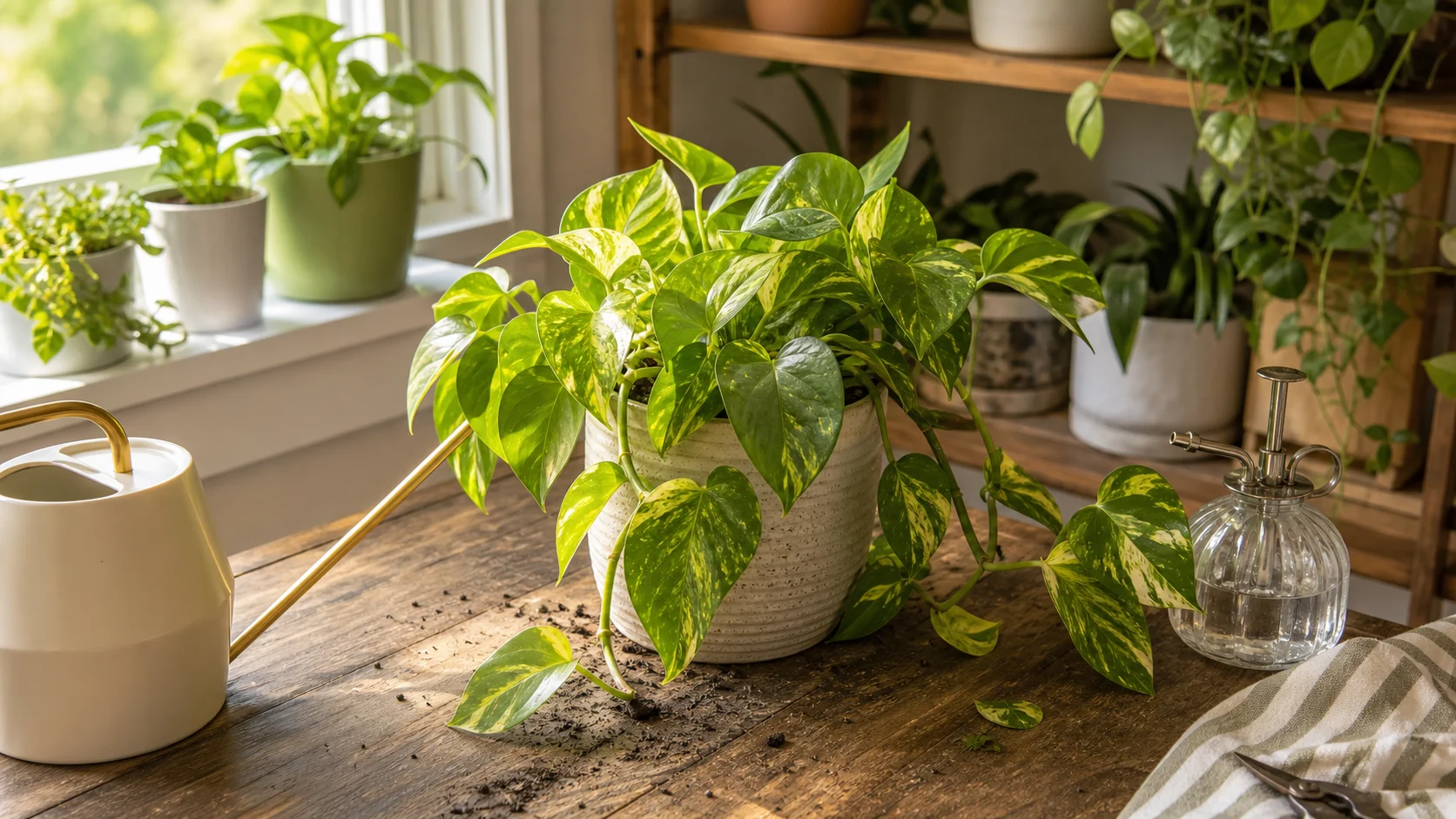
Bright indirect light and a soil-first watering check matter more than a fixed weekly schedule.
Variety Comparison Table
| Variety | Likely botanical group | Leaf pattern | Light needed to keep color | Growth speed | Common confusion | Pet-safety read before you buy |
|---|---|---|---|---|---|---|
| Golden | Epipremnum aureum | Green with yellow-gold splashes | Medium to bright indirect for strongest variegation | Fast | Mixed up with Hawaiian or reverted marble queen | ASPCA lists golden pothos species as toxic to cats and dogs |
| Jade | Epipremnum aureum | Solid green | Tolerates the lowest light of the core group | Fast | Mistaken for any reverted variegated pothos | Treat like other true pothos cultivars and keep away from chewing pets |
| Neon | Epipremnum aureum | Solid chartreuse | Medium light keeps the color brightest | Fast | Mistaken for a nutrient issue when mature leaves deepen slightly | Treat like other true pothos cultivars and keep away from chewing pets |
| Marble Queen | Epipremnum aureum | White and cream marbling on green | Bright indirect light | Medium to slow | Mixed up with snow queen | Treat like other true pothos cultivars and keep away from chewing pets |
| Snow Queen | Epipremnum aureum | Mostly white leaves with limited green | Bright indirect light, more than marble queen | Slow | Overcalled when a bright marble queen just happens to have pale leaves | Treat like other true pothos cultivars and keep away from chewing pets |
| Njoy | Epipremnum aureum | Clean blocks of green and white | Bright indirect light | Slow to medium | Mixed up with Pearls and Jade or Glacier | Treat like other true pothos cultivars and keep away from chewing pets |
| Pearls and Jade | Epipremnum aureum | White margins with green and gray-green speckling | Bright indirect light | Slow | Mixed up with Njoy because both stay compact | Treat like other true pothos cultivars and keep away from chewing pets |
| Manjula | Epipremnum aureum | Wide leaves with swirled white, cream, and green | Bright indirect light without harsh sun | Slow | Mixed up with highly variegated marble queen | Treat like other true pothos cultivars and keep away from chewing pets |
| Global Green | Epipremnum aureum | Green-on-green center pattern | Medium to bright indirect light | Medium | Mistaken for a plain green pothos until the center color develops | Treat like other true pothos cultivars and keep away from chewing pets |
| Cebu Blue | Epipremnum pinnatum | Narrow blue-silver leaves | Bright indirect light to keep the blue cast | Medium to fast | Called pothos even though it is a related species | Verify separate species labeling and pet-safety guidance if that matters in your home |
| Baltic Blue | Epipremnum pinnatum | Deeper blue-green leaves that split earlier | Bright indirect light | Medium to fast | Mixed up with Cebu Blue | Verify separate species labeling and pet-safety guidance if that matters in your home |
| Satin pothos | Scindapsus pictus | Matte green leaves with silver patches | Medium to bright indirect light | Medium | Called a pothos cultivar when it is not | Verify separate species labeling and pet-safety guidance if that matters in your home |
Quick Decision Tree: What Kind of Pothos Is This?
- Are the leaves matte with silver patches instead of glossy green? If yes, you are probably looking at satin pothos, a Scindapsus, not a true pothos cultivar.
- Are the leaves long, narrow, and slightly blue-toned? If yes, start with Cebu Blue or Baltic Blue rather than golden-pothos types.
- Is the leaf mostly solid green? Jade is the usual answer, while neon is the solid chartreuse version.
- Is the variegation white or cream on a classic heart-shaped leaf? Check how the color is arranged next.
- Large marbled splashes across the leaf? Marble queen, or snow queen if the leaf is overwhelmingly white.
- Cleaner blocks of green and white with a tidy compact habit? Njoy is more likely.
- White margins plus green-on-green or gray-green speckling? Pearls and Jade is the better fit.
- Broader leaves with swirled cream, white, and green? Manjula is the likely label to double-check.
The Classic Pothos Varieties Most People Know
Golden Pothos (Epipremnum aureum)
The one that started it all. Golden pothos has deep green leaves splashed with irregular yellow-gold variegation – no two leaves are identical, which gives it a loose, painterly quality. It’s the most widely available variety and for good reason: it tolerates low light, inconsistent watering, and general neglect better than almost anything else you can grow indoors.
Golden pothos also appears in NASA’s 1989 Clean Air Study, where it was tested for removing some indoor pollutants in sealed chamber conditions. That does not mean one pothos will purify a whole room, but it does explain why this variety became so common on houseplant recommendation lists.
The variegation fades in very low light, so if you want those gold tones to stay bright, give it a spot where you’d comfortably read a book without turning on a lamp. For a full care breakdown, see our golden pothos care guide.
Neon Pothos
Neon pothos is easy to identify: it has no variegation at all, just pure, almost electric chartreuse leaves. The color is brightest on new growth and deepens slightly as leaves mature, but it never goes fully green.
It grows fast, handles lower light reasonably well, and works beautifully as a contrast plant next to darker-leaved varieties. If your collection is heavy on greens and whites, neon pothos is the one that makes the rest of the shelf pop. We’ve written a full neon pothos care guide if you want to get the most out of its color.
Marble Queen Pothos
Where golden pothos has gold streaks, marble queen has white ones: lots of them. The leaves are heavily variegated with white and cream against green, with some leaves coming out almost entirely pale. That’s beautiful, but it comes with a tradeoff: the more white on a leaf, the less chlorophyll, which means marble queen grows more slowly than golden or neon and needs a bit more light to thrive.
That white tissue matters for care: the paler the leaf, the less green tissue it has to power growth. Heavily variegated cultivars need brighter conditions to stay healthy and keep their pattern. For a full breakdown of watering, light, and variegation troubleshooting, see our marble queen pothos care guide. If you’re not sure what “bright indirect” actually means in your home, our guide to grow lights for indoor plants can help you think it through.
Give marble queen a bright indirect spot and she’ll reward you with some of the most dramatic foliage in the pothos family.
Pearls and Jade Pothos
A sport developed from marble queen, pearls and jade has smaller leaves with a more restrained variegation pattern: green with white and gray-green patches, often along the leaf edges. The patterning is more precise and delicate than marble queen’s broad splashes.
It’s slower-growing than most pothos, but the detail on each leaf is worth the patience.
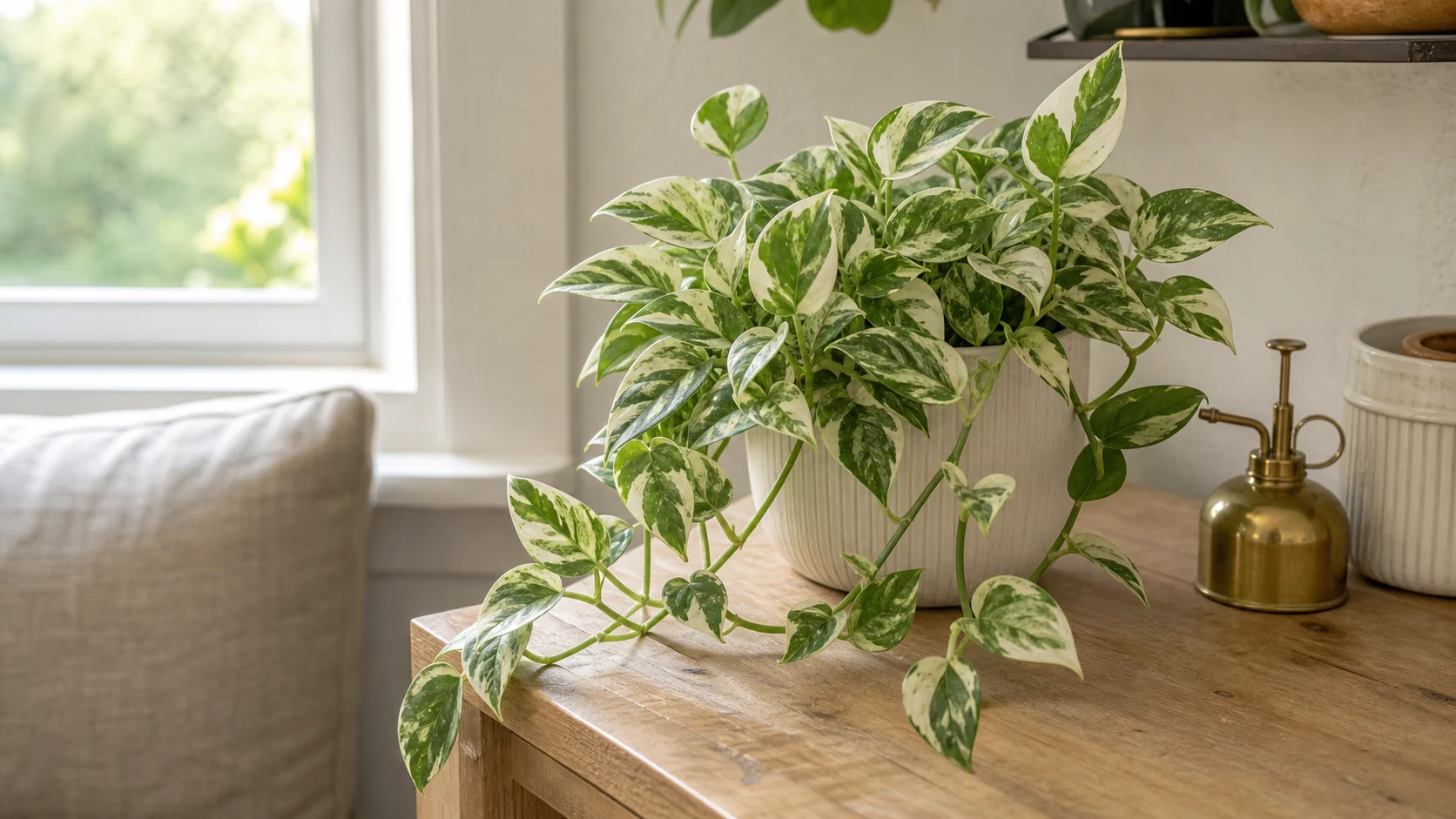
Pearls and Jade stays compact while its small leaves develop precise white edges and muted green speckling.
Rarer Pothos Varieties Worth Seeking Out
Manjula Pothos
Manjula pothos is one of the most distinctive varieties in the family. The leaves are wider and more heart-shaped than most pothos, with a mix of white, cream, and green variegation that swirls rather than streaks – some leaves look almost marbled in multiple tones at once.
Manjula pothos was developed and patented by the University of Florida (US Plant Patent PP21,217, granted 2010), which is part of why it stayed relatively rare for years and still commands a higher price than common varieties. That patent meant propagation was restricted, limiting how widely it could be distributed through the trade. It grows slowly, dislikes direct light on those pale sections, and benefits from slightly higher humidity than the average pothos. It’s not difficult, just more attentive: think of it as a pothos that appreciates a little more consideration.
Njoy Pothos
Njoy has a clean, graphic quality that sets it apart. The leaves are smaller, and the variegation is divided into distinct green and white sections – less blended than marble queen, more like patches of solid color side by side. It holds its pattern well under a range of light conditions, which makes it reliable as well as attractive.
It stays more compact than many trailing varieties, which makes it a good fit for smaller spaces or shelves where a full cascading vine might overwhelm.
Jessenia Pothos
At first glance, jessenia looks similar to marble queen, but the variegation leans toward yellow-green rather than white, and it’s more evenly distributed across each leaf rather than concentrated in patches. It has a softer, more muted quality than marble queen’s high-contrast look.
Jessenia grows at a moderate pace and handles average household light well. If marble queen feels too stark for your space, jessenia is the warmer-toned alternative.
Cebu Blue Pothos (Epipremnum pinnatum)
Technically from a related species, Cebu blue earns its place on any pothos varieties list. The leaves are narrow, elongated, and in the right light they have a soft silvery-blue sheen that looks unlike anything else in the family.
Given enough light and something to climb, it can eventually produce fenestrated leaves: similar to monstera, the leaf develops holes and splits as it matures. Most people grow it as a trailer and never see this, but it’s a real possibility if you let it climb.
Satin and Silver Pothos: The Scindapsus Group
Satin Pothos (Scindapsus pictus)
Satin pothos isn’t technically a pothos at all; it belongs to the Scindapsus genus, but it’s sold alongside them, grown the same way, and grouped with them in most collections. The leaves are matte green with silver spots that have a soft, almost velvety texture in the right light.
It grows a bit more slowly than true pothos and prefers consistent moisture without sitting in wet soil. Otherwise, the care is nearly identical. If you want the deeper care notes, read our satin pothos care guide.
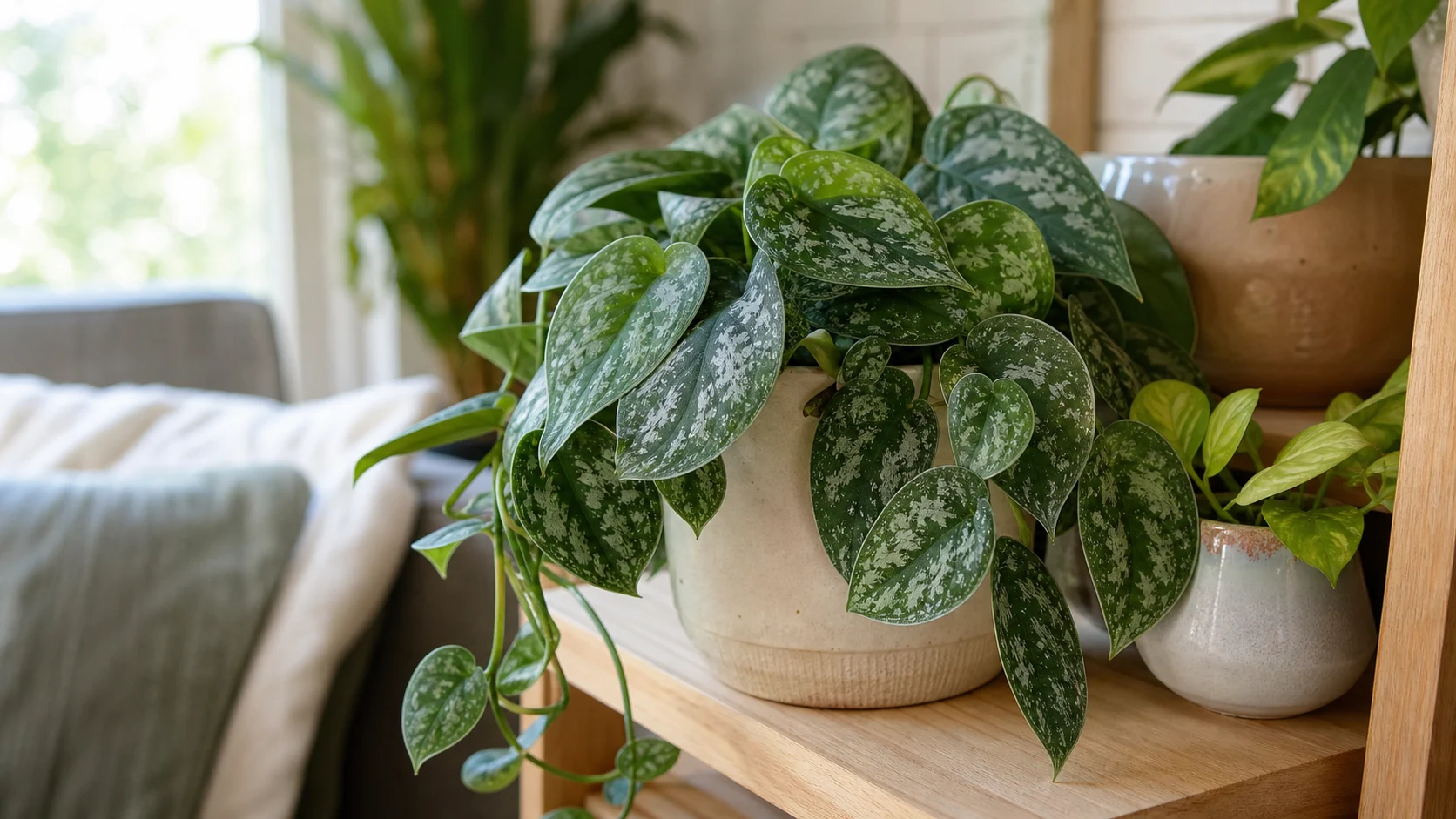
Satin pothos stands apart from true pothos through its matte leaves and soft silver spotting.
Silver Satin / Argyraeus
A variety of Scindapsus pictus, argyraeus has smaller leaves with silver markings that are more concentrated and defined. It’s compact, trails beautifully, and the silver catches light in a way that makes it look more delicate than it actually is.
Other Types of Pothos Worth Growing
Hawaiian Pothos
Hawaiian pothos is often confused with golden pothos, but the leaves are noticeably larger: given room to climb, they can become quite substantial. The variegation is bolder too, with bigger patches of yellow-gold. If you want the golden pothos look at a more dramatic scale, Hawaiian is the one to grow on a moss pole.
Global Green Pothos
A newer variety with an interesting twist: the variegation is green-on-green, with lighter centers fading to darker edges. The effect is subtle but gives the leaves a dimensional, almost layered quality that becomes more apparent as the plant matures.
Baltic Blue Pothos (Epipremnum pinnatum)
Related to Cebu blue, Baltic blue has deeper blue-green coloring and fenestrates earlier and more reliably: even as a young plant in moderate light, you’ll start to see the leaf edges develop splits. It’s become one of the more sought-after varieties in recent years, and for good reason.
Jade Pothos
The plain-leafed version of the family: solid, rich green with no variegation. It grows fast, handles low light extremely well (arguably better than any variegated variety), and has a clean, unfussy look. Sometimes the simplest option is also the most satisfying.
Snow Queen Pothos
Snow queen sits at the extreme end of marble queen’s variegation spectrum: the leaves are predominantly white with just traces of green. It’s striking, grows slowly, and needs good indirect light to stay healthy. A plant for someone who wants a focal point and is willing to give it a little extra attention.
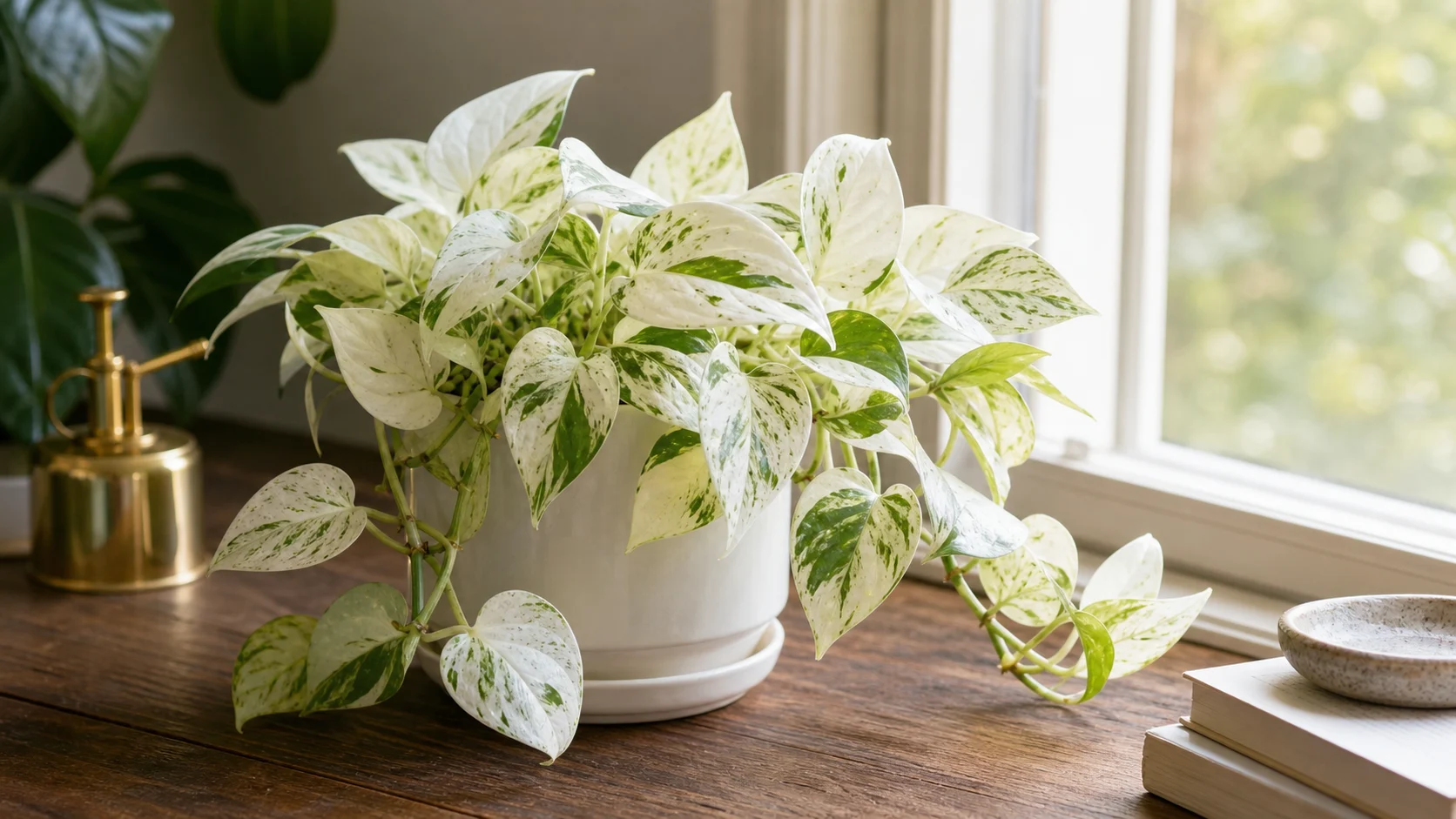
Snow Queen keeps its mostly white foliage healthiest in a bright indirect window position.
Common Problems: Yellow Leaves, Curling, and Brown Tips
Most pothos problems come from watering before the pot has dried enough. Do not water just because it has been a week. Push a finger 2 inches into the potting mix, or lift the pot and feel its weight. If the top layer is dry and the pot feels lighter than it did after watering, water thoroughly. If the mix still feels cool, damp, or heavy, wait a few more days.
Signs you are overwatering: lower leaves turn yellow one after another, the soil stays wet for more than 5 days, stems feel soft near the soil line, the pot smells sour, or fungus gnats keep appearing. Your next step is to stop watering, check that the pot has a drainage hole, move the plant into brighter indirect light, and let the mix dry down before you water again.
Signs you are underwatering: leaves curl inward, vines droop but the stems still feel firm, the pot feels very light, and the soil pulls away from the edge of the pot. Water slowly until it drains from the bottom, then check again in a few days. Very dry soil can repel water, so a second slow watering may be needed after the first soak.
Brown tips or crispy edges: usually mean dry air, inconsistent watering, fertilizer buildup, or direct sun. Trim only the brown part if it bothers you, flush the pot with plain water next time you water, and move the plant back from hot glass or afternoon sun.
Yellow leaves: one old yellow leaf now and then is normal. Several yellow leaves at once usually means the plant stayed too wet, sat in a dark corner after watering, or has roots crowded into a pot that no longer drains well.
Curling leaves: check water first, then light. Curling with bone-dry soil means water. Curling with wet soil means root stress, cold, or low light, so do not add more water.
Common Mistakes People Make With Pothos Varieties
- Treating every trailing aroid as a pothos. This is how Cebu Blue, satin pothos, and heartleaf philodendron end up in the same mental bucket even when their leaf texture and growth habit say otherwise.
- Buying the whitest plant without checking the window first. Marble queen, snow queen, manjula, Njoy, and Pearls and Jade are slower and need brighter indirect light than jade or golden.
- Using the same watering rhythm for every cultivar. Satin pothos and heavily variegated plants usually complain sooner if the mix stays soggy.
- Ignoring pet safety because the plant looks common. Golden pothos toxicity is easy to overlook precisely because pothos is such a standard beginner recommendation.
- Assuming a reverted vine is a different cultivar. A low-light marble queen or manjula can push greener growth that looks like a whole new plant when the real issue is the light level.
Find Your Match: Which Pothos Variety Suits You?
Not sure where to start? Here’s a quick guide based on your actual situation.
You have a dim corner with almost no natural light: Go with jade pothos. Its all-green leaves are the most efficient at photosynthesis, so it handles very low-light conditions better than any variegated variety. Golden pothos is a close second.
You want something that looks different from every other pothos: Cebu blue or Baltic blue. The silvery-blue tone and fenestrating leaves look nothing like the typical trailing vine, and most people won’t recognize them as pothos at all.
You’re working with a small shelf or limited space: Njoy or pearls and jade. Both stay compact, trail neatly, and don’t take over the way golden or neon can on a longer shelf.
You want maximum drama and have a bright spot for it: Marble queen or snow queen. Put either one in good indirect light and the white-and-green contrast becomes the focal point of the room.
You’re a beginner and want something forgiving: Golden pothos, neon pothos, or jade. All three tolerate irregular watering, a range of light levels, and the occasional missed care session without much complaint.
You want something rare and are willing to pay for it: Manjula or jessenia. Manjula in particular has a history of restricted availability and still commands collector interest. The leaf shape alone is worth seeking out.
Your Pothos Action Plan
Today: Put the plant where it gets bright indirect light or gentle low light, not harsh afternoon sun. Check the top 2 inches of soil before watering. If the pot has no drainage hole, use it as a cover pot and keep the nursery pot inside it so excess water can escape.
This week: Watch for the three common warning signs: curling leaves, yellowing leaves, and brown tips. Check the undersides of leaves for pests, especially on plants that came from a store recently. Rotate the pot once so growth does not lean hard toward the window.
This season: Feed once a month in spring and summer if the plant is actively growing. Skip fertilizer in winter. Repot only when roots circle the bottom, water runs straight through, or the plant dries out much faster than it used to.
Seasonal Pothos Care Calendar
All pothos varieties follow the same rhythm through the year. The differences between varieties matter less than the season you’re growing in.
Spring (March to May)
This is when pothos wake up. Growth that slowed over winter picks up noticeably, and you’ll see new leaves pushing out more regularly. Start fertilizing again – once a month with a balanced liquid fertilizer is enough. If your plant has been in the same pot for two or more years and the roots are circling the bottom, spring is the best time to repot. It’s also the ideal season to take cuttings for propagation: the plant is in growth mode and will root quickly.
Summer (June to August)
Peak growing season. Water more frequently as the plant works harder and the soil dries out faster. Keep an eye out for spider mites, especially if your space gets hot and dry: they tend to appear during warm spells and settle on the undersides of leaves. If you’re moving a pothos outside for the summer, keep it in shade or dappled light; direct sun will scorch the leaves within days.
Autumn (September to November)
Growth starts to slow as light levels drop. Taper off fertilizing: the last application of the season should be around September or October. Bring any outdoor plants back inside well before the first cold night, as pothos don’t handle temperatures below about 10C/50F. This is also a good time to wipe the leaves down and remove dust buildup before the lower-light winter months.
Winter (December to February)
The slow season. Pothos won’t stop growing entirely, but new leaves will be smaller and less frequent. Reduce watering significantly: the soil takes much longer to dry out in winter, and overwatering in cold, low-light conditions is the most common way pothos run into trouble. Stop fertilizing until spring. Keep the plant away from cold drafts and heating vents; both are worse for pothos than simply leaving it alone in a stable spot.
How to Choose Between Different Pothos Varieties
The good news: most of these plants share the same basic care. Give them bright indirect light, water when the top 2 inches of soil are dry, use a pot with drainage, and feed lightly during the growing season. None of them like sitting in water, and most will tell you when they are thirsty by letting their leaves go slightly soft.
Darryl Cheng, author of The New Plant Parent, captures the underlying principle well: “Rather than forcing growth with fertilizer, feed your plant to support the pace it’s already growing at.” That’s especially relevant for the slower, heavily variegated varieties: marble queen and snow queen don’t need encouragement to grow faster, they need conditions that support the growth they’re already capable of.
Where varieties differ is in growth speed, light tolerance, and how demanding their variegation is. A good rule: the more white or pale on the leaves, the more light it needs and the slower it will grow. Fully green varieties like jade pothos are the most tolerant of low light. Heavily variegated ones like marble queen, snow queen, and manjula prefer brighter conditions and reward you with their best patterns there.
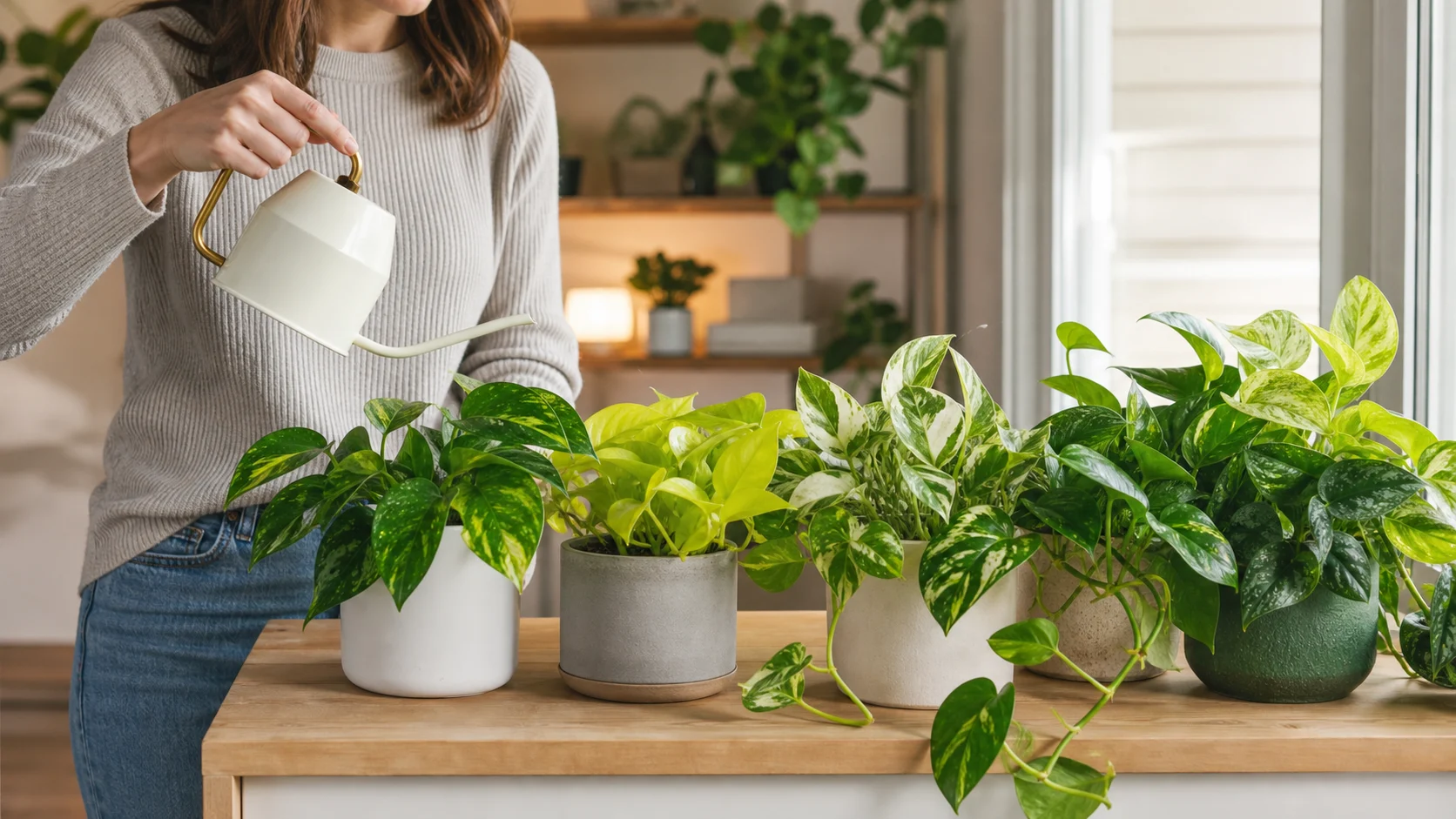
Comparing green, neon, silver, and white-variegated pothos makes their light and growth tradeoffs easier to match to a room.
If you’re growing under artificial light, our best grow lights for indoor plants guide covers exactly what to look for.
One more thing worth knowing: all pothos varieties are toxic to cats and dogs if ingested. The ASPCA lists Epipremnum aureum as toxic to both cats and dogs, with the calcium oxalate crystals in the leaves causing oral irritation and vomiting. If you have pets, take a look at our guide to cat-safe indoor plants for alternatives that give you the same trailing, low-maintenance appeal without the worry.
Once the light, watering routine, and pet-safety question are settled, the choice gets much easier: pick the leaf pattern and growth habit you want to live with.
Methodology Note
This guide was refreshed on 2026-06-22 after checking New York Botanical Garden for botanical framing, ASPCA for the pet-safety baseline around golden pothos, Costa Farms for common retail variety naming, and current care references for the light-versus-variegation tradeoff. Plant-owner discussion was used only as qualitative evidence for where buyers confuse Njoy, Pearls and Jade, Manjula, Cebu Blue, Baltic Blue, and satin pothos in everyday shopping language.
Freshness Note
Cultivar names and seller labels shift faster than the core care advice, so if you are buying a rarer pothos or a pothos-like vine, double-check the current tag before you use the guide to compare care needs. This page was last checked on 2026-06-22.
Real User FAQ
How many types of pothos are there? There are at least 15 to 20 commonly grown pothos cultivars, plus a few closely related Scindapsus and Epipremnum pinnatum varieties that are sold and grown alongside them. New cultivars continue to be developed, so the number keeps growing. The ones you’ll find most reliably are golden, neon, marble queen, njoy, pearls and jade, manjula, and jessenia.
What is the rarest pothos variety? Manjula is among the rarest you’ll find in mainstream retail, partly because of its University of Florida patent history. Jessenia is also less common than the core varieties. At the high end, Epipremnum aureum ‘Harlequin’ – a heavily white-variegated sport of golden pothos – is genuinely rare and commands collector prices when it appears.
What’s the difference between marble queen and snow queen pothos? Both have white-and-green variegation, but snow queen takes it much further: the leaves are predominantly white with just traces of green remaining. Marble queen has a more balanced mix of white, cream, and green. Snow queen grows more slowly and needs more light as a result. If you’ve seen a pothos that looks almost bleached, it’s probably snow queen.
Is Njoy the same as pearls and jade? They look similar at a glance: both have smaller leaves with green-and-white patterning. But they’re distinct cultivars. Njoy tends to have cleaner, more block-like sections of white and green. Pearls and jade has smaller leaves with more delicate mottling, including gray-green tones, and was specifically developed from marble queen. Side by side, the differences are clear.
Can different pothos varieties grow together in one pot? Yes, and it can look beautiful. The main thing to manage is that faster-growing varieties (golden, neon, jade) will eventually crowd out slower ones (marble queen, manjula) if you don’t trim them back periodically. Make sure the pot has good drainage and that all varieties are getting similar light: mixing a shade-tolerant jade with a light-hungry snow queen in the same low-light corner will mean one of them suffers.
Which pothos variety is best for low light? Jade pothos is the clear winner for genuinely low-light spaces. Its solid green leaves contain the most chlorophyll of any variety, so it can photosynthesize efficiently even in dim conditions. Golden pothos and neon pothos are also reasonably tolerant. Avoid heavily variegated varieties like marble queen, snow queen, or manjula in low light: they’ll survive, but they’ll lose their pattern and grow very slowly.
Are pothos safe for cats and dogs? No. All pothos varieties contain calcium oxalate crystals, which cause oral irritation, drooling, and vomiting if chewed. The ASPCA lists Epipremnum aureum as toxic to both cats and dogs, and recommends keeping it out of reach of pets that like to chew on plants. They’re not typically life-threatening, but they’re not safe to have within reach of pets. See our guide to cat-safe indoor plants for trailing and vining alternatives that won’t pose a risk.
Ready to track which variety is which and remember when each one needs water? Download KnowYourPlant for personalized care reminders across your whole collection.