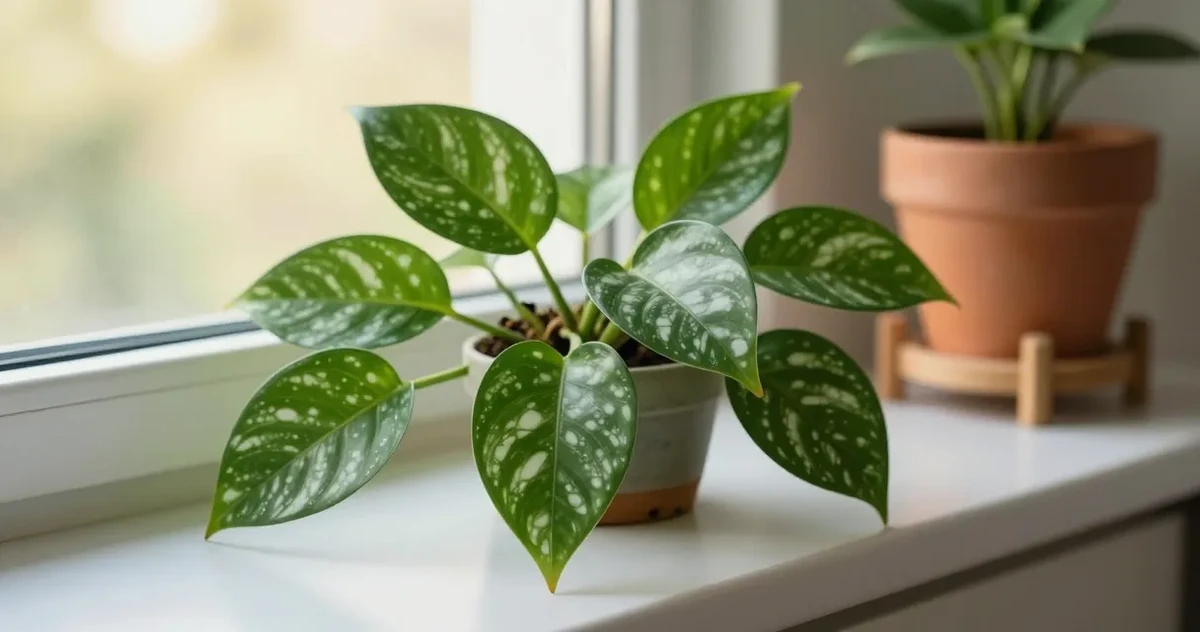
Species-level evidence behind Marble Queen pothos
Marble Queen is a cultivar of Epipremnum aureum, so its species-level field evidence is shared with golden and neon pothos. Variegation itself is not measured by GBIF or CHELSA.
The ranges below are the middle 50% (p25–p75), not recommended indoor setpoints.
| Reference taxon | POWO native range | Annual mean temperature | Annual precipitation | Relative humidity | Solar radiation | Evidence |
|---|---|---|---|---|---|---|
| Epipremnum aureum (golden pothos) | Mo’orea in the Society Islands | 25.7–25.9°C | 2451–2644 mm/yr | 63–64% | 20.0–20.1 MJ/m²/day | 6 climate points; low confidence |
What this changes in this guide: Use the climate profile for broad species context only; the cultivar’s white tissue makes indoor light and growth observations more important than copying the routine of a greener pothos.
Sources and method: Epipremnum aureum in POWO and GBIF; CHELSA V2.1, 1981–2010. GBIF records are limited to POWO-native countries, then filtered for coordinates, establishment signal, licence, precision, and spatial duplication. No community or user-reported care data is used in this module.
Marble Queen Pothos Care: The Quick Answer
If you only remember one thing: Marble Queen Pothos needs brighter light than a regular green pothos, and it should dry partway between waterings. Check the soil once a week. Water when the top 3 to 4 cm, about 1 to 1.5 inches, feels dry. If it still feels damp, wait.
Here is the beginner version:
| What you are deciding | Practical answer |
|---|---|
| Best spot | Bright, indirect light near an east window or a few feet from a south/west window |
| Watering | Usually every 7 to 10 days in active growth, less in winter, but always check the soil first |
| Too much water looks like | Yellow lower leaves, soft limp stems, soil that stays wet for days, musty potting mix |
| Too little water looks like | Curling leaves, drooping vines, very dry soil pulling away from the pot edge |
| Brown tips usually mean | Inconsistent watering, dry air near vents, or mineral buildup from hard tap water |
| Good fit for you? | Yes if you have a bright room and can check soil weekly; no if the only spot is a dark corner |
Marble Queen is still a forgiving houseplant. It just gives clearer feedback than people expect: greener new leaves mean it wants more light, yellow leaves often mean the roots are staying too wet, and curling leaves usually mean the plant is thirsty or drying out too fast.
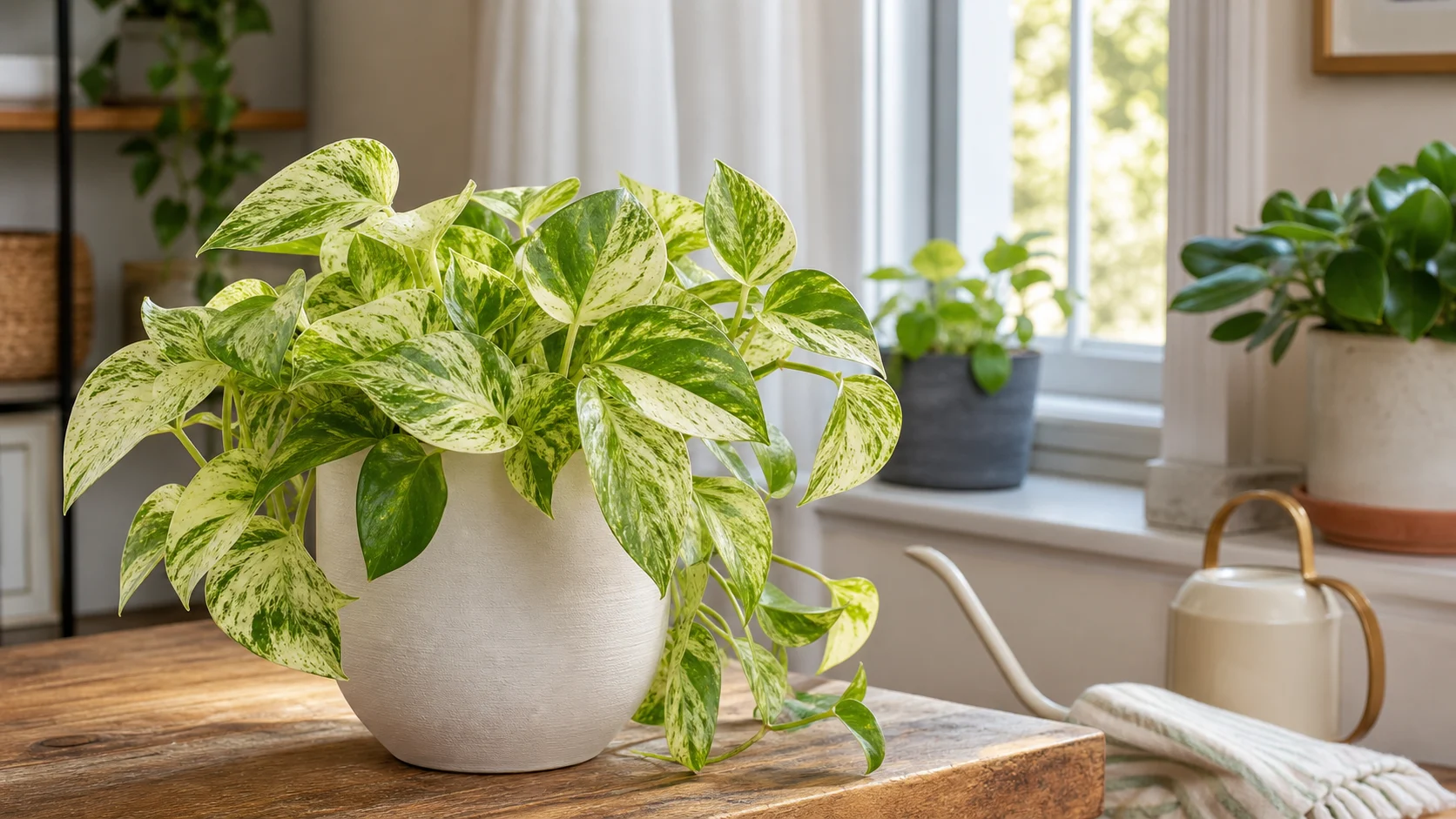
Bright indirect light and a soil-led watering check give Marble Queen Pothos the steady conditions behind healthy marbled growth.
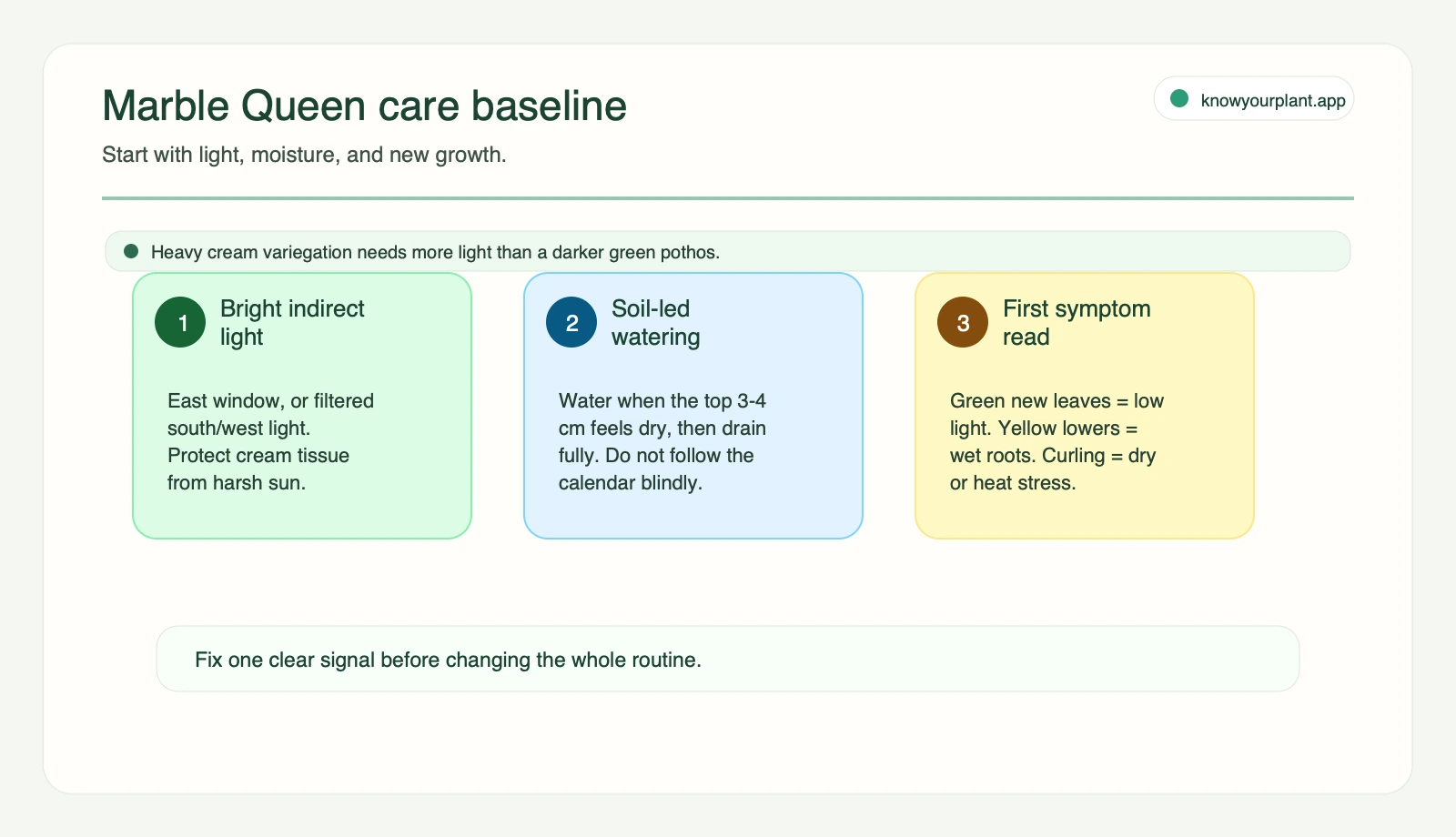
Use the baseline before changing care: Marble Queen wants brighter indirect light, soil-led watering, and one symptom checked at a time.
What Most Care Guides Miss
Most guides about marble queen pothos describe the ideal care routine. Real homes are messier: light changes by season, pots dry at different speeds, and the same symptom can mean different things depending on where it appears.
Before changing care, check the plant in this order:
- Light: is the plant growing toward the window, fading, or scorching?
- Root zone: is the pot drying predictably, or staying wet in the middle?
- Leaf pattern: did the oldest leaves, newest leaves, tips, or stems change first?
- Recent change: new pot, new location, fertilizer, cold draft, heat vent, or pest exposure.
This keeps you from fixing the wrong problem. One clear adjustment is usually safer than a full care reset.
What Makes Marble Queen Pothos Different
Marble Queen Pothos is a variegated cultivar of Epipremnum aureum, the trailing vine most of us already know as pothos, but with a twist: large parts of each leaf are white or cream. Those pale sections do not make energy for the plant. The green portions are doing the work.
That is why Marble Queen grows more slowly than a regular pothos and needs a brighter home. If you bought it for the cream marbling, light is the habit that protects the look. If you want the broader cultivar context, the pothos varieties guide shows where Marble Queen sits compared with golden, neon, and other common types.
When the plant has what it needs, the cream patterns stay vivid and new leaves come in well marbled. When something is off, the first signs are usually simple to read: new growth turns greener, leaves curl, lower leaves yellow, or tips brown. The rest of this guide is built around those decisions so you know what to do next, not just what the plant is called.
Identification Snapshot
- Leaf clue: cream-and-green marbling across heart-shaped leaves, usually with more white than a standard golden pothos.
- Growth clue: slower, more compact growth than greener pothos because the white tissue does not photosynthesize.
- Stress clue: greener new leaves usually point to low light, while brown damage on white sections usually points to scorch, dry air, or inconsistent moisture.
- Best beginner check: compare the newest leaf with the last two older leaves. If the new one is smaller and greener, fix light before you change anything else.
What Owners Keep Getting Stuck On
Recent plant-owner threads tend to circle around the same three problems: new leaves turning greener after a season in weaker light, yellow leaves on vines that are being watered on a fixed schedule, and root-rot panic when the pot stays heavy for too long. That pattern matters because it pushes you toward the safest first check instead of guessing.
Use owner stories as symptom language, not proof. They are helpful for spotting where people get confused, while Clemson, NC State, ASPCA, and University of Minnesota Extension are the sources anchoring the care and safety claims in this guide.
Lookalikes and Confused-With Cases
| Plant | Why people confuse it with Marble Queen | Fast difference |
|---|---|---|
| Golden pothos | Same species, similar trailing habit | Golden pothos has warmer yellow marbling and usually grows faster in average light |
| Manjula pothos | Both have creamy variegation | Manjula leaves are broader and more wavy, with patchier variegation blocks |
| N’Joy pothos | Both are white-and-green pothos | N’Joy has smaller leaves with cleaner white margins rather than cloudy marbling |
| Snow queen pothos | Often sold interchangeably | Snow queen usually carries more white overall and burns faster in weak care conditions |
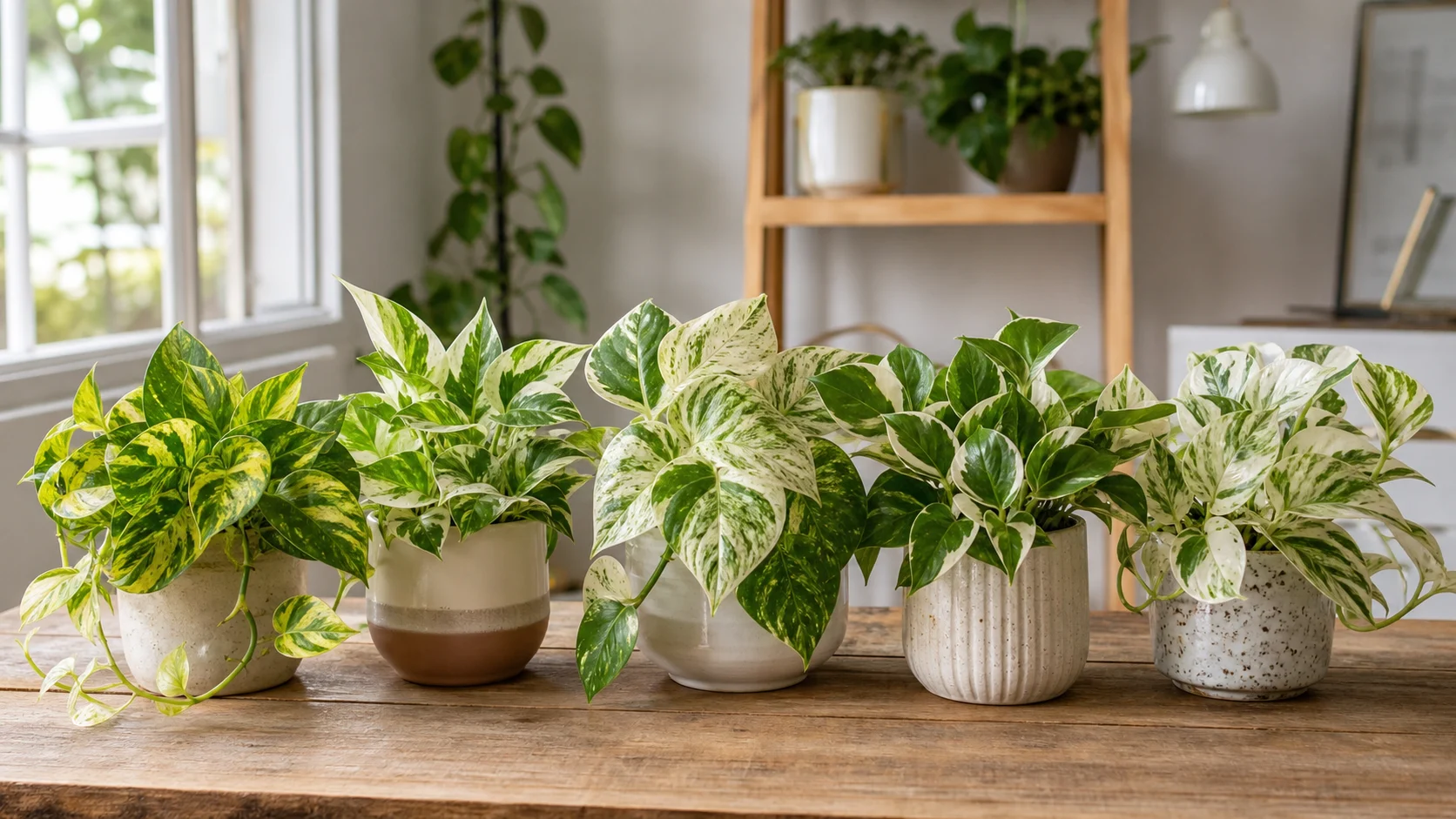
Comparing several pothos cultivars side by side makes Marble Queen’s cloudy cream marbling easier to separate from golden, edged, and higher-white patterns.
Light: The Single Biggest Factor for Variegation
Here’s the most important thing to know about marble queen pothos care: light directly controls how variegated her leaves will be.
She does best in bright, indirect light. Think of the spot where you’d comfortably read a book without squinting at a window or straining in dimness. A few feet back from a south- or east-facing window tends to work well. Too far into a dark corner and new leaves come in mostly green. Too close to harsh afternoon sun and the pale sections scorch.
The practical takeaway is simpler than the numbers: Marble Queen can tolerate average indoor conditions, but the heavier white variegation means it needs steadier bright indirect light than a darker green pothos to keep new growth well marbled.
The reason is simple: the white parts are beautiful, but they are not pulling their weight. The green tissue has to make enough energy for the whole plant, so a Marble Queen in dim light often responds by producing greener leaves.
One thing to keep in mind: Marble Queen grows more slowly than other pothos varieties precisely because of her heavy variegation. That’s normal. Don’t mistake slow growth for a struggling plant. If your home doesn’t get enough natural light, a grow light placed 30 to 45 cm above the foliage for 12 to 14 hours a day will keep her looking her best.
Expert Note
Clemson and NC State both support the big-picture care pattern here: Marble Queen is still an Epipremnum aureum, but the heavy cream variegation means it needs steadier bright indirect light than greener pothos cultivars to stay attractive. ASPCA is the anchor for the pet-toxicity warning, and University of Minnesota Extension is the guardrail behind the repeated advice to avoid chronically wet soil and standing water.
Light Outcome Comparison
| Light setup | What Marble Queen usually does | What to do next |
|---|---|---|
| Bright indirect light | New leaves stay creamier and growth stays compact | Keep the plant there and rotate the pot every few weeks |
| Low light corner | New growth gets greener and vines stretch | Move closer to a window or add a grow light |
| Harsh direct afternoon sun | White sections scorch or bleach first | Pull the plant back and use filtered light |
| Grow light for 12 to 14 hours | Helps winter growth stay more variegated | Keep the light above the foliage, not pressed against it |
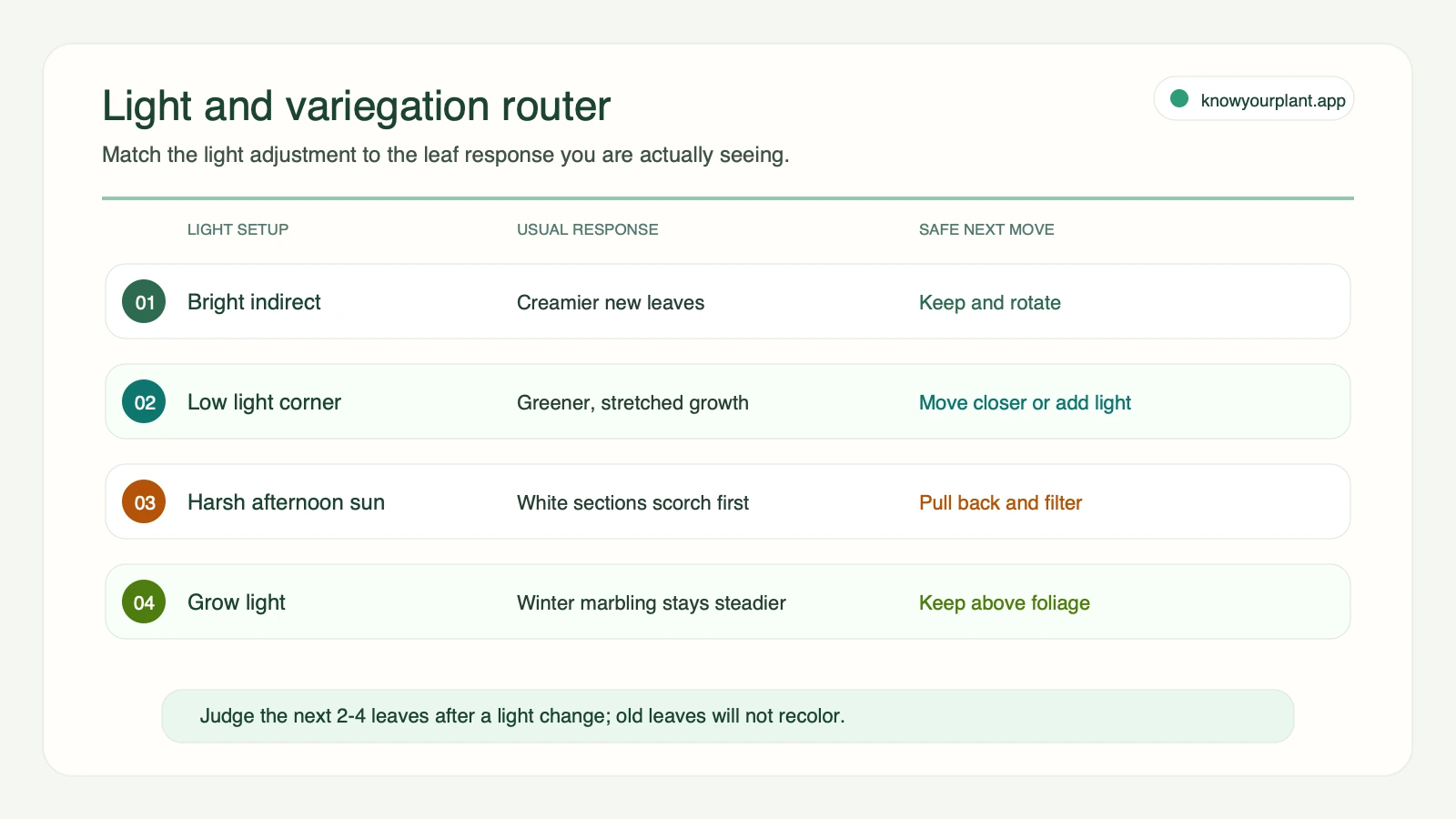
Use the router to protect cream variegation without burning the white leaf sections or starving new growth of light.
Care Cards
| Situation | Best move | What to watch next |
|---|---|---|
| New leaves are smaller and greener | Move closer to bright indirect light or add a grow light | Watch the next 2 to 4 leaves, not the old ones |
| Soil looks dry on top but the pot still feels heavy | Wait and check deeper moisture before watering | Yellow lower leaves and a musty smell point to overwatering risk |
| White patches are browning first | Check for direct sun, dry heat, or irregular watering | Crispy edges mean stress; soft dark spots mean stay alert for root issues |
| You want fuller growth, not just survival | Give steadier light and rotate the pot every few weeks | Slower growth is normal, but leggy vines mean the plant wants more light |
Why Is My Marble Queen Pothos Losing Variegation?
This is the question most care guides skim over. The answer is almost always light, but the details matter. Here’s how to diagnose what’s actually happening with your plant.
Step 1: Look at where the change is happening.
New leaves are coming in mostly green, but the established leaves still show good cream patterning? That’s a current light issue. The plant is adapting to present conditions, and older leaves can’t change what they already are. Move her closer to a window or add a grow light, then watch what the next three to four leaves look like. New growth is always the most honest feedback she can give you.
If established leaves seem to be losing colour too, that’s rarer. Skip to step 4.
Step 2: Check your actual light levels.
“Bright indirect light” is easy to say and surprisingly hard to judge. Your eyes adjust to low light much faster than your plants do. A free light meter app on your phone gives you a rough reading in foot-candles or lux. Anything under 75 foot-candles consistently will push your Marble Queen toward green. Under 30 foot-candles and she’s basically surviving, not growing, and definitely not putting energy into variegation.
Step 3: Is the reversion seasonal?
If the shift toward green coincided with autumn or winter, that’s almost certainly the cause. Days are shorter, the sun sits lower in the sky, and the light coming through your window may have dropped significantly even if the plant hasn’t moved. A grow light through the winter months often brings variegation back in spring growth, sometimes noticeably so.
Step 4: Rule out stress-related causes.
A plant under significant stress, from rootbound conditions, root rot, or prolonged underwatering, sometimes prioritises survival over aesthetics. She’ll push out whatever leaf she can, and a leaf with less white uses less energy. Check the roots: are they circling the pot heavily or forcing through drainage holes? If yes, repot and give her a few months to settle before expecting variegation to recover fully.
Step 5: Accept that some reversion is permanent.
Leaves that have already turned green will stay green. You can’t reverse an existing leaf. What you can do is give the plant what she needs so that new leaves come in beautifully patterned. Four to six weeks after improving conditions, you should see the difference in new growth. That’s roughly how long it takes for a new leaf to form and unfurl.
One note worth making: true genetic reversion, where a whole stem permanently loses its variegation, is rare in Marble Queen. It happens more commonly in plants like Monstera. If you do get a fully green stem, you can prune it out to encourage variegated regrowth, but this is uncommon when light is adequate.
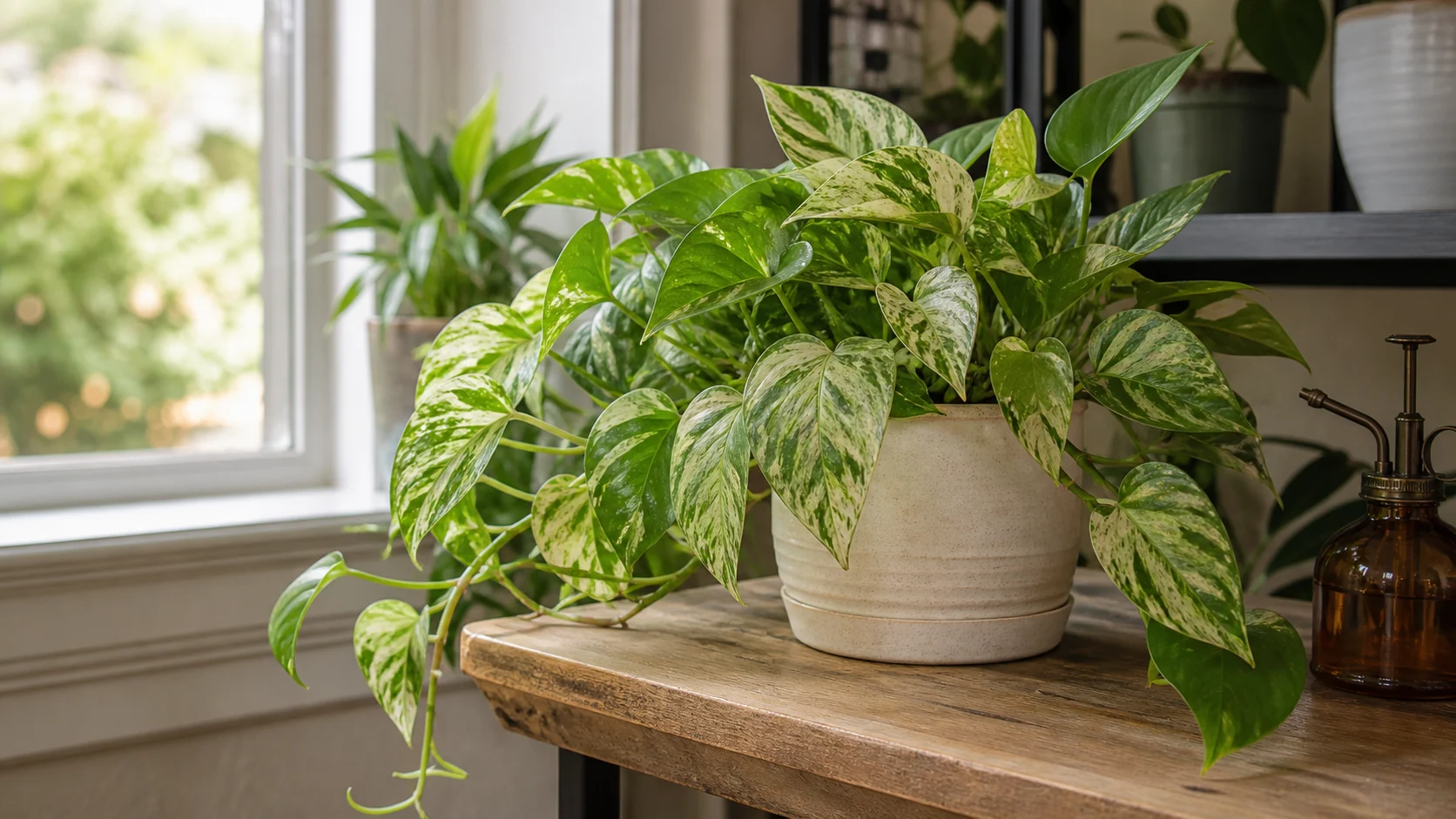
Mixed green and marbled growth beside a bright window shows why the newest leaves are the best evidence when light is changing variegation.
Watering: Less Often Than You Think
Marble Queen Pothos is forgiving about water, but the biggest mistake is treating “once a week” like a rule. In a warm, bright room, weekly watering may be right. In a cooler room or in winter, the same pot may need 10 to 21 days before it is ready again.
The rule is simple: let the top 3 to 4 cm of soil dry out before watering again. Press your finger into the soil up to the first knuckle. Dry? Water thoroughly, until it runs from the drainage holes. Still damp? Give her another day or two.
Overwatering is the most common way people accidentally hurt their pothos. The risk is not one generous watering; it is soil that stays soggy for days. Soggy roots lose oxygen and become more vulnerable to rot. A waterlogged Marble Queen will start showing yellow leaves, usually the lower ones first, and the leaves may feel soft or limp instead of crisp.
If you are unsure whether you are overdoing it, check these before watering again:
- The soil still feels damp below the surface.
- The pot feels heavy several days after watering.
- Lower leaves are yellowing while the soil is wet.
- Stems near the soil line feel soft.
- The pot has no drainage hole or sits in water after watering.
If two or more are true, pause watering, move the plant into brighter indirect light, and let the mix dry further before the next soak. Follow the soil, not the calendar.
Water Quality
Pothos aren’t fussy about water, but if your tap water is heavily chlorinated, letting it sit overnight before watering is a small habit that doesn’t hurt. Filtered or rainwater works well too if you have it.
Symptom Diagnosis Card
| What you see | First check | Most likely causes | Safe first adjustment | When to inspect roots |
|---|---|---|---|---|
| New leaves come out greener | Compare the newest leaf with the last two leaves before it | Not enough light, seasonal light drop | Move the plant into brighter indirect light or add a grow light | Check roots only if growth is also stalling badly |
| Yellow lower leaves | Feel the soil deeper than the surface and lift the pot | Overwatering, old-leaf aging, slow drying mix | Wait longer between waterings if the mix is still wet | Inspect if yellowing spreads fast or stems soften |
| Curling leaves | Check whether the mix is bone dry or still damp | Thirst, hot airflow, light stress | Water deeply if dry, then move away from vents or harsh sun | Inspect if leaves stay limp while the mix is wet |
| Brown tips | Look for hard-water crust, dry air, or skipped waterings | Inconsistent moisture, mineral buildup, dry airflow | Flush the pot and steady the watering rhythm | Usually not needed unless the whole plant is declining |
| Soft stems near the soil line | Press the stem base gently and smell the mix | Root rot, stagnant wet soil | Stop watering and increase airflow while the mix dries | Inspect right away if stems feel mushy |
| Slow growth | Check light first, then pot size and season | Low light, rootbound plant, normal winter slowdown | Improve light before fertilizing or repotting | Inspect if roots are circling or pushing from drainage holes |
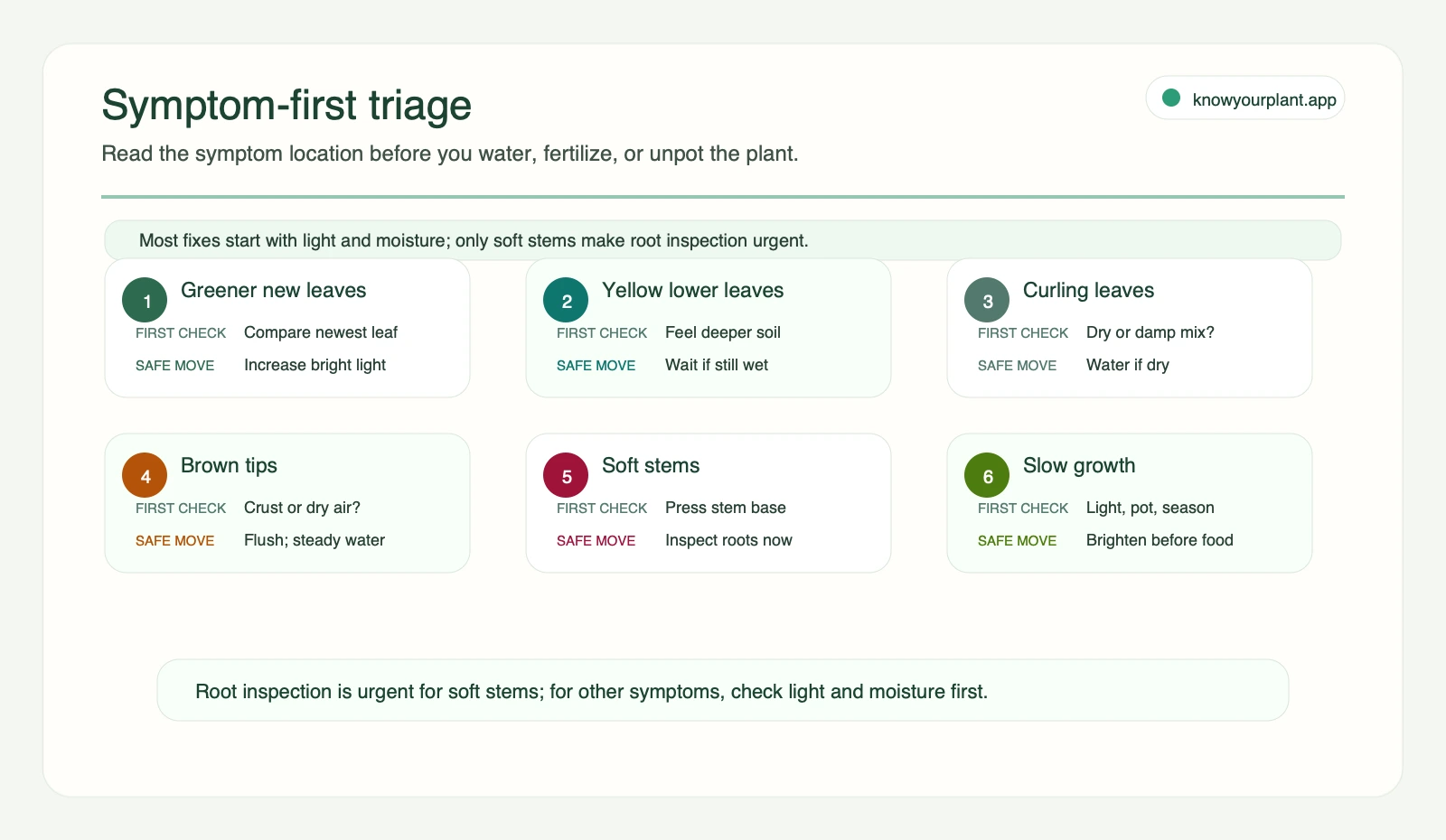
Use the triage map before inspecting roots: most Marble Queen problems have a safer first check than a full repot.
Marble Queen Decision Tree
- Is the newest growth greener than the older leaves? If yes, solve light first.
- Is the center of the pot still damp? If yes, do not water just because the surface looks dry.
- Are the brown marks dry and crispy or soft and dark? Crispy usually points to scorch or moisture swings. Soft dark damage means inspect roots and stems.
- Did the problem start right after a move, repot, draft, or heat wave? If yes, stabilize conditions before adding fertilizer or changing multiple things at once.
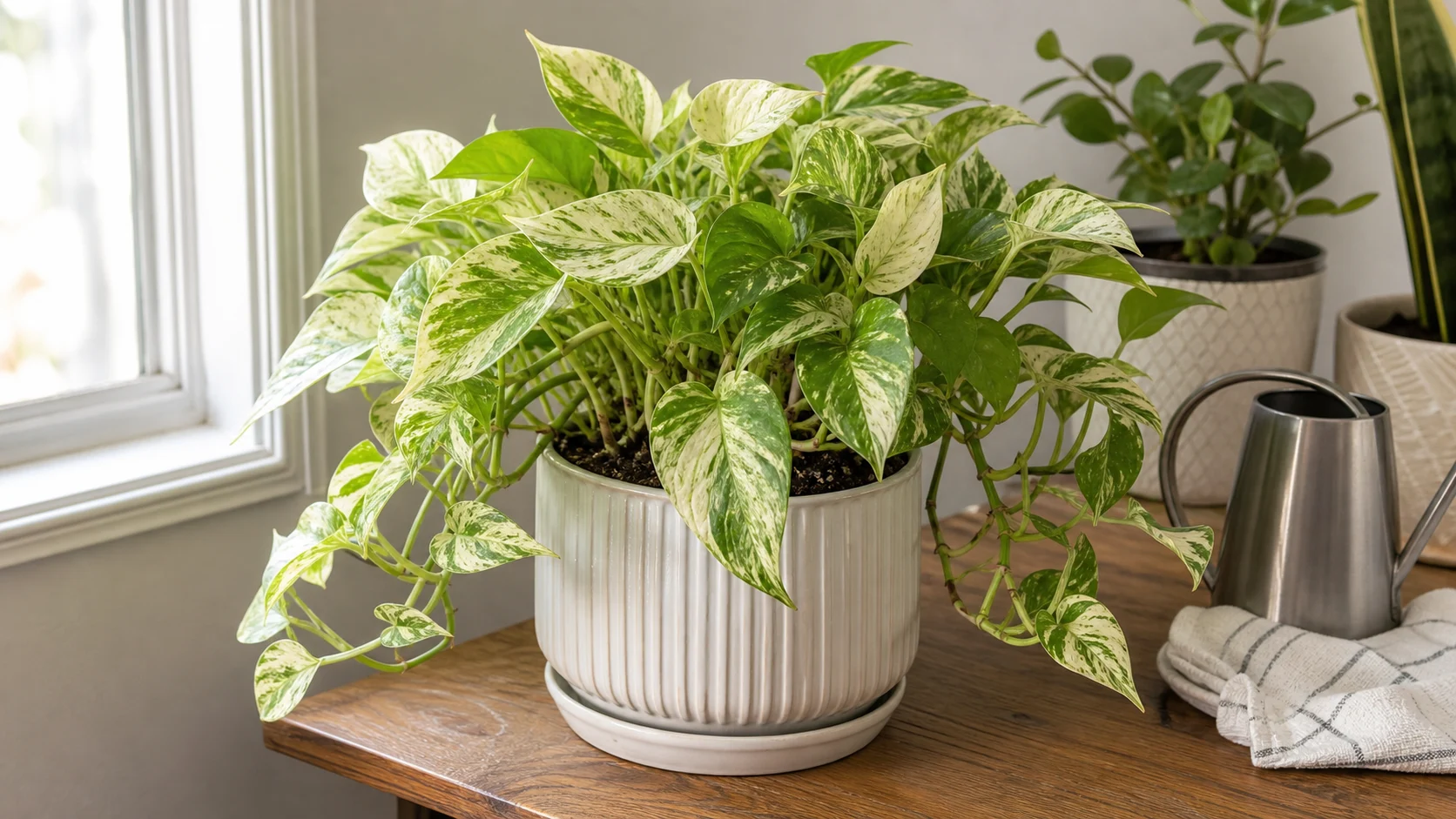
Greener new growth, visible soil, a drainage saucer, and a nearby watering can reinforce the safest order: check light and root-zone moisture before changing care.
Soil and Potting
A well-draining mix is what she needs: something that holds a little moisture but doesn’t stay wet for days. A standard houseplant potting mix works, but adding a handful of perlite improves drainage noticeably. Think of it as giving her roots some breathing room.
Repot when you see roots circling the bottom of the pot or pushing through drainage holes. Go up one pot size at a time. A pot that’s too large holds more soil than her roots can drink from, which keeps things wet longer than you want.
If you’re drawn to self-watering pots, they can work well for pothos, but make sure the wicking system lets the soil dry partway between cycles rather than staying constantly moist.
Temperature and Humidity
Marble Queen Pothos is comfortable in the same range you probably keep your home: roughly 15 to 29°C (60 to 85°F). She doesn’t love cold drafts or heating vents blowing directly on her. Both dry out leaves faster than she’d like.
Humidity is nice but not essential. She’ll do fine in average household humidity. If the leaf edges start looking crispy, a pebble tray with water beneath the pot can help, but most of the time she manages without any special treatment.
Fertilizing
During spring and summer, a balanced liquid fertilizer once a month gives her the nutrients to put out healthy new growth. You don’t need to push her: she’s not a fast grower by nature, and overfeeding won’t change that. It’ll just lead to salt buildup in the soil over time. For a full breakdown of what fertilizers actually do and when to use them, the plant fertilizer guide covers timing, formulations, and how to read your plant’s response.
Skip fertilizer entirely from autumn through winter. She’s resting, not growing much, and feeding a dormant plant doesn’t help.
Propagation: Easier Than You’d Expect
One of the joys of pothos is how readily they propagate. Marble Queen is no different.
Take a cutting just below a node, that little brown bump on the stem where a leaf grows. A cutting with two or three leaves and at least one node is ideal. Remove the lowest leaf so the node is exposed, then place it in a glass of water on a bright windowsill.
Roots usually appear within two to four weeks in warm, bright conditions. Once roots are a few centimetres long, pot the cutting into soil and treat it like any other pothos.
The new plant will be genetically identical to the parent: same variegation pattern, same personality. If you want a full step-by-step method with node placement tips, the propagate pothos guide walks through both water and soil propagation in more detail.
Seasonal Care Calendar
| Season | Light | Water | Fertilize |
|---|---|---|---|
| Spring | Bright indirect, move closer to window | When top 3-4 cm dry | Monthly, balanced |
| Summer | Bright indirect, watch for scorch | More frequent, soil-led | Monthly, balanced |
| Autumn | Maintain position, add grow light if needed | Reduce frequency | Stop by October |
| Winter | Maximise available light | Every 2+ weeks | None |
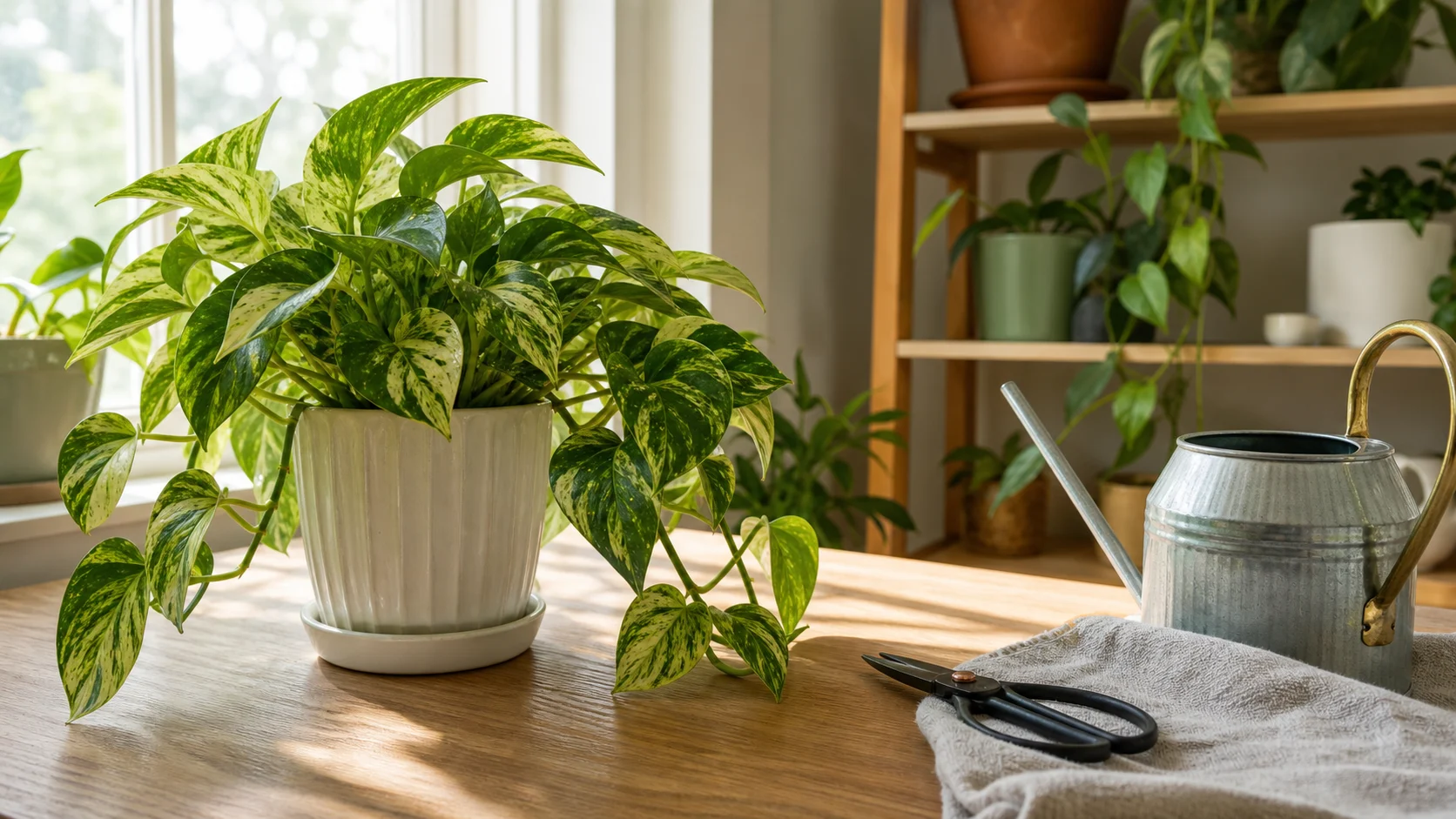
Strong window light, active growth, a watering can, and pruning shears capture the brighter, more hands-on spring and summer side of the seasonal care cycle.
Common Mistakes
- Watering by calendar even when the center of the pot is still wet.
- Treating Marble Queen like a darker green pothos and parking it too far from the window.
- Moving it straight into harsh afternoon sun instead of increasing light gradually.
- Fixing yellow leaves with fertilizer before checking drainage and pot weight.
- Letting trailing vines hang where curious pets can chew them.
Simple Care Plan
Today: Check the soil with your finger, move the plant to the brightest indirect light you have, and empty any water sitting in the saucer.
This week: Watch the newest leaf, not the oldest leaf. New growth tells you whether the current light and watering routine are working.
This season: Rotate the pot every few weeks, prune any bare vines, and consider a grow light in autumn and winter if new leaves are coming in mostly green.
Common Problems and What They Mean
Leaves turning mostly green: Not enough light. Move her closer to a window or add supplemental lighting. New leaves will reflect the improved conditions within a few weeks.
Yellow leaves: Usually overwatering, especially if the soil stays wet. Let the mix dry further before watering again and check that water can leave the pot freely. If yellowing is limited to one old leaf while the rest of the plant looks healthy, that may just be normal leaf aging.
Curling leaves: Most often thirst, heat, or dry air. Check the soil first. If it is bone dry, water thoroughly. If it is wet and the leaves are still curling, move the plant away from direct sun, heaters, or air-conditioning vents.
Brown leaf tips: Usually inconsistent watering, dry air, or mineral buildup. Trim the dry tips if they bother you, water deeply when the soil is ready, and flush the pot with plain water every month or two if your tap water is hard.
Leggy, sparse growth: She’s reaching for light. More light equals more compact, fuller growth.
Pale, washed-out variegation: Sometimes too much direct sun bleaches the leaves. Bright indirect light works better than harsh midday sun.
Pests: Pothos occasionally attract mealybugs or spider mites, especially in dry conditions. Catching them early is the key. Neem oil is a reliable first response and won’t damage the foliage when used correctly.
If you enjoy the easygoing nature of Marble Queen, the heartleaf philodendron is a great companion plant with similar care needs but a different leaf texture and shape.
Pet Safety
ASPCA lists golden pothos, including marble queen forms of Epipremnum aureum, as toxic to cats and dogs because of insoluble calcium oxalate crystals. The practical symptoms to watch for are mouth irritation, drooling, vomiting, and trouble swallowing. If a pet chews the plant, remove any leaf pieces from the mouth, offer water, and call your veterinarian or poison line if symptoms escalate or your pet seems distressed. In everyday life, the simplest prevention is to keep trailing vines out of reach instead of relying on one quick correction after a chew.
Real User FAQ
Why are my Marble Queen’s new leaves coming in mostly green? Almost always a light issue. The plant produces more chlorophyll when light is limited, which means more green and less cream. Move her to a brighter spot and give it four to six weeks: you should see more variegation return in new growth. Older leaves won’t change, but new ones will reflect the improved conditions.
How often should I water my Marble Queen Pothos? There’s no fixed schedule that works for every home. Check the soil: once the top 3 to 4 cm feel dry to the touch, it’s time to water. In warm months that might be every five to seven days. In winter, it could stretch to two weeks or longer. Always follow the soil, not the calendar.
Can Marble Queen Pothos survive in low light? She can survive, but her variegation will fade noticeably. New leaves will come in green-heavy or fully green. If you’re committed to a low-light spot, a grow light is a better solution than hoping she’ll adjust. She’ll stay healthier and more beautiful with supplemental light than sitting in a dim corner.
Is Marble Queen Pothos toxic to cats and dogs? Yes. Like all pothos varieties, Marble Queen contains calcium oxalate crystals that are toxic to cats and dogs if ingested. Symptoms include drooling, vomiting, and irritation around the mouth. Keep her out of reach of pets, or opt for a pet-safe alternative if you have animals who chew on plants.
Why is my Marble Queen Pothos growing so slowly? Slower growth is completely normal for this cultivar. Because so much of each leaf is white and non-photosynthetic, she produces energy more slowly than a fully green plant. What you’re looking for is steady progress: one or two new leaves every few weeks during the growing season is healthy. If growth has completely stalled, check your light levels first.
How do I keep the variegation from fading over time? Light is the primary lever. Keep her in bright indirect light year-round, rotate the pot occasionally so all sides get even exposure, and don’t let her sit in a dark spot through winter. Consistent care helps too: a well-nourished, well-watered plant puts energy into producing good leaves. A stressed plant reverts toward green because green is more efficient.
Can I propagate Marble Queen in soil directly? Yes, though water propagation is more reliable for beginners because you can watch the roots develop. If you prefer soil propagation, use a light, well-draining mix, keep it evenly moist but not wet, and place the cutting in a bright spot. Cover loosely with a clear bag or dome for the first week or two to retain humidity while roots establish.
Methodology Note
This guide was refreshed in June 2026 by reviewing live search results, qualitative plant-owner threads, and source material from Clemson, NC State, ASPCA, and University of Minnesota Extension. Extension and toxicology sources anchor the care and pet-safety claims here. Owner threads were used only to surface the symptom patterns people struggle to interpret at home.
Freshness Note
Last updated June 22, 2026. Re-check light distance and watering speed when seasons change, because Marble Queen can look stable in spring and then start greening out or drying differently once winter light drops or summer heat speeds up evaporation.
A Plant Worth Getting to Know
Marble Queen Pothos rewards attention without demanding it. Find the right spot for her, somewhere genuinely bright, and she’ll put out leaves that stop you mid-step. The variegation deepens, the vines grow fuller, and every now and then a new leaf unfurls that looks almost too good to be real.
She’s low-maintenance, but she notices when you’re paying attention.
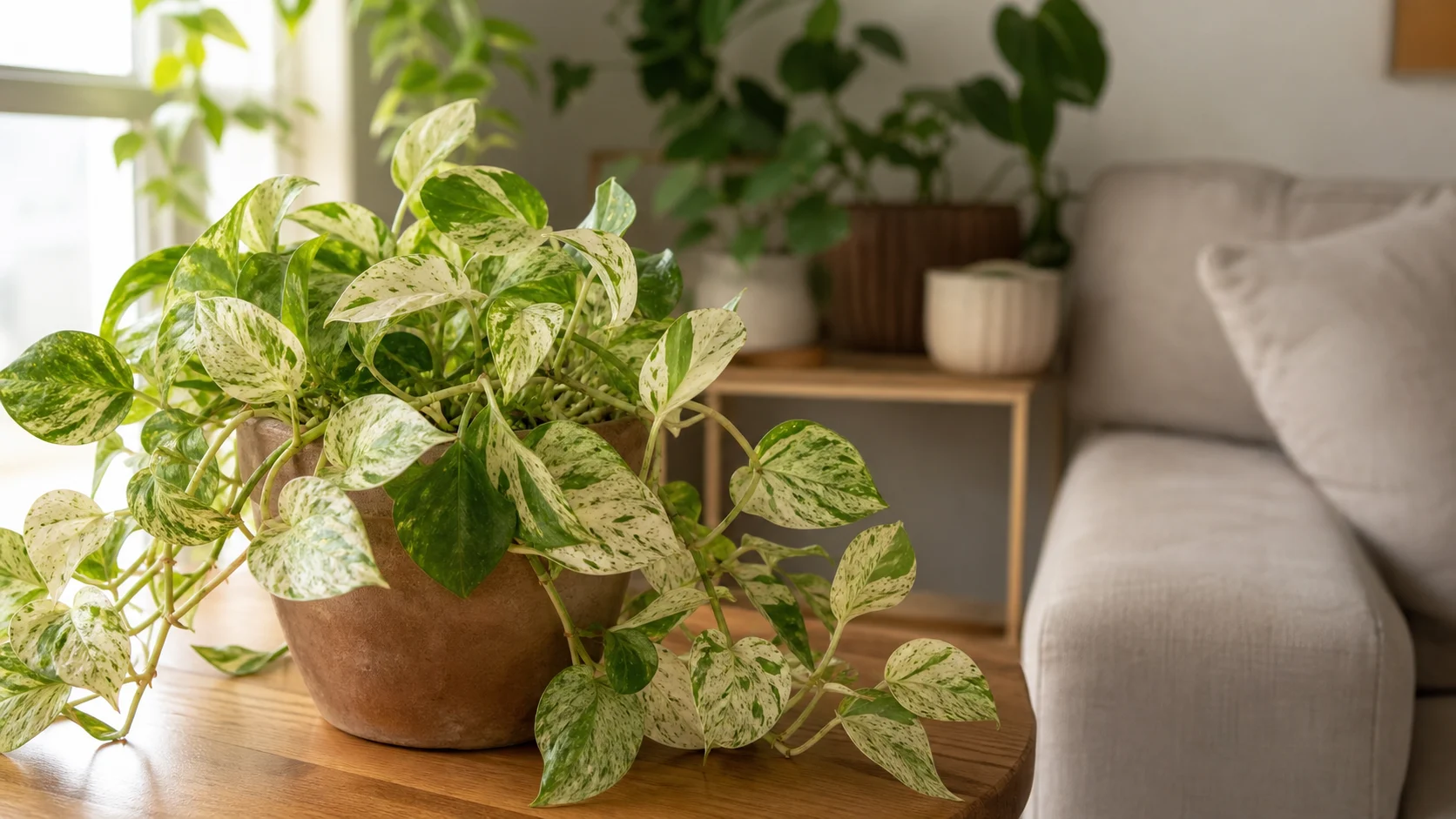
A mature Marble Queen with full trailing vines and bright marbling shows the long-term payoff of a steady, well-lit care routine.
Download KnowYourPlant for personalized plant care reminders based on your home conditions, so you never have to guess when she’s ready for water or a feed.