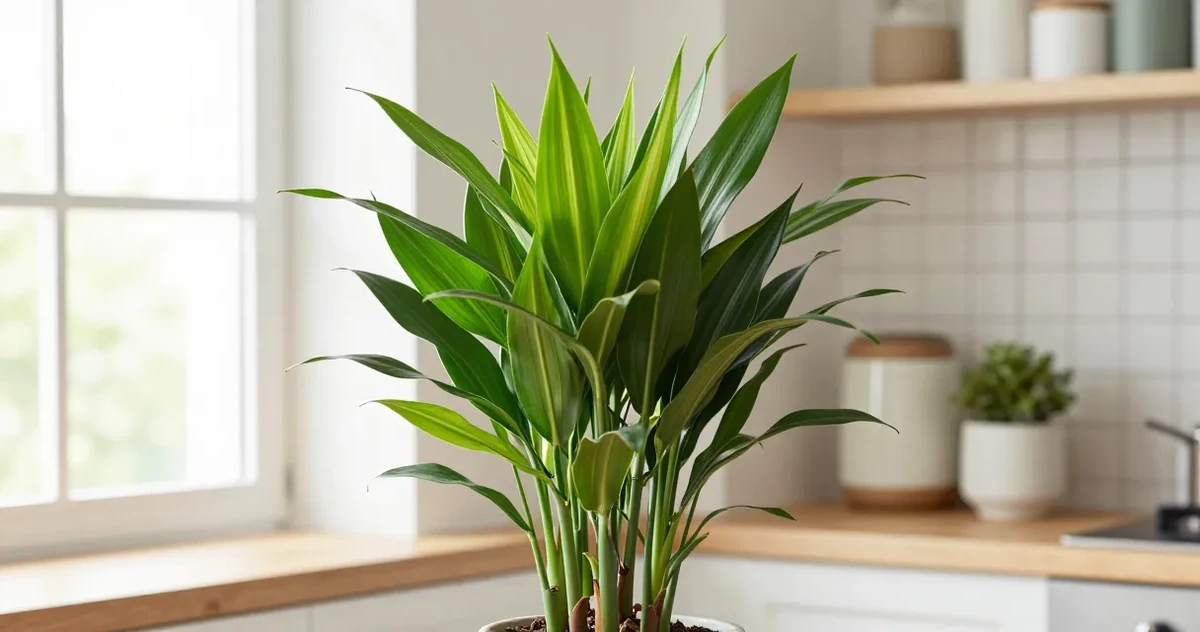
If you have a tall, architectural plant with strappy leaves and brown tips you can’t explain, there is a good chance you are already living with a dracaena. The quick answer: water only when the soil is dry 5 to 6 cm down, expect roughly every 10 to 14 days in warm months, and slow down hard in winter.
The brown tips, yellow leaves, and curling leaves are not random. They usually point to water timing, water quality, light, or dry air. This guide is for everyday plant owners who want to know what to do next, not a botany lecture.
Dracaenas evolved beneath forest canopies, growing in filtered light and well-drained soil. In your home, that translates to one of the most low-maintenance houseplants available, as long as you stop overwatering. Extension houseplant guidance consistently flags overwatering as one of the main reasons indoor plants fail, and dracaenas are a clear example of that pattern.
Climate DNA for a common dracaena reference
Dracaena care covers several species and cultivars. Dracaena fragrans is used here as an explicit reference for corn-plant and related fragrans cultivars, not as a numeric stand-in for the whole genus.
The ranges below are the middle 50% (p25–p75), not recommended indoor setpoints.
| Reference taxon | POWO native range | Annual mean temperature | Annual precipitation | Relative humidity | Solar radiation | Evidence |
|---|---|---|---|---|---|---|
| Dracaena fragrans (corn plant dracaena) | tropical Africa | 18.9–25.1°C | 1248–2259 mm/yr | 61–68% | 17.3–19.1 MJ/m²/day | 30 climate points / 224 usable records; medium confidence |
What this changes in this guide: The native macroclimate helps frame seasonal growth, but brown tips still require checking water quality, roots, room humidity, and recent care rather than copying outdoor rainfall.
Sources and method: Dracaena fragrans in POWO and GBIF; CHELSA V2.1, 1981–2010. GBIF records are limited to POWO-native countries, then filtered for coordinates, establishment signal, licence, precision, and spatial duplication. No community or user-reported care data is used in this module.
Start With the Pattern, Not One Cause
Most articles about dracaena list possible causes. That is helpful, but it can also make you change watering, light, fertilizer, and soil all at once, which makes the plant harder to read.
Start with the pattern instead:
- Oldest leaves first: often points to watering rhythm, root stress, or normal aging.
- Newest growth first: look harder at light, nutrients, pests, or temperature stress.
- Tips and edges first: check drying, salts, heat, or inconsistent moisture.
- Stems, crown, or soil smell: treat it as a root-zone warning before adding more water.
Make one change, then watch new growth. The goal is not to guess every cause; it is to choose the first safe check.
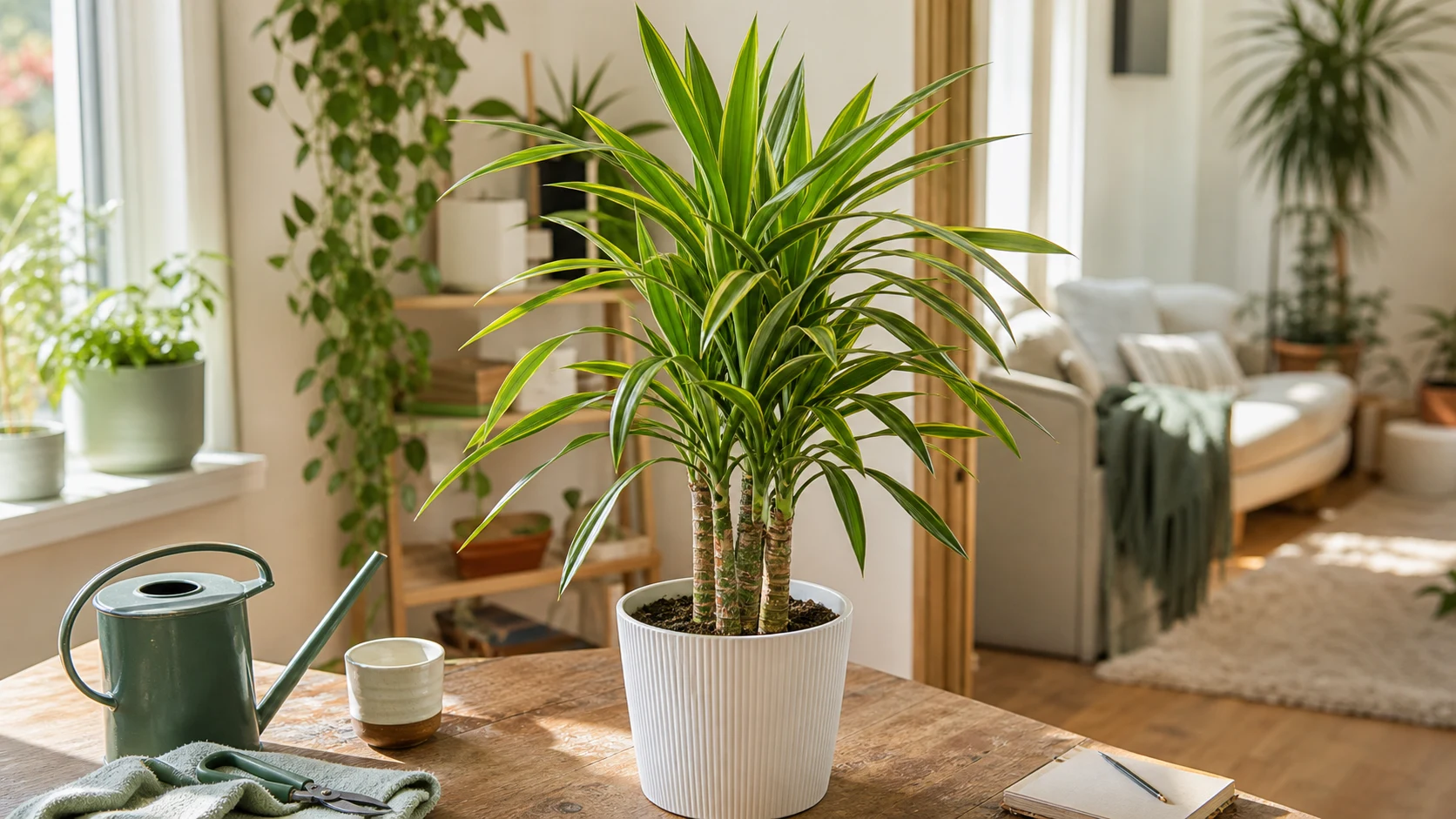
A quick visual check of the whole dracaena helps you choose one measured care change instead of changing everything at once.
Dracaena Care in One Minute
Water: Check the soil before watering. If it is still damp 5 to 6 cm down, wait. If it is dry at that depth, water until excess runs from the drainage hole, then empty the saucer.
Usual timing: Every 10 to 14 days in spring and summer is common. Every three to four weeks can be enough in autumn and winter, especially in a cooler or darker room.
Signs you are overdoing it: Yellow leaves, soil that stays wet for a week, a sour smell from the pot, soft lower stems, or black and mushy roots.
Signs the plant is too dry or stressed: Curling leaves, crispy edges, dry soil pulling away from the pot, or drooping that improves after a thorough watering.
Light fit: A bright room with no harsh direct sun is ideal. Low light is workable for Lisa and Fragrans, but a corner where you need a lamp during the day is too dark.
Identification Snapshot
- Growth habit: Upright cane or trunk with rosettes of strap-like leaves.
- Fast visual clue: Brown tips alone are usually a care-stress signal, not a sign the whole plant is failing.
- Lisa: Broad, deep green leaves and strong low-light tolerance.
- Fragrans: Wider arching leaves, often with a lighter stripe.
- Marginata: Narrower leaves with red or purple edging and a slightly drier rhythm.
- Trifasciata: Upright sword leaves and the driest watering rhythm in the group.
Care Cards
| Care card | Best move | Red flag to check first |
|---|---|---|
| Light | Bright to moderate filtered light | Bleached or washed-out leaves mean too much direct sun |
| Water | Water only when the soil is dry 5 to 6 cm down | Wet soil for a week, sour smell, or a soft stem means too much water |
| Water quality | Try filtered water or rainwater if brown tips keep spreading | White crust plus worsening tips points to salt or fluoride buildup |
| Temperature | Keep above 10°C and away from cold draughts | Sudden yellowing after a cold night is often temperature stress |
| Pet safety | Keep it away from chewing pets | Dracaena is toxic to cats and dogs |
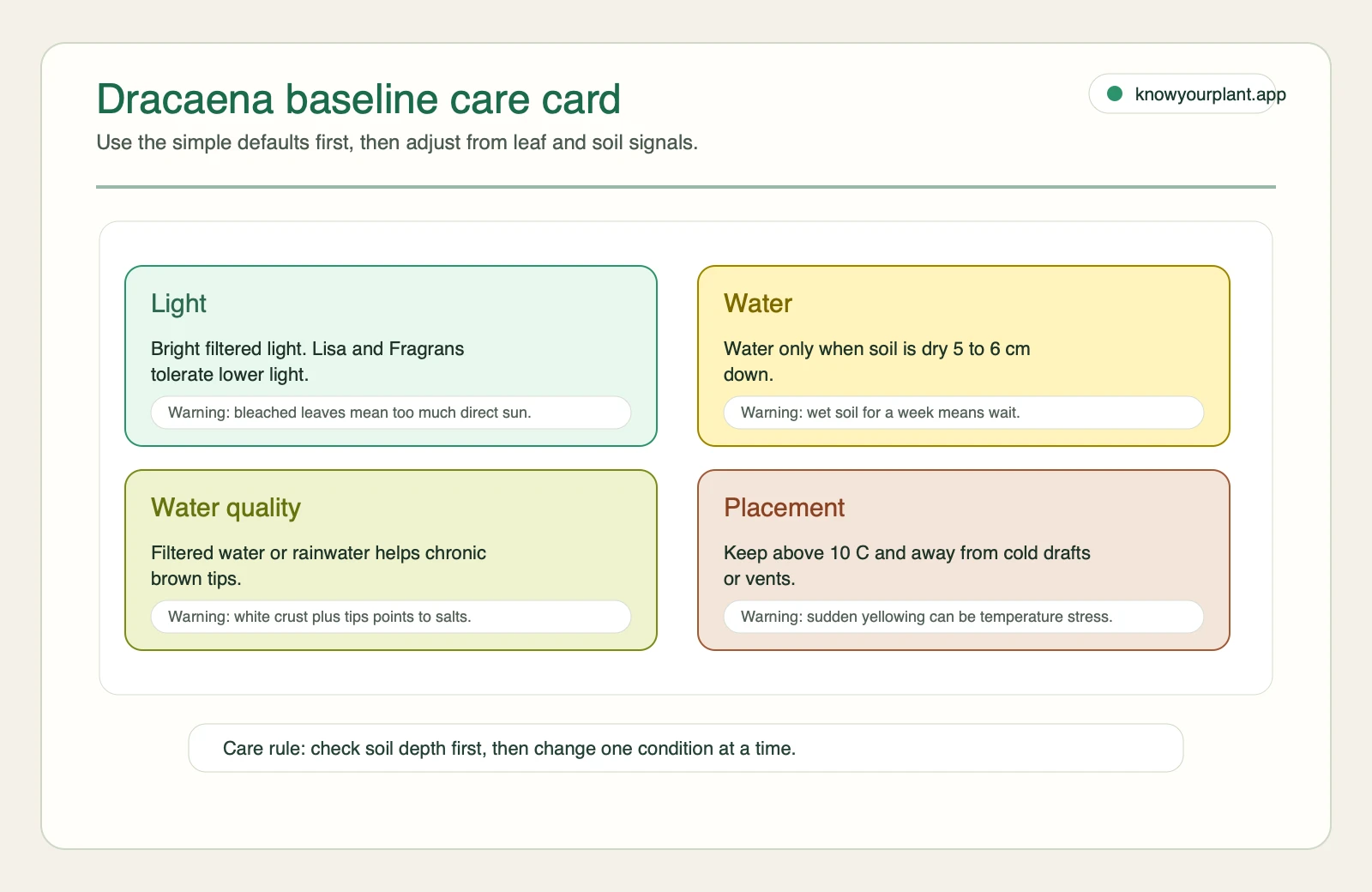
Use the baseline card before making changes: dracaena care starts with filtered light, dry-at-depth watering, water quality, and stable placement.
Meet the Dracaena Family
There are dozens of dracaena types, but a handful show up in most homes and garden centres.
Dracaena Lisa
Dracaena Lisa has broad, deep green leaves and a thick, cane-like stem. She’s one of the most tolerant varieties: handles low light well and doesn’t complain when you forget her for a week. A solid choice if you’re newer to houseplants or have a dim corner that needs filling.
Dracaena Fragrans (Corn Plant)
Sometimes called the corn plant because of how the leaves fan out from a central stalk, Dracaena Fragrans has wide, arching leaves with a lighter green stripe down the middle. She can grow quite tall over the years, with some specimens reaching ceiling height indoors. She’ll occasionally produce small, intensely fragrant flowers, which is a genuine surprise the first time it happens.
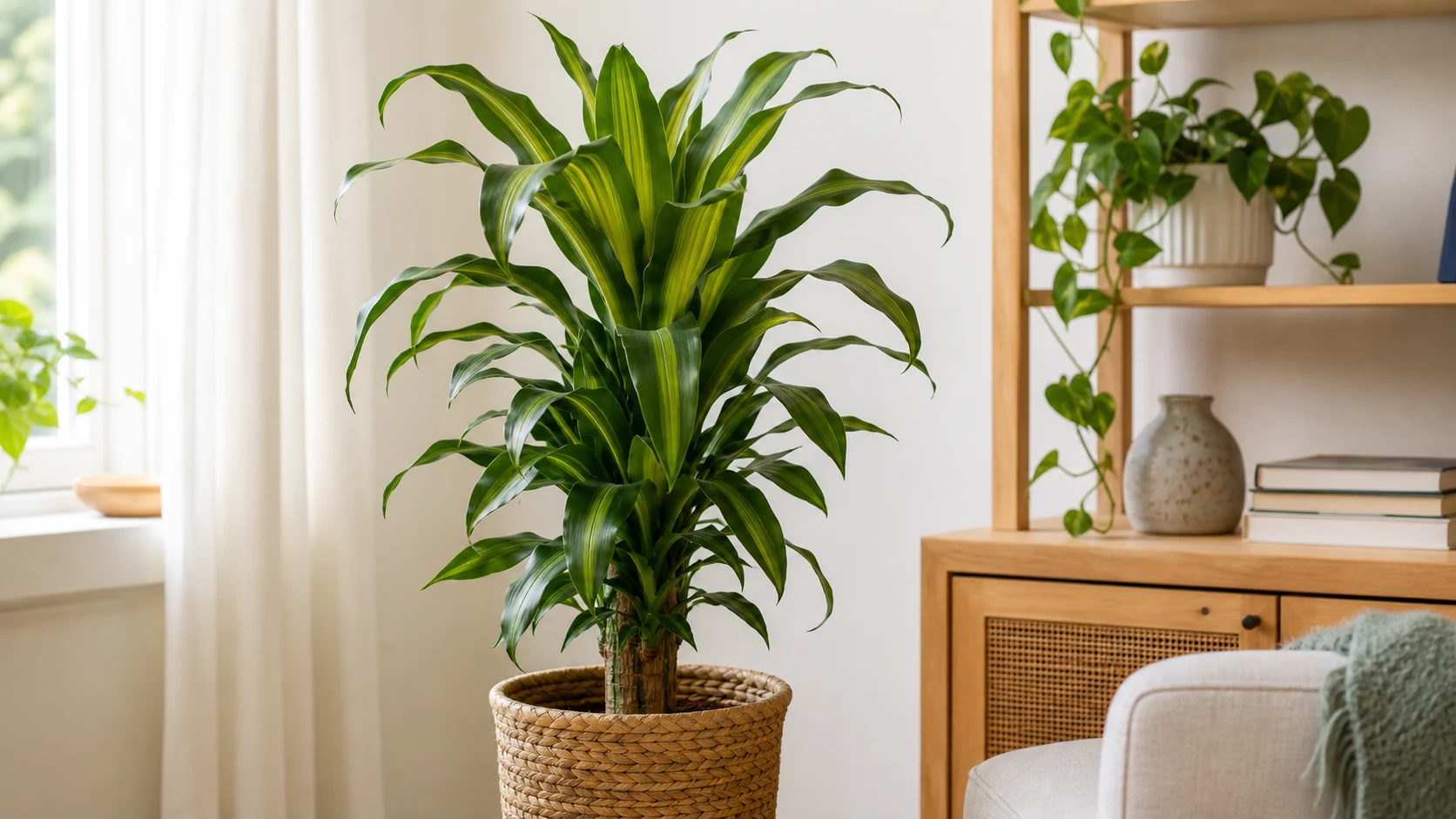
A mature corn plant shows the broad, striped leaves and tall cane growth that distinguish Dracaena fragrans indoors.
Dracaena Marginata (Dragon Tree)
This is the dramatic one. Long, thin leaves edged in red or purple, growing from narrow woody canes that lean and branch in interesting directions over time. Marginata is more drought-tolerant than the others and a bit more light-hungry. She’s the one people describe as sculptural.
If you want her to branch rather than grow as a single straight cane, cut the stem tip cleanly with a sharp, clean blade. She’ll push new growth from just below the cut, typically two or three stems. It takes a few months, but the result looks considerably more interesting than a single tall pole.
Dracaena Trifasciata (formerly Sansevieria)
Botanists moved snake plants into the dracaena family, so if you have one at home, you’re already a dracaena owner. Same resilience, same low-water preferences, same sensitivity to fluoride in tap water. If you’re curious about the details, the snake plant care guide covers her specific needs in full.
Before You Buy: Is Dracaena a Good Fit?
Choose a dracaena if you want a plant that can handle missed waterings, upright growth, and normal indoor temperatures. It is a good fit for offices, bedrooms, hallways with a nearby window, and anyone who prefers a plant that does not need daily attention. If you are still learning the basics, the indoor plant care guide for beginners gives you the bigger picture around light, drainage, and watering rhythm.
Think twice if you like watering on a fixed weekly schedule no matter what the soil feels like. Dracaena roots dislike staying wet, so the routine has to be “check first, water only when dry.” Also skip it or place it well out of reach if you have a cat or dog that chews leaves, because dracaenas are toxic to pets.
Lookalikes and Confused With
People often treat every dracaena the same, but the watering rhythm shifts a bit across the group.
- Lisa and Fragrans handle lower light better and usually stay happiest on a slower, steady watering rhythm.
- Marginata wants a brighter position and dries a little faster than the broad-leaf forms.
- Trifasciata sits in the dracaena family, but it tolerates the driest schedule of the lot.
If you are not sure which type you own, avoid copying a snake-plant routine onto a Lisa or Fragrans. Start with the soil check, then let the plant’s leaf shape and growth habit tell you which branch of the family you are dealing with.
Light: Bright Indirect Is the Sweet Spot
Most dracaena types do best in bright indirect light: the kind of spot where there’s plenty of brightness in the room but no direct sun falling on the leaves. Direct sun, especially through a south or west window, will scorch the leaves and cause bleaching.
That said, dracaenas are genuinely adaptable to lower light. Lisa and Fragrans especially will manage in spots that other plants would struggle in, which is why they show up on so many lists of the best low-light indoor plants. They’ll grow more slowly in low light, which is fine. They weren’t in a hurry anyway.
What they won’t tolerate is a completely dark corner with no natural light at all. If you can’t comfortably read in the space without turning on a lamp, it’s probably too dark even for a dracaena. If your home genuinely runs dim, a simple grow light placed nearby for a few hours a day makes a real difference.
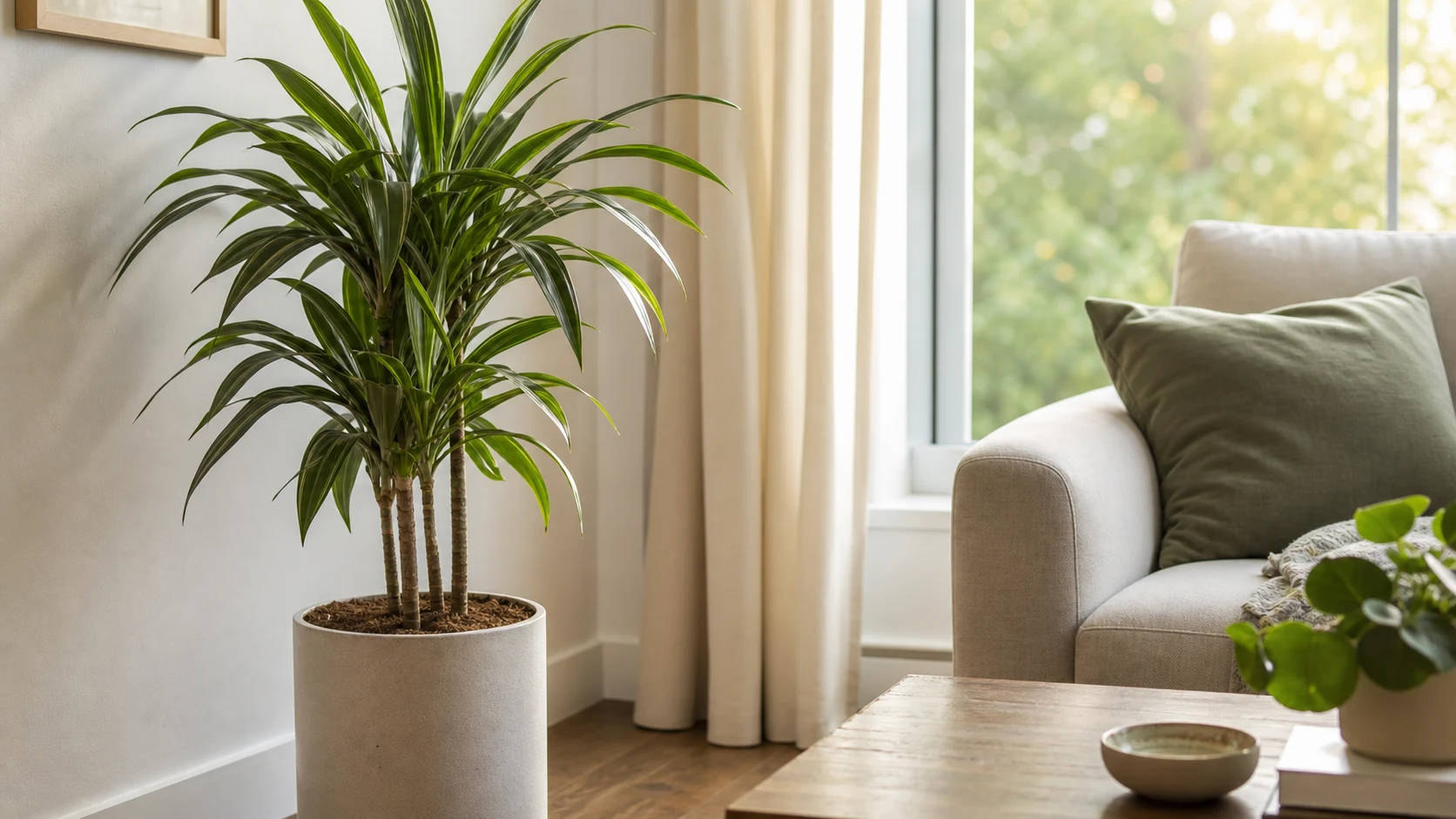
A sheer curtain keeps this bright window placement useful for dracaena without exposing the leaves to harsh direct sun.
Watering: Less Than You Think
This is where most people go wrong with dracaena plant care. Dracaenas prefer to dry out a bit between waterings. They store moisture in their thick stems and roots, so they’re far more likely to suffer from too much water than too little.
A good rhythm for most homes is watering every 10 to 14 days in spring and summer, and stretching to every three weeks or so in autumn and winter when growth slows. But don’t follow a schedule blindly. Check the soil instead.
Push your finger into the soil about 5 to 6 cm deep. If it still feels damp, wait. If it’s dry at that depth, she’s ready. The top of the soil can look dry while the lower half is still wet, so the finger test is more reliable than just eyeballing it.
When you do water, water thoroughly until it drains from the bottom, then empty the saucer. Sitting in water is how roots rot.
If you are unsure today, use this rule: dry at depth means water now; damp at depth means wait three or four more days. Do not water just because the top of the soil looks pale.
If you think you have overwatered, stop watering, empty the saucer, and check that the pot has a drainage hole. If the soil smells sour or the stem feels soft near the base, slide the plant out of the pot and inspect the roots. Healthy roots are firm. Rotten roots are brown or black, mushy, and may smell bad. Trim rotten roots and repot into fresh, barely moist mix.
Why Dracaena Tips Turn Brown
Brown tips on dracaena leaves are one of the most common things people notice, and one of the most misunderstood. The tips going brown doesn’t mean the plant is dying. It’s usually a sign of one of three things.
Fluoride and Mineral Sensitivity
Dracaenas are particularly sensitive to fluoride and salts that accumulate from tap water and some fertilisers. NC State Extension lists dracaena among the houseplants prone to fluoride injury, and tip burn is one of the classic signs. If your tap water is heavily treated, letting it sit overnight before watering helps release some of the chlorine. Rainwater or filtered water works well too.
Inconsistent Watering
Going from bone dry to soaked and back again stresses the plant. The tips reflect that stress. Consistent, moderate watering, not too frequent, not too neglectful, keeps the tips cleaner.
Low Humidity
Dracaenas come from humid tropical environments. In heated or air-conditioned homes, the air gets quite dry, and the leaf tips are the first to show it. Grouping plants together, using a humidifier nearby, or placing a pebble tray with water under the pot can all take the edge off the dryness.
Once a tip goes brown, it won’t turn green again. You can trim the brown part off with clean scissors, cutting at a slight angle so it looks natural, without harming the plant at all.
Do not try to fix brown tips by watering more. That is the most common wrong turn. First check water quality, then watering consistency, then dry air.
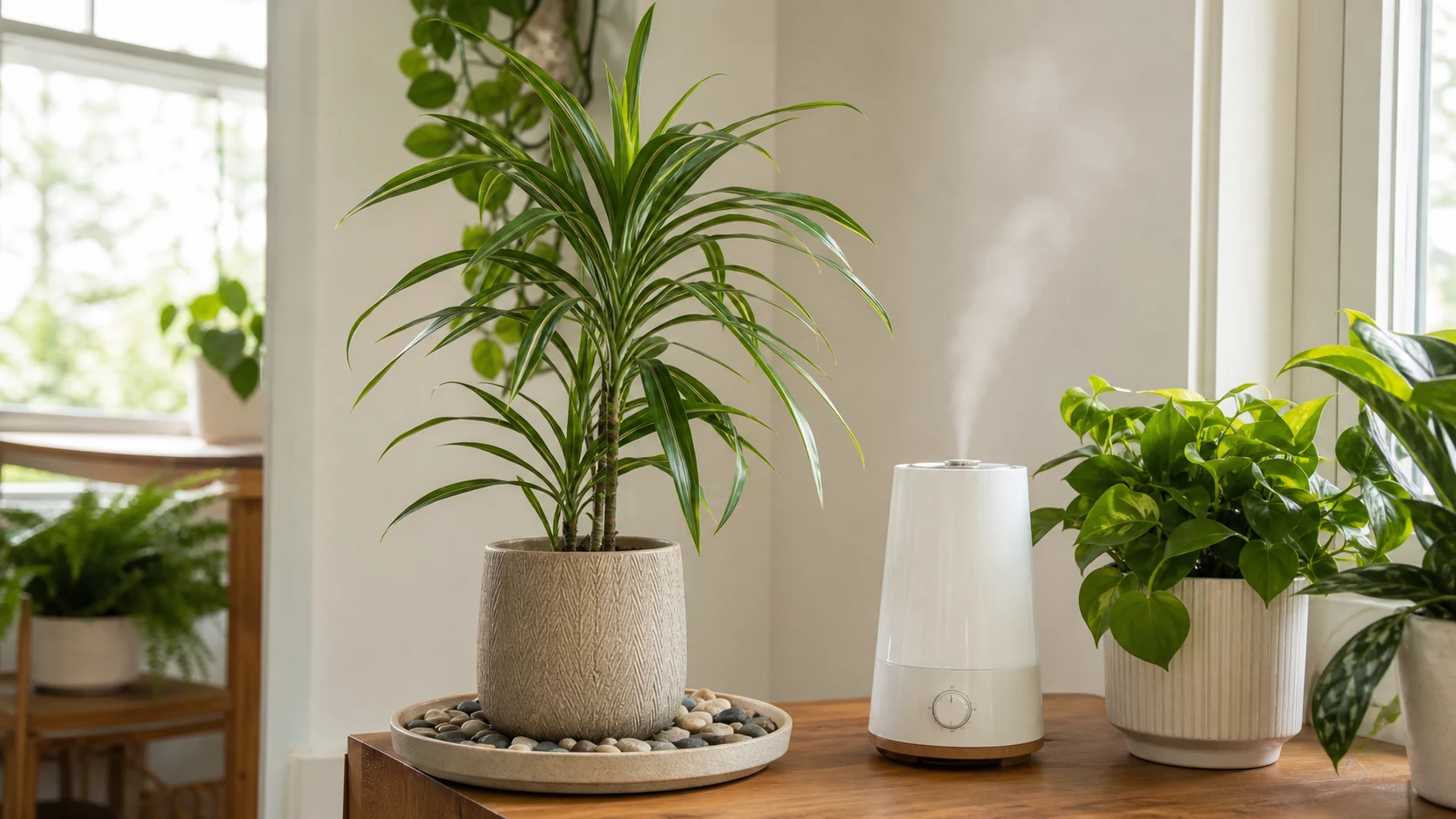
Grouping tropical plants, adding a nearby humidifier, and using a pebble tray can soften dry indoor air around a dracaena.
Brown Tips Diagnosis: Which Problem Is Yours?
Knowing the three causes is useful. Knowing which one is actually affecting your plant is more useful. Work through these steps in order.
Step 1: Look at where the browning starts and what surrounds it.
If only the very tip is brown and the rest of the leaf is a healthy, even green, that points to water quality or humidity rather than watering volume. If the browning is creeping down the leaf edges, or the leaf looks pale or yellowed alongside the browning, you’re likely dealing with a watering issue or root stress.
Step 2: Check your water source.
If you’re using tap water straight from the tap and live in an area with heavily treated municipal water, fluoride sensitivity is the most likely culprit, especially if the plant has been in the same spot for months and the tips have been slowly getting worse without any other changes. Switch to filtered water or rainwater for two to three months. New growth that comes in with cleaner tips confirms the diagnosis.
Step 3: Review your recent watering pattern.
Think back over the past few weeks. Has the soil dried out completely at any point, to where it pulled away from the edges of the pot? Or has the plant been sitting in a saucer with standing water? Either is a stress event, and the tips will show it roughly one to two weeks later. Steady, consistent watering, where the soil gets dry at depth but not to the point of the plant visibly drooping, is the fix.
Step 4: Test the air in the room.
Run your hand along the leaves on a dry winter day with the heating on. If the leaf edges feel crisp or papery rather than smooth and slightly waxy, the air is probably too dry. A pebble tray with water near the pot, or clustering her alongside other plants, adds a small but real amount of humidity. This step matters most in winter and in homes with forced-air heating.
Most brown-tip problems are a combination of two or three of these at once. Address them in order, starting with water quality, and you’ll see improvement within a few months as new growth comes in cleaner.
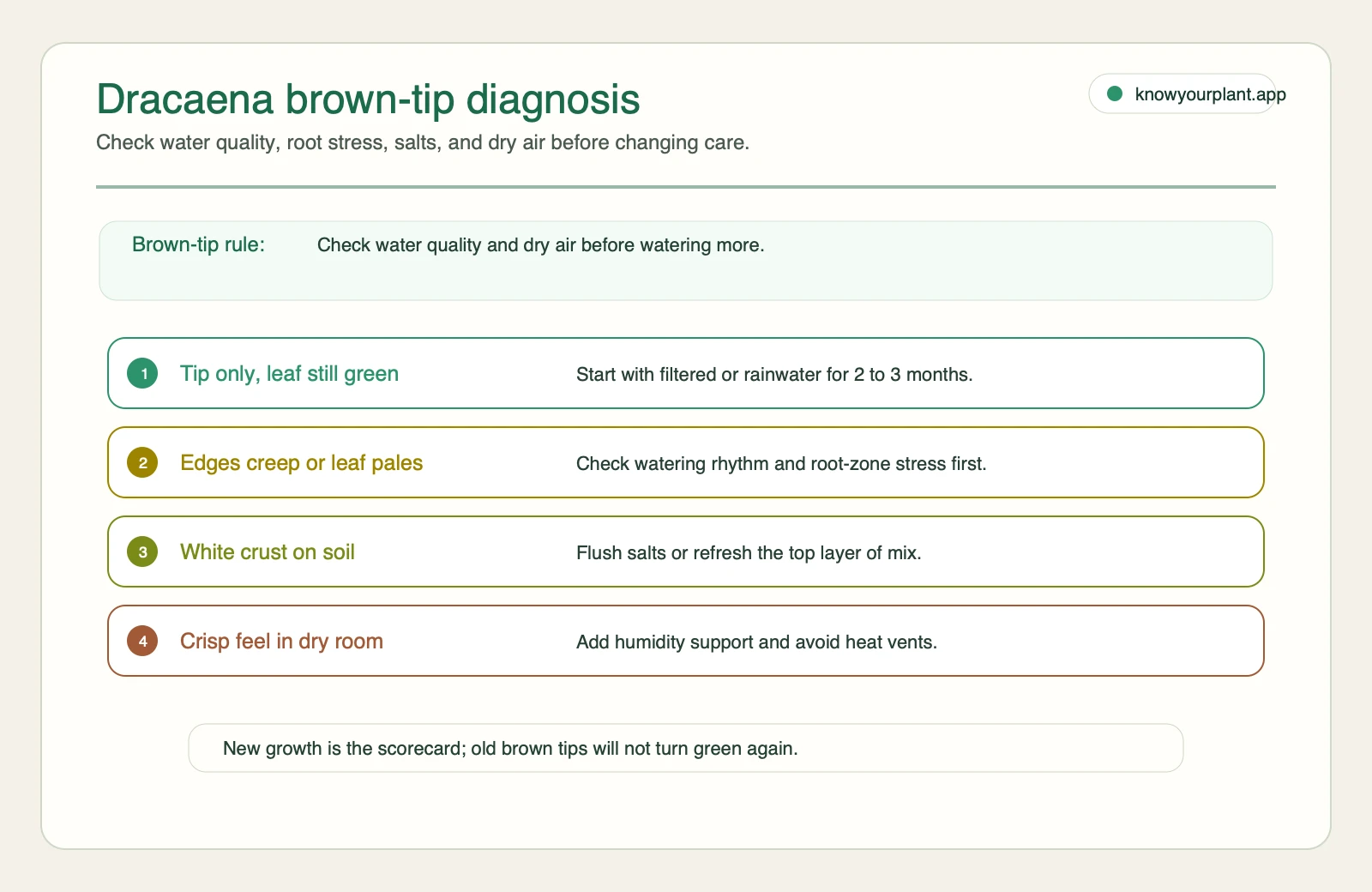
Use the brown-tip diagnosis before watering more; old tips stay brown, so judge whether new growth comes in cleaner after the right fix.
Expert Note
NC State’s dracaena guidance is useful because it separates three problems owners often blur together: fluoride or salt sensitivity, brown tips from dry air, and root stress from staying too wet. When tips burn but the rest of the leaf stays firm and green, test water quality and humidity before you assume the plant needs more water.
Comparison Table: Tap Water vs Filtered Water vs Rainwater
| Water source | Convenience | Fluoride and salt risk | When it is worth trying |
|---|---|---|---|
| Tap water | Easiest | Highest in treated-water areas | Fine if tips stay clean and your water is mild |
| Filtered water | Easy once set up | Lower | Best first test when chronic tip burn keeps returning |
| Rainwater | Least convenient | Lowest | Useful for very fluoride-sensitive plants if you can collect it cleanly |
Soil and Potting
A well-draining potting mix is important. Standard houseplant compost works, but adding a handful of perlite improves drainage and reduces the risk of waterlogging. Dracaenas don’t need rich soil; they’re not heavy feeders.
Repot only when she’s clearly outgrown her pot, usually every two to three years. Go up one pot size at a time. A pot that’s too large holds more moisture than the roots can use, which circles back to the overwatering problem.
Temperature and Humidity
Dracaenas prefer temperatures between 16 and 24 degrees Celsius and will struggle below 10. Keep them away from cold draughts, air conditioning vents, and windowsills in winter where temperatures drop overnight.
Average home humidity is usually fine, though the tips will stay cleaner in slightly more humid conditions. If you’re grouping plants together for humidity, dracaena fits well in a cluster alongside other tropical foliage plants.
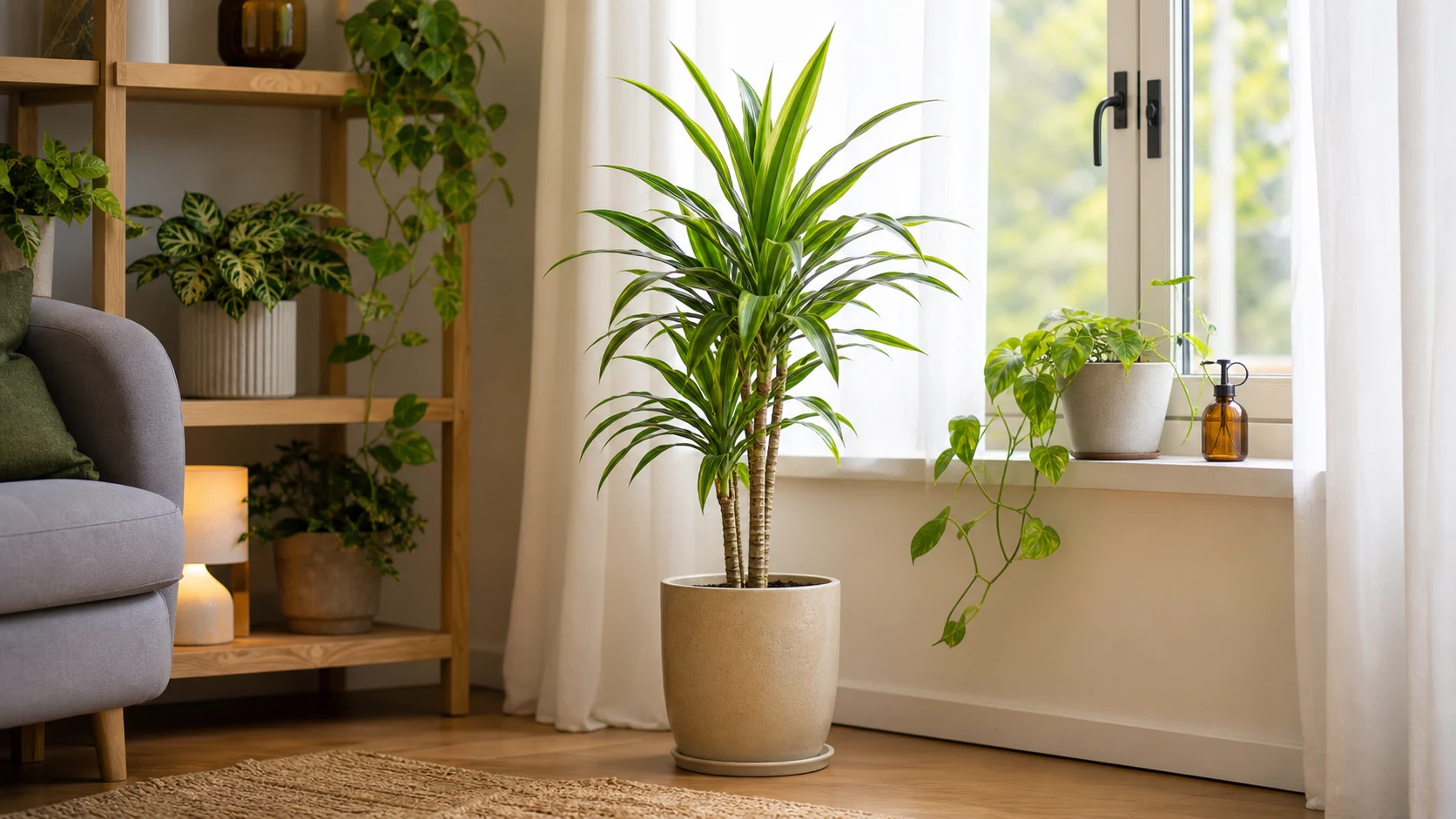
A stable floor position beside clustered tropical foliage keeps dracaena away from a cold sill while supporting comfortable humidity.
Toxicity Warning for Cats
This matters before you bring a dracaena home: dracaenas are toxic to cats and dogs. The ASPCA lists dracaena as toxic to both, with possible symptoms including vomiting, excessive drooling, and lethargy. The reaction is generally more pronounced in cats than in dogs.
If you have a cat who likes to chew on plants, a dracaena is one to keep well out of reach or avoid altogether. For alternatives that are safe to have around curious cats, the cat-safe plants guide has a full list worth bookmarking.
Your Simple Care Plan
Today: Check the soil 5 to 6 cm down. Water only if it is dry at that depth, empty the saucer, trim any brown tips if they bother you, and move the plant out of harsh direct sun or cold draughts.
This week: Watch the newest leaves, not the oldest damaged tips. New yellowing means the soil is probably staying too wet. New curling means the plant may be too dry, too hot, too cold, or sitting in very dry air.
This season: Fertilise lightly in spring and summer, slow watering in autumn and winter, and repot only when roots are crowded. Most dracaenas are happier with small, steady adjustments than with dramatic rescues.
Seasonal Care Calendar
Dracaena care doesn’t need a dramatic seasonal shift, but a few small adjustments through the year make a real difference.
Spring: As light returns and temperatures rise, dracaena will start pushing new growth. This is the time to resume more regular watering, check whether she needs repotting, and begin a light fertilising routine with a balanced liquid fertiliser diluted to half strength, once a month.
Summer: Peak growing season. Keep her in bright indirect light, water when the soil is dry at depth, and watch humidity if you’re running air conditioning heavily. This is also the right time to propagate if you’d like more plants: cut a healthy cane section with at least one node, let it callus for a day, then set it into moist soil or place it in a glass of water to root. New growth typically appears within four to six weeks.
Autumn: Growth slows as light drops. Start spacing out waterings again, typically every two to three weeks, and stop fertilising by late autumn. Bring any outdoor plants back inside before temperatures drop below 13 degrees.
Winter: Minimal intervention. Water only when the soil is genuinely dry at depth, sometimes as infrequently as once a month, and keep her away from cold windowsills and heating vents. Don’t fertilise. She’s resting, and that’s fine.
Common Problems at a Glance
Yellow leaves: Usually overwatering or the plant sitting in water. Check the roots. If they’re soft or mushy, she needs to dry out and likely be repotted into fresh, drier soil. If you want the broader troubleshooting pattern, use the yellow leaves guide to separate overwatering from drought, low light, and seasonal leaf drop.
Curling leaves: Usually dry soil, dry air, temperature stress, or roots that are struggling. Check the soil first. If it is dry at depth, water thoroughly. If it is damp, do not add more water; look for cold draughts, hot vents, or root rot instead.
Brown tips: Usually water quality, inconsistent watering, or dry air. Trim the damaged tip if you want, then switch to filtered or rainwater for a couple of months and keep watering based on soil dryness.
Pale, washed-out leaves: Too much direct sun. Move her back from the window.
Drooping lower leaves: Normal as the plant matures. Lower leaves naturally fall away over time as she grows upward. If it’s happening quickly across multiple leaves, check watering.
Leggy, sparse growth: Not enough light. Move her somewhere brighter and growth will fill back in over the next few months.
White crust on soil surface: Mineral build-up from tap water or fertiliser salts. Flush the soil thoroughly with water a couple of times, or top-dress with fresh compost.
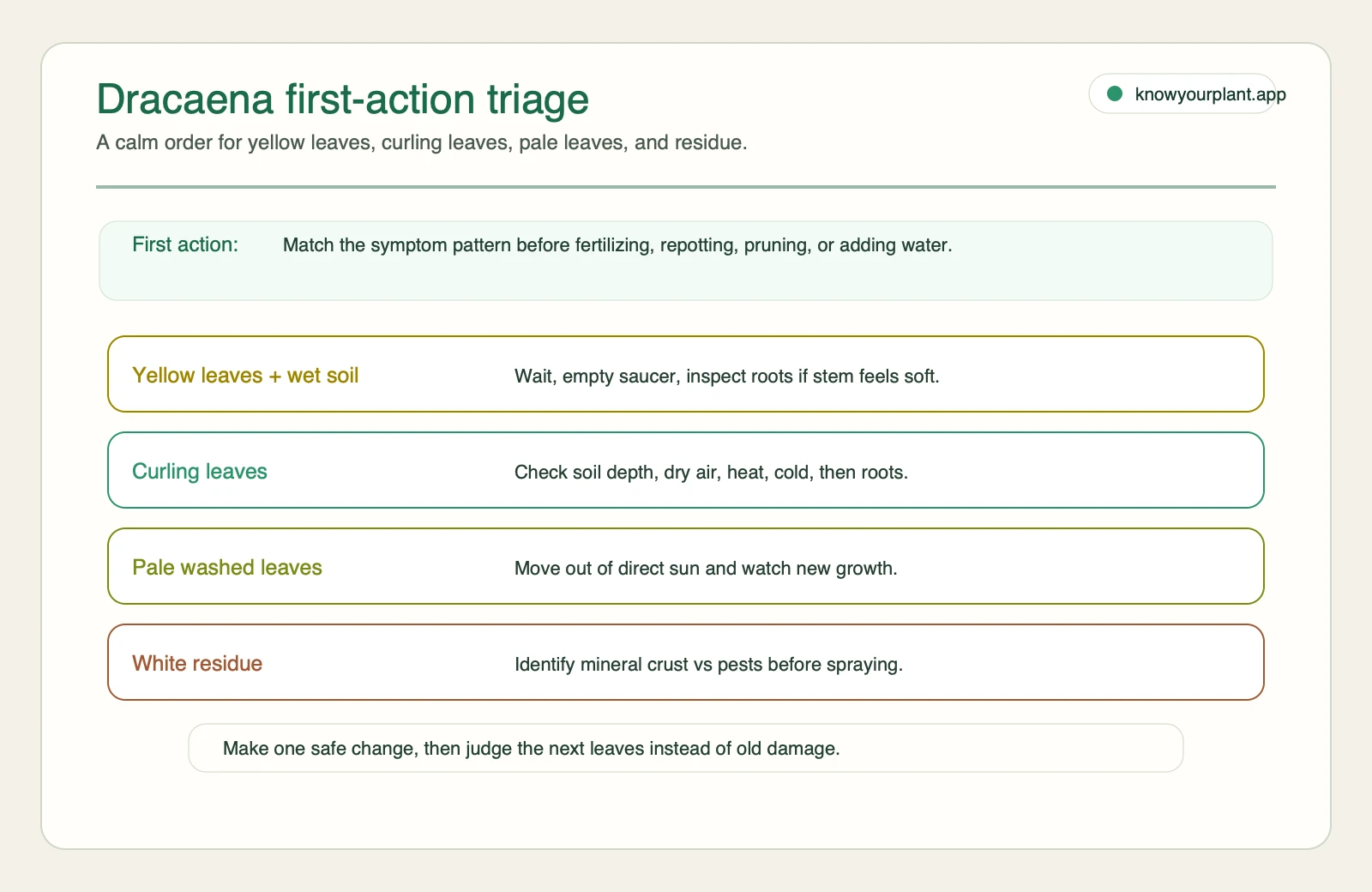
Use the triage card to choose one safe first move instead of fertilizing, repotting, pruning, and watering in the same afternoon.
Real User FAQ
I came back after a few days away and my dracaena looks collapsed. Should I water, soak, or repot first?
Check the soil depth first. If the root ball is bone dry and pulling from the pot, a thorough soak may help. If the soil is still wet, or the stem feels soft, stop and inspect drainage and roots before adding more water.
Can I cut back a dracaena without killing it?
Usually, yes. A clean cut above a node can trigger new shoots below the cut, especially on cane-form dracaenas. After pruning, avoid the common panic move of overwatering while the plant is recovering.
What if the white residue on my dracaena is not a watering issue at all?
Treat white residue as a diagnosis fork, not one problem. Check whether it looks like cottony insects, powdery growth, or crusty mineral buildup before you reach for spray or extra water.
My leaves are yellowing and the soil is wet. Do I need fertiliser or a bigger pot?
Usually neither. Yellowing plus wet soil is a root-zone warning first. Let the mix dry, empty the saucer, and inspect roots if the stem feels soft or the pot stays wet for too long.
Methodology Note
This guide was refreshed with current search discovery for dracaena care questions, then cross-checked against Gardening Stack Exchange threads for real owner pain patterns and verified against NC State Extension and ASPCA for care and pet-safety claims. Forum threads are qualitative signal, not proof of prevalence. Last updated June 7, 2026.
Frequently Asked Questions
How often should I water my dracaena? Every 10 to 14 days in spring and summer, and every three weeks or so in autumn and winter. But the finger test matters more than the schedule. Push your finger 5 to 6 cm into the soil. If it’s still damp, wait. If it’s dry, water thoroughly.
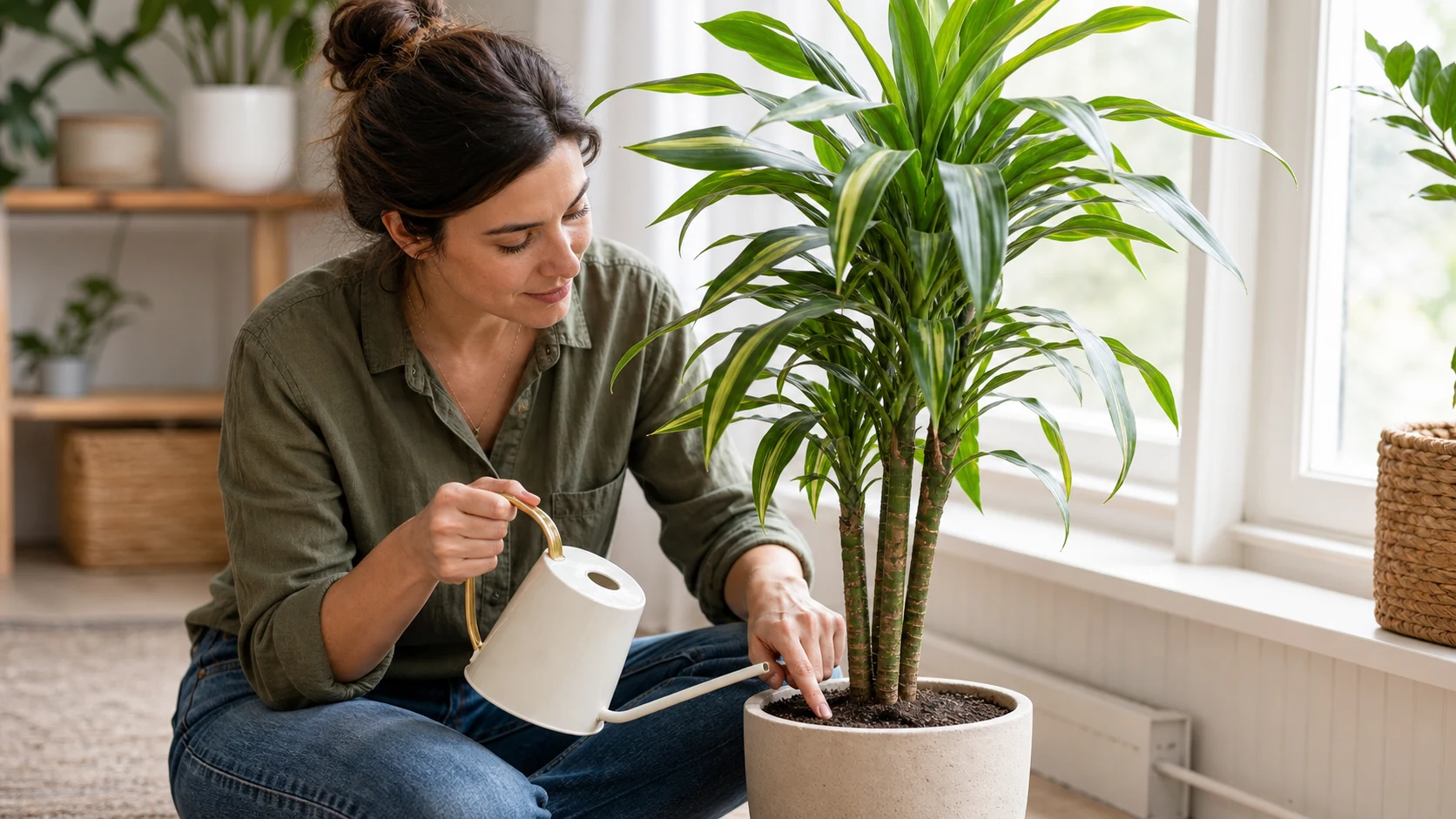
Test the soil at depth before reaching for the watering can; damp soil means the dracaena can wait.
Why does my dracaena have brown tips even though I’m watering it regularly? Brown tips on dracaena are most commonly caused by fluoride in tap water, low humidity, or inconsistent watering. If you’re watering on a regular schedule, the culprit is usually water quality. Try letting tap water sit overnight before using it, or switch to filtered water, and see whether new growth comes in cleaner.
Can I cut off the brown tips? Yes. Use clean, sharp scissors and cut at a slight angle to mimic the natural leaf shape. This is purely cosmetic: it won’t hurt the plant and makes her look much neater. The brown won’t spread past where you cut.
Are all dracaena types cared for the same way? Mostly, yes. Light preferences vary slightly: Marginata wants a bit more brightness than Lisa or Fragrans. But the watering principles, fluoride sensitivity, and humidity preferences are consistent across types.
My dracaena is losing its lower leaves. Should I be worried? Probably not. Dracaenas naturally drop lower leaves as they grow, which is how they develop that architectural cane shape. If the leaf loss is gradual and the newer growth at the top looks healthy, she’s fine. If leaves are dropping quickly across the whole plant, check whether she’s been sitting in wet soil.
Can I put my dracaena outside in summer? You can, in a shaded or dappled-light spot. Direct outdoor sun will scorch her quickly. Bring her back inside before temperatures drop below 13 degrees Celsius. Moving her back indoors can sometimes trigger a brief adjustment period where a few leaves yellow, which is normal.
Is dracaena safe for cats? No. Dracaena is toxic to cats and dogs. If you have a cat who chews on plants, keep dracaena out of reach or choose a different plant for that space. The cat-safe plants guide is worth a look if you need pet-friendly alternatives.
Dracaenas have been popular houseplants for a long time, and the reasons are easy to understand. They’re architectural without being demanding, tolerant without being boring, and once you understand the watering rhythm and the fluoride sensitivity, the brown-tip mystery stops feeling like a mystery. She’ll tell you what she needs. You just have to learn to read her.
Download KnowYourPlant for personalised care reminders, so you always know when your dracaena is ready for water, and when she’d rather be left alone.