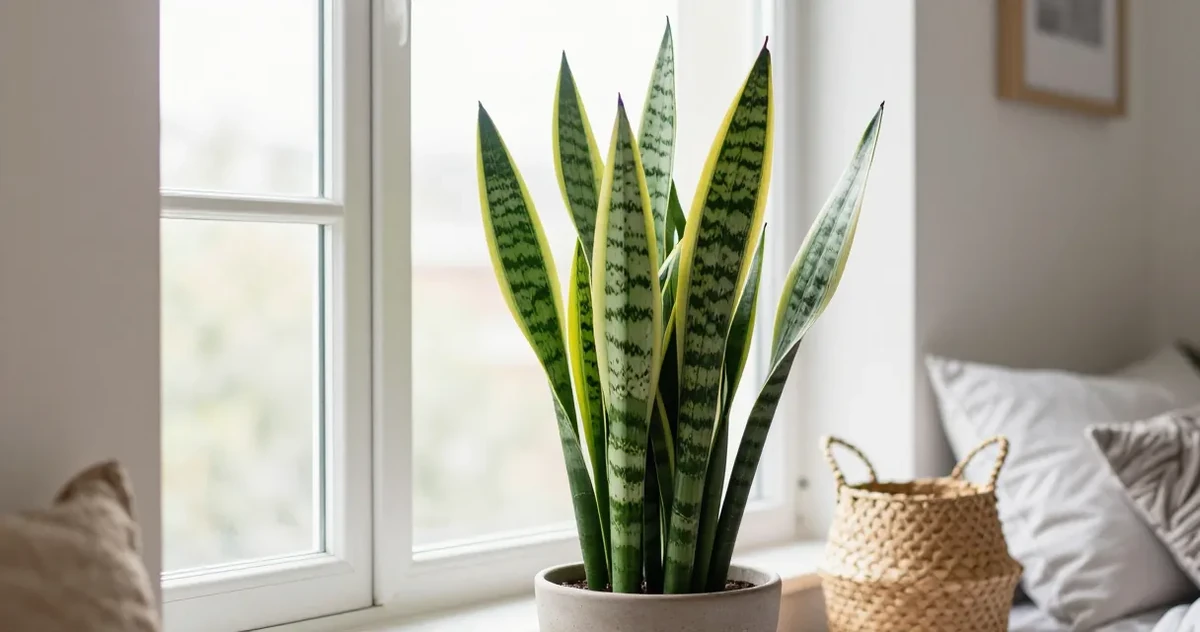
Climate DNA for Dracaena trifasciata
Snake plant is resolved here to the accepted name Dracaena trifasciata, with Sansevieria trifasciata retained by GBIF and POWO as the familiar synonym.
The ranges below are the middle 50% (p25–p75), not recommended indoor setpoints.
| Reference taxon | POWO native range | Annual mean temperature | Annual precipitation | Relative humidity | Solar radiation | Evidence |
|---|---|---|---|---|---|---|
| Dracaena trifasciata (snake plant) | southern Nigeria to west-central tropical Africa and Tanzania | 23.3–25.2°C | 1585–1783 mm/yr | 65–69% | 16.1–18.1 MJ/m²/day | 29 climate points; medium confidence |
What this changes in this guide: Its seasonally dry background supports caution with persistent wetness, but a container is not native ground: soil structure, light, temperature, and root health decide the safe interval.
Sources and method: Dracaena trifasciata in POWO and GBIF; CHELSA V2.1, 1981–2010. GBIF records are limited to POWO-native countries, then filtered for coordinates, establishment signal, licence, precision, and spatial duplication. No community or user-reported care data is used in this module.
The Short Version: Water Less Than You Think
If you are here because your snake plant has yellow leaves, curling leaves, brown tips, or you are standing in a shop wondering whether this plant fits your routine, start here: snake plants usually struggle because they get watered too often, not because they are ignored.
For most homes, water every two to three weeks in spring and summer, and about once a month in autumn and winter. Always check the soil first. If it is still damp a few centimetres down, do not water yet. If the leaves are yellow, mushy at the base, leaning in wet soil, or the pot smells sour, you are probably overdoing it.
The snake plant (Dracaena trifasciata, formerly Sansevieria) is a succulent-like perennial with stiff, upright leaves that grow in tall architectural fans. It is a good fit if you have bright indirect, medium, or low light and you want a plant that can wait between care days. It is not a good fit for a pot without drainage, a spot blasted by hot afternoon sun, or a routine where you like to water every few days. Snake plant care is mostly about waiting until the soil is dry, watering deeply, and walking away. For a shorter symptom-first reset, use snake plant care: water, light, and easy fixes.
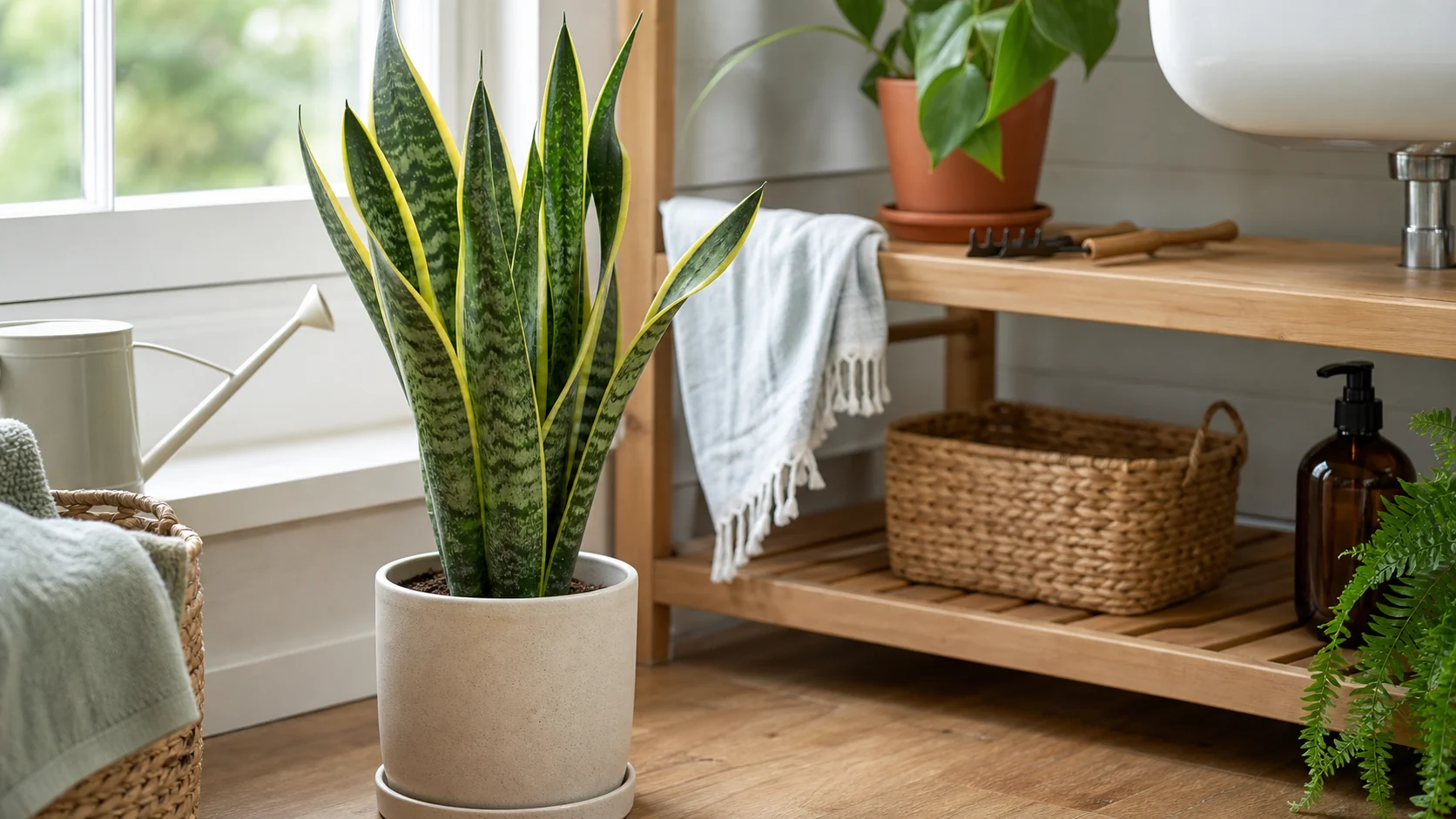
A healthy snake plant beside an unused watering can reinforces the care rule that waiting for dry soil is usually safer than watering on schedule.
Identification Snapshot
| Detail | What to look for |
|---|---|
| Botanical name | Dracaena trifasciata (formerly Sansevieria) |
| Growth habit | Upright rosettes with thick, sword-like leaves |
| Leaf feel | Firm, fleshy, and rigid rather than thin or floppy |
| Common stress signal | Yellowing, mushy bases, or wrinkled leaves after watering mistakes |
| Good fit for | Owners who forget to water more often than they overwater |
Snake plants have been a staple of homes and offices for decades, and not just because they are easy. They genuinely earn their place. If you want to understand everything yours is actually doing for your home beyond just looking good, it’s worth reading about the benefits of snake plants and the broader air-purifying indoor plants guide too.
What Most Care Guides Miss
Most guides about snake plant describe the ideal care routine. Real homes are messier: light changes by season, pots dry at different speeds, and the same symptom can mean different things depending on where it appears.
Before changing care, check the plant in this order:
- Light: is the plant growing toward the window, fading, or scorching?
- Root zone: is the pot drying predictably, or staying wet in the middle?
- Leaf pattern: did the oldest leaves, newest leaves, tips, or stems change first?
- Recent change: new pot, new location, fertilizer, cold draft, heat vent, or pest exposure.
This keeps you from fixing the wrong problem. One clear adjustment is usually safer than a full care reset.
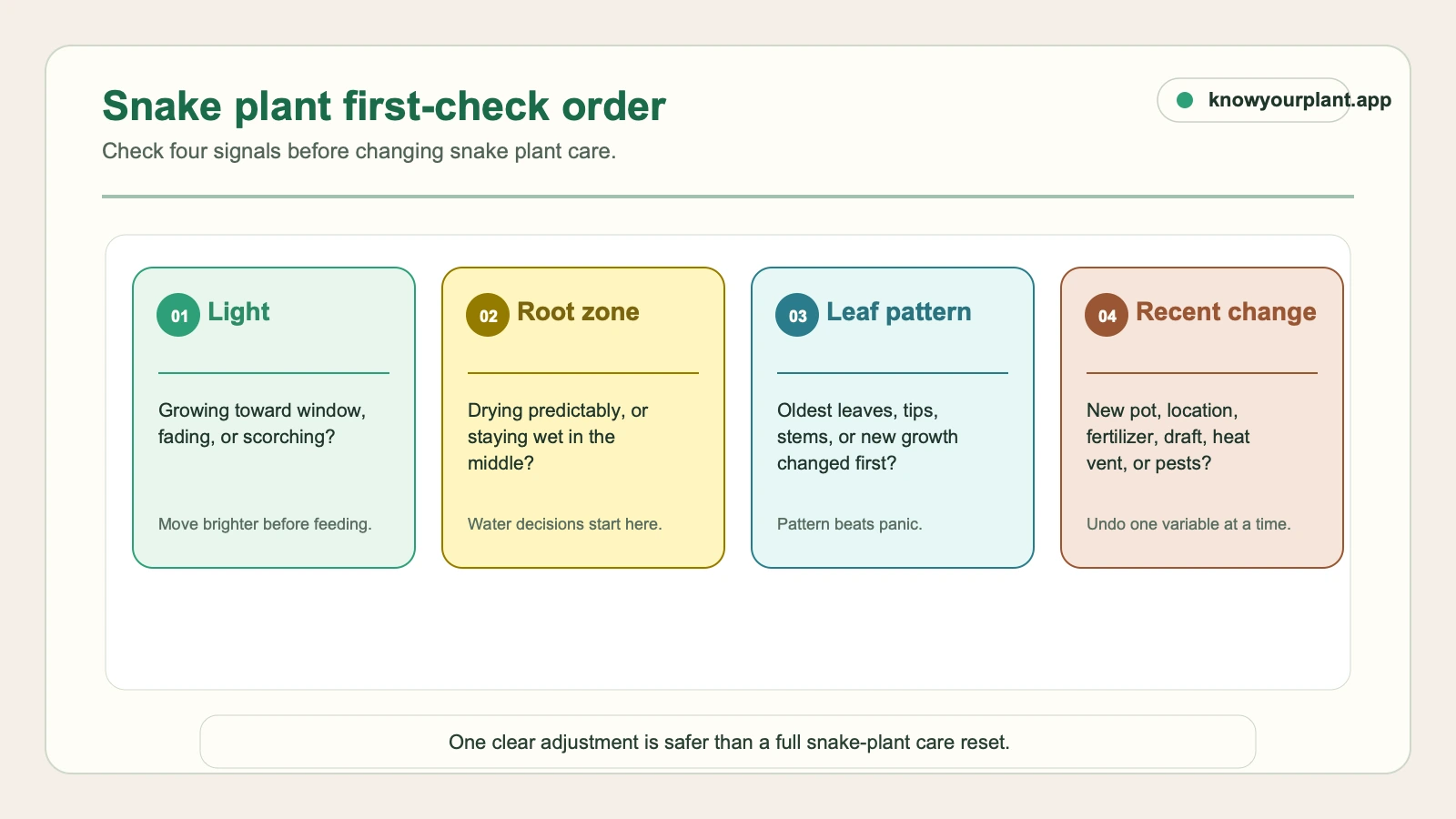
Use this order before changing the routine. It keeps one yellow leaf, one damp pot, or one recent move from turning into a full-care reset.
Lookalikes/Confused-With
| Plant | Why people mix them up | What to notice first | Care trap |
|---|---|---|---|
| Snake plant (Dracaena trifasciata) | Upright sword leaves | Thick leaves, tight rosette, usually green banding or yellow margins | Too much water in dense soil |
| ZZ plant (Zamioculcas zamiifolia) | Tough, low-maintenance reputation | Leaflets on stems, not one upright leaf blade | Different root structure and fuller shade tolerance |
| Aloe | Succulent feel | Saw-toothed leaf edges and softer leaf shape | Wants brighter sun and different watering rhythm |
| Mother-in-law’s tongue cultivars | Same plant, different common names | Variegation and height vary a lot | Owners assume every variety wants identical light speed and growth rate |
Care Cards
| Need | Fast rule |
|---|---|
| Light | Bright indirect is best, low light is survival mode |
| Water | Let the soil dry fully before watering again |
| Pot | Drainage hole required |
| Soil | Fast-draining succulent or cactus mix |
| Temperature | Best in warm indoor rooms, away from cold drafts |
| Feeding | Light feeding in spring and summer only |
Expert Note
NC State Extension describes snake plant as tolerant of very low light but prone to root rot when watering stays too frequent or the mix drains poorly. ASPCA lists snake plant as toxic to cats and dogs. Those two facts explain most practical care decisions: let the roots dry properly, and do not place the plant where pets can chew it.
Light: More Flexible Than You’d Think
One of the most common questions about snake plant care is how much light she actually needs. The honest answer: less than you think, and much less than most houseplants.
What she loves: Bright indirect light. A spot near an east-facing window, or a few feet back from a south or west window, is where she’ll grow fastest and show her sharpest banding.
What she handles just fine: Medium to low indirect light. A room with one window on the far wall, a hallway that gets some ambient daylight. She’ll grow more slowly, but she won’t struggle.
What causes problems: Long stretches of direct, harsh sun. It can bleach her leaves and leave pale patches that don’t recover. A little morning sun is fine. Hours of afternoon sun through a south or west window in summer is too much.
According to the University of Florida IFAS Extension, Sansevieria can survive in light levels as low as 25-50 foot-candles, making it one of the most shade-tolerant houseplants available. That said, they note that growth rate and color intensity improve significantly at 100 foot-candles or above. So she’ll survive a dark corner, but she’ll truly thrive near a window.
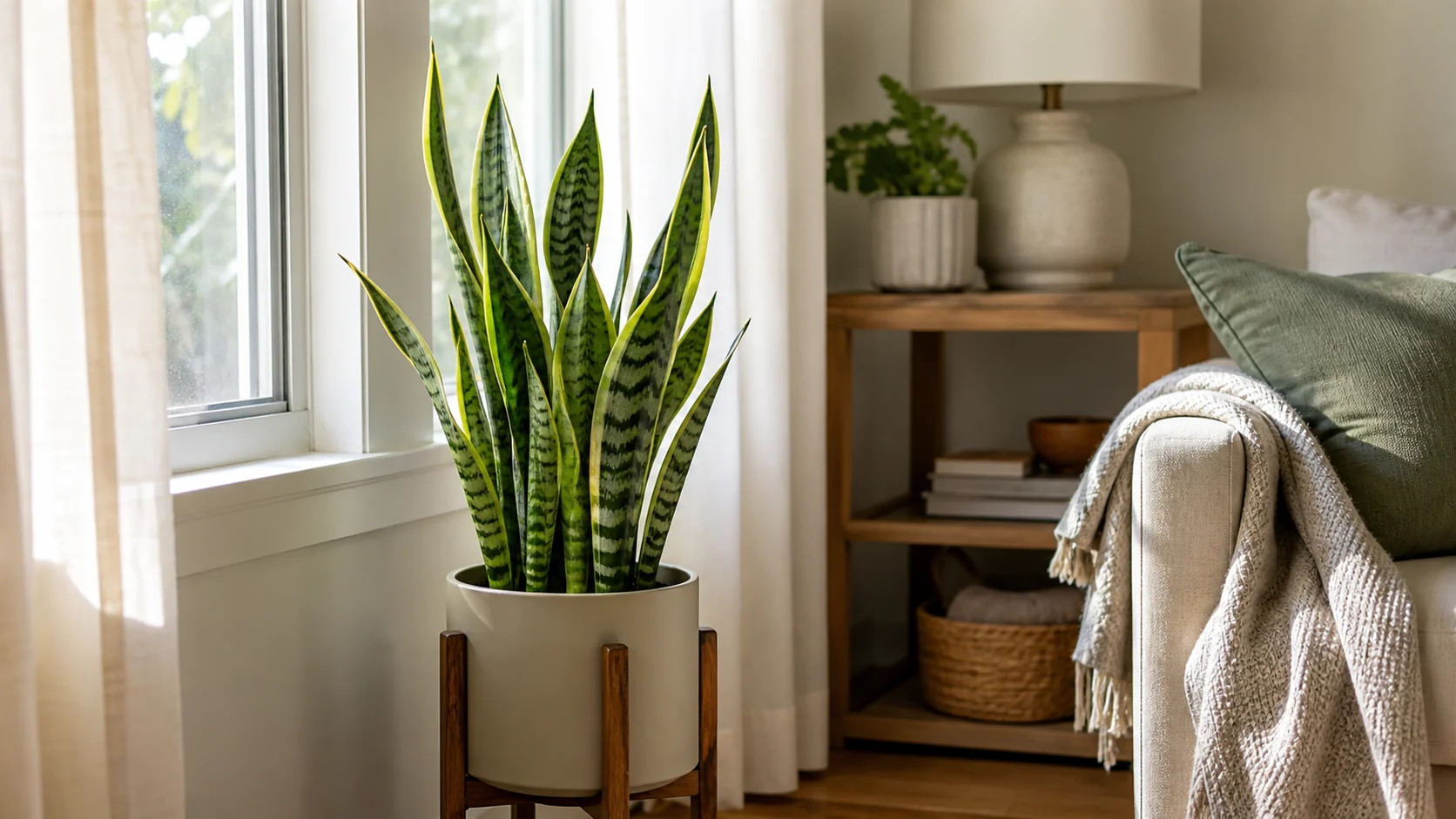
A snake plant beside a softly filtered window gets strong ambient light without hours of harsh afternoon sun.
Tolerate vs Thrive Light Ladder
| Placement | What usually happens | Your care adjustment |
|---|---|---|
| Dim corner, no direct window light | Plant survives, but growth slows and recovery from mistakes drags out | Water even less often and do not expect much new growth |
| Medium indirect light | Stable, decent leaf color, moderate growth | Keep watering conservative and rotate the pot occasionally |
| Bright indirect light | Strongest growth, best color, easiest recovery after stress | This is the safest long-term placement for most homes |
If your home doesn’t have great natural light, she’s one of the few plants that actually responds well to a basic grow light setup. Even a modest supplemental light for a few hours a day can keep her growing steadily through the darker months. That flexibility is also why she stays on so many lists of the best bedroom plants for people who want a low-effort plant that can handle dimmer corners.
Watering: The One Thing That Actually Matters
Here is where most snake plant problems start. Overwatering is by far the most common mistake, and it’s an understandable one. She looks lush. She looks like she might be thirsty. She isn’t.
The rule that works: Let the soil dry out completely before watering again. Not just the top layer. All the way through.
Push your finger a few centimetres into the soil. If there’s any moisture left, wait. When the soil is dry all the way down, water thoroughly until it drains from the bottom of the pot, then leave her alone again.
In spring and summer, that might mean watering every two to three weeks. In autumn and winter, once a month is often enough. Some people stretch to six weeks in a cool, dim room and find the plant perfectly content.
Christopher Satch, plant scientist and Director of Horticulture at The Sill, puts it plainly: overwatering is the primary cause of indoor houseplant failure, and snake plants are especially vulnerable because their thick leaves store water so efficiently. A plant that looks fine on the surface can already have roots that are beginning to rot below the soil line.
That framing is useful. It shifts how you think about watering. You’re not giving her something she needs today. You’re deciding whether she’s already had enough. Most of the time, she has.
NC State Extension notes that succulents and drought-adapted plants like Sansevieria typically require 50-75% less water during winter dormancy than during the growing season, and that more overwatering damage occurs in winter than at any other time of year, precisely because people keep watering on the same schedule year-round.
Signs she’s had too much water
- Leaves turning yellow or mushy at the base
- Soft, almost spongy feeling near the soil line
- A faint sour smell from the pot
- Leaves that lean or flop rather than standing upright
Signs she’s ready for water
- Soil bone dry several centimetres down
- The pot feeling noticeably lighter than when you last watered
- Leaves looking very slightly less firm than usual, not soft, just less taut
Root rot from consistently wet soil is genuinely the main way snake plants die. Get the watering right and most other things fall into place.
Your next watering decision
- Today: Push a finger into the soil or lift the pot. If the soil feels damp or the pot still feels heavy, leave it alone. If the soil is dry all the way through, water until it drains from the bottom, then empty the saucer.
- This week: Check that the pot has drainage holes and that the soil is not staying wet for more than a few days. If it is, move the plant into a grittier cactus or succulent mix.
- This season: In spring and summer, expect to check more often. In autumn and winter, slow down on purpose and let the dry period stretch longer.
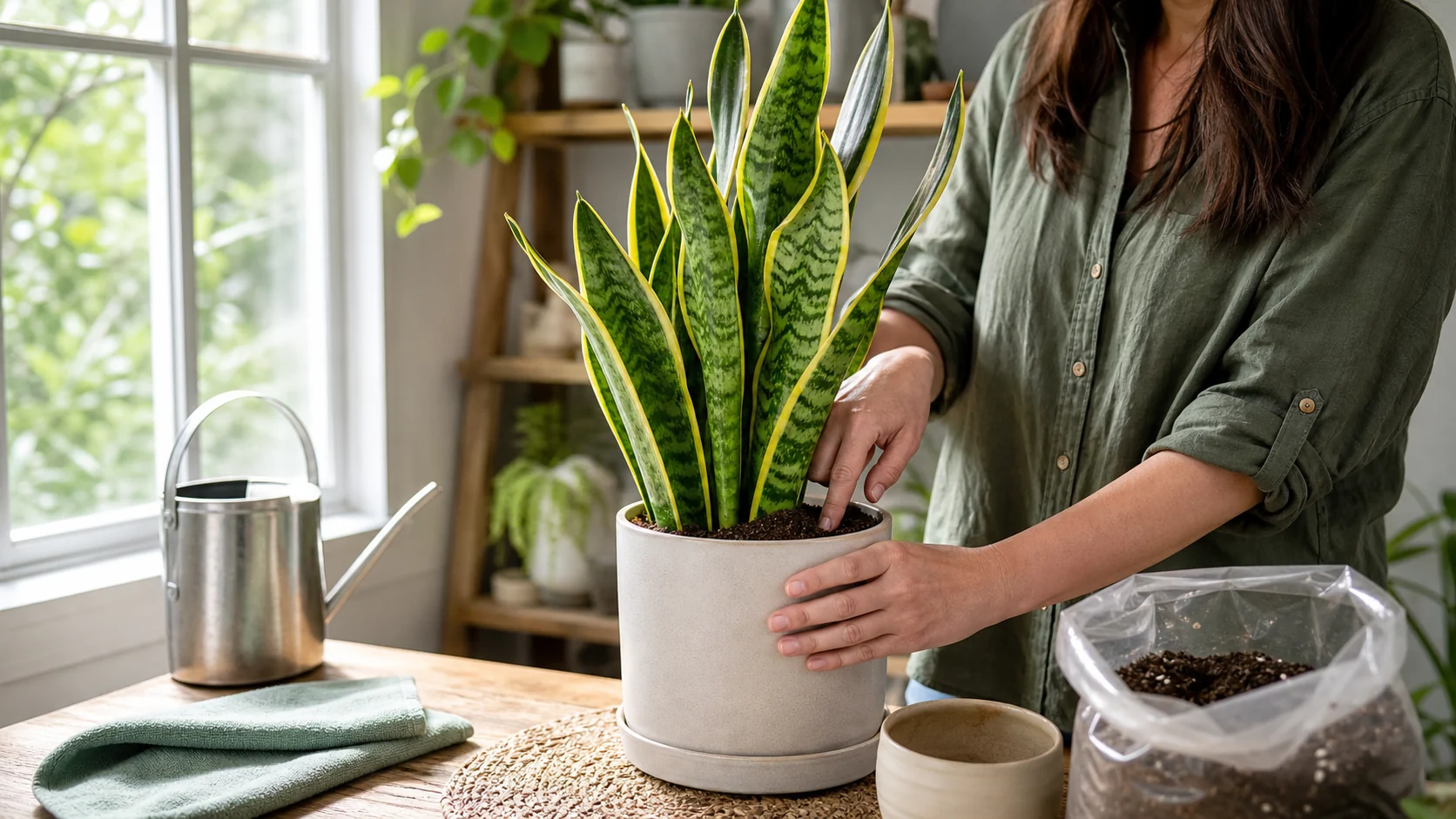
Check the soil before reaching for the watering can; a gritty mix and a draining pot make the decision easier.
Rescue Decision Tree
- Leaves firm and soil dry all the way through? Water deeply, let the pot drain, then wait until it dries again.
- Leaves wrinkled but soil still damp? Do not add more water. Unpot and inspect the roots for rot or dense, airless soil.
- Leaves yellow or mushy at the base? Cut away black roots or soft tissue, repot into dry fast-draining mix, and hold water for several days.
- Plant alive but stagnant in a dark corner? Move it brighter before changing fertilizer or pot size.
- Only one old outer leaf declining? That can be normal aging, not a full-care emergency.
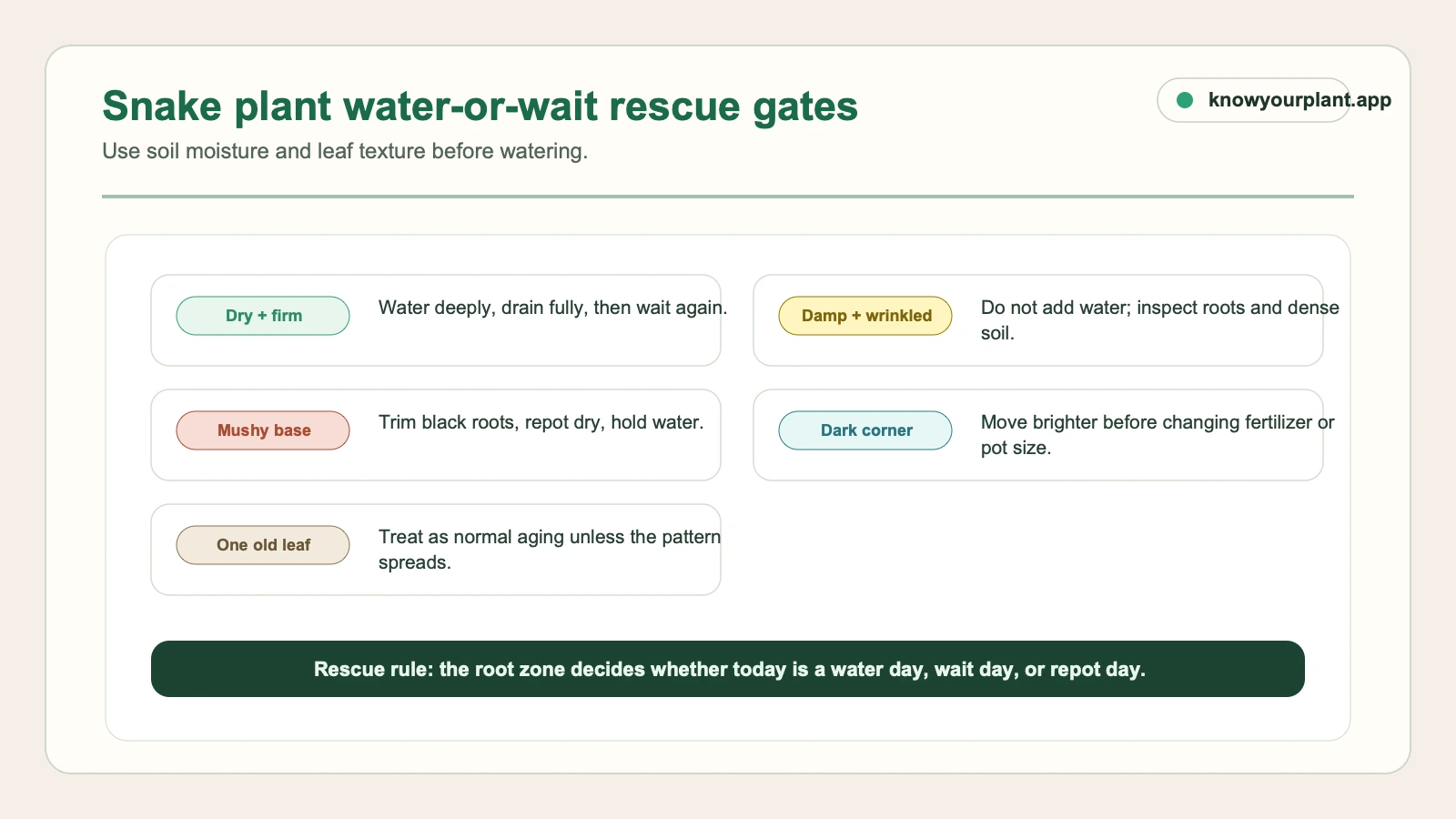
The safest snake plant rescue starts with the root zone. Water only when dry, stop when damp, and inspect roots before adding more water to a stressed plant.
Soil and Pots
Well-draining soil is not optional. She stores water in her leaves, so she doesn’t need the soil to hold moisture for her. A cactus or succulent mix works well on its own. Standard indoor potting mix is fine if you add a generous amount of perlite to open it up, roughly one part perlite to two parts mix.
The pot matters too. Terracotta is ideal because it’s porous and wicks away excess moisture naturally. Plastic and glazed ceramic hold moisture longer, which is fine as long as you’re disciplined about watering. If you’ve had trouble with overwatering in the past, terracotta makes it noticeably easier to stay on the right side of that line.
Drainage holes are non-negotiable. A beautiful pot without drainage is a trap.
She doesn’t need repotting often. Darryl Cheng, author of The New Plant Parent, points out that many houseplant owners repot far too eagerly, and that plants which prefer dry conditions, like Sansevieria, are particularly prone to problems when moved into oversized containers. The extra soil volume holds more moisture than the roots can use, which is exactly what you want to avoid. Go up just one size when she genuinely needs it, and only when roots are circling the bottom or actively pushing out of the drainage holes.
Seasonal Care Calendar
Most care guides treat snake plants like they’re the same year-round. They aren’t. Her needs shift with the seasons, and following that rhythm is the simplest way to avoid the most common mistakes.
Spring (March to May)
This is when she wakes up. After a slow winter, tight new shoots push up from the base and unfurl over a few weeks. Resume regular watering as the days lengthen, but still wait for the soil to dry completely before each water. Start monthly feeding with a balanced liquid fertilizer at half strength. If she’s been in the same pot for two or more years, check the roots: spring is the best time to repot if they’re circling the bottom. If she spent winter in a darker corner, move her closer to a window now.
Summer (June to August)
Peak growing season. She’ll put out the most new leaves now, and existing leaves may deepen in color over time.
- Watering frequency increases naturally. Every two weeks is common.
- Keep feeding monthly, but flush the soil with a thorough watering occasionally to prevent fertilizer salt buildup.
- Watch for afternoon sun through south or west-facing windows. A few hours of direct summer sun can bleach her leaves.
- If you move her outdoors, find a spot with bright shade, not full sun, and bring her back in before nights drop below 15°C (60°F).
Autumn (September to November)
Time to taper off. Growth slows as light dims and days shorten.
- Water less often. The soil takes longer to dry in cooler temperatures, so your watering interval naturally stretches.
- Stop fertilizing by October. She won’t use it, and unused nutrients accumulate in the soil.
- Move her away from cold drafts as windows get colder.
- If she’s been near an air conditioning unit, make sure you’re not switching her straight into heating vent exposure.
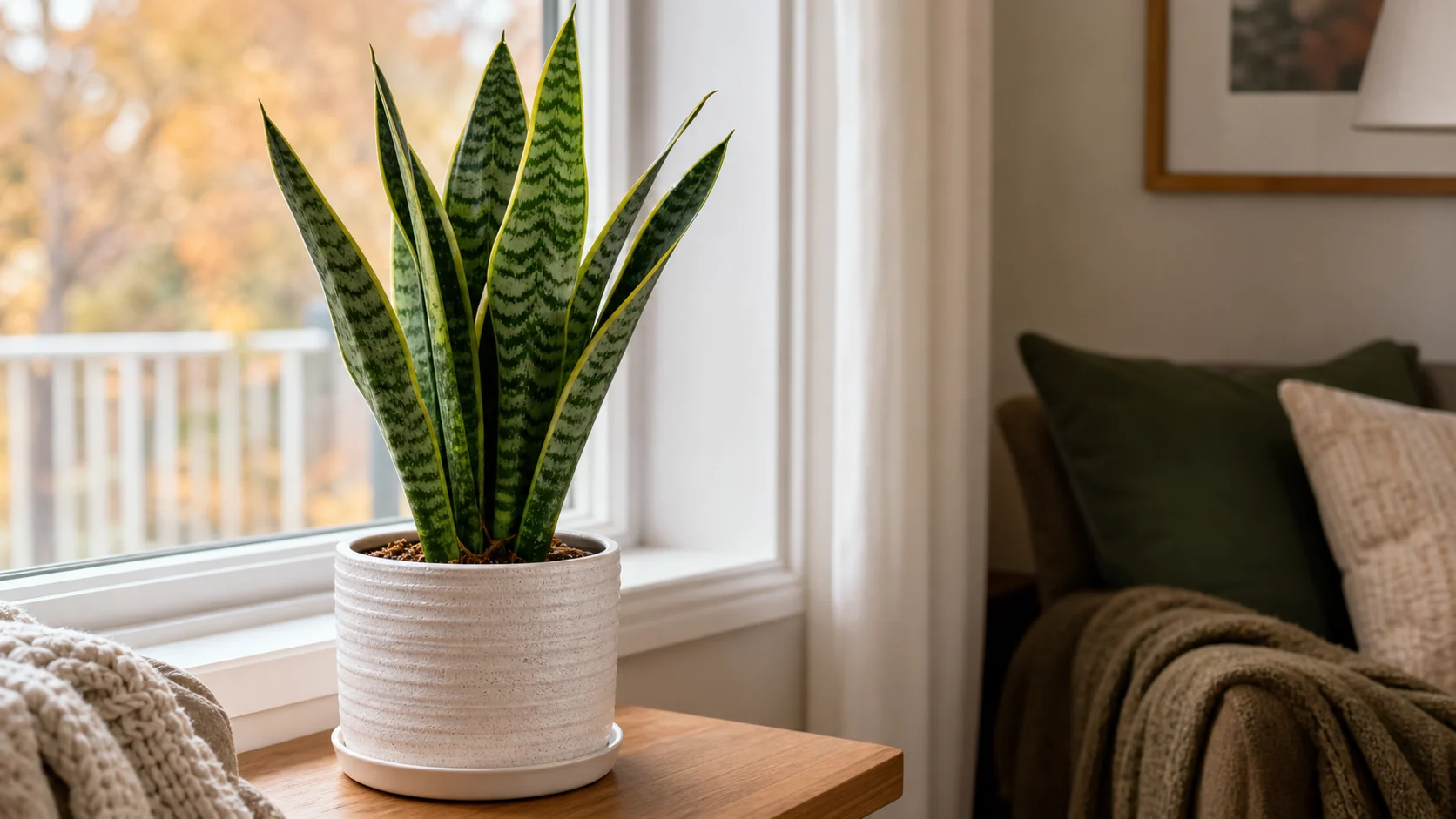
As outdoor color shifts and indoor light softens, let the soil stay dry longer and keep the pot buffered from cooling glass.
Winter (December to February)
She rests. And she genuinely needs that rest. This is when most overwatering damage happens: people continue watering on the same schedule as summer, forgetting that she’s barely drinking.
- Water once a month, sometimes less. In a cool room with low light, six weeks between waterings is fine.
- No feeding at all.
- Keep her away from cold windows and drafts. A frost-touched window can damage her leaves overnight.
- Don’t worry about slow or no growth. She’ll resume in spring.
- This is a good time to wipe her leaves with a damp cloth and let her breathe.
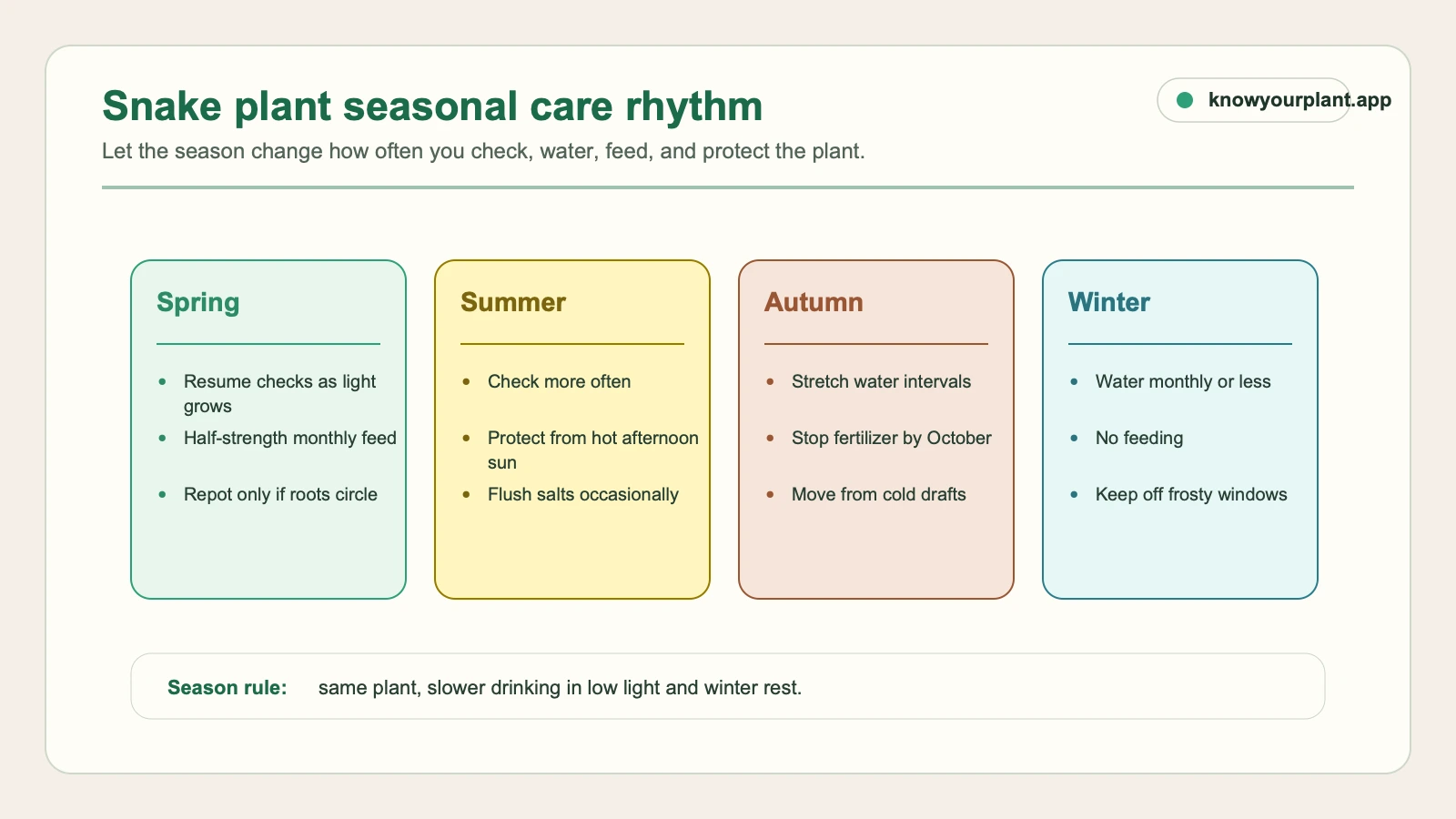
Snake plants stay easy when the care rhythm follows the season: more checking in growth months, deliberate slowdown through autumn and winter.
Temperature and Humidity
Snake plant care is uncomplicated on this front. She’s comfortable anywhere between 15-29°C (60-85°F), which covers most homes year-round.
What she dislikes: cold drafts, temperatures below 10°C (50°F) for extended periods, and sitting near heating vents that blast dry air directly onto her leaves. Keep her away from windows that frost over in winter and she’ll be fine.
Humidity is mostly a non-issue. She’s adapted to dry conditions and doesn’t need misting or pebble trays. Average indoor humidity suits her perfectly well.
Feeding
She doesn’t need much. A balanced liquid fertilizer, diluted to half strength, once a month in spring and summer is plenty. Skip feeding in autumn and winter entirely. She’s in a slow period and won’t use it, and unused fertilizer salts can build up in the soil and damage her roots over time.
If you’re growing her in low light, feed every six to eight weeks even in the growing season. Less light means slower growth, which means less demand for nutrients.
For more detail on how to choose and use fertilizer for indoor plants without causing more harm than good, the plant fertilizer guide covers the key principles.
Why Isn’t My Snake Plant Growing?
Sometimes you’re doing everything right and she still seems stuck. Before assuming something is seriously wrong, work through this in order.
1. Check the season. In autumn and winter, no visible growth is completely normal. She’s resting. If it’s October through February, there’s nothing to fix.
2. Check the light. Growth stalls in low light more than almost anything else. Move her a few feet closer to a window, or directly in front of one with indirect light, and give her three to four weeks to respond.
3. Check how long she’s been in the same soil. Soil that’s two or more years old starts to compact and lose nutrients even if you’re fertilizing regularly. If her soil looks dense and pale, repotting into fresh mix can make a noticeable difference.
4. Check the roots. If she’s severely root-bound, roots tightly circling the bottom with no fresh soil visible, growth can stall. Moving her up one pot size in spring usually resolves this.
5. Check your watering pattern. Occasional deep waterings followed by a proper dry-out period are better than small, frequent sips. She needs a thorough drink to flush the soil, then a real rest to encourage roots to push downward.
If you’ve worked through all five and she’s still not growing in the active season, more light is almost always the answer.
Common Problems and What They Usually Mean
Yellow leaves
Most often overwatering. Check the soil and let it dry out properly before the next watering. If the base of the leaves feels soft or mushy, root rot may have already set in. Take the plant out of its pot, trim off any blackened roots with clean scissors, and repot into fresh dry soil. Let her settle for a week before watering again.
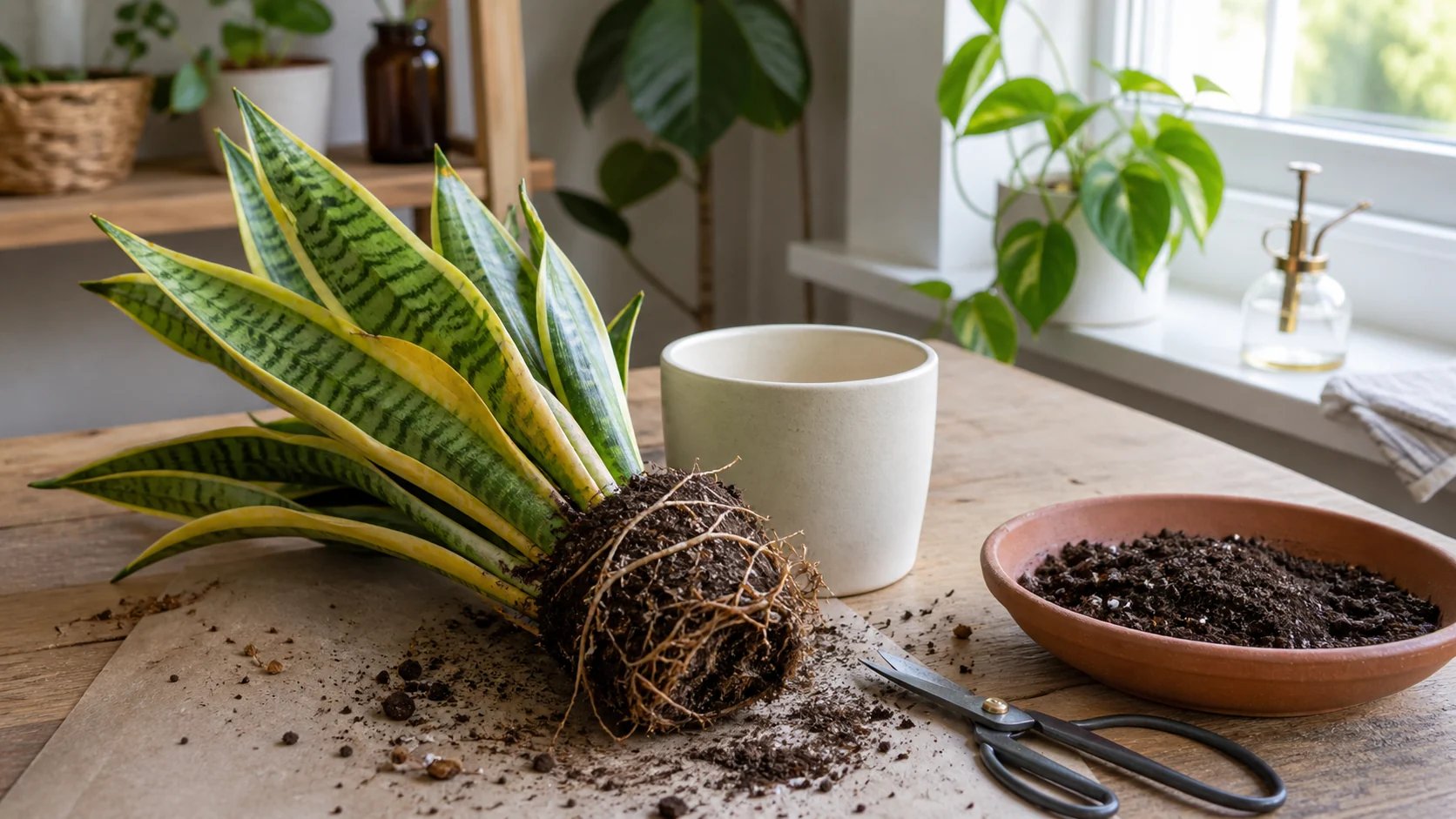
Yellowing leaves are a cue to unpot the plant, inspect the roots, remove damaged tissue, and reset it in fresh dry mix.
Brown tips
Usually one of three things: inconsistent watering, very dry air, or fluoride sensitivity from tap water. Letting the soil dry more thoroughly between waterings helps. If you suspect tap water, leave it out overnight before using, or switch to filtered water. A few brown tips are cosmetic and won’t hurt her.
Curling leaves
Curling leaves are a check-the-soil problem, not an automatic water-now problem. If the soil is bone dry and the leaves feel firm but folded inward, water thoroughly and let the pot drain. If the soil is damp and the leaves are curling, yellowing, or soft near the base, stop watering and let the mix dry; the roots may be stressed from staying wet too long. If curling comes with fine webbing, tiny speckles, or sticky patches, inspect closely for spider mites or mealybugs.
Pale or washed-out leaves
Usually too much direct sun. Move her somewhere with bright indirect light rather than direct exposure, and give her a few weeks to show improvement.
Drooping or leaning leaves
Overwatering is the most common cause. If the soil has been consistently wet and the leaves are starting to lean or look soft, let her dry out completely and reassess your watering schedule. In upright varieties like ‘Laurentii’, persistent drooping can also suggest the roots aren’t healthy enough to support the plant’s weight. If that symptom is the main thing you’re trying to solve, the snake plant drooping guide walks through the fastest diagnosis sequence.
Pests
Snake plants are fairly resistant to pests, but spider mites and mealybugs occasionally appear, especially in dry conditions. If you spot fine webbing or small white cottony clusters near the base of the leaves, the neem oil guide covers how to treat them without harming the plant.
Pet Safety
Snake plant is not pet-safe. ASPCA lists it as toxic to cats and dogs because it contains saponins that can trigger nausea, vomiting, and diarrhea if chewed or eaten.
Use this quick checklist if pets share the room:
- Put the plant where leaves are not easy to mouth from the floor or sofa.
- Do not leave cut leaves or divided pups on the ground after repotting.
- If your cat or dog already chews foliage, choose a different plant for that space instead of testing their self-control.
- Call your vet promptly if chewing is followed by drooling, vomiting, or repeated pawing at the mouth.
Freshness Note
This guide was refreshed in June 2026 around the questions that keep showing up in current search results and snippet-level community discussions, especially low-light confusion and overwatering rescue.
Methodology Note
Care guidance here was checked against NC State Extension for watering and light tolerance, ASPCA for pet safety, and current search plus community snippets to see where beginner advice keeps breaking down in real homes. Community examples were used as qualitative pattern-spotting, not as lab data.
Real User FAQ
How often should I water a snake plant?
There’s no fixed schedule that works for everyone, because it depends on the pot size, the soil, the season, and how much light she gets. The most reliable method: push your finger into the soil a few centimetres. If it’s still damp, wait. If it’s bone dry all the way through, water thoroughly and let the pot drain completely. In summer this might mean every two to three weeks. In winter, once a month or less.
Can a snake plant survive in a room with no windows?
She can tolerate very low light for a while, but without any natural light at all, she’ll eventually decline. A room with no windows isn’t really a long-term option. If you’re in a space with minimal natural light, a simple grow light setup can make a genuine difference and keep her growing through the darker months.
Why are my snake plant’s leaves turning yellow?
Yellow leaves are almost always a watering problem, usually too much. Pull the plant from its pot and check the roots. Healthy roots are white or light tan. Dark, mushy roots mean root rot has set in. Trim the damaged roots, let the remaining plant dry for a day or two, then repot in fresh well-draining soil. Going forward, let the soil dry out completely between waterings.
Why do my snake plant’s leaf tips keep turning brown?
Brown tips on snake plants usually come from one of three things: inconsistent watering (letting it go from very dry to very wet and back), tap water that’s high in fluoride or chlorine, or very dry indoor air. Try watering more consistently, letting tap water sit overnight before using it, and keeping her away from heating vents.
Is a snake plant safe for cats and dogs?
No. Snake plants are toxic to cats and dogs if ingested. They contain saponins, which can cause nausea, vomiting, and diarrhea in pets. If you have animals that like to chew on plants, keep her somewhere out of reach, or consider a different plant for that space.
How do I know when to repot my snake plant?
When roots are visibly circling the bottom of the pot or pushing out of the drainage holes, it’s time. She actually tolerates being a little root-bound, so there’s no need to rush. When you do repot, go up just one pot size and use fresh well-draining soil.
Why isn’t my snake plant growing?
In winter, slow or no growth is completely normal. She’s resting. In the growing season, if she’s truly stalled, work through the five-step check above: season, light, soil age, root condition, and watering pattern. More light, even just moving her closer to a window, is the most reliable way to encourage new growth.
Can I propagate a snake plant?
Yes, and it’s quite straightforward. The simplest method is division: when you repot, separate any offsets (smaller plants growing at the base) and pot them up individually. You can also propagate from leaf cuttings placed in water or directly into soil, though cuttings from variegated varieties like ‘Laurentii’ won’t always pass on the yellow margins. The full step-by-step is in the snake plant propagation guide.
What She Really Needs
At the heart of it, snake plant care comes down to a short list. Well-draining soil, a pot with drainage holes, watering only when the soil is completely dry, indirect light, and comfortable temperatures. Follow the seasonal rhythm and you’ll avoid the two mistakes that get most people: overwatering in winter, and under-lighting year-round.
She won’t ask you for much attention. But when you get the basics right, she rewards you with steady, architectural growth, leaves that deepen in color over time, and the quiet satisfaction of a plant that’s genuinely thriving rather than just surviving.
Pay attention to the soil before you water. Don’t push her into harsh direct sun. Let her rest in winter. Everything else, she handles herself.
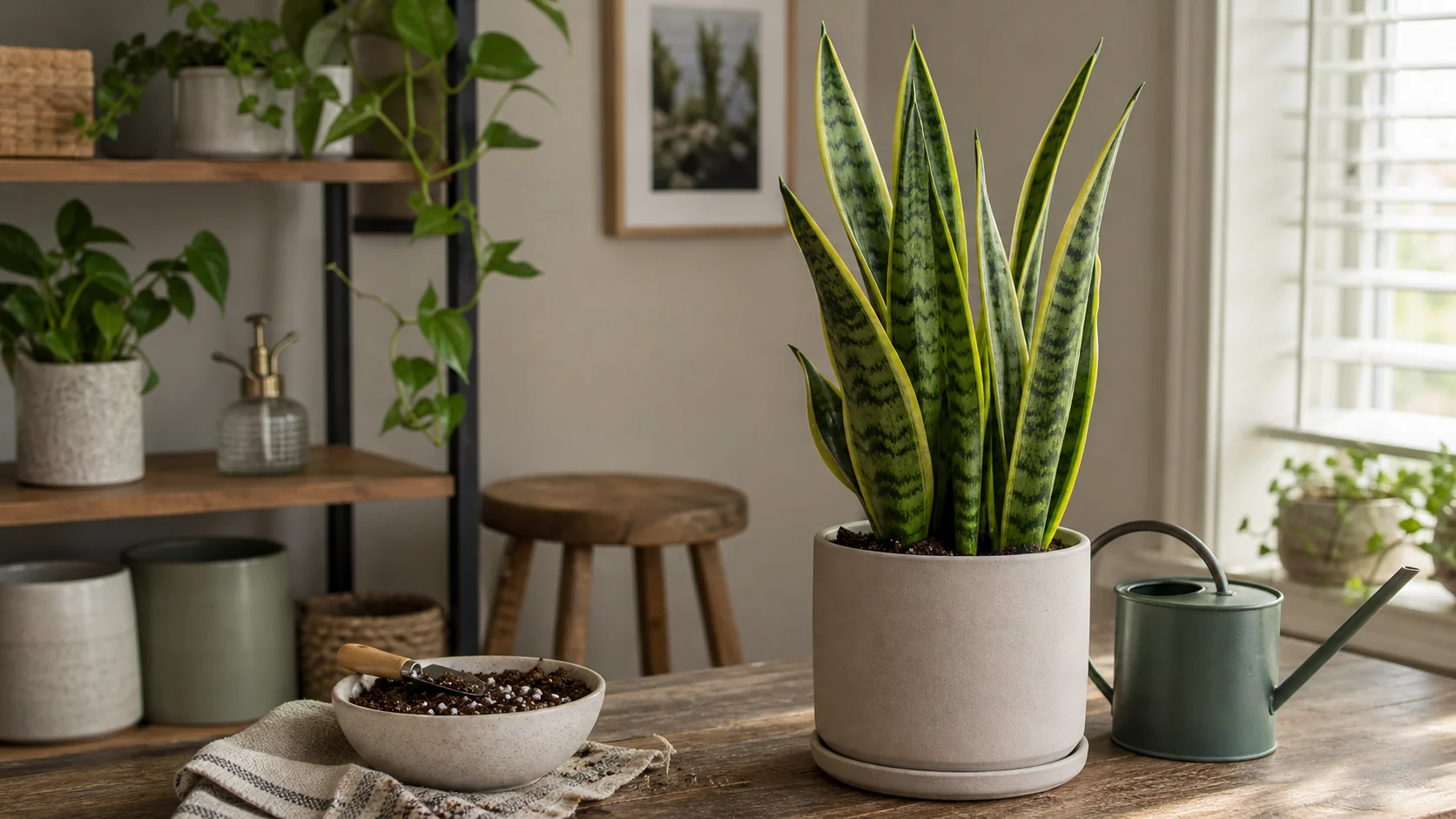
Filtered light, fast-draining mix, a draining pot, and restraint with the watering can cover nearly everything a snake plant needs.
If you want a little help remembering when to check on her, download KnowYourPlant for personalized plant care reminders based on your plant, your conditions, and the season, so you’re not guessing when she’s actually ready.