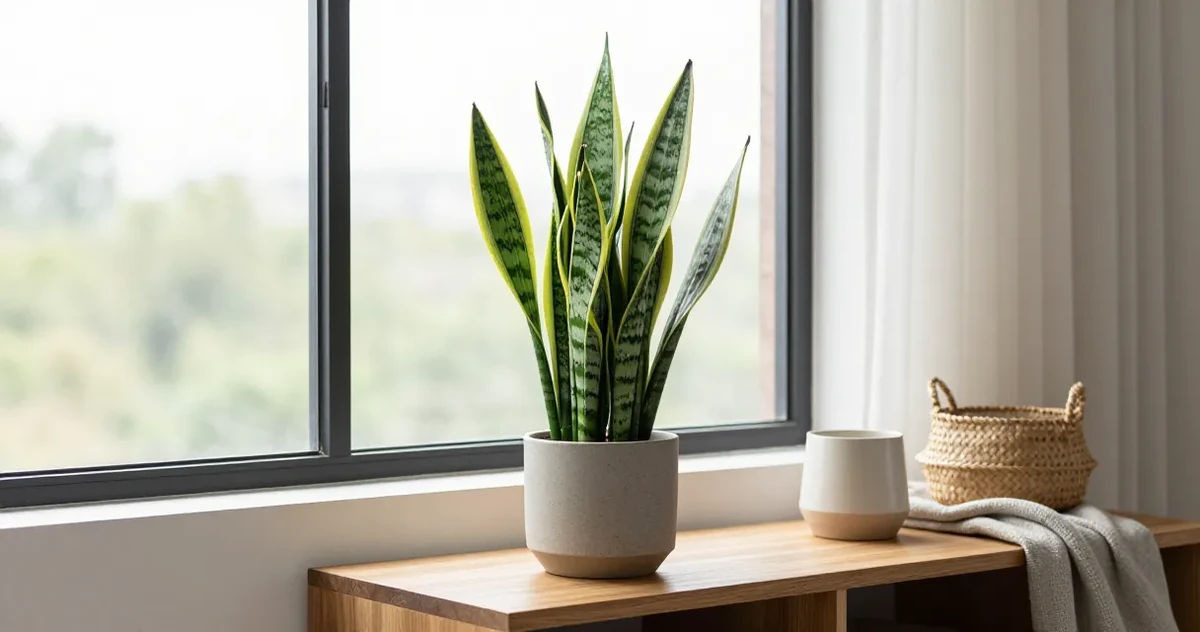
If you want one indoor plant that can handle imperfect light, missed waterings, and a beginner learning curve, a snake plant is one of the safest bets. The real benefit is not that it magically fixes a room. It is that it gives you clear, slow feedback and rarely punishes you for being busy.
For everyday care, think of a snake plant as a low-routine plant: give it a bright or medium-light spot if you can, let the soil dry all the way out, then water deeply and leave it alone again. If you want the full routine, the snake plant care guide walks through watering, light, and drainage in more detail. If the plant already looks wrong, the shorter snake plant care reset starts with the visible signal.
Whether you’re buying your first houseplant or trying to choose something for a hallway, bedroom, office, or rental with awkward light, the snake plant – often sold as Sansevieria and now classified as Dracaena trifasciata – is worth considering.
Here is what it is actually good for, how to care for it without overthinking, and what to do when the leaves start curling, yellowing, or getting brown tips.
What Most Plant Roundups Miss
Most roundups about snake plant Benefits for Every Room list attractive options. The better question is which choice will still make sense in your actual room three months from now.
Use this filter before choosing:
- Light reality: what the plant receives on a normal cloudy day, not the brightest hour of the week.
- Care rhythm: whether you prefer weekly attention or a plant that can be ignored longer.
- Space: mature height, spread, trailing habit, and whether leaves will touch walls or pets.
- Failure signal: what the plant does first when the match is wrong: yellowing, stretching, crisping, or dropping leaves.
A good recommendation is not just beautiful. It fits the room, the owner, and the first problem you are likely to notice.
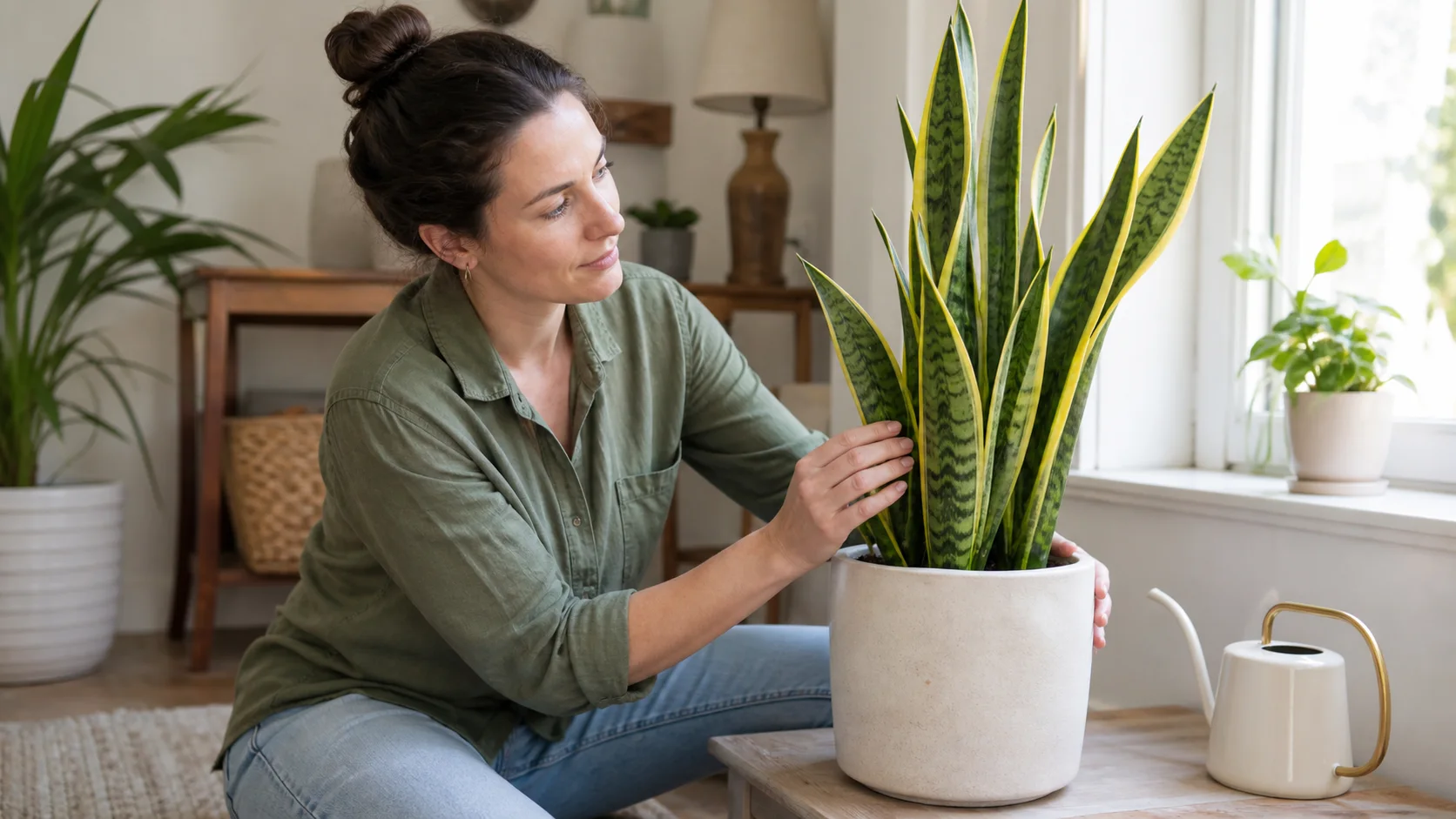
Choose a snake plant for the room’s real light, space, and care rhythm, not for resilience alone.
Quick Fit Check Before You Buy
A snake plant is a good fit if you want a plant that can wait between care sessions. It is not the best fit if you know you will water every few days or if pets chew houseplant leaves.
- Best match: Bright indirect light, medium light, or a low-light room where you accept slower growth.
- Easy routine: Check the soil every 2 weeks, but only water when it is dry to the bottom of the pot.
- Main risk: Overwatering. Wet soil, a pot with no drainage hole, or a saucer that stays full can rot the roots.
- Pet note: Snake plants are mildly toxic to cats and dogs if eaten, so choose a different plant if your pet chews leaves.
If that sounds manageable, the benefits below are useful. If you want a plant you can fuss over daily, choose something that likes more frequent attention.
Identification Snapshot
- Botanical name: Dracaena trifasciata (often still sold as Sansevieria)
- Growth habit: Upright, sword-like leaves with a succulent-style water reserve
- Best fit: Beginners, busy owners, offices, bedrooms, and brighter low-maintenance corners
- Main watch-out: Wet soil and chewing pets cause more trouble than occasional neglect
Lookalikes and Confused With
| Plant | Why people mix them up | Fast difference to notice |
|---|---|---|
| ZZ plant | Both are tough, upright, low-attention houseplants | ZZ has glossy leaflets on arching stems, not sword-like leaves from the base |
| Aloe | Both have thick, drought-tolerant leaves | Aloe leaves form a rosette with softer, fleshy blades instead of flat upright fans |
| Cylindrical snake plant | It is still a snake plant, just a different form | The leaves grow as rounded spears rather than flat blades |
Care Cards
| Need | What works best | What usually causes trouble |
|---|---|---|
| Light | Bright indirect light to medium light | A very dark corner that keeps soil wet for too long |
| Water | Let the mix dry fully, then water deeply | Frequent top-ups on a fixed schedule |
| Soil | Fast-draining cactus or amended potting mix | Dense soil with poor drainage |
| Room fit | Bedrooms, offices, hallways with some usable light | Windowless bathrooms or pet zones with active chewers |
| Owner fit | Busy beginners who prefer low-routine care | People who like to water and fuss every few days |
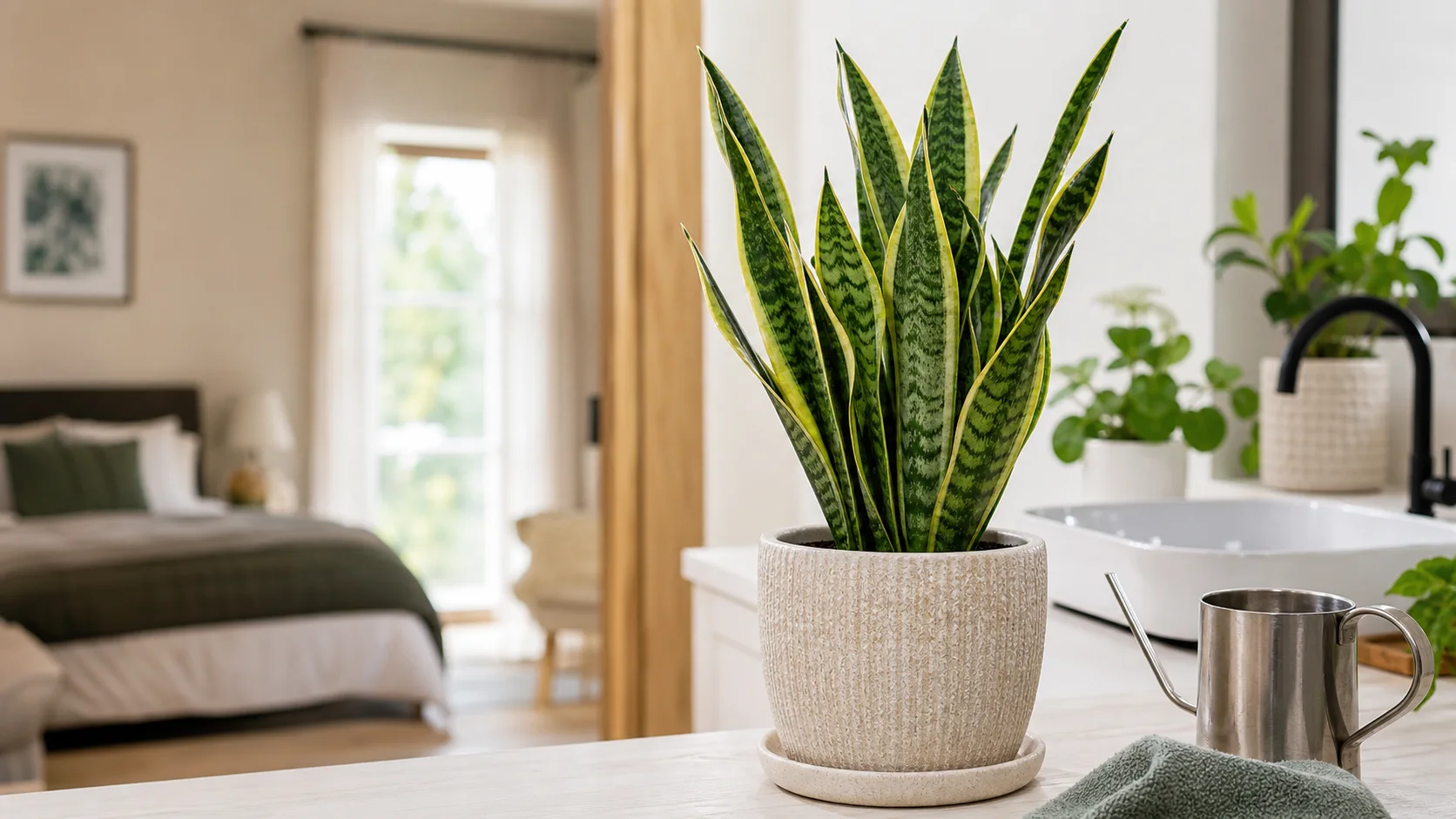
Bright window light, a drainage saucer, and a narrow-spout can support the snake plant’s dry-between-waterings routine.
What Real Owners Actually Care About
Across public discussions about snake plant benefits, the same three themes keep repeating:
- Air-cleaning claims spread faster than the caveats. People still share NASA-style talking points without explaining that sealed-chamber research does not equal whole-room purification.
- Pet safety often shows up after the purchase. Many people buy snake plants for toughness first, then discover the chewing risk later.
- The most reliable benefit is neglect tolerance. Beginners consistently want a plant that survives missed waterings and imperfect light, not a miracle wellness device.
That is why the strongest case for a snake plant is practical, not mystical: it is an easy-care, low-attention plant with a real pet-safety tradeoff.
Benefits Reality Check
| Benefit claim | What is dependable | What to keep in perspective |
|---|---|---|
| Low maintenance | Very dependable if the pot drains and the soil dries fully | Easy plants still fail when they stay wet too long |
| Lower-light tolerance | Strong survival trait | In very dim rooms, growth slows and overwatering risk rises |
| Small-space fit | Excellent because the leaves grow upright | Tall varieties still need stable placement away from foot traffic and pets |
| Night oxygen talk | The CAM trait is real | It does not turn one plant into a bedroom air device |
| Air purification | There is controlled-environment evidence behind the claim | In an ordinary room, ventilation still matters more than one plant |
| Stress or sleep benefits | A calm room and easy routine can feel helpful | Do not treat the plant as a medical or allergy solution |
Climate DNA behind the snake plant
Benefits claims and care evidence should not be mixed. This module contributes only the accepted taxonomy, native range, filtered occurrences, and macroclimate profile for Dracaena trifasciata.
The ranges below are the middle 50% (p25–p75), not recommended indoor setpoints.
| Reference taxon | POWO native range | Annual mean temperature | Annual precipitation | Relative humidity | Solar radiation | Evidence |
|---|---|---|---|---|---|---|
| Dracaena trifasciata (snake plant) | southern Nigeria to west-central tropical Africa and Tanzania | 23.3–25.2°C | 1585–1783 mm/yr | 65–69% | 16.1–18.1 MJ/m²/day | 29 climate points; medium confidence |
What this changes in this guide: The seasonally dry native context is relevant to care tolerance; it does not prove indoor air-cleaning magnitude, sleep effects, or health outcomes.
Sources and method: Dracaena trifasciata in POWO and GBIF; CHELSA V2.1, 1981–2010. GBIF records are limited to POWO-native countries, then filtered for coordinates, establishment signal, licence, precision, and spatial duplication. No community or user-reported care data is used in this module.
1. It Can Support Cleaner Indoor Air
This is the benefit most people have heard of, but it needs a plain-English caveat. Snake plants were included in NASA’s indoor air research and can absorb some volatile organic compounds in controlled conditions. In a normal home, one plant will not replace ventilation, an air purifier, or opening a window.
The practical takeaway: enjoy it as one small part of a healthier room, not as a stand-alone air-cleaning system. If you want realistic comparisons beyond snake plants, see the air-purifying indoor plants guide.
2. It Releases Oxygen at Night
Most plants do their gas exchange during the day – taking in CO2, releasing oxygen when the sun is up, then going quiet at night. Snake plants are different. They use a photosynthesis process called CAM (Crassulacean Acid Metabolism), which means they release oxygen after dark.
This makes them a sensible bedroom plant, especially if you want something upright that will not need constant attention. The effect is modest in a normal room, but the care fit is strong. If you are comparing a few sleep-friendly options, the best plants for bedroom guide can help narrow the list.
Quick Decision Tree for Beginners and Pet Owners
Use this before you buy or before you move a snake plant into a new room:
- Do cats or dogs chew plant leaves in this home? If yes, a pet-safe plant is usually the better default.
- Is the intended spot dim all day, or does it still get some usable light? Snake plant can survive lower light, but the darker the room, the slower it dries and the easier it is to overwater.
- Do you want a plant you can mostly leave alone? If yes, snake plant is a strong fit. If you prefer frequent watering or daily interaction, it may feel boring or easy to over-care for.
- Are you buying it mainly for air-quality or sleep claims? If yes, reset the expectation and treat those as secondary, modest benefits.
Short answer: snake plant is a great beginner plant when resilience matters more than pet safety, and when the room has at least some real light.
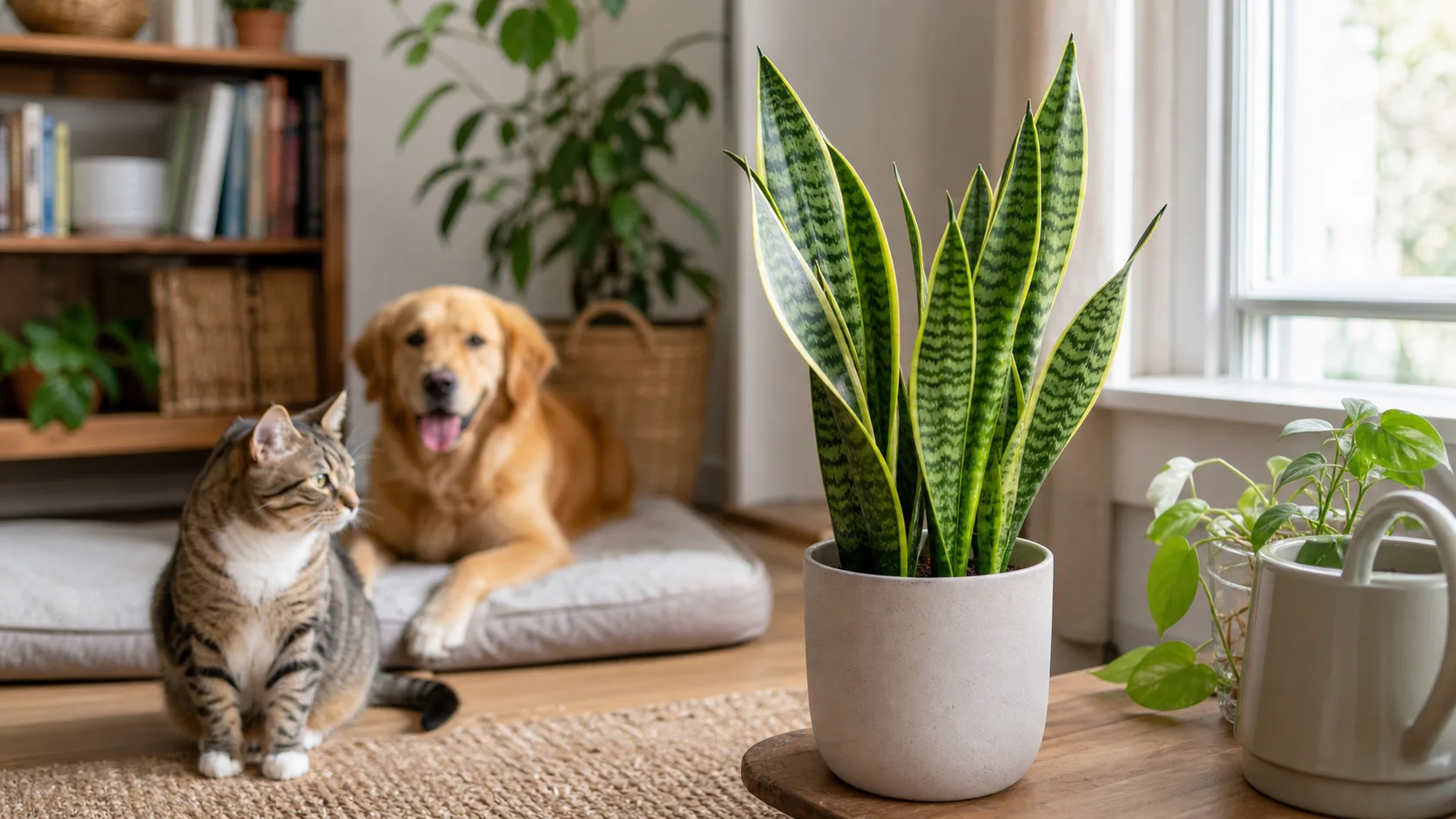
A snake plant fits low-routine homes, but cats and dogs make pet safety a first-step decision rather than an afterthought.
3. It Survives Low Light Better Than Almost Anything
Most houseplants have a narrow light preference. Snake plants have a wider light tolerance. They grow best in bright indirect light, manage in medium light, and can survive in low light if you are patient.
This makes them useful for hallways, bathrooms with windows, offices, bedrooms, and other spaces where fussier plants stretch, fade, or drop leaves. In low light, expect slower growth and longer drying time between waterings.
If you are deciding where a snake plant would actually fit before you buy one, KnowYourPlant can help you save the plant and keep the care notes matched to your room and routine.
4. They Barely Need Watering
If there’s one thing snake plants are known for among plant people, it’s this: they can go weeks without water and be completely fine. Their thick, fleshy leaves store moisture. Overwatering is the main way people accidentally kill them – root rot from soggy soil is their real enemy, not drought.
In practice, this means:
- Bright, warm room: check every 2 weeks and water about every 2 to 4 weeks if the soil is dry.
- Low light or cool season: check every 3 to 4 weeks and water about every 4 to 8 weeks if the soil is dry.
- Before watering: push a finger or wooden chopstick deep into the mix. If it comes out damp, wait.
- After watering: soak the soil until water drains out, then empty the saucer.
Signs you are overdoing it include yellow leaves, soft or mushy leaf bases, soil that stays wet for more than a week, and a sour smell from the pot.
5. They’re One of the Hardest Houseplants to Kill
Snake plant benefits include something you might not expect: resilience that borders on stubbornness. They tolerate neglect, irregular watering, low humidity, temperature swings, and dust on their leaves. They’re not dramatic about anything.
For beginners, this matters. There’s real joy in learning to care for a plant that gives you feedback slowly and forgives your mistakes generously. The snake plant is a good first teacher.
6. They May Help Reduce Stress
Indoor plants can make a room feel calmer and more cared for, and snake plants are especially easy to keep in that role because they do not demand daily attention. You can wipe dusty leaves, rotate the pot, and check the soil without turning plant care into a second job.
It is not a medical treatment or a magic mood fix. It is a simple way to make a bedroom, desk, or living room feel more alive with very little maintenance.
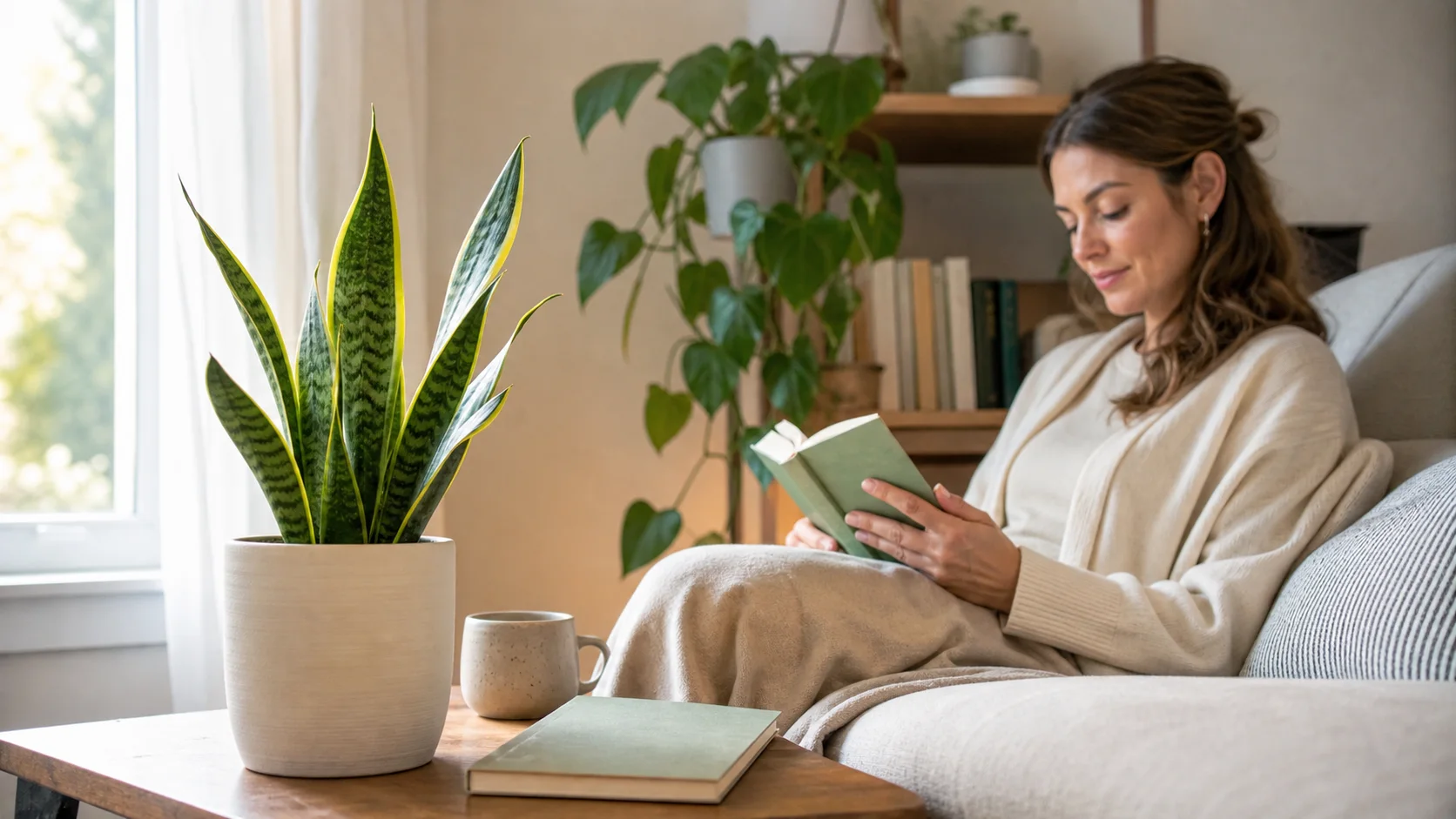
A low-maintenance snake plant adds calm, living texture to a room without turning relaxation into another care task.
Common Problems: Curling, Yellowing, and Brown Tips
Snake plants usually decline slowly, which gives you time to correct the problem. Start with the soil before you add fertilizer or move the plant.
| Symptom | Most likely cause | What to do today |
|---|---|---|
| Leaves curling inward | Too dry for too long, heat stress, or very strong sun | Check soil. If bone dry, water deeply. If the plant sits in harsh afternoon sun, move it back from the window. |
| Leaves turning yellow | Overwatering, poor drainage, or root stress | Stop watering. Check that the pot drains. If the soil smells sour or the base feels mushy, inspect roots and repot into dry, airy mix. |
| Brown tips | Inconsistent watering, mineral buildup, cold drafts, or sun scorch | Trim only the dry tip if it bothers you. Use room-temperature water, keep the plant away from vents, and flush the soil next watering. |
| Leaves leaning or flopping | Not enough light, damaged roots, or a crowded pot | Move closer to a window with indirect light. Check roots if the soil has been wet. Stake only after fixing the cause. |
If your plant is already showing stress, the focused guides on snake plant yellow leaves and snake plant drooping walk through the most likely causes in more detail. | Wrinkled leaves | Long drought | Water thoroughly once, let it drain, then wait for the leaves to firm up over the next several days. |
Common Mistakes That Cancel Out the Benefits
A snake plant feels easy right up until a small routine mistake keeps repeating. These are the ones that matter most:
- Watering on a schedule instead of waiting for the mix to dry all the way down
- Using a pot with no drainage hole or a dense mix that stays wet too long
- Treating low-light tolerance as no-light tolerance
- Leaving the plant within chewing range of curious pets
- Repeating NASA-style air-cleaning or allergy claims without the real-world caveat
If you avoid those five mistakes, most of the practical benefits stay intact.
7. They Add Strong Architectural Character
Snake plant benefits go beyond care. Its upright leaves create strong vertical lines, so it looks tidy even when you are not actively shaping or pruning it. That makes it helpful in small rooms, busy shelves, narrow corners, and entryways where trailing plants would get in the way.
You can grow one larger plant as a floor accent or keep a compact variety on a desk or nightstand. If you want to multiply a healthy plant later, the snake plant propagation guide explains when division works better than leaf cuttings. Just make sure the pot has drainage and enough weight that the tall leaves do not tip it over.
8. It Fits Feng Shui Principles
In feng shui, the snake plant is often associated with protective energy because of its upright, pointed leaves. Some people place it near an entrance, desk, or window for that reason.
Whether or not you follow feng shui, the practical care advice stays the same: choose a stable pot, avoid soggy soil, and give it the best indirect light available.
9. It Adapts to Any Room in the House
This is where “one in every room” can make practical sense, as long as each room has enough light for the plant to maintain itself. Snake plants are widely available, come in tall and compact varieties, and do not need daily care.
- Bedroom: choose a spot with indirect light and water lightly because bedrooms are often cooler.
- Bathroom: only use one if there is a window or grow light. A dark bathroom is still too dark.
- Office: keep it near a window or under steady artificial light, then rotate it every few weeks.
- Living room: place it where the tall leaves will not be bumped by people, pets, or curtains.
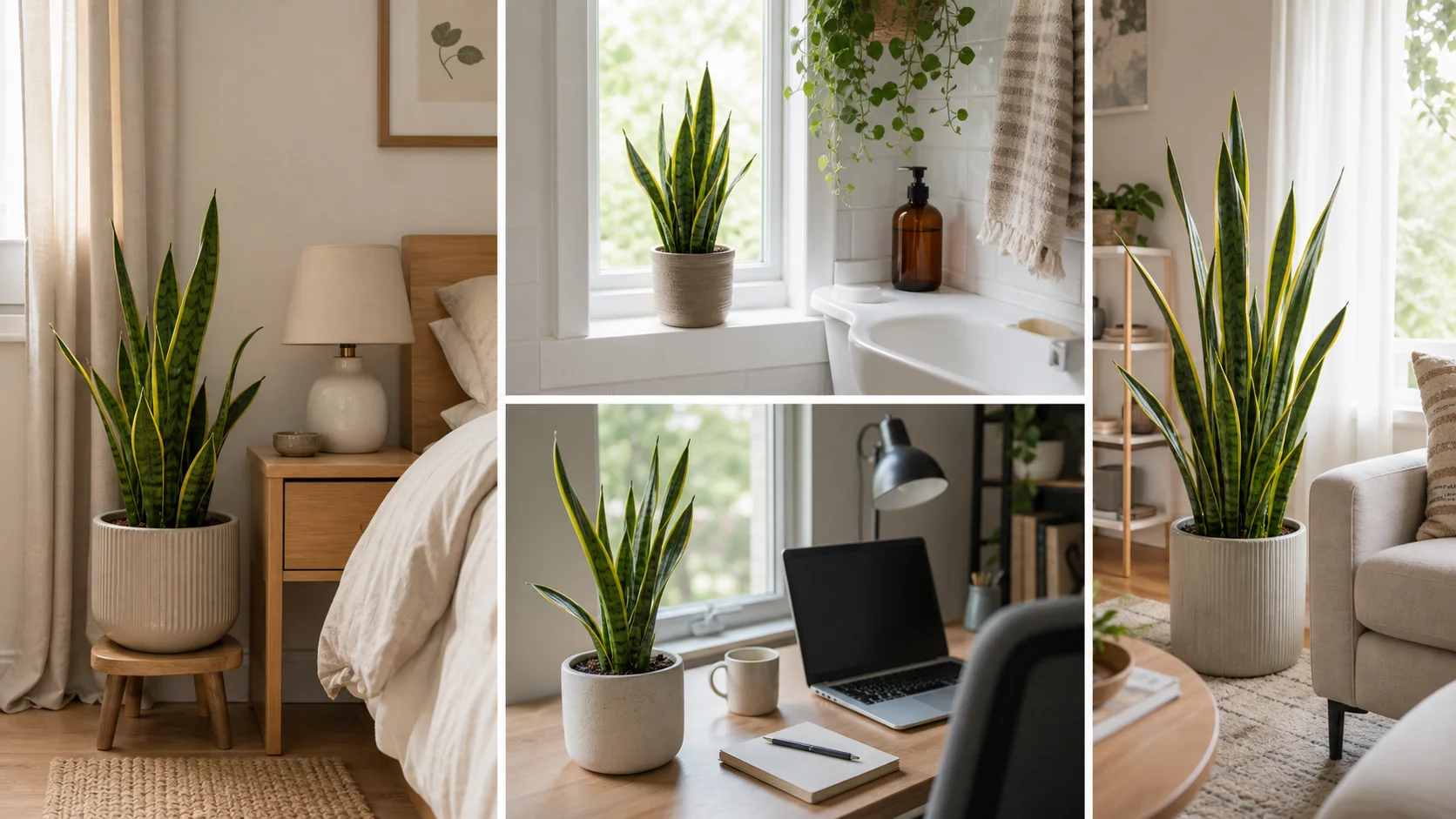
Bedroom, windowed bathroom, office, and living-room placements show why light and foot traffic matter more than room labels.
10. They Give a Lot and Ask for Very Little
What makes 10 benefits of snake plant ownership genuinely useful – rather than just impressive on paper – is the ratio of what they offer to what they ask for. Most air-purifying plants need bright light, regular watering, careful humidity management, and consistent feeding. Snake plants ask for almost none of that.
You get a tough, upright, attractive plant that can handle a real person’s schedule. In exchange, you need a draining pot, dry soil between waterings, and enough light to keep the leaves firm and upright.
That’s a good deal.
Simple Snake Plant Care Plan
Use this routine if you are new to plants and just want to keep the plant healthy.
- Today: Check the pot has a drainage hole. Feel the soil. If it is dry all the way down, water until it drains. If it is damp, do nothing.
- This week: Watch the leaves. Firm, upright leaves mean the plant is coping. Yellow, mushy, or sour-smelling soil means too much water.
- This season: Water less in cool or low-light months. Repot only when roots crowd the pot or water runs straight through without soaking the mix.
A Few Quick Care Notes
Snake plants are forgiving, but a few things help them thrive rather than just survive.
Light: Bright indirect light is ideal, but they manage in medium and low light. Keep them away from harsh direct afternoon sun for long stretches because it can bleach or scorch the leaves.
Water: Less is more. Let the soil dry completely between waterings. In winter or low light, once a month may still be too often, so check the soil instead of following a fixed calendar.
Soil: Well-draining mix is important. A cactus or succulent blend works well, or add perlite to standard potting mix.
Toxicity: Worth knowing – snake plants are mildly toxic to cats and dogs if ingested. Keep them out of reach of curious pets.
For a related care deep dive, see the low-light indoor plants guide, the cat-safe indoor plants guide, the grow lights guide for indoor plants.
Expert Note: What the Evidence Actually Supports
Extension guidance from North Carolina State emphasizes that snake plant tolerates lower light and dry periods well, but is most often lost to overwatering and root rot, not neglect. ASPCA lists snake plant as toxic to cats and dogs if eaten. NASA-linked plant-air research helps explain why the air-purifying claim became famous, but those tests happened in controlled sealed environments, not ordinary living rooms. Separate fact checks have also debunked viral claims that a small number of snake plants can produce life-saving oxygen for a home.
That mix of evidence leads to a calmer conclusion: snake plant is genuinely useful because it is resilient, space-efficient, and forgiving. Its wellness reputation needs more qualification than most viral roundups give it.
Freshness note: updated in June 2026 to separate dependable beginner benefits from overclaimed NASA-style wellness myths and to foreground the pet-safety tradeoff.
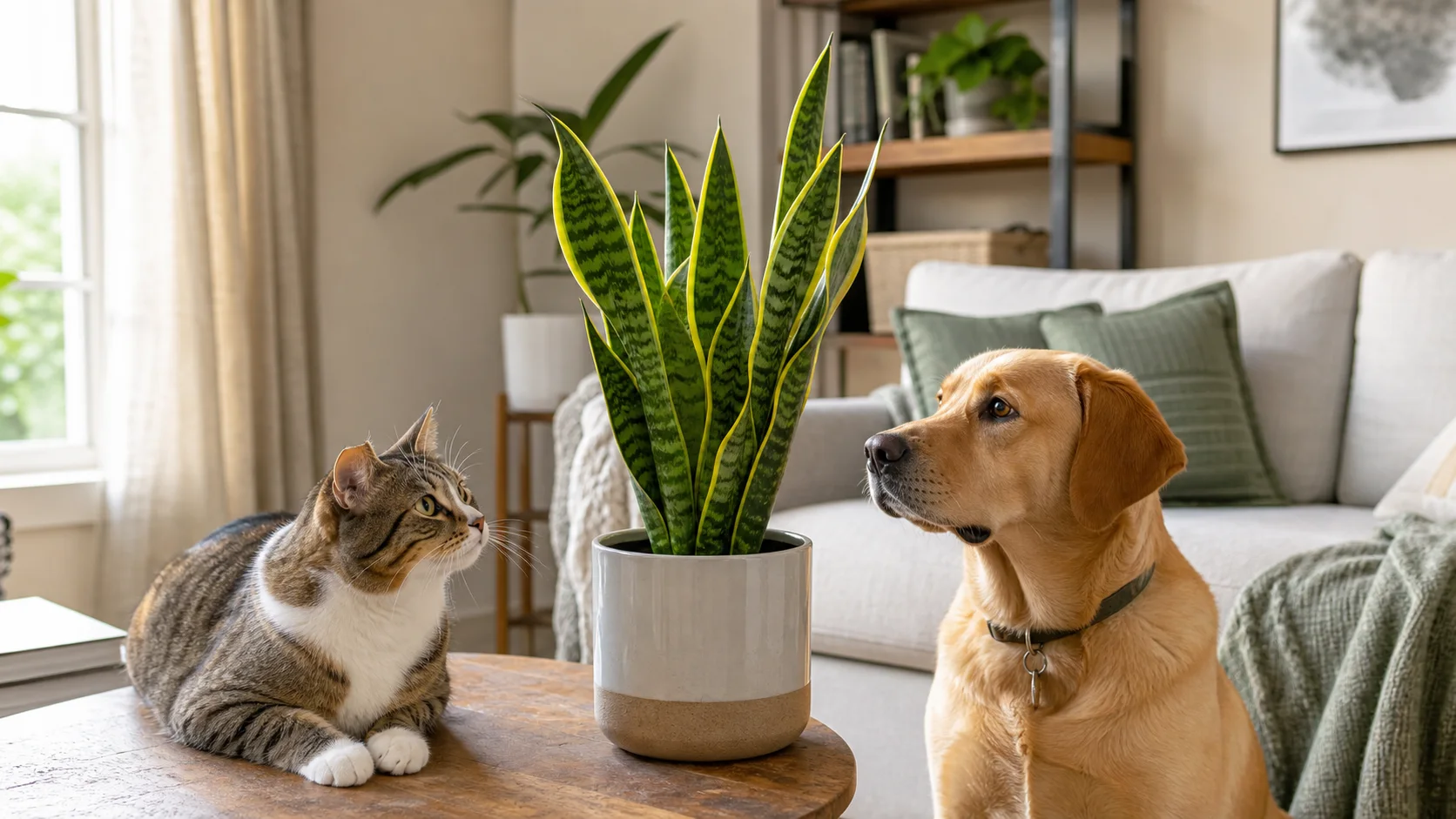
Evidence supports snake plant resilience, but cats and dogs make its toxicity warning more practical than viral wellness claims.
Methodology Note
This article was refreshed in June 2026 using extension guidance for care and overwatering risk, ASPCA toxicity guidance for pet safety, NASA-linked plant-air research for the original air-quality claim, an AP fact check on exaggerated oxygen myths, and public discussion patterns that showed where beginners still get misled. Social discussion is used here as qualitative signal about reader confusion, not as scientific proof.
Real User FAQ
What are the main benefits of a snake plant?
The main snake plant benefits are low-maintenance care, tolerance of lower light, upright architectural foliage, night gas exchange through CAM photosynthesis, and the ability to handle missed waterings better than many common houseplants.
Is a snake plant good for the bedroom?
Yes. Snake plants are good bedroom plants because they tolerate lower light, stay upright and compact, and release oxygen at night. They still need occasional light and dry soil between waterings to stay healthy.
Do snake plants really purify air?
Snake plants were included in NASA’s indoor air research and can absorb some volatile organic compounds in controlled conditions. In a normal home, think of them as one small part of better indoor air, not a replacement for ventilation.
How often should I water a snake plant?
Water only when the soil is dry all the way down. Many snake plants need water every 2 to 4 weeks in bright, warm rooms and every 4 to 8 weeks in cooler or lower-light rooms.
What are signs I am overwatering my snake plant?
Common overwatering signs include yellow leaves, soft or mushy leaf bases, soil that stays wet for days, a sour smell from the pot, and sudden drooping after frequent watering.
Are snake plants safe for cats and dogs?
No. Snake plants are mildly toxic to cats and dogs if eaten and can cause nausea, drooling, or stomach upset. Keep them out of reach if your pets chew leaves.