If your prayer plant leaves are curling, yellowing, or turning crispy at the tips, you probably do not need a botany lesson. You need to know what to check first, how often to water, and whether this plant fits the light and routine you actually have at home.
Here is the short version: keep a prayer plant in bright indirect light, water when the top 2-3 cm of soil feels dry, and do not let the pot sit in runoff water. Most homes need water every 5-7 days in warmer months and every 10-14 days in winter, but the soil check matters more than the calendar. Curling usually means the plant is too dry, too hot, or sitting in dry air. Yellow lower leaves usually mean too much water. Brown crispy tips usually mean low humidity or sensitive tap water.
The prayer plant family includes two main groups you’ll find at most garden centers: Maranta and Calathea (with Calathea now officially reclassified as Goeppertia, though almost no one calls them that in practice). Maranta is usually the easier choice for newer plant owners. Calathea can be beautiful, but it asks for more consistent humidity, light, and water quality, which is why our Calathea care guide is useful if you are trying to tell which routine fits the plant you brought home.
Climate DNA for Maranta leuconeura
This profile is specific to Maranta leuconeura, the accepted prayer-plant species, rather than every plant sold under the wider prayer-plant label.
The ranges below are the middle 50% (p25–p75), not recommended indoor setpoints.
| Reference taxon | POWO native range | Annual mean temperature | Annual precipitation | Relative humidity | Solar radiation | Evidence |
|---|---|---|---|---|---|---|
| Maranta leuconeura (prayer plant) | central and eastern Brazil | 20.9–23.1°C | 1332–1606 mm/yr | 60–65% | 16.9–18.1 MJ/m²/day | 30 climate points / 154 usable records; medium confidence |
What this changes in this guide: The wet-tropical field context helps frame sensitivity to dry air, but leaf curl can still come from root stress, light, salts, heat, or pests; the climate row is not a diagnosis.
Sources and method: Maranta leuconeura in POWO and GBIF; CHELSA V2.1, 1981–2010. GBIF records are limited to POWO-native countries, then filtered for coordinates, establishment signal, licence, precision, and spatial duplication. No community or user-reported care data is used in this module.
What Most Care Guides Miss
Most guides about prayer plant describe the ideal care routine. Real homes are messier: light changes by season, pots dry at different speeds, and the same symptom can mean different things depending on where it appears.
Before changing care, check the plant in this order:
- Light: is the plant growing toward the window, fading, or scorching?
- Root zone: is the pot drying predictably, or staying wet in the middle?
- Leaf pattern: did the oldest leaves, newest leaves, tips, or stems change first?
- Recent change: new pot, new location, fertilizer, cold draft, heat vent, or pest exposure.
This keeps you from fixing the wrong problem. One clear adjustment is usually safer than a full care reset.
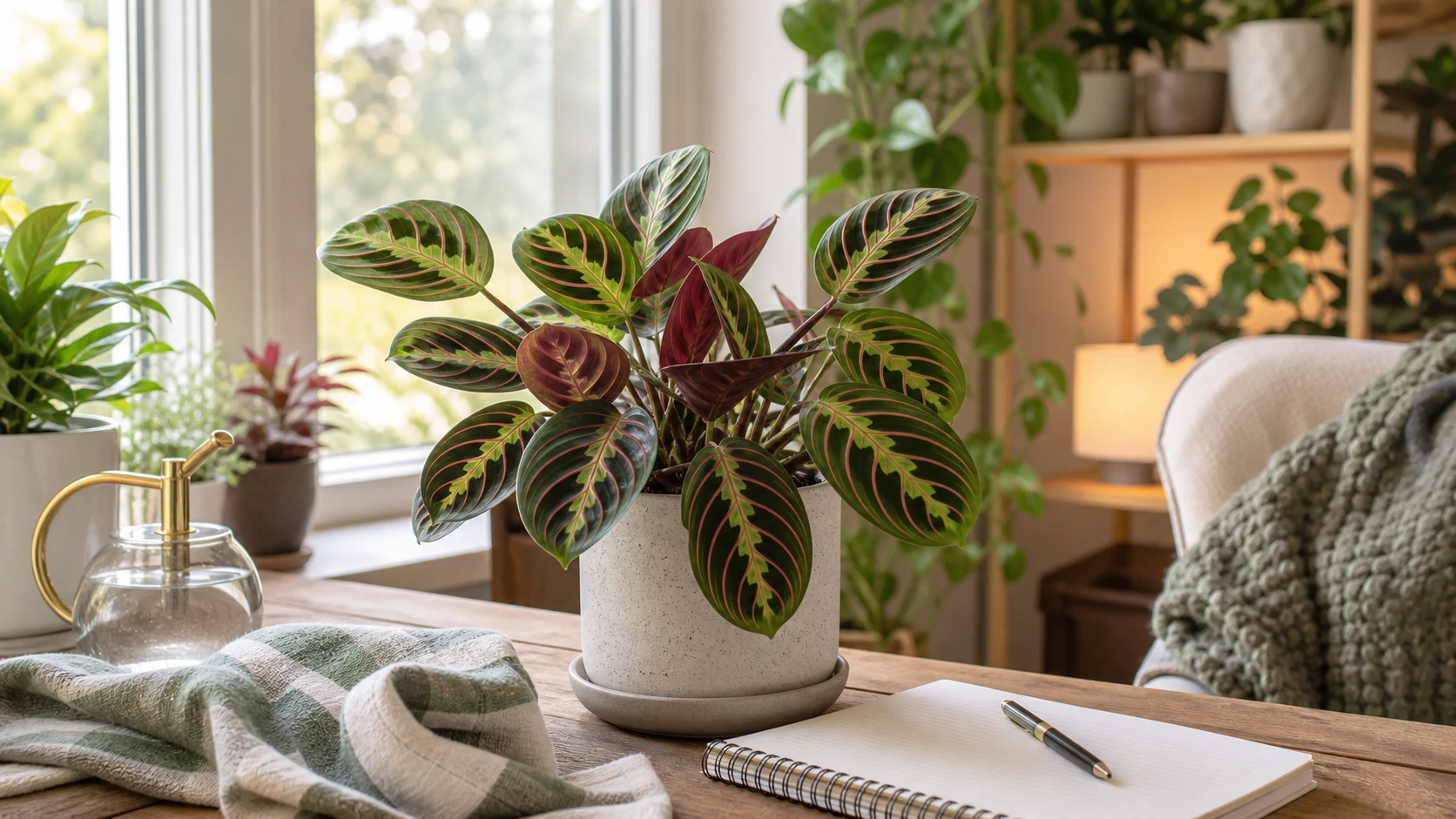
Check the whole care setting—light, root-zone moisture, leaf pattern, and recent changes—before resetting a prayer plant’s routine.
Identification Snapshot
- Botanical group: most houseplants sold as prayer plants are Maranta or Calathea / Goeppertia in the Marantaceae family
- Best beginner pick: Maranta leuconeura is usually more forgiving than most Calathea types
- What the movement means: healthy plants usually open by day and fold upward at night, so changes in that rhythm can warn you early that care is off
- Biggest indoor stress points: dry air, soggy roots, harsh direct sun, and mineral-heavy tap water on sensitive varieties
- Pet safety: prayer plants are generally considered non-toxic to cats and dogs, which makes them one of the safer tropical foliage choices for pet homes
Lookalikes and Confused With
| Plant or label | What you are likely looking at | Why it matters for care |
|---|---|---|
| Maranta leuconeura | Lower-growing plant with oval leaves, strong red or dark veining, and a more forgiving temperament | Usually the easiest true prayer plant for a normal home routine |
| Calathea / Goeppertia | Broader leaves, more dramatic striping or silver patterning, often sold under the same prayer-plant umbrella | Usually needs steadier humidity and is more likely to show water-quality stress |
| Generic ‘prayer plant’ nursery label | Mixed Marantaceae sold without a clear species name | Owners often apply the fussiest Calathea advice to every plant, or underestimate how much easier Maranta can be |
The practical difference is simple: if you want the prayer movement without as much household drama, start with Maranta. If you bought a Calathea for the leaf pattern, expect tighter humidity and water-quality management.
Care Cards
| Care area | What works best | What usually goes wrong |
|---|---|---|
| Light | Bright indirect light, with no harsh afternoon sun | Direct sun bleaches and curls the leaves; deep shade dulls the pattern and weakens movement |
| Water | Water when the top 2-3 cm feels dry, then drain fully | Fixed-schedule watering keeps roots wet too long |
| Humidity | Aim for 50% or higher when possible, especially for Calathea | Dry rooms create crispy edges and stalled new growth |
| Water quality | Filtered, rain, or gentler tap water is worth testing if tips keep browning | Owners keep changing humidity while the real issue is mineral-heavy or fluoride-sensitive water |
| Soil | Light indoor mix that holds moisture but still drains well | Dense soil stays wet and raises root-rot risk |
| Seasonal rhythm | More frequent checks in spring and summer, fewer in winter | Feeding or watering like it is July during winter rest slows recovery |
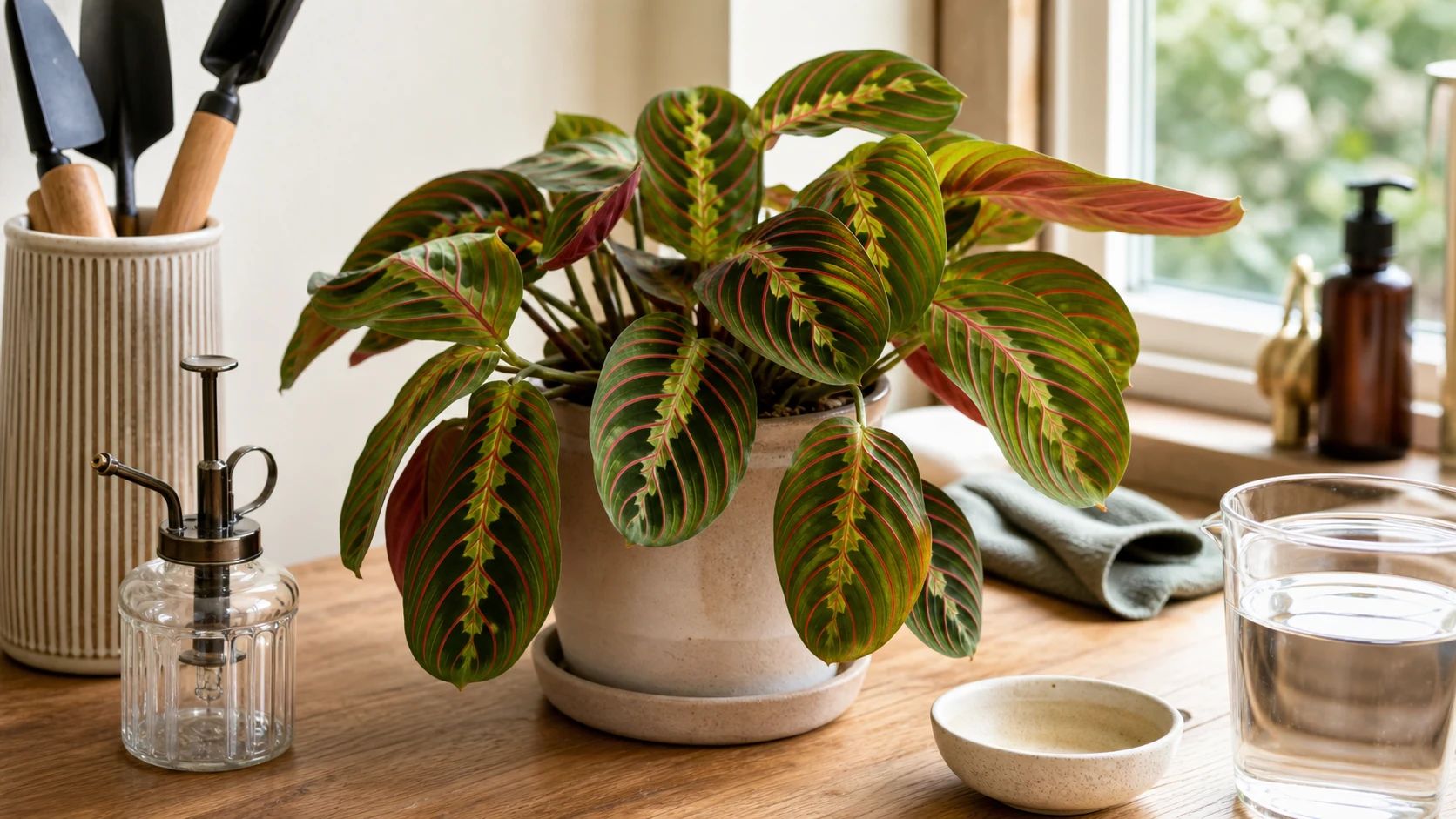
Bright filtered light, controlled watering, suitable tools, and a draining pot work together as one practical prayer-plant care system.
Quick Care Snapshot
Best fit: A room with bright indirect light, a person who can check soil once or twice a week, and a spot away from heating or cooling vents.
Think twice if: Your only spot is a dark corner, you travel often, or your indoor air stays very dry. In that case, start with Maranta rather than a fussier Calathea, or choose an easier plant like pothos.
Watering rule: Check the top 2-3 cm of soil. If it feels dry, water thoroughly and empty the saucer. If it still feels damp, wait.
Early warning signs: Curling leaves, fading patterns, yellow lower leaves, crispy brown tips, or a plant that stops folding at night.
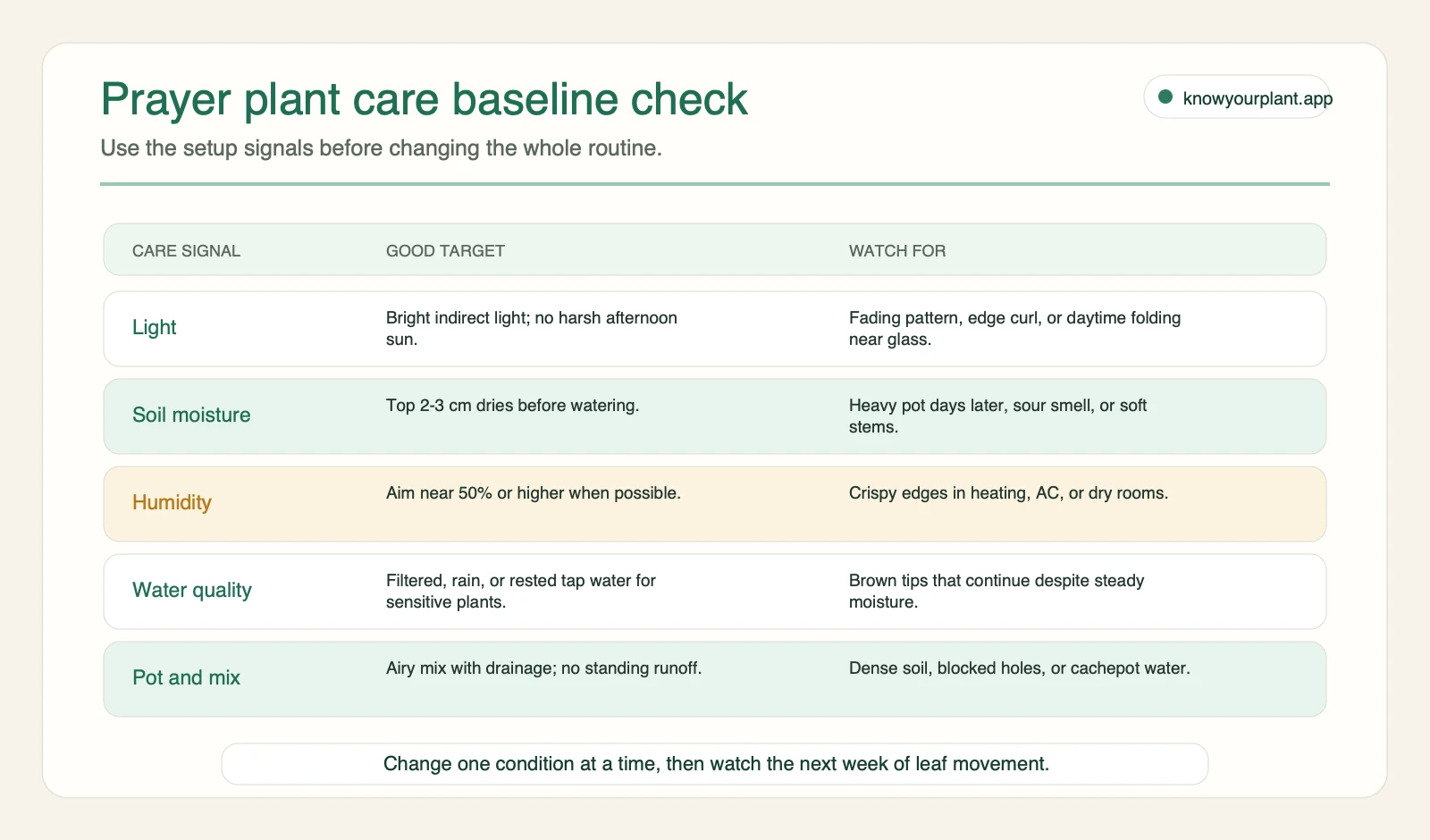
Use the baseline check before changing the whole routine. Prayer plants respond best when light, root-zone moisture, humidity, water quality, and drainage are adjusted one at a time.
What Makes Prayer Plants Different
Most houseplants are fairly passive. A prayer plant is not. The folding movement, called nyctinasty, happens in response to light changes throughout the day. Watch one near a window and you’ll catch it shifting, tilting, adjusting. It’s one of those plants that makes a room feel more alive.
That movement is useful because it gives you an early stress signal. A healthy prayer plant usually folds upward as the room gets dark and opens again as light returns. If the movement becomes weak, random, or stops completely, check light, watering, and roots before the leaves get worse.
The patterned leaves are the other thing. Maranta leuconeura has deep green leaves with red veins and lighter markings along the midrib. Calathea ornata has fine pink stripes on dark green. Calathea orbifolia has broad silvery-green bands. Calathea medallion has burgundy undersides that flash when a breeze moves through. Each variety is different, but they all share that intricate quality, like someone painted them by hand.
Light: Bright, But Gentle
Prayer plants come from the forest floor of tropical rainforests, which means they evolved under a canopy. They’re used to light that’s been filtered through layers of leaves before it reaches them.
Near a north or east-facing window is usually ideal. A west or south-facing window can work if there’s something to soften the light: a sheer curtain, some distance from the glass, or other plants nearby. What they don’t like is direct afternoon sun hitting their leaves. It bleaches the patterns, curls the edges, and stresses the plant in a way that takes weeks to recover from.
If your space is genuinely dim, a grow light placed a foot or two above the plant gives them what they need without the harshness of direct sun. For guidance on choosing the right setup, our grow light guide for indoor plants covers exactly this kind of scenario. Prayer plants will tell you when the light isn’t right: the leaves lose saturation and the patterns start to fade toward a dull, flat green.
Watering: Consistent, Never Soggy
Prayer plants like to stay evenly moist. Not wet, not bone dry, somewhere in between, and fairly consistently so.
Check the top 2-3 cm of soil. When that layer feels dry, it’s time to water. In practice this usually means every 5-7 days in the warmer months and slightly less often in winter when growth slows down.
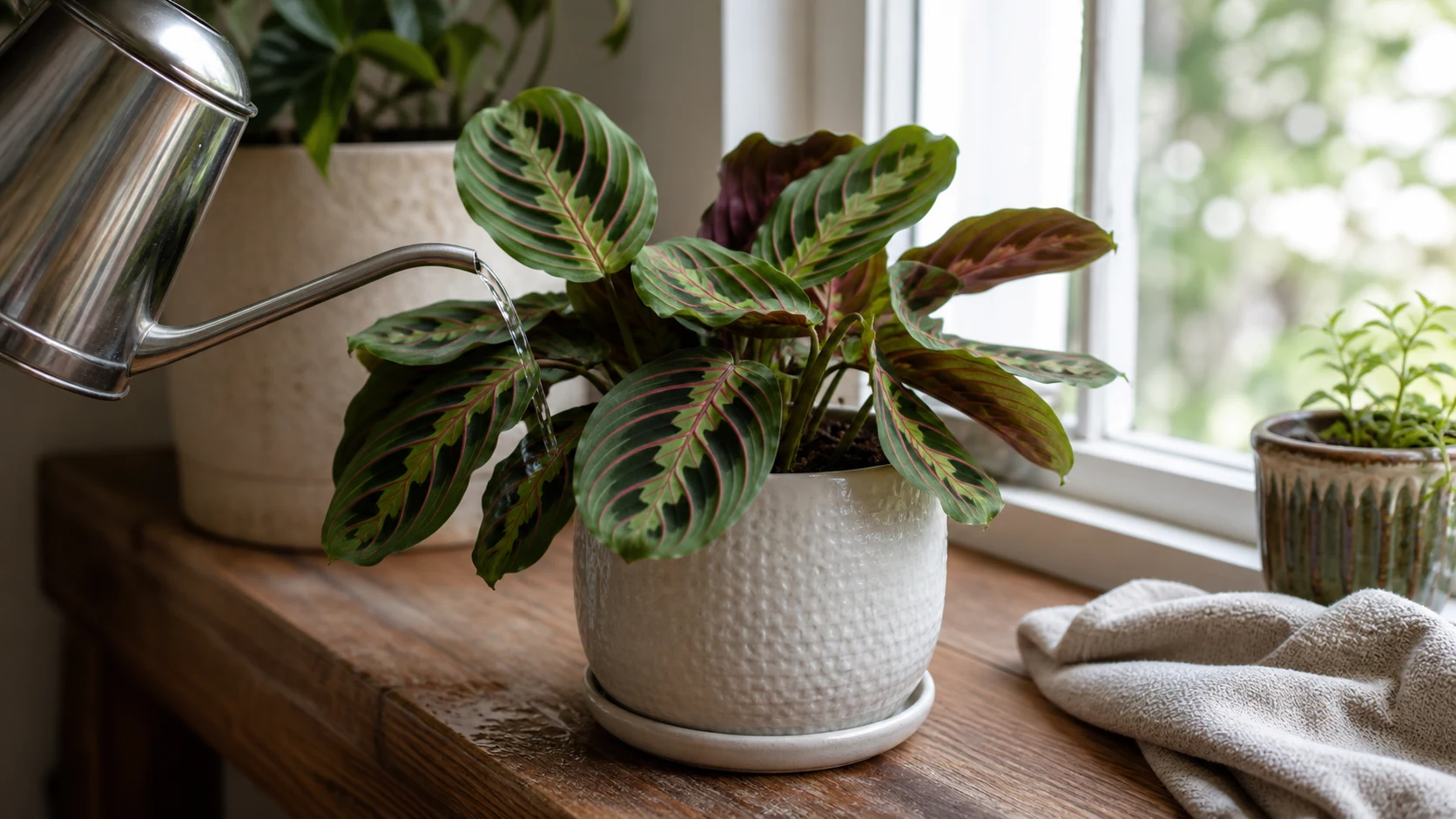
Water the root zone thoroughly when the surface dries, then let the saucer and drainage path keep the roots from staying soggy.
Signs you are overwatering are concrete: lower leaves turn yellow first, the pot still feels heavy several days after watering, the soil smells sour, or stems near the soil line feel soft. If you see those signs, pause watering, make sure the drainage holes are open, empty any saucer or cachepot, and let the top layer dry before watering again. If the plant keeps yellowing in wet soil, slide it out of the pot and check for dark, mushy roots.
Signs you are underwatering look different: the plant wilts, leaves curl inward, the pot feels very light, and the soil pulls away from the edge of the pot. Water thoroughly until it runs through the drainage holes, then let the extra water drain away.
One thing that matters more with prayer plants than with most houseplants: water quality. Calathea in particular is sensitive to fluoride and chlorine in tap water. NC State Extension lists Calathea among houseplants with notable fluoride sensitivity, noting that even low fluoride concentrations in irrigation water can cause tip and margin necrosis that looks, at first glance, like a humidity problem. If your tap water is heavily treated, leaving it out overnight helps the chlorine off-gas. Filtered water or rainwater works even better if you have access to it.
When you water, water thoroughly until it drains from the bottom, then let the pot drain fully before setting it back down. Sitting in water is how root rot starts, and prayer plants that develop root rot decline quickly.
Humidity: The More the Better
This is where prayer plants set themselves apart from forgiving houseplants like pothos or snake plants. They want humidity, ideally 50% or higher. Most homes run between 30-40%, which is on the low side for them.
According to the University of Florida IFAS Extension, tropical foliage plants including Calathea and Maranta perform best at relative humidity above 50% and are likely to show leaf margin browning and curling when humidity drops consistently below 40%. In practical terms, that means most centrally heated or air-conditioned homes need a little help.
A few ways to raise it. A pebble tray with water under the pot raises the humidity immediately around the plant. Grouping plants together does the same: they transpire and create a small shared microclimate. A small humidifier nearby is the most reliable solution if your home is dry, especially in winter when heating pulls moisture out of the air. If you want a full breakdown of what actually helps and what barely changes the room, see our guide to humidity for houseplants indoors.
Misting is a topic of debate. It creates a brief burst of humidity but dries quickly, and if the leaves stay wet too long, it can invite fungal issues. If you do mist, do it in the morning so the leaves dry before evening.
Brown, crispy leaf edges, not yellowing but actual crunch at the tips, usually point to dry air or sensitive tap water.
Soil and Potting
Prayer plants do best in a mix that holds some moisture but still drains well. A standard houseplant potting mix is usually fine, but it benefits from being lightened with a little perlite to keep it from compacting. Something in the ratio of two parts potting mix to one part perlite works well.
Repot when roots start circling the bottom of the pot or poking out the drainage holes. They like being slightly snug, so don’t jump too many pot sizes at once: one size up is usually right.
Feeding Your Prayer Plant
Prayer plants are moderate feeders. During the growing season (roughly spring through summer), a balanced liquid fertilizer diluted to half strength once a month keeps them well-nourished without risking salt buildup in the soil. Skip feeding entirely in autumn and winter when growth slows or stops. For a deeper look at fertilizer choices and timing, our plant fertilizer guide covers the full picture.
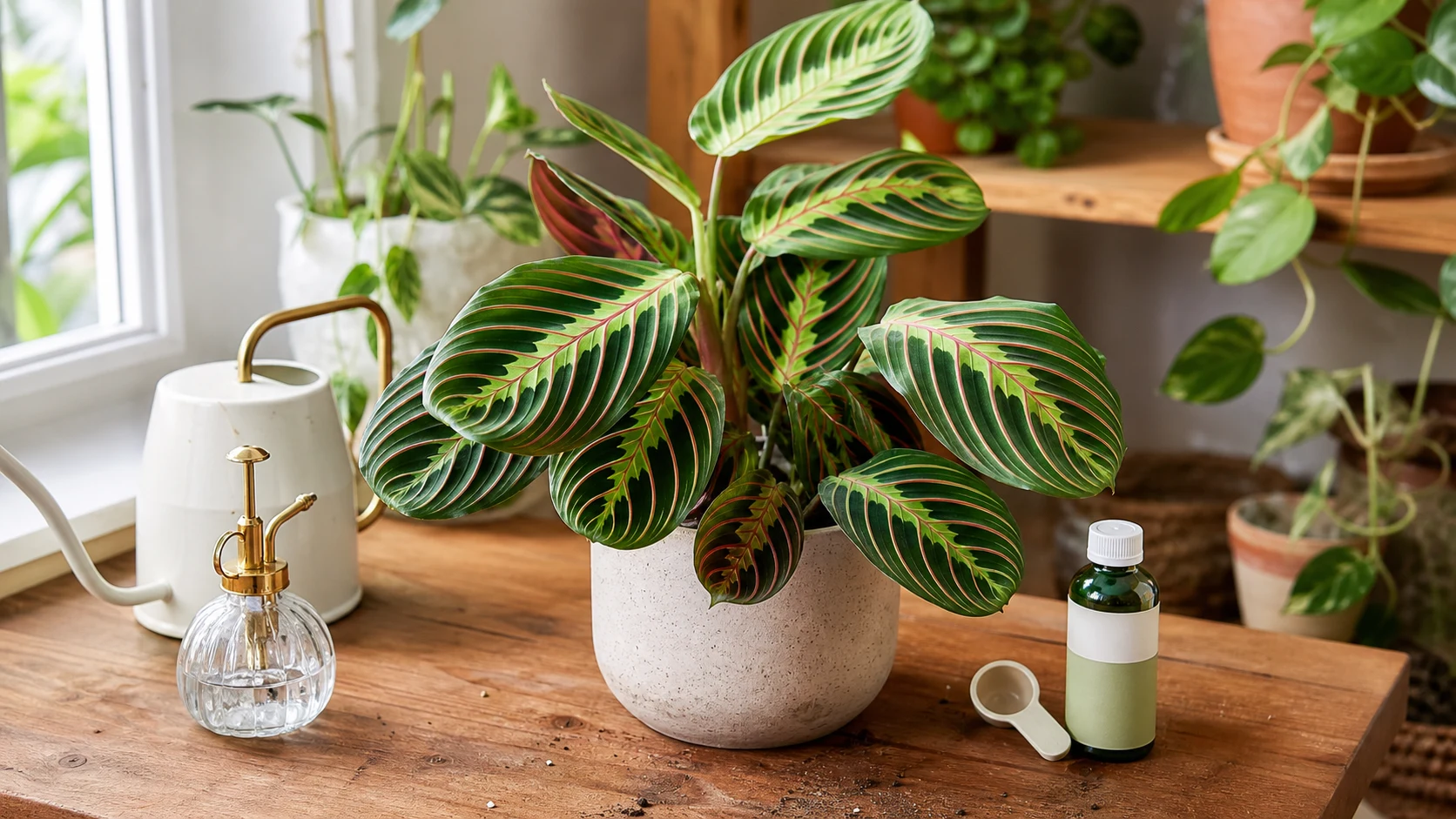
Measure a light, diluted feeding only while a healthy prayer plant is actively producing new leaves.
Darryl Cheng of House Plant Journal notes that the goal with feeding houseplants is to support the growth the plant is actually doing, not to force growth it isn’t ready for. For prayer plants, that means feeding lightly and only when they’re actively pushing out new leaves.
Your Simple Prayer Plant Routine
Today: Put the plant where it gets bright light without direct afternoon sun. Check the top 2-3 cm of soil. Empty any standing water. Look for curling, yellowing, brown tips, or fading patterns.
This week: Water only when the top layer dries. Rotate the pot a quarter turn if growth leans toward the window. Wipe dust from the leaves with a damp cloth so the plant can use the light it gets. If your home feels dry, start a pebble tray or humidifier nearby.
This season: Feed monthly in spring and summer at half strength. Stop feeding in autumn and winter. Repot only when roots circle the pot or come out of the drainage holes, and move up just one pot size.
Seasonal Care Calendar
Spring: As daylight increases, prayer plants start pushing new growth. Resume feeding if you paused in winter. Check whether repotting is needed before the growing season picks up properly.
Summer: The most active growth period. Water more frequently as the plant drinks more. Keep an eye on humidity since air conditioning can dry things out just as much as winter heating. Bright, filtered light keeps the patterns vivid.
Autumn: Growth starts to slow. Taper off fertilizing and begin watering slightly less often. Watch for the drying effect of turned-on central heating as temperatures drop.
Winter: Minimal feeding, reduced watering, and close attention to humidity. Prayer plants don’t go fully dormant, but they are resting. This is not the time to repot or propagate.
Reading the Movement
The folding is the best diagnostic tool you have. A prayer plant in good health moves reliably: leaves fold upward as light fades in the evening, open again as light returns in the morning. Once you’ve watched it for a week, you’ll know what normal looks like for your plant.
Changes in that pattern are worth paying attention to before anything else looks wrong.
Sluggish or incomplete folding usually means low light. The nyctinasty mechanism is driven by the contrast between day and night light levels. If the ambient light in your space is too low, the plant doesn’t experience enough contrast to trigger a full response. Try moving it closer to a window or supplementing with a grow light.
Partial daytime closing is often a reaction to direct sun. If leaves partially fold during the afternoon, it’s the plant trying to reduce its exposed surface in response to heat or brightness. That’s a stress response, not the normal nighttime behavior. Move it back from the window and the daytime folding should stop.
No movement at all is the most serious signal. A prayer plant that has stopped folding entirely is typically dealing with root problems, severe dehydration, or genuinely insufficient light. Check the roots for rot (soft, dark, with an unpleasant smell), check whether the soil has gone bone dry, and reassess the light situation. Most prayer plants recover their movement once the underlying issue is resolved.
The movement is the early warning system. Most problems announce themselves here before you’ll see anything obvious in the leaves, which means catching something early is usually as simple as watching whether the plant still folds at night.
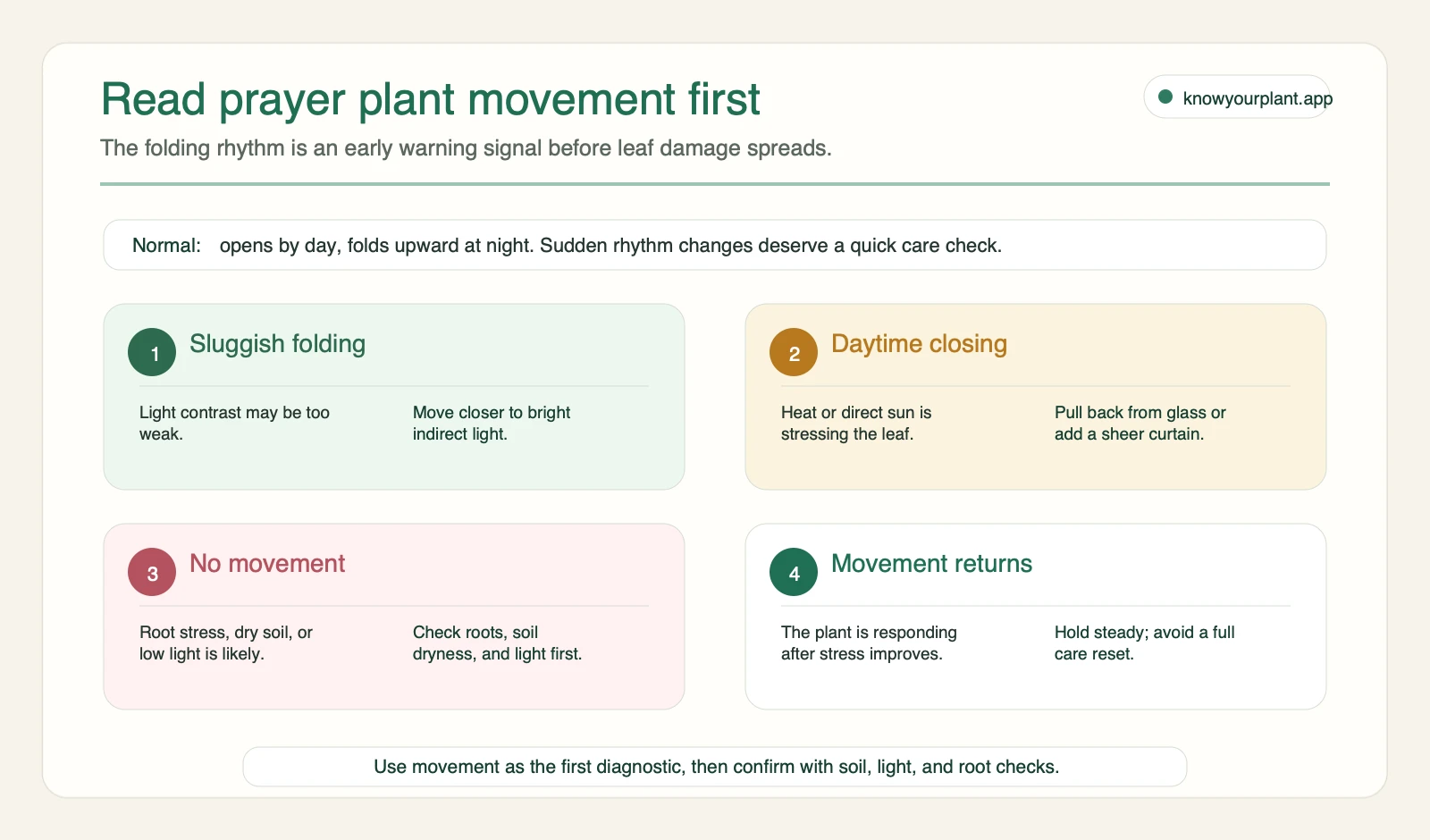
Read the movement pattern first, then confirm with soil, light, and root checks. A prayer plant that stops folding is usually asking for diagnosis before fertilizer or a full care reset.
Prayer Plant Varieties Worth Knowing
Maranta leuconeura ‘Erythroneura’ (Red Prayer Plant): The most common variety. Dark green leaves, bright red veins, lighter yellowish markings along the midrib. Forgiving and a good starting point for anyone new to the family.
Maranta leuconeura ‘Kerchoveana’ (Rabbit’s Foot): Pale green leaves with brown patches that turn greener as the leaf matures. Slightly easier than Calathea varieties and a good confidence-builder.
Calathea ornata: Dark green leaves with fine pink stripes and deep burgundy undersides. One of the more striking varieties, and one of the more demanding.
Calathea orbifolia: Large, rounded leaves with broad silver-green stripes. Needs consistent humidity and doesn’t love being moved around once it’s settled in.
Calathea medallion: Deep green and purple patterning with a bold medallion shape on each leaf. Popular for good reason.
Calathea lancifolia (Rattlesnake Plant): Long, narrow leaves with dark spots along the margins. Slightly more tolerant of lower humidity than other Calatheas, making it a good first Calathea for most homes.
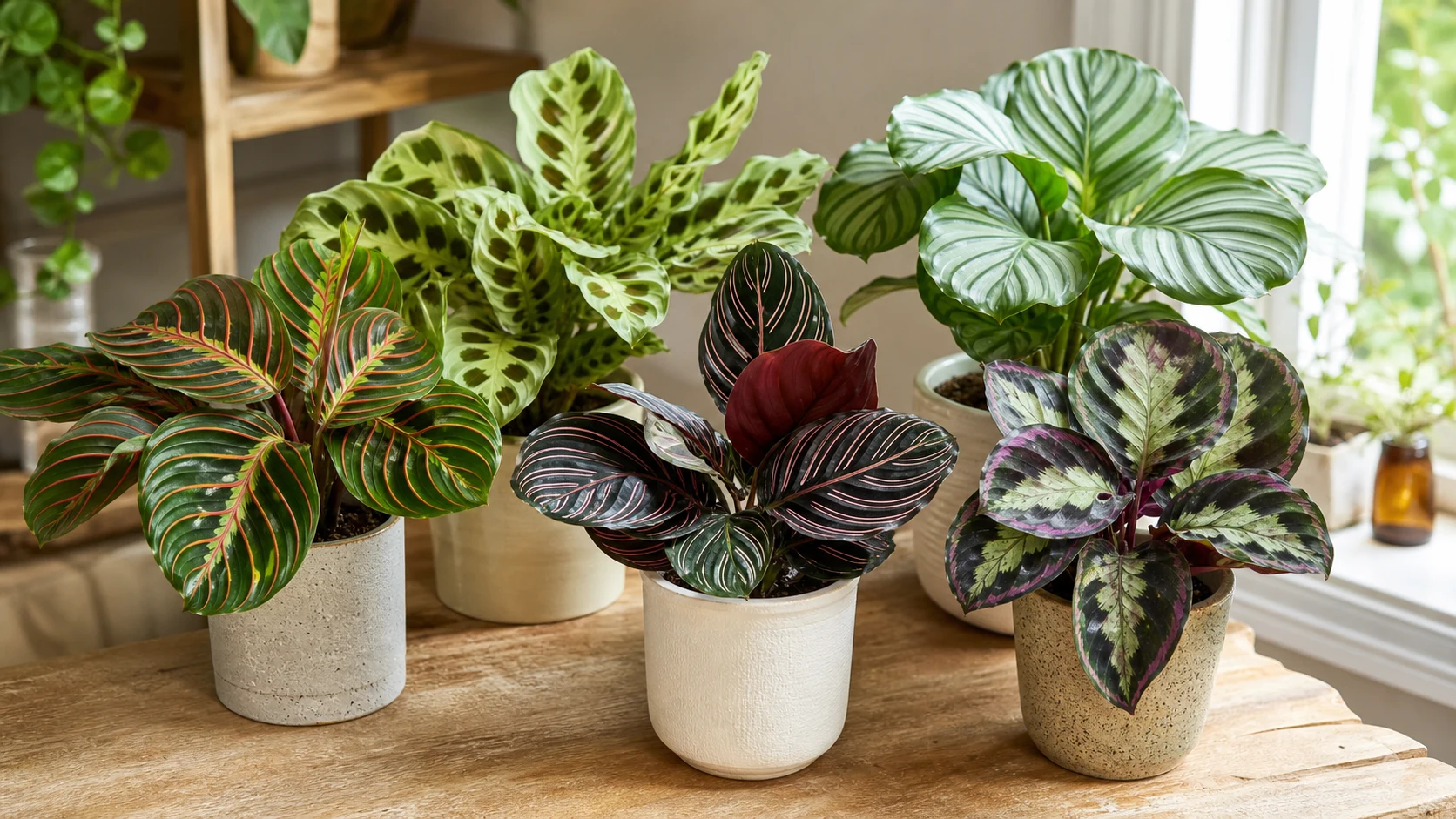
Compare the red veins, rabbit’s-foot patches, pink pinstripes, silver bands, and medallion patterns that distinguish popular prayer-plant varieties.
Prayer Plant Propagation
Propagating prayer plants is straightforward once you know what to look for. The main method is stem cuttings in water or soil.
Take a cutting just below a node, the small bump where a leaf meets the stem. The cutting should have at least one or two leaves and ideally be 10-15 cm long. Remove any leaves that would sit below the waterline if you’re rooting in water.
In water, roots typically appear within 3-4 weeks. Keep the jar somewhere warm and bright but out of direct sun, and change the water every few days. Once roots are 3-5 cm long, pot the cutting into a small pot with moist potting mix.
Division is another option when repotting. If your plant has grown into a full clump, you can gently separate sections at the roots and pot them individually. It’s a bit stressful for the plant in the short term, so give each division extra humidity and indirect light for a week or two while they settle.
Summer Rayne Oakes, horticulturalist and author of “How to Make a Plant Love You,” recommends waiting until a prayer plant is visibly healthy and actively growing before attempting propagation: stressed plants root slowly and are more vulnerable to rot during the process.
Common Problems: What Your Prayer Plant Is Telling You
Start with the symptom pattern instead of changing everything at once:
- Crispy tips with otherwise normal leaves: think dry air or water quality first.
- Yellow lower leaves plus damp soil: think overwatering or poor drainage first.
- Curling leaves plus a light pot: think underwatering, heat, or very dry air first.
- Prayer movement becomes weak or stops: check light, roots, and overall plant stress before fertilizing.
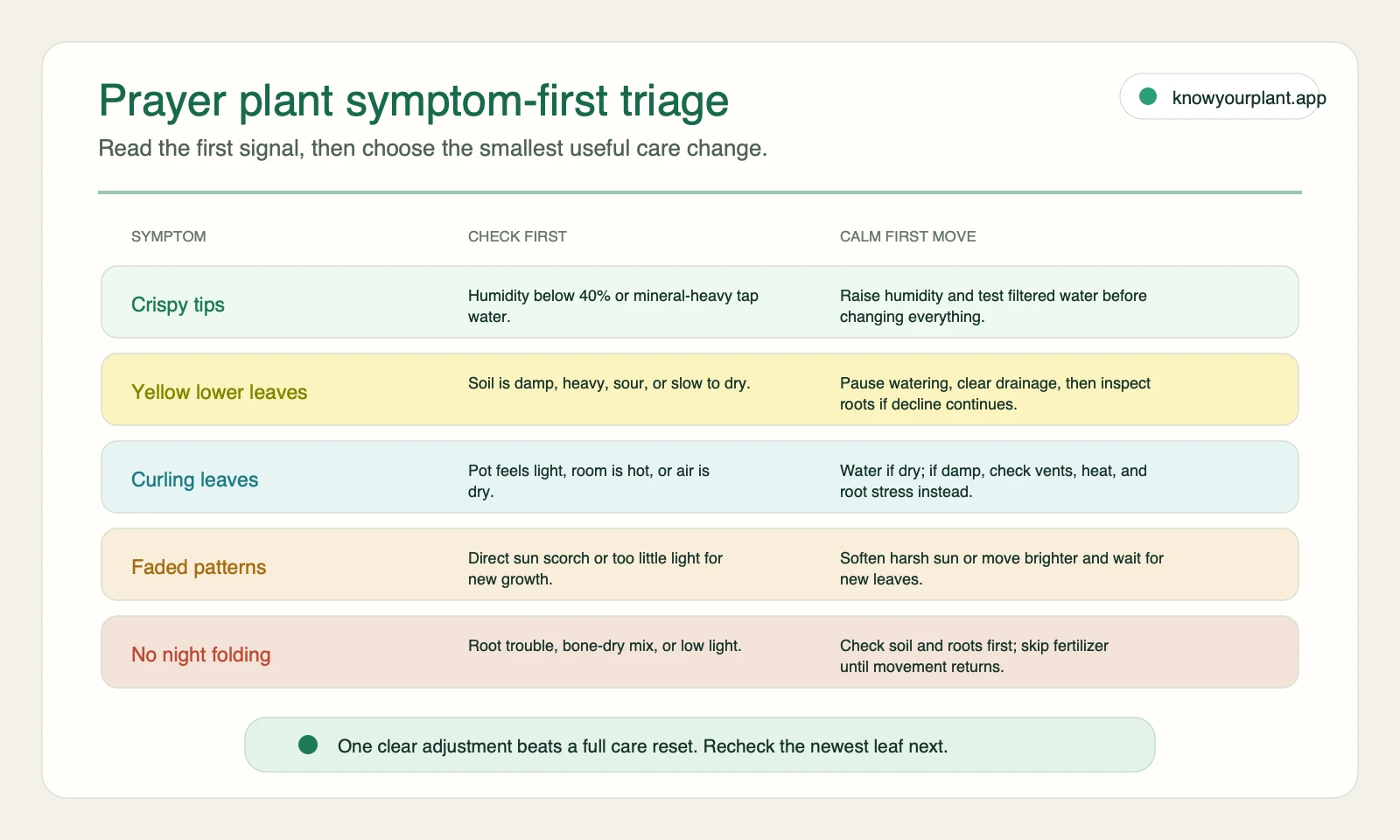
Start with the visible pattern and make one clear adjustment. Changing water, light, soil, and fertilizer all at once makes it harder to see what actually helped.
Leaves curling: Check the soil first. If it is dry and the pot feels light, water thoroughly. If the soil is damp, look for dry air, direct afternoon sun, or a heating or cooling vent nearby. Curling is the plant trying to reduce stress, so fix the condition rather than adding fertilizer.
Yellow leaves: Overwatering is the most common cause, especially when yellowing starts from the lower leaves upward. Let the top layer dry, check that drainage holes are not blocked, and stop leaving water in the saucer. If the soil smells sour or roots are mushy, trim the rotten roots and repot into fresh, airy mix.
Brown crispy tips: Think dry air or water quality before you think underwatering. Raise humidity around the plant, keep it away from vents, and switch to filtered water or tap water left out overnight. Trim only the fully brown tissue; brown tissue will not turn green again, but new growth should come in cleaner once the cause is fixed.
Faded patterns: Too much direct light is likely. Move the plant farther from the window or add a sheer curtain between it and the glass. If new leaves are also smaller and the plant has stopped folding, the issue may be too little light instead.
Leaves not folding at night: If the prayer movement has stopped, the plant is likely stressed by low light, severe dehydration, or root problems. Check whether the soil is bone dry or soggy, then reassess the light. It will usually resume once conditions improve.
For a related hands-on growing walkthrough, use Prayer Plant Propagation: Nodes, Cuttings, Division, and Rooting for the setup and follow-up care.
Real User FAQ
How often should I water a prayer plant? In spring and summer, most prayer plants need watering every 5-7 days. In autumn and winter, you can stretch that to every 10-14 days as growth slows. The real guide is the soil: check the top 2-3 cm, and water when it’s dry. Consistency matters more than a fixed schedule.
Why does my prayer plant have brown tips? Brown, crispy tips are almost always a humidity problem or a water quality issue. Low humidity (below 40%) is the most common culprit in homes with central heating or air conditioning. If your humidity seems fine, try switching from tap water to filtered water or rainwater for a few weeks. Fluoride in tap water can cause identical symptoms on Calathea in particular.
Can prayer plants grow in low light? They tolerate lower light better than many tropical plants, but they don’t thrive in genuinely dark conditions. Without enough light, the patterns fade and growth slows significantly. A north-facing window with decent natural light, or a grow light for dimmer spaces, keeps them healthy. Heartleaf philodendrons are a better choice if you’re working with a very dark corner.
Are prayer plants toxic to cats and dogs? Maranta and Calathea are both considered non-toxic to cats and dogs according to the ASPCA. They’re a good choice for households with pets that tend to investigate houseplants, and our full list of cat-safe indoor plants can help if you are comparing them with other pet-friendly options.
Why does my Calathea keep getting crispy leaves even though I water it regularly? Watering regularly is part of it, but Calathea are particularly sensitive to what’s in the water, not just how much they get. Fluoride and chlorine can cause crispy leaf edges and tips even when moisture levels are fine. Switch to filtered water, raise humidity above 50%, and make sure the plant isn’t near any heating or cooling vents blowing dry air across the leaves.
What’s the difference between Maranta and Calathea? They’re from the same family (Marantaceae) and share the prayer movement, but Maranta is generally more forgiving. Maranta leuconeura tolerates a wider range of humidity and is less sensitive to water quality. Calathea varieties tend to be more demanding about humidity, light consistency, and water purity, but they reward the extra care with some of the most striking leaf patterns in the houseplant world.
Can I propagate a prayer plant in water? Yes. Take a stem cutting just below a node, remove any leaves that would sit in the water, and place it in a jar in bright indirect light. Roots usually appear within 3-4 weeks. Change the water every few days to keep it fresh. Once roots reach about 3-5 cm, pot the cutting into moist soil and keep it in a humid spot while it adjusts.
How do I know if my prayer plant is getting enough light? Healthy prayer plants have vivid, saturated leaf patterns and actively move throughout the day. If the patterns are fading toward dull green, or the leaves aren’t folding at night anymore, the plant likely needs more light. Try moving it closer to a window or adding a grow light positioned a foot or two above the plant.
Methodology Note
This guide was refreshed using live OpenClaw research reviewed on 2026-06-13, including current search results for prayer plant care, Maranta care, and Calathea care, plus qualitative owner pain points from public community threads surfaced through Brave search snippets. Care claims were anchored to Illinois Extension, NC State Extension, UF/IFAS guidance, Extension Q&A material on fluoride sensitivity, and ASPCA pet-safety reference material.
Last Updated Note
Last updated on 2026-06-16 after validating the article against the current prayer-plant Research Pack.
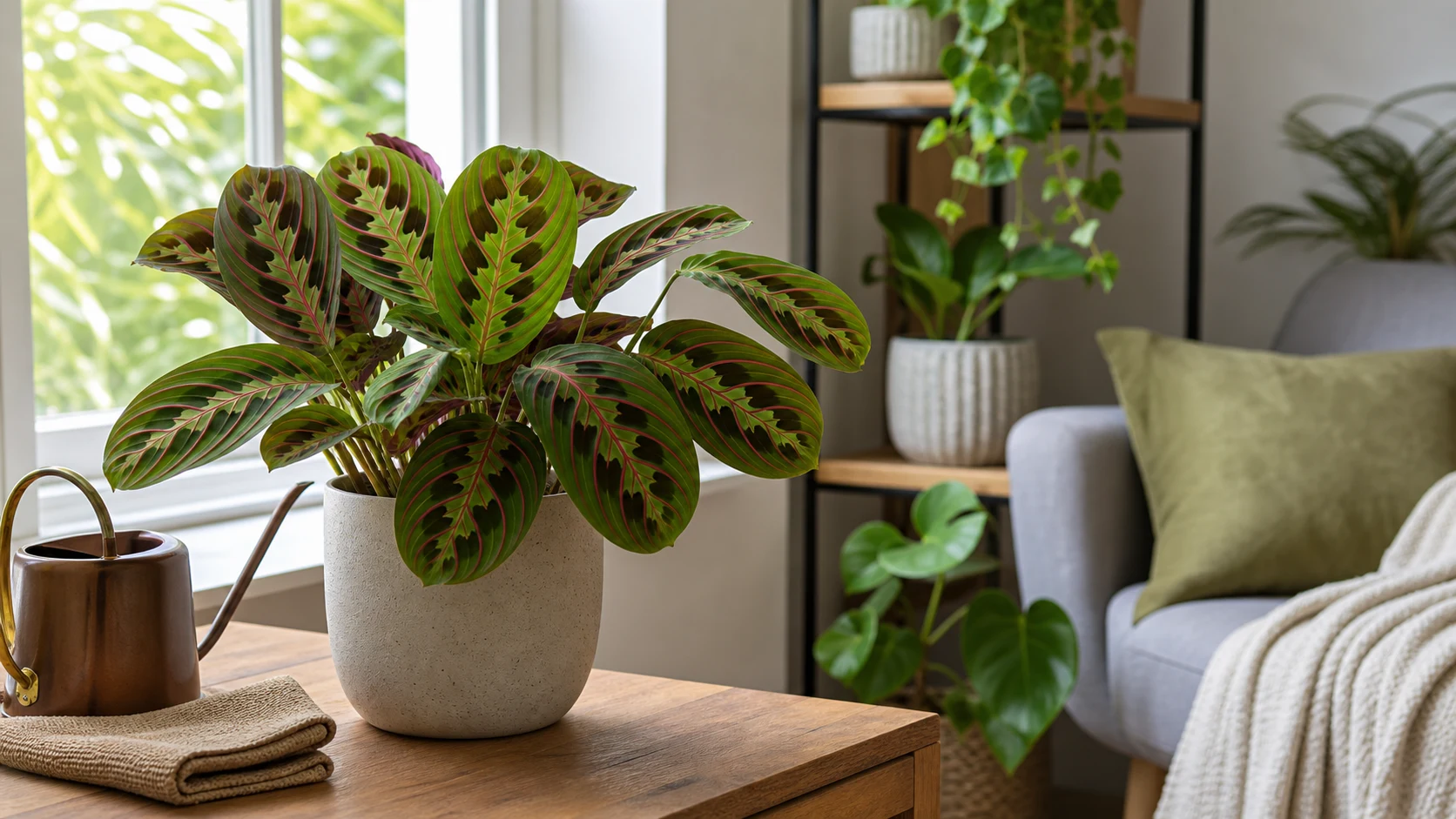
A mature Maranta in filtered light shows what steady watering and a consistent place in the home can achieve over time.
Prayer plants reward attention. They’re not the most forgiving houseplant, but they’re not as difficult as their reputation suggests: they just need conditions that match where they’re from. Get the humidity and watering right, keep them out of direct sun, and they’ll spend years folding and unfolding in your living room like they own the place.
If you want to make prayer plant care easier to keep consistent, download KnowYourPlant for personalized plant care reminders based on your specific plant and conditions. One less thing to remember, one more reason for your prayer plant to keep opening its leaves every morning.