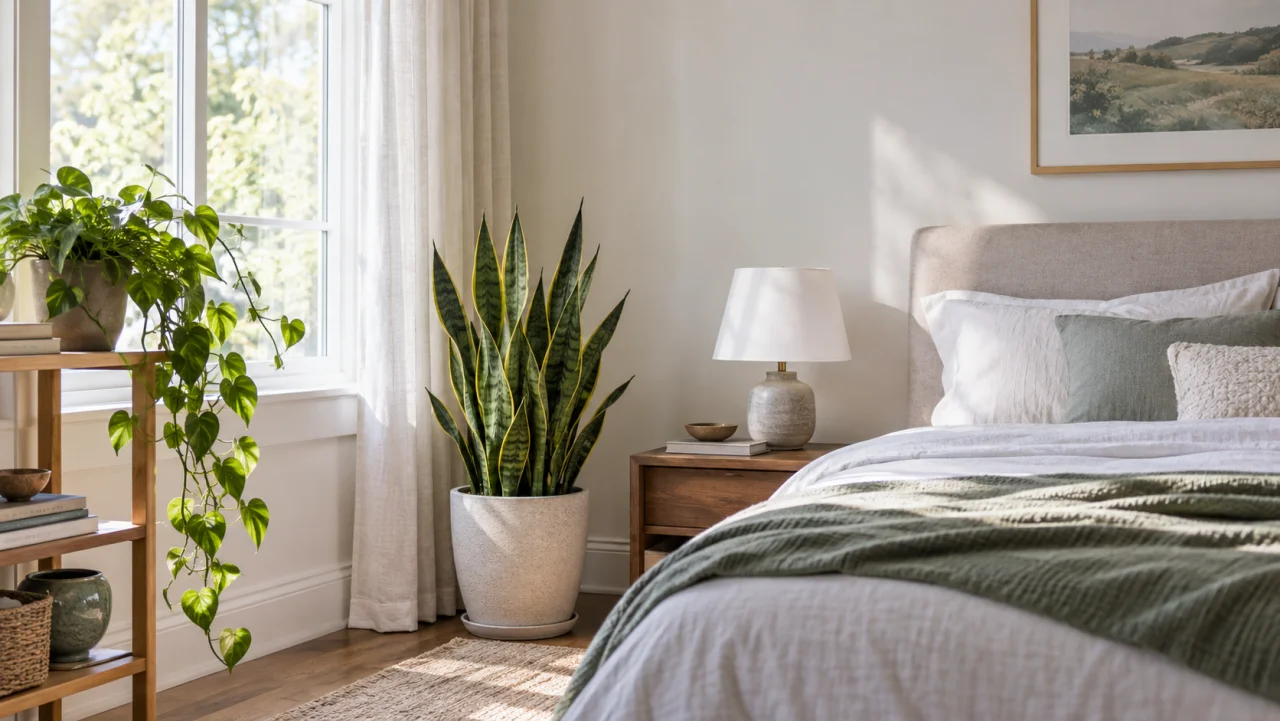
You want a bedroom plant that fits the room you actually have: maybe low light, maybe a pet on the bed, maybe a watering routine that is more “when I remember” than “every Saturday at 9.” The best choice is not the plant with the prettiest photo. It is the plant that can handle your light, your sleep setup, and your care habits without becoming another thing to worry about.
This guide covers 12 bedroom plants that earn their spot on a nightstand, shelf, windowsill, or floor corner. For each one, you will see the light it needs, how often to water it, whether it is safe around pets, and which warning signs mean you are overdoing water, light, or humidity.
Native-climate contrast for bedroom plants
Bedroom suitability is mostly a light, space, pet-safety, and maintenance decision. The table separates four popular choices by their documented native macroclimates so one care routine is not applied to all of them.
The ranges below are the middle 50% (p25–p75), not recommended indoor setpoints.
| Reference taxon | POWO native range | Annual mean temperature | Annual precipitation | Relative humidity | Solar radiation | Evidence |
|---|---|---|---|---|---|---|
| Dracaena trifasciata (snake plant) | southern Nigeria to west-central tropical Africa and Tanzania | 23.3–25.2°C | 1585–1783 mm/yr | 65–69% | 16.1–18.1 MJ/m²/day | 29 climate points; medium confidence |
| Spathiphyllum wallisii (peace lily) | Colombia to Venezuela | 18.8–20.7°C | 2102–3281 mm/yr | 67–68% | 16.7–18.3 MJ/m²/day | 10 climate points; low confidence |
| Ficus elastica (rubber plant) | Nepal to western Yunnan and western Malesia | 22.5–26.6°C | 1514–2822 mm/yr | 61–66% | 16.7–19.1 MJ/m²/day | 30 climate points / 120 usable records; medium confidence |
| Epipremnum aureum (golden pothos) | Mo’orea in the Society Islands | 25.7–25.9°C | 2451–2644 mm/yr | 63–64% | 20.0–20.1 MJ/m²/day | 6 climate points; low confidence |
What this changes in this guide: The climatic spread supports using different soil-check rhythms for drought-tolerant snake plant and wet-tropical foliage plants; it does not support watering by calendar.
Sources and method: Dracaena trifasciata in POWO and GBIF; Spathiphyllum wallisii in POWO and GBIF; Ficus elastica in POWO and GBIF; Epipremnum aureum in POWO and GBIF; CHELSA V2.1, 1981–2010. GBIF records are limited to POWO-native countries, then filtered for coordinates, establishment signal, licence, precision, and spatial duplication. No community or user-reported care data is used in this module.
How We Evaluated These Bedroom Plants
This is not a lab ranking about which plant is best in the abstract. It is a bedroom-fit guide. Each pick was reviewed against the same decision factors that kept repeating in bedroom-plant searches and community questions: real light levels, pet safety, watering rhythm, sleep-related expectations, and how clearly the plant signals trouble before it declines.
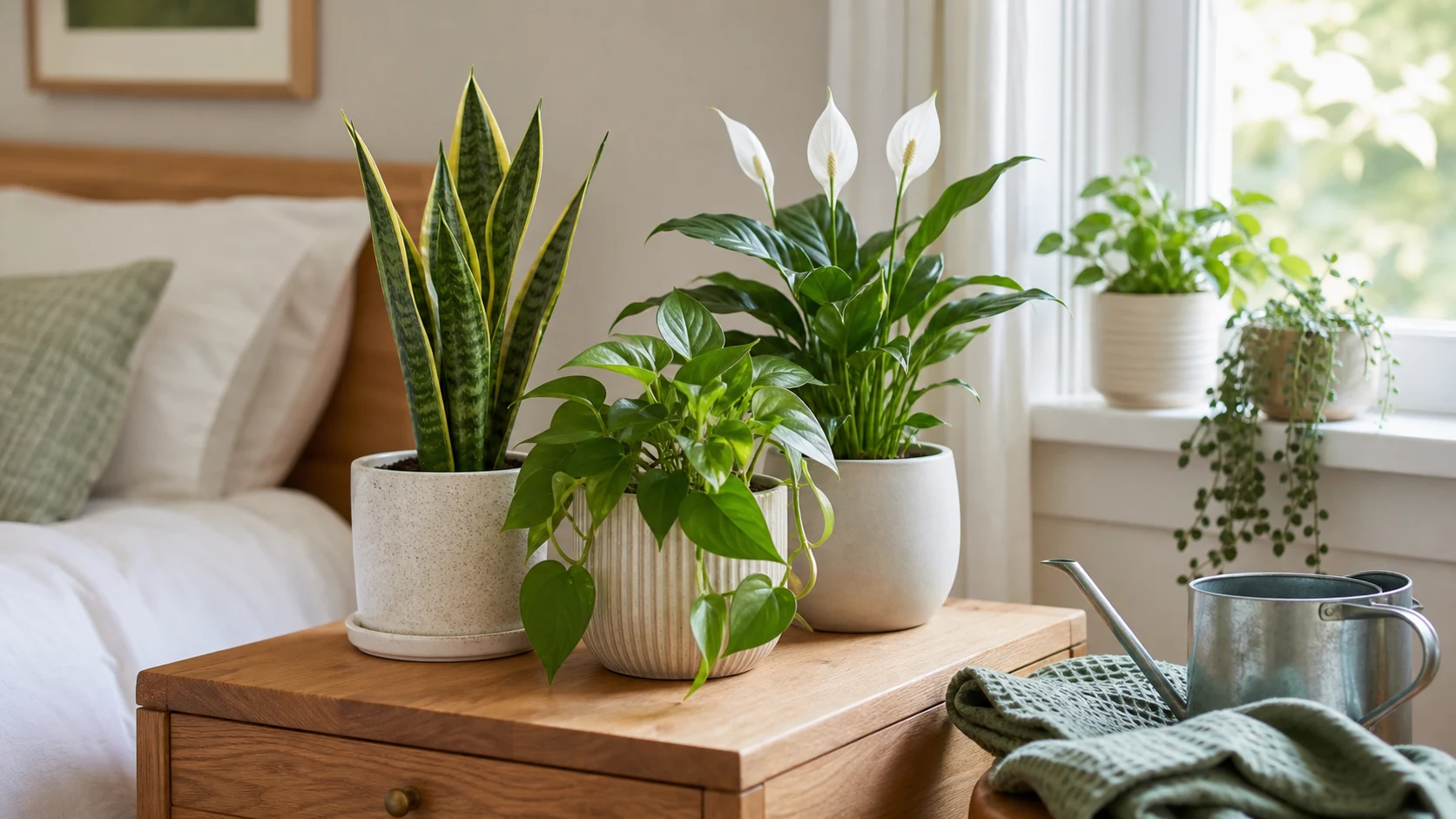
Comparing recognizable bedroom plants beside real daylight and watering cues keeps the guide focused on practical room fit and care.
Bedroom Plant Scoring Rubric
| Criterion | What scored well in this guide |
|---|---|
| Light reality | The plant can handle the light people actually have in bedrooms, not just greenhouse conditions or a perfect sunroom. |
| Care rhythm | The plant forgives missed waterings or, if it does not, the tradeoff is stated clearly. |
| Pet safety | Toxicity is called out plainly, with safer alternatives when pets chew leaves. |
| Sleep or air-quality promise | The benefit is grounded in what the plant really offers, such as fragrance, a little humidity, or CAM photosynthesis, not exaggerated purifier claims. |
| Placement fit | The plant can realistically live on a nightstand, shelf, windowsill, or floor corner without quickly outgrowing the spot. |
| Failure-signal clarity | Yellowing, browning, drooping, or stretching shows up early enough that a beginner can course-correct. |
Testing and Evaluation Method
We did not run a bedroom air-lab test for these 12 plants. Instead, we used the same source-backed checklist for each one: extension and botanical references for light and watering needs, poison-center or plant-toxicity references where relevant, and careful filtering of common reader questions around low light, pets, fragrance, and nighttime oxygen claims. That means the scoring here is a decision tool for real homes, not a claim that one plant will clean a whole room by itself.
What Most Plant Roundups Miss
Most roundups about bedroom Plants for Sleep and Air list attractive options. The better question is which choice will still make sense in your actual room three months from now.
Use this filter before choosing:
- Light reality: what the plant receives on a normal cloudy day, not the brightest hour of the week.
- Care rhythm: whether you prefer weekly attention or a plant that can be ignored longer.
- Space: mature height, spread, trailing habit, and whether leaves will touch walls or pets.
- Failure signal: what the plant does first when the match is wrong: yellowing, stretching, crisping, or dropping leaves.
A good recommendation is not just beautiful. It fits the room, the owner, and the first problem you are likely to notice.
Bedroom Plant Fit Check
Use this quick match before you buy. It is easier to choose the right plant now than to rescue the wrong plant later.
- Dark bedroom, low effort: Snake plant, ZZ plant, or pothos. Water only when the top few inches of soil are dry and the pot feels light.
- Bright windowsill, low effort: Aloe vera. It likes stronger light and dry soil, so it is better for a sunny sill than a dim nightstand.
- Pets sleep in the room: Spider plant, areca palm, boston fern, prayer plant, or jasmine. Choose these if your cat or dog chews leaves.
- Dry winter air: Areca palm, boston fern, or spider plant. Brown tips usually mean dry air, inconsistent watering, or mineral-heavy tap water.
- You forget plants for weeks: Skip ferns, jasmine, and peace lilies. Start with snake plant or ZZ plant instead.
If you are choosing between two plants, save the better fit in KnowYourPlant so the care schedule matches the plant you actually bring home.
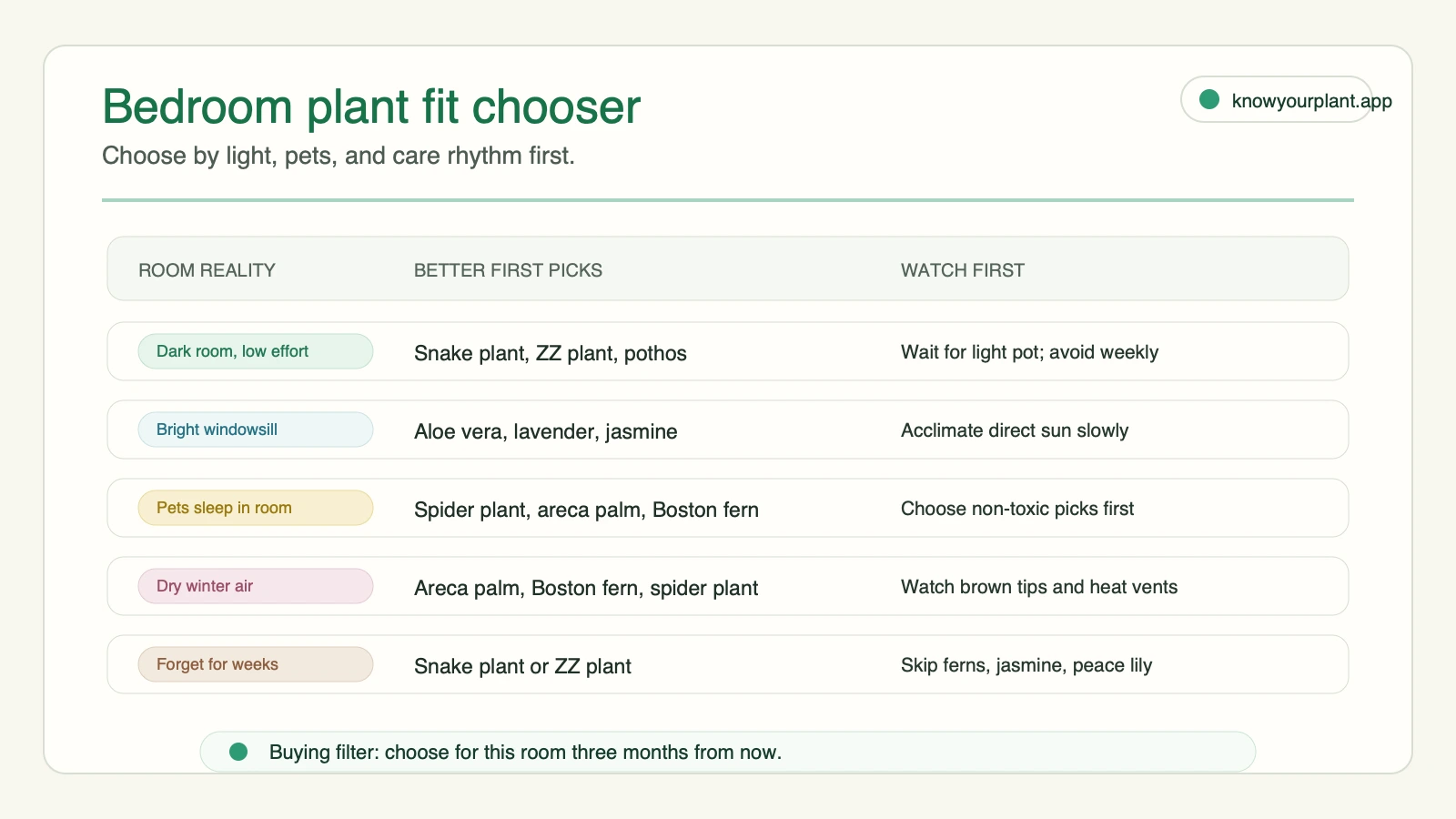
Use the fit chooser before buying. The best bedroom plant is the one that matches your actual light, pet access, and care rhythm for more than the first week.
Best For and Not For by Bedroom Situation
| Bedroom situation | Best for | Not for |
|---|---|---|
| Dark room, low effort | Snake plant, ZZ plant, pothos | Lavender, jasmine, aloe vera |
| Pets sleep in the room | Spider plant, areca palm, boston fern, prayer plant, jasmine | Snake plant, pothos, ZZ plant, peace lily, rubber plant, aloe vera, lavender |
| You forget to water | Snake plant, ZZ plant, aloe vera | Boston fern, jasmine, peace lily |
| You want scent near bedtime | Lavender, jasmine | Snake plant or ZZ if fragrance is the main goal |
| You are allergy- or fragrance-sensitive | Snake plant, spider plant, ZZ plant, prayer plant | Strongly scented picks like lavender and jasmine |
| You only have a sunny windowsill | Aloe vera, lavender, jasmine | Boston fern or peace lily tucked far from the glass |
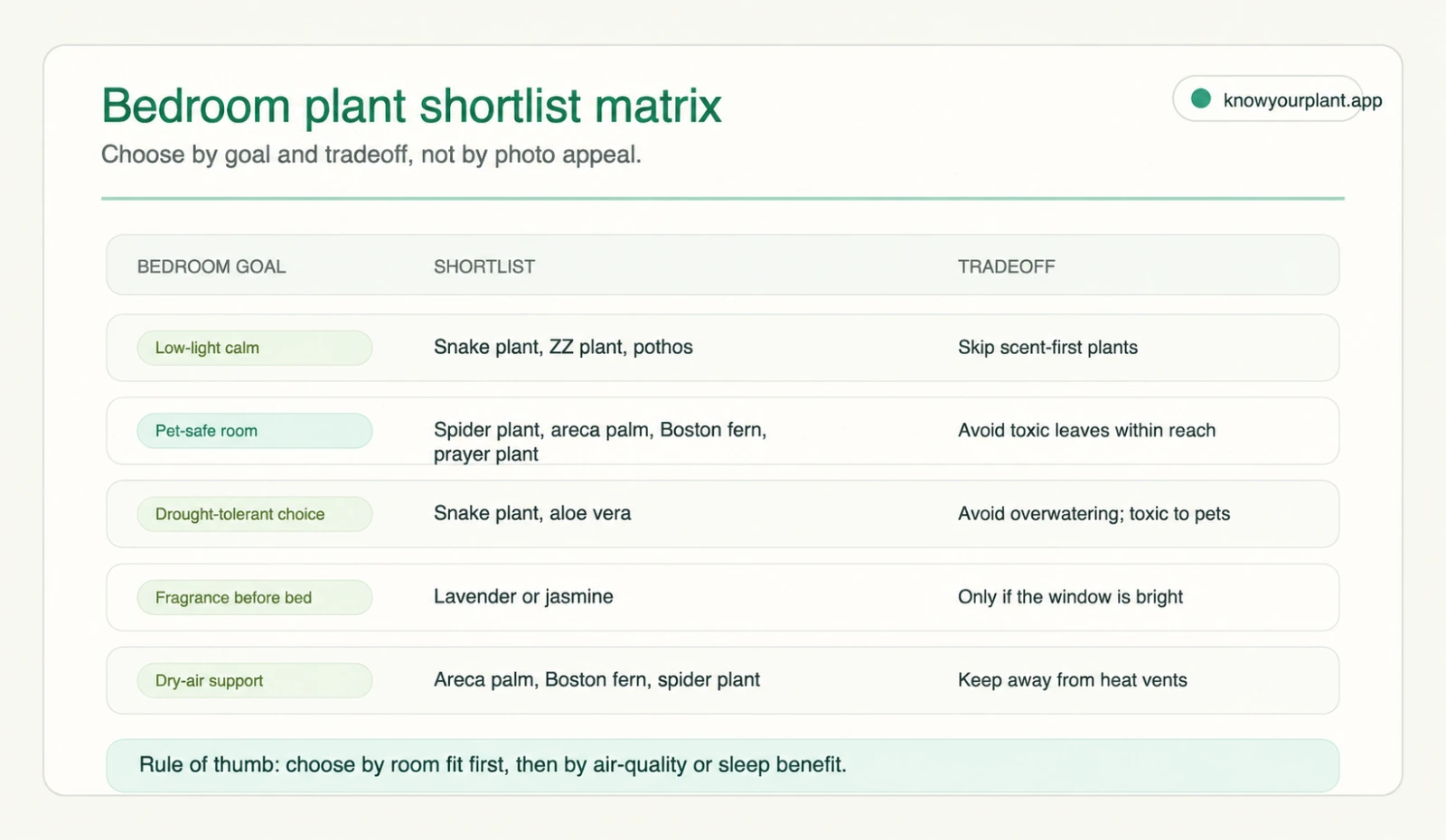
Start with the room goal, then check the tradeoff. A plant chosen for fragrance, pet safety, or drought tolerance still has to fit the bedroom conditions.
Why Bedroom Plants Matter
Most people grab a bedroom plant because it looks nice. That’s a perfectly good reason. But there’s more going on than decoration.
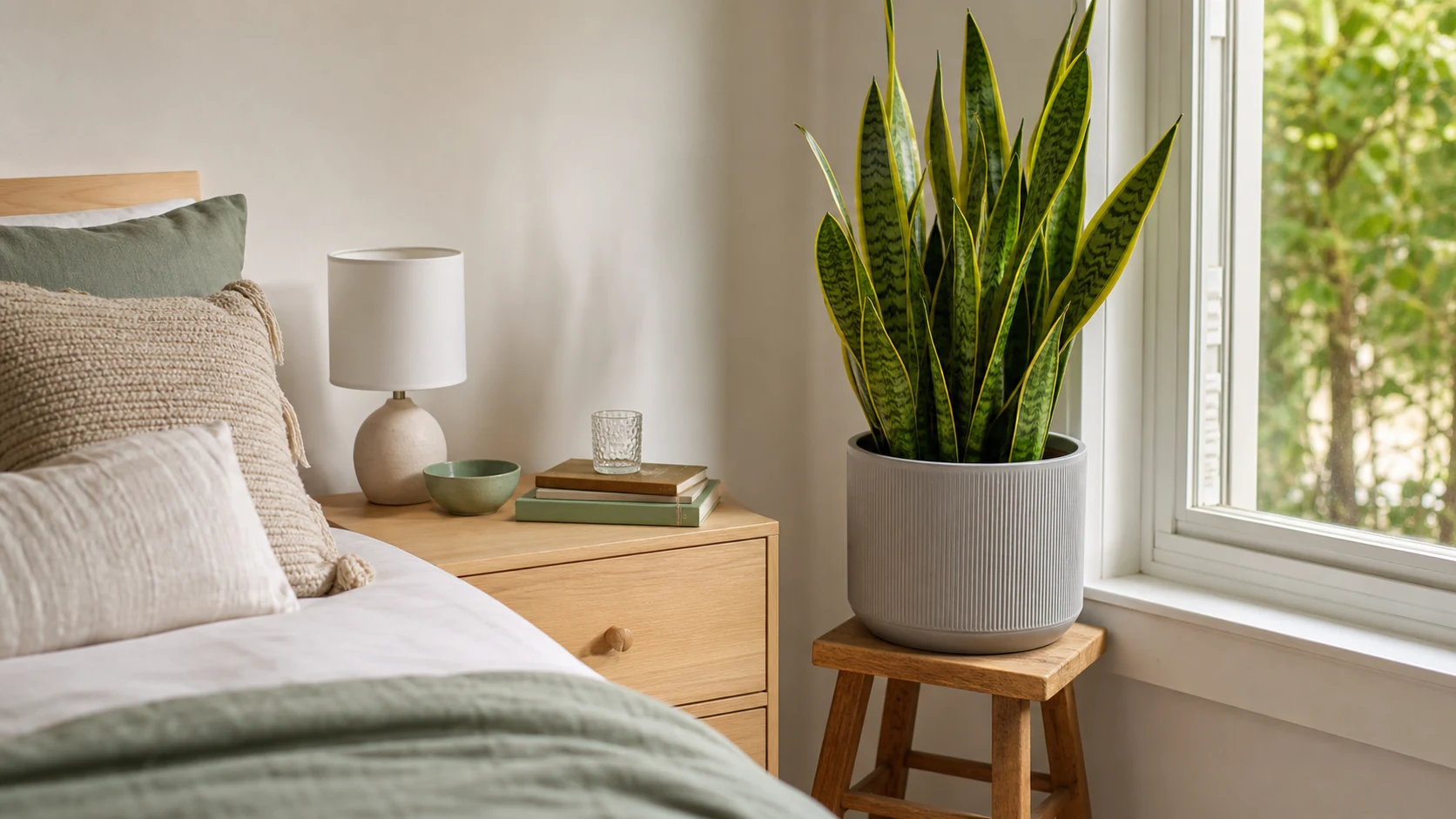
A snake plant beside a bright bedroom window connects the room-setting benefits with the CAM plant example discussed in this section.
Air quality: Houseplants can absorb small amounts of indoor pollutants through leaves, soil, and roots. The often-quoted NASA study was done in sealed test chambers, so one plant will not clean a normal bedroom like an air purifier. Still, plants with broad leaves and healthy soil can support a fresher room when combined with ventilation and dust-free leaves. (We cover the full science in our air-purifying plants guide.)
Nighttime oxygen: CAM (Crassulacean Acid Metabolism) lets plants such as snake plant and aloe vera take up CO2 at night and store it for daytime photosynthesis. It does not mean they produce oxygen in darkness: oxygen production depends on light, as explained by NC State Extension. Choose these plants for their care needs, not a promised overnight oxygen boost.
Humidity: The University of Minnesota Extension notes that indoor humidity below 30% can disrupt sleep and irritate airways. Plants naturally release moisture through transpiration, and grouping a few together can make the air around that corner feel less dry. If that air-quality angle is your main reason for buying plants, our air-purifying plants guide goes deeper on which species pull the most weight.
The calming factor: This one is harder to measure, but real. Having something green and living in your line of sight as you wind down does something good for your nervous system. Think of it as a tiny reminder that not everything needs a screen.
Bedroom Plant Myth Check
Use this table when the shopping advice starts sounding too magical. Most bad bedroom-plant picks come from treating a lab headline, a fragrance claim, or a pet-safe label as the whole story.
| Common claim | What it really means in a bedroom |
|---|---|
| “A houseplant will clean the room while you sleep.” | NASA’s often-cited plant work used sealed chambers, not a normal bedroom with doors opening, dust, and regular airflow. A bedroom plant can still add atmosphere, a little humidity, and healthy foliage, but it does not replace ventilation or an air purifier. |
| “Any sleep plant works in low light.” | Fragrance-led picks like lavender and jasmine usually need a much brighter window and steadier care than the low-light plants beginners ask for. If the room is dim, choose fit over fragrance. |
| “Pet-safe and low-light always overlap.” | The easiest low-light winners, like snake plant, ZZ plant, pothos, and peace lily, are not pet-safe. If animals chew leaves, your shortlist gets narrower and that tradeoff should be explicit before you buy. |
| “Brown tips mean the plant is thirsty.” | Sometimes yes, but bedroom plants also get brown tips from dry air, mineral-heavy water, or keeping the soil damp too often. Check the soil before you respond to the leaf. |
When a Bedroom Plant Is the Wrong Recommendation
A plant does not have to go next to the bed to be useful. Move it to another room, or skip the bedroom entirely, if one of these is true:
- Allergies already flare up in the room. Dusty leaves, soggy soil, pollen, or strong fragrance can make sleep worse, not better.
- The only spot is a very dark corner. A low-light-tolerant plant may survive there, but many “bedroom plants” will just stretch, yellow, and decline.
- Pets chew everything. Use only the pet-safe shortlist, or keep toxic plants completely out of the bedroom instead of gambling on a high shelf.
- You want fragrance but do not have a bright window. That is the fastest way to end up with a struggling lavender or jasmine plant that gives you neither flowers nor scent.
The 12 Best Bedroom Plants
Low-Light Bedroom Picks
These four thrive in bedrooms that don’t get much natural light, north-facing windows, or spots several feet from the nearest window.
1. Snake Plant (Sansevieria trifasciata)
The closest thing to an indestructible bedroom plant. Snake plants use CAM to take up CO2 at night, but oxygen production still needs light. They handle low light, dry air, and irregular watering without complaint. If your bedroom is dark and you tend to forget about plants, start here.
Light: Low to bright indirect | Water: Every 2-3 weeks | Pet safe: No (mildly toxic to cats and dogs)
2. Pothos (Epipremnum aureum)
Pothos trails beautifully from a high shelf or hanging planter, and it handles low light better than almost any other trailing plant. It is also forgiving when you miss a watering. New leaves unfurl lighter and gradually darken, which is a small thing, but it gives you something pleasant to notice. For the full routine, start with our golden pothos care guide.
Light: Low to bright indirect | Water: When top inch of soil is dry | Pet safe: No (toxic if ingested)
3. ZZ Plant (Zamioculcas zamiifolia)
The ZZ plant’s thick, waxy leaves store water, so it can go weeks without attention. It tolerates fluorescent light and dim corners. The dark-green foliage looks good against any wall color, and the plant grows slowly enough that you won’t need to repot it for years.
Light: Low to bright indirect | Water: Every 2-4 weeks | Pet safe: No (mildly toxic)
4. Peace Lily (Spathiphyllum)
Peace lilies are one of the few flowering plants that bloom reliably in low light. They also tell you when they need water by drooping slightly, then perking right back up after a drink. That communicative quality makes them surprisingly easy to care for, as long as you do not keep the soil soggy.
Light: Low to medium indirect | Water: When top inch is dry, or when it droops slightly | Pet safe: No (toxic to cats and dogs)
Air-Purifying and Oxygen Producers
These are good picks if you want foliage that supports a fresher-feeling room through healthy leaves, cleaner surfaces, and a little extra humidity.
5. Spider Plant (Chlorophytum comosum)
Spider plants are forgiving, fast to recover, and easy to keep on a bedroom shelf. They produce offshoots (“babies”) that dangle from the mother plant on long stems, so one healthy plant can eventually become several. Bonus: they are one of the few pet-safe plants that also handles normal indoor air well.
Light: Medium to bright indirect | Water: When top inch is dry | Pet safe: Yes
6. Areca Palm (Dypsis lutescens)
If your bedroom gets decent light, an areca palm acts as a natural humidifier. It’s one of the highest-rated plants for moisture release through transpiration, which helps if dry air wakes you up with a scratchy throat. The soft, feathery fronds add a calm, tropical feel.
Light: Bright indirect | Water: When top inch is dry | Pet safe: Yes
7. Rubber Plant (Ficus elastica)
Large, glossy leaves make the rubber plant a strong bedroom floor plant. It handles medium light well and grows into a substantial corner plant over time. Wipe the leaves with a damp cloth occasionally so dust does not block light or make the plant look dull.
Light: Medium to bright indirect | Water: When top 2 inches are dry | Pet safe: No (mildly toxic)
Calming and Sleep-Friendly
These plants are often associated with relaxation and better sleep.
8. Lavender (Lavandula)
Lavender is the only plant on this list where the scent is the main benefit. Studies have linked the smell of lavender to reduced heart rate and lower blood pressure, both of which help you fall asleep. The catch: lavender needs a lot of light. Place it on a sunny windowsill, or it won’t thrive indoors.
Light: Full sun (6+ hours direct) | Water: When soil is dry | Pet safe: No (toxic to cats and dogs; ASPCA)
9. Jasmine (Jasminum polyanthum)
Like lavender, jasmine earns its bedroom spot through fragrance. The sweet scent has been associated with reduced anxiety in small studies. Indoor jasmine needs a bright window and cooler nighttime temperatures to bloom. It’s more work than a pothos, but the evening fragrance reward is real.
Light: Bright indirect to direct | Water: Keep soil lightly moist | Pet safe: Yes
10. Aloe Vera
Another CAM plant that takes up CO2 at night and uses the stored carbon in daylight; it does not produce oxygen in the dark. Aloe vera is low-maintenance, handles dry air without fussing, and the gel inside the leaves is useful for minor burns or skin irritation. It’s a practical plant for a bedroom nightstand, quiet and functional.
Light: Bright indirect to direct | Water: Every 2-3 weeks | Pet safe: No (toxic to cats and dogs)
Pet-Safe Bedroom Plants
If you share your bedroom with cats or dogs, these are solid options. For a complete list, check our cat-safe plants guide.
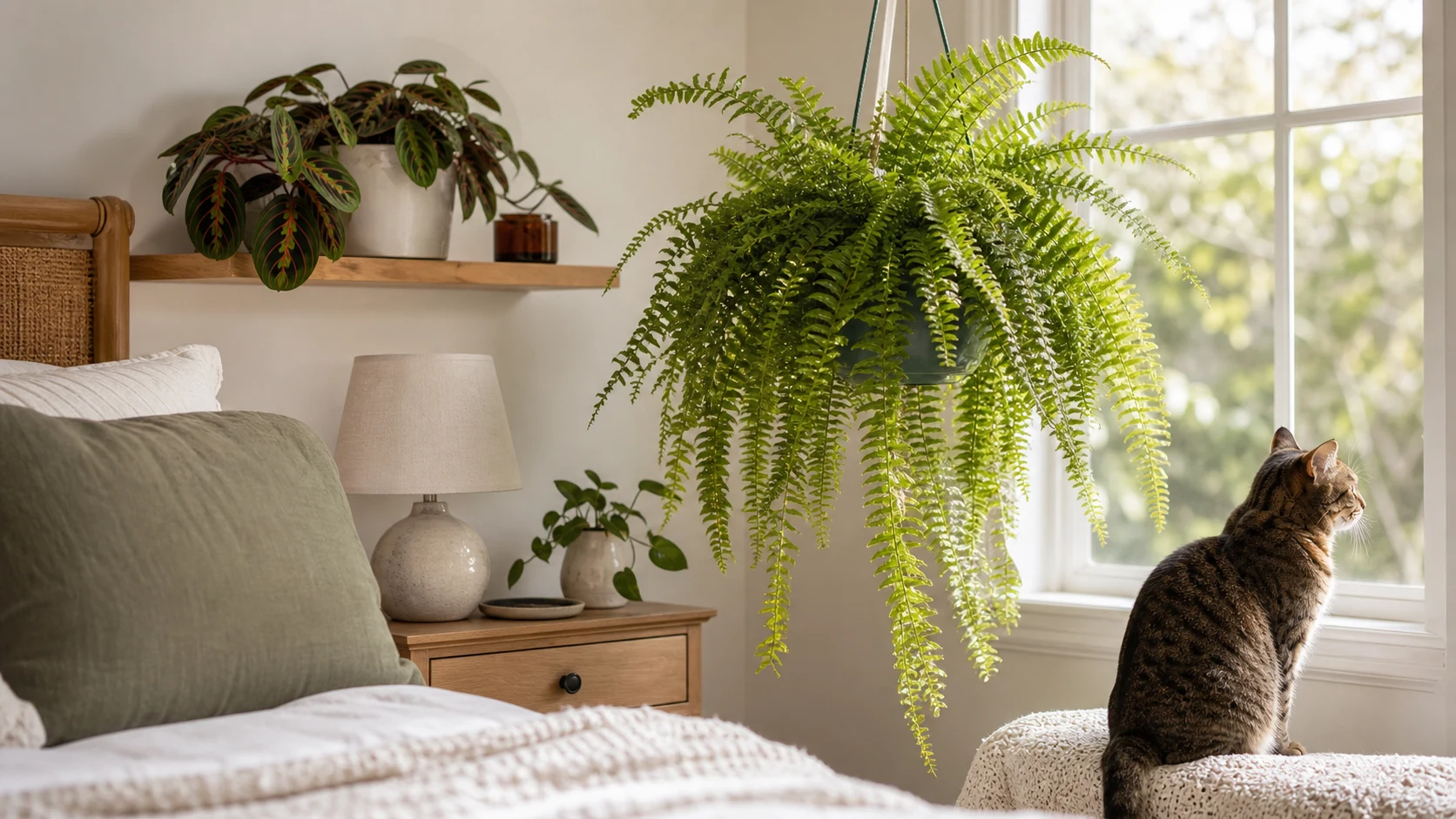
A hanging Boston fern and a prayer plant bring pet-safe greenery into the same bedroom space as a relaxed cat.
11. Boston Fern (Nephrolepis exaltata)
Boston ferns are excellent humidifiers and completely safe for pets. The lush, arching fronds look beautiful hanging from a bedroom ceiling or sitting on a high shelf. They do need consistent moisture and humidity, so mist them or place the pot on a pebble tray with water.
Light: Medium indirect | Water: Keep soil consistently moist | Pet safe: Yes
12. Prayer Plant (Maranta leuconeura)
Prayer plants fold their leaves upward at night, almost like they’re going to sleep alongside you. This movement (called nyctinasty) is completely normal and oddly comforting to watch. They’re pet-safe, prefer indirect light, and their patterned leaves add visual interest to a bedroom without needing flowers.
Light: Low to medium indirect | Water: When top inch is dry, use filtered water | Pet safe: Yes
Quick-Reference Comparison
| Plant | Light | Water Frequency | Pet Safe | Air Purifying | Night CO2 Uptake |
|---|---|---|---|---|---|
| Snake Plant | Low-bright | Every 2-3 weeks | No | Yes | Yes (CAM; oxygen needs light) |
| Pothos | Low-bright | Weekly | No | Yes | No |
| ZZ Plant | Low-bright | Every 2-4 weeks | No | Yes | No |
| Peace Lily | Low-medium | Weekly | No | Yes | No |
| Spider Plant | Medium-bright | Weekly | Yes | Yes | No |
| Areca Palm | Bright indirect | Weekly | Yes | Yes | No |
| Rubber Plant | Medium-bright | Every 1-2 weeks | No | Yes | No |
| Lavender | Full sun | When dry | No | No | No |
| Jasmine | Bright | Keep moist | Yes | No | No |
| Aloe Vera | Bright | Every 2-3 weeks | No | Yes | Yes (CAM; oxygen needs light) |
| Boston Fern | Medium | Keep moist | Yes | Yes | No |
| Prayer Plant | Low-medium | Weekly | Yes | No | No |
Pros and Cons at a Glance
| Plant | Pros | Cons |
|---|---|---|
| Snake plant | Best low-effort choice for dim rooms and one of the clearest CAM picks for bedroom interest | Toxic to pets and easy to overwater if you treat it like a fern |
| Pothos | Fast-growing, forgiving, and easy to place on a shelf | Toxic if chewed and not a true low-light miracle in very dim rooms |
| ZZ plant | Handles neglect and dry indoor air better than most foliage plants | Toxic to pets and slow enough that people sometimes miss stress until late |
| Peace lily | Gives you flowers in lower light and droops when thirsty | Toxic to pets and less forgiving of soggy soil than its reputation suggests |
| Spider plant | One of the safest beginner picks for pet owners | Brown tips are common in dry air or with inconsistent watering |
| Areca palm | Adds the strongest humidifying feel in a bright bedroom corner | Needs brighter light and more regular watering than drought-tolerant picks |
| Rubber plant | Strong statement plant with glossy leaves for medium-light rooms | Toxic to pets and can get too large for a tight bedroom quickly |
| Lavender | Best fragrance-led sleep pick when the room is truly sunny | Toxic to cats and dogs; usually disappoints in dim bedrooms and needs more direct light than roundups admit |
| Jasmine | Evening fragrance feels luxurious in the right bright spot | More fussy about light, moisture, and temperature than beginner plants |
| Aloe vera | Practical, drought-tolerant, and another CAM option for bright rooms | Toxic to pets and weak in dim bedroom corners |
| Boston fern | Pet-safe and excellent for adding a softer, more humid feel | Demands the most consistent moisture and humidity on this list |
| Prayer plant | Pet-safe, compact, and visually interesting even without flowers | Sensitive to dry air and mineral-heavy water |
If Leaves Start Yellowing, Curling, or Browning
Bedroom plant problems usually come down to water, light, air flow, or dry indoor air. Check the soil before you react, because the same leaf symptom can mean different things depending on whether the pot is wet or dry.
- Yellow leaves and wet soil: You are probably watering too often. Let the top 2 inches dry, empty the saucer, and make sure the pot has a drainage hole.
- Yellow leaves and dry soil: The plant may be staying dry too long between waterings. Give it a full drink until water drains through, then wait for the soil to dry to the right depth before watering again.
- Curling leaves: Check for dry soil first, then check for harsh sun or pests under the leaves. Move the plant out of direct afternoon sun and water only if the soil is actually dry.
- Brown tips: This often points to dry air, inconsistent watering, or mineral-heavy tap water. Try a pebble tray, group plants together, and use filtered water for prayer plants and ferns.
- Drooping: Dry soil means water now. Wet soil means stop watering and give the roots air; more water will make the problem worse.
- Tiny flies around the pot: Fungus gnats usually mean the top layer of soil stays wet. Let the surface dry longer and avoid topping up with little splashes.
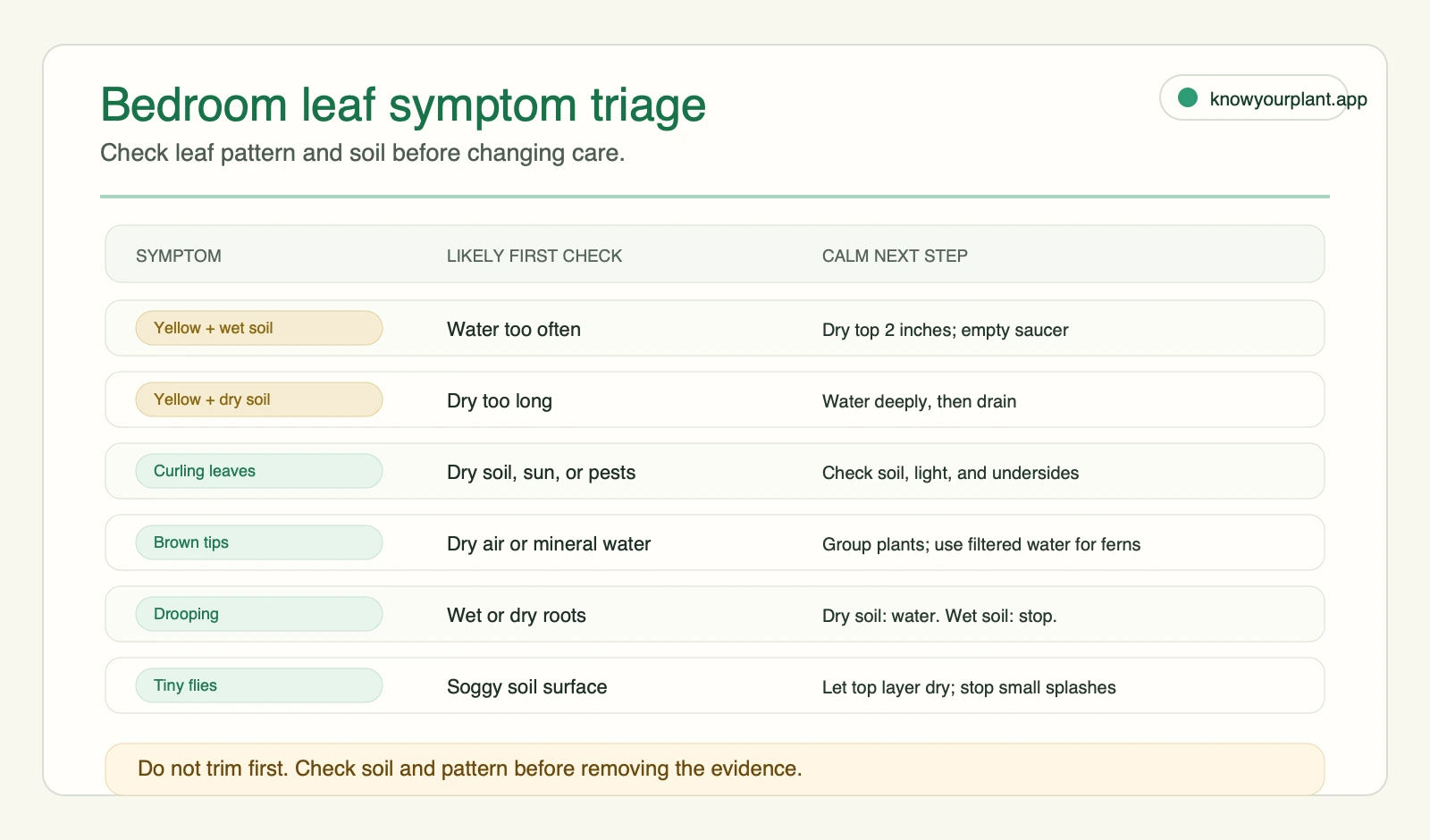
Treat the symptom as a clue, not a verdict. Check the soil and pattern before trimming leaves or changing the whole care routine.
How to Choose the Right Bedroom Plant
Picking the right plant comes down to four things:
Your light situation. Walk into your bedroom during the day and honestly assess what you see. If you can comfortably read a book by window light, you have medium to bright indirect light. If the room feels dim even at noon, stick with snake plant, pothos, ZZ plant, or peace lily. As Darryl Cheng of House Plant Journal puts it: match the plant to the light you actually have, not the light you wish you had.
Your pets. If cats or dogs sleep in your bedroom, go with spider plant, areca palm, boston fern, prayer plant, or jasmine. All safe if your pet decides to chew a leaf. If you want more choices beyond the bedroom shortlist, browse the full cat-safe indoor plants roundup.
Your maintenance style. Be honest. If you want something you can ignore for two weeks, choose snake plant, ZZ plant, or aloe vera. If you enjoy a brief daily check-in, peace lily, boston fern, or jasmine will reward the attention. If you’re still figuring out what kind of plant owner you are, the easy houseplants for beginners guide is a good reality check before you buy.
Your priority: air quality or sleep. Plants can add greenery and atmosphere, but ventilation or an air purifier matters more for room air quality. If you enjoy fragrance and have enough light, lavender or jasmine may suit you; keep lavender away from cats and dogs. Snake plant and aloe vera use CAM to take up CO2 at night, but that is not an overnight oxygen benefit. Cornell explains how CAM separates nighttime carbon uptake from daytime use.
Setting Up Your Bedroom Plant Corner
Where you place your plants matters almost as much as which ones you pick. A few practical tips:
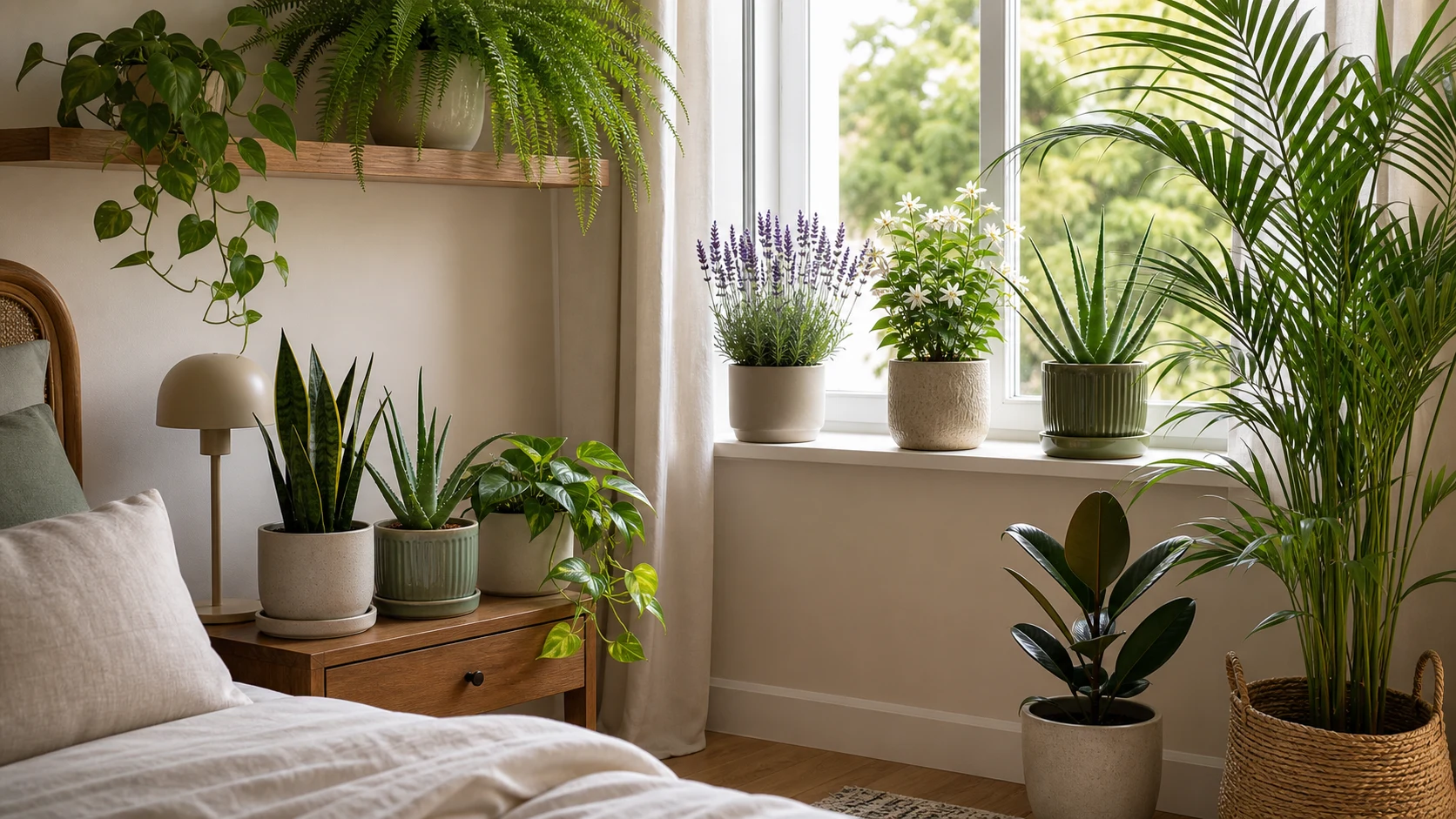
Nightstand, windowsill, high-shelf, and floor plants each use the bedroom light and space differently in this practical setup.
Nightstand picks. Small, low-maintenance plants work best here: a snake plant in a 15cm pot, an aloe vera, or a small pothos in a decorative planter. Keep drainage trays underneath to protect the surface.
Windowsill lineup. This is where your light-hungry plants go: lavender, jasmine, aloe vera. Group two or three together and they’ll create a small humidity pocket that benefits all of them.
High shelf or hanging spot. Trailing plants like pothos and boston fern look their best cascading downward. A shelf above the bed or a hanging planter in the corner adds greenery without taking up floor space. If you want more options in that same look, our best trailing plants for indoors roundup is a good next stop.
Floor statement. Areca palm and rubber plant grow large enough to stand on the floor in a corner. Position them where they’ll get the best light, but keep them away from heating vents, which dry out leaves and disrupt the humidity benefit.
The grouping trick. Clustering three or four plants together raises the humidity around them more effectively than spreading single plants across the room. Pick one corner or one side of the room and create a small green cluster there.
If your bedroom barely gets any natural light, a small grow light can open up your options. Even a basic clip-on LED running for 8-10 hours gives low-light plants enough to thrive.
A Simple Bedroom Plant Routine
This is enough for most beginner-friendly bedroom plants. Adjust only when the plant or soil tells you to.
Today: Put the plant in a pot with drainage, set it where the light matches the plant’s needs, and water only if the soil is dry to the depth listed above. If the nursery pot is still damp, leave it alone.
This week: Check the pot weight once or twice. A dry pot feels noticeably lighter. Look for yellowing leaves, curling leaves, brown tips, sticky residue, or tiny flies before you water again.
This season: In spring and summer, expect faster drying and feed lightly once a month if the plant is growing. In autumn and winter, reduce watering, keep plants away from vents and cold windows, and skip fertilizer until growth starts again.
Seasonal Bedroom Plant Care Calendar
Your bedroom plants need different things as the seasons change. Here’s what to adjust throughout the year.
Spring (March to May)
This is when most plants wake up and start growing again. Increase watering slightly as growth picks up. If you stopped fertilizing over winter, start again with a half-strength liquid feed once a month. Move plants a little closer to windows as the days get longer. Check for new growth on your spider plant and pothos, a good sign they’re happy.
Summer (June to August)
Peak growing season. Water more frequently, especially if you run air conditioning, which drops humidity. Keep an eye on your boston fern and prayer plant: if leaf edges start browning, the air is too dry. A pebble tray or occasional misting helps. Rotate plants a quarter turn each week so they grow evenly. Lavender and jasmine will be at their most active now.
Autumn (September to November)
Growth slows down. Reduce watering gradually, let the soil dry a bit more between drinks. Stop fertilizing by mid-October. As daylight hours shorten, you may need to shift plants closer to windows or add supplemental light. This is a good time to wipe down leaves (dust blocks light absorption) and check for pests that hitchhike indoors as temperatures drop.
Winter (December to February)
Most bedroom plants go semi-dormant. Water less, maybe half the summer frequency. Keep plants away from cold window drafts and heating vents (both cause stress). Humidity often drops below 30% from central heating, which is when grouped plants can help the corner around them feel less dry. Don’t repot or fertilize until spring.
Methodology Note
This article was refreshed using live research checked on 2026-06-06: exact-keyword SERP review for best plants for bedroom and close variants, snippet-validated reader questions about night oxygen, allergy concerns, and pet-safe low-light options, plus primary-source checks from NASA Spinoff, Arizona State University, extension services, botanical references, and poison-center sources used for care and toxicity claims. Community discussions are used here as qualitative signal, not as proof on their own. A targeted correction on 2026-10-07 checked CAM against NC State Extension and Cornell, and lavender toxicity against the ASPCA; nighttime CO2 uptake is now distinguished from oxygen production, and lavender is excluded from the pet-safe list.
Freshness Note
Last updated: 2026-10-07. Re-check pet safety, fragrance tolerance, and low-light expectations whenever you move a plant between a bright windowsill and a dimmer bedside spot, or when a new pet starts sharing the room.
Frequently Asked Questions
How many plants do I need in my bedroom?
Two to three medium-sized plants make a noticeable difference in how the room feels. You don’t need to fill every surface. Start with one plant you’re confident you can keep alive, then add more as you get comfortable.
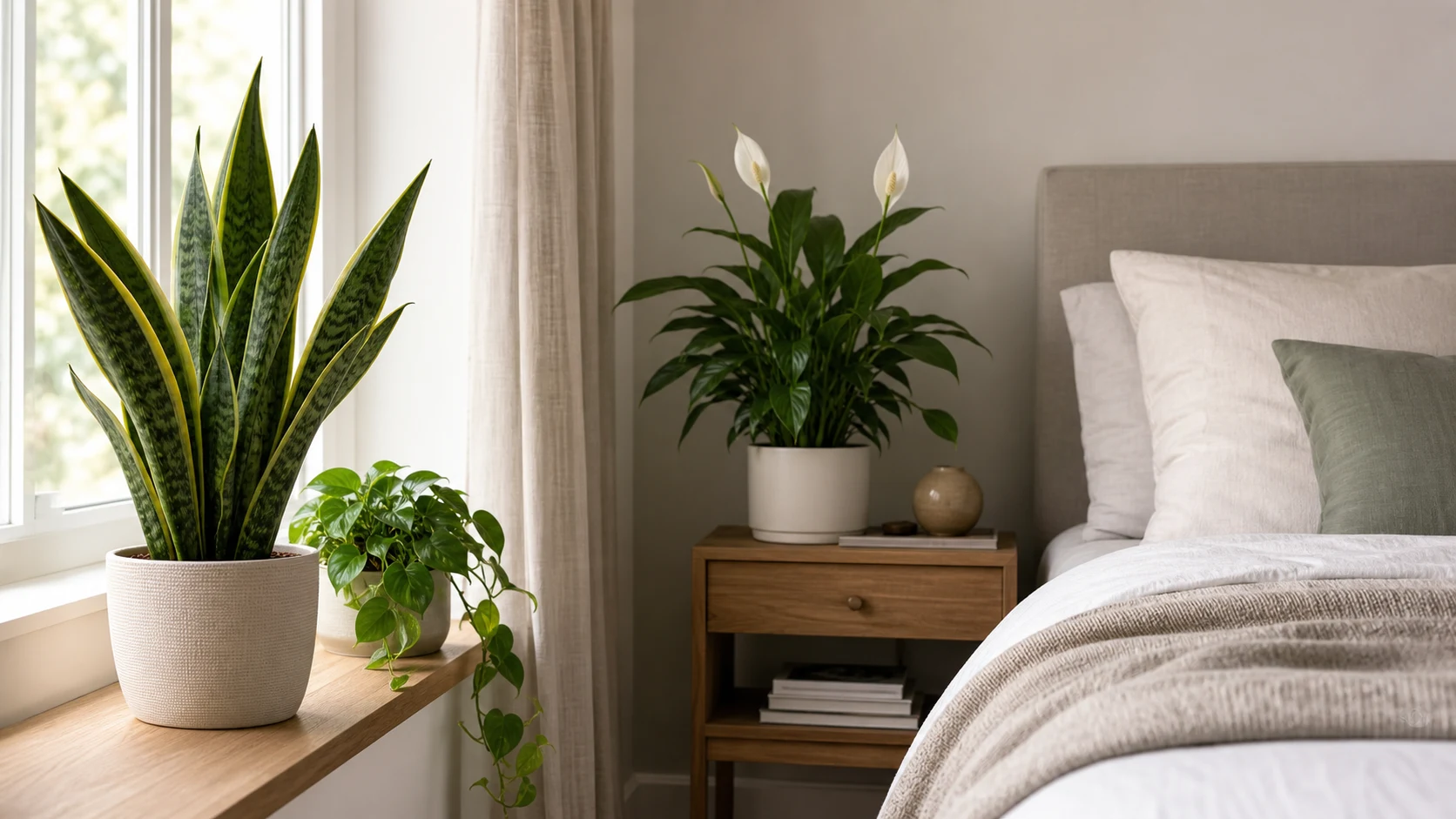
Three medium plants add greenery across the bedroom without filling every available surface.
Is it safe to sleep with plants in my bedroom?
Yes. The amount of CO2 plants release at night is tiny compared to what you and a partner breathe out. CAM plants such as snake plant and aloe vera can take up CO2 at night, but they do not produce oxygen in darkness. Choose plants that fit the room and keep normal ventilation.
Which plants produce oxygen at night?
Snake plant and aloe vera take up CO2 at night through CAM, but oxygen production requires light. Nighttime carbon uptake and nighttime oxygen production are different processes; Cornell’s explanation of CAM describes how the stored carbon is used during the day. Do not expect these plants to boost bedroom oxygen after dark.
What if I forget to water my bedroom plants?
Snake plant, ZZ plant, pothos, and aloe vera all handle neglect well. These four can go two to three weeks without water and still look fine. If you travel often or just forget, stick to these drought-tolerant picks.
Can bedroom plants help with dry air from heating?
Yes, a little. Plants release moisture through transpiration, and grouping a few together can make the air around that plant corner feel less dry. Boston fern, areca palm, and spider plant are especially good choices for this. The University of Minnesota Extension notes that humidity below 30% can disrupt sleep, so plants help most when paired with normal fixes like moving them away from vents and keeping the room from getting bone-dry.
Which bedroom plants are safe for cats?
Spider plant, areca palm, boston fern, prayer plant, and jasmine are the non-toxic choices on this list. Lavender is toxic to cats and dogs according to the ASPCA, so keep it off the cat-safe shortlist. Check our full cat-safe plants guide for more options. If your cat chews plants, choose only from the pet-safe list and keep toxic plants out of the room.
Will bedroom plants attract bugs?
Overwatering is the main cause of pest issues indoors. If you let the soil dry appropriately between watering and use pots with drainage holes, bugs are unlikely. Fungus gnats are the most common nuisance, and they only show up in consistently soggy soil. Keep your watering in check and you’ll be fine. For more on low-light options that work well in bedrooms, see our low-light indoor plants guide.
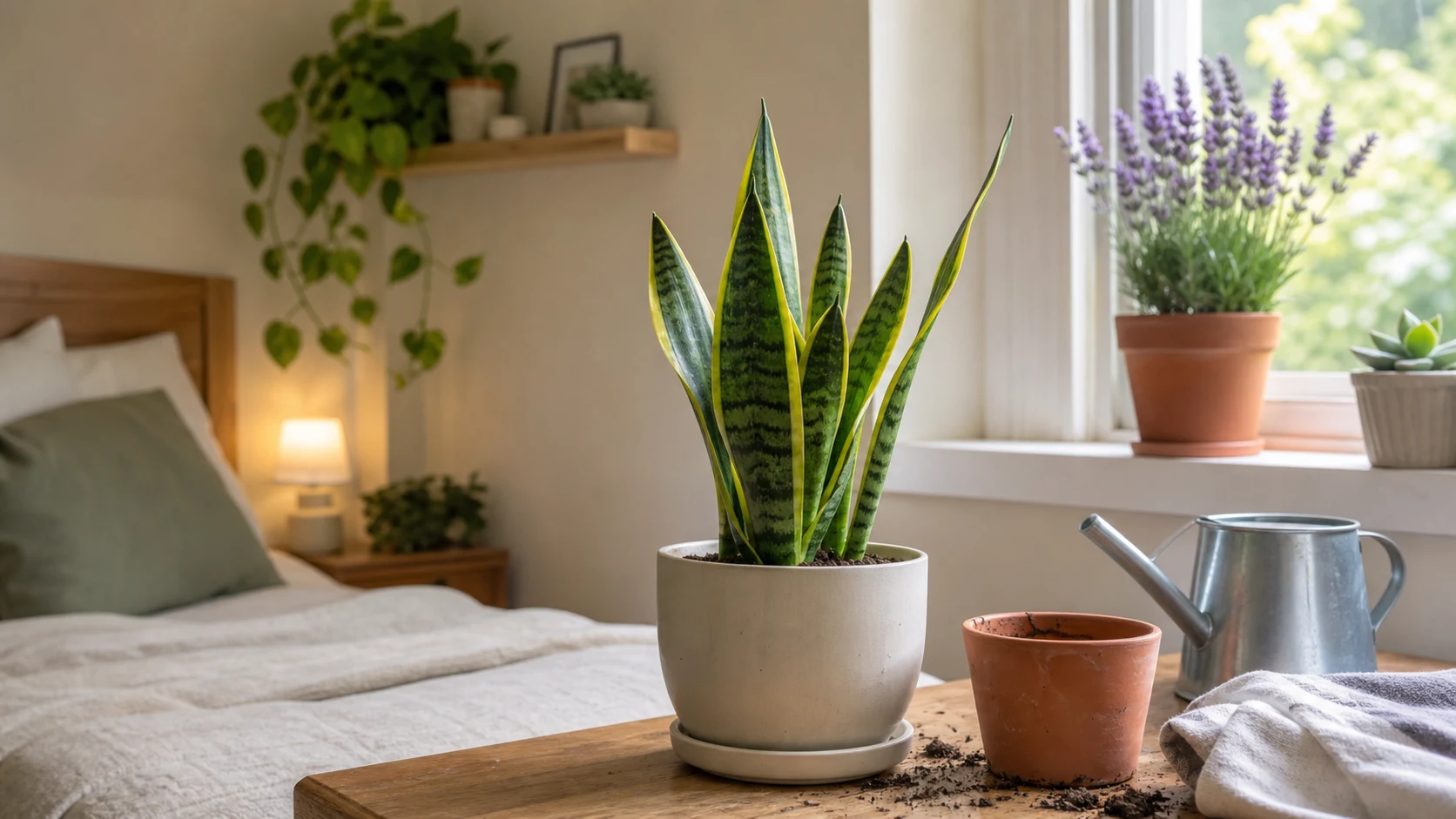
Drying soil appropriately and using a drained pot with a saucer help prevent the soggy conditions that attract fungus gnats.
Your bedroom should feel like a place you actually want to be, not just a room you sleep in. A snake plant on the nightstand, a trailing pothos on a high shelf, maybe a lavender on the windowsill if you get the light: that’s enough to shift the air quality and the whole atmosphere of the room.
Pick one plant from this list that matches your light and your lifestyle. Give it a spot, water it when it needs it, and let it do its thing.
Add your chosen plant to KnowYourPlant so the reminders and care notes match the bedroom plant you actually bought.