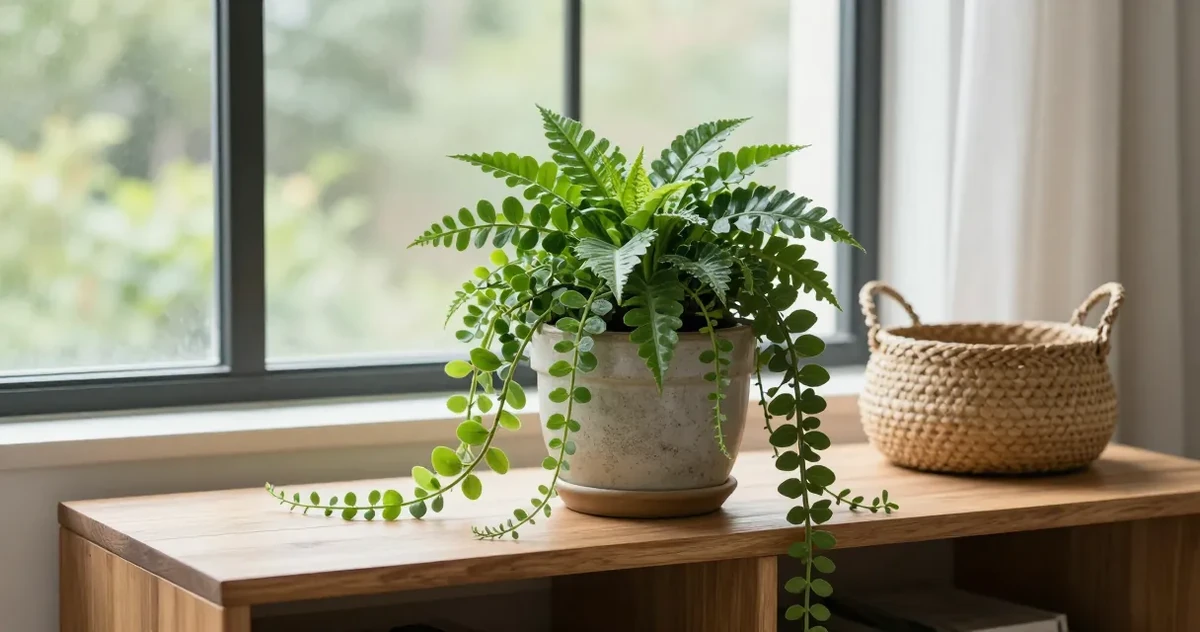
If you are choosing a trailing indoor plant, the useful question is not just “which vine looks good on a shelf?” It is “will this plant work with my light, my watering habits, and my pets?” This guide is for everyday plant owners who want a clear shortlist before buying, plus quick answers when leaves curl, yellow, or get brown tips.
A trailing plant grows by sending stems outward and downward instead of mostly upright. That habit makes trailing plants useful for hanging baskets, high shelves, wardrobes, bookcases, and small rooms where you do not want another pot on the floor. If you are deciding between a true trailing vine and a fuller basket plant, our indoor hanging plants guide shows where those categories overlap and where they behave differently.
Byline: KnowYourPlant editorial team. Last updated June 18, 2026. We refreshed this guide against ASPCA toxicity lists plus extension care profiles for golden pothos, spider plant, and string of pearls, then used current plant-owner questions as a reality check for low light, pet safety, and hanging-basket watering problems.
Trailing plants with different climate histories
Trailing is a growth habit in a room, not a climate category. Four popular vines are compared here as accepted species so a shared shelf position does not imply shared ecology.
The ranges below are the middle 50% (p25–p75), not recommended indoor setpoints.
| Reference taxon | POWO native range | Annual mean temperature | Annual precipitation | Relative humidity | Solar radiation | Evidence |
|---|---|---|---|---|---|---|
| Epipremnum aureum (golden pothos) | Mo’orea in the Society Islands | 25.7–25.9°C | 2451–2644 mm/yr | 63–64% | 20.0–20.1 MJ/m²/day | 6 climate points; low confidence |
| Philodendron hederaceum (heartleaf philodendron) | Mexico to tropical America | 24.0–25.9°C | 1668–2787 mm/yr | 64–68% | 17.0–18.7 MJ/m²/day | 30 climate points / 783 usable records; medium confidence |
| Scindapsus pictus (satin pothos) | southeastern Bangladesh to western and central Malesia | 24.0–26.6°C | 2758–3377 mm/yr | 67–70% | 17.4–18.9 MJ/m²/day | 30 climate points / 52 usable records; medium confidence |
| Monstera adansonii (Monstera adansonii) | tropical America | 21.8–25.5°C | 1613–3025 mm/yr | 64–69% | 16.8–18.6 MJ/m²/day | 30 climate points / 1,332 usable records; medium confidence |
What this changes in this guide: Use the contrast to individualize pot checks and light placement. The same hanging basket material can dry at different rates once leaf area, roots, and species response diverge.
Sources and method: Epipremnum aureum in POWO and GBIF; Philodendron hederaceum in POWO and GBIF; Scindapsus pictus in POWO and GBIF; Monstera adansonii in POWO and GBIF; CHELSA V2.1, 1981–2010. GBIF records are limited to POWO-native countries, then filtered for coordinates, establishment signal, licence, precision, and spatial duplication. No community or user-reported care data is used in this module.
What Most Plant Roundups Miss
Most roundups about trailing indoor plants list attractive options. The better question is which choice will still make sense in your actual room three months from now.
Use this filter before choosing:
- Light reality: what the plant receives on a normal cloudy day, not the brightest hour of the week.
- Care rhythm: whether you prefer weekly attention or a plant that can be ignored longer.
- Space: mature height, spread, trailing habit, and whether leaves will touch walls or pets.
- Failure signal: what the plant does first when the match is wrong: yellowing, stretching, crisping, or dropping leaves.
A good recommendation is not just beautiful. It fits the room, the owner, and the first problem you are likely to notice.
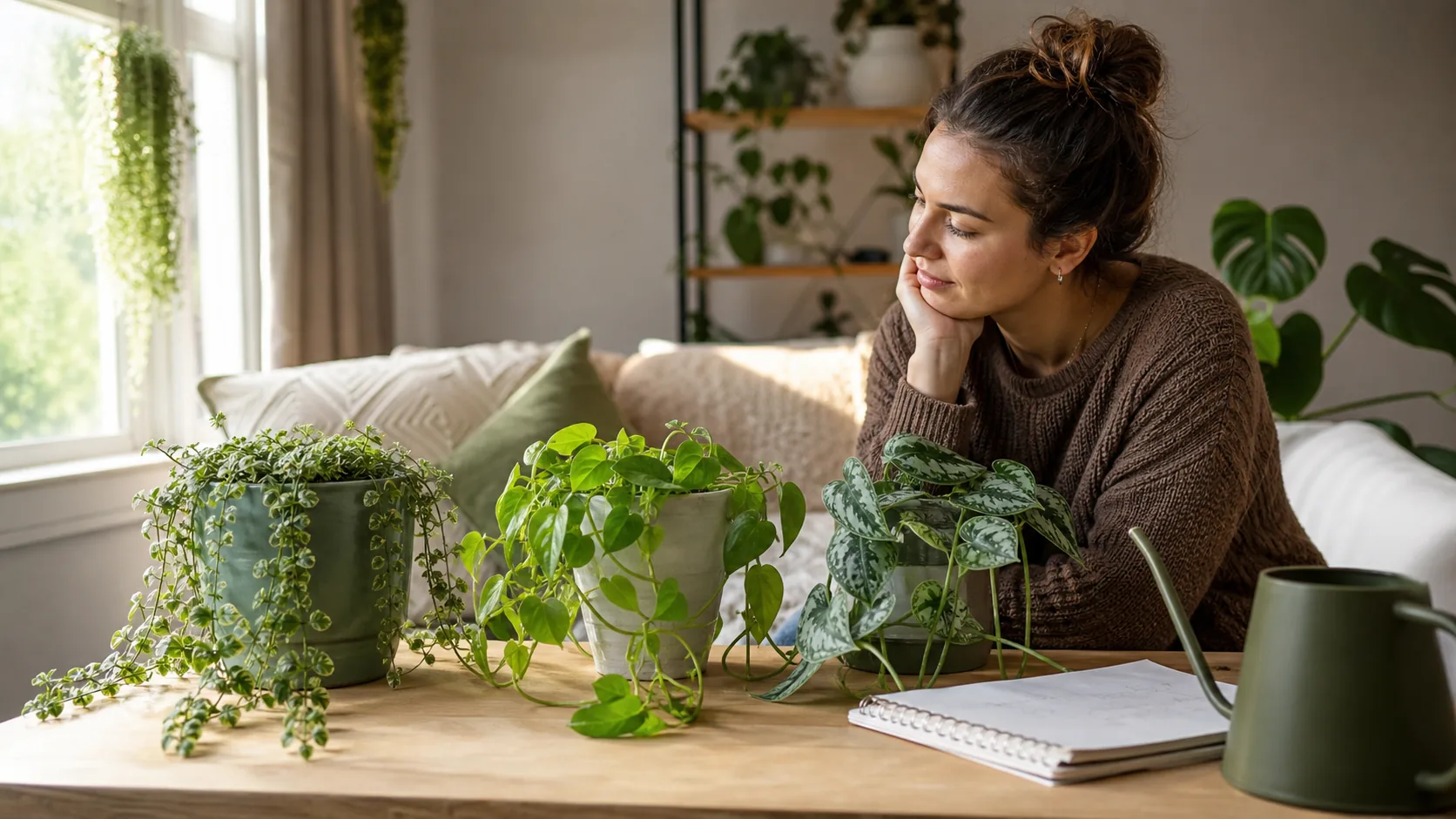
Comparing light, watering rhythm, and trailing reach makes room fit more useful than appearance alone.
Identification Snapshot
Use this quick snapshot before you buy. It helps you sort trailing plants by how they behave, not just by how they photograph.
| Plant type | What you will notice first | Usually best for | Usually frustrating when… |
|---|---|---|---|
| Forgiving vines | Soft, leafy stems that recover well after a missed watering | Shelves, bookcases, beginners, mixed-light rooms | You want a pet-safe option without tradeoffs |
| String succulents | Bead-like or thin succulent leaves that store water | Bright windows, forgetful waterers, minimalist setups | The room is dim or you water out of habit |
| Humidity lovers | Dense fronds or finer foliage that dries faster | Bright bathrooms, plant owners who check soil often | The room is hot, dry, or watered on autopilot |
| Fast fillers | Quick vining or runner growth that changes a display fast | People who want visible growth and easy propagation | You want a very tidy plant with no pruning |
Quick Fit Check Before You Buy
Use this first if you are standing in a plant shop or comparing options online:
| Your room or routine | Start with | Avoid for now | Pet-safety note | First failure signal |
|---|---|---|---|---|
| Low to medium light | Golden pothos, heartleaf philodendron, spider plant | String of pearls, burro’s tail | Spider plant is the easier safer pick if pets can reach the pot | Small leaves and long gaps between nodes mean the room is dimmer than you thought |
| Bright window and you forget to water | String of hearts, string of bananas, burro’s tail | Boston fern, creeping fig | Keep string succulents away from chewing pets | Mushy stems mean the mix stayed wet too long |
| You water often and have humidity | Boston fern, creeping fig | Most string succulents | Boston fern is usually the easier pet-safer option | Crispy edges mean dry air or inconsistent moisture, not always lack of water |
| You want fast growth | Tradescantia, golden pothos, Swedish ivy | String of turtles | Tradescantia and pothos are poor picks for chewing pets | Bare stems near the pot mean the light is weaker than the growth rate needs |
| Pets chew plants | Spider plant or Boston fern are better starting points | Pothos, English ivy, string of pearls | Verify the exact species against ASPCA cat and dog lists before bringing it home | Bite marks and tipped baskets matter more than a label that says hanging plant |
The simple watering rule: pothos, philodendron, spider plant, Swedish ivy, and tradescantia usually want water when the top inch or two of soil is dry. String succulents want the whole pot to dry out before you water again. Ferns and creeping fig want more consistent moisture and are less forgiving if you forget them for long stretches.
Expert note: the beginner pattern here matches extension care profiles, but pet-safety calls should be checked separately through ASPCA cat and dog toxicity lists. Golden pothos can tolerate low light but fails fast when the pot stays wet. Spider plant handles a broader range of indoor conditions and works well in hanging baskets. String of pearls is far less forgiving because weak light and extra water both become problems quickly.
What Plant Owners Keep Getting Stuck On
Reader questions around trailing plants usually cluster around three awkward combinations: low light plus a true trailing shape, pet safety plus a plant that still looks lush, and bright-window vines that do not collapse when watering gets inconsistent.
That is why this guide separates survives low light from still trails attractively in low light, and why spider plant and Boston fern show up so often as safer starting points when cats or dogs can reach the foliage. Community threads are useful for spotting those patterns, but the care and toxicity calls here are anchored to extension guidance and ASPCA lists rather than plant-shopping hype.
Lookalikes and Confused-With Plants
A lot of trailing-plant frustration starts with buying the wrong lookalike.
| If you are choosing between… | The simpler read | Why it matters |
|---|---|---|
| Golden pothos vs heartleaf philodendron | Pothos leaves are usually thicker and waxier, philodendron leaves look softer and more heart-shaped | Both are forgiving, but philodendron usually asks for a bit brighter light |
| String of pearls vs string of bananas | Pearls look round, bananas look curved and longer | Care is similar, but buyers often misidentify them and then misread the leaves |
| Boston fern vs delicate collector ferns | Boston fern is the safer starting point and usually fuller | Some fern lookalikes are much less forgiving in ordinary dry rooms |
| Swedish ivy vs English ivy | Swedish ivy has softer, fleshier foliage and is the better beginner choice | English ivy is a cooler-room plant and is not the same pet-risk tradeoff |
Care Cards
Use these quick cards if you want a shortlist before reading all fifteen plants.
Care Card 1: Forgiving starter vines
- Best picks: golden pothos, heartleaf philodendron, spider plant
- Best light: low to bright indirect light
- Watering style: let the top part of the soil dry before watering again
- Why people like them: they recover well, grow visibly, and make good first hanging or shelf plants
- What goes wrong first: yellow soft leaves from staying wet too long
Care Card 2: Bright-light string succulents
- Best picks: string of pearls, string of hearts, string of bananas, burro’s tail
- Best light: bright indirect light or a strong window
- Watering style: let the pot dry much more fully than you would for pothos or philodendron
- Why people like them: sculptural look, lighter watering rhythm, strong windowsill appeal
- What goes wrong first: mushy stems from overwatering or stretched growth from dim light
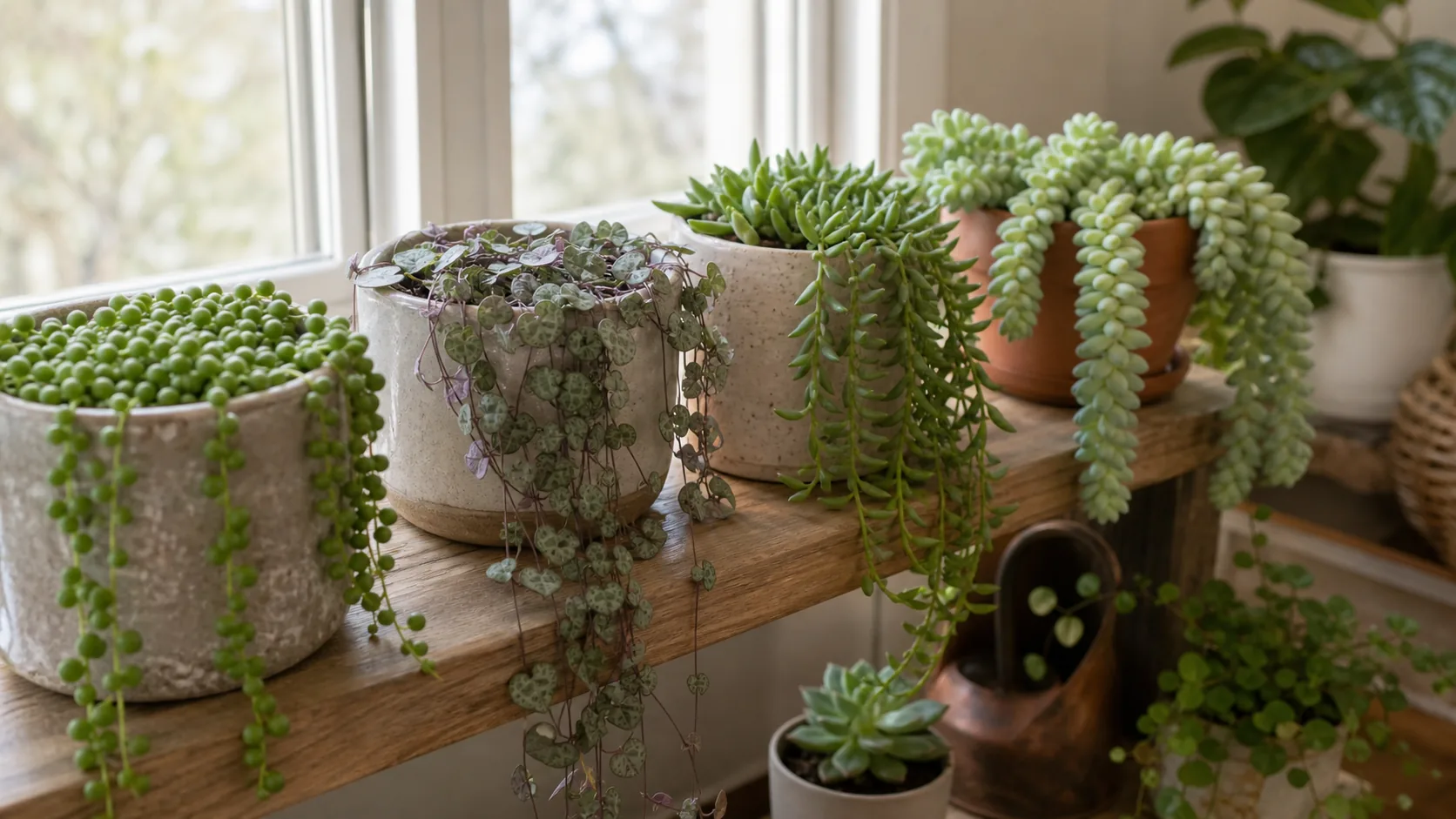
Bright window light and a drier watering rhythm suit sculptural string succulents.
Care Card 3: Humidity lovers and thirstier trailers
- Best picks: Boston fern, creeping fig
- Best light: bright indirect light with steadier moisture
- Watering style: check them more often and do not let them sit dry for long
- Why people like them: fuller texture, softer look, strong bathroom or bright kitchen fit
- What goes wrong first: crispy edges when air is dry or water is inconsistent
Care Card 4: Fast growers and easy fillers
- Best picks: tradescantia, Swedish ivy, neon pothos
- Best light: medium to bright indirect light
- Watering style: regular but not soggy
- Why people like them: they fill a basket or shelf quickly and respond well to pruning
- What goes wrong first: leggy growth when the light is weaker than expected
Here are fifteen to consider.
1. Golden Pothos (Epipremnum aureum)
If you’re new to trailing plants, golden pothos is the one to start with. She trails generously, tolerates low light, and forgives inconsistent watering better than most. The heart-shaped leaves are glossy green with yellow variegation that looks different depending on the light. If you are deciding between pothos and a similar-looking vine, our pothos vs philodendron comparison makes the differences easy to spot.
She’s happy in a hanging basket or draped over a high shelf. Let the soil dry out between waterings and she’ll keep growing steadily. For more on her specific needs, the golden pothos care guide covers everything in detail.
Best for: beginners, low-light rooms, high shelves
Care cue: Water when the top 2 inches feel dry. Yellow, soft leaves usually mean the pot is staying too wet, curling or drooping leaves with dry soil mean she is thirsty.
2. Heartleaf Philodendron (Philodendron hederaceum)
Heartleaf philodendron trails in a softer, more relaxed way than pothos. The leaves are deeper green with a slight droop at the tip that makes each stem look like it’s leaning into the light. She tolerates low light but prefers something brighter. Water when the top inch of soil feels dry and she’ll reward you with steady, cheerful growth.
The heartleaf philodendron care guide has a good section on reading her leaf color to diagnose what she needs, and the best tropical plants for indoors roundup helps if you want more trailing plants with the same lush aroid feel.
Best for: shelves, medium-light rooms, beginners
Care cue: Water when the top inch feels dry. Small pale leaves usually mean she wants brighter indirect light, limp leaves in dry soil mean water today.
3. String of Pearls (Senecio rowleyanus)
String of pearls is unmistakable. The leaves have reduced themselves to perfect little spheres along each stem, which hang in threads from the pot. It looks architectural, slightly surreal, and completely unlike anything else on a shelf. If you already have a healthy plant and want to multiply it without losing strands to rot, the step-by-step String of Pearls propagation guide is the next useful read.
She needs bright light and minimal water. She stores moisture in those round leaves, so overwatering is the main risk. A bright windowsill or hanging basket near a sunny window suits her well. If your windowsills don’t get enough natural light, a grow light can make a real difference: see the grow lights for indoor plants guide for options that work well with succulents.
Best for: bright windowsills, hanging baskets, succulent collections
Care cue: Let the pot dry out fully before watering. Shriveled pearls mean she is too dry, mushy, yellow, or translucent pearls mean too much water.
4. String of Hearts (Ceropegia woodii)
Delicate silver-green hearts on thin purple stems. String of hearts trails more subtly than most plants on this list, but up close she’s one of the most interesting trailing houseplants you can grow indoors.
She prefers bright indirect light and needs to dry out fully between waterings. In good conditions, she’ll produce small tubers along the stems that you can use to propagate new plants.
Best for: bright rooms, hanging near windows, small spaces
Care cue: Let the soil dry fully between waterings. Thin, curling leaves point to thirst, soft stems or yellowing near the soil line point to overwatering.
5. Tradescantia (Tradescantia zebrina)
Tradescantia grows fast and trails dramatically. The striped purple-and-silver leaves of Tradescantia zebrina are striking, and the plant has no problem filling a hanging basket in a single season.
She fades in low light, but brighter conditions keep the color vivid. Pinch back the tips occasionally to keep her full rather than sparse at the base.
Best for: color contrast, fast growth, hanging baskets in bright rooms
Care cue: Water when the top inch dries. Faded leaves mean she needs brighter light, crispy brown tips usually mean inconsistent watering or very dry air.
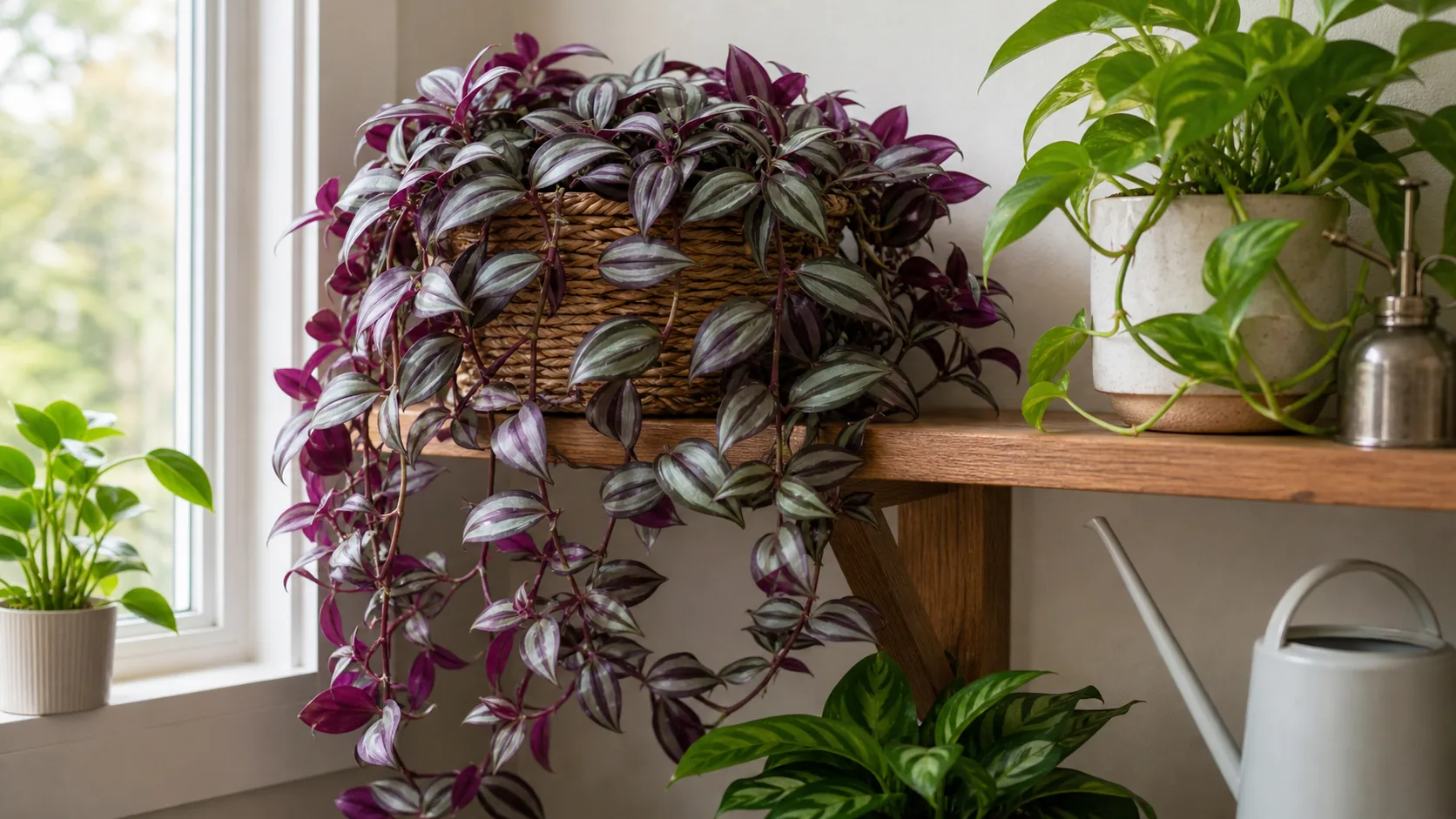
Bright indirect light keeps Tradescantia zebrina full and its silver-purple stripes vivid.
6. Spider Plant (Chlorophytum comosum)
Spider plants are classic for a reason. The arching green-and-white striped leaves are attractive on their own, but the real show comes when the plant sends out long runners with baby plants at the tips. Hang her up and those babies dangle in the air like ornaments.
She tolerates most light conditions and grows consistently. Hard to kill, easy to propagate, and one of the few trailing plants that produces plantlets you can pot up and give away.
Best for: beginners, kitchens, hallways
Care cue: Water when the top inch dries. Brown tips are common with dry air, mineral-heavy water, or irregular watering, yellow, limp leaves in wet soil mean slow down.
7. Burro’s Tail (Sedum morganianum)
Burro’s tail is one of the most satisfying succulents to grow in a hanging basket. The thick, overlapping blue-green leaves build up along each stem into something that looks almost braided.
She needs full sun and very little water. The leaves detach easily, so handle her gently, but any that fall into soil will often sprout into new plants on their own.
Best for: sunny windowsills, hanging baskets in bright rooms, succulent collections
Care cue: Let the pot dry out completely before watering. Wrinkled leaves mean she is ready for water, mushy leaves that drop easily often mean overwatering.
8. String of Bananas (Senecio radicans)
Similar care to string of pearls, but with leaves shaped like small curved bananas instead of spheres. She grows faster and trails more vigorously, making her a good choice if you want that succulent trailing look on a shelf rather than a fine hanging thread.
Bright light and infrequent watering. She’s drought-tolerant and doesn’t enjoy wet soil.
Best for: bright shelves, sunny rooms, fast trailing growth
Care cue: Water only after the soil dries through. Wrinkled leaves need a drink, soft or translucent leaves mean the roots have been too wet.
9. English Ivy (Hedera helix)
English ivy is one of the few trailing plants that actually prefers cooler temperatures. She thrives in rooms that stay on the cool side and can handle lower light than most plants on this list.
The lobed leaves come in many varieties: plain green, variegated white, or golden. She does well in hanging baskets or trailing from a shelf in a hallway or bathroom.
Best for: cool rooms, hallways, low-light spots
Care cue: Water when the top inch dries, and keep her away from hot, dry air. Crispy edges can mean dry air or pests, yellow leaves in wet soil mean overwatering.
10. String of Turtles (Peperomia prostrata)
String of turtles grows slowly, but each tiny leaf is patterned like a turtle shell in dark green and silver. She’s a collector’s plant in the best sense.
She needs moderate to bright indirect light and doesn’t like to stay wet. Her small size makes her perfect for a windowsill or the edge of a small shelf.
Best for: windowsills, collectors, small spaces
Care cue: Water when the top half of the pot has dried, not while the mix is still damp. Dropping leaves often means cold, wet soil or too much water.
11. Marble Queen Pothos (Epipremnum aureum ‘Marble Queen’)
Everything about golden pothos applies here, with one difference: the white marbling in the leaves is more pronounced, giving her a lighter, almost frosted look. She grows a little slower because of the reduced chlorophyll in those pale areas.
She needs slightly brighter light to maintain that contrast, but she’s still one of the more tolerant indoor trailing plants you’ll find.
Best for: bright rooms, high shelves, variegation lovers
Care cue: Water when the top 2 inches dry. If the white variegation fades, move her closer to bright indirect light, yellow leaves near the base usually mean too much water.
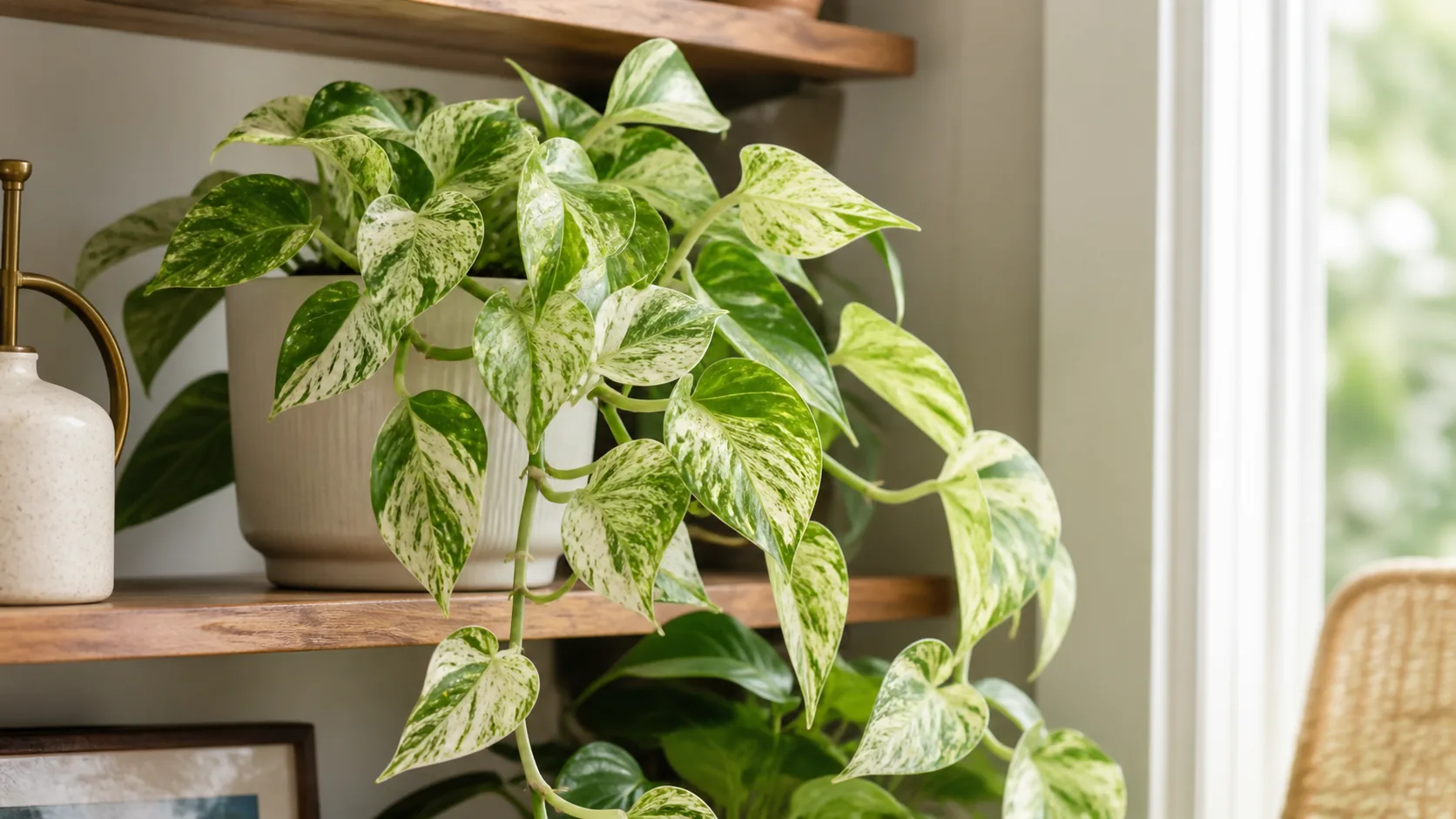
Bright indirect light helps Marble Queen pothos maintain its distinctive cream-green contrast.
12. Boston Fern (Nephrolepis exaltata)
Boston ferns were built for hanging baskets. The long, arching fronds spill outward in every direction and create a soft, full silhouette that fills a space beautifully.
She needs humidity, consistent moisture, and indirect light. She’s more demanding than most plants on this list, but if your bathroom gets good natural light and stays warm, she is one of the better hanging choices. In a dry living room, expect crispy fronds unless you keep the soil evenly moist and raise humidity.
Best for: humid bathrooms, hanging baskets, bright indirect light
Care cue: Keep the soil lightly moist, not soggy. Crispy brown fronds mean she dried out too much, yellowing at the base means the pot may be waterlogged.
13. Creeping Fig (Ficus pumila)
Creeping fig trails rather than hanging dramatically, making her a good choice for the edge of a shelf or a planter where you want coverage. The small, slightly wavy leaves create a dense look over time.
She needs consistent moisture and doesn’t like to dry out fully. Medium to bright indirect light keeps her healthy.
Best for: shelf edges, dense coverage, terrariums
Care cue: Keep the soil slightly moist. Crispy leaves mean it dried too far, yellow leaves and a sour-smelling pot mean the roots are staying wet.
14. Swedish Ivy (Plectranthus australis)
Swedish ivy is a reliable, unpretentious plant that doesn’t get enough attention. She grows quickly, trails well, and produces small white or purple flowers occasionally.
She handles a range of light conditions and only asks for regular watering when the top layer of soil dries out. A solid choice for a hanging basket in a room where other plants have struggled.
Best for: hanging baskets, medium-light rooms, reliable growth
Care cue: Water when the top inch dries. If the plant gets leggy, give it more light and pinch the tips so it branches instead of making long bare stems.
15. Neon Pothos (Epipremnum aureum ‘Neon’)
Neon pothos has lime-green leaves so vivid they look almost luminous. She shares the same easy care as other pothos varieties but brings a completely different energy to a shelf or hanging basket.
She does best in moderate to bright indirect light, which keeps that color saturated. In low light, the leaves tend toward a more muted yellow-green. For a full comparison of pothos varieties and what makes each one different, the pothos varieties guide is worth reading before you choose.
Best for: bright rooms, color contrast, high shelves
Care cue: Water when the top 2 inches dry. Duller green leaves mean light is too low, yellow leaves near the soil line mean check for wet soil before watering again.
Quick Symptom Fixes for Trailing Plants
When a trailing plant starts looking off, check water and light before changing everything at once. Most problems show up first in the leaves and the soil.
Yellow leaves: Feel the soil before you water. If it is damp, wait longer next time and make sure the pot drains freely. If it is bone dry and the whole plant is limp, water deeply and let the extra drain away.
Curling leaves: Curling usually means the plant is protecting itself from thirst, too much direct sun, or a cold draft. Check the soil first. If it is dry, water. If it is wet, move the plant to steadier light and leave the soil alone until it dries.
Brown tips or crispy edges: Look for dry air, missed waterings, harsh direct sun, or mineral buildup from tap water. Trim the brown tips if you dislike the look, then fix the cause rather than watering more automatically.
Sparse, leggy vines: Move the plant closer to a window or grow light, then pinch back the longest stems. A brighter spot plus light trimming usually makes new growth fuller.
Symptom-First Mini Decision Tree
- Yellow, soft leaves and damp soil? Water less often and check that the inner pot drains freely.
- Wrinkled, curled, or drooping leaves with dry soil? Water deeply, then let the pot drain before hanging it back up.
- Long bare stems with small leaves? Increase light before you increase fertilizer.
- Mushy stems on a string succulent? Stop watering, move it brighter, and check for rot near the soil line.
- Brown tips on a fern or spider plant? Review dry air, mineral-heavy water, and inconsistent watering before assuming disease.
Simple Care Routine: Today, This Week, This Season
Today: Put the plant where it matches its light needs, then check the soil with your finger. Water only if the soil matches that plant’s watering cue.
This week: Rotate the pot, inspect leaf undersides for pests, remove dead leaves, and trim one or two long bare stems if the plant is getting thin.
This season: Repot only if roots are circling tightly or growing through the drainage holes. Fertilize during active growth, then reduce feeding and watering when growth slows in autumn and winter.
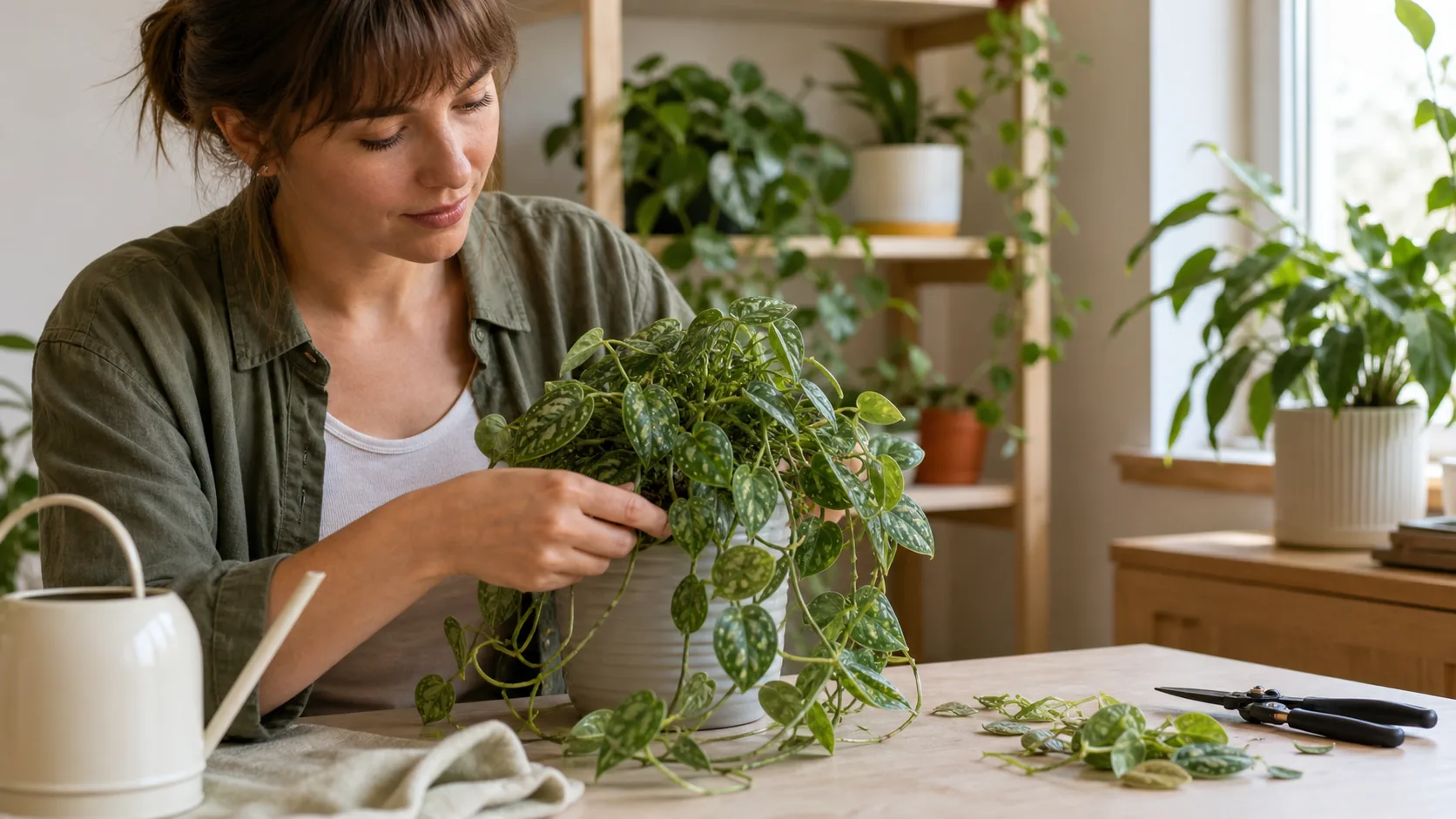
Regular inspection and selective trimming keep a trailing plant full without overcorrecting its care.
Seasonal Care Calendar for Trailing Plants
Most care guides tell you what to do but not when. Trailing plants follow seasonal rhythms even indoors, and matching your care to the season prevents most of the common problems.
Spring (March to May)
This is when trailing plants want to grow. If a plant has been in the same pot for two or more years, check the drainage holes in March: roots poking through is your signal to repot, one size up. Start fertilizing monthly as daylight increases. Pothos, philodendron, and tradescantia all root easily in water now, so spring is the best time to take cuttings. Expect faster growth than you saw all winter and adjust your watering frequency to match.
Summer (June to August)
Hanging baskets dry out faster in warm months because air circulates around the pot on all sides. Check the soil more often than you do in winter. Spider mites also love dry heat, so look closely at tradescantia and string succulents if leaves start to dull or spot.
Autumn (September to November)
Slow down fertilizing in October and stop by November. Growth will slow on its own and pushing it with fertilizer when light is declining causes weak, leggy stems. Reduce watering frequency as the soil takes longer to dry.
Winter (December to February)
String succulents need near-dormancy in winter. Water much less often, move all trailing plants away from cold drafts, and do not fertilize until you see fresh growth return.
A Note on Pet Safety
Several plants on this list are toxic to cats and dogs, including pothos varieties, string of pearls, string of hearts, and English ivy. If you have a chewing pet, do not leave those within reach just because the basket is hanging today. Vines grow, and pets climb.
If pet safety is a first priority, spider plant and Boston fern are usually better starting points than pothos or ivy. The cat-safe indoor plants guide gives a fuller shortlist if you need to narrow choices before you buy.
Choosing the Right Trailing Plant for Your Space
The best trailing plant for your space comes down to two things: your light conditions and your watering habits.
If you tend to forget to water, lean toward succulents like string of pearls, string of hearts, or burro’s tail. If you water regularly and have good humidity, a Boston fern or creeping fig will reward you. If light is limited, pothos and heartleaf philodendron are your most forgiving options.
With trailing plants, overwatering often shows up as yellowing leaves near the base of a vine while the soil still feels damp. If you see that pattern, let the soil dry out more fully before the next watering and check that the pot is draining instead of adjusting light, fertilizer, and humidity all at once.
If your space doesn’t get much natural light, don’t rule out trailing plants entirely. Pothos, heartleaf philodendron, and spider plant all handle low light reasonably well. For spaces with no useful natural light at all, a grow light positioned above a hanging basket can make a genuine difference.
Methodology and Sources
We updated this article by comparing the most common trailing-plant questions with extension-backed care basics and ASPCA toxicity lists for cats and dogs. The factual care anchors here came from extension profiles for golden pothos, spider plant, and string of pearls, especially around light tolerance, watering risk, and hanging-basket suitability. Community threads were used only as qualitative signals for what indoor growers keep getting stuck on, such as low-light expectations, pet-safe substitutes, and the awkward reality of watering hanging baskets without root rot.
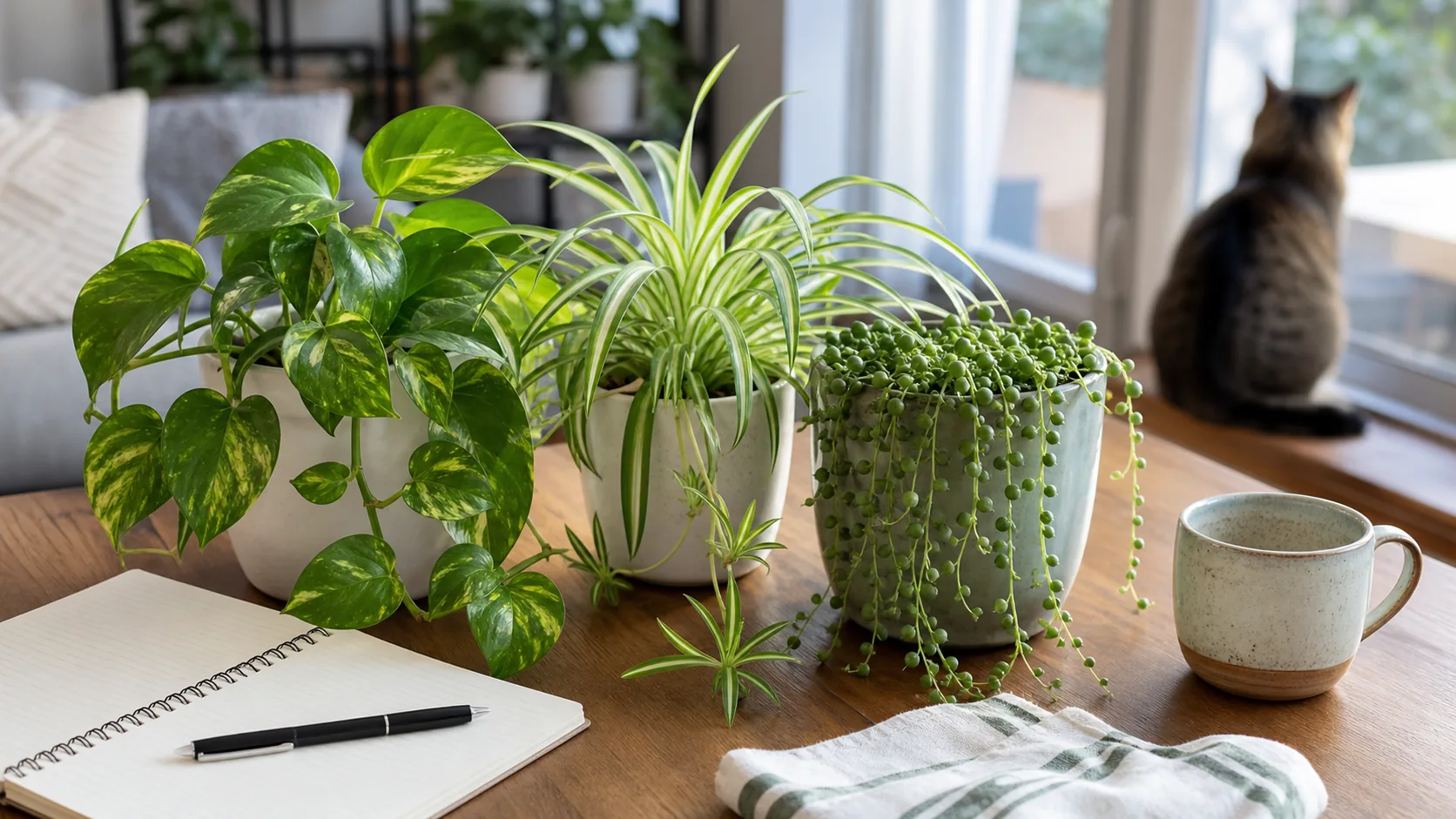
Care recommendations were checked across representative trailing plants, everyday owner questions, and pet-safety evidence.
Real User FAQ
What’s the easiest trailing plant for a complete beginner?
Golden pothos. She tolerates low light, bounces back from missed waterings, and grows fast enough that you’ll see progress quickly. Start there and add others once you have a feel for how trailing plants behave.
Can trailing plants survive in low light?
Some can. Pothos varieties, heartleaf philodendron, and spider plant all manage in lower light conditions. Succulents like string of pearls and burro’s tail need bright light and won’t thrive away from a window. Match the plant to your actual light rather than trying to force a sun-lover into a dim corner.
Why is my trailing plant getting sparse and leggy?
Usually light. When a trailing plant doesn’t get enough, it stretches toward the nearest source and stops putting energy into side growth. The fix is more light, plus pinching back the tips to encourage branching. With tradescantia especially, regular pinching makes the difference between a full, lush plant and a few sad threads.
How do I water a plant in a hanging basket?
The tricky part is drainage. Water slowly until it runs out the bottom, let it drain fully, then hang it back up. A nursery pot inside a decorative cachepot is often easier than planting directly into a basket with poor drainage. Check the soil with your finger before watering again rather than going by a schedule.
Are trailing plants safe for cats and dogs?
Some are, some are not. Pothos, string of pearls, string of hearts, and English ivy are poor choices for chewing pets. Spider plant and Boston fern are safer starting points if you need a trailing look without the same risk profile.
How long can trailing plants get indoors?
Pothos vines can grow several meters over time if the plant is healthy and you keep trimming and feeding lightly. String succulents usually stay more compact. Pot size, light, and how often you prune matter as much as the exact variety.
Can I mix different trailing plants in the same hanging basket?
You can, but pair plants with similar needs. Pothos and heartleaf philodendron work well together because they like similar light and watering. Mixing a succulent with a fern in the same pot usually ends badly for one of them.
Trailing plants reward attention without demanding it. Start with one that fits your light and your habits, and pay attention to how it responds. The plants themselves will tell you what they need. Download KnowYourPlant for personalized care reminders that adapt to your specific plants and conditions.