Non-toxic indoor plants, quick care cues, and what to avoid when your cat treats leaves like snacks.
Reviewed by the KnowYourPlant editorial team. Safety references in this guide were source-checked on 2026-05-17 against ASPCA plant toxicity entries, the FDA warning on true lilies, and PetMD guidance on stomach upset after heavy chewing.
You’ve probably noticed: cats are drawn to plants. Something about the texture, the movement, the rustling. And if you’ve ever watched your cat take a deliberate bite out of a leaf and felt that familiar spike of panic (is this one okay?), you know the research spiral that follows.
Most lists online mix safe and truly toxic plants with barely a warning between them. This one doesn’t. Every plant here is on the ASPCA’s non-toxic list for cats, then sorted by the kind of room and care routine it actually suits. Cat-safe, by that standard, means the plant is not expected to cause poisoning if your cat takes a casual nibble. It does not mean the plant should become a snack bar: repeated grazing can still cause mild stomach upset, and any plant your cat obsessively chews should be moved or protected.
Climate evidence for three cat-safe examples
Pet safety and plant care are different evidence questions. This table does not establish toxicity; it compares native climates for three examples already discussed in the guide.
The ranges below are the middle 50% (p25–p75), not recommended indoor setpoints.
| Reference taxon | POWO native range | Annual mean temperature | Annual precipitation | Relative humidity | Solar radiation | Evidence |
|---|---|---|---|---|---|---|
| Goeppertia orbifolia (calathea orbifolia) | eastern Brazil | 22.8–24.6°C | 1370–1870 mm/yr | 66–69% | 17.2–18.2 MJ/m²/day | 12 climate points; low confidence |
| Maranta leuconeura (prayer plant) | central and eastern Brazil | 20.9–23.1°C | 1332–1606 mm/yr | 60–65% | 16.9–18.1 MJ/m²/day | 30 climate points / 154 usable records; medium confidence |
| Phalaenopsis amabilis (moon orchid) | Malesia to northeastern Australia | 24.1–26.4°C | 1967–3100 mm/yr | 65–69% | 18.3–19.5 MJ/m²/day | 30 climate points / 48 usable records; medium confidence |
What this changes in this guide: After confirming safety from a veterinary source, use these contrasts to avoid treating prayer plants, calathea relatives, and epiphytic orchids as if they occupy the same root environment.
Sources and method: Goeppertia orbifolia in POWO and GBIF; Maranta leuconeura in POWO and GBIF; Phalaenopsis amabilis in POWO and GBIF; CHELSA V2.1, 1981–2010. GBIF records are limited to POWO-native countries, then filtered for coordinates, establishment signal, licence, precision, and spatial duplication. No community or user-reported care data is used in this module.
What Most Plant Roundups Miss
Most roundups about cat-safe indoor plants list attractive options. The better question is which choice will still make sense in your actual room three months from now.
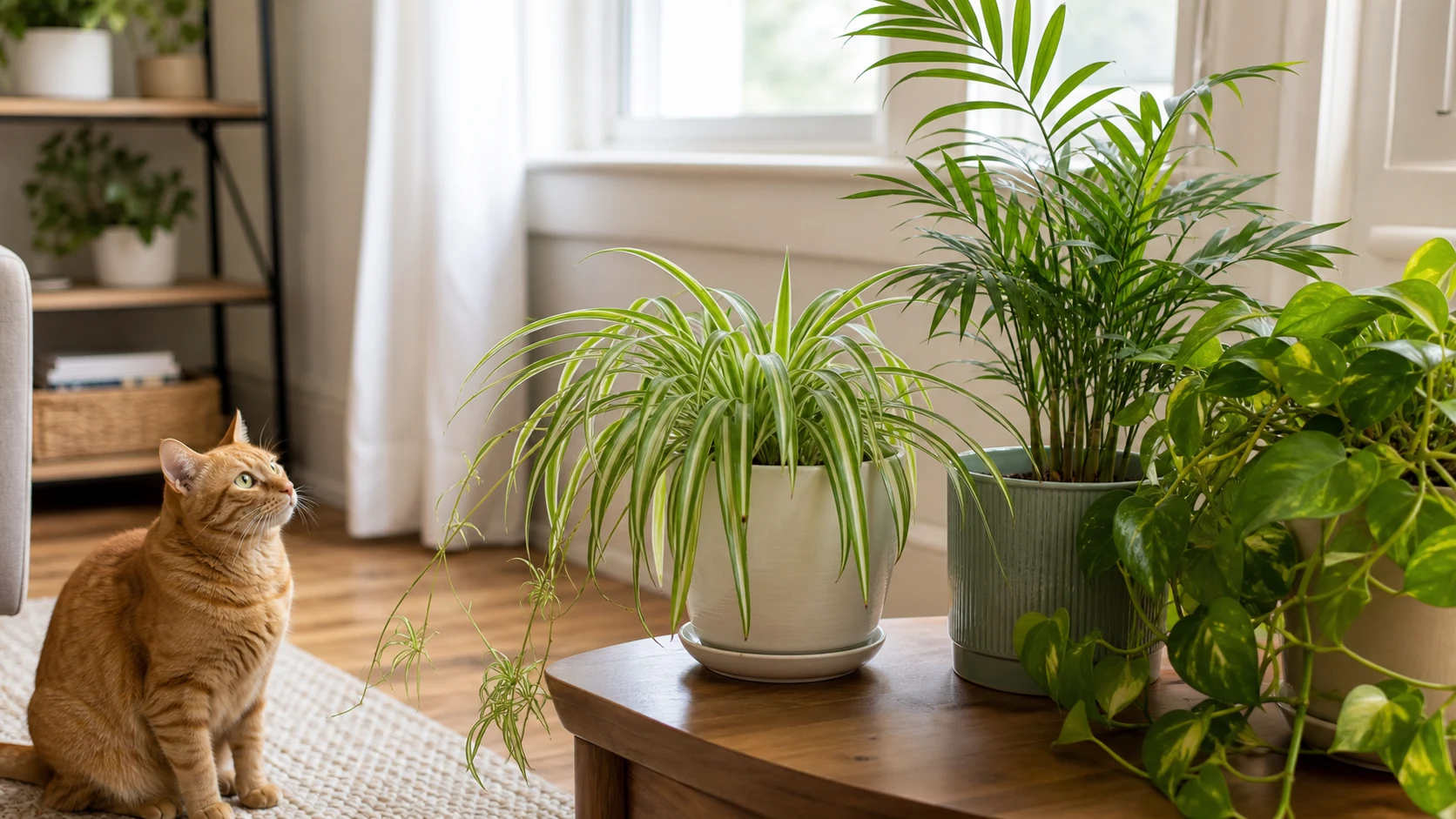
A safe spider plant and parlor palm can fit the room, but an accessible pothos makes plant identity and cat behavior part of the choice.
Use this filter before choosing:
- Light reality: what the plant receives on a normal cloudy day, not the brightest hour of the week.
- Care rhythm: whether you prefer weekly attention or a plant that can be ignored longer.
- Space: mature height, spread, trailing habit, and whether leaves will touch walls or pets.
- Failure signal: what the plant does first when the match is wrong: yellowing, stretching, crisping, or dropping leaves.
A good recommendation is not just beautiful. It fits the room, the owner, and the first problem you are likely to notice.
Start Here: Pick by Light, Water, and Cat Interest
If you are buying a plant today, choose from the room and your routine first. The prettiest safe plant still becomes a problem if it needs a bright window you do not have, or weekly watering you will forget.
| Your setup | Best cat-safe picks | Skip for now |
|---|---|---|
| Low light and you forget to water | Cast Iron Plant, Spider Plant, Parlor Palm, Peperomia | Ferns, Nerve Plant, most Calatheas |
| Bright window and you like low-water plants | Hoya, Haworthia, Echeveria, Money Tree | Boston Fern, Baby’s Tears |
| Bathroom or humid kitchen with a window | Boston Fern, Bird’s Nest Fern, Prayer Plant, Nerve Plant | Echeveria, Haworthia |
| Cat chews dangling leaves | Cast Iron Plant, Haworthia, Bromeliad, Peperomia | Spider Plant, String of Hearts, Swedish Ivy unless hung well out of reach |
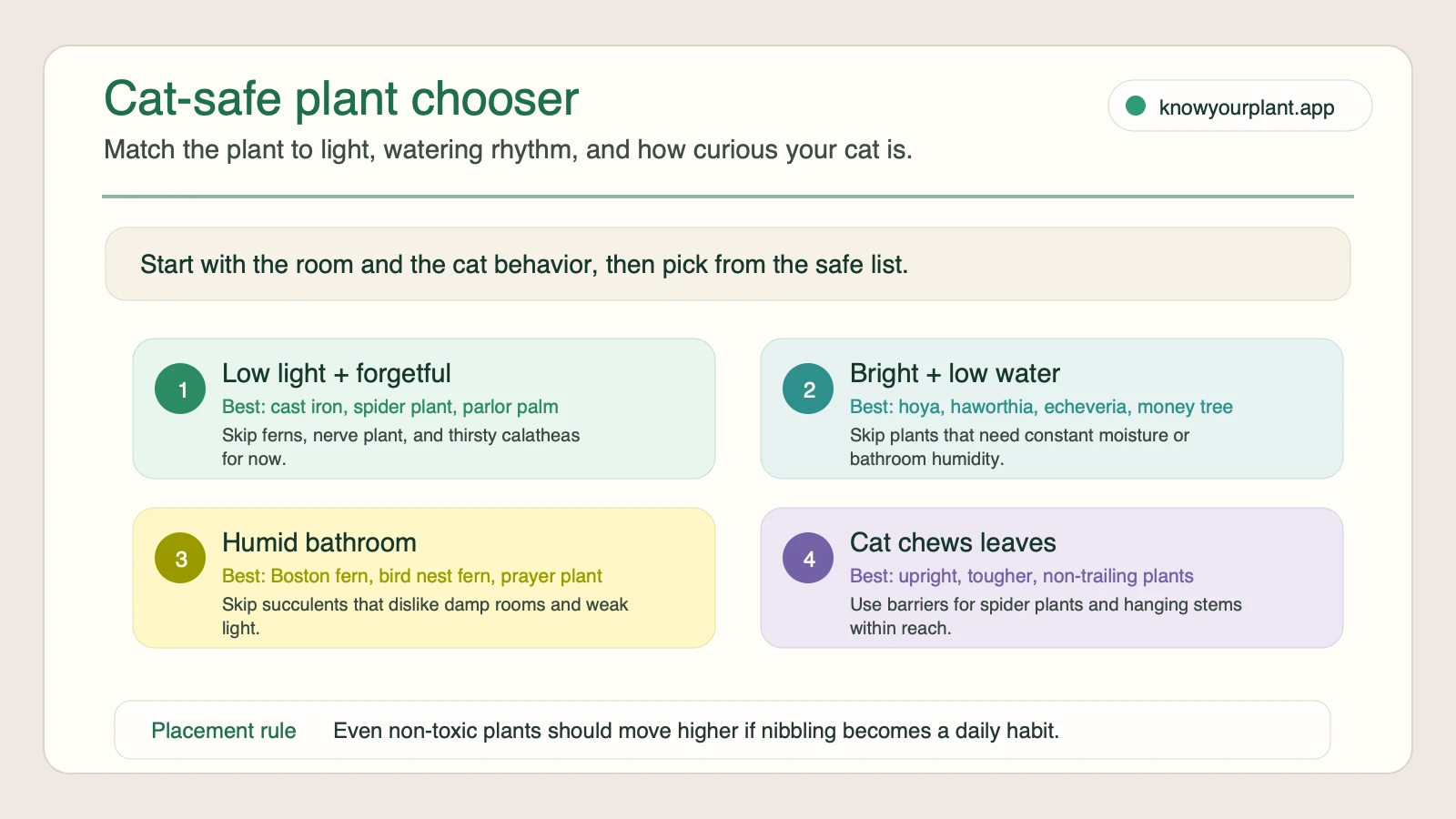
Use this chooser before buying from the safe list: the best non-toxic plant still has to match your actual light, watering rhythm, and how determined your cat is to chew leaves.
Use these watering rhythms as a starting point, then check the soil before you pour:
- Leafy houseplants: often every 7-10 days in warm months; water when the top 1-2 inches of soil feel dry.
- Ferns, Nerve Plant, Baby’s Tears: often once or twice a week in dry homes; water when the surface is just starting to dry.
- Succulents and Hoyas: often every 2-4 weeks indoors; water only after the soil dries all the way through.
- Orchids: often every 7-14 days; water when the visible roots turn silvery grey, not while they are plump and green.
The first signs you are overdoing it are wet soil that stays wet for days, yellowing soft leaves, fungus gnats, a sour smell from the pot, or mushy stems near the soil line. If you see those, stop watering, check that the pot has drainage, and let the root ball dry before you do anything else.
A Quick Word on “Safe”
No plant should be a regular part of your cat’s diet. Any vegetation in large quantities can cause mild stomach upset — the same way eating a fistful of parsley might affect you. But the plants on this list are not expected to cause poisoning if she bats one off a shelf, chews a leaf, or decides a trailing stem is a toy.
The ASPCA’s toxic and non-toxic plant database is the safety line used here because it is specific to cats, dogs, and horses instead of general human houseplant advice. Many risky plants are common, popular, and widely sold without a clear warning on the tag. That’s exactly the gap this list is trying to close.
The species to keep well out of reach, or out of your home entirely if you have a dedicated chewer, include Pothos, Peace Lily, Philodendron, Snake Plant, ZZ Plant, Aloe vera, Jade Plant, and true lilies such as Easter Lily or Asiatic Lily. Beautiful, everywhere, and genuinely toxic. Worth knowing before you buy.
Fast Safety Triage After a Chew
| If this happened… | What it usually means | What to do now |
|---|---|---|
| Your cat chewed a plant from this safe list, took only a small bite, and is acting normal | Non-toxic does not usually mean poisoning, but heavy chewing can still cause vomiting or loose stool | Remove access to the plant, offer water, and monitor your cat closely |
| Your cat chewed Peace Lily, golden pothos, or an unknown lookalike and is drooling, pawing at the mouth, vomiting, or struggling to swallow | Oral irritation and toxic exposure are more likely | Call your vet or a pet poison line promptly and bring the plant name or a photo |
| Your cat chewed, brushed against, or drank water from a vase holding a true lily or daylily | This is an emergency because lily exposure can cause fatal kidney failure in cats | Seek urgent veterinary help immediately, even if symptoms have not started yet |
This fast split is the part most generic roundups blur together. Safe list plants may still upset the stomach if a cat overeats them. Peace lily and pothos are not in that category, and true lilies are in a much higher-risk category again.
Identification Snapshot
If you need to make a fast decision after a cat nibble, start with the visual distinction, not the marketing label.
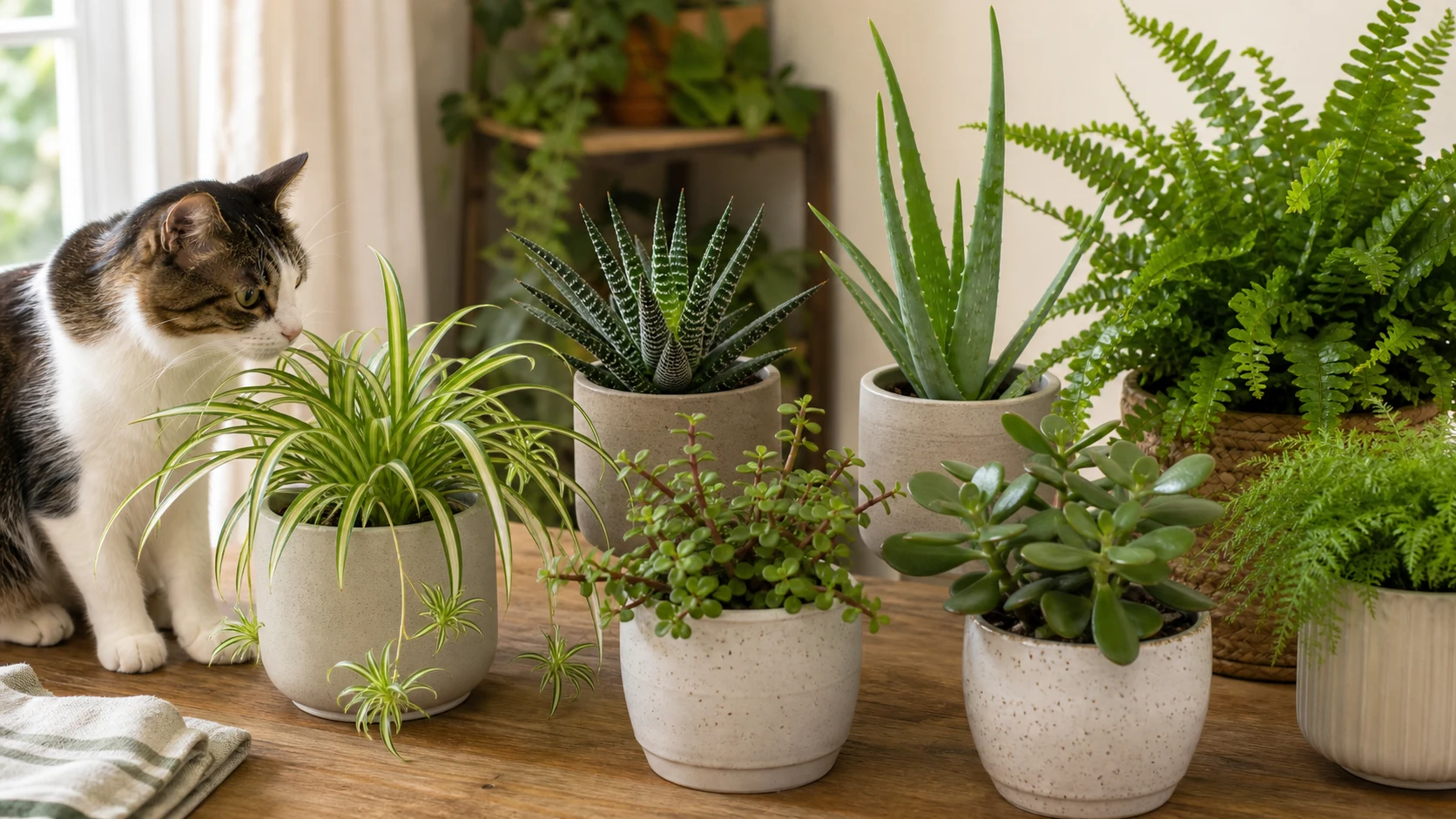
Compare growth habit and leaf structure: spider plant, Haworthia, elephant bush, and Boston fern differ clearly from their toxic lookalikes.
| If the plant looks like… | Safer plant on this list | Common toxic plant people confuse it with | Fast visual clue |
|---|---|---|---|
| Arching striped leaves with dangling babies | Spider Plant | Golden Pothos | Spider Plant makes grassy rosettes and plantlets, pothos has thicker heart-shaped leaves on vines |
| Upright strap-like succulent leaves in a rosette | Haworthia | Aloe vera | Haworthia stays compact with white striping; aloe has thicker fleshy blades with gel inside |
| Small rounded succulent leaves on reddish stems | Elephant Bush | Jade Plant | Elephant Bush has smaller softer leaves on red stems; jade has thicker opposite leaves on chunkier grey-green stems |
| Soft feathery fern fronds | Boston Fern | Asparagus Fern | Boston Fern has flat pinnate fronds; Asparagus Fern has needle-like cladodes and may show fine thorns |
| Round leaf clusters or tidy petioles | Baby rubber plant (Peperomia obtusifolia) or Chinese Money Plant | Peace Lily when bought small, or trailing pothos for “easy green” shelf styling | Peace Lily forms pointed leaves from a basal crown; pothos trails from vines instead of compact clumps |
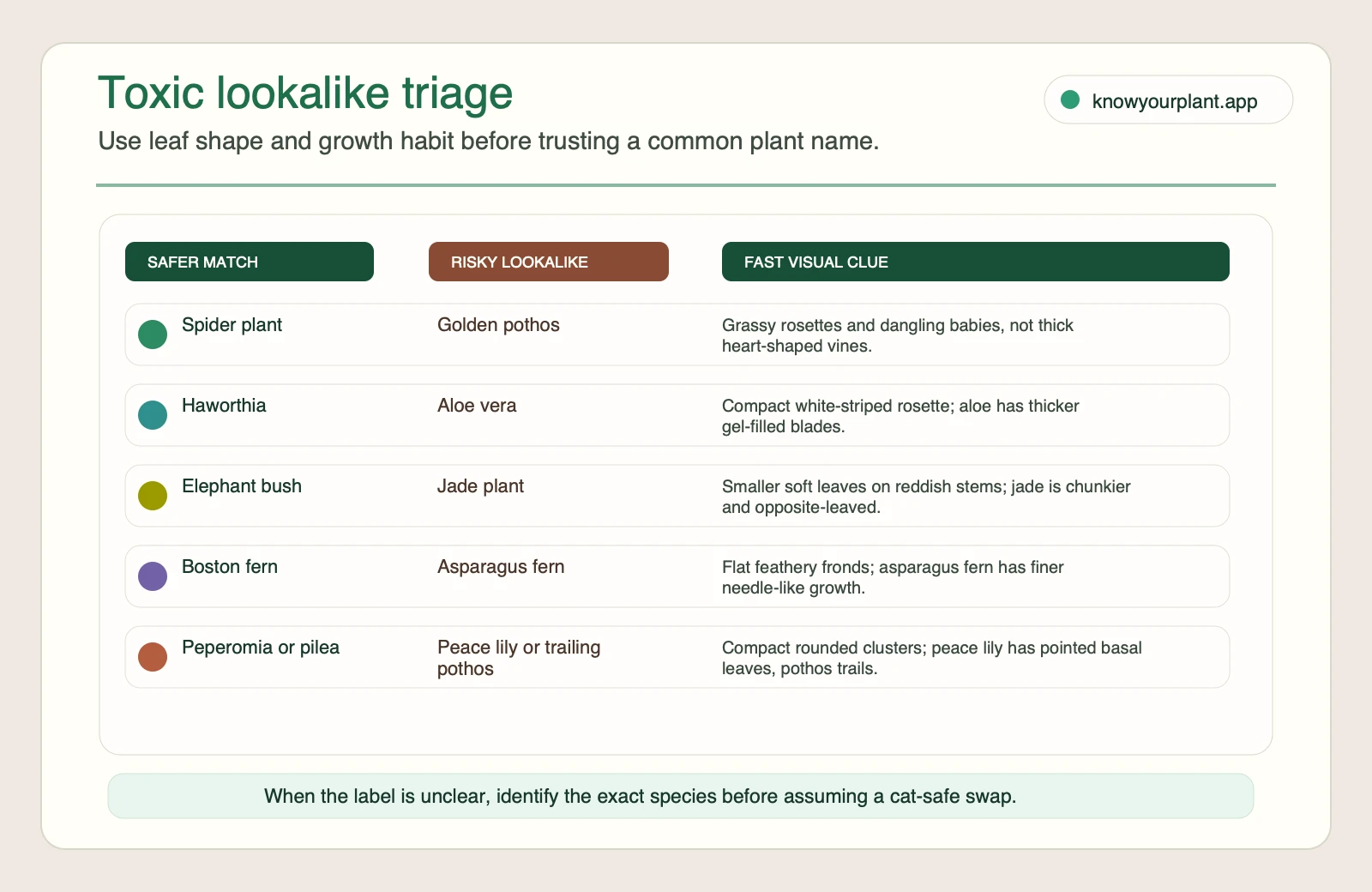
Use this triage card when the plant label is vague. Leaf shape, growth habit, and the exact species matter more than a familiar common name.
Toxic Lookalikes and Confused-With
The biggest safety mistake is treating a familiar common name as proof. Peace lily is not a safe lily for cats, golden pothos is not a safe trailing “beginner plant,” and true lilies are in their own emergency category. According to the ASPCA entries reviewed for this update, peace lily and golden pothos are toxic to cats, while the FDA warns that true lilies and daylilies can cause fatal kidney failure in cats even from very small exposures.
Care Cards
Use the room first, then the plant. These care cards condense the article’s safest starting points.
| Situation | Best fits from this list | Water rhythm to start with | Placement note |
|---|---|---|---|
| Low light, low-maintenance | Cast Iron Plant, Parlor Palm, Peperomia, Spider Plant | Check weekly; water when the top 1 to 2 inches are dry | Good for shelves and corners where direct sun never hits |
| Bright window, lower water | Hoya, Haworthia, Echeveria, Money Tree | Let soil dry further between waterings; succulents often go 2 to 4 weeks | Best near bright indirect light or a gentle morning-sun window |
| Humid room or bathroom | Boston Fern, Bird’s Nest Fern, Prayer Plant, Nerve Plant | Keep more evenly moist than succulents or hoyas | Use where showers, cooking, or a humidifier keep the air from getting too dry |
| Cat loves to chew dangling leaves | Cast Iron Plant, Bromeliad, Haworthia, Peperomia | Water based on soil, not guilt nibbling | Avoid Spider Plant or hanging trailers unless they are truly out of reach |
Decision Tree: Choose by Cat Behavior First
- Decorative-only cat household: almost any plant on this list can work if the room and watering rhythm fit.
- Occasional chewer: stick with non-toxic plants, but still expect some vomiting or loose stool if a cat grazes heavily.
- Obsessive chewer: avoid tempting trailing plants in reach and prioritize tougher upright options like Cast Iron Plant, Haworthia, Bromeliad, or Peperomia.
- Climber or shelf-launcher: treat “high shelf” as a design problem, not a guarantee, and avoid keeping true lilies, peace lily, or pothos anywhere a jump sequence can reach.
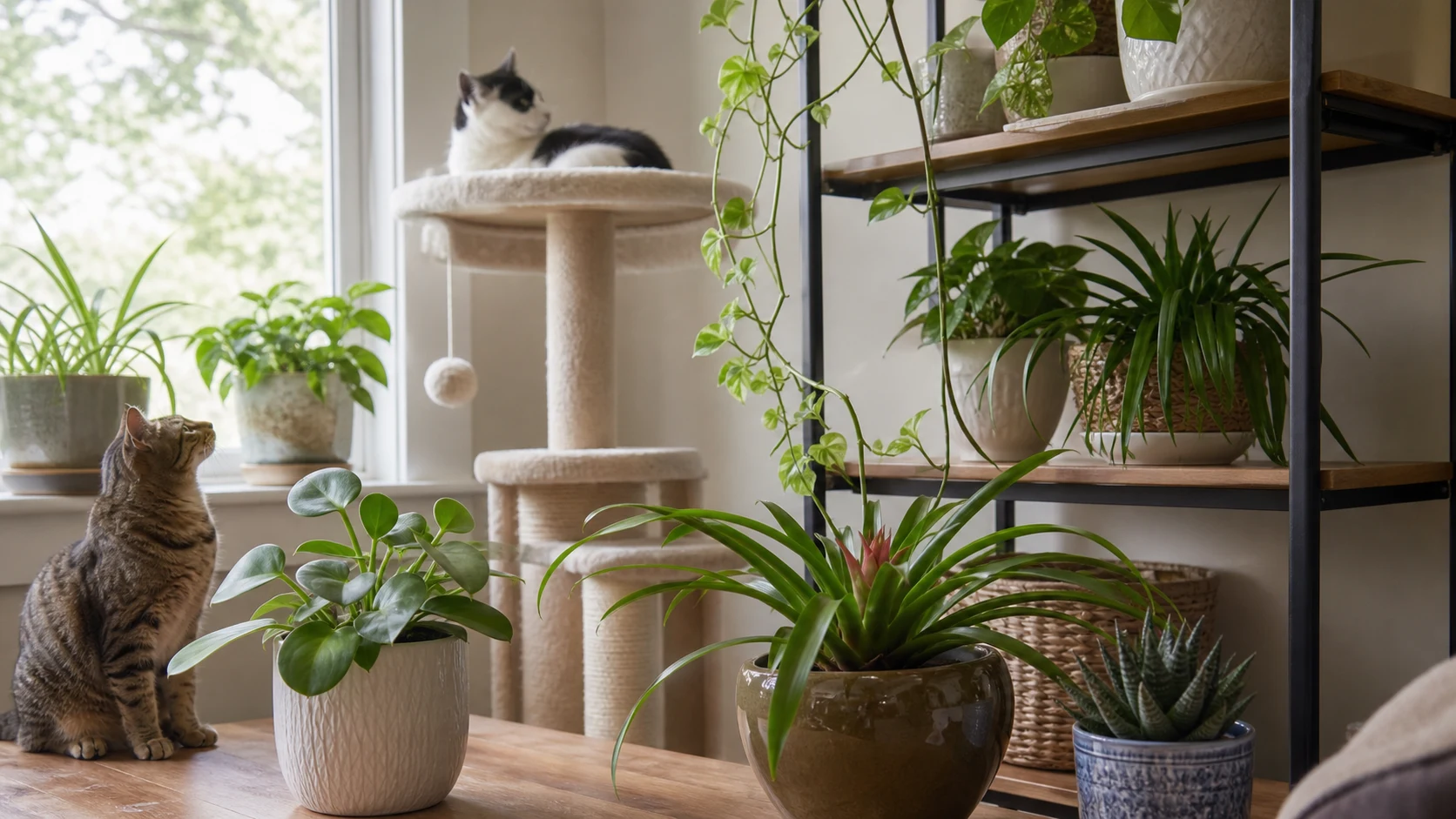
Peperomia, bromeliad, and Haworthia suit a chewer better, while the cat tree shows why a high pothos is still reachable.
Expert Note: Source Layer
This list was reviewed against the ASPCA non-toxic and toxic plant database for species-level safety checks, the FDA warning on true lilies and daylilies, and PetMD’s reminder that non-toxic does not mean symptom-free if a cat eats a large amount. That combination matters because it separates poisoning risk from the much more common mild-stomach-upset scenario.
Methodology Note
We used the Research Pack for cat-safe-plants-indoor to update this article. Safety and lookalike claims are grounded in the ASPCA entries for spider plant, peace lily, and golden pothos, the FDA warning on lily toxicity in cats, PetMD guidance on non-toxic plants still causing GI upset when overconsumed, and qualitative owner-confusion signals about peace lily, spider plant, pothos-like hanging plants, and cats over-chewing otherwise safe plants. Social posts are used only to surface recurring questions, not to measure prevalence.
Freshness Note
Safety references for this article were last reviewed on 2026-05-17. If a plant is not on this list, verify it directly in the ASPCA database before assuming it is cat-safe.
Your Cat-Safe Plant Plan
Today: identify every plant your cat can reach, then separate them into safe, toxic, and unknown. Move toxic and unknown plants behind a closed door, into a closed terrarium, or onto a high shelf with no nearby launch point.
This week: choose one or two safe plants that match your actual room. If the room is dim and you forget watering, pick Cast Iron Plant or Parlor Palm. If the window is bright and you travel often, pick Hoya, Haworthia, or Echeveria. If the bathroom has a window, pick Boston Fern or Bird’s Nest Fern.
This season: watch the first month of watering. Yellow soft leaves, fungus gnats, or soil that stays wet for days means you are overwatering. Curling leaves, crispy edges, or a pot that feels very light means the plant may be drying out too far between checks.
Group 1: Low-Maintenance Classics
These are the plants you can put on a shelf, water occasionally, and trust to handle the attentions of a curious cat.
Spider Plant (Chlorophytum comosum) One of the most cat-tested plants in any home. Many cats are obsessed with the ribbon leaves and trailing baby plants, so expect some nibbling if it sits within reach. It is non-toxic, but repeated chewing can still upset your cat’s stomach and make the plant ragged. Grows in low to medium light, tolerates inconsistent watering, and produces little offshoots that are oddly satisfying to watch multiply.
The spider plant benefits guide explains how its pet safety, easy propagation, and forgiving care compare with the plant’s much less convincing air-purifying claim.
Prayer Plant (Maranta leuconeura) Named for how its leaves fold upward at night like hands in prayer. Tolerates lower light than most patterned plants, and the slow motion of the leaves folding and unfolding tends to attract exactly the kind of cat attention you’d expect. Recovers well from nibbling. If you want one, start with our prayer plant care guide.
Cast Iron Plant (Aspidistra elatior) Earns its name. Low light, inconsistent watering, cold drafts, the occasional bite: this plant genuinely doesn’t care. If you need something that asks for almost nothing, this is it, and our low-light indoor plants guide has more options in the same category.
Parlor Palm (Chamaedorea elegans) A small, elegant palm that does well in the kind of indirect indoor light most rooms actually have. Slow-growing, clean-looking, and completely harmless if your cat decides the fronds look chewable.
Boston Fern (Nephrolepis exaltata) Lush and feathery, with a trailing habit that makes it beautiful in a hanging basket. Boston ferns want humidity and consistency — they’ll sulk if you let them dry out — but they’re one of the safest options you can have around cats, and they’re lush enough that losing a frond or two to a curious paw barely shows. If you want one, start with our Boston fern care guide.
Calathea / Rattlesnake Plant (Goeppertia species) The whole Calathea family is non-toxic. Their patterns: stripes, spots, deep purple undersides — make them worth the extra attention they need around humidity and consistent watering. Rattlesnake Plant (Calathea lancifolia) is a good starting point: easier than most, and striking enough to earn its shelf space.
Group 2: For Brighter Spots
These prefer a window nearby, but not direct afternoon sun burning through the glass.
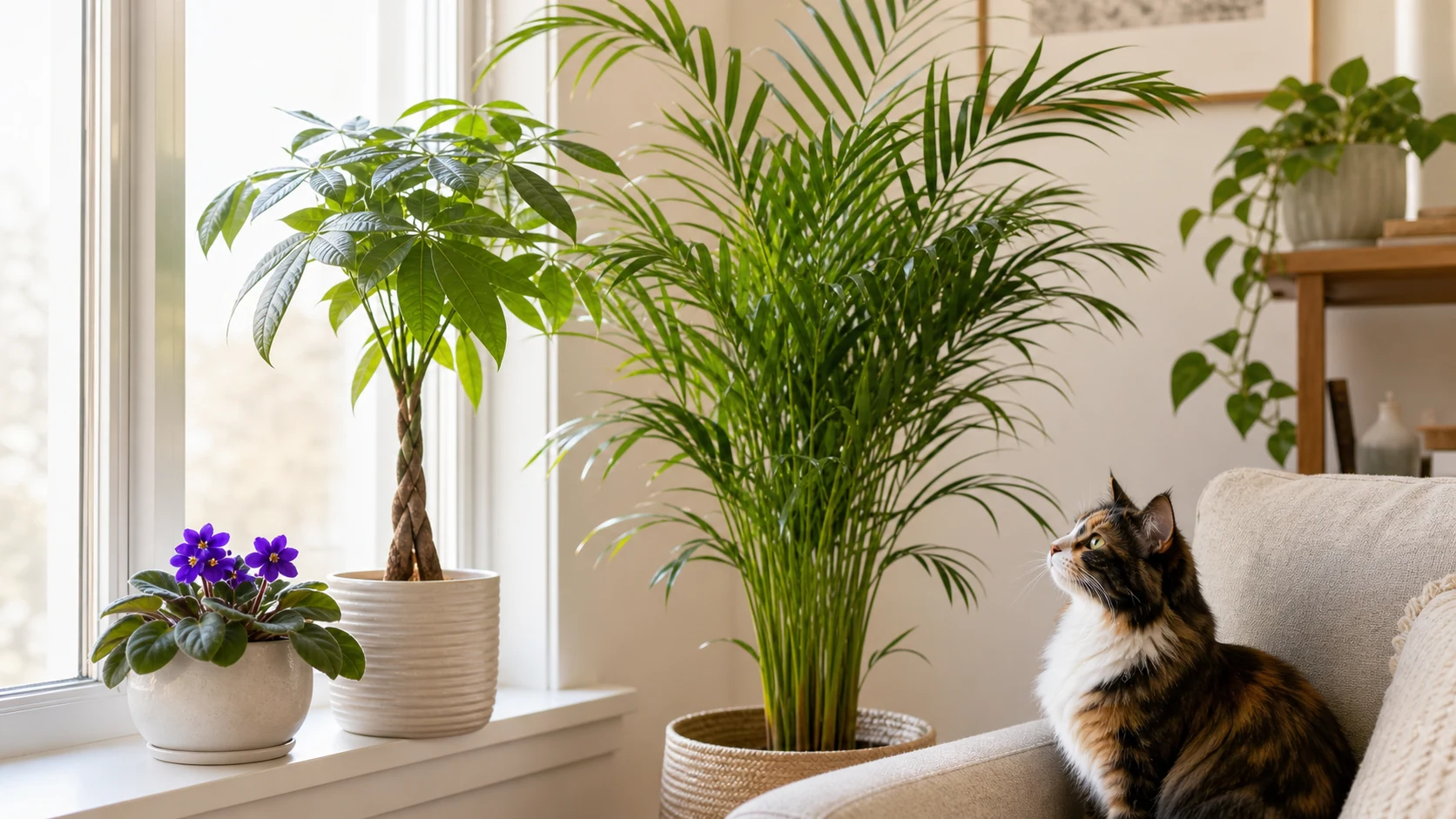
An African violet, braided money tree, and areca palm use bright window light without sitting in harsh afternoon sun.
Areca Palm (Dypsis lutescens) Tall, feathery, and works well as a room feature. Tolerates some dryness between waterings. In bright indirect light it grows steadily; the fronds have a gentle movement to them that cats find interesting but not dangerous.
Money Tree (Pachira aquatica) Often sold with a braided trunk. Prefers to dry out a bit between waterings and does well in bright indirect light. A casual nibble is not a poisoning concern for cats or dogs, but the plant will do better if it is not treated like a chew toy.
African Violet (Saintpaulia) One of the few flowering plants on this list that genuinely thrives on a windowsill year-round. Water from below — the leaves spot if you get water on them from the top — and it will reward you with small, velvety flowers for months at a stretch.
Orchid (Phalaenopsis) The grocery store orchid. Safe for cats, and more forgiving than its reputation suggests. With the right care, it will rebloom year after year. The roots visible through a clear pot tell you when she’s ready to drink: plump and green means she’s fine; silvery-grey means it’s time. Cats occasionally bat at the flowers. No harm done.
Bromeliad (Guzmania, Neoregelia) Striking, architectural, and non-toxic. Water into the central cup rather than the soil, give them bright light, and they’ll hold a bloom for months. The stiff leaves don’t appeal much to cats, which is honestly a relief.
Hoya / Wax Plant (Hoya species) Thick, waxy leaves and clusters of star-shaped flowers if you’re patient enough. Hoyas like bright light and slightly root-bound conditions. Cats mostly ignore the tough leaves, which suits everyone.
Group 3: Succulents and Air Plants
Most succulents are safe, but not all. Aloe vera and Jade Plant are both toxic, and both widely sold. Our full succulent care guide covers which varieties to choose and how to keep them thriving indoors. These specific ones are reliably non-toxic.
Haworthia Small, striped, and genuinely low-maintenance. Tolerates lower light than most succulents, which makes it useful on shelves away from a window. Water infrequently and let the soil dry completely between waterings. Cats sometimes investigate the pointed tips, then lose interest.
Christmas Cactus (Schlumbergera) Blooms in late autumn and winter when most other plants have gone quiet. Unlike most cacti, it prefers indirect light and some humidity. No harmful compounds if a cat decides to investigate.
Echeveria Classic rosette succulent. Needs bright light: a south-facing windowsill in winter, or outdoors in summer if you have the option. Non-toxic, low-water, and deeply satisfying to look at.
Air Plant (Tillandsia) No soil required. Air plants absorb moisture through their leaves and need regular soaking rather than potting. Perfect for hanging arrangements where a cat can reach them without any risk: they’re lightweight, non-toxic, and the worst case is a rearranged display.
Elephant Bush (Portulacaria afra) Often confused with Jade Plant, which is toxic. Elephant Bush isn’t — it’s a South African succulent with small rounded leaves on reddish stems. More forgiving than it looks, and safe if chewed.
Group 4: Trailing and Hanging
Swedish Ivy (Plectranthus verticillatus) Fast-growing and trailing, with slightly fuzzy leaves that feel soft to the touch. Works well in a hanging basket where the stems can spill downward. Handles most indoor light levels without complaint.
Baby’s Tears (Soleirolia soleirolii) A mossy, creeping plant that spreads to cover the surface of its pot in a dense green mat. Looks delicate, bounces back from nibbling, and creates a lush effect with minimal effort.
Peperomia (various species) The Peperomia genus covers dozens of shapes: watermelon stripes, deeply rippled leaves, thick round pads, trailing stems. All of them are non-toxic. Pick whichever catches your eye; they’re tolerant of imperfect care and interesting enough to keep.
Chinese Money Plant (Pilea peperomioides) Round, coin-shaped leaves on individual long stems, each one a little different. Easy to propagate: it constantly produces small offshoots at the base that you can separate into new pots. Safe for both cats and dogs.
String of Hearts (Ceropegia woodii) Delicate heart-shaped leaves on trailing stems that can reach a meter or more. Tolerates some drought, looks beautiful cascading from a high shelf, and won’t harm a cat who decides to investigate. For the full routine, see our string of hearts care guide.
Common Problems: If the Leaves Start Looking Wrong
Cat-safe does not mean care-proof. Most leaf problems come back to water, light, or the pot, so start there before adding fertilizer.
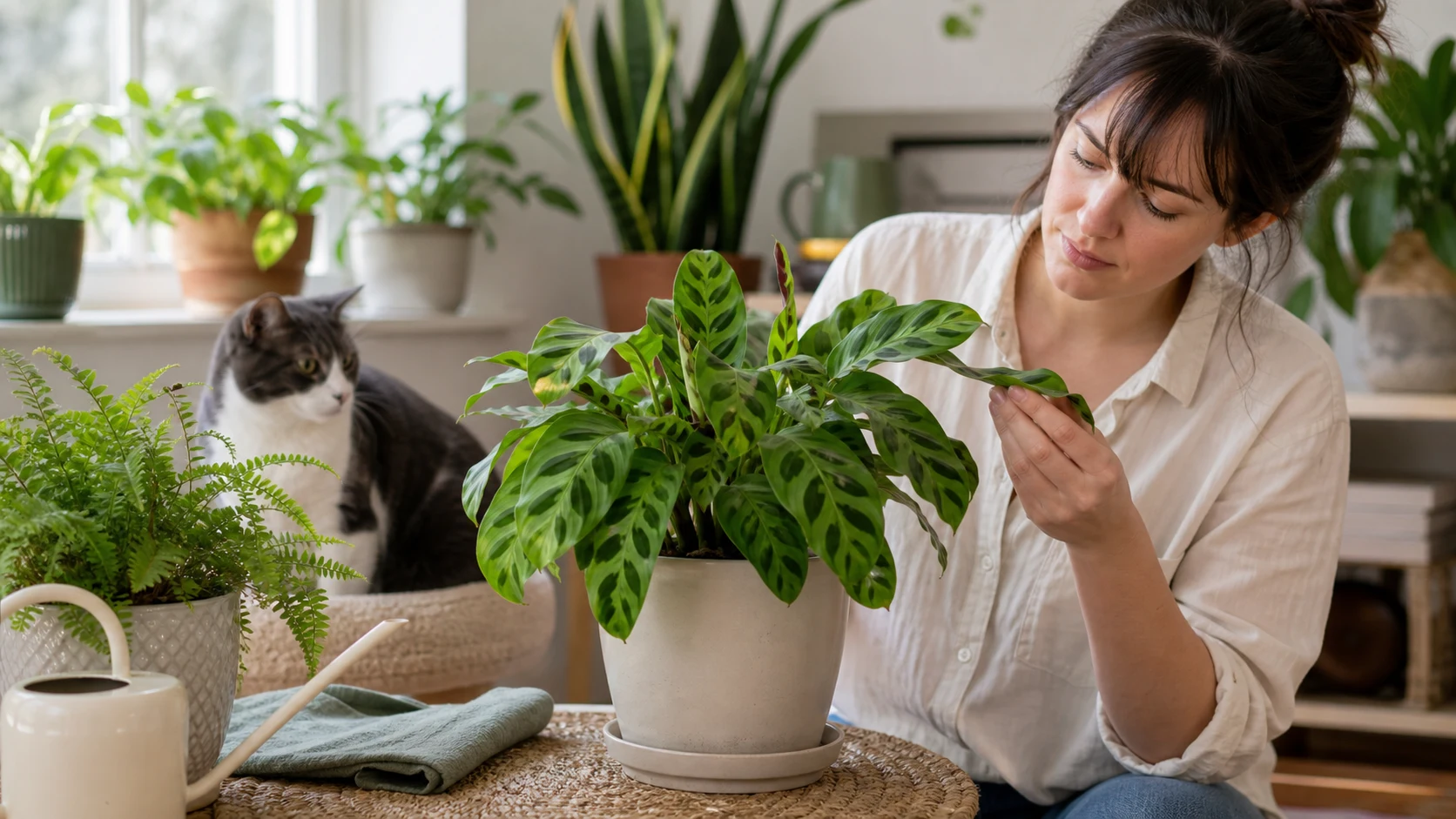
Check the leaf, soil, drainage saucer, and recent watering before assuming a cat-safe plant needs fertilizer.
Yellow leaves Check the soil first. Wet soil plus yellow, soft leaves usually means too much water or poor drainage. Let the pot dry, empty any saucer, and do not water again until the correct soil depth is dry. Dry soil plus yellow, crispy edges usually means the plant went too long without water; give it a full soak and let the extra drain away.
Curling leaves Curling usually means the plant is trying to conserve moisture or avoid stress. Check for bone-dry soil, hot direct sun through glass, a heater vent, or very dry air. Move the plant out of harsh sun, water if the soil is dry, and keep humidity-loving plants like ferns, Prayer Plants, and Nerve Plants away from vents.
Brown tips Brown tips often come from inconsistent watering, dry air, or mineral buildup from tap water. Trim the brown tips if they bother you, then fix the cause: water more evenly, flush the pot with clean water every few months, and use filtered or rested water for sensitive plants like Calatheas and ferns.
Drooping Do not assume drooping always means “add water.” Lift the pot and feel the soil. A light pot with dry soil needs a soak. A heavy pot with wet soil needs air, drainage, and time.
If the plant is also sticky, webbed, speckled, or dropping leaves fast, check for pests before changing the care routine. Look on leaf undersides for webbing (spider mites), white cottony clusters (mealybugs), moving dark specks (aphids), or sticky residue that points to scale or sap-feeding pests.
Group 5: A Few More Worth Knowing
Bird’s Nest Fern (Asplenium nidus) Wide, arching fronds that unfurl slowly from a central rosette — there’s something almost prehistoric about the way new growth emerges. Loves humidity and lower light, which makes it ideal for a bathroom shelf with a window. If your cat pats at the smooth fronds, no problem at all.
Nerve Plant (Fittonia albivenis) Small and striking, with white or pink veining etched across dark green leaves like a fine pencil drawing. It needs consistent moisture and humidity, and will dramatically droop the moment it dries out, then revive just as quickly once you water it. A little theatrical, but completely harmless.
Polka Dot Plant (Hypoestes phyllostachya) Pink, white, or red spots splashed across green leaves, compact enough for a windowsill or a corner of a shelf. Pinch the tips regularly to keep it bushy rather than leggy. Safe, cheerful, and easy to find at most garden centres.
Friendship Plant (Pilea involucrata) Deeply textured leaves with a bronze-green sheen that shifts depending on the light. Easy to tuck onto a shelf alongside other plants. Non-toxic and settled in its habits once established.
Banana Plant (Musa) If you have the space and the light for a statement plant, this is a safe one. Cats occasionally chew the big waxy leaves: a piece of banana leaf is just a piece of banana leaf. No harm done, and the plant grows quickly enough that a little cat damage is barely noticeable.
Living with Both: When You Don’t Want to Give Up the Risky Ones
Most cat owners don’t want to clear every beautiful plant they love — they want to make thoughtful choices. Here’s how to keep toxic plants if you’re attached to them.
Height is your best tool. Cats can jump, but not infinitely. A floating shelf at 1.8 metres or above, with no nearby furniture to use as a launch point, puts most plants genuinely out of reach. IKEA Lack wall shelves, floating picture ledges, and high window sills all work well. The key is making sure there’s no stepping-stone route up.
Closed terrariums work for smaller plants. A sealed glass container lets you grow a Pothos or a Philodendron in full view while keeping it completely inaccessible.
Room separation is the simplest option for larger statement plants. A Snake Plant in a home office with a closed door is a different situation from one in a living room where the cat spends her day.
The goal isn’t a perfect list of safe plants and nothing else. It’s knowing what you have and arranging things so the risky ones are genuinely out of reach. That’s a much more realistic setup for most homes.
KnowYourPlant can help you audit what you already own. Point your camera at any leaf to confirm the plant name, then use that ID to check whether it belongs in the safe, toxic, or move-out-of-reach category.
If Something Goes Wrong
If your cat eats a plant and you’re not sure whether it’s on this list, or if she seems off afterward — lethargic, drooling, or vomiting — call the ASPCA Animal Poison Control Center (888-426-4435) or your vet. Have the plant name ready if you can.
Here’s the practical distinction worth knowing: a cat who has eaten something from this list and seems briefly unsettled is usually experiencing mild GI irritation, temporary and self-resolving. A cat who has eaten Pothos, any true Lily, or Philodendron is in a different situation and needs veterinary attention right away. The ASPCA database covers more than 1,000 plants and their team can tell you within minutes which situation you’re in.
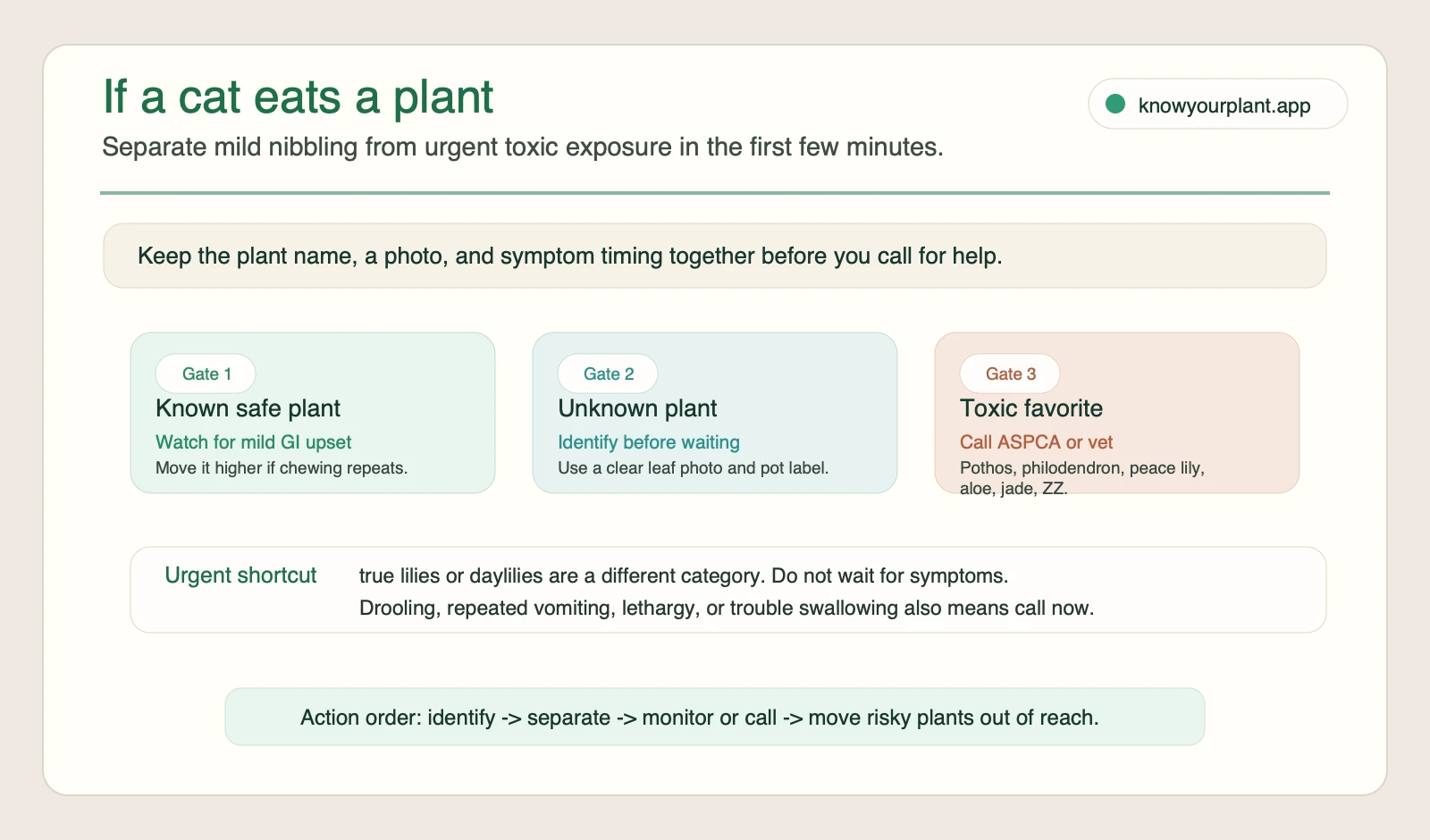
Use these gates in the first few minutes after a nibble: identify the plant, separate it from the cat, then decide whether to monitor or call ASPCA Animal Poison Control or a vet.
If you are comparing care routines for another houseplant, see Christmas Cactus Care: Watering, Light, and Repeat Blooms for a focused step-by-step guide.
For another practical pet-safety check, see Is Money Tree Toxic to Cats? Chewing, Stomach Upset, and Safety for the risk level and the next steps.
Real User FAQ
Are succulents safe for cats? Most are, but Aloe vera and Jade Plant are not — and both are very common. The reliably safe ones include Haworthia, Echeveria, Christmas Cactus, and Elephant Bush. If you’re building a succulent collection and you have cats, those four are a safe place to start.
My cat won’t stop eating my spider plant. Should I be worried? Spider Plant is considered non-toxic to cats, so one bite is not the same emergency as a lily, Pothos, or Philodendron. Still, constant chewing can cause vomiting or diarrhea and will shred the plant. Move it higher, trim the dangling baby plants, or offer cat grass if your cat keeps returning to it.
What should I do if my cat eats a plant I’m not sure about? Call the ASPCA Animal Poison Control Center (888-426-4435). Have the plant name or a clear photo ready. They can tell you quickly whether you need to see a vet. If your cat is already showing symptoms — drooling, vomiting, lethargy — go to the vet regardless and bring a sample of the plant or a photo.
How much of a toxic plant does my cat have to eat to be in danger? It depends on the plant category, which is why plant ID matters so much. For true lilies and daylilies, the FDA warning is severe enough that even small exposures deserve urgent veterinary attention. For peace lily and pothos, the more typical pattern is immediate oral irritation, drooling, and vomiting because of calcium oxalate crystals. For plants on the ASPCA non-toxic list, the bigger issue is usually volume: a cat that keeps chewing Spider Plant or cat grass may still end up with a mild stomach upset even though the plant is not considered poisonous.
Are all ferns safe for cats? Most common ferns are. Boston Fern, Bird’s Nest Fern, and Maidenhair Fern are all fine. The one to watch out for is Asparagus Fern, which isn’t a true fern despite the name, and is toxic to cats. The quick shop-floor clue is shape: Boston Fern has flat, feathery fronds, while Asparagus Fern has finer needle-like growth and may show small thorns on the stems.
Is Peace Lily safe for cats? No. Peace Lily is one of the most common houseplants and one of the most commonly toxic. It contains calcium oxalate crystals that cause oral pain, drooling, and difficulty swallowing. Keep it out of any home where cats roam freely. Read more about peace lily care if you want to grow one in a cat-free room.
Putting It Together
Thirty safe plants gives you a lot to work with. You don’t need to avoid the plants you love — you just need to know which ones to keep as-is, which ones to move up high, and that the two categories are genuinely different.
A home full of cat-safe plants isn’t a consolation prize. It’s just a home where you can relax a little when she helps herself to a leaf.
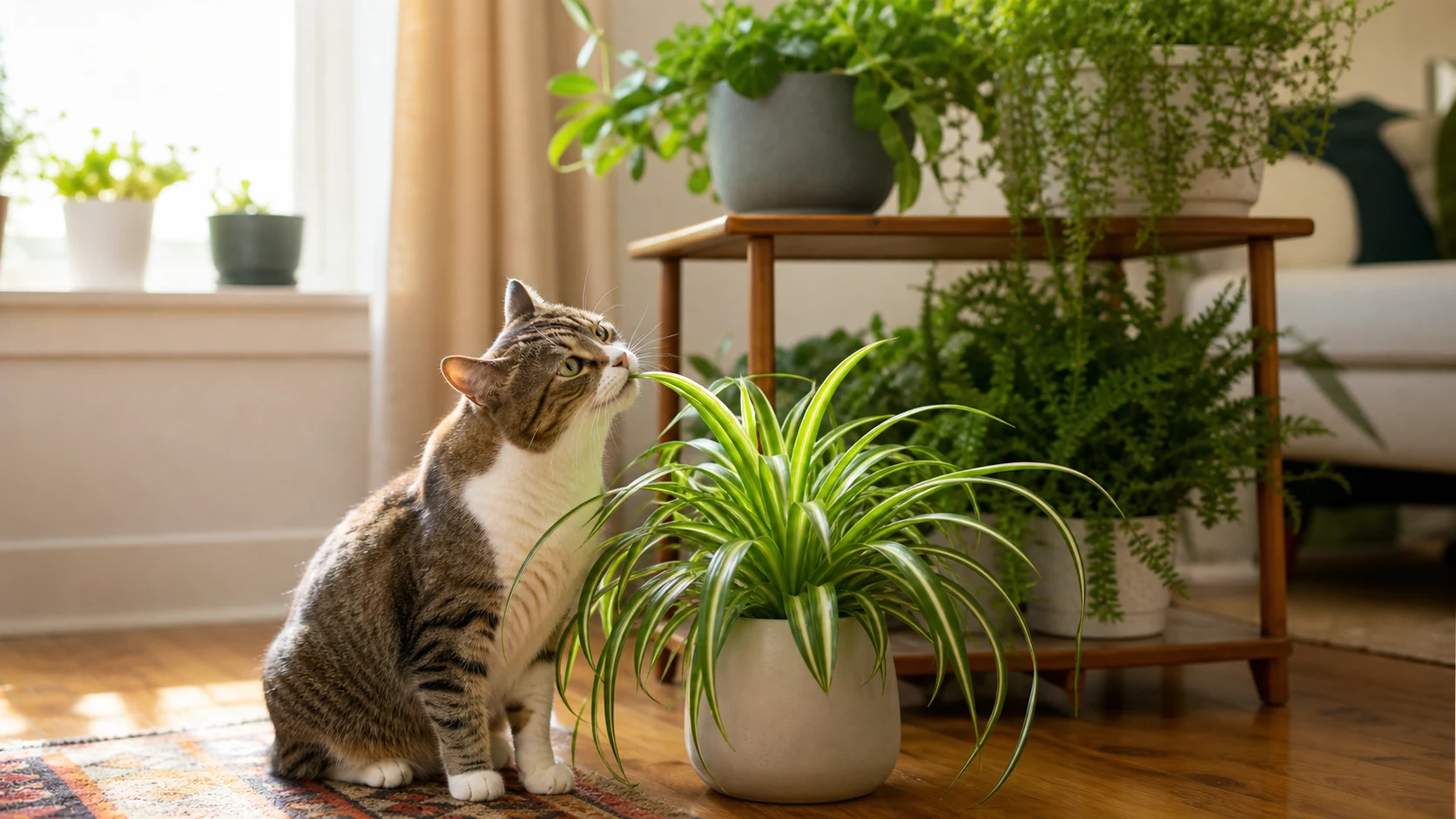
A spider plant and Boston fern make a relaxed cat-friendly room practical, even when a curious cat samples a leaf.