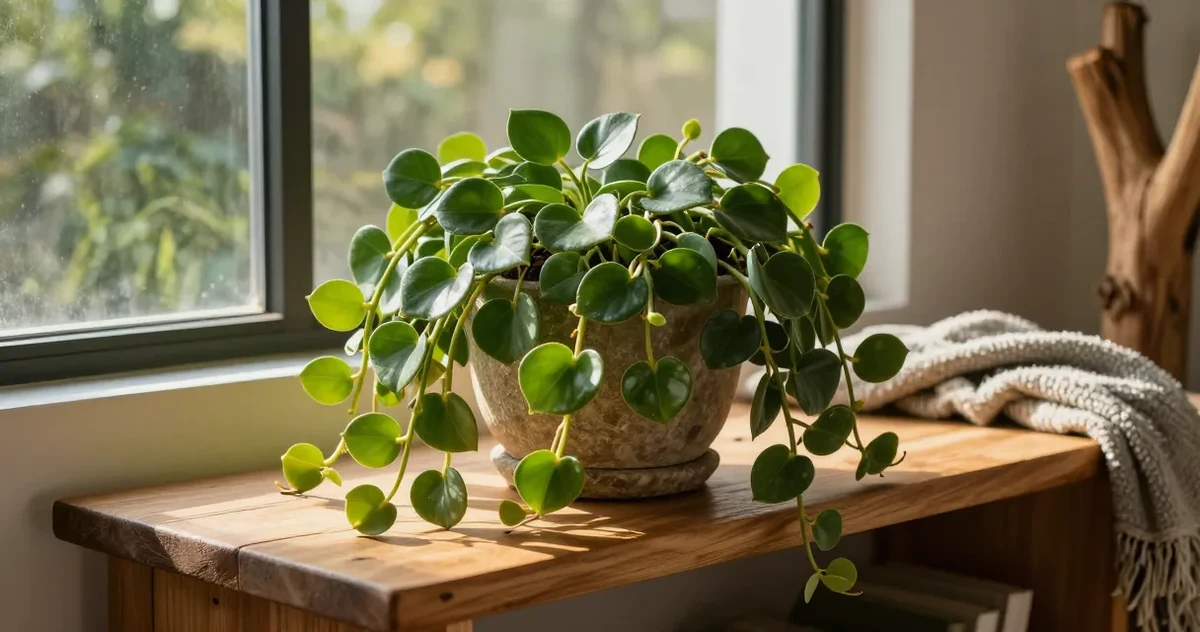
String of hearts is one of those plants people fall for instantly, then start second-guessing a few months later. The vines look so thin you worry she is weak. The leaves go paler and you wonder if she is dying. You water because she looks delicate, and somehow she looks worse.
Here is the shift that makes this plant much easier to understand: string of hearts behaves much more like a succulent than like a thirsty trailing vine. Once you see her that way, most of her drama starts making sense.
She is not a difficult plant, but she does have one big rule. She wants bright light and a real dry-out between waterings. Most of the trouble starts when we assume she wants the same routine as a pothos. If your main question is how to turn one vine into several healthy plants, use the dedicated guide to String of Hearts propagation, which goes deeper on cut points, butterfly method setup, and how to avoid rotting the nodes.
What Most Care Guides Miss
The most common misdiagnosis with string of hearts is assuming every sparse vine, pale leaf, or soft-looking plant needs more water. Generic advice like “water when dry” is not enough here, because this plant can look fragile even when she is completely healthy.
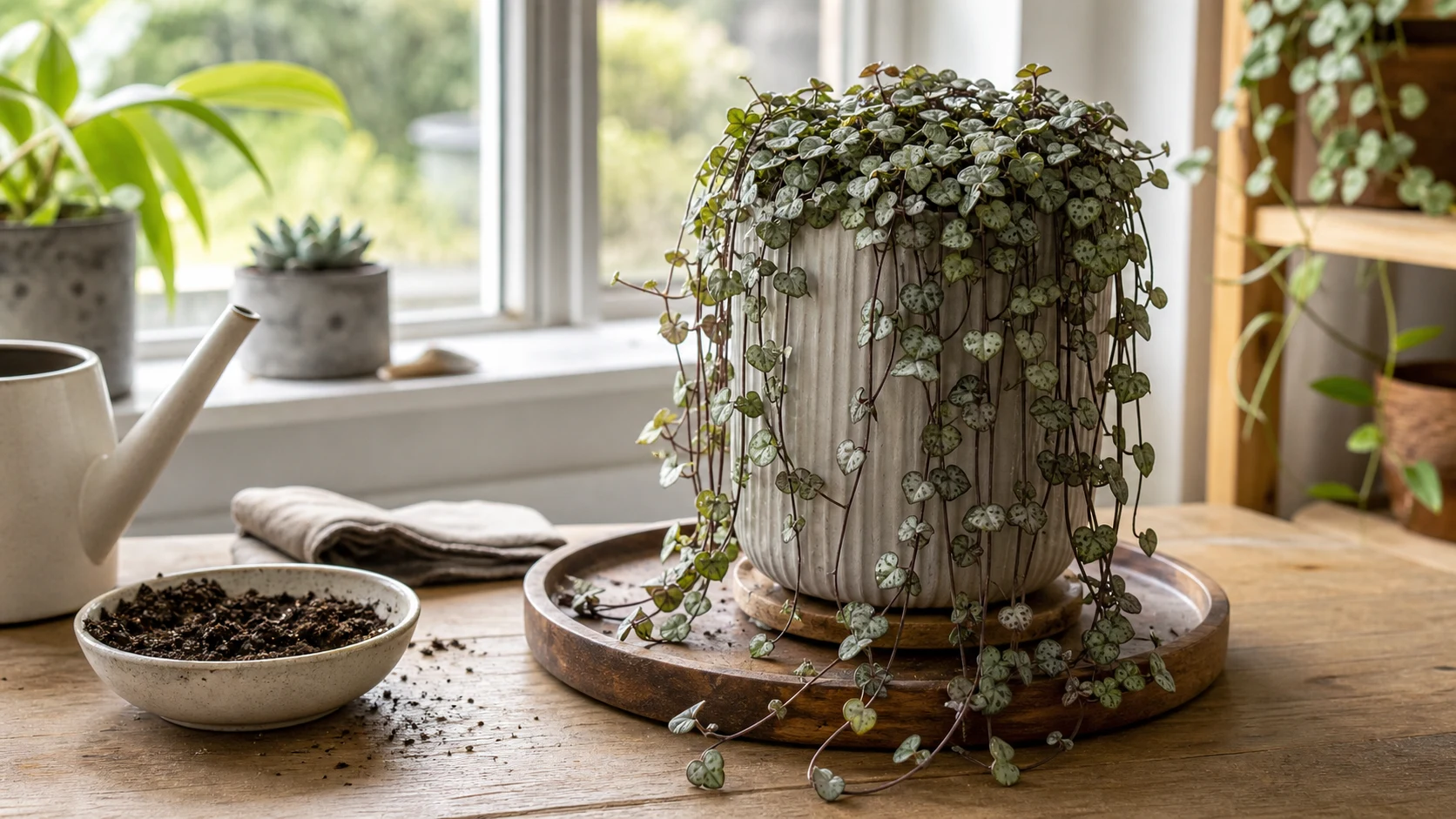
Check leaf texture, full-pot dryness, and stem firmness together before assuming delicate vines need water.
Before you change anything, check these three things together:
- Are the leaves actually thin and wrinkled, or just small and delicate?
- Is the soil bone dry all the way through, or only dry on top?
- Are the stems firm at the soil line, or soft and dark near the base?
That quick check tells you more than panic-watering ever will.
Symptom diagnosis card
| What you see | Most likely issue | Check first |
|---|---|---|
| Thin stems but firm leaves | Normal growth habit | Leaf texture, spacing, and stem firmness |
| Long gaps between leaves | Not enough light | Distance from the window |
| Lower leaves yellowing, soft base | Overwatering | Soil moisture and root health |
| Pale or fading variegation | Light too low | Brightness over the full day |
| Limp leaves in fully dry soil | Thirst | Whether the pot feels very light and fully dry |
Decision tree
- If the stems are thin but the leaves are still firm, do not treat that as a watering emergency. That is usually normal.
- If the leaves are spaced far apart, fix light before you touch anything else.
- If the base of the plant feels soft, check roots and stop watering more.
- If the leaves are soft and the soil is fully dry, give her a deep drink and let her recover.
What String of Hearts Actually Is
String of hearts, or Ceropegia woodii, is a trailing semi-succulent from southern Africa. In the wild she grows where rain comes in bursts and the soil dries quickly. She does not live in steady moisture. She lives in a cycle of drink, dry out, recover, and grow again.
That structure shows up clearly indoors too. Her stems stay thread-fine. Her leaves are small. She forms little tubers along the vine and stores energy in the root zone instead of building thick, fleshy stems.
That is why she usually does better when you treat her more like a succulent than a tropical trailing plant. If you already grow String of Pearls or other drought-tolerant vines, the watering logic will feel familiar. If this is your first semi-succulent, the succulent care guide is a helpful companion.
Identification Snapshot
- Leaf shape: small heart-shaped leaves with a marbled silver pattern, usually with a purple underside
- Stem habit: long, wiry trailing vines are normal, even on healthy plants
- Node clue: little aerial tubers can form along the vine and are part of how the plant stores energy
- Light clue: large gaps between leaves usually mean the plant needs more light, not more water
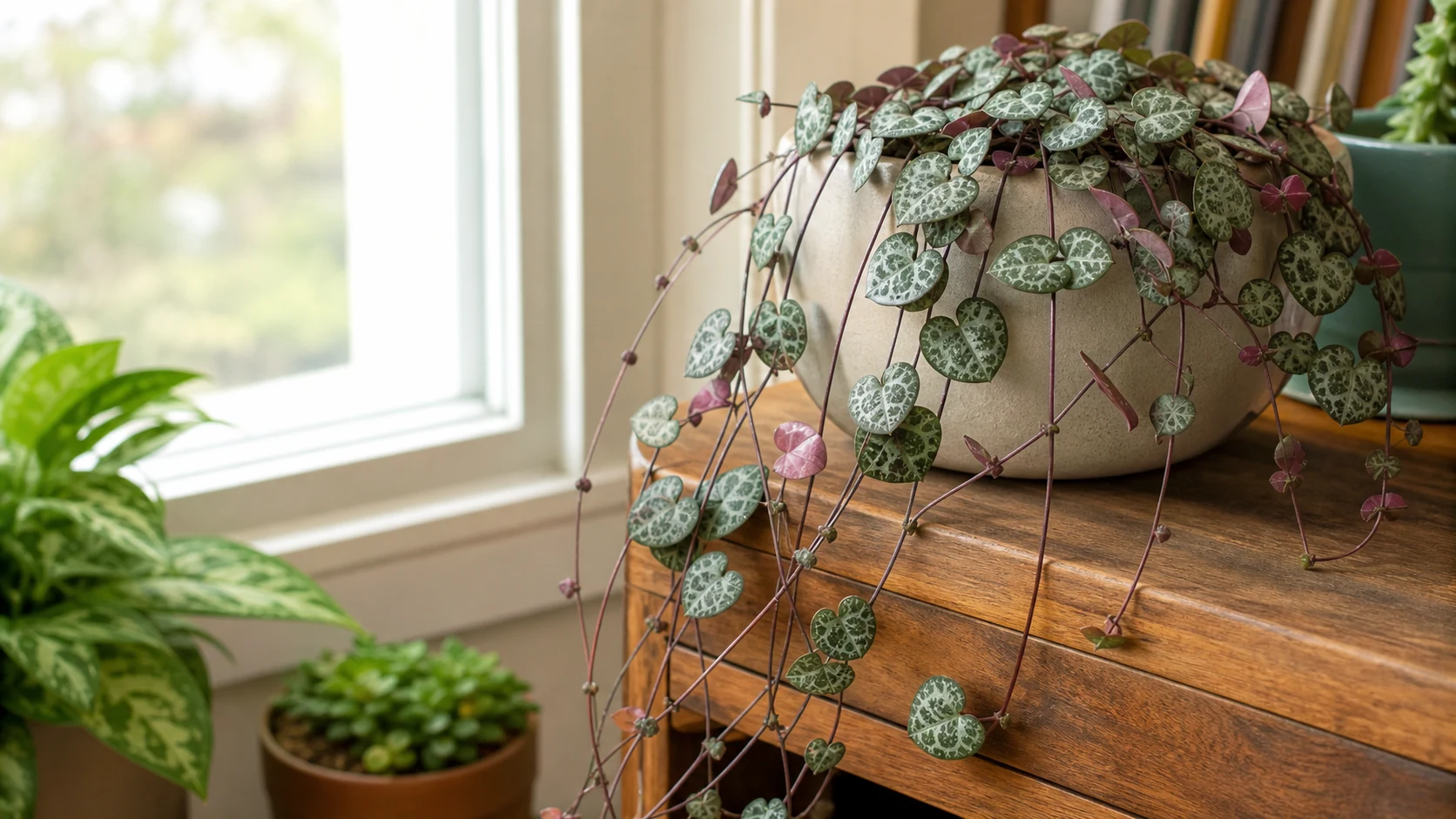
Silver-marbled heart leaves, purple undersides, wiry vines, and bead-like aerial tubers distinguish String of Hearts at a glance.
Lookalikes and Confused With
| Plant or form | What people confuse it with | What to check |
|---|---|---|
| Variegated String of Hearts | All-green String of Hearts | Cream and pink tones usually need brighter light to stay visible |
| Silver Glory | Standard marbled String of Hearts | Leaves look broader and more silver than the usual marbled form |
| String of Arrows | Standard String of Hearts | The trailing habit is similar, but the leaves read narrower and more arrow-shaped than heart-shaped |
String of Hearts at a Glance
| Care need | What works best |
|---|---|
| Light | Bright indirect light, with some gentle morning sun |
| Water | Wait until the soil is fully dry, then water deeply |
| Soil | Fast-draining cactus mix or potting mix with lots of perlite |
| Pot | Small pot with drainage holes, terracotta if possible |
| Growth habit | Thin trailing vines are normal |
| Variegation | Strongest in brighter light |
| Easiest propagation | Water rooting or butterfly cuttings |
| Biggest mistake | Watering on a fixed schedule |
Care Cards
Light care card
Give string of hearts the brightest indirect light you can manage, then use leaf spacing as the reality check. Tight leaf spacing usually means the spot is working. Long bare stretches usually mean it is not.
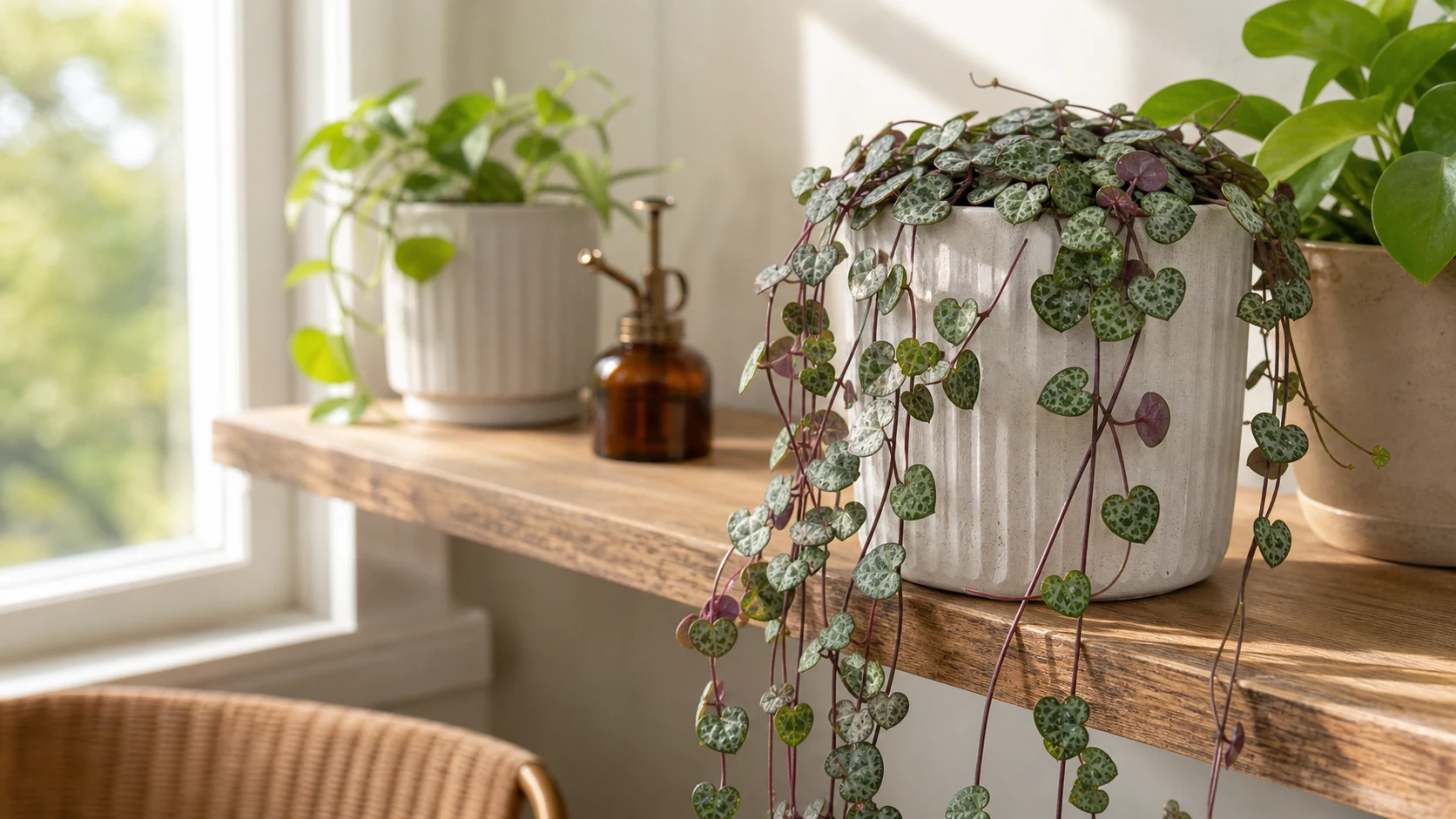
Dense leaf spacing near a bright window signals a better light position than long bare stretches along the vines.
Watering care card
Wait for a full-pot dry-down, not just a dry top layer. If the pot is still heavy or cool inside, wait.
Soil and pot care card
Use a fast-draining mix and a pot that does not stay wet for too long. Terracotta helps if you tend to water early.
Propagation care card
Use water propagation for confidence and butterfly cuttings or pinned tubers when the real goal is a fuller pot.
Winter care card
In winter, reduce watering and trust bright light more than habit. This plant usually needs less help, not more, when growth slows.
Light: What Keeps Her Full and Colorful
Light controls almost everything with string of hearts, especially if you have the variegated form.
If she gets enough light, the leaves stay closer together, the pink and cream tones stay brighter, and new growth looks more intentional than stretched. If she does not, the plant usually starts reaching. The gaps between leaves get longer, the pattern fades, and the whole vine starts looking sparse.
Variegated plants have less green tissue doing the work of photosynthesis, so they usually need brighter conditions than all-green versions to keep their color. That is why a variegated string of hearts can slowly turn greener in a dim room even if she is technically still alive.
A spot close to an east-facing window works beautifully. A bright south-facing window can work too, especially if she is a little back from harsh midday sun. Gentle morning sun is usually fine. Strong direct afternoon sun through hot glass can bleach the leaves.
If you are unsure whether the problem is light or watering, look at the spacing first. Wide gaps between leaf pairs usually point to light before anything else. If your room is dark for part of the year, grow lights for indoor plants can help her stay compact and keep that variegation.
How to Water String of Hearts
This is the care step that decides whether she thrives or slowly collapses.
Wait until the soil is fully dry. Not almost dry. Not dry on top and cool underneath. Fully dry. Then water thoroughly until water runs from the drainage holes, and let the excess drain away.
That is the whole method.
In brighter spring and summer conditions, that may mean watering about every 10 to 14 days. In winter, it is often closer to every 3 to 4 weeks. But the schedule matters less than the soil. If you push a finger down and feel even a little cool dampness, wait.
A good string of hearts watering check looks like this:
- the pot feels light,
- the soil is dry all the way down,
- the leaves may feel a little less plump than usual,
- but the stems still feel firm.
If she has yellow leaves near the crown, a soft stem base, or a faint musty smell from the pot, she is not asking for more water. She is telling you the roots have been sitting wet too often.
Soil and Pot: The Part That Makes Watering Easier
String of hearts is much easier when the mix drains fast.
A cactus and succulent mix is the simplest option. You can also use regular potting mix and cut it heavily with perlite, about half and half. Orchid bark can help too if your mix tends to stay dense.
The goal is simple: after watering, the roots should get moisture and air, not stay trapped in heavy damp soil.
Terracotta is especially helpful here because it lets moisture escape through the pot walls. Plastic and glazed ceramic can still work, but you usually need to be more conservative with watering in those.
And keep the pot fairly snug. A huge pot full of extra soil stays wet much longer than she wants. If you are deciding what container to move her into next, the terracotta pots guide can help you choose.
About Those Thin Stems, Because Yes, They Really Are Normal
This is one of the most useful things to know before you overcorrect.
String of hearts naturally grows on very fine, threadlike stems. That alone is not a sign she is weak. A healthy plant can still look delicate.
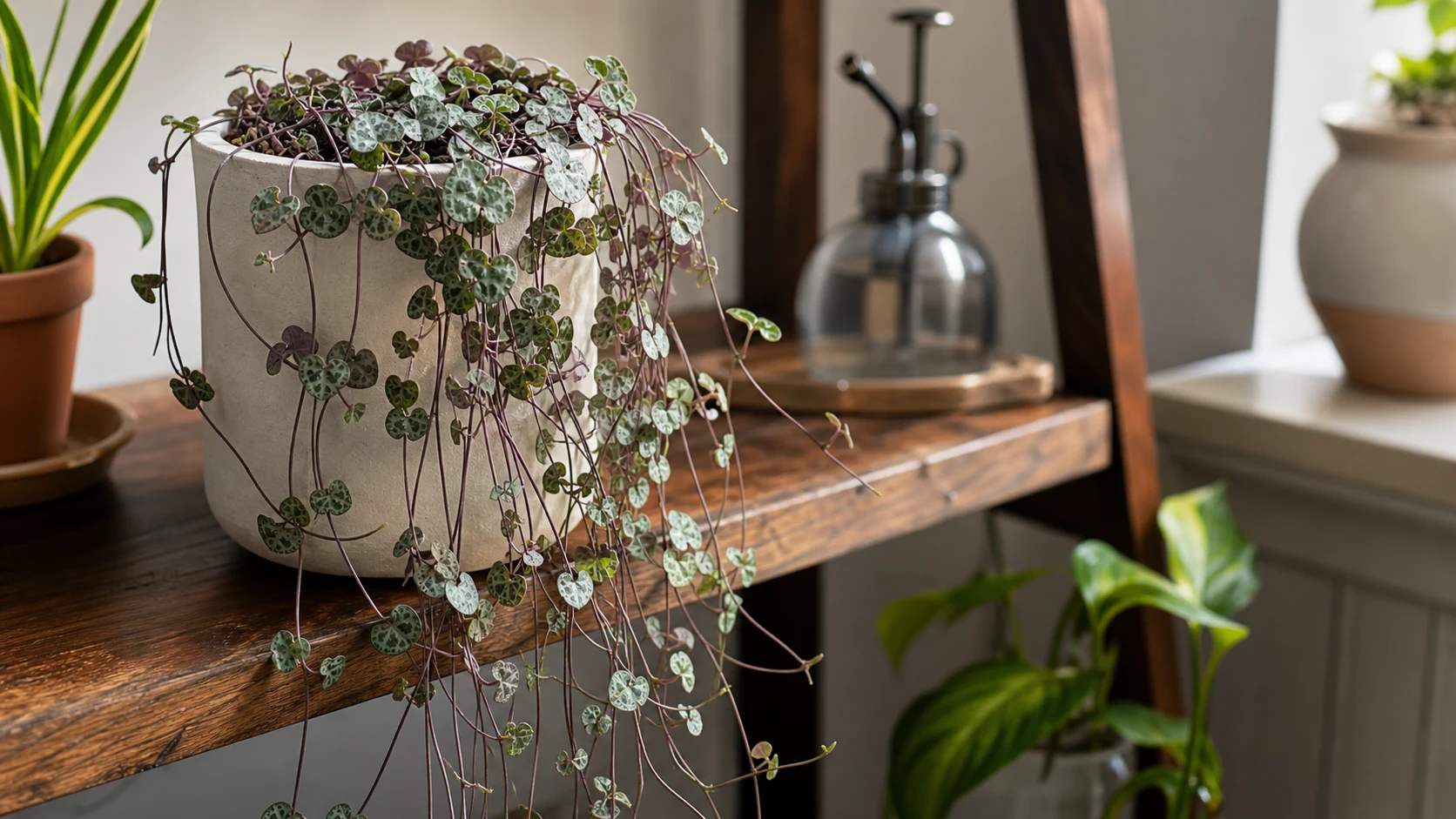
A stable crown, firm leaves, and even spacing show how naturally thread-fine vines can still be healthy growth.
The difference is in the details:
- Healthy thin stems: leaves are firm, spacing is fairly even, crown is stable
- Light-starved thin stems: leaves are far apart and the vine looks stretched
- Water-damaged stems: base feels soft, dark, or mushy
- Severely thirsty stems: leaves feel flat, thin, and wrinkled instead of just small
If you learn that difference, you will avoid one of the biggest string-of-hearts mistakes, treating normal fine growth like a crisis.
Aerial Tubers: The Little Beads Along the Vine
Those little round bumps forming at the nodes are aerial tubers. They can look strange if you have never seen them before, but they are not pests and they are not damage.
They are a storage system.
When your plant starts making them, it usually means she is settled enough to stash energy for later. That is a good sign. They are also useful for propagation. You can rest a tuber against soil while it is still attached to the vine and let it root in place. It takes patience, but it is a lovely way to fill out a sparse pot.
This is one of the details most quick care guides skip, and it matters because a lot of people worry the beads mean something has gone wrong. Usually, they mean the opposite.
How to Propagate String of Hearts in Water
If you want the easiest beginner method, start with water propagation.
Take a cutting with at least one bare node and a couple of healthy leaf pairs above it. Remove any leaves that would sit underwater. Put only the node in water, not the foliage.
Then:
- Place the cutting in bright indirect light.
- Change the water every few days.
- Wait for roots, usually in 2 to 4 weeks.
- Pot it up once the roots are about 1 to 2 cm long.
The other beginner-friendly method is the butterfly cutting. Take a short segment with one pair of leaves and one node, lay that node on lightly moist soil, and keep the mix barely damp until it roots. This works especially well if your goal is to make the pot look fuller instead of creating a separate plant.
If you want a broader propagation refresher, the how to propagate plants guide covers the basics in plain language.
Common Problems
Most string of hearts problems become much less mysterious when you sort them by pattern.
Yellow leaves and soft stems
This usually means too much water. If the damage is near the soil line and the stems feel soft, check the roots. Dark, mushy roots need to be trimmed away before you repot her into fresh dry mix. If the crown and roots are already collapsing, the root rot treatment guide walks through the rescue steps.
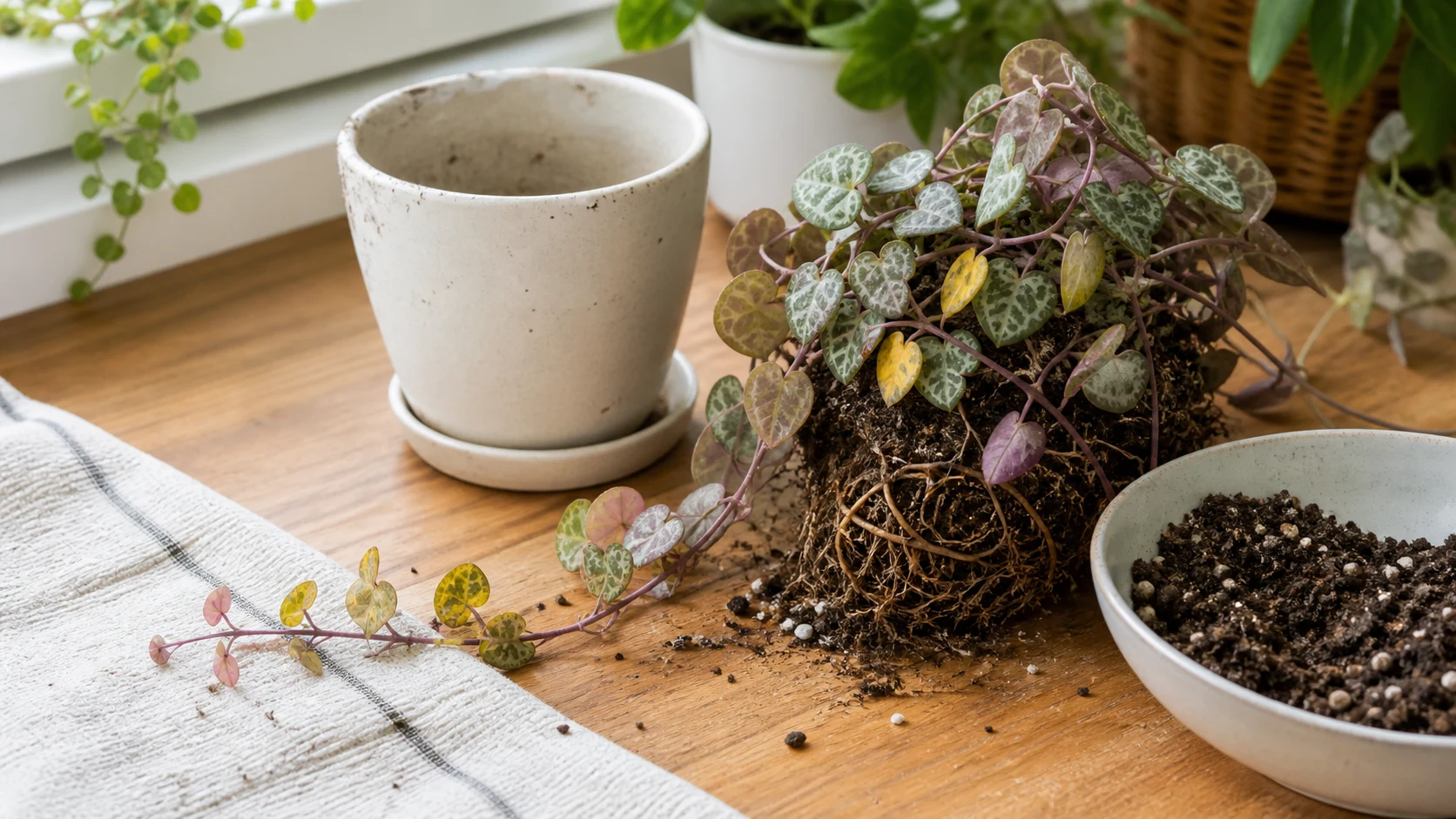
After yellow leaves and a soft base appear, inspect the roots and repot only healthy tissue into fresh airy mix.
Long bare stretches with tiny leaves
That is usually a light problem. Move her closer to a brighter window. The old vine will not fill back in, but new growth should come in tighter.
Fading variegation
Almost always not enough light. She is trying to make more chlorophyll to support herself.
Limp leaves in dry soil
That is thirst. Give her a proper soak and let the water drain through.
Fine webbing or dusty, stippled leaves
Check for spider mites, especially in dry winter air. Wipe the leaves gently and treat early before they spread.
Common Mistakes
- Watering because the vines look delicate, not because the soil is truly dry
- Keeping her too far from the window and then blaming the plant for getting sparse
- Potting her into a container that is much too large
- Burying leaves during propagation instead of just the node
- Assuming thin stems automatically mean she is struggling
- Panicking over aerial tubers when they are actually a healthy sign
Pet Safety
According to the ASPCA, string of hearts is not listed as toxic to cats or dogs. That makes her a gentler choice for pet homes than many trailing houseplants.
Still, if you live with a cat who treats dangling vines like toys, placement matters. A non-toxic plant can still end up shredded. If you are building a safer collection overall, the cat-safe indoor plants guide is a good next stop.
String of hearts also looks lovely mixed with other draping houseplants. If that is the look you are after, the trailing plants indoor guide can help you choose companions with similar vibes, even if their watering needs differ.
Seasonal Note
This plant can feel easy in summer and suddenly tricky in winter, mostly because light changes faster than our habits do.
- Spring: She wakes up, grows faster, and is usually ready for more frequent watering and propagation.
- Summer: Bright growth season. Watch harsh direct sun and check for spider mites in dry heat.
- Autumn: Growth slows. This is when overwatering starts sneaking in.
- Winter: Give her your brightest window, very little water, and patience.
If she starts fading or stretching in winter, it does not mean you failed. It usually means the room changed and her routine needs to change with it.
Expert and Source Layer
This guide is built around practical houseplant care sources and widely used indoor-growing principles:
- University of Missouri Extension on overwatering as a common houseplant failure pattern
- University of Florida IFAS guidance on root-rot risk in waterlogged, low-oxygen soil
- ASPCA toxic and non-toxic plant database for pet safety
- Darryl Cheng’s growth-based watering approach from The New Plant Parent
The most important part is not memorizing the source list. It is knowing what to check first in your own home: light, real soil dryness, and whether the stems are firm or soft.
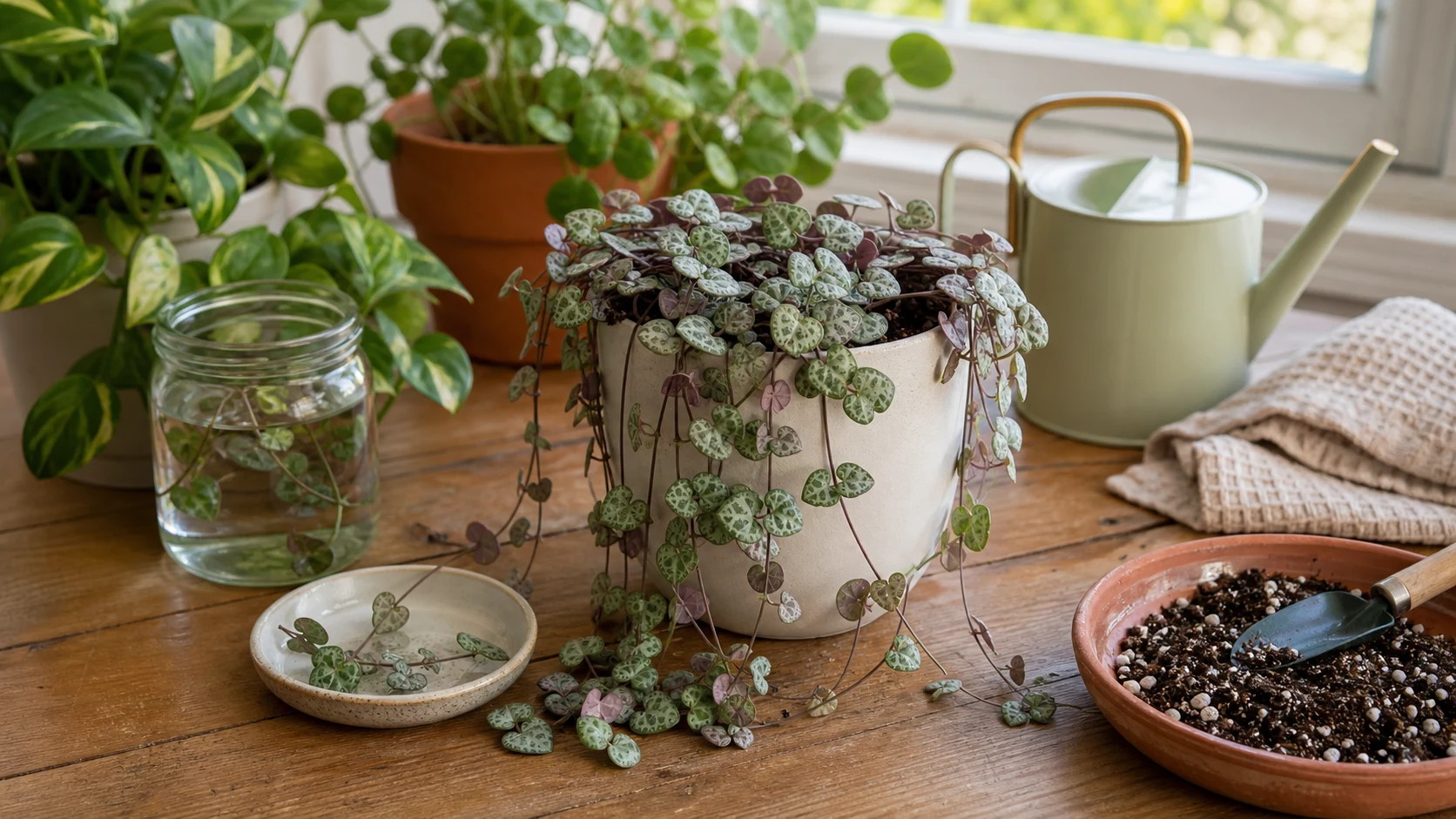
Practical care evidence starts with the plant in front of you: window light, true soil dryness, and firm stems.
For a related hands-on growing walkthrough, use Spider Plant Propagation: Root Plantlets in Water or Soil for the setup and follow-up care.
Methodology Note
This remediation refresh used the Research Pack for string-of-hearts-care-guide, which reviewed live SERPs and Reddit snippet patterns on 2026-05-22, then anchored visible care, diagnosis, tuber, propagation, and seasonal guidance to Wisconsin Horticulture and NC State Extension. Social signals are included here as real owner confusion patterns, not as controlled testing data.
Freshness Note
Last reviewed: 2026-05-26.
String of hearts care changes a lot with season, window strength, and pot type, so always trust what the plant and the soil are doing in your space over any rigid watering calendar.
Real User FAQ
How often should I water string of hearts?
Only when the soil is fully dry. In brighter growing months that is often every 10 to 14 days. In winter it can easily stretch to 3 to 4 weeks. The soil should decide, not the calendar.
Why is my string of hearts losing its pink and cream coloring?
Usually because she needs more light. Variegated growth is harder for the plant to maintain in dim conditions, so new leaves may come in greener when she is not getting enough brightness.
Can I propagate string of hearts in water?
Yes, and it is one of the easiest ways to start. Put a bare node in water, keep the leaves above the waterline, and change the water every few days until roots form.
Why are the lower leaves turning yellow?
Most often, too much water. If the soil is staying wet and the base of the plant feels soft, check the roots before watering again.
What kind of soil does string of hearts need?
A fast-draining mix. Cactus soil is an easy option, or you can mix regular potting soil with lots of perlite to help the roots breathe.
Are the tiny beads on the vine a problem?
No, those are aerial tubers. They are a normal storage structure and often a sign that the plant is mature and settled.
Are thin stems normal?
Yes. Healthy string of hearts naturally grows on very fine stems. What matters more is whether the leaves are firm and the base is healthy.
When should I repot string of hearts?
Usually when she is drying out very quickly after watering or when roots are pushing out of the drainage holes. Move up only one pot size at a time.
Download KnowYourPlant for care reminders, watering notes, and calm diagnosis help when something starts looking off. It is an easy way to keep track of what you changed and how she responds over the next few weeks.