Succulent care usually goes wrong in one of two ways: the plant gets watered while the soil is still damp, or it sits in a room that is too dim for the soil to dry quickly. If you are new to plants, start here: most indoor succulents want a deep drink every 7-14 days in spring and summer, every 3-5 weeks in autumn and winter, and no water until the soil is dry 2 inches down.
The first warning signs are easy to spot. Soft, translucent, yellowing lower leaves or a mushy stem usually mean too much water. Wrinkled, curling, or puckered leaves usually mean the plant is thirsty. Brown dry tips or bleached patches usually point to sun, heat, or a watering gap. This guide helps you match the symptom to the fix before the plant is in real trouble. For the weaker-light and slow-drying conditions of apartments, continue with how to care for succulents indoors. If the plant is stretching or the shelf is unevenly lit, use the succulent grow-light setup guide to test distance, duration, and coverage. If you are not sure what succulent you are holding in the first place, use the succulent identification guide before you change care.
A measured succulent reference: jade plant
Succulent describes a water-storage strategy across many unrelated plants. Crassula ovata is used as one explicit species reference rather than a fabricated average for every succulent.
The ranges below are the middle 50% (p25–p75), not recommended indoor setpoints.
| Reference taxon | POWO native range | Annual mean temperature | Annual precipitation | Relative humidity | Solar radiation | Evidence |
|---|---|---|---|---|---|---|
| Crassula ovata (jade plant) | southeastern Mozambique to the southeastern Cape Provinces | 16.5–18.6°C | 489–770 mm/yr | 56–60% | 16.7–19.0 MJ/m²/day | 30 climate points / 70 usable records; medium confidence |
What this changes in this guide: Apply the evidence to jade plant only. Other succulents may come from different rainfall seasons, temperatures, elevations, and growth cycles.
Sources and method: Crassula ovata in POWO and GBIF; CHELSA V2.1, 1981–2010. GBIF records are limited to POWO-native countries, then filtered for coordinates, establishment signal, licence, precision, and spatial duplication. No community or user-reported care data is used in this module.
What Most Care Guides Miss
Most guides about succulent describe the ideal care routine. Real homes are messier: light changes by season, pots dry at different speeds, and the same symptom can mean different things depending on where it appears.
Before changing care, check the plant in this order:
- Light: is the plant growing toward the window, fading, or scorching?
- Root zone: is the pot drying predictably, or staying wet in the middle?
- Leaf pattern: did the oldest leaves, newest leaves, tips, or stems change first?
- Recent change: new pot, new location, fertilizer, cold draft, heat vent, or pest exposure.
This keeps you from fixing the wrong problem. One clear adjustment is usually safer than a full care reset.
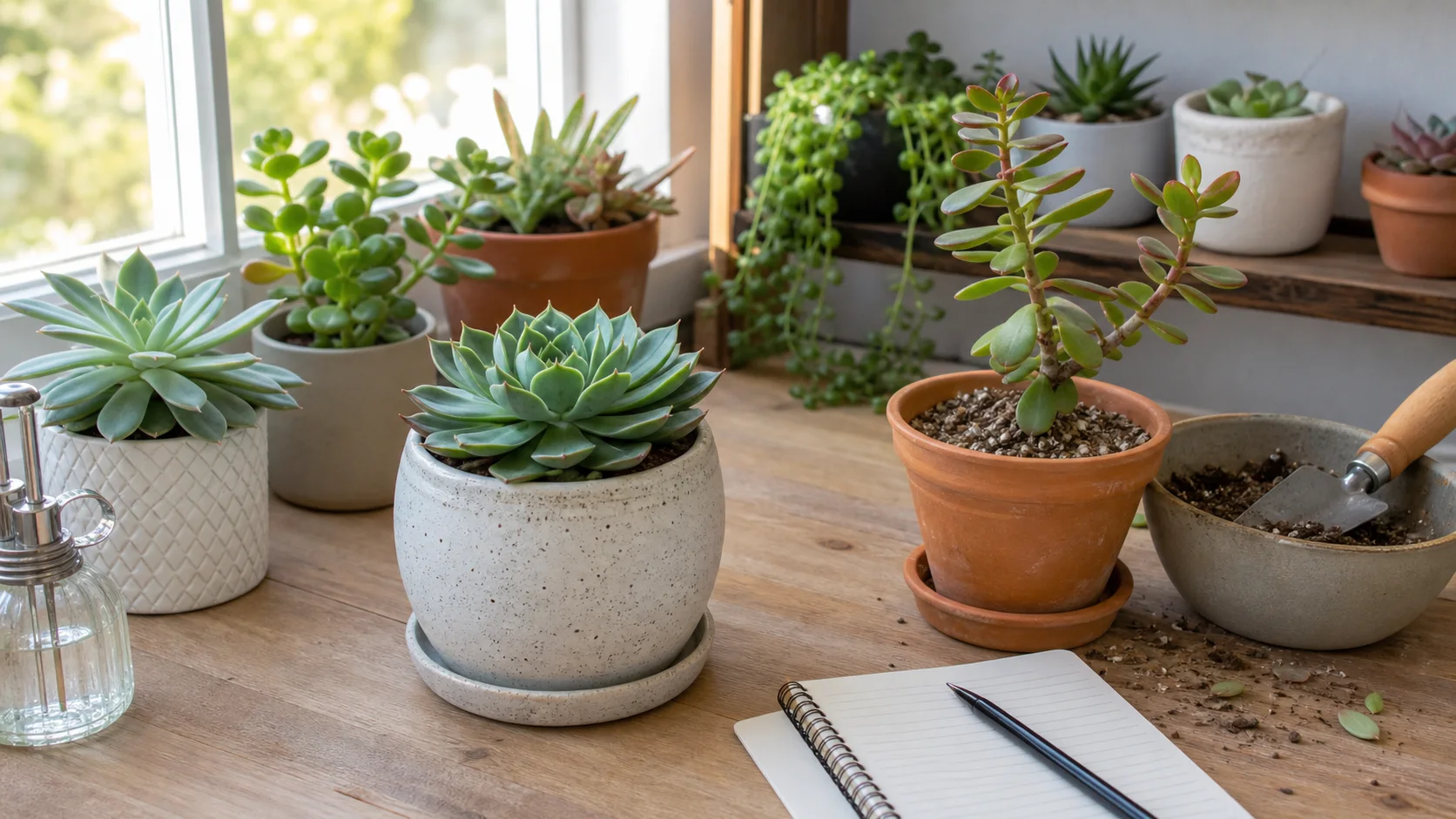
Compare light, leaf shape, soil texture, and recent pot changes before resetting a succulent’s care.
Identification Snapshot
| Succulent group | Quick visual clue | Why it matters indoors |
|---|---|---|
| Rosette succulents such as echeveria types | Leaves stack into a tight rose shape | Usually need the strongest window light and stretch fastest when the room is too dim |
| Haworthia and gasteria types | Thicker leaves with stripes, bumps, or translucent tips | Often handle bright indirect light better than sun-hungry rosette types |
| Aloe types | Upright spears or chunky leaves with toothed edges | Need strong light, deep watering, and extra caution if pets chew plants |
| Cacti sold beside succulents | Spines grow from small areoles rather than directly from the leaf | Usually want the brightest light and the leanest watering routine of the group |
Lookalikes and Confused-With
| Often confused plants | Quick difference | Why the distinction helps |
|---|---|---|
| Haworthia or gasteria vs echeveria | Haworthia and gasteria stay firmer and tolerate lower light better; echeveria rosettes flatten and stretch faster | It keeps you from promising the same light routine to every succulent |
| Aloe vs agave | Aloe leaves are usually softer and more flexible; agave leaves are stiffer and sharper | Aloe is more common indoors, while agave often wants brighter, drier conditions than beginners expect |
| Cactus vs leafy succulent | Cacti carry areoles and spines; many other succulents store water in leaves without those spine clusters | It changes how much direct sun and winter dryness the plant can tolerate |
Succulent Care Cards
| Care card | Practical target |
|---|---|
| Light | Brightest window available, with direct sun introduced gradually |
| Water | Deep drink only after the mix is dry at least 2 inches down |
| Soil | Fast-draining mix that returns close to dry within about 4-7 days indoors |
| Pot | Drainage hole first, pot size second, decorative cachepot last |
| Winter reset | Less water, no automatic feeding, and more caution in dim rooms |
Expert Note
University extension guidance from Minnesota, Iowa State, and South Dakota lines up on the same baseline: abundant light, a true wet-dry watering cycle, and soil that does not stay wet for long. If your plant keeps declining, start by checking whether your home conditions are breaking one of those three basics before you chase exotic fixes.
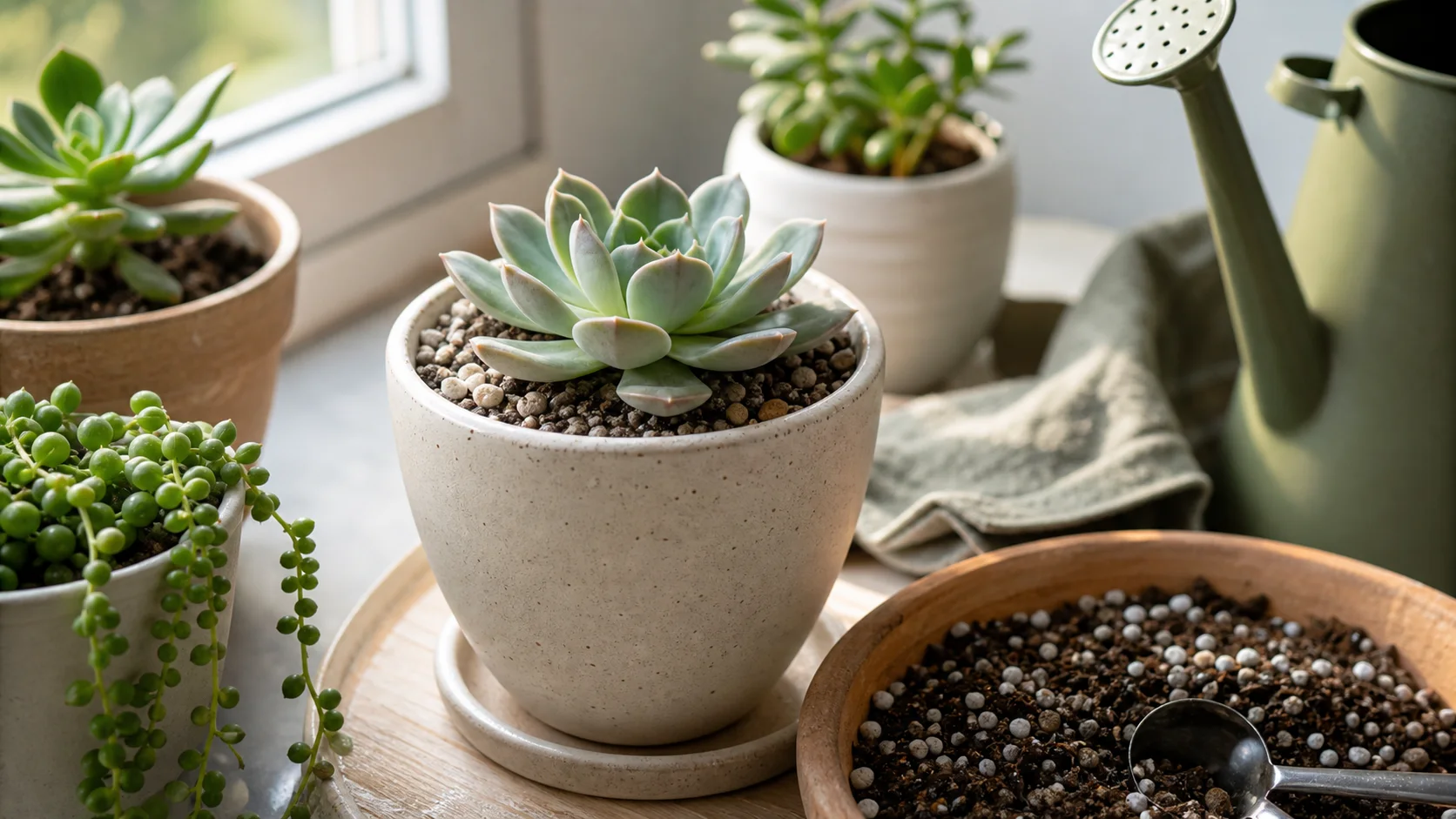
Bright window light, a gritty mix, and a full wet-dry cycle form the reliable baseline for indoor succulent care.
The 2-Minute Succulent Check
If you only have a minute, do this before watering:
- Today: Push your finger or a chopstick 2 inches into the soil. If it comes out cool or damp, wait. If it comes out dry, water until it drains.
- This week: Put the plant in the brightest window you have, then rotate the pot a quarter turn so it does not lean.
- This season: Water more often when days are long and growth is active; slow down hard in winter when the soil takes longer to dry.
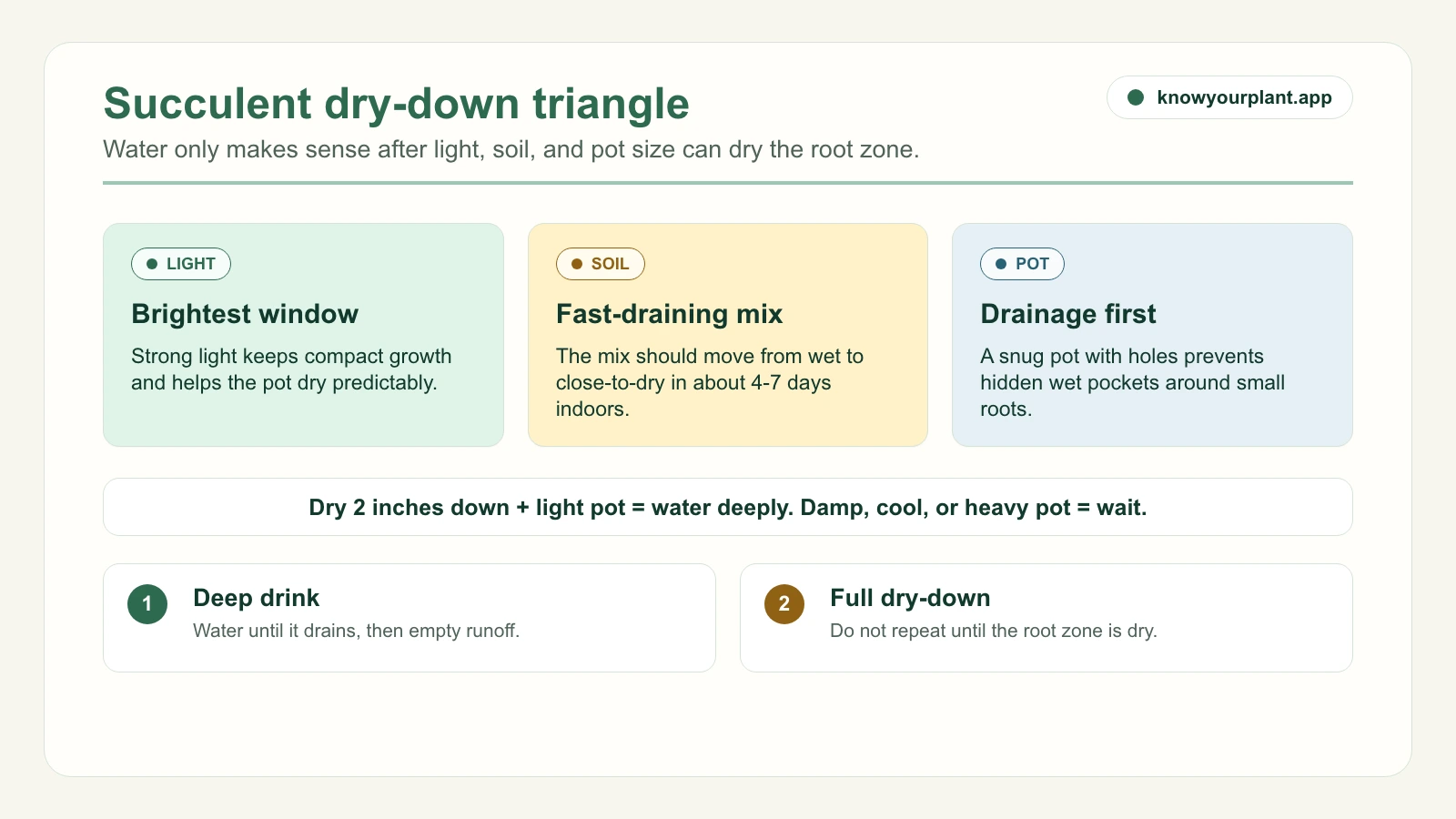
Use the dry-down triangle before watering: light, soil, and pot size decide whether a deep drink is safe or whether the root zone still needs time.
How Succulents Think About Water
The number one reason succulents die indoors is overwatering. Not neglect. Overwatering.
Succulents evolved in places where rain is rare and intense: deserts, rocky hillsides, coastal cliffs. They’ve built water storage directly into their leaves, stems, and roots. That’s why the leaves feel thick and plump - they’re holding reserves for the dry season.
Indoors, the dry season never comes. We water on a schedule, the soil stays damp, and the roots sit in moisture they weren’t built to tolerate. They rot.
The right approach: Water deeply, then let the soil dry out completely before watering again.
In summer, that might mean watering every 7-14 days. In winter, once a month or less. What matters isn’t the calendar but the soil: stick your finger 2 inches in. Completely dry? Time to water. Still a little damp? Wait.
When you do water, water thoroughly, until it drains out the bottom. Shallow watering encourages shallow roots and leaves deeper soil damp without the plant being able to reach it.
Seasonal Watering Schedule
| Season | How Often | Notes |
|---|---|---|
| Spring | Every 7-10 days | Active growth, increase gradually |
| Summer | Every 7-14 days | Watch for heat stress; water in morning |
| Autumn | Every 14-21 days | Taper off as growth slows |
| Winter | Every 3-5 weeks | Minimal - let soil dry completely |
If you are unsure, wait one more day. A thirsty succulent usually recovers after one deep watering; a rotten succulent is harder to save.
Reading Your Plant’s Leaves
The leaves are talking. Learn to listen.
Signs you’re overwatering:
- Leaves are soft, translucent, or mushy (especially lower leaves)
- Lower leaves turn yellow and feel soft, not dry
- Leaves drop when you barely touch them
- Stem feels soft at the base
- Soil smells slightly off
Signs you’re underwatering:
- Leaves are wrinkled or puckered, not plump
- Leaf edges curl inward
- Leaves feel thin and papery at the tips
- Brown dry tips appear after long dry stretches or hot sun
- Plant leans or looks deflated
Wrinkled leaves look alarming, but they are usually fixable. The plant is thirsty. Give it a thorough drink and check back in 24 hours. The leaves should plump back up. If they are also soft or mushy, that is a different situation entirely - see the diagnosis guide below.
What Your Leaves Are Telling You: A 5-Step Diagnosis
Before scrolling to the problems table, work through these five steps. They’ll get you to the actual cause faster.
Step 1: Touch the leaves.
Are they soft and mushy, or firm but wrinkled, or firm and smooth but changing color?
- Soft and mushy, especially lower leaves: go to Step 2
- Firm but wrinkled, puckered, or curling inward: go to Step 3
- Firm and smooth, but yellowing, browning, or bleaching: go to Step 4
- No leaf problems, but strange growth pattern: go to Step 5
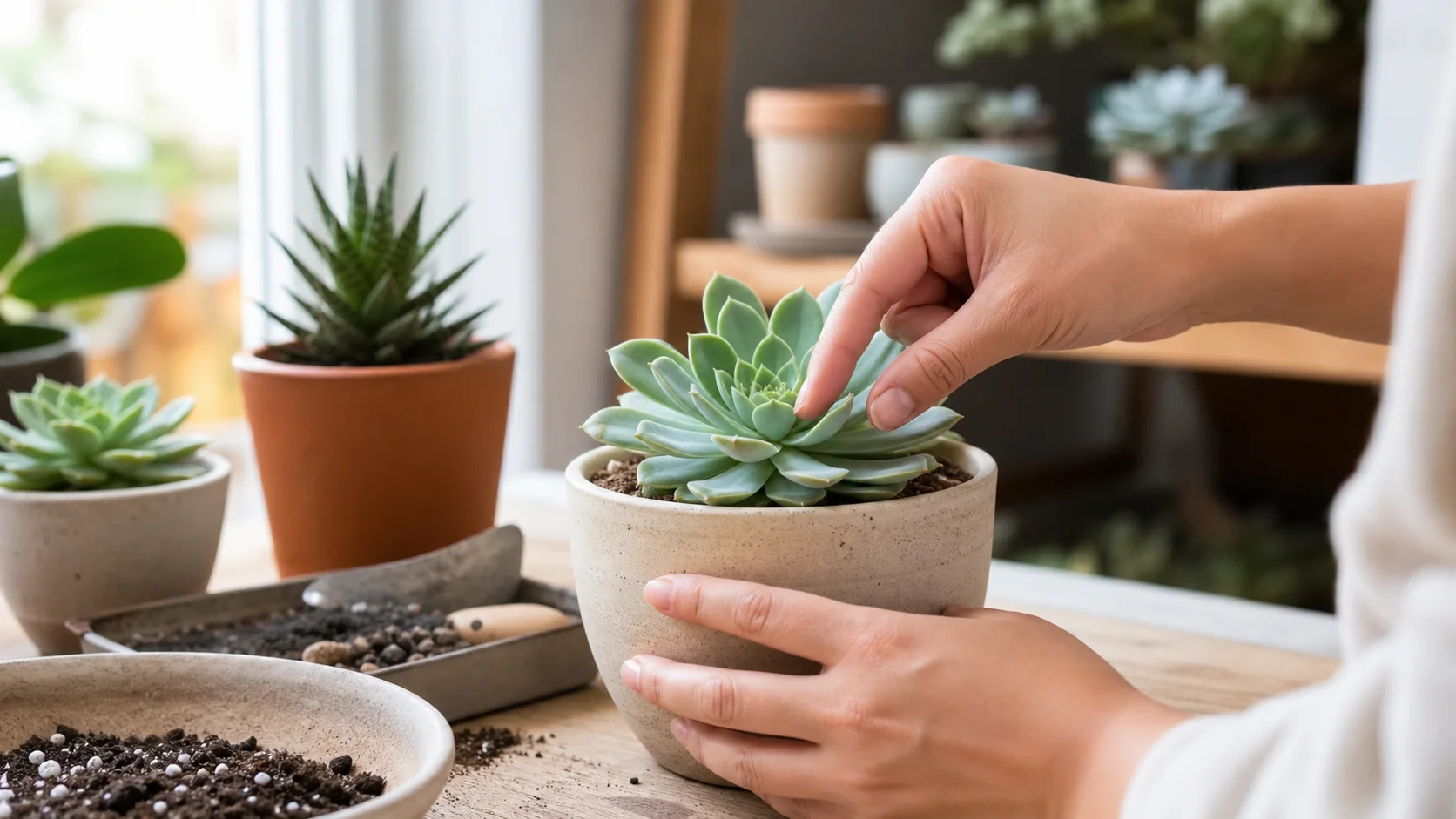
A gentle leaf check helps separate soft overwatering symptoms from firm, wrinkled thirst signals.
Step 2: The soft/mushy check (overwatering)
Press the stem gently at the soil line.
- Stem is also soft, dark, or smells off? Root rot has started. Unpot immediately, cut away any black or brown mushy roots with clean scissors, let the plant air-dry for 1-2 days, then repot in fresh dry succulent soil. Hold off watering for at least two weeks. If you need a full rescue walkthrough, use our root rot treatment guide.
- Stem still firm? The leaves caught it early. Stop watering completely, let the soil dry out fully, and wait. It will usually recover on its own if the roots are still healthy.
Step 3: The wrinkled or curling leaf check (underwatering)
Wrinkled, puckered, or inward-curling leaves usually mean the plant is using stored water faster than the roots are replacing it.
- Last watered more than 10 days ago? Water deeply now, let it drain fully, and check back in 24-48 hours. The leaves should plump back up.
- Last watered less than 10 days ago? The soil may not be draining fast enough. Press down 2-3 inches. Still damp? The problem isn’t frequency, it’s the soil mix or pot drainage.
Step 4: Firm leaves with color changes
- Pale, bleached, or brown dry patches: sunburn, usually after moving to direct afternoon sun too quickly. Transition future sun exposure gradually over 1-2 weeks.
- Yellow-orange, especially lower leaves: excess moisture over time, or early root stress. Check whether the soil is staying wet too long.
- Brown dry tips with otherwise firm leaves: heat stress, mineral buildup, or uneven watering. Check whether the soil has been bone-dry for weeks, then review afternoon sun and water quality. Trim only dead dry tips; green tissue will not turn green again.
- Dropping leaves at the slightest touch: temperature shock or a sudden environmental change. Check for nearby drafts, vents, or a recent move.
Step 5: Strange growth patterns
- Plant leaning toward one side: normal light-seeking. Rotate the pot 90 degrees every two weeks to keep growth even.
- New growth is stretched, with large gaps between leaves: etiolation from insufficient light. The stretched stem won’t shrink back, but moving to a brighter spot stops new growth from continuing to reach.
- Tiny white clusters at the base or tucked into leaf crevices: mealybugs. Treat immediately with 70% isopropyl alcohol on a cotton swab, and repeat weekly.
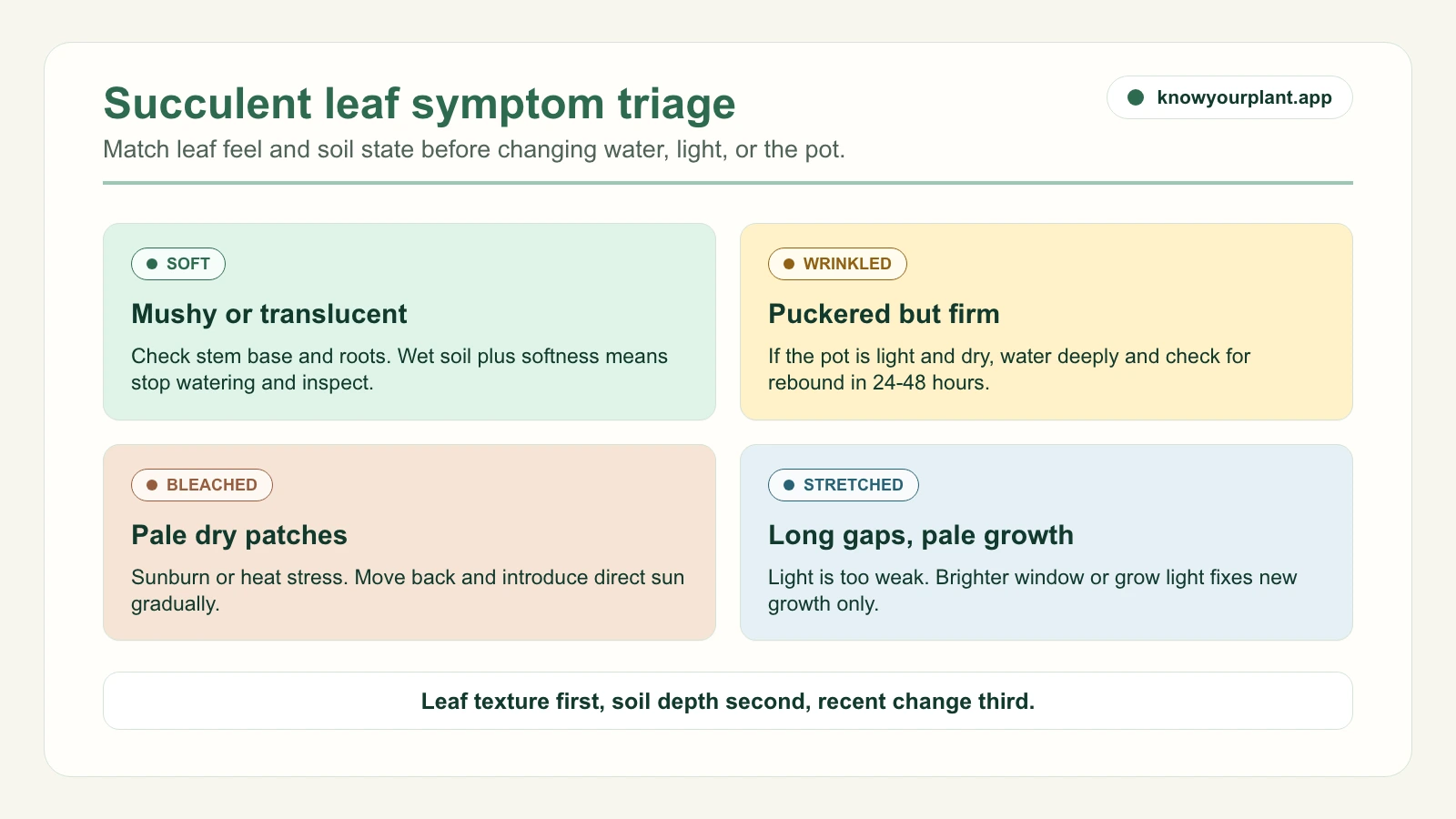
Match leaf feel, soil state, color change, and growth pattern before fixing; the same tired-looking succulent can need opposite next steps.
Light: More Than You Think
Succulents need a lot of light. More than most people expect, and more than most rooms provide.
Outdoors, they live in full sun. Indoors, the closest you can offer is a south-facing window with direct sun for several hours. East or west-facing windows work too, though growth will be slower.
Light also controls how fast the pot dries. In a dim room, the soil can stay damp for too long, so the same watering schedule becomes riskier. Light isn’t just about growth - it helps keep the watering cycle healthy.
What happens in low light: the plant etiolates. It stretches toward the light, getting leggy and pale. The spacing between leaves increases. The compact rosette shape you fell in love with gets loose and tall. It’s not dead, but it’s reaching.
If you don’t have good natural light, grow lights are a genuine solution. A full-spectrum LED set to 12-14 hours a day, placed 6-12 inches above the plant, can replace a sunny window completely. See our guide to the best grow lights for indoor plants for specific recommendations.
Light Guide by Window Direction
| Window Direction | Direct Sun Hours | Succulent Result |
|---|---|---|
| South-facing | 6+ hours | Thrives, compact, full color |
| East-facing | 3-4 hours morning | Good, slightly slower growth |
| West-facing | 3-4 hours afternoon | Good - watch for sunburn in summer |
| North-facing | 0 direct hours | Stretching, poor long-term |
One note on sunburn: if you move a succulent from low light suddenly into direct afternoon sun, the leaves can bleach or develop brown patches. Transition gradually over 1-2 weeks.
Soil: Drainage Is Everything
Regular potting soil holds too much moisture for succulents. It’s designed for plants that want consistently moist conditions - the opposite of what your succulent needs.
What succulents want is a mix that drains fast and dries out quickly. A practical benchmark: after a full watering, the mix should be close to dry again within about 4-7 days indoors. If it is still damp after a week, improve drainage, downsize the pot, or move the plant into stronger light.
Option 1: Buy a cactus/succulent mix. Most garden centers carry them. Look for one with perlite or coarse sand already mixed in.
Option 2: DIY mix (better). Combine regular potting soil with 50% perlite or coarse grit. This dramatically improves drainage and aeration. Avoid fine beach sand - it compacts and makes drainage worse.
Soil Drainage Comparison
| Soil Type | Drainage Speed | Dry-Out Time | Succulent Suitability |
|---|---|---|---|
| Standard potting mix | Slow | 1-2 weeks | Poor |
| Cactus mix (store-bought) | Medium-fast | 5-7 days | Good |
| 50/50 potting + perlite | Fast | 4-6 days | Excellent |
| 70/30 perlite/pumice grit | Very fast | 2-4 days | Excellent (for serious growers) |
The goal is soil that, when you pour water in, drains through in seconds - not soil that holds water like a sponge.
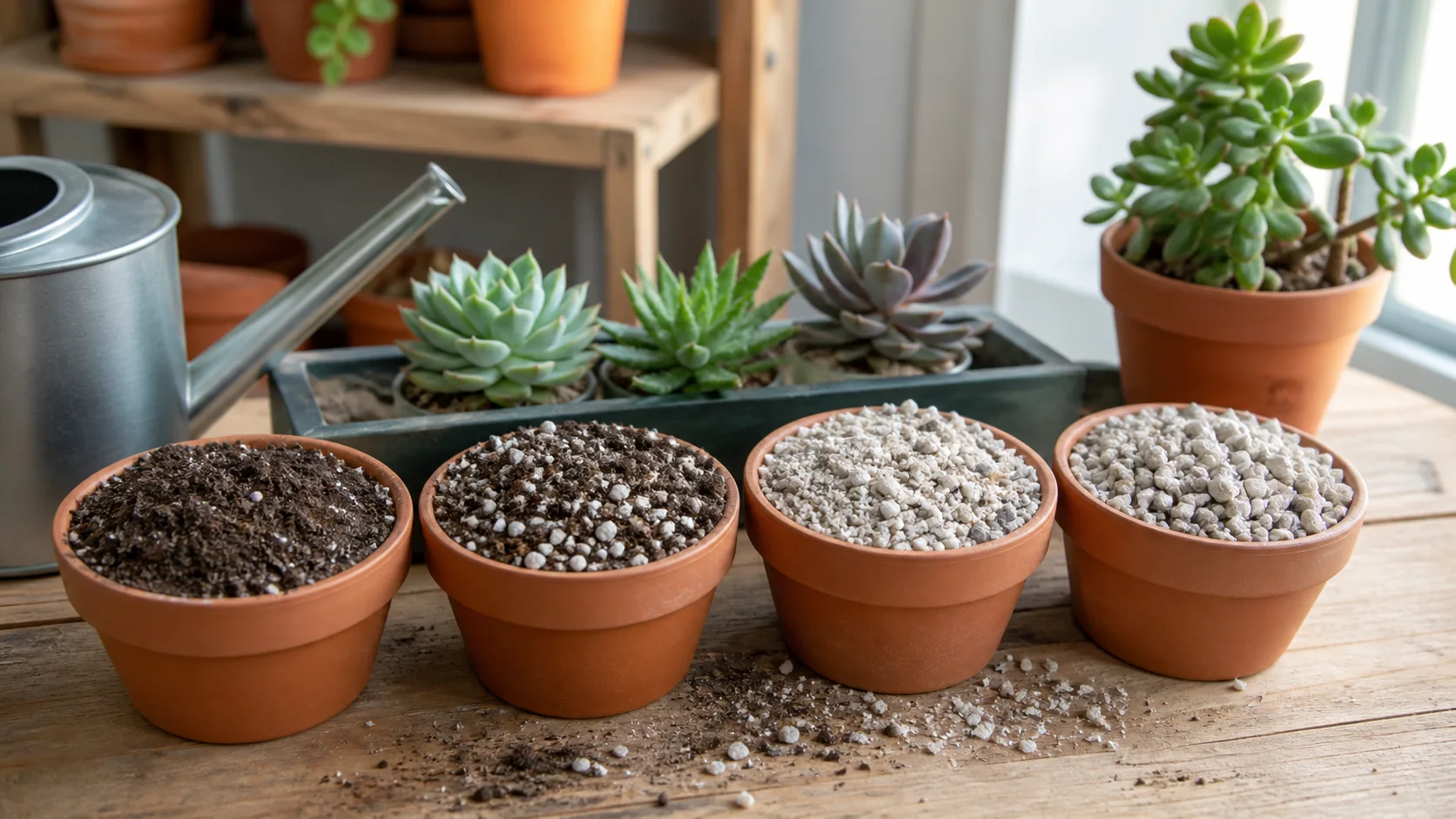
Comparing organic mix with increasing amounts of perlite and pumice makes drainage differences visible before potting.
Pots and Drainage Holes
Always use a pot with a drainage hole. No exceptions. Water that can’t escape sits at the bottom and rots roots, even in good succulent soil. This is also why self watering pots are usually the wrong choice for succulents, they keep moisture available longer than most desert-adapted roots can safely handle.
Terracotta pots are ideal. They’re porous, so excess moisture evaporates through the walls - a forgiving buffer if you water slightly too often. For more on why terracotta works so well, check our terracotta pots guide.
Glazed ceramic or plastic pots work too, but they hold moisture longer, so you’ll need to water less frequently. Avoid pots that are too large - in a big pot, the roots can’t dry out the soil before the edges get waterlogged. A pot roughly 1-2 inches wider than the plant is ideal.
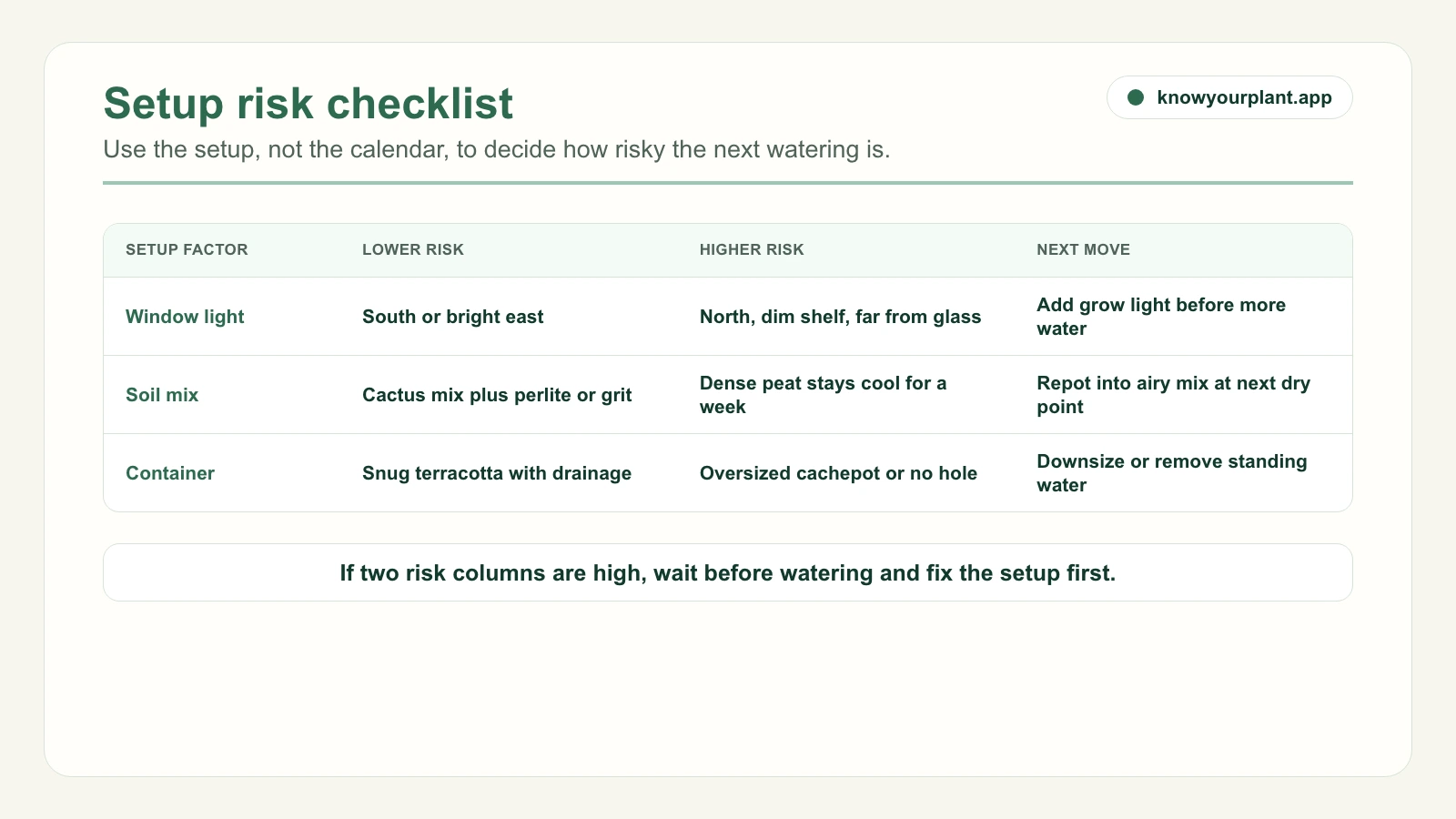
Use setup risk, not the calendar, before the next watering: dim light, slow soil, oversized pots, and hidden cachepot water all slow dry-down.
Temperature and Humidity
Most succulents are comfortable between 60-80°F (15-27°C) - basically, wherever you’re comfortable.
What they don’t like: frost, drafts, and high humidity. Keep them away from air conditioning vents in summer and cold drafts in winter. If you live somewhere cold, bring outdoor succulents in before the first frost.
Humidity isn’t usually a problem in most homes, but bathrooms and kitchens with poor ventilation can be too moist for succulents long-term.
Fertilizing (Lightly)
Succulents don’t need much fertilizer. Too much can burn roots or cause soft, weak growth that’s more vulnerable to pests. Feed once in spring and once in early summer with a balanced liquid fertilizer diluted to half strength. Skip entirely in autumn and winter when the plant is resting.
Choosing the Right Succulent for Your Light
Not all succulents are equal. If your space is darker than ideal, this matters.
Before you buy, choose by the light you actually have, not the label’s promise that the plant is easy. If you only water occasionally but have a bright sill, many succulents fit. If your room is dim, choose shade-tolerant types or plan on a grow light.
| Light Situation | Best Choices | Avoid |
|---|---|---|
| Bright south window | Echeveria, Sedum, Crassula, Aeonium | Nothing - all work |
| East/west window | Aloe, Gasteria, Haworthia | Echeveria (will etiolate) |
| Low light / north window | Haworthia, Gasteria | Most rosette types |
| Grow lights (12-14h/day) | Any species | Nothing - all work |
Haworthia and Gasteria are the unsung heroes of succulent care indoors. They actually evolved in the shade of rocks and other plants, so they’re far more likely to stay compact and happy in a less-than-perfect spot than an Echeveria that will slowly stretch itself sad.
Month-by-Month Succulent Care Calendar
Most succulent guides treat care as a fixed routine: water this often, give this much light. But succulents respond to the seasons, and your care should shift accordingly. This calendar gives you a starting point for each month - always let the soil, not the date, make the final call.
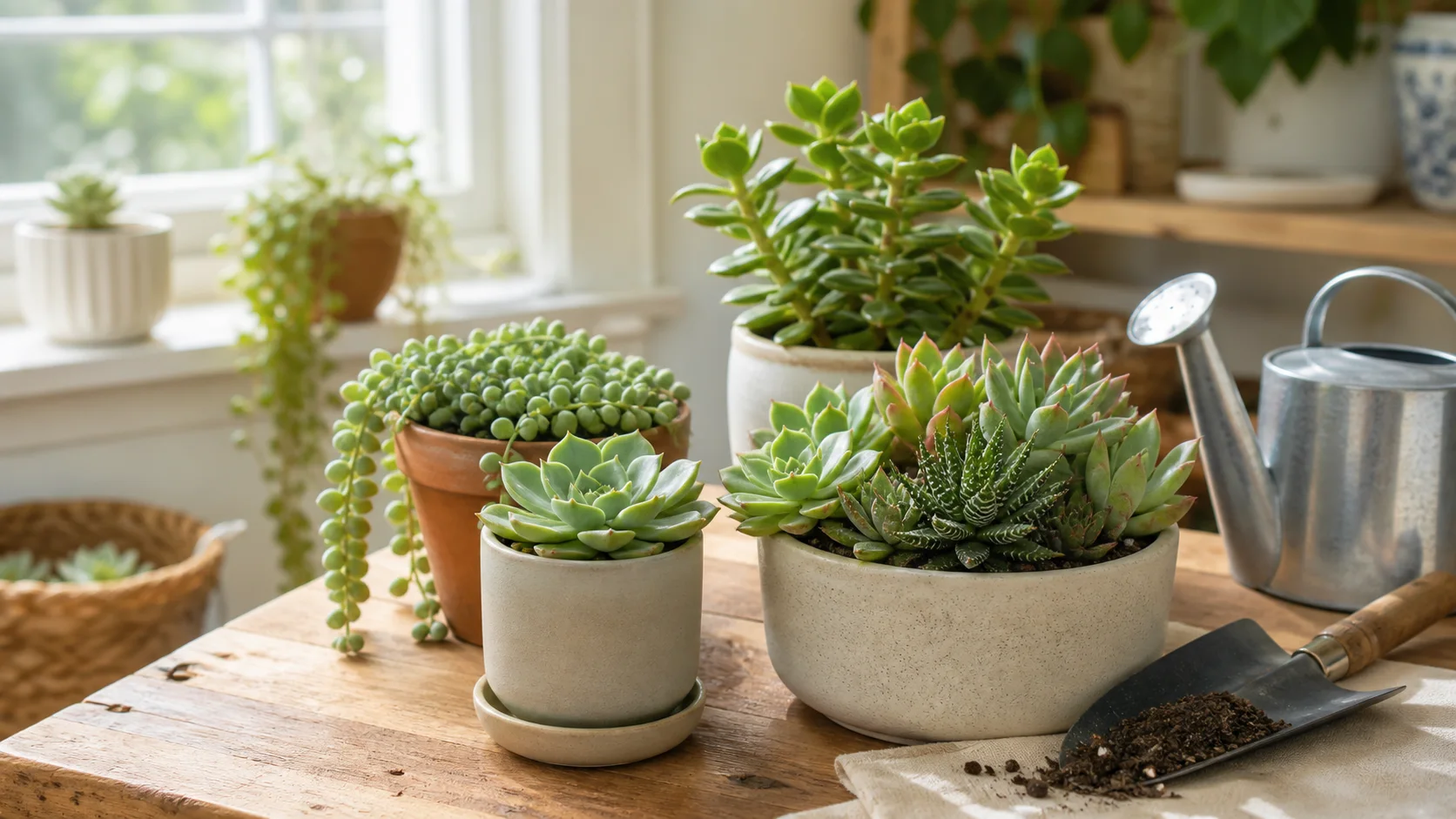
Seasonal light and growth changes should set the pace, with soil dryness - not the date - deciding when to water.
| Month | Watering | What to Watch |
|---|---|---|
| January | Every 4-6 weeks | Short days mean slow soil drying. Don’t rush the next watering. |
| February | Every 3-5 weeks | Days start lengthening. Watch for the first signs of new growth. |
| March | Every 2-3 weeks | Active growth begins. Check the soil more frequently now. |
| April | Every 10-14 days | Spring growth picks up. Introduce half-strength fertilizer if you see new leaves forming. |
| May | Every 7-10 days | Peak growing season. Best month for repotting if needed. |
| June | Every 7-10 days | If moving plants outdoors, transition over 2 weeks to prevent sunburn. |
| July | Every 7-14 days | Water in the morning, not during afternoon heat. Watch closely for mealybugs. |
| August | Every 7-14 days | Good month to propagate leaf cuttings and offsets. |
| September | Every 14-21 days | Start tapering off. Give one last dose of fertilizer early in the month. |
| October | Every 2-3 weeks | Bring outdoor succulents inside before the first frost. Stop fertilizing. |
| November | Every 3-5 weeks | Dormancy is settling in. Resist the urge to water when the soil still feels slightly cool. |
| December | Every 4-6 weeks | Rest period. Minimal watering, minimal intervention. Let it rest. |
The hardest months for most people are November through February, when the instinct to water is stronger than the plant’s actual need. Trust the soil, not the calendar.
Common Problems and Fixes
| Problem | Likely Cause | Fix |
|---|---|---|
| Mushy, translucent leaves | Overwatering / root rot | Stop watering, check roots, repot if needed |
| Leggy, stretched growth | Not enough light | Move to brighter spot or add grow light |
| Wrinkled, puckered, or curling leaves | Underwatering or hot conditions | Check soil 2 inches down; deep water if dry |
| Yellow lower leaves that feel soft | Too much moisture over time | Let soil dry, check drainage, reduce winter watering |
| Brown dry tips | Underwatering, hot sun, or mineral buildup | Deep water if soil is dry; filter water if crust builds up |
| Leaves turning brown and crispy | Sunburn or heat stress | Transition away from intense midday sun |
| Dropping lower leaves naturally | Normal aging | No action needed |
| White crusty deposit on soil | Mineral buildup from tap water | Flush soil with filtered water occasionally |
| Tiny white fluff at base or leaves | Mealybugs | Wipe with 70% isopropyl alcohol, repeat weekly |
| Rust-colored speckles on leaves | Spider mites | Isolate, treat with neem oil or insecticidal soap |
Care Summary
| Factor | Succulent Preference |
|---|---|
| Light | 6+ hours bright/direct; south window ideal |
| Water | Deeply, let dry completely between waterings |
| Spring/summer watering | Every 7-14 days |
| Autumn/winter watering | Every 3-5 weeks |
| Soil | Fast-draining: 50% perlite + 50% cactus mix |
| Pot | Terracotta with drainage hole |
| Temperature | 60-80°F (15-27°C) |
| Humidity | Low to moderate |
| Fertilizer | Half-strength liquid, spring + early summer only |
Pet Safety: Are Succulents Safe for Pets?
“Succulent” is not a pet-safety category by itself. Some common indoor succulents, especially aloe types, can irritate cats and dogs if chewed. Others are lower risk. If pets or small children share the space, confirm the exact genus before bringing the plant home and treat any chewing, vomiting, or drooling as a reason to call your vet. If you keep aloe for its gel, the aloe vera uses guide separates safe topical harvesting from the parts that should not be eaten.
Real User FAQ
How often should I water succulents indoors? Every 7-14 days in spring and summer, every 3-5 weeks in autumn and winter. Always check the soil first - if it’s not completely dry 2 inches down, wait. The calendar is a starting point; the soil is the truth.
Why are my succulent leaves wrinkled? Wrinkled or puckered leaves usually mean the plant is thirsty. Give it a thorough watering (until water drains out the bottom) and the leaves should plump back up within 24-48 hours. If they’re soft or mushy rather than just wrinkled, that’s overwatering - two very different situations that can look similar at first glance. Use the leaf diagnosis guide above to tell them apart, or go deeper with our guide to succulent leaves falling off if the plant is also dropping foliage.
Can succulents survive indoors without direct sunlight? Some can. Haworthia and Gasteria genuinely do well in bright indirect light. Most other succulents, especially Echeveria, Sedum, and Crassula, will stretch and decline without direct sun. A grow light is the best solution if your windows are limited.
What’s the best soil for succulents? A mix of 50% regular potting soil and 50% perlite, or a commercial cactus/succulent mix with added perlite. The goal is soil that dries out completely within 4-7 days after watering. For exact mix logic, pot material tradeoffs, and drainage tests, use the full succulent soil guide.
Why is my succulent stretching and getting leggy? Not enough light. This is called etiolation - the plant is reaching for more sun. Move it to a brighter spot or add a grow light. The stretched stem won’t shrink back, but new growth will be more compact once it gets adequate light.
Can I use regular potting soil for succulents? You can, but it holds too much moisture and dramatically increases the risk of root rot. If you’re going to use regular potting soil, mix it with at least 50% perlite to improve drainage.
Are succulents safe for cats and dogs? Most common succulents are non-toxic, but there are exceptions. Aloe vera is toxic to cats and dogs (causes digestive upset). Most Echeveria, Haworthia, and Sedum are pet-safe. When in doubt, check the ASPCA toxic plant database before buying.
How do I know if my succulent has root rot? If lower leaves are mushy and the stem feels soft at the base, root rot is likely. Unpot the plant and look at the roots. Healthy roots are white or tan; rotted roots are brown, black, and mushy. Trim away the rot with clean scissors, let the plant air-dry for a day or two, then repot in fresh dry soil.
When should I repot my succulent? When roots are visibly growing out of drainage holes, when the plant looks too big for its pot, or when soil stays wet longer than 5-7 days (often means the soil has compacted). Spring is the best time. See our repotting guide for step-by-step instructions.
Methodology Note
This guide was refreshed using the current succulent care Research Pack, which reviewed live SERP results, recurring Reddit troubleshooting snippets about overwatering, etiolation, and soil drainage, and extension guidance from the University of Minnesota, Iowa State, and South Dakota State. Extension sources were treated as the source of record for care basics. Community snippets were used only as qualitative signal for the symptom patterns beginners keep misreading.
The Honest Truth About Indoor Succulents
Most succulents will survive indoors. Very few will truly thrive unless they get enough light. If your home is darker than you’d like, lean toward Haworthia and Gasteria in our indoor succulent plants guide, plus Aloe. They handle less-than-perfect conditions far better than most Echeverias or Sedums.
If you have a sunny windowsill or a grow light, your options open up considerably. To keep this routine matched to the plant you actually own, save it in KnowYourPlant and use the same dry-soil, bright-light checklist as the seasons change.
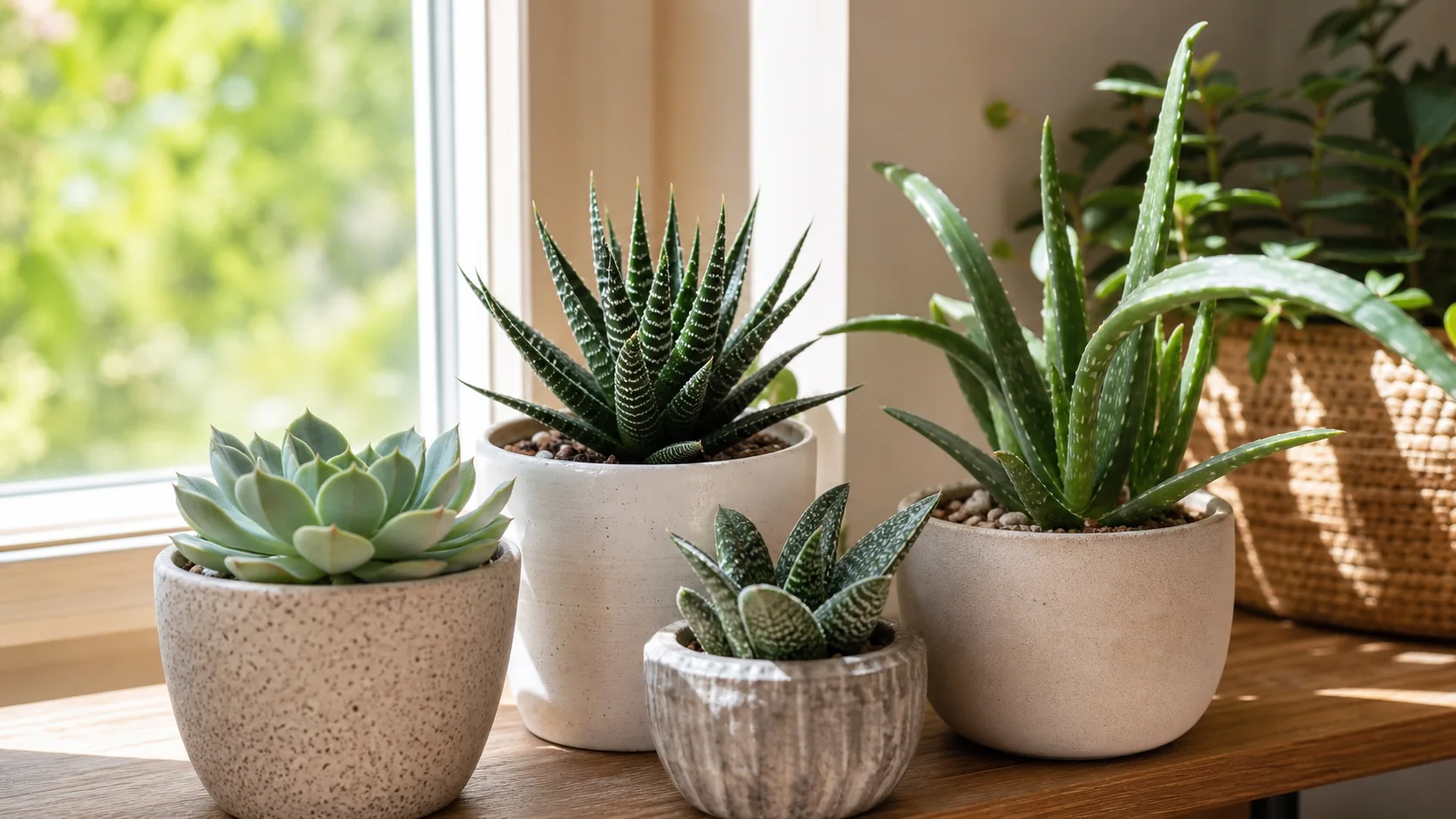
Haworthia and Aloe tolerate ordinary indoor light better than sun-hungry Echeveria, though every group benefits from a bright window.