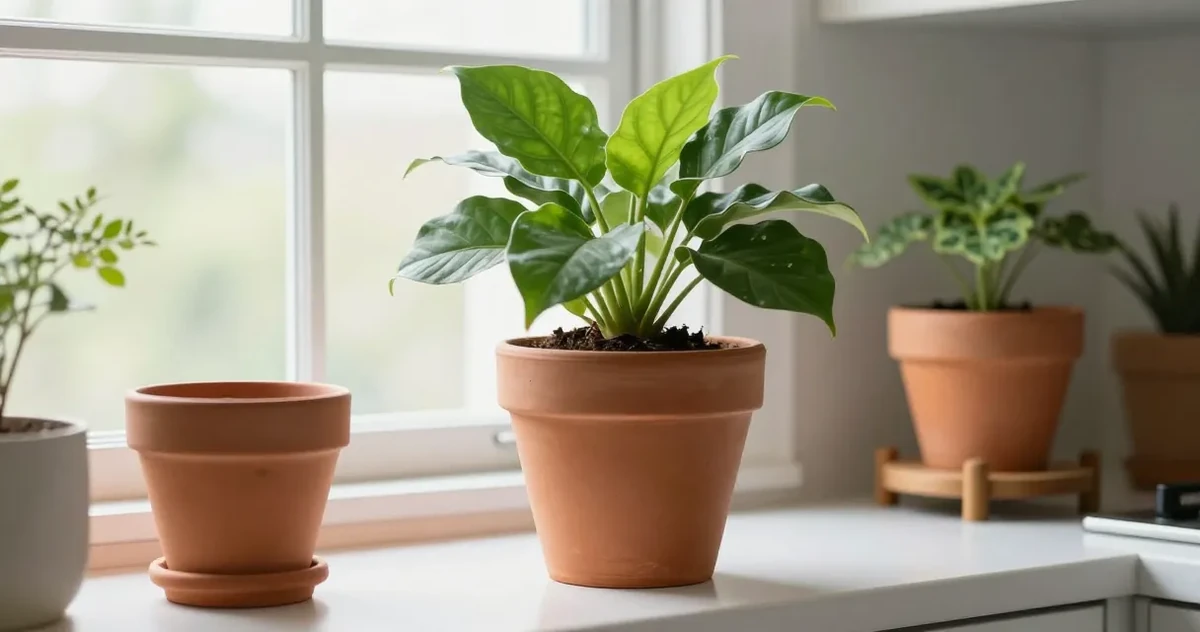
If your plant keeps yellowing in a pretty ceramic pot, or drying out too fast in a tiny clay one, the pot may be changing your watering routine more than you realize.
Terracotta is not automatically “better.” It is simply porous clay, which means soil dries faster and roots get more air. That is great for succulents, snake plants, pothos, monsteras, herbs, and anyone who tends to overwater. It is frustrating for ferns, calatheas, and other plants that hate drying out.
Quick answer: use terracotta when your plant likes the top inch or two of soil to dry before watering. In an average indoor room, many leafy houseplants in terracotta need water about every 5-7 days in warm, bright months and every 10-14 days in winter. Check the soil before watering instead of following the calendar blindly.
Signs you are overdoing it: yellow leaves, mushy stems, soil that stays damp for days, fungus gnats, or a sour smell from the pot. Signs terracotta is drying too fast: curling leaves, crispy brown tips, soil pulling away from the pot wall, or a plant that wilts again one day after watering.
What Most Plant Roundups Miss
Most roundups about terracotta Pots Guide for Houseplants list attractive options. The better question is which choice will still make sense in your actual room three months from now.
Use this filter before choosing:
- Light reality: what the plant receives on a normal cloudy day, not the brightest hour of the week.
- Care rhythm: whether you prefer weekly attention or a plant that can be ignored longer.
- Space: mature height, spread, trailing habit, and whether leaves will touch walls or pets.
- Failure signal: what the plant does first when the match is wrong: yellowing, stretching, crisping, or dropping leaves.
A good recommendation is not just beautiful. It fits the room, the owner, and the first problem you are likely to notice.
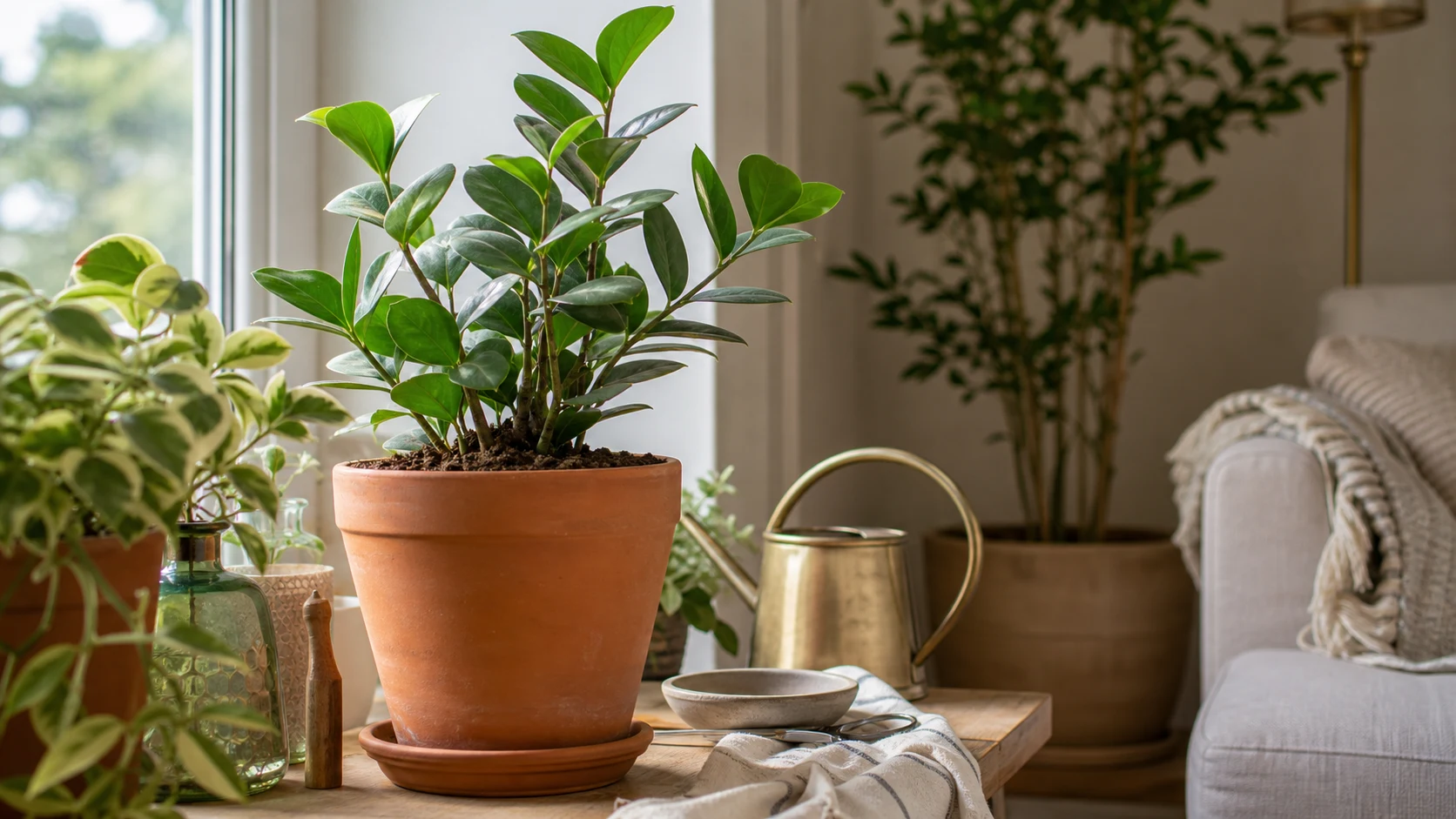
A healthy ZZ plant in terracotta shows how pot choice must fit the room’s light, available space, and the owner’s real care rhythm.
What Makes Terracotta Different (And Why Roots Care)
Terracotta is unglazed clay, fired at relatively low temperatures. That unglazed, porous surface is the whole point. Air and water don’t just escape through the drainage hole, they move slowly through the walls of the pot itself.
For roots, this changes everything:
- Oxygen reaches the root zone even when the soil is still slightly damp
- Moisture wicks outward from the center, so the whole soil mass dries more evenly instead of staying wet in the middle
- Salt and mineral buildup from fertilizer gets drawn to the outer surface instead of accumulating around roots
Roots need oxygen as much as they need water. When soil stays wet for too long, the spaces that should hold air fill with water instead. That is when root rot becomes more likely, especially in dense potting mix or a decorative pot with poor drainage.
For practical context: a plant in a plastic pot might need watering every 7–10 days, while the same plant in terracotta might need water every 5–7 days. You water a little more often, but in return, you get dramatically more forgiving conditions for root health.
Terracotta vs Plastic vs Glazed Ceramic
| Feature | Terracotta | Plastic | Glazed Ceramic |
|---|---|---|---|
| Wall porosity | High | None | None |
| Drainage speed | Fast (walls + hole) | Moderate (hole only) | Moderate (hole only) |
| Weight | Medium | Very light | Heavy |
| Soil drying speed | Fast | Slow | Slow |
| Root rot risk | Lower | Higher | Higher |
| Best for | Succulents, aroids, herbs, most houseplants | Ferns, moisture-lovers | Any, as outer pot |
| Cost | Low-medium | Very low | Medium-high |
Plastic and glazed pots are not bad, they’re just different. Plastic is actually ideal for plants that want consistent moisture: Boston ferns, calatheas, peace lilies. But for the majority of popular houseplants, pothos, monsteras, snake plants, succulents, most aroids, terracotta creates better conditions.
Glazed pots behave like plastic inside: sealed walls, moisture retention, slower drying. They’re beautiful, and a useful trick is to use them as outer decorative containers, dropping a terracotta pot inside. You get the aesthetic without sacrificing root health.
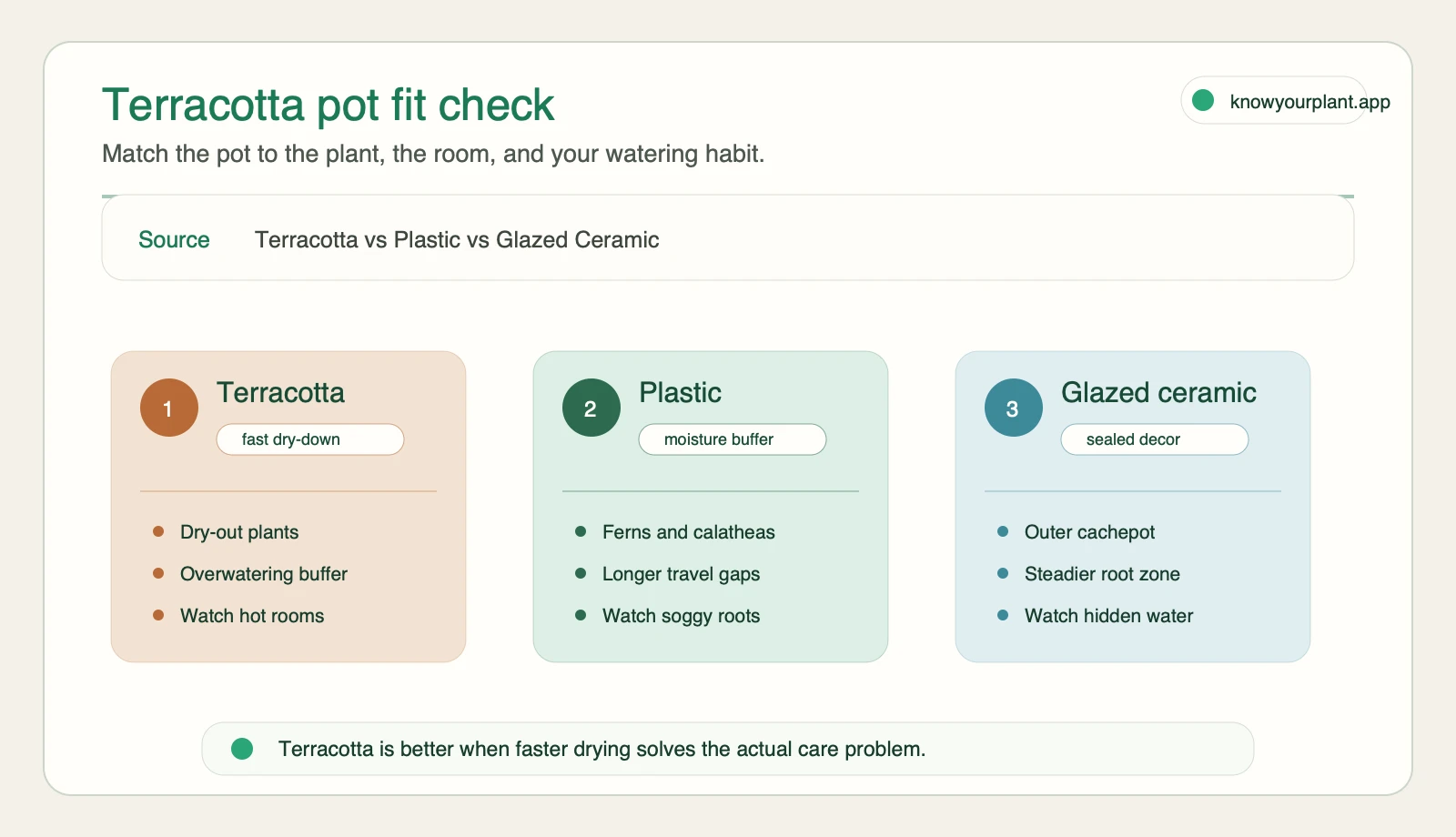
Use pot material as a care tool. Terracotta helps plants that need faster dry-down, while plastic and glazed pots protect plants that need a longer moisture buffer.
Expert Note: What the Horticulture Guidance Actually Supports
RHS container guidance says unglazed terracotta dries faster than plastic, and RHS watering guidance tells growers to check the soil instead of following a fixed calendar because terracotta can dry quickly. BBC Gardeners’ World makes the same point from the cactus side: terracotta is a strong fit for plants that want extra airflow and a quicker dry-down.
That does not mean terracotta is automatically best for every indoor plant. It means the material is best when faster drying is the thing your plant actually needs.
Best For / Not For
Best for
- succulents, cacti, snake plants, ZZ plants, rosemary, thyme, and other plants that benefit from a real dry interval
- owners who tend to water too soon and want a pot that helps the root zone dry more evenly
- bright rooms, airy mixes, and growers who do not mind checking soil more often in summer
Not for
- ferns, calatheas, marantas, and other plants that decline quickly when the root ball dries out
- owners who travel often or routinely forget watering for a week or more
- very hot, dry rooms where a small clay pot can become a constant battle
Terracotta Pot Fit Scorecard
Scoring rubric: score each option from 1 to 5 on dry-down control, overwatering forgiveness, moisture retention, and maintenance visibility. Higher totals mean the pot makes it easier to read what is happening in the root zone, not that it suits every species.
| Pot setup | Dry-down control | Overwatering forgiveness | Moisture retention | Maintenance visibility | Best for | Not for |
|---|---|---|---|---|---|---|
| Unglazed terracotta with drainage | 5 | 5 | 2 | 5 | Dry-between-waterings plants and growers who overwater | Ferns, prayer plants, and anyone who forgets to water |
| Plastic nursery pot with drainage | 3 | 2 | 5 | 3 | Moisture-loving plants and growers who want a longer buffer | Owners who chronically keep soil wet |
| Glazed ceramic with drainage | 3 | 2 | 4 | 2 | Decorative setups where the plant likes a steadier moisture level | People who need a fast visual cue that the mix is drying |
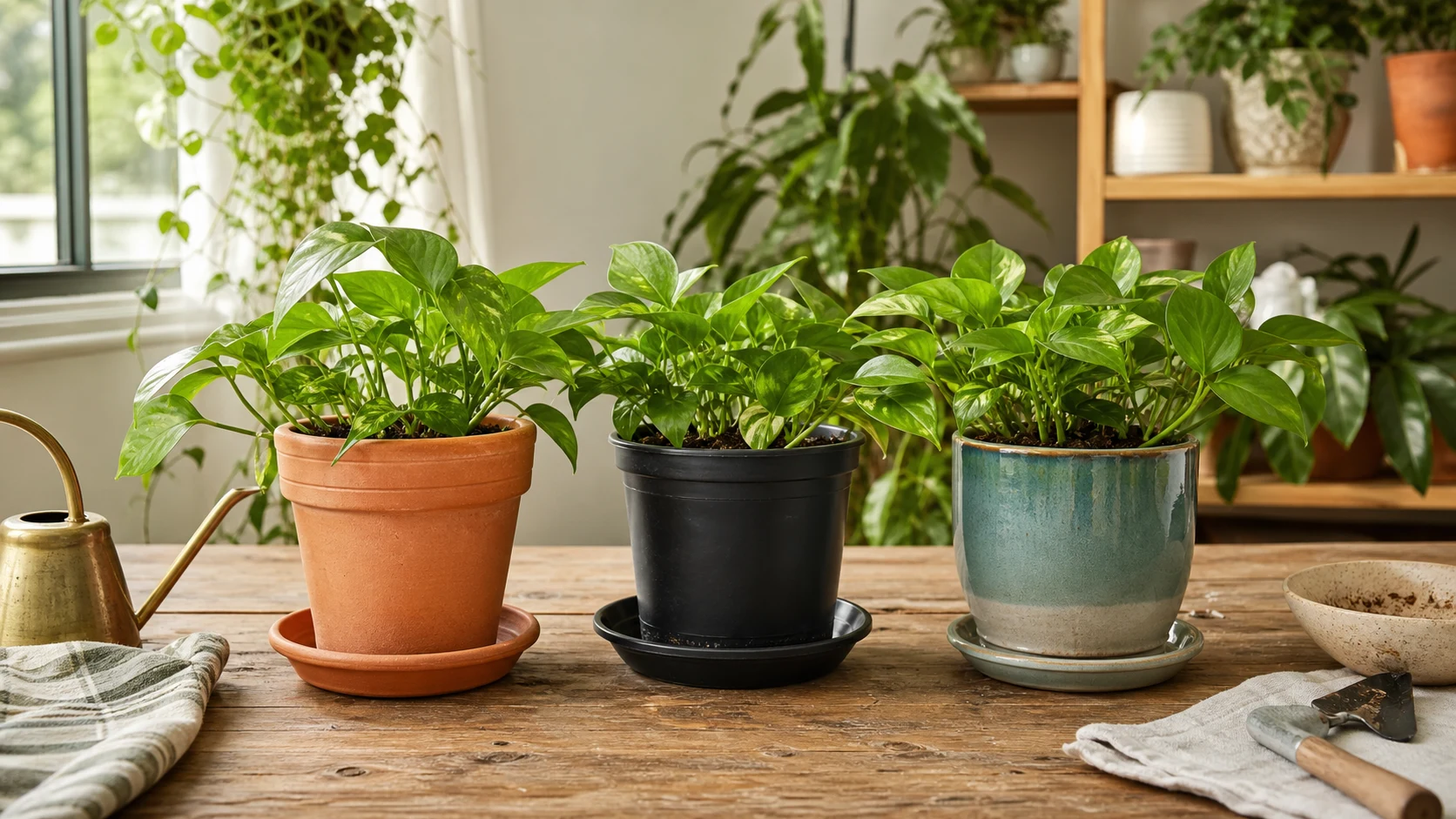
The same pothos in terracotta, plastic, and glazed ceramic makes each material’s dry-down and moisture-retention tradeoff visible.
Pros and Cons of Terracotta Pots
Pros
- extra airflow around the root zone
- faster dry-down for plants that rot easily in wet soil
- white mineral bloom on the outside can warn you that salts are building up
- easy to judge moisture by color and weight once you know the pot
Cons
- small pots can dry out far too fast in bright, hot, or low-humidity rooms
- moisture-loving plants often decline sooner in clay than in plastic
- the pots chip, crack in freezing conditions, and weigh more than plastic
- salt staining is harmless but annoys owners who want a spotless finish
Social Listening: Why Blanket Repotting Backfires
Community threads keep repeating the same regret pattern: growers hear that terracotta improves drainage, repot half the collection into clay, then realize the result depends on plant type and watering habits. Owners who overwater often love terracotta. Owners with dry homes or thirsty plants often learn quickly that “more drainage” is not the same thing as “better for everything.”
Plants That Actually Benefit From Terracotta
Before you buy, match the pot to your plant and your routine:
| Your situation | Terracotta fit | What to do |
|---|---|---|
| You often water too soon | Strong fit | Use terracotta with a drainage hole and check the top 2 inches before watering |
| Your room is bright and warm | Usually good | Expect faster drying in spring and summer |
| You travel often or forget watering | Mixed | Use terracotta only for drought-tolerant plants |
| Your room is dry and hot | Mixed | Size up carefully or use plastic for thirsty plants |
| Your plant wilts if soil gets dry | Poor fit | Use plastic or glazed ceramic with drainage |
These plants genuinely thrive in terracotta:
- Succulents and cacti (fast drying is exactly what they need)
- Snake plants (deeply unhappy sitting in wet soil)
- Pothos and philodendrons (more forgiving in terracotta; less likely to rot)
- Monstera (prefers drying out between waterings)
- Herbs: basil, rosemary, thyme, sage (drier conditions suit Mediterranean plants)
- ZZ plants and aglaonemas
- Rubber plants and fiddle leaf figs
Think twice before using terracotta:
- Ferns (need consistent moisture; terracotta dries too quickly)
- Calathea and prayer plants (sensitive to moisture fluctuation)
- Peace lilies in dry climates (may struggle to stay adequately hydrated)
- Carnivorous plants (need wet, acidic, low-nutrient conditions)
The simple rule: if your plant likes to dry out between waterings, it will like terracotta. If it prefers staying evenly moist, stick with plastic or glazed.
The Step Most People Skip: Seasoning a New Terracotta Pot
A brand new terracotta pot is extremely thirsty. The clay is completely dry, and it will pull moisture aggressively from your soil, leaving your plant’s roots dry right when they’re trying to settle in after repotting.
The fix takes about an hour:
- Submerge the pot completely in water, use a bucket, your bathtub, even a kitchen sink
- Wait until the bubbling stops, those bubbles are trapped air escaping as the clay absorbs water
- Let it drip dry briefly, a few minutes is fine before adding soil
That’s it. The clay is now saturated and won’t compete with your plant for moisture.
Do this with any dry stored terracotta pot, not just brand new ones. A pot that sat in the garage all winter needs the same treatment before spring repotting.
Your First Week With a Terracotta Pot
Do not repot and then guess. Use this simple check-in plan.
Today: Soak the empty pot until bubbling stops, repot your plant into fresh mix, water once until water drains from the bottom, and let the pot sit somewhere with the right light for that plant.
In 3-4 days: Push a finger 2 inches into the soil. If it still feels damp, wait. If it feels dry and the pot is noticeably lighter, water again.
This week: Watch the leaves. Curling or crispy tips usually means the plant is drying faster than it can keep up. Yellowing, mushy stems, or a stale smell usually means the soil is still too wet.
This season: Recheck your watering rhythm when the weather changes. Terracotta dries much faster in warm, bright months and much slower in winter.
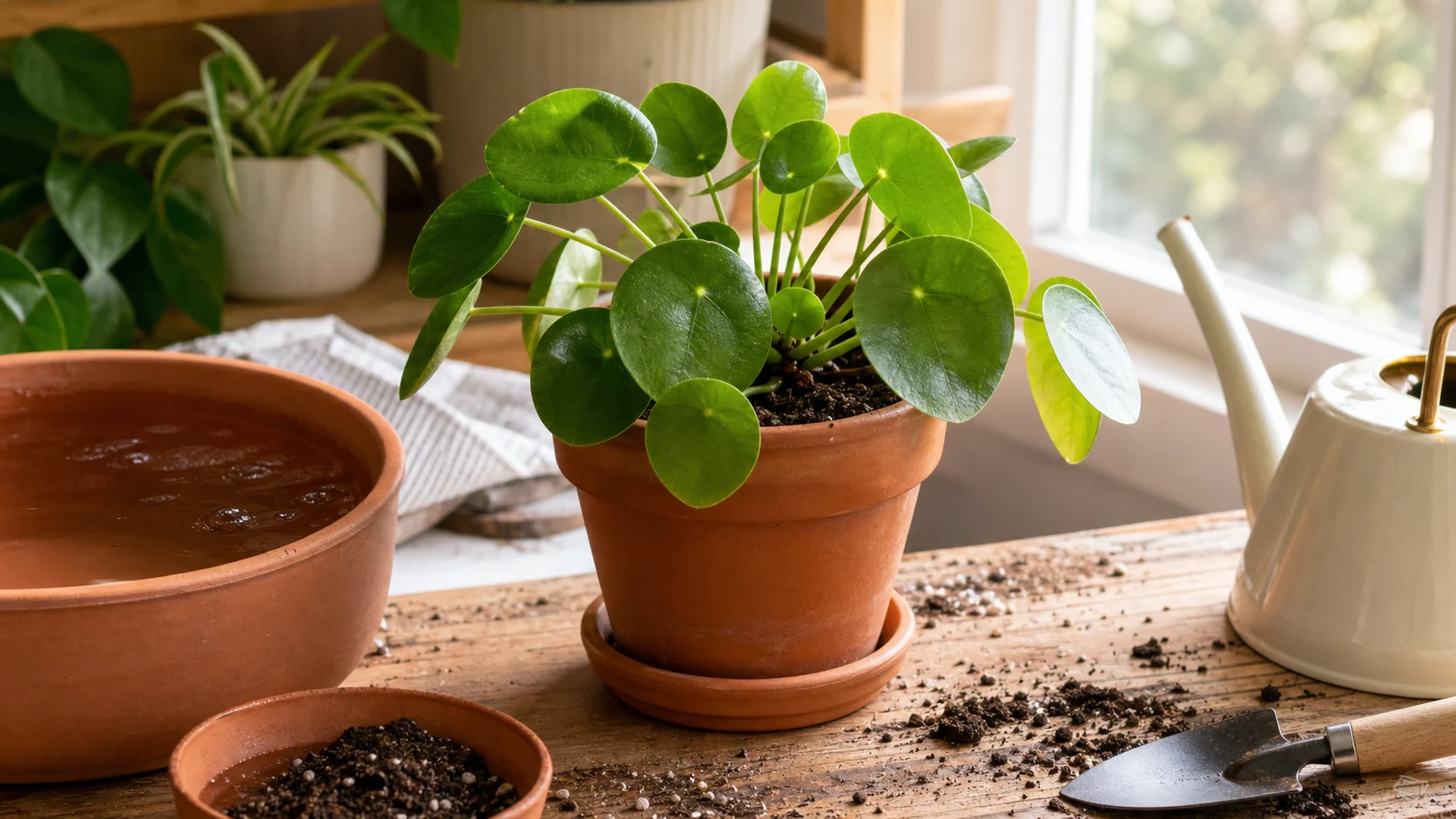
A soaked empty pot, fresh mix, and newly potted Pilea turn the first week into a simple observe-and-adjust routine.
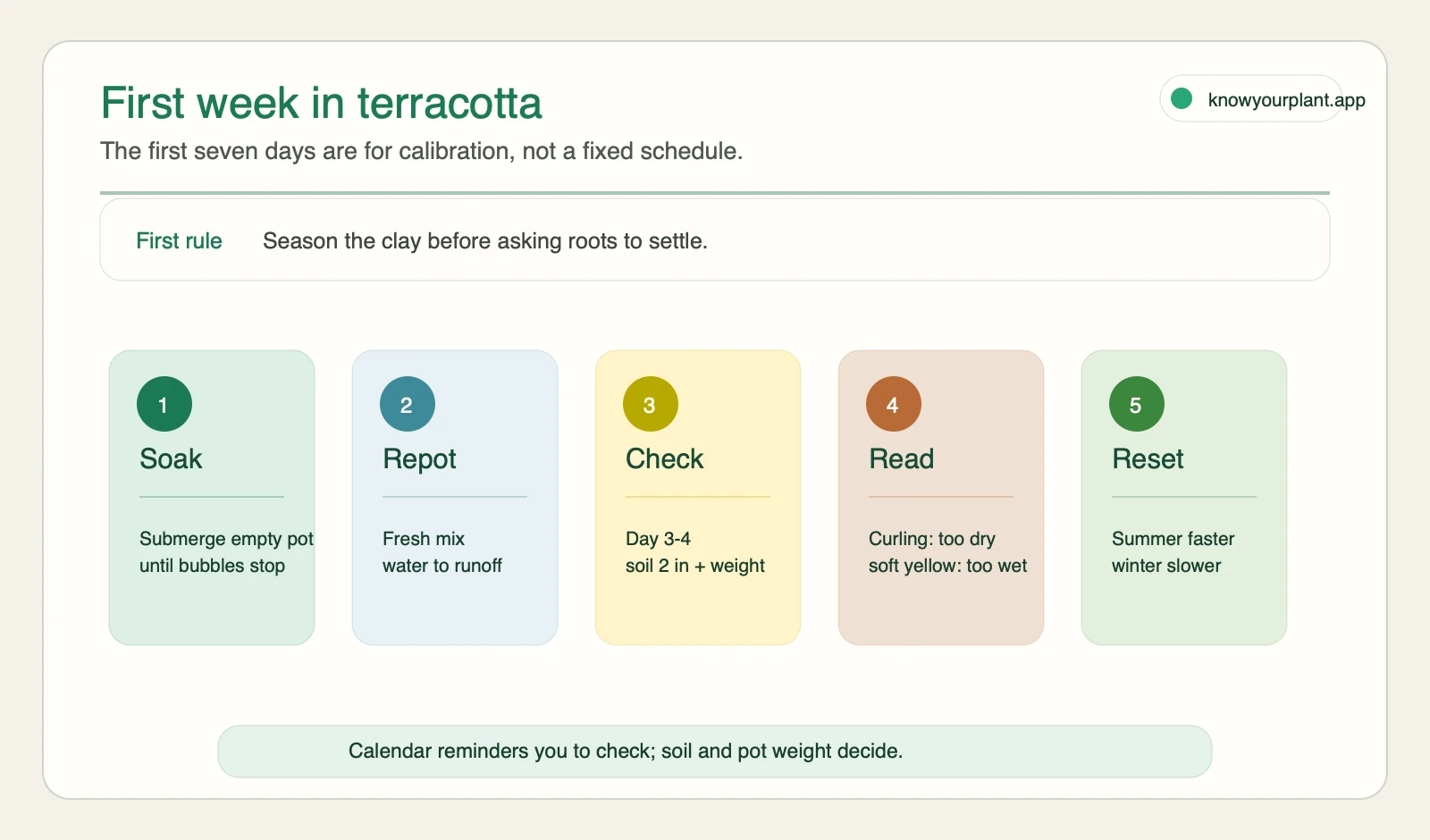
The first week is a calibration period: soak the pot, water once, then let soil depth, pot weight, and leaf signals set the new rhythm.
Caring for Terracotta Over Time
White crusty buildup on the outside: That white powder is mineral salts from fertilizer and hard water wicking through the porous walls over time. It’s completely harmless. If it bothers you aesthetically, scrub it off with a stiff brush and a 50/50 mix of white vinegar and water.
Some people love the weathered look. Over years, a well-used terracotta pot develops a patina that no amount of artificial aging can replicate.
Frost and freezing: Terracotta’s biggest weakness. If soil inside a pot freezes and expands, the pot cracks. In climates with hard winters, either bring terracotta indoors before the first freeze or empty the pots and store them somewhere protected.
Cleaning between plants: Don’t skip this step. Old soil can harbor fungal spores, pests, and pathogens. Scrub used pots with a solution of 1 part bleach to 9 parts water, rinse thoroughly, and let them dry completely before adding new plants.
The Seasonal Terracotta Calendar
Most pot guides tell you the same thing year-round. But terracotta responds to the seasons, and so do the plants inside them. Here’s what to actually do each quarter.
Spring (March, April, May): Repotting Season
Spring is when terracotta works hardest. Roots are waking up, growth is accelerating, and this is when most repotting happens.
March: Start checking for root-bound plants. If roots are circling the bottom or escaping drainage holes, it’s time to size up. Soak replacement pots thoroughly before use, spring soil dries fast in fresh terracotta.
April: Peak repotting month. Move up one size (1–2 inches in diameter), not two, oversized pots stay wet too long even in terracotta. Fill gaps with fresh potting mix and water in gently.
May: Watch watering frequency carefully. Longer days and warming temperatures mean terracotta dries faster now than it did in February. A pot that needed water weekly in winter might need it every 4–5 days in May.
Summer (June, July, August): Fastest Drying Season
This is when terracotta’s speed is most noticeable, and most useful.
June: If you moved any plants outdoors for summer, terracotta in direct sun can dry out within a day or two in heat. Shade positioning or a light-colored pot sleeve can slow this down without losing the benefits.
July and August: Water by feel, not by schedule. The finger test (top 2 inches dry = time to water) becomes essential in peak summer. Fertilizing increases salt buildup, so you may see more white crust forming on the outside. Normal, scrub if needed.
Outdoor tip: Terracotta warms up in sun and cools at night, which mimics natural desert-style temperature swings many plants evolved to handle. Your succulents and herbs will reward this.
Autumn (September, October, November): Transition and Prep
September: Start slowing down watering as temperatures drop and plant growth slows. Terracotta will take longer to dry out as days shorten, you’ll notice this if you’ve been watering by feel all summer.
October: Stop fertilizing most plants. Terracotta is honest about this: if you overfeed now, you’ll see heavy salt buildup on the pot walls through winter.
November: This is your frost deadline. Before the first freeze in your area, bring all outdoor terracotta inside or empty the pots and stack them somewhere dry. Even a light frost can crack a pot if soil is still inside and wet.
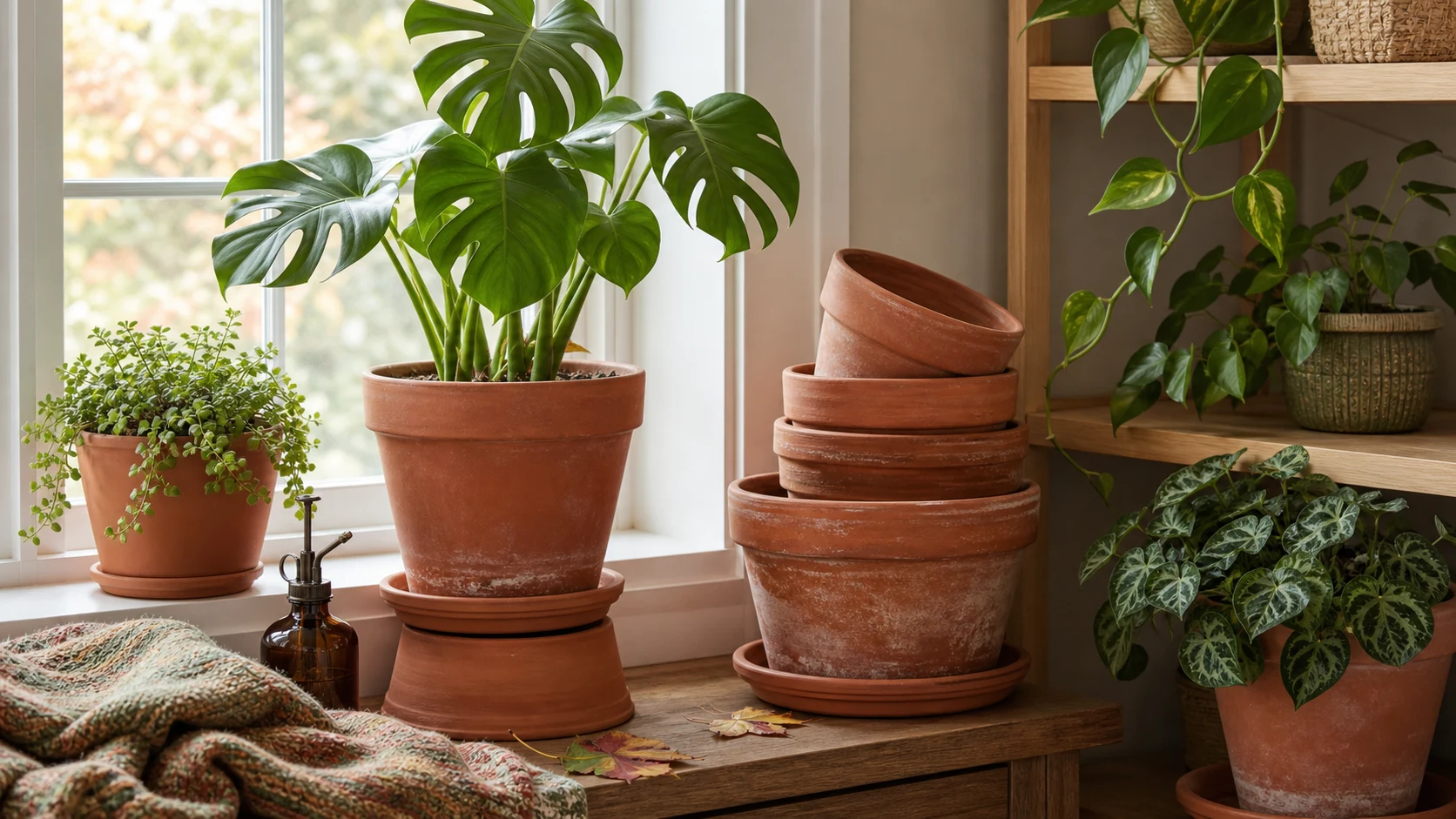
Healthy houseplants moved indoors beside dry stacked clay pots show the autumn shift from active care to frost preparation.
Winter (December, January, February): Rest Mode
December and January: Most houseplants in terracotta need watering roughly half as often as summer. Check soil before watering, a pot that needed water every 5 days in July might only need it every 10–14 days now. Terracotta actually helps here: you can feel the weight difference easily, and the walls dry visibly when it’s time.
February: Start thinking about spring. Order new pots, collect secondhand finds, and assess which plants need sizing up when growth resumes. Terracotta stored dry over winter needs a good soak before you use it again, the clay gets extremely thirsty sitting empty.
Terracotta Troubleshooting: When Things Go Wrong
Even terracotta has its moments. Here’s how to diagnose the most common problems.
“The leaves are curling, yellowing, or getting brown tips”
Start with the soil, not the leaf. The same symptom can mean different things depending on whether the pot is wet or dry.
| Symptom | Check first | Most likely pot-related cause | What to do today |
|---|---|---|---|
| Leaves curling inward | Soil is bone-dry 2 inches down | Terracotta is drying too fast | Water deeply, move out of hot direct sun, and check again in 2 days |
| Lower leaves yellowing | Soil is still damp after several days | Still too wet, even in terracotta | Wait to water, improve light, and make sure the drainage hole is open |
| Brown crispy tips | Soil dries within 1-2 days | Pot is too small, room is dry, or salts are building up | Flush with plain water, trim dead tips, and consider one pot size larger |
| Soft yellow leaves or mushy stems | Soil smells sour or feels soggy | Root stress from wet soil | Stop watering, unpot if it worsens, and remove mushy roots before repotting |
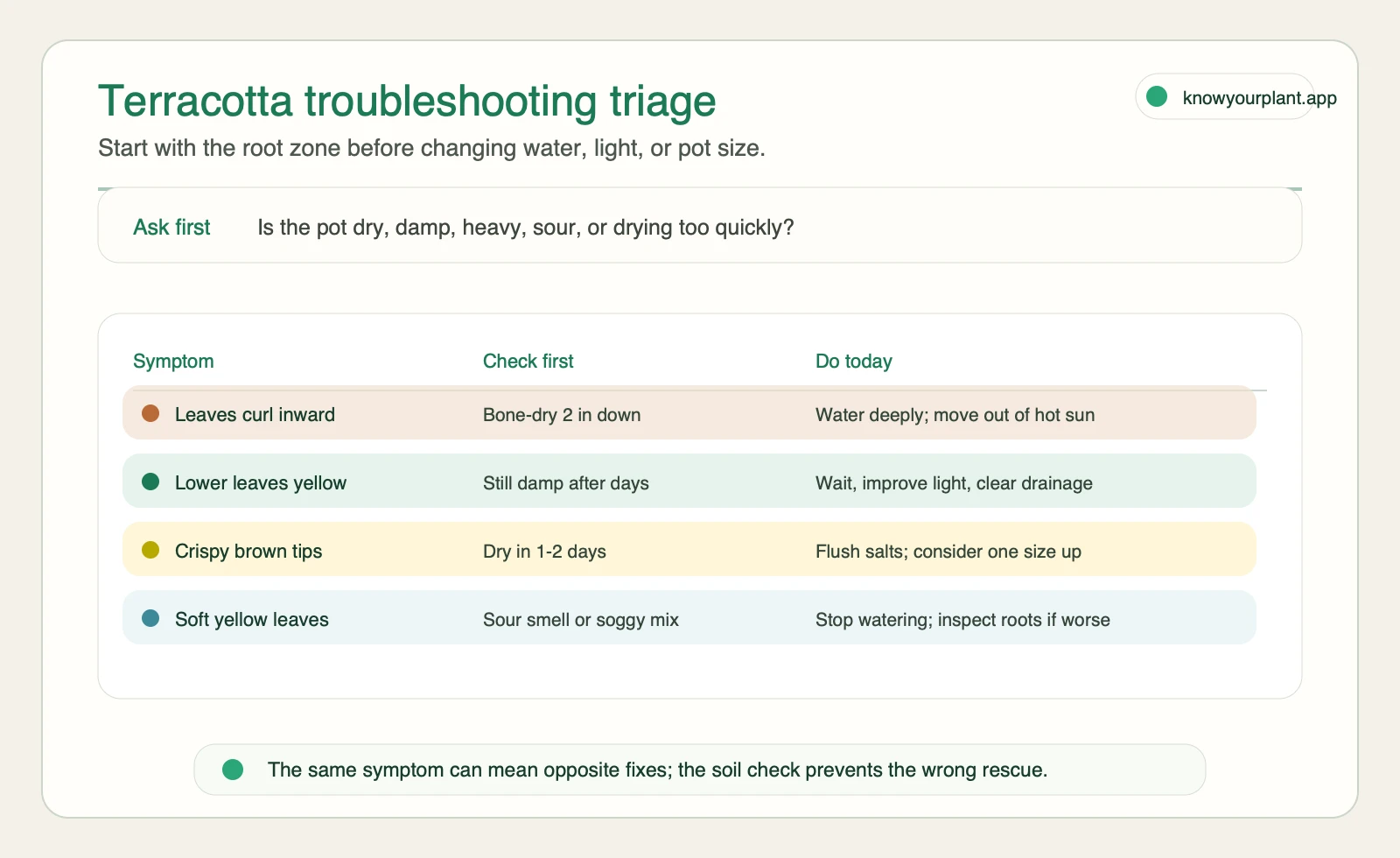
Start with the soil and pot weight before reacting to leaves. The same terracotta setup can mean too-fast dry-down, lingering dampness, salt buildup, or root stress.
“My plant dries out too fast: I’m watering every other day”
This usually means one of three things:
-
The plant is severely root-bound. A pot full of roots and almost no soil will dry out within hours. Check if roots are densely packed or escaping the drainage hole. If yes: repot up one size.
-
The pot is too small for the plant’s water needs. A large monstera in a 6-inch terracotta pot is a recipe for constant watering. Size up or switch to plastic for that specific plant.
-
Your climate is very dry or very hot. In desert climates or during summer heat waves, terracotta in direct sun can dry within a day. Move the pot to a slightly shadier position or place it on a tray of wet pebbles to add ambient humidity around the base.
“I see white powder on my terracotta”
That is mineral salt and fertilizer residue wicking through the clay walls. It means the pot is working exactly as designed.
If it’s thin and dusty: completely fine, ignore it or scrub it off occasionally.
If it’s thick and crusty, concentrated in one spot: your plant may be getting too much fertilizer. Scale back feeding and flush the soil with plain water once a month to reduce buildup.
“My terracotta pot cracked”
During winter: Classic frost damage. The pot is cracked from ice expansion inside the soil. A cracked pot can still function, the crack won’t necessarily fall apart, but repot the plant before the crack widens.
During normal use: Look for hairline cracks after a drop or impact. Terracotta is breakable. Small hairline cracks are usually fine. A pot cracked in half needs replacing.
Prevention: Always empty or bring in outdoor terracotta before frost. Never let a pot freeze while soil is still inside and wet.
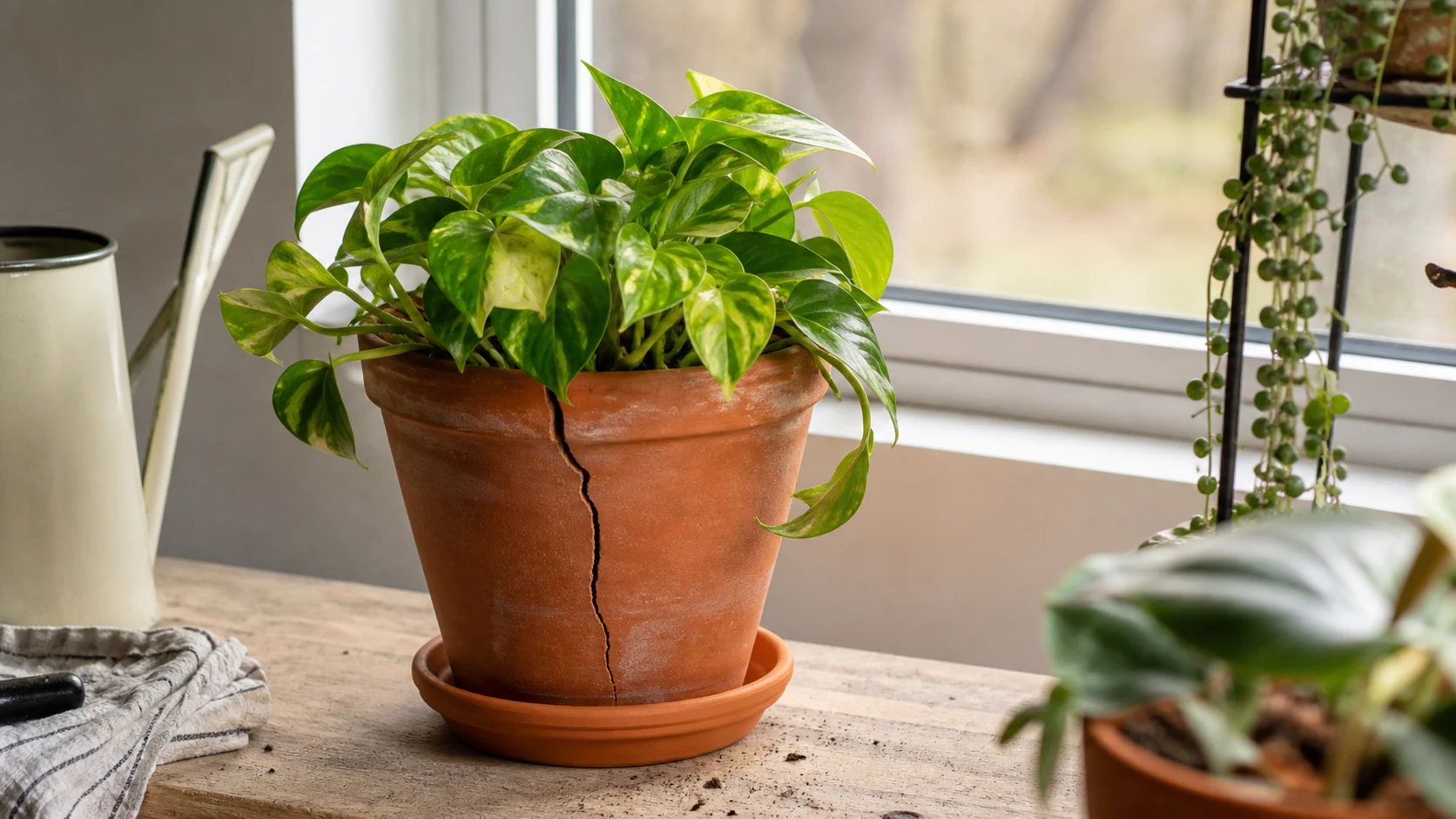
A wide crack beside a healthy pothos is the cue to repot before normal watering or another cold spell makes the damage worse.
“My terracotta pot has green or black staining”
Green is algae, which forms in humid conditions and on the outside of pots that stay moist. Black or dark patches can be mold or mildew.
Neither is harmful to your plant, the staining is on the outside of the pot, not inside the root zone. To remove it: scrub with a stiff brush and a dilute bleach solution (1 part bleach to 9 parts water), rinse thoroughly, and let the pot dry in sunlight.
To prevent it: improve air circulation around pots, avoid leaving them in permanently shady, damp spots.
“I can’t tell if the soil in my terracotta is dry enough to water”
Look at the pot, not just the soil. When terracotta is holding moisture, the outside walls are darker in color. When the pot is dry through, the walls lighten to a consistent pale orange-tan. This color cue is remarkably reliable once you’ve noticed it a few times.
You can also lift the pot. A well-watered pot feels noticeably heavier than a dry one. Over time, you’ll develop a feel for the weight difference without thinking about it.
Where to Buy Cheap Terracotta Pots
Prices vary wildly. A 4-inch terracotta pot can run anywhere from $0.99 to $8 depending on where you shop.
Best sources for everyday terracotta:
IKEA, Consistently the cheapest new terracotta available. The MUSKOT and INGEFARA lines are plain, functional, and stacked in flat-pack quantities. No character, but unbeatable price per pot.
Home Depot / Lowe’s, Decent range of sizes, reasonable prices. Watch for end-of-season clearance in autumn, garden departments mark down remaining pot inventory heavily.
Walmart / Target, Hit-or-miss by location, but seasonal garden sections (March through June) often stock basic terracotta at competitive prices.
Dollar stores, Dollar Tree and Dollar General often carry small terracotta (4–6 inch) for very little. Quality is basic but functional for propagation, small herbs, and starter plants.
Thrift stores (Goodwill, Salvation Army, local charity shops), One of the most overlooked sources. Terracotta lasts essentially forever, so older pots are just as functional. Find beautiful weathered pots with real patina for $1–4.
Facebook Marketplace / Craigslist / Nextdoor, The single best source for large terracotta pots cheap. People downsize gardens, move apartments, sell entire collections. A 12-inch terracotta pot costs $25–40 new; you can often find the same thing secondhand for $5–10. This is especially true at end of summer when outdoor gardeners clear their spaces.
For large terracotta pots cheap: secondhand is the way. Retail pricing on large terracotta is genuinely high, a 16-inch pot can cost $50–80 new. Check Marketplace every few weeks in late summer and early fall.
Evaluation Method
This guide compares terracotta, plastic, and glazed pots against the decision points that surfaced most clearly in research: how fast the mix dries, how forgiving the pot is for overwatering, how visible salt buildup or moisture issues become, and which plant types repeatedly succeed or struggle in each material. Horticulture claims were anchored to RHS container and watering guidance plus BBC Gardeners’ World’s terracotta guidance for cacti. Community discussion was used only as qualitative evidence for real owner mistakes and confusion patterns.
Freshness Note
Updated 2026-06-17 with a decision-first scoring rubric, plant-fit guidance, and source-backed reminders about dry-down speed, mineral bloom, and why terracotta is a tool rather than an automatic upgrade.
Before you buy a cart full of pots, save the plant list and pot changes somewhere you will actually check. KnowYourPlant can keep each plant’s pot type, watering rhythm, and seasonal reminders in one place.
FAQ: Terracotta Pots
Do terracotta pots need drainage holes? Yes. The porous walls help, but they’re not a substitute for a drainage hole. Water needs somewhere to go. If you have a terracotta pot without a drainage hole, use it as a decorative outer container and keep the plant in a smaller pot with a hole inside it.
Can you leave terracotta pots outside year-round? In mild climates, yes. In areas with freezing winters, no, the freeze-thaw cycle cracks terracotta. Empty or bring in pots before temperatures drop below freezing.
How long does terracotta last? Decades, essentially indefinitely. Archaeological sites have uncovered terracotta vessels thousands of years old. The ones you buy today, treated reasonably, will outlast you. Many gardeners inherit pots from their parents.
Why does my terracotta pot have white powder on it? Mineral salts from fertilizer and hard tap water wicking through the porous clay. Harmless. Scrub with vinegar and water to remove it, or embrace it as part of the aged look.
Do I need to seal terracotta pots? No, and don’t. Sealing removes the porosity that makes terracotta valuable. If you want sealed walls, you have a glazed pot. Keep terracotta uncoated.
Are terracotta pots good for all plants? Not all. Best for drought-tolerant plants and those that prefer to dry between waterings. Less ideal for ferns, calathea, and other moisture-loving plants.
Can terracotta pots go in the dishwasher? Technically yes, but the high heat and detergent will leach into the porous clay. Stick with hand-washing and a dilute bleach solution for sanitizing.
How do I stop terracotta from drying out too fast? You don’t, necessarily, that’s the feature. But if you’re in a very dry, hot environment and your pots are drying faster than you can keep up with, try placing them in a slightly shadier location, or switch to plastic for especially moisture-hungry plants.
What size terracotta pot do I need? Aim for a pot 1–2 inches larger in diameter than your plant’s current root ball. Too large a pot means excess soil stays wet too long, which is counterproductive even with terracotta.
Simple Summary
| Best for | Succulents, aroids, herbs, most houseplants |
| Not ideal for | Ferns, calathea, moisture-loving tropicals |
| Season before use? | Yes, soak completely until bubbles stop |
| Cheapest new | IKEA (MUSKOT / INGEFARA lines) |
| Best large pots cheap | Facebook Marketplace, end-of-season sales |
| Frost safe? | No, empty or bring inside before freezing |
| Lifespan | Essentially indefinite with basic care |
If your plants keep struggling in beautiful pots that never quite dry out, one change to terracotta might solve half your problems. Roots that can breathe are roots that thrive.
Want help keeping track of which plants are in terracotta and which still need slower-drying pots? Download the KnowYourPlant app and save each plant’s watering rhythm by pot type, season, and room conditions.
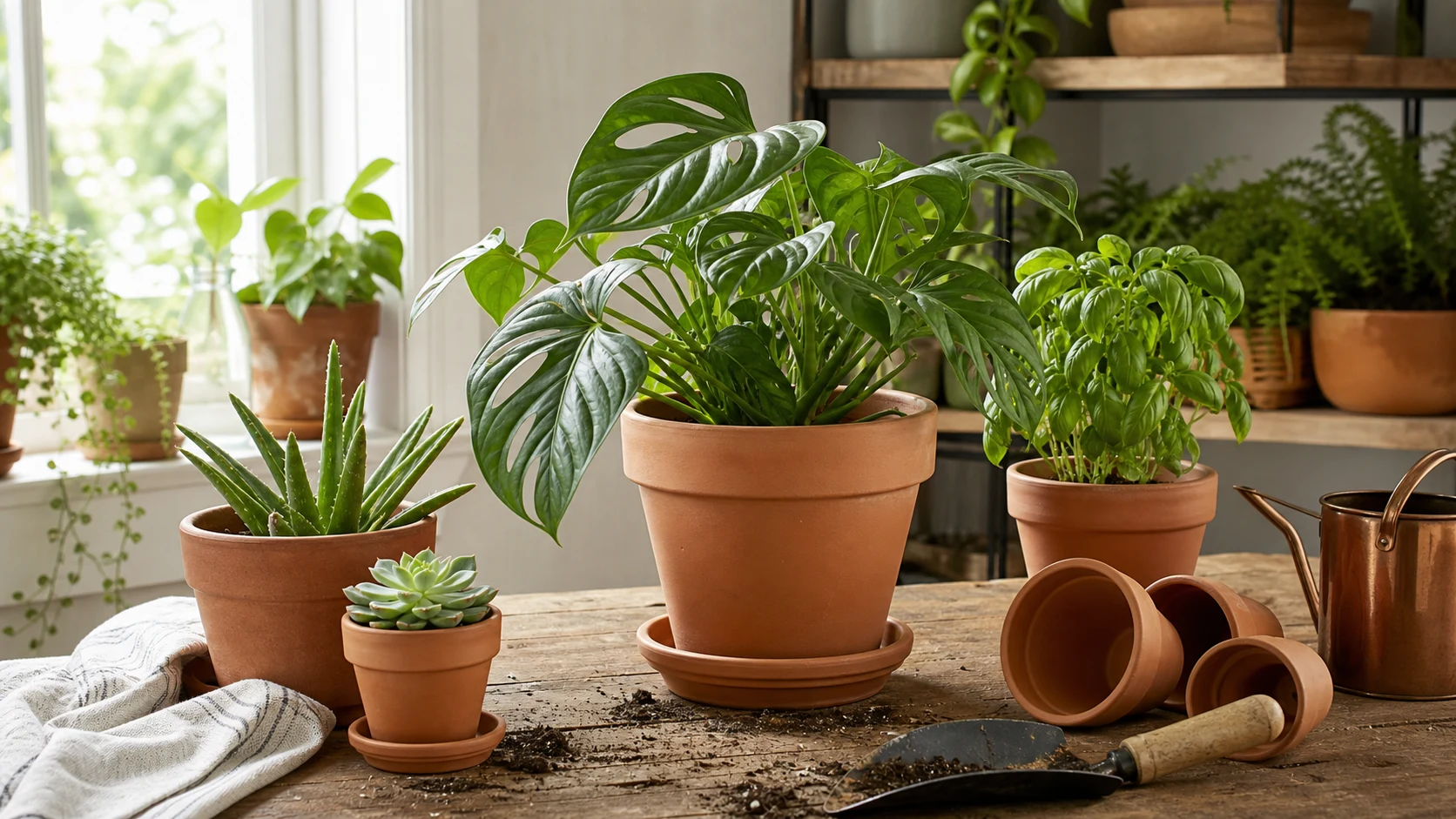
Aroids, succulents, aloe, and herbs show the practical sweet spot for porous pots that let the root zone dry more freely.
Related reads: