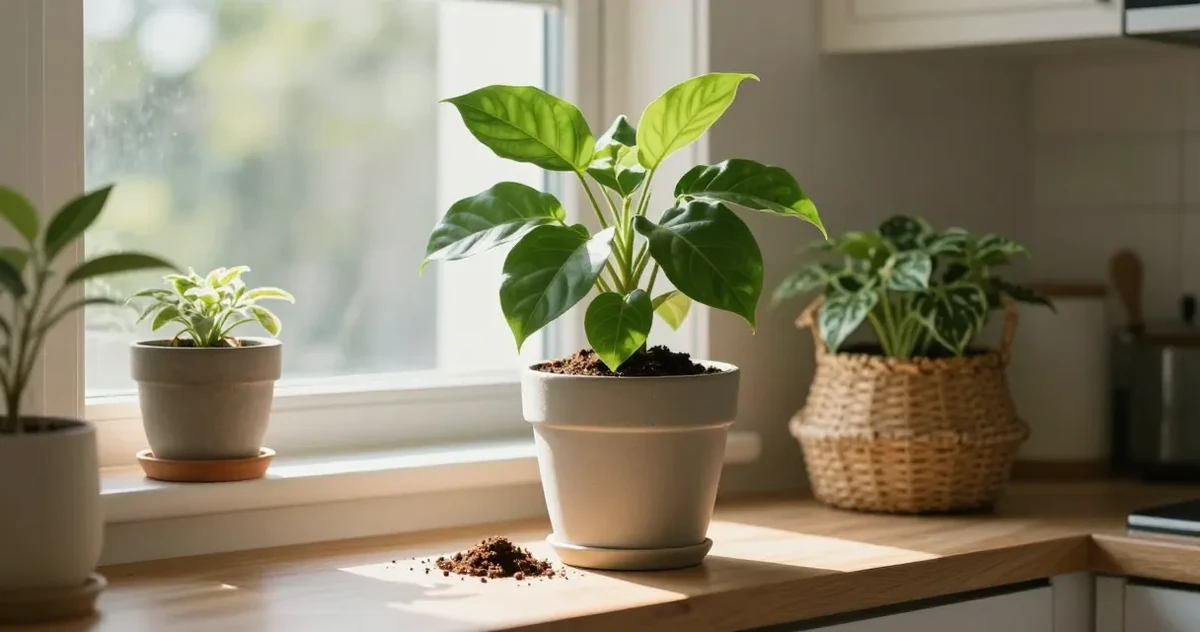
The best potting soil for indoor plants is a container mix that fits the plant’s roots, the pot, and the conditions in the room. Many foliage plants can start in an all-purpose indoor mix, while succulents need a more mineral blend and common epiphytic orchids such as Phalaenopsis need an airy orchid medium, often a coarse bark-based blend.
If a plant started declining after a repot, the mix is one possibility to check, not an automatic diagnosis. Pot size, drainage, damaged roots, light, temperature, and watering can produce similar symptoms. A mix that drains at the surface can also remain wetter deeper in the pot, especially in a large container or a dim, still room.
Use dry-down time as an observation rather than a deadline. Check below the surface and compare what you find with the plant’s normal moisture preference. If the root zone stays saturated and the plant develops soft yellowing, a sour smell, or declining roots, inspect the roots and the whole setup before deciding whether to amend the mix, change the pot, or adjust watering.
What you will leave with: a plant-type decision table, a three-question room audit, adaptable DIY mix ratios, and a checklist for deciding whether the mix is part of the problem.
Best Soil for Indoor Plants: Quick Answer by Plant Type
The types of potting soil for indoor plants differ mainly in how much moisture they retain and how much air space they preserve. Pick your plant type below for a starting point, then use the Indoor Conditions Audit to adjust for the container and room.
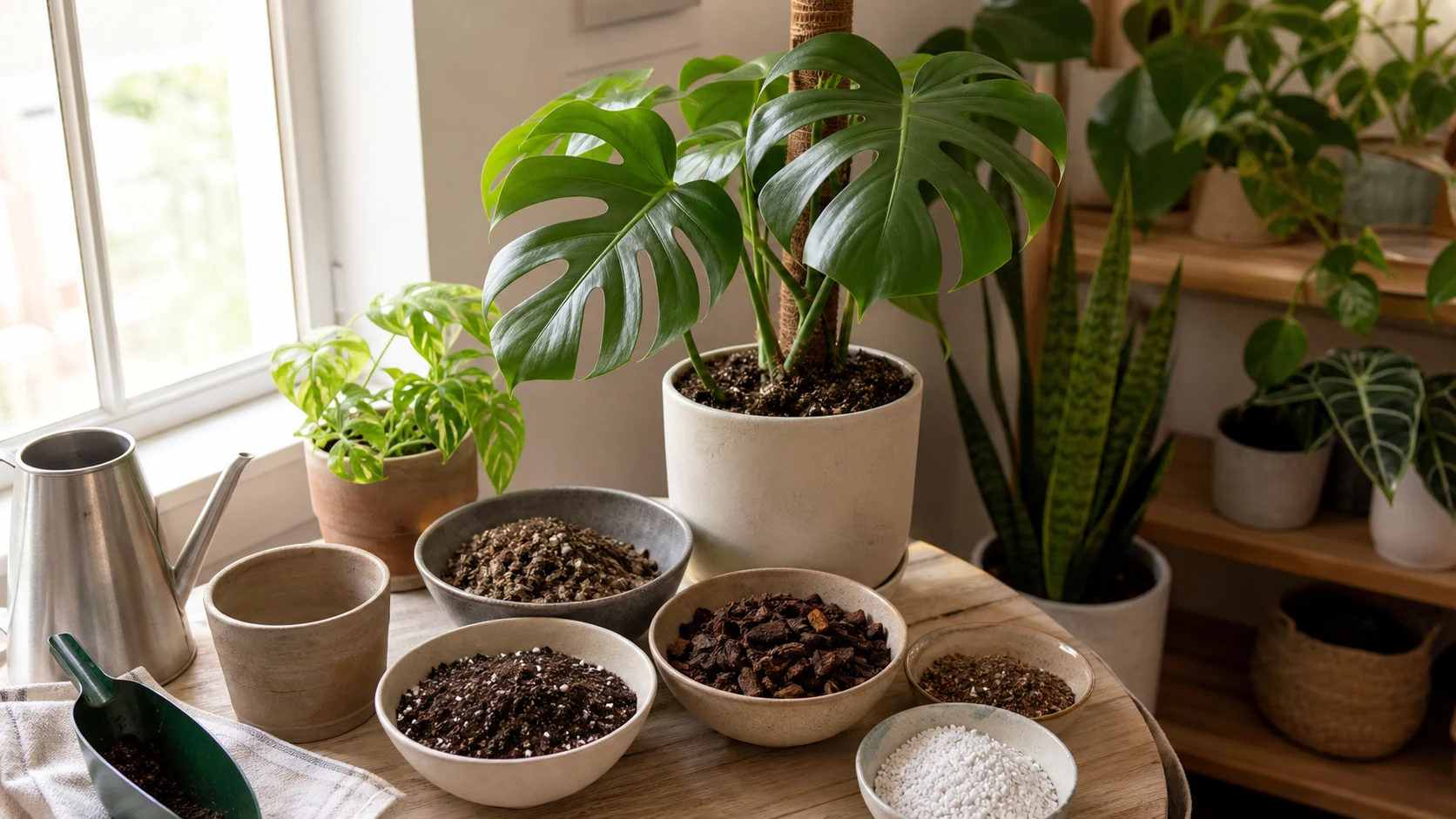
Matching recognizable houseplants with distinct bark, perlite, and soil components makes the first mix choice concrete.
| My plant is… | Use this mix | Dry-down check, not a schedule |
|---|---|---|
| Monstera, philodendron, pothos, alocasia | Loose aroid blend with bark and mineral amendment | Make sure the center does not remain saturated after the surface dries |
| Snake plant or ZZ plant | Fast-draining mix with a substantial mineral fraction | Let most of the mix dry before watering again |
| Succulent, cactus, aloe, haworthia | Lean succulent mix | Check that water moves through freely and the root zone does not stay damp |
| Phalaenopsis or another epiphytic orchid | Airy orchid medium, often a coarse bark-based blend | Use root color, pot weight, and moisture within the medium together |
| Fern, calathea, moisture-loving foliage | Moisture-retentive but aerated potting mix | Aim for even moisture without a waterlogged lower root zone |
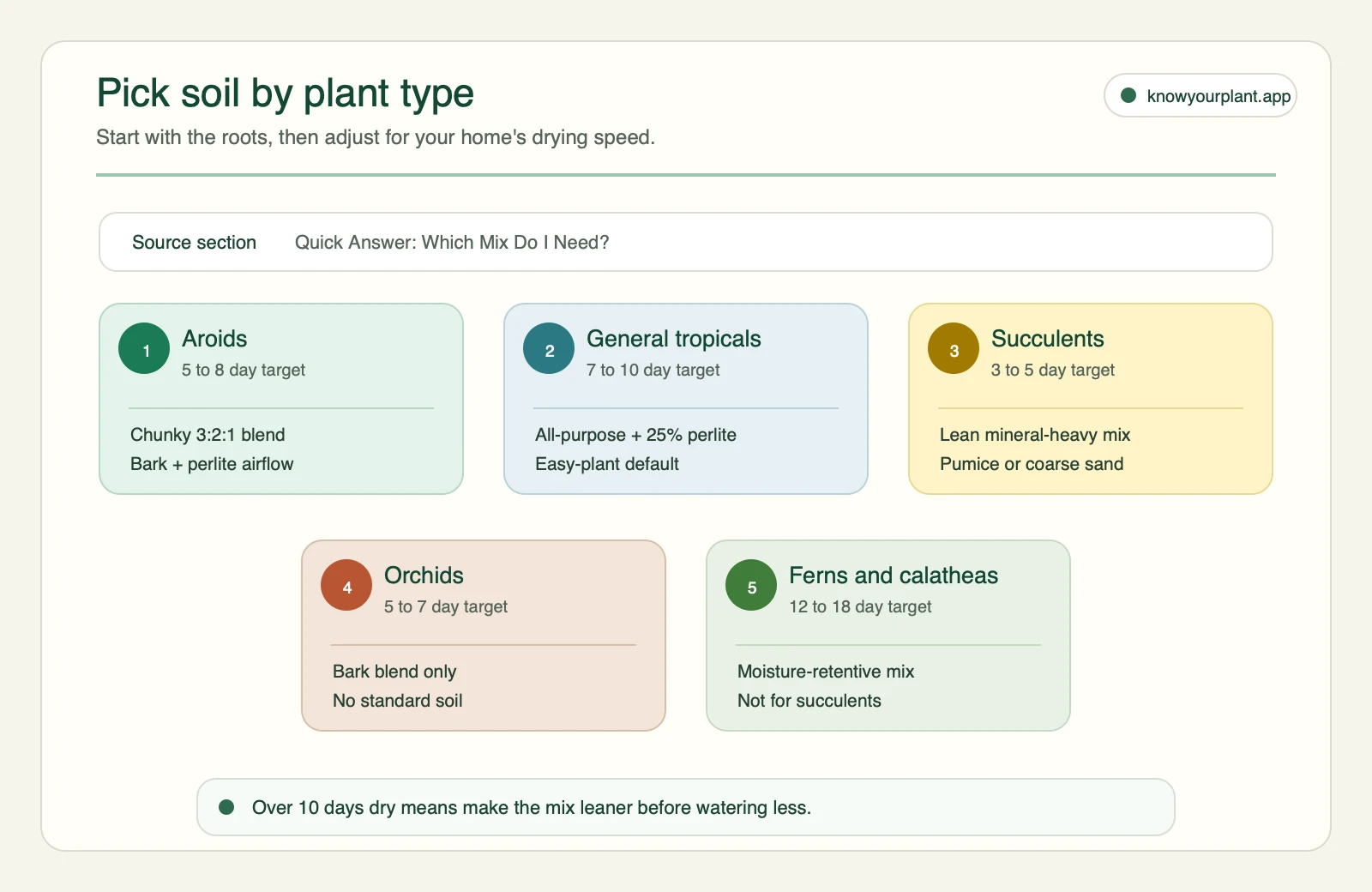
Use the mix picker as a first pass, then adjust by how fast the pot dries in your actual room.
If the tag is missing or unreadable, your starting point changes. KnowYourPlant lets you snap a photo and get the plant name plus care notes before you buy or repot.
What Most Care Guides Miss About Indoor Potting Soil
Watering and potting mix work together. A plant can struggle when the mix, container, and watering rhythm do not match its roots or the conditions in the room. Dense media and oversized pots can remain wet below the surface even when the top looks dry, but similar symptoms can also come from damaged roots, temperature stress, pests, or disease.
Many roundups respond by recommending “well-draining” soil, then listing popular bags. That advice skips an important variable: how does a watered pot behave in your home? Drainage describes how excess water exits when you water; it does not reveal how long the center of the root zone remains moist. Light, airflow, humidity, pot size, pot material, and root density can make the same bag behave differently in two spaces.
The misdiagnosis most people make: they see “well-draining” on the label and assume it is safe for their plant indoors. It is not a guarantee. “Drains well” means water passes through at potting time. It does not mean the mid-pot stays dry long enough to prevent root stress in your specific light and humidity conditions.
Decision check – observe before buying or mixing anything: after watering, check moisture below the surface over several days and watch the plant. Slow drying is not automatically a problem for a moisture-loving plant, and fast drying is not automatically ideal for a drought-tolerant one. Investigate when the lower root zone stays wet alongside stress signals such as soft yellowing, sour-smelling media, or declining roots.
What Plant Owners Keep Running Into With Bagged Mix
Plant owners keep asking versions of the same question: is a simple bagged mix with perlite enough, or do they need a totally different recipe for each plant? In beginner threads and owner discussions, the pattern is consistent. People buy an all-purpose mix, discover it stays wet too long indoors, then start adding perlite, bark, or cactus mix until the pot finally dries on a sane timeline. That does not make every comment thread formal horticultural proof, but it does show where the confusion lives: dense store-bought mix, one-size-fits-all ratios, and no simple way to judge whether a mix fits the room it is going into.
The practical takeaway is simpler than many shopping roundups make it sound. A general base mix plus one purposeful amendment can cover many common foliage plants, while specialty root systems need specialty media. Match the blend to the plant type, pot size, and how the container behaves in your home.
Dense Mix vs Amended Mix: What Happens Below the Surface
The difference is not just how fast water runs through when you water. It is how long the root zone stays wet between waterings.
| What to compare | Dense, fine-textured mix | Coarser amended mix |
|---|---|---|
| Surface versus center | The surface may feel dry while the center remains moist | Larger particles can create more air space through the pot |
| After repeated watering | Fine particles may settle and compact | Bark, pumice, or coarse perlite can help preserve structure |
| Best fit | Plants and rooms where even moisture is useful | Roots that need more air or setups that remain wet too long |
| Main caution | Do not diagnose by the dry surface alone | A very coarse mix can dry too quickly in a small, warm, bright pot |
This comparison is directional. Ingredient grade, pot size and material, root density, room conditions, and watering volume can change how either mix behaves.
The surface can dry before the center of the pot, so a dry top layer does not always mean the whole root zone is ready for water. Persistent moisture becomes concerning when it appears with plant or root symptoms; drying time alone does not identify the cause of yellowing or leaf drop.
Your Home, Your Mix: The Indoor Conditions Audit
The Quick Answer table gives you a plant-type starting point. This three-question audit calibrates that starting point to your specific space – because the same mix performs very differently depending on where it sits.
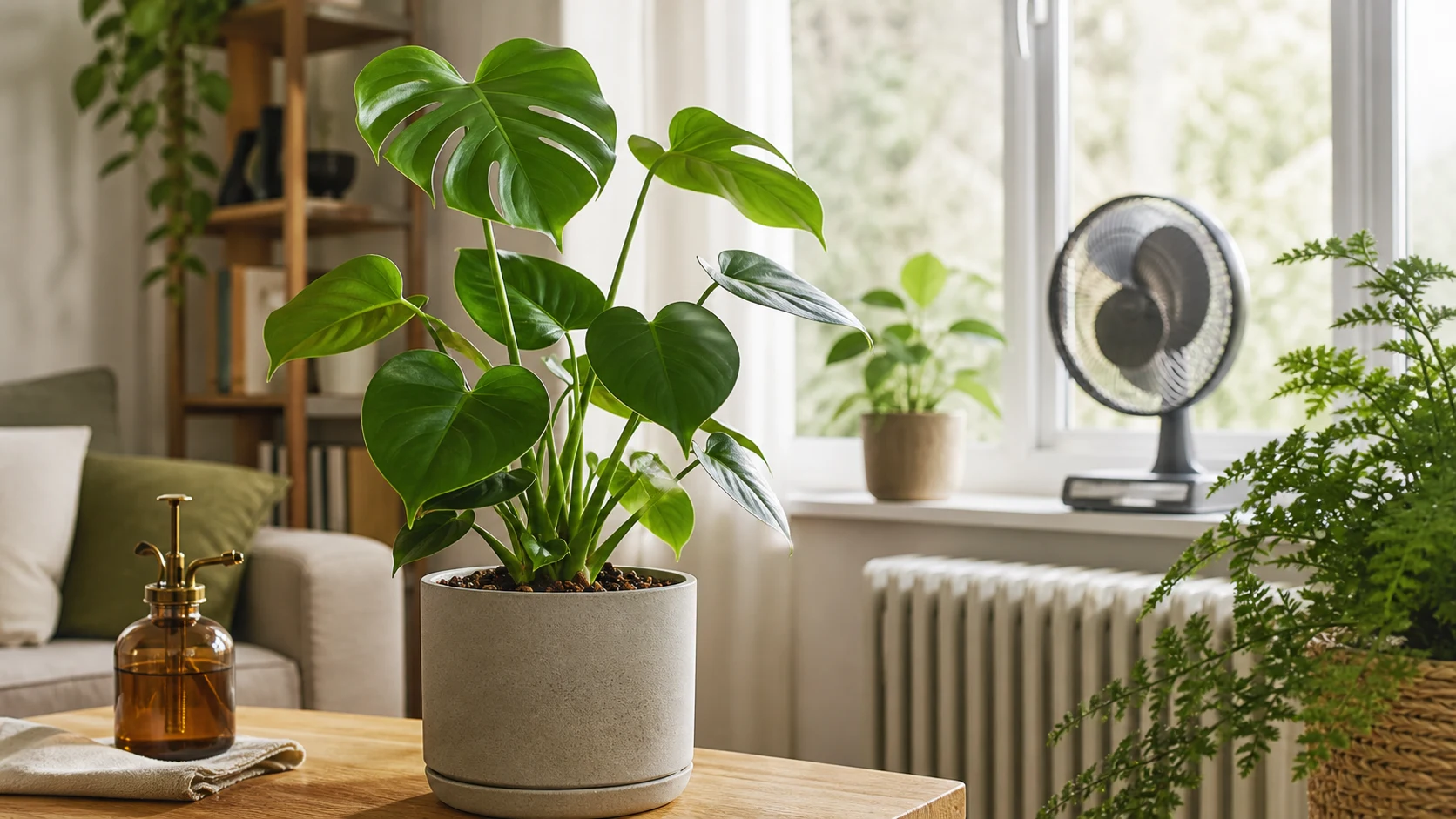
Window light, moving air, room heat, and humidity all change how quickly the same potting mix dries.
Question 1: How much light does the spot get?
Brighter usable light often increases plant water use, while low light can slow it. Do not use window direction or a fixed distance alone as the rule. If the pot remains wet and the plant shows root-zone stress, a coarser mix, a smaller pot, more usable light, or a longer watering interval may be appropriate.
Question 2: Is there airflow in the room?
Moving air, heating or cooling, open windows, and porous terracotta can all change water loss from a pot. Still air can slow surface evaporation, but check the center of the mix and the plant rather than assuming airflow alone determines the interval.
Question 3: What is the typical humidity?
High-humidity spaces can slow evaporation, while air conditioning or heat can speed it. If the pot’s behavior changes with the season, recheck moisture at root depth before watering. A different interval may be enough; a mix change is useful only when the medium and container remain a poor fit.
How to use the audit: if several answers point toward slow drying, start at the coarser end of the appropriate recipe and avoid an oversized pot. If the room is bright, airy, and dry, retain enough moisture for the plant rather than adding amendment automatically. Make one change at a time and judge it by root-zone moisture and new growth.
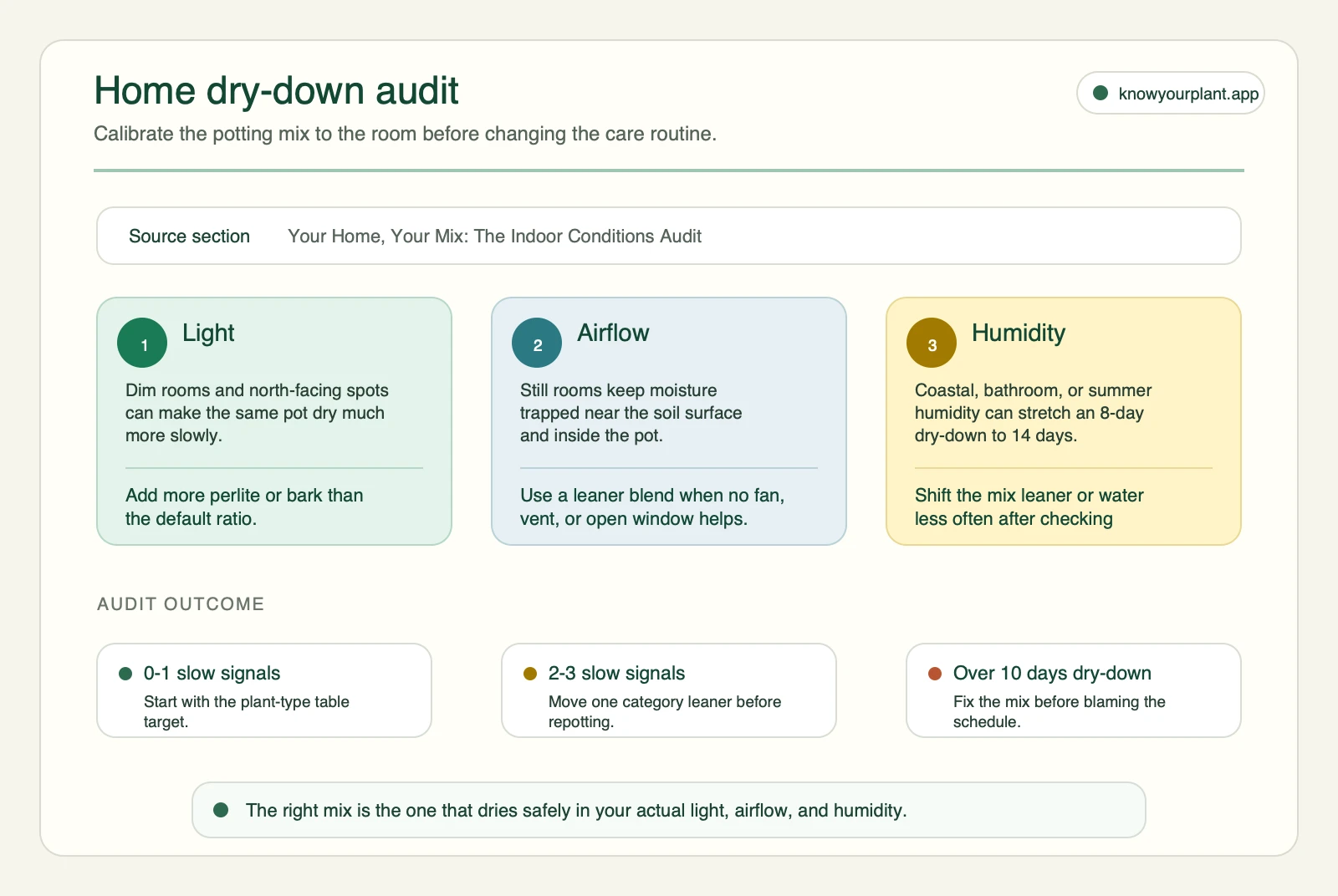
Use the audit to decide whether the default mix should stay standard or shift leaner for a dim, still, or humid room.
Rankings: Indoor Potting Mixes by Use Case
These editorial comparisons evaluate mix categories on four practical criteria: drainage, aeration after repeated waterings, observed dry-down, and the conditions that can support fungus gnats. They are starting points rather than universal recipes or product-test results.
Scoring Rubric Used for These Rankings
| Criterion | What it measures indoors | Weight |
|---|---|---|
| Drainage speed after a full watering | Whether excess water exits quickly instead of pooling in the root zone | 30% |
| Aeration and root airflow | How much space the mix leaves for roots to breathe after it settles | 30% |
| Drying time in real indoor conditions | Whether the mix usually lands in a safe moisture window for the plant type | 25% |
| Pest and rot risk | How likely the mix is to stay wet enough to encourage fungus gnats or root stress | 15% |
Editorial note: these are category evaluations drawing on published horticultural guidance from The Old Farmer’s Almanac, the American Orchid Society, and University of Missouri Extension. They are not controlled side-by-side product tests. Individual product performance within a category can vary. No sponsored placements.
| Rank | Mix type | Best for | Drying time (typical indoor) | Root risk if wrong |
|---|---|---|---|---|
| 1 | All-purpose + 25% perlite | Tropical houseplants, pothos, snake plants, philodendrons | 7 to 10 days | Low with amendment |
| 2 | Chunky aroid blend (3:2:1) | Monstera, alocasia, pothos, anthurium, hoya | 5 to 8 days | Low if mixed correctly |
| 3 | Lean succulent/cactus mix | Succulents, cacti, haworthia, string of pearls | 3 to 5 days | Medium if organic fraction too high |
| 4 | Orchid bark blend | Phalaenopsis orchids, epiphytic orchids | 5 to 7 days | High if standard soil used instead |
| 5 | All-purpose straight from bag | Ferns, moisture-loving plants only | 12 to 18 days | High for aroids or drought-tolerant plants |
The drying-time ranges are illustrative observations, not watering schedules or pass/fail cutoffs. Fixture light, season, container size and material, root density, and room conditions can move a pot outside these ranges without proving the mix is wrong.
Pros and Cons by Mix Type
| Mix type | Pros | Cons | Best for | Not for |
|---|---|---|---|---|
| All-purpose + 25% perlite | Cheapest upgrade, easy to mix, works for many tropicals | Can still stay wet too long in dim humid rooms | Pothos, philodendron, snake plants, peace lilies | Orchids, very drought-adapted succulents |
| Chunky aroid blend | Creates large air spaces around thick roots | Ingredients cost more and bark breaks down over time | Monstera, alocasia, anthurium, hoya | Ferns or plants that prefer evenly moist media |
| Lean succulent/cactus mix | Dries faster and retains less water | Can be too lean for tropical foliage plants | Cacti, aloe, haworthia, echeveria | Peace lilies, calatheas, ferns |
| Orchid bark blend | Essential airflow for epiphytic orchids | Dries too quickly for most non-orchid houseplants | Phalaenopsis and similar orchids | Standard houseplants grown in potting mix |
| All-purpose straight from the bag | Easy to find and moisture-retentive | May dry too slowly in an oversized pot, dim room, or drought-tolerant setup | Ferns and other moisture-lovers | Succulents and common epiphytic orchids |
Aloe is especially sensitive to a mix that stays damp around the roots; the soil guide for aloe plants gives exact mix ratios and a quick drainage test.
What Is Actually in the Bag: Ingredient Breakdown
Most potting soil labels list ingredients without explaining the indoor tradeoffs. This table focuses on how each component performs in indoor conditions, where low light and limited airflow work against you.
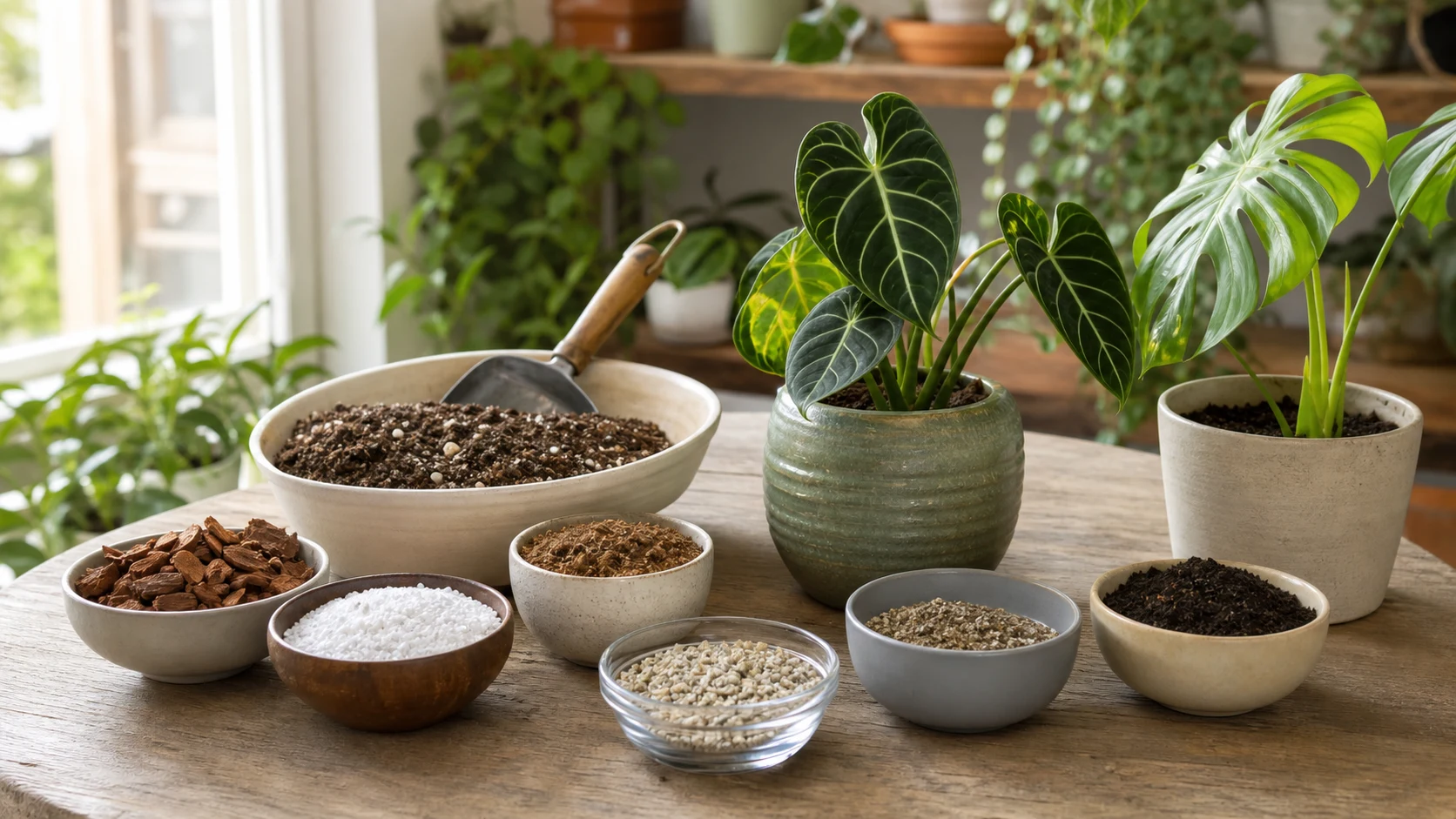
Bark, perlite, coir, mineral amendments, and organic mix create very different moisture and airflow conditions around indoor roots.
| Ingredient | Moisture retention | Airflow | Pest risk indoors | Best for |
|---|---|---|---|---|
| Peat moss | High | Low | Medium: stays wet | Ferns, moisture-lovers |
| Coco coir | Medium | Medium | Low | General base, DIY blends |
| Perlite | Very low | High | Low | Most houseplants, aroids, succulents |
| Orchid bark | Low | Very high | Low | Aroids, orchids, chunky-root plants |
| Coarse sand or pumice | Very low | High | Low | Succulents, cacti |
| Vermiculite | High | Low | Medium | Seed starting, ferns |
| Worm castings | Medium | Low | Low | Topdress or sparse addition only |
The Old Farmer’s Almanac notes that perlite absorbs very little moisture while significantly improving soil aeration, making it one of the most effective and lowest-risk amendments for indoor container mixes. Adding even 20 percent perlite to a dense bagged mix changes how it drains and dries: you can feel the difference when you lift the pot a day after watering.
One thing that trips up indoor growers: vermiculite and peat are both moisture-retentive. A mix heavy in both will stay wet for a long time indoors. That is fine for a fern in a humid bathroom. It is not fine for a monstera in a dim bedroom.
The Four Mix Categories, Ranked
Rank 1: All-Purpose Mix with Perlite
Choose this if: your plant is a pothos, snake plant, ZZ, philodendron, peace lily, or any general tropical houseplant with moderate moisture tolerance.
For most tropical houseplants, an all-purpose mix amended with perlite does the job. The issue is not the mix category. It is using it straight from the bag for plants that need airflow around their roots, or watering on a fixed schedule instead of checking the soil first, which is exactly why the watering guide matters as much as the mix itself.
Works well for snake plants, pothos, ZZ plants, peace lilies: low-maintenance plants with moderate moisture tolerance that handle wetter conditions between waterings without immediate root stress.
Works less well for aroids with thick, chunky roots in dim apartments. An unmodified all-purpose mix can hold moisture for 10 to 14 days in low-light, low-airflow conditions, which is long enough to cause root damage even with careful watering.
Quick improvement: add 20 to 30 percent perlite by volume before potting. It costs almost nothing and meaningfully shortens drying time without changing how you water.
Rank 2: Chunky Aroid Blend
Choose this if: your plant is a monstera, philodendron, alocasia, anthurium, hoya, or any tropical with thick chunky roots that dislike sitting in compact soil.
Monsteras, philodendrons, alocasias, and most pothos varieties have roots that need air as much as moisture. In their natural environment, these plants grow on or around decomposing bark and tree trunks, not in compacted soil. Their roots are adapted for a loose, open structure with plenty of gaps to breathe.
A useful aroid mix balances moisture with open structure so the root zone is less likely to remain saturated. It should feel loose in your hands and fall apart after a gentle squeeze rather than forming a dense, sticky clump.
Works well for monstera, philodendron, alocasia, pothos, syngonium, anthurium, hoya. See the monstera care guide for more detail on how mix structure affects leaf size and fenestration.
DIY aroid mix:
- 3 parts all-purpose potting mix
- 2 parts perlite
- 1 part orchid bark (medium grade)
Mix thoroughly. The finished blend should drain immediately when you water and feel noticeably lighter than standard bagged mix. If it still clumps in your fist, add more perlite.
Rank 3: Lean Succulent and Cactus Mix
Choose this if: your plant is a succulent, cactus, haworthia, aloe, echeveria, string of pearls, or any drought-adapted plant that needs its soil to dry almost completely between waterings.
Succulents and cacti need their soil to dry out almost completely between waterings. A standard potting mix, even one amended with perlite, usually retains too much moisture for desert plants in an indoor setting.
Pre-made succulent mixes use a higher ratio of mineral material: coarse sand, pumice, or decomposed granite, with less organic matter. Buying generic potting soil and adding a little extra sand rarely gets you there. The result is usually still too moisture-retentive for drought-adapted plants indoors.
Works well for string of pearls, aloe, echeveria, haworthia, cacti, string of hearts. The succulent care guide covers what to watch for when succulents sit in soil that is too wet.
DIY succulent and cactus mix:
- 1 part all-purpose potting mix
- 1 part perlite
- 1 part coarse sand or pumice
For very drought-adapted plants such as lithops or many cacti, growers often use a higher mineral fraction. Treat any ratio as a starting point: climate, pot material, particle size, and the species determine whether the mix retains too much or too little moisture.
Rank 4: Orchid Bark Blend
Choose this if: your plant is a Phalaenopsis or another epiphytic orchid commonly grown in a coarse medium. Fine standard potting soil can remain too wet and restrict air around these roots, so a bark-based orchid mix is the safer starting point.
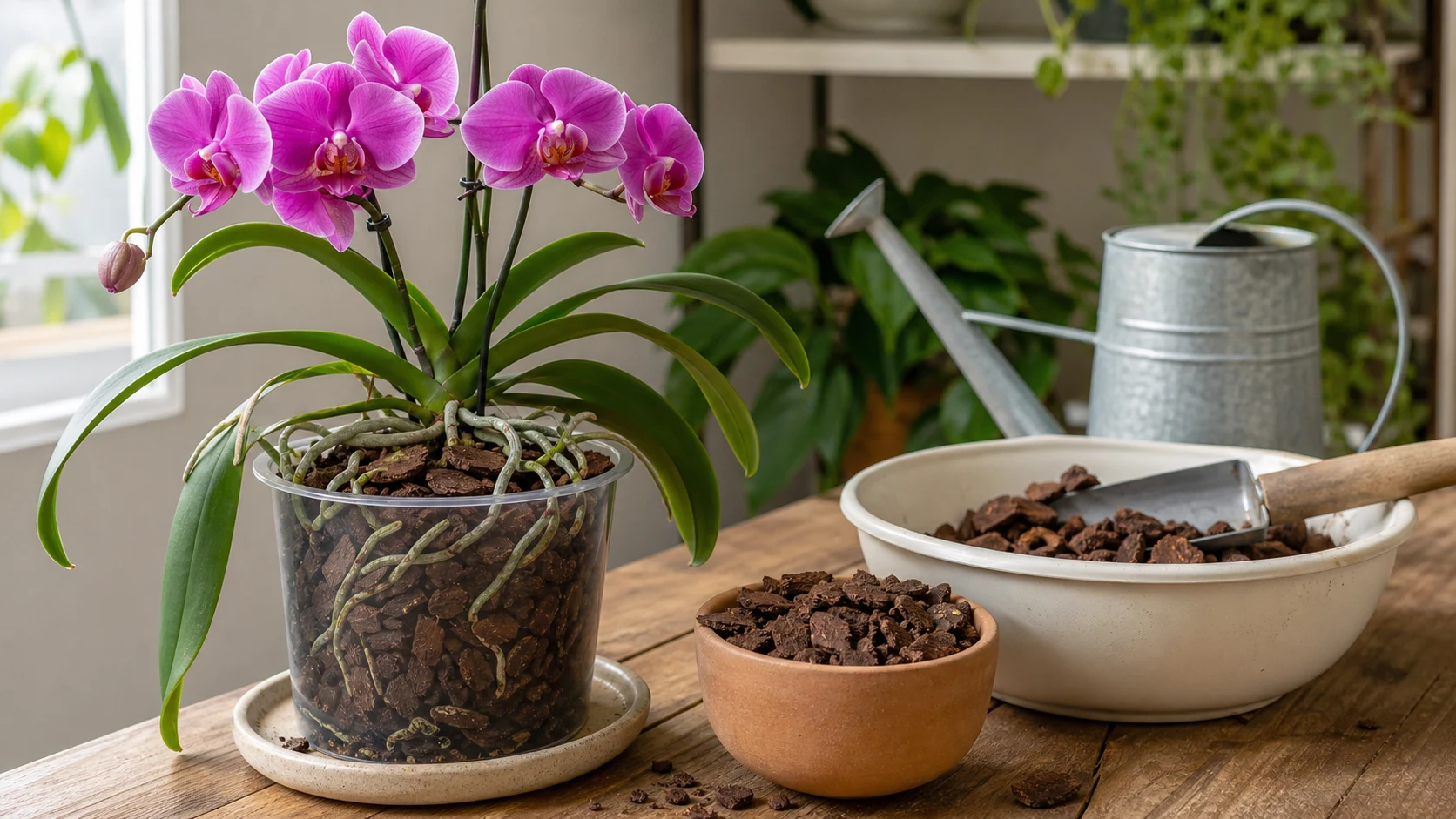
A clear pot reveals why chunky bark and open air around Phalaenopsis roots matter more than ordinary potting soil.
For common epiphytic orchids, do not substitute ordinary fine potting soil for a purpose-made orchid medium. Confirm the orchid type first because terrestrial orchids have different media needs.
The American Orchid Society identifies air movement around roots as an important part of successful orchid culture. A coarse medium can preserve air space while still holding some moisture; a fine, persistently wet medium can compromise root health.
In the wild, most common orchids – especially phalaenopsis, the kind sold in grocery stores – grow on tree bark with roots exposed to open air and intermittent moisture. Orchid bark media recreates those conditions: it drains immediately and dries quickly between waterings.
DIY orchid mix:
- 70 percent medium-grade orchid bark (primary ingredient)
- 20 percent coarse perlite
- 10 percent sphagnum moss (optional: only if your space is very dry and the bark dries in under 5 days)
The Old Farmer’s Almanac notes that orchids sold packaged in wet sphagnum moss benefit from a fresh repot into bark-based media after they finish blooming. The wet moss keeps them alive in transit but is not the right long-term environment for most home setups.
This category is less useful for ordinary foliage plants but important for common epiphytic orchids. Match the medium to the orchid rather than treating every orchid as a plant for standard potting mix.
Fix Your Bagged Mix: Diagnostic Rubric
Not every soil problem requires a full repot. You can often read what the mix needs from how the plant is already behaving.
| What you are seeing | What it signals | What to do |
|---|---|---|
| Lower root zone stays wet while the plant shows stress | Mix, pot size, and watering may be keeping roots saturated | Inspect roots and drainage; use a coarser mix on the next repot if structure is part of the problem |
| Fungus gnats returning after treatment | Warm, moist organic material is breeding habitat | Let mix dry further; consider inorganic top layer or leaner blend |
| Roots brown and soft when you unpot | Root rot in progress | Repot into fresh, leaner mix; trim affected roots |
| Yellowing leaves without a clear watering error | Possible soil-structure problem | Unpot and inspect roots; move to better-draining mix |
| Mix dries in 2 to 3 days even after thorough watering | Mix too lean or peat crust has formed | Soak pot to rehydrate, or add coco coir to next blend |
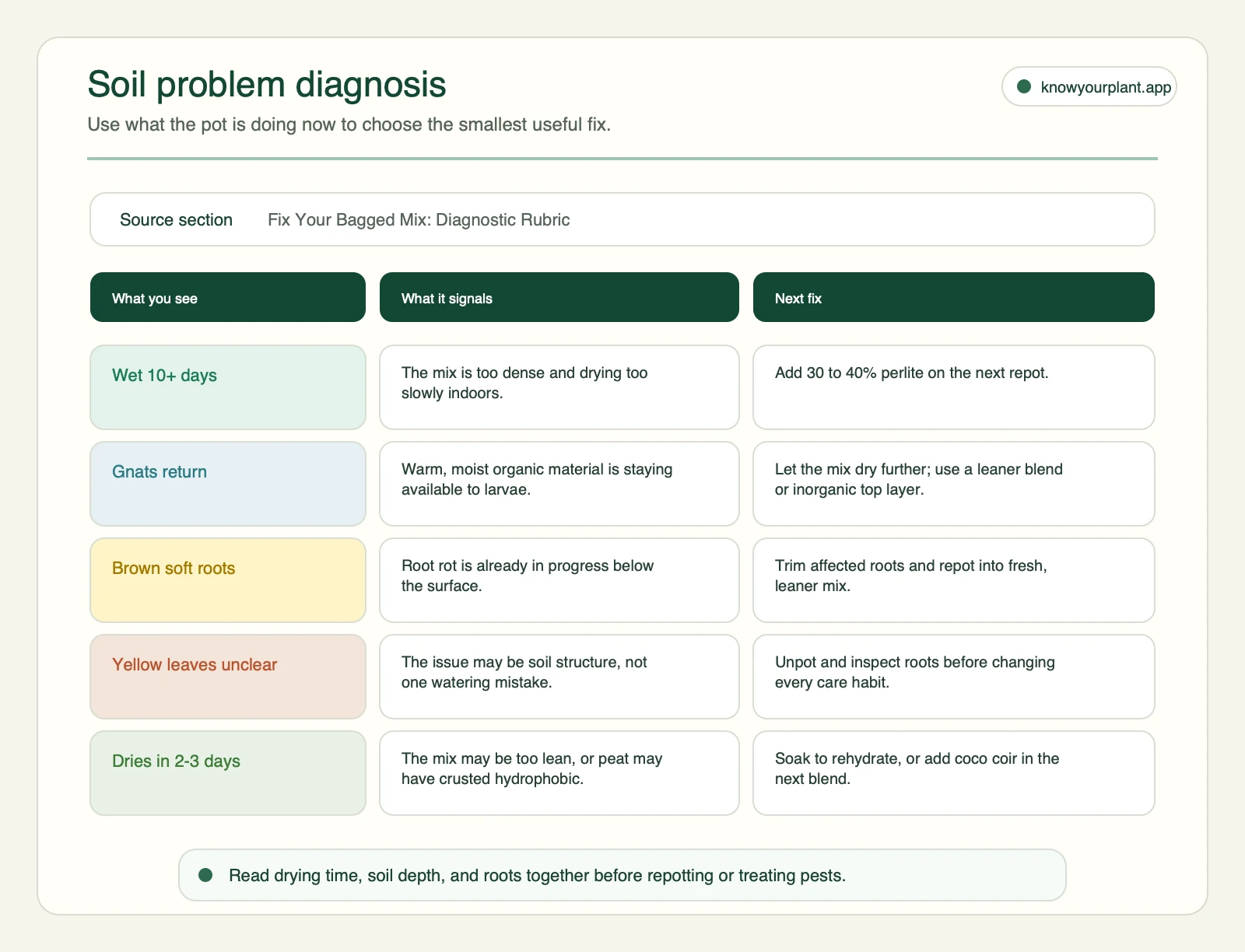
Use the diagnosis card before repotting from scratch. The smallest useful fix depends on drying time, root condition, and what the pot is doing now.
Fungus gnats are often a soil-structure complaint as much as a watering problem. Their larvae need moist, warm organic material to survive. A mix that dries faster between waterings removes the breeding habitat more reliably than insecticide treatments alone. The fungus gnat guide covers both treatment and the soil adjustments that actually reduce recurrence.
Horticulturist note: Clemson HGIC describes indoor mixes in terms of ingredient function and structure, while Colorado State Extension, Wisconsin Horticulture, and UC IPM all point back to the same pest pattern: media that stays wet too long becomes a better home for fungus gnats. That is why mix structure, pot size, and dry-down time matter just as much as any trap or spray.
If the rubric above points to root rot, catching it early matters. The root rot treatment guide walks through what to look for and how to recover a plant that is still salvageable.
Amendment Quick Reference
You do not always need a separate commercial bag for every plant. Adding an appropriate coarse or mineral component before potting can improve structure when the base mix is too fine for the intended plant and container.
Perlite: The most practical amendment for most houseplants. Lightweight, white, volcanic mineral that improves drainage and aeration without adding nutrients or changing pH. Aim for 20 to 30 percent for tropical houseplants, 30 to 50 percent for drought-tolerant plants.
Orchid bark: Adds large air pockets and fast drainage. Good for aroids and anything with chunky roots. It breaks down over 18 to 24 months, so mixes heavy in bark need refreshing more often than standard potting mixes.
Coco coir: A peat substitute made from coconut husk fiber. Holds some moisture but stays looser and more airy than peat-heavy mixes. More resistant to the hydrophobic crust problem that peat develops when it dries out completely. Good as the organic base in DIY blends.
Pumice or coarse sand: Best for succulents and cacti. Pumice is lighter and more porous than coarse sand. Both add drainage without any organic material to hold moisture. Do not use fine sand: it fills air pockets instead of creating them.
One Dense Bag, Three Different Plants
If you buy one standard indoor potting mix and want to use it across several plants, the better move is not to treat every pot the same. Change the structure based on the plant.
Monstera: Start with the bagged mix, then add perlite and orchid bark until the blend feels loose enough to fall apart in your hand. Monsteras tolerate moisture, but thick roots resent compact wet media. A chunkier blend shortens dry-down and lowers rot risk.
Snake plant: Use the same base mix, but push the mineral side harder: extra perlite or pumice, less organic matter, and a smaller pot if you are between sizes. Snake plants fail more often from staying wet than from being a little too lean.
Fern: This is the plant least likely to appreciate a dramatic lean-out. A fern can stay in a finer all-purpose mix, especially in a bright bathroom or another humid room, but it still benefits from avoiding oversized pots and watching for fungus gnats if the surface never dries.
That is the pattern most “best soil” roundups blur together. The bag is only the starting point. The amendment level is what makes the mix fit the plant.
Which Mix for My Plant?
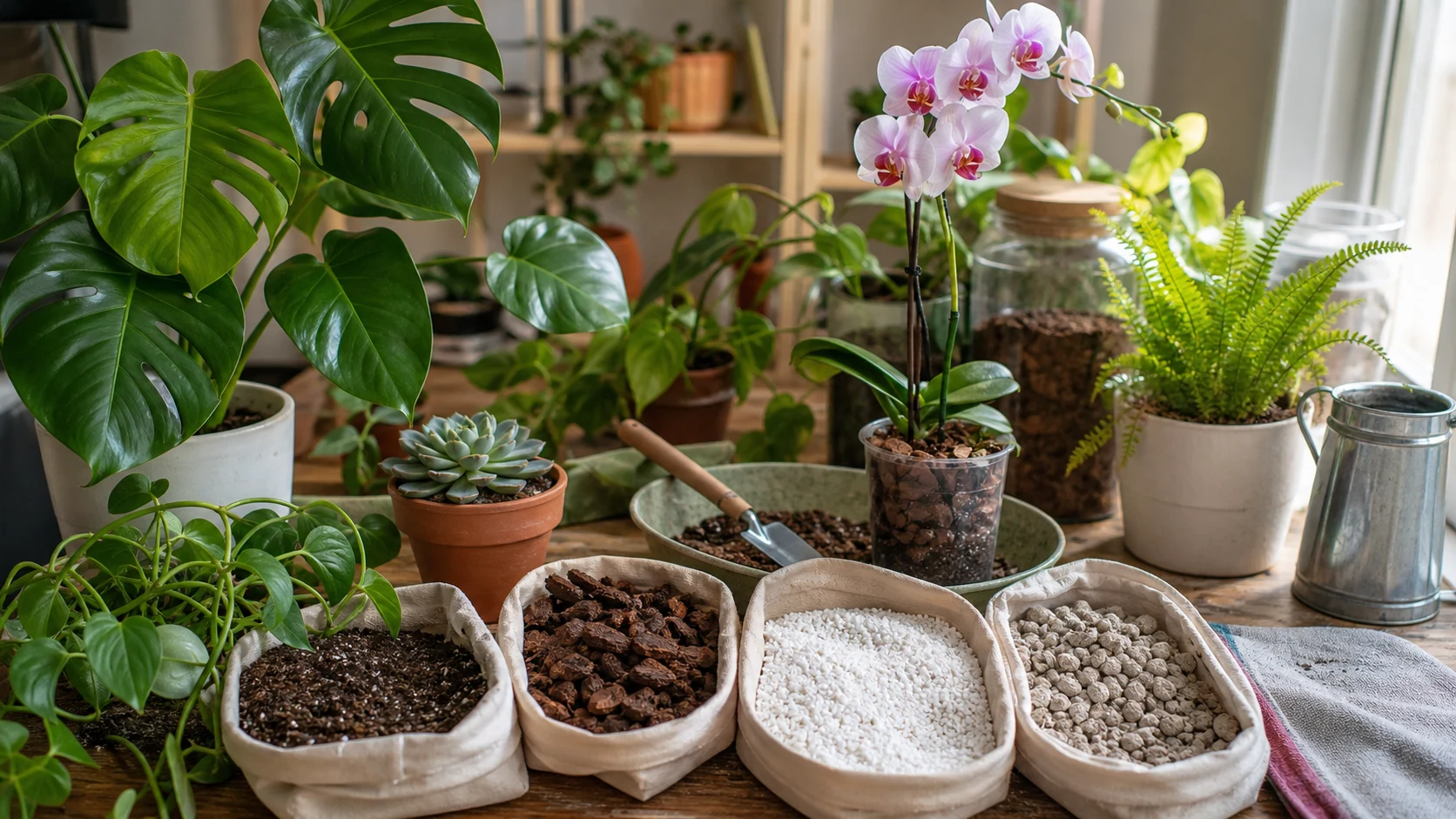
Aroids, succulents, orchids, and ferns each pair naturally with different proportions of soil, bark, perlite, and mineral amendments.
| Plant type | Recommended base | Key amendment | Drying time target |
|---|---|---|---|
| Most tropical houseplants | All-purpose mix | 20 to 30% perlite | 7 to 10 days |
| Aroids (monstera, philodendron, pothos) | All-purpose mix | Orchid bark + perlite, 3:2:1 ratio | 5 to 8 days |
| Succulents and cacti | Lean base or purpose-made succulent mix | 40 to 50% pumice or coarse sand | 3 to 5 days |
| Orchids | Orchid bark blend only | No standard soil | 5 to 7 days |
| Ferns and moisture-loving plants | All-purpose mix as-is | None needed | 12 to 18 days |
| Trailing and hanging plants | All-purpose mix | 20% perlite | 7 to 10 days |
The drying time target column is the variable most care guides omit. It is also the most useful indoor-specific check because it accounts for your home’s humidity, airflow, and light – factors no soil rating on a bag can account for on your behalf. Use the Indoor Conditions Audit above to calibrate these targets for your specific space.
When you repot, it is worth inspecting roots and checking pot sizing before committing. The how to repot plants guide walks through root condition, pot sizing, and when to swap soil versus leave it alone.
Common Mistakes with Indoor Potting Soil
Most soil problems follow recognizable patterns. These are the ones worth knowing before you repot.
Using the same mix for every plant. A pothos and a cactus are both sold as “easy indoor plants,” but their roots have different moisture and aeration needs. A dense, moisture-retentive mix that suits some foliage plants can remain too wet for a succulent. Use the Quick Answer table as a starting point.
Adding too little perlite. A small handful of perlite in a full bag of potting mix does almost nothing. The blend should feel noticeably lighter and less cohesive than the original mix when you scoop it. For tropical houseplants, aim for roughly one cup of perlite per three cups of mix. Less than 20 percent rarely changes indoor drying time enough to matter.
Trusting surface dry. Dense mix dries from the top down. The surface can feel completely dry while the mid-pot and bottom remain moist. That surface-to-center mismatch can contribute to root problems in an otherwise careful routine. Push a finger to the second knuckle, use a wooden chopstick, or lift the pot: a wet pot is noticeably heavier. Check below the surface before every watering decision.
Reusing mix from a troubled plant. Mix that held a plant with root rot, persistent fungus gnats, or an unknown decline may carry pathogens or larvae into the new pot. Dispose of it and start fresh. For a healthy plant moving to a slightly larger pot, mixing old soil with fresh mix plus extra perlite is a reasonable shortcut.
Using fine sand for succulents. Fine sand compacts over time and fills air pockets instead of creating them. Coarse sand, pumice, or horticultural grit behave completely differently. If your succulent mix feels almost powdery when dry, the sand is probably too fine.
Repotting straight from the nursery without checking the setup. Nursery media may prioritize production, shipping, or retail watering routines. Do not repot automatically: let a healthy plant adjust, observe how the existing medium behaves in your home, and change it when the roots, mix structure, or pot size provide a reason.
Seasonal Soil Performance: What Changes and When
The same mix can behave very differently across seasons, even when you do not change what you are doing.
Winter: Central heating drops indoor humidity, sometimes dramatically. A mix that took ten days to dry in October may dry in six days by January. Plants that seemed to need frequent watering in summer may need less in winter, but they also may not: a drier home speeds soil drying, which can mean the plant is actually thirstier. Check the pot weight rather than watering on a schedule.
Spring: The best repotting window. Increasing light and warming temperatures give roots more energy to establish in fresh mix. If a plant struggled through winter in dense, exhausted soil, spring is the right time to move it into a leaner blend. Spring repots recover fastest.
Summer: Warmer temperatures accelerate microbial breakdown of organic mix components. A bark-heavy aroid mix that held structure for 18 months may start to compact in summer heat. High humidity in coastal cities or unconditioned apartments can push drying time well beyond the normal range even for lean mixes. Succulents in particular may need even leaner conditions in a humid summer than the standard recipe suggests.
Fall: A poor time for major soil changes. Root disturbance before the lower-light months stresses plants when they have less energy to recover. Hold off on repotting in fall unless a root problem requires immediate action. Adjusting the watering schedule is a better intervention than changing the mix.
Testing and Evaluation Method
These rankings were built as an editorial comparison of mix categories, not a sponsored product roundup. The evaluation combined current product-review and care-guide patterns, owner questions about dense indoor mixes and all-in-one soils, and extension or IPM guidance checked against Clemson HGIC, Colorado State Extension, Wisconsin Horticulture, and UC IPM. Community threads were used as qualitative owner-language signal, not statistical proof. In plain terms, the scoring favors mixes that dry on a safer indoor timeline, keep airflow around roots, and reduce the common “looks dry on top, still wet at the roots” problem.
Frequently Asked Questions
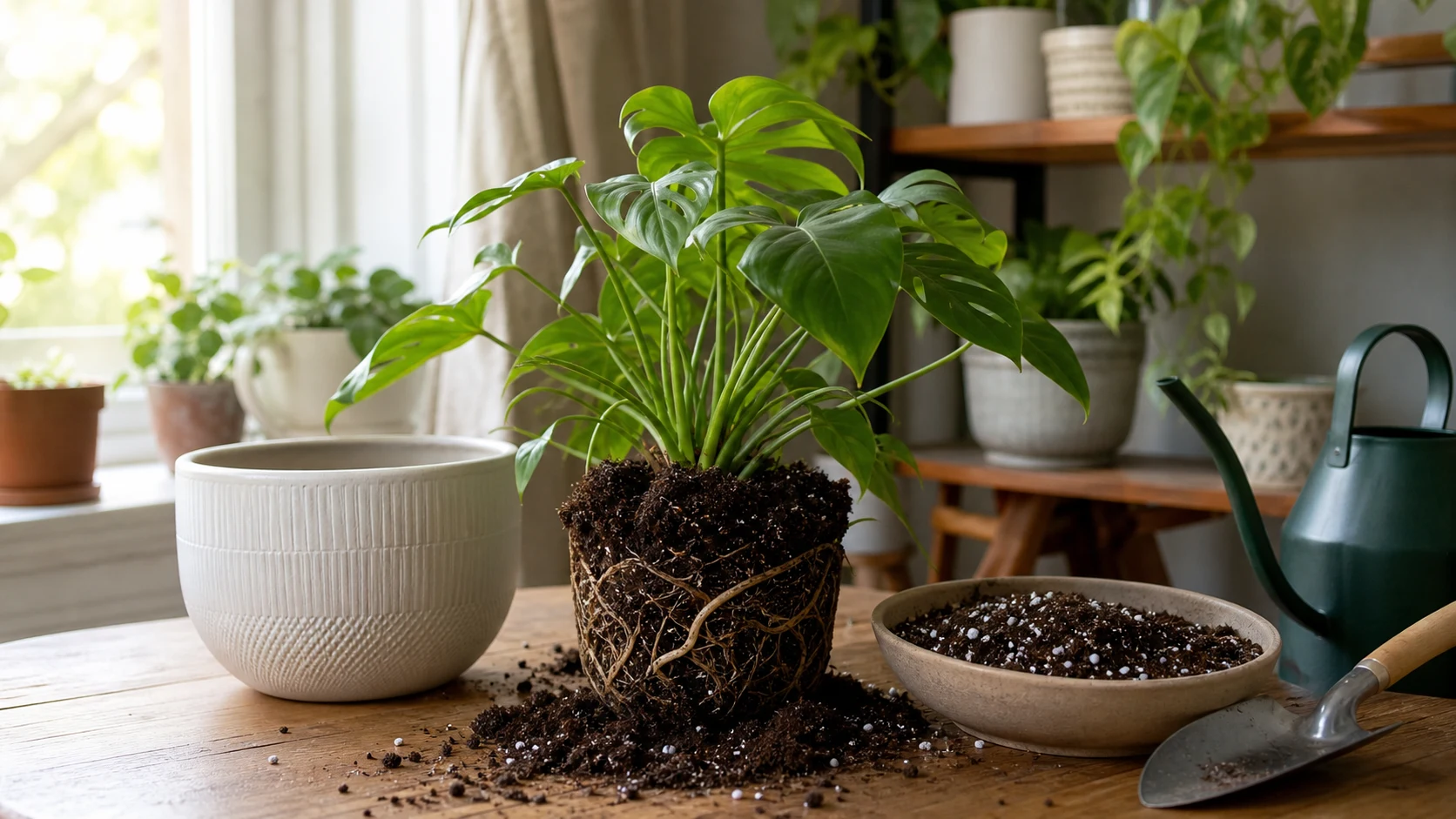
Circling roots, compacted old mix, a larger pot, and fresh perlite-amended soil make the repotting decision visible.
Can I use garden soil for indoor plants? Garden soil used alone is usually a poor container medium because it can compact and reduce drainage and air space. It may also bring weeds or pests indoors. Use a purpose-made container mix, or a recipe specifically formulated for pots, instead.
How often should I change my potting soil? Most mixes start to break down after 18 to 24 months. Signs: soil has shrunk noticeably in the pot, it stays wet much longer than it used to, or roots are circling and pushing through drainage holes. Repot when the plant or soil shows these signals, not on a fixed calendar.
Is perlite safe for all houseplants? Perlite is a lightweight mineral amendment commonly used to increase air space in container mixes. The useful proportion varies by plant, base mix, and particle grade; moisture-loving plants may need less than drought-adapted plants. Very fine perlite can float to the surface, so standard or coarse grades are easier to use in containers.
Why do fungus gnats keep coming back even after I let the soil dry out? Gnat larvae can survive at the bottom of the pot even when the surface looks dry. Dense, peat-heavy mixes stay moist in their lower half long enough to keep the life cycle going. Switching to a leaner mix or adding an inorganic top layer removes the breeding habitat more reliably than surface drying alone.
What is the difference between potting soil and potting mix? In practice, the terms are used interchangeably. Technically, “potting soil” may contain actual mineral soil while “potting mix” is soilless. Most products sold for containers today are soilless even when labeled “potting soil.” For indoor houseplants, the two terms usually describe the same product category.
Do I need a different soil for every plant? Not for every plant. Many tropical foliage plants can share an adaptable base mix. Specialty groups need closer attention: common epiphytic orchids generally use coarse orchid media, succulents and cacti usually need a leaner mineral fraction, and bog or aquatic plants need media matched to their growing method.
Can I reuse old potting soil? You can, with tradeoffs. Old mix has less structure, fewer nutrients, and may carry pathogens or pests from the previous plant. If the previous plant had root rot or recurring fungus gnats, do not reuse that soil. For a healthy plant moving to a slightly larger pot, mixing old soil with fresh mix and adding perlite is reasonable. Do not reuse mix that smells sour, has visible mold throughout, or has broken down into a dense powder.
Why is my mix repelling water instead of absorbing it? Peat-based mixes can develop a crust that becomes hydrophobic when they dry out completely. Water runs straight off the surface and out the drainage holes without soaking in. The fix: submerge the entire pot in a bucket of water for 20 to 30 minutes to rehydrate the mix, or switch to coco coir as your base ingredient on the next repot. Coco coir resists this problem much better than peat.
How do I know if my specific home needs a leaner mix than standard recommendations? Use the Indoor Conditions Audit above. Low light, still air, humidity, pot size, and pot material can all change dry-down. After watering, check below the surface and compare the result with the plant’s normal moisture preference. If the lower root zone remains wet alongside root-stress symptoms, inspect the roots and consider a coarser mix, a smaller pot, or a longer watering interval.
Sources reviewed: June 2026. The answer-first guidance and diagnostic qualifiers were updated in September 2026. Rankings are an editorial evaluation based on published horticultural guidance from The Old Farmer’s Almanac, the American Orchid Society, and University of Missouri Extension—not controlled product testing. No sponsored placements.