Nerve Plant Care: How to Keep Fittonia from Wilting
If you searched “nerve plant” and spent the first few minutes reading about human anatomy – you are not alone. The phrase is genuinely ambiguous online, and search engines routinely surface medical content alongside houseplant guides. The nerve plant you’re looking for is Fittonia albivenis, a creeping tropical from South American rainforests, named for the vivid network of white, pink, or red veins running across its small dark-green leaves. It also goes by “mosaic plant,” and both names get used interchangeably.
Here’s what makes Fittonia different from most houseplants: it collapses dramatically when something is off. Stems flop completely, leaves go limp, and the whole plant looks like it’s given up. One hour it looks fine; the next it looks like a crisis. That moment is exactly why most people search for nerve plant care. And it’s where most care guides fall short.
The good news is that the dramatic wilt is actually useful. Fittonia gives you an early warning that most plants never bother with. A snake plant or ZZ plant can decline quietly for weeks before you notice anything wrong. Fittonia tells you within hours. If you know how to read the signal, you can fix the problem before lasting damage sets in.
What Most Care Guides Miss
Search for Fittonia care and you’ll find the same three points repeated everywhere: bright indirect light, high humidity, keep the soil moist. That’s not wrong, but it’s incomplete in a way that creates real confusion.
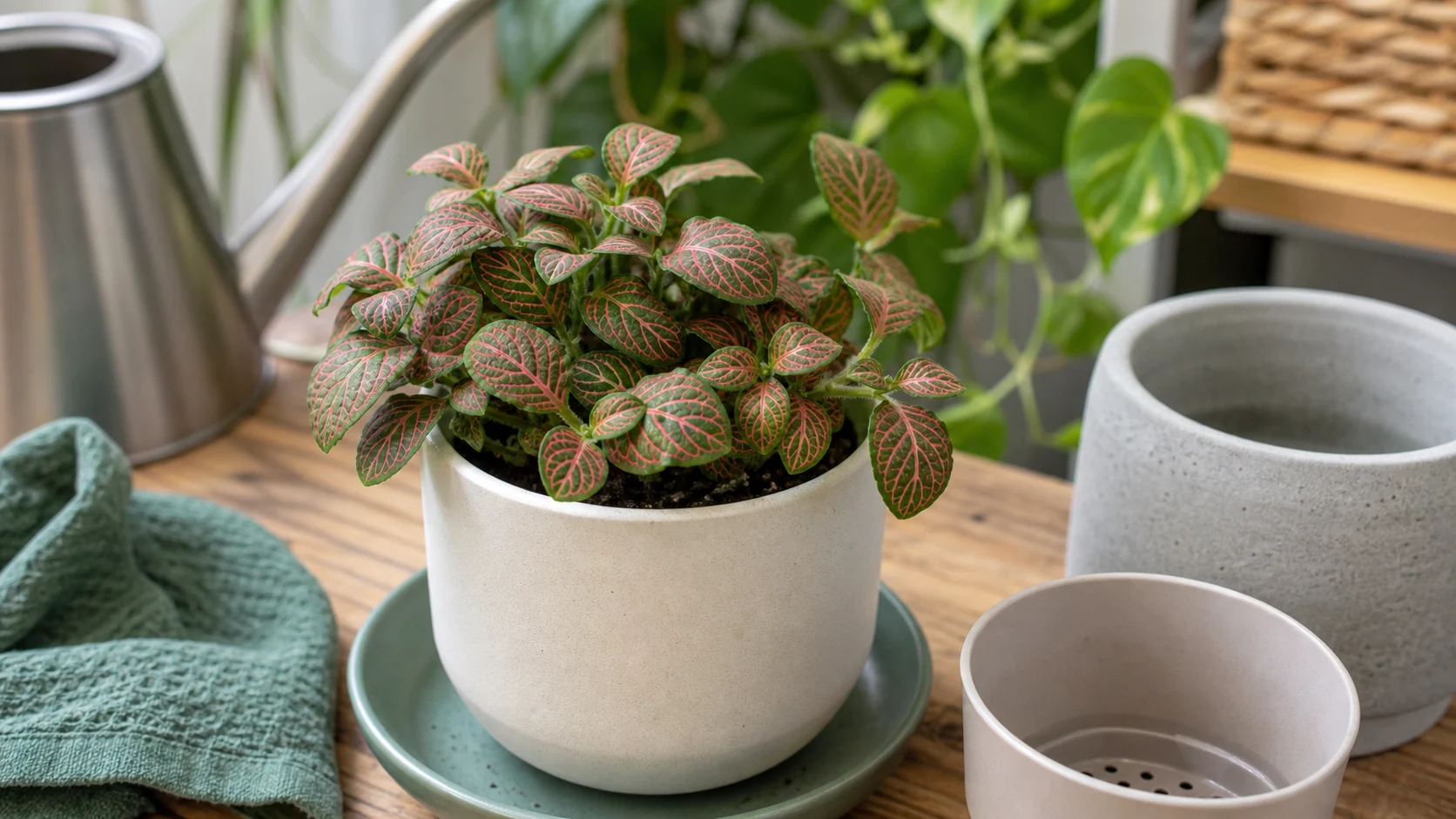
Check the container and drainage setup before treating every Fittonia wilt as thirst.
The common misdiagnosis: wilting means thirst. So owners water. The plant droops again a few days later. They water again. Eventually the roots are sitting in stagnant, poorly aerated soil, and the plant is declining for a completely different reason than it started.
The practical first check isn’t the watering schedule. It’s the container. Specifically: does your pot have drainage holes, and does water actually move through freely? A decorative cachepot with no drainage can hold standing water at the base while the top layer of soil looks and feels dry. The plant signals stress, the owner adds more water, and the real problem gets worse, not better.
Check the container before you change anything else.
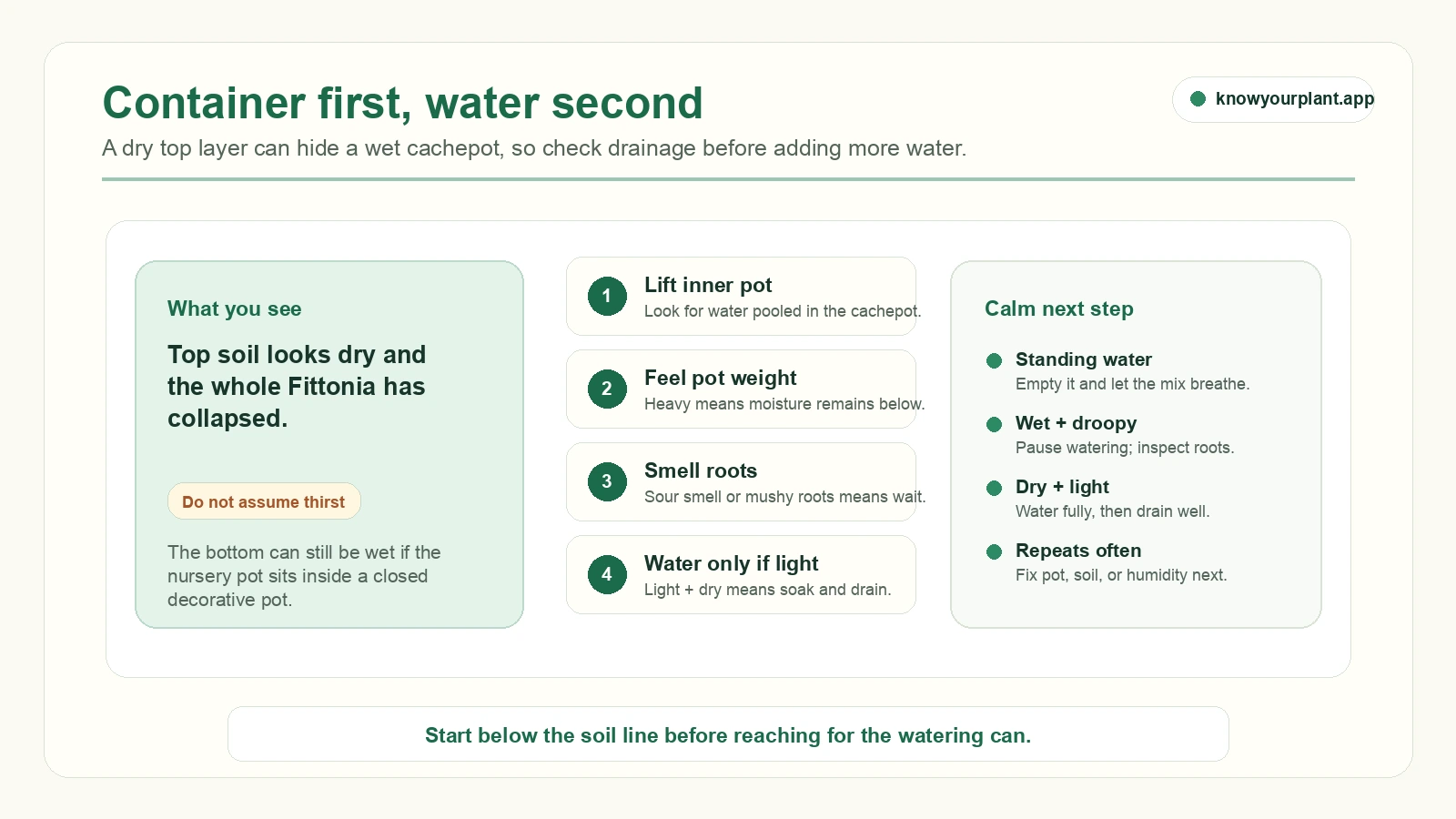
Check below the soil line before watering again. A dry-looking top layer can hide trapped water in a decorative cachepot.
Identification Snapshot
| Trait | What to look for |
|---|---|
| Botanical name | Fittonia albivenis, usually sold as nerve plant or mosaic plant |
| Growth habit | Low, creeping stems that spread outward instead of growing upright |
| Fastest stress signal | Dramatic drooping that can happen quickly when water, humidity, or roots are off |
| Best home setup | Bright indirect light, steady warmth, and a pot that drains freely |
| Pet safety | ASPCA lists nerve plant as non-toxic to cats, dogs, and horses |
Lookalikes and Confused With
| Plant or label | Why people confuse it with Fittonia | What matters for care |
|---|---|---|
| Polka dot plant (Hypoestes phyllostachya) | Similar small leaves and bright pink patterning | Polka dot plants usually grow more upright and are less dramatic about sudden wilt |
| Prayer plant relatives (Maranta or Calathea) | Tropical foliage, patterned leaves, humidity preference | Prayer plants usually have larger leaves and different watering rhythm, so Fittonia droop advice does not transfer perfectly |
| Generic “mosaic plant” label | Nurseries use the name loosely | Confirm the low creeping habit and clear vein network before following Fittonia-specific advice |
For another compact, textured foliage plant with a different watering rhythm, compare the Moon Valley pilea care guide.
Care Cards
| Care area | What works best | What usually goes wrong |
|---|---|---|
| Light | Bright to medium indirect light | Direct sun bleaches and crisps leaves, while deep shade dulls the vein color |
| Water | Keep the mix lightly moist, never swampy | Owners follow a fixed schedule and miss what the soil is actually doing |
| Humidity | 50-60% relative humidity is the comfort zone | Dry air gets mistaken for underwatering |
| Container | Nursery pot or inner pot with drainage holes | Decorative cachepots trap water and make wilt diagnosis harder |
| Soil | Indoor mix with extra aeration, such as perlite | Dense soil stays wet too long and stresses roots |
| Seasonal rhythm | More frequent checks in active growth, tighter humidity support in winter | Winter heating makes the plant droop even when the watering habit stayed the same |
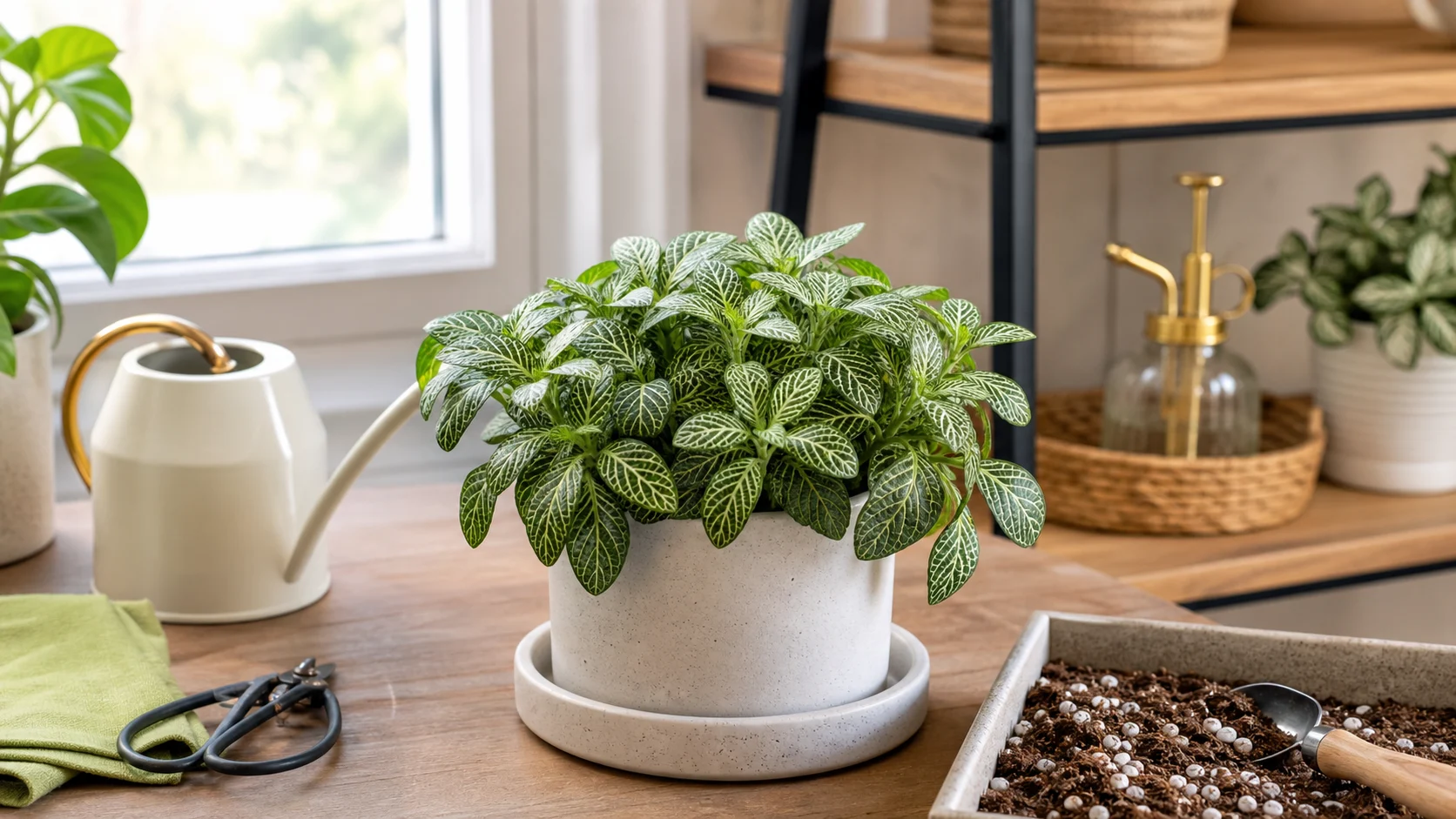
Bright indirect light, a draining pot, and an airy mix form the practical core of Fittonia care.
What Fittonia Actually Is
Fittonia albivenis is a creeping perennial native to the tropical rainforests of Peru and surrounding parts of South America, where it grows as dense ground cover beneath a forest canopy. It stays small – rarely reaching 15–30 cm in height – and spreads laterally. The defining feature is its intricate leaf venation: bright white, pink, or red veins against deep green leaves, which is where both “nerve plant” and “mosaic plant” come from.
In cultivation, it behaves exactly as its rainforest origins suggest: filtered light, consistent moisture, humid air, and warmth. It doesn’t forgive dry indoor air or direct sun, but it does forgive being moved and adjusted, which makes it a reasonable plant for someone willing to troubleshoot.
According to the North Carolina Extension Gardener Plant Toolbox, Fittonia is well-suited to terrariums and enclosed containers precisely because those environments replicate its native rainforest-floor microclimate: moderate light, stable humidity, no drafts.
Light: The Balance Is Narrower Than You’d Think
Fittonia wants bright to medium indirect light. A north or east-facing windowsill, or a few feet back from a south or west window, usually works well. The range is genuinely narrow:
- Too little light: growth slows to almost nothing; leaves lose color intensity and may look limp even when moisture is fine
- Direct sun for even part of the day: leaves scorch quickly, turning papery and pale at the edges
Think rainforest floor – bright overhead canopy filtered down to the surface. A sheer curtain between the plant and a sunny window is often all you need. If the leaves look washed out or bleached, move the plant farther from the light source before adjusting water.
Humidity: The Non-Negotiable
This is the part most guides mention but don’t emphasize enough. Fittonia comes from a genuinely humid environment, and it shows when indoor air is dry. Below about 40% humidity, Fittonia curls its leaves inward, develops brown tips, and eventually droops even when the soil moisture is completely fine.
In winter with central heating running, indoor humidity commonly drops to 20–30% in heated rooms. That’s well below what Fittonia can comfortably tolerate.
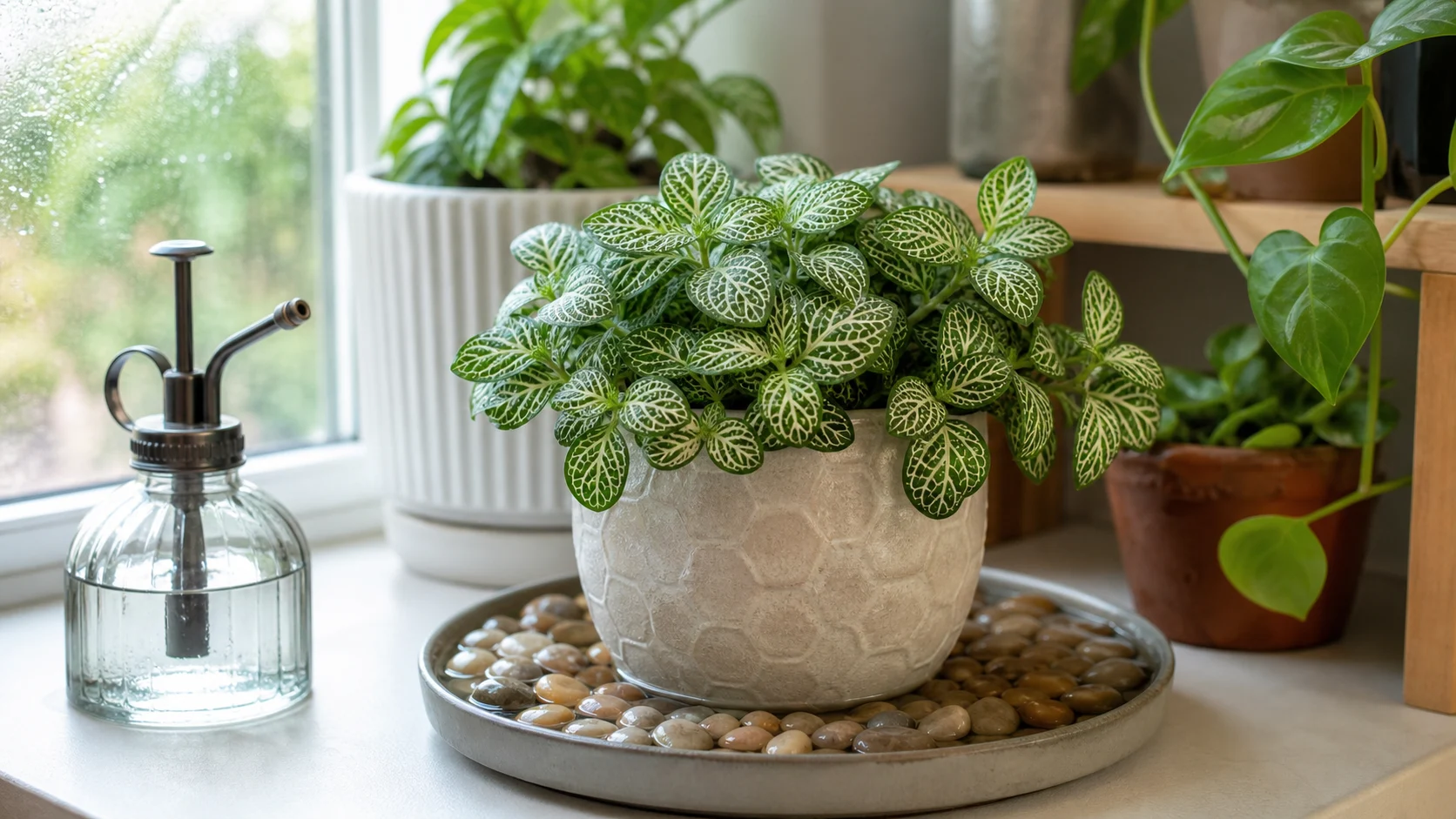
A pebble tray and nearby tropical plants can support a humid pocket around Fittonia without soaking its roots.
A consistent 50–60% relative humidity is where it’s comfortable. If you need a full breakdown of what actually raises humidity and what barely moves the needle, see humidity for houseplants indoors. Things that actually work:
- A pebble tray with water placed under (not touching) the pot: as the water evaporates, it raises humidity in the immediate air around the plant
- Grouping plants together: transpiration from multiple plants raises local humidity modestly
- A small ultrasonic humidifier nearby: the most reliable method for consistently dry rooms
- A closed or semi-closed terrarium: the most hands-off solution for humidity, covered in its own section below
Daily misting is often recommended but provides only a brief spike. If the room air is very dry, misting every morning won’t maintain the sustained humidity Fittonia needs. It’s a nice ritual, but don’t rely on it as your primary humidity strategy.
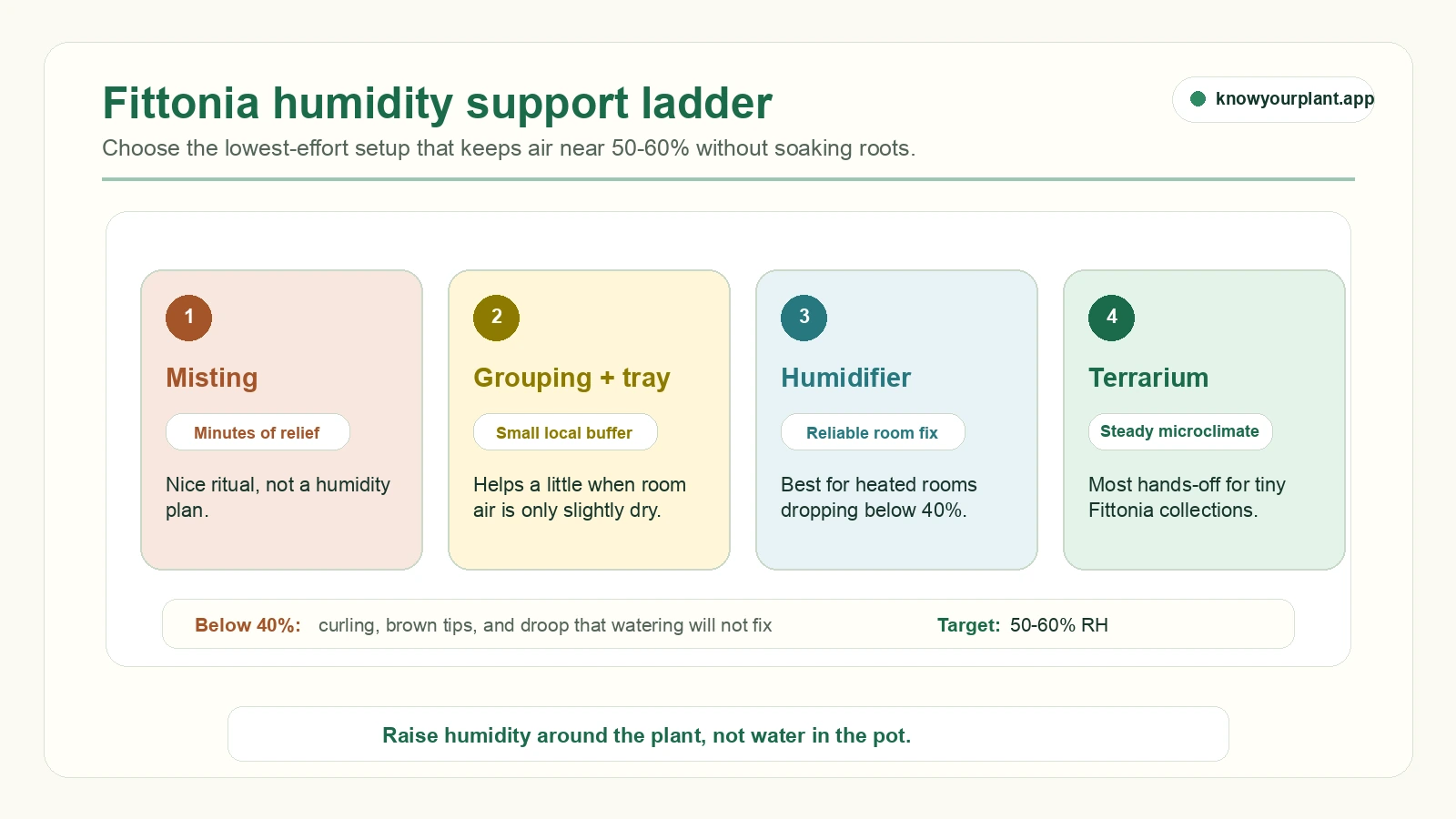
Raise the humidity around the plant, not water inside the pot. Fittonia usually wants a steady 50-60% humidity range.
Watering: What “Consistently Moist” Actually Means
“Keep the soil evenly moist” is standard advice and accurate, but “evenly moist” is easy to misread in both directions. Here’s what it means in practice:
Press your finger into the top 2 cm of soil. If it’s completely dry and pulling away from the pot edge, it’s time to water. If it still feels cool and barely damp, wait another day. Fittonia doesn’t want to dry out fully between waterings the way a succulent does, but it also doesn’t want to sit wet.
When you water, water thoroughly. Let water run out of the drainage holes and stop there. Don’t let the pot sit in water in a saucer. Empty the saucer after each watering.
Well-draining soil matters here. A standard indoor potting mix is usually fine, but if it stays soggy for more than a few days after watering, it’s holding too much moisture. Adding roughly 20–30% perlite by volume improves drainage and aeration without losing moisture retention entirely.
If you want a more forgiving setup with less swing between too-wet and too-dry, self-watering pots work well with Fittonia. The wick system keeps moisture consistent and removes the guesswork. How self-watering pots work for indoor plants has the details on setup.
The Container Problem: Most Guides Skip This
This is the diagnostic step that would have saved a lot of owners from making things worse.
A standard nursery pot with drainage holes lets excess water move through freely. A decorative cachepot – the attractive outer vessel with no drainage – traps water at the bottom. What you often end up with:
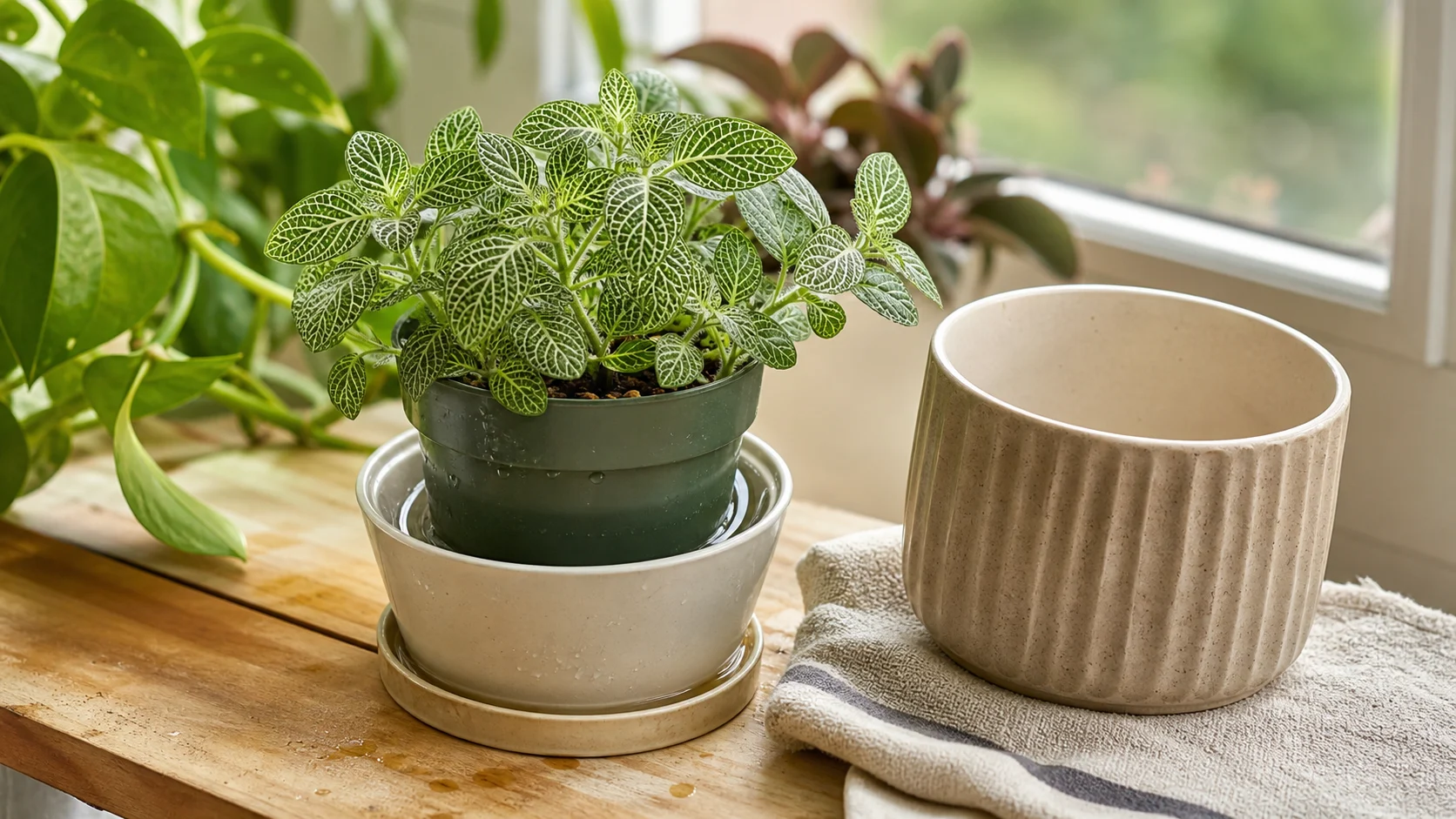
Lift the nursery pot out of its cachepot and check for standing water before adding more.
- The top inch of soil looks and feels dry
- The bottom of the pot has standing water
- Roots are stressed or beginning to rot
- The plant wilts repeatedly
- The owner adds more water, reading the dry top layer as thirst
Before assuming a wilting Fittonia needs water, lift it out of any decorative outer container and look at the base of the nursery pot. If it’s sitting in water, drain it and let it dry out partially before watering again. If the roots look brown, soft, or mushy rather than white and firm, you may be dealing with early root rot. Identifying and treating root rot has the next steps.
Why Fittonia Wilts: A Four-Step Triage
When your nerve plant collapses, run through these four checks in order. Don’t skip ahead, and don’t assume you already know the answer.
1. Soil moisture first. Press a finger into the top 2 cm of soil. Bone dry? Water thoroughly, let it drain completely, and observe for 30–60 minutes. Fittonia often recovers visibly fast when thirst is the real cause – sometimes within the hour. This is the early-warning advantage: if you catch it quickly, it bounces back with almost no lasting damage.
2. Drainage second. Does the pot have drainage holes? Is the base of the pot sitting in water? Check the cachepot situation. A plant that wilts repeatedly despite regular watering is often in stagnant conditions, not dry ones.
3. Humidity and drafts third. Is the plant near a heating vent, air conditioner, or frequently opened door? Dry-air wilting looks identical to thirst wilting and does not respond to watering. Pick up an inexpensive hygrometer and measure the room humidity. If it’s below 40%, address humidity before adjusting the watering schedule.
4. Light last. Is the plant in direct sun for part of the day? Direct afternoon light stresses Fittonia even through a window. If leaves look pale or papery, indirect light is the fix.
When watering stops fixing it: If your Fittonia used to bounce back within an hour of watering and now stays droopy even after thorough watering and drainage, the diagnosis has shifted. Persistent droop despite normal watering usually points to root stress, overwatering history, or a significant humidity deficit. Check the roots, then measure the humidity. If leaf yellowing or curling is also present, the guide to why plant leaves turn yellow covers the overlapping causes in detail.
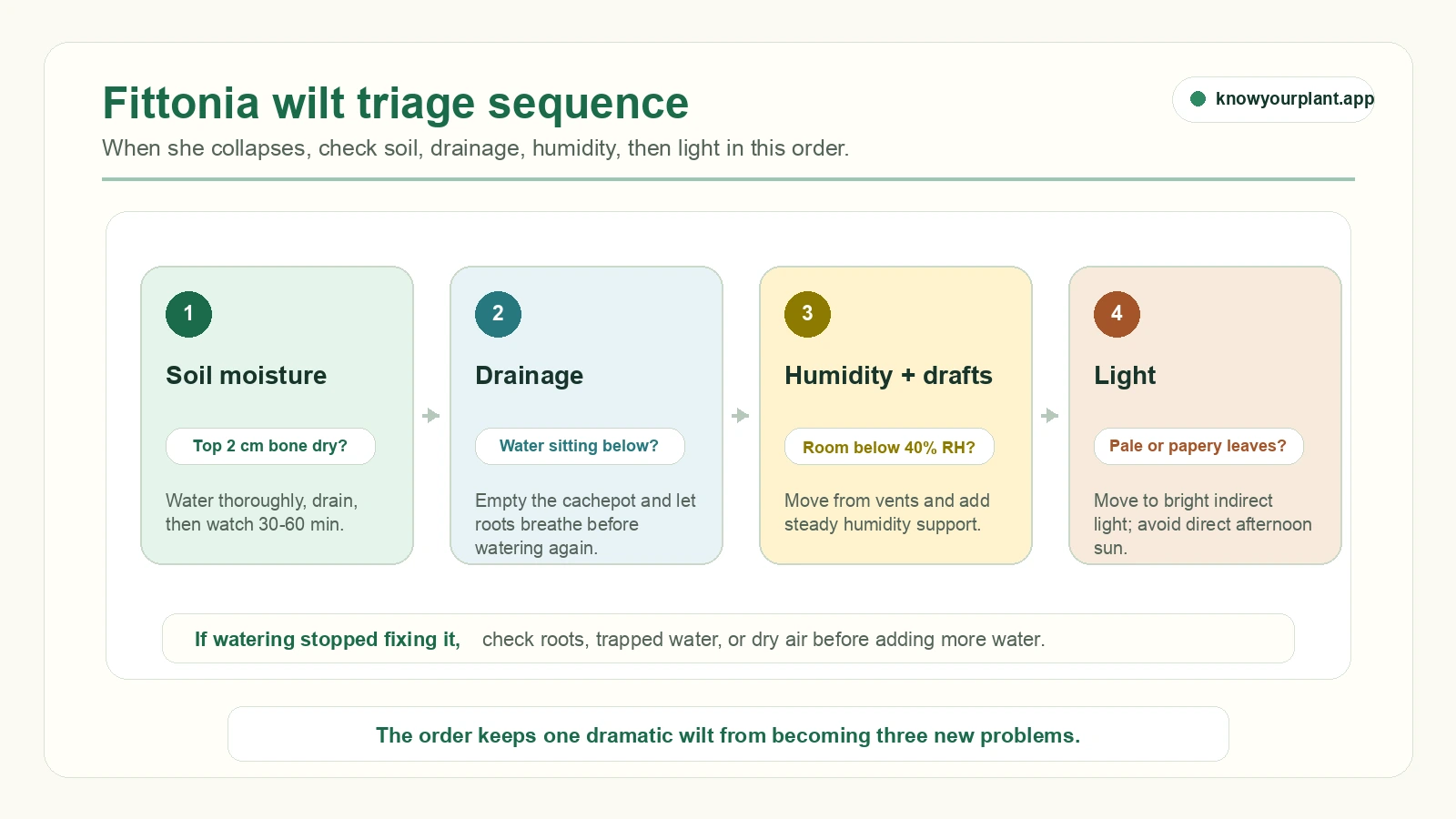
Use the triage order before changing the whole care routine. Soil, drainage, humidity, and light each leave different clues.
Common Problems: Reading What the Droop Means
Different kinds of wilting or leaf damage point to different causes. Here’s how to read the signals:
| Symptom | Most likely cause | First check |
|---|---|---|
| Sudden total collapse, soil dry | Thirst | Water thoroughly, observe 30–60 min |
| Persistent droop despite recent watering | Poor drainage or root stress | Check for standing water, inspect roots |
| Leaves curling inward, brown tips | Humidity too low or dry drafts | Measure room humidity, move away from vents |
| Pale or bleached leaf centers | Too much direct light | Move farther from window or add a sheer curtain |
| Yellow leaves, soft lower stem | Overwatering or root rot | Check drainage, inspect roots |
| Leggy growth, faded veins | Not enough light | Move closer to a bright indirect light source |
If you’re dealing with curling leaves alongside other symptoms, plant leaves curling: causes and fixes breaks down the humidity, watering, and pest overlap more thoroughly.
Terrariums: The Easier Path for Humidity
If you’ve been fighting Fittonia on a dry windowsill, a terrarium is worth serious consideration. It’s not just a decorative choice; it’s a fundamentally different growing environment that removes the humidity challenge almost entirely.
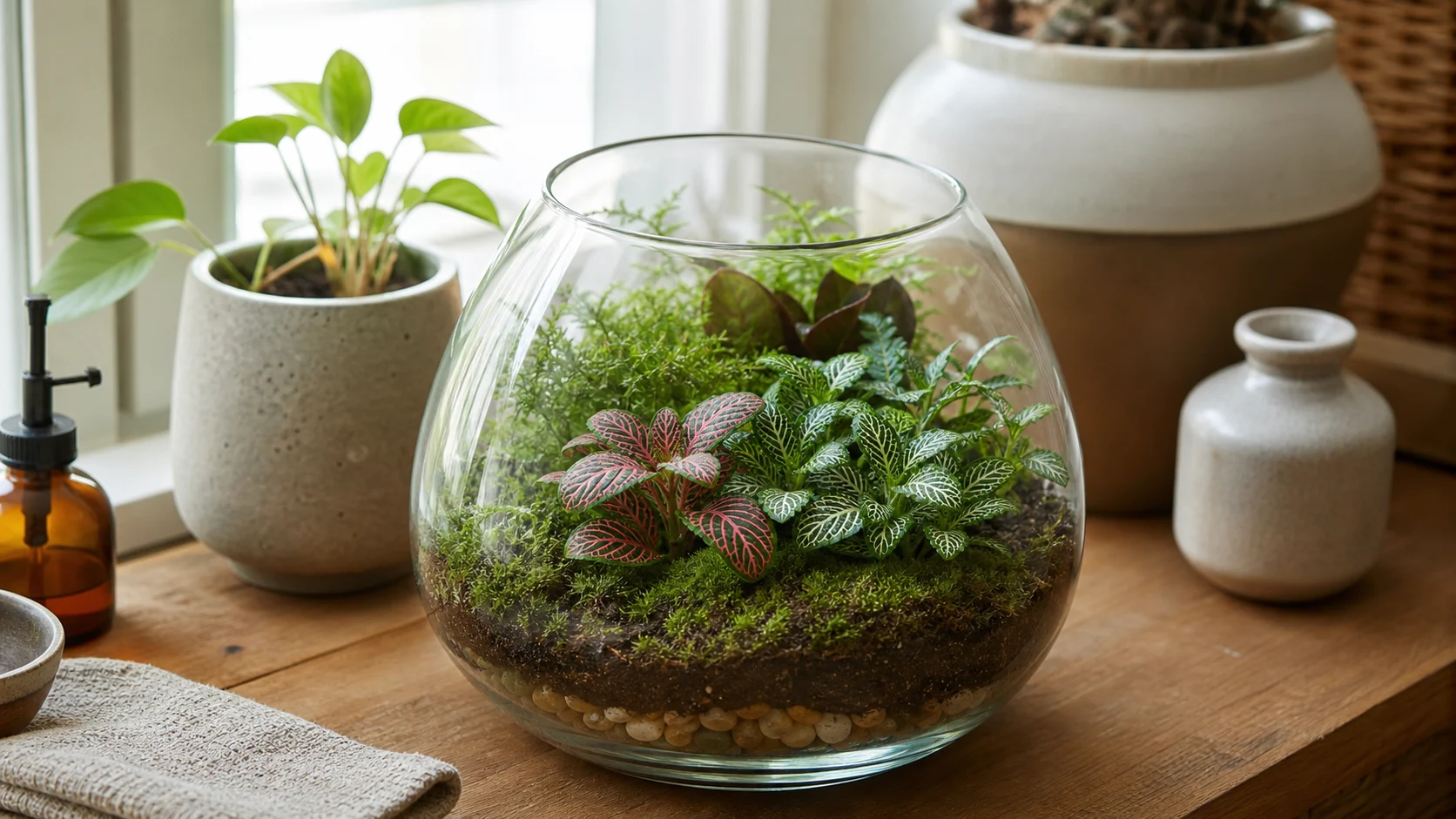
Layered soil and drainage beneath Fittonia turn a glass terrarium into a steadier humid microclimate.
In a closed or semi-closed terrarium, the moisture cycle of the plants maintains the air humidity automatically. You water less frequently because evaporation is minimal and the glass walls trap moisture. No humidifier. No misting. No checking the hygrometer every day.
Fittonia’s natural growth habit – low, creeping, small-leaved – makes it ideal for terrarium layering alongside other small tropicals. Its size stays manageable, and the vivid vein patterns stand out in a contained glass environment.
One practical note on terrarium setup: the container still needs adequate drainage at the base. A layer of horticultural charcoal and coarse gravel below the soil prevents stagnant conditions at the bottom even in an enclosed vessel. You’re not adding drainage holes; you’re building a drainage layer.
Pruning and Keeping the Shape
Fittonia gets leggy over time if you don’t pinch it back. When stems grow long and sparse, the plant loses its compact, full look and becomes harder to keep humidity-stable since the leaves are more spread out.
Pinching back stem tips by one-third every few weeks encourages branching and keeps the plant bushy. Use clean scissors and cut just above a leaf node. The trimmings are easy to propagate: place the cut end in a small amount of water or directly into moist soil, and new roots form within a few weeks. How to propagate plants covers this same basic approach across species if you want to try it with other houseplants too.
Pet Safety
If you share your space with cats, dogs, or horses, nerve plant is safe. The ASPCA lists Fittonia albivenis as non-toxic to dogs, cats, and horses on their Toxic and Non-Toxic Plants database. You don’t need to keep it out of reach for their sake. For a broader list if you’re furnishing a room with animals in mind, cat-safe indoor plants covers the full range of tropical options.
Seasonal Care Calendar
Fittonia’s care needs shift meaningfully through the year. Here’s what to watch for in each season.
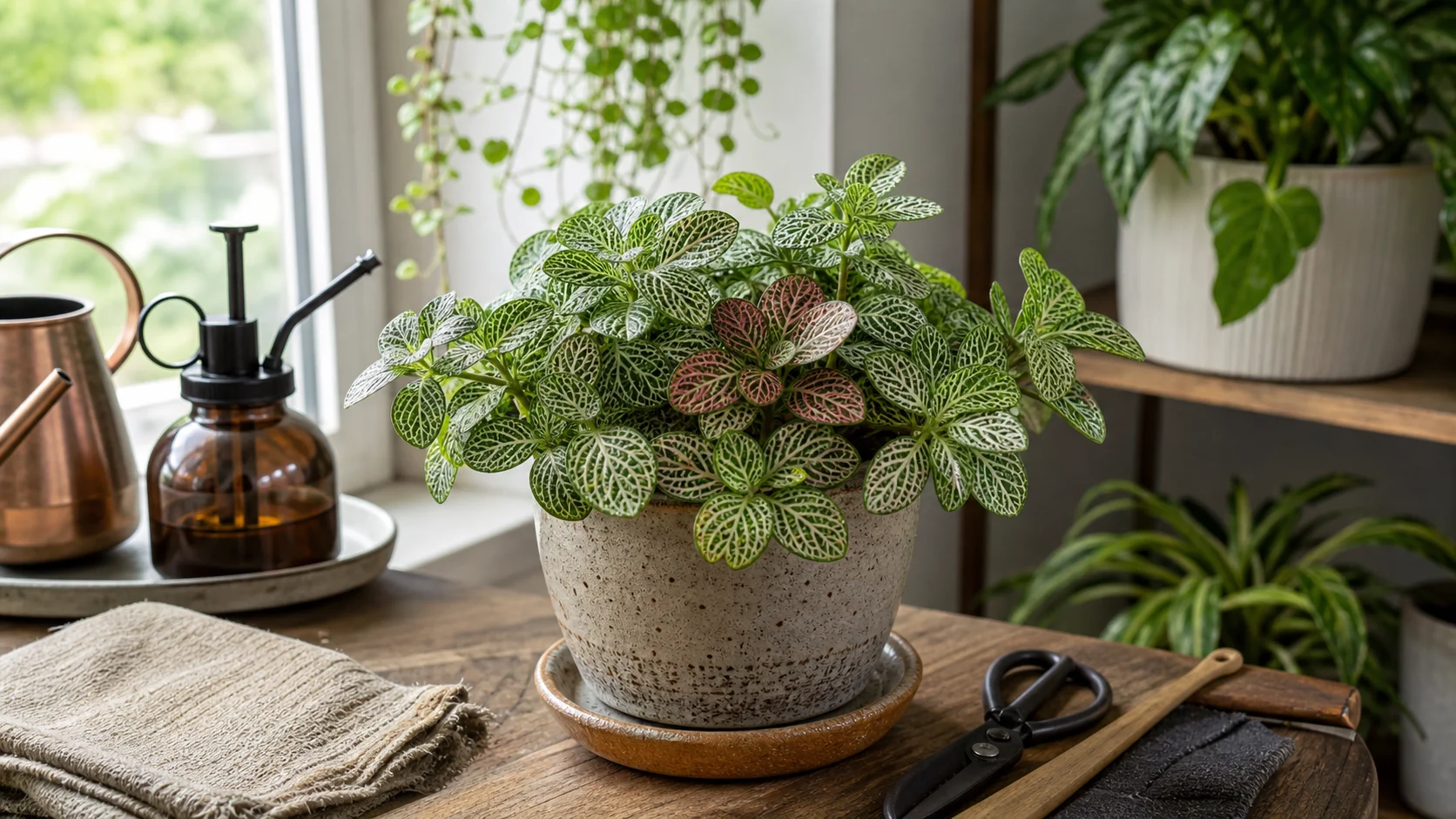
Match watering, feeding, and pruning checks to Fittonia’s changing growth pace through the year.
Spring (March–May): Growth picks back up and new leaves appear regularly. Increase watering frequency to match the faster moisture use. Begin fertilizing lightly every 4–6 weeks with a balanced liquid fertilizer diluted to half strength. This is a good time to propagate, since warm temperatures and longer days give cuttings a strong start.
Summer (June–August): Peak growth season. Water consistently and keep fertilizing every 4–6 weeks. Watch for drafts from fans and air conditioning; cool dry airflow is one of the main summer wilting triggers. If the plant is near a window, a sheer curtain becomes even more important as sun angles shift.
Autumn (September–November): Growth slows. Begin reducing fertilizer frequency, dropping to once every 8–10 weeks. Start monitoring humidity more carefully as heating systems begin to run. This is when the gap between indoor humidity and what Fittonia needs starts widening.
Winter (December–February): Lowest growth period. Stop fertilizing entirely or reduce to once in mid-winter if the plant is in a warm, bright spot. The main risk is indoor heating dropping humidity sharply; this is when most wilt complaints come in, and when owners often assume the problem is underwatering when it’s actually dry air. A humidifier during heating season often resolves what felt like a chronic watering problem.
Real User FAQ
Why does my nerve plant keep wilting even after I water it? Persistent wilt after watering usually means the problem isn’t thirst. Check the drainage first: is the pot sitting in water inside a cachepot? Check the roots: if they look brown and soft rather than white and firm, root rot has set in. Then check humidity: low humidity wilting looks identical to thirst wilting but doesn’t respond to water. Work through the four-step triage above before adding more water.
How often should I water a nerve plant? There’s no universal schedule because it depends on pot size, soil mix, room temperature, and humidity. The finger test is more reliable than a calendar: press into the top 2 cm of soil. Completely dry? Water thoroughly. Still cool and damp? Wait another day. In typical indoor conditions during warm months, that usually means watering every 3–5 days. In winter with the heat on, check more often because evaporation from leaves speeds up in dry air even as growth slows.
Can a nerve plant recover after completely collapsing? Yes. When the cause is thirst, Fittonia recovers surprisingly quickly. Water thoroughly, let it drain, and leave it somewhere sheltered. Many owners see the plant looking substantially better within an hour, and fully recovered within a day. If the collapse doesn’t reverse after watering, the cause is something other than thirst, and you’ll need to address drainage or humidity before it bounces back.
What humidity does a nerve plant need? A sustained 50–60% relative humidity is ideal. Below 40% and you’ll see curling leaves, brown tips, and eventual drooping that watering won’t fix. The most reliable way to maintain this in a dry home is a small ultrasonic humidifier placed nearby. Pebble trays and plant grouping help at the margins, but neither is enough on its own in genuinely dry rooms.
Is nerve plant safe for cats and dogs? Yes. The ASPCA lists Fittonia albivenis as non-toxic to cats, dogs, and horses. It’s one of the safer tropical houseplants to have around pets.
Why are my nerve plant’s leaves turning yellow? Yellow leaves on Fittonia most often point to overwatering or poor drainage: roots sitting in wet or stagnant soil lose their ability to absorb water properly, and the plant responds by shedding leaves. Less commonly, yellow leaves indicate insufficient light or a significant humidity deficit combined with stress. Check drainage and pot conditions first. If the base of the stem feels soft, that points toward root rot.
Is nerve plant good for terrariums? It’s one of the best houseplants for terrariums. Its small size, creeping growth habit, and demand for humidity are all perfectly suited to enclosed or semi-closed glass containers. Terrariums handle the humidity requirement automatically, which removes the main challenge of growing Fittonia in a typical indoor environment. Just make sure the container has a drainage layer at the base.
My nerve plant has brown, crispy leaf tips. What’s wrong? Crispy brown tips almost always point to low humidity or exposure to dry air from a heating vent, fan, or air conditioner. Leaf tip burn in Fittonia is an early humidity stress signal: the rest of the leaf still looks fine, but the edges are drying out faster than the plant can hydrate them. Move the plant away from any drafts, raise the humidity, and avoid direct airflow. Once tips are brown they won’t recover, but new growth coming in will be clean.
Methodology Note
This guide was refreshed on June 17, 2026 after reviewing live search-result ambiguity around the phrase “nerve plant,” checking real owner questions on Gardening Stack Exchange, and grounding care and pet-safety claims in North Carolina Extension, ASPCA, Garden Design, and Gardening Know How. Owner stories are used here as qualitative signal about common confusion, not as controlled trials.
Last updated: June 17, 2026. The most useful part of nerve plant care is not the ideal routine on paper, but the order of diagnosis when a dramatic wilt makes every problem look like thirst.
Fittonia asks a little more attention than average, but it gives clear signals when something’s off – which makes it easier to respond to than plants that quietly decline. The wilt is dramatic, but it’s informative. Start with the container, then the humidity, and you’ll have covered the most common causes before reaching for the watering can.
Keep track of your Fittonia’s care with KnowYourPlant: https://knowyourplant.app