You have watched a plant decline before. Maybe it was a slow yellow creep from the bottom up, or a sudden collapse after two weeks of getting the watering wrong. Maybe something like that is happening right now on your shelf.
Here is what most people do not know: the window to save a plant often closes before you realize it was open. A single healthy stem taken before things get worse can restart the whole thing in a glass of water within two weeks. You do not need a whole plant in perfect health to begin. You need one good stem. If the goal is to keep roots in water long term rather than transfer a cutting to soil, use the guide to houseplants that grow in water. If you are working with a trailing vine and want a plant-specific walkthrough, go straight to String of Hearts propagation, which covers butterfly method cuttings, tubers, and the mistakes that make vines rot before they root.
Propagation is usually taught as a reward for success: your pothos is thriving, you want more, you take cuttings. But that is not always why people do it. Often the reason is more urgent: a plant going leggy, a stem that snapped off, an expensive purchase you want to protect before something goes wrong. That context matters, because it changes what you do and when.
Below are five methods that consistently work, when each one applies, and the specific details that prevent the most common failures.
Freshness note: Reviewed in June 2026 against Iowa State, Missouri, and Virginia Cooperative Extension guidance, plus recurring community-reported propagation problems around missing nodes, stem rot in water, and transplant shock after rooting.
What Most Propagation Guides Miss
Most propagation guides explain the cut. They do not spend enough time on the choice that comes first: whether your plant has a usable node, whether division is safer than another cutting, and whether your home conditions can support the aftercare.
Before you start, check:
- Plant structure: trailing vines usually need a node, clump-forming plants are often better divided, and succulent leaves need the full leaf base intact.
- Growth stage: active growth usually roots faster than a stressed or dormant plant.
- Rot risk: if you have already lost cuttings to mushy stems, skip another jar of water and use an airy propagation mix instead.
- Aftercare: stable light, warmth, and a short observation window matter more than constant adjustments.
Expert note: Extension guidance from Iowa State, Missouri, and Virginia Tech all points to the same boring truth: healthy, actively growing tissue in a clean, airy rooting setup beats hacks, additives, and over-handling.
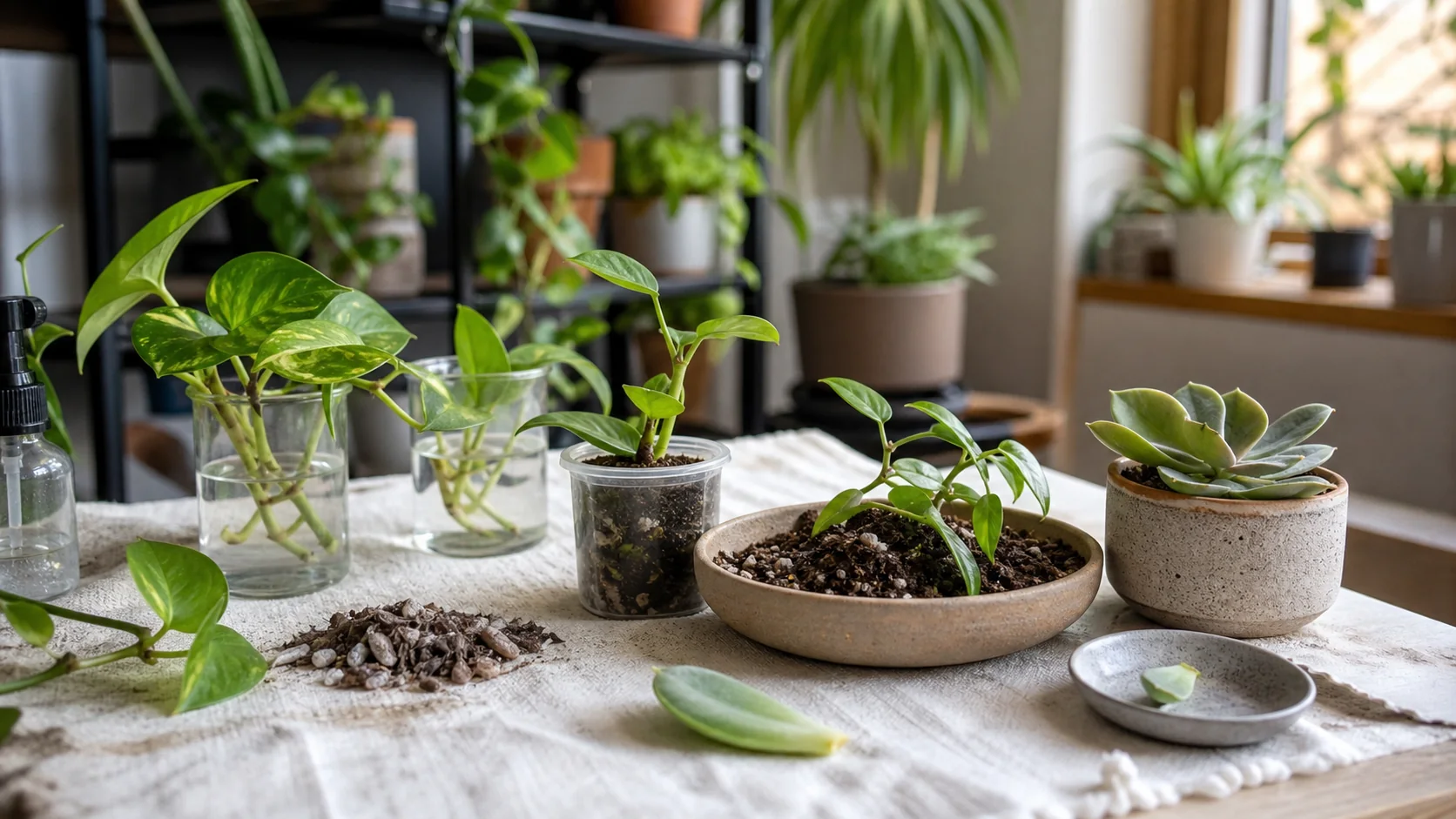
Compare plant structure and rot risk before choosing water, mix, division, or leaf propagation.
When to Propagate, Including When Things Are Going Wrong
Most guides assume you are starting from abundance. But the most useful moment to take a cutting is often when a plant is already showing signs of trouble.
Leggy or thinning plant: The stems are long, the gaps between leaves are wide, and the plant looks sparse compared to when you bought it. The stems themselves are often still healthy. Cutting the tips and rooting them is not giving up on the plant. It is the reset. You can pot the new cuttings back in alongside the original to restore fullness.
Declining but not dead: Yellow leaves spreading from the bottom, a limp stem that is not recovering, soil that stays wet longer than it should. If there are still firm, green stems above the problem area, take cuttings now. Waiting to see if the plant recovers on its own rarely works once the pattern has started.
Overwatered plant with healthy stems still showing: Root rot often kills the roots while leaving the upper stems intact. Cut the healthiest stems, let them form roots in water or fresh soil, and start again. The original plant may not survive; the cuttings can.
An expensive plant you are nervous about: One pot, one failure point. Taking a cutting while the plant is healthy does not hurt it. It gives you a second chance at no cost if something goes wrong with the original.
If the whole plant has collapsed with no firm tissue left anywhere, propagation will not save it. But in most partial-decline situations, there is still a cutting worth taking. Do not wait until you are certain the plant is dying before you act.
Which Method for Which Plant
The most common reason propagation fails before it even starts: using the wrong method for the plant. A succulent leaf will not root in water. A pothos node needs to be submerged, not just the stem tip. A rubber plant cutting left in a glass of water will sit there for months with nothing happening.
Match the method to the plant first, then follow the step-by-step.
| Plant | Best Method |
|---|---|
| Pothos (all varieties) | Water propagation or stem cuttings in soil |
| Heartleaf philodendron | Water propagation |
| Monstera adansonii | Stem cuttings in soil or water |
| Rubber plant | Air layering or stem cuttings in soil |
| Snake plant | Leaf cuttings in soil, or division |
| Succulents and echeveria | Leaf cuttings or offsets |
| Peace lily | Division |
| Calathea | Division |
| Spider plant | Offset division (pups) |
| Tradescantia | Water propagation |
| Hoya | Stem cuttings in soil |
| Begonia | Water propagation or leaf cuttings |
| Fiddle leaf fig | Air layering |
Identification Snapshot: What You Are Propagating
Use the plant’s structure, not just its name, to choose a method quickly.
| Plant shape or situation | What matters before you cut | Best first method |
|---|---|---|
| Trailing vine with visible nodes | You need at least one node for roots to emerge | Water propagation or stem cuttings in soil |
| Clump-forming plant with multiple crowns | Separate rooted sections instead of forcing a cutting | Division |
| Rosette or succulent with full leaf bases | The leaf base matters more than a stem section | Leaf cuttings or offsets |
| Thick cane or woody indoor plant | Rot risk is higher and rooting is slower | Stem cuttings in soil or air layering |
| Expensive plant you cannot afford to lose | Keep the stem attached while roots form | Air layering |
Propagation Method Chooser
- You can see a node on a soft stem. Start with water propagation or stem cuttings in mix.
- The plant already has separate rooted sections. Divide it instead of taking extra cuttings.
- You only have a healthy leaf base to work with. Use leaf propagation, not a jar of water.
- The stem is thick, woody, or high-value. Choose air layering or a soil-based cutting, not a long water trial.
- You keep losing cuttings to rot. Move from water to an airy propagation mix or perlite and reduce leaf mass.
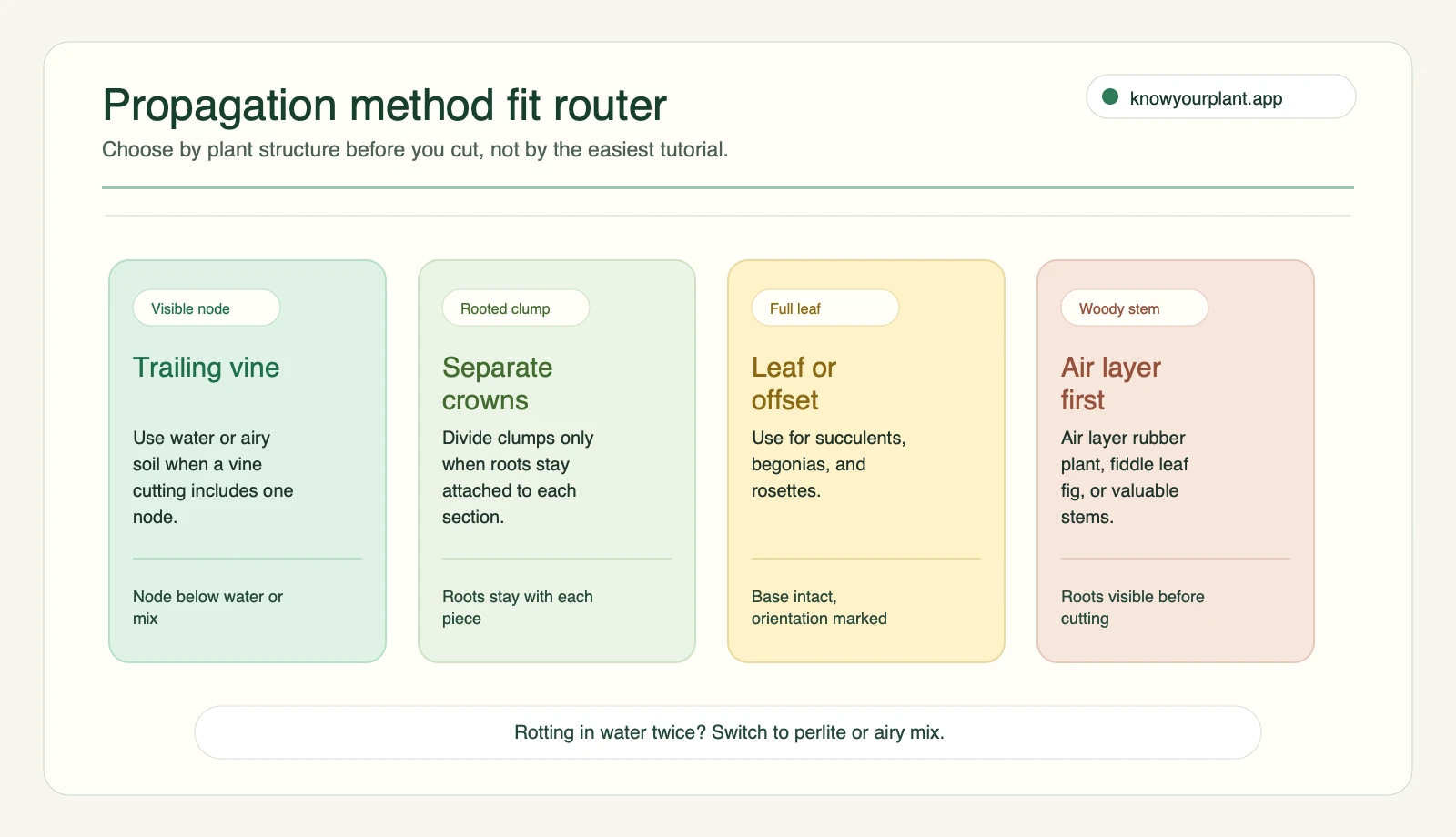
Use the router before making a cut so the method matches the plant structure, not just the easiest tutorial.
Commonly Confused-With Cases
| If you have… | It is often confused with… | What to do instead |
|---|---|---|
| A pothos leaf on a bare stem tip | A viable pothos cutting | Make sure at least one node is included before rooting |
| A Monstera leaf and petiole only | A full propagation segment | Look for the node or aerial-root bump, not just the leaf |
| A snake plant section turned upside down | A normal leaf cutting | Keep top and bottom orientation correct before planting |
| A rubber plant cutting in water for weeks | A slow but normal rooting pattern | Switch to soil or air layering if nothing is happening |
| A leggy clumping plant | A plant that needs more fertilizer first | Divide or reset healthy sections before decline spreads |
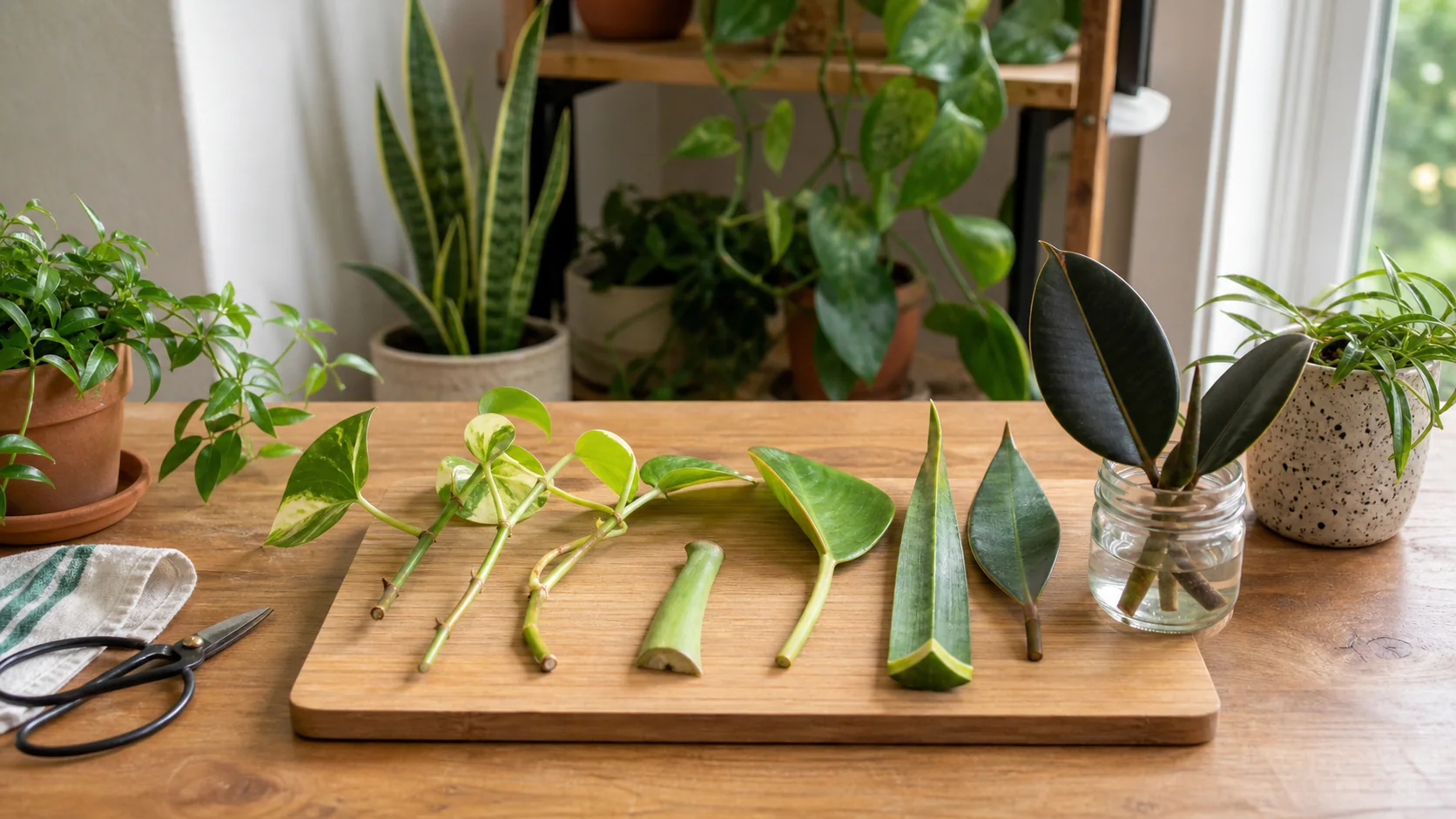
Nodes, orientation, and plant structure determine whether a cutting can produce roots.
Method 1: Water Propagation
The best starting point for most people. Cut a stem, place it in a jar of water, and watch roots appear over the next few weeks. It is slow enough to feel rewarding, fast enough to not forget about.
Works well for: pothos, philodendron, tradescantia, begonia, impatiens, most soft-stemmed tropicals.
If you are propagating a pothos and want to know which variety you have, that can matter here. Some trailing varieties like Marble Queen root a little more slowly than Golden or Neon. The pothos varieties guide can help if you are unsure what you are working with, and the propagate pothos guide walks through node placement and transfer timing in more detail.
How to do it
- Take a stem cutting 10-15cm long with at least one node, the bumpy joint where leaves attach and where roots will emerge.
- Remove any leaves that would sit below the waterline. Submerged leaves rot and cloud the water within days.
- Place the cutting in a clean glass or jar, in a bright spot away from direct sun.
- Change the water every 5-7 days to keep oxygen levels up and slow bacterial growth.
Roots usually appear within 2-4 weeks. When they are 3-5cm long (roughly thumb-tip to first knuckle), move the cutting to soil.
One thing most guides skip: do not wait too long to pot it up. Water roots are structurally different from soil roots. According to University of California Cooperative Extension research on cutting propagation, water-rooted cuttings that stay too long in water develop a thinner root structure that struggles to take up nutrients once transferred to soil. The longer a cutting lives in water, the harder the transition becomes. Move it while the roots are still young and flexible.
What to expect, week by week
If you have never propagated in water before, the first week of silence can feel worrying. Here is what is actually happening:
Week 1: Nothing visible, and that is completely normal. The cutting is sealing the cut end and beginning to redirect energy toward root production. Keep the water changed. Do not move the jar.
Week 2: Tiny white bumps or nubs may appear at the node. These are root initials: the plant has committed to producing roots. The cutting is not dying; it is building.
Week 3: Roots are now visible, anywhere from a few millimetres to a centimetre. The cutting may also start pushing a new leaf at the top. Both happening together is a good sign.
Week 4: Roots are 2-5cm long. This is the ideal transfer window. Pot up into slightly damp soil, keep it out of direct sun for a week, and water lightly to help the roots adjust.
If week four passes with nothing: check that the node is actually submerged (not just the stem tip), change the water, move the jar to a brighter spot, and give it two more weeks before giving up.
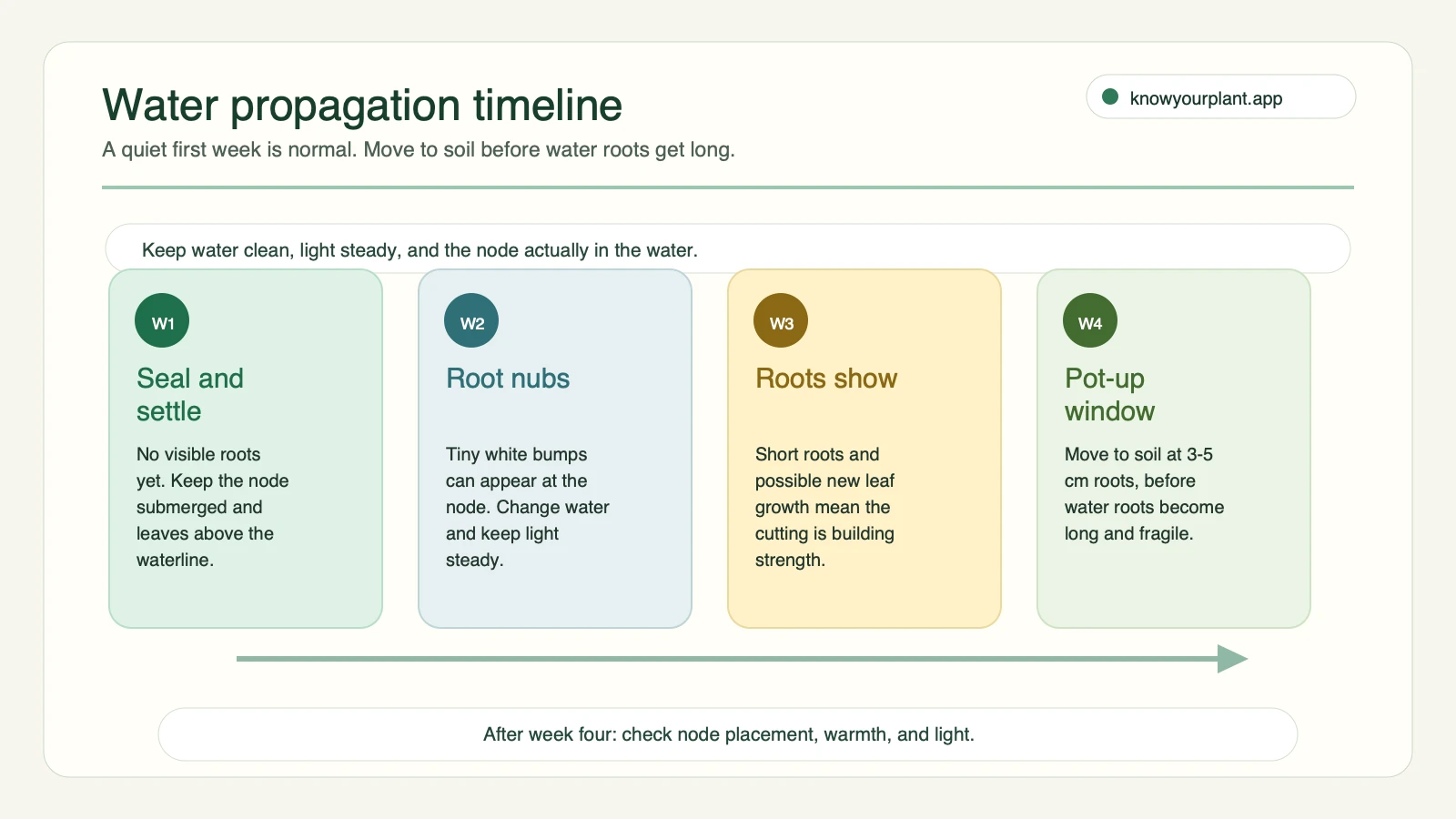
The timeline keeps the quiet first week from feeling like failure and shows when roots are ready to leave water.
Method 2: Stem Cuttings in Soil
More commitment upfront, but the roots that form are already adapted to soil, which means less transplant stress later. This is also the method to use when you are taking cuttings from a plant that is declining: soil cuttings do not require the plant to have been recently watered or particularly healthy, as long as the stem itself is firm.
Works well for: monstera, pothos, heartleaf philodendron, rubber plant, hoya, most woody-stemmed houseplants.
How to do it
- Take a cutting with 1-2 nodes and at least one healthy leaf.
- Let the cut end sit out for 30-60 minutes until it forms a slight skin. This step reduces rot risk.
- Dip the cut end in rooting hormone powder if you have it. NC State Extension notes that cuttings treated with IBA-based rooting hormone can root two to three times faster than untreated cuttings in many common houseplant species. It is worth keeping a small jar on hand.
- Push the node end into damp potting mix or perlite, about 2-3cm deep.
- Cover loosely with a clear plastic bag, or place the pot near other plants to hold humidity around the leaves.
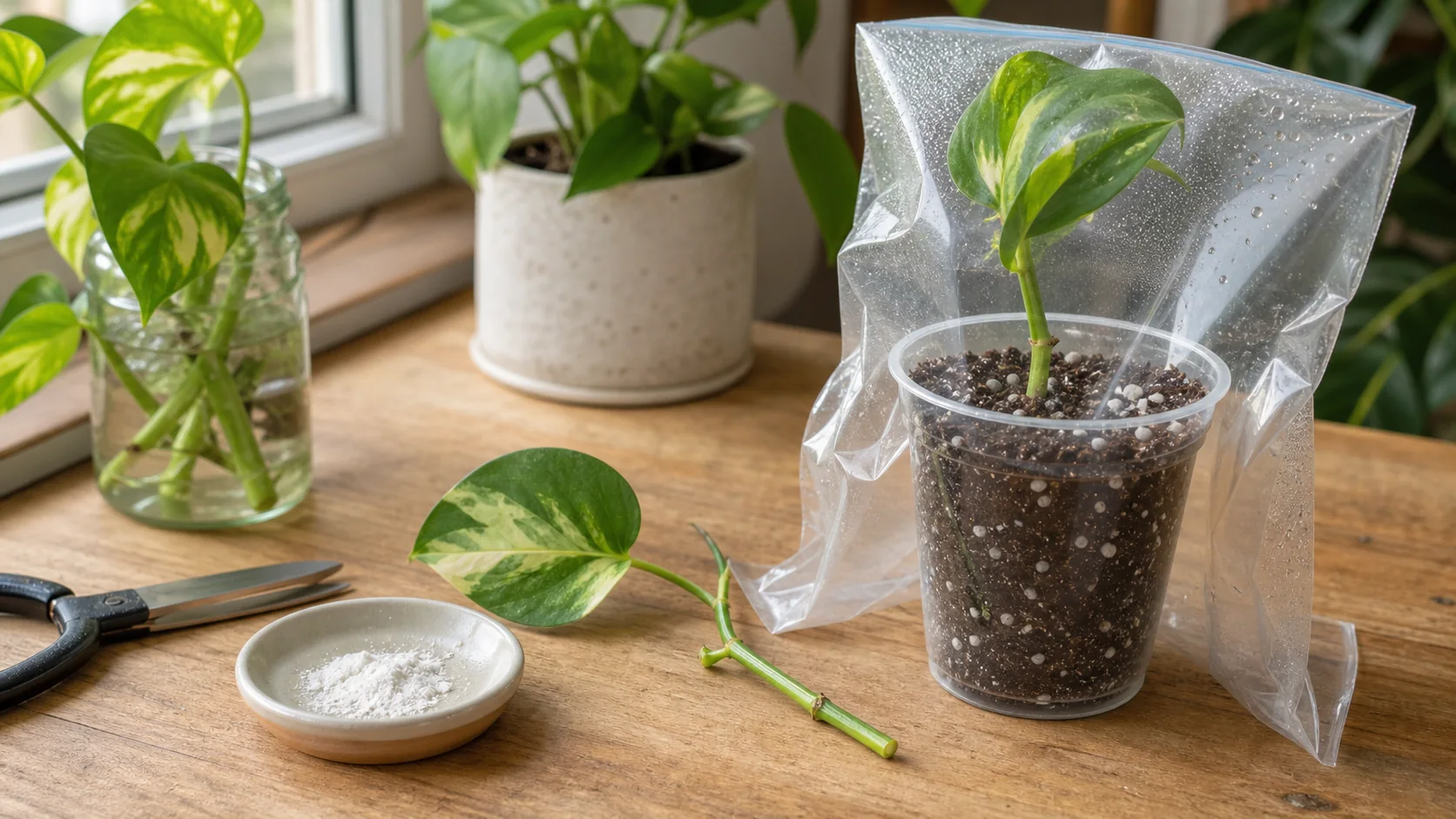
An airy mix, a buried node, and gentle humidity give soil cuttings a practical start.
Do not water again until the top layer of mix is dry. Too much moisture before roots form invites rot.
Check for roots in 3-4 weeks by giving a very gentle tug. If there is resistance, roots are forming. If the cutting pulls out easily, give it more time and resist the urge to check again for another week.
As Darryl Cheng of House Plant Journal puts it: “The goal with any cutting is to reduce the energy demands on the plant while it redirects resources to root production.” That is why you remove extra leaves, cover the cutting to hold humidity, and hold off on fertilizer entirely until new growth appears.
Method 3: Division
The simplest method if you have a plant that already grows as a clump. No cutting, no rooting hormone, just separating what is already there. Division is also the right move if a clump-forming plant has been struggling: separating an overcrowded root mass often gives each half better access to water and soil nutrients.
Works well for: peace lily, calathea, snake plant, spider plant offsets, cast iron plant.
How to do it
- Unpot the whole plant and shake off most of the soil.
- Find where natural divisions are. Look for separate stems with their own root systems attached.
- Pull or cut the sections apart gently. If you use a knife, let the cut surface dry for 30 minutes before repotting.
- Plant each section in its own pot with fresh soil.
Both halves may droop for a few days. They are recovering from the shock of separation. Keep them out of direct sun and hold off on fertilizer for a month while the root systems settle in.
Method 4: Leaf Cuttings
This works differently from stem cuttings. A single detached leaf produces an entirely new plant from the base, no stem attached. It is a useful rescue method for rosette-forming plants where the stems themselves are damaged but the individual leaves are still healthy.
Works well for: snake plant, echeveria, sedum, begonia rex, and other rosette-forming succulents.
For succulents and echeveria
The University of Florida IFAS Extension notes that succulent leaf cuttings root most reliably when taken from actively growing stems during spring or early summer, when auxin levels in the plant are naturally at their highest. A healthy, plump leaf taken in March will outperform the same leaf taken in January when the plant is resting. If you are working with mixed succulent types and want the baseline care right after rooting, the succulent care guide is the best companion piece.
- Twist or pull a healthy leaf cleanly from the stem. It needs to come off whole, including the base where it meets the stem. A torn base will not root.
- Let it sit on dry soil or a tray for a day or two until the end calluses slightly.
- Lay it on top of dry succulent potting mix. Do not bury it.
- Mist lightly every few days. Within a few weeks, tiny roots form at the base, then a small rosette appears.
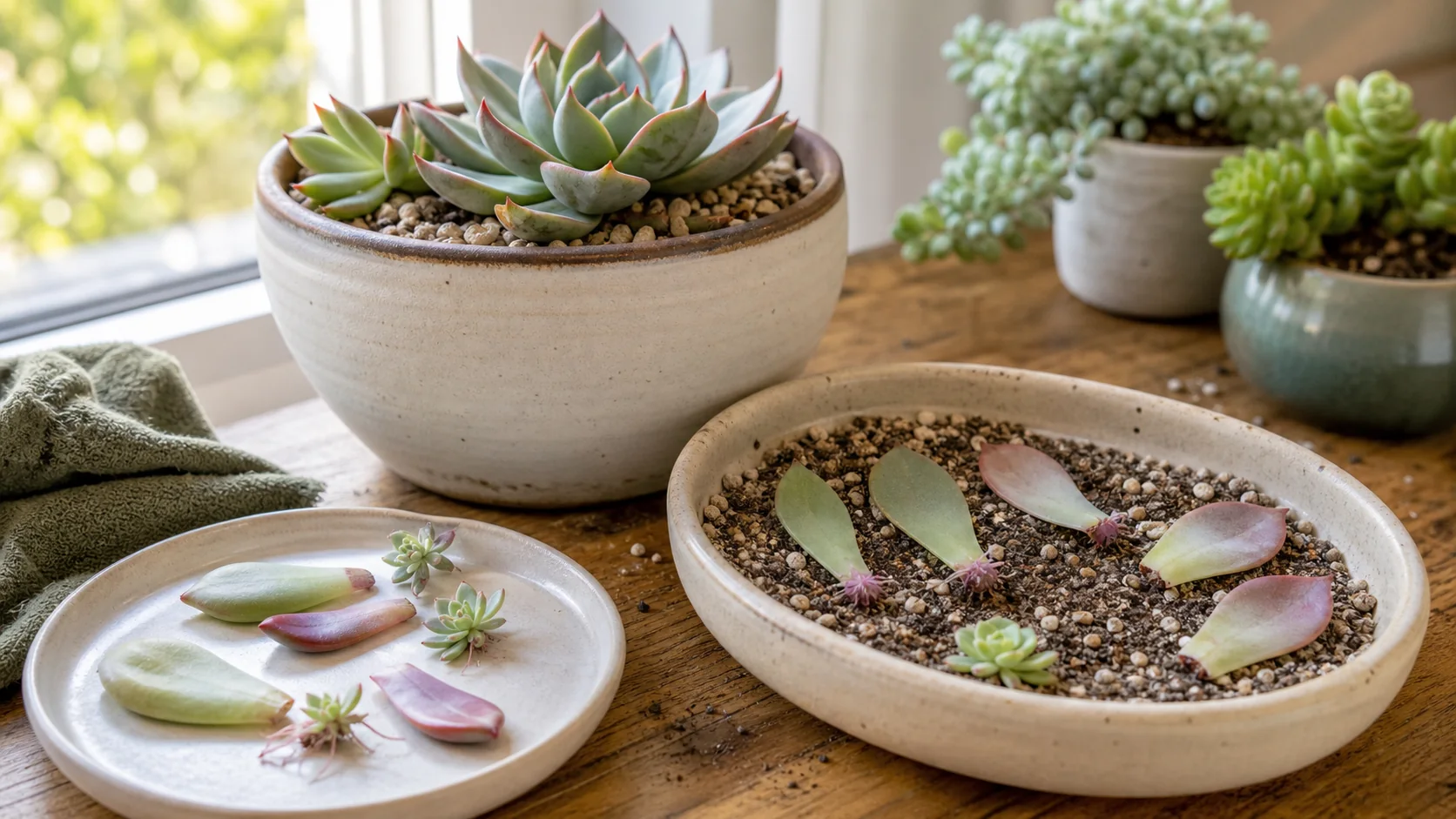
Whole leaves progress from callused bases to roots and tiny rosettes on dry gritty mix.
The original leaf will eventually shrivel as the new plant draws on its stored energy. This is normal. Do not remove it until it comes away on its own.
For snake plant
Cut a leaf into 5-7cm sections. Keep careful track of which end was pointing up, because direction matters. Sections planted upside down will not root. Push each piece about 2cm into damp soil with the correct end down.
Method 5: Air Layering
The slowest method, and the most reliable for plants that do not root easily from cuttings, especially larger woody specimens you would rather not cut down to a stump. It is also the right choice when you want to propagate a rubber plant or fiddle leaf fig without removing material and risking the whole plant. For the full ficus-specific walkthrough, the fiddle leaf fig pruning guide covers when air layering makes more sense than a straight top cut.
Works well for: rubber plant, fiddle leaf fig, dracaena, large monstera stems.
How to do it
- Find a healthy section of stem below a node. Make a small upward-angled cut about one-third through the stem, or remove a 3cm ring of bark from the surface.
- Pack the wounded area with damp sphagnum moss, enough to cover it completely.
- Wrap the moss tightly in clear plastic wrap, sealed at both ends with tape or twist ties so no moisture escapes.
- Wait 4-8 weeks. Through the plastic, you will see white roots forming and growing into the moss.
- Once roots are visible and filling the moss, cut the stem just below the rooted section and pot it up.
Keep the plastic sealed the whole time. The moss stays damp from the plant’s own moisture. You do not need to open it to add water. Resist the urge to check by unwrapping it.
Care Cards by Propagation Method
| Method | Best for | Setup that gives it the best chance | Ready to move on when… | Biggest watch-out |
|---|---|---|---|---|
| Water stem cuttings | Pothos, philodendron, tradescantia | Bright indirect light, clean water, node submerged, leaves above water | Roots are 3-5cm long and the cutting still feels firm | Letting leaves sit below the waterline or waiting too long to pot up |
| Stem cuttings in soil or perlite | Monstera, hoya, rubber plant, rescue cuttings | Airy mix, gentle humidity, warm room, no soggy pot | A light tug meets resistance and new growth starts | Overwatering before roots form |
| Division | Peace lily, calathea, spider plant, snake plant clumps | Separate rooted sections cleanly and use small pots | The divisions stop drooping and push new growth | Tearing off sections with too few roots attached |
| Leaf cuttings | Snake plant, succulents, begonias | Correct orientation, callused cut edge, bright filtered light | New plantlets or roots emerge from the base | Burying the leaf too deep or misting constantly |
| Air layering | Fiddle leaf fig, rubber plant, large canes | Damp moss, sealed wrap, patience, warm steady light | Roots visibly fill the moss ball | Opening the wrap too often or cutting before enough roots form |
Common Problems and Fast Fixes
| Symptom | Most likely cause | Next move |
|---|---|---|
| Stem end turns brown or mushy in water | Rot from stale water, too much leaf mass, or a weak cutting | Recut above the damage, refresh the jar, and remove extra leaves |
| No roots after several weeks | No node, low light, or cold conditions | Confirm the node is included and move the cutting somewhere warmer and brighter |
| Cutting wilts right after potting up | Water roots stayed in water too long or the soil dried too fast | Pot up earlier next time and keep the mix evenly moist for the first two weeks |
| Soil cutting blackens at the base | Mix stayed too wet or the cutting was buried too deep | Restart with a shallower cut and a looser propagation mix |
| Division droops for a week or more | Too few roots came with the section or the light is too harsh | Move it to bright indirect light and reduce handling while it settles |
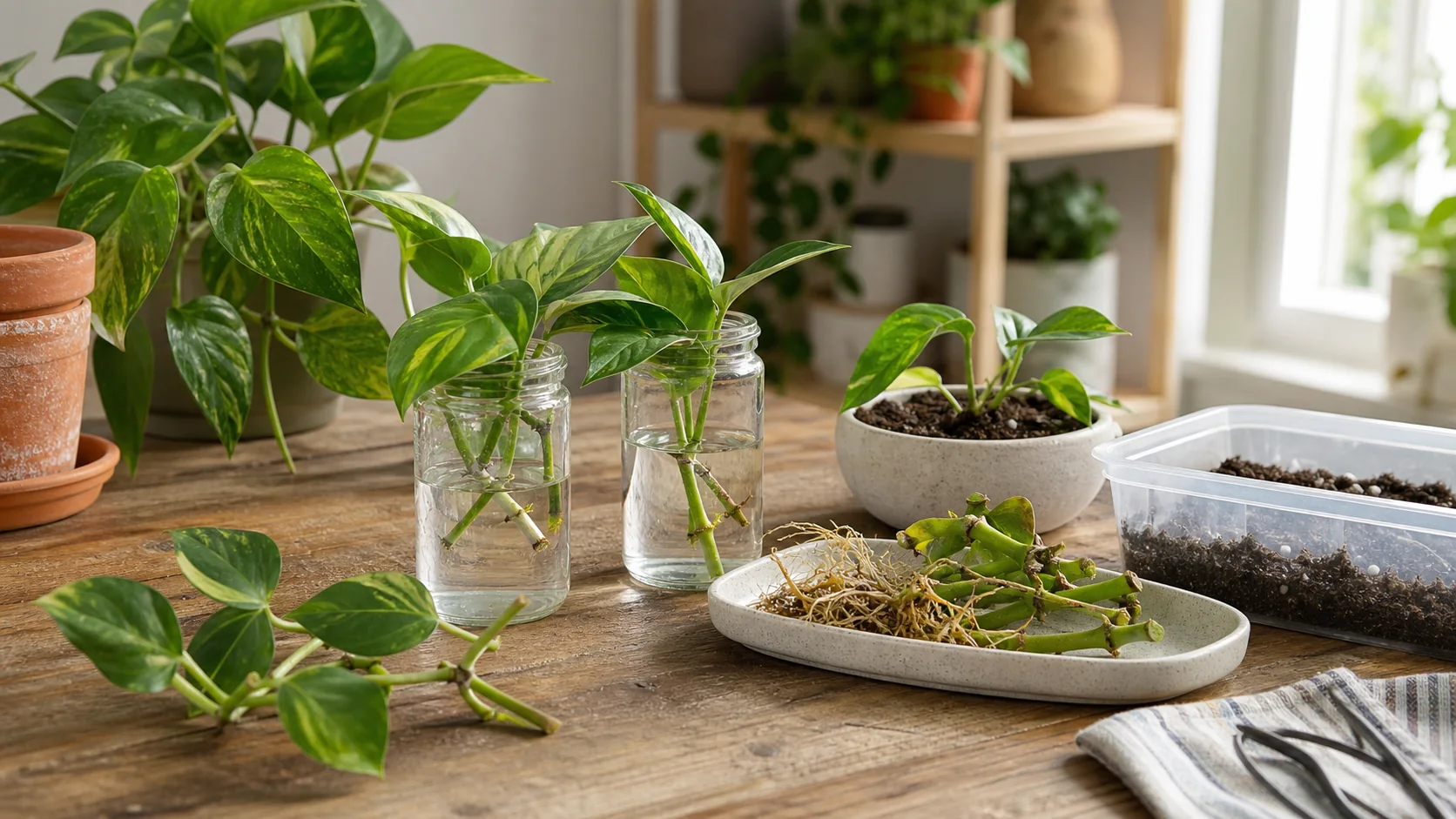
Refresh failing water setups, keep viable nodes and roots, then move strong cuttings into airy mix.
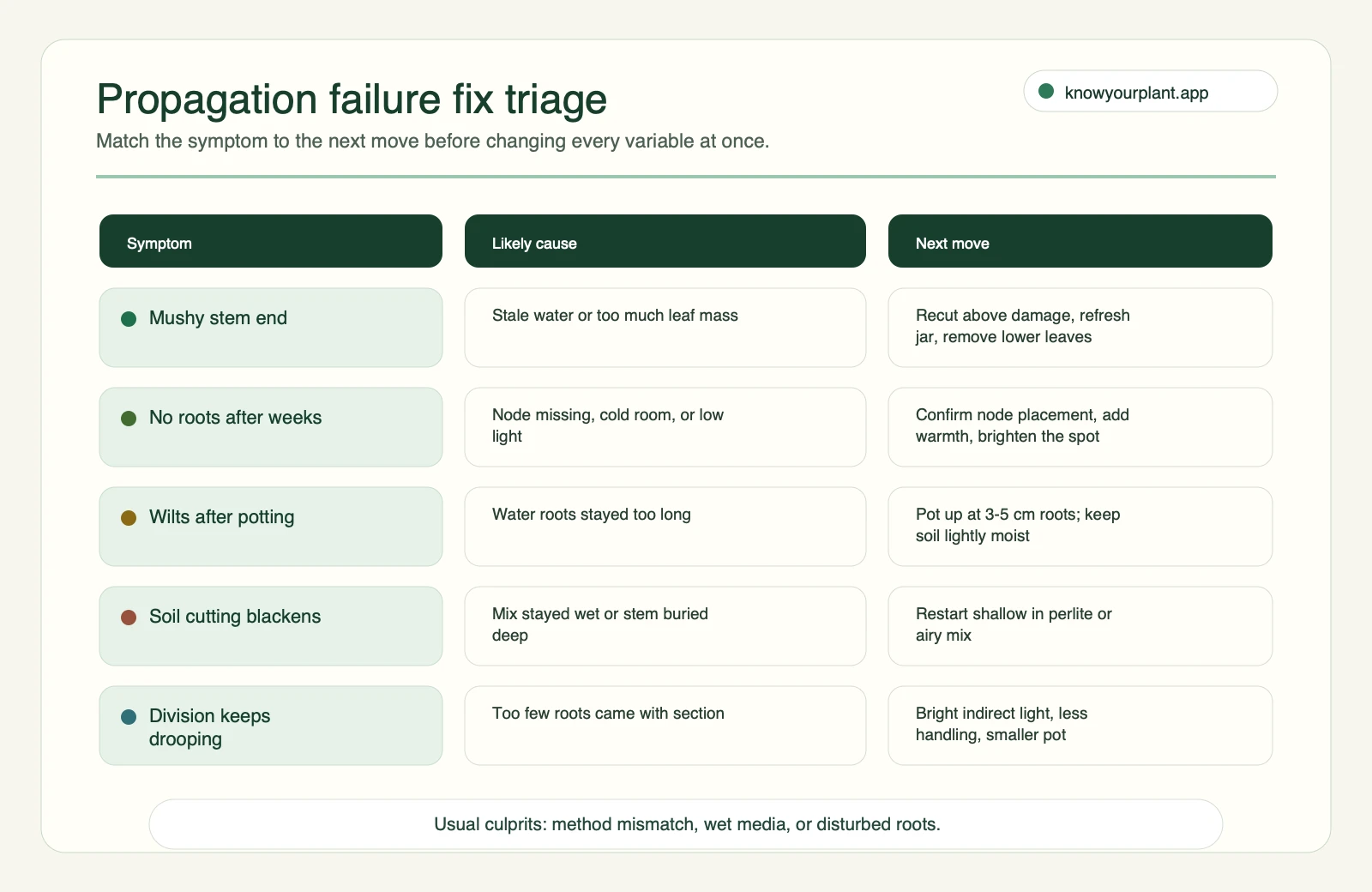
Use this triage before changing water, soil, light, and timing all at once.
Common Mistakes
- Taking a leaf or stem tip without a node and expecting it to root like a pothos cutting.
- Leaving water-rooted cuttings in jars until they grow long, fragile roots that struggle in soil.
- Propagating tissue that is already mushy instead of cutting back to clean, firm growth first.
- Potting new cuttings into a large, wet container instead of a small airy setup.
- Tugging on cuttings every few days to “check” whether roots are there yet.
Seasonal Timing: When Propagation Works Best
Most houseplants propagate most successfully in spring and early summer. That is when stems have the highest concentration of growth hormones and the plant is actively pushing energy into new growth. A cutting taken in April will root faster and more reliably than the same cutting taken in November.
Winter propagation is not impossible. It just means more patience. It helps to keep the cutting somewhere warm, around 20-24C, to compensate for lower light levels. A heat mat under the pot makes a real difference during colder months.
If your plant is declining and it is winter, do not wait for spring to take cuttings. A slow-rooting cutting taken now is better than no cutting if the original plant continues to deteriorate. Adjust expectations, keep the cutting somewhere warm, and give it extra time.
The Most Common Reason Propagation Fails
Too much water, too little patience.
Most cuttings rot because they are kept too wet before roots form, or because they get disturbed before those roots are established. The cutting looks healthy on the outside while failing underneath.
The fix is simple: keep the medium just barely damp, not wet. And resist the urge to check every few days by pulling the cutting up. Roots need undisturbed time to anchor.
The second most common cause is method mismatch. A succulent leaf will not root in water. A pothos node needs to be submerged, not just the stem tip. A rubber plant cutting in a cup of water will sit there for months with nothing happening. Match the method to the plant and the results follow. The table at the top of this guide is your starting point.
Pet Safety While You Propagate Indoors
Propagation stations are easy for pets to reach because leaves, stems, rooting hormone, moss, and open jars often sit at nose height on tables and windowsills. Keep cuttings, powders, and dropped leaf pieces out of reach while you work. If you are not certain whether the species itself is pet-safe, treat every cutting as off-limits until you confirm the plant’s profile.
For a related hands-on growing walkthrough, use Spider Plant Propagation: Root Plantlets in Water or Soil for the setup and follow-up care.
Real User FAQ
I cut a stem, but there is no node. Will it still root?
Usually no for vining houseplants. Pothos, philodendron, Monstera, and similar plants need a node, the joint where roots can actually emerge. A leaf by itself may stay green for a while, but it usually will not become a new plant.
My water cuttings keep rotting. Should I stop using water propagation?
If you are seeing repeated mushy ends, switch to an airy propagation mix or perlite and use a smaller cutting with less leaf mass. Water propagation is beginner-friendly, but it is not the safest method for every home setup.
Can I propagate a plant that already looks stressed?
Yes, if the stems or crowns you are using are still firm and healthy. This is especially useful when the roots are failing but the top growth is still salvageable.
How do I know when rooted cuttings are ready for soil?
Use root development and plant firmness, not the calendar. For water-rooted cuttings, move them when roots are about 3-5cm long and the stem still looks fresh. If a cutting has started pushing new growth, that is another strong sign it is ready.
Frequently Asked Questions
Can any plant be propagated? Most houseplants can be propagated by at least one method, but not all methods work for all plants. Soft-stemmed tropicals like pothos and philodendron propagate easily in water or soil. Succulents do best from leaf cuttings or offsets. Some plants, like palms, can only be grown from seed or by separating pups at the base. If you are unsure, the safest starting point is a stem cutting in water. You can see what is happening as it develops.
How long does it take to see roots? In water, most soft-stemmed plants show roots within 2-4 weeks. In soil, root formation happens invisibly. You usually cannot confirm it until 3-5 weeks, when a gentle tug meets resistance. Air layering takes the longest, 4-8 weeks, but you can watch progress through the plastic wrap without disturbing anything.
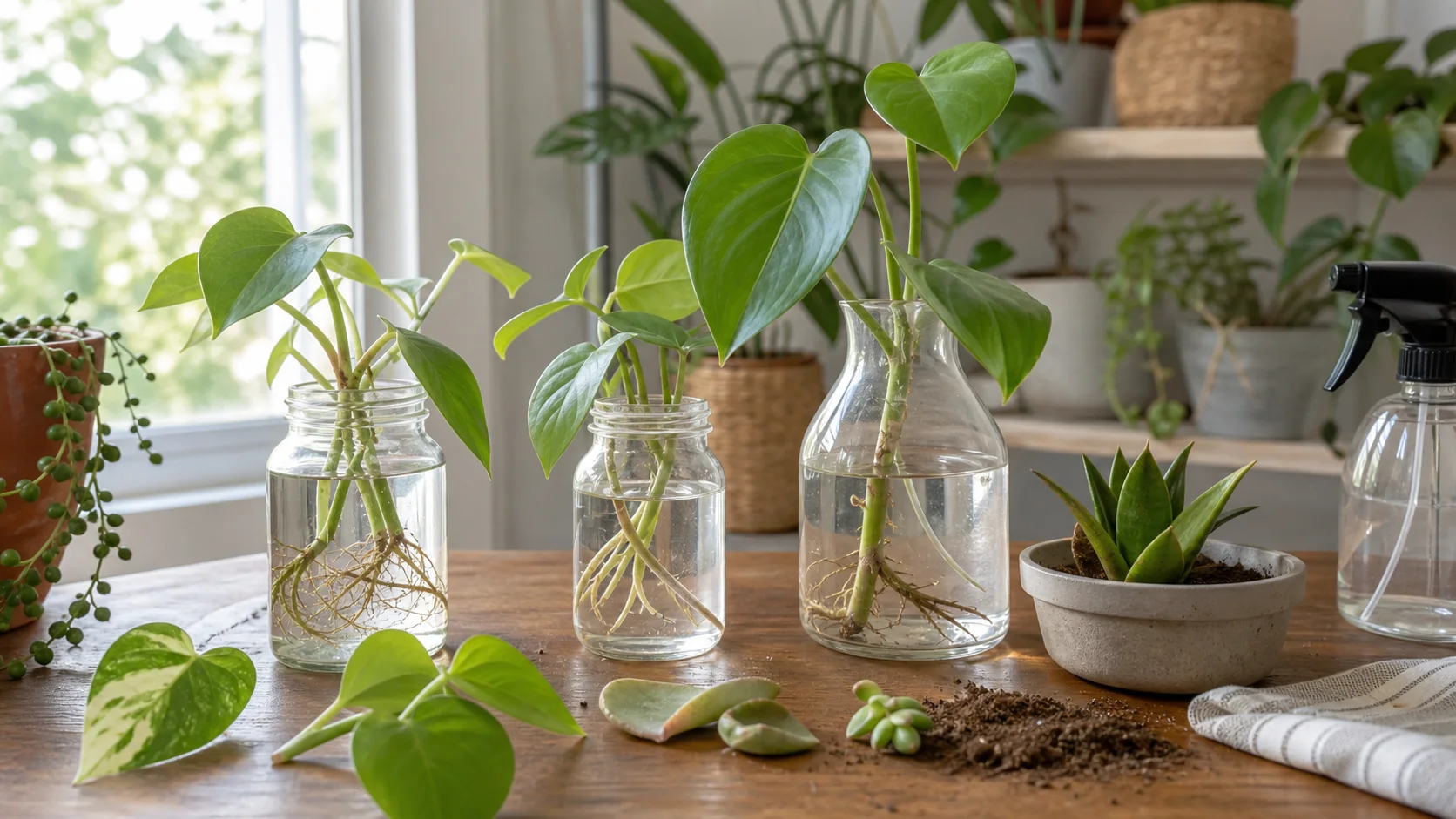
Visible roots and contrasting plant structures show why method choice and timing vary by plant.
Do I need rooting hormone? Not always, but it helps. Easy-to-root plants like pothos, tradescantia, and spider plant do not need it. For plants that are slower to root, rubber plant, fiddle leaf fig, hoyas, rooting hormone can meaningfully improve your success rate and cut the waiting time. It is a small investment worth having around.
Why are my cuttings rotting instead of rooting? Rot before roots almost always comes down to two things: too much moisture in the growing medium, or leaves left below the waterline. Remove any leaves that touch the soil or sit in the water, and let the medium dry slightly between waterings. If rot is a recurring problem, try perlite instead of regular potting mix. It drains faster and holds less moisture against the stem.
Can I put water-rooted cuttings straight into soil? Yes, but do it while the roots are still relatively young, around 3-5cm long. The longer a cutting spends in water, the more its roots adapt to a low-oxygen, high-moisture environment, and the harder the transition to soil becomes. When you transfer, keep the soil slightly more moist than usual for the first two weeks to help the roots adjust.
My cutting has been in water for two months with no roots. What is wrong? A few possibilities: the node was not submerged (the node, not just the stem tip, needs to be in the water), the water was not changed regularly enough, or the cutting is somewhere too dark or too cold. Most water propagation failures trace back to the node sitting above the waterline. Check placement first. If the stem has started to go soft or mushy, it has rotted and will not recover.
Is there a best time of year to take cuttings? Spring is the most reliable window. Plants are in active growth, hormone levels are high, and roots form faster. Summer works well too. Autumn and winter cuttings can succeed, especially with bottom heat, but expect slower results and a lower success rate overall. If your plant is declining in winter, do not wait: take the cutting now rather than waiting for better conditions.
Can I propagate a plant that is already stressed or sick? It depends on what is failing. If the problem is at the roots, overwatering, root rot, poor soil drainage, but the stems above are still firm and green, then yes: take cuttings from those healthy stems. This is often the best option when a plant is in partial decline. The cuttings can root successfully even if the original plant cannot be saved. If the entire plant has collapsed with no firm tissue anywhere, there is usually nothing left to work with.
Methodology: This guide was reviewed in June 2026 using Iowa State, Missouri, and Virginia Cooperative Extension guidance for method choice, node placement, timing, and rooting conditions. Community examples from Reddit snippets and Gardening Stack Exchange were used only to surface beginner confusion around where to cut, stem rot in water, and aftercare after rooting.