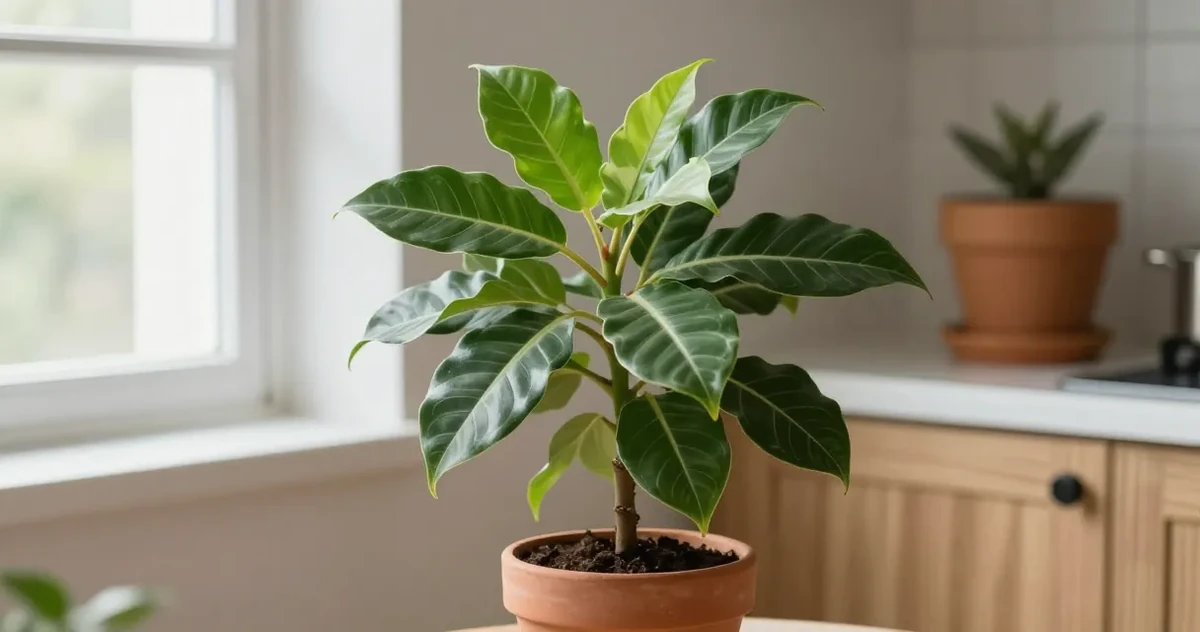
If you’ve ever killed a plant and sworn off trying again, Chinese Evergreen care might be your way back in. The Aglaonema is one of those rare plants that adapts to you: your light, your schedule, even the occasional forgotten watering. It doesn’t demand much, and it rewards you with bold, patterned leaves that look far more exotic than the effort required to grow them. If you want a few similarly forgiving options, the easy houseplants for beginners guide is a good next stop.
That’s not a sales pitch. It’s just what this plant is.
Identification Snapshot
| Detail | What to notice |
|---|---|
| Botanical name | Aglaonema spp., usually sold as Chinese evergreen |
| Growth habit | Upright clump with short canes, not a trailing vine |
| Leaf pattern | Green leaves marked with silver, cream, pink, or red depending on cultivar |
| Best room fit | Medium to low indirect light for dark green forms, brighter indirect light for colorful ones |
| Watering rhythm | Let the top third dry in active growth, closer to the top half in winter |
| Pet safety | Not pet-safe, chewing can irritate the mouth and stomach because of calcium oxalate crystals |
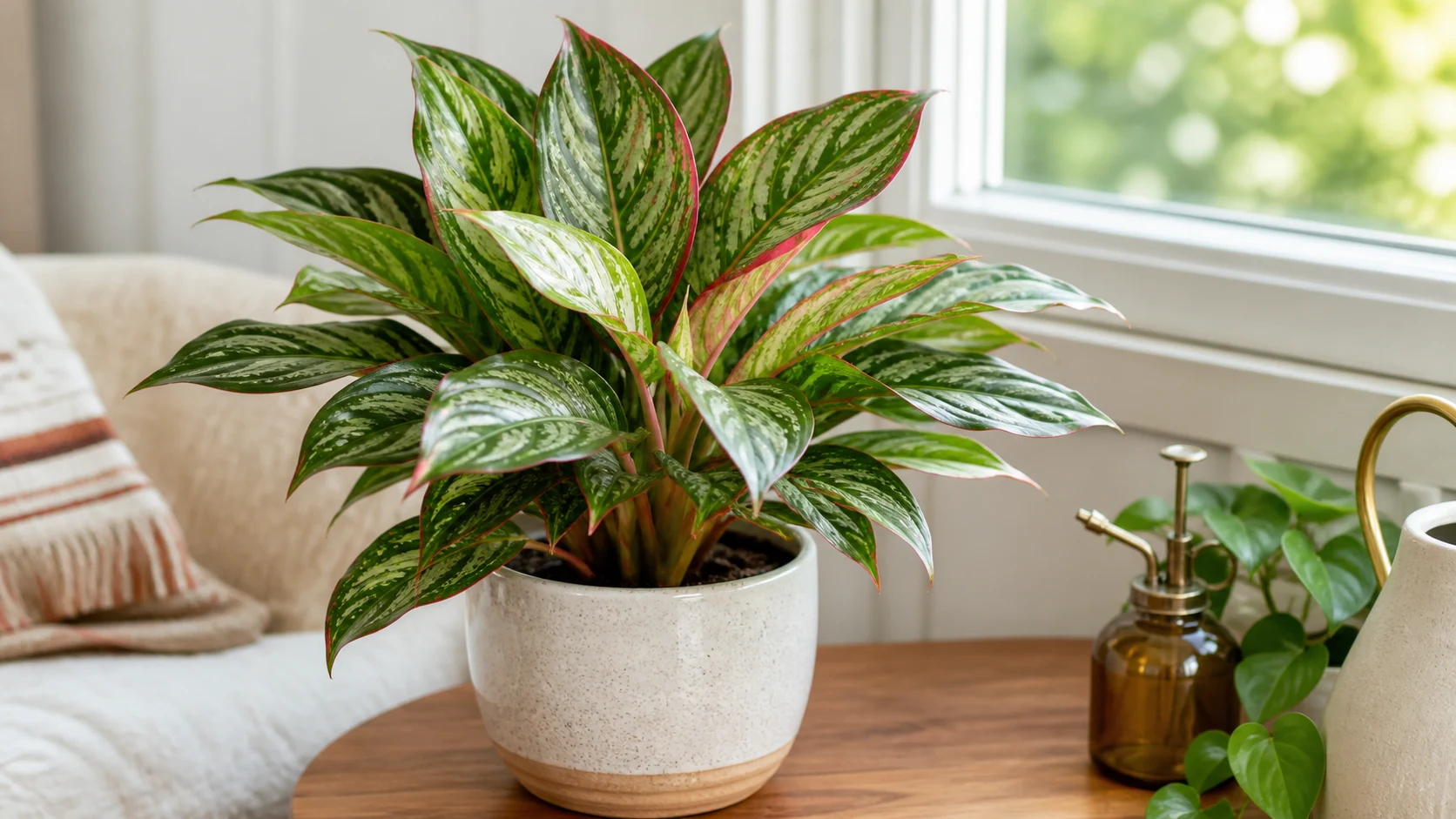
Upright Aglaonema growth and silver-pink leaf patterning make Chinese evergreen easy to recognize.
What Most Care Guides Miss
Most guides about Chinese evergreen describe the ideal care routine. Real homes are messier: light changes by season, pots dry at different speeds, and the same symptom can mean different things depending on where it appears.
Before changing care, check the plant in this order:
- Light: is the plant growing toward the window, fading, or scorching?
- Root zone: is the pot drying predictably, or staying wet in the middle?
- Leaf pattern: did the oldest leaves, newest leaves, tips, or stems change first?
- Recent change: new pot, new location, fertilizer, cold draft, heat vent, or pest exposure.
This keeps you from fixing the wrong problem. One clear adjustment is usually safer than a full care reset.
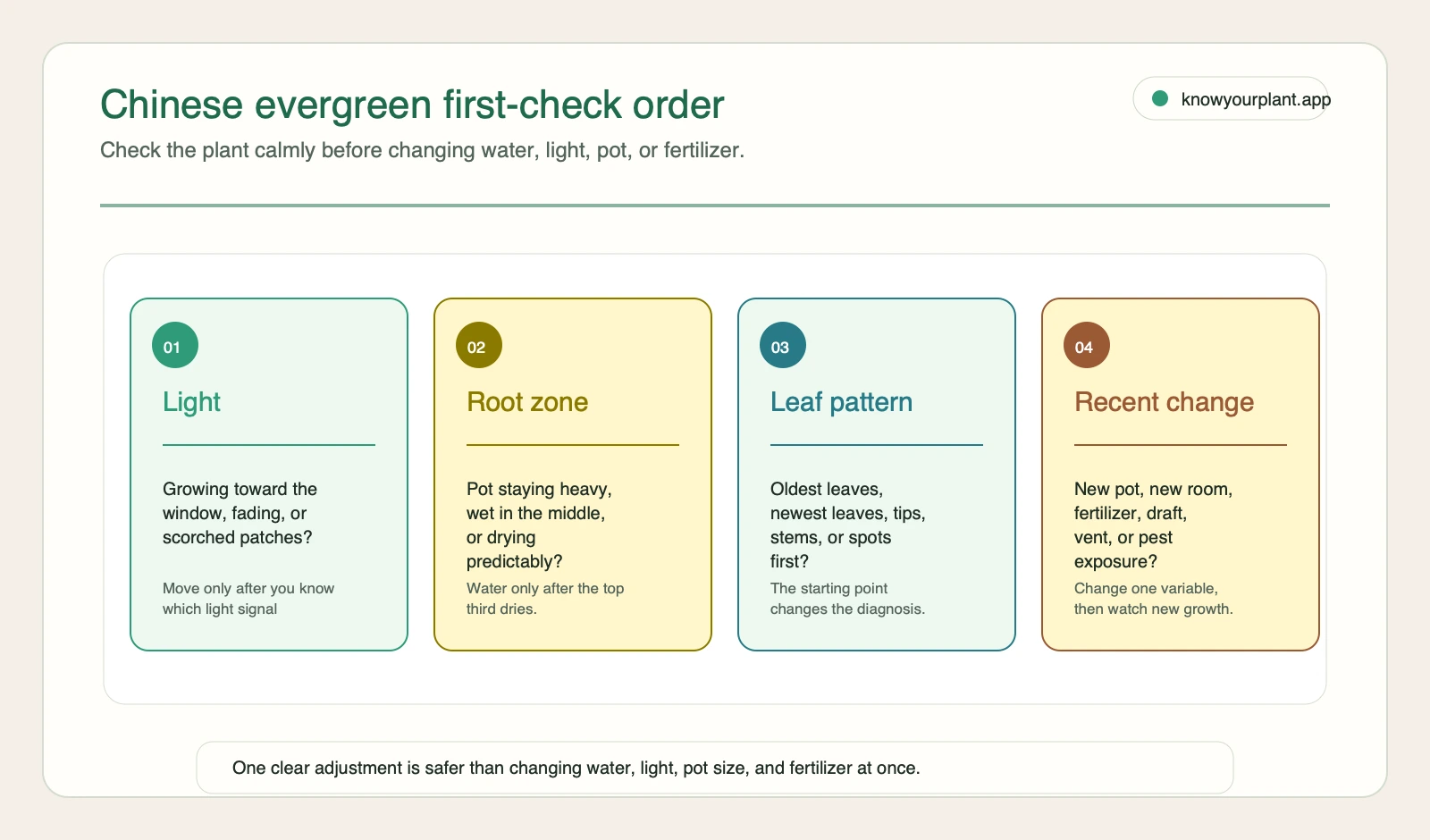
Use this first-check order before changing the routine: confirm light, root-zone moisture, leaf pattern, and recent changes so you do not fix the wrong problem.
What Owners Keep Getting Wrong With Chinese Evergreen
Public plant-owner threads keep circling the same problems: a nursery pot that stays heavy and wet after you bring it home, yellowing that gets treated like thirst, brown tips blamed on low humidity alone, and spotted leaves that get ignored until they spread. Those posts are useful because they show how often the first mistake is not the care problem itself, but reacting too fast to a symptom without checking the root zone, the newest growth, and any recent move.
Use those patterns as a caution flag, not a diagnosis. If your Chinese evergreen suddenly declines, slow down and check three things first: whether the nursery mix is still soaked in the center, whether the problem started on the oldest leaves or the newest ones, and whether the plant also got a light, draft, or watering-routine change in the same week.
What Makes Chinese Evergreen So Forgiving
Aglaonema is native to the tropical forests of Southeast Asia, where it grows under dense canopy cover with filtered light and inconsistent rain. That origin is exactly why it thrives in homes. It evolved for the conditions most houses naturally offer: low light, dry air, and irregular watering. This plant was built for the spots where other plants decline.
According to the University of Florida IFAS Extension, Aglaonema is one of the most tolerant foliage plants available for interior use, capable of withstanding low light levels, low humidity, and drought that would stress most other houseplants. That resilience is not marketing language. It is how the plant is built.
If your last plant died because your windowsill is not very bright, or because life got busy and you went two weeks without watering, this is the plant for you. And if you are rebuilding your whole routine, the indoor plant care guide for beginners lays out the basics that make low-maintenance plants stay that way.
Why Leaf Color Predicts Light Tolerance
This is the piece most Chinese Evergreen guides skip, and it is worth understanding before you buy or before you wonder why yours is not doing what you expected.
Aglaonema leaves fall into two broad groups: mostly deep green, and significantly variegated with cream, silver, pink, or red patterning. The green pigment in leaves is chlorophyll, which is what the plant uses to capture light and produce energy. A leaf that is heavily green has more chlorophyll and can extract usable energy from a dimmer environment. A leaf with large cream, pink, or red sections has less chlorophyll in those areas, so it needs more total light to meet the same energy needs.
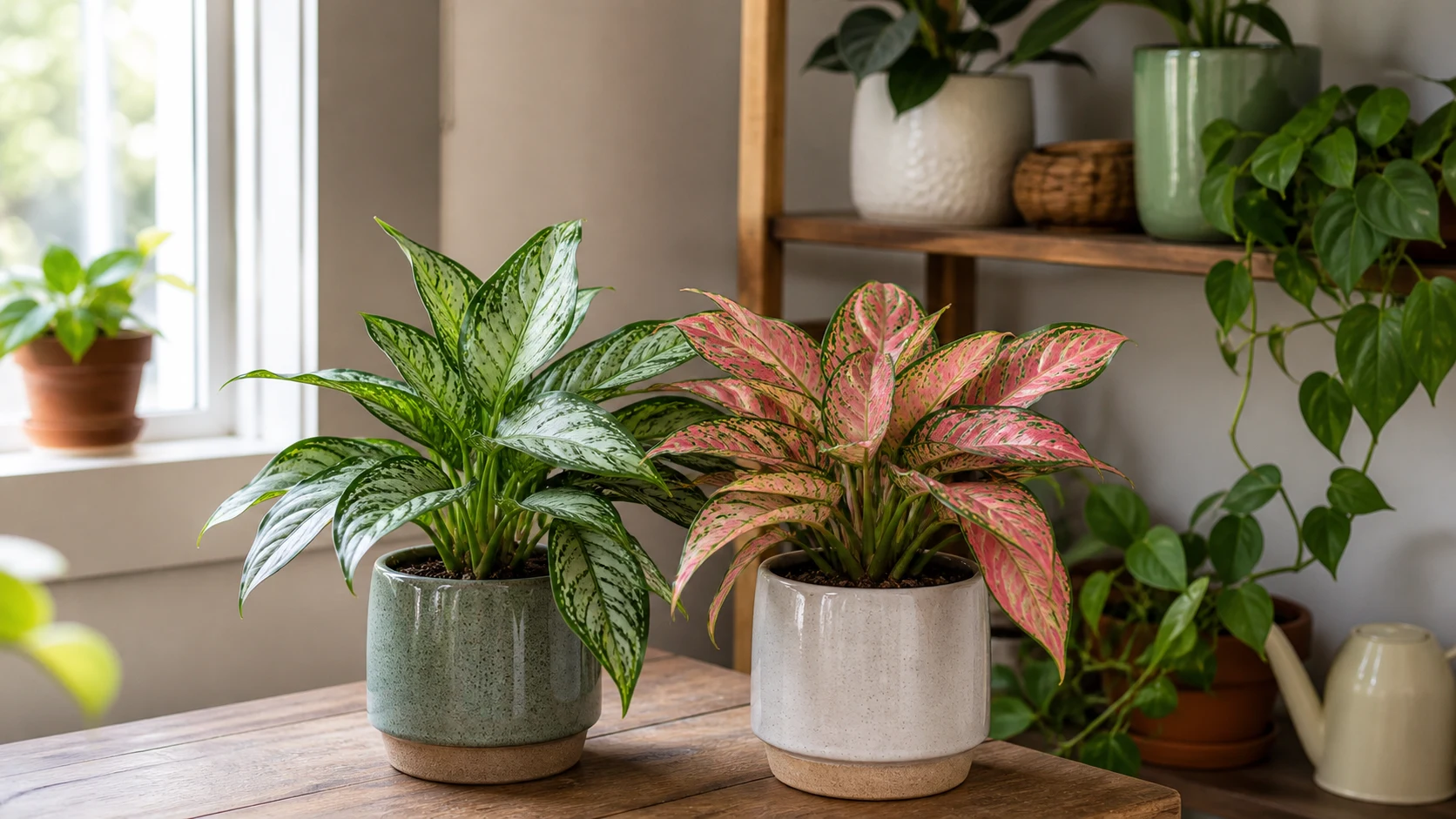
Green-heavy cultivars tolerate dimmer rooms, while colorful forms hold their pattern best in brighter indirect light.
In practice:
- A ‘Silver Bay’ or ‘Maria’ with mostly green, silver-flecked leaves can handle a genuinely dim corner
- A ‘Red Siam’ or ‘Pink Dalmatian’ with vivid pink or red patterning needs a bright, indirect spot to keep that color
This explains a frustration many people share: “I have the same plant as a friend, but theirs is vibrant and mine keeps fading.” Often, they have different varieties, and one was placed in conditions that suit a green variety, not a colorful one.
When a colorful variety does not get enough light, it does not immediately die. It gradually reverts toward greener patterning. The plant is redistributing what chlorophyll it has to survive. Correct the light, and new growth over the following months will come in with the original color. The older, faded leaves will not recover, but everything pushing after the move will.
Understanding this mechanism makes the variety selection section below much easier to navigate.
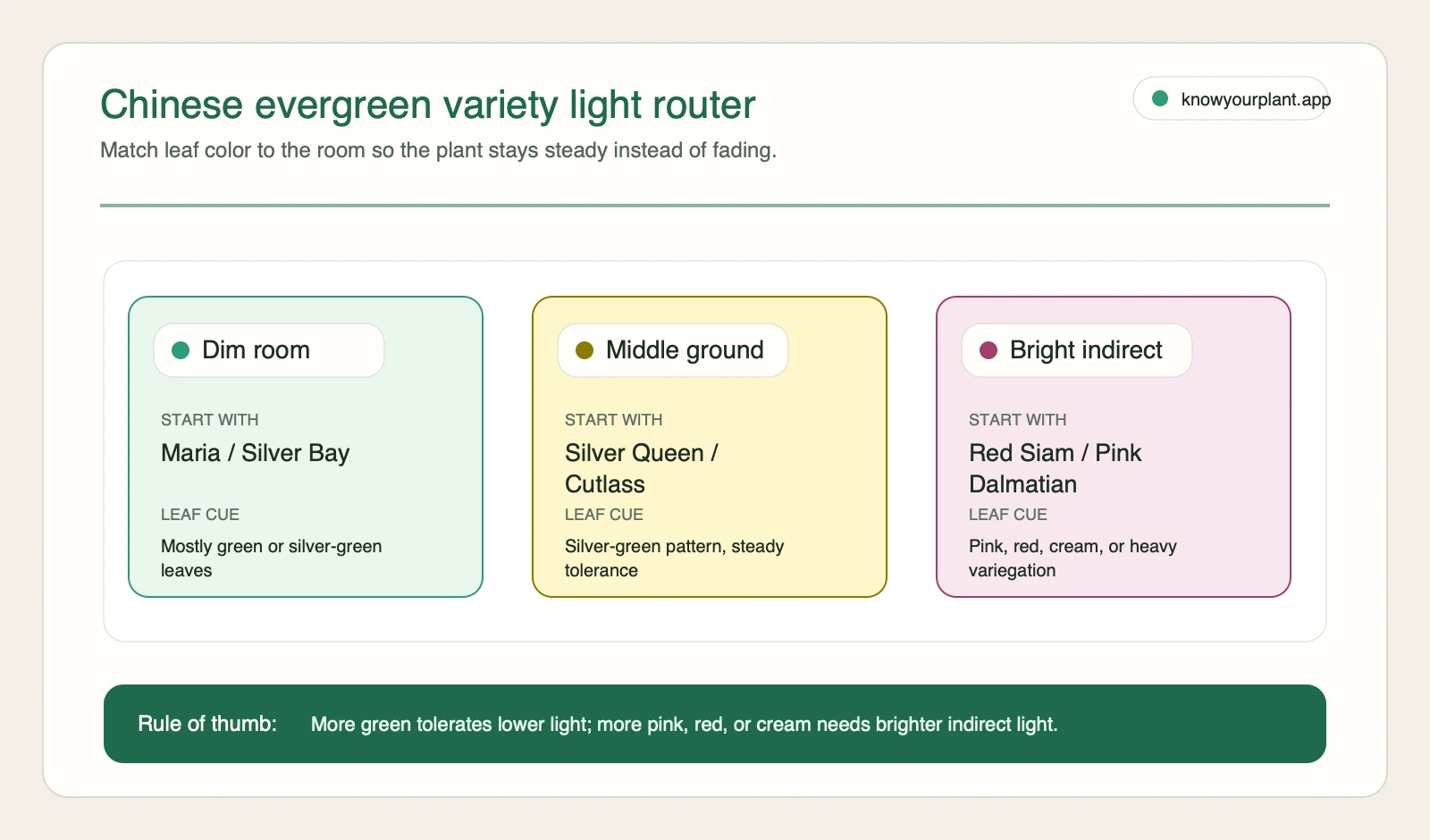
Match the variety to the room: greener Aglaonema tolerate lower light, while pink, red, cream, or heavily variegated plants need brighter indirect light to keep color.
Care Cards
| Care card | Fast answer |
|---|---|
| Light | Dark green varieties tolerate dimmer rooms, pink, red, and heavily variegated types need brighter indirect light to keep color |
| Water | Water deeply, then wait until the top third dries, in winter wait a little longer because dry-down slows |
| Soil | Standard potting mix plus perlite or another drainage booster |
| Pot | Always use drainage holes, terracotta helps if you tend to overwater |
| Temperature | Best between 60 and 85°F, away from cold drafts and heating or AC vents |
| Feeding | Half-strength liquid feed monthly in spring and summer, skip the cool slow season |
Light: Almost Any Spot Will Work
Chinese Evergreen care is flexible when it comes to light, but the variety you choose shapes your options.
Deep green varieties like ‘Maria’ or ‘Silver Queen’ handle low light well. They will sit comfortably a few feet from a window and stay healthy. Variegated and colorful varieties need brighter indirect light to keep their coloring vibrant. Put them in a dim corner and they will slowly fade.
The one rule that applies to every variety: no direct sun. A few hours of harsh afternoon rays will bleach and scorch those patterned leaves.
A spot with bright to medium indirect light works for most varieties. Think: light that fills a room without casting sharp shadows. If you are unsure whether a spot has enough light, the guide to grow lights for indoor plants covers how to measure and supplement light without guessing.
NC State Extension notes that low-light tolerant varieties like ‘Silver Bay’ and ‘Maria’ can survive in spots as dim as 75 to 150 foot-candles, the kind of light found well back from most windows, while still maintaining healthy growth.
Watering Your Chinese Evergreen
This is where most people accidentally go wrong, not by forgetting to water, but by watering too often.
Chinese Evergreen stores water in its thick stems and leaves. It is not a succulent, but it does not want wet soil either. Let the top third of the soil dry out before watering again. In practice, that usually means every 10 to 14 days in summer and every 2 to 3 weeks in winter.
Press your finger into the soil up to the second knuckle. Still moist? Come back in a few days. Dry that far down? Time to water.
When you water, water thoroughly until it drains from the bottom of the pot. Then leave it until that top third dries out again.
The University of Missouri Extension identifies overwatering as the single most common cause of death in indoor foliage plants, and Aglaonema is no exception. The thick, fleshy roots are sensitive to sitting in wet soil, and root rot can progress quickly once it sets in.
What the leaves are telling you:
- Brown tips: inconsistent watering or very dry air
- Yellow leaves starting from the bottom: too much water, too often
- Drooping leaves with dry soil: thirsty, water now
- Drooping leaves with wet soil: root stress from overwatering, let it dry out before watering again
Expert note: Clemson, NC State, and UF/IFAS all point to the same core pattern with Aglaonema: let the top layer dry before watering again, protect it from temperatures below about 55°F, and do not confuse low-light tolerance with wet-soil tolerance. A Chinese evergreen can handle a dim room far better than it can handle roots sitting cold and soggy.
Soil and Pots
Chinese Evergreen does best in a well-draining mix. A standard potting soil works, but it improves with a handful of perlite mixed in. That extra drainage stops water from sitting around the roots.
Choose a pot with drainage holes. Without them, water collects at the bottom no matter how carefully you water, and roots sitting in that moisture will rot.
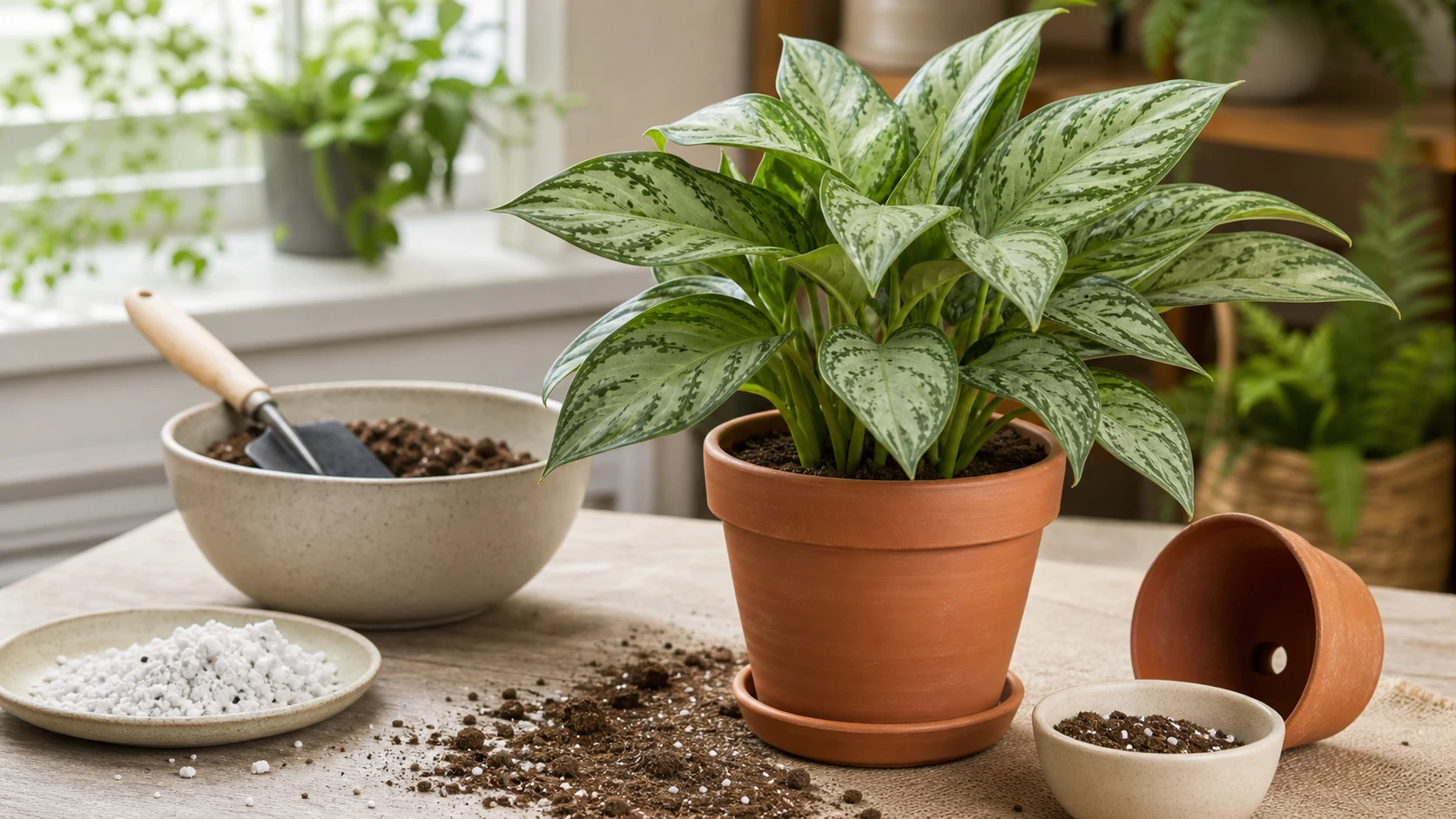
A terracotta pot with a drainage hole and a perlite-amended mix helps Aglaonema roots dry evenly.
NC State Extension recommends terracotta pots for plants prone to overwatering. The porous walls wick moisture away from the soil and help it dry faster between waterings. For Aglaonema, this makes a real difference if you tend to water on a schedule rather than checking the soil first.
Repot only when the plant has clearly outgrown its container. Roots circling the bottom or poking out of drainage holes are the signal. Every two to three years is usually about right. The guide to repotting houseplants is worth reading before you start, particularly for handling roots without stressing the plant in the process.
Temperature and Humidity
Chinese Evergreen prefers temperatures between 60 and 85°F (15 to 30°C). The main thing to avoid is cold drafts. Keep it away from air conditioning vents and windows that let in cold air in winter. Temperatures below 55°F stress the plant and cause leaf damage that will not reverse.
It tolerates average household humidity fine. In very dry winter air, a pebble tray with water beneath the pot adds gentle ambient humidity without misting the leaves directly, which can invite fungal issues.
Feeding
Feed once a month in spring and summer with a balanced liquid fertilizer diluted to half strength. Skip feeding in autumn and winter when growth slows.
NC State Extension recommends stopping fertilizer applications from October through February for most indoor foliage plants, including Aglaonema. Feeding during the slow season pushes weak, leggy growth that is more susceptible to pests and stress. Less is more here.
For a clear breakdown of fertilizer types, timing, and what those NPK numbers actually mean for indoor plants, the plant fertilizer guide covers it without the jargon.
Seasonal Care Calendar
Care for Chinese Evergreen does not need to be complicated, but adjusting slightly with each season keeps it healthier year-round.
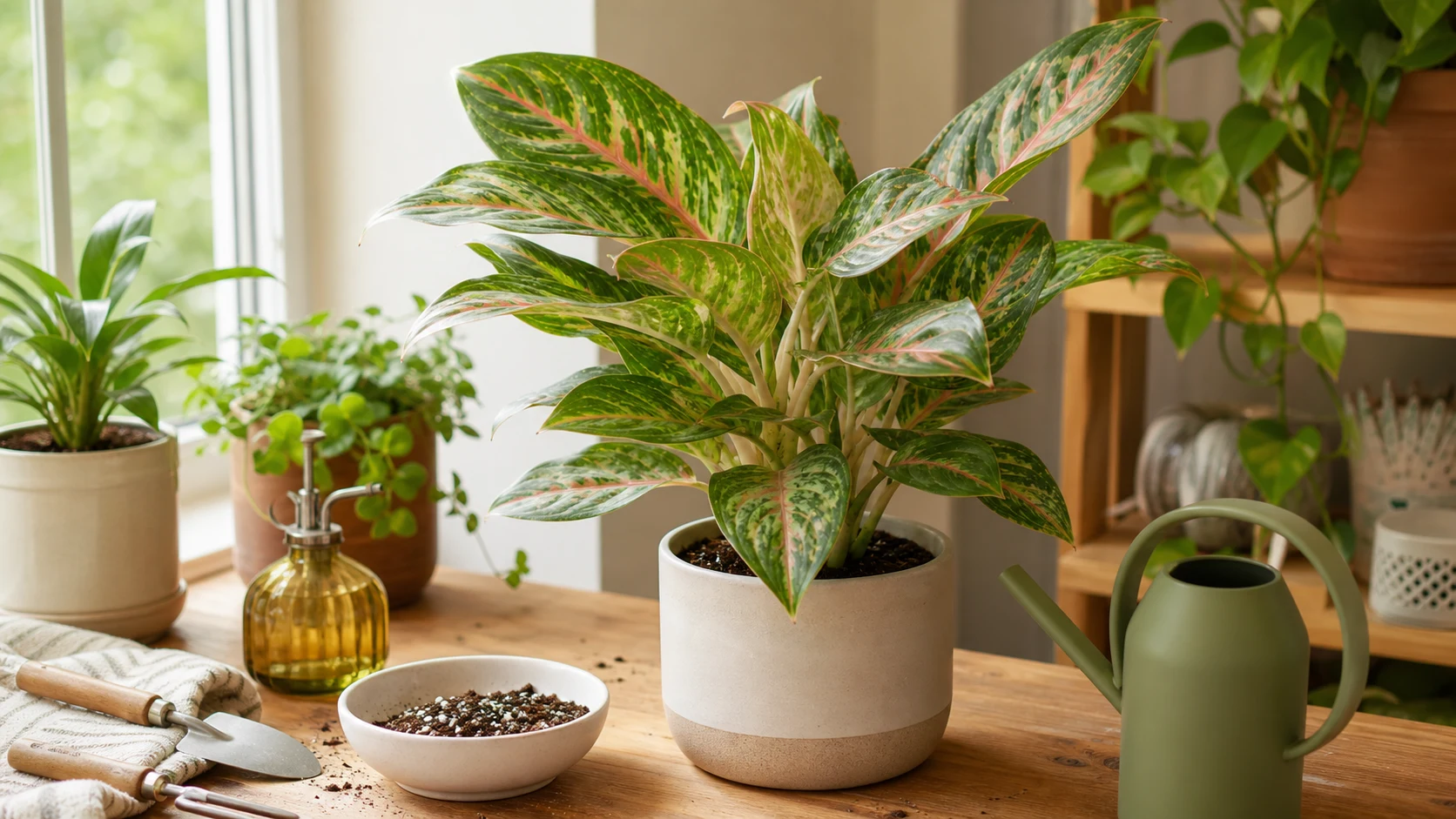
Fresh growth, watering, and repotting tools reflect the more active spring and summer care season.
Spring (March to May) Growth picks back up as days lengthen and temperatures rise. Resume monthly feeding, water a bit more frequently (check the soil first), and this is the best window to repot if the plant has outgrown its container. New leaves pushing in spring are a good sign that winter went well.
Summer (June to August) Peak growing season. Water more frequently as soil dries faster in the warmth. Keep up monthly feeding. Check the undersides of leaves for spider mites and mealybugs, which become more active in summer heat. In good conditions, a new leaf every few weeks is normal.
Autumn (September to October) Taper off feeding and reduce watering frequency. Start moving the plant away from windows that will let in cold drafts as the season turns. The last feed of the year should happen in September or early October. Growth will noticeably slow, which is expected.
Winter (November to February) Minimal intervention. Water only when the top half of the soil is dry, skip fertilizer entirely, and keep the plant away from cold drafts and heating vents. Growth slows significantly, but the plant is not struggling. It is resting. The main risk is cold air from exterior walls or drafts in poorly insulated rooms.
Choosing Your Variety
There are dozens of Aglaonema varieties, and picking the right one for your space shapes how easy your experience will be.
For low light spaces: ‘Silver Bay’, ‘Maria’, or ‘Silver Queen’. These tolerate the least light and are the most forgiving overall.
For moderate to bright indirect light: ‘Red Siam’, ‘Pink Dalmatian’, or ‘Siam Aurora’ are striking, but they need more light to hold their color.
For a middle ground: ‘Silver Queen’ or ‘Cutlass’ offer silver-green patterning that works across a range of lighting conditions.
The rule of thumb: the more green in the leaves, the lower the light it can handle. The more red, pink, or cream, the brighter a spot it needs. Use the Chinese evergreen varieties guide to compare the green, silver, red, and pink cultivar groups before choosing one.
If you are not sure what light level you are actually working with, the low light indoor plants guide has a practical breakdown of what different light levels look like in a real home, without needing a light meter.
Quick Decision Tree: Which Chinese Evergreen Fits Your Room?
- The room is genuinely dim for most of the day. Start with a mostly green or silver-green cultivar like ‘Maria’ or ‘Silver Bay’.
- You want pink, red, or cream patterning. Give it brighter indirect light from day one, because colorful cultivars hold color best there.
- The plant is healthy, but the color is fading. Increase indirect light gradually and judge the fix by the next two or three leaves, not the older faded ones.
- Leaves are bleaching or getting crispy patches. Move it back from direct sun, because color loss from low light and scorch from harsh light can look similar at first.
- A cat or dog is likely to chew leaves. Skip Aglaonema and choose a pet-safe alternative instead, because this is still a toxic houseplant even when it is marketed as beginner-friendly.
Lookalikes and Plants Chinese Evergreen Gets Confused With
- Dieffenbachia (dumb cane): similar upright canes and patterned leaves, but dieffenbachia usually has broader leaves and a chunkier cane. Chinese evergreen stays neater and more compact indoors.
- Syngonium cultivars: colorful syngoniums can overlap on leaf color, but they have arrow-shaped leaves and eventually climb or trail instead of forming a dense upright clump.
- Peace lily: people sometimes compare them because both are forgiving indoor plants, but peace lily leaves are solid green and its white blooms make identification much easier.
If the label is vague, the fastest tell is growth habit: Aglaonema forms an upright clump of patterned leaves from short canes, not a vine and not a flowering spathe plant.
Common Problems and What They’re Telling You
Chinese Evergreen Symptom Diagnosis Card
| Symptom | First check | Likely direction | What to do now | What not to do |
|---|---|---|---|---|
| Lower leaves yellowing | Soil moisture halfway down the pot | Old leaf turnover or overwatering | Remove fully spent leaves, then lengthen the dry-down if the mix is staying wet | Do not water more just because yellow looks dramatic |
| Mushy stems or a heavy wet pot | Pot weight, drainage hole flow, smell near the root zone | Root stress from staying soggy | Let the mix dry, empty any cachepot water, inspect roots if the stem base softens | Do not fertilize or repot into an even bigger wet pot |
| Brown tips | Recent dry spells, heater or AC airflow, fertilizer buildup | Inconsistent watering, dry air, or salt stress | Return to even watering, flush the pot occasionally, move away from direct vent airflow | Do not assume brown tips always mean the plant needs more frequent watering |
| Pale or faded colorful leaves | Distance from window and recent seasonal light drop | Not enough indirect light for a colorful cultivar | Move it gradually brighter and watch new growth | Do not expect old faded leaves to recolor |
| Drooping with dry soil | Soil depth and pot weight | Thirst | Water deeply and let excess drain | Do not start a rigid daily schedule afterward |
| Drooping with wet soil | Root zone and room temperature | Overwatering or cold-stressed roots | Pause watering, increase warmth, and make sure the pot drains freely | Do not keep adding water because the leaves look limp |
| Spreading yellow or brown spots | Leaf undersides, nearby plants, splash patterns | Pest or disease pressure | Isolate the plant, avoid wetting leaves, and inspect before treating | Do not keep misting or guessing if the spots are actively spreading |
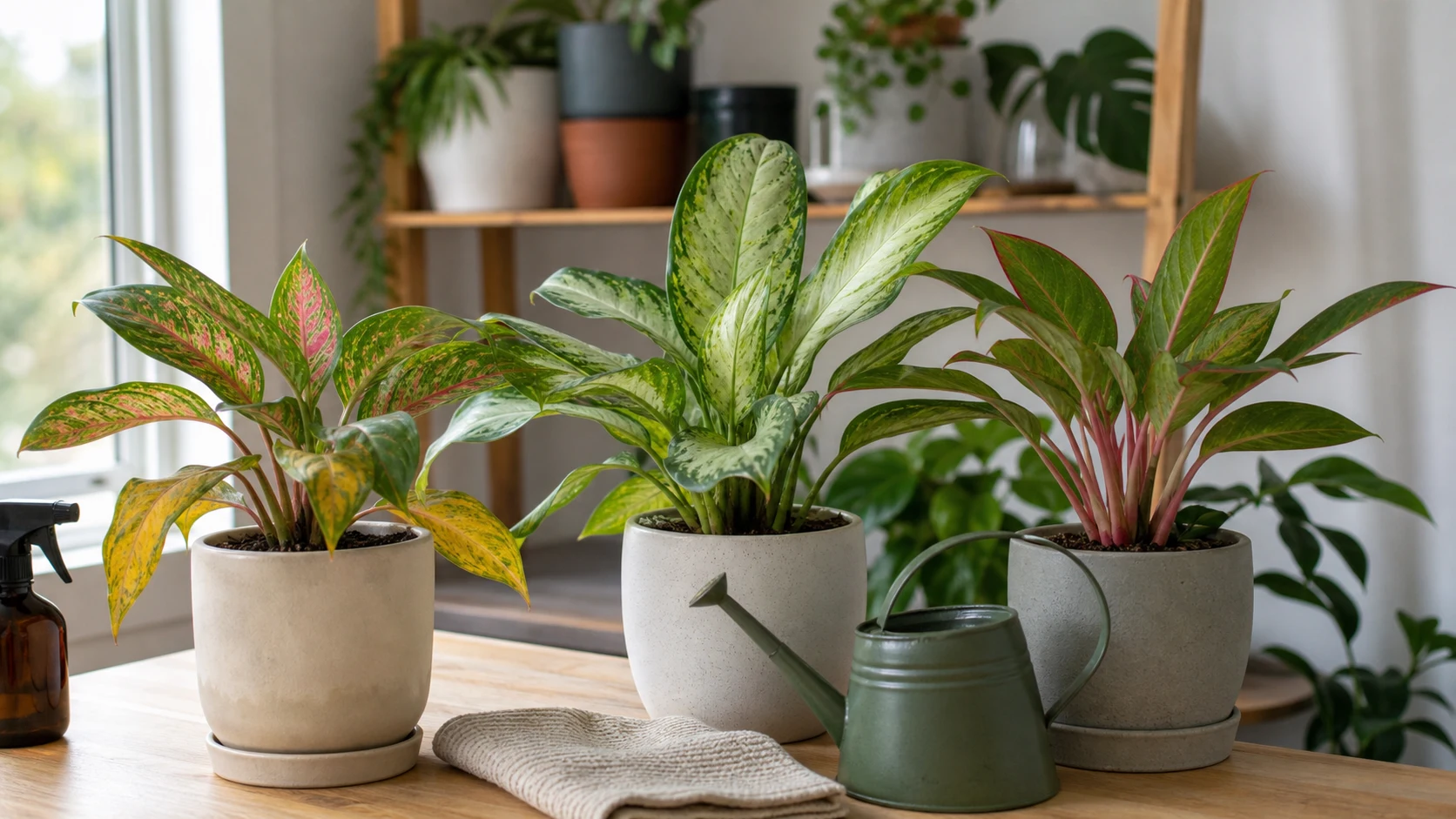
Compare lower-leaf yellowing against healthy new growth before changing watering or repotting.
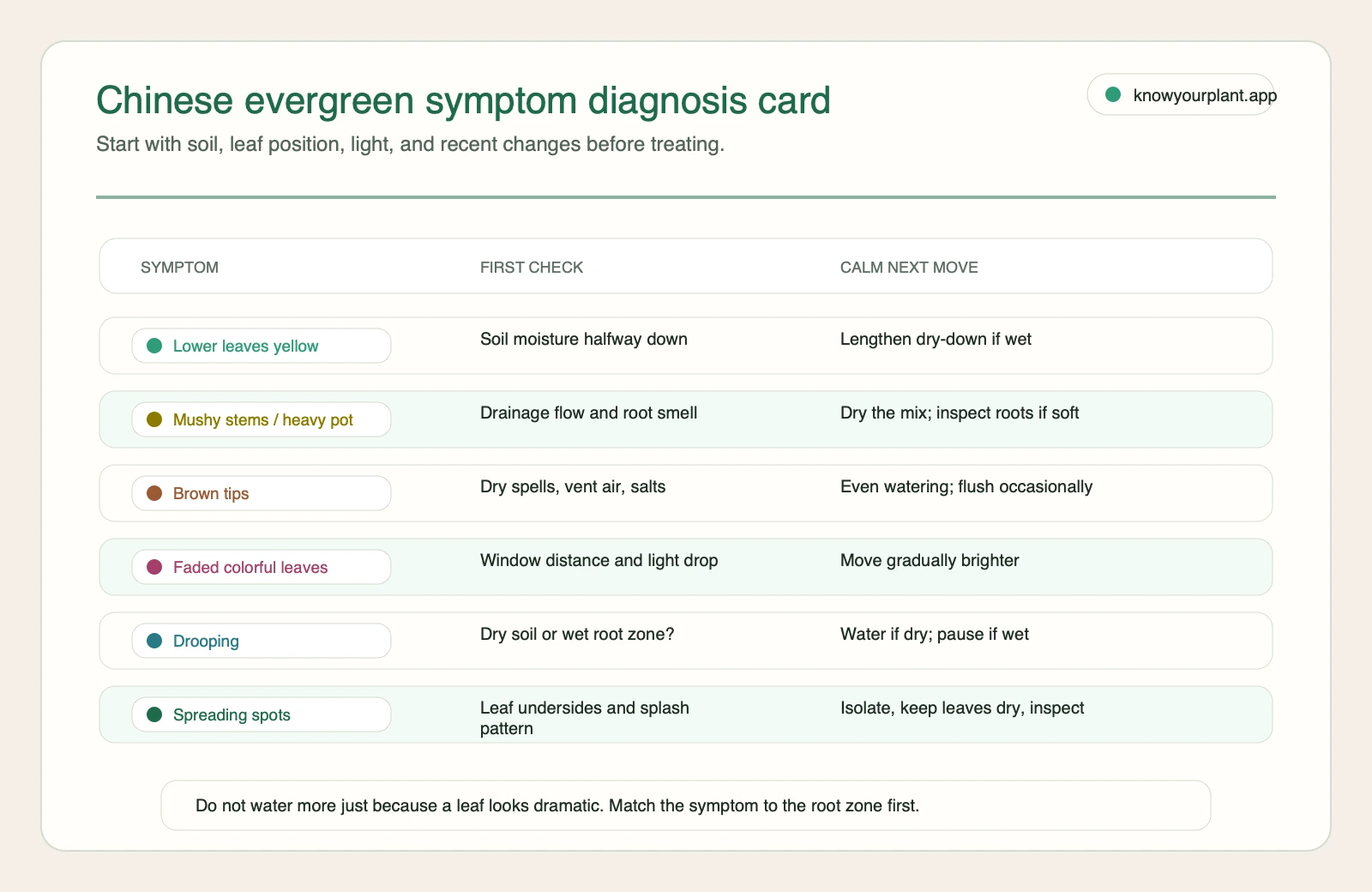
Use the symptom card as a fast triage layer: match the visible leaf or stem change to the first check before watering, repotting, fertilizing, or treating.
Yellow leaves: Almost always too much water. Let the soil dry out more between waterings and check that the pot is draining properly.
Brown leaf tips: Dry air or inconsistent watering are the two most common causes. A pebble tray under the pot helps with humidity, and checking the soil before watering usually clears it up over time.
Pale, washed-out leaves: Too much direct light, especially in colorful varieties. Move it back from the window or find a spot with softer, more diffused light.
Leggy, stretched growth: Not enough light. The plant is reaching toward a brighter source. Move it somewhere with more ambient light during the day.
Drooping leaves: Either very dry soil or cold stress. Check the soil first, then consider whether it might be sitting near a draft or vent.
Pests: Chinese Evergreen is relatively pest-resistant, but spider mites and mealybugs occasionally appear on stressed plants. A plant that has been overwatered, underlit, or sitting in very dry air is more vulnerable. Check the undersides of leaves whenever you water, and use the houseplant pests guide if you need a broader ID and treatment flow.
Common Mistakes After Bringing One Home
The easiest way to set this plant back is to treat it like a fresh, dry plant the moment it arrives. Chinese evergreens are often sold in dense nursery mix that is already wetter than it looks at the top.
The first-week mistakes to avoid are simple:
- watering on a calendar before checking whether the center of the pot is still wet
- leaving runoff trapped inside a cachepot or decorative sleeve
- moving a colorful cultivar into a dim corner because the care tag said “low light”
- reacting to one yellow lower leaf by changing light, watering, and fertilizer all at once
Make one adjustment at a time and let the plant show you whether the change helped.
Pet Safety
Chinese Evergreen is toxic to cats and dogs. The leaves and stems contain calcium oxalate crystals, which cause mouth irritation and digestive upset if ingested. If you have pets, keep it out of reach or choose a pet-safe alternative. The guide to cat-safe indoor plants has a solid list of options if you need something safer for a plant-and-pet household.
Real User FAQ
My Chinese evergreen is drooping and yellowing at the same time. Is it thirsty or overwatered? Check the soil before anything else. If the mix is still wet several inches down, treat this as root stress, not thirst. Public Aglaonema troubleshooting threads repeatedly surface slow winter dry-down and soggy soil as the hidden cause of drooping plus yellow leaves.
My red or pink variety is alive, but the color keeps fading. What changed? Usually light. Colorful cultivars can survive in lower light, but they lose saturation there. Move it to brighter indirect light and judge the fix by new growth, not the faded older leaves.
I repotted or moved it, and now it looks worse. Should I change everything again? No. Start with one question: did the change also affect dry-down speed, draft exposure, or direct sun? Chinese evergreen often sulks after a move, and piling on extra watering or fertilizer usually prolongs the problem.
My cat chewed a leaf. What should I watch for? ASPCA lists Chinese evergreen as toxic to cats and dogs because of insoluble calcium oxalates. Watch for mouth irritation, drooling, vomiting, or trouble swallowing, and contact your vet if symptoms appear.
FAQ
How often should I water my Chinese Evergreen? There is no fixed answer because it depends on pot size, light level, and season. In summer, most Aglaonema need water every 10 to 14 days. In winter, that often stretches to every 2 to 3 weeks. The reliable method: push your finger into the soil to the second knuckle. If it is dry at that depth, water thoroughly. If it is still moist, wait a few more days. Checking the soil beats any fixed schedule every time.
Why are my Chinese Evergreen leaves turning yellow? Yellow leaves, especially starting from the lower leaves and working upward, almost always point to overwatering or poor drainage. The roots are sitting in too much moisture and cannot function properly. Let the top third of the soil dry out before your next watering, make sure the pot has drainage holes, and check that water is not pooling in the saucer beneath the pot. New growth should come in healthy once you correct the watering. The yellowed leaves will not recover, but they can be removed once they have fully dried.
Can Chinese Evergreen grow in low light? The darker green varieties, ‘Maria’, ‘Silver Bay’, and ‘Silver Queen’, handle low light better than most houseplants. They will not grow as fast as they would in brighter conditions, but they will stay healthy in spots that would cause most other plants to struggle. The colorful pink and red varieties need more light to hold their color. In low light, they will gradually fade toward green but typically survive.
How do I know which Chinese Evergreen variety to choose? Match the variety to your light conditions. Dim corner or north-facing room: choose a dark green variety. Bright east or west-facing window with good indirect light: a pink or red variety will stay vibrant. Not sure: ‘Silver Bay’ or ‘Silver Queen’ is a reliable choice that works across a wide range of conditions.
Why does my Chinese Evergreen have brown tips? Brown tips usually come from dry air (common in winter when heating systems run), inconsistent watering, or occasionally salt buildup from tap water or fertilizer over time. Try placing the pot on a pebble tray filled with water to raise ambient humidity, and stick to checking the soil rather than watering on a fixed schedule. If tap water might be the issue, letting it sit overnight before using it allows some of the chlorine to dissipate.
Is Chinese Evergreen safe for cats and dogs? No. Chinese Evergreen contains calcium oxalate crystals, which are toxic to cats and dogs if ingested. Symptoms include drooling, pawing at the mouth, and digestive upset. Keep it out of reach of pets, or consider a plant from the pet-safe list if your animals are likely to chew on leaves.
How fast does Chinese Evergreen grow? Aglaonema is a slow to moderate grower. In good conditions, with bright indirect light, regular watering, and monthly feeding in the growing season, you might see a few new leaves per month in spring and summer. In lower light or winter, growth slows considerably. A long stretch with no new leaves is not cause for concern. It is likely just moving at its own pace.
When should I repot my Chinese Evergreen? Repot when roots are visibly circling the bottom of the pot, poking out of drainage holes, or the plant dries out very quickly after watering. That usually happens every two to three years. Move it up just one pot size. Jumping to a much larger container increases the risk of the soil staying wet too long before the roots can absorb it.
Methodology
Last updated: June 2026. This guide was refreshed using live search review for Chinese evergreen care and Aglaonema care, plus extension and safety sources that could be checked directly. Community snippets about yellowing, brown tips, oversoaked nursery pots, and spotting confusion were used only as qualitative reader-signal, not as proof for any diagnosis. Care and safety claims were cross-checked against Clemson Cooperative Extension, NC State Extension, UF/IFAS, the University of Arizona Cooperative Extension, and ASPCA guidance.
A Plant That Grows With You
Chinese Evergreen care does not require expertise. It requires you to check in, pay attention to what the leaves are telling you, and trust that the plant will meet you halfway. Most of the time, it will.
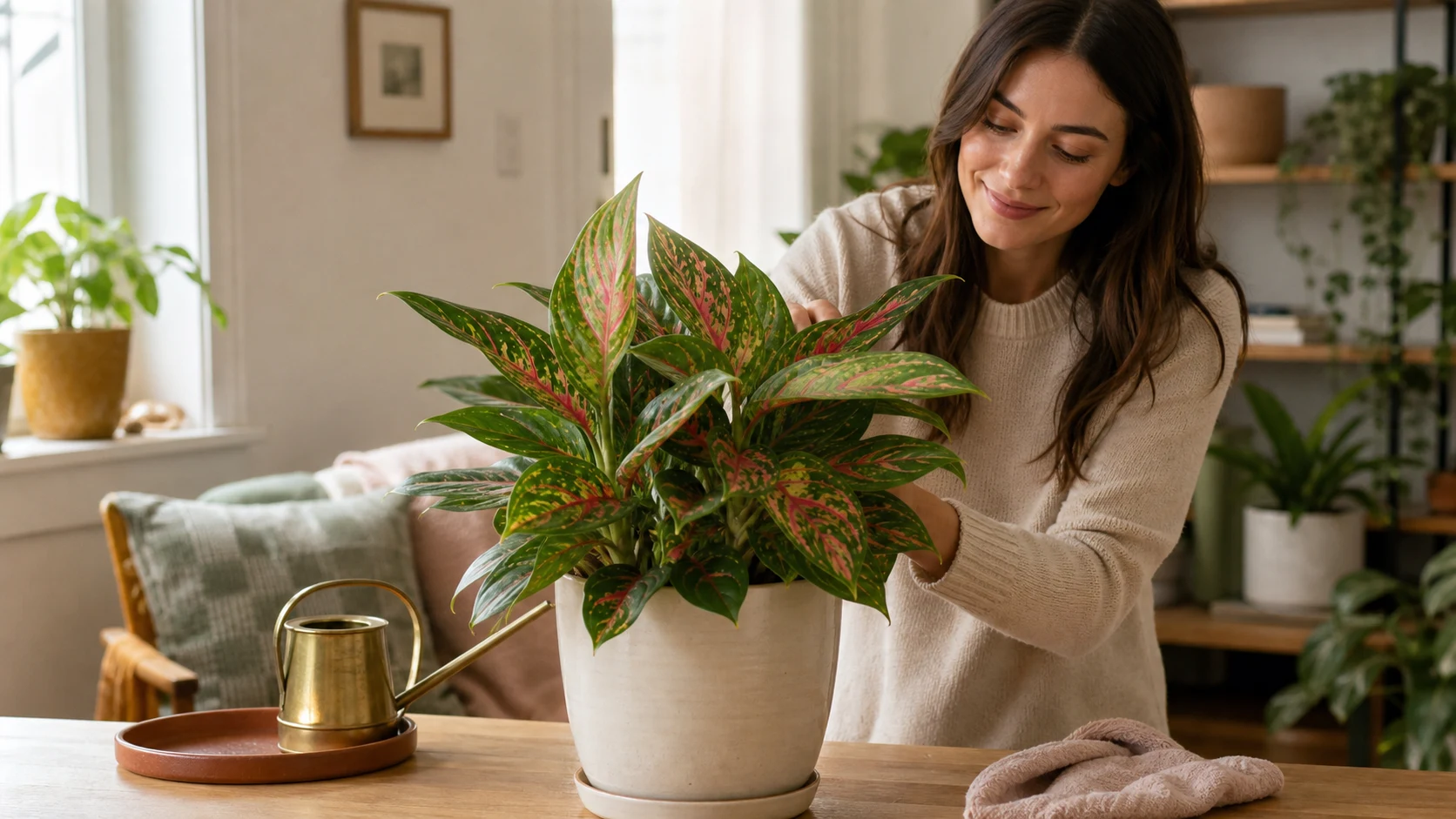
Regular leaf checks, not a rigid calendar, help an Aglaonema grow with its caretaker.
Plant care expert Darryl Cheng, author of The New Plant Parent, frames it simply: the goal is not to follow a rigid schedule. It is to learn to read your plant. Aglaonema is one of the best teachers for that, because it communicates clearly and forgives early mistakes while you are still figuring things out.
Download KnowYourPlant for personalized plant care reminders based on your specific plant and conditions. It takes the guesswork out of when to water, when to feed, and what to do when something looks off.