By KnowYourPlant editorial team, last updated June 15, 2026.
Your calathea’s leaf edges have gone brown and papery. Not just the tips – the whole outer edge of older leaves is drying out and pulling inward, and it is spreading to newer growth. You have read everything you can find. Every article says the same thing: these plants need high humidity. So you have been misting it almost every day. The crispy edges are still spreading.
Here is what those articles didn’t tell you: misting raises the humidity around your plant for about four minutes. Then the water evaporates. The air returns to exactly where it was before you picked up the spray bottle.
That is the part most guides skip over, and it is why a lot of people spend months misting faithfully while the plant keeps declining.
Humidity for plants is simply the moisture in the air your plant lives in. Most tropical houseplants evolved where air holds 60% or more relative humidity year-round. According to Penn State Extension, a heated or air-conditioned home can easily fall below 30% in winter. That gap is real, and it does affect sensitive plants. But before you buy a humidifier or change your whole routine, it is worth checking whether low humidity is actually the thing hurting your plant.
Identification Snapshot
Before you change the whole room, identify which kind of humidity problem you actually have.
- Likely a true low-humidity issue: thin-leaved tropicals such as calatheas, ferns, anthuriums, or alocasias show crispy edges across multiple leaves, especially when the room sits below about 40% and heating or AC is running hard.
- Less likely to be solved by humidity alone: a tough plant such as pothos, snake plant, or ZZ has one damaged leaf, only the oldest foliage is browning, or the plant sits directly in a draft.
- Most useful first clue: if symptoms improve after moving the plant away from a vent or after stabilizing watering, the air itself was probably not the only problem.
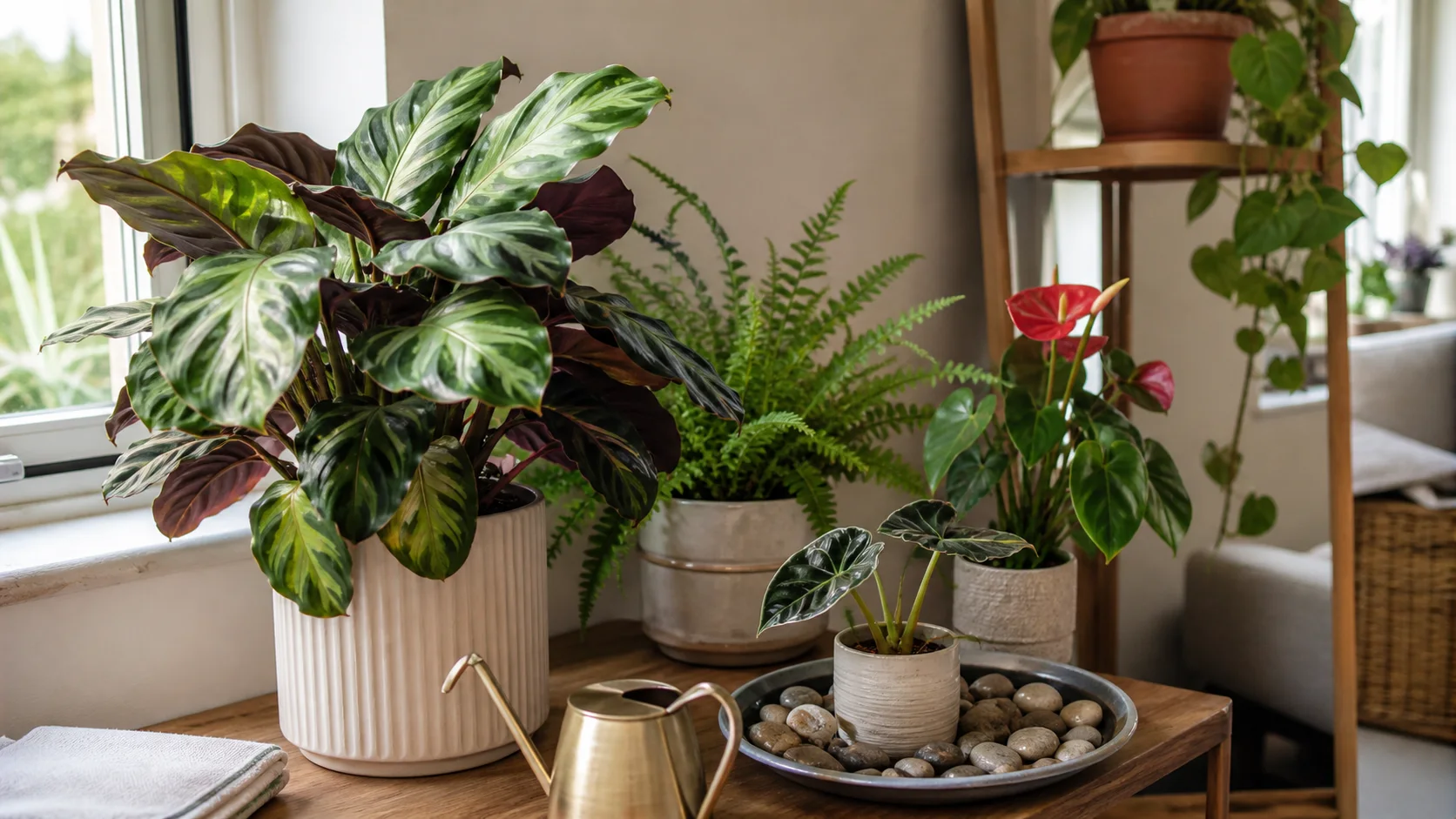
Browned calathea edges among humidity-loving plants are a clue to check dry air, drafts, and watering before changing the whole room.
What Most Care Guides Miss
Most articles about humidity for plants give you the same list: mist more, try a pebble tray, group your plants, get a humidifier. What they almost never address is that not every crispy leaf edge is a humidity problem, and raising humidity won’t help if something else is the real cause.
Brown leaf tips and crispy edges can come from low humidity, yes. They can also come from:
- A heating or cooling vent blowing warm, dry air directly across the leaves
- Mineral salts from tap water building up in the soil (calatheas and prayer plants are especially reactive to this)
- Root-ball moisture dropping too low between waterings
- Humidity swings, where the air sits at 55% during the day but falls to 30% overnight when heating runs hard
Nebraska Extension lists dry, brown, brittle leaf edges as the classic symptom of low humidity, but also notes that the same symptoms appear when plants sit near doors and heat vents. That overlap is exactly why a location check comes before any other change.
The practical first check: before adjusting anything, look at where the plant is sitting. Is there a vent within a metre? A drafty single-pane window? Move the plant two or three feet away and wait two to three weeks. If things improve, you found the cause without spending anything. If nothing changes, low air moisture is more likely the real factor – and it makes sense to address it directly.
Which Plants Actually Need More Humidity
Not every houseplant has the same needs. Treating a snake plant the same way as a calathea will not work for either of them.
Low humidity – comfortable at 30-40%: Succulents, cacti, snake plants, ZZ plants, and most pothos varieties. These plants adapted to drier conditions and do not need humidity support. If this is what you grow, nothing in this article will help, because the plant does not need help. Save the effort for the ones that do.
Medium humidity – happy at 40-60%: Monstera, philodendron, peace lily, spider plant, and rubber tree. Most popular tropical houseplants fall here. They handle typical home air well but can show stress in winter when central heating runs hard. A little support during those months is enough.
High humidity – happiest above 60%: Calatheas, prayer plants, alocasias, nerve plants, anthuriums, Boston ferns, and many orchids. University of New Hampshire Extension puts tropical species at 70-80% for optimal health – a level most homes won’t reach without active management. These are the plants where the difference between doing nothing and doing something becomes visible in the foliage, sometimes within a week or two.
Knowing which category your plant belongs to is the real first step. A pothos at 38% humidity is fine. A calathea at 38% humidity will let you know about it.
Care Cards by Humidity Band
| Plant group | Useful humidity range | First move | When to escalate |
|---|---|---|---|
| Low-demand plants | 30-40% | Do nothing unless a vent is blasting the leaves | Usually no humidity gear needed |
| Medium-demand tropicals | 40-60% | Group plants and avoid drafts | Add a nearby humidifier if winter damage keeps returning |
| High-demand tropicals | 60%+ | Use a humidifier close to the plant and track overnight lows | Consider a cabinet or enclosure only for a true humidity-hungry collection |
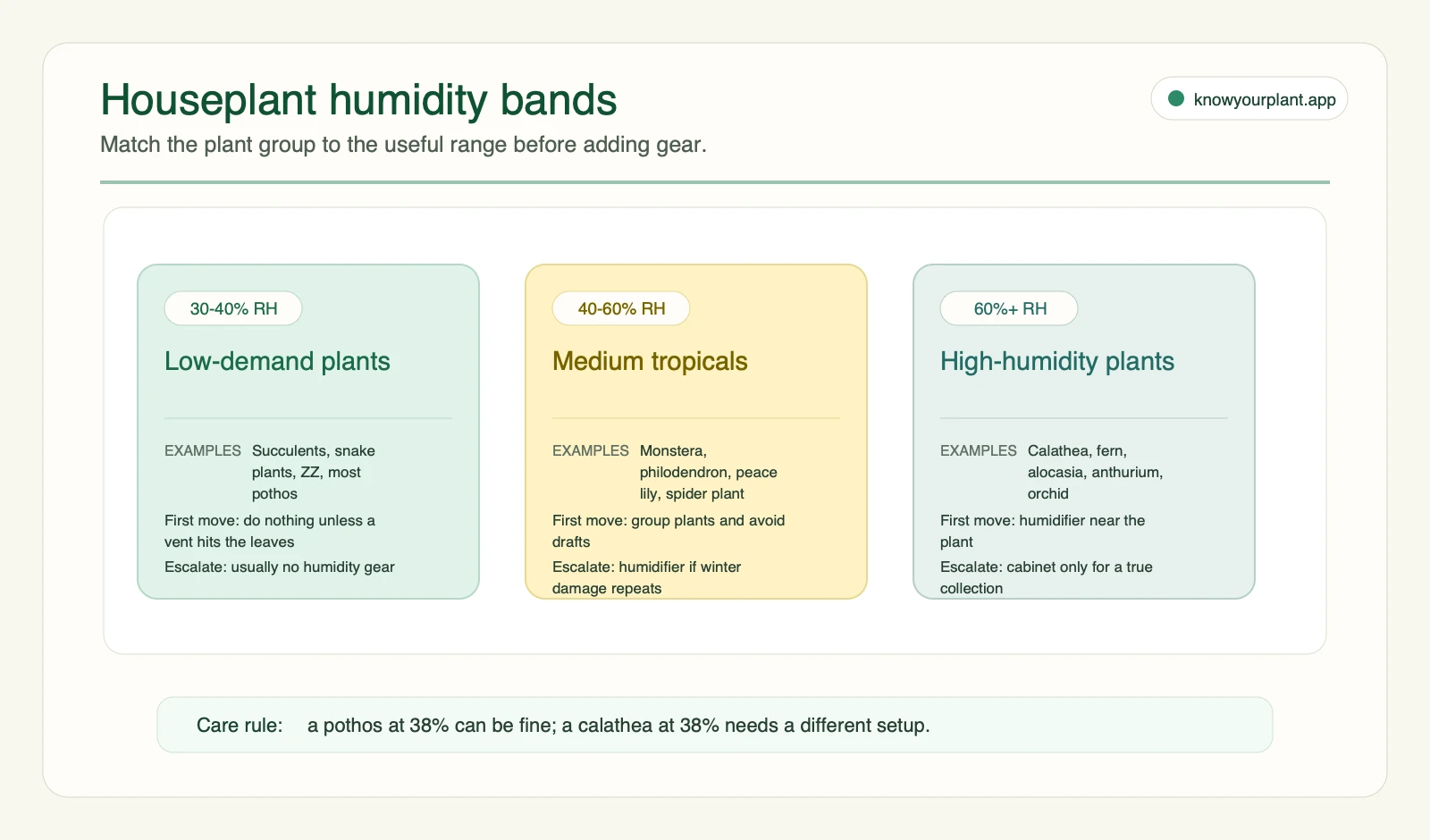
Use these care cards to decide whether the plant actually needs humidity support before adding trays, cabinets, or a humidifier.
Lookalikes, or Problems Confused With Low Humidity
| What you see | Often blamed on humidity | Check first |
|---|---|---|
| Brown edges on calathea leaves | “The room is too dry” | Tap-water mineral buildup and overnight humidity drops |
| Crisping on only one side of the plant | “This species needs a humidifier” | A nearby vent, radiator, or drafty window |
| Dry tips on a pothos or bird of paradise | “All tropical plants need 60%+ humidity” | Inconsistent watering, salts, or normal wear on older leaves |
| Pebble tray with no visible improvement | “Pebble trays do not work at all” | Airflow may be too high for a tiny local effect to matter |
The big diagnostic mistake is treating every brown edge like a pure humidity number problem. The forum cases reviewed for this article kept repeating the same lesson: dry air is one variable, not the only one.
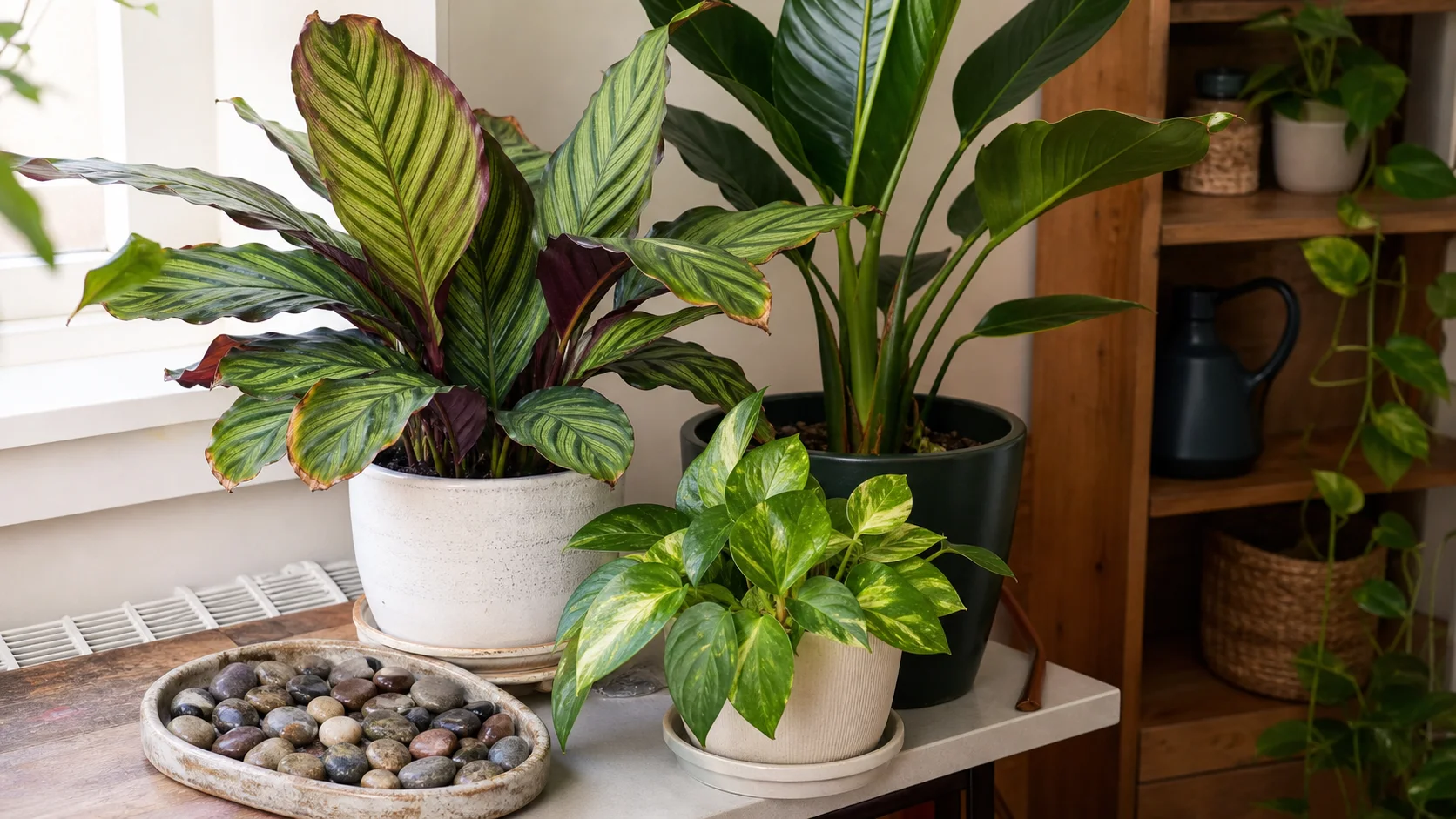
A nearby heat vent, dry pebble tray, and species-specific leaf damage can mimic a whole-room humidity problem.
The Overnight Drop That Most Guides Don’t Mention
Here is where most humidity advice falls short: guides talk about what your humidity reading should be. They almost never talk about when it matters most.
If you run a humidifier during the day but heating runs at full power overnight, local humidity can drop by 20 to 30 points while the plant sits in the dark. A plant that reads 55% in the afternoon may be breathing 28% air by early morning, every night through the whole winter. That repeated overnight stress explains why some calatheas and ferns keep crisping even when the daytime number looks acceptable – and why “I’m already running a humidifier” sometimes doesn’t stop the damage.
Most standard hygrometers show the current reading or a daily average. Look for the overnight minimum instead. If you see a 20-point drop between what you check at noon and what you see at 7am, that is the actual story. A humidifier on a timer that switches off at bedtime defeats itself in this exact way.
This is one of the more common reasons calathea owners stay stuck even after doing everything the articles suggest.
Method Comparison: What Actually Works
There is a real difference between raising humidity across the whole room and creating a small local microclimate around the plant. Most methods only do the second thing. That is still useful, but knowing what you are getting helps you choose the right tool.
| Method | Room-level impact | Local microclimate | Maintenance | Mold risk | Best for |
|---|---|---|---|---|---|
| Humidifier near plants | High | High | Medium | Low to medium | High-humidity plants, winter months |
| Grouping plants | None | Moderate | Low | Low | Medium-humidity collections |
| Pebble tray | None | Low to moderate | Low | Low | Single sensitive plants in still air |
| Bathroom or kitchen | Moderate (natural) | High | None | Low | Ferns, orchids, low-light calatheas |
| Cloche or cabinet | None | Very high | Medium to high | Medium to high | Rare aroids, one to two specimens |
| Misting | None | A few minutes only | High (daily) | Low | Not reliable as a humidity strategy |
| Moving away from vent | Not applicable | Not applicable | None | None | Most crispy-tip problems |
Penn State Extension confirms that misting raises humidity only until the water evaporates, and that wet pebble trays make almost no measurable impact on overall room relative humidity. University of Maryland Extension recommends grouping plants and using a humidifier near them as the most reliable approaches for meaningfully raising moisture in a plant’s immediate area.
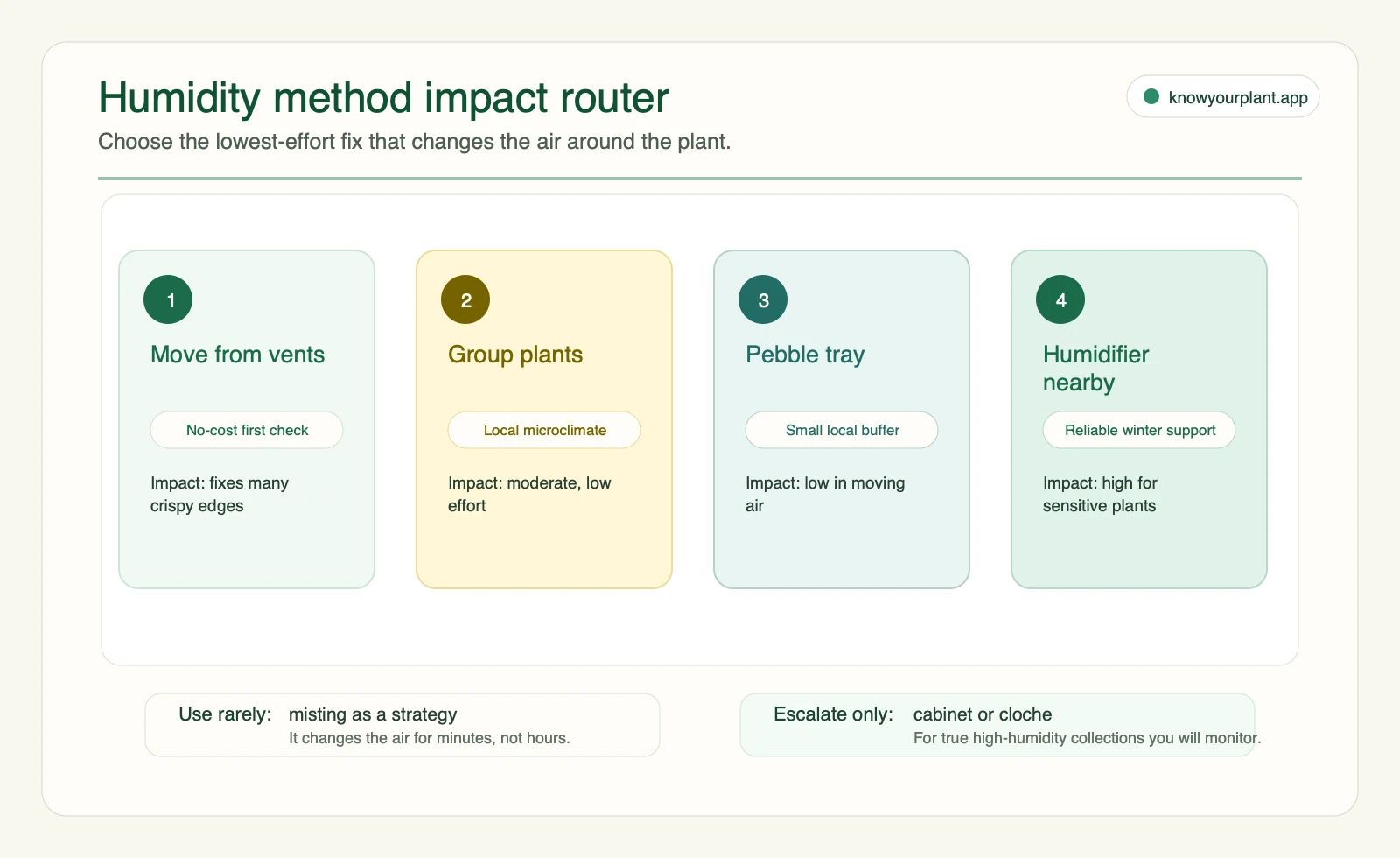
Use this method router to choose the lowest-effort option that changes the air around the plant instead of relying on misting as a daily ritual.
Expert Note
Penn State Extension says misting only raises humidity until the water evaporates, which is why it feels active but rarely fixes a stressed calathea. University of New Hampshire Extension says a portable humidifier near the plants creates the biggest real benefit, while grouping plants and pebble trays offer smaller local gains. That is the cleanest evidence-based order to follow: remove drafts first, then choose the least complicated humidity support that fits the plant.
7 Ways to Raise Humidity for Plants Indoors
A Humidifier Near the Plants
For high-humidity plants, this is the most reliable method by a wide margin. A small ultrasonic humidifier placed within one to two metres of the plants – not across the room – raises local moisture in a way other methods cannot match. Placement matters more than the specific device. Run it during the day and let the area breathe a little overnight to reduce mold risk at the soil surface. If you notice the plant still crisping despite daily use, check the overnight minimum on your hygrometer before assuming the device is not doing its job.
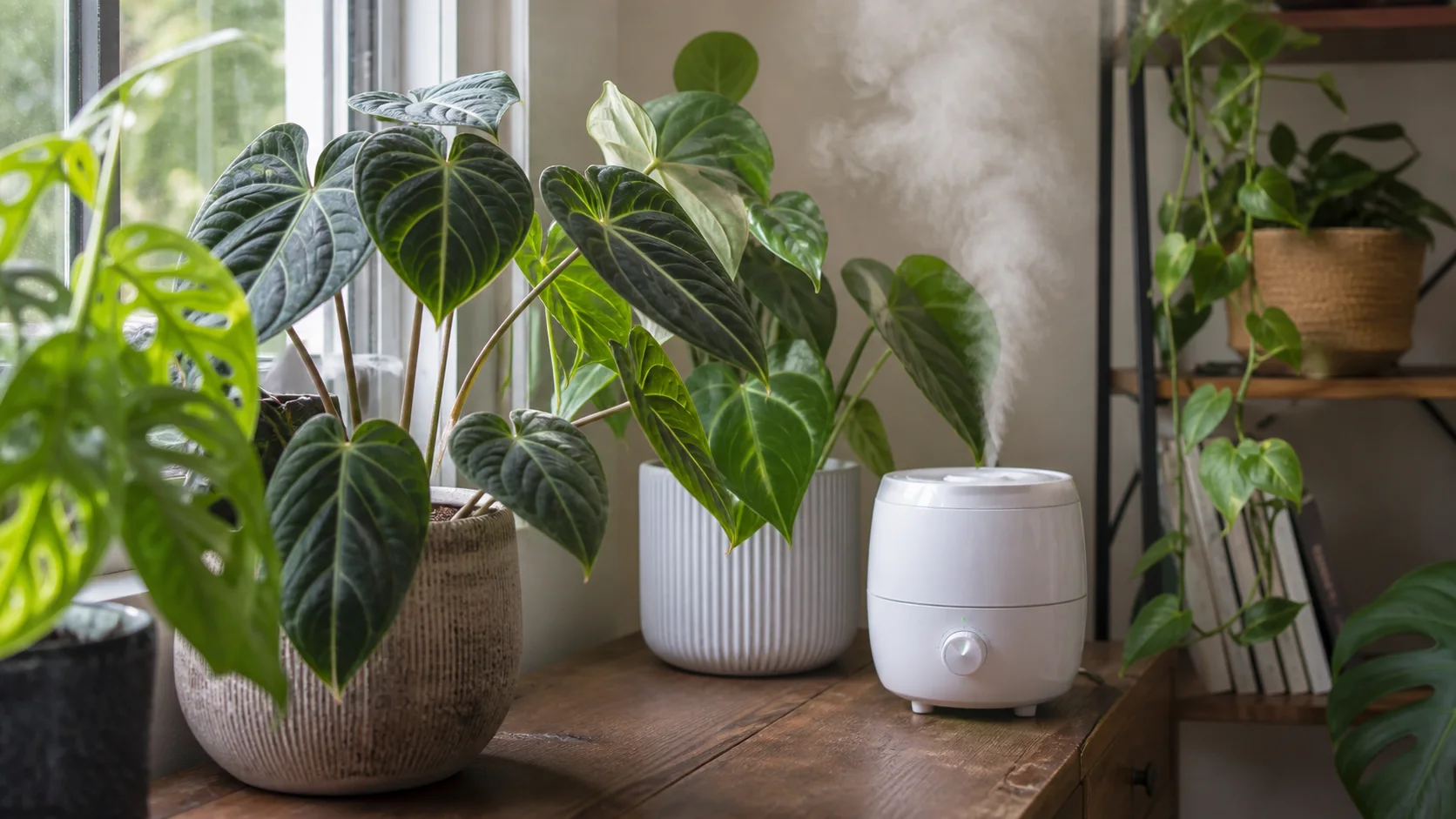
A nearby humidifier creates a useful local microclimate for anthuriums and other humidity-demanding aroids.
Group Plants Together
Plants release moisture through their leaves as they breathe, a process called transpiration. Grouping several plants together builds a shared pocket of more humid air between them. A cluster of five or six plants generates a noticeably more stable local microclimate than the same plants spread individually around a room. This will not dramatically shift the whole room’s reading, but it creates a real and low-effort improvement for medium-humidity collections.
A Pebble Tray with Water
Fill a shallow tray with small stones, add water so it sits just below the top of the stones, then set the pot on top so drainage holes are not submerged. As the water evaporates, moisture rises around the plant. The effect is real in a still corner with low airflow, and minimal in a well-ventilated room. Works best as part of a plant cluster rather than as a standalone solution.
Move Them Away from Vents and Drafts
This is not adding humidity, but it may be the single most useful step on this list for most plants showing crispy edges. Hot air from a heating vent strips moisture from leaves directly and fast. Cold drafts from single-pane windows stress foliage and accelerate water loss. Moving a sensitive plant two or three feet from these sources often resolves what looked like a humidity problem – without any other change.
A Naturally Humid Room
Bathrooms and kitchens generate humidity as a byproduct of daily life. If the light works for the plant, the bathroom is a genuinely good microclimate for ferns, pothos, orchids, and low-light calatheas. Our guide to best plants for bathrooms covers which species actually thrive in there. No equipment, no maintenance – just a spot that naturally supports what the plant wants.
A Cloche or Enclosed Cabinet
For plants that genuinely need very high humidity – rare aroids, delicate ferns, anthuriums – an enclosed glass cloche or plant cabinet traps moisture effectively. It works well for one or two small specimens. For larger setups, managing airflow to prevent mold becomes an ongoing task that requires fans, regular wiping, and monitoring. Worth it for a dedicated collection; too high-maintenance if you want low-effort care.
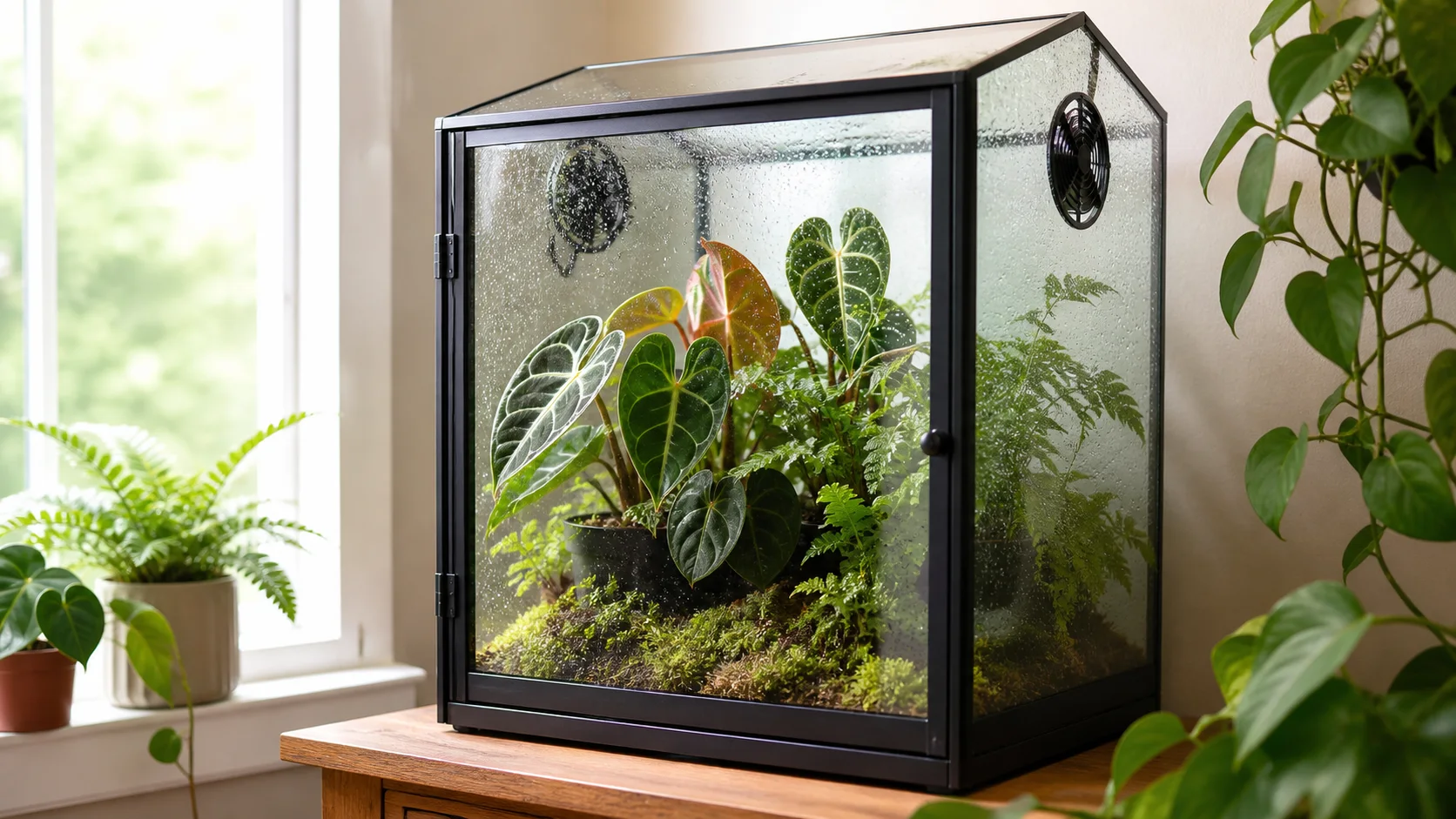
A ventilated glass cabinet holds moisture around rare aroids and ferns while making condensation and airflow management visible.
Misting
Misting raises humidity for a few minutes, then conditions return to where they were. It can briefly refresh dusty leaf surfaces and provide momentary moisture to aerial roots. As a standalone humidity strategy, it won’t hold. If you have been misting consistently and still see leaf-edge damage, this is why. Use it as an occasional refresh, not as your main approach.
Is Low Humidity Actually the Problem? A Quick Checklist
Work through this before changing your setup:
- Check placement first. Is the plant near a vent, radiator, or drafty window? That is the most common cause of dry leaf tips that get blamed on humidity.
- Check watering depth. Is the root ball getting wet all the way through, or are you wetting the top few centimetres repeatedly? Shallow watering produces the same crispy-edge symptoms as low humidity.
- Consider your water source. Calatheas and prayer plants react visibly to fluoride and mineral salts in tap water. Switching to filtered or distilled water often helps more than raising humidity does.
- Know your plant’s category. If it is a pothos, snake plant, or ZZ plant, it probably does not need humidity intervention at all.
- Check the overnight minimum. If you have a hygrometer, look at the overnight reading, not just the afternoon number. A 20-point overnight drop is stressful even if the daytime reading looks acceptable.
If none of those checks explain the symptoms and the plant genuinely belongs in the high-humidity category, start with grouping plants and moving them to a lower-airflow spot. If that is not enough after a few weeks, a small humidifier near the plants is the straightforward next step.
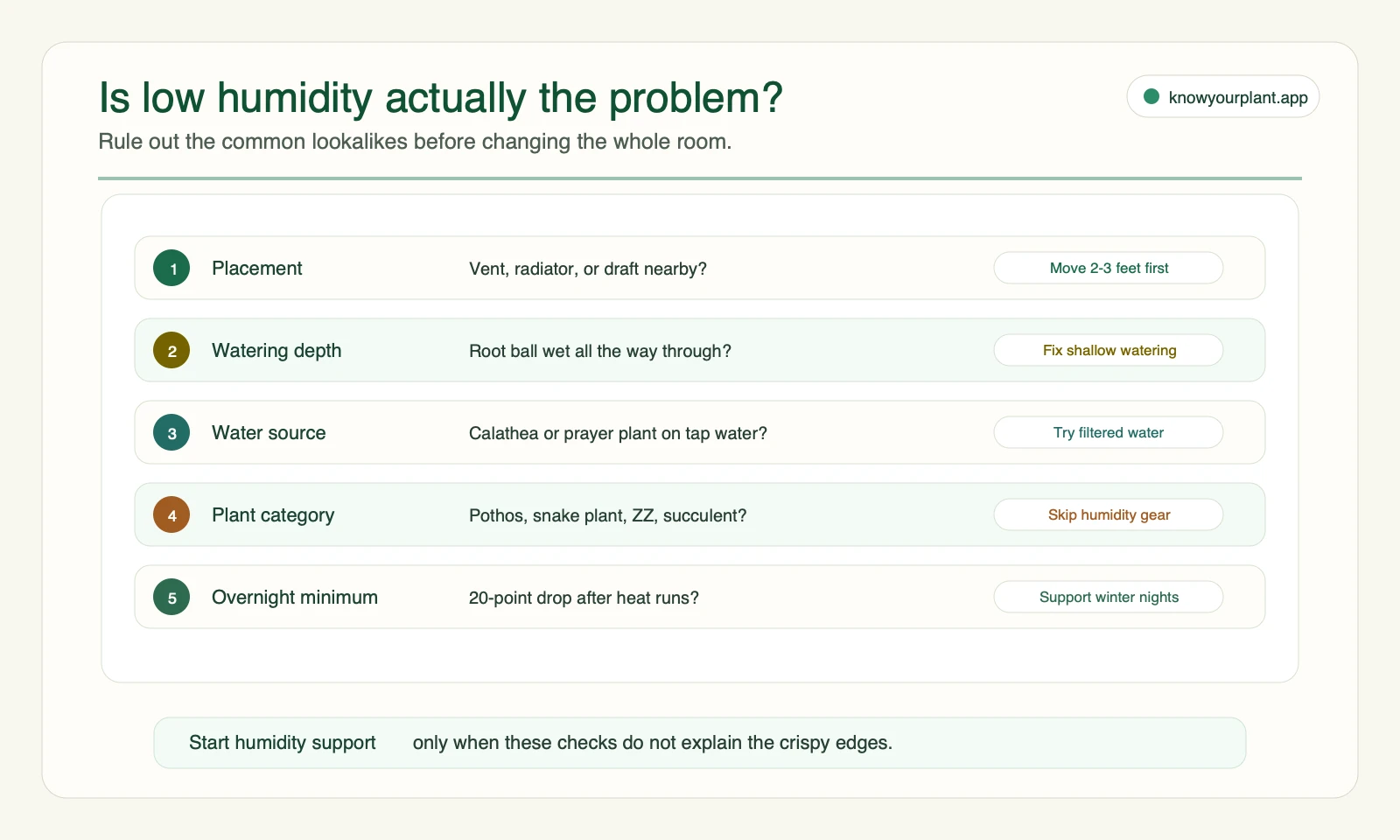
Use this checklist before changing the room so drafts, shallow watering, tap-water salts, plant type, and overnight humidity drops are ruled out first.
Common Problems
“My plant still has crispy edges at 50 to 55% humidity.”
Check the overnight minimum, not just the afternoon reading. A plant can spend the day around 55% and still drop into stressful air overnight when heating runs. Also rule out tap-water salts and uneven root-ball moisture before you assume the humidifier failed.
“I added a pebble tray and nothing changed.”
That does not mean you did it wrong. Pebble trays create a very small local effect and work best in still air, close to the foliage, and usually as part of a grouped setup rather than as a standalone fix.
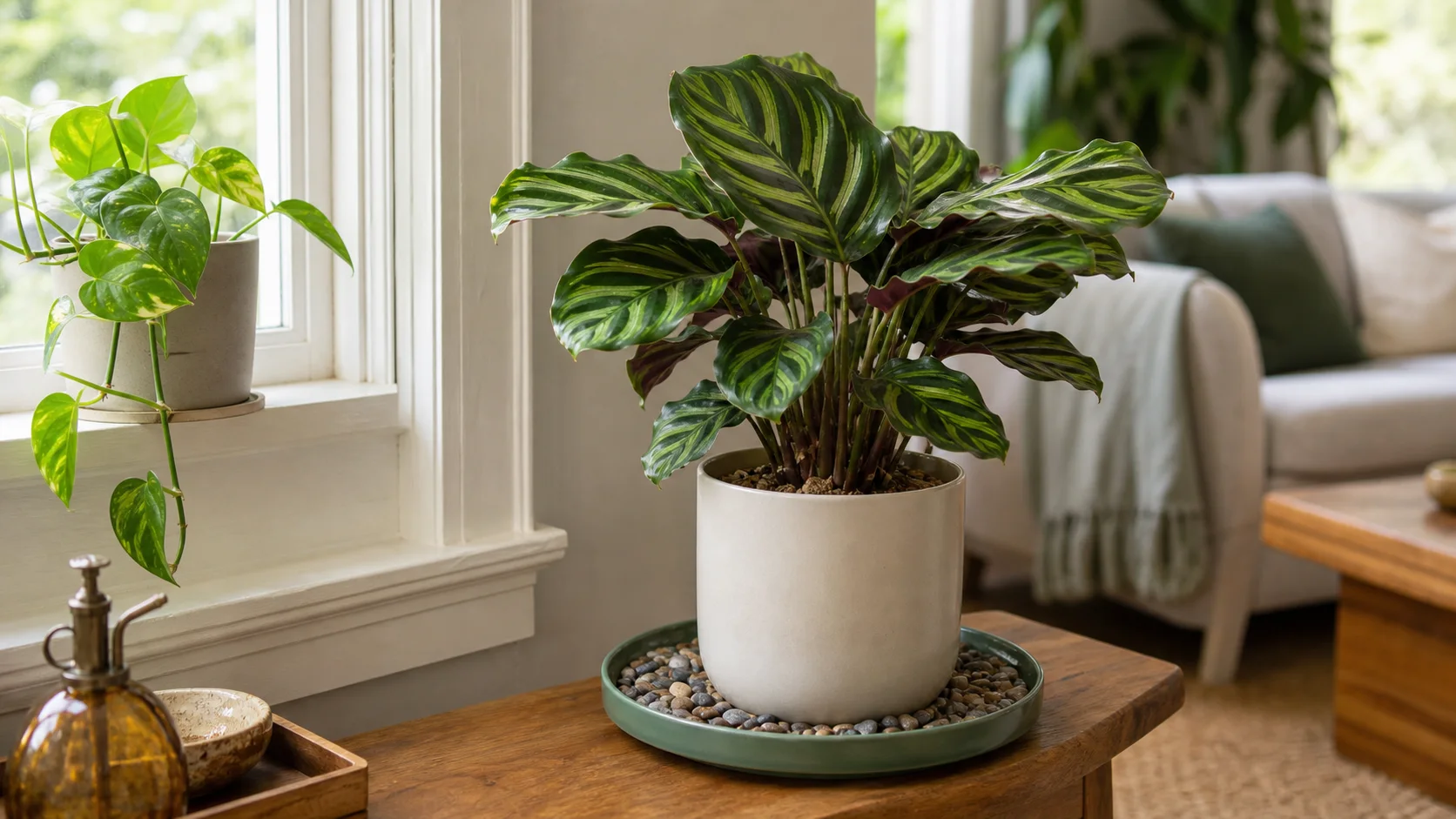
A pebble tray beneath one calathea creates only a small local effect, especially when the surrounding plants are not closely grouped.
“Only one plant in the room is struggling.”
That usually points to plant type, placement, or watering rather than a whole-room emergency. A calathea may complain at 38% humidity while a pothos beside it stays fine.
Pet Safety
Humidity changes the air around a plant, not the plant’s inherent toxicity. If pets share the room, treat humidity support and pet safety as two separate checks. Choose the simplest setup that solves the plant problem first, then verify the plant itself is appropriate for a pet-accessible space before you add more humidity-loving species to that room.
A Seasonal Note
Most humidity problems are not year-round problems. They are winter problems.
Summer air in most climates naturally sits closer to what tropical plants want. The shift happens when central heating turns on in autumn. Penn State Extension notes that winter heating can push indoor air below 30%, drier than many desert regions. That is when crispy edges appear on plants that were perfectly fine through the warmer months, and owners assume they have a chronic problem rather than a seasonal one.
If you have limited time or budget for humidity management, focus it on the heating months. Running a humidifier near sensitive plants from October through March will do more than anything applied evenly across all twelve months.
For a related hands-on growing walkthrough, use Humidifier for Plants: When It Helps, Where to Put It, and Risks for the setup and follow-up care.
Real User FAQ
These are based on recurring plant-owner questions surfaced in live forum reviews for this article. They are useful diagnosis patterns, not controlled trials.
My calathea still crisps even though the hygrometer says 50 to 55%. What else should I check?
Check for overnight drops, dry HVAC airflow, mineral-heavy tap water, and whether the root ball is drying unevenly between waterings. Those were the biggest repeat explanations in real owner threads.
Is a humidity cabinet worth it, or is it just more maintenance?
It is worth it for a true high-humidity collection, not for plants that already cope with normal room air. Owners who like cabinets usually accept the extra fans, wiping, cable management, and mold prevention work.
My bird of paradise has split leaves and brown edges. Is that automatically a humidity problem?
No. Some splitting is normal, and brown edges can also come from watering inconsistency, salts, leaf handling, or the plant rubbing a wall or window. Humidity can contribute, but it is not the only suspect.
Methodology
This article was checked against live search results and extension guidance on 2026-05-18. We reviewed the primary keyword and close variants to see where the SERP was mixing plant care with generic weather or shopping intent, then used plant-forum discussions to surface recurring owner confusion around misting, cabinets, drafts, salts, and overnight humidity swings. Factual care guidance was verified against Penn State Extension, University of Maryland Extension, University of New Hampshire Extension, and Nebraska Extension. Forum posts were treated as qualitative signal, not scientific proof.
Frequently Asked Questions
What humidity level do houseplants actually need?
Most popular houseplants are comfortable at 40-60% relative humidity. Common tropicals like monstera, pothos, and philodendron handle typical home air without much trouble. Truly high-humidity species such as calatheas, alocasias, anthuriums, and most ferns prefer 60-80%, according to University of New Hampshire Extension. The average home sits between 30 and 50%, which is fine for most plants but a genuine shortfall for the more demanding ones.
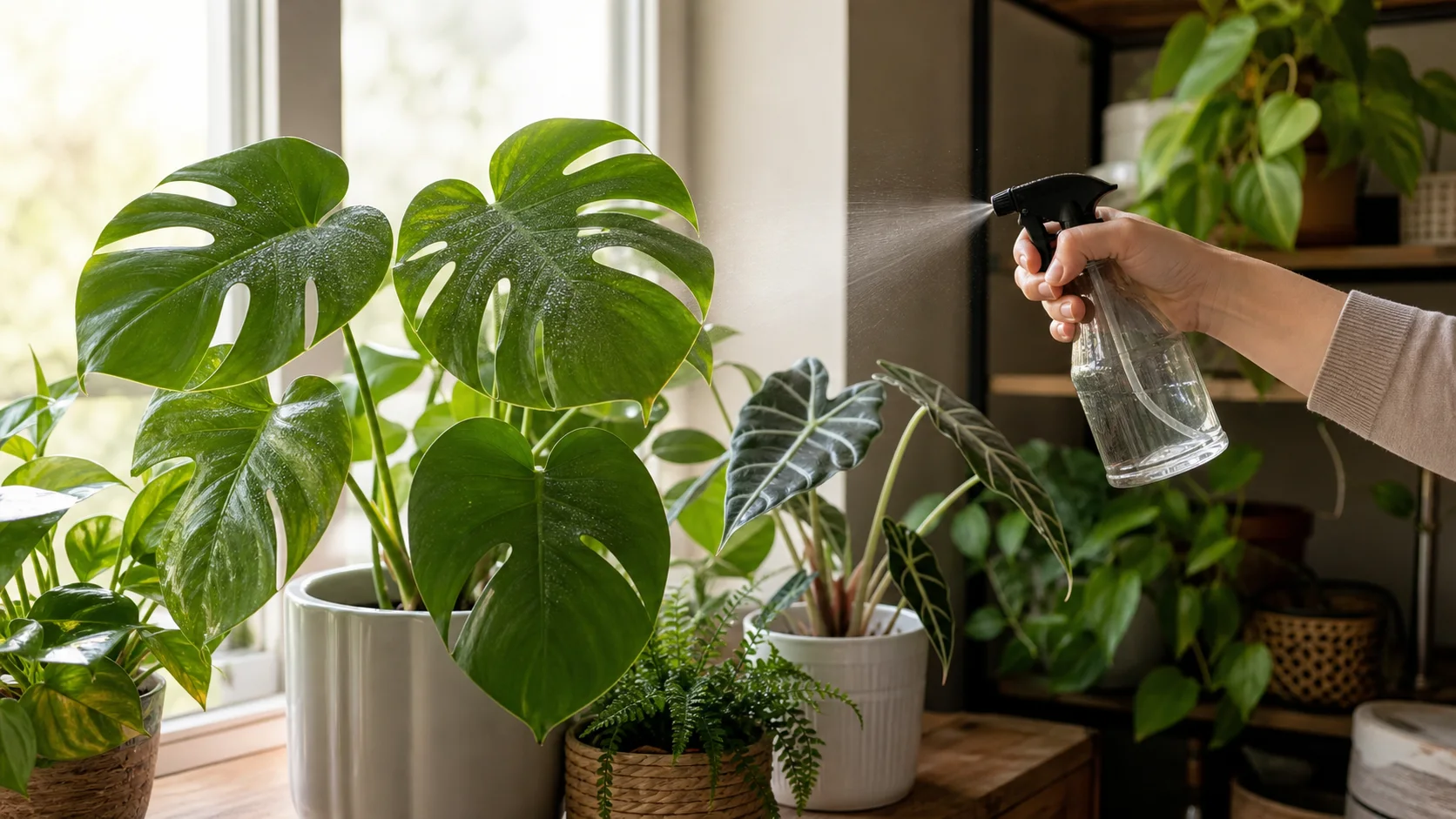
Misting briefly wets a mixed tropical collection, but it does not hold the higher humidity that sensitive alocasias and ferns need.
Does misting actually help with humidity?
For a few minutes, yes. After the water evaporates, the ambient humidity returns to what it was before. Penn State Extension confirms that misting only raises humidity until the water evaporates, which means it is not a reliable strategy for sensitive plants. It is not harmful, but do not count on it to resolve brown tips on a calathea or prayer plant.
Why does my calathea still have brown tips even though I use a humidifier?
A few things are worth checking. First, placement: a humidifier on the other side of the room delivers much less benefit than one within a metre or two of the plant. Second, water source: calatheas react visibly to fluoride and mineral salts in tap water, and the brown tip pattern from salt buildup looks nearly identical to low-humidity damage. Third, overnight readings: if the humidifier runs during the day but the room drops sharply at night, the plant experiences real stress during its rest hours even when the daytime reading looks fine.
What is the easiest way to raise humidity without buying anything?
Group your plants together. Transpiration from clustered plants builds a real microclimate of more stable, slightly higher moisture around all of them. Moving sensitive plants to a bathroom or kitchen costs nothing and takes advantage of naturally higher moisture from daily use. And if a heating vent or drafty window is nearby, moving the plant a few feet away often solves what looked like a humidity problem without any other change.
Are pebble trays worth it?
They create a real local effect immediately around the plant, but don’t raise whole-room humidity in any meaningful way. Penn State Extension notes that wet pebble trays make almost no measurable impact on overall room relative humidity. As part of a plant cluster in a low-airflow corner, they add something. As a standalone solution in a well-ventilated room, the effect is minimal.
Which houseplants handle low humidity well?
Snake plants, ZZ plants, succulents, cacti, and most pothos varieties are comfortable at 30-40% humidity. These plants adapted to drier conditions and do not need humidity support. If your home runs dry in winter but you mostly grow these species, you can largely ignore humidity as a care variable.
Should I worry more about humidity in winter than summer?
Yes, significantly more. When central heating runs consistently, indoor humidity can fall below 30%. Summer air in most climates is naturally closer to what tropical plants want. The shift from summer to winter heating is when most humidity-related leaf damage appears, particularly on plants that were doing fine all year up to that point.
Sources: Penn State Extension, Humidity and Houseplants; University of New Hampshire Extension, How can I increase humidity indoors for my houseplants (January 2025); Nebraska Extension in Lancaster County, Success with Houseplants – Humidity; University of Maryland Extension, Temperature and Humidity for Indoor Plants.