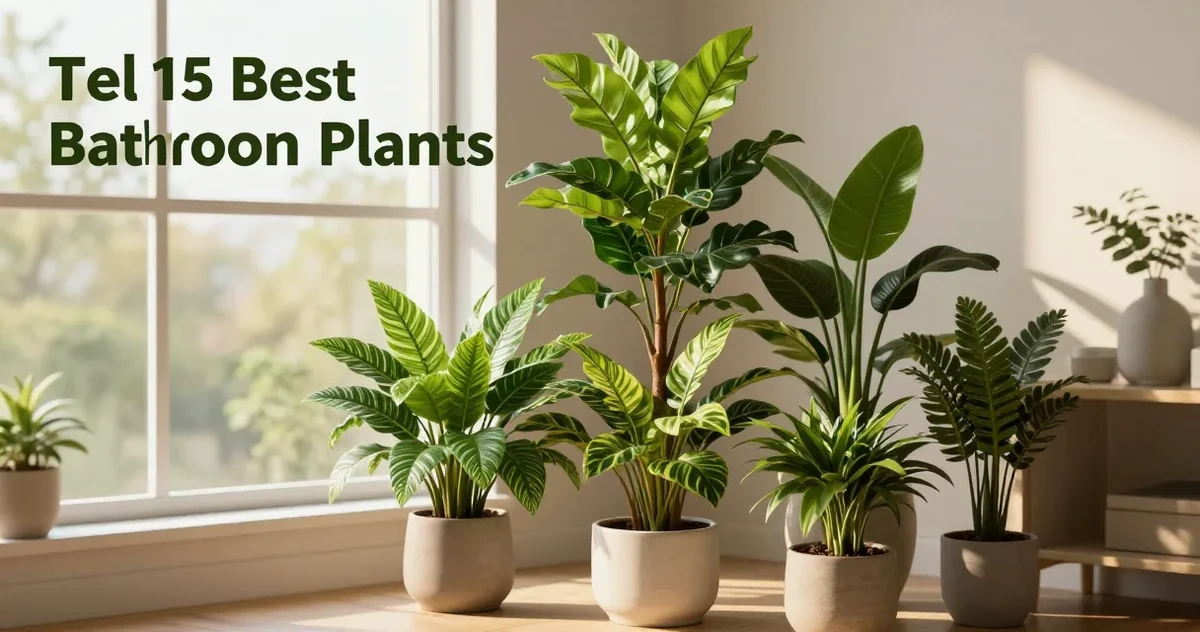
Best Bathroom and Shower Plants: Quick Picks
Choose by usable light first, then by splash exposure and how quickly the pot dries.
| Bathroom setup | Best starting choices | Main check |
|---|---|---|
| Bright window | Boston fern, calathea, orchid | Keep leaves out of harsh direct sun and give the pot drainage |
| Frosted or medium-light window | Pothos, heartleaf philodendron, spider plant, peace lily | Check below the surface because humid rooms may slow dry-down |
| Windowless with a grow light | Snake plant, ZZ plant, cast iron plant | Use a timer and adjust the fixture from new-growth signals |
| Shower shelf or splash-prone ledge | Air plant, or pothos in a draining pot | Avoid standing water and water trapped in leaf crowns |
| No window and no grow light | Preserved moss, faux greenery, or temporary plant rotation | Humidity cannot replace usable light |
What native-climate records add to a bathroom shortlist
A steamy bathroom is not automatically bright, and humidity alone does not make every plant a match. These records compare four moisture-loving candidates without turning outdoor climate into an indoor watering schedule.
The ranges below are the middle 50% (p25–p75), not recommended indoor setpoints.
| Reference taxon | POWO native range | Annual mean temperature | Annual precipitation | Relative humidity | Solar radiation | Evidence |
|---|---|---|---|---|---|---|
| Spathiphyllum wallisii (peace lily) | Colombia to Venezuela | 18.8–20.7°C | 2102–3281 mm/yr | 67–68% | 16.7–18.3 MJ/m²/day | 10 climate points; low confidence |
| Goeppertia orbifolia (calathea orbifolia) | eastern Brazil | 22.8–24.6°C | 1370–1870 mm/yr | 66–69% | 17.2–18.2 MJ/m²/day | 12 climate points; low confidence |
| Maranta leuconeura (prayer plant) | central and eastern Brazil | 20.9–23.1°C | 1332–1606 mm/yr | 60–65% | 16.9–18.1 MJ/m²/day | 30 climate points / 154 usable records; medium confidence |
| Epipremnum aureum (golden pothos) | Mo’orea in the Society Islands | 25.7–25.9°C | 2451–2644 mm/yr | 63–64% | 20.0–20.1 MJ/m²/day | 6 climate points; low confidence |
What this changes in this guide: Choose by light first, then use the climate ranges to understand why stale wet soil and low light remain risky even for plants associated with humid habitats.
Sources and method: Spathiphyllum wallisii in POWO and GBIF; Goeppertia orbifolia in POWO and GBIF; Maranta leuconeura in POWO and GBIF; Epipremnum aureum in POWO and GBIF; CHELSA V2.1, 1981–2010. GBIF records are limited to POWO-native countries, then filtered for coordinates, establishment signal, licence, precision, and spatial duplication. No community or user-reported care data is used in this module.
Why the Bathroom Is Actually a Great Place for Plants
The best bathroom plant is not just the prettiest one on a list. It is the one that matches your light, your watering habits, and how steamy the room gets after showers. A bright bathroom and a windowless powder room can both work, but they need very different plants.
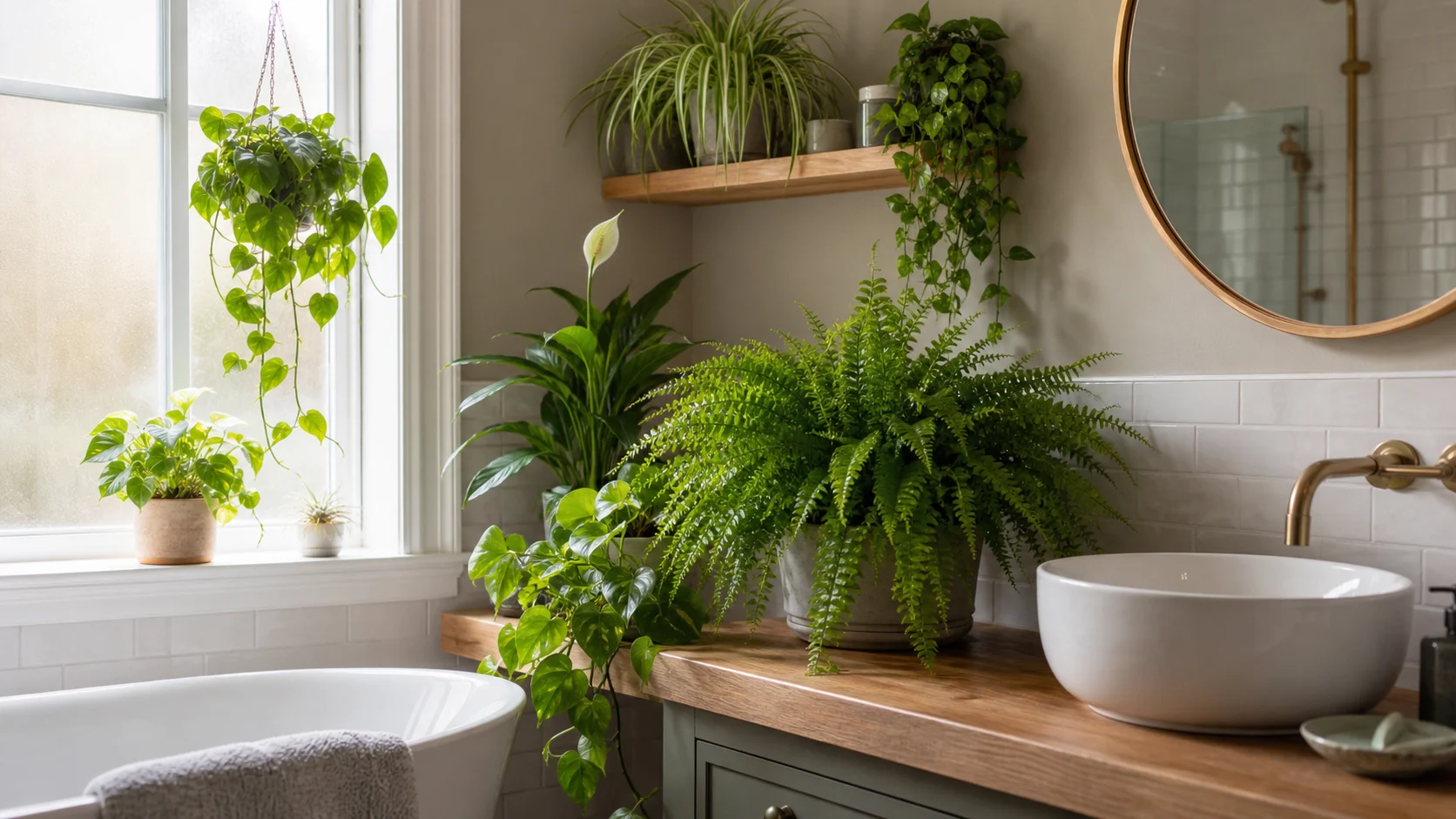
A bright, humid bathroom supports moisture-loving ferns alongside forgiving pothos, spider plant, and peace lily.
Think of the bathroom as a small humidity boost, not a magic fix. Steam from the shower, warm air, and moisture hanging in the air help tropical foliage stay fuller and less crispy. According to NC State Extension, most tropical houseplants prefer relative humidity between 40% and 60%. After a shower, bathroom humidity routinely climbs to 80-100%. That can help plants that struggle in dry indoor air, but they still need the right light and a pot that drains.
The key is matching the right plant to your specific bathroom before you buy it. A bright, south-facing bathroom with a big window is a very different space from a windowless powder room with a single overhead bulb. Both can support plants, you just need to choose for the room you actually have. If your bathroom has no windows at all, jump straight to the no-light section. If you are willing to add a grow light, you can safely expand your options.
What Plant Owners Keep Running Into in Real Bathrooms
The recurring mistake in plant-owner discussions is treating low light and no usable light as the same thing. They are not. A frosted window, a small east-facing window, or a bathroom next to a bright hall can still work for tolerant plants. A truly windowless bathroom with only a standard ceiling bulb is different. In that setup, even tough plants usually need a grow light or rotation time in a brighter room to stay healthy long term.
The second pattern is overwatering. In a humid bathroom, potting mix dries more slowly, especially for plants tucked into corners with weak airflow. That means a plant can like steam and still rot if the soil stays wet too long. If you remember only one rule from this guide, make it this: choose by light first, then humidity, then watering risk.
Expert note
Penn State Extension notes that many houseplants appreciate higher humidity than heated homes usually provide, while bathroom-plant guides from Garden Design and Lowe’s still sort recommendations by window conditions because humidity does not replace light. That is why this guide treats steam as a bonus, not a substitute for usable plant light.
What Most Plant Roundups Miss
Most roundups about bathroom Plants for Every Light list attractive options. The better question is which choice will still make sense in your actual room three months from now.
Use this filter before choosing:
- Light reality: what the plant receives on a normal cloudy day, not the brightest hour of the week.
- Care rhythm: whether you prefer weekly attention or a plant that can be ignored longer.
- Space: mature height, spread, trailing habit, and whether leaves will touch walls or pets.
- Failure signal: what the plant does first when the match is wrong: yellowing, stretching, crisping, or dropping leaves.
A good recommendation is not just beautiful. It fits the room, the owner, and the first problem you are likely to notice.
Bathroom Plant Fit Scoring Rubric
This scoring rubric keeps the room, not the prettiest plant, at the center of the decision. Score each candidate plant from 1 to 3 in each category before you buy it.
| Factor | 1 | 2 | 3 |
|---|---|---|---|
| Light tolerance | Needs bright indirect light to stay attractive | Accepts medium light or a frosted window | Holds steady in low light or under a small grow light |
| Humidity affinity | Humidity is only a small bonus | Likes humidity but can live elsewhere | Clearly improves with steam and bathroom moisture |
| Watering forgiveness | Sulks quickly if you miss the window | Moderately forgiving | Recovers well and dislikes being fussed over |
| Shower-splash tolerance | Rot risk if leaves or crown stay wet | Fine near steam, not direct spray | Can handle occasional splash if drainage is excellent |
| Pet-safety risk | Toxic if chewed | Mild concern or mixed household fit | Safer choice for homes with plant-chewing pets |
| Failure signal clarity | Decline is subtle and easy to miss | Mixed signals | Gives obvious early warnings like curl, droop, or stretch |
A strong bathroom candidate usually scores highest on light tolerance, humidity affinity, and failure-signal clarity. Humidity helps, but it never cancels out a light mismatch.
Best for / Not For Quick Matrix
| Bathroom profile | Best for | Not for | Why |
|---|---|---|---|
| Bright bathroom with a real window | Boston fern, calathea, orchid, bird of paradise | Snake plant or ZZ plant if you want active growth from that window | These humidity-lovers can actually use the extra light instead of just surviving it |
| Frosted or medium-light bathroom | Peace lily, Chinese evergreen, pothos, heartleaf philodendron | Cactus, succulents, or anything that wants direct sun | Softer light works when the plant already tolerates lower-light indoor conditions |
| Shower shelf with regular splash | Air plants, pothos in a draining pot, spider plant hung nearby | Orchids with water trapped in the crown, heavy cachepots with no drainage | Splash and trapped water matter more here than headline humidity |
| No window, but you will add a grow light or rotate plants | Snake plant, ZZ plant, cast iron plant, lucky bamboo | Boston fern or calathea as permanent residents | Tougher plants hold steady here; thirstier foliage plants usually need rotation or stronger light |
| No window and no grow light | Preserved moss, faux greenery, or a very temporary plant rotation | Almost every conventional houseplant sold as a “bathroom plant” | This is the hard truth most listicles skip: humidity does not replace light |
Pros and Cons by Bathroom Type
Bright or windowed bathroom
Pros: Gives you the widest plant choice, better recovery after watering mistakes, and more active growth.
Cons: Ferns, calatheas, and orchids still need airflow and drainage, not just steam. Direct afternoon sun can also scorch softer leaves through glass.
Windowless bathroom with a grow light
Pros: Lets you keep tougher foliage plants alive without constant rotation and makes the room feel intentionally green instead of improvised.
Cons: You are still managing a piece of equipment, and the result depends on keeping the light on long enough each day.
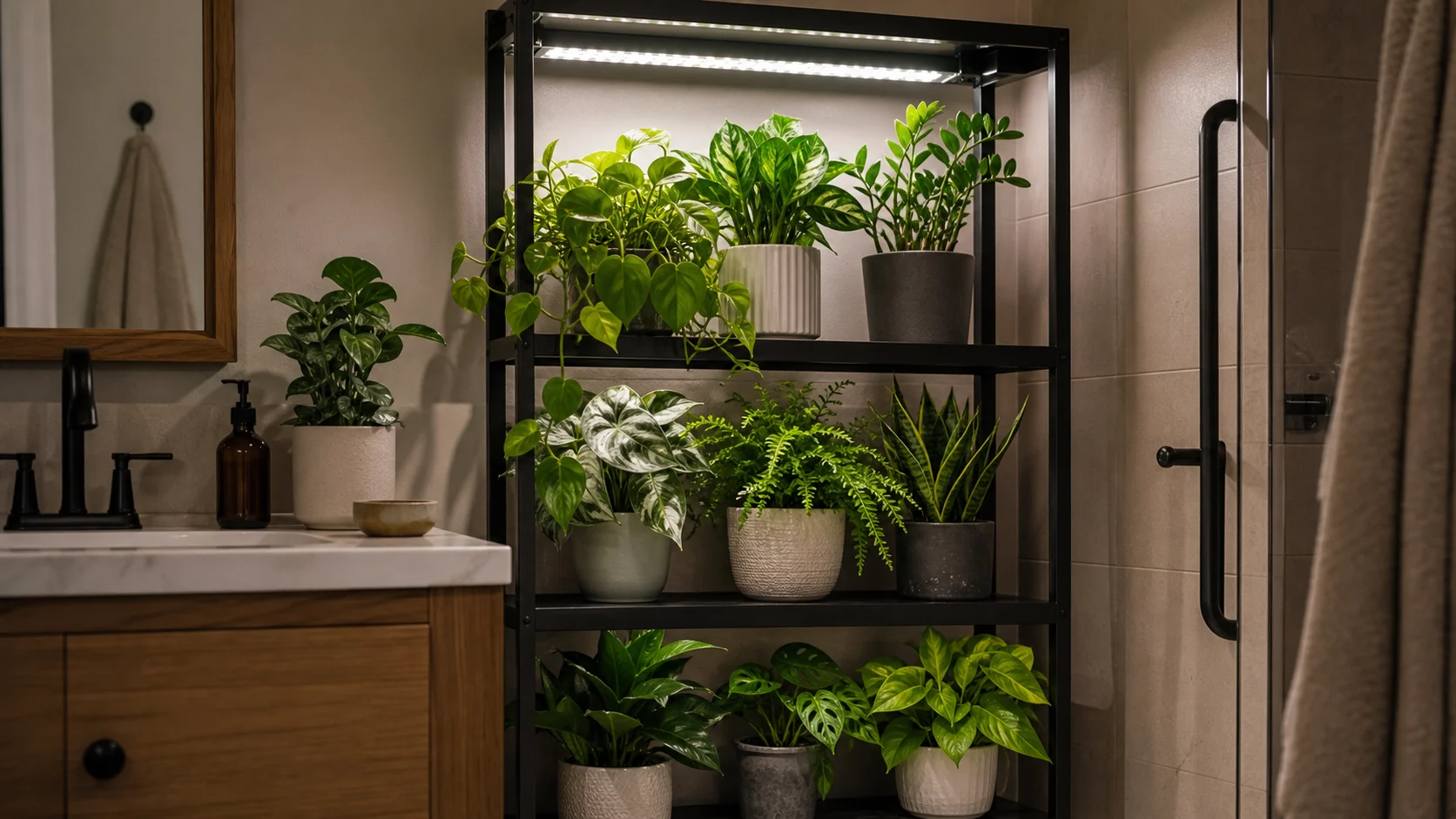
A dedicated overhead grow light keeps pothos, ZZ plant, snake plant, and other tolerant foliage stable in a windowless bathroom.
Windowless bathroom without a grow light
Pros: Lowest maintenance if you switch to preserved moss or faux greenery and stop fighting the room.
Cons: Most living plants slowly decline here, even if they are marketed as low-light. The usual failure pattern is stretched growth, soft yellowing, or long-term stalling.
Shower-shelf placement
Pros: Air plants and a few trailing species make dramatic use of steam and vertical space.
Cons: Standing water, poor drainage, and splash trapped in leaf crowns can rot a good plant faster than dry air ever would.
Bathroom Plant Decision Tree
Use this before you buy anything:
- Do you have natural light or a grow light? If no, skip straight to preserved moss, faux greenery, or a plan to add a grow light.
- Will the potting mix dry within a reasonable time? If your bathroom stays damp for days, lean toward snake plant, ZZ plant, cast iron plant, or lucky bamboo instead of thirstier ferns and calatheas.
- Is the plant safe for pets, or will it stay out of reach? This matters more than people expect once trailing plants start hanging lower.
- Does the plant prefer humidity, merely tolerate it, or resent wet roots? Choose humidity-lovers for bright bathrooms and forgiving survivors for darker ones.
If you cannot answer yes to step one, the honest move is not a more “low-light” plant. It is changing the setup.
Bathroom Plants for Bright or Medium Light
These plants do best with natural light. Even a frosted window makes a real difference for them.
1. Bird of Paradise
Bold and upright, bird of paradise loves humidity and rewards a bright bathroom with strong, steady growth. Give her a spot near a window and she’ll fill a corner nicely over time. Keep the soil consistently moist but not waterlogged, and wipe her large leaves occasionally so they can breathe and take in the light properly. For placement and watering details, see our bird of paradise plant care guide.
2. Peace Lily
One of the few flowering plants that genuinely tolerates low light, peace lily is also a classic bathroom choice because she loves moisture in the air. She’ll let you know when she needs water: her leaves droop just slightly, then perk right back up after a drink. White blooms appear once or twice a year, often without any extra effort on your part.
University of Florida IFAS Extension notes that peace lily (Spathiphyllum) is among the most adaptable foliage plants for indoor low-light environments, tolerating as little as 75 foot-candles. That puts her in the running even for bathrooms with small or frosted windows.
3. Orchid
Orchids have a reputation for being finicky, but in a bathroom with good indirect light, they’re often happier than anywhere else in the house. The humidity mimics their natural habitat. Place her on a windowsill, water sparingly (once a week at most), and let the roots tell you when she’s thirsty: silvery-grey means dry, green means she’s fine. For more on what those roots are signaling, the orchid leaves turning yellow guide covers the signs worth watching.
4. Boston Fern
Boston fern was basically made for bathrooms. She craves exactly what most homes can’t provide: high humidity, consistent moisture, indirect light. A bathroom solves all three at once. Hang her from the ceiling near a window or set her on a shelf where she can trail. Check the soil every few days. She doesn’t like to fully dry out.
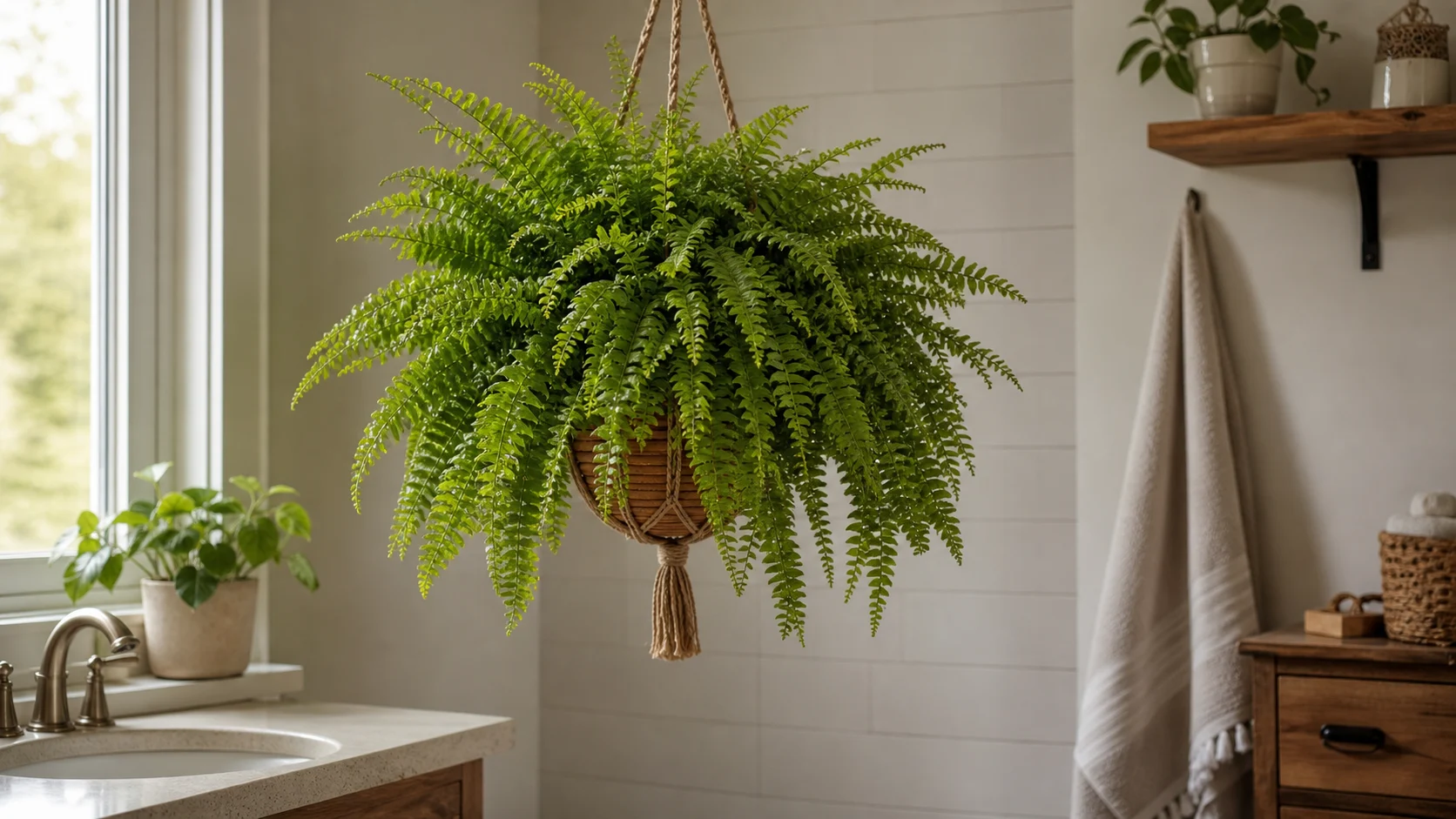
A hanging Boston fern gets the bright indirect light and humid air that keep its long fronds full.
5. Calathea
Calathea is particular about water quality and humidity, which makes her a better fit for the bathroom than most rooms. She reacts badly to tap water minerals and dry air: two problems bathrooms often solve naturally. Her patterned leaves show more variety than almost anything else you’ll find at a standard plant shop, and the way they fold up at night (a movement called nyctinasty) never gets old. If you’ve had calathea struggle elsewhere in the house, give her a try in the bathroom before giving up on her.
6. Chinese Evergreen
Chinese evergreen adapts well to the bathroom environment and tolerates lower light than most variegated plants. She’s easygoing about watering, handles temperature fluctuations without drama, and looks good in almost any style bathroom. If you want something reliable that still has visual interest, she’s a strong choice.
Shower Plants
These plants do particularly well mounted or hung near the shower, where they catch the most steam.
7. Pothos
Pothos is forgiving, fast-growing, and perfectly happy trailing down from a high shelf in a steamy bathroom. She tolerates a wide range of light conditions, from bright indirect to quite dim. Let the soil dry out between waterings. The humidity in the air will actually reduce how often she needs a drink. For a comparison of pothos varieties and which suits your conditions best, see the pothos varieties guide.
8. Heartleaf Philodendron
Very similar to pothos in what she needs, heartleaf philodendron is another reliable trailer for bathroom shelves. Her heart-shaped leaves catch the light nicely and she grows quickly enough that you’ll notice the progress week to week. Water when the top inch or two of soil is dry.
Not sure whether you have a pothos or a philodendron? The pothos vs. philodendron guide settles it clearly.
9. Air Plants (Tillandsia)
Air plants are a natural fit for the bathroom because they absorb moisture directly through their leaves. University of Florida IFAS Extension notes that Tillandsia species are among the most humidity-responsive plants available to home growers: in consistently humid environments, their need for supplemental watering drops significantly. In a steamy bathroom, you may barely need to water them at all. Mist occasionally and give them a longer soak once a week or so. They look good mounted on driftwood or displayed in small glass holders near the shower.
10. Spider Plant
Spider plant is hard to kill and loves humidity. She produces long arching leaves and eventually sends out spiderettes: little offshoots on long runners that you can pot up separately. Hang her from the ceiling in a bright-ish bathroom or set her on a high shelf. She’s a good choice if you want something lively and growing without much effort. If pet safety matters, pair this with our cat-safe indoor plants roundup.
Bathroom Plants for Very Low Light or a Grow-Light Setup
Low-light plants still need usable light. In a windowless bathroom, add a grow light on a timer or rotate a plant into the room temporarily; no living plant can remain healthy indefinitely in complete darkness.
The plants below tolerate very low light better than most, but dim conditions also slow growth and water use. Treat a grow light or a bright-room rotation as part of the setup rather than compensating with extra water.
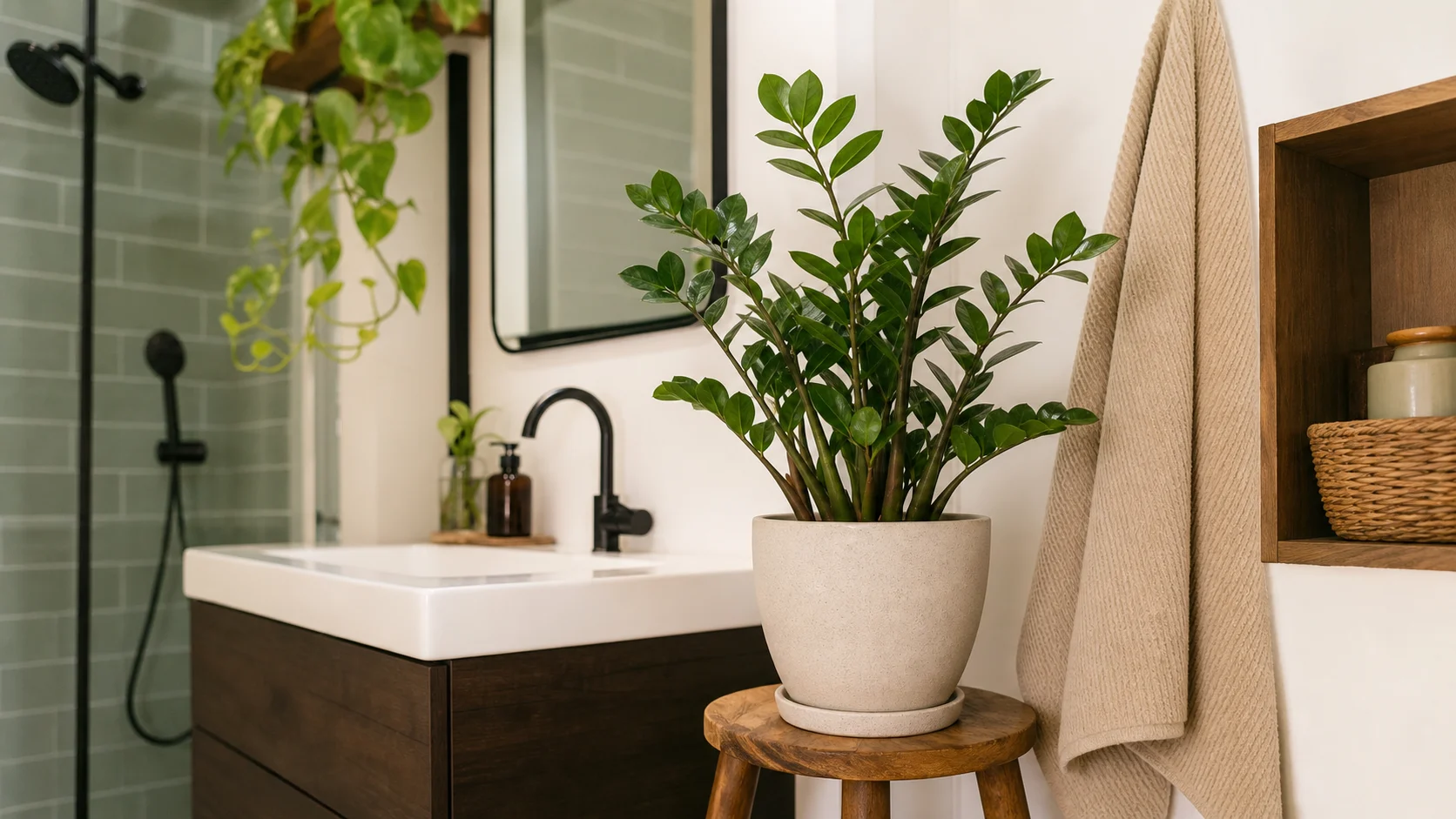
A sturdy ZZ plant can suit a very low-light bathroom when supplemental light keeps the space usable for living plants.
11. Snake Plant
Snake plant tolerates very low light and grows slowly there. Use it where some indirect or supplemental light reaches the leaves, and water only after checking that most of the mix has dried. It is a strong anchor plant for a small bathroom, but it is not a permanent no-light solution.
12. Cast Iron Plant
Cast iron plant handles low light and occasional missed watering better than many houseplants. It will not grow quickly in a dim bathroom, and a windowless room still requires a grow light or temporary rotation into brighter conditions.
13. ZZ Plant
ZZ plant stores water in thick rhizomes, which makes it drought-tolerant and able to handle low light while retaining glossy, dark green leaves. Check the mix rather than watering on a fixed interval, because a dim, humid room can slow dry-down considerably. It also belongs on our low-light indoor plants list if you’re planning other dim rooms.
University of Missouri Extension notes that overwatering is the number one cause of houseplant death. ZZ plant’s rhizome water storage makes overwatering the main thing to avoid, especially when she’s already in a humid environment and drinking less than usual.
14. Lucky Bamboo
Lucky bamboo can grow in water and suits a humid bathroom with indirect light or adequate fluorescent or grow-light coverage. Keep the water clean, place it away from direct sun, and watch new growth for stretching or paling that signals insufficient light.
15. Moss (Sheet Moss or Preserved Moss)
If you want greenery in a truly dark bathroom and aren’t sure anything will survive, preserved moss is worth considering. It doesn’t grow, doesn’t need water, and doesn’t need light, but it adds texture and a natural quality to walls, frames, or shelving. Living sheet moss can also work in very humid bathrooms if you mist it regularly. Not every solution needs to be a potted plant.
Bathroom Watering Cheat Sheet
Bathroom humidity helps leaves, but it also means potting mix dries more slowly. Use these ranges as a starting point, then check the soil before you water.
| Plant group | Start with | Water when | Signs you are overdoing it |
|---|---|---|---|
| Boston fern, calathea, peace lily | Check twice a week | The top half-inch to 1 inch starts to dry | Yellow lower leaves, sour soil smell, fungus gnats, soft stems |
| Pothos, philodendron, spider plant, Chinese evergreen | Every 7-14 days | The top 1-2 inches are dry | Limp yellow leaves while soil is wet, black spots near the soil line |
| Snake plant, ZZ plant, cast iron plant | Every 2-4 weeks | The soil is mostly dry | Mushy base, yellowing stalks, pot still wet after a week |
| Orchid | About once a week at most | Roots turn silvery and the pot feels light | Black roots, limp yellow leaves, water sitting in the crown |
| Air plants | Mist or soak weekly | Leaves curl inward or feel brittle | Black or mushy base, leaves falling from the center |
| Lucky bamboo | Change water every 2-3 weeks | Water looks cloudy or low | Slimy stems, yellow stalks, bad smell in the vase |
If you are new to plants, the safest bathroom habit is simple: touch the soil first. If it still feels wet, wait. Most bathroom plant problems come from adding water because it is “watering day,” not because the plant is actually dry.
Seasonal Bathroom Plant Care Calendar
Bathroom conditions shift across the year, and your plants feel it. Here’s what to watch for in each season.
Spring (March to May)
This is when most plants wake up and start asking for more. Resume fertilizing at half strength for the heavy growers: bird of paradise, Boston fern, pothos, philodendron. If any plant has been sitting root-tight in its pot all winter, spring is the right time to size up.
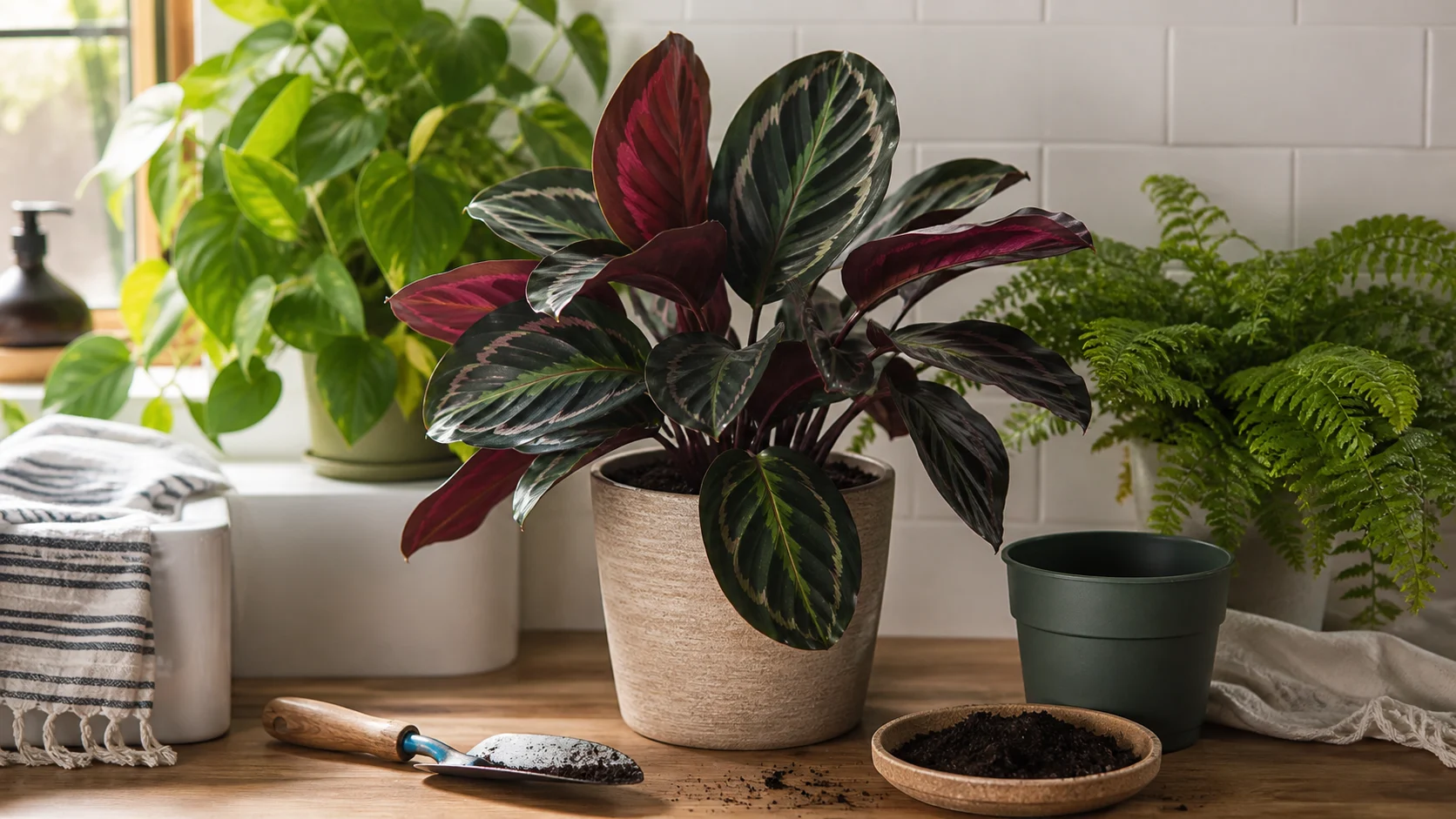
Fresh potting mix and a slightly larger pot prepare a calathea for renewed spring growth.
Air plants and tillandsias may need slightly more frequent misting as spring humidity levels are less predictable than summer. Calathea coming out of a slow winter period often pushes new leaves in spring. If you see unfurling, that’s a sign to start watering a little more consistently and to check that the soil isn’t compacting.
Check drainage holes on all bathroom pots. Winter’s slower growth and reduced watering can lead to blocked drainage over time.
Summer (June to August)
Peak growing season. Natural humidity tends to be higher in most climates, which means your bathroom plants are getting passive moisture from both the shower and the ambient air. Watch for one specific problem in summer: fungus gnats. They love warm, moist soil, and a bathroom in summer is good conditions for them. If you start seeing tiny flies near your pots, let the top layer of soil dry out more between waterings. That usually solves it without any other intervention.
Air plants may need almost no supplemental watering if your bathroom gets hot and steamy regularly. Spider plant and pothos will grow noticeably faster. Summer is the best time to take cuttings from pothos, philodendron, or spider plant if you want to propagate.
Autumn (September to November)
This is the season where the bathroom pulls ahead of the rest of the house. When heating systems turn on, indoor air gets drier everywhere except the bathroom, which stays humid from regular use. Humidity-lovers like calathea, Boston fern, and orchid that might struggle in a heated living room stay comfortable here through autumn and winter.
Slow down fertilizing in September and stop by October. Growth is winding down and the plants don’t need extra nutrients heading into a slower period.
If you have outdoor tropicals you’re bringing in for winter, the bathroom can serve as a good acclimatization spot for plants that need humidity to adjust to indoor conditions.
Winter (December to February)
The slowest season. Reduce watering across the board, even for moisture-lovers. Bathroom plants are still getting ambient humidity, which means their soil dries out more slowly than you’d expect.
ZZ plant can easily go four to six weeks between waterings in a low-light winter bathroom. Snake plant, the same. Lucky bamboo still needs water changes every few weeks, but growth slows considerably.
Don’t fertilize anything from December through February. The plants are resting and extra nutrients won’t help them. Wait for the first signs of new growth in late February or March before starting again.
Boston fern and calathea are the most vulnerable in winter if your bathroom gets cold overnight. Keep them away from windows that draft and away from exterior walls that might chill overnight.
Matching Plant to Bathroom
A quick way to think about placement before you buy:
- Bright window, regular plant-checking routine: Bird of paradise, orchid, Boston fern, calathea
- Frosted window or medium indirect light, beginner-friendly routine: Peace lily, Chinese evergreen, pothos, philodendron
- Shower area with splash risk: Air plants are safest; spider plant and pothos can work if they drain freely
- No window, with a grow light: Snake plant, ZZ plant, cast iron plant, lucky bamboo
- No window and no grow light: Preserved moss or faux greenery; use living plants only for temporary rotation
- No window and you want zero watering: Preserved moss
If you’re working with a truly dark space and want to give brighter-light plants a chance, a small grow light for indoor plants mounted under a cabinet or shelf opens up a lot more options.
One more thing worth noting: several plants on this list, including pothos, philodendron, peace lily, and ZZ plant, are toxic to cats and dogs. If you share your home with pets, the cat-safe indoor plants guide is a good reference before you decide on placement.
Common Bathroom Plant Problems
Use the symptom first, then check the soil. In bathrooms, the leaf problem is often a watering or airflow problem, not a lack of humidity.
- Leaves curling: If the soil is dry, water thoroughly and let the pot drain. If the soil is wet, stop watering for now and improve airflow; wet roots can make leaves curl because they cannot take up water properly.
- Yellow leaves: One old yellow leaf is normal. Several yellow lower leaves plus wet soil usually means overwatering. Let the mix dry, empty the saucer, and check that the pot has drainage.
- Brown tips: Calathea, peace lily, and fern tips often brown from dry spells, mineral-heavy tap water, or cold drafts. Trim the damaged tip, switch to filtered water if you can, and keep the plant away from a chilly window.
- Tiny flies around the pot: Fungus gnats mean the top layer is staying wet. Let the first inch dry before the next watering and avoid decorative cachepots that hold hidden water.
- Mushy stems or black leaf bases: Treat this as possible rot. Move the plant out of direct spray, stop watering, remove mushy growth, and repot if the soil smells sour.
If the problem started right after moving the plant into the bathroom, give it one calm week: same spot, no fertilizer, and water only if the soil test says it is dry. Constantly moving a stressed plant makes the diagnosis harder.
How We Evaluated Bathroom Plants
This article uses a visible evaluation method rather than a flat popularity list. We started with the current search results for bathroom plants, then checked recurring plant-owner objections about windowless rooms, humidity versus light, splash risk, bugs, and pet safety. From there, we cross-checked recommendations against RHS guidance on right plant, right place; Penn State Extension guidance that bathrooms may add humidity but often lack light; Costa Farms guidance that dark bathrooms still need rotation or supplemental light; University of Maryland Extension guidance on artificial light and pest checks; and ASPCA toxicity notes for common bathroom picks such as pothos, philodendron, peace lily, Chinese evergreen, and spider plant.
A plant stayed on the list only if it had a clear bathroom profile, a realistic care burden, and an obvious failure signal when the room was wrong for it. Sources were reviewed on June 27, 2026; the quick-picks chooser and search presentation were updated on September 9, 2026.
Frequently Asked Questions
Can any plant survive in a bathroom with no windows?
No living plant can stay healthy indefinitely in a bathroom with no usable light. Humidity does not replace photosynthesis. Add a grow light on a timer, rotate a low-light-tolerant plant into brighter conditions, or choose preserved moss or faux greenery for a permanently dark room.
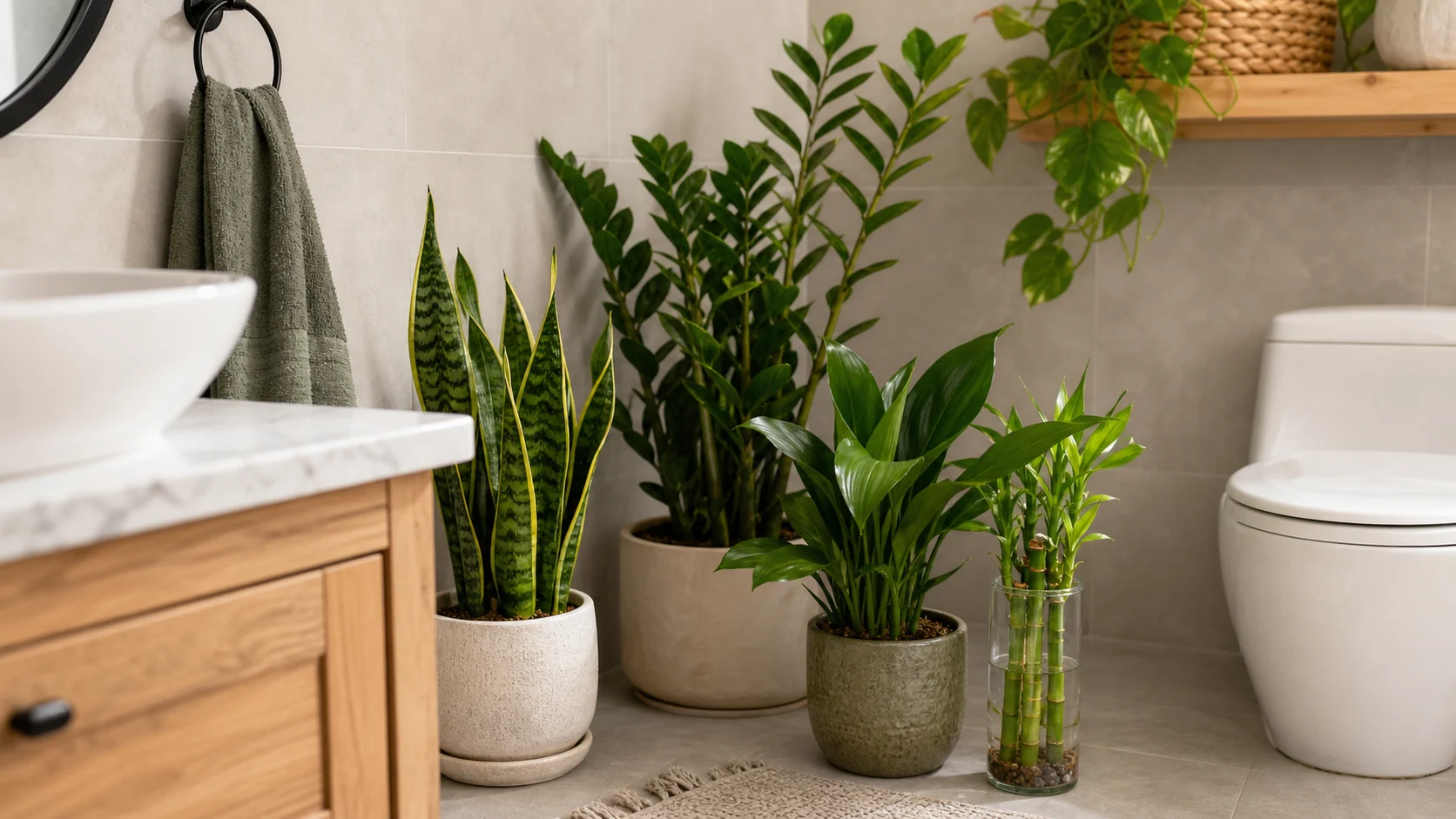
Snake plant, ZZ plant, cast iron plant, and lucky bamboo can work in a windowless bathroom when a grow light supplies usable light.
Do bathroom plants actually need the shower humidity, or is that optional?
For most of the plants on this list, the humidity is a genuine benefit, not a requirement. Pothos, snake plant, and spider plant will grow fine in lower humidity. But for moisture-lovers like Boston fern, calathea, and air plants, the bathroom environment isn’t just nice to have: it’s often what finally makes them thrive when they’ve struggled everywhere else.
How often should I water plants in a humid bathroom?
Less often than you think. Because bathroom air holds more moisture, plants absorb some of it through their leaves and dry out more slowly than they would in a living room. Start with your normal watering schedule and then push it back by a day or two. Always check the soil before watering rather than going by a fixed schedule.
Will steam from the shower damage my plants?
For most humidity-loving plants, no. In fact, occasional direct steam can be beneficial. The things to watch are temperature extremes (a cold draft hitting a warm plant repeatedly) and standing water collecting in leaf axils, which can cause rot. Good air circulation in the bathroom helps with both.
My calathea is crispy and struggling in the living room. Will moving her to the bathroom help?
Almost certainly yes. Calathea’s most common struggles, brown leaf edges, curling leaves, slow decline, are usually caused by dry air and inconsistent watering. A humid bathroom addresses both. Move her there, water with filtered or rainwater if possible, and give her a few weeks to adjust before expecting a turnaround.
Are bathroom plants safe for cats?
Some are, some aren’t. Spider plant, Boston fern, and air plants are considered non-toxic to cats by the ASPCA. Pothos, philodendron, peace lily, and ZZ plant are all toxic if ingested. If you have cats that chew on plants, stick to the non-toxic options or place toxic plants well out of reach. The cat-safe indoor plants guide has a full breakdown.
Can I keep a plant on the shower shelf itself?
Yes, if you choose carefully. Air plants are the best candidate because they’re used to getting wet and dry out quickly. Pothos can also tolerate occasional splashes. The main risk is sitting water: any plant in a container without drainage that gets drenched regularly will rot. If the shelf gets direct spray, go with air plants or mount a small tillandsia on the wall rather than potting anything in soil.
The bathroom is underrated as a plant space. Once you find the plants that match your specific conditions, it becomes one of the more effortless rooms to keep green, because the environment is doing most of the work for you.
Download KnowYourPlant for personalized plant care reminders and guidance matched to the plants you actually have.