If your peace lily is drooping, yellowing, curling, or getting brown tips, you do not need a botany lecture. You need to know whether to water, wait, move it, or check the roots.
This peace lily care guide gives you a plain-English routine for indoors: where to put it, how often to water, what overwatering looks like, and what to do when the leaves start looking wrong. If you want a shorter signal-first overview before the deep routine, start with the updated peace lily care guide.
Climate DNA for Spathiphyllum wallisii
Peace lily is used for multiple cultivated forms; this module states its reference taxon explicitly as Spathiphyllum wallisii from Colombia to Venezuela.
The ranges below are the middle 50% (p25–p75), not recommended indoor setpoints.
| Reference taxon | POWO native range | Annual mean temperature | Annual precipitation | Relative humidity | Solar radiation | Evidence |
|---|---|---|---|---|---|---|
| Spathiphyllum wallisii (peace lily) | Colombia to Venezuela | 18.8–20.7°C | 2102–3281 mm/yr | 67–68% | 16.7–18.3 MJ/m²/day | 10 climate points; low confidence |
What this changes in this guide: The limited native-record sample is useful context but not enough to justify a fixed humidity or watering number. Let the pot and roots carry more diagnostic weight.
Sources and method: Spathiphyllum wallisii in POWO and GBIF; CHELSA V2.1, 1981–2010. GBIF records are limited to POWO-native countries, then filtered for coordinates, establishment signal, licence, precision, and spatial duplication. No community or user-reported care data is used in this module.
What Most Care Guides Miss
Most guides about peace lily describe the ideal care routine. Real homes are messier: light changes by season, pots dry at different speeds, and the same symptom can mean different things depending on where it appears.
Before changing care, check the plant in this order:
- Light: is the plant growing toward the window, fading, or scorching?
- Root zone: is the pot drying predictably, or staying wet in the middle?
- Leaf pattern: did the oldest leaves, newest leaves, tips, or stems change first?
- Recent change: new pot, new location, fertilizer, cold draft, heat vent, or pest exposure.
This keeps you from fixing the wrong problem. One clear adjustment is usually safer than a full care reset.
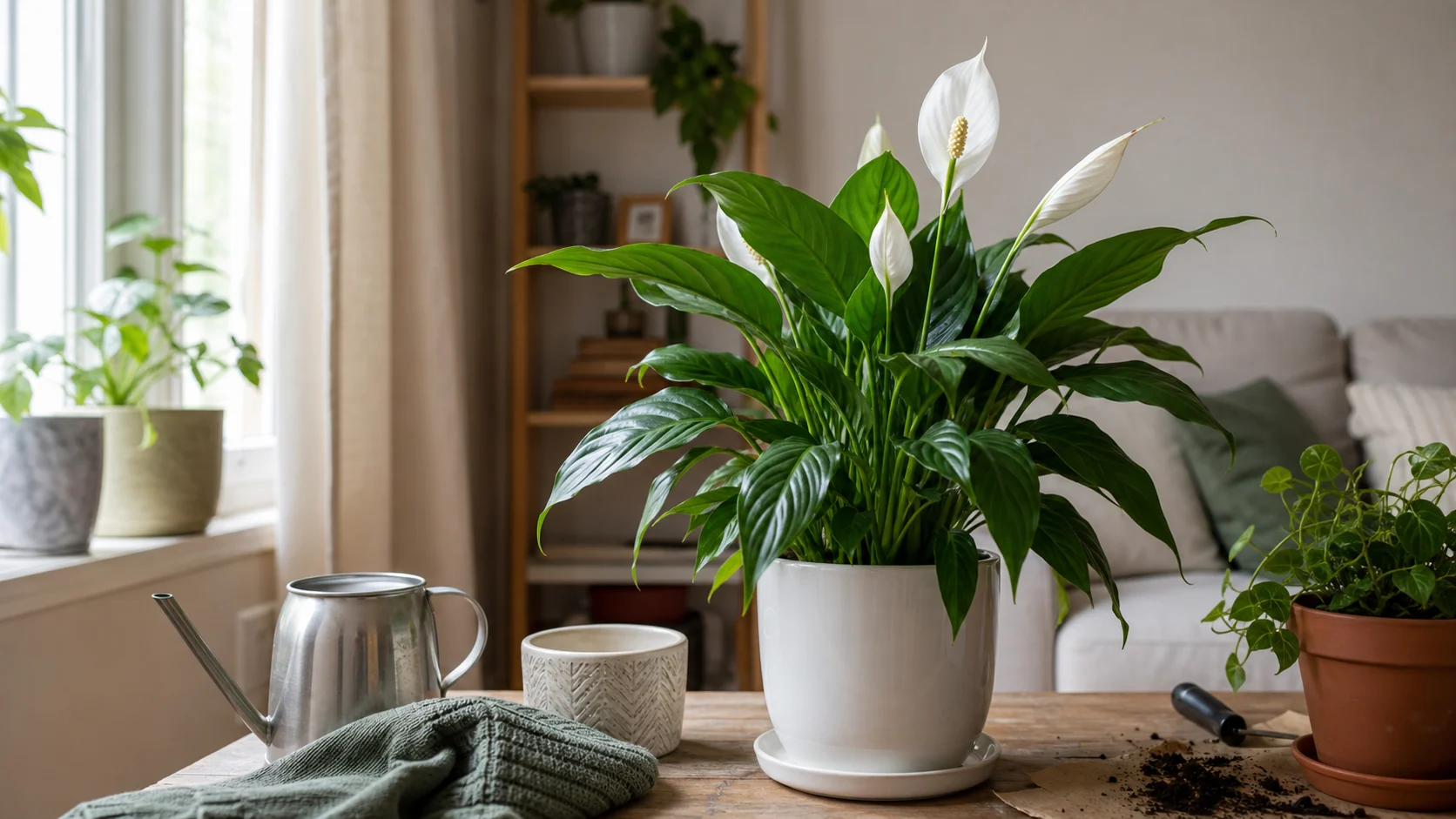
Check the whole care setup—light, soil moisture, drainage, and recent changes—before reacting to one symptom.
Quick Fit Check: Should You Buy a Peace Lily?
A peace lily is a good beginner plant if your home has indirect light and you can check the soil once or twice a week. It is not the best choice for a windowless room, a hot sunny sill, or a home where pets chew leaves.
| Your Home or Routine | Fit? | What It Means |
|---|---|---|
| Bright room, no direct afternoon sun | Good fit | Place it near the window, not pressed against the glass |
| Low-light room with a window | Usually fine | Expect healthy leaves, but fewer white flowers |
| Windowless bathroom or office | Poor fit | Use a grow light or choose another plant |
| You can check soil weekly | Good fit | Watering is simple when you touch the soil first |
| You forget plants for weeks | Risky | It will droop hard when dry and may decline |
| Cats, dogs, or kids chew plants | Poor fit | Peace lilies are toxic if chewed |
Beginner verdict: buy a peace lily if you can give it indirect light, drainage, and a quick soil check each week. Skip it if you need a pet-safe plant or a plant that can handle direct sun.
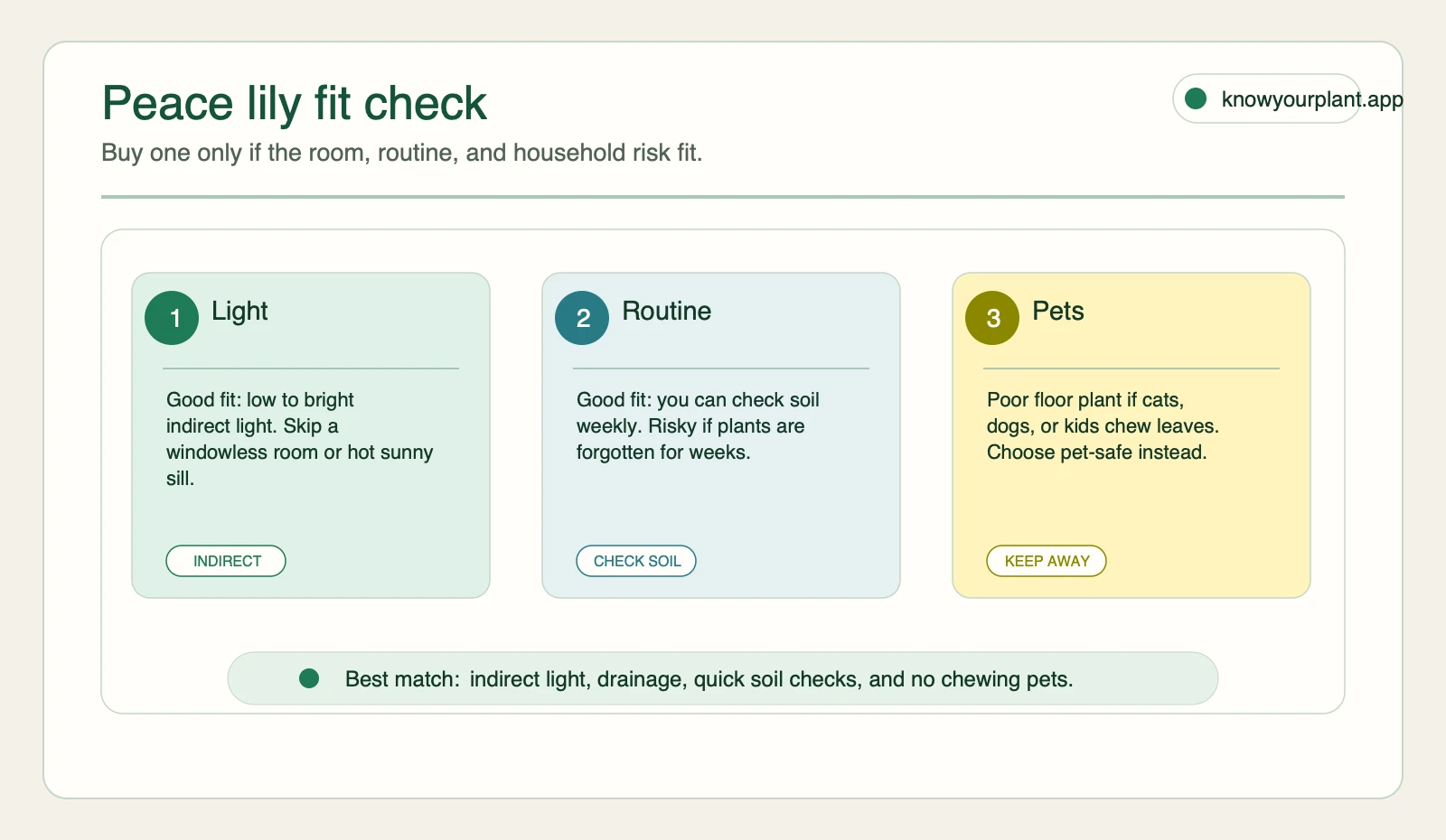
Use the fit check before you buy: peace lilies are forgiving indoors only when the room has indirect light, the pot drains, soil checks happen weekly, and chewing pets are not part of the setup.
Quick Start: Today, This Week, This Season
Today: put the plant in low to bright indirect light, check whether the top 3-4 cm of soil is dry, and empty any water sitting in the saucer.
This week: watch how fast the soil dries. If it droops and the soil is dry, water deeply. If leaves yellow while the soil stays damp, stop watering and check drainage.
This season: feed monthly in spring and summer, reduce watering in winter, and repot in spring only if roots are circling the pot or pushing out of the drainage holes.
Identification Snapshot
| Detail | What to check |
|---|---|
| Botanical name | Spathiphyllum spp., a tropical aroid commonly sold as a peace lily |
| Leaf cue | Glossy green leaves rise from the base, with white hood-like spathes around a central spadix when blooming |
| Light fit | Bright indirect light keeps growth stronger and flowers more likely; lower light is tolerated but slower |
| Water rhythm | Water after the top 3 to 4 cm of soil dry out, then let excess water drain away |
| Indoor warning sign | Dramatic drooping with dry soil usually means thirst, while drooping in damp soil points to root or setup trouble |
| Pet safety | Unsafe for cats and dogs to chew, even though it is not a true lily |
Lookalikes and Common Confusions
| Plant or label | How to tell it apart | Why the confusion matters |
|---|---|---|
| Peace lily | Glossy leaves from the base and a white spathe around a finger-like spadix | This guide fits here |
| True lilies | Strap-like leaves on upright stems, usually sold as cut flowers or outdoor bulbs rather than a clumping houseplant | The shared name confuses pet owners, but it is a different plant group with different care expectations |
| Calla lily | More sculptural funnel-shaped flowers and a stronger preference for brighter light during active growth | Similar common name, different indoor routine |
Care Cards
| Care card | Best indoor move | Watch for |
|---|---|---|
| Light | Keep it in low to bright indirect light, closer to the window if you want blooms | Harsh sun scorches leaves; dim corners keep it alive but reduce flowering |
| Water | Check the soil first and water deeply only after the top layer dries | Damp soil plus drooping is a root-zone warning, not a cue to water again |
| Humidity and temperature | Aim for warm rooms and moderate humidity, especially away from vents | Brown tips often stack dry air with tap-water minerals or fertilizer salts |
| Soil and pot | Use a draining pot and a mix that stays lightly moist, not soggy | Oversized pots and saucers full of water keep the root zone wet too long |
| Bloom support | Give brighter indirect light, consistent watering, and light feeding in spring and summer | Healthy leaves without flowers usually point to light or setup, not a mystery deficiency |
What Kind of Plant Is a Peace Lily?
Peace lilies (Spathiphyllum spp.) are tropical plants native to the rainforests of Central and South America. In the wild, they live under the shade of towering trees, in humid, warm air, with soil that stays moist but never waterlogged.
That backstory matters. When you’re deciding where to put her in your home, think of the forest floor, filtered light, no cold drafts, consistently moist but not soggy.
Despite the name, she’s not actually a lily at all. She’s an aroid, closely related to monstera and pothos. And she’s been earning her keep indoors since the 1990s, when NASA’s Clean Air Study found that Spathiphyllum removed benzene, formaldehyde, and trichloroethylene from sealed chamber air at measurable rates. Real-world filtration is more modest, but the research gave the peace lily a reputation it still carries today, and our air-purifying indoor plants guide explains where that claim really holds up at home.
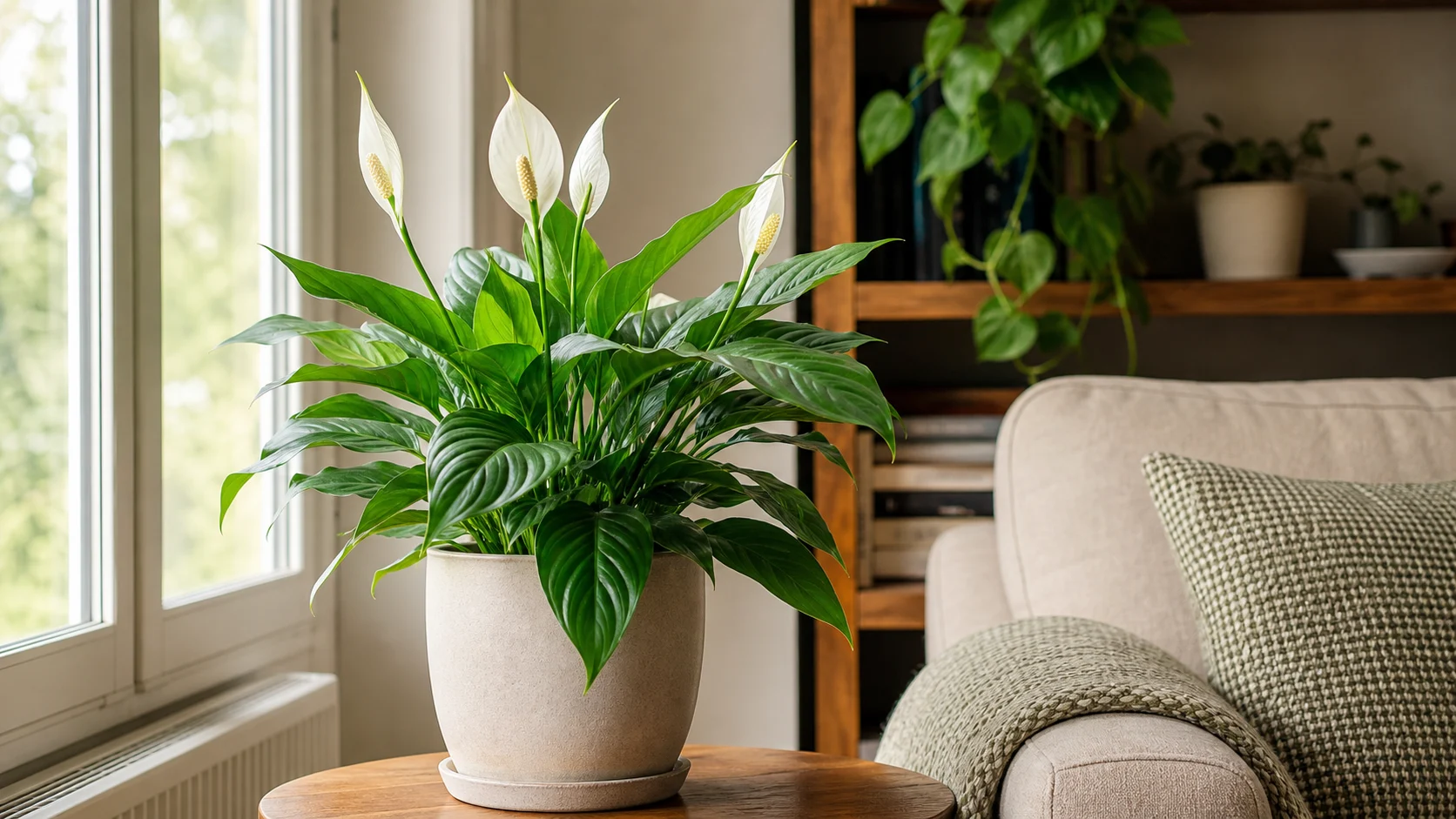
Filtered light and steady indoor warmth echo the shaded tropical habitat where peace lilies grow beneath taller plants.
Light: She Prefers the Shade
Peace lilies are one of the few flowering plants that genuinely do well in low light. She doesn’t need a sunny windowsill. In fact, direct sun will scorch her leaves quickly, bleached patches or brown edges can appear within days.
What works well:
- A spot 1-3 metres from a north or east-facing window
- Bright indirect light (the kind where you could read comfortably)
- Low light is tolerated, though she’ll flower less often
Signs the light is wrong:
- Too much light: Yellowing leaves, bleached patches, brown crispy edges
- Too little light: Dark green leaves but no flowers, slow growth, limp stems
A simple test: if you can comfortably read a book where she’s sitting without turning on a lamp, the light is about right. If the room feels dim at noon, she might survive but won’t bloom.
“Peace lilies are extraordinarily adaptable to lower light levels, but ’low light’ doesn’t mean no light. They need some indirect natural light to bloom reliably.” (Tovah Martin, garden author and horticulturist (The Indestructible Houseplant, 2015)
Watering: The Dramatic Drooper
Peace lilies have a gift for communication. The moment they get thirsty, the leaves flop, the plant looks half-dead, you panic, you water her, and within an hour she’s standing upright again. It’s dramatic. It’s also useful.
How to water:
- Check the top 3-4 cm of soil. When it’s dry to the touch, water thoroughly until it drains from the bottom.
- Empty the saucer after 30 minutes so she’s not sitting in standing water.
- Use room-temperature water. Cold water can shock tropical roots.
- If possible, use filtered water or leave tap water out overnight. Peace lilies are sensitive to chlorine and fluoride, which cause brown leaf tips over time.
Seasonal Watering Guide
| Season | Frequency | What to Watch |
|---|---|---|
| Spring | Every 5-7 days | Growth picking up; increase gradually |
| Summer | Every 5-7 days | Check more often in heat; soil dries faster |
| Autumn | Every 7-10 days | Growth slowing; ease off |
| Winter | Every 10-14 days | Minimal water needed; drought-resistant in dormancy |
Signs you’re overwatering:
- Yellow leaves, especially older leaves near the base
- Soft or mushy stems at the soil line
- Soil that never quite dries out
- Fungus gnats circling the pot
Signs you’re underwatering:
- Drooping that perks up quickly after watering
- Bone-dry soil pulling away from the pot edges
- Crispy brown leaf tips
The most common mistake: watering on a fixed schedule instead of checking the soil. A peace lily in a small pot in a sunny room needs water much more often than one in a large pot in a shaded corner. Let the soil tell you.
“Overwatering is the single biggest killer of houseplants. Peace lilies in particular are susceptible to root rot the moment they sit in waterlogged soil for too long.” (Darryl Cheng, creator of House Plant Journal and author of The New Plant Parent (2019)
Humidity and Temperature
Coming from tropical rainforests, peace lilies appreciate humidity above 40-50%. Average home humidity (around 30-40%) is workable, but she’ll look her best with a little boost, and show her gratitude in fewer brown tips.
Practical humidity tips:
- Set the pot on a tray filled with pebbles and a little water (keep the pot above the waterline, not sitting in it)
- Group her with other plants to create a shared microclimate
- A bathroom or kitchen with natural light is often ideal, which is why she also shows up in our best bathroom plants guide
- Misting provides brief relief but evaporates quickly; a pebble tray or humidifier is more effective
A 2020 study published in HortScience found that Spathiphyllum maintained significantly better leaf quality at 60% relative humidity versus 30%, with fewer brown leaf margins and improved overall appearance over a 12-week period.
Temperature: She likes warmth, between 18-29°C (65-85°F). She’ll tolerate cooler rooms but slows down noticeably below 13°C (55°F). Keep her away from cold drafts, air conditioning vents, and radiators. A sudden temperature swing is more damaging than steady cool temperatures.
Soil and Repotting
A well-draining, moisture-retentive mix suits her best. Standard houseplant potting mix works fine, though you can improve drainage by adding a small amount of perlite (roughly 1 part perlite to 4 parts mix).
Repotting:
- Repot every 1-2 years, or when roots start circling the pot or pushing out of drainage holes
- Go up one pot size at a time, a pot that’s too large holds excess moisture and raises root rot risk
- Spring is ideal, just as she’s coming out of her winter rest
She’s not fussy about pot material. Terracotta allows more air exchange and dries faster, which some growers prefer for overwatering-prone plants. If you tend to overwater, terracotta pots are worth considering.
Fertilizing
Peace lilies are light feeders. During spring and summer, feed once a month with a balanced liquid fertilizer diluted to half the recommended strength. That’s it.
Stop fertilizing in autumn and winter when she’s resting. Over-fertilizing causes salt buildup in the soil, which shows up as brown leaf tips and a white crust on the soil surface. If you see that crust, flush it out with a long, slow watering session and hold off on fertilizer for a month.
A bloom booster fertilizer (higher phosphorus, middle number on the NPK ratio) given once in early spring can help encourage flowering. Don’t overdo it.
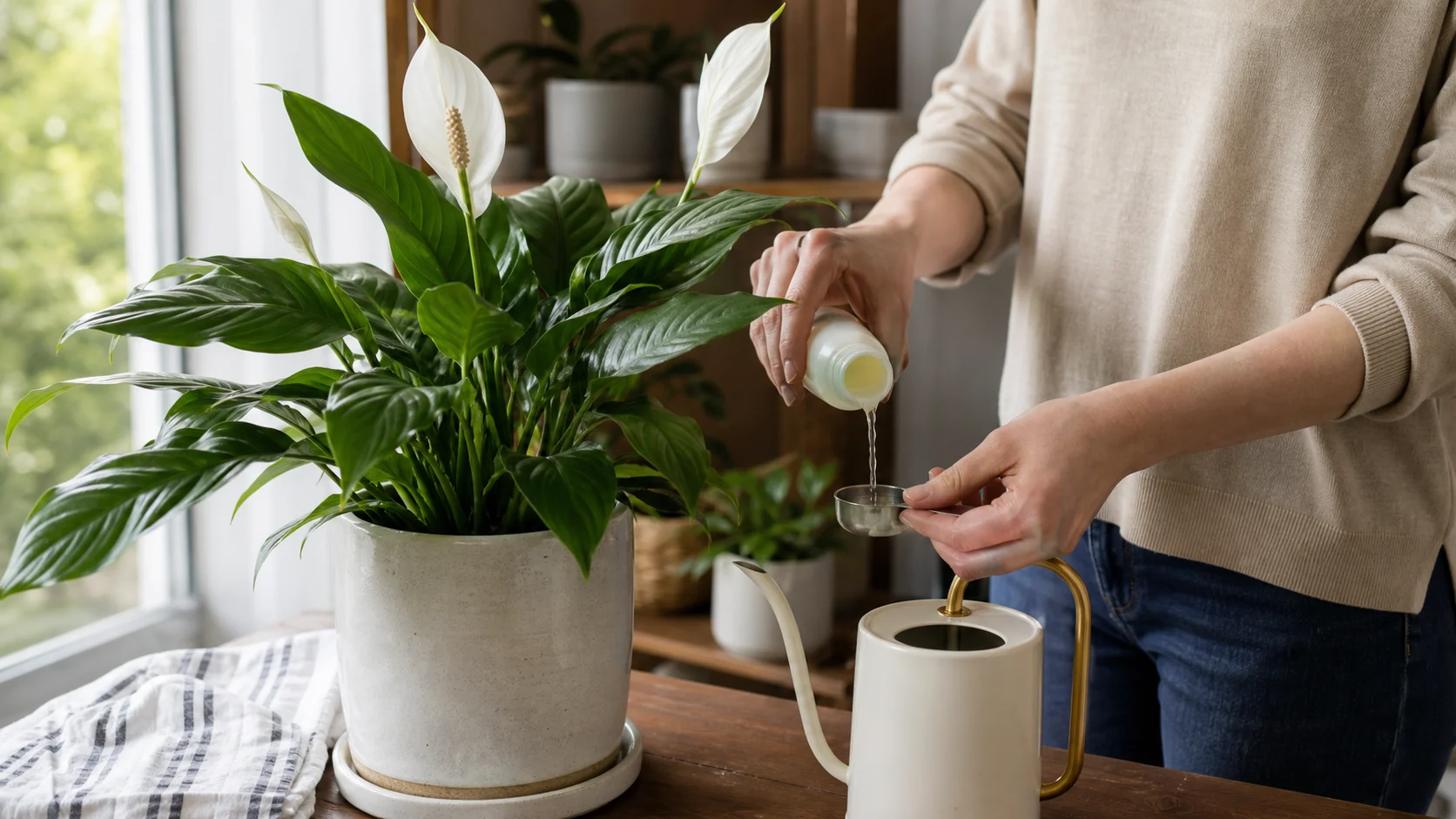
Measure a small fertilizer dose into the watering can so this light-feeding plant gets a properly diluted spring or summer feed.
How to Get Your Peace Lily to Bloom
The white flowers are technically a spathe (modified leaf) wrapped around a finger-like spadix. They’re what many people buy her for, and the most common complaint is that she stops producing them.
The main reasons she stops flowering:
- Not enough light. This is the number one cause. Move her closer to a bright window (indirect only).
- Temperature drop in late winter. Exposing her to 15-18°C for a few weeks can trigger blooming, mimicking her natural dry-season cue.
- Inconsistent watering. Stress from irregular watering disrupts the flowering cycle.
- No fertilizer in spring. A single dose of bloom booster in early spring often does the trick.
Healthy plants in good indirect light typically flower in spring, sometimes again in autumn. Don’t be fooled by artificially bloomed plants from garden centres, those were treated with gibberellic acid, a growth hormone. Natural blooms take patience.
Month-by-Month Peace Lily Care Calendar
Most care guides tell you what to do in general. This one tells you what to do right now, month by month.
January
She’s resting. Keep watering to a minimum, check the soil every 10-14 days, and only water when the top half of the pot feels dry. No fertilizer. If the air is dry from central heating, keep the pebble tray filled with water.
February
Still dormant, but days are getting slightly longer. Check for any yellowing lower leaves and remove them cleanly at the base. If you’ve been meaning to repot, get a new pot ready, you’ll use it next month. Give her a warm shower to rinse dust off her leaves.
March
Time to wake her up. Begin fertilizing again, a bloom booster (high phosphorus) once this month. Increase watering frequency slightly as growth resumes. This is the best month to repot if her roots are circling the pot. If she’s going to flower this year, buds often form in late March.
April
Active growing season begins. Water every 5-7 days, checking soil each time rather than assuming. Watch for new leaves unfurling, they’ll emerge pale green and glossy. If flowers are forming, resist the urge to move her to a sunnier spot. She knows where she is.
May
Flowers should be open or close to opening now. Feed monthly with a balanced fertilizer. If you have a shaded outdoor space and nighttime temperatures are reliably above 15°C, she can spend summers outside, but ease her into increased light gradually. Sudden bright light will scorch her.
June
Peak growing season. She may be drinking every 5-6 days. Check the soil more frequently in hot weather. If you see flowers turning green, that’s natural, the blooms are finishing their cycle. Snip them off at the base to tidy things up and encourage the plant’s energy toward new growth.
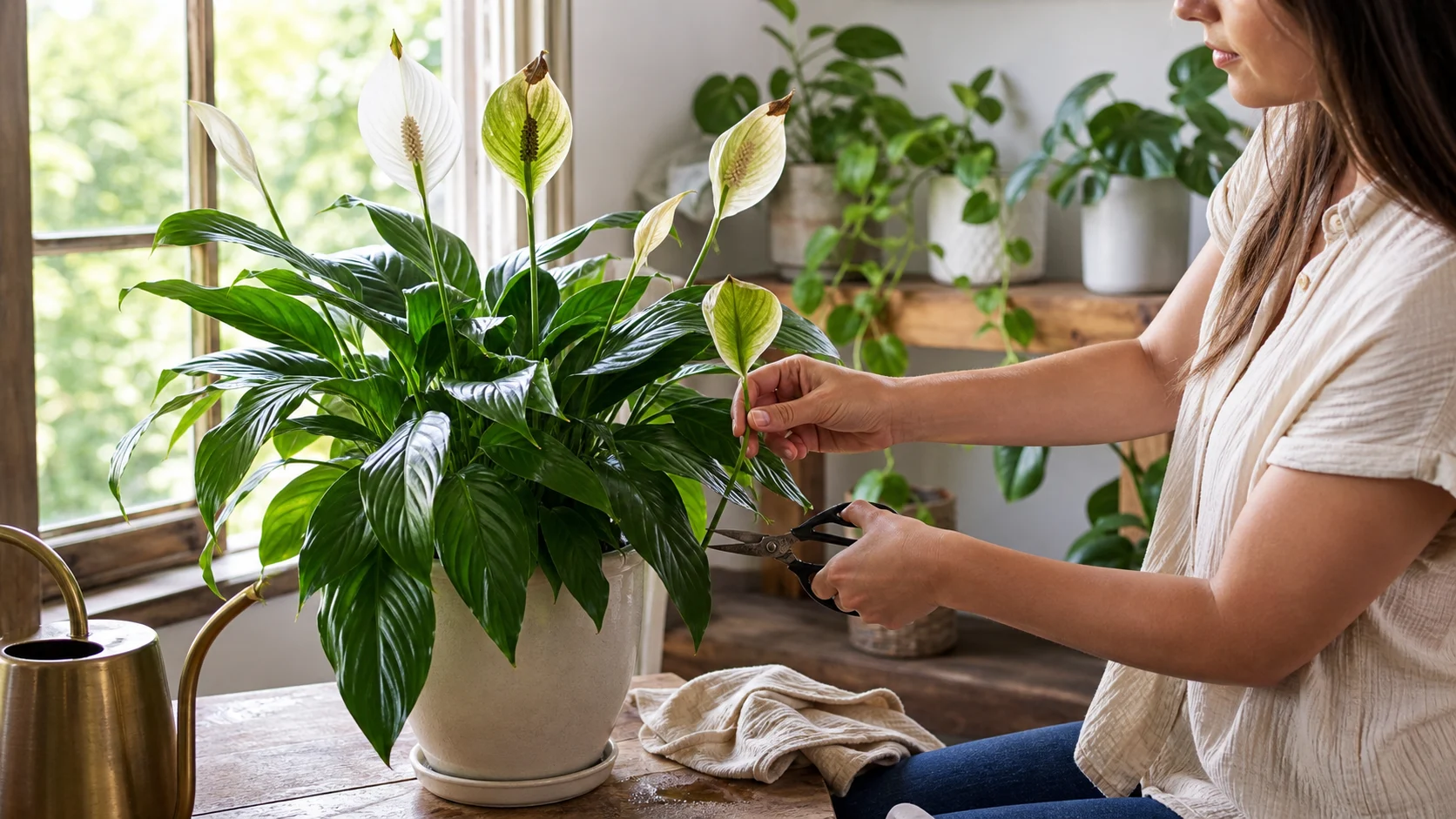
In peak growing season, check moisture often and remove finished green-brown blooms at the base with clean shears.
July
Continue regular watering and monthly feeding. Keep her away from air conditioning vents, the dry cold air is one of the fastest ways to get crispy brown tips. If the pebble tray runs dry in the summer heat, top it up. Good humidity during flowering helps the blooms last longer.
August
Some peace lilies produce a second round of flowers in late summer. If you want to encourage this, a light dose of bloom booster now can help. Otherwise, stick to balanced fertilizer. Check under leaves for any signs of pests, summer heat sometimes brings spider mites.
September
Ease off fertilizing as the season turns. Water a little less frequently as temperatures drop and growth slows. Move her back indoors before nighttime temperatures drop below 13°C if she’s been outside. Transition slowly, a few days in a bright doorway before bringing her fully inside.
October
Begin winding down. Last fertilizer dose of the year. Start checking the soil less frequently and allowing it to dry a little more before watering. Remove any dead or yellowing leaves as they appear. She’s preparing to rest.
November
Dormancy approaches. Water every 10-14 days now. No fertilizer. Keep the pebble tray filled as central heating dries the air. This is a good month to wipe down her leaves with a damp cloth, dust blocks light absorption and she needs every bit of winter light she can get.
December
Full dormancy. Minimal water. Minimal fuss. If she looks a little less lush than she did in July, that’s normal. She’s saving her energy. Keep her away from draughty windows and cold sills. Trust that she’s resting, not dying.
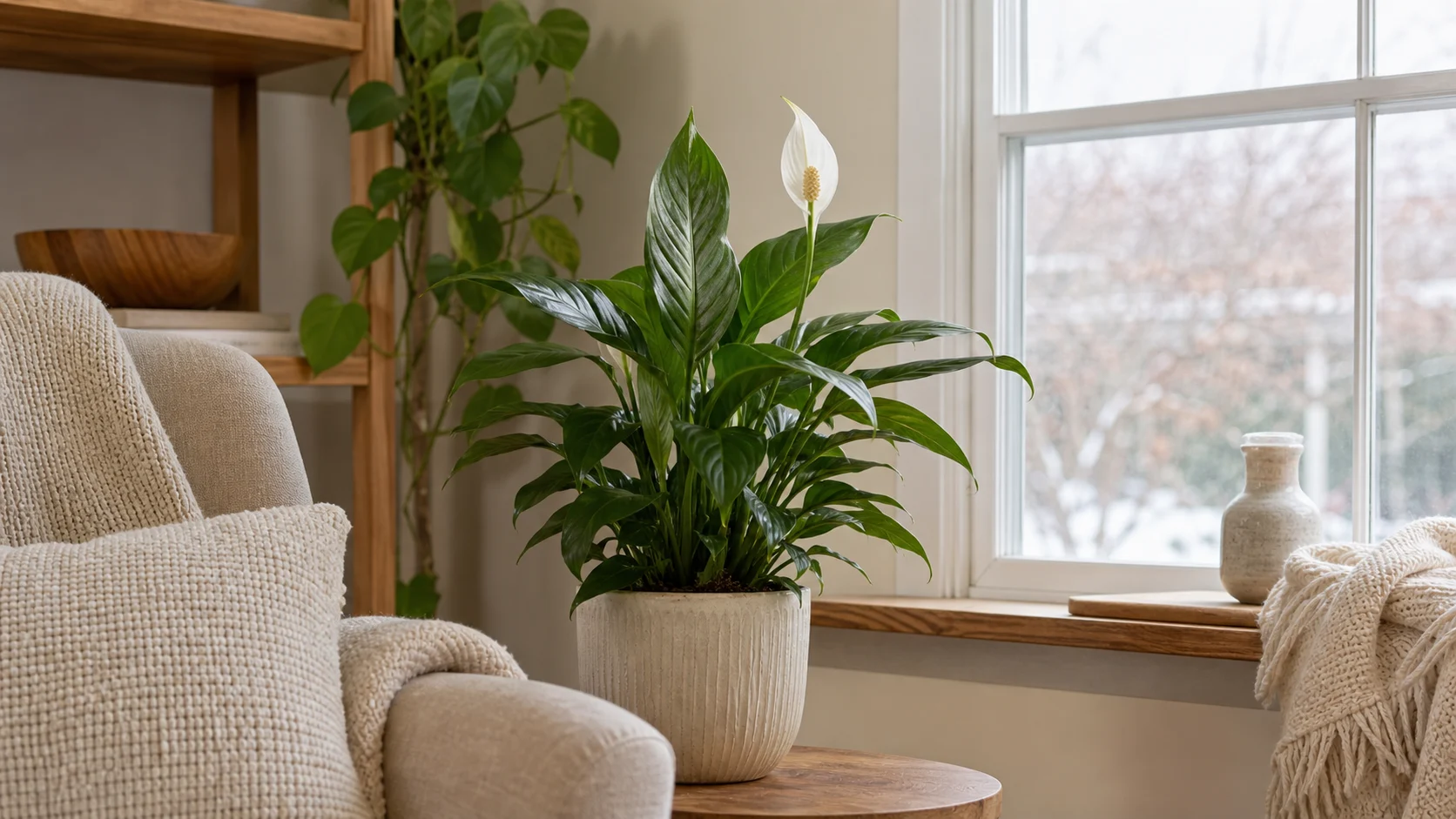
During winter rest, keep the peace lily in a warm room away from the cold sill and water only after the soil has dried further.
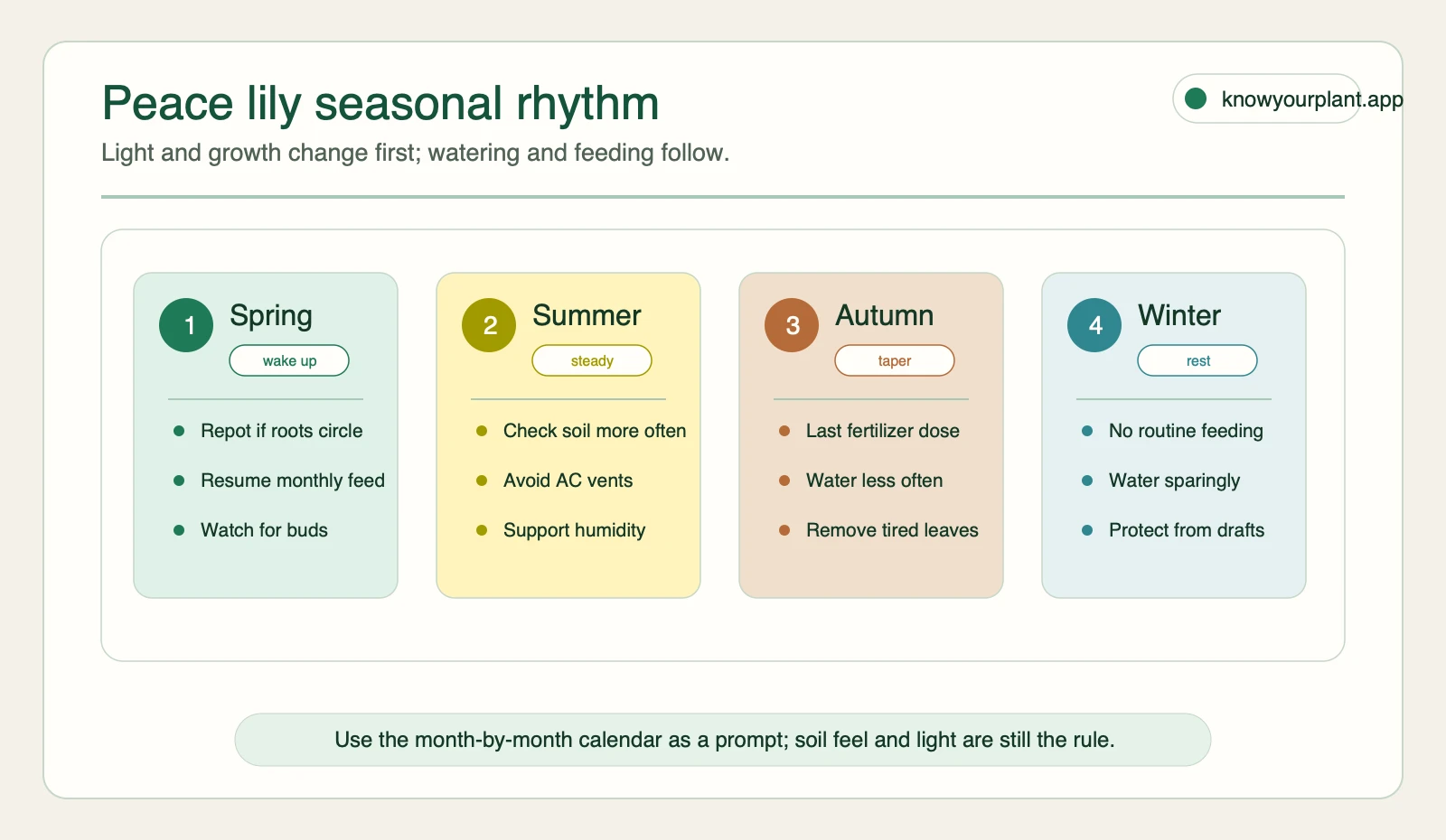
The seasonal rhythm compresses the month-by-month calendar into the four care shifts that matter most: wake up, steady growth, taper, and winter rest.
Why Is She Drooping? A Step-by-Step Diagnosis
Peace lilies droop for different reasons, and confusing them leads to making things worse. Here’s how to figure out what’s actually going on.
Step 1: When did you last water?
- More than 10 days ago, and the soil feels dry: She’s thirsty. Water thoroughly and she should perk up within an hour.
- Less than 5 days ago, or the soil still feels damp: Do not water again. Keep reading.
Step 2: Check the soil and stem base
- Tip the pot gently and look at the drainage hole. Are roots pushing out? Are they white and firm, or brown and soft?
- Squeeze the stem at soil level. Does it feel firm and green, or mushy and soft?
If the roots or stem base feel mushy and smell unpleasant, you’re likely dealing with root rot. Go to Step 3.
If roots are firm and white, the drooping has another cause. Go to Step 4.
For a focused walkthrough of thirst, wet-root stress, transplant shock, and environmental causes, use the peace lily drooping guide before watering again.
Step 3: Root rot, act now
Root rot moves fast. Here’s the recovery process:
- Remove the plant from the pot entirely
- Rinse the roots gently under lukewarm water
- Use clean scissors to cut off any brown, mushy roots, cut back to firm white tissue
- Let the roots air-dry for 30-60 minutes
- Repot into fresh, well-draining mix in a clean pot with drainage holes
- Water lightly and place in bright indirect light
- Hold off on fertilizer for at least 4 weeks
She may still droop for a day or two after repotting. Give her time.
Step 4: Check the environment
If the roots are healthy but she’s drooping, look at these in order:
- Is she near a heat source or air conditioning vent? Hot dry air causes wilting even in well-watered plants. Move her away from vents and radiators.
- Has she just been repotted or moved? Transplant shock and adjustment stress cause temporary drooping. Wait 1-2 weeks before drawing conclusions.
- Is the temperature below 15°C? Cold roots can cause drooping even when the soil is moist. Move her somewhere warmer.
- Is this a very large pot? Oversized pots hold moisture unevenly, roots in the centre may be waterlogged while roots at the edges are dry. If the pot is much bigger than the root ball, consider downsizing.
Step 5: If none of the above apply
Check under the leaves and along the stems for pests. Spider mites and mealybugs can cause drooping as they feed on the plant’s fluids. Fine webbing under leaves indicates spider mites; white fluffy patches in stem joints indicate mealybugs.
For pests: wipe the plant down with a damp cloth, then treat with insecticidal soap or neem oil spray.
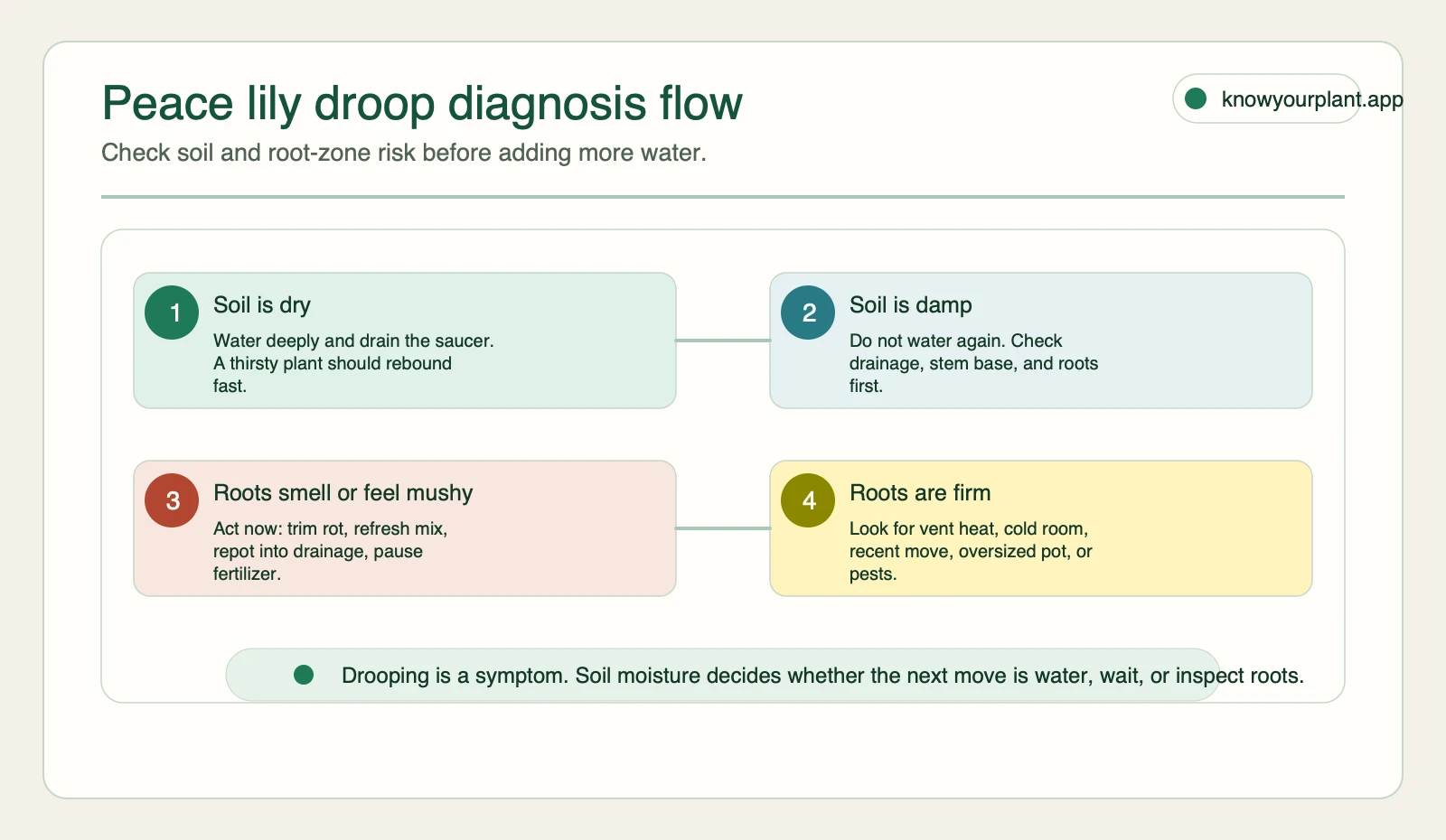
Use the flow before watering again. Dry soil points to a normal thirst response, while damp soil means the safer next step is drainage, root, stem, environment, or pest inspection.
Common Problems and Fixes
| Problem | Likely Cause | Fix |
|---|---|---|
| Yellow leaves | Overwatering, natural aging, or nutrient deficiency | Check soil moisture; if wet, reduce frequency |
| Curling leaves | Dry soil, low humidity, or heat/cold stress | Check soil first; if dry, water deeply; if damp, move away from vents and raise humidity |
| Brown leaf tips | Fluoride or chlorine in water, low humidity | Switch to filtered water; add pebble tray |
| Brown edges | Direct sun, underwatering, or drafts | Move away from direct sun; check watering |
| Drooping leaves | Underwatering (most common) or root rot | Use diagnosis guide above |
| No flowers | Insufficient light, no fertilizer | Move closer to a bright indirect window |
| Fungus gnats | Consistently overwatered soil | Let soil dry more before watering |
| White crust on soil | Fertilizer salt buildup | Flush with long deep watering; pause fertilizing |
For a deeper look at the yellowing issue, see our guide to peace lily leaves turning yellow.
If the damage is confined to dry leaf edges, the peace lily brown tips guide helps separate water quality, fertilizer salts, dry air, sun, and root stress.
Expert and Source Layer
When symptoms overlap, start with the extension guidance before you try random fixes. Clemson, South Dakota State, and North Carolina Extension all describe the same indoor pattern: yellowing usually needs a watering check first, brown tips can come from salts, dry air, or direct sun, and soggy soil is a real root-risk signal. That is why the diagnosis flow above checks moisture, roots, and environment before it tells you to add more water.
Pet Safety
Peace lilies are not true lilies, but that does not make them safe for pets. ASPCA lists peace lily as toxic to cats and dogs because chewing the plant can release calcium oxalate crystals that irritate the mouth and throat.
Use this household checklist:
- If a cat or dog chews plants, assume this is not a safe floor plant. Put it well out of reach or choose a cat-safe indoor plant instead.
- Treat chewing as the real risk. Brushing past the leaves is not the same as biting them, but a curious pet can still get mouth pain, drooling, vomiting, or trouble swallowing.
- Watch the first hour after chewing. Pawing at the mouth, foaming, drooling, or vomiting are stronger signals than a single sniff.
- Call your veterinarian or pet poison line if chewing happened. The risk is irritation and distress, not a harmless naming mix-up.
If you need a similar houseplant for a pet home, spider plants and Boston ferns are usually easier recommendations.
Peace Lily Care at a Glance
| Factor | Ideal Range |
|---|---|
| Light | Low to bright indirect |
| Water | Every 5-14 days (check soil first) |
| Humidity | 40-60% |
| Temperature | 18-29°C (65-85°F) |
| Fertilizer | Monthly, spring and summer only |
| Repotting | Every 1-2 years |
| Toxicity | Toxic to pets and humans |
Want this care sheet saved instead of rereading the article? Keep the watering, feeding, and repotting routine in KnowYourPlant and adjust it to your room, pot, and season.
For another practical pet-safety check, see Is Peace Lily Toxic to Cats? Why It Is Not the Same as a True for the risk level and the next steps.
Real User FAQ
My peace lily drooped the day after I watered it. Should I water again? No. If the soil is still damp, watering again is more likely to worsen the problem. Check for root crowding, mushy roots, a cold room, or recent repot stress before you add more water.
Can a peace lily live in a dim room and still bloom? It can survive in lower light, but blooming usually needs brighter indirect light than many owners expect. Think “bright enough to read nearby” rather than “dark corner that stays green.”
Why do brown tips keep coming back even when the watering schedule looks right? Brown tips often stack multiple causes: mineral-heavy tap water, fertilizer salts, low humidity, and occasional dry-down stress. Reset by checking the water source, flushing salts, and looking at the room conditions, not just the calendar.
The tag says peace lily is not a true lily. Does that mean it is okay for cats? No. The name distinction matters botanically, but it does not make the plant pet-safe. Chewing can still cause oral irritation, drooling, and vomiting.
Freshness Note
This guide was updated in June 2026 after reviewing recurring indoor-owner questions about drooping, brown tips, missing blooms, and pet-safety confusion, then checking those patterns against extension and ASPCA guidance.
Methodology Note
This article combines three evidence layers: university extension care guidance, ASPCA pet-safety guidance, and qualitative owner questions that show where indoor peace lily care is often misdiagnosed. Extension and ASPCA sources support the factual care and safety claims here. Community examples were used only to decide which problems needed clearer indoor explanations.
Frequently Asked Questions
How often should I water a peace lily? Check the soil rather than sticking to a fixed schedule. Water when the top 3-4 cm of soil feels dry. In spring and summer that’s typically every 5-7 days; in autumn and winter, every 10-14 days. The plant itself tells you when she’s thirsty by drooping dramatically.
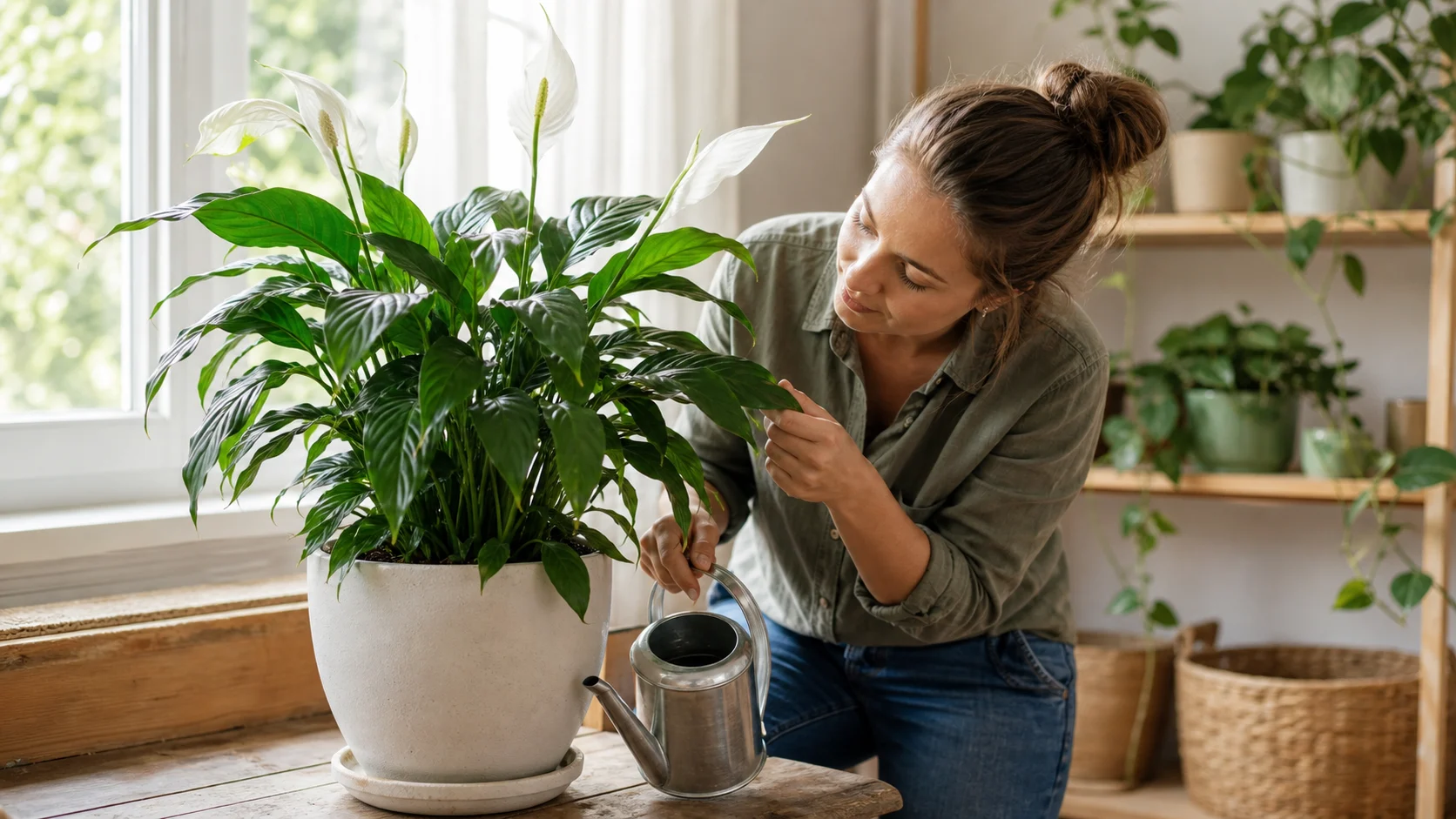
Pause before watering: inspect the leaves and check the soil so the plant’s symptoms guide the next care step.
Why are my peace lily leaves turning yellow? The most common cause is overwatering. Check the soil; if it’s been wet for a while, let it dry out and reduce your watering frequency. Other causes include natural leaf aging (lower leaves, easy to remove), nutrient deficiency if you haven’t fertilized in months, or too much direct sun. See our full guide to peace lily yellow leaves for step-by-step diagnosis.
Why are my peace lily leaves curling? Curling usually means the plant is protecting itself from stress. Check the soil first. If it is dry, water deeply. If it is damp, look for low humidity, cold drafts, heat vents, or direct sun. Do not add more water until you know the soil is actually dry.
Why is my peace lily drooping even after watering? If she droops but doesn’t recover within an hour or two after thorough watering, she may have root rot. Use the step-by-step drooping diagnosis guide above to find the cause and fix it.
How do I get my peace lily to bloom again? The number one fix is more light. Move her closer to a bright window with indirect light. If light is already good, try a dose of bloom booster fertilizer (high phosphorus) in early spring. Cooler nighttime temperatures in late winter (around 15-18°C) can also trigger blooming.
Can peace lily grow in low light? She tolerates low light better than most flowering houseplants, but “low light” still means some natural light. In a dark room with no windows, she’ll survive but won’t flower and will grow slowly. For areas with almost no natural light, a grow light for indoor plants can help.
Can I keep a peace lily in the bathroom? Yes, often a great spot. Bathrooms tend to have higher humidity from showers, which peace lilies love. As long as there’s a window or some natural light nearby, she’ll do well. Windowless bathrooms with artificial light only usually don’t provide enough light for long-term health.
Is peace lily safe for cats and dogs? No. Peace lilies contain calcium oxalate crystals that cause mouth irritation, drooling, and vomiting if chewed. They’re not lethally toxic, but keep them away from pets that chew plants. If you need a large, low-light, non-toxic alternative, spider plants are a good choice.
Why does my peace lily have brown tips? Usually caused by fluoride or chlorine in tap water. Let tap water sit out overnight before using it, or switch to filtered water. Low humidity and cold drafts can also cause brown tips. Make sure she’s not sitting near an air conditioning vent.
How long do peace lily flowers last? The white spathes typically last 1-2 months. As they age, they turn green, then yellow-brown. Once green, they’re finishing their cycle, you can remove them at the base. A healthy plant in good light may flower twice a year, usually spring and autumn.
Peace lilies are one of those plants that reward attention without demanding too much of it. Give her filtered light, check the soil before you water, and she’ll reward you with glossy leaves and white flowers for years.
If you want personalized reminders for watering, fertilizing, and repotting based on your specific home conditions, download the KnowYourPlant app, it’ll tell you exactly when your peace lily needs attention so you never have to guess.