What Most Plant Roundups Miss
Most roundups about air-Purifying Indoor Plants list attractive options. The better question is which choice will still make sense in your actual room three months from now.
Use this filter before choosing:
- Light reality: what the plant receives on a normal cloudy day, not the brightest hour of the week.
- Care rhythm: whether you prefer weekly attention or a plant that can be ignored longer.
- Space: mature height, spread, trailing habit, and whether leaves will touch walls or pets.
- Failure signal: what the plant does first when the match is wrong: yellowing, stretching, crisping, or dropping leaves.
A good recommendation is not just beautiful. It fits the room, the owner, and the first problem you are likely to notice.
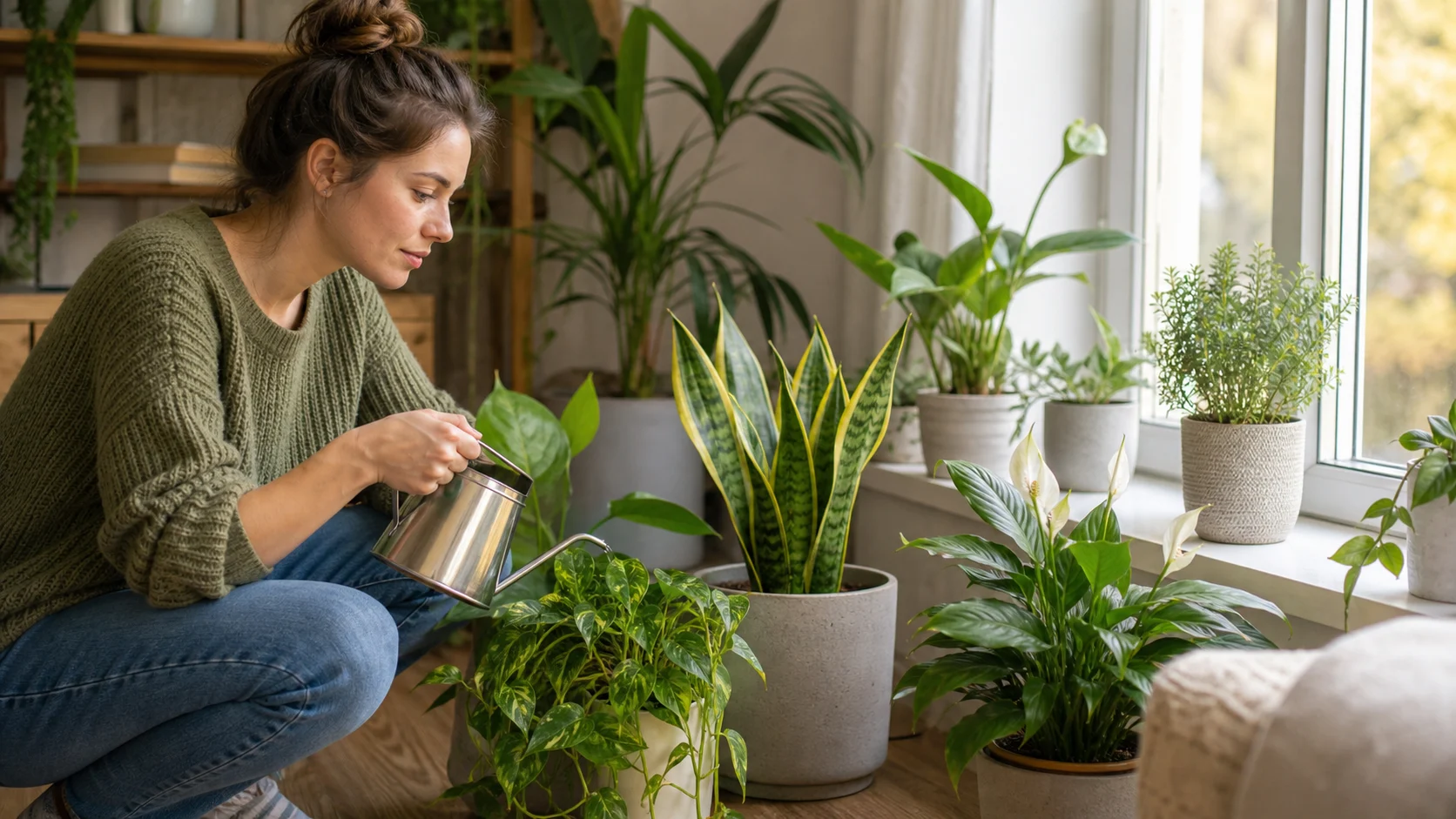
Choose plants for the room’s real light, space, and care rhythm, not for a roundup label alone.
Start Here: Pick the Plant You Can Actually Keep Alive
If you want cleaner-feeling indoor air, the best plant is not the one with the biggest claim on a list. It is the one that fits your light, your watering habits, and your pets. A healthy snake plant in the right corner beats a fussy fern that stays soggy for three weeks.
- Low light and forgetful watering: Start with snake plant, ZZ plant, pothos, or Chinese evergreen.
- Bright window and dry soil between waterings: Try aloe vera, rubber plant, spider plant, or monstera.
- You like checking plants often: Peace lily, Boston fern, bamboo palm, and areca palm give clear feedback but need more attention.
- Cats or dogs can reach the plant: Use spider plant, parlor palm, areca palm, bamboo palm, Boston fern, or gerbera daisy. Skip pothos, peace lily, philodendron, dracaena, ZZ plant, and fiddle-leaf fig unless they can stay out of reach.
For most of these plants, the safest beginner rule is simple: check the soil before watering. If the top 1-2 inches are still damp, wait. If leaves are yellowing, curling, getting brown tips, or drooping while the pot still feels heavy, pause before adding more water.
Climate evidence for four plants on this list
Air-cleaning claims do not tell you whether a plant fits the room you have. This comparison adds a separate evidence layer: the recorded native macroclimates of four common choices in this guide.
The ranges below are the middle 50% (p25–p75), not recommended indoor setpoints.
| Reference taxon | POWO native range | Annual mean temperature | Annual precipitation | Relative humidity | Solar radiation | Evidence |
|---|---|---|---|---|---|---|
| Dracaena trifasciata (snake plant) | southern Nigeria to west-central tropical Africa and Tanzania | 23.3–25.2°C | 1585–1783 mm/yr | 65–69% | 16.1–18.1 MJ/m²/day | 29 climate points; medium confidence |
| Epipremnum aureum (golden pothos) | Mo’orea in the Society Islands | 25.7–25.9°C | 2451–2644 mm/yr | 63–64% | 20.0–20.1 MJ/m²/day | 6 climate points; low confidence |
| Spathiphyllum wallisii (peace lily) | Colombia to Venezuela | 18.8–20.7°C | 2102–3281 mm/yr | 67–68% | 16.7–18.3 MJ/m²/day | 10 climate points; low confidence |
| Ficus elastica (rubber plant) | Nepal to western Yunnan and western Malesia | 22.5–26.6°C | 1514–2822 mm/yr | 61–66% | 16.7–19.1 MJ/m²/day | 30 climate points / 120 usable records; medium confidence |
What this changes in this guide: Use the spread as a fit check, not as proof of air purification. Snake plant’s seasonally dry origin and the wet-tropical references for pothos and peace lily point to genuinely different moisture backgrounds.
Sources and method: Dracaena trifasciata in POWO and GBIF; Epipremnum aureum in POWO and GBIF; Spathiphyllum wallisii in POWO and GBIF; Ficus elastica in POWO and GBIF; CHELSA V2.1, 1981–2010. GBIF records are limited to POWO-native countries, then filtered for coordinates, establishment signal, licence, precision, and spatial duplication. No community or user-reported care data is used in this module.
What “Air-Purifying” Actually Means
Before the list, a quick honest note: the NASA Clean Air Study was conducted in sealed, controlled chambers, not your open-plan living room. In those chambers, plants removed volatile organic compounds from the air. That does not mean one pothos will clean a whole apartment.
In a real home, ventilation, source control, cleaning habits, and actual air purifiers do more for pollutants than houseplants alone. Plants still help your room feel better, add a small humidity boost, and give you a clear visual cue to care for the space you live in.
What Plant Owners Keep Calling Out
A lot of recent plant-owner discussion is not “plants are useless.” It is frustration with how often the old NASA study gets stretched into “this plant cleans your whole room.”
- Sealed chamber results are not room-scale results. A lab setup is not the same as a home with air exchange, cooking, dust, pets, and doors opening all day.
- People still want the plants, just not the hype. The consistent appeal is a calmer-feeling room, visible greenery, and a plant that fits the space without becoming a constant rescue project.
- Smoke, mold, and VOC problems need real air-quality tools first. If the room has a source problem, start with source control, ventilation, filtration, or moisture control before you rely on a plant list.
Honest Claim Ladder
Use the strongest wording that still matches the evidence.
| If you mean… | Safer wording |
|---|---|
| This is a good houseplant for a normal room | “A practical indoor plant that can make a room feel greener and more comfortable when you keep it healthy.” |
| This plant shows up in older VOC discussions | “Often mentioned in sealed-chamber VOC studies, but not a replacement for ventilation or filtration.” |
| This plant solves indoor-air problems | Avoid saying this. Use source control, ventilation, and filtration for measurable air-quality improvement. |
For VOC removal specifically, you’d need a dense collection to make a measurable dent in indoor pollutants. That’s more of a jungle than most of us keep. But even a few well-chosen plants near where you work and sleep can support humidity, make the room feel calmer, and give you the everyday benefit of living greenery.
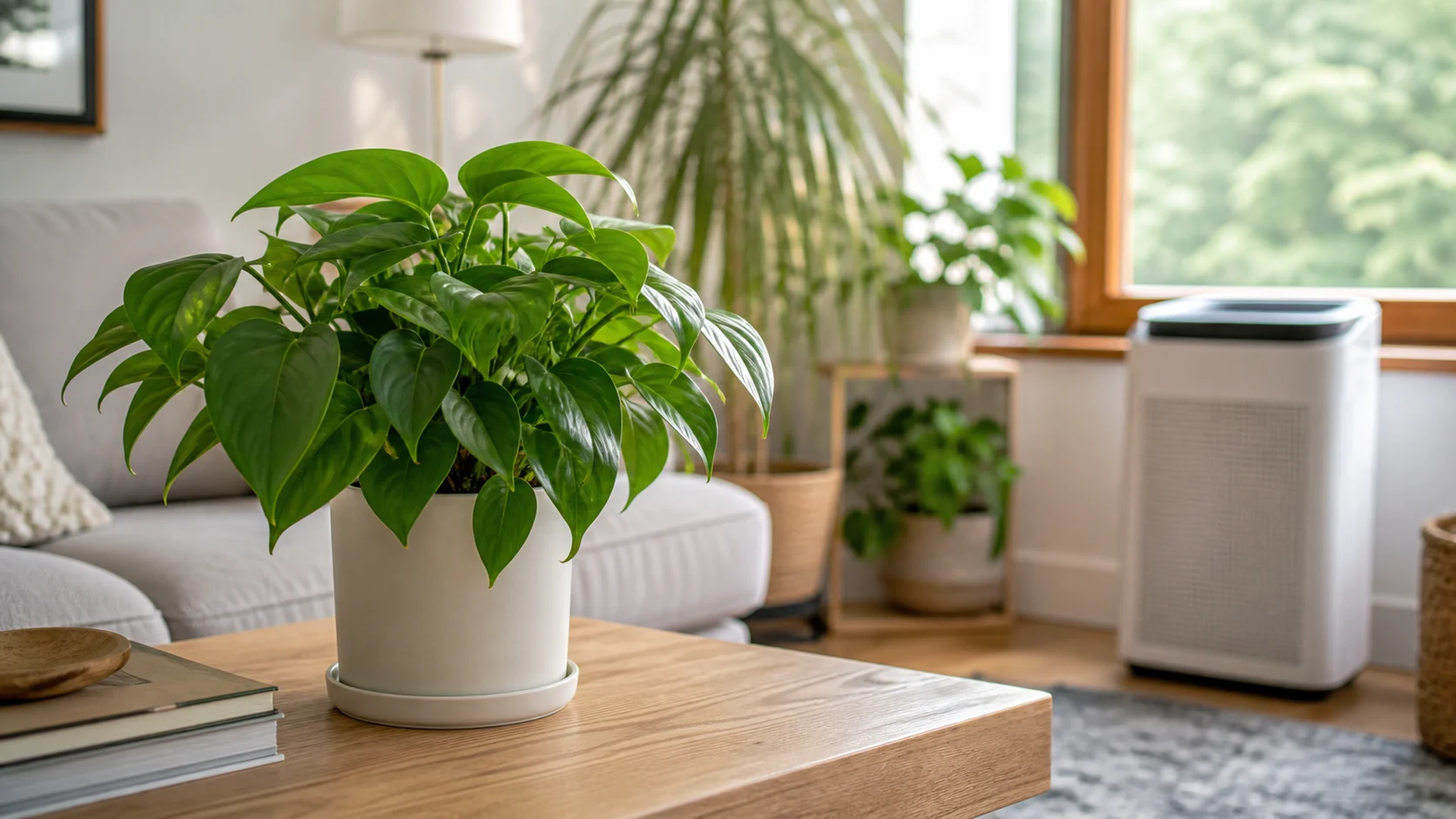
Healthy plants add greenery and comfort, while ventilation and filtration handle measurable indoor-air improvement.
Snake plants, notably, release oxygen at night through CAM photosynthesis, which is why they’re particularly recommended for bedrooms. If you want the full breakdown, our snake plant benefits guide explains why they punch so far above their weight indoors.
So yes, put plants near your desk, your bed, your kitchen. Just don’t cancel your air purifier subscription. If the bedroom is your priority, the best plants for bedroom guide narrows this list down to the species that work best where you sleep.
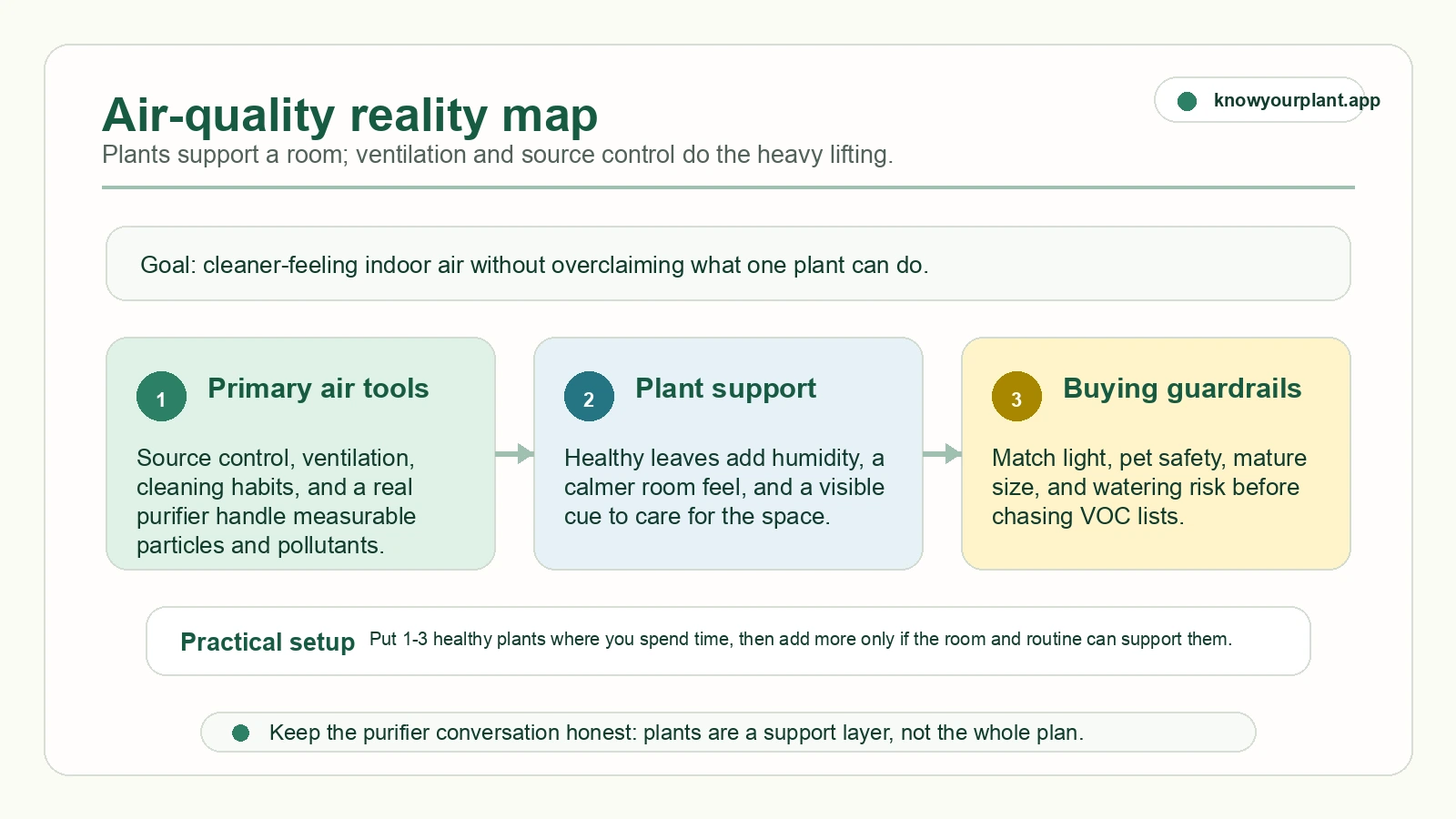
Keep the air-quality expectation honest: plants can support humidity, comfort, and care routines, but ventilation, source control, cleaning, and purifiers still do the measurable work.
Comparison Table: Care Fit and Claim Caution
Use this as a shopping filter, not as proof that one plant will clean a room better than another.
| Plant | Best for | Pet safety | Care fit | Safer air-quality wording |
|---|---|---|---|---|
| Snake plant | Bedrooms, low-effort owners, dimmer rooms | Toxic to cats and dogs | Very forgiving | Often mentioned in sealed-chamber VOC discussions, but still not a substitute for ventilation or filtration |
| Spider plant | Pet-friendly homes, bright indirect light | Non-toxic | Easy | Best chosen for pet safety and easy care, not for measurable room-scale air cleaning |
| Boston fern | Humid bathrooms, people who check plants often | Non-toxic | Moderate to fussy | Better framed as a humidity-loving plant than as a fix for indoor-air problems |
| Peace lily | Medium-light rooms with attentive owners | Toxic to cats and dogs | Moderate | Common in older air-purifying lists, but real-home air quality still depends on source control and airflow |
| Bamboo palm | Pet-safe tropical look, brighter rooms | Non-toxic | Moderate | A practical choice for readers who want a safer palm, not a replacement for a purifier |
| Pothos | Shelves, trailing growth, beginner setups | Toxic to cats and dogs | Easy | Useful as an easy indoor plant that appears in VOC discussions, without promising room-scale purification |
If smoke, mold, or strong chemical odors are the real problem, fix the source first. Plants belong in the comfort layer, while ventilation, filtration, and moisture control handle the measurable air-quality work.
Quick Buyer Shortlist
Use this if you are choosing a plant today and do not want to read twenty care guides first.
| Your room or routine | Best first picks | Watering baseline | Watch for |
|---|---|---|---|
| Dim bedroom or office | Snake plant, ZZ plant, pothos | Every 2-4 weeks for snake plant/ZZ; every 1-2 weeks for pothos | Mushy stems or yellow leaves mean too much water |
| Bright indirect window | Spider plant, rubber plant, monstera | Check weekly; water when the top 1-2 inches are dry | Brown tips often mean dry air, minerals, or inconsistent watering |
| Bathroom or humid room | Boston fern, English ivy, peace lily | Check every 3-7 days; do not let ferns fully dry out | Crispy edges mean dry air; soggy soil means poor drainage |
| Pet-friendly home | Spider plant, parlor palm, areca palm, bamboo palm, Boston fern | Check weekly; palms like lightly moist soil | Yellowing lower fronds can mean overwatering |
| You travel or forget | Snake plant, ZZ plant, aloe vera | Let soil dry out fully before watering again | Soft leaves or a sour smell mean the roots are staying wet |
If you are comparing plants at the store, KnowYourPlant can help you check the plant name, pet safety, and care routine before you bring it home.
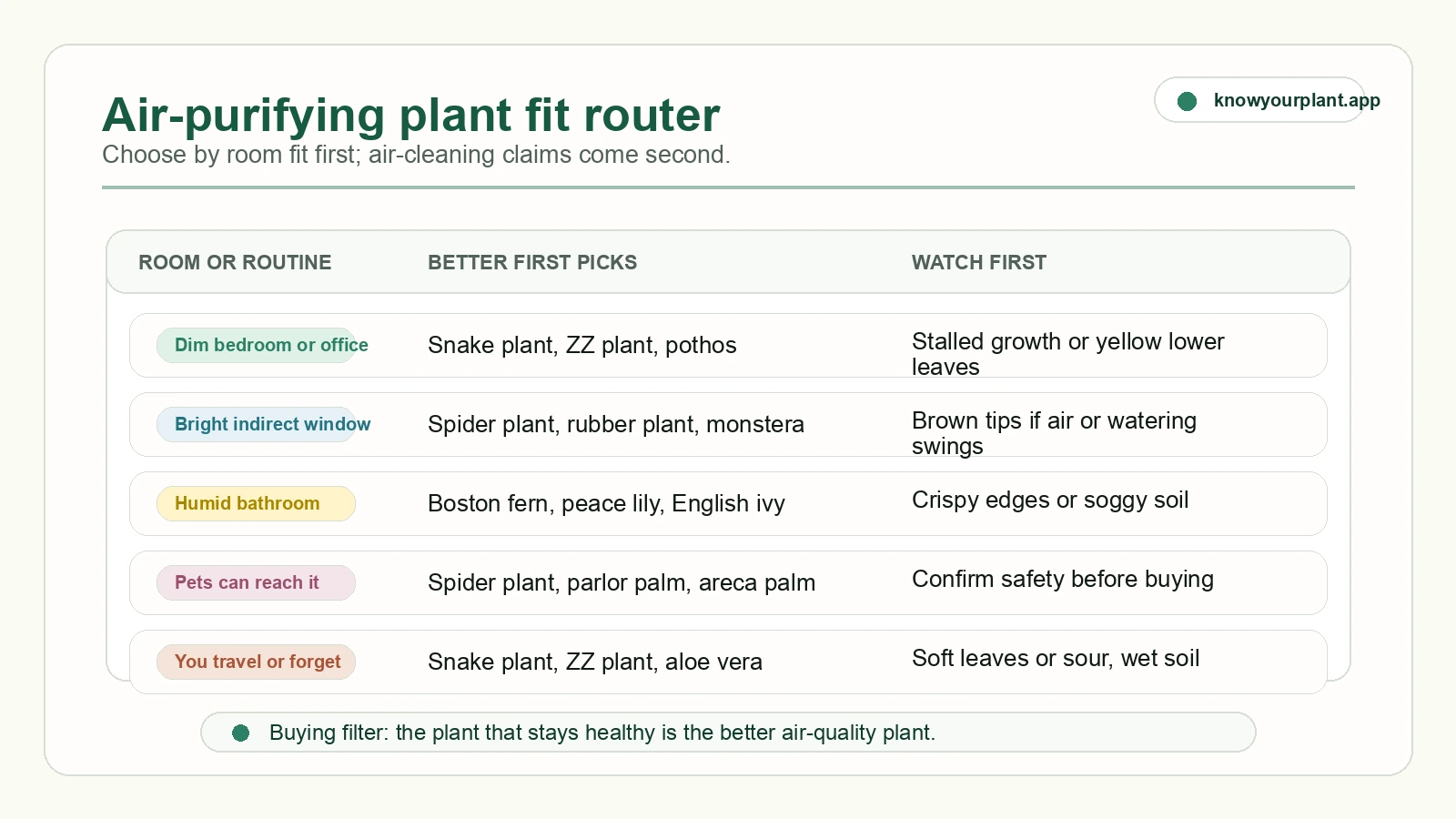
Use the router as a buying filter before choosing from the full list. A healthy plant that matches the room will do more for the space than a stressed plant with a stronger air-purifying claim.
Identification Snapshot
If you want a fast scan before buying, these are the most useful identity buckets in this list.
| Plant group | Best known picks from this guide | Best fit | First thing buyers get wrong |
|---|---|---|---|
| Upright drought-tolerant plants | Snake plant, ZZ plant, aloe vera | Forgetful waterers, bedrooms, desks | Watering on a schedule instead of checking the soil |
| Trailing or shelf plants | Pothos, heartleaf philodendron, spider plant, English ivy | Shelves, bright indirect light, easy visual growth | Assuming all trailing plants are pet-safe |
| Humidity lovers | Peace lily, Boston fern, bamboo palm, areca palm | Bathrooms, kitchens, homes with regular care | Treating them like drought-tolerant plants |
| Statement plants | Monstera, rubber plant, fiddle-leaf fig, bird of paradise | Bright rooms where the plant can stay put | Buying for looks before checking light reality |
Quick Decision Tree
Use this decision tree if your real goal is better air and not just a prettier corner.
- Your main goal is measurable dust or particle reduction: start with source control, ventilation, and an air purifier first. The EPA treats those as the primary tools. Add plants after that for comfort and humidity.
- Your main goal is a calmer-feeling room with low effort: choose snake plant, ZZ plant, or pothos.
- Your main goal is a pet-safe plant: start with spider plant, parlor palm, areca palm, bamboo palm, or Boston fern.
- Your room is truly dark most of the day: skip the “air-purifying” marketing and either add a grow light or choose a different spot. Low light tolerance is not the same as no-light survival.
- You know you overwater: avoid peace lily and Boston fern as your first pick. Start with snake plant, ZZ plant, or aloe.
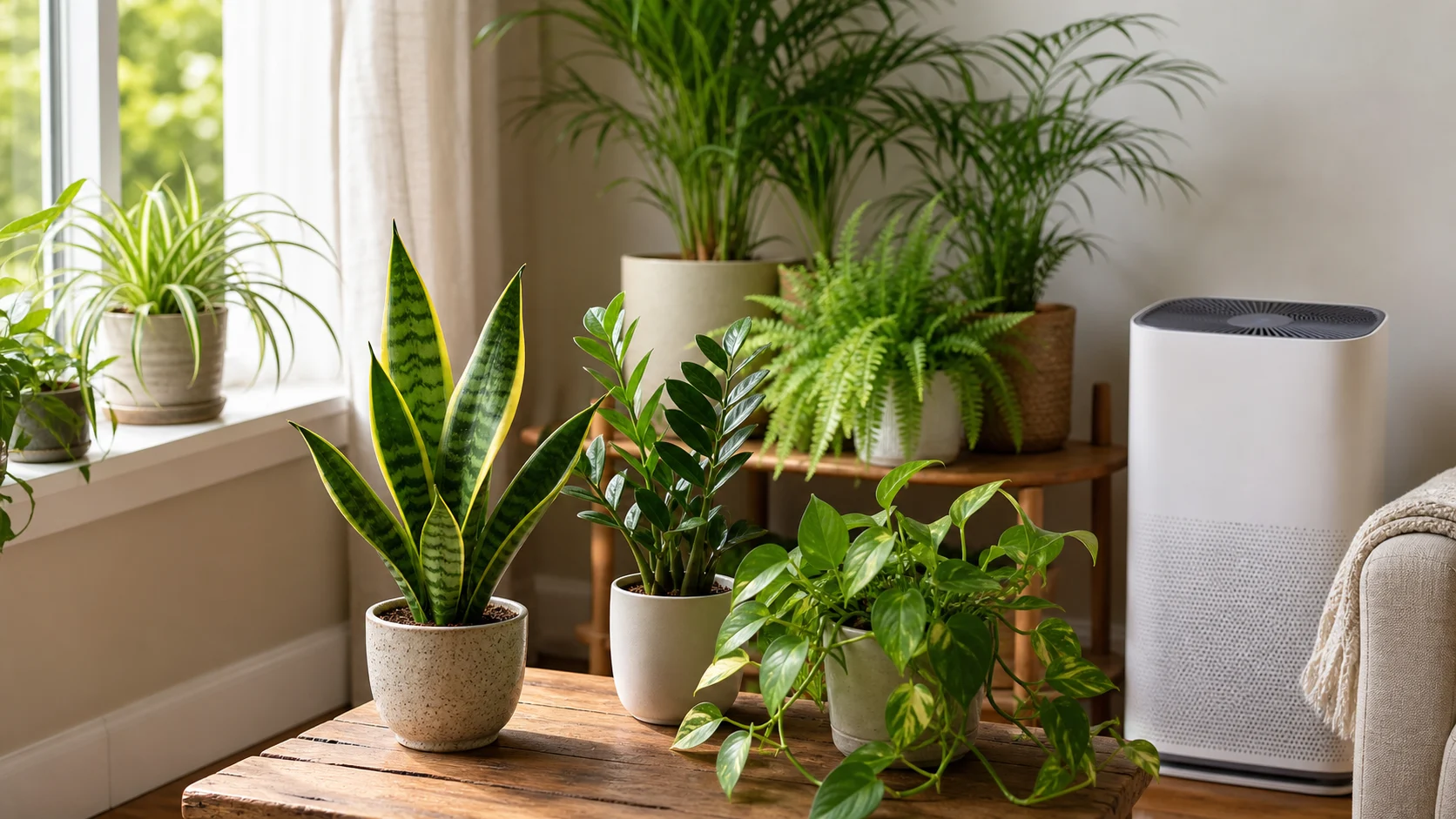
Match low-effort and pet-safe plants to real window light, and use filtration when cleaner air is the measurable goal.
Lookalikes/Confused-With
These mix-ups cause a lot of bad buying decisions because store labels and social posts often flatten very different care needs.
- Pothos vs heartleaf philodendron: both trail and both are toxic to pets, but pothos usually has thicker, waxier leaves and tolerates neglect a little better. Philodendron tends to want slightly steadier moisture.
- Snake plant vs aloe vera: both look beginner-friendly and drought tolerant, but aloe wants much brighter light than snake plant. If the spot is dim, snake plant is the safer call.
- Areca palm vs parlor palm: both are pet-safe, but areca palm gets larger and wants brighter light. Parlor palm is the easier fit for apartments and lower-light rooms.
Care Cards
Use these care cards to match the plant to the home you actually have.
| Care card | Choose these plants | Light reality | Watering rule | Skip if |
|---|---|---|---|---|
| Beginner / low-drama | Snake plant, ZZ plant, pothos | Low to medium for snake plant and ZZ, medium for pothos | Let the top 1-2 inches dry, or more for snake plant and ZZ | You want a guaranteed pet-safe plant |
| Pet-safe starter | Spider plant, parlor palm, bamboo palm | Bright indirect to medium | Check weekly and keep palms lightly moist, not soggy | The room is extremely dark |
| Humidity lover | Peace lily, Boston fern, areca palm | Medium to bright indirect | Check every few days and do not let them swing from swamp to bone-dry | You travel often or forget routine care |
| Bright-window statement plant | Monstera, rubber plant, bird of paradise | Bright indirect with room to grow | Water deeply, then wait for partial drying | You plan to move the plant around often |
The 20 Best Air-Purifying Plants
Low to Medium Light
These thrive without a bright window — ideal for bedrooms, offices, or interior rooms. If you want a broader look at what survives in dim conditions, the low-light indoor plants guide covers care specifics for many of these.
1. Peace Lily (Spathiphyllum) One of the top performers in the NASA study for removing benzene and trichloroethylene. She’ll also let you know exactly when she needs water — dramatic drooping, then perky again after a drink. Prefers low to medium indirect light. Toxic to cats and dogs. For full care details, see the peace lily care guide.
2. Snake Plant (Sansevieria / Dracaena trifasciata) Removes formaldehyde and nitrogen oxides, and unlike most plants, releases oxygen at night through CAM photosynthesis — which is why people put her in bedrooms. Extraordinarily drought-tolerant. The most forgiving plant on this list. Safe for humans, toxic to cats and dogs. If you want the full routine, read our snake plant care guide.
3. Pothos (Epipremnum aureum) Trails gracefully from a shelf and pulls formaldehyde from the air. Extremely low-maintenance, grows in almost any light, and propagates easily in water. If you’ve never kept a plant alive, start here. Toxic to cats and dogs. For the practical version, see our golden pothos care guide.
4. Chinese Evergreen (Aglaonema) Handles low light and irregular watering without complaint. Removes benzene and formaldehyde. The darker the leaves, the more low-light tolerant she is — a good rule of thumb with aglaonema. Toxic to cats and dogs.
5. ZZ Plant (Zamioculcas zamiifolia) Drought-tolerant and low-light capable. Absorbs benzene, toluene, and xylene. She stores water in her thick rhizomes underground, which is why she forgives neglect so easily. Toxic to cats and dogs — wear gloves when handling the sap.
6. Dracaena (various species) A big family with lots of options — Dracaena marginata (dragon tree), D. fragrans (corn plant), D. reflexa. All absorb formaldehyde and benzene well. Most tolerate lower light. Keep her away from fluoride — brown tips are usually the first sign. Toxic to cats and dogs.
Bright Indirect Light
These do their best work near a window with filtered or indirect sunlight.
7. Spider Plant (Chlorophytum comosum) Removes carbon monoxide and formaldehyde. One of the safest plants for homes with cats and dogs — genuinely non-toxic. She produces dangling “babies” that you can propagate endlessly. Thrives in indirect light and forgives inconsistent watering. Non-toxic to cats and dogs.
8. Aloe Vera Best known for soothing burns, aloe also removes formaldehyde from the air. She needs bright indirect light and very infrequent watering — let the soil dry completely between waterings. The gel in her leaves is one of the most useful things to have in a kitchen. Toxic to cats and dogs if ingested.
9. Boston Fern (Nephrolepis exaltata) The best natural humidifier on this list. She releases moisture into the air through transpiration while removing formaldehyde and xylene — doubly useful in dry climates or when central heating dries everything out. The catch: she needs consistent humidity and indirect light. Mist her regularly, or set the pot on a tray of wet pebbles. Non-toxic to cats and dogs.
10. Rubber Plant (Ficus elastica) Beautiful dark glossy leaves and impressive air-filtering capacity — particularly for toluene and xylene. Grows into a proper indoor tree if given space and light. Wipe her leaves occasionally so they can breathe and photosynthesize properly. Toxic to cats and dogs.
11. Heartleaf Philodendron Removes formaldehyde efficiently and is one of the easier philodendrons to keep. Trails or climbs depending on how you support her. Medium to bright indirect light, and she’ll tell you she needs water when her leaves start to look slightly limp. Toxic to cats and dogs.
12. English Ivy (Hedera helix) Good at reducing airborne mold, which makes her particularly useful in bathrooms or damp rooms. Prefers indirect light and cooler temperatures. Let the top inch of soil dry between waterings. Toxic to cats and dogs.
Statement Plants
These purify air and double as a focal point in the room — worth the extra care.
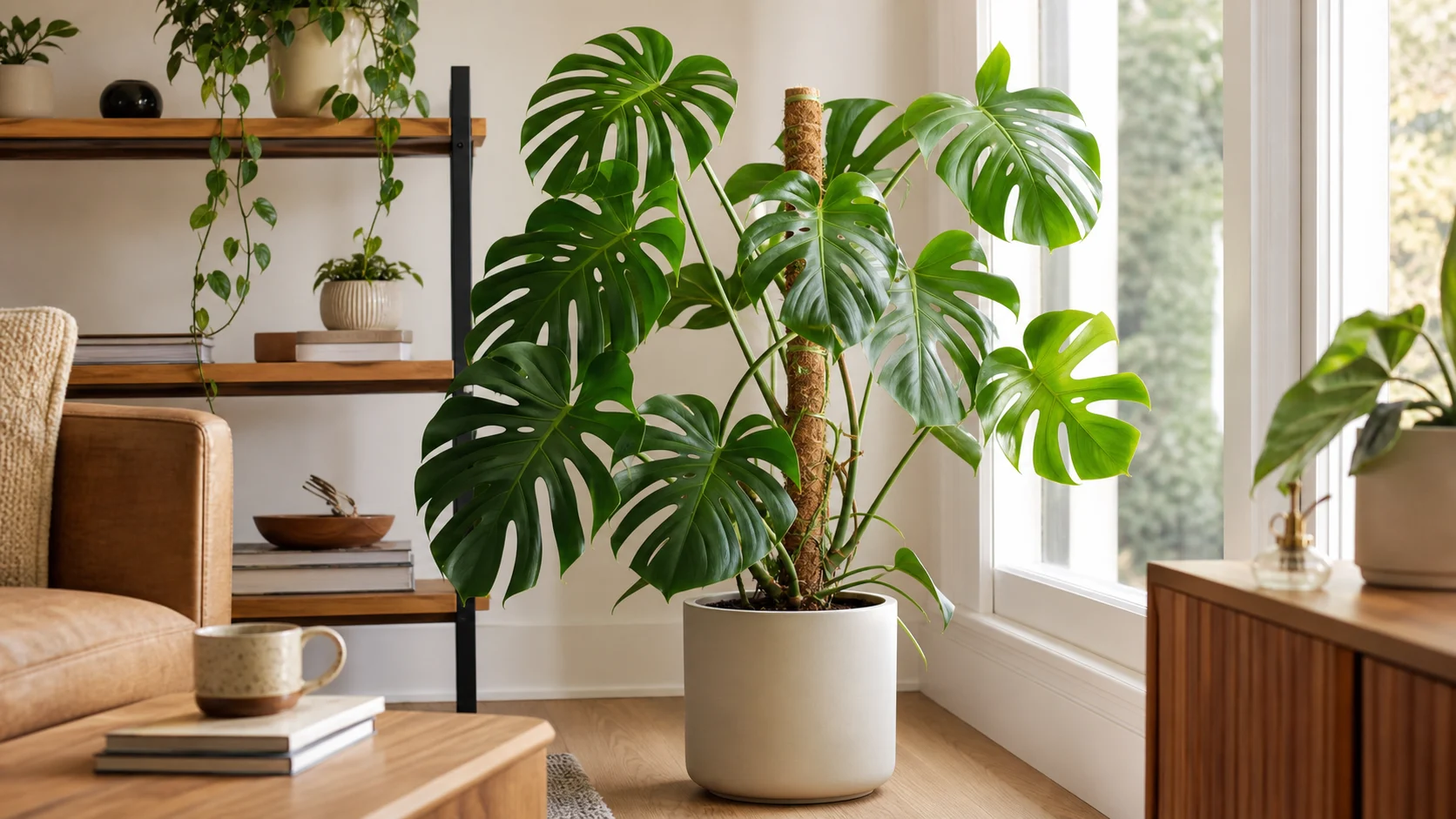
A mature Monstera becomes a true statement plant when bright indirect light, space, and climbing support all match its needs.
13. Monstera deliciosa The fenestrated leaves are iconic, and she removes formaldehyde from the air. Needs bright indirect light to develop her signature splits. Give her a moss pole and she’ll climb happily for years. Full care in the monstera care guide. Toxic to cats and dogs.
14. Bird of Paradise (Strelitzia reginae) Dramatic, large-leaved, and effective at filtering air. Needs a lot of bright indirect light — ideally near a south or east-facing window. She’s slow-growing, but when she settles into a spot she likes, she’s stunning. Mildly toxic to cats and dogs. If you want one as a statement plant, start with our bird of paradise plant care guide.
15. Fiddle-Leaf Fig (Ficus lyrata) Has a reputation for being finicky, and honestly that reputation is earned — she dislikes drafts, inconsistent watering, and being moved. But in the right spot, she becomes a defining piece of the room and filters benzene and formaldehyde. Find her spot, leave her alone, and she rewards you. Toxic to cats and dogs.
16. Areca Palm (Dypsis lutescens) One of the best humidifiers and air purifiers in the palm family. Removes formaldehyde, benzene, and carbon monoxide. Bright indirect light, regular watering in summer. A full, lush look that’s hard to match. Non-toxic to cats and dogs.
The practical rule still holds: choose the plant you can keep healthy in the spot you actually have. A stressed statement plant with wet roots will not outperform a simple pothos that is growing steadily.
Easy Wins (Lower Maintenance)
17. Parlor Palm (Chamaedorea elegans) A compact palm that tolerates lower light than most. Removes formaldehyde and benzene. Slow-growing, relatively low-maintenance, and safe for cats and dogs — one of the few palms that earns that distinction.
18. Chrysanthemum The highest overall VOC remover in the NASA study — benzene, formaldehyde, trichloroethylene, and ammonia all in one plant. The caveat: she blooms for a few weeks, then needs to be discarded or moved outdoors to rebloom. Worth it for the blooming season. Toxic to cats and dogs.
19. Bamboo Palm (Chamaedorea seifrizii) Another strong performer in the NASA study. Removes formaldehyde and acts as a natural humidifier. Prefers indirect light and consistent moisture. A good choice if you want tropical energy without high-maintenance drama. Non-toxic to cats and dogs.
20. Gerbera Daisy (Gerbera jamesonii) Rarely on these lists but one of the most effective at benzene and trichloroethylene removal. Bright, cheerful, and relatively short-lived as an indoor plant — treat her like a long-lasting cut flower arrangement rather than a permanent fixture. Needs good light. Non-toxic to cats and dogs.
How to Get the Most from Your Air-Purifying Plants
A few things that actually move the needle:
Size matters more than number. A large plant in a big pot filters more air than three small ones. When choosing, go bigger if you can. A snake plant in a 10-inch pot does more work than two 4-inch ones.
Leaves need to breathe. Dusty leaves absorb less because the leaf surface is blocked. Wipe them down with a damp cloth every few weeks, especially on large-leaved plants like rubber plant and monstera.
Grouping helps. Plants together raise humidity slightly through transpiration and create a micro-environment that benefits both them and you. A cluster of three does more than three scattered around the apartment.
Placement counts. Put them where you spend the most time — bedroom, home office, kitchen — not just where they look nice in photos. Your desk or bedside table matters more than the guest room shelf.
Simple Weekly Care Routine
Do this once a week and you will avoid most beginner problems:
1. Check soil before water. Push your finger 1-2 inches into the potting mix. If it feels damp or the pot still feels heavy, wait. If it feels dry and the leaves are slightly softer or lower than usual, water.
2. Water deeply, then drain. Add water until it runs from the drainage hole, then empty the saucer. A small splash on a schedule keeps roots shallow and can leave dry pockets in the pot.
3. Use the plant type as your starting rhythm. Snake plant, ZZ plant, and aloe often need water every 2-4 weeks indoors. Pothos, philodendron, spider plant, rubber plant, and monstera are often closer to every 1-2 weeks. Boston fern, peace lily, bamboo palm, and areca palm may need checking every 3-7 days because they dislike drying out completely.
4. Learn the overwatering signs. Yellow leaves, limp stems, fungus gnats, a sour smell, wet soil for more than a week, or mushy leaf bases mean you should stop watering and check drainage before doing anything else.
5. Set the seasonal job. Today, choose the brightest suitable spot and check drainage. This week, wipe dusty leaves and inspect undersides for pests. This season, repot only if roots circle the pot, soil dries out almost immediately, or growth has stalled during spring or summer.
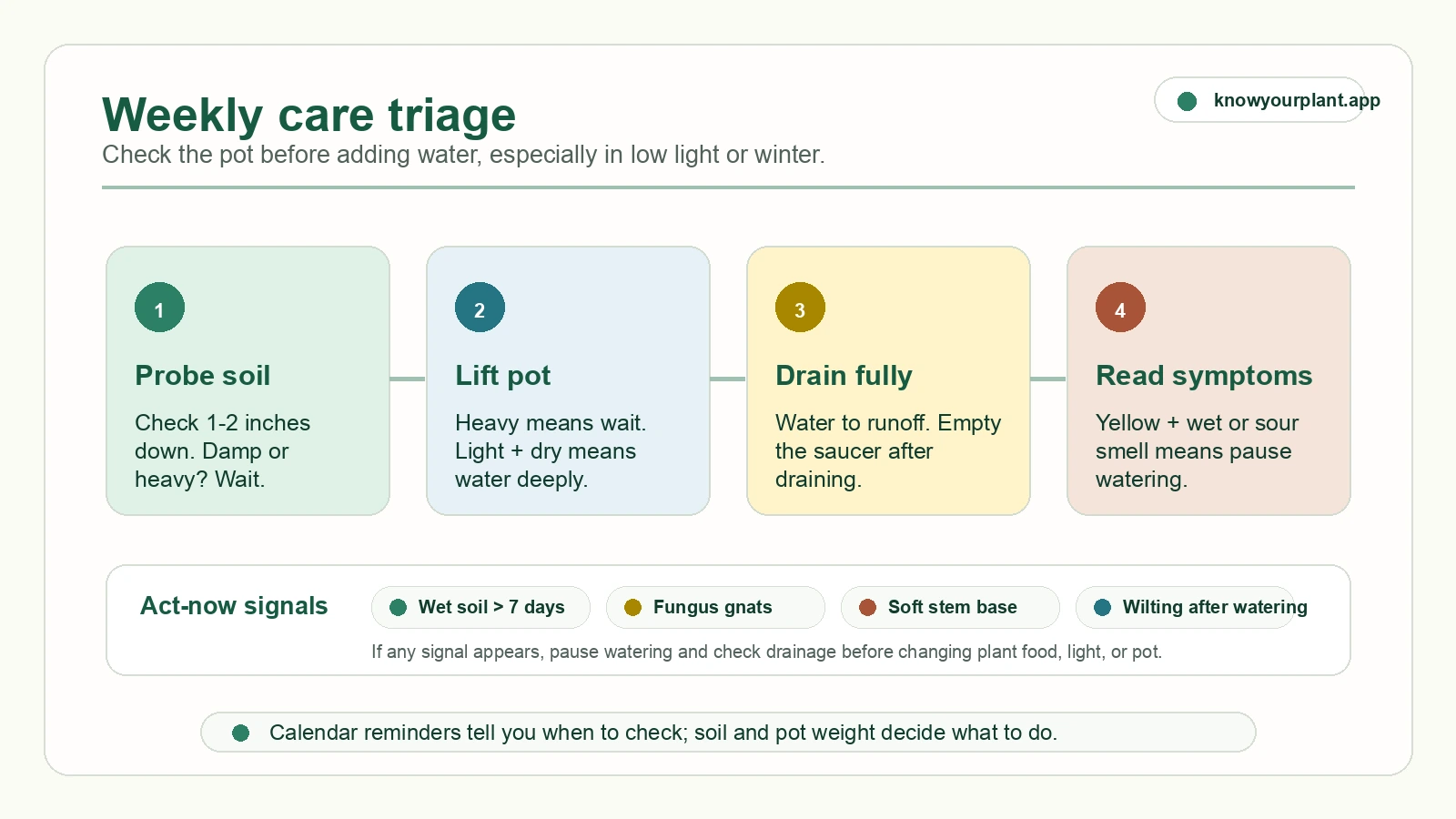
Use this once-a-week triage before adding water. In low light or winter, a heavy pot and damp soil usually mean the right move is to wait.
Expert Note
The honest source-backed position is simple:
- The original NASA study showed VOC removal in sealed test chambers, which is why these plants appear in so many lists.
- The American Lung Association says houseplants do not meaningfully clean indoor air in normal rooms the way people often assume from those older tests.
- The EPA recommends source control, ventilation, and air cleaners as the primary indoor-air-quality tools.
- ASPCA toxicity guidance matters just as much as the air-purifying claim if pets can reach the plant.
That does not make these plants pointless. It means the practical buying question is not “which plant cleans the air best?” but “which plant will stay healthy in this room without creating a pet-safety or overwatering problem?”
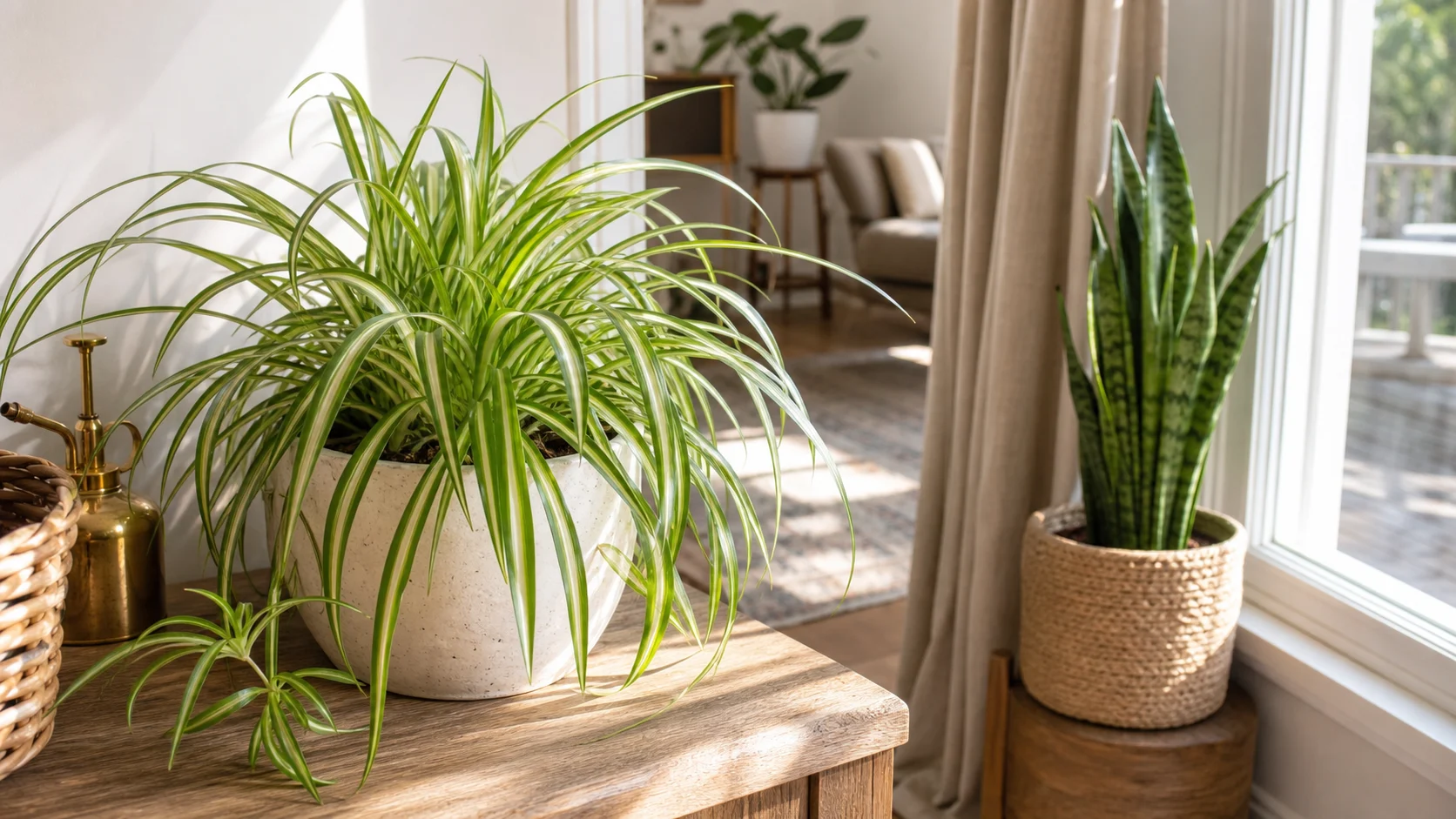
Choose by room fit, watering tolerance, and pet safety—not by sealed-chamber air-cleaning claims alone.
Seasonal Care Calendar for Air-Purifying Plants
The light and humidity in your home change through the year, and your plants feel it. Here’s what to do each season to keep your collection doing its best work.
Spring (March–May) This is when most of your plants will wake up and start growing again. Move them closer to windows as days lengthen — the monstera, rubber plant, and bird of paradise especially appreciate the extra light. It’s also the best time to repot anything that’s been in the same container for two or more years, before the growing season is in full swing. Start fertilizing again (monthly, at half strength) after the winter break.
Summer (June–August) Watering frequency goes up — check every 3–4 days instead of weekly for most plants on this list. The Boston fern and bamboo palm will love a pebble tray with water for added humidity. Watch for spider mites and scale on the ficus family (rubber plant, fiddle-leaf fig) — they tend to peak in summer heat. If you have outdoor space, the snake plant, aloe, and ZZ plant can spend summer outside in filtered shade and will come in stronger in autumn.
Autumn (September–November) Start pulling back fertilizer in September — most plants slow down and don’t need the feed. Move plants away from windows as the sun angle drops; south-facing spots that were fine in summer may now get too direct. Watch for the peace lily and philodendron drooping more than usual — it’s often the shift in light, not a watering issue. Check carefully for pests before bringing any outdoor plants inside for winter.
Winter (December–February) This is when most people lose plants — not from cold, but from overwatering combined with low light. Reduce watering by roughly half for most plants on this list. Keep them away from cold draughts near windowsills and exterior doors, but also away from radiators, which dry the air and can scorch leaves. If you have a humidifier, winter is when it earns its place next to the Boston fern and areca palm.
Common Problems and First Fixes
Even well-chosen plants have rough patches. Here’s how to read the common signs:
Yellow leaves spreading from the bottom up Almost always overwatering. Check the soil — if it’s soggy or the pot feels heavy, hold off and let it dry out fully. If the base of the stem is soft, you may be dealing with root rot: unpot, trim the black roots, and repot in fresh dry soil. The peace lily and philodendron are particularly susceptible.
Brown leaf tips Usually fluoride or mineral sensitivity — this is very common in dracaena, spider plant, and peace lily. Switch to filtered water or let tap water sit overnight before using, and trim the brown tips with clean scissors at an angle so it looks natural. Also check: is she sitting too close to a heat source?
Leggy growth reaching toward the light Not enough light. Move her closer to the window. With pothos, philodendron, and spider plant, this is easy to fix quickly. With the fiddle-leaf fig or rubber plant, move gradually — a sudden change in position can trigger leaf drop.
Wilting even though you just watered Counterintuitively, this often signals root rot rather than thirst. Feel the soil — if it’s still wet and the plant is wilting, the roots can’t absorb water anymore. Unpot and inspect: healthy roots are white or tan; rotting roots are brown, mushy, and may smell.
Dusty, dull-looking leaves Wipe them down. This isn’t just cosmetic — dusty leaves photosynthesize less efficiently and absorb fewer VOCs. If you’re keeping plants specifically for air quality, clean leaves matter. A damp cloth every few weeks makes a real difference on the rubber plant, monstera, and fiddle-leaf fig.
Leaves curling inward Usually stress from dry soil, low humidity, too much direct sun, or pests. Check in this order: soil moisture, heat from the window, then leaf undersides. If the soil is bone dry, water deeply. If it is damp, move the plant out of harsh sun and inspect for mites or sticky residue.
If you are troubleshooting another common plant symptom, see Areca Palm Care Indoors: Light, Water, and Yellow Leaves for a focused diagnosis and recovery plan.
Real User FAQ
I mostly want cleaner bedroom air. Should I buy more plants or an air purifier first? If your goal is measurable indoor-air improvement, start with ventilation and a purifier first, then add plants you can actually keep healthy. A snake plant or spider plant can still improve the feel of a room, but it should not be your only air-quality strategy.
I have cats. Which picks from this list are the least stressful? Start with spider plant, parlor palm, areca palm, bamboo palm, Boston fern, or gerbera daisy. Do not rely on generic roundup labels for pothos, peace lily, philodendron, or snake plant. Check the ASPCA listing before buying.
My corner gets “low light.” Is that enough for an air-purifying plant? Only if it is genuinely dim but still usable light from a nearby window. If the plant cannot see the sky from that spot, expect slow decline unless you add a grow light. Snake plant and ZZ plant tolerate low light better than most, but even they do not want a black corner.
I keep killing peace lilies and snake plants. What is the most common reason? Overwatering is the most common reason, especially when “easy-care” gets translated into watering by the calendar. Check the soil first. Yellow leaves plus a heavy, wet pot usually mean you should wait, not water again.
Frequently Asked Questions
Do air-purifying plants actually work? Yes, but with caveats. The NASA research was conducted in sealed chambers, not open rooms. In a normal home, plants are a small support for air quality, not a replacement for ventilation, cleaning, or a real air purifier. Their more reliable everyday benefits are humidity, greenery, and the routine of caring for your space.
How many plants do I need to purify a room? For meaningful VOC reduction, more than most people want to maintain. For a practical home setup, start with 1-3 healthy plants where you spend time, then add more only if the light and your routine can support them.
What is the best single plant for removing formaldehyde? Pothos and snake plant are the most practical — they’re easy to keep alive and consistently appear in studies. For outright effectiveness in controlled tests, the Boston fern and bamboo palm rank high.
Are most air-purifying plants safe for pets? No — most are not. Spider plant, parlor palm, areca palm, bamboo palm, Boston fern, and gerbera daisy are non-toxic. Peace lily, pothos, philodendron, dracaena, and most others on this list are toxic to cats and dogs. Always check before bringing a new plant home.
Where is the best place to put an air-purifying plant? Near where you spend the most time. Bedroom (snake plant, peace lily) and home office (pothos, ZZ plant) make the most impact. Bathrooms work well for Boston fern and English ivy — they like the humidity. Kitchen is a good spot for aloe vera, which doubles as a practical first-aid plant.
Where to Start
If you’re choosing your first air-purifying plant, the snake plant and pothos are genuinely the easiest — forgiving of irregular watering, adaptable to most light, and effective. If you want something with a bigger visual presence, the areca palm or monstera will reward you. If you have pets, the parlor palm or Boston fern give you the air benefits without the worry.
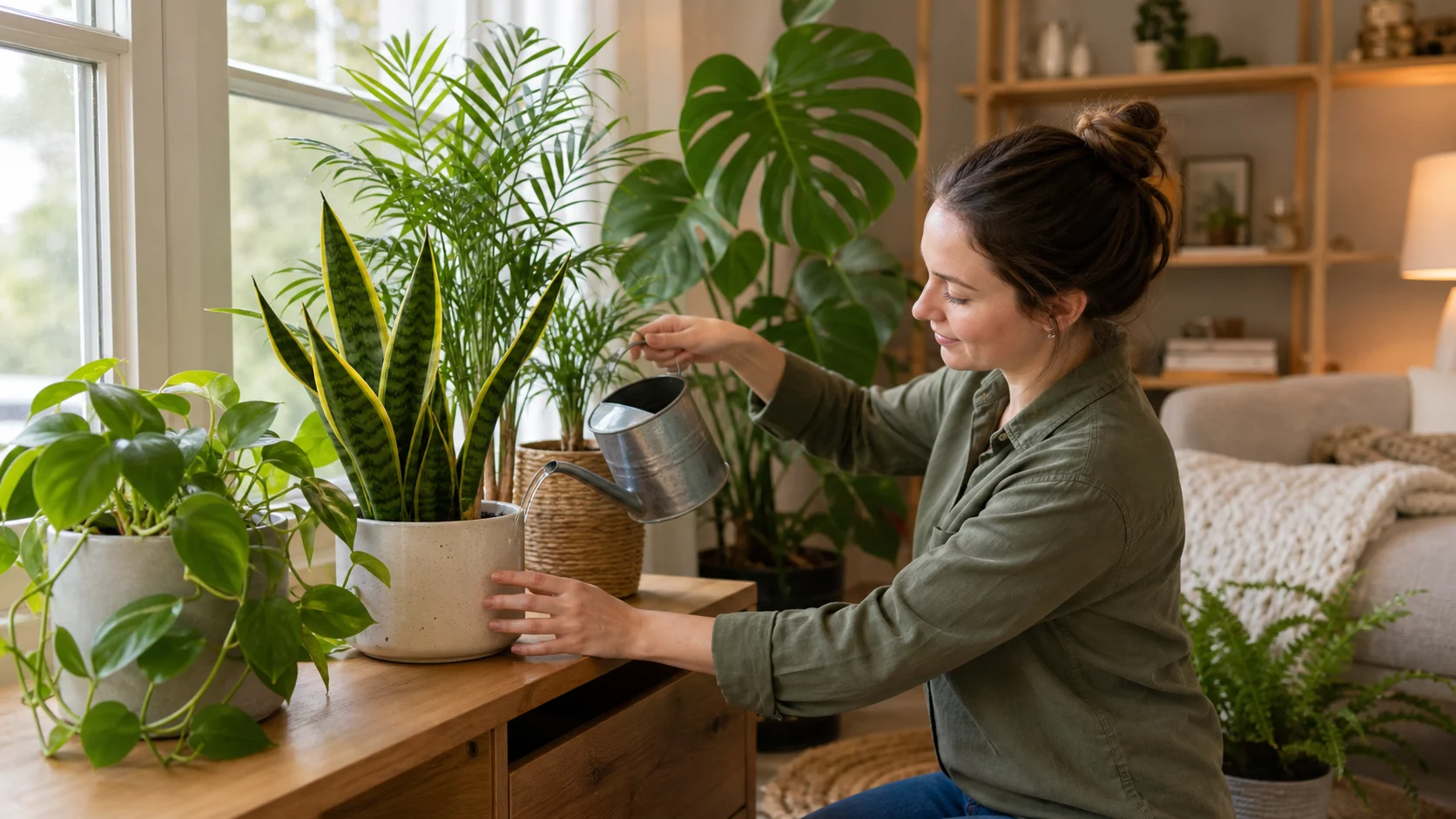
Start with one plant whose light, watering rhythm, size, and pet safety fit the room you already have.
Pick one you’ll actually enjoy looking at. The air benefits are real but modest — the joy of a living thing in your space is the part that compounds over time.
Methodology Note
This guide was updated after reviewing search results for air-purifying indoor plants, recurring plant-owner questions about pet safety, low light, and overwatering, and primary-source material from NASA, the American Lung Association, the EPA, and ASPCA. The shortlist tables, decision tree, and care cards in this article are editorial tools built to help readers choose plants by room fit and failure risk, not to claim measured pollutant-removal performance in a normal home.