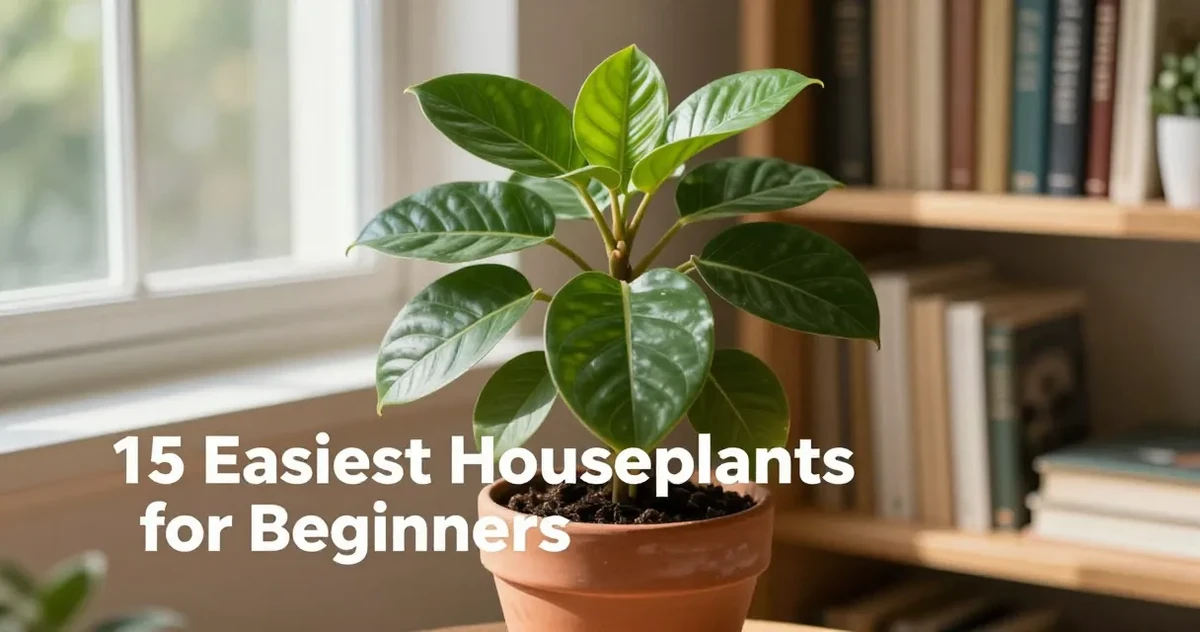
If you’ve bought a plant with good intentions and watched it slowly yellow, curl, or collapse, this list is for you. The goal is not to find a plant that needs no care. It is to choose one that fits your light, your memory, and your normal week.
For each beginner-friendly plant below, focus on three things: where it will live, when to water, and what the first warning sign looks like. That is the difference between buying a plant because it looks easy and choosing one you can actually keep alive.
If you’re just getting started, the complete indoor plant care guide for beginners covers the fundamentals of soil, light, and watering that apply to everything on this list.
Before you choose, scan this quick fit guide. A calendar like “every 1-2 weeks” is only a starting point: warm rooms, small pots, and bright windows dry faster, while winter, low light, and heavy soil slow everything down.
Why easy houseplants still need different routines
Beginner-friendly describes tolerance, not identical biology. Four common starter plants are compared here using the same occurrence and climate method.
The ranges below are the middle 50% (p25–p75), not recommended indoor setpoints.
| Reference taxon | POWO native range | Annual mean temperature | Annual precipitation | Relative humidity | Solar radiation | Evidence |
|---|---|---|---|---|---|---|
| Dracaena trifasciata (snake plant) | southern Nigeria to west-central tropical Africa and Tanzania | 23.3–25.2°C | 1585–1783 mm/yr | 65–69% | 16.1–18.1 MJ/m²/day | 29 climate points; medium confidence |
| Epipremnum aureum (golden pothos) | Mo’orea in the Society Islands | 25.7–25.9°C | 2451–2644 mm/yr | 63–64% | 20.0–20.1 MJ/m²/day | 6 climate points; low confidence |
| Ficus elastica (rubber plant) | Nepal to western Yunnan and western Malesia | 22.5–26.6°C | 1514–2822 mm/yr | 61–66% | 16.7–19.1 MJ/m²/day | 30 climate points / 120 usable records; medium confidence |
| Philodendron hederaceum (heartleaf philodendron) | Mexico to tropical America | 24.0–25.9°C | 1668–2787 mm/yr | 64–68% | 17.0–18.7 MJ/m²/day | 30 climate points / 783 usable records; medium confidence |
What this changes in this guide: The wide native-climate contrast is a reason to learn each pot’s drying pattern instead of giving every beginner plant the same weekly drink.
Sources and method: Dracaena trifasciata in POWO and GBIF; Epipremnum aureum in POWO and GBIF; Ficus elastica in POWO and GBIF; Philodendron hederaceum in POWO and GBIF; CHELSA V2.1, 1981–2010. GBIF records are limited to POWO-native countries, then filtered for coordinates, establishment signal, licence, precision, and spatial duplication. No community or user-reported care data is used in this module.
What Most Care Guides Miss
Most guides about easy Houseplants for Beginners to Grow describe the ideal care routine. Real homes are messier: light changes by season, pots dry at different speeds, and the same symptom can mean different things depending on where it appears.
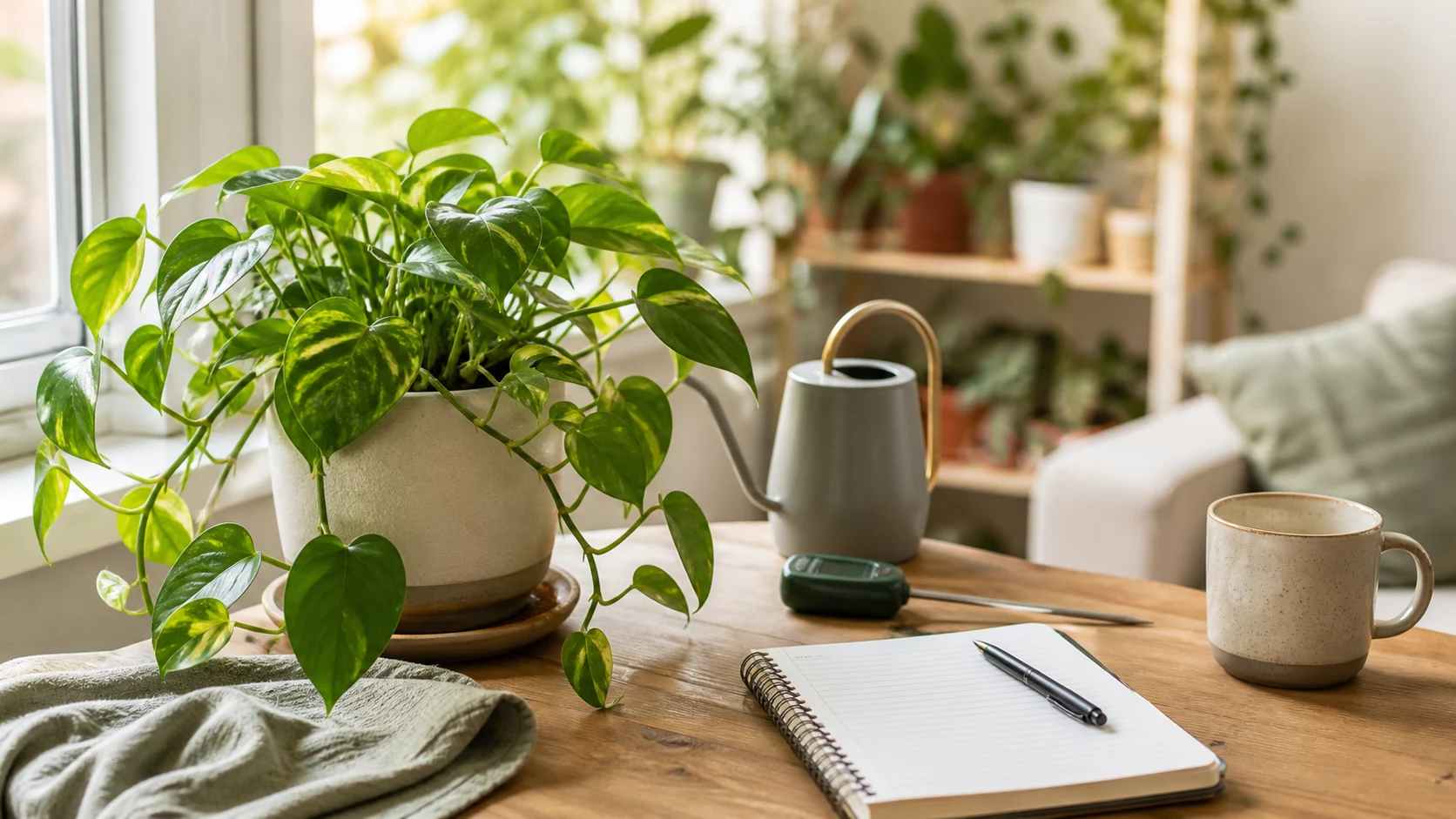
A pothos care check pairs changing window light with soil and watering observations before any routine is reset.
Before changing care, check the plant in this order:
- Light: is the plant growing toward the window, fading, or scorching?
- Root zone: is the pot drying predictably, or staying wet in the middle?
- Leaf pattern: did the oldest leaves, newest leaves, tips, or stems change first?
- Recent change: new pot, new location, fertilizer, cold draft, heat vent, or pest exposure.
This keeps you from fixing the wrong problem. One clear adjustment is usually safer than a full care reset.
Quick Watering and Warning Signs
| Plant | Best fit | Water when… | First warning sign to check |
|---|---|---|---|
| Pothos | Shelves, low to medium light, forgetful watering | The top 2-5 cm of soil feels dry or leaves soften slightly | Several leaves yellow at once and the soil stays wet |
| Snake plant | Dark corners, travel, very low routine | The soil is dry all the way down | Leaf bases turn soft, mushy, or wrinkled while soil is damp |
| ZZ plant | Offices, dim rooms, people who water rarely | The soil is fully dry and the pot feels light | Stalks yellow from the base or lean with soft stems |
| Heartleaf philodendron | Trailing shelves, medium light, fast growth | The top half of the pot feels dry | New leaves stay small, old leaves yellow, and soil smells sour |
| Chinese evergreen | Low-light rooms and steady indoor temperatures | The top few centimetres feel dry | Lower leaves yellow quickly and stems feel soft |
| Cast iron plant | Very shady rooms and inconsistent care | The top half of the pot has dried | Leaf tips brown or yellow while the pot remains wet |
| Dracaena | Upright floor plant for medium or low light | The top 2-5 cm feels dry | Lower leaves yellow while soil is damp; brown tips can also mean dry air or mineral-heavy tap water |
| Aloe vera | Sunny windowsills and people who forget to water | The soil is dry from top to bottom | Leaves turn soft, translucent, or mushy |
| Spider plant | Bright indirect light, easy propagation | The top few centimetres feel dry | Crown feels soggy, leaves yellow while soil is damp, or tips brown from dry air or minerals |
| Rubber plant | Bright indirect light and a steady spot | The top third to half of the pot feels dry | Lower leaves yellow and drop while the soil is still wet |
| Peace lily | Lower light with clear thirst signals | The top few centimetres feel dry or leaves droop slightly | Leaves yellow and the pot smells musty |
| Haworthia | Small sunny shelves and desk plants | The soil is completely dry | Leaves go translucent or mushy at the base |
| Hoya | Hanging baskets and dry-between-watering care | Most of the pot has dried out | Leaves wrinkle or yellow while the soil is still wet |
| English ivy | Cool bright rooms and hanging baskets | The top 2 cm feels dry | Leaves yellow and drop while roots stay wet |
| Monstera | Bright rooms with space to grow | The top 5 cm feels dry | Lower leaves yellow or black spots appear after watering |
Here are 15 plants that will work with you, not against you.
Social Listening: What Beginners Actually Keep Asking
Across current beginner plant discussions, four patterns keep repeating:
- People do not just want an “easy” plant, they want one that matches a dim room, a drafty corner, or a bad watering habit.
- Pet safety changes the shortlist fast, because many classic beginner plants are easy to grow but not safe for a chewing cat or dog.
- Overwatering anxiety is bigger than underwatering anxiety. Beginners want to know when not to water as much as when to water.
- A long list is less useful than a short route to the right first plant.
That is why this guide sorts by fit, warning signs, and real-home conditions instead of just stacking names.
Identification Snapshot: Start With the Home, Not the Hype
Use this quick filter before you buy anything.
| If this sounds like your home… | Start with these plants | Why they work |
|---|---|---|
| I forget to water and need a plant that forgives me | Snake plant, ZZ plant, haworthia, aloe vera | They prefer to dry out and usually fail from too much attention, not too little |
| My room is dim and I do not have a sunny sill | ZZ plant, cast iron plant, Chinese evergreen, heartleaf philodendron | They tolerate lower light better than most beginner lists admit |
| I want fast visible growth so I stay interested | Pothos, heartleaf philodendron, spider plant | They push new growth often enough to feel rewarding |
| I have pets and need a safer shortlist | Spider plant, haworthia | They are easier starter picks than many toxic beginner staples |
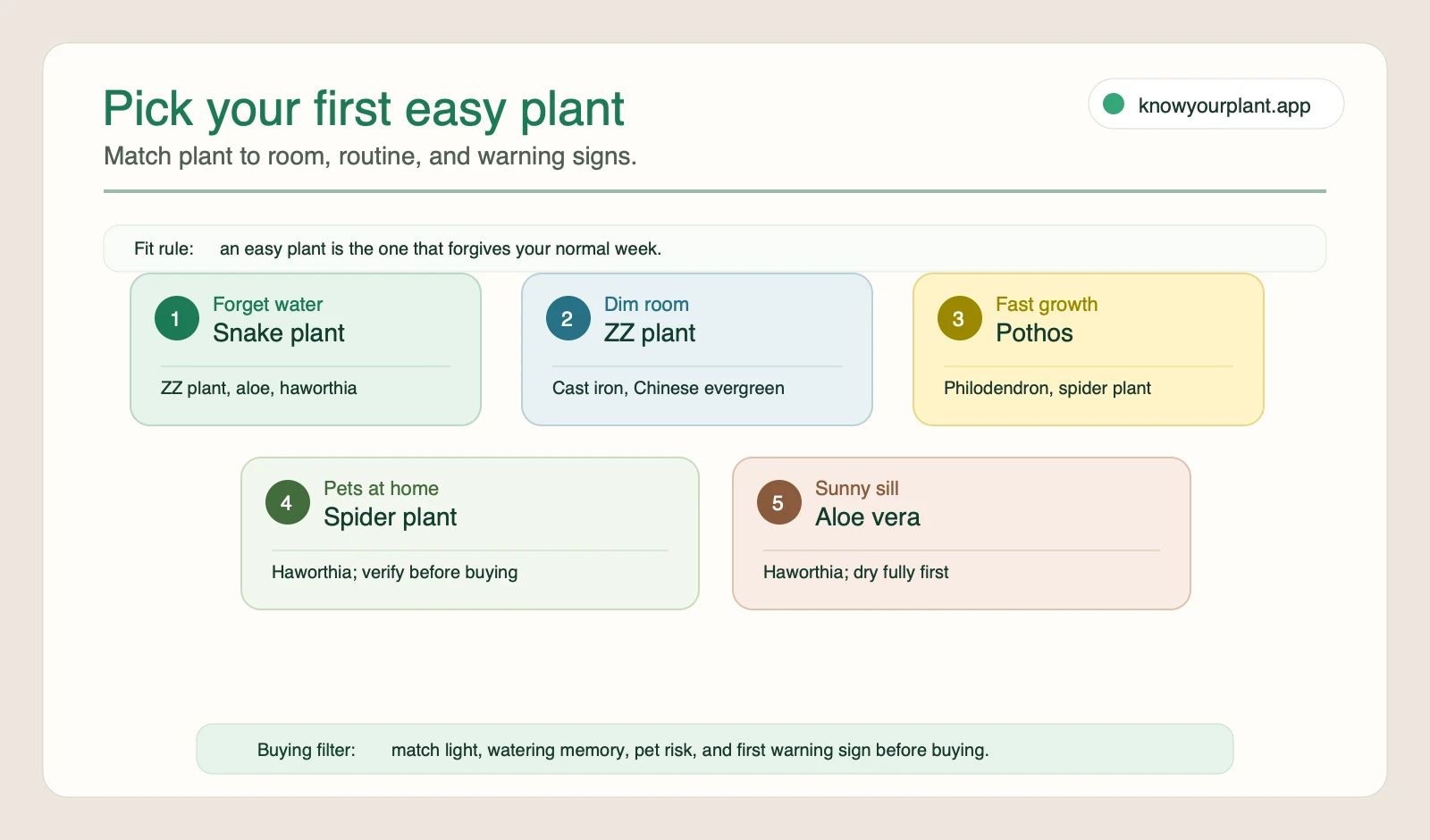
Use the fit router before buying: the easiest plant is the one that matches your light, watering memory, pet risk, and first warning sign.
Common Lookalikes and Confusion Traps
| Easy plant people mean | Often confused with | What to remember |
|---|---|---|
| Haworthia | Aloe vera | Both are small succulents, but haworthia handles indoor life more easily and is the safer beginner pick in pet homes |
| Pothos | Heartleaf philodendron | Both trail well, but pothos usually tolerates darker corners more easily while philodendron wants steadier watering |
| Snake plant | ZZ plant | Both forgive neglect, but snake plant prefers to dry much harder between waterings and ZZ often shows overwatering first at the base |
| Peace lily | Other glossy green foliage plants | Peace lily is easy to read because it droops when thirsty, but it is not a pet-safe beginner default |
Care Cards for Four Reliable First Plants
| Plant | Light | Water rhythm | First warning sign | Best for |
|---|---|---|---|---|
| Pothos | Low to bright indirect | Water when the top 2 to 5 cm dries | Several leaves yellow while the pot stays wet | Fast feedback and forgiving care |
| Snake plant | Low to bright indirect | Let the soil dry fully | Soft or mushy leaf bases | Forgetful owners and darker corners |
| ZZ plant | Low to medium indirect | Wait until the mix is fully dry | Yellowing stalks from the base | Offices, dim rooms, and low-routine homes |
| Spider plant | Bright to medium indirect | Water when the top few centimetres dry | Brown tips or a soggy crown | Beginners who want fast visible growth |
Plants That Thrive on Neglect
1. Pothos (Epipremnum aureum)
Pothos might be the most forgiving plant on this list. It trails beautifully from a shelf, tolerates low light better than almost anything else, and tells you clearly when it’s thirsty: the leaves go slightly soft and droopy, then perk right back up after a drink. You can ignore pothos for two weeks and it will still be fine.
The mistake to avoid is watering it just because a calendar says so. If the pot still feels damp, wait. Pothos usually forgives a dry week faster than it forgives soggy roots.
There are several varieties to choose from: classic golden, bright neon, silvery satin. All equally easygoing. For a full care breakdown, the golden pothos care guide covers everything you need.
2. Snake Plant (Sansevieria / Dracaena trifasciata)
Snake plants are practically indestructible. They store water in their thick leaves, which means they prefer being left alone between waterings. Bright light, low light, dry air, drafts: they handle it all without complaint.
If you’ve killed other plants and can’t figure out why, start with a snake plant. It will help restore your confidence. For everything from watering schedules to propagation, the snake plant care guide has the details.
3. ZZ Plant (Zamioculcas zamiifolia)
The ZZ plant grows from thick underground rhizomes that store water like small reservoirs. This means it can go weeks without watering and still look glossy and healthy. It grows slowly, stays tidy, and thrives in low-light corners where other plants would struggle. The only real way to make a ZZ plant unhappy is to overwater it.
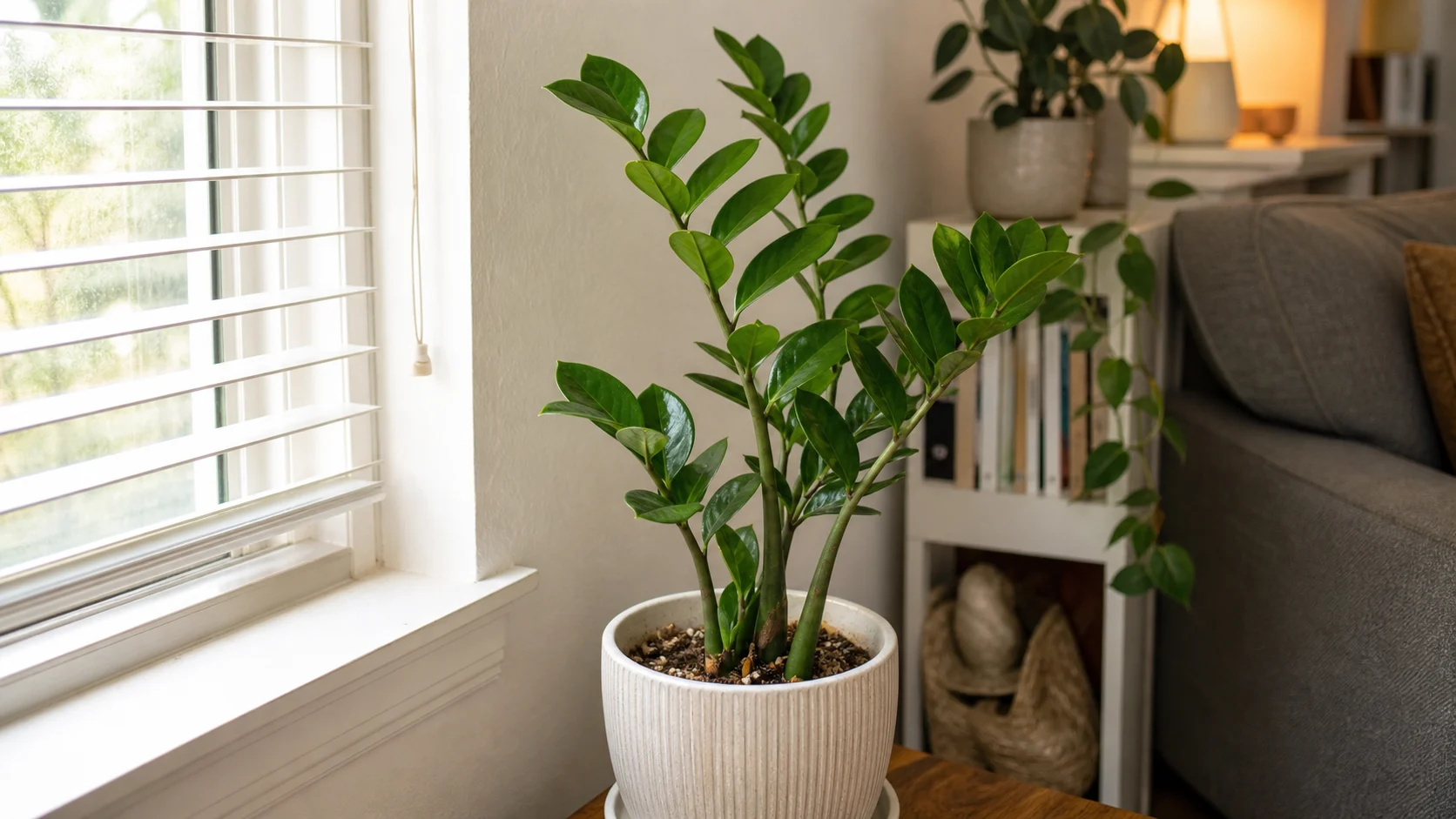
A ZZ plant sits in dry, airy mix under filtered room light, with a saucer ready to keep runoff from lingering around the roots.
Best Plants for Beginners in Low Light
4. Heartleaf Philodendron (Philodendron hederaceum)
Heartleaf philodendron is warm, easy, and grows quickly enough to feel rewarding. The heart-shaped leaves trail or climb depending on what you give them to work with. It tolerates lower light reasonably well, though it grows faster with something brighter. Water when the top half of the soil feels dry, and it will reward you with a new leaf every week or two during growing season.
The University of Florida’s Institute of Food and Agricultural Sciences describes heartleaf philodendron as “one of the most adaptable and easy-to-grow houseplants available,” noting its ability to handle the low humidity and inconsistent light typical of most homes. Full care details are in the heartleaf philodendron care guide.
5. Chinese Evergreen (Aglaonema)
Chinese evergreens come in a wide range of leaf patterns: deep green, silver-streaked, even pinkish-red. The darker green varieties handle low light exceptionally well, which makes them ideal for offices and dim apartments. They’re slow-growing, unfussy about humidity, and rarely attract pests. Water when the top layer of soil dries out and that’s about all the attention they need.
6. Cast Iron Plant (Aspidistra elatior)
The name tells you everything. Cast iron plants tolerate deep shade, temperature swings, dry soil, and neglect in a way that few plants can match. They grow slowly, but they never seem to die. If you have a dark corner that’s already defeated three other plants, this is the one to try.
7. Dracaena
Most dracaena varieties are excellent plants for beginners. They grow upright, look architectural, and handle low light without sulking. Water when the top inch or two of soil is dry, and avoid fluoride-heavy tap water if you can: brown leaf tips are usually the first sign of fluoride sensitivity. The dracaena care guide covers variety-specific advice. Dracaena marginata and Dracaena fragrans are both great starting points.
Best Low Maintenance Indoor Plants for Brighter Spots
8. Aloe Vera
Aloe is the classic low-maintenance succulent. Give it a sunny windowsill and water it roughly once every two to three weeks, less in winter. It stores water in its fleshy leaves, so the danger is almost always overwatering, not underwatering. If the leaves feel firm, do not water just because the soil surface looks dry.
9. Spider Plant (Chlorophytum comosum)
Spider plants are cheerful, fast-growing, and nearly impossible to kill. They tolerate inconsistent watering, adapt to a wide range of light conditions, and produce long trailing stems with baby plantlets you can propagate and pass on to friends. Brown tips are common and do not always mean the plant is dying; tap water minerals, dry air, and irregular watering can all cause them.
10. Rubber Plant (Ficus elastica)
Rubber plants have broad, glossy leaves that come in deep green or dark burgundy depending on the variety. They like bright indirect light and prefer to dry out slightly between waterings. They’re not as hands-off as pothos or snake plant, but they’re still firmly in beginner territory. Give them a consistent spot: they don’t love being moved around, and given time they’ll grow into something impressive.
11. Peace Lily (Spathiphyllum)
Peace lilies are one of the few flowering plants that do well in lower light. They communicate clearly when thirsty: the leaves droop gently, then bounce back after watering. They’ll bloom periodically with elegant white flowers that last for weeks. One important note: peace lilies are toxic to cats and dogs. If you have pets at home, check the cat-safe indoor plants guide before choosing this one. Full care details are in the peace lily care guide.
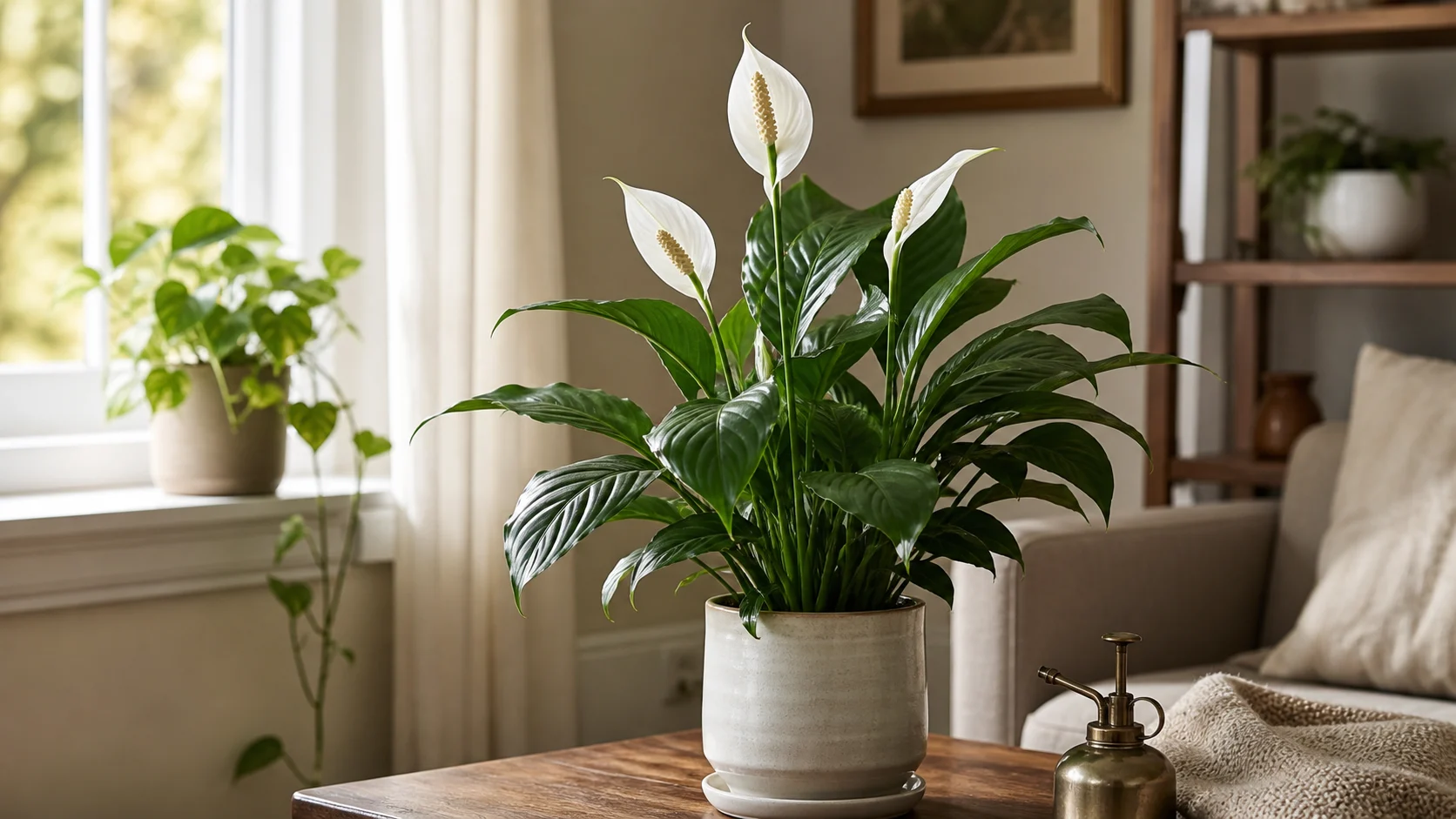
A flowering peace lily in filtered room light shows the glossy leaf posture beginners can watch between waterings.
Small and Easy
12. Haworthia
Haworthia looks like a tiny, elegant succulent but it’s far more tolerant of indoor conditions than most cacti. It doesn’t need a south-facing window or intense sun: indirect light is fine. Water it every few weeks, let the soil dry completely between drinks, and it will stay compact and architectural on a shelf or desk.
13. Hoya (Wax Plant)
Hoyas are slow-growing trailing plants with thick, waxy leaves that store moisture. They prefer to dry out between waterings, tolerate some neglect, and eventually produce clusters of small, star-shaped flowers with a sweet scent. They’re the kind of plant you stop noticing for a while, then look up one day and think: when did this get so beautiful?
Two More for Your Shortlist
14. English Ivy (Hedera helix)
English ivy trails well and grows quickly in a bright spot. It prefers cooler temperatures and consistent moisture more than some others on this list, but it’s still beginner-friendly and looks good in a hanging basket or climbing a small trellis. Keep it away from pets: it’s mildly toxic if eaten.
15. Monstera Deliciosa
Monstera isn’t just easy: it’s one of those plants that grows visibly and dramatically enough to feel like an event. New leaves unfurl every few weeks during growing season, each one larger and more split than the last. It needs bright indirect light, watering when the top few centimetres of soil are dry, and a little space to expand. If you want one plant that makes a real impression, monstera earns its place on this list.
Which Plant Suits Your Home?
Not sure where to start? Here’s a quick guide based on your actual situation.
You’re away a lot or forget to water: ZZ plant, snake plant, aloe vera, or haworthia. All four prefer to dry out completely between waterings and won’t punish you for a missed week or two.
Your home is quite dark: ZZ plant and cast iron plant are the strongest performers here. Chinese evergreen, snake plant, and heartleaf philodendron are close behind. If your space has almost no natural light, a grow light will help any of them.
You want something that grows fast and feels rewarding: Pothos, heartleaf philodendron, and spider plant all push out new growth regularly enough to keep a beginner engaged. Pothos in particular gives you visible progress every couple of weeks.
You have pets: Peace lily, pothos, English ivy, and monstera are all toxic to cats and dogs. Snake plant is also mildly toxic if eaten. Spider plant and haworthia are safer choices. The cat-safe indoor plants guide has a full breakdown.
You want flowers: Peace lily blooms reliably in lower light. Hoya produces clusters of waxy, fragrant flowers once it’s settled in, though it takes a while to get there.
You have a sunny windowsill: Aloe vera and haworthia are ideal here. Both want as much sun as a windowsill can offer and need almost no watering in return.
You want one plant that makes a statement: Monstera or rubber plant. Both grow large enough to anchor a room, and both are easier than they look.
Common Problems Beginners See First
When a beginner plant looks unhappy, check the soil before you guess. Most common symptoms can come from either too much water or too little water, so the pot tells you what to do next.
Leaves curling: If the soil is dry, water deeply until excess drains out, then let the pot dry again. If the soil is wet, move the plant into brighter indirect light and pause watering until the top layer dries. Curling can also happen near heaters, air conditioning vents, or very hot windows.
Yellow leaves: One old yellow leaf is normal. Several yellow leaves at once usually mean the roots are staying wet too long, especially on pothos, ZZ plant, rubber plant, peace lily, and monstera. Let the pot dry, empty any saucer water, and make sure the container has drainage.
Brown tips: Do not fix brown tips by adding more water automatically. On dracaena and spider plant, brown tips often point to dry air, mineral-heavy tap water, or inconsistent watering. Trim the dry tip if it bothers you, then switch to filtered water or let tap water sit out overnight before using it.
Drooping: Peace lily and pothos droop clearly when thirsty, but drooping with wet soil is a warning sign. If the pot is wet and the plant is limp, stop watering and move it somewhere brighter with airflow.
Soft stems or mushy leaf bases: Treat this as urgent overwatering. Remove the plant from decorative outer pots that trap water, let the soil dry, and check whether the roots smell rotten. If the roots are dark and mushy, trim damaged roots and repot into fresh, well-draining soil.
Common mistakes that cause most beginner problems
- Watering on schedule without checking the soil first
- Putting a low-light-tolerant plant in a room that is actually too dark to support new growth
- Leaving nursery plants inside decorative pots that trap runoff water
- Buying a plant for the look, then discovering it is toxic in a pet home
- Changing light, watering, fertilizer, and pot size all at once, then not knowing what caused the decline
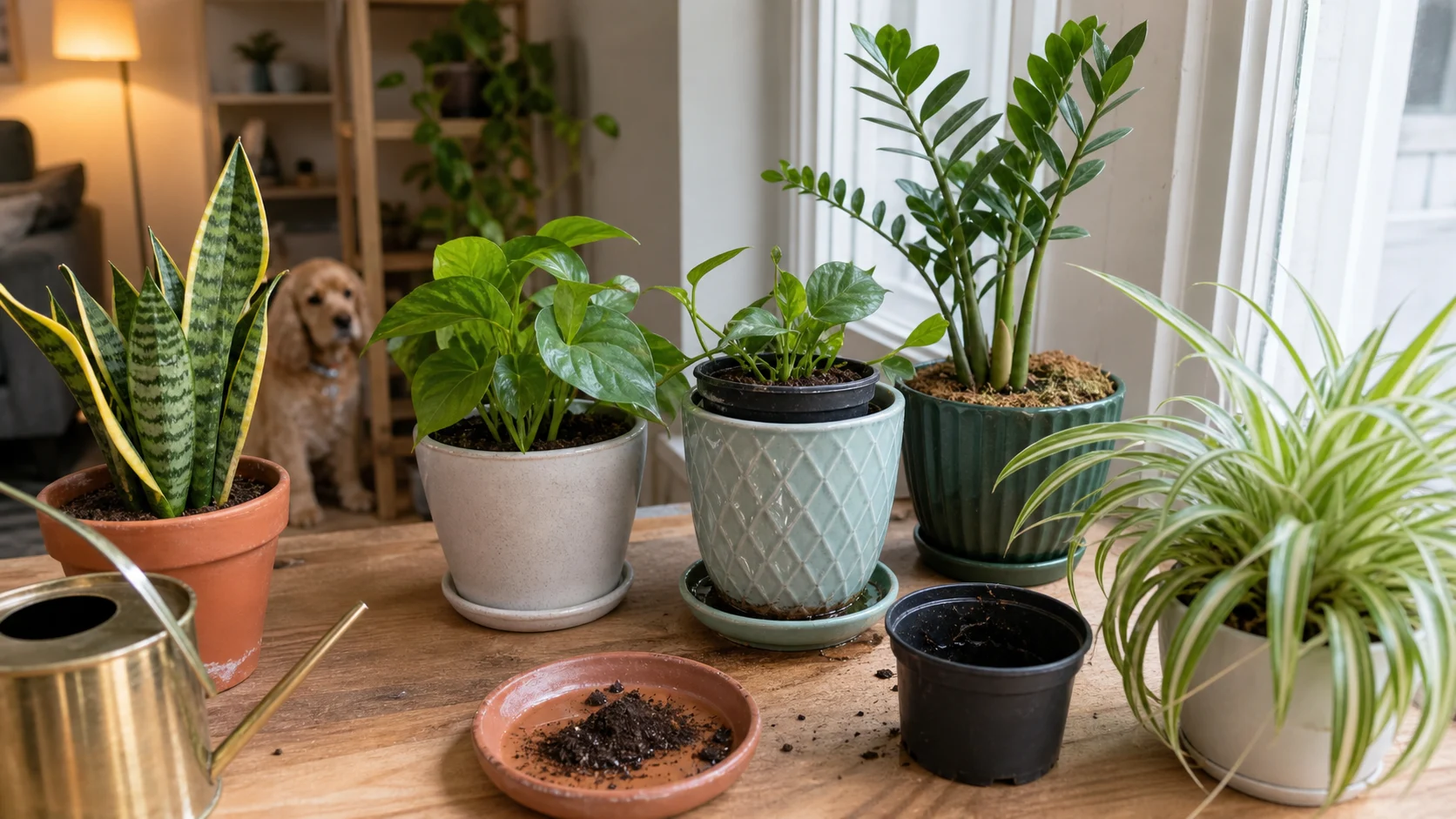
Nested pots, wet runoff, loose soil, several care changes, and a nearby pet show why beginners should diagnose one variable at a time.
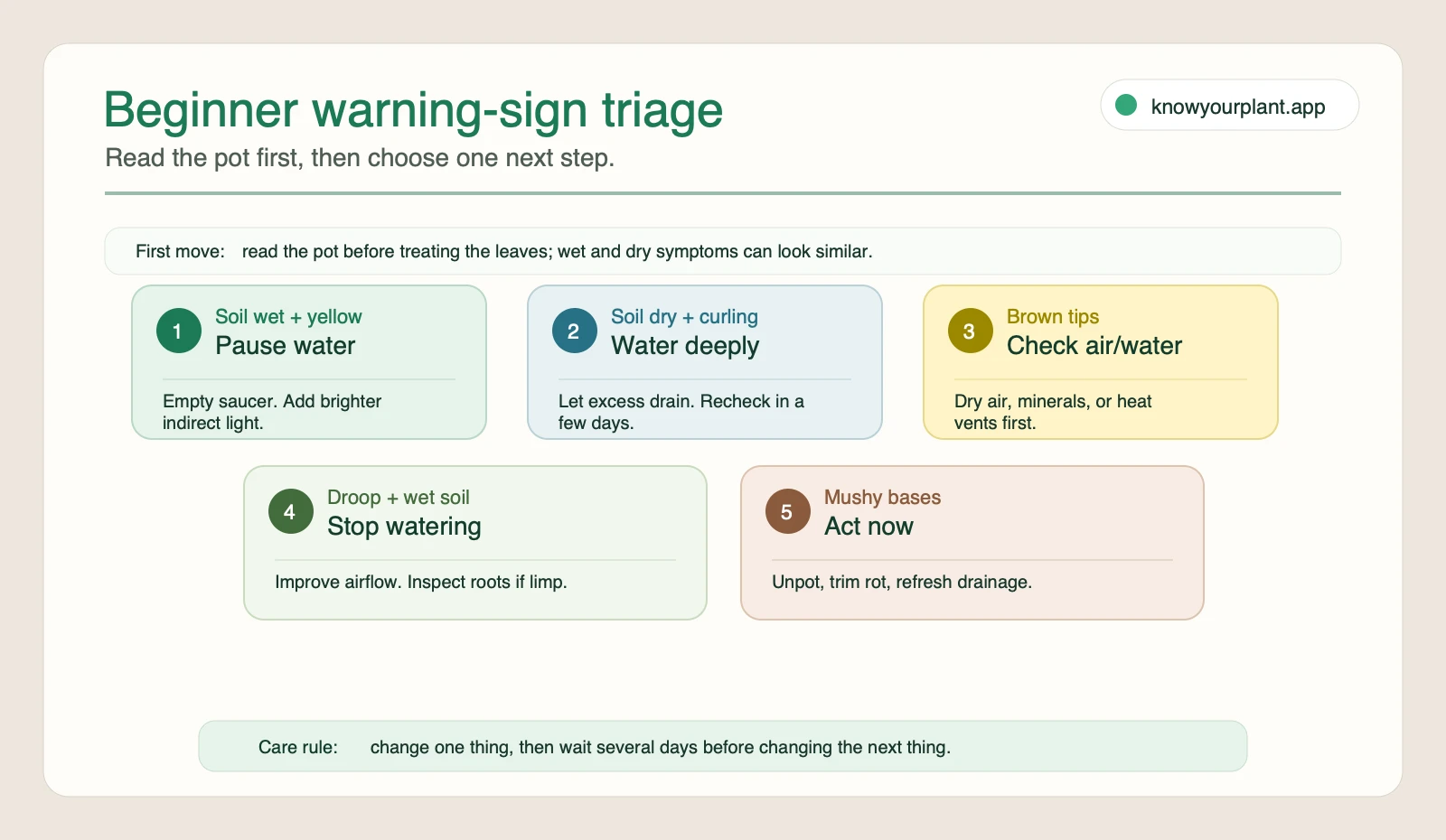
The warning-sign triage keeps the first response calm: read the pot, choose one next step, and avoid changing every care variable at once.
Your First Care Plan
Today: Put the plant where it gets the right light, check that the pot has drainage, and feel the soil before watering. If the soil is wet, do nothing. If it is dry at the depth your plant prefers, water until a little drains out, then empty the saucer.
This week: Check the same plant twice, three or four days apart. You are learning how fast your home dries the pot, not trying to follow a perfect schedule. Take one photo now so you can compare leaf color and posture next week.
This season: In spring and summer, expect faster growth and more frequent watering. In autumn and winter, stop fertilizing, check soil less often, and let drought-tolerant plants stay dry longer.
Use this quick rule when you are unsure:
| What you find | What to do next |
|---|---|
| Soil is wet and leaves are yellowing | Do not water. Empty the saucer and give the plant brighter indirect light. |
| Soil is dry and leaves are curling or drooping | Water deeply, let the extra drain out, then check again in a few days. |
| Soil is dry but the plant looks fine | Wait another day or two. Easy plants do not need perfect timing. |
| Brown tips but the soil feels right | Check dry air, tap water minerals, or heat vents before adding more water. |
One odd leaf is usually not a crisis. A pattern of several leaves changing at once is the sign to adjust light, water, or drainage.
Change one thing at a time, then give the plant several days to respond before you change the next thing.
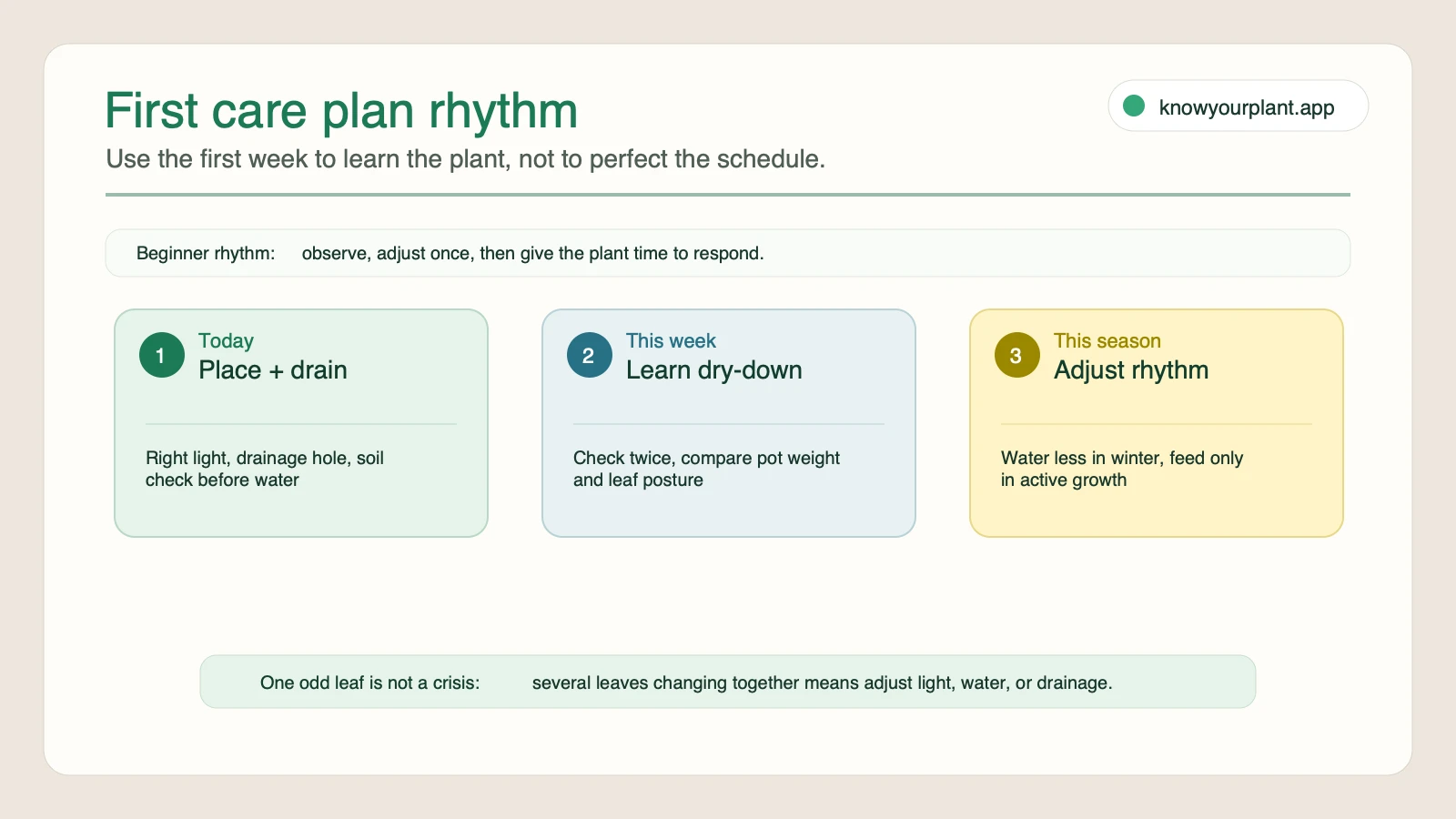
The first-care rhythm is deliberately simple: place and drain today, learn the pot’s dry-down this week, then adjust watering and feeding by season.
Seasonal Beginner Care Calendar
Most plant guides treat care as a fixed weekly routine. The reality is that your plants slow down in winter and accelerate in spring, and what works in July can cause problems in January. Here’s what to expect across the year with any of the plants on this list.
Spring (March to May)
This is when most houseplants start waking up. Days get longer, light comes back, and growth picks up noticeably. Resume fertilizing with a balanced liquid fertilizer every four to six weeks. If you’ve been meaning to repot something, spring is the right time: the plant has the energy to settle into new soil quickly. Check for pests as warmer weather arrives. Spider mites and fungus gnats tend to appear in spring, often brought in on new plants or soil.
Summer (June to August)
Peak growing season. Most of these plants will need watering more frequently as temperatures rise and soil dries faster. Check soil more often than usual rather than sticking to a fixed schedule. Move plants away from air conditioning vents: the cold, dry air stresses them more than heat does. This is also the best time to propagate. Pothos, heartleaf philodendron, spider plant, and monstera all root easily in summer cuttings.
Autumn (September to November)
Growth starts slowing down. Ease off fertilizing by mid-September and stop by October. Water less frequently as the plant’s needs decrease. If you’ve had any plants outdoors during summer, bring them back inside before temperatures drop below 10°C at night. This is a good time to clean leaves, check for pests before the plant heads into its slower winter period, and tidy up any dead or damaged growth.
Winter (December to February)
The quietest time of year. Most of these plants need very little water: once every two to three weeks for most, even longer for succulents. Don’t fertilize. The low light and shorter days mean growth has slowed, and fertilizing when a plant isn’t actively growing just builds up salt deposits in the soil. Watch for brown tips on dracaena, which can worsen when central heating dries the air. A pebble tray with a little water near the pot can raise local humidity without the risk of overwatering.
What the Research Says
A 2019 study published in the Journal of Physiological Anthropology found that interacting with indoor plants reduced both physiological and psychological stress in participants, even with low-maintenance varieties. The plants didn’t need to be rare or demanding to have a positive effect: the presence of something living, and the small rituals of caring for it, were enough.
Darryl Cheng, author of The New Plant Parent and one of the most thoughtful voices in the indoor plant world, puts it well: “The goal isn’t to keep plants alive. It’s to understand what they need and give it to them on their schedule, not yours.” For beginner-friendly plants, that schedule is refreshingly relaxed.
Where to Start
If you’re new to houseplants and not sure which to try first, start with pothos or snake plant. Both are hard to kill, available almost everywhere, and rewarding enough to build your confidence quickly.
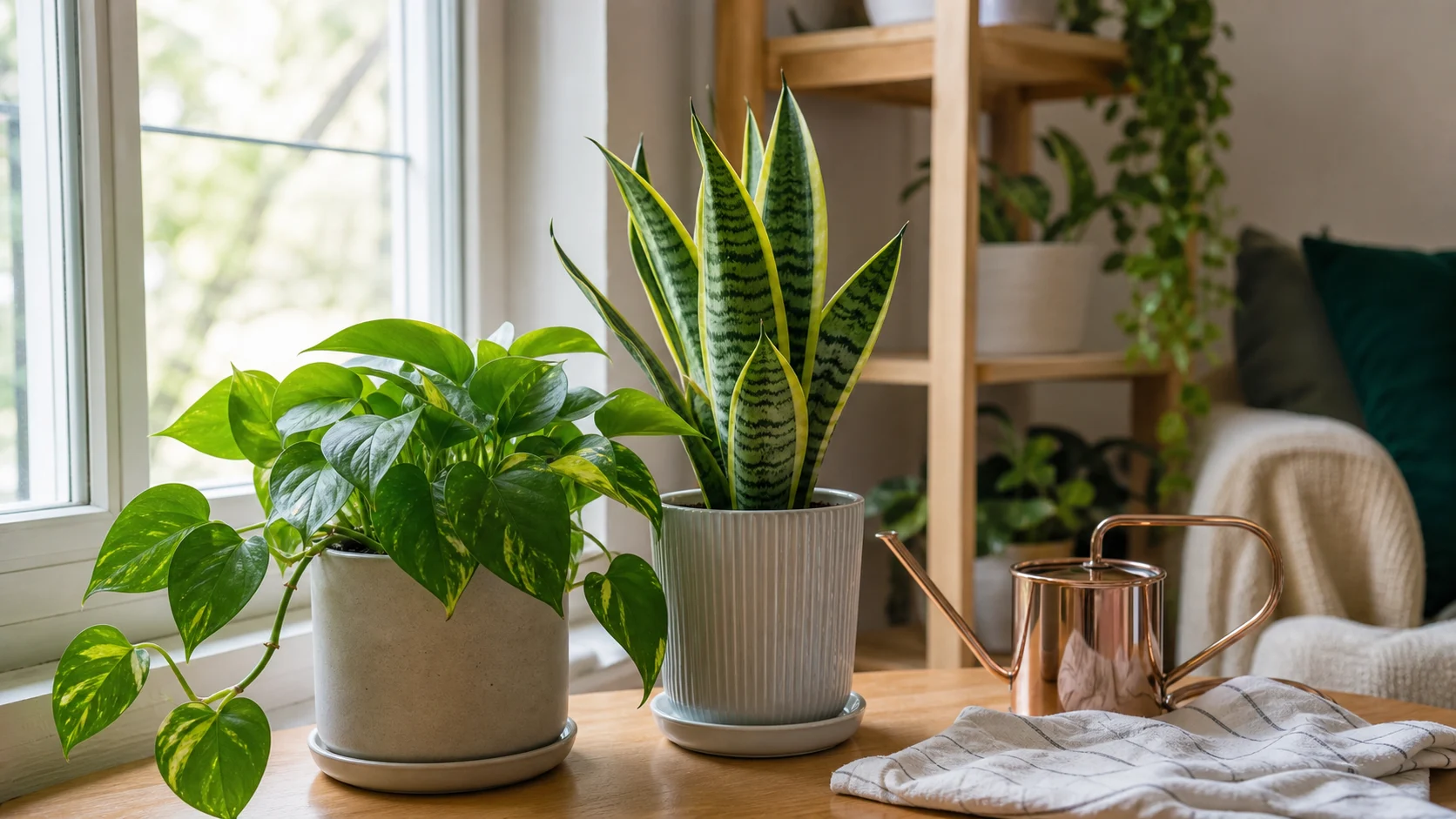
Pothos and snake plant make a forgiving first pair when each has a draining pot, a saucer, and attention instead of a rigid watering schedule.
The goal isn’t to collect as many plants as possible. It’s to find a few that suit your home and your habits, and to learn to pay attention to them. Once you understand what one easy plant needs, the next one gets easier too.
Download KnowYourPlant for personalized care reminders tailored to the plants you actually have.
Methodology Note
This guide was refreshed against the current research pack on 2026-06-14. The recommendation framework combines live SERP review for beginner-plant queries, qualitative community-language signals about low light, pet safety, and overwatering anxiety, and primary care references from Clemson Extension, Iowa State Extension, Penn State Extension, Illinois Extension, NC State Extension, and ASPCA. Community discussion is used here as a directional signal about beginner confusion, not as scientific proof.
Freshness Note
Plant availability changes by nursery and season, but the fit rules in this guide stay stable: match the plant to your light, watering habit, and pet situation first, then fine-tune care once it is home. Re-check pet safety before buying if the label only shows a common name.
Real User FAQ: Beginner Questions That Come Up Fast
What is the easiest houseplant to keep alive?
Pothos and snake plants are consistently the easiest for most beginners. Pothos tells you when it’s thirsty by drooping slightly, grows in almost any light condition, and bounces back quickly from neglect. Snake plants prefer dry conditions and can go weeks without water without complaint. Either one is a good first plant if you’ve struggled before.
Which easy houseplants are best for low light?
The strongest low-light performers on this list are snake plant, ZZ plant, Chinese evergreen, cast iron plant, heartleaf philodendron, and peace lily. ZZ plant and cast iron plant tolerate the darkest conditions of all. If your space has very little natural light, a grow light can make a real difference for any of these plants.
How often should I water easy houseplants?
There’s no single answer because it depends on the plant, the pot size, the season, and your home’s humidity. As a general guide: pothos and philodendrons like to dry out partially between waterings; snake plants and ZZ plants prefer to dry out completely; succulents like aloe and haworthia want even longer between drinks. When in doubt, underwater rather than overwater. Most plants on this list recover from drought far more easily than from soggy roots.
Can easy houseplants survive in offices with fluorescent lighting?
Several of them can. Chinese evergreen, snake plant, ZZ plant, and pothos are all commonly found in office environments with artificial lighting. They won’t grow as fast as they would near a window, but they’ll stay healthy. Heartleaf philodendron also adapts well to office conditions.
Are any of these plants safe for cats and dogs?
Several plants on this list are toxic to pets, including peace lily, English ivy, pothos, and monstera. Snake plant is also mildly toxic if eaten. If you have cats or dogs, the cat-safe indoor plants guide will help you choose plants that won’t cause a problem. Haworthia and spider plant are among the safer options on this list.
Why do my easy plants still die?
The most common reason is overwatering. It causes root rot, which looks a lot like underwatering: drooping, yellowing leaves. People often respond by watering more, which makes things worse. Before watering, check the soil with your finger: push it in a centimetre or two, and only water if it feels dry at that depth. The second most common issue is too little light. Even “low light” plants need some natural light to stay healthy long-term.
What’s the best low maintenance plant for a windowsill?
Aloe vera is ideal for a sunny windowsill. It stores water in its leaves, needs very little attention, and looks good in almost any pot. Haworthia works well in slightly less intense light and stays compact. If your windowsill gets lower light, a pothos or heartleaf philodendron will do better than either succulent.
How do I know when to repot an easy houseplant?
Look for roots growing out of the drainage holes, soil that dries out very quickly after watering, or a plant that’s visibly too large for its pot. Most of the plants on this list are slow growers and only need repotting every two to three years. When you do repot, go up just one pot size (roughly 5 cm wider) rather than jumping to a much bigger container, which can leave too much wet soil around the roots.
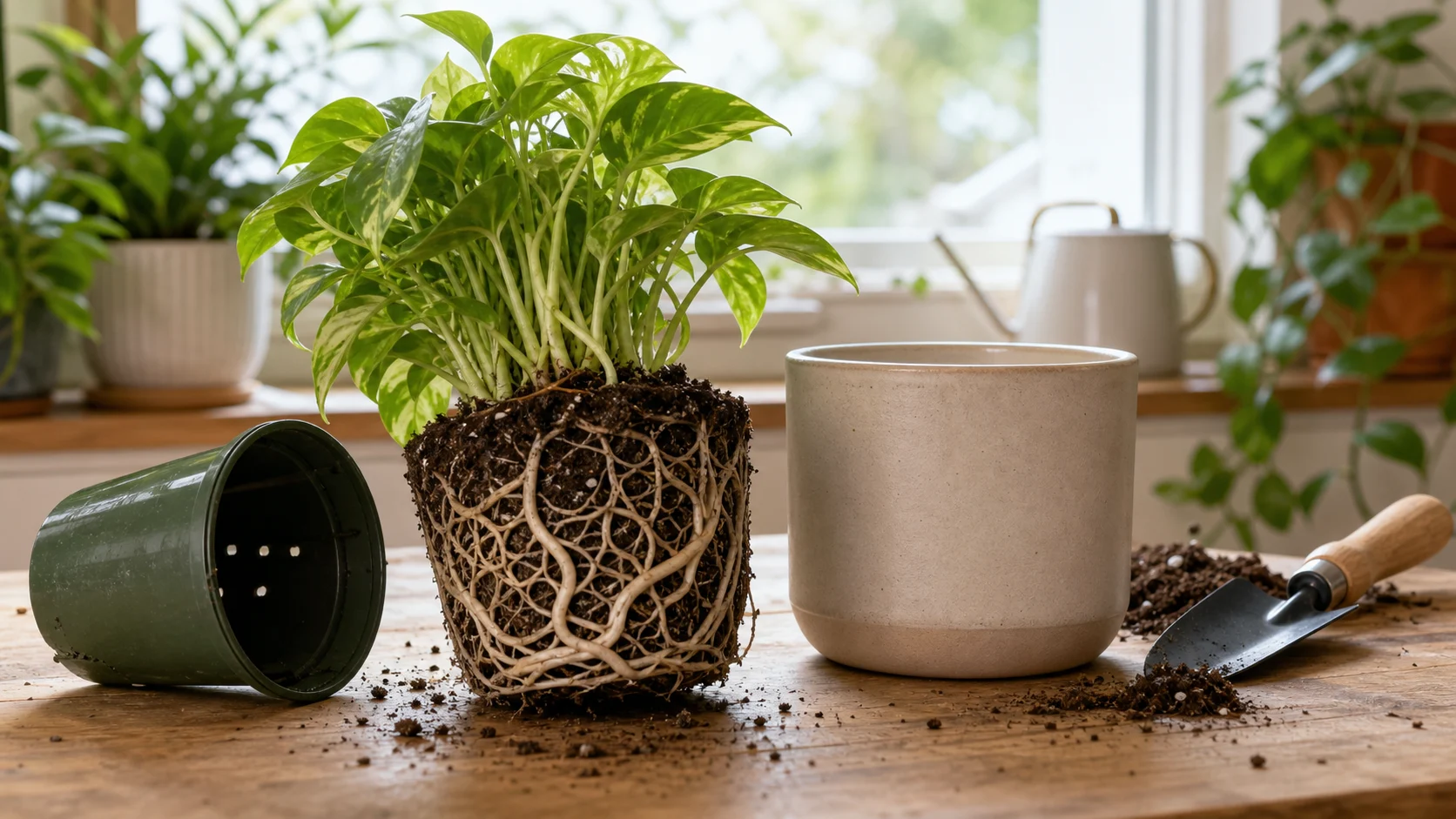
A dense pothos root ball and its draining nursery pot show the signal to move up by only one container size.