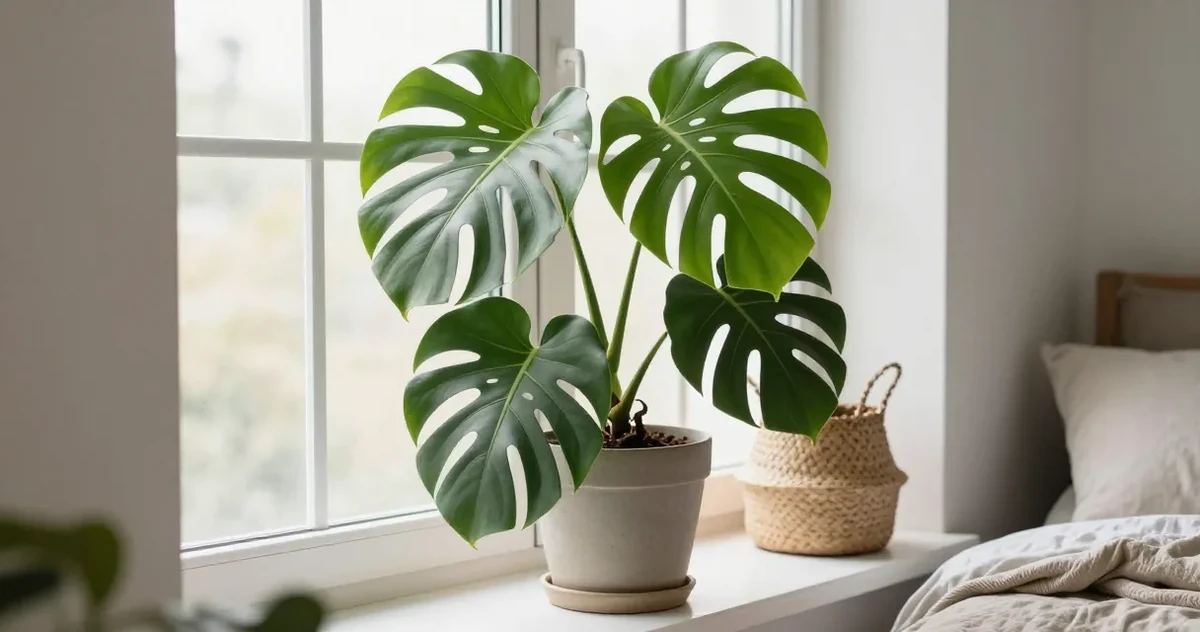
If you just brought one home, you probably want three answers fast: how often to water it, what the scary leaf symptoms mean, and whether the pricey variegated leaves need special treatment. The short version is simple: water only when the top 2 inches of soil are dry, give it brighter indirect light than a plain green monstera, and treat yellow lower leaves or mushy stems as overwatering warnings.
Maybe you spent $150, maybe $300, maybe more. Now it’s sitting on your shelf and you’re suddenly very aware of every yellowing edge and every leaf that doesn’t look quite right. Welcome to the Thai Constellation experience.
Here’s the honest answer: Monstera Thai Constellation is not significantly harder to care for than a regular Monstera deliciosa. The care requirements are similar. What makes it feel harder is the anxiety that comes with the price tag, and the fact that the variegation does have one real extra need: more light than a plain green monstera.
Species evidence behind Thai Constellation
Thai Constellation is handled as a cultivated Monstera deliciosa, so the field record describes the species background rather than the cultivar’s variegated performance.
The ranges below are the middle 50% (p25–p75), not recommended indoor setpoints.
| Reference taxon | POWO native range | Annual mean temperature | Annual precipitation | Relative humidity | Solar radiation | Evidence |
|---|---|---|---|---|---|---|
| Monstera deliciosa (Monstera deliciosa) | southern Mexico to Guatemala | 18.6–22.8°C | 1308–2510 mm/yr | 62–67% | 17.8–19.9 MJ/m²/day | 154 climate points; high confidence |
What this changes in this guide: The species envelope does not measure white tissue, growth rate, or cultivar stability. Indoors, light management and root health deserve more weight than a generic Monstera schedule.
Sources and method: Monstera deliciosa in POWO and GBIF; CHELSA V2.1, 1981–2010. GBIF records are limited to POWO-native countries, then filtered for coordinates, establishment signal, licence, precision, and spatial duplication. No community or user-reported care data is used in this module.
Identification Snapshot
| Field | What to look for |
|---|---|
| Leaf pattern | Cream-to-white splashes and speckles across thick Monstera deliciosa leaves, often with marbling instead of clean half-moon sectors. |
| Growth habit | A slower-growing climbing Monstera that eventually wants a pole or plank for larger, more stable leaves. |
| What makes it different | The pale tissue gives the plant less chlorophyll, so it needs brighter indirect light and usually recovers more slowly from stress. |
| Support need | Best when you plan for upward support before the stems sprawl or aerial roots dry out. |
| Best home fit | Bright room, drainage pot, patient watering habits, and an owner who can watch the soil instead of following a rigid schedule. |
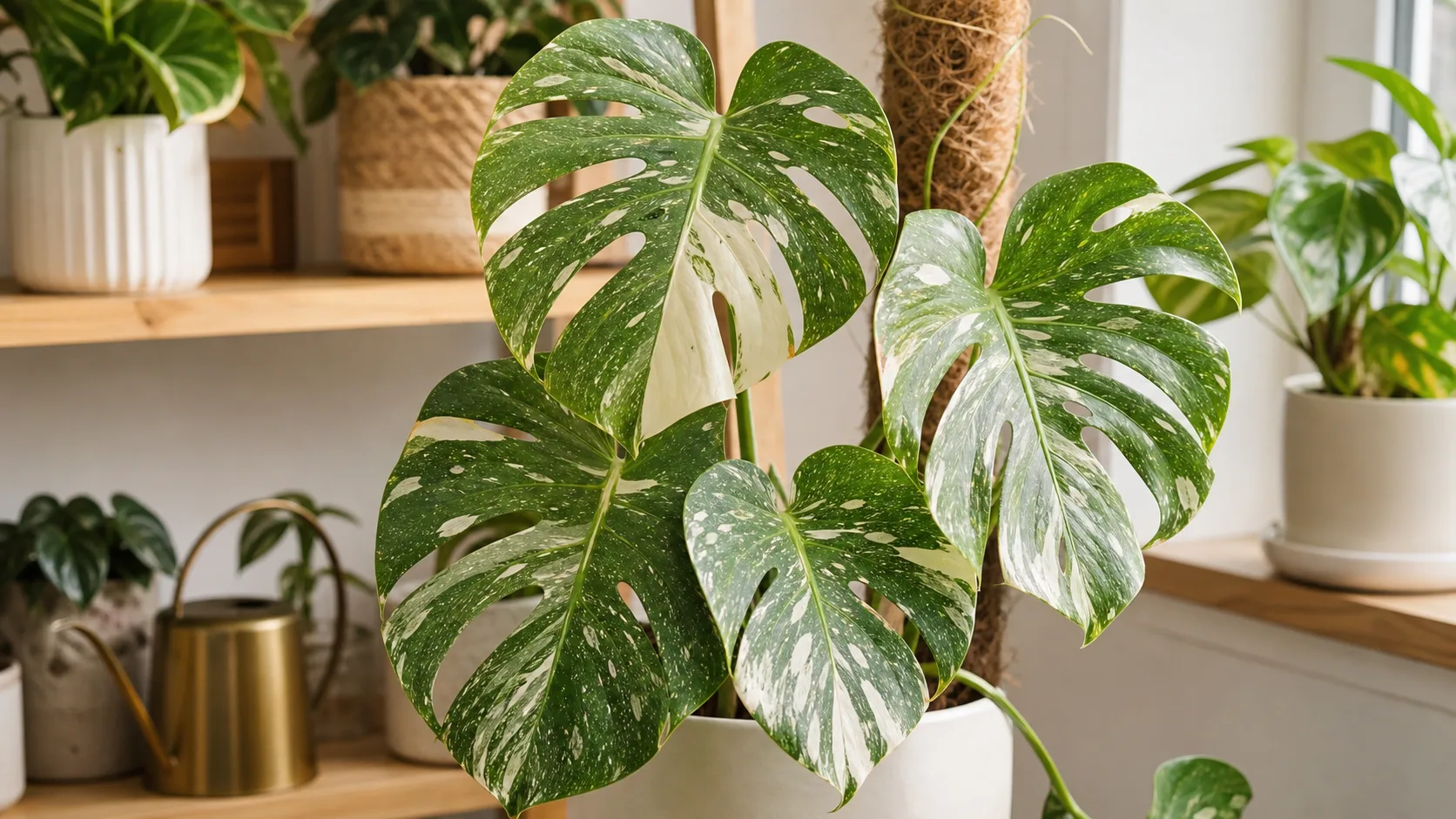
Cream-speckled, fenestrated leaves and an upright support distinguish a healthy Thai Constellation in a bright home setting.
Lookalikes and Confused-With Plants
| Plant | Why people mix it up with Thai Constellation | What to check before you copy the care advice |
|---|---|---|
| Regular Monstera deliciosa | Same overall shape and growth habit, especially on younger plants. | The green form tolerates slightly lower light and bounces back faster after stress. |
| Monstera albo | Both are expensive variegated Monsteras with cream or white sections. | Albo variegation is less stable and often shows larger pure-white patches that scorch faster. |
| Juvenile split-leaf philodendron listings | Garden centers still use overlapping common names for large tropical leaves. | Confirm the node structure and mature leaf shape before you follow a watering or support routine. |
| Low-variegation Thai Constellation | New owners sometimes assume a greener leaf means the plant changed species or lost value overnight. | One greener leaf can happen; the bigger question is whether the plant has enough light for future growth. |
Get the light and watering rhythm right, and the rest falls into place.
What Most Care Guides Miss
Most guides about Monstera Thai Constellation describe the ideal care routine. Real homes are messier: light changes by season, pots dry at different speeds, and the same symptom can mean different things depending on where it appears.
Before changing care, check the plant in this order:
- Light: is the plant growing toward the window, fading, or scorching?
- Root zone: is the pot drying predictably, or staying wet in the middle?
- Leaf pattern: did the oldest leaves, newest leaves, tips, or stems change first?
- Recent change: new pot, new location, fertilizer, cold draft, heat vent, or pest exposure.
This keeps you from fixing the wrong problem. One clear adjustment is usually safer than a full care reset.
Care Cards
| Care card | What Thai Constellation usually wants | What owners get wrong most often |
|---|---|---|
| Light | Bright indirect light for 4 to 6 hours, with more exposure than a standard green monstera. | Treating it like a low-light shelf plant because it still looks healthy for a few weeks. |
| Water | Thorough watering only after the top 2 inches dry. | Watering on nerves instead of checking the root zone first. |
| Support | A pole, plank, or stable stake as the plant matures. | Waiting until the stems sprawl and then expecting a quick shape reset. |
| Recovery time | Gentle changes, fewer emergency interventions, and patience after shipping or repotting. | Repotting, fertilizing, and moving it all in the same week. |
| Pet risk | Keep it out of reach because chewing can irritate the mouth and stomach. | Assuming the high price means it must be safer or more delicate than other aroids. |
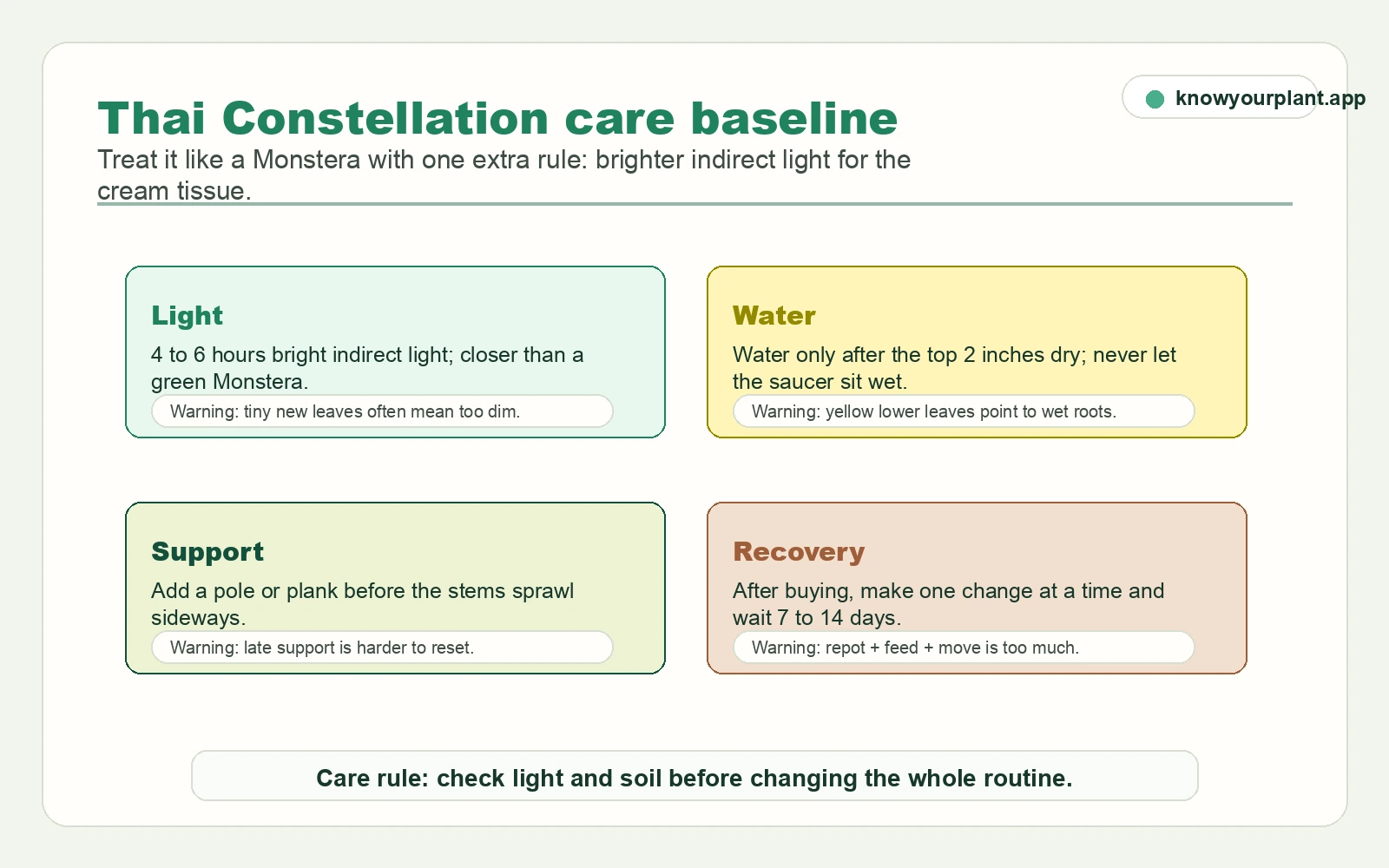 Use the baseline card before making changes: check light and soil first, add support early, and let the plant recover between adjustments.
What Is Monstera Thai Constellation?
Monstera Thai Constellation is a variegated cultivar of Monstera deliciosa, originally developed through tissue culture at a laboratory in Thailand. The variegation appears as creamy white or pale yellow speckles, splashes, and patches across the leaves. No two leaves are identical. Some will have a half-moon split of white; others will have scattered constellations of cream, which is where the name comes from.
The key difference from wild variegation: Most other variegated Monsteras get their colouring from a genetic mutation that can appear, disappear, or revert over time. Thai Constellation was cultivated so that the variegation is stable at the cellular level. This means the plant will consistently produce patterned leaves throughout its life. It won’t revert to solid green.
Tissue culture production is part of why Thai Constellation exists and part of why it costs what it does. The process from lab culture to a retail-ready plant takes 12 to 18 months, and scaling it up requires significant investment from specialist nurseries.
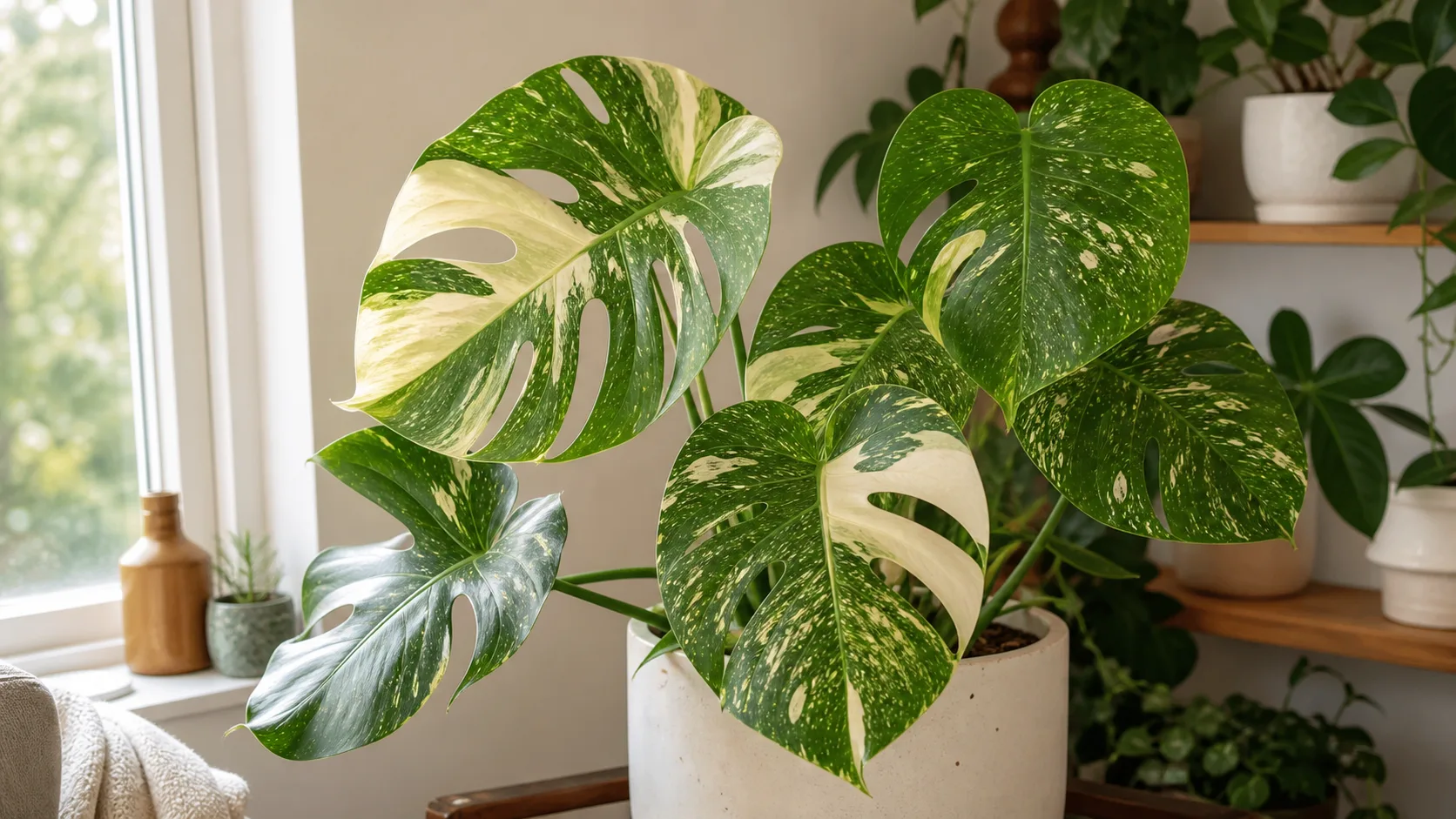
Each leaf carries a different mix of cream splashes and fine speckling while retaining the cultivar’s stable pattern.
Should You Buy One for Your Home?
Thai Constellation is a good fit if you can give it a bright spot and you are willing to check the soil before watering. It is not a good fit for a dim corner, a pot with no drainage hole, or a routine where every plant gets watered on the same day no matter what the soil feels like.
Buy it if: You have an east-facing window, a bright south or west window with filtered light, or space for a grow light. You also need a few minutes each week to check soil moisture and inspect the leaves.
Wait if: Your only open spot is across the room from a window, you travel often and need a plant that can be ignored for weeks, or you tend to water whenever you feel nervous. A plain green Monstera deliciosa will handle lower light and inconsistent care better.
Set it up before you bring it home: Choose a pot with drainage, use a chunky mix that does not stay soggy, and plan where the plant will actually live. Moving it from a bright shop into a dark room is one of the fastest ways to get small new leaves and weak growth.
First 7 Days After Purchase
If you just brought a Thai Constellation home, do less than your anxiety wants to do. Use the first week to stabilize the plant, not to reinvent its whole setup.
- Day 1: Put it in bright indirect light and confirm the pot drains freely.
- Days 1 to 3: Do not repot just because the plant is expensive. Repot early only if the mix is sour, compacted, or staying soaked.
- Days 3 to 7: Check whether the top 2 inches are actually drying before you water. Shipping stress and store conditions can make the first watering deceptively early.
- End of week 1: Decide whether it needs a brighter spot, a support pole, or simply more time to settle.
What Changes Because This One Is Variegated
The basics still come from Monstera deliciosa care, but three adjustments matter more here: the plant needs brighter indirect light to compensate for the pale leaf tissue, it usually grows and recovers more slowly than a plain green monstera, and the cream sections show browning or scorch sooner when watering, humidity, or sun exposure drift out of range.
Light: The One Thing That Actually Matters More
For a regular green Monstera, bright indirect light is ideal but the plant is fairly forgiving in lower light. For Thai Constellation, light is non-negotiable, and the reason is the variegation itself.
The white and cream sections of each leaf contain little to no chlorophyll. That means the plant is working with less photosynthetic capacity than an all-green Monstera. Plant educator Darryl Cheng of House Plant Journal has written extensively about this dynamic: variegated plants need to be positioned closer to windows than their green counterparts, because the non-green cells contribute almost nothing to the plant’s energy production. Think of it as a car running with half its cylinders. It can still go, but it needs more fuel.
What you’re aiming for: A spot with bright indirect light for at least 4 to 6 hours per day. Near an east-facing window is ideal. Morning light is gentle and sustained. A few feet back from a south-facing window also works well, especially with a sheer curtain to soften the most intense midday rays.
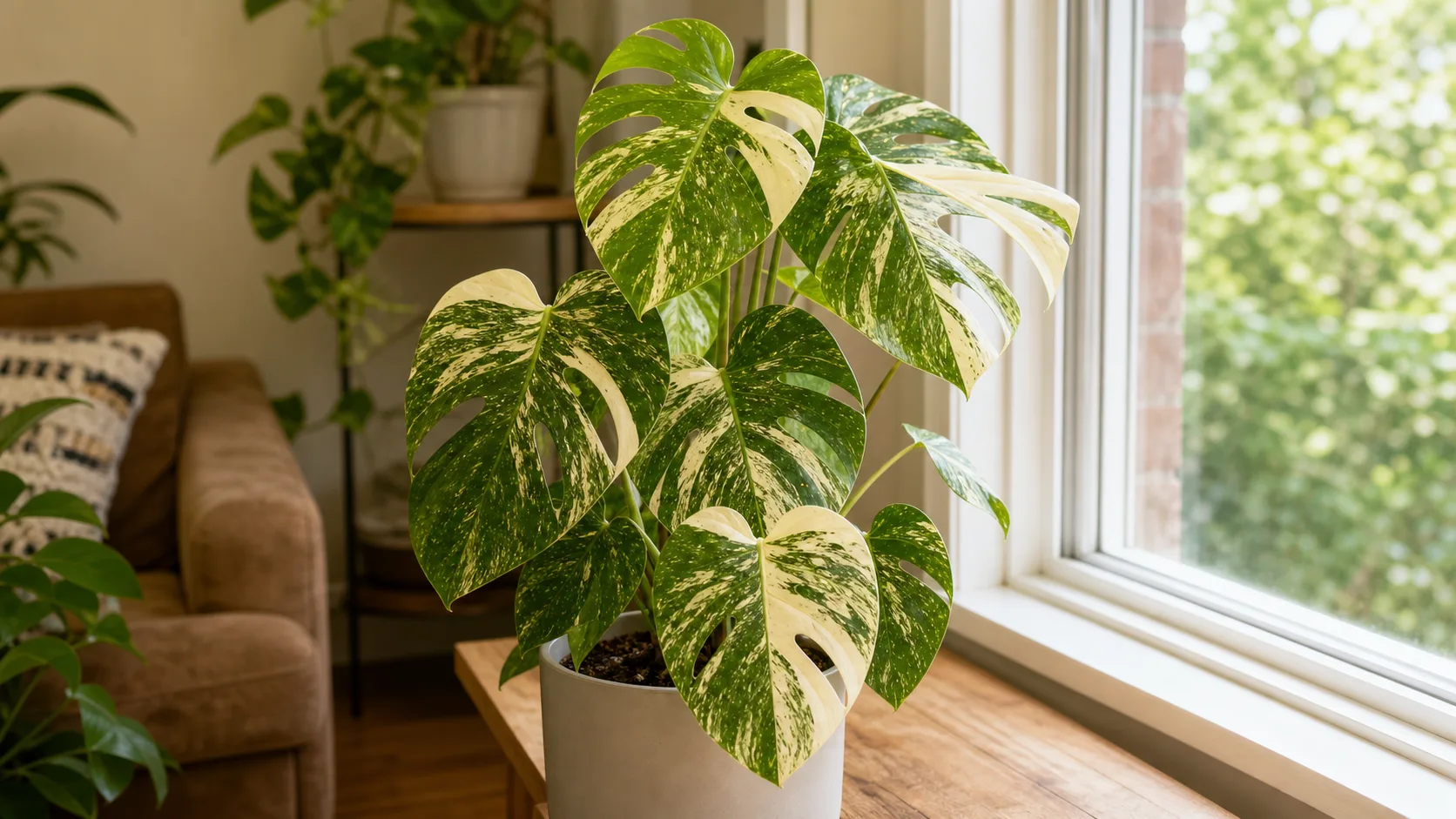
A place beside a bright window supplies the stronger indirect light that cream-variegated leaves need without exposing them to harsh sun.
Signs the light is not enough: New leaves come in smaller than expected, the variegation appears in smaller patches or barely shows at all, and growth slows even during the growing season. The plant just looks like it’s coasting.
If your home doesn’t have a bright enough window: A quality grow light can fill the gap. Our grow lights guide explains what to look for and how to position one correctly for tropical plants.
Avoid direct harsh afternoon sun: The white sections of Thai Constellation leaves are more vulnerable to sunscorch than the green sections. A pale, bleached-looking patch that feels papery is usually sun damage, not a disease.
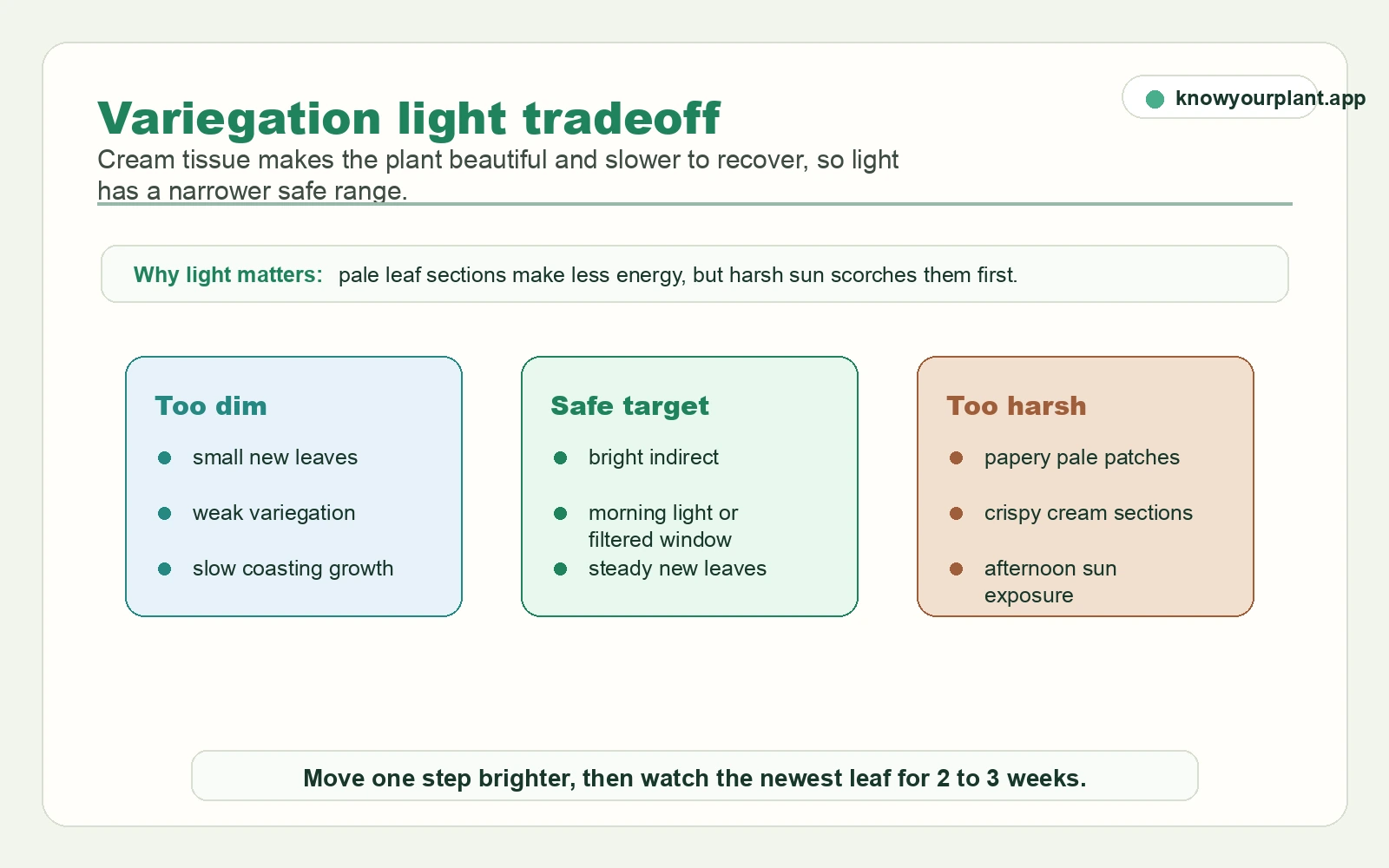 The variegation narrows the light window: move one step brighter when growth is weak, but protect pale tissue from harsh afternoon sun.
Watering
This is where Thai Constellation behaves almost identically to regular Monstera. Overwatering is the main risk. The roots need oxygen, and soil that stays wet too long will start to rot before you notice anything above the soil surface.
The finger check: Push your finger about 2 inches into the soil. If it feels moist, leave it. If it’s dry at that depth, water thoroughly until water drains freely from the bottom, then let it drain completely before putting the saucer back. Never let the pot sit in standing water.
In spring and summer, this typically means watering every 7 to 10 days. In autumn and winter, when the plant slows down, stretch that to every 14 to 21 days. Check the soil rather than following a fixed schedule.
For the first month, check the soil twice a week and write down when it is actually dry. That gives you your home’s real watering rhythm instead of someone else’s internet schedule.
If you’re not sure whether to water, wait one more day. Thai Constellation handles slightly dry soil better than it handles wet feet.
Signs of overwatering: Lower leaves yellowing first, soil that stays wet for more than a week after watering, soft or mushy stem near the base.
Signs of underwatering: Crispy leaf edges, soil pulling away from the pot sides, leaves that droop slightly and feel thin.
Humidity and Temperature
Thai Constellation is a tropical plant. It comes from a warm, humid environment and it prefers to stay that way, but it’s more tolerant than people expect.
Humidity: Aim for 50 to 60% if you can. If your home runs drier in winter, a pebble tray with water under the pot helps. Grouping it with other plants also raises the local humidity slightly. Avoid misting directly on the leaves. It’s less effective than you’d think and can leave water spots on the pale sections, which show up more than they do on green leaves.
Temperature: Comfortable room temperature, roughly 65 to 85°F (18 to 30°C). Keep her away from cold drafts, air conditioning vents, and windows that frost in winter. Temperatures below 55°F (13°C) will stress the plant.
Soil and Potting
Thai Constellation needs well-draining soil above all else. Standard potting mix holds too much moisture on its own. A good starting point: mix regular potting soil with perlite in roughly a 60/40 ratio, or use an aroid mix if you can find one locally.
Pot choice: Terracotta pots are excellent for Thai Constellation because they wick excess moisture through the sides, which helps prevent the overwatering that’s easy to accidentally do with this plant. Our terracotta pots guide covers sizing and why terracotta outperforms ceramic for aroids. If you prefer ceramic or plastic, just be especially careful with watering frequency.
Repotting: Go up one pot size when you see roots appearing from the drainage holes or circling visibly in the soil. Don’t rush it. Thai Constellation grows somewhat slowly, and a slightly snug pot is fine.
Fertilizing
During the growing season (spring and summer), fertilize with a balanced liquid fertilizer once a month. Dilute it to half the recommended strength. Variegated plants are slightly more sensitive to fertilizer burn than all-green plants, so less is genuinely better here.
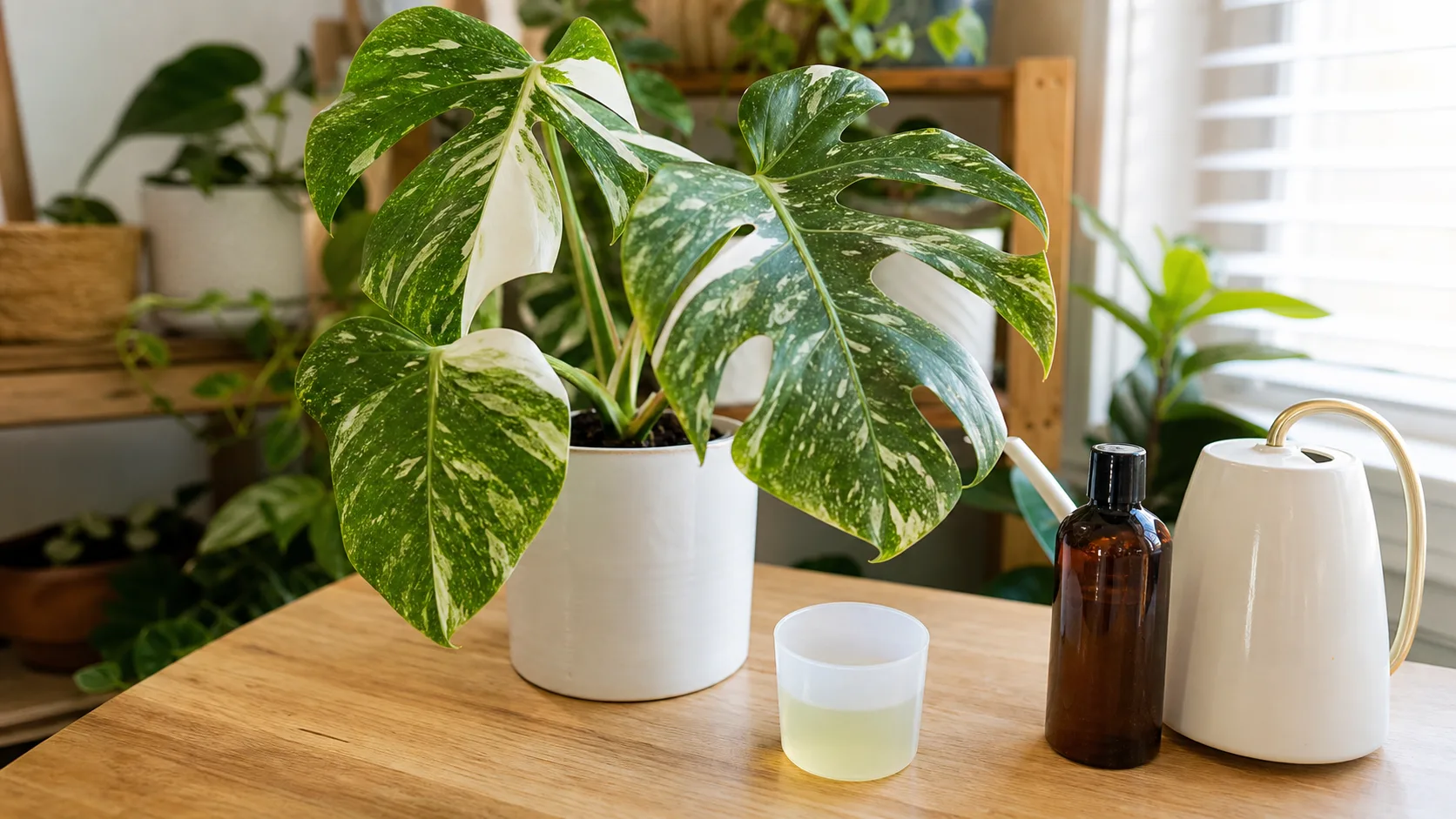
A small measure of diluted liquid feed is enough for a monthly growing-season application; stronger is not better for variegated roots and foliage.
What does fertilizer burn look like on Thai Constellation? Brown tips and crispy edges that appear a few days after fertilizing, even when the watering has been correct. If that happens, flush the soil thoroughly with plain water to push out excess salt buildup.
Skip fertilizing in autumn and winter. The plant is in a slower phase and the extra nutrients will just accumulate in the soil unused.
Propagation
Thai Constellation can be propagated from stem cuttings, the same way as regular Monstera. You need a cutting with at least one node (the thickened joint where a leaf meets the stem) and ideally one healthy leaf attached. If you want the full step-by-step for water propagation, soil propagation, and when to move cuttings up, our how to propagate plants guide walks through each method.
Place the cutting in a jar of water or in moist sphagnum moss and keep it somewhere warm and bright. Roots typically appear within 4 to 8 weeks. Resist the urge to check on them constantly. Every disturbance sets back the process, and the anxiety of not seeing roots yet is almost always misplaced.
A couple of things worth knowing upfront. First, Thai Constellation cuttings are expensive even before they’ve rooted, sometimes $50 to $100 or more per node. Warmth and high humidity help considerably; if you have a spot that stays around 70 to 75°F, that’s where the cutting wants to be. Second, tissue culture plants can sometimes be slower to root than cuttings from mature field-grown plants. Be patient.
The good news: the variegation in any propagated plant will be stable, just like the parent.
Toxicity: A Note for Cat and Dog Owners
Monstera deliciosa, including Thai Constellation, is listed by the ASPCA as toxic to cats and dogs. The plant contains insoluble calcium oxalate crystals that cause oral irritation, excessive drooling, and vomiting if ingested. Most pets will stop after a small taste because it causes immediate discomfort, but keep it out of reach if you have a plant-curious cat or dog.
If you’re looking for statement tropical plants that are safe for pets, our cat-safe plants guide covers 30 options with similar visual impact.
Thai Constellation vs Albo: The Honest Comparison
Monstera Albo (Monstera deliciosa ‘Albo Variegata’) is the other famous variegated Monstera. The differences matter if you’re deciding between them.
Variegation stability: Thai Constellation’s variegation is stable, produced through tissue culture. Albo’s variegation is a natural mutation and can revert — meaning sections of the plant might grow back fully green. Some Albo plants are stable for years; others revert unpredictably. This is the most important practical difference.
Leaf appearance: Thai has cream and white speckles with a constellation-like pattern. Albo tends to produce larger blocks of pure white, including half-white leaves that are visually dramatic but more fragile and more prone to sunscorch.
Care difference: Albo’s pure-white sections are even more vulnerable than Thai’s cream patches. Thai is generally considered the more reliable long-term choice for this reason.
Price: Both are expensive. Albo is often priced higher for especially dramatic leaves. Thai tends to be more consistently available because of its tissue culture production.
Why Is It So Expensive?
The short answer: supply is limited by how slowly variegated Monsteras grow and propagate.
Thai Constellation cannot be grown from seed. Seeds produce plain green plants. It propagates only through stem cuttings or through tissue culture in specialist labs. The tissue culture process from start to retail-ready plant takes 12 to 18 months, and the facilities required are expensive to build and run.
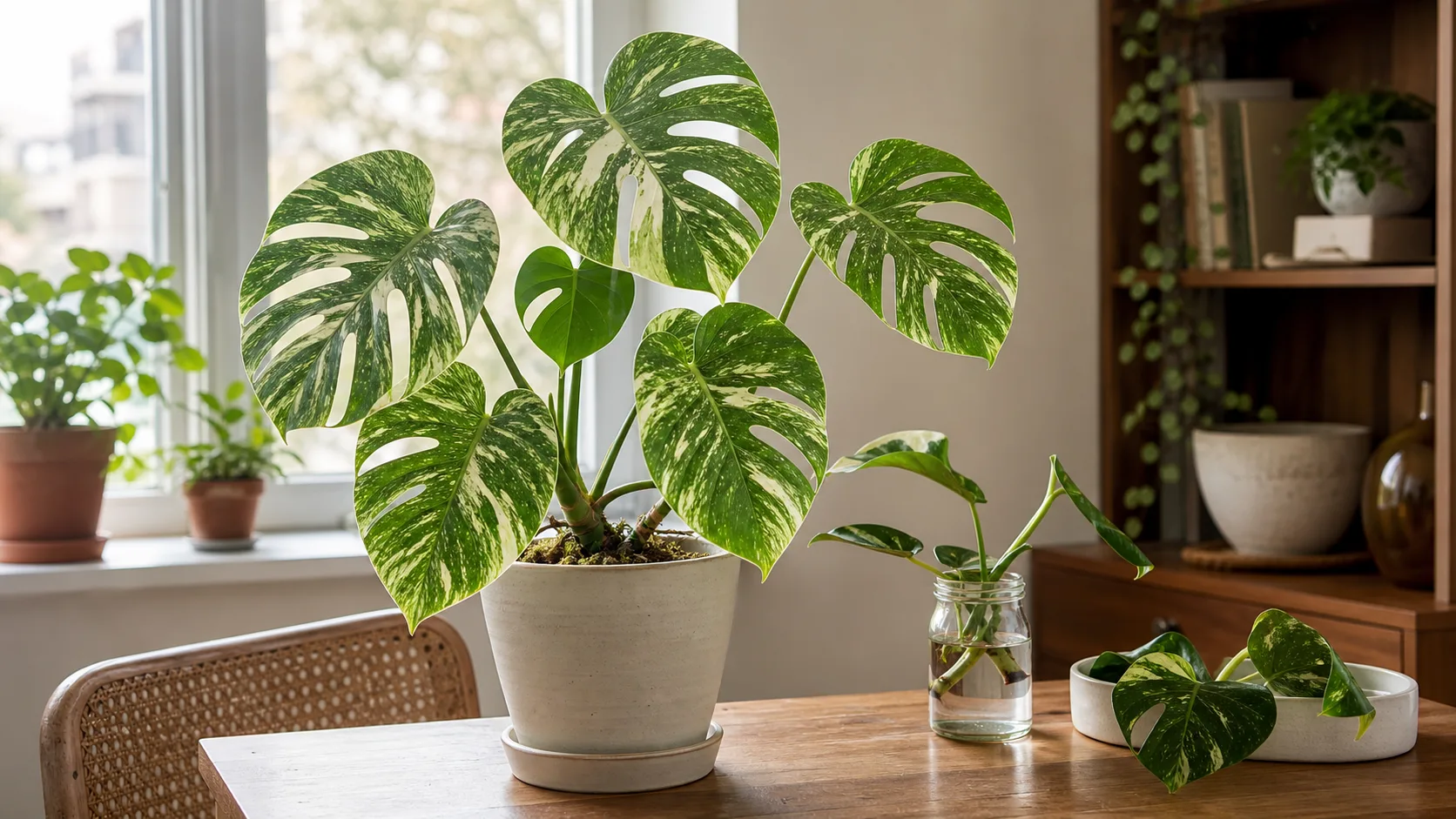
A mature plant and a small number of node cuttings show why new Thai Constellations take time to propagate and reach saleable size.
Prices peaked during the houseplant boom of 2020 to 2021, when some specimens sold for over $1,000. By 2024 to 2025, prices for well-established plants had settled to $100 to $400 as more nurseries got tissue culture protocols in place. The trend is likely to continue gradually downward as production scales.
Seasonal Care Calendar
Thai Constellation’s needs shift with the seasons. Following a seasonal rhythm means fewer surprises.
Spring (March to May): This is when growth resumes after winter. Resume fertilizing at half strength. Move her closer to the window if you shifted her back in winter, or add grow light hours. Watering frequency will pick up as temperatures rise; start checking the soil every 6 to 7 days rather than every 10.
Summer (June to August): Peak growing season. Water more frequently, usually every 7 to 10 days, but always check the soil first. New leaves will arrive more regularly. Watch for afternoon sun coming through south or west windows — the pale sections scorch more easily in high-summer light. This is also when you’ll see the most variegation on new growth if light levels are good.
Autumn (September to November): Taper off fertilizer by mid-autumn and stop entirely by October. Growth will slow noticeably. Reduce watering frequency as the plant settles into its rest phase. If you’ve had it near an open window for summer humidity, close the gap before nights turn cold.
Winter (December to February): Rest phase. Water every 14 to 21 days, confirming the soil is genuinely dry before each watering. No fertilizer. This is when low light does the most damage. Short winter days may not provide enough bright light for your Thai Constellation. A grow light on a timer — 12 hours per day — makes a real difference in keeping the plant healthy through until spring.
If seasonal shifts are where your care routine falls apart, save the plant in KnowYourPlant and let reminders cover the practical tasks: water checks, feeding months, repotting timing, and the winter slowdown.
Common Problems
Yellow leaves starting from the bottom: This is almost always overwatering. Check the soil. If it still feels damp more than a week after your last watering, let it dry out more before the next one. Don’t panic at one yellow leaf; look for a pattern. If you need a broader symptom breakdown, start with our guide to monstera leaves turning yellow.
Leaves curling inward: Check the soil first. If the top 2 inches are dry, water thoroughly and let the pot drain. If the soil is damp, do not add more water; move the plant away from cold drafts, heaters, or air conditioning vents and check whether the air is very dry.
Brown crispy edges: The two most common causes are low humidity and underwatering. Check the soil moisture first. If it’s dry and the air in your home is dry, try a pebble tray under the pot and water a little more often.
New leaves coming in small with barely any variegation: She’s not getting enough light. This is the most common and most fixable problem with Thai Constellation. Move her closer to a window. If that’s not possible, a grow light positioned 12 to 18 inches above the plant will help.
Soft or mushy stem near the base: Root rot, and it needs attention quickly. Unpot the plant, trim away any black or mushy roots (healthy roots are white or light tan), let the root system air-dry for 30 to 60 minutes, then repot in fresh dry mix. It looks alarming but the plant can often recover if you act early. If you want the full rescue sequence, use our monstera root rot guide.
Slow growth in summer: Usually not enough light or fertilizer. In winter, slow growth is normal and expected. She’s resting, not struggling.
Why Isn’t My Thai Constellation Thriving?
If the plant is alive but not doing well, here’s a methodical way to work through it.
Step 1: Check the light first. This is the most common issue. Is she getting at least 4 to 6 hours of bright indirect light per day? Hold your hand between the plant and the window. If your hand casts a sharp, clear shadow, the light is adequate. Faint or no shadow means it’s probably too dim. Consider moving her or adding a grow light.
Step 2: Check the soil moisture. Push your finger 2 inches in. If it’s been more than 10 days since you watered and the soil still feels damp, something is wrong with drainage. Check for compacted soil or a pot without drainage holes. If it’s bone dry and you’ve been watering on schedule, try watering more deeply until water flows freely from the drainage holes.
Step 3: Check the roots. If you haven’t repotted in over two years and growth has stalled, she may be rootbound. Gently tip her out of the pot. Tightly circling roots packed around the root ball confirm it’s time to size up. If you see black or mushy roots, that’s root rot, addressed above.
Step 4: Check for pests. Inspect the undersides of leaves carefully. Spider mites appear as fine webbing and tiny moving specks, especially in dry winter air. Scale looks like small brown bumps along stems. Mealybugs appear as white cottony fluff in leaf joints. Any of these can drain the plant’s energy long before the damage is visible on the leaf surface.
Step 5: Consider the season. In winter, slow growth and fewer new leaves is normal. If the plant looks healthy otherwise, it may simply be resting. Wait until spring before concluding something is wrong.
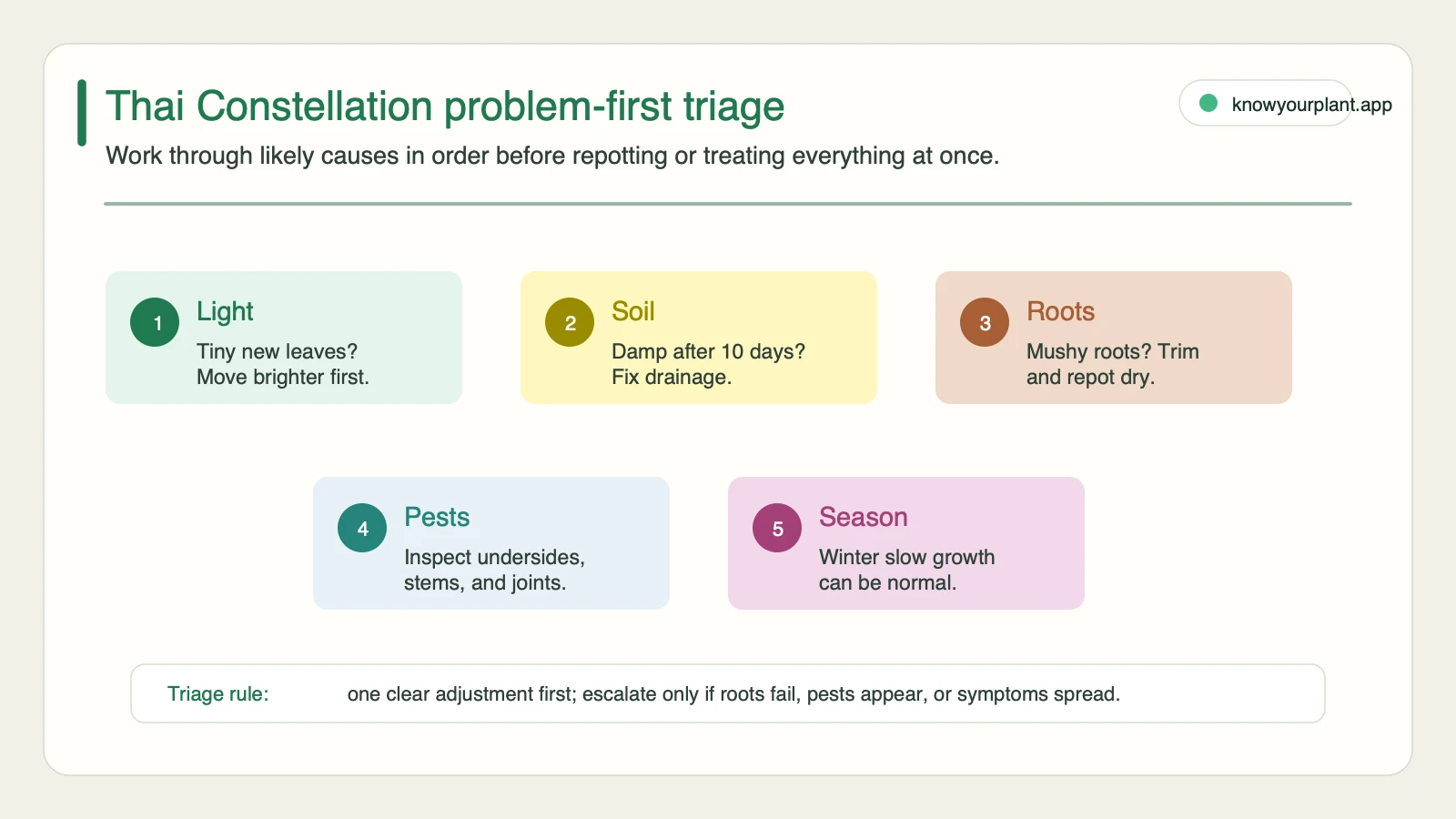 Use the triage order before repotting or treating everything at once: light, soil, roots, pests, then season.
Quick Care Reference
| Care Factor | What Thai Constellation Needs |
|---|---|
| Light | Bright indirect, 4 to 6 hours minimum |
| Watering | When top 2 inches of soil are dry |
| Humidity | 50 to 60% preferred |
| Temperature | 65 to 85°F (18 to 30°C) |
| Soil | Well-draining aroid mix or potting soil + perlite |
| Fertilizer | Half-strength balanced, monthly in spring/summer |
| Repotting | When rootbound; go up one size |
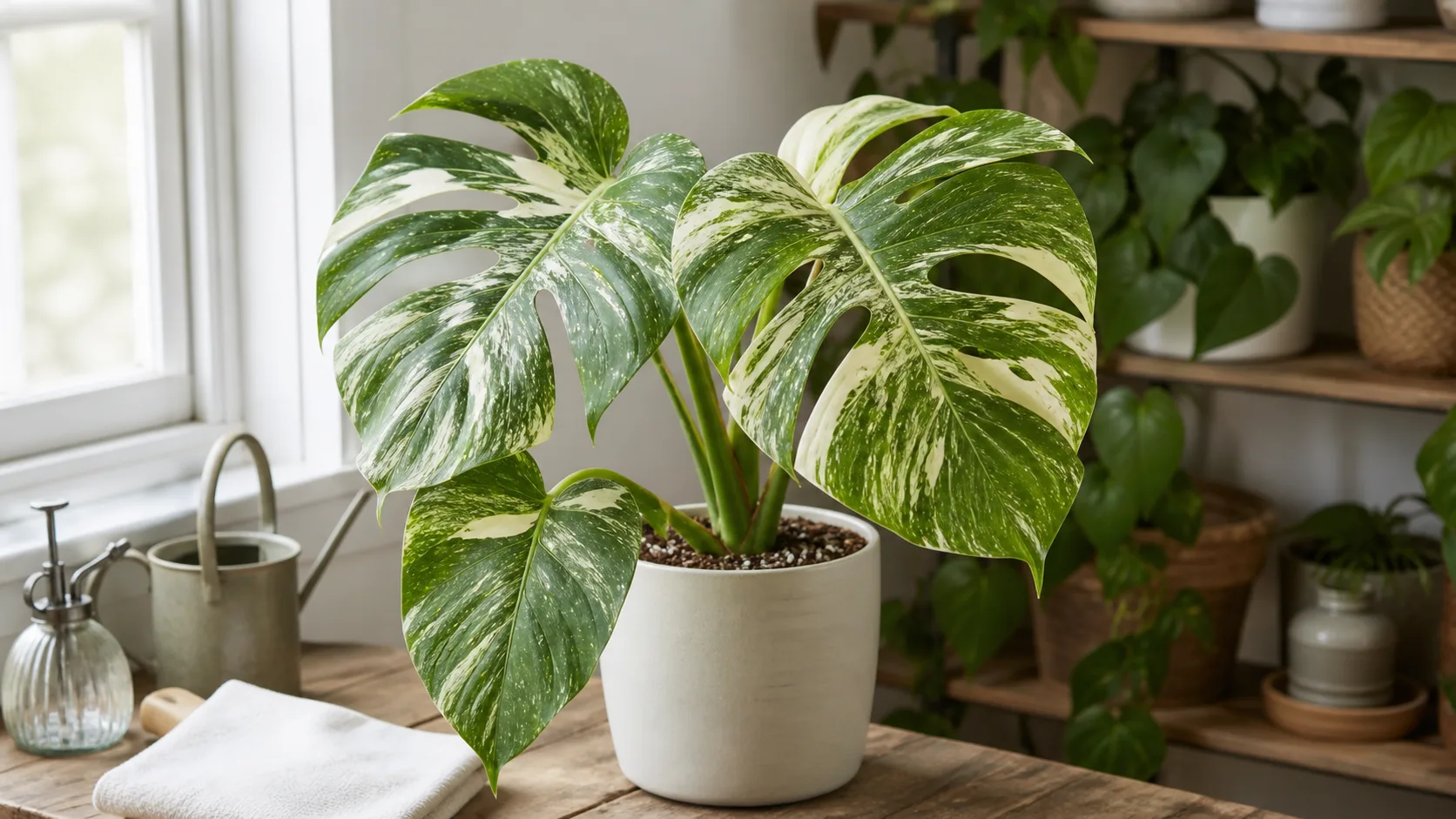
Bright indirect light, a chunky mix, and watering only after the root zone dries form the core of a dependable Thai Constellation routine.
For a related hands-on growing walkthrough, use Moss Pole for Monstera: Choose, Install, and Train It Correctly for the setup and follow-up care.
Methodology Note
This guide was refreshed after reviewing current search results and owner questions about post-purchase acclimation, yellowing leaves, and slower growth, then checking the care and safety baseline against NC State Extension, the ASPCA toxicity database, and cultivar references used by growers. Community threads were used to surface what owners panic about first; the extension and safety sources anchor the care baseline.
Real User FAQ
I just brought a Thai Constellation home. Should I repot it right away?
Usually no. Give it 7 to 14 days in bright indirect light first, unless the potting mix is staying soggy, smells sour, or the roots are already clearly compromised. A rushed repot adds stress before you even know how the plant behaves in your home.
Is Thai Constellation actually harder than a regular Monstera?
Not dramatically harder, but it is less forgiving of dim light and panic watering. The variegation means the plant makes less energy from each leaf, so mistakes usually take longer to recover from and show up faster on the pale tissue.
Is Monstera Thai Constellation hard to care for?
Not really. It needs the same basic conditions as any Monstera: bright indirect light, well-draining soil, and careful watering. The one genuinely extra requirement is light. Because of the variegation, Thai Constellation needs a brighter spot than a plain green Monstera. Get that right and it’s a very manageable plant.
Why are my Thai Constellation’s new leaves coming in mostly green?
Not enough light, almost always. When the plant is struggling to photosynthesize, it produces more chlorophyll-rich (green) cells to compensate. Move her to a brighter spot and the variegation in new growth should improve over the next few leaves.
Can I propagate Monstera Thai Constellation?
Yes, through stem cuttings with at least one node. Place the cutting in water or moist sphagnum moss in a warm, bright spot. Rooting takes 4 to 8 weeks. The variegation in the propagated plant will be stable, the same as the parent.
Is Thai Constellation toxic to cats and dogs?
Yes. The ASPCA lists Monstera deliciosa as toxic to both cats and dogs due to insoluble calcium oxalate crystals. Symptoms include oral irritation and vomiting. Keep it out of reach if you have curious pets.
Will Thai Constellation ever revert to plain green?
No. This is one of its main advantages over Albo Variegata. Thai Constellation’s variegation is tissue-culture stable at the cellular level. Each new leaf will continue to show the characteristic cream and white patterning throughout the plant’s life.
The Thai Constellation is a genuinely rewarding plant to grow. The care is not exotic — it’s the same careful attention you’d give any monstera, with a bit more focus on getting the light right. Once you find her spot and establish a watering rhythm, she’ll reward you with new leaves that are worth every careful look.