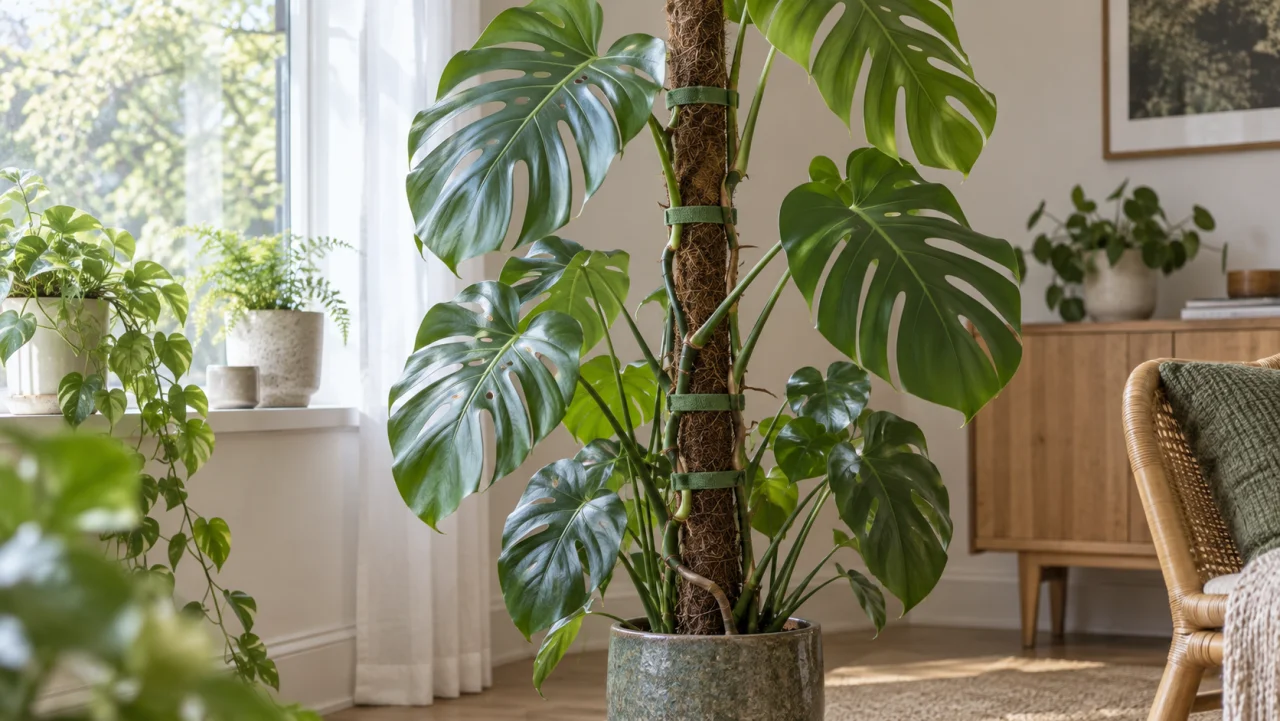
If you’ve been researching moss poles for Monstera and noticed that most guides treat every product on the market as roughly equivalent, you’re not imagining it. Most articles give you a list of steps, tell you to tie the vine on, and call it done. Then you follow those steps, and the plant ignores the pole completely.
The reason is almost never the product. It’s one of three things most guides skip entirely: the type of support doesn’t match what you actually want, the pole went in at the wrong moment relative to the root ball, or the support is on the wrong side of the plant. That last one is the most common, and it’s the easiest to fix once you understand it.
This guide walks through all three, plus what happens over time as roots grow into the support and the plant outgrows the pole.
What Most Care Guides Miss
The most common reason a Monstera ignores a moss pole isn’t the brand or the material. It’s the side the pole is on.
Monstera vines have a direction. Leaves face one way, toward the light. Nodes and aerial roots face the other way, along the back of the main stem, away from the leaf surface. If you place the support on the same side as the leaves, the aerial roots are already growing away from it. The vine has no reason to reach toward something positioned where none of its contact-seeking roots are pointing.
Generic guides almost never explain this. They show a pole standing in the pot and a Monstera tied to it. What they skip is that the pole position relative to the back of the vine is the entire difference between a plant that climbs willingly and one that keeps flopping sideways no matter how firmly you tie it.
The practical first check: find a node on the main stem. That thickened joint where the petiole meets the stem is where aerial roots emerge. The side with nodes faces the support. The side with leaves faces the light. Every installation decision follows from that one observation, and we’ll build on it throughout this guide.
What Monstera Actually Needs From a Vertical Support
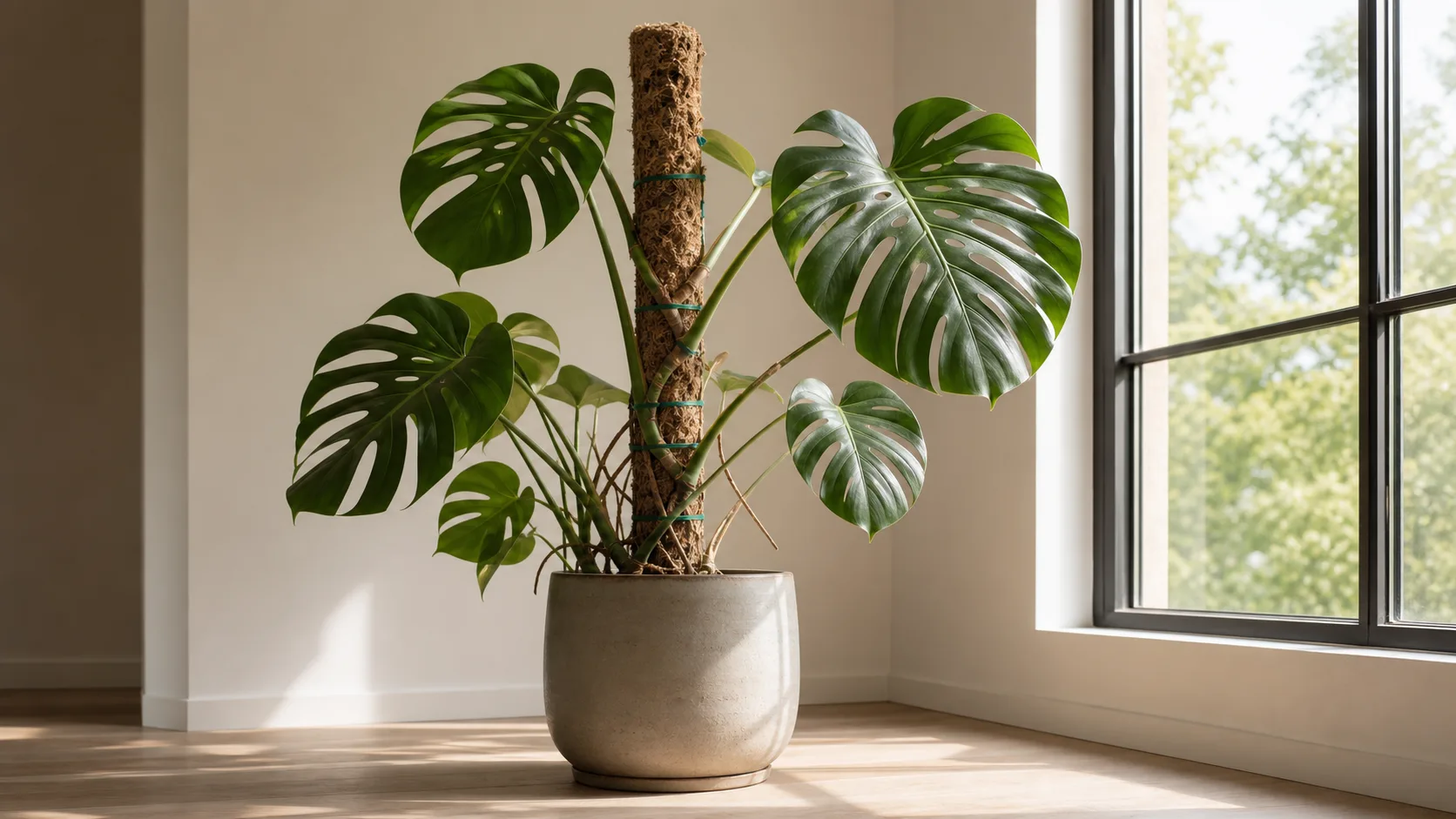
The vine’s nodes and aerial roots meet the pole while the leaves remain free to face the light.
Monstera deliciosa is a climbing vine in the wild. The Missouri Botanical Garden describes it as a climbing evergreen perennial with long cord-like aerial roots that, in its natural environment, anchor it to tree trunks as it grows toward the canopy. The Royal Horticultural Society similarly classifies it as an evergreen climbing shrub, noting that aerial roots are a defining feature of the plant’s growth habit rather than an oddity to manage.
In your living room, that climbing instinct doesn’t disappear. The plant keeps producing nodes and aerial roots, looking for something to grip.
A support does two jobs. The obvious one is structural: it keeps a heavy, top-heavy vine from toppling or drooping under its own weight. The less obvious one is developmental. If aerial roots can actually penetrate the support material and establish a secondary root zone, they get access to additional moisture and anchorage. Research published in the Botanical Gazette (Hinchee, 1981) documented that among the three root types Monstera produces, aerial roots showed the greatest elongation rate and elongation zone of all root categories. In practical terms: aerial roots are more actively seeking contact than the substrate roots in your pot.
A 2022 review in Frontiers in Plant Science found that aerial roots of aroids including Monstera deliciosa show distinct cellular architecture compared to soil roots, which supports treating aerial roots as functional rather than decorative. Many owners report larger and more fenestrated leaves after aerial roots embed into a moist support, though the benefit is likely tied to the whole setup, including stable upright growth and increased light interception, rather than the support material alone.
The key point is that structural support and root-penetrable support are two different goals, and they require different materials and different maintenance habits.
Choosing the Right Support for What You Actually Want
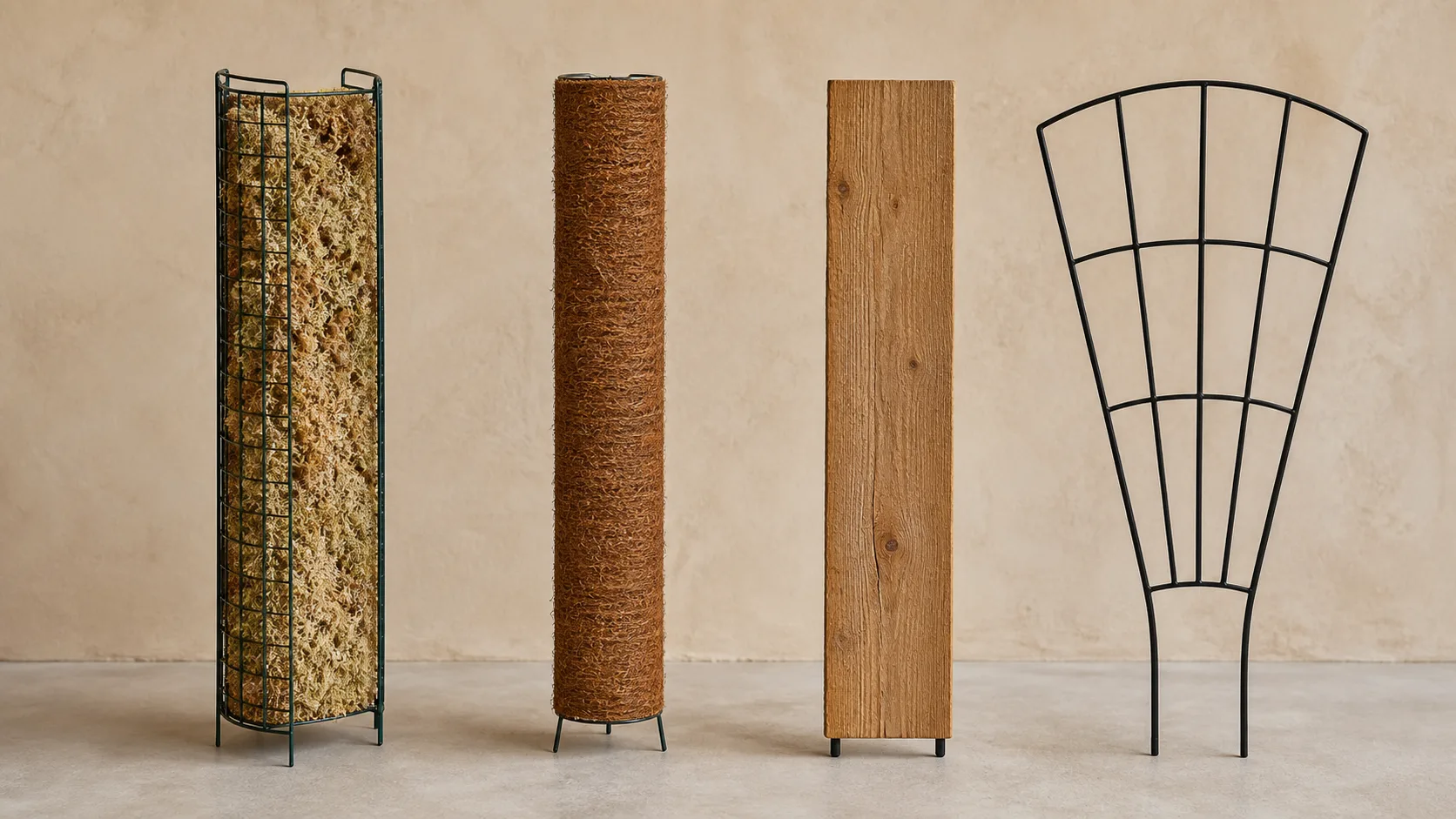
Sphagnum supports root penetration; coir, wood, and trellises trade that feature for simpler structural support.
Open Sphagnum Moss Poles
These are the most widely recommended, and they’re genuinely well-suited for one specific goal: letting aerial roots grow into the support. The open structure of sphagnum can be penetrated, and if you keep it consistently moist, aerial roots will embed themselves within a few months.
The catch is the phrase “consistently moist.” A sphagnum pole that dries out will shed the roots it attracted, and maintaining moisture means either a dedicated watering spike, regular misting directly at the pole, or a slow top-pour that soaks down through the moss. That’s a second watering habit on top of your regular soil routine. Some owners find this satisfying. Others find it a task they quietly stop doing by November.
Best for: owners who specifically want aerial roots to penetrate the support and are willing to run a separate moisture routine for it.
Coco Coir Poles
Coco coir poles are denser and less permeable than open sphagnum. Aerial roots will wrap around the outside and grip the surface texture, but they typically can’t grow into the material the way they can with open moss. The upside is that coir poles need no moisture maintenance at all. They hold their shape, they’re widely available, and the aerial roots that cling to the outside can still provide useful anchorage.
Best for: owners who primarily want structural support without a second watering commitment.
Wood Planks, Branches, or Tree Fern Fiber
A flat section of rough wood or tree fern fiber mimics what a Monstera would grip in the wild more closely than a cylindrical pole does. Aerial roots can grip and sometimes penetrate the surface texture depending on the material. No moisture maintenance required. The limitation is that flat mounts work better secured against a wall than as freestanding poles, so installation usually means attaching the plank to a wall or building a heavy base.
Best for: owners with wall space who want a natural-looking setup and don’t mind a more involved installation.
Stakes and Trellises
Simple bamboo or metal stakes give structural support only. A trellis works particularly well when a Monstera has branched into a bushy shape rather than a single climbing vine, since you can support multiple stems at once without fighting the plant’s natural spread.
Best for: structural support on a budget, or multi-stem plants where a single pole doesn’t match how the plant has actually grown.
The Vine Has a Front and a Back
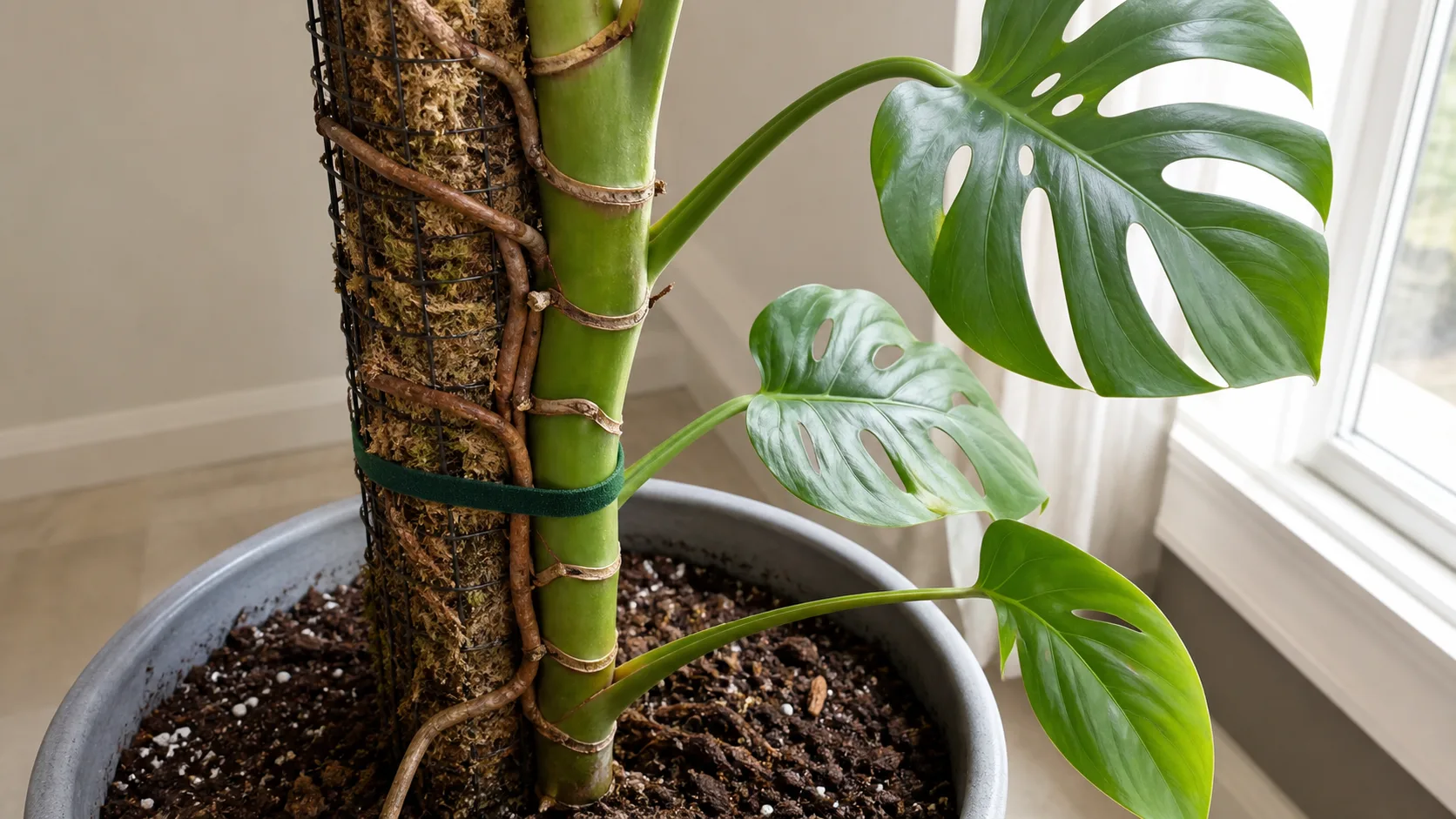
Find the nodes and aerial roots first: that side of the main vine belongs against the support.
Once you understand this, the orientation confusion clears up completely.
Monstera leaves always orient toward the light source. That’s the front. The nodes, the thickened joints where each petiole meets the stem, sit on the back, and aerial roots emerge from that same side. When the plant wants to climb, it sends aerial roots out from the back of the stem, looking for something to grab behind it.
If you place the support on the leaf-facing side of the plant, you’ve positioned it exactly where the plant isn’t trying to go. The aerial roots are growing in the opposite direction. No amount of tying will change that, because you’re working against the plant’s own direction of travel.
The setup that works: look at the main stem from the top. Find a node. The support goes there, directly behind the nodes and aerial roots, while leaves continue to face the light source. The vine will lean toward the pole because the pole is now in the direction it was already trying to go.
If you’ve already installed a pole and the plant seems to be ignoring it completely, this is almost certainly why. The fix is to rotate the plant in the pot so the node-facing side is toward the support, or to move the support to the other side of the stem. Either works. The plant doesn’t care which, as long as the pole ends up behind the nodes.
When to Install: Now vs. At Repotting
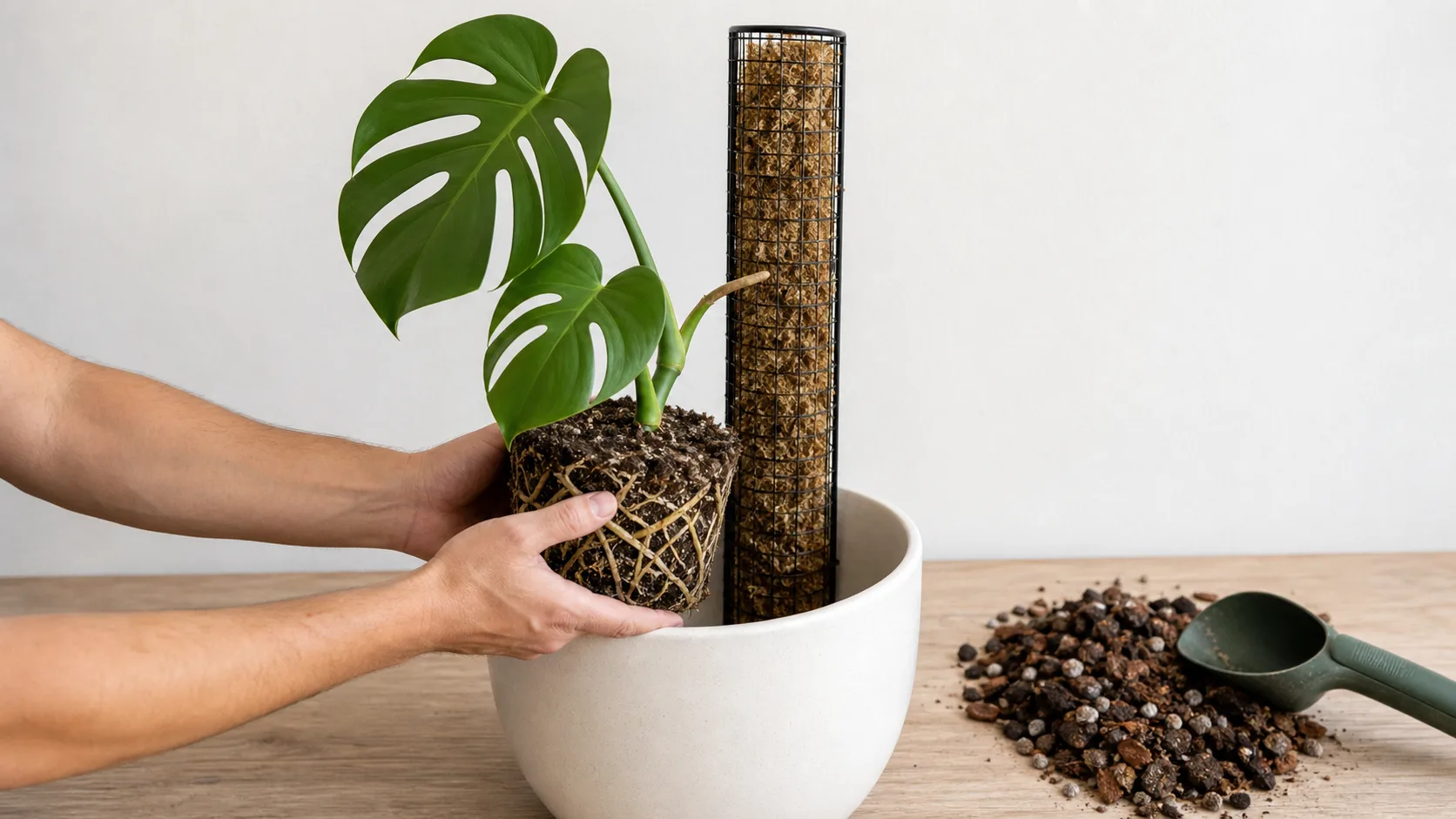
Installing one pole behind the root ball during repotting avoids forcing it through a packed root system.
Installing a pole into a mature or rootbound Monstera requires a choice. If the pot is dense with roots and there’s little open soil at the back of the root ball, pushing a pole through the center will damage roots. A heavy pole with a wide base plate makes this worse.
Install now if: the plant is young and the soil is still loose, you can feel open space at the back of the pot when you probe gently with a finger or chopstick, the pole is thin enough to slide down without forcing, and you can find a clear path behind the main stem without significant resistance.
Wait for repotting if: the plant is rootbound, the pot is packed with roots from top to bottom, or you’d need to force the pole past dense root mass. Repotting gives you a fresh opportunity to position the pole before you add soil around it. This is the cleanest install, and the least stressful for the plant. When to repot your plants covers the signs that your Monstera is ready, including root-circling and drainage indicators worth checking first.
Use an external support in the meantime if: you don’t want to disturb the root ball at all. A sturdy bamboo stake tied loosely to the stem will hold the plant upright while you wait for the right repotting window.
If you do repot at the same time, how to repot plants walks through minimizing root damage during the transition, which matters more when you’re also inserting a pole into the same soil.
How to Attach the Vine
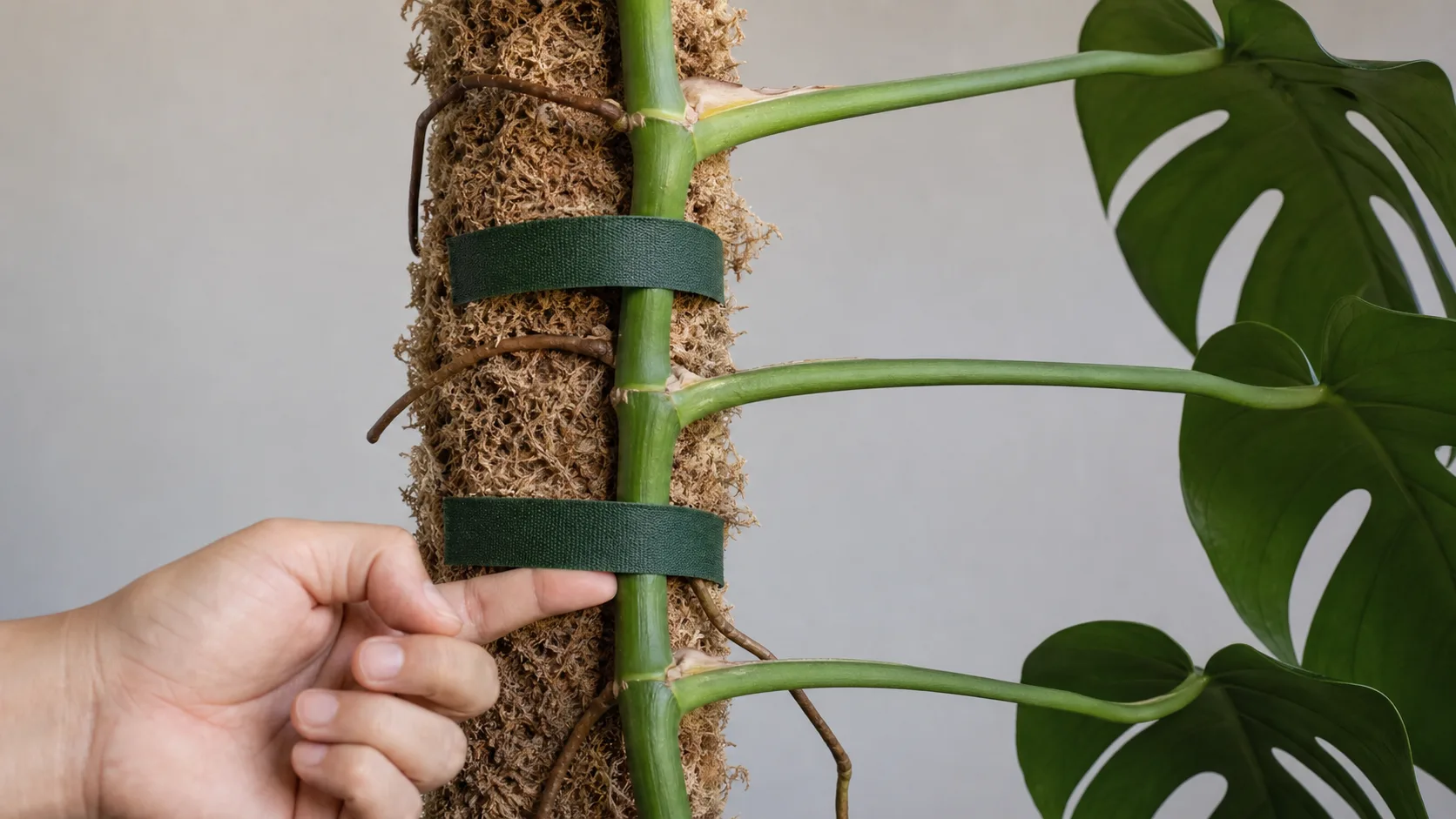
Loose ties at internodes secure the main vine without restricting the moving leaf petioles.
Tie only the main stem. Petioles, the stalks that connect individual leaves to the stem, flex and move as the plant grows and as leaves age. Tying a petiole to a pole creates a pressure point as the stem thickens. The leaf end should be free to move.
Use soft, adjustable ties: plant velcro, silicone clips, or strips of old fabric work well. Avoid wire and plastic zip ties. Leave a finger-width gap between the tie and the stem so there’s slack as the stem thickens over the growing season. A tie that feels comfortable in spring can become uncomfortably tight by late summer.
Place ties at the internodes, the sections of stem between nodes, not at the nodes themselves. Check them every four to six weeks during active growth.
For aerial roots: guide them toward the support gently. If a root has already hardened in another direction, don’t force it. You can wrap a small piece of damp sphagnum around the root and pin it lightly against the pole. It may find its way over the following weeks. If it doesn’t, leave it alone. Aerial roots that don’t attach to a support aren’t harming the plant.
If stray aerial roots become unmanageable or you want to redirect energy into new growth, how to prune Monstera covers when and how to trim them safely.
What to Plan For as the Plant Grows
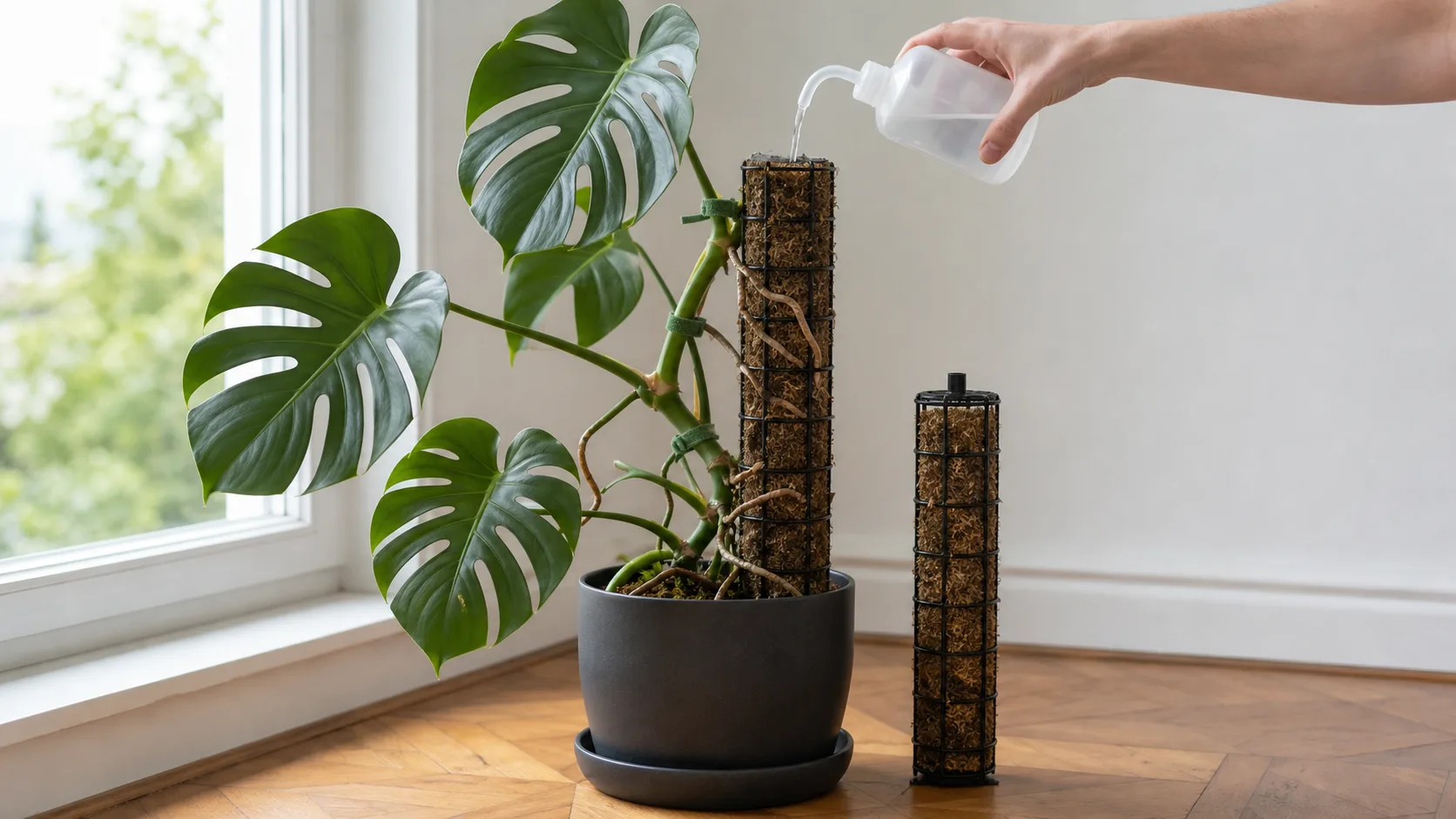
An open sphagnum pole needs its own moisture routine, and an extension is easiest to plan before the vine reaches the top.
A 60 cm pole may seem generous when you first install it. For an actively growing Monstera with good light and consistent watering, you might be looking for an extension within 18 months to two years.
Before you buy, check whether the pole you’re considering is extendable. Many sphagnum and coir systems stack or screw together, which makes adding height much simpler than replacing the whole setup. If extension isn’t an option, plan to start with more height than the plant currently needs.
If you chose a sphagnum pole, plan a separate watering schedule for it. Some owners water it once or twice a week during the growing season and reduce frequency in winter. Others use a reservoir spike inserted near the top. The key is that the moss shouldn’t dry out completely between waterings, because that’s when established aerial roots lose their grip.
And one thing worth knowing before you commit: when aerial roots grow deeply into a sphagnum pole, removing the pole later without tearing those roots is genuinely difficult. If you ever need to change setups, the gentler approach is to cut the pole into sections gradually rather than pulling the whole thing from the root mass. Alternatively, leave the old pole in place, cut it down close to soil level, and install a new taller pole beside it. The embedded roots stay intact, and the plant adjusts.
For general Monstera care alongside support setup, the Monstera deliciosa care guide covers light, watering, and leaf health in detail. If your plant is drooping despite having a support, Monstera drooping: causes and fixes helps you tell the difference between a structural lean and a care-related droop.
Support Type Decision Reference
| Support Type | Root Penetration | Moisture Needed | Best Owner Fit |
|---|---|---|---|
| Open sphagnum pole | Yes | Yes, ongoing | Root attachment goal |
| Coco coir pole | No (surface grip only) | No | Structural support, low maintenance |
| Wood plank or tree fern | Sometimes | No | Natural look, wall-mounted |
| Bamboo stake | No | No | Budget structural support |
| Trellis | No | No | Bushy or multi-stem plants |
Frequently Asked Questions
How long does it take for aerial roots to attach to a moss pole?
On a consistently moist sphagnum pole during spring and summer, you may see aerial roots begin to anchor within six to ten weeks. On a dry coir pole, roots grip the surface texture without penetrating, and that surface contact can happen faster. If aerial roots seem to be growing away from the pole entirely, check orientation first: the support should sit behind the nodes, not on the leaf-facing side of the stem.
Will a moss pole make my Monstera produce bigger or more fenestrated leaves?
There’s no controlled study proving a moss pole directly causes more fenestration. What does seem to help is giving the plant a stable upright position, which allows it to put energy into new leaves rather than supporting a drooping stem. Aerial roots that embed into a moist pole may also contribute additional moisture uptake. Many owners report more fenestration over time with a well-established pole, but that benefit is tied to the whole care setup, not the pole alone. If your Monstera isn’t developing holes, Monstera fenestration: why no holes covers the light and maturity factors that matter more.
Can I install a moss pole without repotting?
Yes, if the plant isn’t rootbound and there’s open soil at the back of the stem. Probe gently with a chopstick before inserting a pole and go slowly. If you hit significant resistance, stop and wait for repotting. Forcing a heavy pole through a dense root ball can damage the roots that handle water and nutrient uptake, and that’s a worse outcome than waiting a few months.
How do I keep a sphagnum pole moist without waterlogging the soil?
Water the pole separately from the soil. Pour a small amount of water slowly down the center of the pole, or use a watering spike planted into the moss near the top. You’re targeting the moss itself, not the surrounding soil. If the soil is getting soggy from pole watering, switch to bottom watering for the pot and top-water only the pole. The two moisture routines can run independently.
My Monstera keeps leaning away from the pole. What’s happening?
Almost always, this is an orientation problem. The plant leans toward its light source, and the nodes and aerial roots grow away from the leaf face. If the pole is on the same side as the leaves, the stem will continue leaning away from it. Rotate the plant so the node-facing side is toward the support, or move the support to the other side of the stem. Recheck your ties too: they should guide the stem gently toward the pole at the internodes, not just hold one point near the top.
How tall should a moss pole be?
Choose a pole that extends at least 30 cm above the current top of the plant. Monstera can grow 15 to 30 cm or more per growing season in good conditions. A pole that’s only as tall as the plant today may need extending or replacing within a year. If you’re using a stackable system, buy the extension before the plant tops out, not after.
Can I use a bamboo stake as a temporary support?
Yes, and this is often the right call when the plant is rootbound and you’re waiting for a repotting window. A bamboo stake tied loosely to the main stem will keep the plant upright without disturbing the root ball. Check the ties regularly: a comfortable fit in spring can become a tight one by summer. Use soft fabric strips or plant velcro rather than wire or zip ties.
What happens if I need to remove a sphagnum pole after aerial roots have grown into it?
If the roots are established, pulling the pole out will tear them, which stresses the plant significantly. The gentler approach is to cut the pole into sections gradually over several weeks, reducing it bit by bit so the plant can adjust. Another option: leave the old pole in place, cut it down to soil level, and install a new taller pole beside it. This avoids disturbing the embedded roots while giving the plant somewhere new to climb.
Methodology
This article draws on the Missouri Botanical Garden’s plant profile for Monstera deliciosa, the Royal Horticultural Society’s species notes, peer-reviewed aerial root research from Hinchee (1981) in the Botanical Gazette and a 2022 comparative study in Frontiers in Plant Science, and recurring owner confusion patterns around pole orientation, aerial root attachment, and late-stage installation. Social evidence from plant care communities shaped the pain framing and FAQ priorities but is directional only and is not represented as controlled data. Last updated: 2026-07-19.