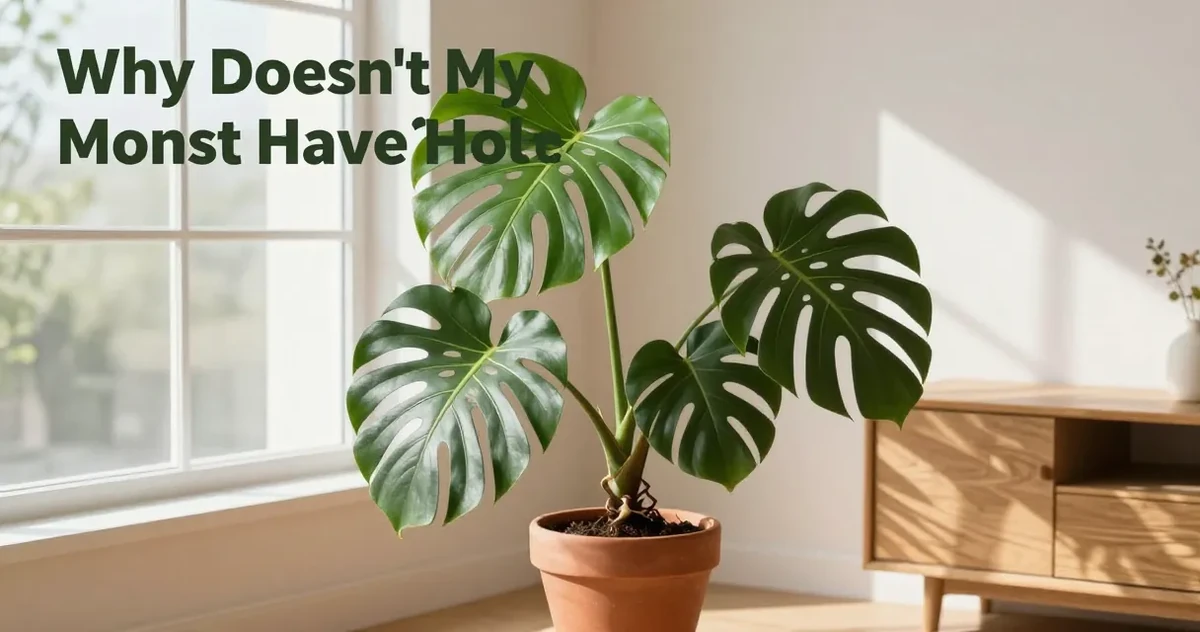
You got a monstera for those dramatic, Swiss-cheese leaves, and yours keeps pumping out big, smooth, completely solid ovals. The plant looks healthy. It’s growing. But month after month, still no holes, no splits, nothing even close to the photos you saved before buying it.
The confusing part is that a healthy, growing monstera with no holes isn’t obviously broken. So you’re left wondering whether to change the light, repot it, buy a moss pole, start fertilizing, or just wait. And most of what you find online tells you to “give it more light” without explaining why, or whether that’s even your actual problem.
Here’s the clearer answer: fenestration follows a predictable pattern once you know what stage your plant is in and what’s actually holding it back. The diagnosis matters more than the fix.
Fenestration is the formation of holes and deep cuts in a monstera’s leaf blade. It’s a natural feature of mature growth, not a care achievement - and it doesn’t happen on a fixed schedule. If the openings are ragged, random, or newly spreading instead of smooth and repeated, compare them with the damage patterns in the plant-with-holes-in-leaves guide.
What Most Care Guides Miss
The most common advice online is “give it more light.” That’s not wrong, but it’s incomplete in a way that leaves most monstera owners stuck.
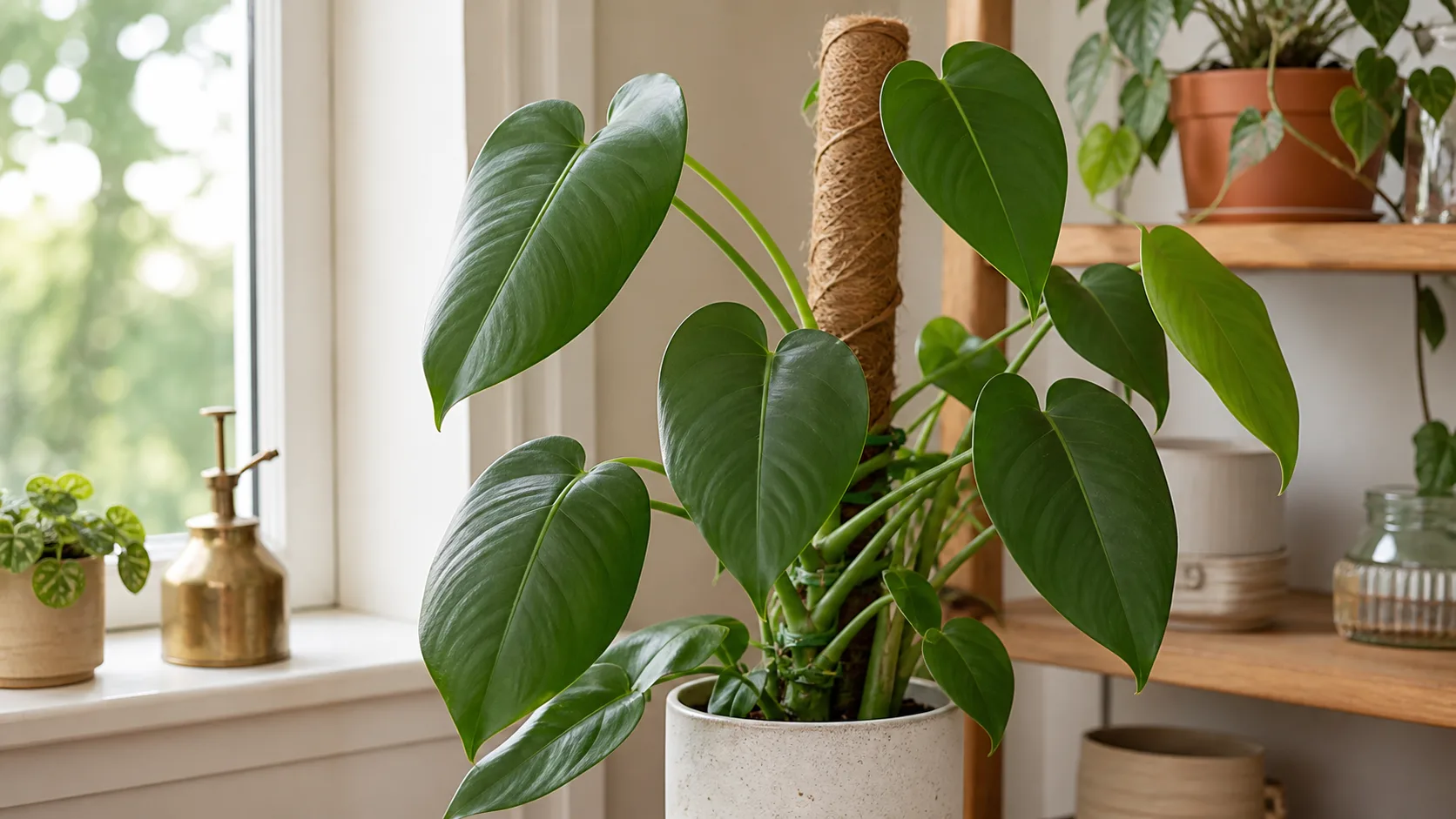
A healthy juvenile monstera can keep producing solid leaves while it matures.
Here’s what gets skipped: a monstera producing solid leaves is often a juvenile plant, and juvenile and mature leaves don’t behave the same way. Penn State Extension documents this clearly - juvenile monstera leaves are mostly entire (uncut), while mature leaves become perforated and distinctively cut. That transition is a normal developmental stage, not a care failure.
The misdiagnosis is treating no holes as a symptom of something wrong, when the real situation is often that the plant simply hasn’t hit the developmental threshold yet. A young monstera can be perfectly healthy, growing well in decent light, and still produce entirely smooth leaves for its first year or two - because that’s what young monsteras do.
The first check: Before changing anything, look at your plant’s leaf history. Have new leaves been getting bigger over time, or staying roughly the same size? Juvenile leaves tend to stay small and solid. Once new leaves start reliably coming in at 12 inches or larger, the plant is entering the range where fenestration becomes possible - if the other conditions are there too. Leaves that stay consistently under 8 inches despite decent light usually signal a plant that’s still in its early phase, not a plant that’s stalled because of something you did.
The One Thing Most Owners Don’t Know: Existing Leaves Never Change
This is the single most overlooked fact about fenestration, and it changes how you read your plant’s progress.
Once a monstera leaf is fully unfurled, it is permanent. It will not develop holes or splits after the fact. Not in better light. Not with more fertilizer. Not in higher humidity. A leaf that came in solid will stay solid for the life of that leaf. Do not remove a healthy solid leaf just to chase a mature shape; if the plant genuinely needs trimming, use the Monstera pruning guide to choose the correct node and cut.
Fenestration only happens as a new leaf is forming. The pattern - holes, splits, lobing - develops in the rolled-up leaf as it pushes out of the stem, before it opens. Once a leaf has fully expanded and hardened, its shape is set.
This matters because many owners stare at their existing solid leaves waiting for something to change. That wait is never going to pay off on those leaves. The right thing to watch is new growth. When your monstera unfurls a leaf with even a small notch along the edge that wasn’t there on previous leaves, that is the signal conditions are moving in the right direction.
It also reframes the timeline. After you move a monstera to a brighter spot or add a moss pole, improvement doesn’t show up in the leaves already on the plant. It shows up - slowly - in the next few new leaves that grow after the change. Given that a monstera might produce one new leaf every three to five weeks in good conditions, that means waiting two to three months before you can honestly evaluate whether a change helped.
Why Does Monstera Even Have Holes?
Most care guides skip this entirely, but understanding why the plant evolved fenestration makes the care logic obvious rather than arbitrary.
Monstera grows naturally on the floor of tropical forests in Central and South America, where the canopy above is dense and light reaches the understory as scattered bright patches - called sunflecks - rather than consistent illumination. The leading hypothesis among botanists is that the holes and cuts in mature monstera leaves help the plant intercept those moving patches of light more efficiently: a large, lace-like leaf spread across a wide area catches more sunflecks over the course of a day than a smaller, solid leaf of the same total surface area.
This is why light quality matters so much for fenestration indoors. In a dim room, the plant has no biological reason to produce the large, energy-expensive, fenestrated leaves it would grow toward a forest canopy gap. It produces smaller, simpler leaves instead - exactly the juvenile pattern Penn State Extension and Missouri Botanical Garden describe. The plant is making the leaf that makes sense for the light it has.
Practically: a monstera in a bright room is being asked to behave like a mature forest vine reaching toward a canopy opening. That’s the context that produces the holes. A monstera in a dim corner is being treated like a shaded juvenile. It responds accordingly.
Myths That Keep People Stuck
These show up constantly in monstera advice. Following them without context usually leads to wasted effort and frustration.
“A healthy monstera should already have holes.” Not true if the plant is young. Small, solid leaves are completely normal for the first year or two of growth. The plant is doing exactly what it’s supposed to do at its current stage.
“Humidity is the key to fenestration.” Humidity supports overall plant health, but it isn’t a meaningful driver of holes. NC State Extension notes that monstera prefers higher humidity as part of its tropical background, but a plant with good light, climbing support, and adequate maturity will fenestrate in moderate humidity. Chasing 70% humidity while ignoring low light won’t move things forward.
“Fertilizer will force holes.” Fertilizer helps a plant sustain healthy growth during the growing season, but it doesn’t cause fenestration on its own. If the plant is juvenile, in low light, or has no support structure, feeding it more won’t change the leaf output. You feed to support the conditions that allow fenestration - not to substitute for them.
“A moss pole will immediately produce better leaves.” A moss pole is genuinely useful, but it’s a slow contribution. It works best as part of a complete setup: good light, a maturing plant, and upward support over many months. If the plant is very young or in low light, a pole alone won’t produce holes within weeks.
“If conditions improve, your current leaves will eventually develop holes.” They won’t. As described above, existing leaves are permanent once they’ve opened. Only new growth reflects new conditions.
Quick Diagnosis Snapshot
Use this before you start moving pots around or buying new supplies.
| What you see right now | What it usually means | First move |
|---|---|---|
| Small solid leaves on a young plant | Normal juvenile growth | Keep care steady and watch new leaf size |
| Long gaps between leaves plus no holes | Light is too weak | Move closer to bright indirect light or add a grow light |
| Healthy growth but the vine sprawls sideways | The plant is not maturing upward | Add a pole or trellis and guide aerial roots |
| New leaves smaller after a move or repot | Temporary stress response | Wait 4 to 6 weeks before changing more variables |
| Big older plant, decent growth, still no holes | Conditions are close but one factor is limiting progress | Recheck light intensity, support, and timeline expectations |
Why Your Monstera Might Have No Holes
The plant is still juvenile
This is the most overlooked reason, and it’s the one that causes the most unnecessary worry. Young monsteras produce entirely solid, uncut leaves. Missouri Botanical Garden describes how mature leaves develop distinctive perforations and cuts while juvenile leaves remain small and mostly uncut - that’s standard plant development, not a signal that anything is wrong.
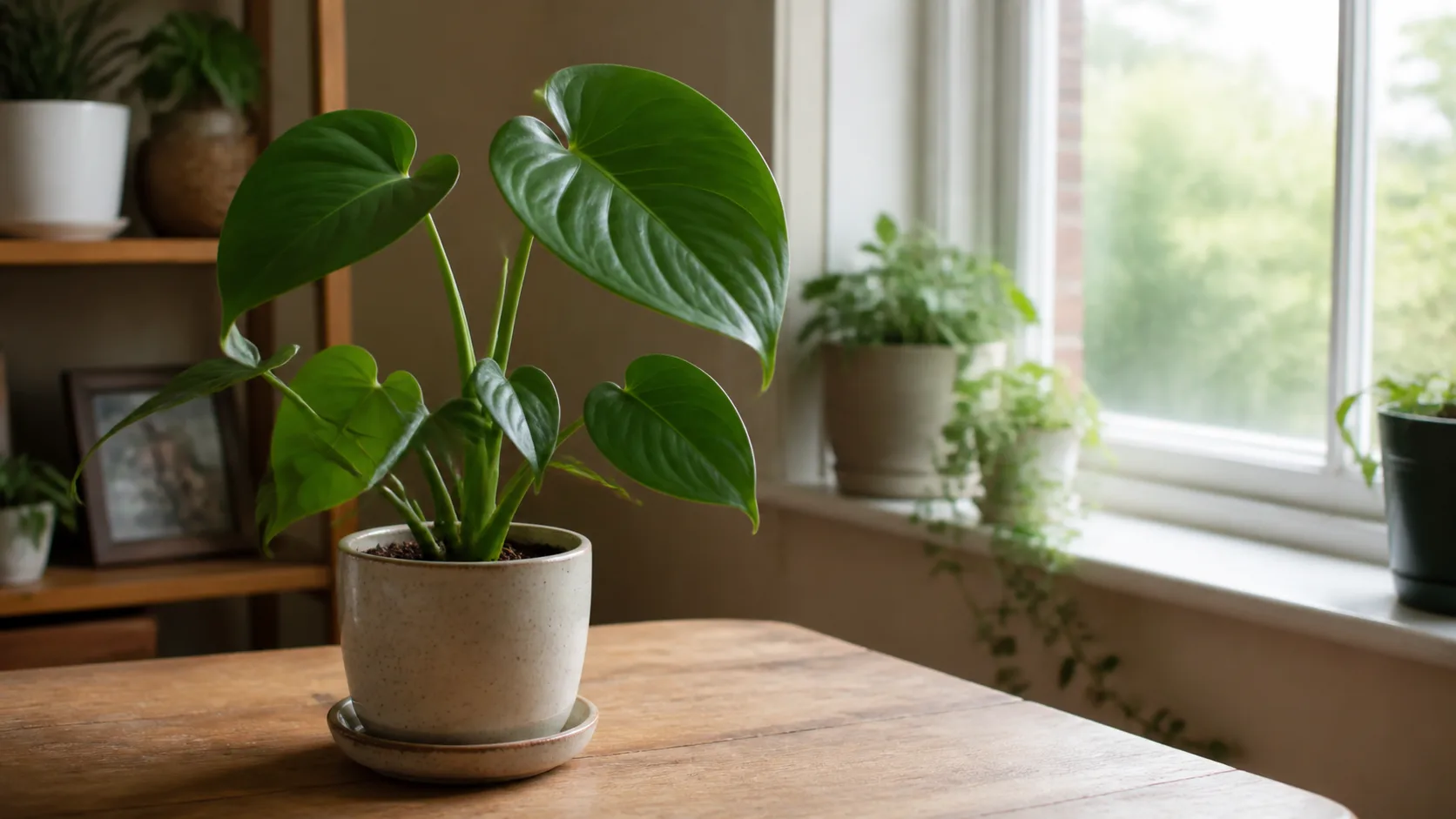
Solid, heart-shaped leaves are normal on a healthy juvenile monstera.
If you bought a small starter plant, plan to wait. Most monsteras show their first fenestrations sometime in their second year of growth, though the exact timing depends on conditions. Consistent care in good conditions speeds the transition - but it can’t skip it entirely.
The emotional piece here is real: it’s genuinely confusing to watch a plant grow vigorously and still not look like what you expected. That disconnect between “doing well” and “not making holes” is one of the most common sources of frustration with monsteras. Usually, the plant is fine. It just needs more time.
Light is too low
A monstera in low light will grow, but it often grows leafier without getting bigger, and small leaves rarely develop holes. NC State Extension documents that Monstera deliciosa prefers moderate brightness without direct sun, and that inadequate light leads to leggy, stretched growth with leaves that don’t develop the plant’s mature appearance.
In practice, this means a spot with bright, indirect light for several hours a day. A spot several feet back from a window, or in a room where natural light doesn’t reach the plant’s leaves consistently, usually isn’t enough to push leaf size into the range where fenestration happens.
The useful thing about low-light stalling is that it shows up in combination with other signs: stems growing long and stretched between leaves, and new leaves coming in smaller than older ones. No holes paired with leggy growth points strongly to light - not just age.
For spaces where windows don’t deliver consistent brightness, grow lights for indoor plants can fill the gap reliably.
No climbing support
Monstera is a vine. UF/IFAS describes it as a fast-growing vine with numerous aerial roots that naturally produces deeply dissected, perforated leaves as part of mature vine growth. That climbing habit isn’t just a preference - it’s part of how the plant behaves developmentally.
A monstera sprawling across a pot or trailing sideways tends to stay more juvenile-looking. Leaves stay smaller and less developed, because the plant isn’t doing what its biology is set up to do. Missouri Botanical Garden recommends a pole or trellis specifically to support the climbing habit and let aerial roots anchor - which over several months of upward growth helps the plant produce larger, more mature leaves.
A moss pole isn’t a quick fix, but combined with decent light and a maturing plant, it’s a genuine part of how monsteras eventually start fenestrating reliably.
Recent stress - a move or repot
If your monstera recently arrived from a nursery, moved to a new spot, or was repotted, it may be directing its energy toward recovery rather than new growth. Plants under stress tend to produce smaller, simpler leaves.
Give a recently disrupted plant 4-6 weeks before judging its leaf quality. Making multiple changes at once during a recovery window usually just extends the settling-in period. Let the plant stabilize before adjusting light, adding a pole, or drawing conclusions from what it’s been producing.
The timeline is shorter than you realize
Most reference photos of monsteras with enormous, dramatically cut leaves show plants that are several years old, growing in ideal conditions - often in a greenhouse or warm tropical climate. A one-year-old monstera in a bright apartment isn’t going to look like that yet. That’s completely normal, and worth naming plainly, because a lot of frustration with fenestration comes from comparing a young plant to mature specimens that have had years to develop.
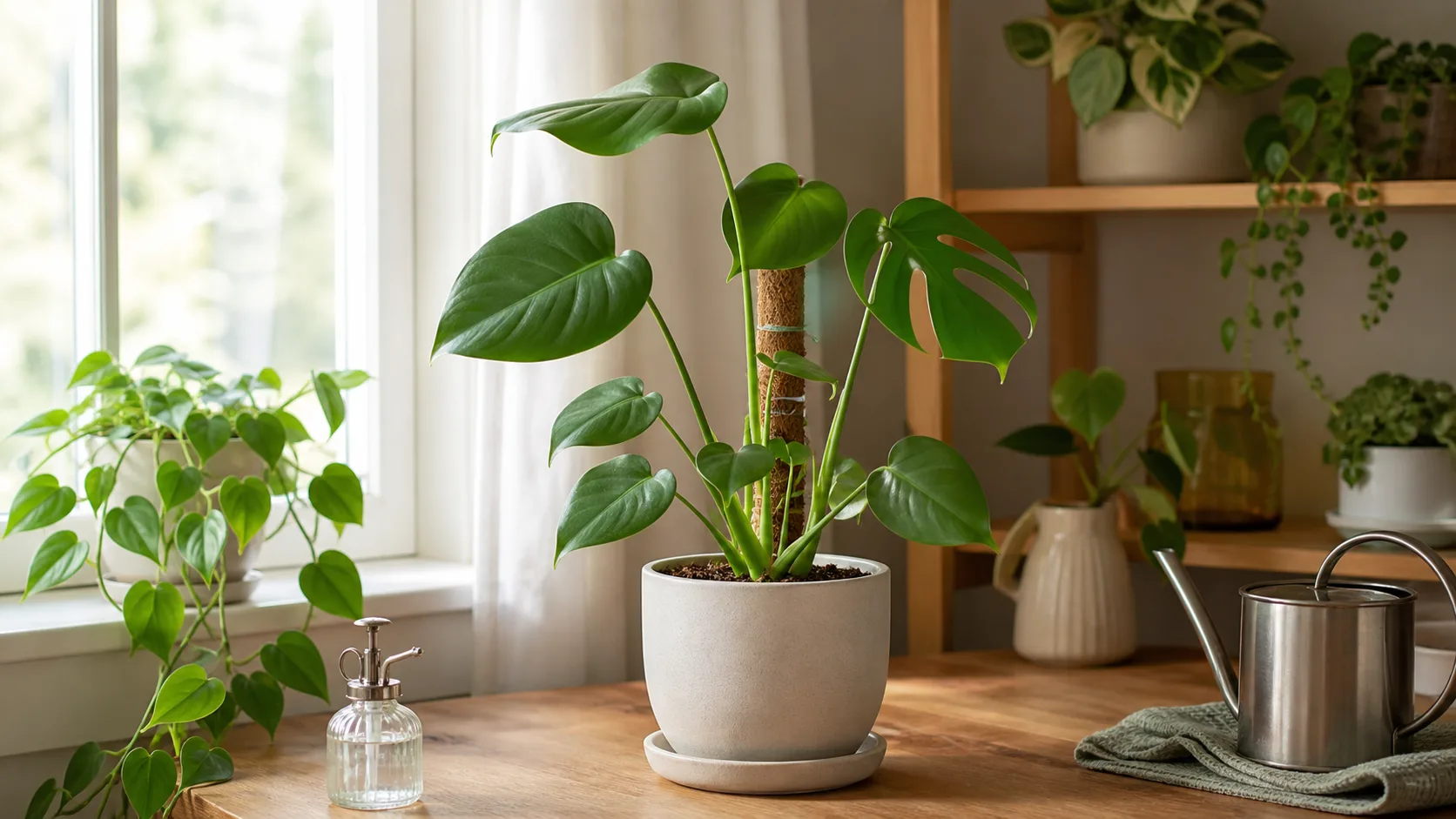
A first split leaf can appear while most of a young monstera remains solid.
What Real Owners Keep Getting Stuck On
Recent plant-owner threads and social posts keep circling the same frustration: a monstera can look green, alive, and even fast-growing while still refusing to make the holes people expected. The useful takeaway is not that one magic fix exists. It is that owners usually need to separate five different situations before changing care: a genuinely juvenile plant, low-light stretch, a vine with no climbing support, a plant recovering from a move or repot, or a timeline expectation pulled from mature greenhouse photos.
That owner confusion lines up with expert guidance. Penn State Extension and Missouri Botanical Garden both note that juvenile monstera leaves are mostly entire, while mature leaves become cut and perforated. NC State Extension and UF/IFAS reinforce the other two big levers: brighter indirect light and sturdy climbing support. In other words, no holes by itself is not a diagnosis. It only becomes useful when you read it alongside leaf size, stem stretch, and whether the plant is climbing.
Identification Snapshot
If your plant is a juvenile Monstera deliciosa, the newest leaves are usually smaller, smoother, and fully solid. A plant moving toward maturity usually shows three changes together: leaves getting larger over time, stronger upright or climbing growth, and the first shallow edge splits before internal holes show up. Penn State Extension and Missouri Botanical Garden both describe that juvenile-to-mature shift, which is why leaf size and growth habit matter more than one perfect watering tweak.
Lookalikes and Confused-With Cases
“No holes” gets lumped into one problem, but owners usually mean one of three different situations:
| Situation | What is actually happening |
|---|---|
| Juvenile Monstera deliciosa | A normal young plant has not reached the mature leaf stage yet |
| Mature-looking plant stalled in low light | The plant is alive, but leaf size and structure are not advancing because conditions are too weak |
| A different Swiss-cheese style plant, such as Monstera adansonii | The plant naturally fenestrates differently, so comparing hole pattern or timing creates the wrong expectations |
Care Cards
| Care factor | What to aim for | Why it matters for fenestration |
|---|---|---|
| Light | Bright indirect light for several hours a day | Bigger leaves need more energy before they can split or perforate |
| Support | Moss pole, pole, or trellis with upward guidance | Climbing growth helps the vine behave like a maturing plant instead of a sprawling juvenile |
| Watering | Water thoroughly, then let the top few inches dry | Stable moisture supports bigger new leaves without forcing soft, stressed growth |
| Timeline | Judge the next two or three leaves, not the current ones | Fenestration shows up on new growth only |
Which Situation Are You In?
It helps to know whether no holes is a maturity issue or a stalled-growth issue, because the response is different.
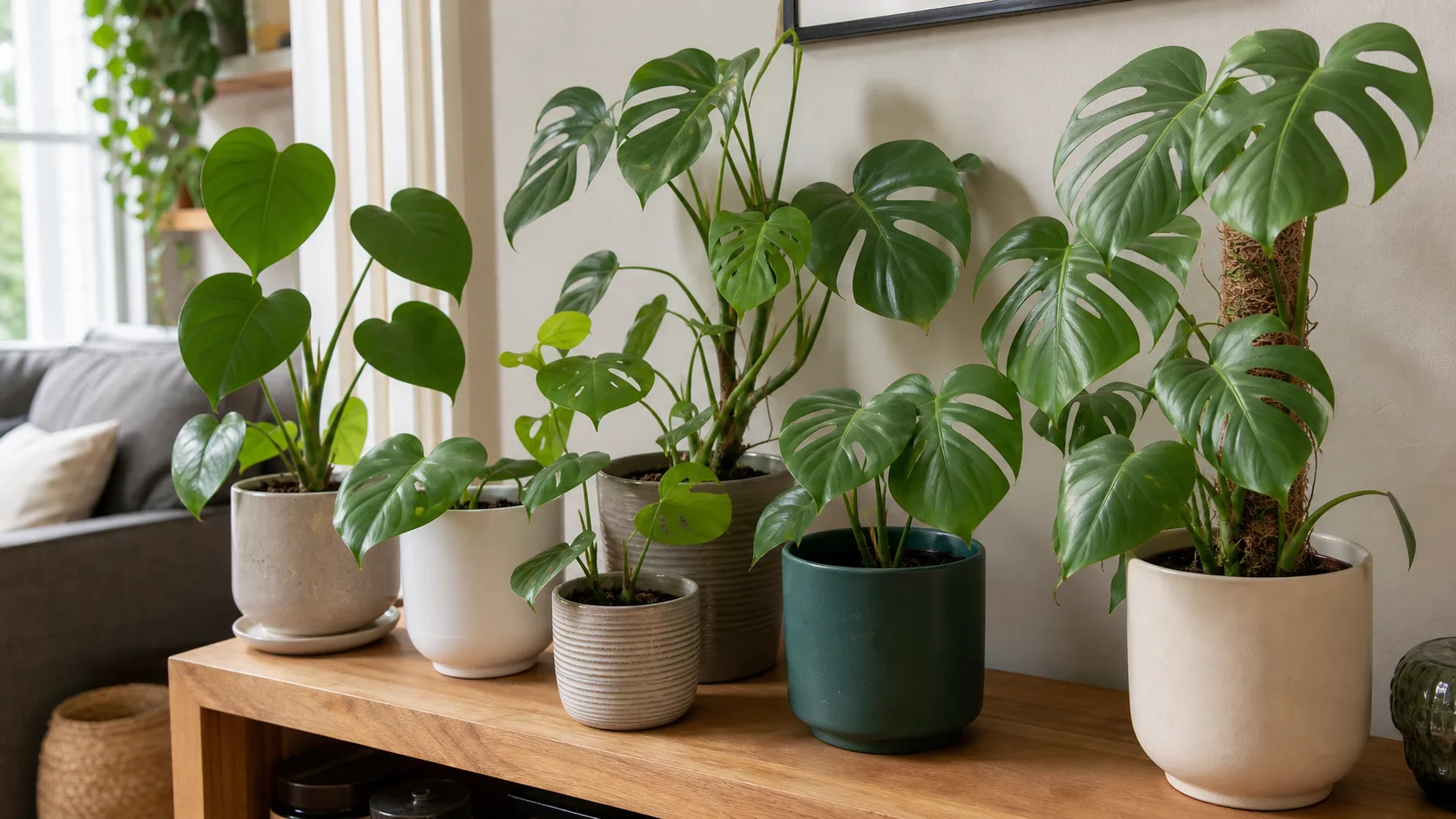
Comparing juvenile, transitional, and mature growth helps separate age from stalled care.
| What you’re seeing | Most likely explanation |
|---|---|
| Small, solid leaves - plant is under a year old | Normal juvenile phase, wait and keep conditions steady |
| Leaves getting bigger over time, some edge splits appearing | Plant is maturing, conditions are working |
| Leaves staying the same size, stems growing long and stretched | Low light keeping the plant in juvenile growth mode |
| New leaves suddenly smaller after a move or repot | Stress response - give it 4-6 weeks to recover |
| Large plant, decent light, no holes after 2+ years | Check light intensity, climbing support, and root crowding |
| Some small holes but development seems stalled | Conditions are close - check light and whether a pole is in use |
Common Problems
| What you notice | Most likely cause | What to do next |
|---|---|---|
| Lots of green growth but every new leaf stays solid | The plant is still juvenile or light is still too weak | Check leaf size trend and move to brighter indirect light first |
| Long stems with wider gaps between leaves | Low light stretch | Increase usable light before adjusting fertilizer or humidity |
| Bigger pot, fresh soil, then smaller leaves | Repot stress or root disruption | Hold steady and judge the next leaves after recovery |
| Healthy plant that sprawls out of the pot | No climbing support | Add a pole or trellis and guide new growth upward |
What to Check Before You Change Anything
Work through this in order. Changing one variable at a time makes it much clearer what’s actually helping.
- Age and leaf size - Are leaves still small and solid, or have they been getting bigger over time? If they’re consistently small, maturity is likely the limiting factor, not a specific care mistake.
- Light - Does the plant get bright, indirect light for most of the day? A dim corner or a spot several feet from the nearest window is usually the highest-leverage thing to change.
- Climbing support - Is the plant growing upward on a pole or trellis, or spreading sideways? Adding support helps over months, not weeks.
- Recent disruption - Has the plant moved, been repotted, or arrived recently? If yes, wait before expecting improvement.
If the plant is young, light is already good, and support is in place - the honest answer is usually patience. And when you do make a change, remember: you’re watching for new growth to reflect it, not waiting for existing leaves to transform.
Fenestration Decision Tree
-
Are the newest leaves still small and fully solid?
If yes, start by asking whether the plant is still juvenile. Do not treat no holes as a failure by default. -
Are stems stretched with wide gaps between leaves?
If yes, light is probably the first constraint to fix. -
Is the plant climbing a pole or trellis?
If no, add support before expecting mature-looking leaves. -
Did you recently move, repot, or receive the plant?
If yes, give it a settling-in window before judging the next leaves. -
Have the last two or three new leaves been getting bigger?
If yes, the plant is moving toward fenestration even if full holes have not shown up yet.
What Actually Changes First
When conditions improve, the most noticeable shift isn’t a sudden explosion of holes. It’s leaf size. New leaves start coming in bigger. Then, as those larger leaves mature, edge slits start appearing along the sides. Full internal holes (perforations through the leaf blade) tend to come later, as the plant grows even larger over time.
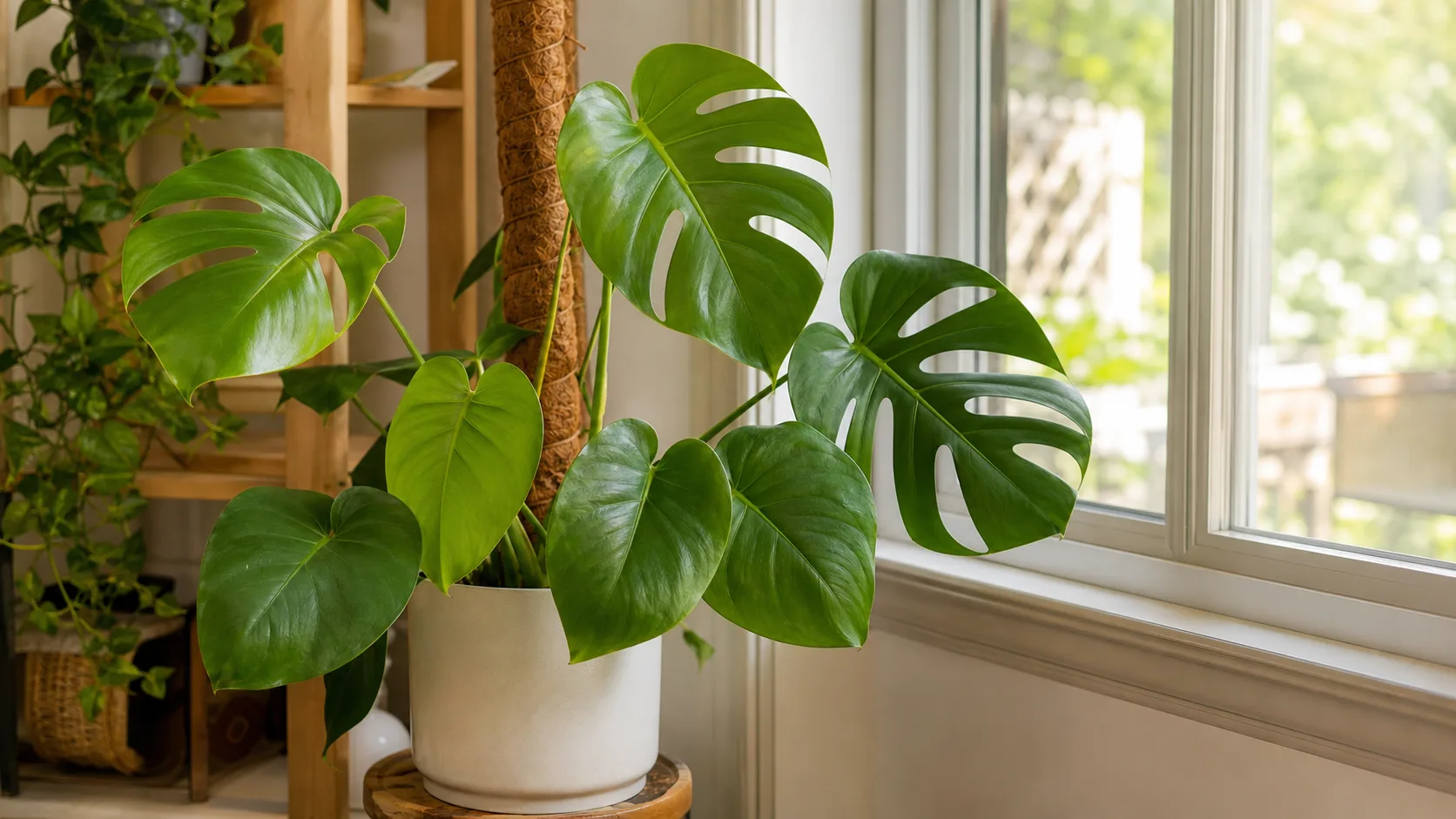
Larger new leaves and edge splits usually arrive before full internal holes.
Knowing that sequence helps set realistic expectations. If you move your monstera to a brighter spot in spring and see new leaves coming in noticeably larger over the following months, that’s the signal you want. The holes follow as the plant builds on that growth. Existing leaves won’t change - all progress is in the new ones.
What Early Fenestration Actually Looks Like
Most guides describe fenestration as an on/off state: either there are holes or there aren’t. The actual progression is more gradual, and knowing each stage makes it easier to recognize whether your monstera is moving forward - even before holes appear.
Stage 1: Scalloped or notched margins The first signs usually show up along the outer edge of the leaf, not the center. New leaves come in with slight waves or shallow notches along the margins - easy to miss if you’re looking for holes. The plant is beginning to form the anatomy that produces cuts; it just hasn’t gotten there yet.
Stage 2: Edge splits that don’t quite reach the midrib As leaves get larger, those margin notches deepen into partial cuts - slots that extend maybe halfway across the blade toward the center. The leaf starts to look somewhat lobed. Still no internal holes, but this is active progress.
Stage 3: Full pinnation (splits reaching the midrib) The cuts extend all the way to the central rib, producing the classic lobed silhouette. The dramatic shape is there - this is what’s often photographed as “mature monstera” - even without perforations through the blade.
Stage 4: Internal perforations The oval holes through the blade appear last, typically near the midrib first, then spreading outward as subsequent leaves grow larger still.
This matters because a monstera at stage 2 isn’t failing - it’s actively moving in the right direction. If your plant has started showing edge notches and partial splits, that’s forward motion. The holes come after, on leaves that get big enough to carry them.
The Most Effective Moves
The steps that actually support fenestration progression:
- Move the plant to a spot with bright, indirect light for several hours a day
- Add a moss pole and guide aerial roots toward it as new stems emerge
- Water consistently and let the soil partially dry between waterings - about the top 2-3 inches
- Feed with a balanced fertilizer during the growing season to support the larger leaf production the plant needs
If you need to correct the whole routine rather than one fenestration factor, start with the Monstera deliciosa care guide and then judge the next two or three leaves.
Common Mistakes That Slow Fenestration
- Changing three things at once, so you cannot tell whether light, support, or recovery time helped
- Judging the plant by old leaves instead of the next two or three new ones
- Treating fertilizer or humidity as the main fix when the plant is still too young or too shaded
- Letting a climbing vine sprawl sideways for months, then wondering why new leaves stay small
- Comparing a young indoor monstera to mature greenhouse photos instead of to its own last few leaves
If your home doesn’t get consistent natural brightness, grow lights for indoor plants can extend the daily light hours your monstera needs to keep growing into mature leaf size. And if you’re considering a monstera species that develops fenestrations earlier and more readily, Monstera adansonii is worth knowing - it’s a different plant, but its holes appear sooner: see the monstera adansonii care guide for details.
One More Thing Worth Knowing
Monstera deliciosa is toxic to cats and dogs because of insoluble calcium oxalates, according to the ASPCA. If you have pets, keep the plant out of reach - especially worth thinking about when you’re moving it to a brighter spot and repositioning it around the room. Cat-safe indoor plants are worth knowing if you’re trying to fill a bright, sunny spot near a curious cat.
For another practical pet-safety check, see Is Monstera Toxic to Cats? Symptoms, Risk, and Safer Placement for the risk level and the next steps.
Real User FAQ
How long does it take for a monstera to develop holes?
Most monsteras show their first fenestrations - usually edge splits rather than full internal holes - sometime in their second year of growth, assuming they’re getting enough light and have something to climb. Full perforations through the leaf blade tend to come later, as the plant matures further and leaves get significantly larger. A plant in a bright room with a moss pole will usually get there faster than one in a dim corner with no support.
Will existing solid leaves ever develop holes?
No. Once a monstera leaf is fully unfurled, its shape is permanent. Holes, splits, and lobing all develop as the leaf forms inside the stem before it opens. After that, the leaf’s structure is fixed for its entire life. If you improve conditions, watch for new growth - not changes to existing leaves.
Will my monstera ever get holes if it’s in a low-light spot?
It may eventually show small fenestrations, but development will be slow and limited. Low light keeps monstera in a growth mode where leaves stay smaller, and small leaves rarely produce holes. If you want to see real fenestration, moving to a brighter location or adding a grow light is the most reliable change you can make.
Does fertilizing help monstera get holes faster?
Fertilizer supports healthy growth but won’t cause fenestration on its own. If the plant is already getting good light, has climbing support, and is mature enough, a balanced fertilizer during the growing season helps it sustain the larger leaf production that eventually leads to holes. But feeding a plant in low light or still in the juvenile stage won’t change the trajectory.
My monstera has some holes, but they’re small. What does that mean?
Small fenestrations are a good sign - the plant is moving in the right direction. Holes tend to grow larger and more numerous as the plant matures and leaves get bigger. Keep conditions consistent: bright indirect light, climbing support, regular watering with partial drying between sessions. The plant will usually build on what it’s already started.
Does humidity affect fenestration?
Humidity affects overall plant health and stress levels, but it isn’t a primary driver of fenestration. Monstera does prefer humidity above 50% when possible - NC State Extension notes the plant’s preference for higher humidity as part of its tropical background - but a plant with adequate light, support, and maturity will fenestrate in moderate humidity. Prioritize light and support before spending energy on humidity.
My monstera is a few years old and still has no holes. What’s wrong?
Start with light. An older plant in low light can stay stuck in a growth pattern that doesn’t produce fenestration because leaves never get large enough to trigger perforations. Then check whether it has anything to climb - a large plant sprawling in a pot rather than growing upward often produces leaves that stay smaller than the plant’s actual potential. If light and support are both solid, check whether roots are severely crowded. And if the plant was recently repotted, give it time to recover before expecting leaf quality to improve.
Is there a monstera variety that develops holes more easily?
Monstera adansonii develops fenestrations earlier and more readily, though the holes are more circular and the overall look is quite different from Monstera deliciosa. If you want a plant with quicker and more consistent fenestration, adansonii can be a lower-patience option - though it’s a different plant with its own care needs. For more on that species, see the monstera adansonii care guide.
Methodology and Freshness Note
This guide was checked against current extension and botanical sources, including Penn State Extension, NC State Extension, Missouri Botanical Garden, UF/IFAS, and ASPCA. We also reviewed current owner questions and plant-care posts to see where people still get stuck, but those social signals are treated as anecdotal patterns, not proof on their own.
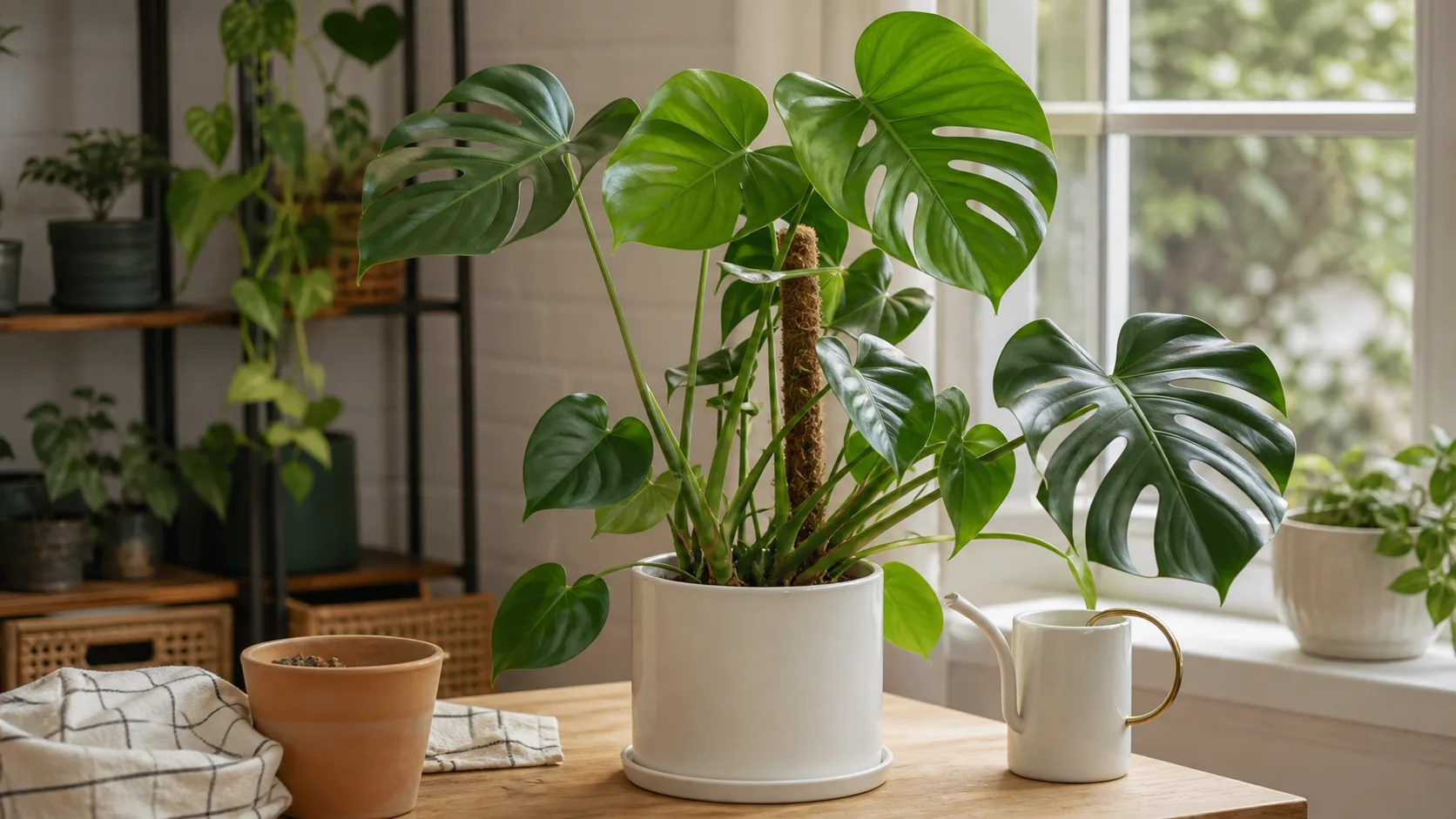
Track the next few leaves in steady conditions before changing another care variable.
Freshness note: Reviewed against those sources on 2026-05-18. If your plant recently moved, was repotted, or is growing in unusually low light, expect the next few leaves to tell you more than the current ones.
Sources: Penn State Extension (juvenile vs. mature leaf development); Missouri Botanical Garden Plant Finder (juvenile and mature leaf descriptions, climbing support); NC State Extension Gardener Plant Toolbox (light, humidity, and fertilizer preferences); UF/IFAS (vine growth habit and aerial root behavior); ASPCA Poison Control (toxicity to cats and dogs). Research conducted May 2026.
Fenestration is a slow reward, but it does come. The plants that develop the best leaf structure are the ones given consistent light, something to climb, and the time to grow into themselves. The solid green ovals your monstera is making right now are exactly what it’s supposed to be doing - for now. When better leaves do come, they’ll show up in the new growth, not the old.