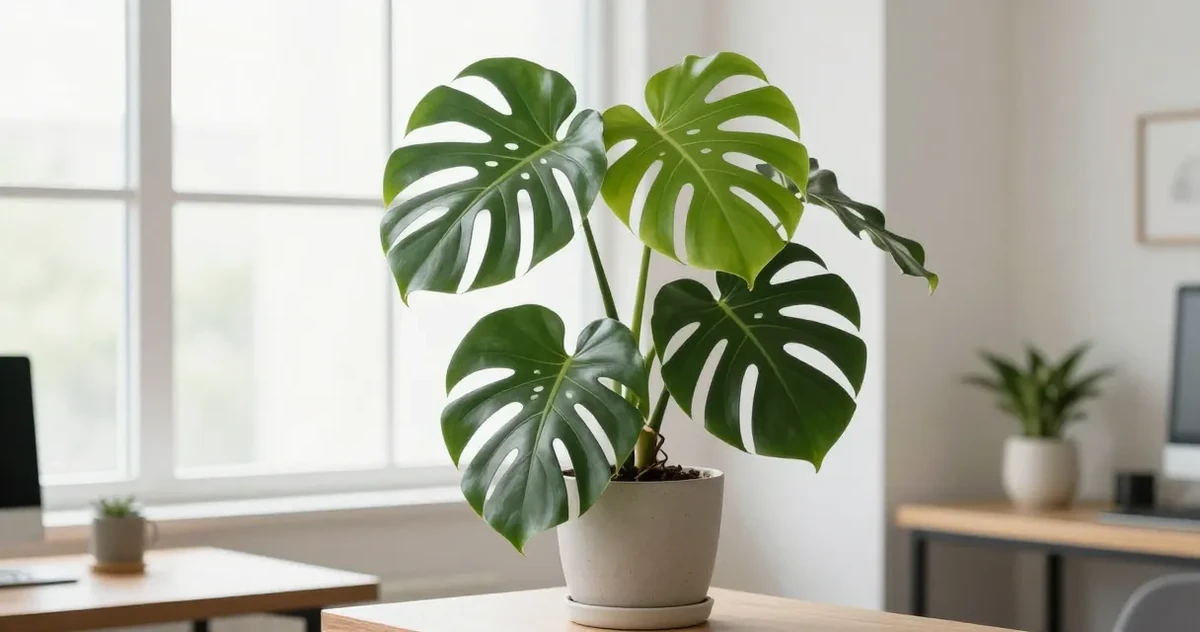
You decide your monstera needs a trim. You get the scissors. You stand there. And then the plant just looks back at you, and you realize you have no idea which stem to cut, let alone where on that stem the cut should go.
That specific moment of freezing is what this guide is for. And if you have already made a cut and now have a stem sitting in a glass of water doing nothing for the past two months, this guide explains why that happens – and what a viable cutting actually needs before you clip anything else.
Pruning monstera correctly comes down to one thing most care articles skip entirely: your goal changes where you cut. The word “pruning” covers four different operations, and each one calls for a different cut in a different location. Using the propagation cut method for a simple shape trim leaves behind a stem with fewer nodes than it needs. Using the leaf-removal cut when you meant to propagate leaves you with a glass of stems that will never root regardless of how long you wait.
Identification Snapshot
| Field | What to check before you cut |
|---|---|
| Plant this guide fits | Standard indoor Monstera deliciosa or a similar large-form monstera grown for climbing growth and cuttings. |
| Growth habit | A climbing aroid vine. New growth emerges from nodes on the main stem, not from the petiole of a removed leaf. |
| Node clue | A slightly swollen joint on the main vine where a leaf, aerial root, or growth point emerges. |
| Aerial roots | Thick brown nubs or roots along the stem often mark the most obvious propagation points. |
| Mature leaf clue | Older leaves get larger and more split. Juvenile leaves stay simpler, so use the stem and node structure, not leaf drama alone, to decide where to cut. |
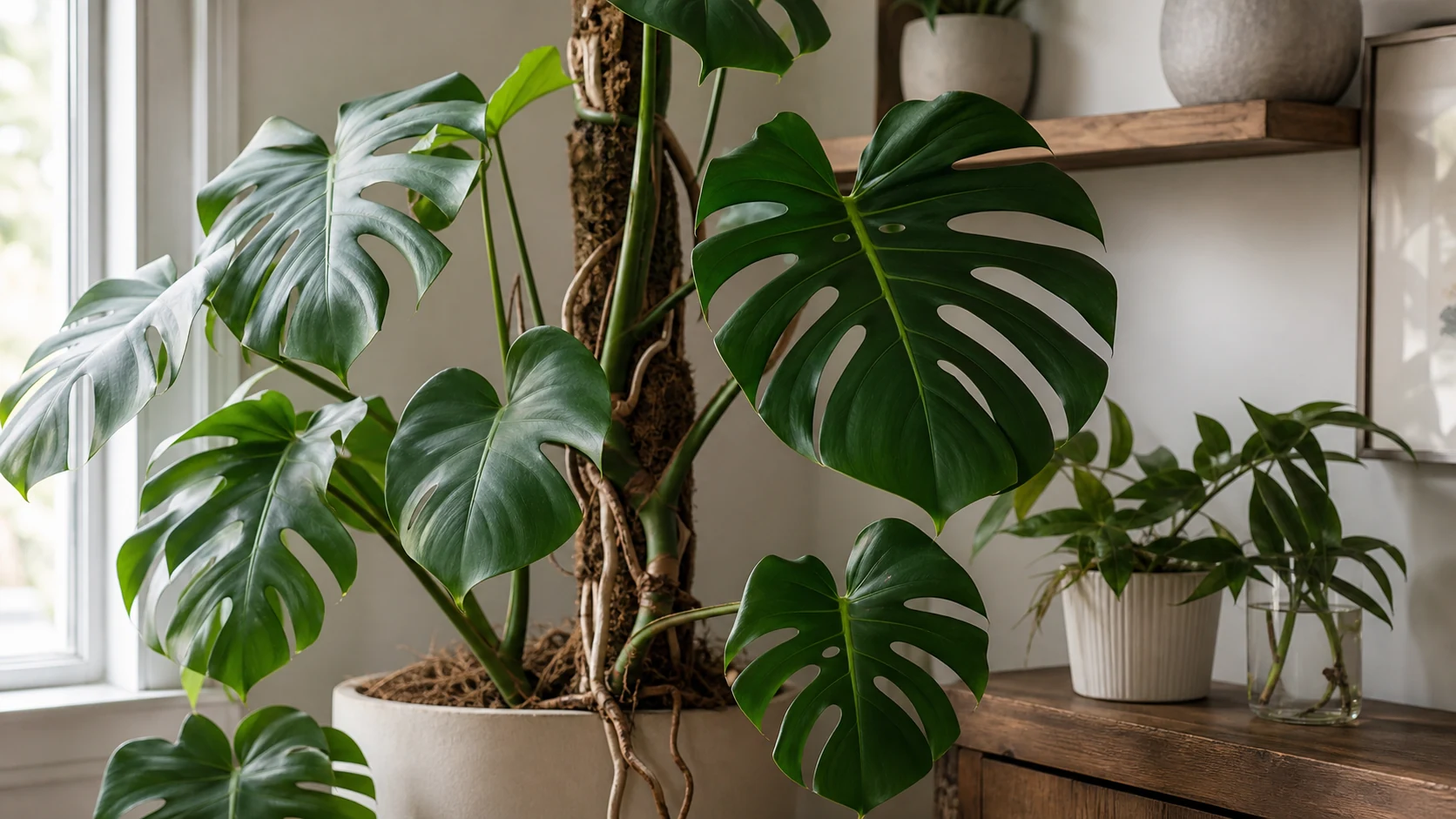
A mature climbing Monstera deliciosa shows the fenestrated leaves, stem joints, and aerial roots to identify before cutting.
Lookalikes and Confused-With Plants
This pruning guide assumes the common indoor Monstera deliciosa. If your plant was sold under a loose label like “Swiss cheese plant,” confirm what you have before copying the cut plan exactly.
| Plant | Why people mix it up with monstera | What matters before you copy this pruning advice |
|---|---|---|
| Monstera adansonii | Also gets sold as Swiss cheese plant because the leaves develop holes. | The same node rule still applies, but the vines are thinner and the cut points are tighter and easier to misread. |
| Monstera Thai Constellation | Same broad monstera look, so owners expect the same recovery speed after pruning. | The node logic is the same, but slower growth means post-pruning recovery and new leaves usually take longer. |
| Split-leaf philodendron | Garden centers still use the name loosely for large split tropical leaves. | Growth habit and stem structure differ enough that you should confirm the label before assuming the same pruning response. |
What Most Care Guides Miss: One Plant, Four Different Jobs
Most monstera pruning guides describe every cut the same way – a maintenance trim gets the same instruction as a propagation cut, and readers walk away confused when the cutting fails or the plant looks worse after shaping. The deeper problem is that standard guides tell you where to cut but skip what the remaining plant actually does afterward. That is the gap this article closes.
The misdiagnosis is treating pruning as a single task when it is four, each requiring a different cut location and producing a different response from the plant.
| Goal | Where you cut | What the remaining plant does |
|---|---|---|
| Remove a damaged or dead leaf | Petiole, close to main vine | Scar heals; no structural change |
| Shorten a long vine | Below a node on the main stem | Nodes immediately below the cut activate; new leaves emerge from those lower points over the following weeks |
| Take a propagation cutting | Below a node (cutting includes the node) | Same activation effect below the cut on the remaining plant |
| Fix legginess | Fix light first, then prune | Cutting without improving light produces new growth that is just as leggy |
What this changes about how you prune: new leaves do not regrow from the cut tip. They emerge from nodes that remain on the stem, typically the ones immediately below where you cut. If your remaining stem has very few nodes left after a major cut, new growth will be slow or may emerge from a completely different part of the plant. This is why how aggressively you cut, and how many nodes you leave behind, matters – and why that decision should come before the scissors do.
The practical first check: decide which of these four jobs you are doing. That answer – not the plant’s overall shape – tells you exactly where the cut goes.
What goes wrong when the goal and cut location don’t match
This is where most failed pruning attempts start. The specific failure modes are worth naming because they are not obvious until after the fact:
- Leaf-only cut when propagating: You cut a beautiful stem with a large leaf, put it in water, and wait. Nothing roots. Three months pass. Still nothing. The stem eventually softens and you tip it out. The reason: a leaf attached to a petiole with no node has no meristematic tissue – no cells capable of producing roots. It can stay alive in water for a surprisingly long time without ever rooting.
- Aggressive shaping cut on a stem with few nodes: You shorten a long vine by half, leaving behind a short stem with only one node. The remaining plant looks fine, but new growth is very slow or doesn’t appear for an entire growing season. The cut activated the nodes, but if there is only one node remaining and it’s slow to push, the plant’s visible response is minimal.
- Pruning a leggy plant without fixing light: You cut the long, weak stems back. New growth comes in. It looks equally leggy within a month or two because the cause – insufficient light – was never addressed. The plant is doing exactly what it was doing before, just from a shorter starting point.
Recognizing which of these failure modes matches your situation is the diagnostic step that most pruning guides omit.
Social Listening: The Questions Owners Keep Asking
Across monstera troubleshooting threads, three questions come up again and again right before someone makes a cut they regret:
- Does this cutting actually have a node? Many owners are holding a healthy-looking leaf and petiole, but not a viable propagation piece.
- Why is my big top cutting still doing nothing? Large cuttings without aerial roots or warm, bright conditions test people’s patience fast.
- Will pruning fix a stretched plant on its own? Usually not. Legginess is often a light and support problem first, then a pruning problem second.
That pattern is why this guide keeps returning to node location, realistic rooting timelines, and the “fix light before cutting harder” rule.
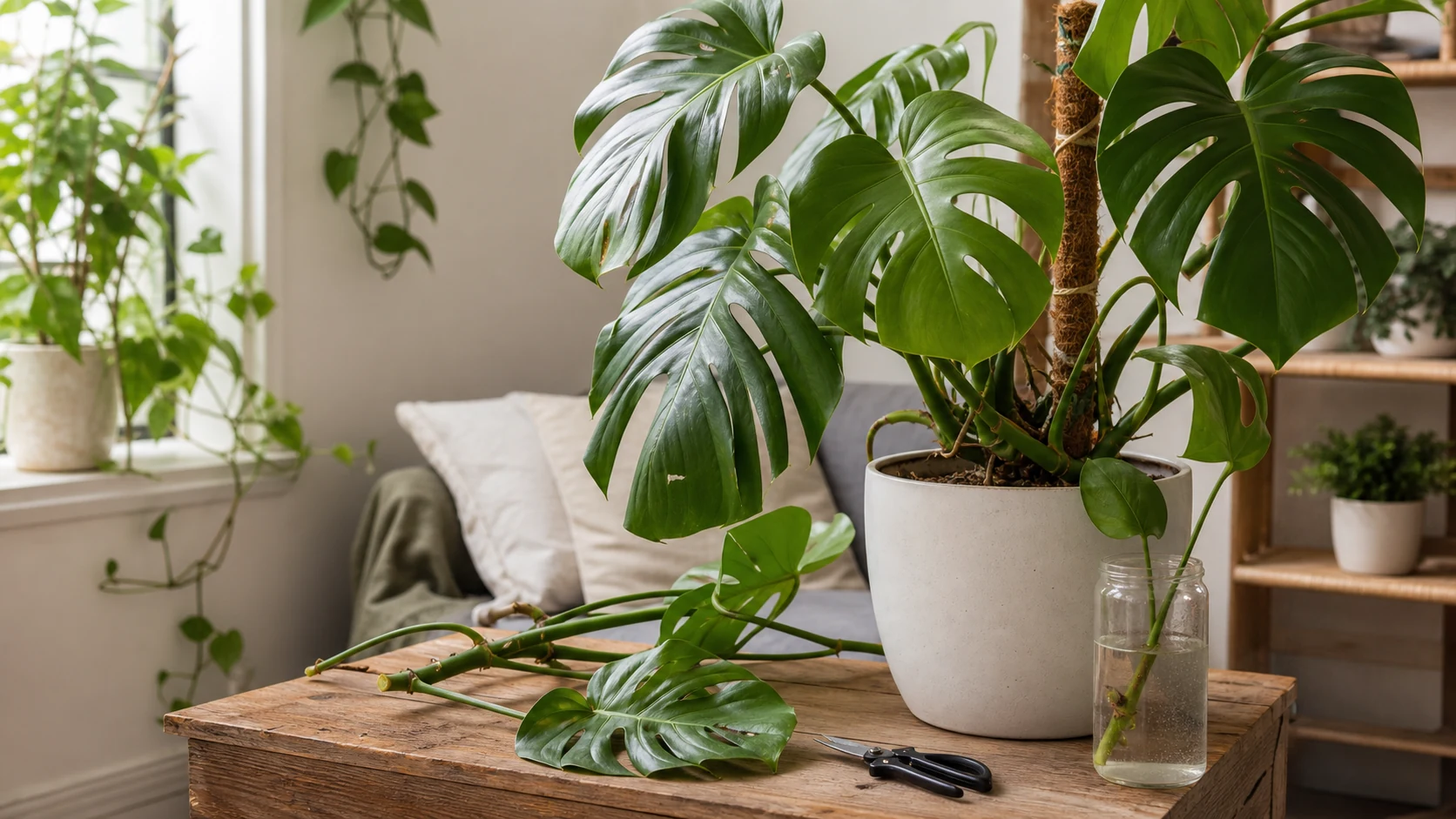
Cut stems, visible nodes, a water-rooting jar, and a leggy mother plant bring the most common pruning questions into one practical scene.
Care Cards
| Care card | What matters before and after pruning | What owners get wrong most often |
|---|---|---|
| Timing | Shape and propagation cuts recover fastest when the plant is actively growing. | Treating a winter cut, a spring cut, and an emergency cleanup cut like they all behave the same way. |
| Light | Bright indirect light helps both the mother plant and the cutting recover. | Trying to fix a leggy monstera with scissors while leaving it in the same dim corner. |
| Cutting choice | Any piece meant for propagation needs at least one clear node. | Rooting a leaf and petiole with no node because it looks like a complete cutting. |
| Aftercare | Keep watering steady, support the vine, and change only one variable at a time. | Fertilizing immediately or moving the plant to harsh sun right after a major cut. |
| Pet risk | Fresh trimmings should stay out of reach because monstera is toxic if chewed. | Leaving cut stems or water jars where pets can mouth them. |
When to Prune Your Monstera
Monstera can be pruned at any time of year, but spring and early summer give both the mother plant and any cuttings the best chance of recovering quickly. Ask Extension confirms that active growth in spring or summer is generally the better window for shaping cuts, and that cuts work best when made at a node or near a leaf bud.
That said, if a leaf is damaged, yellowing from the base up, or a stem has died back, do not wait for spring. Remove it now. If you are not sure whether that yellowing is just an old leaf aging out or part of a larger care problem, the monstera yellow leaves guide helps you check the pattern before cutting. Holding onto dead or dying material does not help the plant, and it creates conditions for fungal problems to take hold.
Prune for health whenever the problem appears. Prune for shape and propagation when the plant is actively growing.
Where to Cut: Match the Goal to the Location
Your cut location depends on why you are pruning, not on what looks tidy from across the room.
Goal 1: Remove a damaged or yellowing leaf
Cut the petiole – the long stem connecting the leaf to the main vine – as close to the main stem as you comfortably can without nicking it. You are not propagating anything here, so the node does not matter. The scar heals, nothing structural changes, and the plant moves on.
Goal 2: Shorten a long vine
Cut just below a node on the main vine. The node is the bump or joint on the stem where a leaf attaches and where new growth emerges. Cutting here signals to the plant to push new growth from the nodes remaining on the stem below your cut. If you want to keep the removed section as a cutting, it can double as a propagation attempt as long as it includes a node.
One thing worth doing before you cut: count the nodes remaining on the stem after your planned cut. If only one or two will be left behind, think about whether you need to cut quite that far back. Leaving three or more nodes on the remaining stem gives the plant more options for where to push new growth.
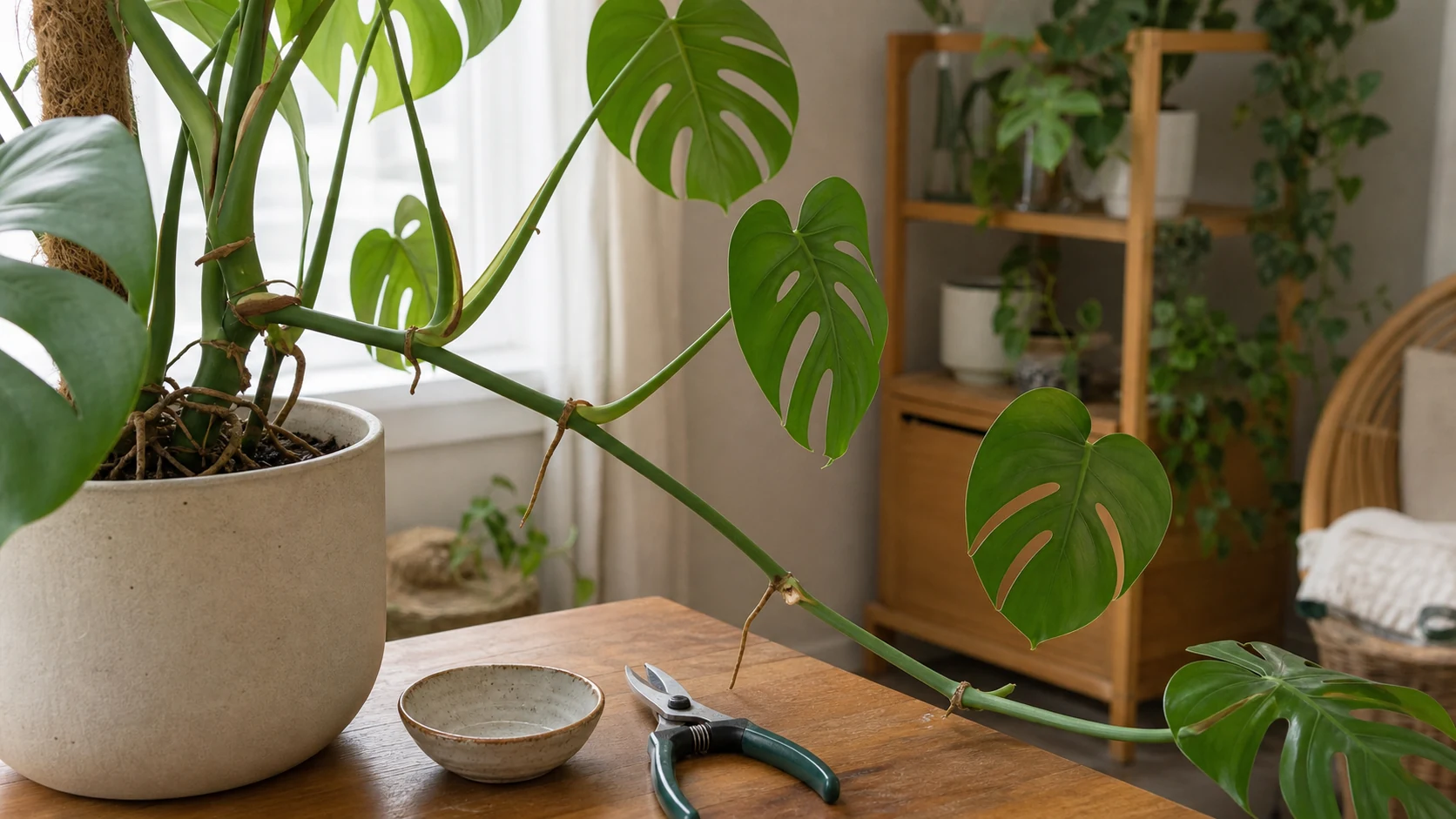
A long Monstera vine exposes several nodes and aerial-root nubs so the shortening cut can preserve multiple regrowth points.
Goal 3: Take a propagation cutting
Cut below a node so the cutting itself includes at least one node and ideally one or two leaves. According to the University of Minnesota Extension, a leaf without a node attached to stem tissue will not root into a new plant, no matter how long it sits in water. This is the single most common propagation mistake. Find the node first, then decide where to cut relative to it – not the other way around.
Goal 4: Fix a leggy plant
If your monstera has long gaps between leaves, small foliage, or very little fenestration, the problem is almost always light rather than overgrowth. Penn State Extension notes that low light makes monstera leggy, and cutting more stems without improving the light will not solve it. The new growth will come in leggy too. If missing holes are the main concern, use the Monstera fenestration guide before removing healthy growth.
One diagnostic check: compare your monstera’s newest leaves to the older ones. If the newer growth is noticeably smaller and less fenestrated than leaves that formed in better conditions, that is light deficiency driving the legginess, not the plant’s natural size. Fix the light first – move the plant to a brighter spot or consider adding a grow light – then prune for shape once the plant is putting out vigorous new leaves.
How to Find a Node
This is where most propagation attempts fail before the scissors even come out. A plant owner takes what looks like a healthy piece of stem, puts it in water, and waits weeks or months for something to happen. Nothing does. Usually the cutting had no node – and the frustrating part is that it looked right. A piece of stem with a large, beautiful leaf attached can look exactly like a viable cutting to someone who hasn’t yet learned where the node sits.
A node looks like a slightly swollen ridge or bump where the petiole meets the main vine. The texture is subtly different from the smooth stretches of stem between leaves. To find one, run your thumb slowly along the main vine starting from where a leaf attaches and moving toward the plant’s base. You will feel a slight swell or raised ring before the vine smooths out again – that ridge is the node. On a mature monstera, you may also see small brown nubs beginning to form at or near the same point. These are aerial roots emerging, and they are a reliable landmark when you are scanning a long stem.
According to UF/IFAS, monstera develops numerous aerial roots along the stem as part of its natural climbing habit. Finding one of these nubs means you have found the right section of stem to work with.
If you are not certain you have found a node, look and feel for:
- The scar or ridge where a leaf base meets the main vine
- Any small, brown, nub-like structure emerging from the stem at that point
- A slightly thicker band of tissue compared to the smoother stretches between leaves
The node versus no-node test: press your thumbnail gently into the stem at the point you think is the node, then compare it to a smooth section of stem between two leaves. There should be a noticeable difference in firmness and tissue density at the node. If both sections feel identical and look identical, you may be at a petiole junction rather than a true node. The node is on the main vine, not on the petiole itself.
No node, no new plant. A piece of stem with only a leaf and petiole attached has no meristematic tissue to produce roots. Keep it in water for months and nothing will happen – not slowly rooting, not stalling, just nothing until the cut end softens. Find the node first, then cut.
Expert Note: Node First, Leaf Second
The extension sources behind this guide line up on the same practical point: node presence is the real dividing line between a viable cutting and decorative stem. University of Minnesota Extension anchors propagation success to the node, UF/IFAS reinforces that aerial roots help but do not replace node tissue, and Penn State’s indoor-care guidance explains why weak light creates the leggy growth people often try to prune away. In other words, leaf size is not the deciding factor. A small cutting with one healthy node usually has a better future than a dramatic top cutting taken for looks alone.
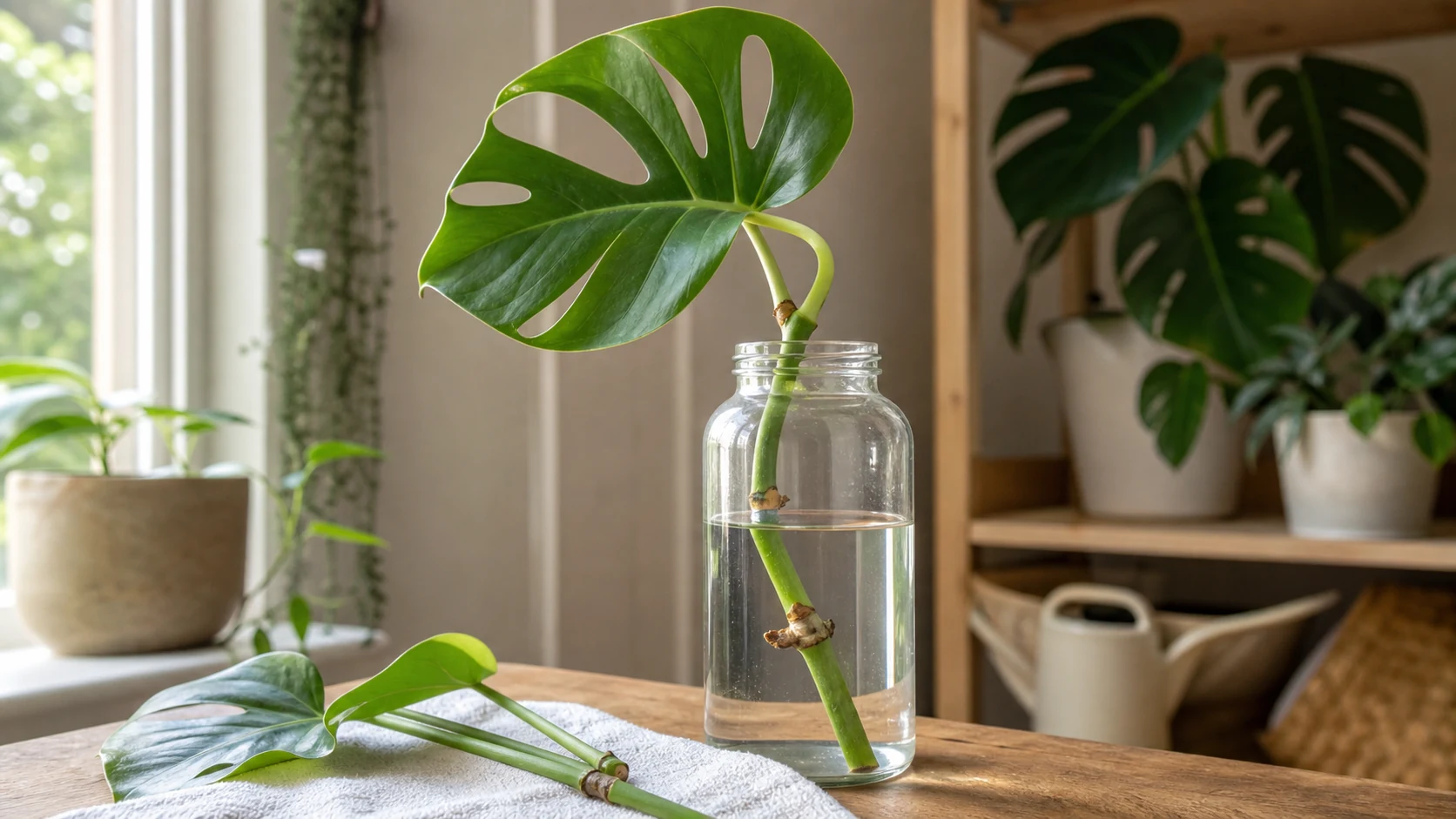
A modest Monstera cutting succeeds on structure, with node tissue and an aerial-root nub placed below the waterline.
The Top-Cutting Question: Aerial Roots and Realistic Expectations
A specific scenario worth naming directly: you cut a large section from the top of the plant – a stem tip with multiple mature leaves, no aerial roots, and a clean node – and it sits in water for eight weeks producing no visible roots. This is one of the more frustrating propagation experiences with monstera, and the research behind it is worth understanding.
Aerial roots, when present on a cutting, give it a head start. They begin taking up moisture quickly while the cutting works on generating root tissue from the node. A cutting without an aerial root has to do all of that root generation from scratch, which takes longer. According to UF/IFAS, monstera is most commonly propagated by stem cuttings, and a cutting with a node will root whether or not an aerial root is already present – but the timeline is genuinely different.
A large top cutting with mature leaves and no aerial root has an additional variable: it is supporting a substantial amount of leaf tissue that loses water while root generation is happening. The cutting is doing two things at once – generating roots and maintaining the existing leaves – and this takes longer than rooting a smaller cutting with fewer leaves.
Practical adjustments if you are rooting a large cutting:
- If a leaf yellows and drops during rooting, that is not failure – it is the cutting reducing the leaf load it has to support while it focuses on roots
- Placing a loose plastic bag over the cutting reduces water loss from the leaves, which can meaningfully speed up rooting when no aerial roots are present
- Bright indirect light, consistent warmth (above 18°C / 65°F), and weekly water changes are not optional details – they are the conditions under which root tissue actually generates
- If rooting in water, the node must be submerged; a node sitting at the waterline or just above it will not root reliably
The University of Minnesota Extension notes that a rooted monstera node can take up to 2 to 3 months before forming its first new leaf. For a large top cutting, total timeline from cut to visible new growth is often 4 to 6 months. This is not a sign that anything has gone wrong.
Pre-Cut Checklist
Before making any cut, run through this quickly:
- Do I know which of the four pruning goals I am working toward?
- Have I located the node on the stem I am about to cut?
- Does my intended cutting include at least one node, not just a leaf and petiole?
- Are my scissors or shears clean? (Wipe with rubbing alcohol before you start.)
- Am I wearing gloves, or prepared to wash my hands after handling cut stems?
- Is the cutting long enough that the node will sit submerged in the rooting vessel while the leaf stays above water?
- Does the remaining stem after my cut still have at least two or three nodes on it?
If you are removing a damaged leaf rather than propagating, skip the node checks. For everything else, all boxes should be ticked before the cut.
How to Make the Cut
Use clean, sharp scissors or pruning shears. Wiping the blades with rubbing alcohol before you start prevents transferring bacteria or fungal spores between stems. It takes thirty seconds.
Before you begin: monstera sap contains calcium oxalate crystals, which can cause skin irritation in some people. Penn State Extension recommends wearing gloves because of possible contact dermatitis. Wash your hands after handling cut stems regardless.
Monstera is also toxic to cats and dogs. According to ASPCA Poison Control, the insoluble calcium oxalates in monstera cause oral irritation, drooling, vomiting, and difficulty swallowing in pets. Keep trimmed material out of reach. If you are sorting through which plants are safe around animals, the cat-safe indoor plants guide covers the main options.
What To Do With the Cutting
A monstera cutting with a node and at least one leaf can be rooted in water or directly in moist potting mix. Water rooting lets you watch for root development so you can see when roots are long enough to transplant – typically 3 to 5 centimetres. Soil rooting tends to produce roots that adapt more easily to growing conditions long-term, but either approach works for a healthy cutting.
Place the cutting in bright indirect light. Direct sun on an unrooted cutting adds stress it does not need. Change the water every week or so to keep it clear and prevent bacterial build-up.
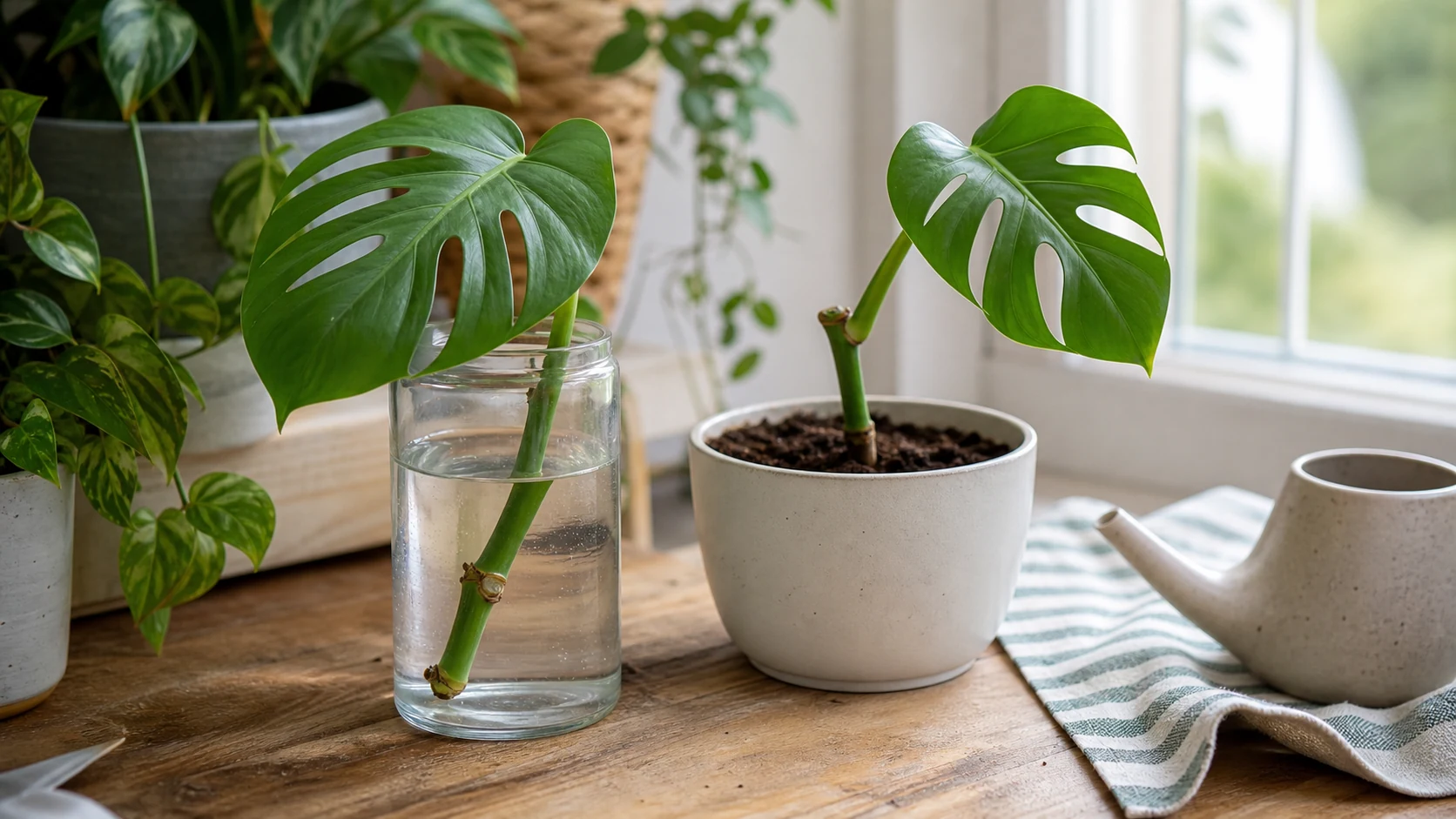
Healthy Monstera cuttings can start with the node in clear water or set directly into moist potting mix.
Aftercare: The Plant You Pruned and the Cutting You Took
What you do after the cut depends on which side of the scissors you are focused on.
| Mother plant | The cutting | |
|---|---|---|
| Light | Keep in its usual spot, bright indirect light | Bright indirect light, no direct sun |
| Watering | Continue normal schedule | Keep rooting medium consistently moist; change water weekly if water-rooting |
| Feeding | Hold off fertiliser for 3 to 4 weeks | No fertiliser until roots are well established |
| Support | Check that moss pole or trellis is still secure | Support the leaf with a small stake if propagating in soil |
| New growth timeline | Nodes below the cut activate first; timing varies by season and light | First new leaf can take 2 to 3 months after roots form |
| Humidity | Standard indoor humidity is fine | A loose plastic bag over the cutting slows water loss and can speed rooting |
The plant you pruned from will push new growth from nodes below or near your cut – not from the cut tip itself. If the remaining stem had very few nodes after a major cut, new growth may be slow or may emerge from a different part of the plant entirely. Give it a full growing season before worrying.
One thing the remaining plant will sometimes do after a significant cut: the cut tip may dry back slightly over a few weeks, the dried section darkening and pulling away from the healthy stem below it. This is normal healing, not rot or disease spreading. As long as the tissue below the dried section remains firm and green, the plant is fine.
Common Problems After Pruning
| Problem | Check first | What to do next |
|---|---|---|
| A cutting has been in water for weeks with no roots | Confirm that the cutting includes a true node and that the node is actually staying in contact with water. | If there is no node, start over. If the node is firm, keep it warm, bright, and patient rather than recutting repeatedly. |
| The cut end turned dark and mushy | Smell the water or inspect the tissue at the node. | Trim back to firm tissue with clean blades, refresh the water or medium, and remove any submerged leaf material. |
| The mother plant is not pushing new growth | Count how many nodes remain below the cut and look at the season and light. | Leave the plant alone, improve light if needed, and give it a full active-growth window before assuming the cut failed. |
| New growth is still stretched and sparse | Recheck light levels and whether the vine has support. | Move the plant brighter or add a pole first. More pruning without better conditions usually repeats the same problem. |
A Note on Size and Support
Monstera deliciosa is a fast-growing vine that can get genuinely large indoors. If your plant is outgrowing the room, pruning is a practical and reasonable response. The plant will not mind a significant cut.
What it does need after: hold back on fertiliser for a few weeks while it recovers, keep watering consistent, and give it a sturdy support like a moss pole or trellis to encourage upward growth rather than sideways sprawl.
For the full care picture – light, water, humidity, soil, and repotting – the monstera deliciosa care guide covers everything in one place. If you want to go deeper on propagating from cuttings more generally, the how to propagate plants guide walks through rooting methods for a range of common houseplants.
For another practical pet-safety check, see Is Monstera Toxic to Cats? Symptoms, Risk, and Safer Placement for the risk level and the next steps.
Real User FAQ
“I already cut a big top section and it has no aerial roots. Did I ruin it?”
Not necessarily. Aerial roots help, but they are not the deciding factor. The real question is whether the cutting includes a healthy node and whether you are giving it bright indirect light, warmth, and time. Large top cuttings often root more slowly because they are supporting a lot of leaf mass while trying to make roots from scratch.
“Can I prune one long vine hard and leave the rest of the plant alone?”
Yes. That is often the cleanest way to reshape a plant without stripping too much energy away at once. Just count the nodes you are leaving behind on that vine, because the regrowth options come from those remaining nodes, not from the cut tip.
“My cutting has a leaf and stem, but I still cannot tell if there is a node. What should I look for?”
Look on the main vine, not the petiole. You want the slightly swollen joint where the leaf attaches and where an aerial root or future growth point can emerge. If the piece is only leaf plus petiole, it can stay green for a while in water but it will not become a new plant.
Frequently Asked Questions
When is the best time to prune a monstera?
Spring and early summer are the best windows for shaping and propagation cuts. Ask Extension confirms that shaping cuts are best made during active growth, at a node or near a leaf bud. For removing damaged or dead material, prune whenever the problem appears. There is no reason to hold onto a rotting stem until spring.
Can I prune monstera in winter?
Yes, but results will be slower. The plant is growing less vigorously in winter, so new growth from nodes below the cut will take longer to appear and cuttings will root more slowly. Removing damaged or dead material can happen any time of year. For shaping or propagation, waiting until spring gives better outcomes with less waiting.
Why is my monstera cutting not rooting?
The most common reason is a missing node. A piece of stem with only a leaf and petiole has no meristematic tissue to produce roots. Check that your cutting includes at least one node – the swollen ridge where the leaf base meets the main vine. If the node is present but rooting is very slow, check that the water is being changed regularly, the cutting is in bright indirect light, and the temperature is above 18°C (65°F). Cooler temperatures significantly slow rooting, and a cutting sitting in still, stale water is more likely to rot than root.
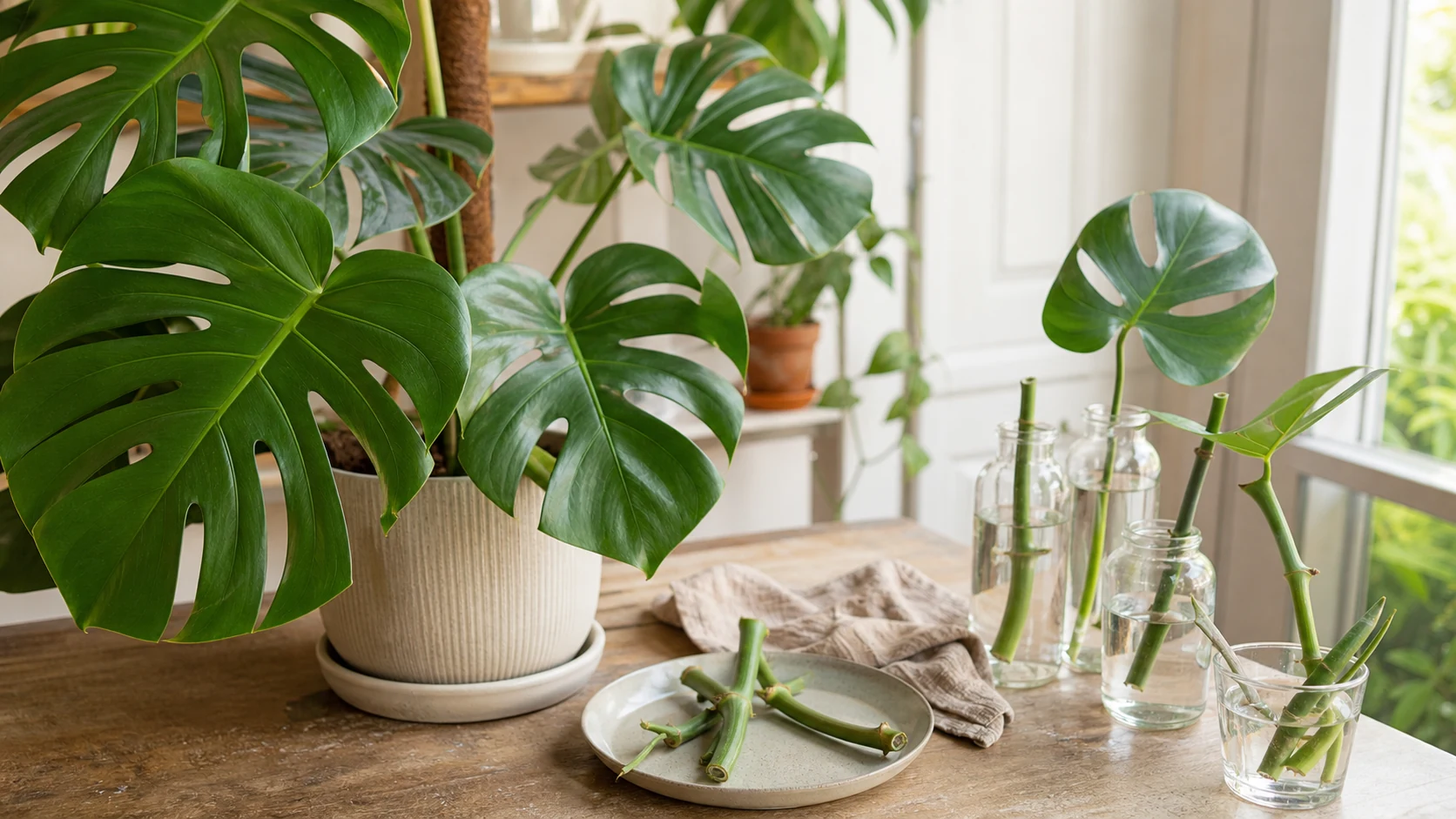
Comparing node-bearing Monstera stem sections with water-started cuttings helps explain why some pieces root and others stall.
My cutting has been in water for two months and nothing is happening. Should I throw it out?
Not necessarily – check the node end first. If the cut end is soft, brown, and mushy, the cutting has rotted rather than rooted. Trim back to firm green tissue and restart if there is still a node present. If the cut end is still firm and the water is clear, the cutting may simply be slow. Large cuttings with no aerial roots and several mature leaves are the slowest to root because they are maintaining significant leaf mass at the same time as generating root tissue. Three months of waiting is not unusual for a large top cutting in cool conditions.
How long does a monstera cutting take to root?
Water rooting typically produces roots long enough to transplant in 3 to 6 weeks for a typical cutting with a node and one or two leaves. After roots are established, the University of Minnesota Extension notes that the first new leaf can take an additional 2 to 3 months to appear. Large top cuttings with no aerial roots commonly take 6 weeks or more just to produce visible root tissue. Total timeline from cutting to a visibly growing plant is commonly 3 to 5 months, sometimes longer. This is normal.
Where exactly does new growth come from after I prune?
New leaves emerge from nodes on the remaining stem, not from the cut site itself. The nodes immediately below your cut are the most likely to activate first. If you cut a vine down significantly and only one or two nodes remain on the plant, new growth will be slower and may emerge from a different part of the plant entirely. Leaving at least two or three nodes on any remaining stem is worth doing when you have the choice.
Will pruning make my monstera bushier?
Pruning can encourage new growth from lower nodes, which makes the plant look fuller over time. But the new growth comes from existing nodes on the remaining stem – not from the cut tip and not from nowhere. If the remaining stem has only one or two nodes left, the response will be limited. And if the plant is leggy because of insufficient light, cutting alone will not fix it. Moving the plant to a brighter spot or adding a grow light produces noticeably better leaf size and fenestration before long.
Is monstera sap dangerous to touch?
For most people, brief contact is not serious, but monstera sap contains calcium oxalate crystals that can cause skin irritation or a mild rash in sensitive individuals. Penn State Extension recommends wearing gloves when pruning. Wash your hands after handling cut stems. The sap is significantly more problematic for cats and dogs – ASPCA Poison Control lists monstera as toxic to both, with symptoms including oral irritation, excessive drooling, and vomiting.
Can I cut off aerial roots?
You can trim aerial roots if they are getting in the way, but they are worth keeping when possible. Aerial roots help monstera anchor to support and can take up moisture. Indoors, they can be tucked onto a moss pole or left to trail. Removing them does not harm the plant, but there is no practical benefit to cutting them unless they are causing an actual problem. If you are propagating and the cutting has an aerial root attached, keep it – it will accelerate rooting.
What do I do with leaf and stem trimmings?
Stems with nodes can be propagated. Stems without nodes, and cut petioles, should go in the bin rather than the compost if you have pets, given the calcium oxalate content. Leaves from a healthy plant can go into a regular compost bin if you are confident they are pest- and disease-free.
Methodology Note
This guide was checked against University of Minnesota Extension for node and new-leaf timing, Ask Extension for pruning timing, Penn State Extension for light, support, and sap-handling cautions, UF/IFAS for aerial-root and stem-cutting behavior, and ASPCA Poison Control for pet-safety guidance. Community troubleshooting threads were used only to surface the recurring pain points that owners keep reporting, especially node confusion, slow top cuttings, and leggy plants that really need more light.
Freshness Note
Last updated June 2026. The practical cut-location advice, rooting timelines, and pet-safety notes were rechecked against the cited extension and safety sources for this update. If your plant is variegated, mislabeled, or clearly not Monstera deliciosa, confirm the species before you copy the exact cut plan.
Sources: University of Minnesota Extension (propagating monstera deliciosa, node requirements, new leaf timelines), Ask Extension (monstera pruning timing and method), Penn State Extension (monstera as a houseplant, leggy growth causes, contact dermatitis risk), UF/IFAS (monstera propagation by stem cuttings, aerial root development), ASPCA Poison Control (toxicity to cats and dogs). Sources accessed May 2026.