Why Are My Monstera Leaves Turning Yellow? 8 Causes & Fixes
By KnowYourPlant editorial team. Last updated June 17, 2026.
Monstera leaves turning yellow is one of those problems where you know something is wrong but the plant is not being specific about what. A yellow leaf is the plant’s most general complaint. It can mean half a dozen different things depending on where the yellowing shows up, what the soil feels like, and what changed in the last few weeks.
The important thing to understand first: a yellowing monstera leaf is a signal, not a diagnosis. You need to check a few things before changing anything, because the fix for overwatering and the fix for underwatering are exact opposites. Guessing wrong makes it worse.
Here is how to actually work through it, one step at a time.
Freshness note: this guide was updated in June 2026 after rechecking current extension guidance and the most common owner confusion patterns around watering, repotting, and drainage.
Symptom Diagnosis Card
| What you see first | Most likely direction | First check |
|---|---|---|
| One old lower leaf yellowing | Normal aging | Watch the rest of the plant before changing care |
| Several lower leaves yellowing | Overwatering or poor drainage | Check soil depth, pot weight, and trapped runoff |
| Newer leaves turning pale yellow | Root stress, low light, or nutrient issue | Check roots, light, and recent feeding |
| Yellowing started right after repotting | Transplant stress or oversized pot | Check how wet the new mix stays between waterings |
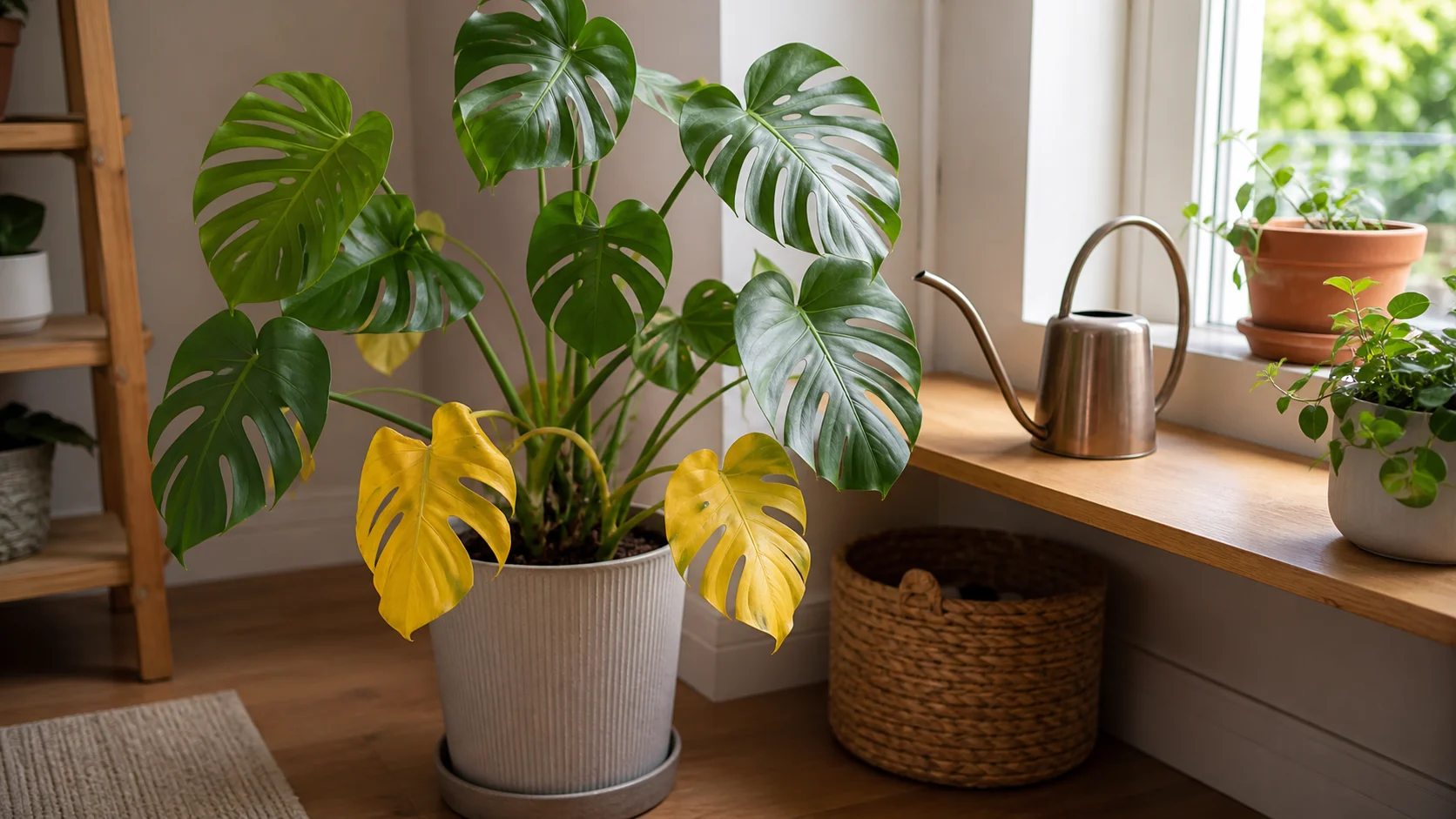
Yellowing on older lower Monstera leaves, paired with a pot and saucer check, helps narrow the likely cause before changing care.
What Most Care Guides Miss
Most articles about monstera yellowing give you a list of eight possible causes and leave you to figure out which one applies. That is where the frustration starts. Yellowing looks similar across several causes until you check the right things in the right order.
The most common misdiagnosis: treating a watering problem when the real issue is the pot setup. A monstera owner can water carefully and consistently while the root ball stays waterlogged inside a decorative cachepot with no drainage, or in a mix that compacts and holds moisture far longer than the container size suggests. The leaves yellow exactly like overwatering. The owner cuts back on water. Nothing improves.
The practical first check: before adjusting your watering schedule, press a finger two inches into the soil. If it is wet or cold after several days without water, the problem is drainage, not frequency. Check whether the pot has working drainage holes, whether anything is sitting in standing water, and whether a recent repot left the plant in a container much larger than its roots can handle.
According to Illinois Extension, excess water must drain freely and saucers must be emptied. A layer of gravel at the bottom of a pot does not improve drainage, it creates a perched water table that keeps roots sitting in moisture longer. That single setup detail can drive months of yellowing that no watering schedule adjustment will fix.
What Owners Keep Getting Stuck On
Current owner questions follow a few repeating patterns:
- Yellowing often starts a fight between “you are overwatering” and “you are underwatering,” even when the owner already changed the schedule once.
- Yellow leaves after repotting are common, especially when a Monstera went into a much larger pot and the new soil volume stayed wet longer than expected.
- Lower leaves yellowing while the plant still pushes new growth confuses people because it can be either normal aging or the first sign of a care issue.
- Moisture meters create false confidence. Owners treat one reading as proof, even when the soil texture, pot weight, and drainage setup point the other way.
That is qualitative signal from public owner discussions, not controlled testing. It is still useful because it shows where people most often misread the plant before they ever change the right variable.
When Each Season Raises the Risk
Yellowing does not happen equally across the year. Knowing when each cause is most likely helps you narrow things down faster.
Spring: As light increases and growth resumes, monsteras can outgrow their pots quickly. Roots running out of room stress the plant. Spring is also when owners shift from infrequent winter watering to more regular sessions and sometimes overcorrect in the first few weeks.
Summer: Generally the most stable season indoors. If the plant sits near a window that gets direct afternoon sun, bleached or scorched patches can develop on the sun-facing side of leaves, easy to miss if you are not checking regularly.
Autumn: Daylight drops faster than most owners expect, and indoor light shrinks with it. If watering frequency does not slow down to match, overwatering symptoms build. Older lower leaves may also begin to shed naturally as the plant moves toward a quieter growth period.
Winter: Lower light, dry heating air, and reduced growth together make this the season when yellow leaves are most common and most misread. The plant needs less water and may shed an older leaf as a normal part of going through a slower period. One lower leaf yellowing gradually in January is usually the plant doing exactly what it should.
Seasonal shifts in window light and watering demand can make a previously stable Monstera start showing pale or yellow leaves.
Start With Leaf Position: This Narrows the Field Immediately
Before anything else, look at which leaves are yellowing.
A single older or lower leaf turning yellow is almost always normal. Penn State Extension notes that Monstera naturally sheds older leaves as it grows. One lower leaf slowly yellowing while the plant pushes healthy new growth at the top is not a problem that needs fixing. If you want the broader baseline for what healthy growth should look like between watering cycles, the Monstera deliciosa care guide gives the full routine. This pattern accounts for a large share of worried questions, the plant is doing exactly what it should.
Multiple leaves yellowing at once, yellowing spreading to newer growth, or overall paleness across the plant is a different situation and worth investigating. If the whole plant looks limp as well as yellow, compare the pattern with our guide to monstera drooping causes and fixes before assuming the issue is only about nutrients or watering.
| Which leaves | Most likely cause |
|---|---|
| Single lowest leaf, plant otherwise healthy | Normal aging, no action needed |
| Several lower leaves yellowing upward | Overwatering or poor drainage |
| New leaves yellowing or pale | Nutrient deficiency, low light, or root rot |
| Yellowing started after a recent repot | Transplant stress or oversized pot |
| Patchy bleached yellow | Direct sun exposure |
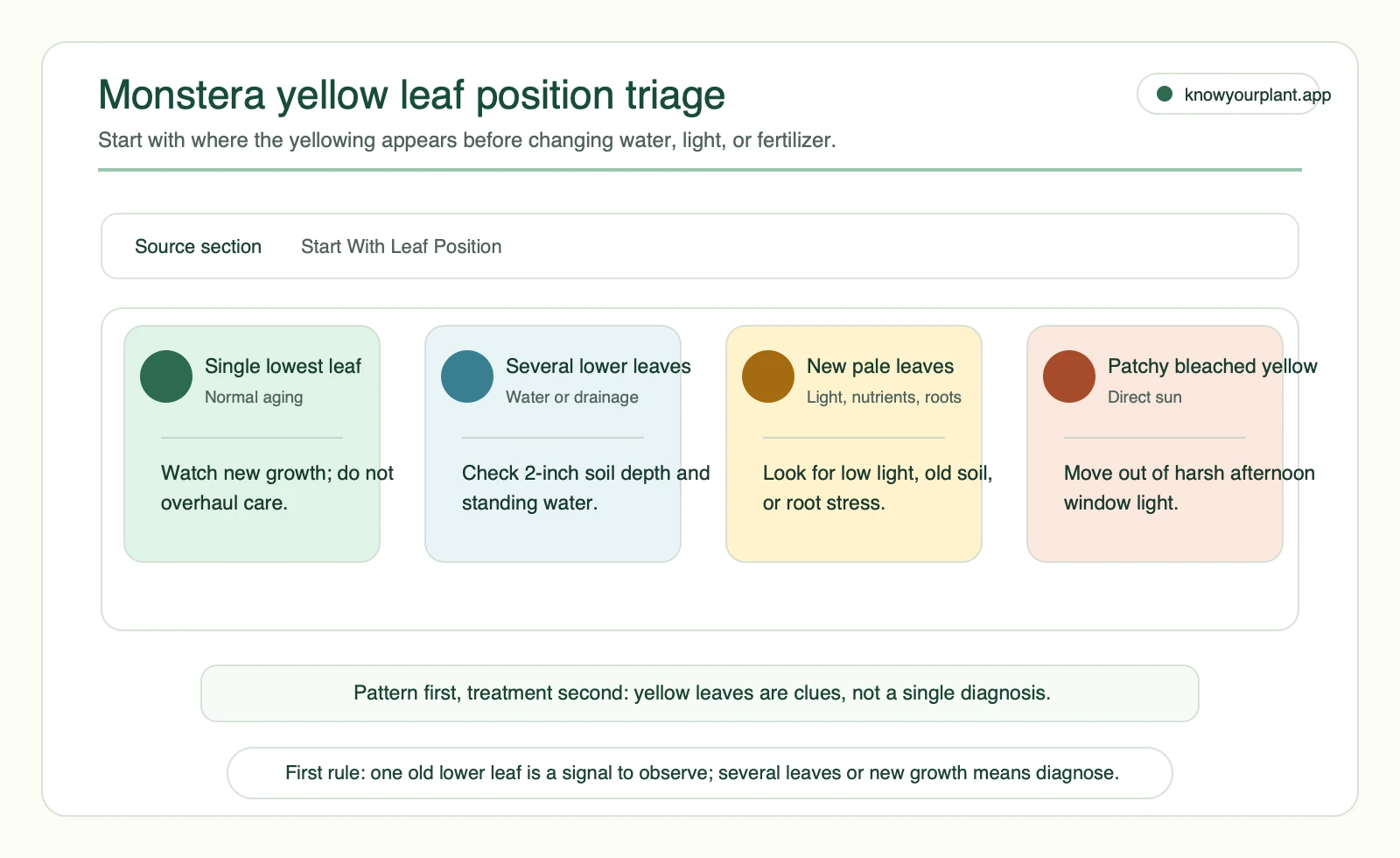
Use leaf position as the first filter: one old lower leaf usually means observe, while multiple leaves or new growth yellowing means diagnose before changing care.
Overwatering vs. Underwatering vs. Normal Aging
These three causes produce yellow leaves that look similar but feel and behave differently when you check carefully.
| Overwatering | Underwatering | Normal aging | |
|---|---|---|---|
| Which leaves | Lower leaves first, spreading up | Any position, often with drooping | Oldest lowest leaf only |
| Leaf texture | Soft, possibly limp or mushy | Dry, may feel papery or crinkly | Normal texture |
| Soil at 2 inches | Wet or cold even after days | Bone dry, often pulling from pot edges | Varies |
| Smell | Sometimes musty near soil | No unusual smell | No unusual smell |
| Recent growth | May slow or stop | New leaves may droop before yellowing | New leaves healthy |
NC State Extension recommends watering thoroughly and then allowing the medium to dry in the top quarter to one-third before watering again. University of Minnesota Extension puts the practical version simply: check whether the top one to two inches of soil are dry before each watering session. A rough weekly schedule works as a reminder, but the soil check is the actual trigger.
If you use a moisture meter, confirm what it says with your finger before acting on the reading. Moisture meters can misread compacted or salt-crusted soil, and this turns out to be a recurring source of confusion in plant care troubleshooting. The finger test is free, immediate, and requires no calibration.
Expert Note: What the Extensions Agree On
NC State, Penn State, and Wisconsin all point in the same direction here: water thoroughly, let the mix dry somewhat before watering again, and do not treat a fixed calendar as the real signal. Illinois Extension adds the practical pot-level warning that trapped runoff and decorative containers can keep roots too wet even when the owner thinks they watered correctly.
That matters because a yellow Monstera leaf is often a root-zone problem before it is a leaf problem.
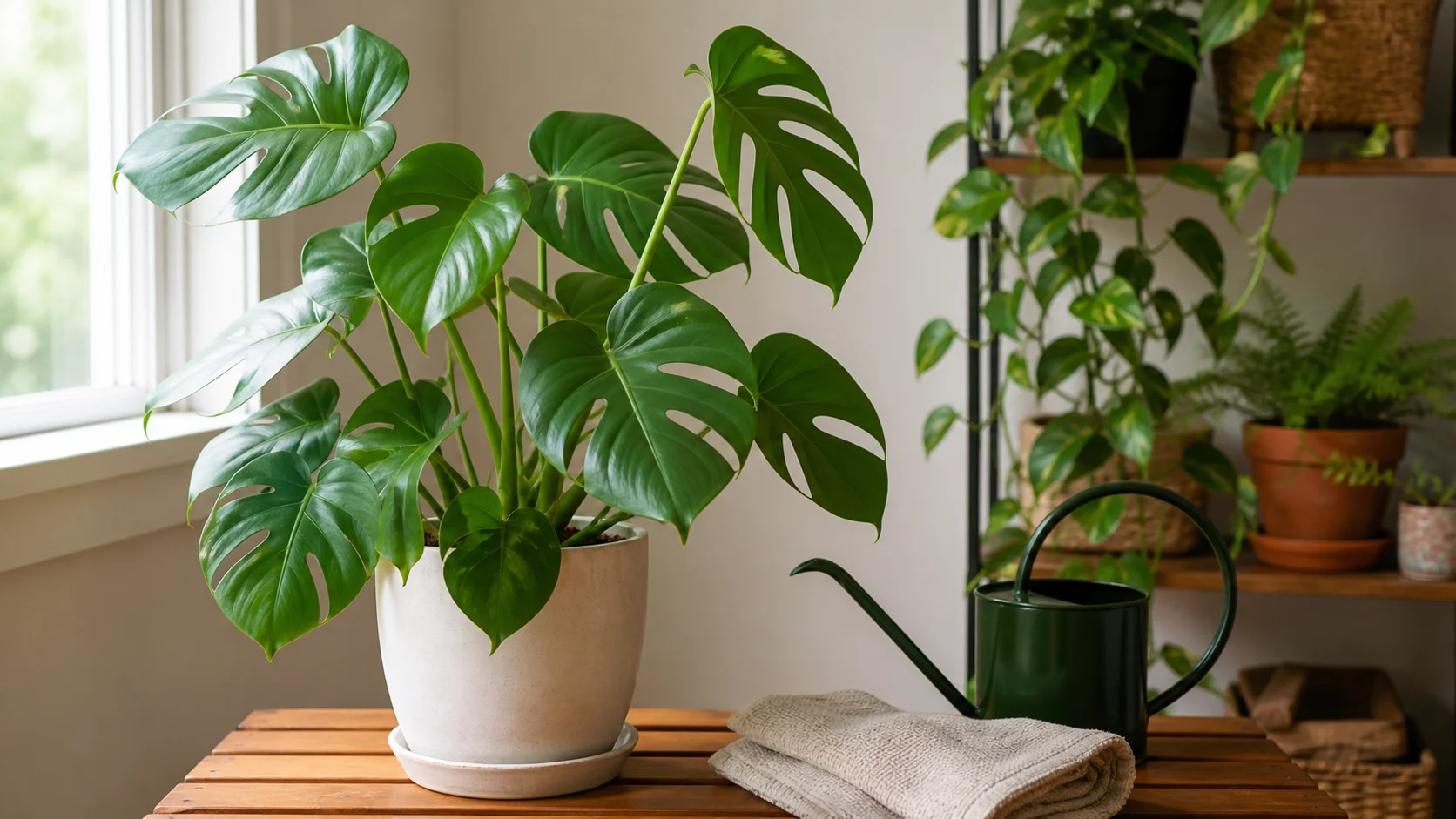
A drainage saucer and a soil check—not a fixed calendar—should determine when this Monstera is watered again.
Check the Whole Pot Setup, Not Just the Schedule
One of the most frustrating patterns in monstera care is adjusting watering, seeing no improvement, and deciding the plant is just sensitive. Often the problem is the container, not the frequency.
Repot and drainage audit:
- Drainage holes. Does the pot have them? Are they clear and not blocked by compacted soil?
- Decorative cachepots. If your monstera sits inside an outer decorative pot, is water pooling at the bottom? A plant can sit in standing water for days without the owner noticing.
- Saucers. Empty them within 30 minutes of watering. A saucer left full means the bottom roots stay wet session after session.
- Pot size after repotting. A monstera moved into a container significantly larger than its old one can struggle because more soil stays wet longer than the roots can absorb.
- Potting mix. Heavy mixes compact over time. If your mix holds water for more than a week after thorough watering, adding perlite improves aeration noticeably.
- Gravel myth. Gravel at the bottom of a pot does not fix drainage and can make the wet zone sit higher around the roots.
Clemson Cooperative Extension notes that visible salt or mineral buildup on the pot rim can signal overfertilization or chronic overwatering, both of which contribute to root stress. Seeing that white crust is worth taking seriously.
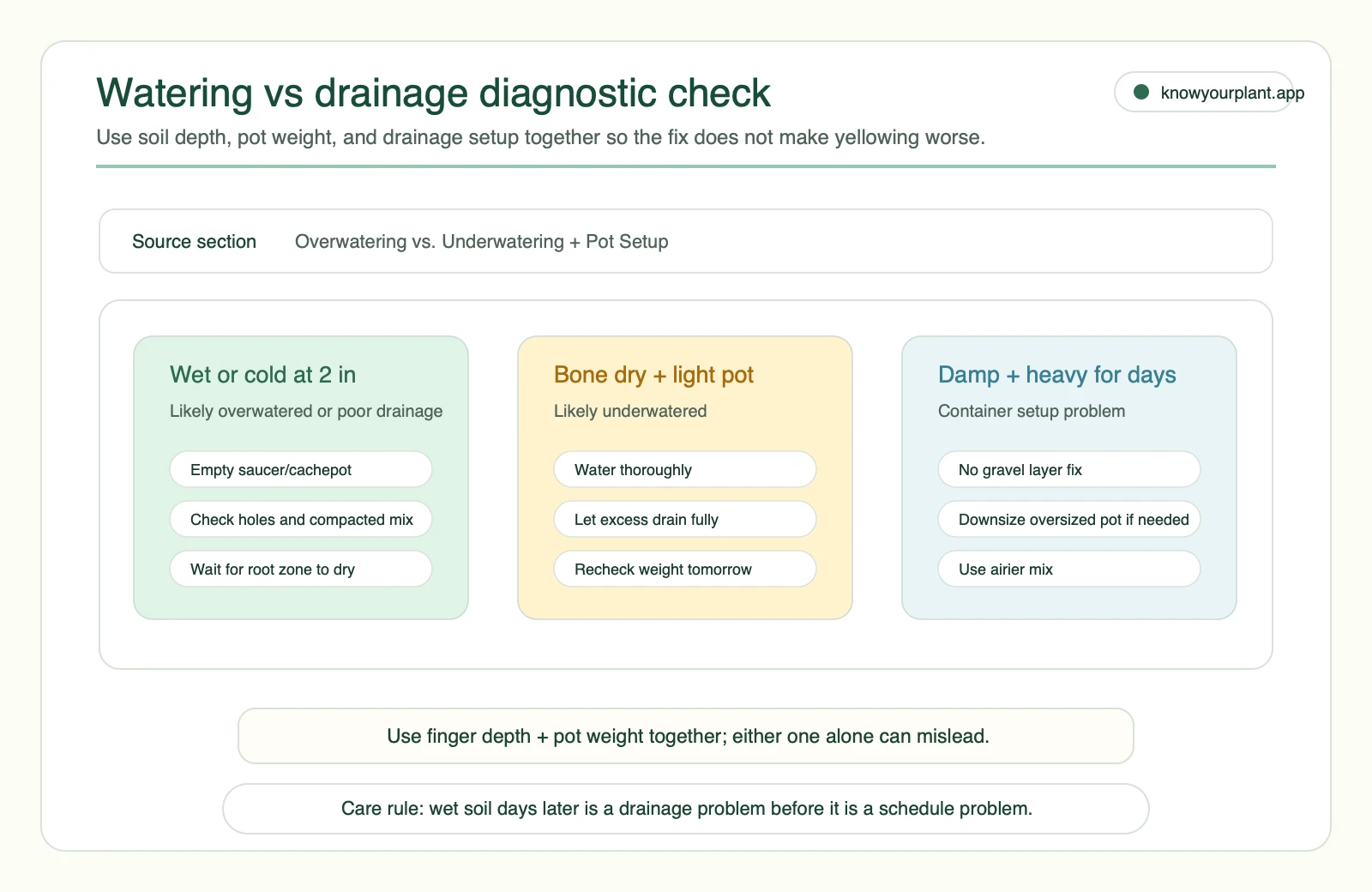
This diagnostic check keeps the fixes separate: wet soil, bone-dry soil, and a heavy pot days later point to different next steps.
Repotting Stress
If your monstera started yellowing in the weeks after a repot, that is likely transplant stress combined with adjusting to the new soil volume. Moving the plant disturbs the root system. If the new container is significantly larger than the old one, the root ball sits surrounded by more wet soil than it can absorb.
This is not a sign anything went wrong. A few practical notes for getting through it:
- Hold off on fertilizer for four to six weeks. Roots in recovery are sensitive to the salt buildup that comes with regular feeding.
- Check soil depth before each watering session rather than going by the calendar. The larger soil volume dries more slowly.
- Give the plant several weeks before expecting new growth to resume. The root system is settling in.
For more on timing, container sizing, and what to do if you think you sized up too aggressively, the how to repot plants guide covers the full process.
Light Problems
Monsteras prefer bright, indirect light. Penn State Extension says direct sun can scorch the leaves, while too little light causes gradual yellowing and slowed growth.
A simple test: can you comfortably read in that spot without turning on a lamp during the day? If not, the plant is probably not getting enough natural light. Moving it a few feet closer to a window often makes a visible difference within a few weeks.
Harsh direct sun through a south- or west-facing window in summer produces a different pattern: bleached or scorched patches on the side of the leaf facing the window, rather than soft all-over yellowing. A sheer curtain or a slightly different position is usually the fix.
If your space is genuinely dim and you cannot get closer to a window, a grow light can fill the gap. The grow lights for indoor plants guide covers what output and placement actually matter.
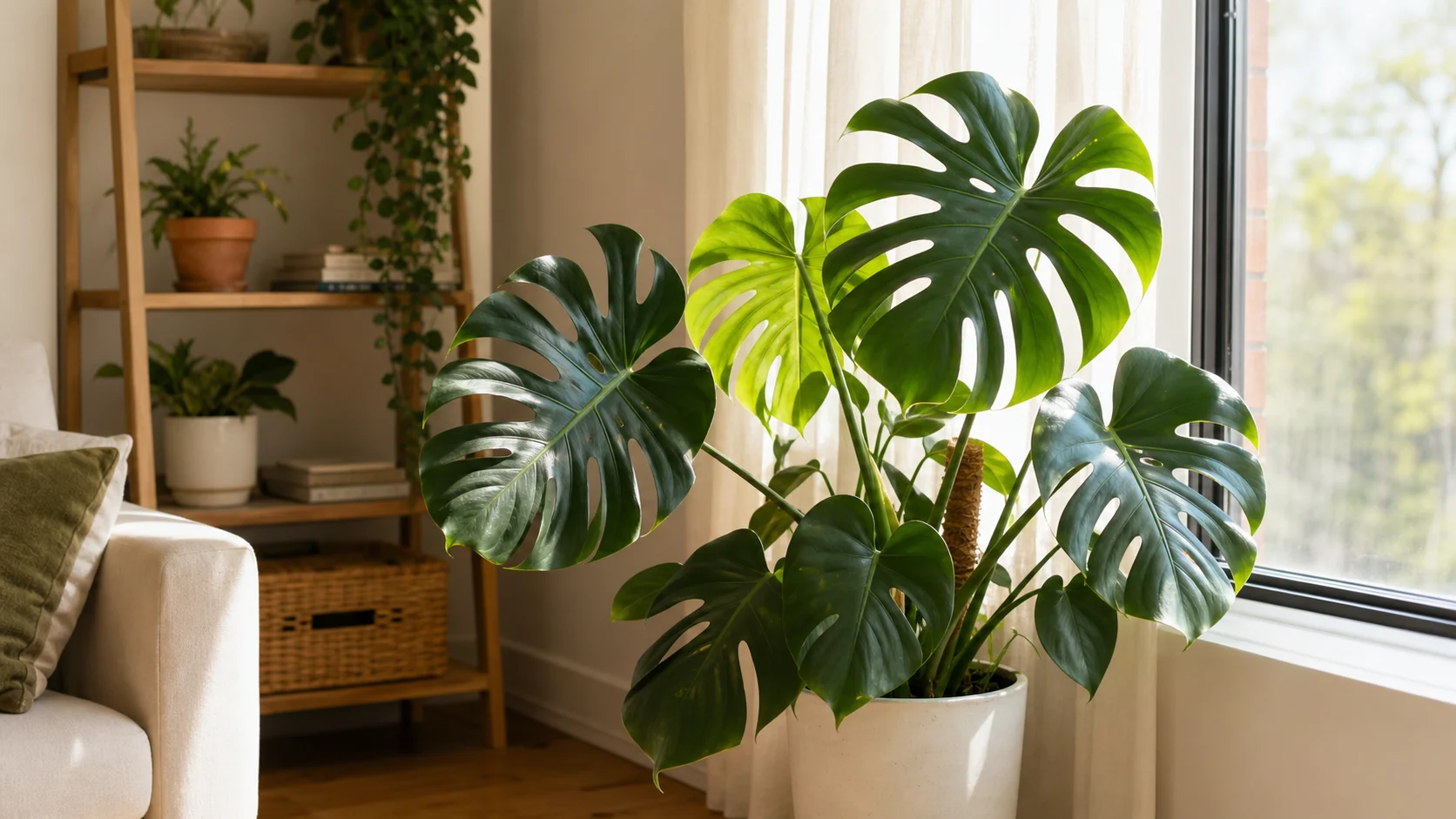
A sheer curtain softens strong window light, while the paler sun-facing leaf helps distinguish light stress from uniform yellowing.
Nutrient Deficiency
If the plant has been in the same soil for more than a year and yellowing appears on newer leaves or spreads evenly across the plant, nutrient deficiency is worth considering. Potting mix loses its fertilizer charge over time, and a plant that has not been fed during the growing season will eventually show it.
During spring and summer, a balanced liquid fertilizer every four to six weeks is usually enough. Wisconsin Horticulture notes that Monstera benefits from a well-managed mix and from fertilization during active growth. Cut back in autumn and stop entirely through winter.
A note on the other direction: too much fertilizer causes yellowing too, through salt buildup around the roots. If you have been feeding heavily, flush the soil thoroughly with plain water a few times before adding more nutrients.
For a complete guide on timing and what to look for, see the plant fertilizer guide.
Root Rot
Root rot is the cause worth catching before it becomes serious. It develops when roots stay wet long enough that they suffocate and begin to decay. By the time leaves are yellowing visibly above the soil, the damage below can already be significant.
Signs root rot may be involved: persistent yellowing that does not respond to watering adjustments, soil that stays wet for a long time after watering, a faint musty smell near the pot, or a general unhealthy appearance even when nothing else seems obviously wrong.
To check: pull the plant gently from its pot and look at the roots. Healthy Monstera roots are white or cream-colored and firm to the touch. Rotten roots are brown or black, soft, and often smell unpleasant. If you find rot, trim the affected sections back to healthy tissue, let the cut ends dry for an hour or so, and repot into fresh well-draining mix.
Root rot needs more than a watering adjustment. It needs physical intervention. The root rot treatment guide walks through the full rescue process.
Pests
Spider mites, mealybugs, and scale can all cause yellowing, though they typically show other signs first. Check the undersides of leaves for fine webbing (spider mites), white cottony clusters (mealybugs), or flat brown bumps along stems (scale). A sticky residue on leaves or nearby surfaces is another signal.
Treat before the infestation spreads to neighboring plants. For spider mites, the how to get rid of spider mites guide covers identification and treatment steps. Mealybugs are addressed in the how to get rid of mealybugs guide.
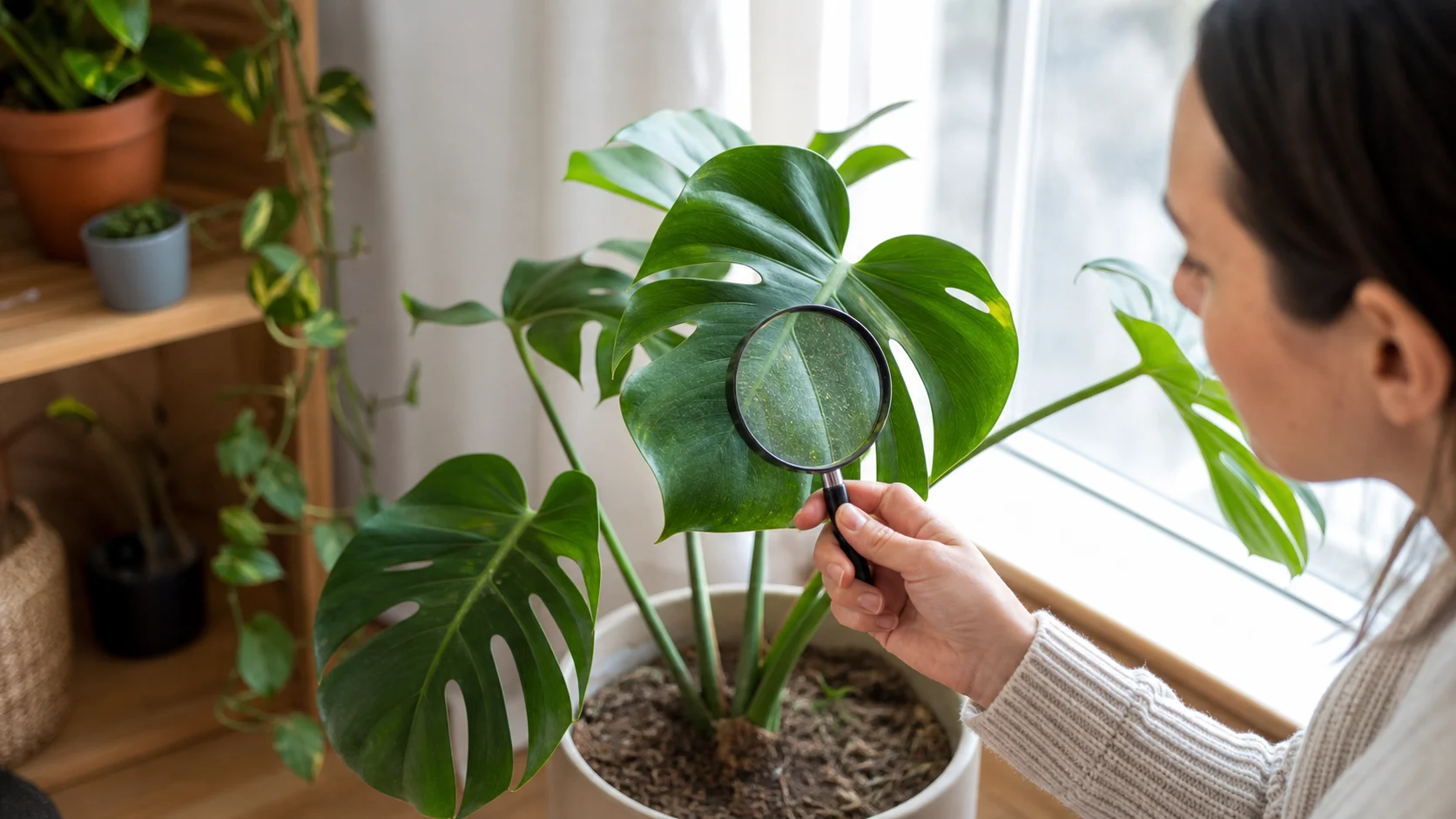
Inspecting the leaf surface and underside closely can reveal fine pest stippling before yellowing spreads to nearby growth.
The 5 Mistakes That Keep Yellow Leaves Coming Back
Even after identifying the cause, some owners see the problem return. These are the patterns that drive repeat yellowing:
-
Watering by calendar, not by soil. A set schedule does not account for seasonal light changes, temperature shifts, or how quickly different pot sizes dry out. The soil check is the actual signal, not the day of the week.
-
Trusting a moisture meter as the only input. Meters can misread compacted, salt-crusted, or hydrophobic soil. Use the finger test as a secondary confirmation before making any big changes.
-
Leaving water in decorative pots or saucers. This single setup issue causes chronic overwatering symptoms even with careful, measured watering. Worth checking every single session.
-
Overreacting to one older leaf. A single bottom leaf slowly yellowing while the rest of the plant looks healthy is normal. Changing the care routine in response can create real problems where there were none.
-
Repotting into a much larger container. Going up more than one pot size at once leaves a lot of wet soil around the roots and produces persistent yellowing that looks like a watering problem but is not one.
What to Do First: Monstera Yellow Leaf Decision Tree
When yellowing appears, work through this in order:
- Which leaf? Single lower or older leaf, plant looks healthy elsewhere → normal aging, no action needed.
- When did it start? After a recent repot → likely transplant stress, give it a few weeks.
- Check soil at 2 inches. Wet after several days → drainage issue, not just frequency. Bone dry → water more thoroughly.
- Check the drainage setup. Holes clear? No standing water in saucer or cachepot?
- Check roots. Soft, brown, or smelly → root rot, needs intervention. White and firm → continue.
- Check light. Plant too far from a window, or getting direct harsh sun?
- Check feeding. More than a year in the same soil with no fertilizer during the growing season?
- Check for pests. Inspect leaf undersides for webbing, bugs, or sticky residue.
Most cases resolve at step 1, 2, or 3. Root rot and pest damage are less common but more serious, and worth checking if the earlier steps do not explain the pattern.
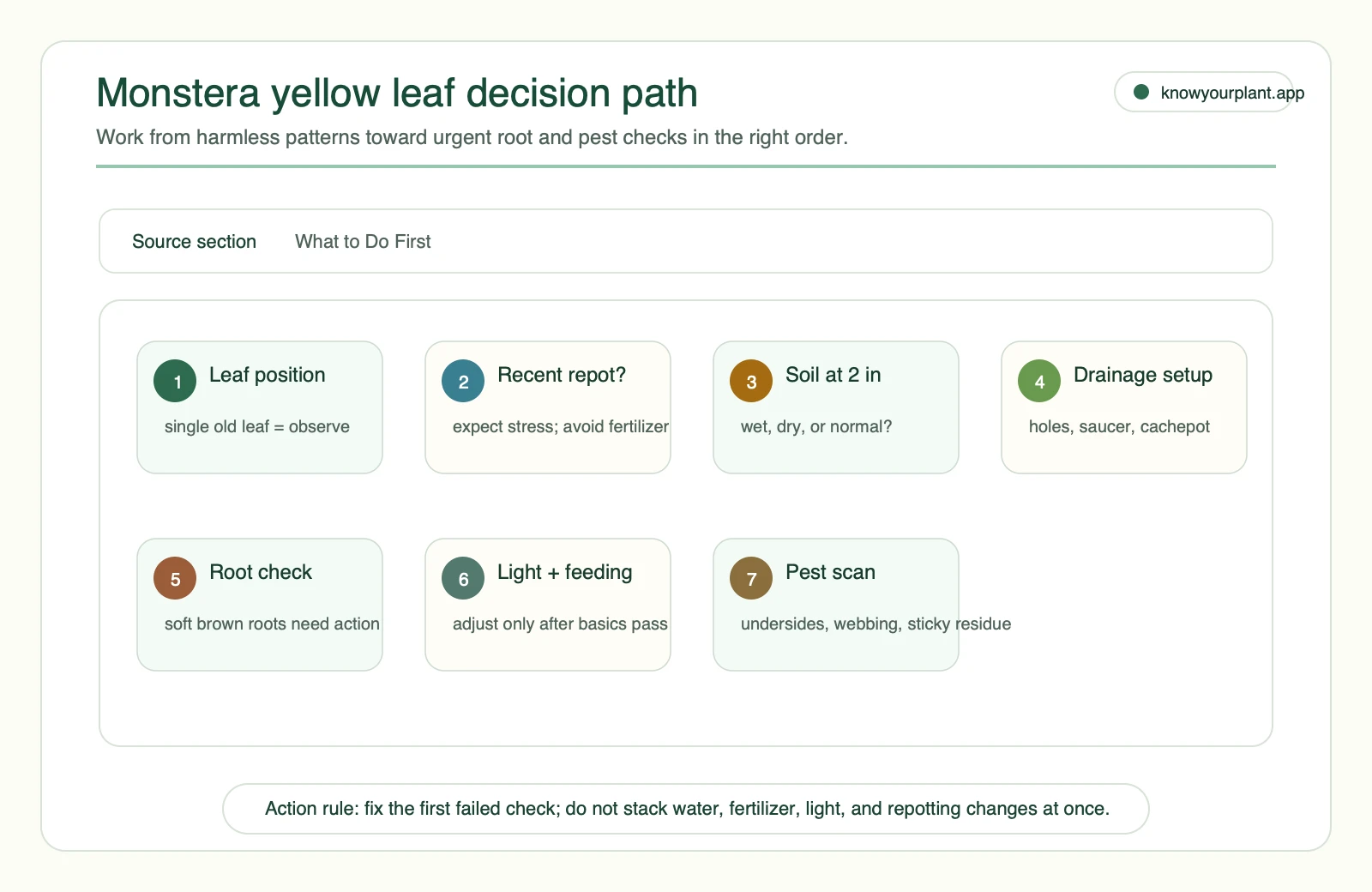
Follow the decision path in order so you fix the first failed check instead of stacking several stressful care changes at once.
If you are troubleshooting another common plant symptom, see Monstera Leaves Curling: Read the Clues First for a focused diagnosis and recovery plan.
Real-User Monstera Yellow Leaf FAQ
Why is my monstera turning yellow even though I just watered it? Yellow leaves appearing right after watering usually mean the plant was already overwatered before that session, or that water is not draining properly. Check whether the pot has clear drainage holes and whether the saucer has standing water. If the soil still feels wet or cold from a previous watering, the issue is drainage rather than schedule.
Is it normal for a monstera to have a few yellow leaves? Yes. One older lower leaf yellowing and eventually dropping while the rest of the plant grows normally is standard. Monsteras redirect energy away from older leaves as they produce new ones. What is not normal is multiple leaves yellowing at once, newer leaves yellowing, or a general pattern of decline.
How do I know if my monstera has root rot? Lift the plant from its pot and look at the roots. Healthy roots are white or tan and firm. Rotten roots are brown or black, feel soft or mushy, and often smell unpleasant. If you find rot, trim affected roots back to healthy tissue and repot in fresh, well-draining mix.
Can underwatering and overwatering look the same? They can produce similar yellowing, which is why the soil check matters more than the leaf appearance. Overwatered soil feels wet or cold at depth even after several days without water. Underwatered soil is bone dry and often pulling away from the sides of the pot. Check at two inches before deciding which direction to adjust.
Why are my monstera leaves turning yellow after repotting? This is transplant stress, and it is common, especially if the new pot is significantly larger than the old one. The root system adjusts to the new soil volume, and extra moisture around the roots can produce symptoms that look like overwatering. Give the plant several weeks without fertilizer and check soil depth before each watering rather than following a schedule.
Could low humidity cause yellow leaves on a monstera? Low humidity is more likely to cause brown, crispy leaf tips and edges than full yellowing. Penn State Extension notes that Monstera prefers humidity above 50%. If your space is very dry in winter, a humidifier or pebble tray may help with overall health, but it is rarely the primary cause of widespread yellowing.
How often should I fertilize a yellowing monstera? If yellowing is already present, wait until you have ruled out drainage and watering issues before adding fertilizer. Adding fertilizer to a stressed or overwatered plant can worsen root stress through salt buildup. Once the plant stabilizes, a balanced liquid fertilizer every four to six weeks through spring and summer is a reasonable baseline.
My monstera keeps producing new leaves but lower ones keep yellowing. Is something wrong? Probably not. A monstera pushing new growth at the top while the bottom leaves slowly yellow and drop is behaving normally. The plant sheds older foliage as it invests energy in new growth. Watch whether the yellowing is accelerating or affecting newer leaves. One or two bottom leaves yellowing while the plant thrives elsewhere is not a warning sign.
Methodology: How This Guide Was Checked
We rebuilt this article around current university and extension guidance, then compared that guidance with the recurring questions owners ask when a Monstera yellows after watering changes, repotting, or a pot upgrade. Extension sources support the care and diagnosis advice. Community discussion is used only to mirror the confusion readers are likely arriving with, not as proof by itself.
The guide’s recommendations were checked against current extension evidence, with owner questions used only to identify recurring confusion.
Sources
- NC State Extension Gardener Plant Toolbox, Monstera deliciosa. plants.ces.ncsu.edu. Accessed 2026-06-04.
- Penn State Extension, Monstera as a Houseplant. extension.psu.edu. Accessed 2026-06-04.
- University of Minnesota Extension, Propagating Monstera deliciosa. extension.umn.edu. Accessed 2026-06-04.
- Illinois Extension, Container Drainage Options. extension.illinois.edu. Accessed 2026-06-04.
- Clemson Cooperative Extension HGIC, Indoor Plants – Cleaning, Fertilizing, Containers & Light Requirements. hgic.clemson.edu. Accessed 2026-06-04.
- Wisconsin Horticulture, Swiss-Cheese Plant, Monstera deliciosa. hort.extension.wisc.edu. Accessed 2026-06-04.