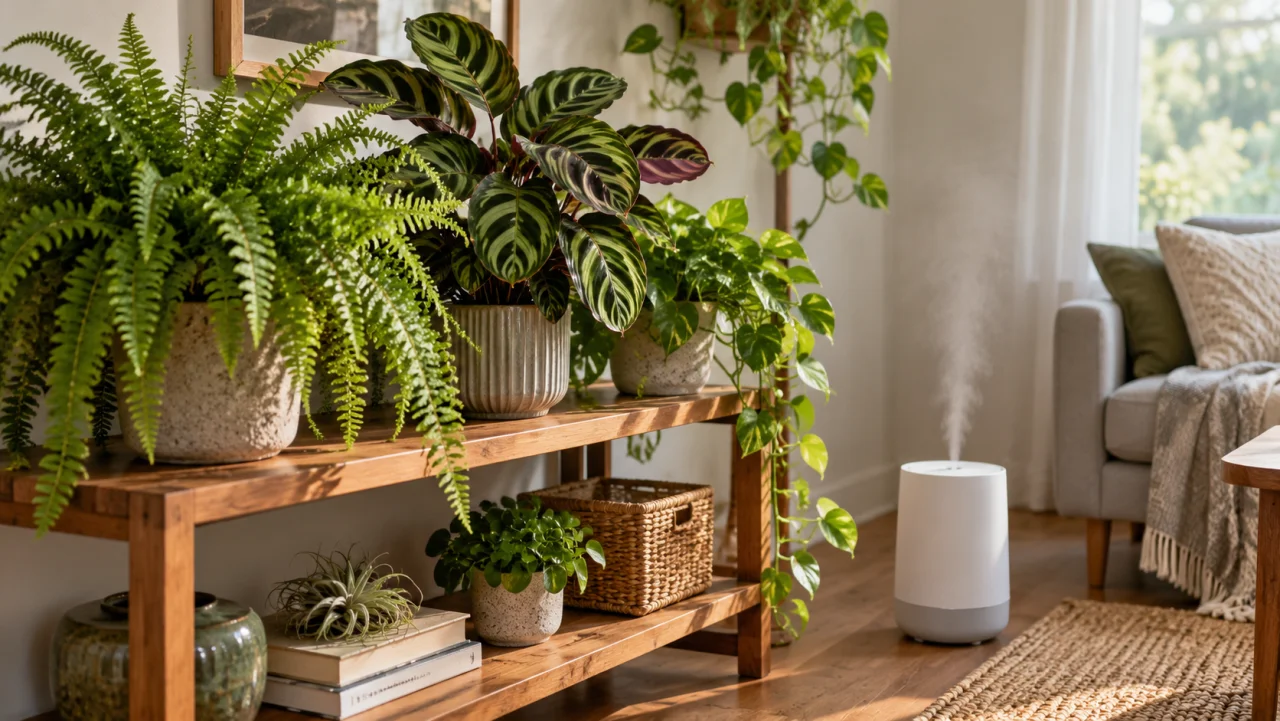
You notice crisp brown edges on your calathea, your fern feels papery by evening, and suddenly every care guide tells you the same thing: buy a humidifier.
Sometimes that advice is right. Sometimes it sends you chasing the wrong fix while the real problem is light, watering, or roots sitting stressed in tired soil.
A humidifier for plants helps only when your room is actually too dry, and the smartest first step is to measure the air before you buy a machine.
This guide is for that exact moment. We are not starting with product hype. We are starting with the question that saves the most money and stress: does your plant corner need extra humidity at all?
What Most Care Guides Miss
Most guides jump straight to “tropical plants love humidity,” which is true but incomplete.
The common misdiagnosis is assuming every brown tip, curl, or droop means dry air. In real homes, those same symptoms can come from underwatering, root stress, hot air from a vent, or a plant sitting brighter than usual and drinking faster.
Before you change care, do this practical first check:
- Put a hygrometer in the exact area where your plants live.
- Watch the reading for a few days, especially in the morning and evening.
- If the space stays around 40 to 60 percent relative humidity, a humidifier is probably not your first fix.
- If it keeps dropping below about 35 percent, especially in winter, now a humidifier becomes a serious tool, not a guess.
University of New Hampshire Extension and Iowa State University Extension both point to roughly the 40 to 60 percent range as workable for most common houseplants, with winter homes sometimes falling far below that. That is the gap most roundup articles skip. They tell you what to buy before helping you decide whether buying anything makes sense.
Symptom diagnosis card
If you want the short version, start here.
- Humidity likely is the problem: tropical plants, especially calatheas and ferns, look worse during heating season, leaf edges crisp first, and your hygrometer reads under 35 percent.
- Humidity might not be the problem: leaves are yellowing more than crisping, soil stays wet too long, stems feel soft, or the room is already 45 to 55 percent.
- Your first move today: measure humidity, check for nearby vents or drafts, then decide whether to group plants, move them, or add a humidifier.
If your symptoms overlap with watering stress, it helps to compare humidity issues with root-zone issues in humidity for plants indoors, why are my monstera leaves turning yellow, and ZZ plant yellow leaves.
Do you actually need a humidifier for plants?
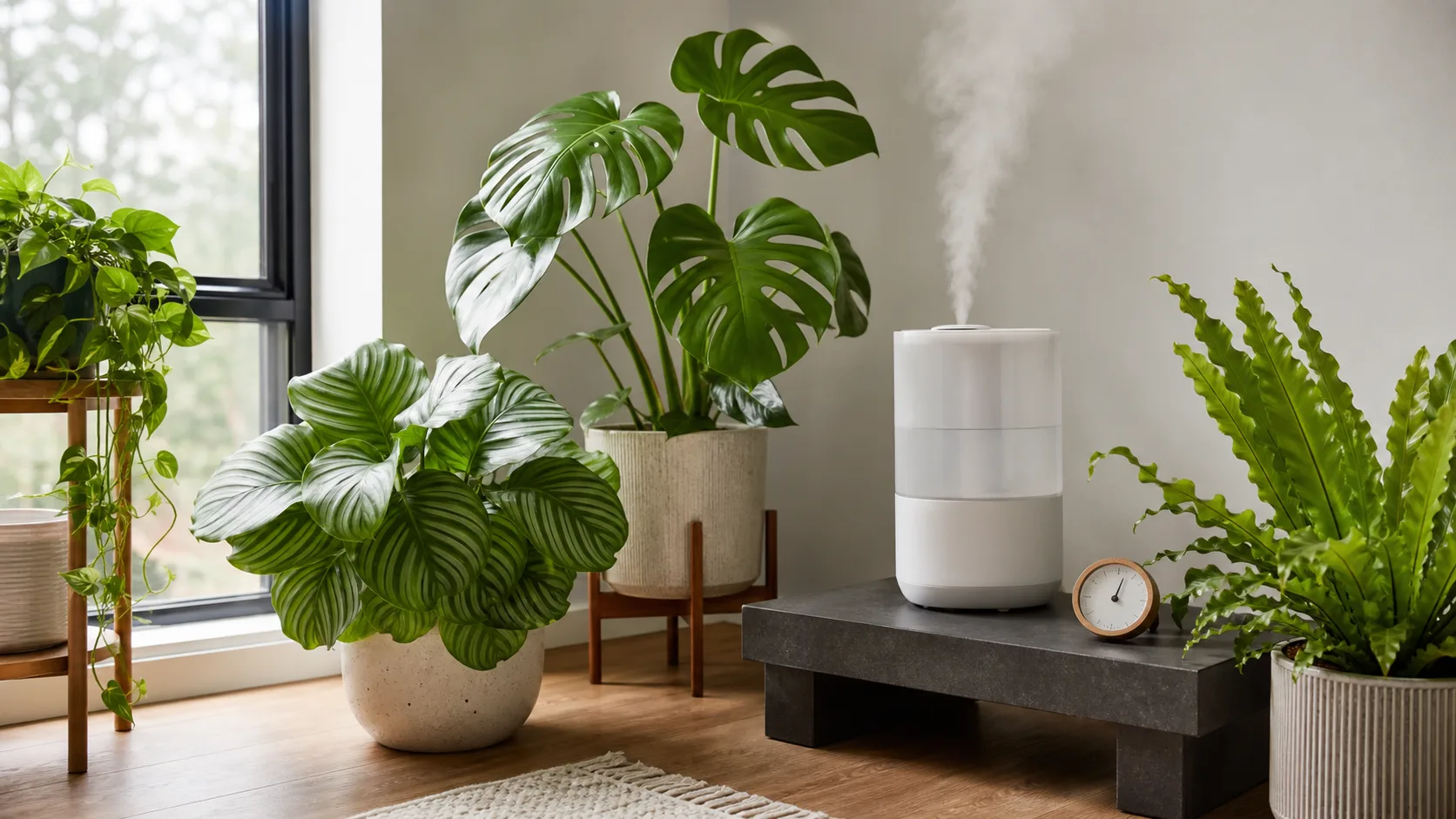
A humidifier is useful only when measured room humidity is below the range your plants actually need.
A lot of plant owners do not.
In summer, many homes naturally land in a plant-friendly range. In winter, central heating can pull indoor air way down. Penn State Extension notes that winter indoor air often drops below 30 percent relative humidity, and Iowa State says some homes can fall into the 10 to 20 percent range during the coldest periods. That is when a plant humidifier can make a visible difference.
Here is a practical decision tree.
Humidifier decision tree
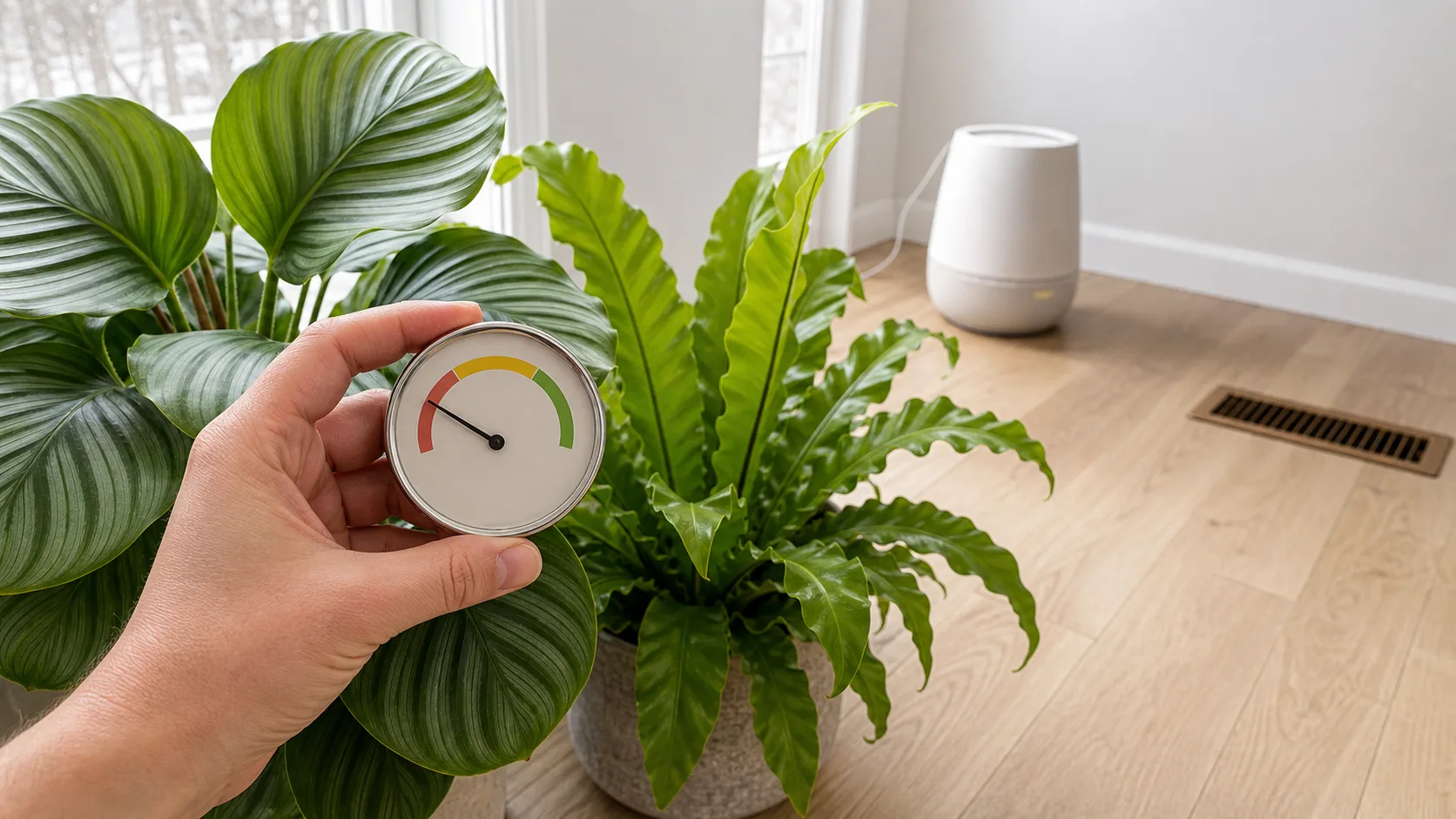
A separate hygrometer turns a vague dry-air guess into a care decision you can verify.
If your hygrometer reads 40 to 60 percent
Do not buy a humidifier yet.
Instead, check:
- whether the plant is too close to a vent, radiator, or drafty window
- whether watering is inconsistent
- whether the potting mix has gone hydrophobic or compacted
- whether one especially needy plant is in a room with tougher, more forgiving plants
If your hygrometer reads 30 to 39 percent
You are in the gray zone.
Try this order first:
- group your tropical plants together
- move them away from direct heat and cold drafts
- monitor whether symptoms stabilize
- add a humidifier only if readings stay low and sensitive plants still struggle
If your hygrometer reads under 30 to 35 percent
A humidifier is usually worth considering, especially for ferns, calatheas, prayer plants, some orchids, and humidity-sensitive aroids.
If you grow mostly succulents, cacti, snake plants, or ZZ plants
A whole-room humidity push may create more problems than benefits. Zoning matters more than maximum moisture.
Which plants benefit most, and which usually do not
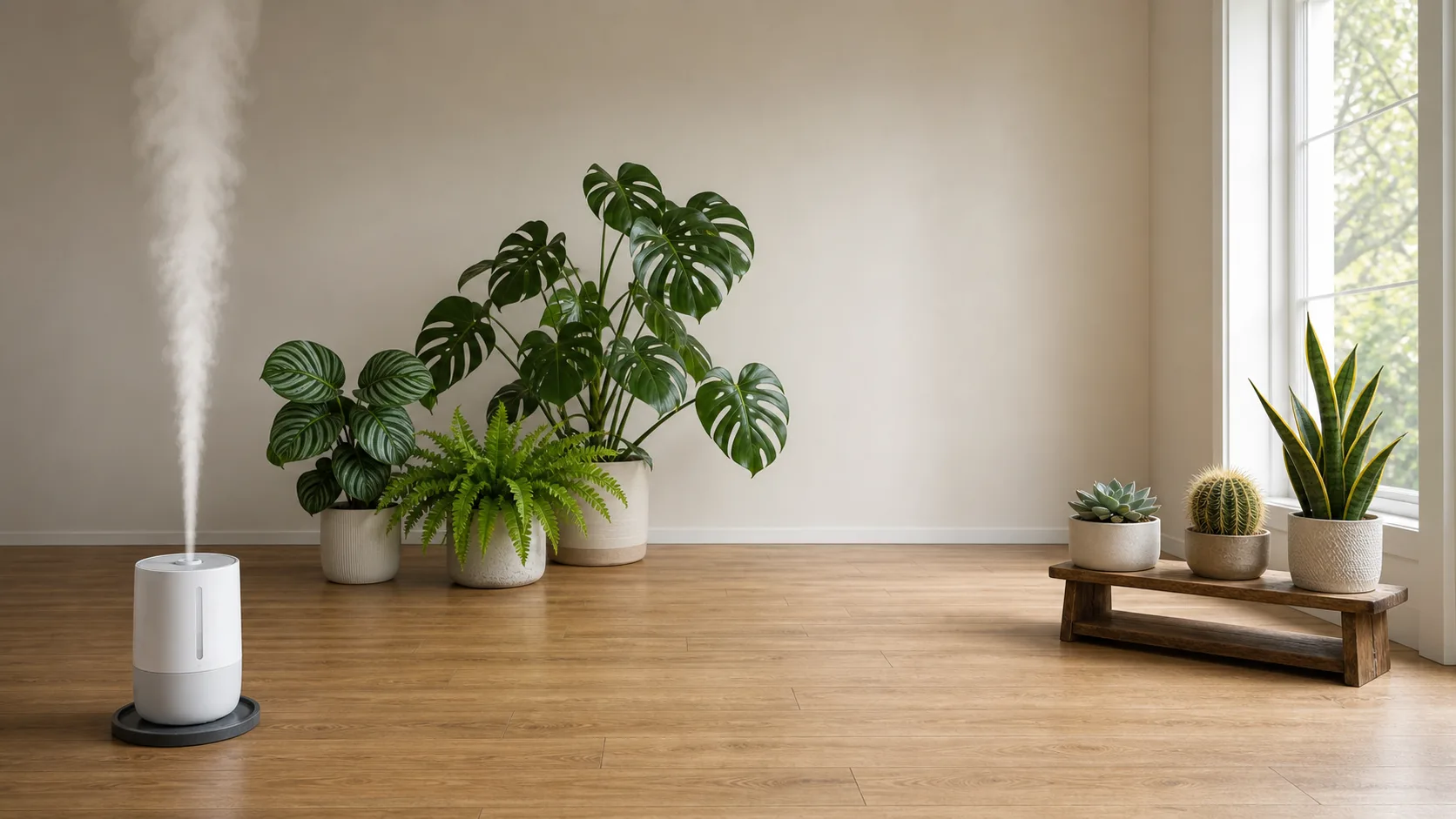
Mixed collections work better as separate care zones: tropical foliage near added humidity, dry-tolerant plants farther away.
This is where mixed collections get tricky.
Plants that often appreciate extra humidity:
- calatheas and marantas
- Boston ferns
- many orchids in dry winter homes
- some anthuriums, philodendrons, and monsteras during heating season
Plants that usually do fine without a humidifier, or may prefer drier air:
- snake plants
- ZZ plants
- most succulents and cacti
- many herbs that dislike stagnant damp air
If your shelf mixes tropicals with desert plants, the better move is usually a plant zone, not a room-wide humidity blanket. Put the moisture-lovers together and let the drier growers live farther away.
How we judged humidifier types for plant use
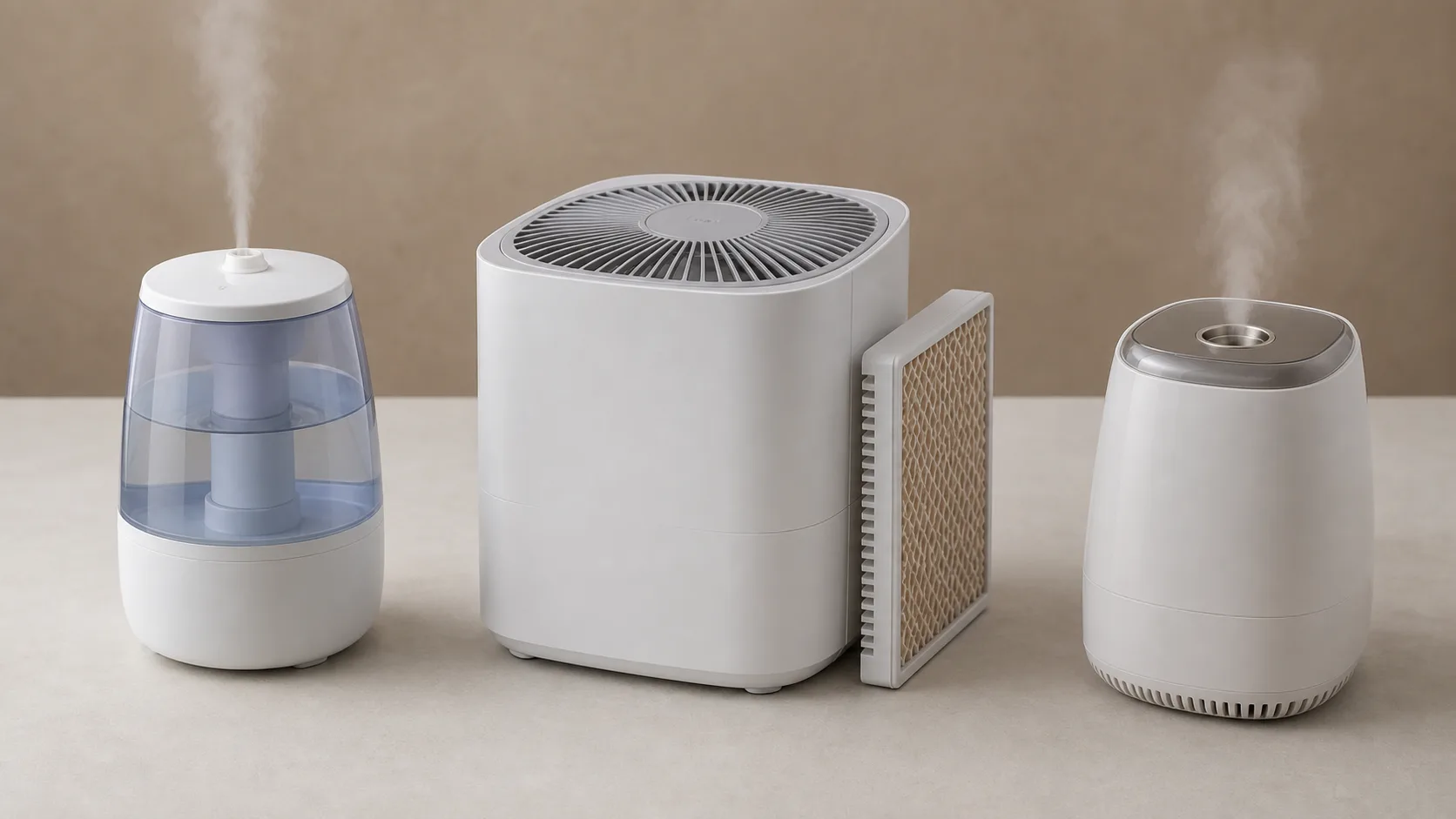
Humidifier type matters less than controllable output, easy cleaning, and a setup that does not leave mineral dust or wet surfaces.
Because this keyword often turns into affiliate fluff, here is the evaluation method behind the recommendations.
We are scoring humidifier styles, not specific brands, using the factors that matter most for real plant owners:
- how well the unit raises humidity in a plant zone
- how easy it is to avoid overdoing it
- white-dust risk
- cleaning burden
- fit for mixed collections
- placement flexibility in small rooms and plant corners
Scoring rubric for a plant humidifier
| Factor | Why it matters | Weight |
|---|---|---|
| Zone control | Helps you target tropical plants without soaking the whole room | 25 |
| Humidity stability | Keeps readings in range without wild swings | 20 |
| Cleaning and hygiene | Dirty tanks create new problems fast | 20 |
| White-dust or mineral risk | Important if you use hard tap water | 15 |
| Mixed-collection friendliness | Matters if succulents and tropicals share a space | 10 |
| Noise and day-to-day ease | You are more likely to use it consistently | 10 |
Best humidifier for plants by setup
There is no single best humidifier for plants. The best one depends on your room, water, and plant mix.
| Type | Best for | Not ideal for | Biggest upside | Main downside |
|---|---|---|---|---|
| Ultrasonic cool mist | Small shelves, plant corners, quiet bedrooms | Hard-water homes if you will not use distilled water | Quiet, efficient, good zone humidity | White dust from minerals, easier to overdo output |
| Evaporative | Mixed collections, medium rooms, people who want a safer range | Anyone who hates replacing filters or wicks | More self-regulating, less white dust | Bulkier, more maintenance parts |
| Warm mist | Small controlled spaces, people prioritizing cleaner output | Homes with pets, kids, or higher energy concerns | Steam-based output, no cool mineral plume | Hot reservoir, more energy use |
My practical recommendation
- Best humidifier for plants in a mixed collection: evaporative
- Best plant humidifier for a tropical shelf in a dry apartment: ultrasonic, but only with low-mineral water
- Best for people who will forget maintenance: honestly, maybe no humidifier yet, because neglected tanks undo the whole point
Where to place a humidifier for plants
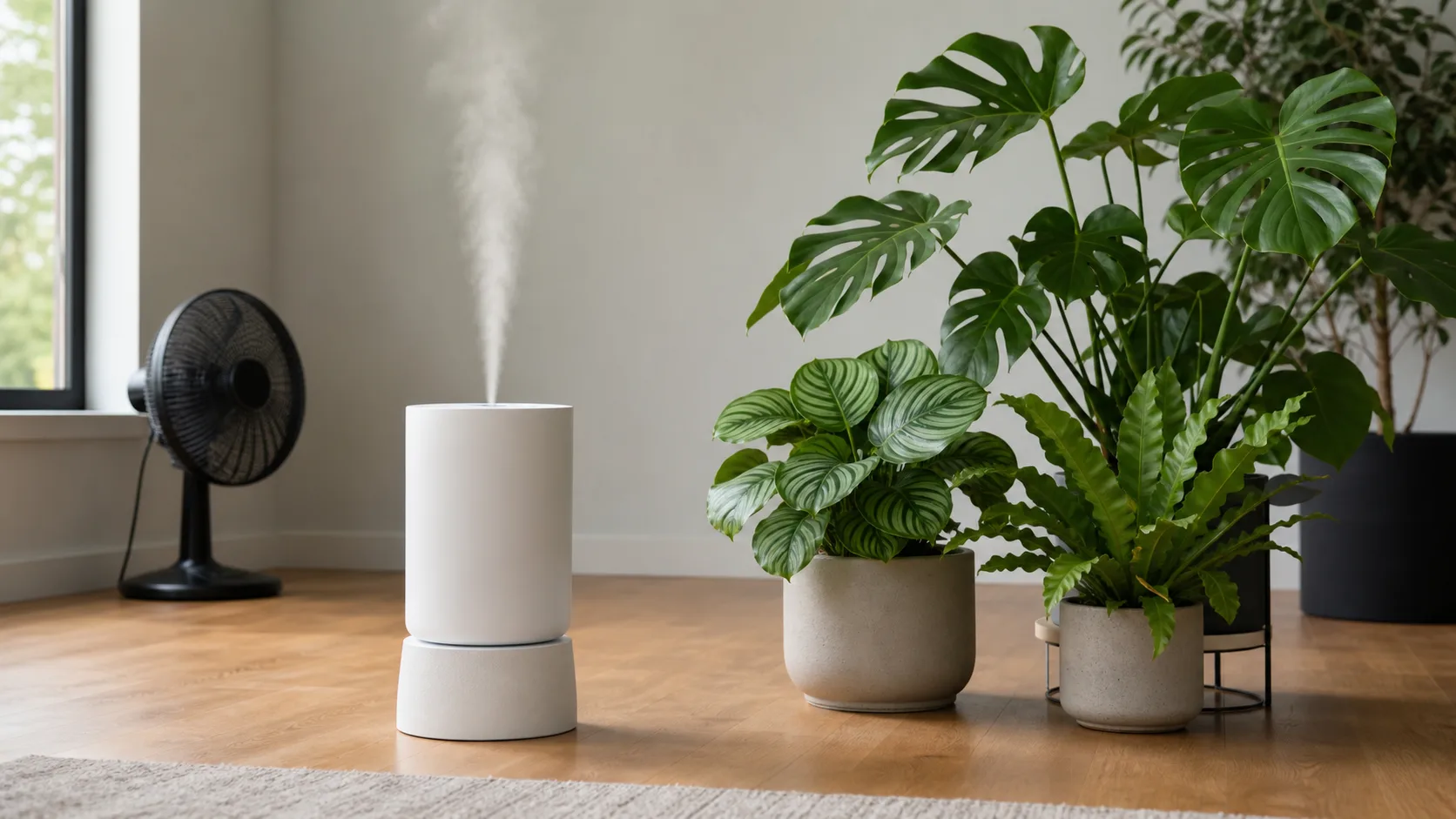
Give the plume open air to disperse before it reaches foliage, walls, windows, vents, electronics, or wood.
Placement matters almost as much as the machine itself.
A humidifier shoved right against leaves is not better. It just creates wet surfaces and still air, which is where leaf spots and mildew start to feel a little too welcome.
Placement rules that actually work
- Keep it about 1 to 2 feet from the nearest foliage, close enough to help the plant zone, not so close that mist lands directly on leaves.
- Raise it off the floor when possible. Mid-shelf height or slightly above the plant grouping helps the moisture disperse better.
- Keep it away from heating vents, radiators, AC blasts, and drafty doors. University of New Hampshire Extension and University of Maryland Extension both flag this.
- Do not aim it toward a cold window or exterior wall. If you see condensation there, your placement or output needs adjusting.
- In a whole room, place it where air can circulate gently, not trapped in a dead corner.
Placement by setup
Small desk or single plant shelf
Use a small unit only if the zone is genuinely small. A mini humidifier running for two casual hours often does less than people hope. Watch the hygrometer instead of trusting runtime.
Plant corner with several tropicals
This is where a humidifier usually makes the most sense. Group the plants first, then place the unit slightly off to the side rather than blasting the center of the canopy.
Mixed living room collection
Target the tropical cluster, not the whole room, unless the entire room is extremely dry and your collection mostly agrees on humidity.
How long should you run a plant humidifier?
The honest answer is not “eight hours” or “all day.” It is: run it until the room reaches the range you want, then stop or let the humidistat take over.
That is why a hygrometer matters so much. Without one, runtime is guesswork.
A simple runtime framework
- Tiny USB or desktop humidifier: only useful for very small zones, enclosed shelves, or sitting close to a tight plant cluster
- Medium portable humidifier: often enough for a shelf wall, plant corner, or bedroom collection
- Larger room unit: useful when the whole room is consistently too dry, but easier to overdo if your collection includes dry-air plants
If you run the humidifier and the hygrometer barely moves, the unit is too small for the space or placed badly. If the windows start sweating, you have already gone too far.
Risks people find out the hard way
A humidifier can help. It can also create a different mess if you use it on autopilot.
1. White dust on leaves and furniture
This usually comes from ultrasonic units filled with hard tap water. The minerals do not disappear. They land on shelves, pots, and leaves as a pale film. The EPA specifically notes that ultrasonic and impeller humidifiers can disperse minerals into indoor air.
What to do: switch to distilled or low-mineral water, or use an evaporative unit instead.
2. Condensation on windows and walls
If the glass near your plant shelf feels damp in winter, that is your warning sign. Extra humidity meeting a cold surface is how mildew gets invited in.
What to do: lower output, move the unit away from windows, and give the room some airflow.
3. Dirty tank, musty smell
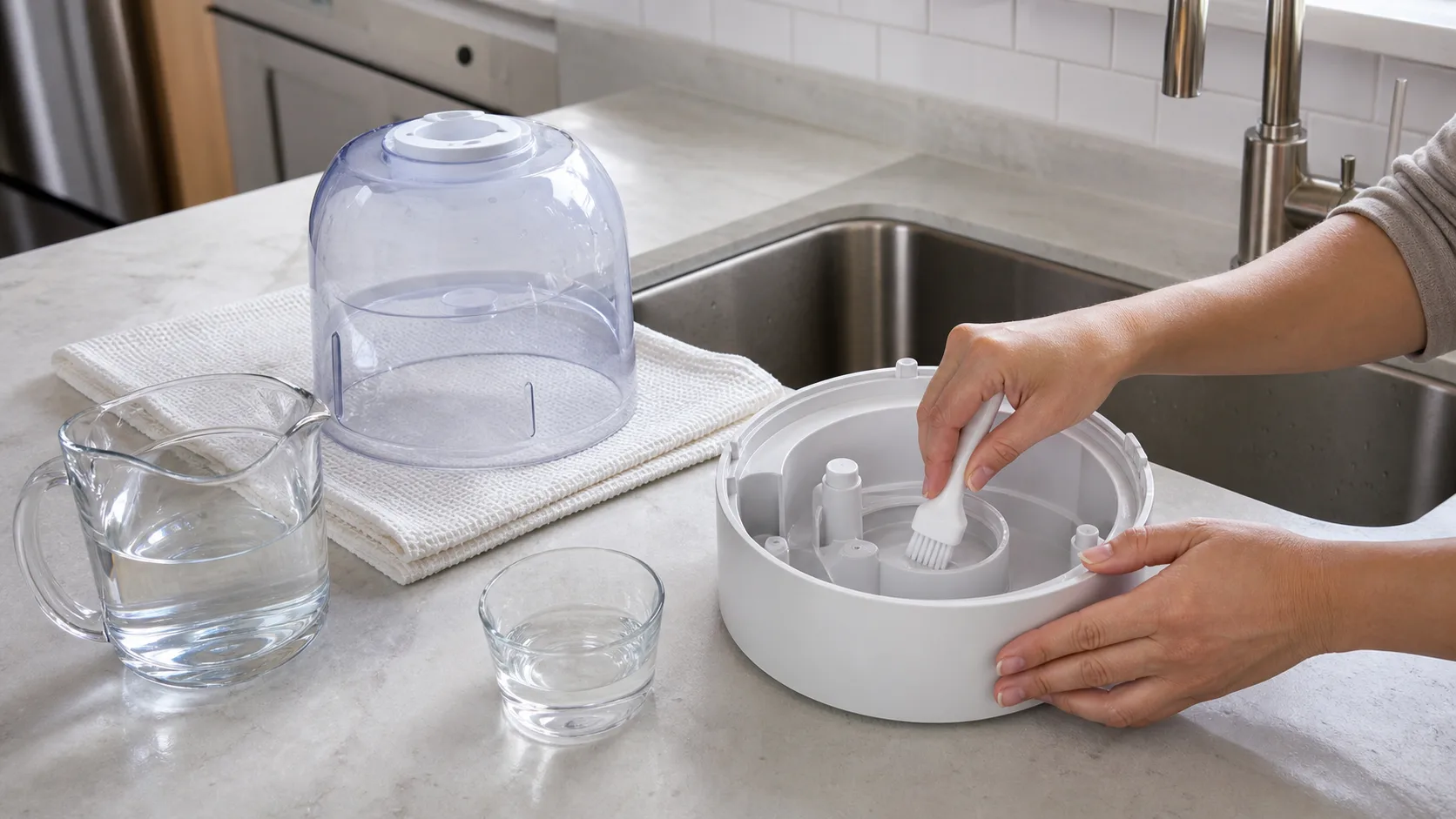
Emptying, wiping, and refilling the tank regularly prevents the humidifier from becoming its own plant-room problem.
This one is more common than people admit. If the tank smells stale, the air around your plants will not feel fresh either.
The EPA recommends emptying portable humidifiers daily, rinsing them thoroughly, and cleaning them every third day. That sounds fussy, but standing water goes gross fast.
What to do: empty unused water, rinse before refilling, deep-clean on schedule, and replace wicks or filters when the manufacturer says to.
Common mistakes
These are the errors I would watch for first.
- buying a humidifier before checking the room’s actual humidity
- trying to fix yellowing leaves with humidity when the real issue is watering or roots
- pointing mist straight at foliage
- running a humidifier beside a cold window
- using hard tap water in an ultrasonic unit, then wondering why everything feels dusty
- raising humidity for calatheas while the nearby succulents quietly hate it
- treating pebble trays and misting as equivalent to a real humidifier
On that last point, Penn State Extension is especially useful. Misting and pebble trays may create a tiny local effect, but they do not reliably raise room humidity the way a dedicated humidifier can.
Seasonal note: winter is the real test
If you are reading this in summer, your home might already be perfectly fine.
Winter is when the question gets real. Heating dries air, windows get colder, and the difference between room humidity and what tropical plants want becomes much sharper. If your calathea only crisps up from late fall through early spring, that pattern matters.
That seasonal pattern is also why a humidifier does not need to run all year just because you bought one. You may use it heavily for a few months, then barely at all once outdoor humidity returns.
Expert note and trust layer
This advice is grounded in extension and EPA guidance, not just product marketing.
- University of New Hampshire Extension supports the 40 to 60 percent range for many houseplants and recommends using a hygrometer with a portable humidifier.
- Iowa State University Extension notes that winter indoor humidity can drop extremely low, which is where tropical plants start to struggle more clearly.
- Penn State Extension explains why misting and pebble trays are limited compared with an actual humidifier.
- University of Maryland Extension supports grouping plants and keeping them away from heating or cooling sources.
- The US EPA covers the mineral-output and cleaning risks that a lot of plant articles skip.
That mix matters because a plant humidifier is not just a plant purchase. It is also an indoor-air and maintenance decision.
Best for, not for
A humidifier is probably worth it if
- you grow humidity-sensitive plants
- your hygrometer regularly shows under 35 percent
- winter heating is clearly drying the room out
- you are willing to clean the unit consistently
A humidifier is probably not your first move if
- your room already stays near 45 to 55 percent
- your collection is mostly snake plants, ZZ plants, succulents, or cacti
- the real problem is likely root stress, overwatering, or poor light
- you know the tank maintenance will not happen
For a related hands-on growing walkthrough, use Prayer Plant Propagation: Nodes, Cuttings, Division, and Rooting for the setup and follow-up care.
Frequently asked questions
Do all houseplants need a humidifier?
No. Many common houseplants do well around 40 to 60 percent relative humidity. A humidifier is most useful when your home, especially in winter, drops well below that range.
Where should I place a humidifier for plants?
Place it near the plant group, usually 1 to 2 feet away from foliage, lifted off the floor if possible, and away from vents, drafty doors, cold windows, and exterior walls.
Can a humidifier hurt plants?
Yes, if mist lands directly on leaves, if the room gets too damp, or if the tank is dirty. The goal is steady air humidity, not wet foliage or a muggy room.
Is an ultrasonic or evaporative humidifier better for plants?
Ultrasonic is great for quiet zone humidity but can create white dust with hard water. Evaporative is usually better for mixed collections because it is more self-regulating.
Do pebble trays work as well as a humidifier?
No, not for meaningful room humidity. They can slightly improve the tiny area around a pot, but they are not a true substitute for a humidifier in a dry home.
How do I know if my humidifier is too much?
Watch for condensation on windows, a damp smell, consistently high humidity readings above about 60 percent, or plants staying wet on the leaf surface. Those are signs to cut back.
The bottom line
The best humidifier for plants is not the fanciest one. It is the one that fits your room, your water, your plant mix, and your willingness to clean it.
Start with the hygrometer. If your air is already fine, save your money and troubleshoot elsewhere. If your tropical plants are spending winter in 25 percent humidity, a well-placed, well-maintained humidifier can make your plant corner feel a lot kinder.
And if you want help tracking symptoms, care routines, and what your specific plants actually need, download KnowYourPlant for personalized plant care reminders and support.