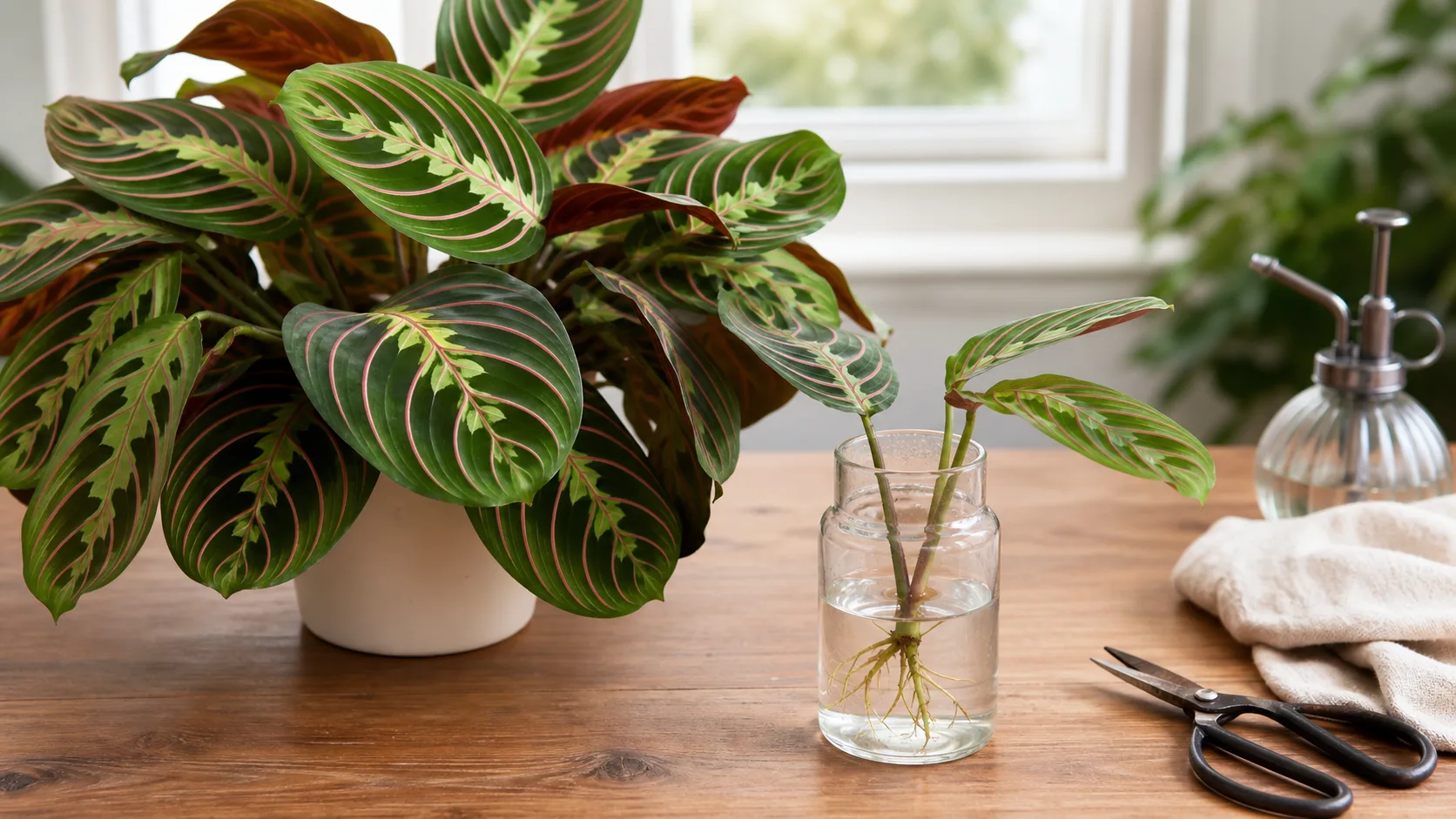
If you need the shortest safe answer, make this decision first:
- Root it if the piece has at least one firm node on a healthy stem.
- Divide it if the parent plant already has separate rooted crowns or sections.
- Discard it if it is leaf-only, node-free, black, mushy, or sour-smelling.
That is the whole job in the first minute. Most failed prayer plant propagation starts with the wrong piece, not the wrong method.
For Maranta leuconeura, a viable cutting is not just a pretty leaf. It needs a node, meaning the stem joint where a leaf attaches and where new roots can form. If you have a crowded mature plant with naturally separate rooted clumps, division is usually faster and less risky than trying to root a small cutting. If the stem tissue is already collapsing, do not try to rescue everything. Cut back to firm tissue once. If no healthy node remains, throw it away.
One-minute decision tree
Follow the rows from top to bottom. Stop as soon as one matches:
| What you have | Decision | Safe next step |
|---|---|---|
| Firm stem with a visible node and 1 to 2 leaves | Root it | Put the node in water or airy mix |
| Mature plant with distinct rooted sections | Divide it | Separate one rooted section and repot |
| Detached leaf with no node | Discard for propagation | Do not wait for roots that will not make a plant |
| Soft, black, hollow, or bad-smelling stem | Discard damaged part | Keep only firm tissue with a usable node |
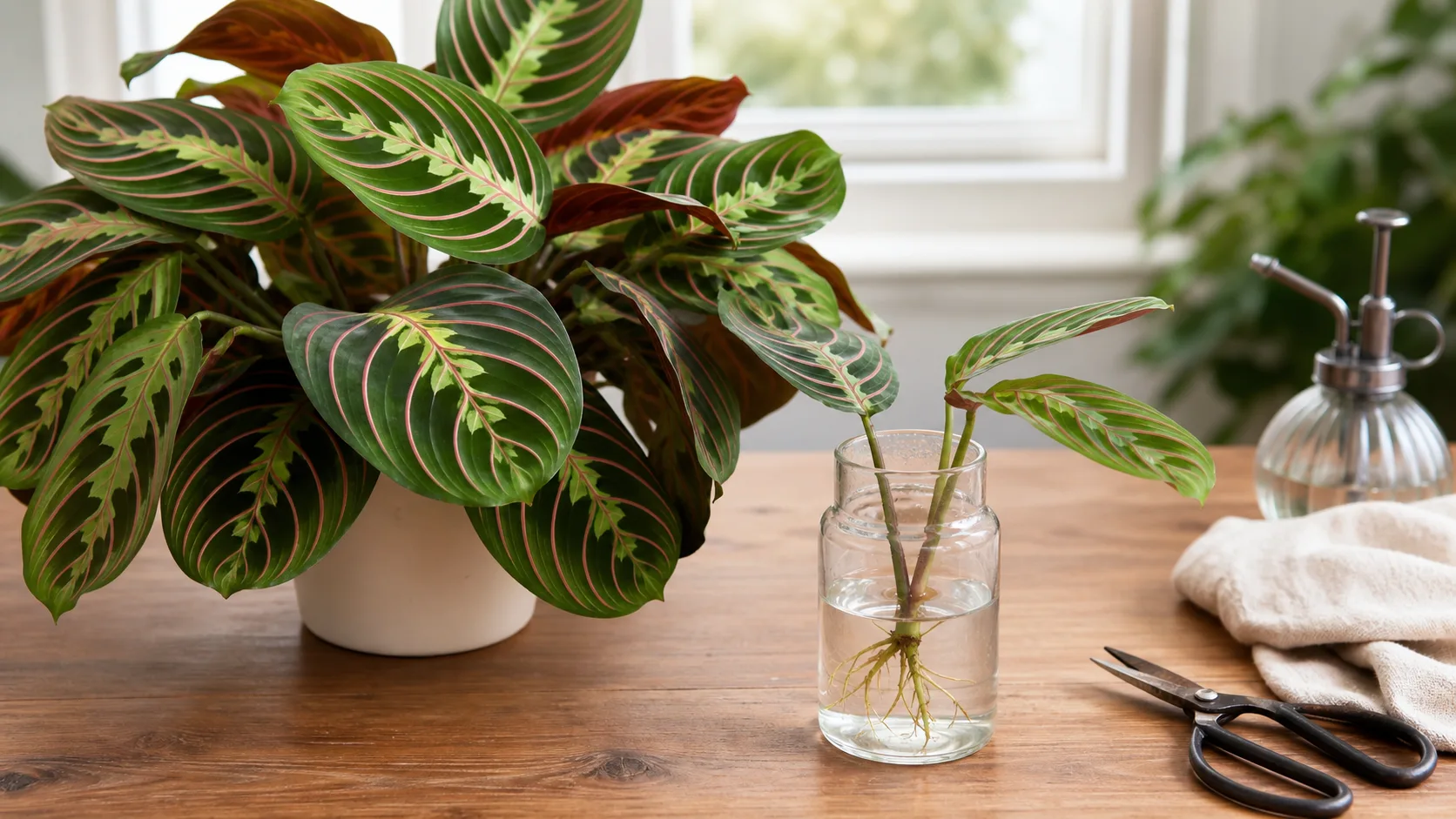
Start with the piece you actually have: a firm node can root, an established crown can be divided, and damaged node-free tissue should be discarded.
The only questions that matter before you start
Ignore broad care advice for a moment. For propagation, you only need five checks:
- Is there a real node?
- Is the node firm, not soft?
- Does the parent already have rooted sections that make division easier?
- Can you keep the setup warm, bright, and out of direct sun?
- Can you check it every few days instead of forgetting it?
If the answer to the first question is no, stop. A leaf without a node can stay green in water for a while and still never become a new plant.
If the answer to the third question is yes, division is usually the better beginner move because the plant already has roots.
Postpone elective propagation if the parent has active pests, widespread yellowing, a soft base, or severely curled dehydrated leaves. A freshly broken healthy stem is still worth rescuing, but stabilize a declining parent before taking extra cuttings or dividing its roots.
How to identify a usable prayer plant node
On some houseplants, the node looks obvious. On prayer plant, it can be subtle.
Trace the stem until you find the point where a leaf joins it. That joint is the node. You are looking for a short section of actual stem, not just a leaf stalk by itself.
A cutting is worth keeping when it has all of these:
- one clear node
- firm green or reddish stem tissue
- one or two healthy leaves
- no blackened, mushy, or sour-smelling area
A cutting is not worth keeping when it has any of these:
- leaf only, with no node
- node area is soft or translucent
- stem is blackening from the cut end upward
- tissue smells rotten
- the only remaining node is crushed or dried flat
If a piece has one good node and too many leaves, reduce the leaf load. Keep one or two leaves and remove the rest. That lowers water loss while the cutting is still rootless.
Labeled examples: usable versus leaf-only
- Usable cutting: leaf blade → leaf stalk → short piece of main stem → visible joint. The joint on the main stem is the node.
- Leaf-only piece: leaf blade → leaf stalk → cut end, with no section of main stem and no joint. It may stay green, but it cannot make a complete new Maranta.
- Damaged cutting: a node is present, but it feels soft or looks translucent. Treat that as rot risk, not a viable start.
What most prayer plant propagation guides get wrong
Three common shortcuts cause most false starts. A leaf that stays green is not proof it can grow into a plant; it still needs a node. A rooted mature clump does not need to be turned into cuttings; division already gives each new plant roots. And one tiny root nub is not a root system ready for soil. These distinctions matter more than choosing a fashionable propagation vessel.
Social listening: what owners actually ask
Search-result snippets from Reddit propagation communities and a Houzz discussion repeatedly surfaced the same situations: owners could not locate a node, hoped a leaf-only break might still grow, disagreed about water rooting versus division, or needed to rescue a snapped heavy stem. These are qualitative problem signals, not horticultural proof; the safe answers in this guide come from the institutional sources below. The pattern is useful because it shows why a method list alone does not solve the reader’s decision.
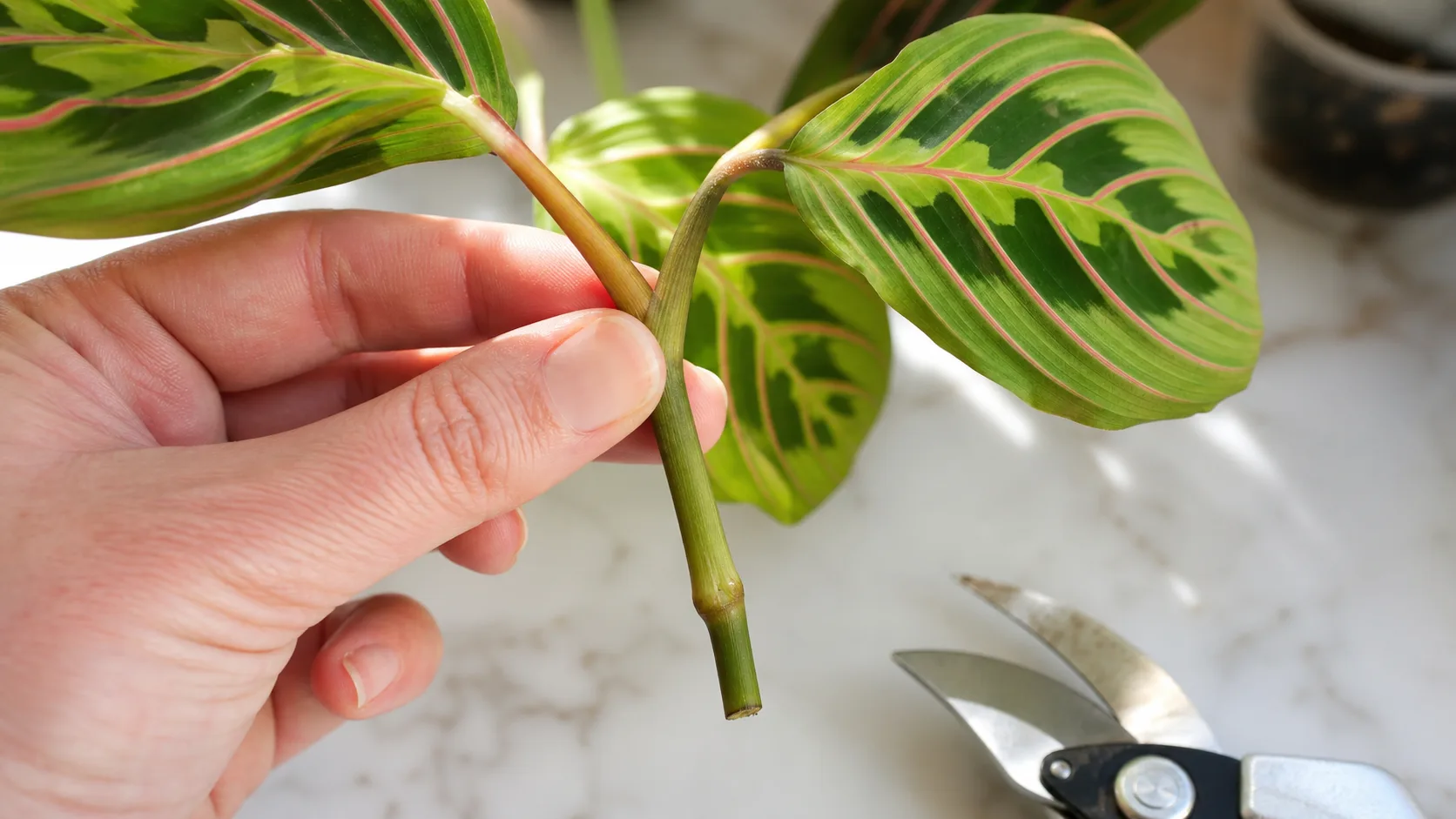
The recurring beginner question is anatomical: the usable node is the joint on the main stem, not the leaf stalk by itself.
What readers confuse with prayer plant propagation
“Prayer plant” is used loosely for several relatives. This guide is for Maranta leuconeura, which can grow from a node cutting or a rooted division. Many Calathea and Goeppertia plants are normally divided rather than propagated from ordinary leaf-and-stem cuttings. Check the botanical name before copying a method from a lookalike plant.
Best method for beginners: water or division
For most beginners, the simplest low-risk order is:
- Divide a rooted clump if the plant already offers one.
- Water-root a healthy node cutting if you only have stem pieces.
- Direct-root in potting mix only if you are confident you can keep the mix lightly moist, not wet.
Why this order works:
- Division skips the hardest stage because roots already exist.
- Water rooting lets you see whether the node is alive, stalled, or rotting.
- Soil rooting can work well, but it hides problems until they are advanced.
| Method | Use it when | Progress is visible? | Main beginner risk |
|---|---|---|---|
| Division | A mature plant has naturally separate rooted crowns | Yes, roots are already present | Tearing one clump into pieces that are too small |
| Water rooting | A broken or pruned stem has a firm node | Yes | Stale water or potting before roots branch |
| Direct soil rooting | The room is warm and humid and you can manage moisture closely | No | Dense mix staying wet around a rootless node |
Water rooting: compact method with clear thresholds
Water rooting is usually the easiest path when you are unsure.
Setup
- Use a clean jar or glass.
- Place only the node under water.
- Keep all leaves above the surface.
- Put the cutting in bright indirect light: near a bright window where the leaves see daylight but no hard midday sun reaches them. A sheer curtain or a position a few feet back from an exposed window is a practical starting point.
- Keep it warm. The New York Botanical Garden lists 65 to 70°F as a comfortable range and advises keeping prayer plant above 55°F.
Water-change threshold
Change the water:
- every 5 to 7 days
- sooner if it turns cloudy
- sooner if it smells stale or sour
- sooner if any submerged tissue starts to soften
Do not top off dirty water forever. Replace it fully.
Viability threshold
Keep going if:
- the node stays firm
- leaves remain mostly hydrated
- roots or root nubs start from the node
- there is no spreading softness
Reset or discard if:
- the node turns soft
- the stem darkens upward
- the water smells foul soon after changing
- the cutting collapses even in correct conditions
If only the cut end is damaged but the node above it is still firm, trim back once to clean healthy tissue and restart in fresh water.
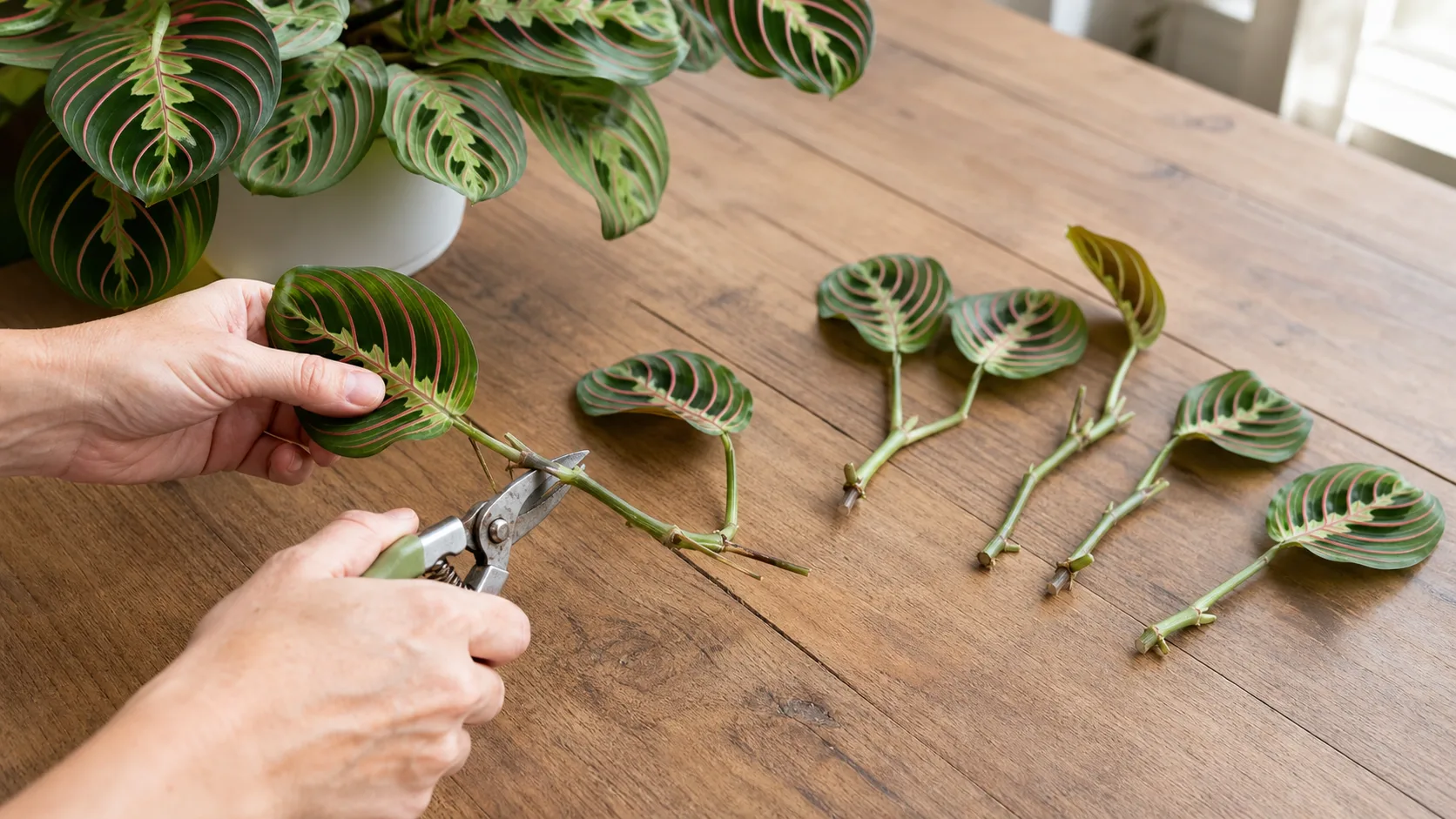
A broken stem is worth restarting only while the node remains firm and clean; spreading softness means the damaged section should go.
When roots are ready for potting
This is where many prayer plant cuttings fail. People pot too early because one tiny root appears.
Do not pot up at the first root nub.
A prayer plant cutting is ready when it has:
- several roots, not one
- roots that are firm and pale, not brown slime
- visible branching or secondary roots
- a small root network that holds together when lifted gently
A simple beginner threshold: wait until the cutting has multiple roots around 1 to 2 inches long, with at least some branching. Exact timing varies, so use the roots you see, not a fixed calendar.
If roots are thin, single, and unbranched, wait longer.
Use KnowYourPlant after choosing a method: set a 5-to-7-day water-change reminder, log weekly root checks, and compare post-potting symptoms with what changed instead of reacting from memory.
Direct soil rooting: when to use it and when not to
Direct rooting in potting mix is fine, but it is less forgiving.
Use it only when you can provide:
- a small pot with drainage
- loose airy mix
- steady warmth
- humidity around 50% or higher, without sealing wet leaves in stagnant air
- restraint with watering
Place the node into the mix and firm it lightly. Then water once to settle the mix.
For a simple airy starting mix, combine two parts indoor potting mix with one part perlite or fine orchid bark. The exact brand matters less than drainage: water should run through promptly rather than pooling on top.
Moisture threshold
After that, water again only when the top half-inch starts to dry. The mix should feel lightly moist below that surface, never soggy and never swampy.
If the pot stays heavy and wet for days, the mix is too dense or the pot is too large.
Division: the fastest low-risk option for mature plants
Division is underused because people assume propagation always means cuttings. For prayer plant, division is often the better answer if the plant is crowded.
The Royal Horticultural Society describes Maranta as rhizomatous and clump-forming. That growth habit is exactly why division works.
Good division threshold
A section is worth separating when it has:
- its own roots
- at least one crown or active stem base
- enough mass to stand on its own after potting
Compact method
- Remove the plant from its pot.
- Look for natural separations first.
- Ease sections apart with your fingers.
- Use a clean knife only if roots are tightly bound.
- Pot each section into a draining mix.
- Water once and let excess drain fully.
Do not shred one dense root ball into tiny fragments just to make more plants. Fewer stronger divisions are safer than many weak ones.
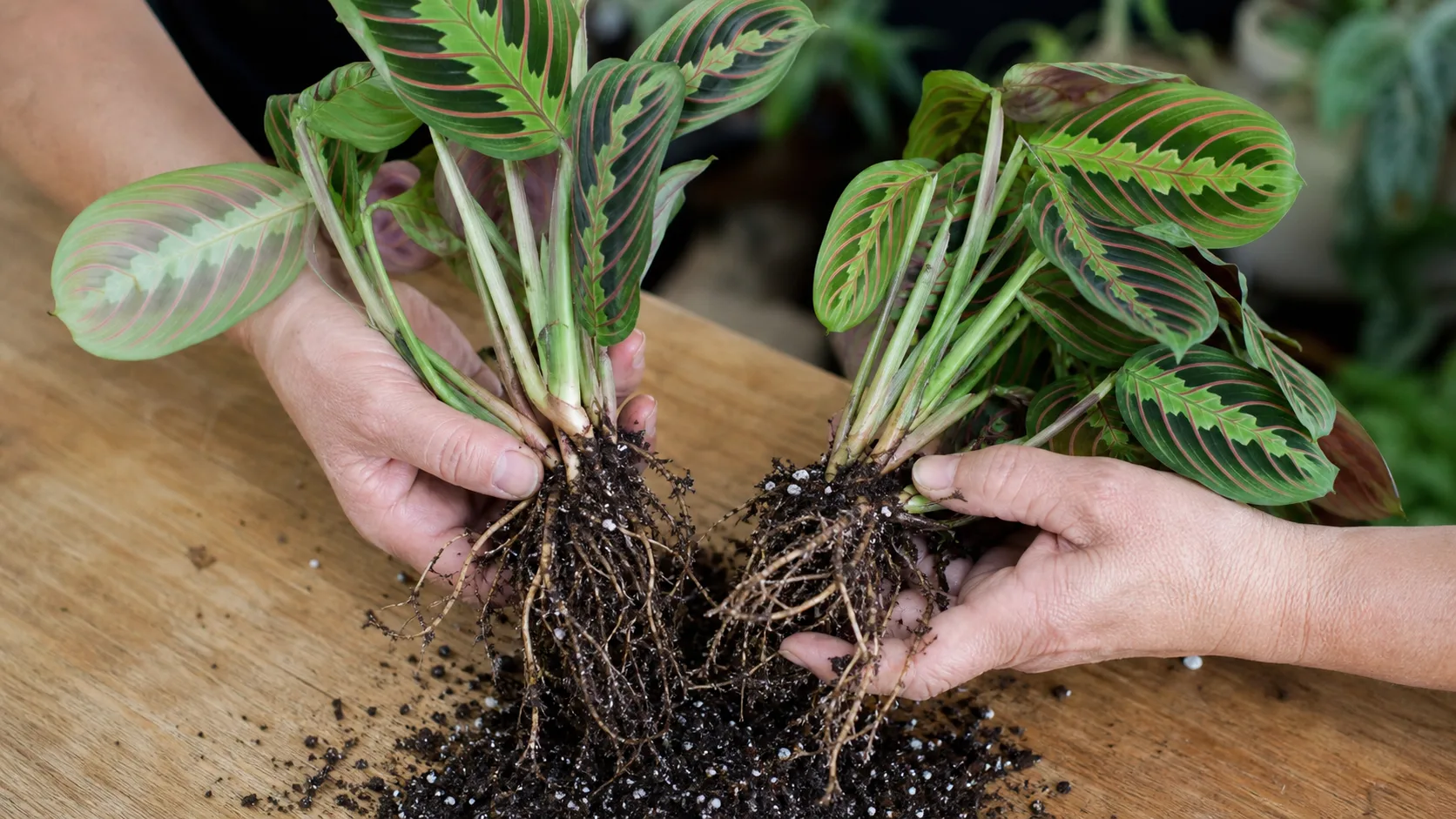
A strong division keeps its own roots and active crown, which makes it safer than forcing a mature clump into many weak pieces.
Aftercare: one-minute checks and failure signals
Once the cutting or division is started, your job is not to keep changing things. Your job is to monitor the right signals.
Every few days
- Is the node still firm?
- Is the water clear enough?
- Is the mix moist but not saturated?
- Are the leaves staying reasonably hydrated?
- Are roots increasing, stalling, or rotting?
What the symptom means
| What you see | Check first | Safest next step |
|---|---|---|
| Curled leaves but a firm node | Direct sun, dry air, or too many leaves | Move out of hard sun, raise room humidity, and keep only one or two leaves |
| One older leaf turns yellow | Node firmness and water clarity | Remove that leaf and keep watching; do not change everything at once |
| Soft node, blackening stem, or sour smell | Spreading rot | Trim once to firm tissue and restart; discard if no healthy node remains |
| No roots after a week or two, but node is firm | Warmth and usable light | Keep conditions stable and wait; do not flood the setup |
| Droop after potting | Root size, mix moisture, and harsh sun | Restore even light moisture and bright indirect light; do not fertilize |
Softness, slime, and bad smell are act-now signs. Do not answer them with more water: rot is usually not a thirst problem.
First 14 days: a simple follow-up checklist
| When | Check | Change something only if |
|---|---|---|
| Day 0 | Node is firm, leaves are above water, or soil drains freely | The setup starts with submerged leaves, dense wet mix, or damaged tissue |
| Days 2 to 4 | Node firmness and leaf condition | Tissue softens, blackens, or receives hard direct sun |
| Days 5 to 7 | Water clarity or top half-inch of soil | Water is cloudy or stale; soil surface has begun to dry |
| Days 8 to 14 | New root nubs, branching, and any spreading rot | Rot appears; otherwise keep stable conditions and wait |
| Before potting | Several pale roots are 1 to 2 inches long and some have branched | Only one fragile root or nub exists |
Two quick examples: a snapped healthy stem with one firm node belongs in a small water-rooting setup where progress stays visible. A crowded mature plant with two rooted crowns should usually be divided; turning those crowns into tiny cuttings adds risk without adding value.
Post-potting aftercare and rescue
Moving a rooted cutting into soil is the next risk point.
Use a small pot with drainage and a loose mix. Water once after potting so the mix settles around the roots. Then let excess water drain away fully.
First two weeks threshold
During the first 1 to 2 weeks after potting:
- do not let the root zone go bone-dry
- do not keep the pot constantly soaked
- keep light bright but indirect
- avoid repotting again unless there is clear rot
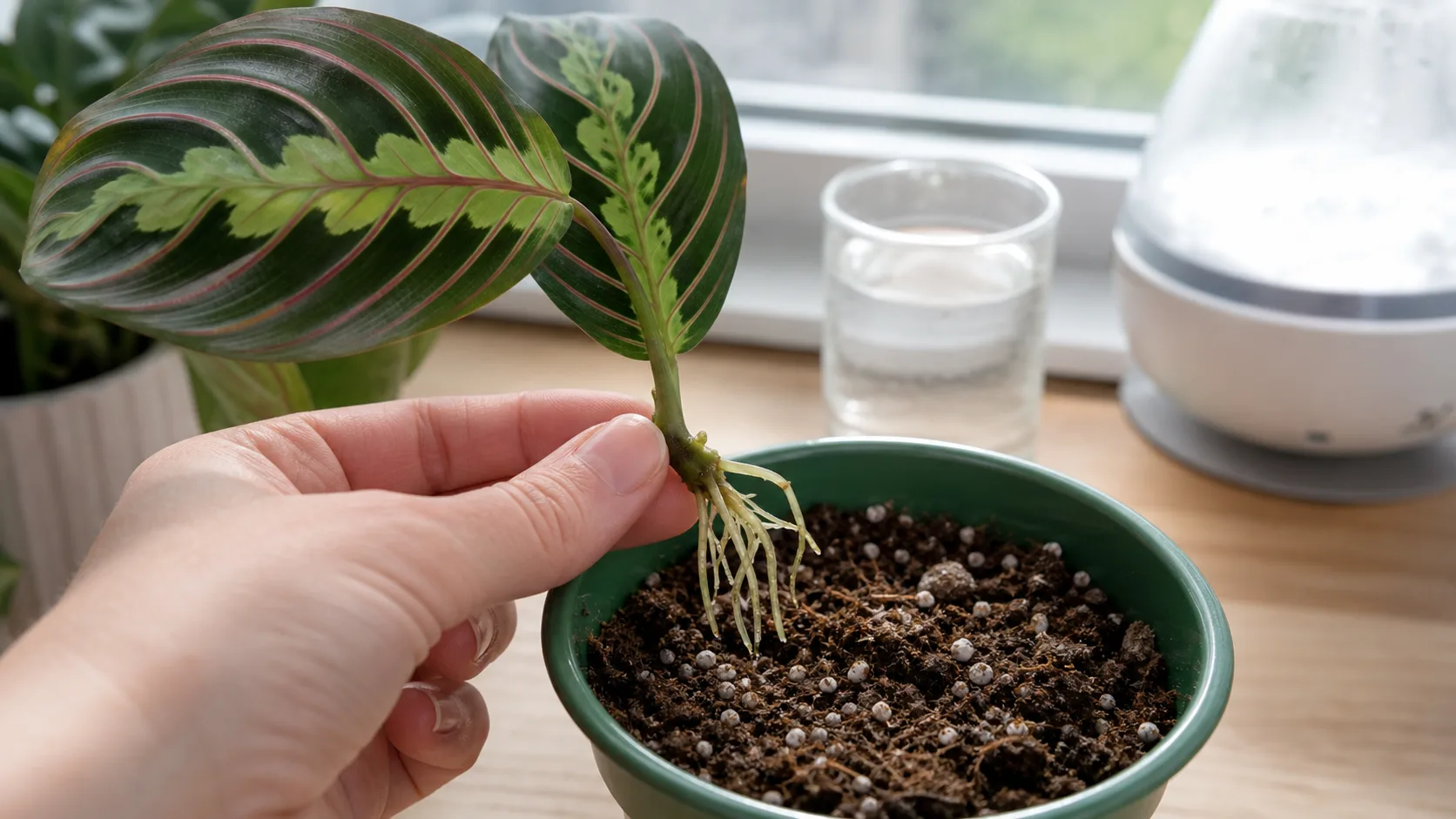
During the first two weeks in soil, protect the new root network with even light moisture, drainage, and stable indirect light.
If the cutting droops after potting
Check these in order:
- Were the roots actually ready? Tiny roots often cannot handle the transition.
- Is the mix too wet? Heavy wet mix can suffocate new roots.
- Did it dry too far? Freshly potted water roots do not like long dry gaps.
- Is it in harsh sun or dry air? Stress rises fast there.
Rescue move: return to even light moisture, stable warmth, and bright indirect light. Do not start fertilizing to fix transplant stress.
Common failure points to avoid
Propagating a leaf with no node
This is the most common false start. It may stay alive temporarily, but it is not the same as a viable stem cutting.
Potting too early
One root is not a root system. Wait for several roots with branching.
Leaving cuttings in stale water
Cloudy water and bad smell are not minor details. They are early warnings.
Overpotting
A large pot holds too much wet mix around a tiny root system. Use small containers first.
Treating softness like thirst
Soft dark tissue usually means rot or breakdown, not a need for more water.
Sources and scope
This article is intentionally narrow. It covers only the decisions that change propagation outcome for Maranta leuconeura: whether a piece is viable, whether cuttings or division is the safer path, when roots are ready, and how to avoid rot and post-potting stress.
Institutional references used here:
- NC State Extension for light, humidity, drainage, division, and rot risk
- Missouri Botanical Garden for moisture balance, cuttings, and division
- New York Botanical Garden for temperature and humidity guidance
- Royal Horticultural Society for Maranta’s rhizomatous, clump-forming habit
Community questions helped identify where readers get stuck, but they were not treated as evidence. Rooting speed and recovery still vary by plant health and home conditions, so the thresholds above rely on visible readiness and rot signals rather than promised timelines.
Method notes
The 65-to-70°F comfort range and above-55°F minimum come from the New York Botanical Garden source. Bright indirect light, moisture balance, drainage, cuttings, and division are institution-backed principles from the references above. The 5-to-7-day water change, multiple 1-to-2-inch branching roots, top-half-inch dryness check, and two-parts-mix-to-one-part-aeration recipe are conservative beginner rules used here to turn those principles into observable decisions; they are not claims that every cutting follows the same calendar.
Freshness and editorial methodology
Prepared by the KnowYourPlant editorial team and reviewed on July 19, 2026. The team checked current search results for the exact topic and close variants, used community snippets only to identify recurring questions, and verified plant-care claims against NC State Extension, Missouri Botanical Garden, New York Botanical Garden, and the Royal Horticultural Society. No fixed rooting timeline is promised because plant condition and home conditions vary.
Helpful next reads on KnowYourPlant
- Prayer Plant Care Guide
- Humidity for Plants Indoors
- Root Rot Treatment Guide
- How to Propagate Plants
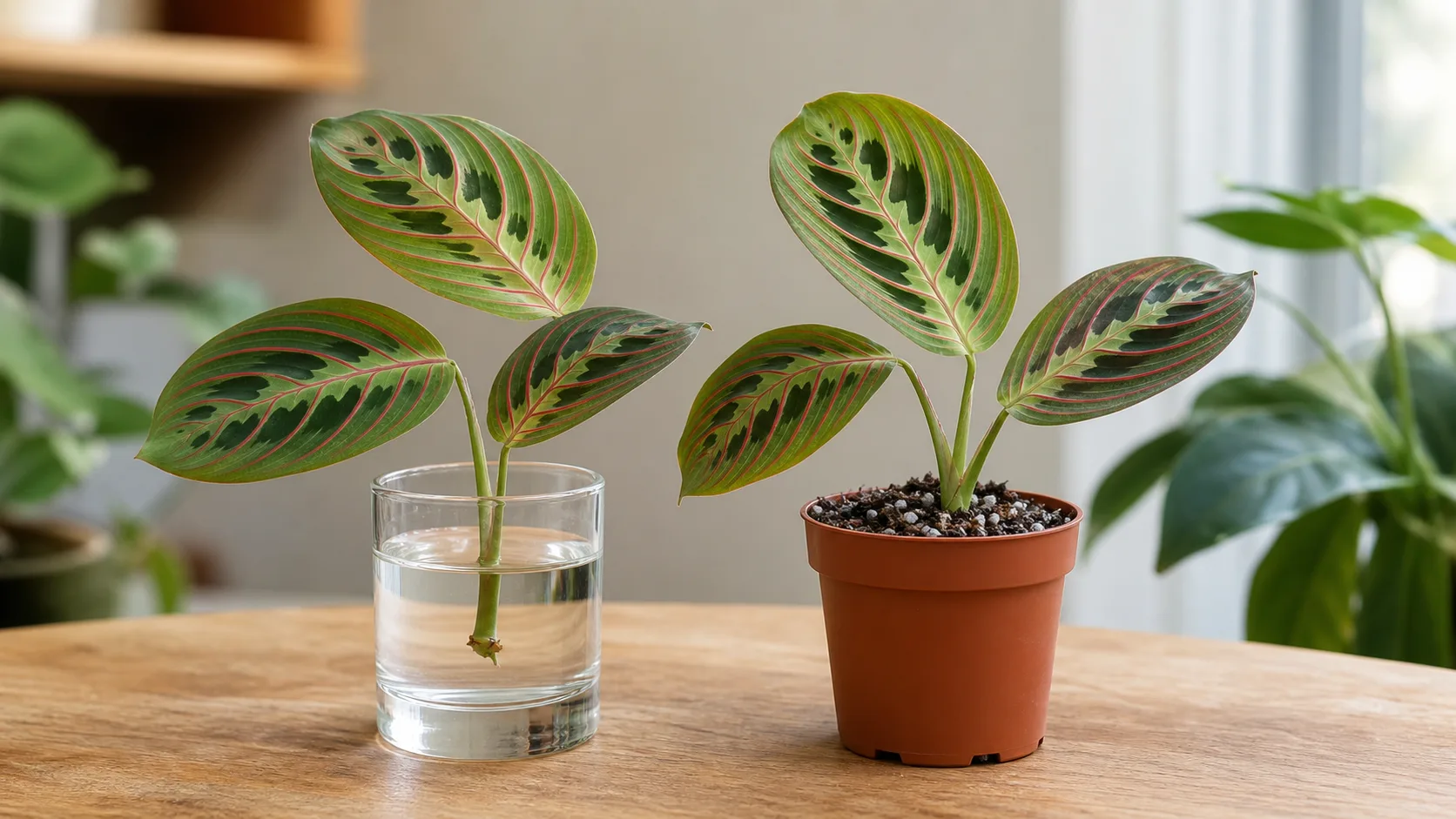
Whether you start in water or soil, track firmness, root branching, and moisture before changing the setup.
For a related hands-on growing walkthrough, use Orchid Propagation: Should You Cut, Wait, or Fix Care First? for the setup and follow-up care.
Use KnowYourPlant after setup, not before. Set recurring water-change reminders, log each root check with notes on firmness and branching, and use symptom rescue after potting if you see curling, yellowing, softness, or stall.