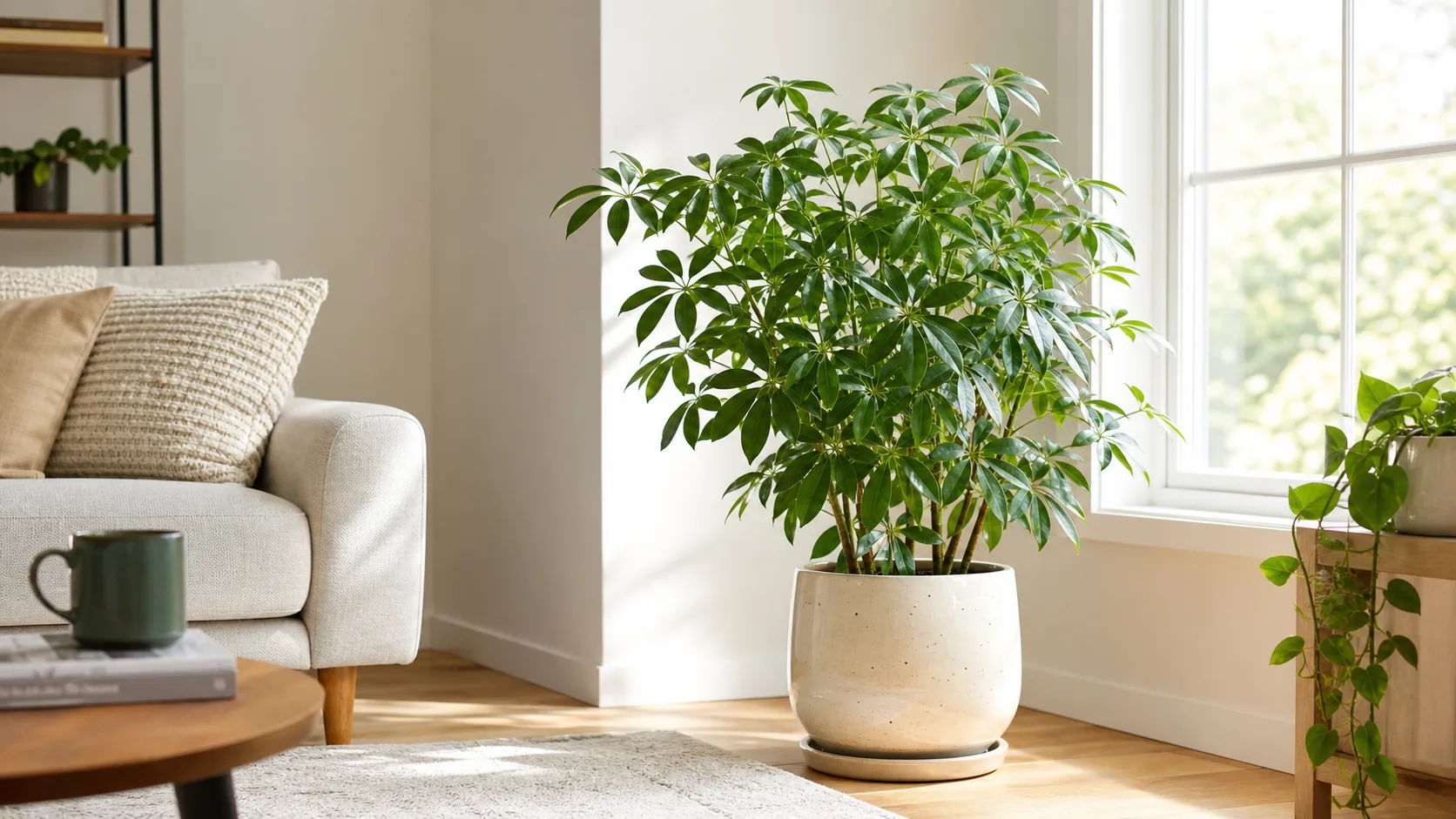
If your schefflera is dropping leaves, yellowing, leaning, or suddenly declining, this guide is built to help you solve the problem in the order that prevents avoidable plant loss: roots first, light second, temperature and drafts third, pests fourth, then pruning or repotting last. Most indoor failures happen when owners stack the wrong fixes on top of the wrong diagnosis.
The practical baseline is simple: bright filtered light, thorough watering followed by moderate drying, steady warmth, and fast inspection of the leaf undersides when symptoms begin. The hard part is not knowing the rules. It is knowing which rule matters first when the plant looks bad.
Quick answer
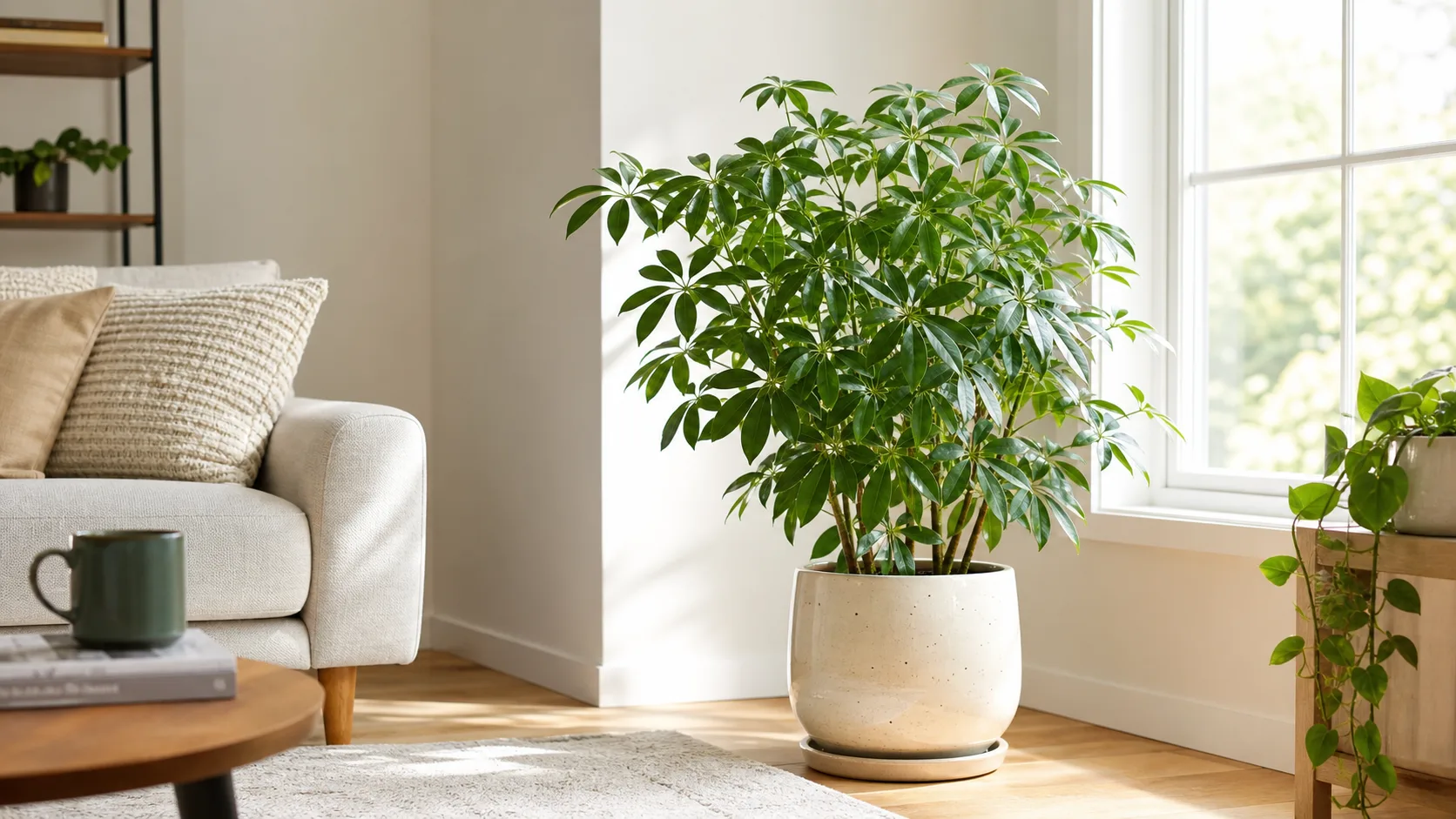
What to notice: compact growth, even shape, and good light from the side. What it means: the plant is meeting its basic light needs. Next action: keep the placement stable, then troubleshoot soil and pests before making bigger changes.
| Question | Short answer |
|---|---|
| Best light | Bright filtered light, often near an east window or a bright south or west window softened by a sheer |
| When to water | Water deeply, then use the top half inch of soil as a starting check; wait until that layer dries before watering again |
| Common leaf-drop cause | Soil that stays too wet or swings between too wet and too dry |
| First check today | Feel the soil, then look under leaves for mites, scale, or mealybugs |
The half-inch rule is a useful starting check, not a promise that every schefflera dries at the same speed. A small pot, airy mix, stronger summer light, and warm weather can dry faster. A larger pot, lower light, dense mix, or cooler room can keep the root zone wet much longer.
Not sure what plant you are caring for?
Open KnowYourPlant, snap a photo, and get the plant name plus care notes matched to the species in front of you.
Identify your plantWhat most Schefflera guides miss
Many schefflera care pages give correct basics but miss the part that causes indoor trouble: diagnosis order. A plant with yellow leaves, leaf drop, or drooping does not need the same fix every time. The same symptom can come from different causes.
For indoor plants, the most useful order is:
- Check whether the root zone has stayed wet too long or swung between wet and dry.
- Check whether the plant is actually getting bright usable window light.
- Check for drafts, vents, or cold exposure.
- Check leaf undersides and stems for pests.
- Prune or repot only after the earlier checks make sense.
That order fits the extension sources more closely than treating every problem as a simple watering mistake.
Do not stack stressors:
| If the plant is already stressed by… | Do not add this immediately | Safer next move |
|---|---|---|
| Wet soil or trapped runoff | More water, fertilizer, or a larger pot | Let the root zone dry appropriately and fix drainage |
| A recent move, draft, or cold shock | Heavy pruning or repotting | Stabilize light and temperature first |
| Low light and legginess | Repotting as the first fix | Move to brighter filtered light, then reassess shape |
| Active mites, scale, or mealybugs | Random watering changes only | Confirm pests and respond before changing everything else |
| A newly purchased plant still adjusting | Rotation, pruning, repotting, and feeding all at once | Make one correction at a time and watch the trend |
Use that step if you want help confirming the exact plant, setting reminders around your home conditions, and avoiding care advice meant for the wrong plant.
Plant ID + Plant Doctor
Not sure what your plant needs?
Snap a photo in KnowYourPlant to identify the plant, check yellow leaves, spots, wilting, or pests, and get a calm next step before the problem spreads.
Quick signs: too wet vs too dry
Schefflera can react badly at both ends, so match the symptom to the soil.
- Wet soil plus yellow, limp, or soft-feeling leaves points more toward overwatering or poor drainage.
- Wet soil plus leaf drop often means the roots have stayed stressed too long.
- Bone-dry soil plus crispy edges, dry leaf drop, or drooping that perks up after watering points more toward underwatering.
- Repeated swings between soggy and bone dry can also trigger leaf drop.
NC State notes that leaves can drop if the plant is kept too wet or too dry. Clemson also ties problems to excessive watering and poor drainage, while Illinois Extension says umbrella tree should dry moderately between waterings.
Want a care schedule you do not have to remember?
KnowYourPlant sends watering, feeding, repotting, and seasonal reminders based on the plants you actually own.
Get care remindersBefore you buy
Good fit if:
- Light: You have an east window, or a bright south or west window with filtered light for part of the day.
- Pet risk: Pets do not chew foliage, or the plant can be kept completely out of reach.
- Watering habits: You are willing to check the soil before watering instead of watering every Saturday by default.
- Temperature: The room stays fairly steady and does not drop below about 60 F at night.
Bad fit if:
- Light: The only spot is a dim interior corner or a gloomy room most of the day.
- Pet risk: Dogs or cats regularly chew leaves or knock into floor plants.
- Watering habits: You prefer a fixed calendar more than a soil check, or you often forget the plant until it is extremely dry.
- Temperature: The plant would sit by a drafty door, cold glass, AC blast, or heating vent.
If your room is dim most of the day, or if you water on a fixed weekly schedule without checking the soil, schefflera may frustrate you. It is a better fit for a bright room, a pot with drainage, and an owner willing to check the soil before watering. It is also not a good choice for homes where pets chew foliage.
The baseline that works in most homes
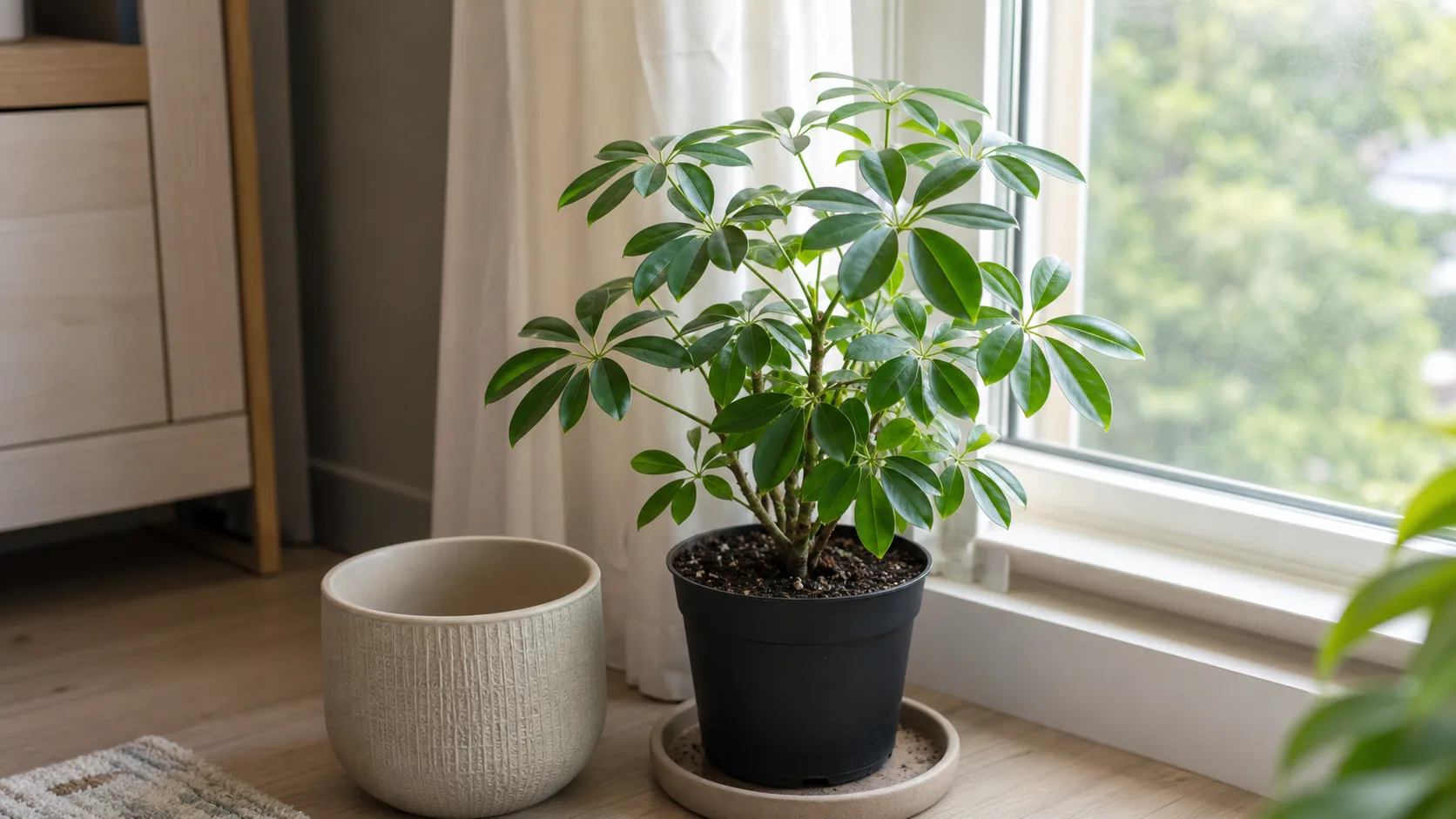
What to notice: the growing pot drains on its own and is not standing in water. What it means: the lower root zone can breathe between waterings. Next action: keep this setup and avoid letting runoff hide in the cachepot.
Schefflera usually stays healthier indoors when these basics are in place:
- Medium to bright filtered light
- Thorough watering, then partial drying before the next watering
- A pot with drainage
- No standing runoff left in a saucer or outer pot
- Stable temperatures, with nights above 60 F
- Enough humidity to avoid a very dry, pest-friendly room
- Pruning only after light and stability are improved
- Repotting for real root or drainage problems, not as a first reaction
That baseline lines up closely with the extension sources. Clemson recommends medium to bright light and says to water thoroughly, then let the soil dry about half an inch deep before watering again. NC State says dwarf schefflera does best indoors with filtered light for several hours and should not be exposed to temperatures below 60 F. Illinois Extension warns that umbrella tree is prone to spider mites in warm, dry rooms.
Expert translation: In plain apartment terms, extension guidance means schefflera is not a dark-corner, once-a-week plant. It usually does best when you can see clear daylight for several hours, when the pot drains completely after watering, when nights stay above 60 F, and when the room is not so hot and dry that mites get an advantage. If you only fix one thing first, make it usable light and drainage discipline.
Social listening: four recurring owner confusions
This section is qualitative only. It reflects recurring questions seen in reviewed community discussions and search-result excerpts, not prevalence data and not care authority.
Failure point 1: top-heavy, droopy, one-sided plant. Owners often do not know whether to move it, prune it, stake it, or repot it first.
Corrective sequence: move to brighter filtered light, stake if unstable, rotate gradually, prune in stages, repot only if root crowding or drainage failure is real.
Failure point 2: nursery pot inside a decorative outer pot. Owners often blame the soil or the species when the real problem is trapped runoff around the inner pot.
Corrective sequence: lift the nursery pot, dump any standing water, let the mix dry moderately, then decide later whether repotting is actually needed.
Failure point 3: stippling and decline mistaken for watering trouble. Owners often keep changing the watering schedule while mites or other sap-feeding pests keep spreading.
Corrective sequence: inspect leaf undersides and stem joints first, identify webbing, bumps, or cottony residue, then respond as a pest problem before changing every other care variable.
Failure point 4: yellowing and leaf loss blamed on one weekly habit. Owners often focus on the calendar and miss low light, cold exposure, and wet roots acting together.
Corrective sequence: check soil moisture pattern, confirm the plant gets real window light, rule out drafts or cold glass, then fine-tune watering only after those basics are clear.
Use community patterns as a clue about what to check. Use extension guidance for the actual care decisions.
Is your room a good fit?
Schefflera is much more forgiving in a bright room than in a dark corner. Illinois Extension says umbrella tree can reach about 8 feet indoors, which means it needs both light and enough space over time. The room does not need to feel tropical, but it does need stable conditions.
A good fit usually means:
- An east-facing window
- A bright south or west exposure with filtered light
- Space away from heating and cooling vents
- No repeated blasts of hot or cold air
- Enough room for the plant to grow upright instead of pressing into glass or furniture
A poor fit usually means:
- A dim interior corner
- A room that stays gloomy most of the day
- A spot right beside an AC vent or drafty door
- A place where pets can chew leaves
If your plant is leaning hard, stretching between leaf clusters, or losing density, treat that as a light warning first.
Light placement by window
“Bright indirect light” is too vague to solve real plant problems. Window direction tells you more.
| Placement | Fit | What usually happens |
|---|---|---|
| East window | Best for most homes | Bright, gentler light that supports fuller growth |
| South window behind a sheer | Very good | Strong light with some protection from harsh rays |
| West window with filtered light | Good | Can work well, but hot afternoon sun may be too intense against glass |
| A few feet back from a bright window | Sometimes good | Works if the room still stays bright for most of the day |
| Dim corner or interior room | Poor | Sparse growth, yellowing, leaning, and leaf loss over time |
NC State says indoor plants do best with eastern, western, or southern exposure and filtered light for 3 to 4 hours daily. Clemson recommends medium to bright light. Put together, that means schefflera wants meaningful brightness, not deep shade.
If you need one simple placement rule, try east first. If east is not available, use a bright south or west window and soften strong direct sun if leaves are pressed close to the glass for long periods.
Watering: use the half-inch check, then read the whole setup
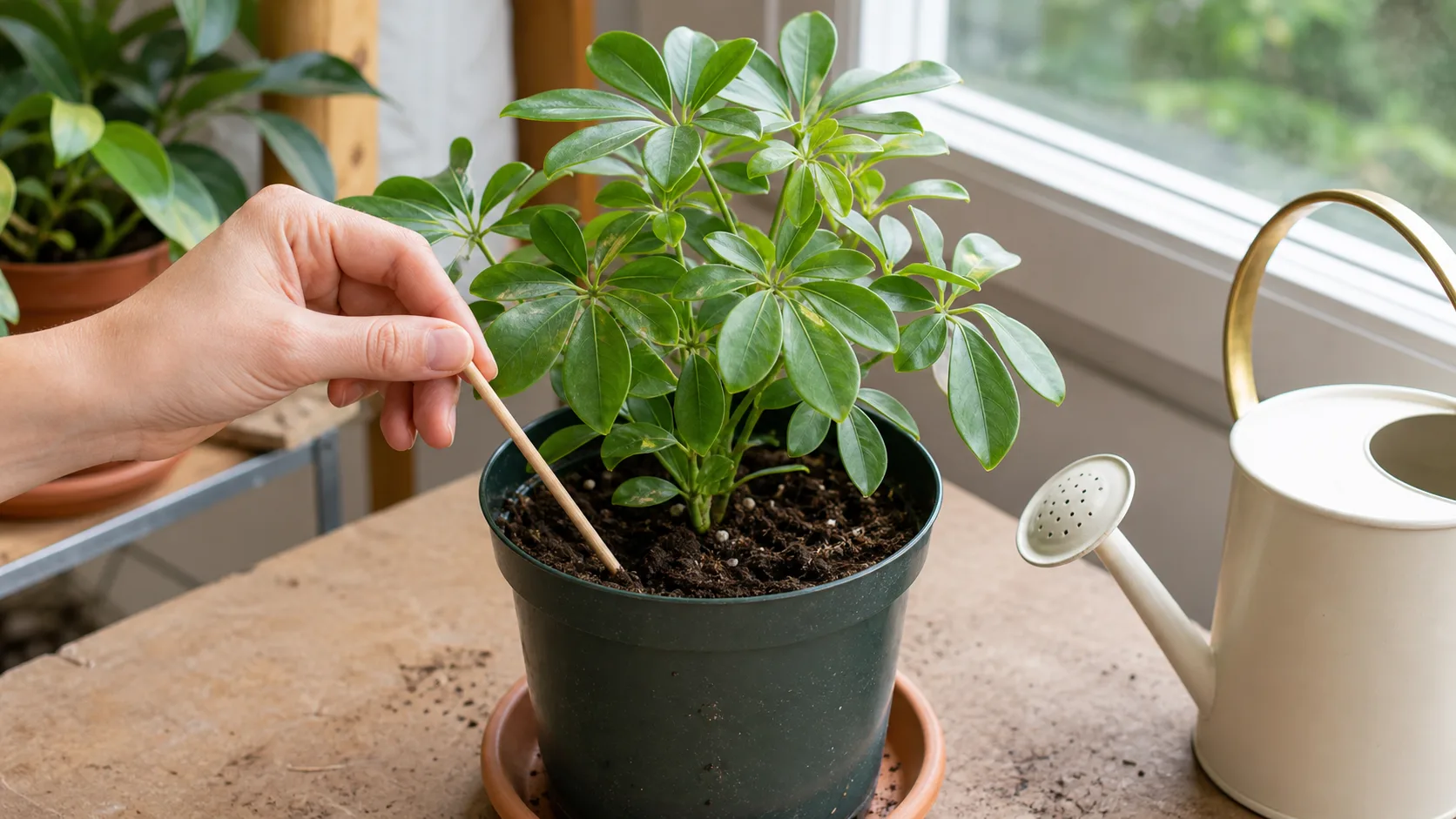
What to notice: the top layer may dry before the lower root ball does. What it means: the half-inch rule is a starting point, not the whole decision. Next action: combine the surface check with pot weight, drying speed, and drainage clues.
The best way to water schefflera is to stop using a rigid calendar. Water deeply, let excess drain, then wait until the top layer starts to dry before watering again.
Use this sequence:
- Push a finger into the top half inch of soil.
- If it still feels moist, wait.
- If that top layer feels dry, look at the whole setup before watering.
- Water thoroughly only when the drying pattern makes sense.
- Let the excess drain out fully.
- Empty the saucer or outer pot.
The half-inch check is helpful because it gives beginners a repeatable starting point. It is still only a starting point. Pot size, soil mix, season, and light change how quickly the root zone dries.
Concrete examples:
- Normal setup: A plant in a reasonably sized pot with decent light and a standard potting mix often follows the half-inch check well. Secondary signal: the pot feels lighter than it did right after watering.
- Oversized pot: The top half inch may feel dry while the lower mix is still wet. Secondary signal: the pot still feels heavy for its size, and the plant is drying slowly in lower light.
- Dense-mix setup: The surface may dry while the center stays compact and damp. Secondary signal: water moves through slowly, the mix feels tight, and the pot stays wet for many days.
- Cachepot setup: The top may look normal while the nursery pot is standing in runoff below. Secondary signal: lifting the inner pot reveals water collected in the bottom of the outer pot.
When the half-inch check can mislead you
Oversized pot
A schefflera in a pot that is much larger than the root ball can have dry topsoil while the lower mix stays wet. If the surface is dry but the pot still feels heavy and the plant is in lower light, wait and reassess before watering again.
Dense or broken-down mix
A dense mix can stay wet for too long even when the top starts drying. If water moves through very slowly, the soil feels compacted, or the plant stays wet for many days at a time, treat poor aeration and drainage as part of the problem.
Hidden cachepot
A decorative outer pot can trap runoff around the nursery pot. The surface may look normal while the bottom of the root ball stays wet. Always lift the inner pot and check whether water is collecting below it.
Cool or dim conditions
In winter, in air conditioning, or in a dim room, the plant may use water much more slowly. Do not keep the same summer rhythm.
Very bright or warm conditions
In brighter summer light, especially near an east window or a bright filtered south exposure, the plant may dry faster and need closer monitoring.
If you keep getting mixed signals, slow down and look at the last two weeks, not just the surface today.
The hidden drainage problem
A decorative cachepot can hide one of the biggest causes of schefflera decline. The soil surface may look fine, but runoff can sit around the nursery pot and keep the bottom of the root ball wet for days.
Clemson links root rot to overwatering and poor drainage. That matters because many people think they are watering normally when the real problem is trapped runoff.
Keep this standard:
- The inner pot should have drainage holes.
- Water should move out freely when you water.
- The bottom of the pot should not sit in standing water.
If your schefflera has yellow leaves and wet soil that never seems to dry, check the pot setup before you change fertilizer, humidity, or soil brand.
Temperature and humidity
Schefflera does not need perfect jungle conditions, but it does want stability. Clemson recommends day temperatures of 65 to 75 F and nights above 60 F. NC State says not to expose it to temperatures below 60 F.
Keep the plant away from:
- Cold glass in winter
- Air conditioner blasts
- Heat vents
- Exterior doors with repeated drafts
Humidity helps most when the room is very dry. NC State says schefflera likes high humidity. Illinois says spider mites are common in warm, dry rooms and that extra humidity plus regular leaf washing can help lower mite pressure. You do not need to chase an exact humidity number. You do need to avoid a spot that is bright enough to stress the plant but dry enough to help mites take over.
Leaf drop decision tree
Use this text decision tree in order. Follow the first branch that fits.
Start here: Is the plant dropping leaves right after a recent move, purchase, draft, cold exposure, or sudden light change?
- Yes: Stabilize the environment first. Move it to bright filtered light, keep it away from vents and drafts, and avoid repotting immediately unless drainage is clearly failing.
- No: Go to the next question.
Question 2: Is the soil still wet or staying wet for many days?
- Yes: Suspect overwatering, poor drainage, dense mix, or trapped runoff in a saucer or cachepot. Delay watering and fix the drainage setup.
- No: Go to the next question.
Question 3: Has the plant gone fully dry more than once, or is the soil pulling away from the pot edge and feeling bone dry?
- Yes: Suspect underwatering or repeated wet-dry swings. Resume deep watering only after the top half inch dries, and aim for a steadier pattern.
- No: Go to the next question.
Question 4: Is the plant in a dim corner, leaning hard, or growing with long bare stretches between leaf clusters?
- Yes: Suspect insufficient light. Move it gradually to a brighter filtered spot and reassess watering after the move.
- No: Go to the next question.
Question 5: Do you see stippling, fine webbing, sticky residue, white cottony patches, or bumps on stems and leaf joints?
- Yes: Treat it as a pest problem and inspect thoroughly before making more watering changes.
- No: Go to the next question.
Question 6: Did the decline start right after repotting or root disturbance?
- Yes: Reduce extra stress, keep conditions steady, and let the plant recover before making more changes unless the repot itself created a drainage problem.
- No: Recheck the full pattern in this order: recent change, moisture pattern, light level, pests, then roots.
Use that step if you want diagnosis help tied to your symptoms, plus reminders that keep you from repeating the same watering or placement mistake.
Pest inspection: what to look for
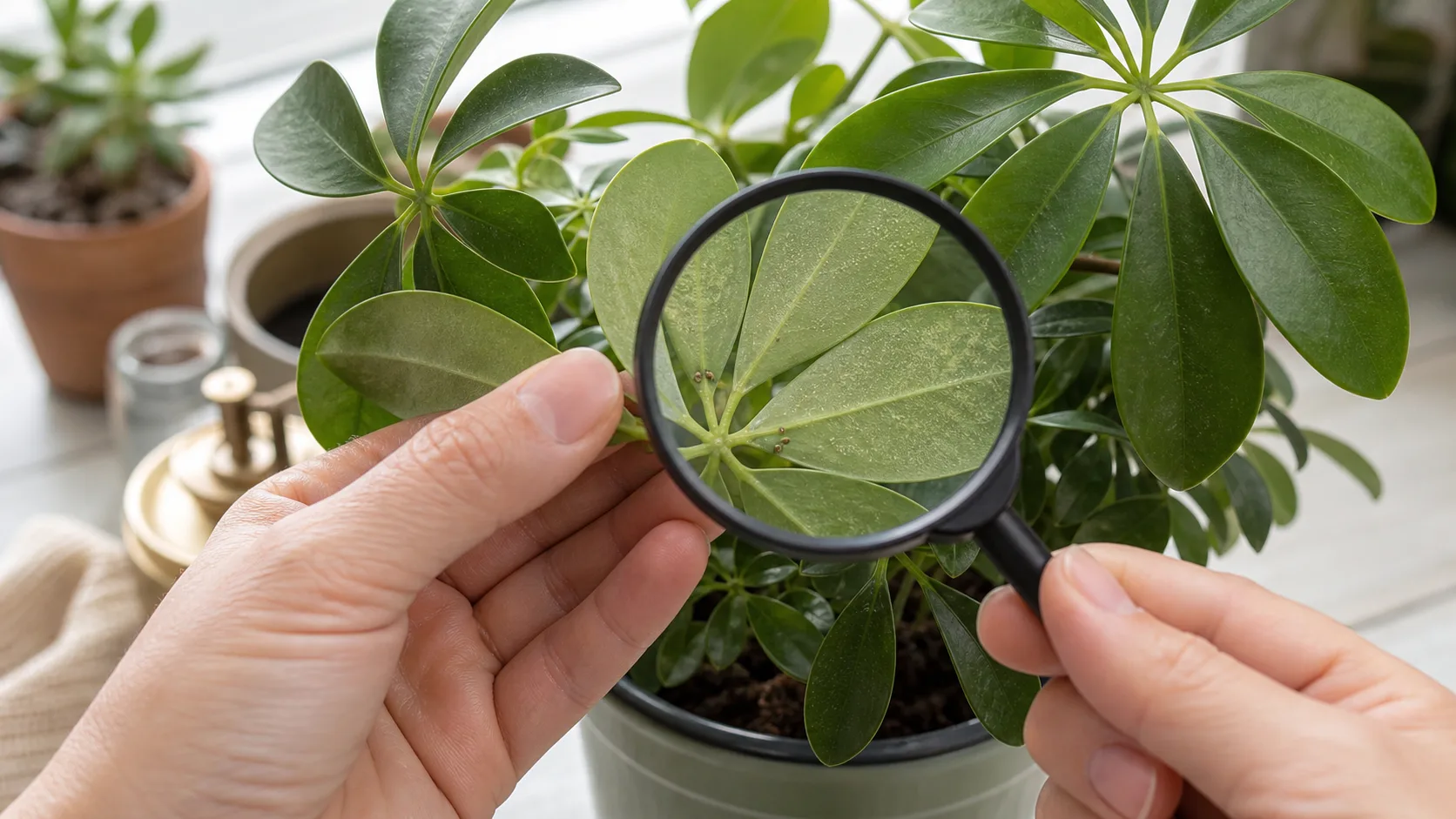
What to notice: pale speckling, webbing, sticky film, bumps, or white cottony patches. What it means: pest stress may be driving the decline. Next action: inspect thoroughly and respond as a pest problem before assuming watering is the only cause.
Schefflera often shows pest stress before beginners notice actual bugs. Check leaf undersides, where leaves join stems, and along the stems themselves.
Use this quick guide:
- Fine pale speckling: often spider mites
- Fine webbing: strong spider mite warning
- Sticky residue: often sap-feeding pests
- Small bumps on stems or leaf joints: often scale
- White cottony patches: often mealybugs
Illinois Extension says spider mites are common in warm, dry rooms. NC State lists red spider mites, mealybugs, and scale among common problems. If you see webbing or stippling, treat it as a pest issue, not just a watering issue.
Mini differential diagnosis:
- Spider mites: look for fine stippling first, then fine webbing if pressure is heavier. Damage often shows as a washed-out, dusty look rather than solid yellow leaves.
- Scale: look for attached bumps on stems and leaf joints plus sticky residue below them. If the bumps stay fixed when disturbed, use the scale insects treatment guide to confirm the pest and plan follow-up checks.
- Mealybugs: look for white cottony patches in protected spots where leaves meet stems.
- Watering-only yellowing: usually gives more general yellow leaves without webbing, bumps, or cottony residue, and the soil pattern often explains the timing.
For webbing or widespread stippling, follow the spider mite treatment guide rather than changing the watering schedule again.
The social evidence behind mite confusion is included here only as qualitative owner context. It is not the authority for the care guidance.
Compact symptom table
| Symptom | Likely cause category | First correction |
|---|---|---|
| Yellowing in a dim spot | Low light, sometimes with wet soil | Move to brighter filtered light and reassess watering |
| Leaf drop with wet soil | Overwatering or poor drainage | Delay watering and fix drainage |
| Leaf drop after repeated dryness | Underwatering | Resume deep watering only when the top half inch dries |
| Sudden drop after draft or cold | Chilling stress | Move to a stable warmer spot |
| Long bare stems and lean | Inadequate or one-sided light | Improve placement, rotate gradually, prune in stages |
| Stippling or webbing | Spider mites | Inspect thoroughly and treat as a pest issue |
| Sticky foliage or bumps | Scale or mealybugs | Treat pests before changing other care |
Rehab sequence for a recently purchased, top-heavy, one-sided plant
If you just brought home a schefflera that is leaning, top-heavy, or reaching strongly in one direction, avoid stacking every fix at once. Use this order instead.
1. Move it first
Place it in bright filtered light, ideally an east window or a bright south or west window with some softening. Keep it away from cold drafts, exterior doors, and vents.
2. Stake it if needed
If the main stem or stems are unstable, add support before pruning. Staking can reduce extra bending while the plant adjusts.
3. Rotate it gradually
Do not spin the plant sharply in one day. Turn it a little at a time over a few weeks so new growth can respond without another sudden stress.
4. Prune in stages
After the plant has started adjusting to better light, shorten the longest and weakest stems first. A staged prune is safer than removing a large amount of top growth at once on a stressed indoor plant.
5. Repot only if the evidence supports it
Repot only if one of these is clearly true:
- Drainage is failing
- The root ball is badly crowded
- The soil has broken down and stays dense or soggy
- Water is collecting in a hidden outer pot and keeping the bottom wet
If the plant is newly purchased but otherwise stable, better placement and drainage discipline usually come before repotting.
Worked example: You inherit a top-heavy schefflera that leans hard toward one window and droops over the pot rim. The first move is not a bigger pot. Put it in brighter filtered light, stake the main stem, rotate it gradually over the next few weeks, and wait to see how new growth responds. If the pot drains well and the root ball is not badly crowded, pruning after stabilization usually makes more sense than immediate repotting.
When repotting is actually needed
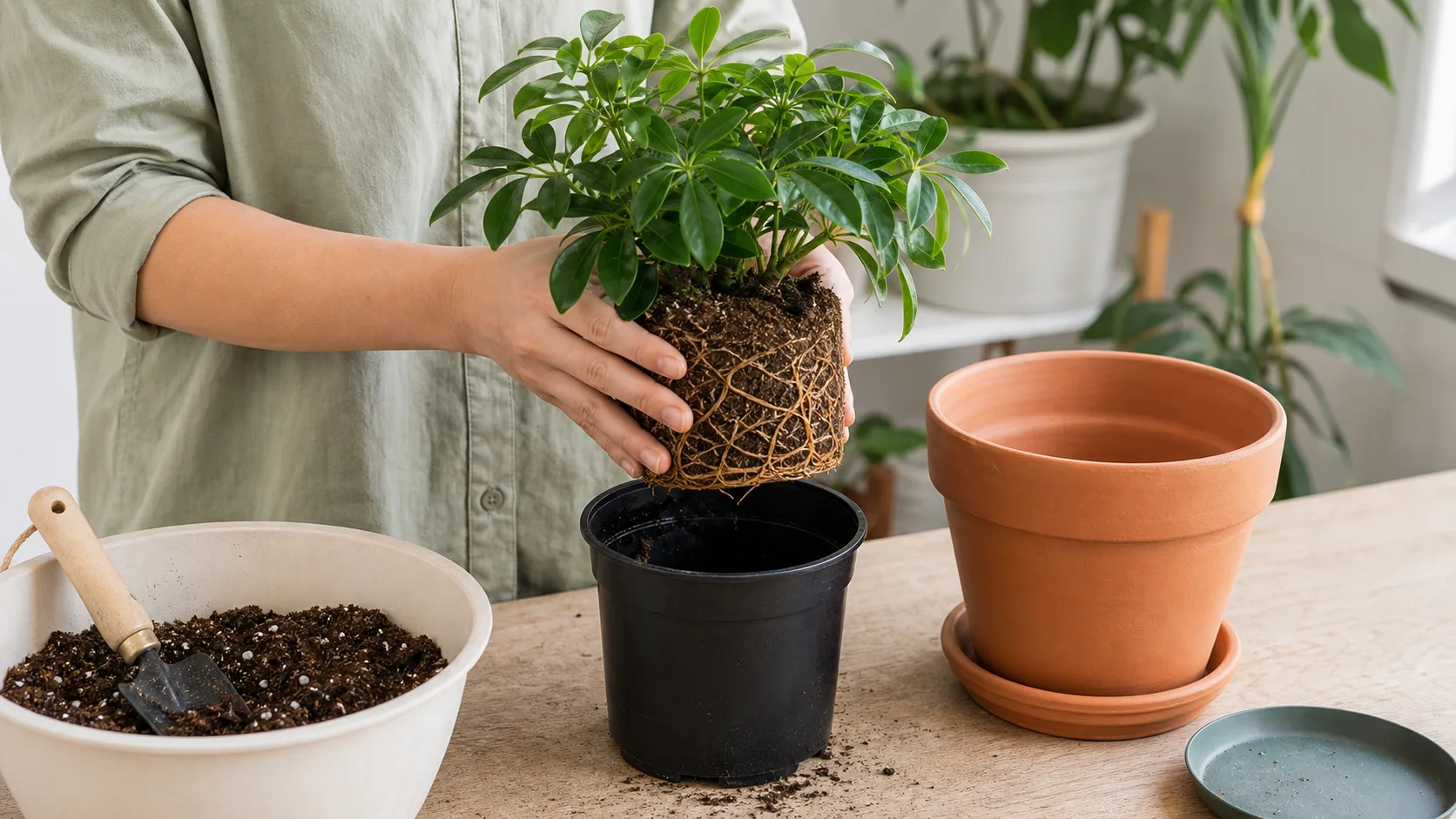
What to notice: actual root crowding, compacted mix, or drainage problems. What it means: repotting is a structural fix, not a reflex. Next action: repot only when the root ball or soil condition supports it.
Repotting is useful, but it is not the first fix for every problem. Illinois Extension says umbrella tree can grow in an all-purpose potting mix, which is a useful reminder that many failures come from water management more than from using the wrong soil.
Repot when:
- The mix stays soggy too long
- Drainage is poor
- The roots are badly crowded
- The soil has broken down and stays dense
- Water runs around the pot without soaking in well
Wait on repotting when:
- The plant is newly purchased and otherwise stable
- The main issue is legginess
- Leaf drop started right after a move to a new room
- The roots are not crowding the pot much
- You have not yet checked light, moisture, and pests carefully
If you have to choose one first step for a top-heavy plant in low light, choose better placement before repotting.
Worked example: You buy a new schefflera that looks healthy on top but the nursery pot is sitting inside a decorative cachepot full of old runoff. The first fix is to remove the trapped water and let the root zone start drying normally. If the plant is otherwise stable, do not rush into a full repot that same day. Reassess after the pot has had time to drain and after you know whether the mix is actually staying too wet.
Pet safety
Schefflera is not a good plant for homes where dogs or cats chew leaves. NC State lists dwarf schefflera as seriously toxic to both. Treat that as a real placement and buying decision.
14-day stabilization plan
If your schefflera is struggling, do a short reset instead of changing everything at once.
Days 1 to 2
- Move it into medium to bright filtered light.
- Keep it away from drafts and vents.
- Check whether the top half inch of soil is dry before watering.
- Empty trapped runoff from saucers or cachepots.
- Inspect leaves and stems for mites, scale, and mealybugs.
Days 3 to 5
- Keep conditions stable.
- Do not fertilize.
- Do not repot unless drainage is clearly failing.
- Watch whether leaf drop slows after the move to better light and steadier warmth.
Days 6 to 8
- Recheck soil using the same half-inch starting check.
- Water thoroughly only if that top layer has dried.
- Clean dusty leaves and inspect undersides again.
Days 9 to 11
- If the plant is still top-heavy but otherwise steadier, stake it if needed.
- Prune the longest, weakest stems in stages.
- Rotate only slightly if one side is badly stretched.
Days 12 to 14
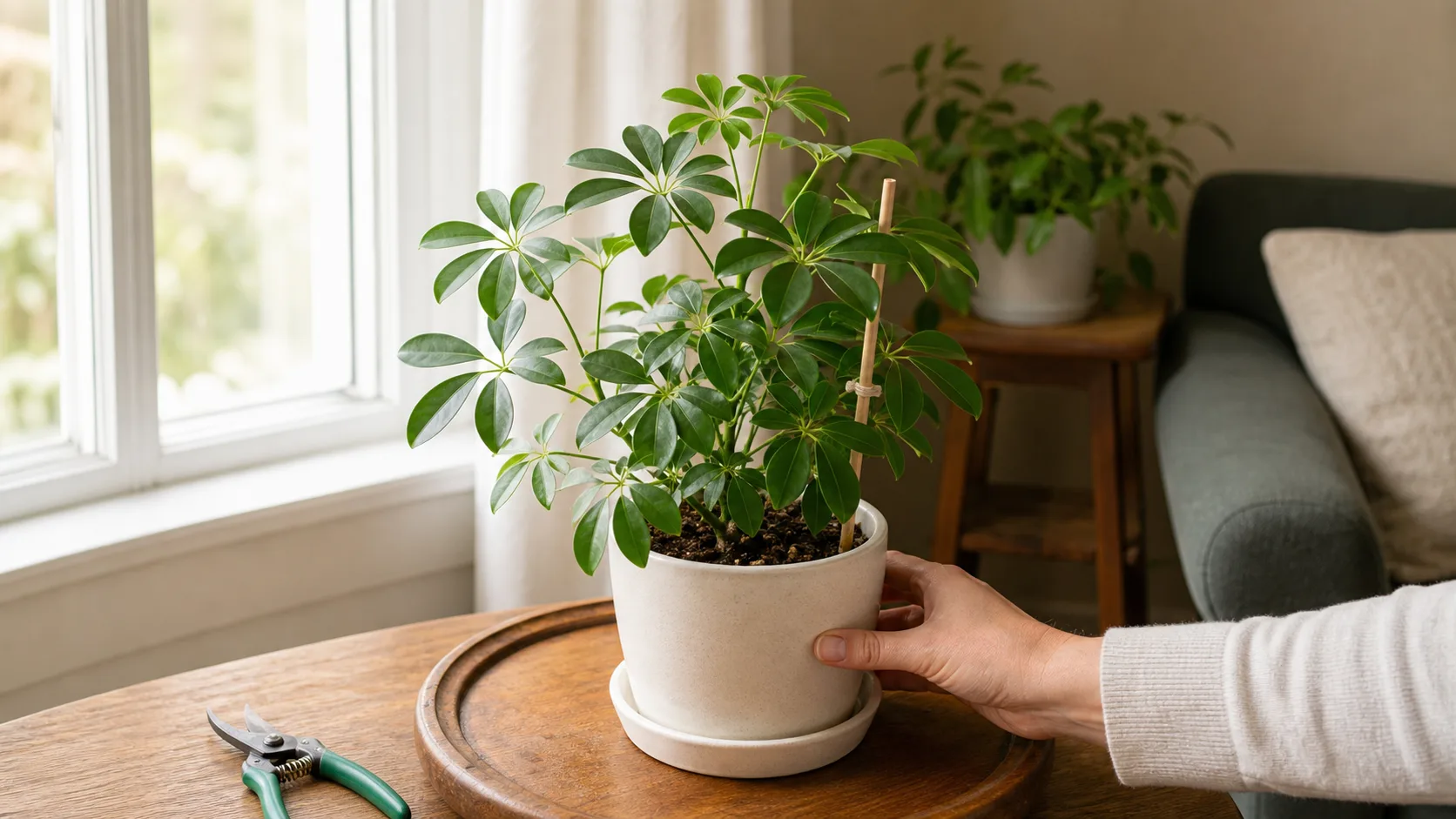
What to notice: slower leaf loss, steadier posture, and a more predictable drying pattern. What it means: the plant may be stabilizing. Next action: choose the single next correction that the evidence supports, instead of stacking more stress.
- Decide whether repotting is truly necessary.
- Repot only if roots, drainage, or degraded soil clearly justify it.
- If symptoms continue, revisit the same order: recent change, moisture pattern, light, pests, then roots.
A schefflera usually improves when the environment gets steadier and your response gets more ordered.
Today: check the soil, empty any trapped runoff, move the plant into brighter filtered light if needed, and inspect leaf undersides for pests.
This week: keep temperature and watering consistent, avoid repotting or heavy pruning unless the evidence is clear, and watch whether leaf drop slows under steadier conditions.
This season: correct chronic issues like poor placement, dense exhausted soil, real root crowding, or repeated pest pressure one at a time instead of all at once.
Use that next step if you want personalized care guidance, symptom-based diagnosis support, or reminders for watering, rotation, and pest checks.
Methodology note
Author: KnowYourPlant editorial team
Reviewer: KnowYourPlant horticulture review
Last reviewed: July 19, 2026
Source hierarchy: Extension and university-backed care guidance came first, especially NC State Extension, Clemson Home & Garden Information Center, and Illinois Extension. Community discussion was used only as a secondary qualitative layer to understand the kinds of owner confusion this topic creates.
Freshness note: This article and its source set were reviewed on July 19, 2026.
Methodology: The article was revised after reviewing the direct source pages listed in the frontmatter and article sources, along with search and community research notes for common indoor-care failure points such as leaf drop, low-light decline, repot timing, and mite confusion.
Social-evidence limitation: Community evidence here is qualitative only. It can show the kinds of questions people ask, but it does not prove prevalence and it does not override extension guidance.
Sources
- NC State Extension: Heptapleurum arboricola
- Clemson Home & Garden Information Center: Schefflera
- Illinois Extension: Umbrella tree
For a related care deep dive, see the low-light indoor plants guide, the cat-safe indoor plants guide, the grow lights guide for indoor plants.
Save this plant plan before you forget the details.
Keep the plant, diagnosis notes, reminders, and care changes in KnowYourPlant so the next decision is based on your actual plant history.
Open KnowYourPlant