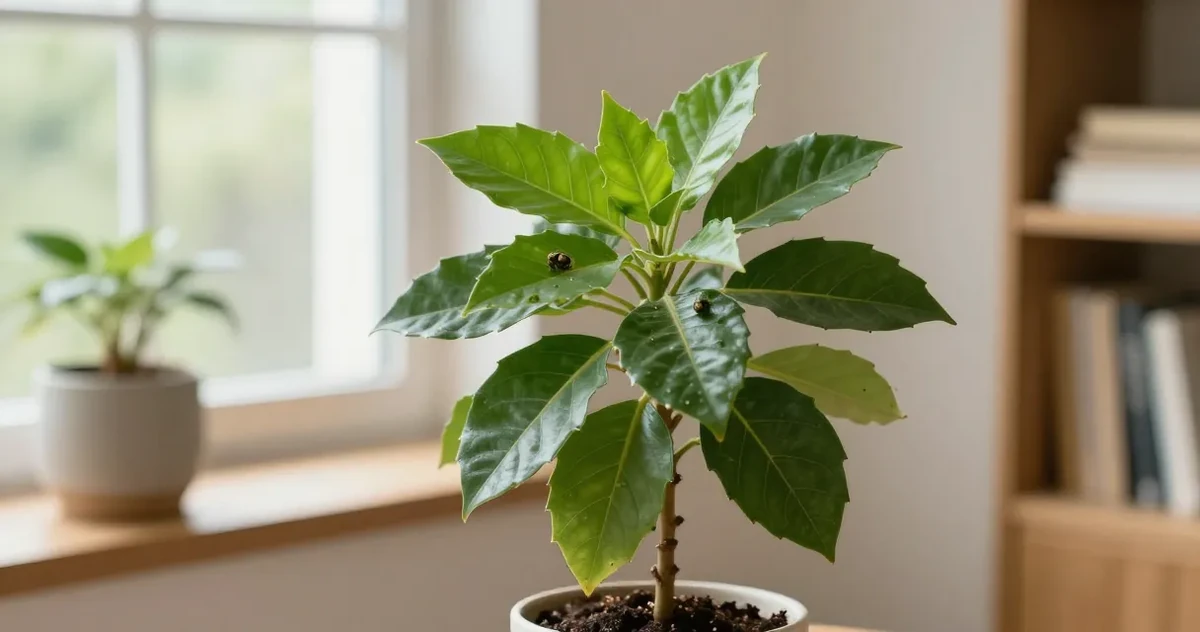
You wipe the plant down, pick off every visible bump, spray it with insecticidal soap. Three weeks later, the stickiness is back. You missed something, and the generic guides do not tell you what.
Scale insects are small sap-sucking bugs that attach to plant stems and leaves under a hardened or waxy covering, making them look like part of the plant rather than an infestation. What most guides skip is the part that explains why so many people treat the same plant three or four times without ever fully clearing the problem: scale has a life stage – the crawler – that most contact products miss, and the two main types respond to completely different treatments.
Getting the identification right first is not optional. It’s the difference between a one-month fix and a six-month frustration.
What You’re Actually Looking At
Scale insects come in two distinct types. The type you have changes everything about how you treat them.
Soft Scale
Soft scales leave sticky honeydew: the clear, tacky residue you find on leaves below the infestation, on furniture, or on the floor beneath the pot. If your plant suddenly feels grimy, or the leaves look shiny and slightly dull at the same time, that’s often soft scale.
The insects themselves look like small oval bumps, brownish or yellowish, pressed against stems and leaf undersides. Their covering is part of their body, not a shell they live under.
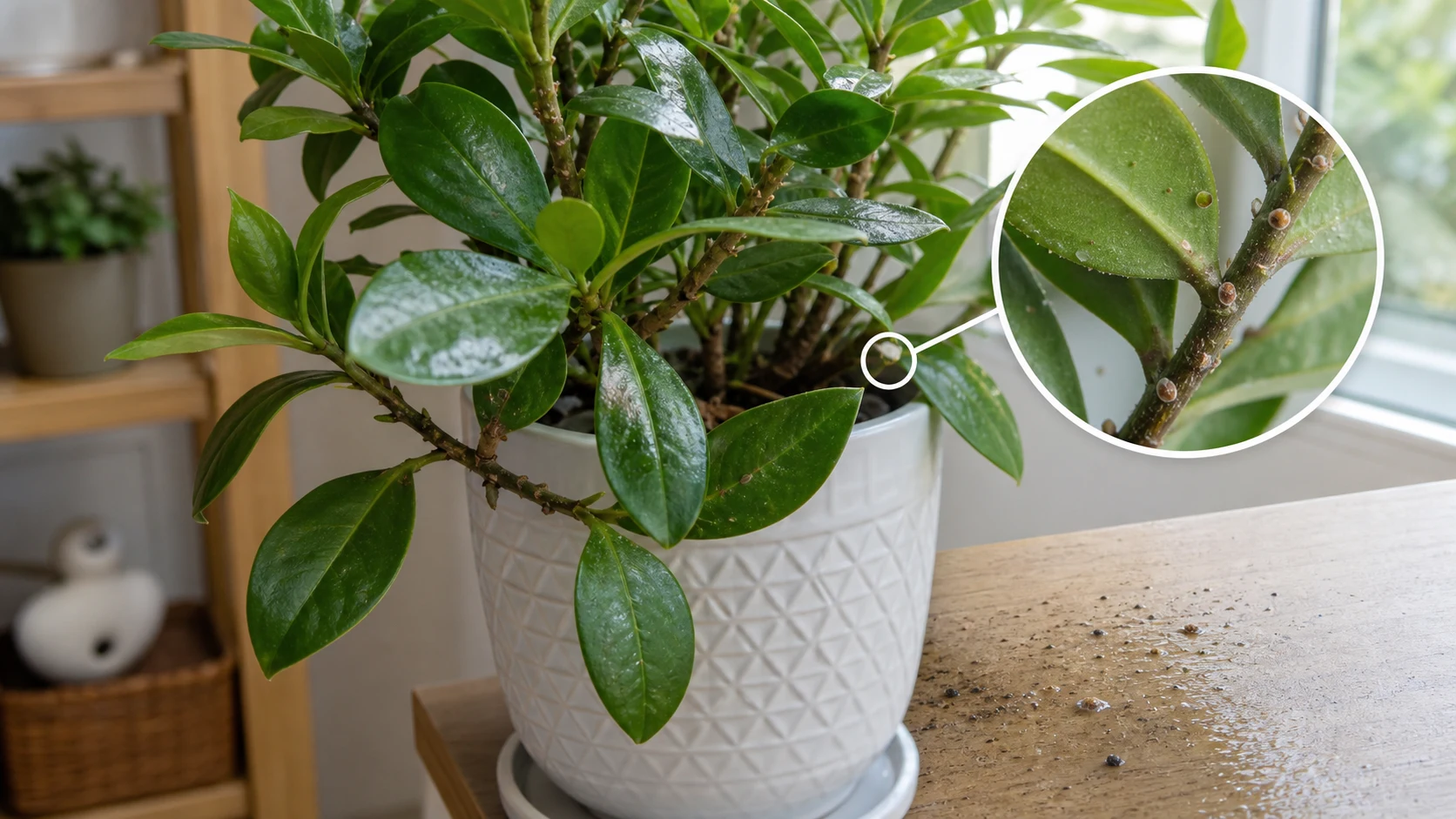
Sticky honeydew and small brown bumps on ficus stems are practical clues that point to soft scale.
Armored Scale
Armored scales don’t produce honeydew. Their signs are subtler: pale or yellowing patches on leaves, stems that look dusty or lightly stippled, small circular or oyster-shaped bumps that scrape off as a clean dome, leaving a tiny insect underneath.
The scrape test is the practical dividing line between the two types. Run your fingernail under one bump. If it smears, soft scale. If it lifts off cleanly as a separate cap, armored scale.
The distinction matters because the waxy armor on armored scale is a separate physical shield, not part of the insect’s body. Some systemic insecticides that move through the plant’s tissue, including soil-applied imidacloprid, are effective against soft scale but do not reach armored scale sitting behind that physical barrier.
Soft Scale vs Armored Scale: Quick Comparison
| Feature | Soft Scale | Armored Scale |
|---|---|---|
| Sticky honeydew on leaves or surfaces | Yes | No |
| Covering | Part of the body | Separate waxy shield |
| Scrapes off cleanly | No, smears | Yes, pops off as a cap |
| Systemic insecticides effective | More likely | Limited |
| Common hosts | Citrus, ficus, ivy | Palms, cacti, woody stems |
| Sooty mold (black coating on leaves) | Common | Rare |
Treatment Approach at a Glance
| Soft Scale | Armored Scale | |
|---|---|---|
| First step | Wipe down with alcohol-dipped swab; remove adults manually | Scrape off adults with swab or soft cloth; don’t just spray |
| Follow-up spray | Insecticidal soap or neem oil, weekly for 4-6 weeks | Horticultural oil timed to crawler hatch, weekly for 4-6 weeks |
| Systemic insecticide (indoor) | Check label; some are effective, but many are outdoor-only | Generally unreliable; armor blocks uptake |
| When to escalate | Heavy coverage after two full treatment cycles | Heavy coverage after two full treatment cycles |
| Key risk | Missing crawler hatch window | Thinking sprays alone are working (they rarely penetrate the armor) |
Is It Really Scale? Common Confusions
Mealybugs vs scale: If scraping the bump leaves behind fluffy white residue, almost like tiny cotton tufts, you have mealybugs, not scale. Mealybugs tend to cluster in leaf joints and stem forks. Scale sits flat against stem surfaces in rows or patches with no fluffiness. Different pest, different treatment.
Scale vs fungal deposits: White powdery patches on leaves that wipe off easily and have no three-dimensional bump underneath are more likely powdery mildew or mineral deposits from water. True scale has a distinct bump you can feel with your fingernail before you scrape.
Scale vs spider mites: Spider mites are almost invisible individually and leave fine webbing on leaf undersides. Scale is the opposite: stationary, visible as distinct bumps, and no webbing. If you see webbing, scale is almost certainly not the problem.
If the signs still do not fit, use the houseplant pests identification guide to compare scale with fungus gnats, thrips, spider mites, and mealybugs before choosing a treatment.
Scale Insects Symptom Diagnosis Card
Use these visible clues before you choose a product.
| What you notice first | Most likely reading | What to do next |
|---|---|---|
| Sticky residue on leaves, shelf, or floor | Soft scale is more likely | Check stems and leaf undersides for brown or tan bumps, then isolate the plant |
| Dry bumps that lift off like tiny caps | Armored scale is more likely | Start with manual removal, then plan repeat oil or soap sprays for crawler hatch |
| White fluffy residue in leaf joints | Probably mealybugs, not scale | Switch to a mealybug-specific ID and treatment path |
| Fine webbing and dusty stippling | Probably spider mites, not scale | Treat as mites, not scale |
| New bumps appear after a cleanup round | Crawler hatch or nearby reinfestation | Check neighboring plants and restart weekly follow-up timing |
Not sure what plant you are caring for?
Open KnowYourPlant, snap a photo, and get the plant name plus care notes matched to the species in front of you.
Identify your plantWhat Most Scale Treatment Guides Miss
Most guides recommend the same steps: wipe down, apply neem oil, repeat. That advice isn’t wrong, but it skips the reason so many people keep failing.
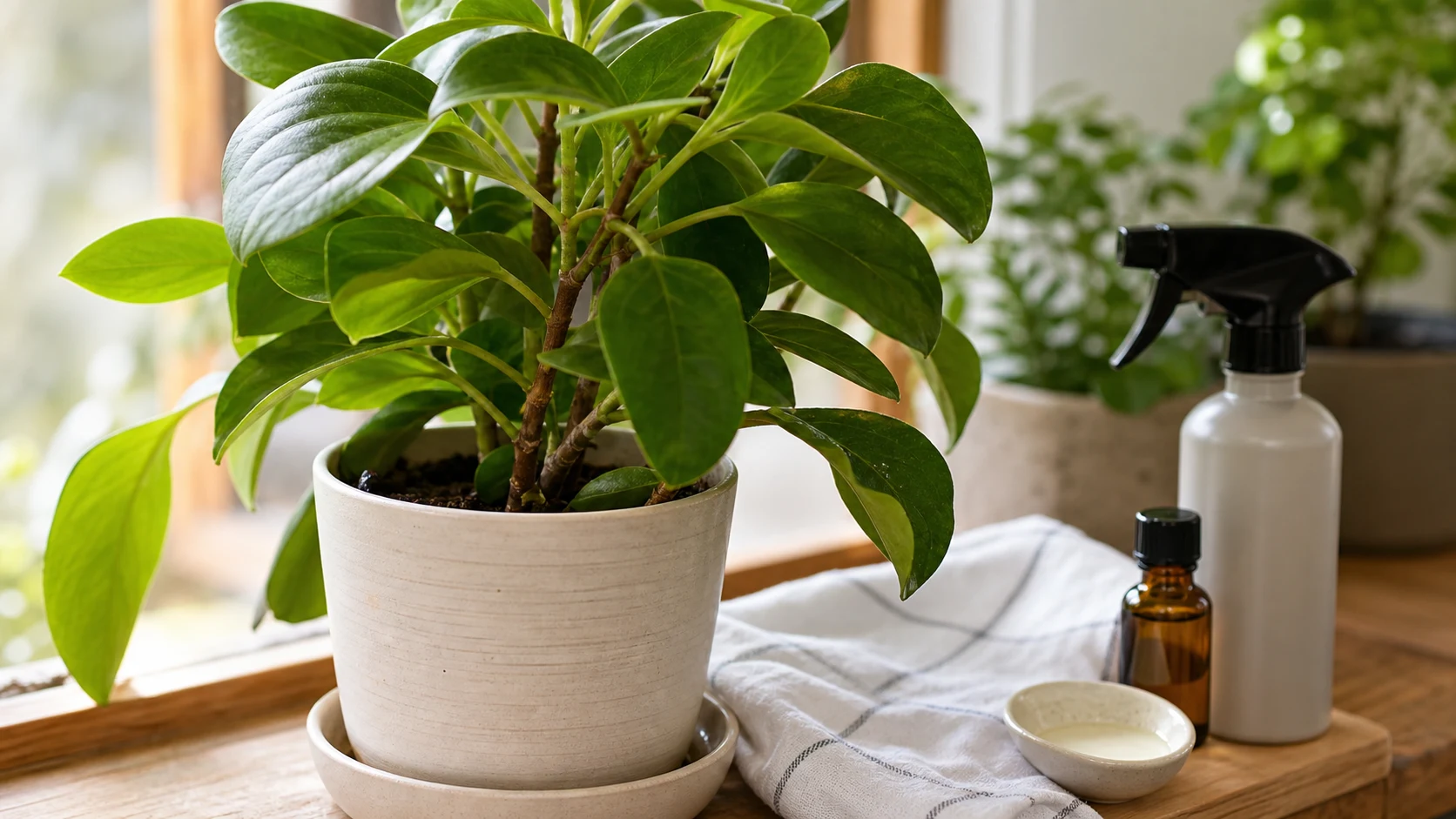
Persistent scale beside several treatment tools is a reminder that product choice and crawler timing matter as much as repeated spraying.
The common misdiagnosis: Treating both scale types the same way. According to the University of California IPM program, soil-applied imidacloprid, one of the most widely recommended systemic insecticides, is not effective against some scales, including armored scales specifically. A product that works well on soft scale may do almost nothing against armored scale sitting behind its separate physical armor.
The timing problem generic guides ignore: Scale goes through a crawler stage, a brief window when the immature insects are mobile and have no protective covering. Contact sprays are far more effective against crawlers than against adults under hardened armor. The University of Minnesota Extension is explicit: correct timing is critical, and identifying the scale species matters before choosing any management approach.
The practical first check: Scrape one bump. Soft scale smears. Armored scale pops off as a clean dome. If what comes off leaves fluffy white residue rather than a distinct cap, you may have mealybugs instead. Get the identification right before picking up any product.
The Scale Life Cycle and Why Standard Treatment Misses It
Understanding this part takes the frustration out of the repeat-failure cycle.
Adult scale, the bumps you can see, are largely stationary. Females lay eggs under or near their bodies. The eggs hatch into crawlers: tiny mobile insects that move across the plant looking for a feeding site. The crawler stage lasts hours to a few days before the insect settles, attaches, and begins building its protective covering.
Once that covering forms, contact sprays become much less effective. Neem oil and insecticidal soap work by coating the insect or disrupting its breathing. Neither penetrates a well-formed waxy or armored covering reliably.
What this means practically:
- Treating once removes visible adults and kills any crawlers present at that moment
- Eggs laid by the adults you removed will hatch over the next one to several weeks
- Each new hatch produces a brief window when contact sprays are highly effective
- Missing that window means the next generation reaches adulthood, forms armor, and the plant looks infested again
Iowa State University Extension recommends planning for four to six weekly applications for complete control. That timeline maps to the crawler hatch cycle, not to product weakness. You need to be there each week a new batch of crawlers emerges.
Signs crawlers have hatched: Look for very small, lighter-colored, and slightly mobile specks near where adults were attached. They’re easy to miss with the naked eye, but a magnifying glass over a treated area often shows them. Catching this generation with a follow-up application is what breaks the cycle.
Scale Treatment Decision Tree
Use this order to choose the next step instead of escalating blindly.
- If you see sticky honeydew, start by assuming soft scale and inspect the stems and leaf undersides closely. Manual removal plus repeat soap or oil applications is usually the first indoor path.
- If the bumps scrape off like separate shells and there is no stickiness, treat it like armored scale. Do not rely on systemics first. Manual removal and timed follow-up sprays matter more.
- If you are not fully sure it is scale, pause before spraying and compare the signs against mealybugs, spider mites, or residue from mildew or minerals. Misidentification is one of the main reasons treatments appear to fail.
- If only one or two leaves or stems are affected, isolate the plant and do a full wipe-down immediately. Small infestations are much easier to clear before crawlers move.
- If several nearby plants show bumps or stickiness, treat the whole cluster like an active outbreak. Check and quarantine neighboring pots on the same day.
- If the plant is heavily covered and still declining after two full treatment cycles, move to a discard-or-quarantine decision instead of repeating the same light treatment again.
Scale Insect Treatment: What Actually Works
Step 1: Isolate First, Always
Move the affected plant away from your other plants before doing anything else. Crawlers are mobile during their brief active window, and if leaves from different pots are touching, crawlers can walk between plants before you’ve finished treating the first one.
The University of Maryland Extension flags quarantining affected plants as one of the most important early steps for indoor scale management, partly because treatment options in enclosed indoor spaces are more limited than in a garden.
Step 2: Manual Removal Before Any Spray
For houseplant-sized infestations, start with physical removal. Dip a cotton swab or soft cloth in rubbing alcohol (70% isopropyl) and wipe scales off stems and leaves individually. This is slower than spraying but removes the adults that contact sprays can’t kill through their covering.
Don’t rush this step. Check every leaf underside, every stem joint, and every fold where leaves attach. Scale hides in tight crevices where spray doesn’t reach, and surviving adults are what restart the infestation.
Step 3: Follow Up With Repeat Spray Applications
After manual removal, apply insecticidal soap or horticultural oil to the entire plant: every leaf surface (both sides) and all stem surfaces. Iowa State University Extension recommends four to six weekly applications for complete control. Each application is targeting the next crawler hatch, not the adults you already removed.
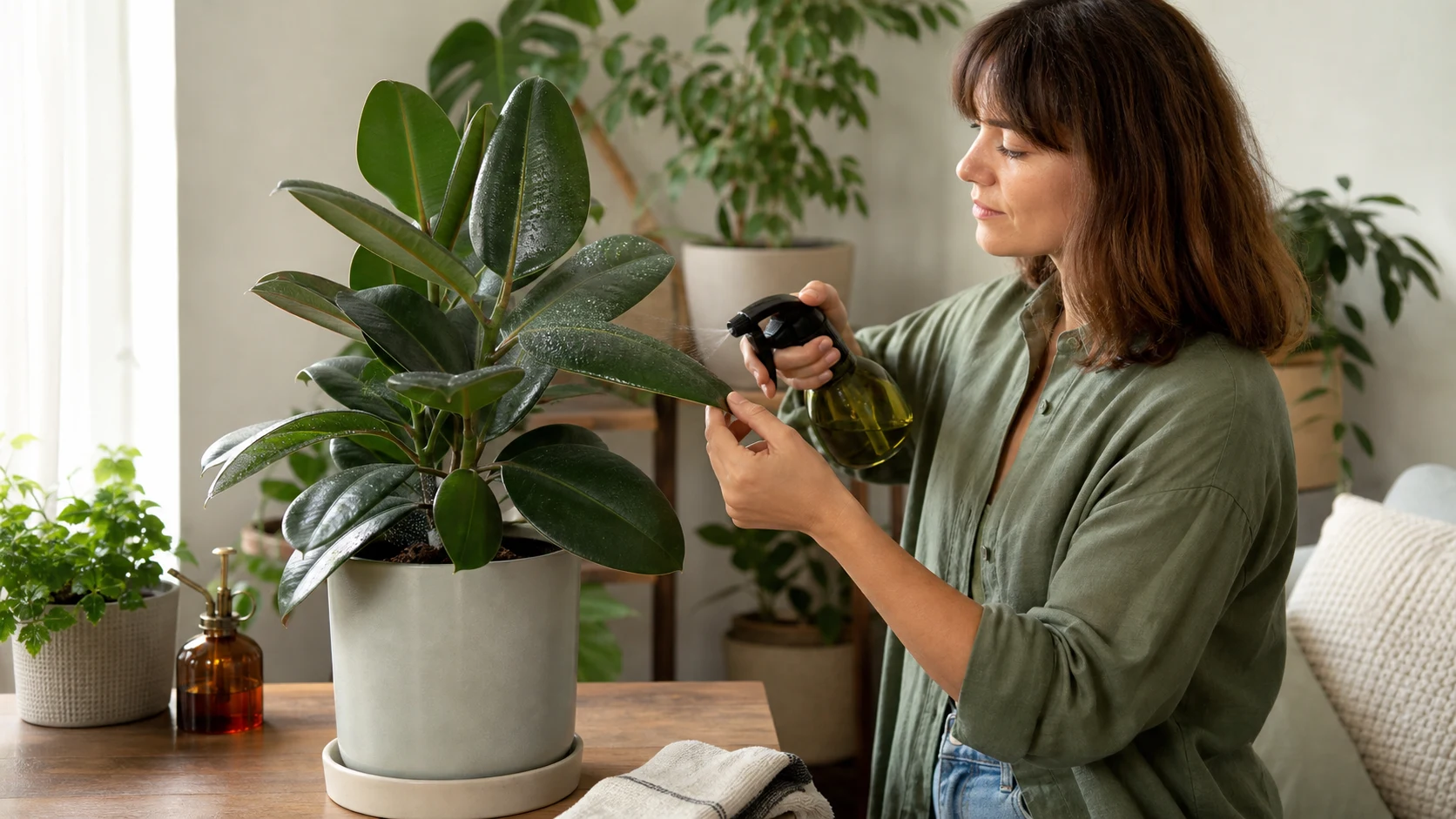
Lifting each leaf while spraying helps coat both surfaces and the stems where newly hatched crawlers settle.
If you’re using neem oil for follow-up, the neem oil guide covers dilution rates and how to avoid the leaf burn that happens with incorrect concentration or timing.
Step 4: Horticultural Oil Timing (Indoors)
Horticultural oil works, but it can damage foliage if applied in direct sun or high heat. For indoor plants, move the pot away from a south-facing window or bright grow light for a few hours after treatment. Apply in the morning or evening rather than at peak light.
Note: recommendations about dormant-season oil application or treating actively flowering shrubs apply to outdoor garden plants. For indoor houseplants, the main rule is to avoid bright direct light immediately after treatment, keep the plant at room temperature, and never apply to heat-stressed or drought-stressed plants.
Step 5: Systemic Insecticides, When and Whether
Systemic treatments move through plant tissue and work when scale insects feed. This makes them more relevant for soft scale, which feeds actively through the plant. On armored scale, which sits under a physical shield separate from its body, systemic uptake is unreliable. As UC IPM notes, some systemics simply don’t reach armored scale at all.
Indoor product restrictions: Most systemic granules and soil drenches are labeled for outdoor use only. Using them in enclosed indoor spaces creates a ventilation issue the label often specifically prohibits. Before buying any systemic product for indoor use, check the label for both scale type and the indoor/outdoor use setting. Many commonly recommended products aren’t legal to use inside.
Expert Note
The most decision-useful point from university IPM guidance is that scale control depends on the type and timing, not on buying a stronger bottle. UC IPM and the University of Minnesota both emphasize that soft scale and armored scale behave differently, and Maryland Extension is unusually direct that indoor treatment options are limited enough that quarantine matters from day one. If a plant keeps getting sticky after cleanup, that usually points to missed crawlers or untreated neighboring plants, not a mysterious pesticide failure.
Plant ID + Plant Doctor
Not sure what your plant needs?
Snap a photo in KnowYourPlant to identify the plant, check yellow leaves, spots, wilting, or pests, and get a calm next step before the problem spreads.
Scale Treatment: What to Do Right Now
Use this as your action checklist for the next six weeks.
Today:
- Isolate the plant away from all other plants
- Do the scrape test to confirm scale type (smears = soft scale; pops off cleanly = armored scale)
- Remove visible adults with a cotton swab dipped in 70% isopropyl alcohol
- Apply insecticidal soap or horticultural oil to all leaf surfaces (both sides) and stem joints
- Check every neighboring plant for bumps or stickiness; treat any you find
Every week for 4-6 weeks:
- Apply insecticidal soap or horticultural oil to the full plant
- Look for new crawlers near previously treated areas (tiny, slightly mobile specks, easier to see with a magnifying glass)
- Check all neighboring plants again
Consider discarding if:
- More than half of the stems have visible scale coverage
- The plant has been in active decline through two or more full treatment cycles (four-plus weeks each)
- It’s a common, inexpensive plant where the treatment effort clearly isn’t worth it compared to a clean start
Want a care schedule you do not have to remember?
KnowYourPlant sends watering, feeding, repotting, and seasonal reminders based on the plants you actually own.
Get care remindersWhy Scale Infestations Keep Coming Back
This is the frustration pattern that repeats: someone treats their plant, the bumps look dead or gone, a few weeks later the stickiness is back and new bumps have appeared.
Here’s a troubleshooting grid for the most common repeat-failure scenarios:
| What you’re seeing | Likely cause | What to check next |
|---|---|---|
| Still sticky after treatment | Missed the crawler stage; eggs already hatched | Schedule 4-6 weekly follow-up sprays; don’t stop after one round |
| Sprays not working after months of applications | Wrong product for scale type, or timing off | Do the scrape test; if armored, switch to manual removal + timed contact spray |
| Bumps look unchanged but plant is declining | Scale still feeding under armor | Increase manual removal; oil or soap alone won’t move armored adults |
| Reinfestation after plant looked clear | Neighboring plants weren’t treated | Check every plant nearby; treat all of them, not just the original |
| Treatment worked but scale returned in weeks | Crawlers hatched after adults were removed | Follow-up sprays need to continue for at least four weeks after adults are gone |
| Tried multiple products including systemics with no lasting result | Armored scale, which systemics don’t reliably reach | Confirm type with scrape test; switch to manual removal plus timed contact spray |
The most common failure modes:
Missed crawlers. You treated adults effectively but didn’t time follow-up applications to the crawler hatch. Four to six weekly follow-up applications isn’t excess caution: it’s what the biology requires.
Wrong product for the scale type. A systemic that works well on soft scale may do almost nothing on armored scale. This is a specific, documented limitation, not a product flaw or user error.
Skipped neighboring plants. Scale on one plant often means scale has already moved to nearby pots during the crawler window. Treating one while leaving others unchecked almost guarantees reinfestation.
Spray only reached the top surface. Scale on leaf undersides and in stem joints survives most spray applications because the product never reached it. Every round needs to cover both leaf surfaces and all stem joints thoroughly.
When to Consider Discarding the Plant
Most guides leave this out, but it’s worth being direct: if a plant is heavily infested, scale covering the majority of stems, leaves yellowing significantly, little healthy tissue remaining, treatment becomes an uphill battle. Scale eggs and crawlers can be lodged in bark crevices and stem joints that even thorough treatment misses.
The University of Maryland Extension is specific: plants with severe infestations indoors are often best discarded rather than treated further. A plant that’s mostly scale is a contamination risk for every other plant you own.
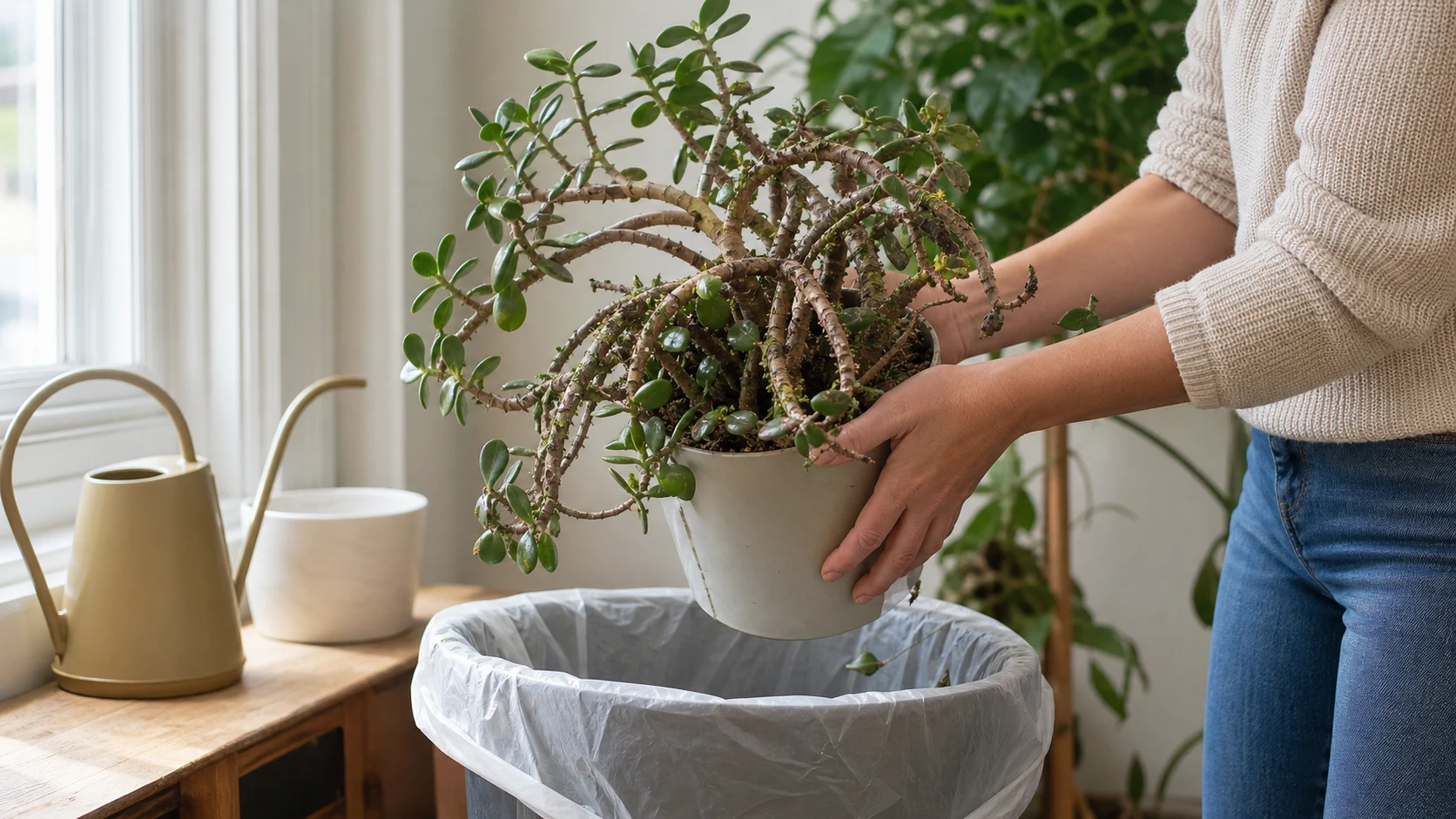
When scale covers most stems and little healthy growth remains, disposal can protect the rest of the collection.
Practical thresholds for the discard decision:
- More than half of the stems have visible scale coverage
- The plant has been in active decline despite two or more full treatment cycles (four-plus weeks each)
- An inexpensive plant where the labor and product cost of continued treatment clearly exceeds the plant’s value
For rare, expensive, or sentimental plants, more intensive effort makes sense. For a common pothos or ivy that cost a few dollars, disposal and a clean start with the next plant is the safer answer.
Save this plant plan before you forget the details.
Keep the plant, diagnosis notes, reminders, and care changes in KnowYourPlant so the next decision is based on your actual plant history.
Open KnowYourPlantPrevention: What to Do With Every New Plant
Most collection-wide scale infestations trace back to a single new plant that came in without a close inspection. Wisconsin Horticulture notes that identifying honeydew and sooty mold early, before infestation spreads to neighboring plants, is the key to managing scale before it becomes a collection problem.
Check every new plant before it comes inside:
- Run your fingers along every stem and check leaf undersides for bumps or stickiness
- Keep new arrivals separate from your existing plants for two to three weeks
- Check again at the end of the quarantine window before introducing the plant to the rest of your collection
- Look for black sooty mold on lower leaves: a downstream sign of soft scale even when the insects themselves are hard to see
For more on common houseplant pests and how to tell them apart, the mealybug guide and the spider mite guide are worth reading alongside this one. All three are easy to misidentify in early stages, and getting the ID right is what changes the treatment path.
Scale insects are manageable. What makes them difficult is the gap between what most people expect (wipe it down once and done) and what the pest’s biology actually requires. Identify the type, remove adults manually, follow up on a schedule that catches crawlers, and isolate immediately. That combination works. One-and-done doesn’t.
Frequently Asked Questions
How do I know if I have scale insects and not something else?
The scrape test is your fastest answer. Use your fingernail to gently lift one of the bumps. If it smears or squashes without a distinct shape, it’s likely soft scale. If it lifts off cleanly as a tiny dome with a small insect underneath, it’s armored scale. If it leaves behind fluffy white residue, you likely have mealybugs: a different pest that clusters in leaf joints and stem forks rather than sitting flat in rows on stems. If you see fine webbing alongside stippled leaves, that points to spider mites, which leave no bumps at all.
Does neem oil actually work on scale insects?
Neem oil can be effective, but mostly against crawlers, when the immature insects are mobile and have no protective covering. On mature adults under their armor, neem oil and other contact treatments have limited penetration. This is why repeat applications matter: you’re trying to catch each new batch of crawlers as they hatch. One neem oil application on adults rarely does much. Four to six weekly applications timed to crawler emergence is closer to what actually works.
How long does scale insect treatment take?
Plan for four to six weeks of consistent weekly treatments, minimum. That timeline follows the crawler hatch cycle. You remove or kill the visible adults in week one, then follow-up applications need to reach each new batch of crawlers as they emerge from eggs over the next several weeks. Stopping treatment after one or two rounds because the plant looks clear almost guarantees that already-present eggs will hatch and restart the infestation.
Can scale insects kill a houseplant?
A light infestation rarely kills a healthy plant quickly, but a sustained heavy infestation can cause serious decline. Scale insects suck plant sap, weakening the plant steadily. Soft scale also produces honeydew, which encourages sooty mold: a black coating that blocks light and adds further stress. Plants with very heavy infestations, or plants that were already struggling before the infestation, are at real risk of not recovering.
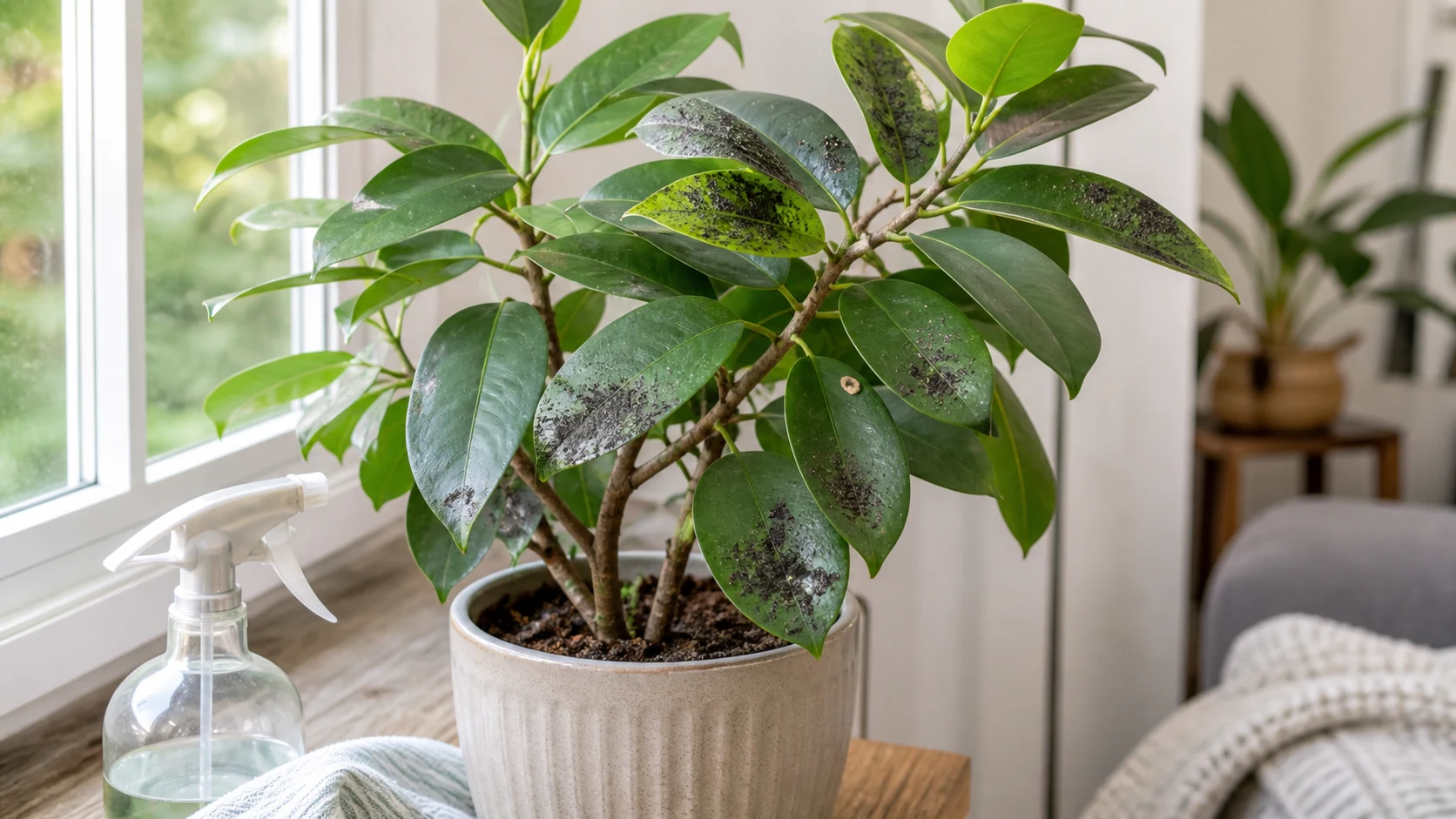
Black sooty mold, yellowing foliage, and attached stem bumps show how a sustained infestation can compound plant stress.
Why do my scale insects come back even after treatment?
Usually one of three reasons: the follow-up schedule wasn’t long enough to catch all the crawlers; neighboring plants weren’t treated and reinfested the plant that was; or the product wasn’t the right match for the scale type. Armored scale in particular can survive systemic treatments that easily control soft scale. Confirming which type you have with the scrape test and switching to a combination of manual removal plus well-timed contact sprays often breaks the cycle when products alone haven’t worked.
Do I need a systemic insecticide, or will manual removal and sprays be enough?
For most houseplant-scale infestations, especially soft scale, manual removal followed by four to six weeks of weekly insecticidal soap or horticultural oil applications is enough, and it avoids the indoor-use restrictions on most systemic products. Systemics make more sense for large outdoor plants or woody shrubs where manual removal isn’t practical. For armored scale indoors, manual removal plus timed contact sprays is often more effective than systemics anyway, since most systemic options don’t penetrate the armor reliably. Check the label of any systemic product before using it indoors: many are labeled for outdoor use only.
Are scale insects dangerous to pets?
Scale insects themselves aren’t toxic to cats or dogs. The main concern when treating scale is the product you use. Some systemic insecticides contain imidacloprid, which is harmful to bees and potentially to other animals: check labels carefully, especially for indoor use restrictions. Insecticidal soaps and rubbing alcohol wipe-downs are generally the safest options for indoor plants in homes with pets. If you’re building a pet-safe collection, the cat-safe plants guide is a useful starting point.
Can scale spread from plant to plant on its own?
Yes, but mostly through the crawler stage. Crawlers are mobile for a brief window right after hatching: this is when they can walk between plants that are touching or drop onto neighboring pots. Once scale reaches adulthood and attaches, the insects become mostly stationary. This is why isolation matters the moment you notice an infestation: moving the plant away from others stops crawlers from reaching your healthy plants during that brief mobile window.
What’s the difference between scale insects and spider mites?
Both are sap-sucking pests, but they look and behave very differently. Spider mites are tiny, fast-moving, and nearly invisible individually: their clearest sign is fine webbing on leaf undersides, paired with stippled or dusty-looking leaf surfaces. Scale is the opposite: stationary, visible as distinct bumps on stems or leaves, and no webbing. If you see webbing, spider mites are the much more likely culprit. The spider mite guide covers identification and treatment for that pest specifically.
Methodology and Last Updated
Last updated: May 26, 2026.
This guide was checked against UC IPM plus university extension references from Minnesota, Iowa State, Maryland, and Wisconsin. The decision tree and repeat-failure troubleshooting sections were shaped by recurring owner questions validated in public Stack Exchange threads, including confusion about whether the pest was really scale, why stickiness kept returning, and why systemic-style treatments sometimes failed for months. Those reader examples were treated as qualitative signal, while the identification and treatment claims stayed grounded in extension and IPM guidance.
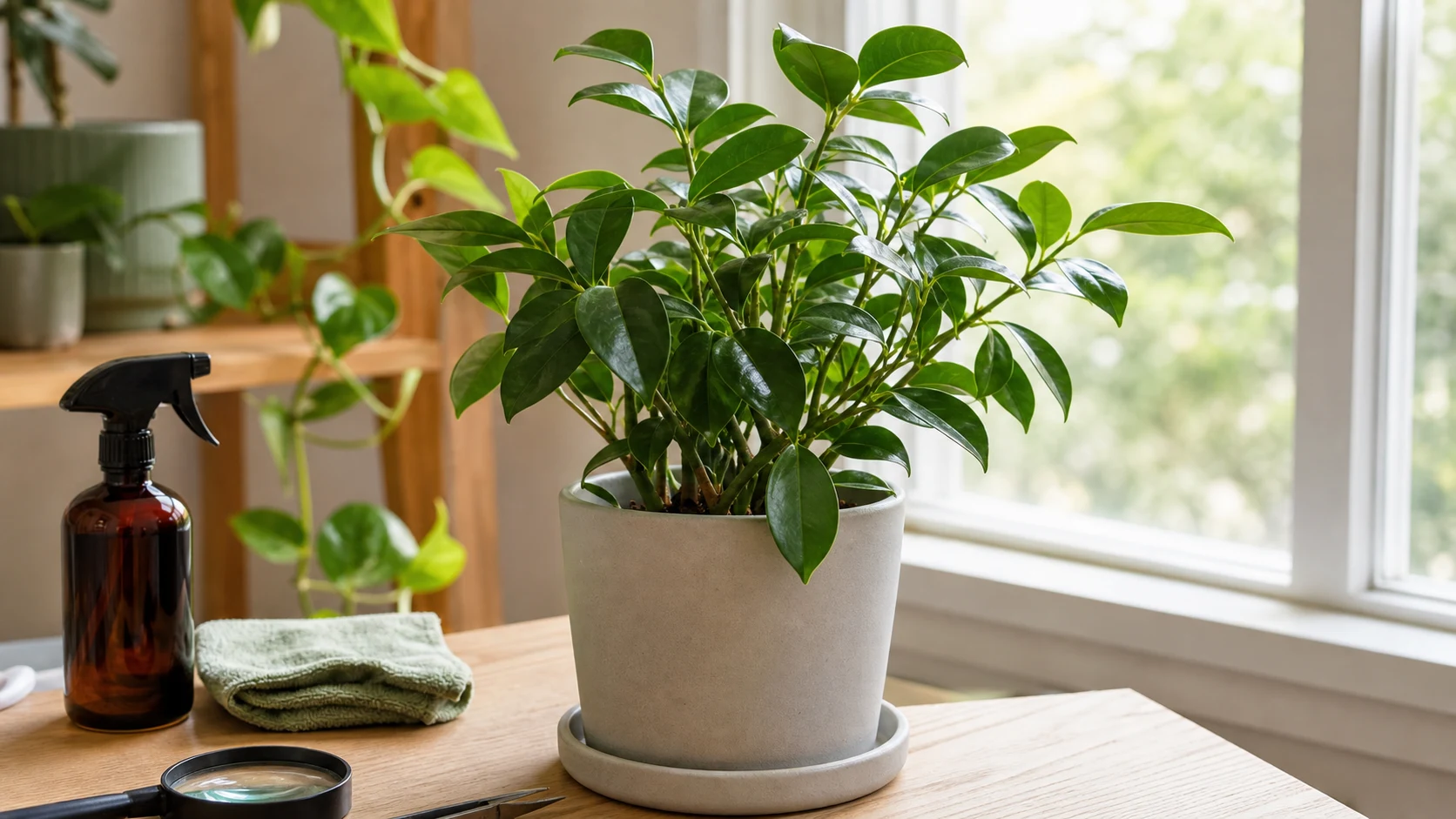
Close inspection tools ground the guide’s diagnosis and treatment claims in observable evidence rather than product assumptions.