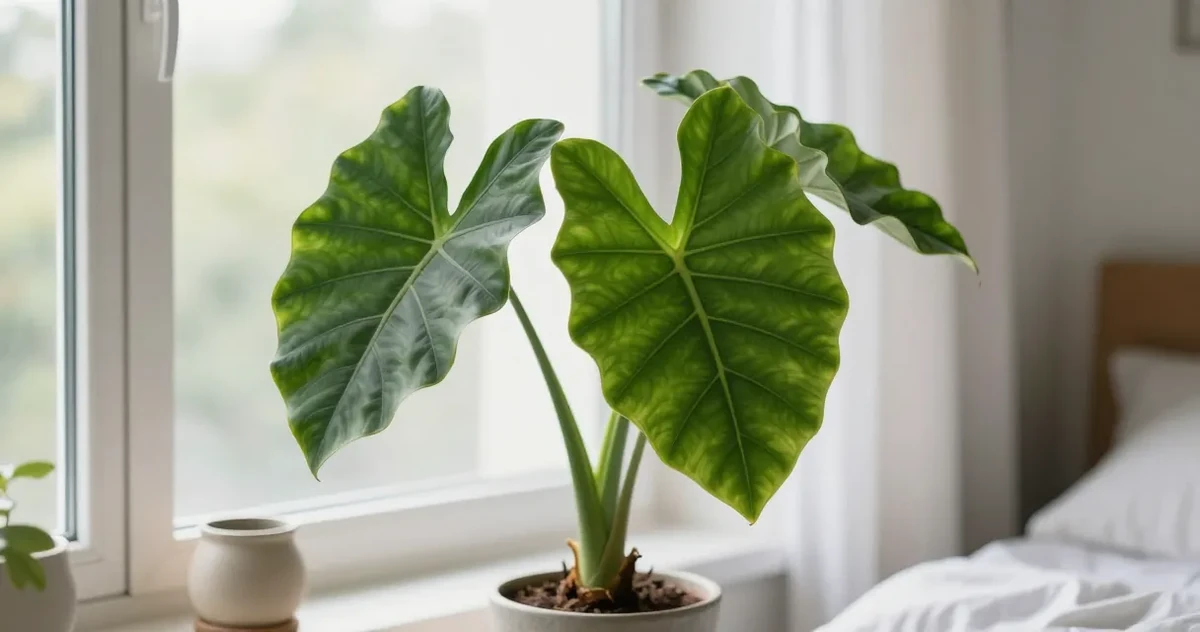
If your elephant ear plant is drooping, yellowing, curling, or getting brown tips, start with two checks: what type of elephant ear you have and how wet the soil is right now. Most care problems come from treating every “elephant ear” the same.
Here is the plain-English split: Colocasia is the thirstier type and usually wants evenly moist soil. Alocasia needs a short dry-down between waterings. If you guess wrong, the leaves complain fast. If your plant is clearly an Alocasia, our full alocasia care guide goes deeper on variety-specific indoor care. For the taller, upright form specifically, continue with the Alocasia odora care guide.
This guide covers both main types — Colocasia (taro) and Alocasia — with practical watering rules, light checks, symptom fixes, and seasonal adjustments for indoor plant owners.
Colocasia and Alocasia climate records compared
Elephant ear is a shared common name, not one species. The comparison keeps Colocasia esculenta and Alocasia odora separate so their field records do not get blended into a fictional average plant.
The ranges below are the middle 50% (p25–p75), not recommended indoor setpoints.
| Reference taxon | POWO native range | Annual mean temperature | Annual precipitation | Relative humidity | Solar radiation | Evidence |
|---|---|---|---|---|---|---|
| Colocasia esculenta (taro elephant ear) | India to southern China and Sumatra | 21.2–24.6°C | 2096–3088 mm/yr | 62–66% | 14.5–17.8 MJ/m²/day | 30 climate points / 544 usable records; medium confidence |
| Alocasia odora (upright elephant ear) | eastern India to southern Japan and Borneo | 21.3–23.2°C | 2501–3630 mm/yr | 63–65% | 14.7–16.3 MJ/m²/day | 30 climate points / 440 usable records; medium confidence |
What this changes in this guide: The overlap explains their shared warmth signal, while the taxonomic split reinforces the guide’s core rule: identify the genus before deciding how wet the root zone should stay.
Sources and method: Colocasia esculenta in POWO and GBIF; Alocasia odora in POWO and GBIF; CHELSA V2.1, 1981–2010. GBIF records are limited to POWO-native countries, then filtered for coordinates, establishment signal, licence, precision, and spatial duplication. No community or user-reported care data is used in this module.
Identification Snapshot
Use this 30-second check before you water:
- Leaves pointing up, more sculptural, usually sold as a houseplant: likely Alocasia
- Leaves hanging or facing down, sometimes sold as taro or a patio plant: likely Colocasia
- Potting mix that should dry a little between waterings: treat it like Alocasia
- Potting mix that should stay evenly moist: treat it like Colocasia
- Both are toxic if chewed, so placement matters from day one
NC State’s genus notes support this split: common indoor Alocasia types want bright indirect light and moist but well-drained soil, while Colocasia esculenta prefers rich soil that should not be allowed to dry out.
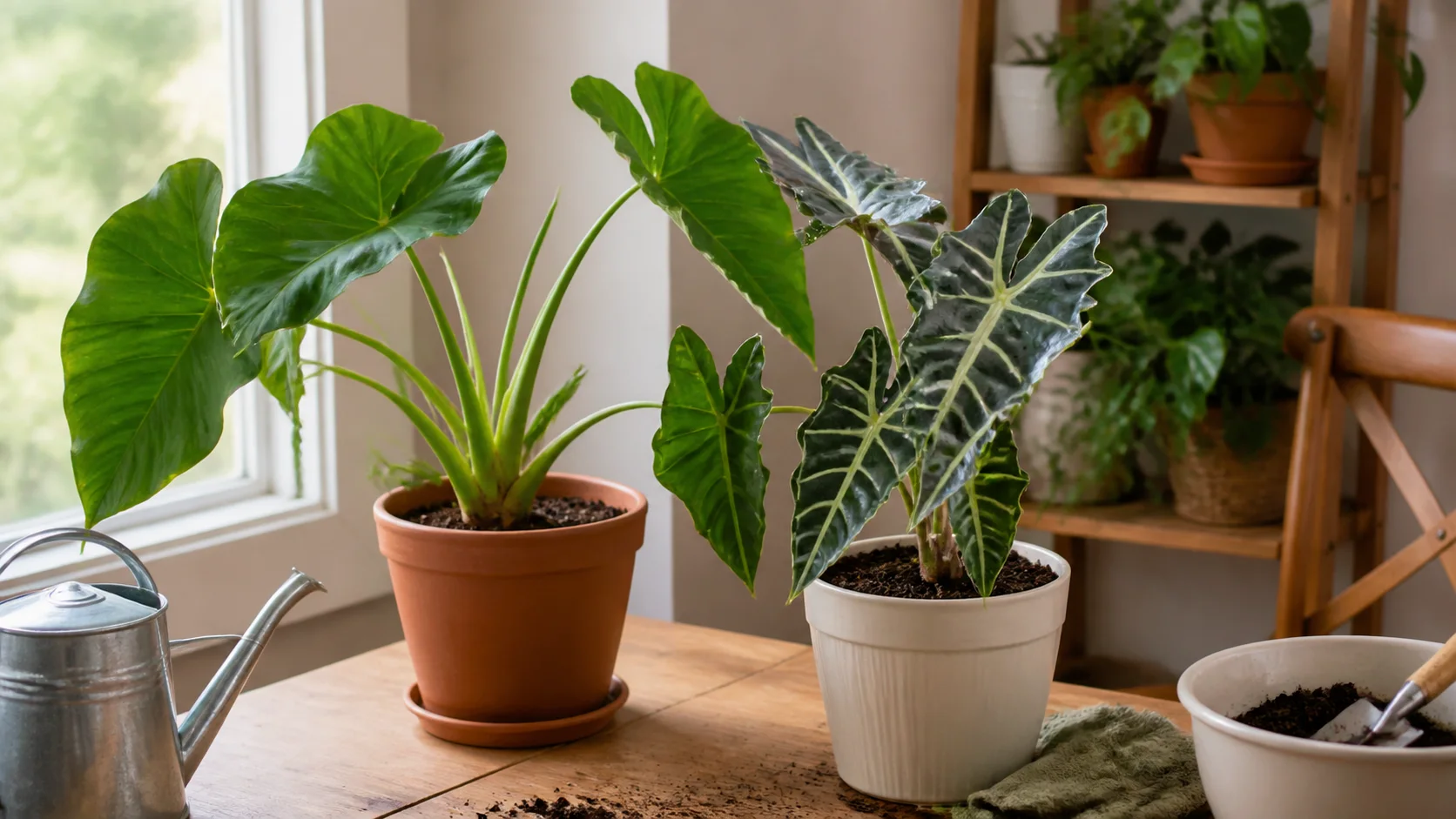
Side-by-side leaf posture makes the Colocasia and Alocasia care split easier to recognize before watering.
Care Cards
| Type | Best indoor fit | Water rule | Light rule | Watch first |
|---|---|---|---|---|
| Alocasia | Better for most indoor growers with limited space | Let the top layer dry slightly, then water thoroughly | Bright indirect light, no harsh afternoon sun | Rot from staying wet, shock after moves or repotting |
| Colocasia | Better if you have stronger light, more space, and can water often | Keep evenly moist; do not let the pot dry hard | Bright light, can take more sun than Alocasia outdoors | Fast droop from thirst, stress if kept too dry |
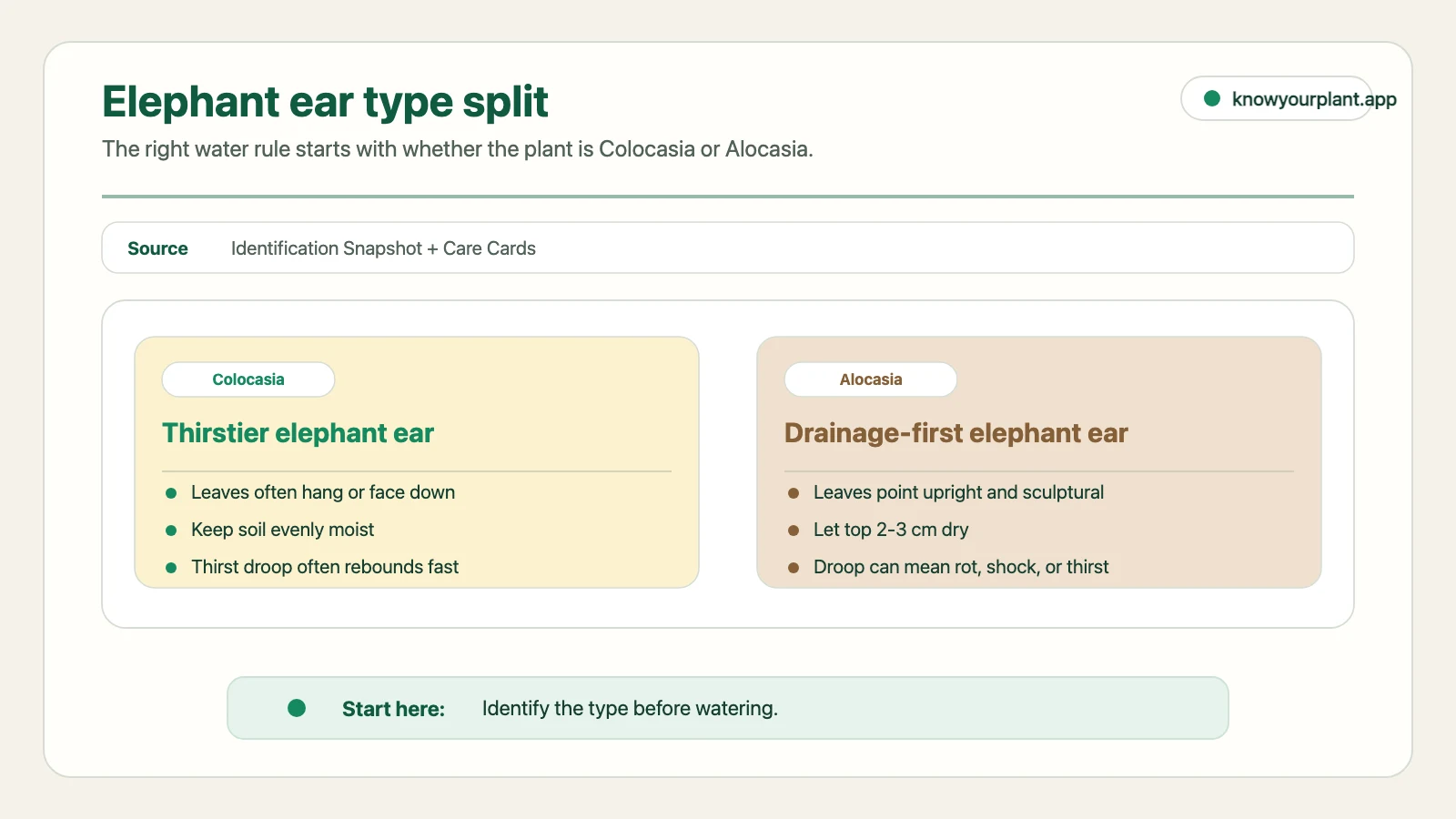
Use the type split before changing water: Colocasia usually wants steady moisture, while Alocasia needs drainage and dry-down time.
What Most Care Guides Miss
Most guides about elephant ear Plant describe the ideal care routine. Real homes are messier: light changes by season, pots dry at different speeds, and the same symptom can mean different things depending on where it appears.
Before changing care, check the plant in this order:
- Light: is the plant growing toward the window, fading, or scorching?
- Root zone: is the pot drying predictably, or staying wet in the middle?
- Leaf pattern: did the oldest leaves, newest leaves, tips, or stems change first?
- Recent change: new pot, new location, fertilizer, cold draft, heat vent, or pest exposure.
This keeps you from fixing the wrong problem. One clear adjustment is usually safer than a full care reset.
Colocasia vs Alocasia: What’s the Difference?
Both go by “elephant ear,” but they’re different plants with slightly different preferences.
| Colocasia | Alocasia | |
|---|---|---|
| Leaf direction | Droops downward | Points upward |
| Moisture preference | Loves water, tolerates wet soil | Needs good drainage |
| Where it grows | Often near ponds and streams in the wild | Tropical forest floors |
| Common varieties | Black Magic, Esculenta | Amazonica, Frydek, Polly |
| Indoor/outdoor | Both, but loves warmth | Great indoors |
| Winter hardiness | Zones 8-11 (corms store in colder zones) | Zones 10-12 (mostly indoor) |
| Max leaf size | Up to 5 feet (1.5 m) in garden conditions | Up to 2-3 feet (60-90 cm) indoors |
A quick trick: look at the leaves. If they droop like they’re bowing, you’ve got a Colocasia. If they stand upright and proud, that’s an Alocasia.
Expert note: NC State Extension separates these plants in the same practical way indoor growers experience them. Alocasia houseplant types prefer bright indirect light and moist but well-drained soil, while Colocasia esculenta tolerates much wetter soil and should not be allowed to dry out.
Lookalikes and Common Confusions
The main confusion trap is not a rare lookalike. It is the vague store label. Many plants are sold simply as “elephant ear,” even though the care routine changes depending on whether you brought home an Alocasia or a Colocasia.
Use these clues before you change anything:
- A newly bought plant with limp outer leaves may just be adjusting to a new room, especially if the soil was already dry at purchase.
- A recently divided or repotted plant can sacrifice one damaged or older leaf before the rest of the plant stabilizes.
- One yellowing older leaf with a new leaf emerging is often normal turnover, not a full-plant emergency.
- Sudden yellowing after a heat, rain, or light change usually means you should re-check pot size, drainage, moisture, and exposure together instead of blaming one cause immediately.
Should You Buy an Elephant Ear Plant?
An elephant ear is a good fit if you can give it bright indirect light, warm temperatures, and regular soil checks. It is not a set-and-forget plant, especially if you choose an Alocasia.
Buy one if:
- You have a bright room or can add a grow light
- You can check the soil once or twice a week
- Your home stays above 60°F (15°C)
- You have room for wide leaves that may lean or spread
- You can keep it away from pets and small children
Skip it for now if:
- The only spot available is dim, cold, or drafty
- You want a plant that tolerates missed checks for weeks
- Your home is very dry and you do not want to use a humidifier
- You have pets that chew houseplants
Choose Alocasia if you want a more compact indoor statement plant and can be careful with watering. Choose Colocasia if you want a thirstier, faster-growing plant and have the space and light to support it.
Light: Bright, But Not Scorching
Both types want bright, indirect light indoors. Think: a spot a few feet from a south or east-facing window where she gets plenty of light but not direct afternoon sun hitting the leaves.
Direct midday sun will scorch those big leaves fast — you’ll see bleached or brown patches appear within days. If that happens, move her back from the window.
Quick room test: if you can comfortably read a book in that spot during the day without turning on a lamp, it is probably bright enough to try. If the corner feels gloomy at noon, your elephant ear will likely stretch, stall, or shrink unless you add a grow light.
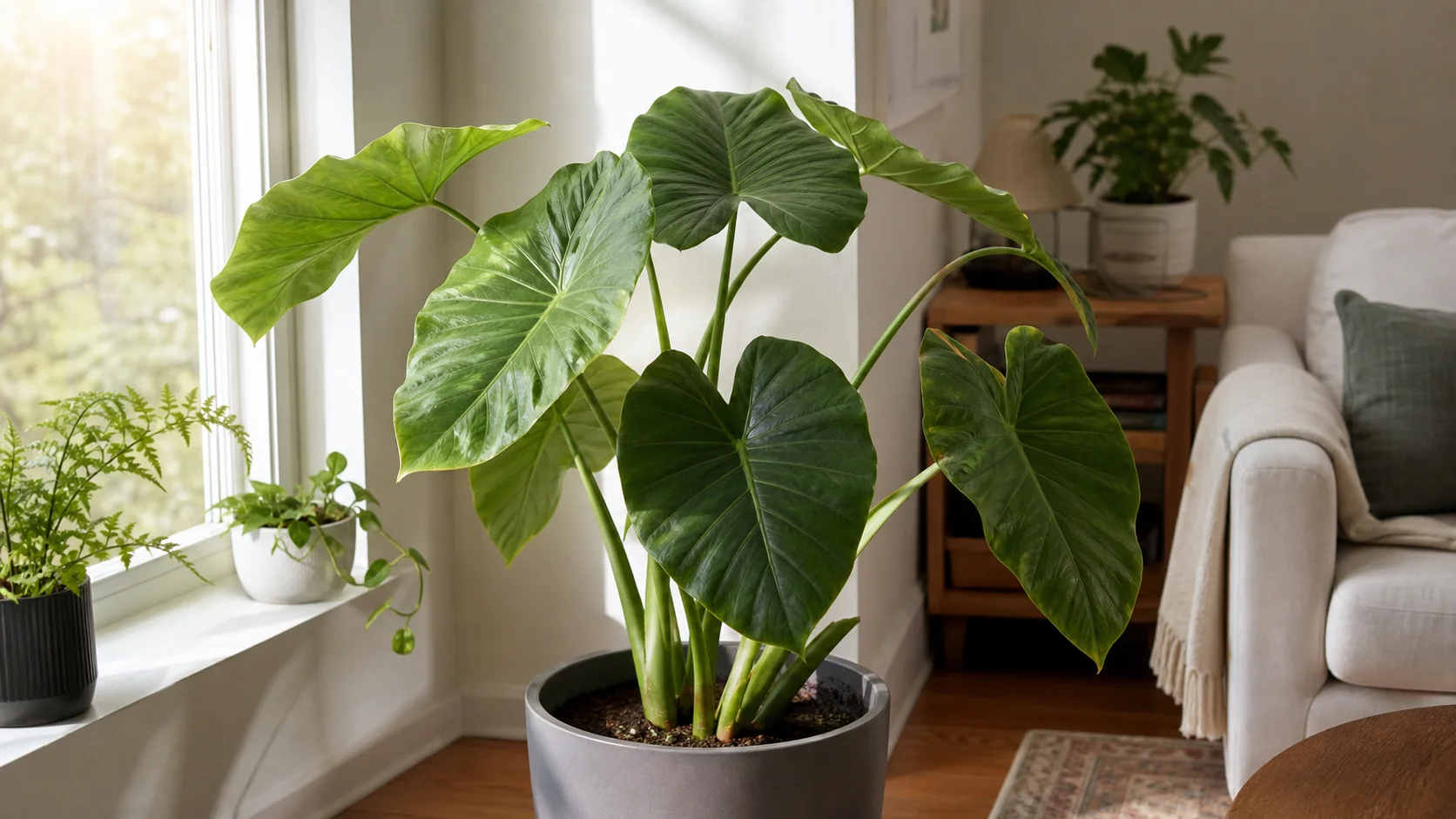
A bright room gives elephant ears useful indirect light without pressing the leaves against hot window glass.
Colocasia outdoors can handle more sun than Alocasia, especially in cooler climates. If you’re growing outside, morning sun with afternoon shade is a good sweet spot.
Low light is a slow death for elephant ears. They’ll stop producing new leaves, existing leaves get smaller, and the whole plant looks tired. If your space is dark, a good grow light set to 12-14 hours will make a real difference. Our grow lights for indoor plants guide will help you choose one that actually works.
According to the University of Florida IFAS Extension, elephant ears need a minimum of 4-6 hours of bright indirect light daily to maintain healthy growth indoors — anything less and you’ll start to see the leaves shrink and the plant go into a slow decline.
Watering: The Big Divide
This is where Colocasia and Alocasia part ways most clearly.
Colocasia is genuinely thirsty. She evolved growing in swampy conditions — you can even grow her in standing water like a pond plant. Indoors, keep the soil consistently moist. Check every 2-3 days in summer, and water when the top inch feels damp-but-not-dripping. Do not let her dry out completely.
Alocasia needs more breathing room. Water when the top 2-3 cm of soil are dry to the touch. Stick your finger in — if it comes back with dry soil clinging to it, water thoroughly until it drains from the bottom. Then wait for it to dry again before the next watering.
For both: always check before watering. The biggest mistake people make is watering on a schedule instead of checking the soil. These plants have different needs in winter (less) versus summer (more), and the soil tells you the truth every time.
Simple watering check:
- Push a finger 1 inch into the soil, or 2-3 cm for Alocasia
- Water Colocasia if the top feels only lightly damp and the pot feels lighter than usual
- Water Alocasia only when the top layer feels dry
- Water until it drains from the bottom, then empty the saucer after 10-15 minutes
- If the soil still feels wet after a week, do not water again yet
“Alocasia is one of the plants I see most commonly over-loved to death. People water it like a thirsty tropical because of its dramatic look, but she actually wants good drainage and dry-down time between waterings. Treat her more like a finicky fern than a pond plant.” — Darryl Cheng, houseplant educator and author of The New Plant Parent
Seasonal watering guide:
Use these as checking intervals, not automatic watering days.
| Season | Colocasia | Alocasia |
|---|---|---|
| Spring | Every 2-3 days as growth picks up | Every 7-10 days, check soil |
| Summer | Every 1-2 days in heat; keep moist | Every 5-7 days; top 2 cm dry = water |
| Autumn | Reduce as growth slows; every 3-4 days | Every 10-14 days; allow more dry-down |
| Winter | Every 5-7 days; soil should be slightly moist | Every 2-3 weeks; soil can dry more deeply |
Signs she is underwatered: drooping leaves, dry crusty soil, leaf edges turning brown and crispy. Water thoroughly, then check again the next day.
Signs you are overdoing it: yellowing leaves starting from the bottom, soft mushy stems, fungus gnats, or soggy soil that stays wet for a week or more. Pause watering, empty the saucer, move the plant into brighter indirect light, and inspect roots if the stem feels soft.
Humidity: The More the Better
Elephant ears are tropical. They love humidity — ideally 60% or higher. Most homes run around 30-50%, which is survivable but not where she thrives.
Studies on tropical aroids show that leaf edge browning (marginal necrosis) increases significantly when relative humidity drops below 40% — which happens in most centrally-heated homes during winter. If you’re seeing brown crispy tips even with good watering habits, this is likely why.
If you notice leaf edges turning brown and crispy even with good watering, low humidity is probably the culprit. A few things that help:
If you’re building a more tropical indoor setup, our best tropical plants for indoors guide is a useful companion.
- Pebble tray with water under the pot — as the water evaporates, it creates a little humid microclimate around the plant
- Group plants together — plants naturally release moisture as they transpire
- A small humidifier nearby — the most reliable fix if you’re in a dry climate or running heating all winter
Misting the leaves directly isn’t very effective and can encourage fungal issues on those big, broad leaves. Better to raise the ambient humidity instead.
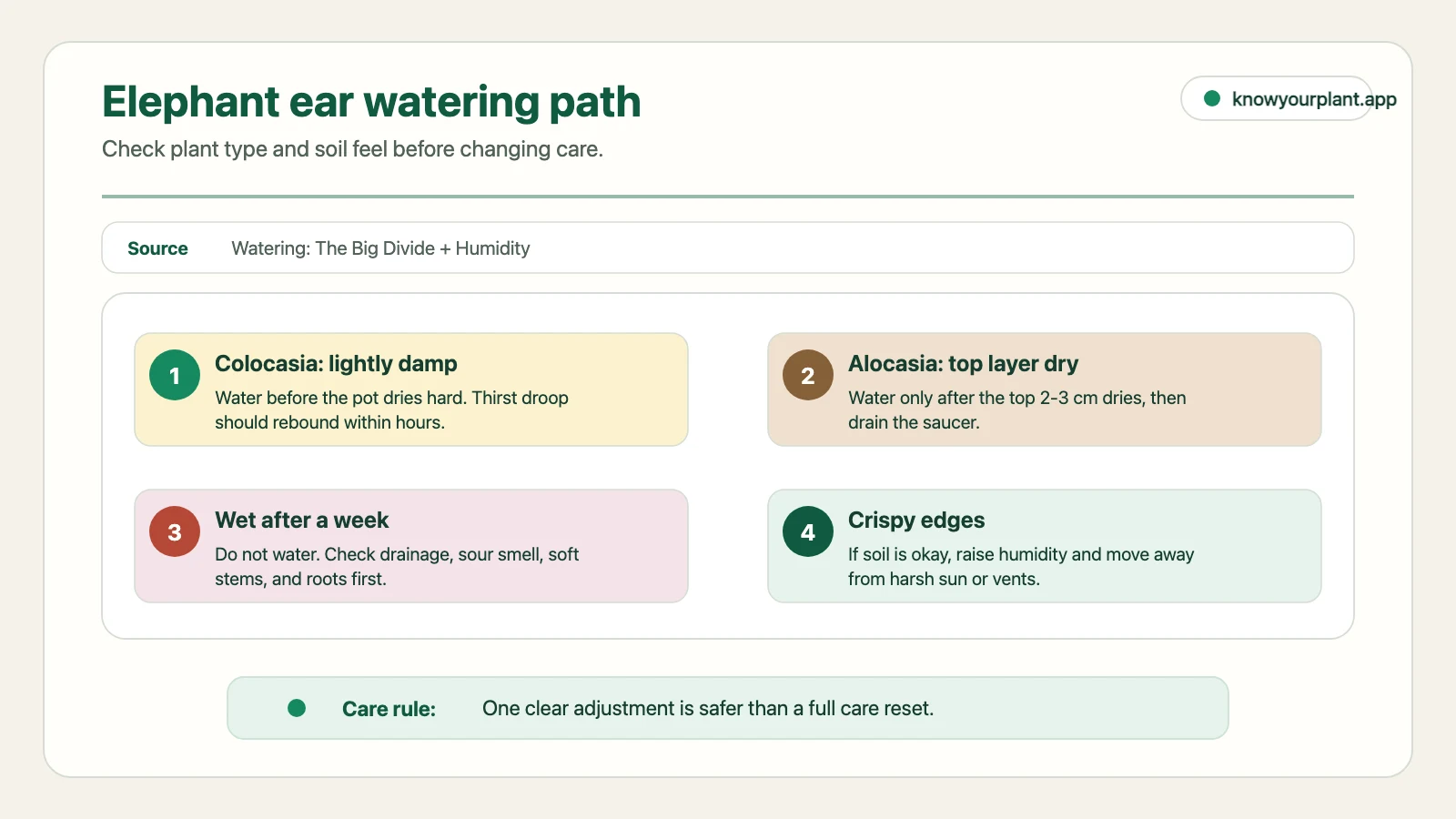
Use the watering path when leaves droop, curl, or crisp: soil feel and plant type decide whether the next move is water, wait, inspect roots, or raise humidity.
Temperature: She Hates the Cold
Keep elephant ears above 60°F (15°C) at all times. Below that and growth stops. Below 50°F (10°C) and you’ll start seeing cold damage — dark, mushy patches on the leaves. They are less forgiving than easy houseplants for beginners, but much more dramatic once established.
Keep her away from:
- Cold drafts from windows or doors
- Air conditioning vents blowing directly on her
- Unheated rooms in winter
Most varieties go dormant outdoors in cold climates. If you’re growing Colocasia as a garden plant in zone 7 or colder, dig up the corms in autumn before the first frost and store them indoors in a cool, dry place.
Soil and Potting
Alocasia wants well-draining, rich soil. A mix of regular potting soil, perlite, and a bit of orchid bark works well — it holds enough moisture without staying soggy. Good drainage is non-negotiable.
DIY aroid mix for Alocasia:
- 40% potting soil
- 30% perlite
- 20% orchid bark
- 10% worm castings (optional, for nutrition)
Colocasia is more forgiving and tolerates heavier, moisture-retentive soil. Regular potting mix is usually fine.
Pot choice matters too. Heavy ceramic or terracotta pots help balance the top-heavy weight of those big leaves. Make sure there are drainage holes — elephant ears should never sit in standing water (Colocasia is the exception if you’re intentionally water-growing her).
Repot every 1-2 years or when you see roots circling the bottom of the pot or poking out of drainage holes. Spring is the best time.
Fertilizing: Feed During Growth
During the growing season (spring through early autumn), elephant ears are hungry. Feed every 2-4 weeks with a balanced liquid fertilizer or a slow-release fertilizer worked into the soil at the start of spring.
High nitrogen supports all that leafy growth. If you see pale, light-green leaves, that’s often a sign she needs more nutrients.
Fertilizer comparison for elephant ears:
| Type | Pros | Cons | Best for |
|---|---|---|---|
| Balanced liquid (10-10-10) | Fast-acting, easy to control dose | Need to apply regularly | Regular feeding schedule |
| Slow-release granular | One application per season | Can’t easily stop if over-fertilized | Outdoor Colocasia |
| High-nitrogen (e.g. 20-10-10) | Maximizes leaf size | Risk of burn if over-applied | Active growing season push |
| Worm castings | Gentle, no burn risk | Lower nutrient concentration | Winter or new cuttings |
Stop fertilizing in late autumn. Winter is rest time — feeding during dormancy can cause fertilizer salt buildup that damages roots.
Common Problems
When a leaf changes, check in this order: soil moisture, light, humidity, then pests. One symptom can have more than one cause, but this order prevents the common mistake of adding more water to an already wet plant.
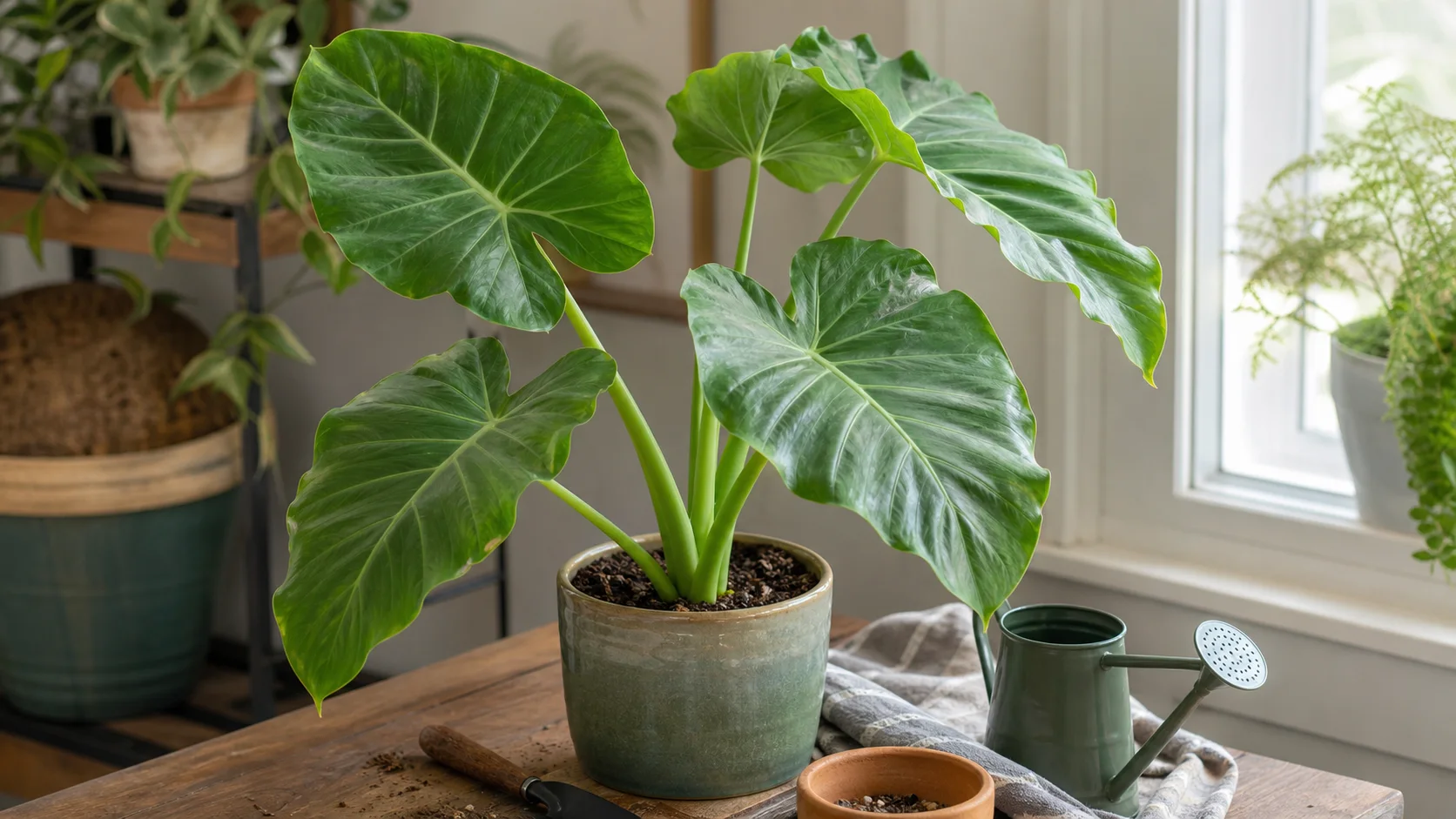
A drooping lower leaf is a cue to inspect the soil before reaching automatically for the watering can.
| Symptom | Most likely cause | What to do today |
|---|---|---|
| Yellow leaves | Overwatering, poor drainage, or old lower leaves dying off | Check the soil. If it is soggy or smells sour, unpot the plant, trim mushy roots, and repot into fresh mix using our root rot treatment guide if you find mushy roots. |
| Curling leaves | Dry soil, low humidity, too much direct sun, or spider mites | Check soil first. If dry, water thoroughly. If soil is fine, move out of harsh sun and inspect leaf undersides for pests. |
| Brown crispy tips or edges | Low humidity, underwatering, fertilizer salt buildup | Raise humidity, water deeply if the soil is dry, and flush the pot with plain water if you have fertilized heavily. |
| Drooping Colocasia | Usually thirst | Water well and check again in a few hours. A thirsty Colocasia often perks up quickly. |
| Drooping Alocasia | Overwatering, underwatering, root rot, or transplant shock | Check soil before watering. If wet and droopy, do not add more water; inspect roots if the stem is soft. |
| Soft, mushy stem | Rot from soggy soil | Stop watering, remove damaged tissue, inspect roots, and repot only firm healthy sections. |
| Leggy growth or smaller leaves | Not enough light | Move closer to a bright window or add a grow light for 12-14 hours a day. |
| White powdery coating | Powdery mildew from low airflow | Improve air circulation and treat with diluted neem oil spray. |
| Tiny webbing under leaves | Spider mites | Wipe leaves with a damp cloth and treat weekly with insecticidal soap. For a step-by-step cleanup, use our guide on how to get rid of spider mites. |
If you see yellow leaves, wet soil, and a soft stem together, treat it as a root problem first. If you see brown tips with dry soil and crispy edges, treat it as a water or humidity problem first.
Pet Safety
Both Colocasia and Alocasia contain calcium oxalate crystals, which are toxic to cats, dogs, and humans if ingested. They cause burning and irritation in the mouth and throat.
Keep them out of reach of curious pets and small children. Wear gloves when handling or trimming — some people also get skin irritation from the sap.
Month-by-Month Care Calendar
One of the biggest mistakes with elephant ears is treating them the same year-round. They’re not static. Their needs shift with the seasons — dramatically so if you’re growing Colocasia outdoors, but even indoor Alocasia has a distinct rhythm between growing season and rest.
Here’s exactly what to do each month:
January
Both types: This is the quietest month. Alocasia indoors may look bare or be holding onto just a leaf or two — that’s fine. Water sparingly (every 2-3 weeks for Alocasia), keep temperature above 60°F, and resist the urge to fertilize. Hold off on repotting.
Colocasia (outdoor corms in storage): Check on stored corms once this month. They should feel firm. Soft or mushy = rotting, discard those. Slightly wrinkled is okay.
February
Both types: Light starts to return. You might see the first signs of new growth on Alocasia — a tightly rolled new leaf emerging from the center. This is exciting. Don’t rush to water more yet; wait until you see consistent new growth before increasing frequency.
Colocasia (outdoor): Still in storage. Check corms again. Some will show small white growth nubs appearing — that’s a good sign.
March
Both types: Growing season begins. If you haven’t repotted in 2 years, now is the time. Increase watering frequency gradually as new leaves appear. For Alocasia, bump from every 3 weeks to every 2 weeks.
Colocasia (outdoor): Last frost risk in most temperate zones. Start corms indoors in pots 4-6 weeks before your last frost date if you want a head start.
April
Both types: Active growth. Start fertilizing — every 2-4 weeks with a balanced liquid feed. Wipe down those big leaves with a damp cloth to clear dust (it actually blocks light from reaching the leaf surface).
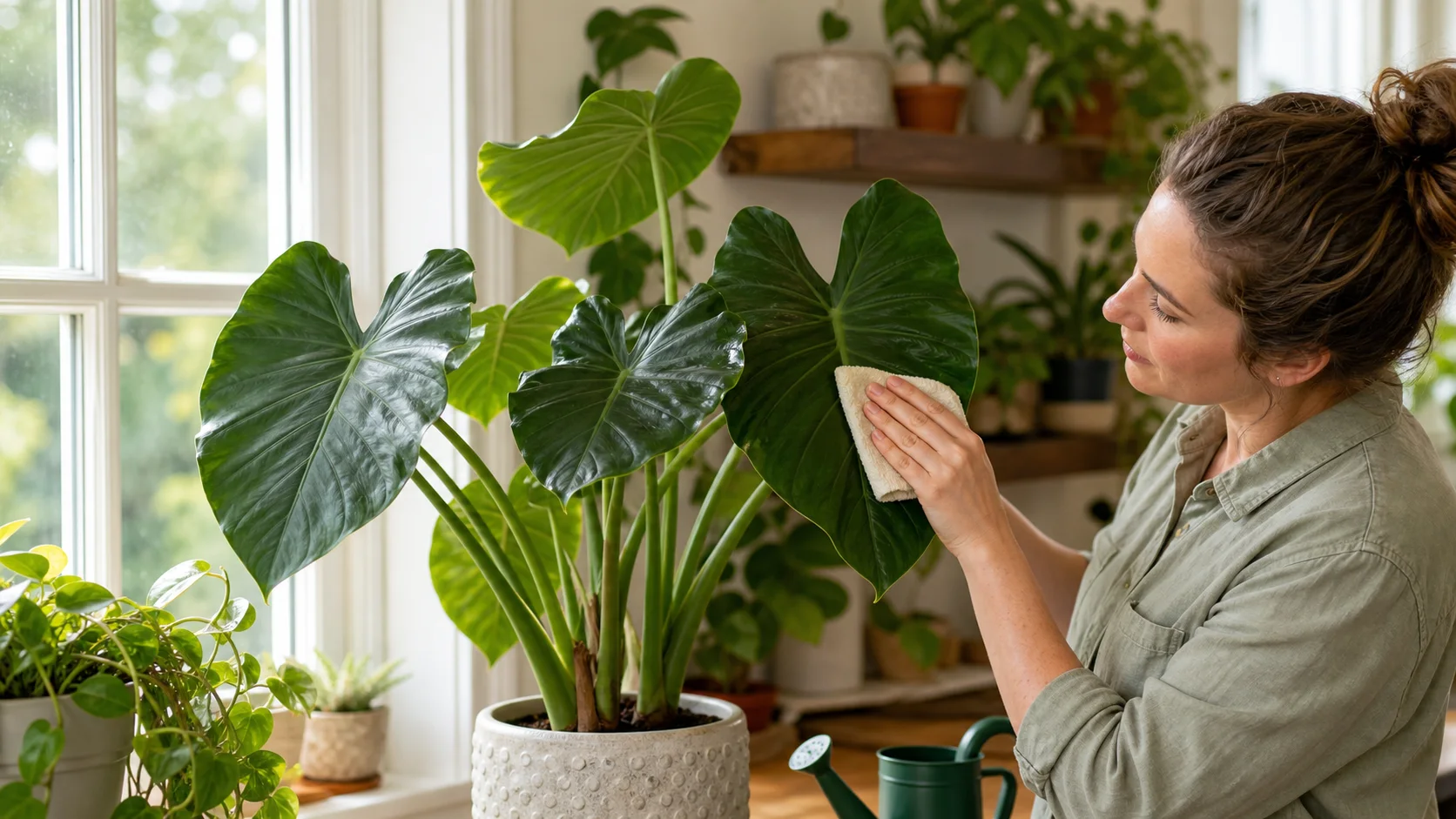
April active growth is a good cue to resume feeding and wipe dust from the broad leaves.
Colocasia (outdoor): Once nighttime temps stay reliably above 50°F, you can start hardening off indoor-started plants for outdoor planting. Give them a week of morning sun before full outdoor exposure.
May
Both types: Full growth mode. Check soil more frequently — Colocasia especially will want water every 2-3 days in warm weather. This is the month to watch humidity; windows open often dry out indoor air. Consider moving Alocasia away from any drafty spots.
Colocasia (outdoor): Plant out after your last frost. Choose a spot with morning sun and some afternoon shade, or full sun if you’re in a cooler climate (below zone 9).
June
Both types: Prime growing season. Feed every 2 weeks. This is when you’ll see the fastest leaf production — sometimes a new leaf every 1-2 weeks on a happy Colocasia. Enjoy it.
Outdoor Colocasia: Water daily in hot, dry weather. Mulch around the base to hold moisture. If you have a pond or water feature, this is when you can genuinely submerge a container-grown Colocasia up to the rim.
July
Both types: Peak summer. Heat can be an issue indoors if your home gets above 85°F — elephant ears slow down in extreme heat. Make sure she’s not sitting in a hot south-facing window that becomes an oven in July. Keep humidity up.
Outdoor Colocasia: This is when she’s at her most dramatic. Those leaves should be massive now. Water consistently and feed every two weeks.
August
Both types: Still active, but start thinking about the transition ahead. Last month to repot if needed (repotting in September can stress the plant right as it’s trying to slow down).
Outdoor Colocasia: If you’re in zone 7 or colder, start planning your corm dig date — you’ll want to do it before first frost, usually 4-6 weeks away.
September
Both types: Ease off fertilizing by mid-September. Water frequency can start dropping. Alocasia may begin to look a bit tired and slow — that’s natural. Don’t panic.
Outdoor Colocasia (cold climates): After the first light frost blackens the foliage, cut the stems back to about 6 inches. Let the ground dry for a few days, then dig the corms carefully. Brush off soil, let them cure in a warm dry spot for a week, then store in a breathable bag with peat moss or sawdust.
October
Both types: Indoor plants in slower mode. Watering frequency drops noticeably — check before every watering, don’t water on autopilot. Stop fertilizing completely.
Stored Colocasia corms: Store in a cool, dry location (50-60°F / 10-15°C). A basement, garage, or cool closet works. Check monthly for rot.
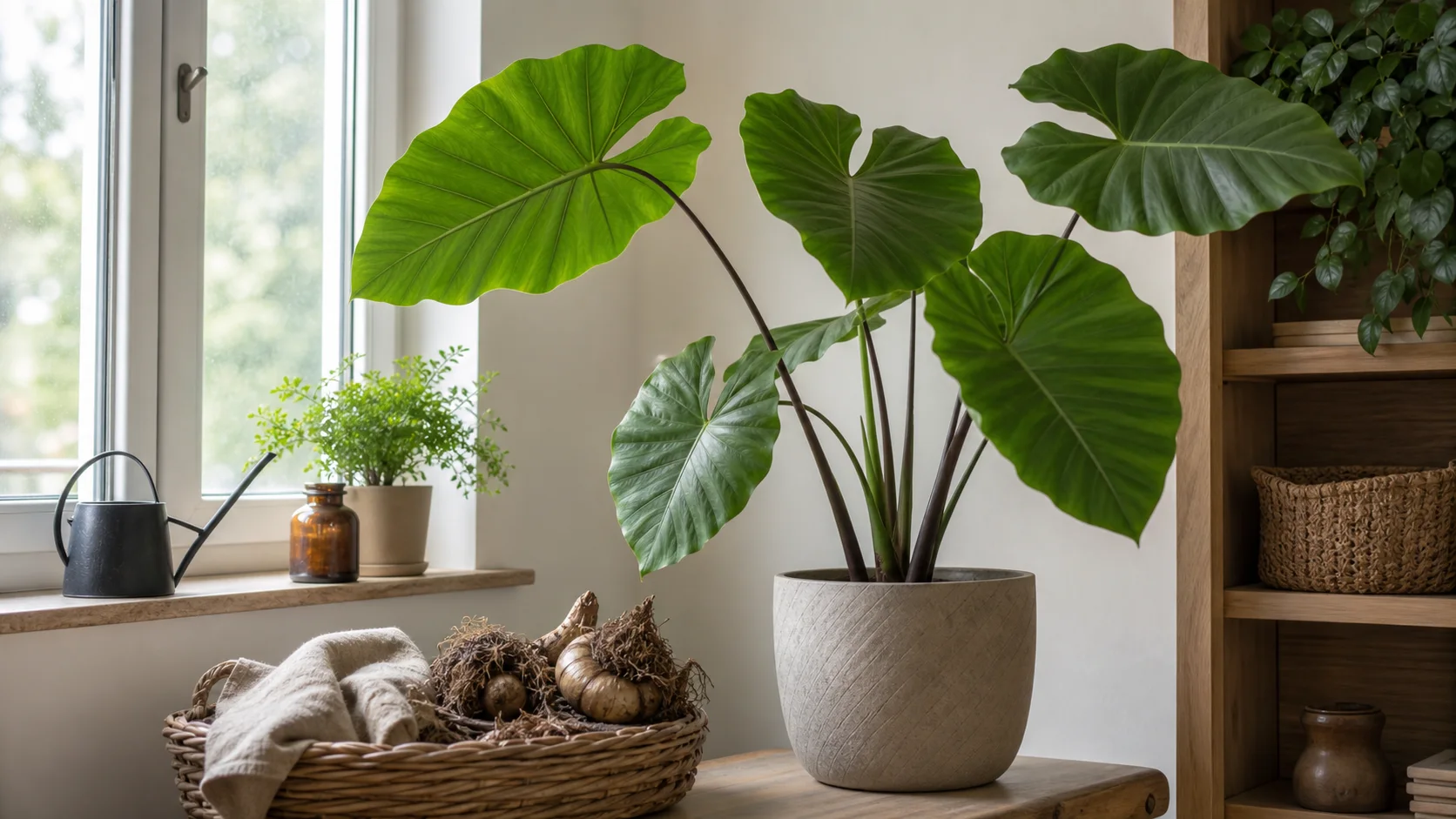
October care slows indoor watering while dry Colocasia corms move into cool-season storage.
November
Both types: Low light, slow growth, minimal needs. Some Alocasia leaves may yellow and fall — let them go. The plant is pulling energy back to the corm. Keep the room above 60°F.
Tip: This is the month people most often over-water because they’re worried. Don’t. A plant going into winter rest needs far less water than in summer.
December
Both types: Rest mode. Water only when the soil is mostly dry (Alocasia) or just barely moist (Colocasia). No fertilizer. Make sure she’s away from cold drafts near windows or doors. The low light is temporary — she’ll come back in spring.
Is My Alocasia Dead or Just Dormant? A Diagnosis Guide
This is the question that haunts every Alocasia owner come winter. She’s lost all her leaves. She looks like a pot of dirt. Is she gone?
Before you throw her away, work through this:
Step 1: Check the soil temperature and conditions Has the room been below 60°F (15°C) recently? Has she been sitting near a drafty window? Cold stress is the #1 trigger for dramatic leaf drop. If yes — she’s probably dormant, not dead.
Step 2: Check the corm Gently unpot her and look at the corm (the thick underground bulb).
- Firm and white or cream-colored inside? She’s alive. Repot in fresh well-draining mix, keep barely moist, and wait.
- Soft, mushy, and brown throughout? That’s rot. Smell it — if it smells bad, you’re looking at root rot that’s gone too far. Cut away anything mushy; if there’s firm tissue remaining, you can try to save it.
- Wrinkled but firm? She’s stressed but alive. Repot and give her a good drink.
Step 3: Check the roots Healthy roots are white or tan and firm. Brown and mushy = rot. If some roots are still healthy and the corm is firm, there’s every reason to think she’ll recover.
Step 4: Give it time If she passes the corm check, repot into fresh soil, place her somewhere warm and bright, and water lightly. Then wait. It can take 4-8 weeks for new growth to appear. A tightly rolled new leaf emerging from the center is your sign that she’s coming back.
What NOT to do:
- Don’t water heavily while waiting — an already-stressed corm sitting in wet soil is an invitation for rot
- Don’t fertilize until you see active new growth
- Don’t assume she needs more warmth and put her on a heat mat — gentle room temperature is fine
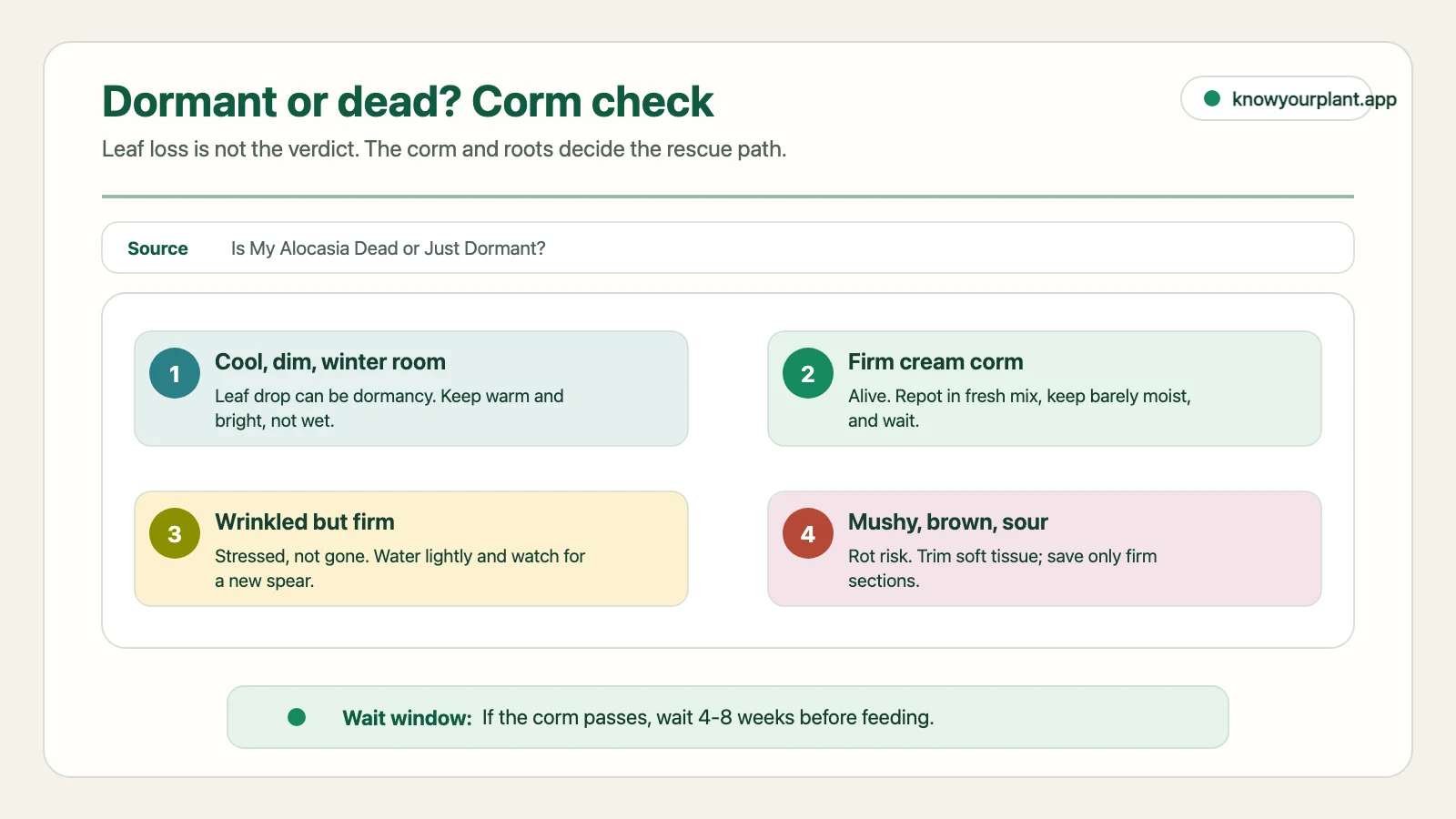
Use the corm check before throwing away a leafless Alocasia: firm tissue means patience; mushy, sour tissue means rot response.
Most Alocasia “deaths” are actually dormancy. The corm is patient. So be patient too.
A Note on Dormancy
If your Alocasia suddenly starts dropping leaves in winter, don’t panic. Many Alocasia varieties go semi-dormant in low light or cool conditions. The leaves die back, but the corm (bulb) is still alive underground.
Keep the soil lightly moist — not dry, not wet — and wait. When light levels increase in spring, she’ll send up fresh new growth. It feels alarming the first time it happens, but it’s completely normal.
Care at a Glance
| Colocasia | Alocasia | |
|---|---|---|
| Light | Bright indirect | Bright indirect |
| Water | Keep moist | Dry top 2-3 cm between watering |
| Humidity | 60%+ | 60%+ |
| Temperature | 60-85°F (15-29°C) | 60-85°F (15-29°C) |
| Fertilizer | Every 2-4 weeks (spring-summer) | Every 2-4 weeks (spring-summer) |
| Repot | Every 1-2 years | Every 1-2 years |
| Toxic | Yes | Yes |
Your Simple Care Plan
Today: Identify whether you have Colocasia or Alocasia, check soil moisture with your finger, empty any standing water from the saucer, and move the plant out of direct afternoon sun.
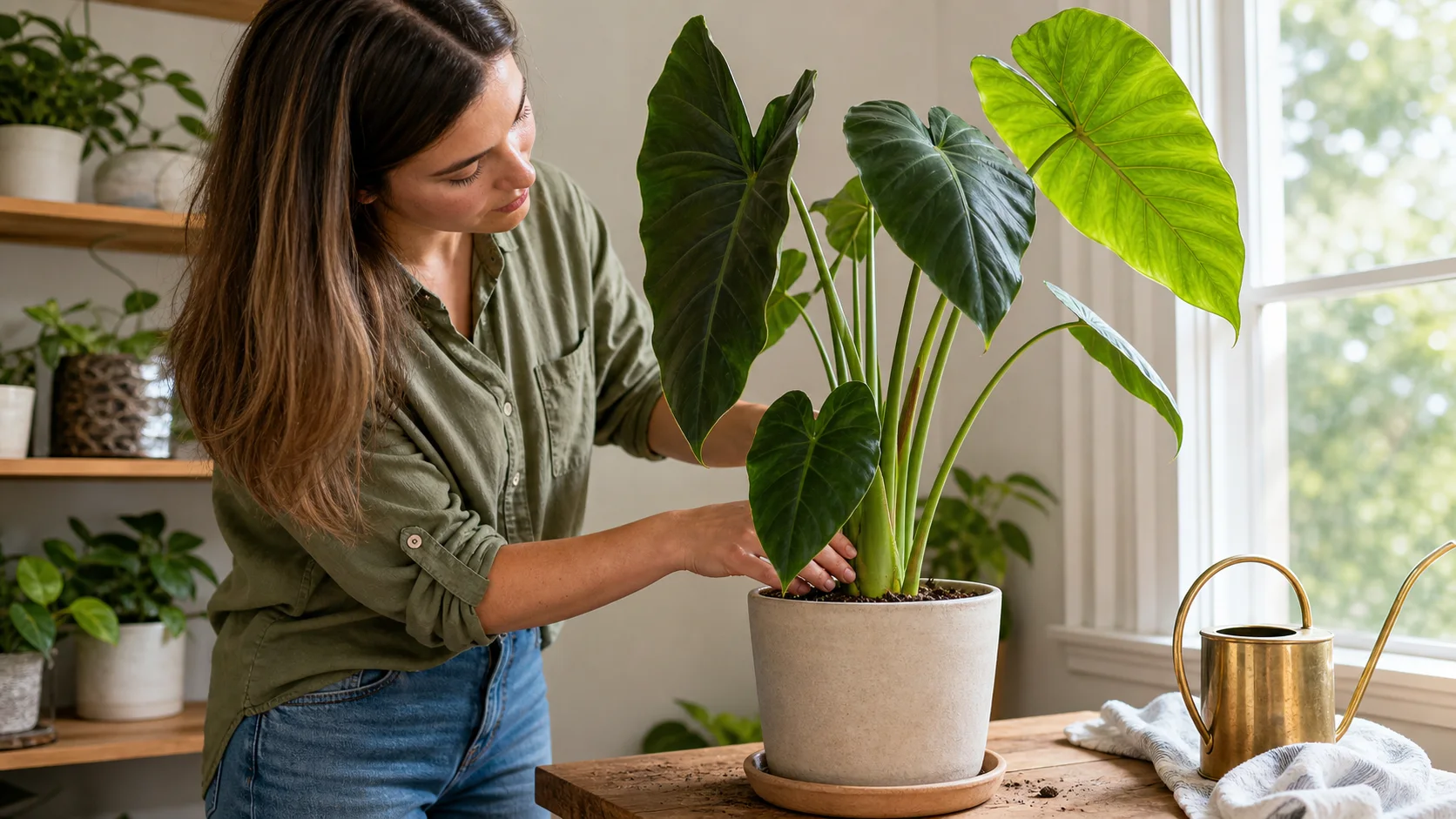
Start the care plan at the soil line, then water only if the pot and saucer confirm the plant needs it.
This week: Watch the newest leaf and the oldest lower leaves. New leaves should unfurl cleanly; older lower leaves may yellow one at a time. If several leaves yellow at once, check roots and drainage before adding more water.
This season: Increase water and fertilizer during active spring and summer growth. In autumn and winter, stop fertilizing, water less often, and expect Alocasia to slow down or drop leaves if light levels fall.
Real User FAQ from Elephant Ear Owners
These are the patterns that show up repeatedly in current owner questions about newly purchased, recently repotted, and suddenly yellowing elephant ears.
Why did my elephant ear go limp a few days after I brought it home?
Start with acclimation, not panic. Check whether the soil was already dry when you bought it, whether only the outer leaves are affected, and whether the plant just moved into dimmer light or colder air. Change one variable at a time rather than watering over and over.
I repotted or divided it and one leaf turned yellow. Did I kill it?
Not necessarily. Recent root disturbance often shows up as one yellowing or broken leaf first. Keep the plant warm, avoid extra fertilizer for now, and let it re-establish before assuming disease or chronic decline.
One old leaf is yellow, but a new leaf is coming. Is that normal?
Often yes, especially on Alocasia. Normal turnover usually means one older leaf fades while the center still pushes new growth. Widespread yellowing plus wet soil is the pattern that deserves closer root-zone inspection.
It suddenly turned yellow after the weather or window exposure changed. What should I check first?
Check how wet the mix stayed after the change, whether the light became hotter or harsher, and whether drainage or pot size is slowing dry-down. Recent environment changes usually explain more than a mystery disease does.
Freshness Note
Last updated: 2026-06-14. Elephant ear advice gets muddled because the same common name is used for more than one plant. The genus split and diagnosis sequence in this guide matter more than any rigid watering calendar.
Methodology Note
This guide was refreshed against current result pages for elephant ear plant care, direct NC State Extension pages for Alocasia and Colocasia, and recent Gardening Stack Exchange questions about acclimation droop, repot stress, and sudden yellowing. Community questions were treated as recurring owner patterns, not controlled experiments.
FAQ
Q: How often should I water my elephant ear plant?
It depends entirely on which one you have. Colocasia wants consistently moist soil — check it every 2-3 days in summer and water before it dries out. Alocasia needs dry-down time: wait until the top 2-3 cm of soil are dry before watering again. Both need less water in winter when growth slows.
Q: Why are my elephant ear leaves turning yellow?
Yellow leaves usually mean overwatering, especially on Alocasia. Check the soil — if it’s been wet for more than a week without drying, pull the plant out and inspect the roots. Brown, mushy roots mean root rot has started. Yellow leaves on Colocasia more often mean underwatering or a nutrient deficiency after a long time without fertilizing.
Q: Can elephant ear plants grow indoors?
Yes — Alocasia is particularly well-suited to indoor growing. She stays at a manageable size (most varieties reach 2-3 feet indoors), loves the warm stable temperatures of a home, and tolerates lower light than Colocasia. Colocasia can grow indoors too but tends to get very large and prefers more light.
Q: Why is my elephant ear drooping?
If it’s a Colocasia, she’s almost certainly thirsty. Water her and she’ll perk up within a few hours. If it’s an Alocasia, drooping is trickier — it could be underwatering, but it can also be overwatering, root rot, or transplant shock after repotting. Check the soil moisture first before adding more water.
Q: Do elephant ear plants go dormant?
Colocasia in outdoor cold-climate gardens goes fully dormant — the above-ground growth dies back and the corm survives underground (or needs to be dug up in zones below 8). Alocasia indoors often goes semi-dormant in winter, dropping leaves when light levels drop. The corm is still alive; it’ll regrow in spring when light comes back.
Q: How do I make my elephant ear plant grow bigger leaves?
Three things drive big leaf size: more light (bright indirect), regular feeding with a high-nitrogen fertilizer during the growing season, and a pot that’s large enough for the root system. Alocasia and Colocasia grown outdoors in full sun with unlimited root space can produce truly enormous leaves — sometimes 3-5 feet across. Indoors, 12-18 inch leaves are realistic with good care.
Q: Are elephant ear plants toxic to cats and dogs?
Yes. Both Colocasia and Alocasia contain calcium oxalate crystals that cause mouth burning, excessive drooling, and vomiting if chewed or eaten. Keep them out of reach of pets. The sap can also irritate human skin — wear gloves when pruning or repotting.
Q: My Alocasia has lost all its leaves — is it dead?
Probably not. Alocasia frequently drops all its leaves when stressed — from a move, a temperature drop, or just a difficult winter. If the corm (the thick root bulb underground) is firm and white or cream-colored inside, the plant is alive. Keep the soil barely moist and wait for new growth. It can take 4-8 weeks, but she usually comes back.
Q: How do I know if I have a Colocasia or an Alocasia?
Look at the leaves. Colocasia leaves droop downward from the stem attachment point — the tip points toward the ground. Alocasia leaves point upward, almost like they’re reaching for the sky. The stem also attaches differently: on Colocasia it connects near the center of the leaf (like a shield), while on Alocasia it connects at the edge near the notch.
Elephant ears are the kind of plant that makes people stop and ask “what is that?” — in the best way. Get the watering right, keep her warm and humid, and she’ll reward you with leaves that just keep getting bigger.
Want personalized care reminders for your elephant ear? Download the KnowYourPlant app — it tracks your plant’s schedule and nudges you when it’s time to water, fertilize, or check the humidity.