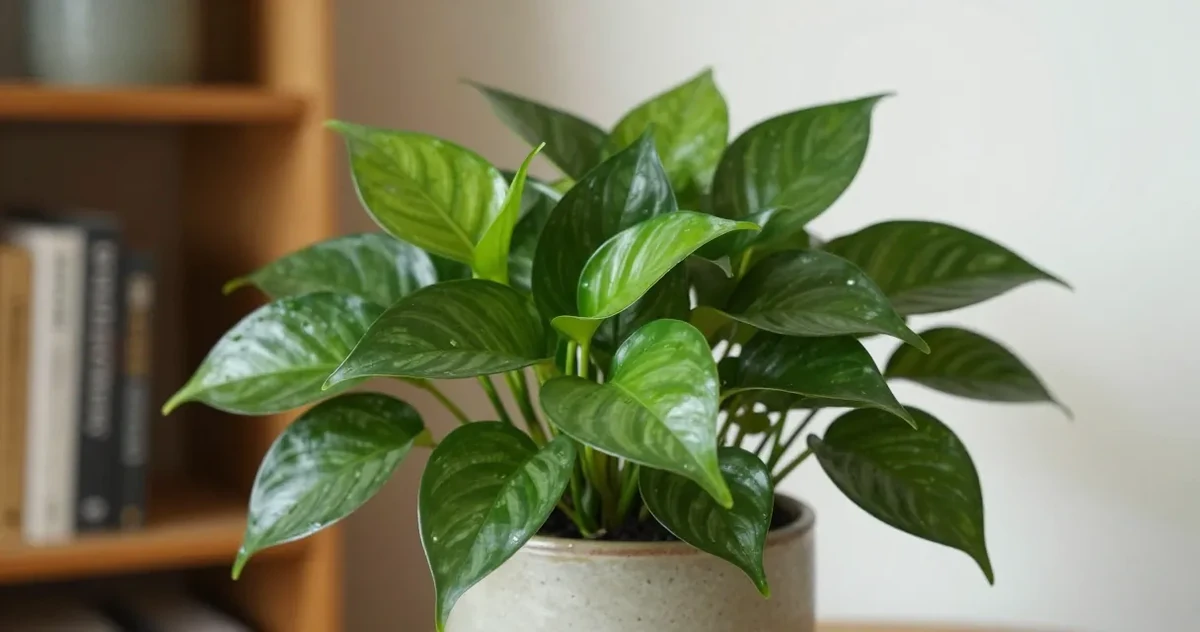
If you just brought home a satin pothos and want the plain answer: put it in bright indirect light, water only when the top half of the soil has dried, and check the soil before reacting to curling or yellowing leaves. In many homes that means watering about every 10 to 14 days in spring and summer, then closer to every three weeks in autumn and winter.
The easiest way to overdo it is to treat satin pothos like a thirsty plant. It is not. Too much water usually shows up as yellow lower leaves, soft stems, or soil that stays damp for more than two weeks. Too little water or too-dry air usually shows up as curling leaves, crispy edges, or brown tips.
The name is confusing, too. Plants sold as “satin pothos,” “silver pothos,” and sometimes “silk pothos” are usually Scindapsus pictus, not true pothos. That matters because Scindapsus grows more slowly than common pothos and complains faster when the roots stay wet.
This guide keeps the botany light and the care decisions practical: how to tell if your home is a good fit, when to water, what symptoms mean, and what to do today if the leaves start looking wrong.
Climate DNA for satin pothos
Satin pothos is not Epipremnum aureum. This module uses the accepted species Scindapsus pictus and keeps its southeastern Asian and Malesian native records separate.
The ranges below are the middle 50% (p25–p75), not recommended indoor setpoints.
| Reference taxon | POWO native range | Annual mean temperature | Annual precipitation | Relative humidity | Solar radiation | Evidence |
|---|---|---|---|---|---|---|
| Scindapsus pictus (satin pothos) | southeastern Bangladesh to western and central Malesia | 24.0–26.6°C | 2758–3377 mm/yr | 67–70% | 17.4–18.9 MJ/m²/day | 30 climate points / 52 usable records; medium confidence |
What this changes in this guide: The taxonomic separation matters more than the shared common name. Use the climate range for context while managing a climbing Scindapsus from its actual light and root-zone response.
Sources and method: Scindapsus pictus in POWO and GBIF; CHELSA V2.1, 1981–2010. GBIF records are limited to POWO-native countries, then filtered for coordinates, establishment signal, licence, precision, and spatial duplication. No community or user-reported care data is used in this module.
Identification Snapshot
| Detail | What to look for |
|---|---|
| Correct plant name | Usually Scindapsus pictus, not a true pothos |
| Leaf texture | Matte or velvety, not glossy |
| Variegation | Silver splashes or silver wash over dark green |
| Growth habit | Slow to moderate trailing vine |
| Early stress signal | Curling, yellowing lower leaves, or fading silver |
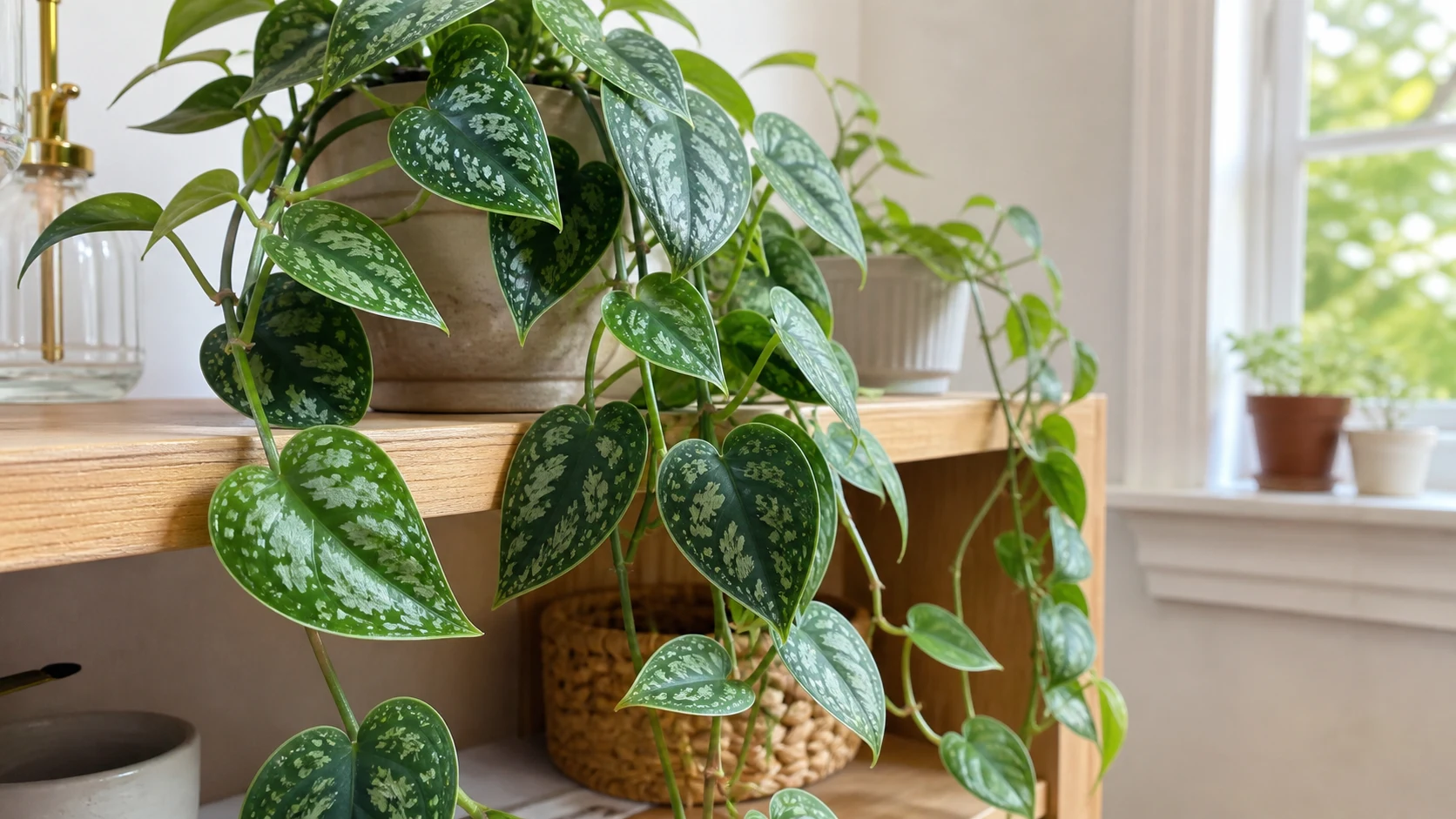
Matte, silver-splashed leaves and a slow trailing vine are the clearest signs of Scindapsus pictus.
What Most Plant Roundups Miss
Most roundups about satin pothos list attractive options. The better question is which choice will still make sense in your actual room three months from now.
Use this filter before choosing:
- Light reality: what the plant receives on a normal cloudy day, not the brightest hour of the week.
- Care rhythm: whether you prefer weekly attention or a plant that can be ignored longer.
- Space: mature height, spread, trailing habit, and whether leaves will touch walls or pets.
- Failure signal: what the plant does first when the match is wrong, yellowing, stretching, crisping, or dropping leaves.
A good recommendation is not just beautiful. It fits the room, the owner, and the first problem you are likely to notice.
What Is Satin Pothos (And Why Isn’t It a Pothos)?
Most plants sold as satin pothos or silver pothos are Scindapsus pictus, typically the variety Argyraeus or Exotica. True pothos belong to the genus Epipremnum. The two look similar from across the room, but the differences become clear up close.
The matte, almost suede-like texture on a Scindapsus leaf is not just an aesthetic quirk. The leaf surface has a different cellular structure from a typical glossy pothos. That is why the silver markings have a depth that shifts with the angle. Under bright indirect light, the metallic splashes almost seem to glow from within. In lower light, the same plant can look nearly plain green.
If your plant has that soft, frosted surface and the silver markings feel painted on with a matte brush, you’ve got a Scindapsus. If the leaves are shiny and smooth, it is probably a golden pothos or another true pothos cultivar. The KnowYourPlant pothos varieties guide covers all the main types side by side if you’re not sure which you have.
The genus difference matters for care. Scindapsus is more sensitive to overwatering than your average pothos, appreciates higher humidity, and grows more slowly. Treat it like a pothos and it survives, but the full pothos care guide is a better comparison point than a one-size-fits-all beginner tip. Understand what it’s actually asking for and it thrives.
Lookalikes and Confused With
| Plant | Looks similar because | Key difference | Care trap |
|---|---|---|---|
| Satin pothos (Scindapsus pictus) | Silver pattern and trailing habit | Matte leaves, slower growth | Wet roots cause trouble fast |
| Golden pothos (Epipremnum aureum) | Similar vine shape | Glossier leaf, faster growth | Advice transfers only partly |
| Scindapsus treubii ‘Moonlight’ | Silver-green look | Thicker, more elongated leaves | Slightly different light tolerance |
| Philodendron hederaceum cultivars | Trailing tropical foliage | Heart-shaped, smoother leaves | Different watering rhythm |
One social confusion shows up again and again: readers assume “satin pothos” means every pothos guide applies cleanly. It does not. The common name is convenient, but it leads people to overwater and overestimate growth speed.
The Main Varieties You’ll See
Scindapsus pictus ‘Argyraeus’ is the most common. Smaller leaves, silver that shows up as distinct splatters rather than a full overlay. It stays compact, trails beautifully, and handles a bit more neglect than the other varieties.
Scindapsus pictus ‘Exotica’ has larger leaves with near-full-coverage silver that bleeds into most of the green surface. The contrast between the dark background and the metallic overlay is the most dramatic of the group.
Scindapsus pictus ‘Silvery Ann’ sits between the two, more silver than Argyraeus, not as intense as Exotica.
Scindapsus treubii ‘Moonlight’ is a different species but gets grouped with satin pothos varieties in many shops. It tolerates lower light a bit better than the pictus group.
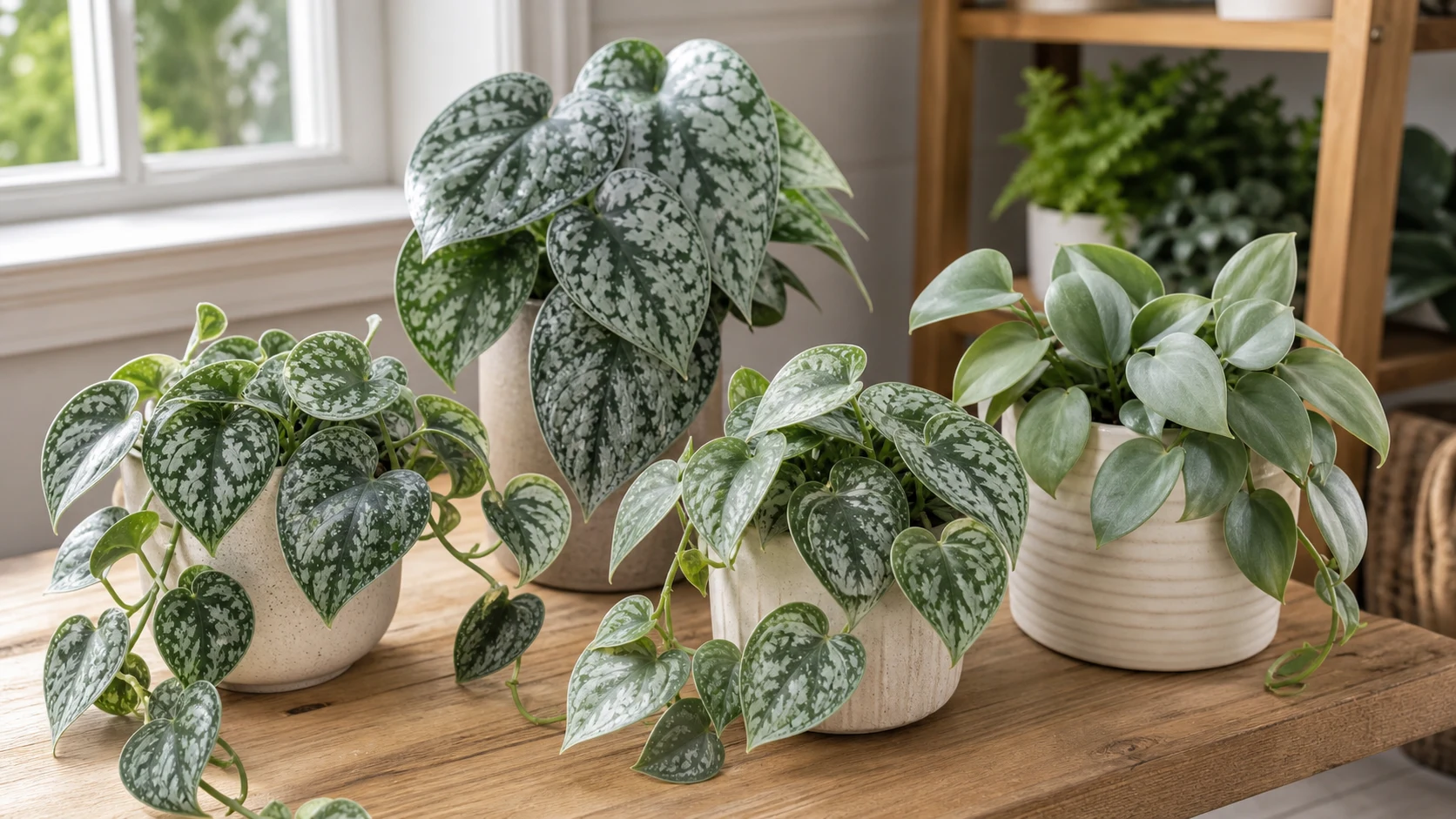
Scindapsus varieties range from compact silver splashes to broad metallic overlays and thicker moonlight foliage.
Is Satin Pothos a Good Fit for Your Home?
Choose satin pothos if you have a bright room, a pot with drainage, and a routine where you can check the soil once a week. It is a good fit for shelves, plant stands, and hanging planters where the vines can trail and the leaves still get steady light.
Be more cautious if your only spot is a dark corner, you tend to water every plant on the same day no matter what, or the pot you want to use has no drainage hole. Satin pothos can forgive a missed watering better than it can forgive wet roots.
If you are choosing between varieties, Argyraeus is the easiest starting point. Exotica gives the boldest silver leaves but is less forgiving in dim rooms. Treubii Moonlight is the better choice when your light is decent but not bright.
Care Cards
| Need | Fast rule |
|---|---|
| Light | Bright indirect light is ideal |
| Water | Let the top half of the pot dry before watering |
| Soil | Chunky, well-draining mix |
| Pot | Drainage hole required |
| Humidity | Average home humidity is okay, but it appreciates more in dry seasons |
| Temperature | Best in warm indoor temperatures, away from cold drafts and vents |
Expert Note
NC State Extension describes Scindapsus pictus as a plant that prefers bright indirect light and well-drained soil. ASPCA lists satin pothos as toxic to cats and dogs because of insoluble calcium oxalates. Those two facts explain most care decisions in one line: keep the roots airy and keep the vines away from curious pets.
Light: Bright Indirect, With a Bit of Flexibility
Satin pothos does best in bright indirect light. A spot a meter or two from a window with good natural light is the sweet spot. The silver markings are the first thing to suffer in low light. The plant compensates by producing more chlorophyll to capture what is available, and those metallic patches gradually shift toward plain green.
Direct sun scorches the leaves. East-facing windowsills work reliably. West and south windows work if there is a sheer curtain or you pull the plant back a foot or two from the glass.
Lower light is survivable, but growth slows significantly and the variegation fades. If you do not have a naturally bright spot, a grow light on a timer keeps the silver vivid without reorganizing your room around it.
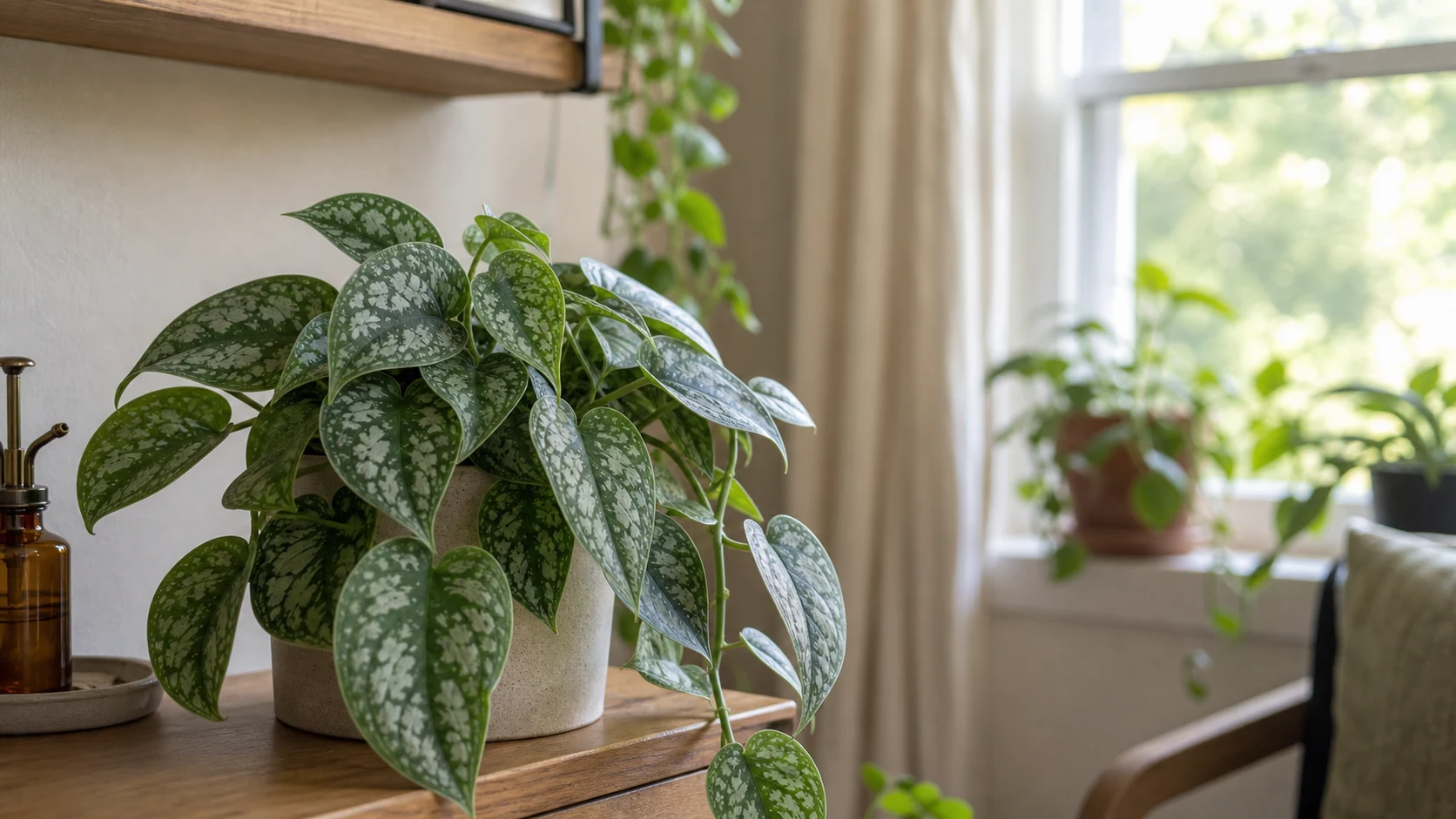
A position set back from a sheer-curtained window keeps the silver vivid without exposing leaves to direct sun.
Watering: Let It Dry More Than You’d Expect
This is where most satin pothos problems begin. The velvety leaves and slower growth rate both point toward a plant that does not want to be watered as frequently as a regular pothos.
Push your finger into the soil to the second knuckle. If it is still damp down there, leave it. Wait until the top half of the soil is dry before watering. In most homes, that works out to every ten to fourteen days in spring and summer, and longer through autumn and winter when growth slows.
If you keep second-guessing the dry-down window, the how often to water pothos guide explains the same finger-test logic in more depth, which still applies even though Scindapsus prefers a slightly more cautious watering rhythm.
A simple routine works better than guessing:
- Check the soil once a week.
- Water only if the top half feels dry.
- Water until it runs from the drainage hole.
- Empty the saucer after the pot drains.
- If the soil is still damp, do nothing and check again in a few days.
One repeated community pattern is worth taking seriously: overwatering root stress can look like thirst because damaged roots stop delivering water to the leaves. If the soil is wet and the leaves are still curling, do not water again first. Check the root zone and the potting mix.
Humidity and Temperature
Scindapsus comes from humid tropical forests and does notice when your home air is dry. Leaf curl is often the first signal.
Average home humidity is fine through most of the year. In winter or dry climates, try grouping your Scindapsus with other plants, setting it on a tray of pebbles and water, or running a small humidifier nearby. Direct misting is less useful here because the matte leaf surface can stay wet longer than you want.
Temperatures between 15 and 29 degrees Celsius suit it well. Keep it away from cold window drafts in winter and heating vents that push dry air directly at the leaves.
Soil and Potting
Standard potting soil can work but tends to stay wet too long on its own. A mix of potting soil with added perlite or orchid bark gives the roots drainage and airflow without drying out too fast.
A pot with drainage holes is not optional. When repotting, choose a pot only slightly larger than the current root ball. Too much extra soil holds moisture the roots have not grown into yet.
Repot in spring when roots are circling the bottom of the pot, pushing through drainage holes, or the soil dries out unusually fast after watering.
Symptom Diagnosis Card
| Symptom | Most likely cause | What to check first |
|---|---|---|
| Curling leaves | Dry air, thirst, or root stress | Soil moisture, then roots |
| Yellow lower leaves | Overwatering or poor drainage | Wet soil, sour smell, mushy roots |
| Brown tips | Dry air, underwatering, or fertilizer buildup | Humidity, watering depth, salts in soil |
| Fading silver | Not enough light | Distance from window or grow light |
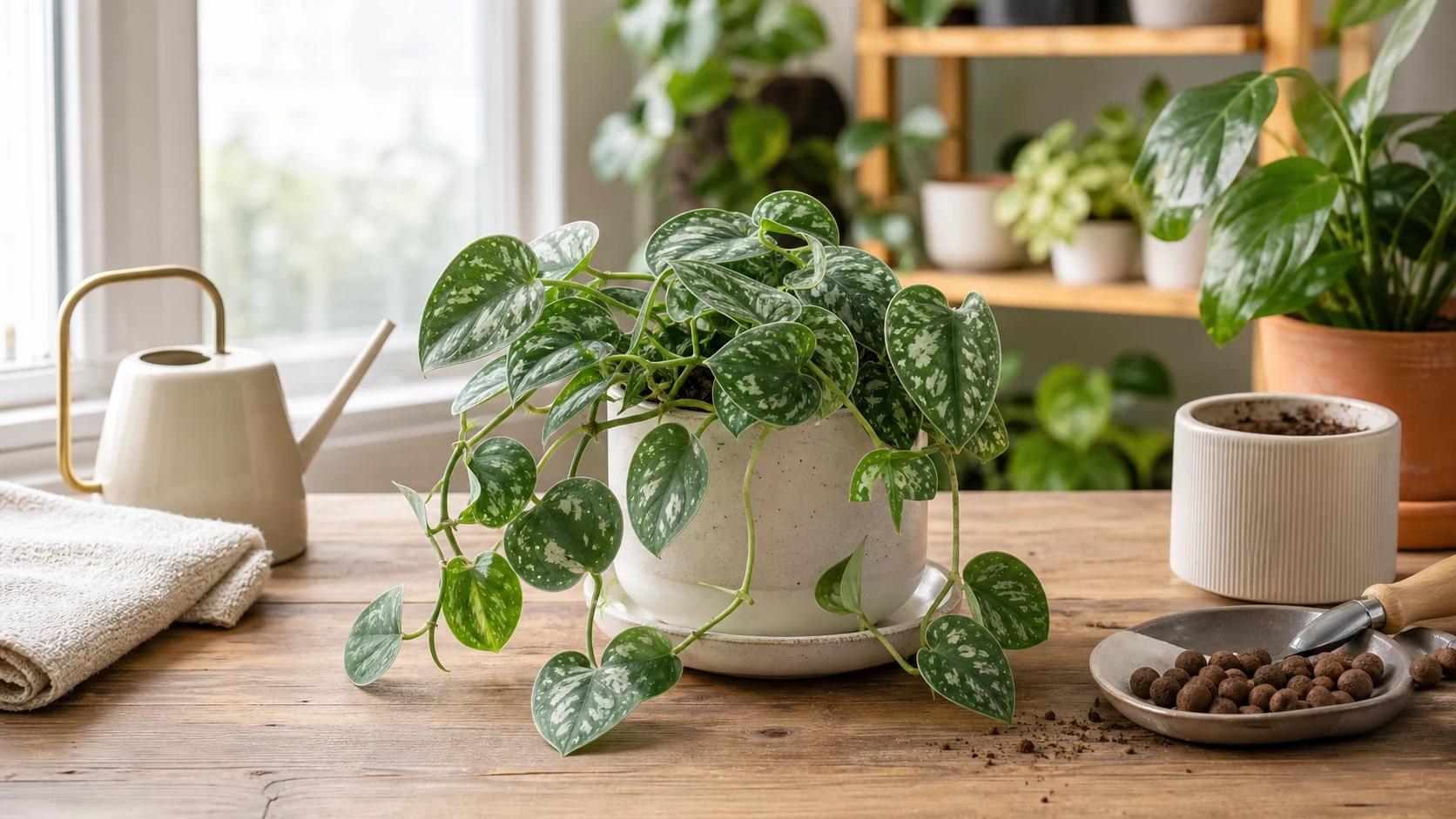
When leaves curl, check soil moisture and the root zone before reaching for the watering can.
Decision Tree: Curling, Yellowing, and Drooping
- Is the soil wet? If yes, stop watering and inspect drainage plus root health.
- Is the soil dry all the way through? If yes, water thoroughly and let the pot drain.
- Is the soil lightly moist but the leaves still curl? Raise humidity and move the plant away from direct heat or drafts.
- Are several leaves yellowing at once? Slide the root ball out and check for mushy roots or an oversized pot.
- Is new growth smaller and less silver? Increase light before changing anything else.
That sequence matters because overwatering and underwatering can look similar from across the room.
Common Problems
| Problem | Why it happens | Best next step |
|---|---|---|
| Leaves curl even after watering | Wet roots or dry air can mimic thirst | Check soil, then humidity and roots |
| Plant stalls after repotting | Pot too large or mix too dense | Let it dry more, avoid extra watering |
| Silver markings fade | Light is too weak | Move brighter or add a grow light |
| Leaves spot or crisp in patches | Direct sun or heat blast | Pull back from glass or vents |
Common Mistakes
- Watering on a fixed schedule instead of checking the soil
- Using dense potting mix with no bark or perlite
- Moving it into a much larger pot too soon
- Treating every curled leaf as underwatering
- Assuming satin pothos behaves exactly like every Epipremnum pothos
Pet Safety
Satin pothos is not pet-safe. ASPCA lists it as toxic to cats and dogs because it contains insoluble calcium oxalate crystals.
Use this pet safety checklist:
- Keep trailing vines out of reach, not just the pot.
- Pick up fallen cuttings after pruning or propagation.
- Wash hands after trimming or repotting.
- If a pet chews the plant and starts drooling, pawing at the mouth, or vomiting, contact your vet or poison support promptly.
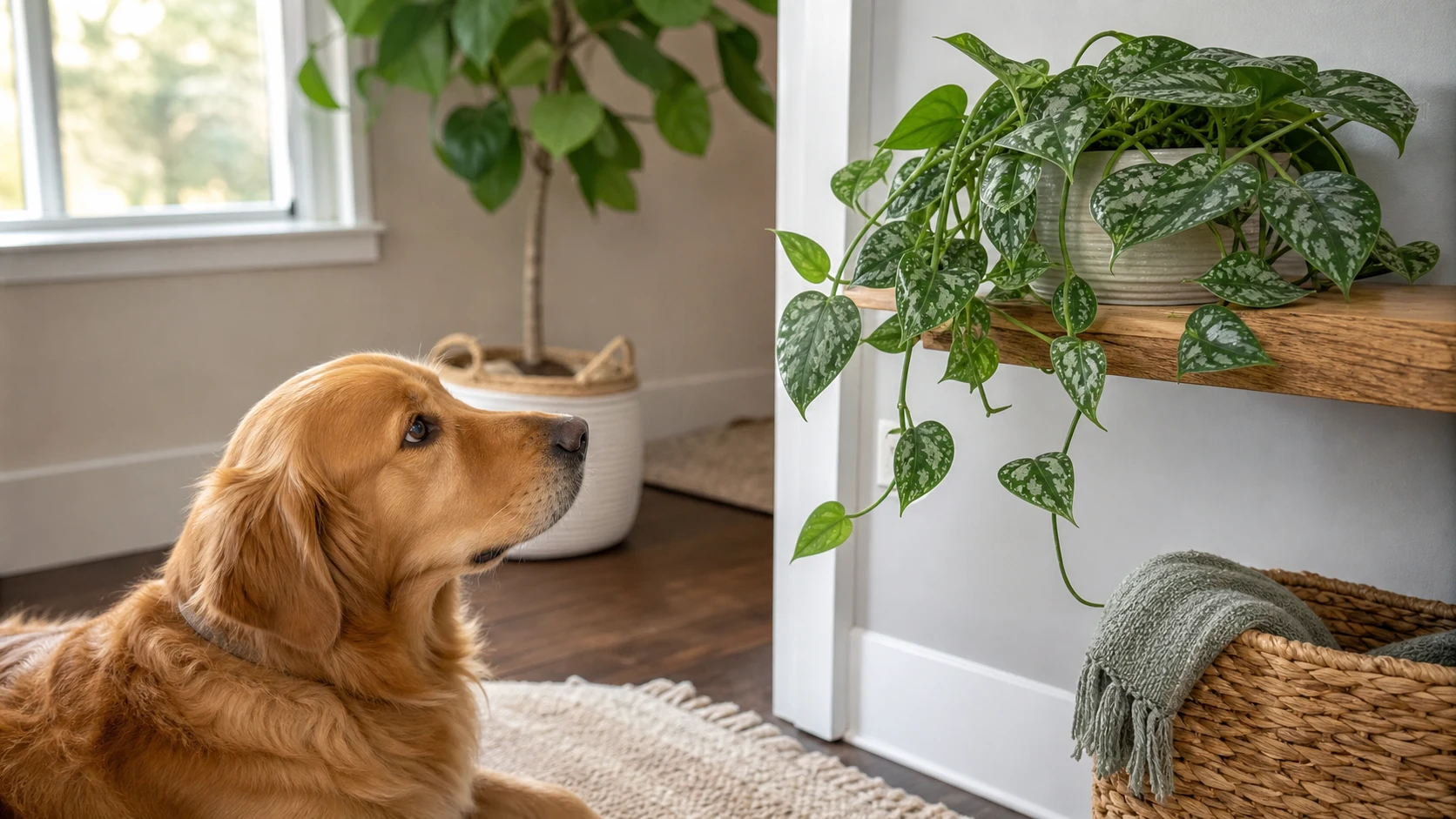
Keep the pot and every trailing vine above the reach of curious cats and dogs.
Propagation
Satin pothos propagates well from stem cuttings. Take a cutting just below a node, remove the lower leaves, and place it in water or moist soil. In water, roots usually appear within two to four weeks. Keep the cutting somewhere warm with indirect light and change the water every few days. If you want the full step-by-step method, see how to propagate pothos, which uses the same node and cutting logic.
Once water roots are a few centimeters long, move the cutting into a small pot with well-draining mix. Keep the soil slightly more moist than usual during the transition week, then back off as new growth appears.
Seasonal Note
Spring and summer are the easiest seasons for satin pothos. It grows faster, uses water more predictably, and recovers from repotting better. In autumn and winter, slow down fertilizing, let the soil dry longer, and watch humidity more closely.
Simple Care Plan
Today: Check the soil depth with your finger, empty any standing water from the saucer, and move the plant out of direct sun or away from a heating vent if the leaves are curling or browning.
This week: Watch one new or recently changed leaf. If the soil dries normally and the leaf looks steady, stay the course. If the soil stays wet all week, improve drainage before watering again.
This season: In spring and summer, fertilize lightly once a month and turn the pot every few weeks so growth stays even. In autumn and winter, stop fertilizing, water less often, and pay more attention to humidity.
For a related hands-on growing walkthrough, use Pothos Repotting: When to Move It and How to Prevent Shock for the setup and follow-up care.
Real User FAQ
How often should I water satin pothos? Every ten to fourteen days in spring and summer is a reasonable starting point, but the real guide is the soil. Push your finger in to the second knuckle. If it is still damp, wait. In autumn and winter, the gap usually stretches to three weeks or more.
Why are my satin pothos leaves curling? The three most common causes are dry air, underwatering, and root problems from wet soil. Check the soil first. If the soil is wet and the leaves are still curling, inspect the roots rather than watering again.
Is satin pothos the same as silver pothos? Both names are usually used for the same plant, Scindapsus pictus. Neither is a true pothos.
What is the difference between satin pothos and silk pothos? “Silk pothos” is another common name for the same plant. Shops often use satin, silver, and silk interchangeably.
Is satin pothos toxic to cats and dogs? Yes. Keep it out of reach and contact your vet if a pet chews it and develops mouth irritation, drooling, or vomiting.
Why is my satin pothos losing its silver markings? Usually too little light. Move it somewhere brighter and new growth should come in with stronger markings.
Can satin pothos grow in low light? It can survive, but growth slows and the silver fades. A grow light is more reliable than a dim corner.
How do I know if I am overwatering my satin pothos? Yellow leaves near the base, soft stems, and soil that stays wet for more than two weeks are the clearest signals.
When should I repot satin pothos? Repot when roots circle the bottom of the pot, push through drainage holes, or the plant dries out unusually fast after watering.
Methodology Note
This guide was refreshed with current SERP review, social discovery from plant-owner discussions, and fact checks against extension and pet-safety sources. Community snippets were used only to surface common confusion patterns, especially the overwatering-versus-thirst mix-up and the naming confusion around “satin pothos.” Care and safety claims were kept conservative and tied to extension guidance or ASPCA toxicity notes.
Last Updated Note
Last updated: 2026-06-16.
Satin pothos is one of those plants that rewards attention. Give it bright indirect light, let the soil dry between waterings, and keep an eye on humidity through winter, and it will trail happily for years.
If you want to keep the routine tied to your actual plant and home conditions, save it in KnowYourPlant with your watering notes and symptom history.
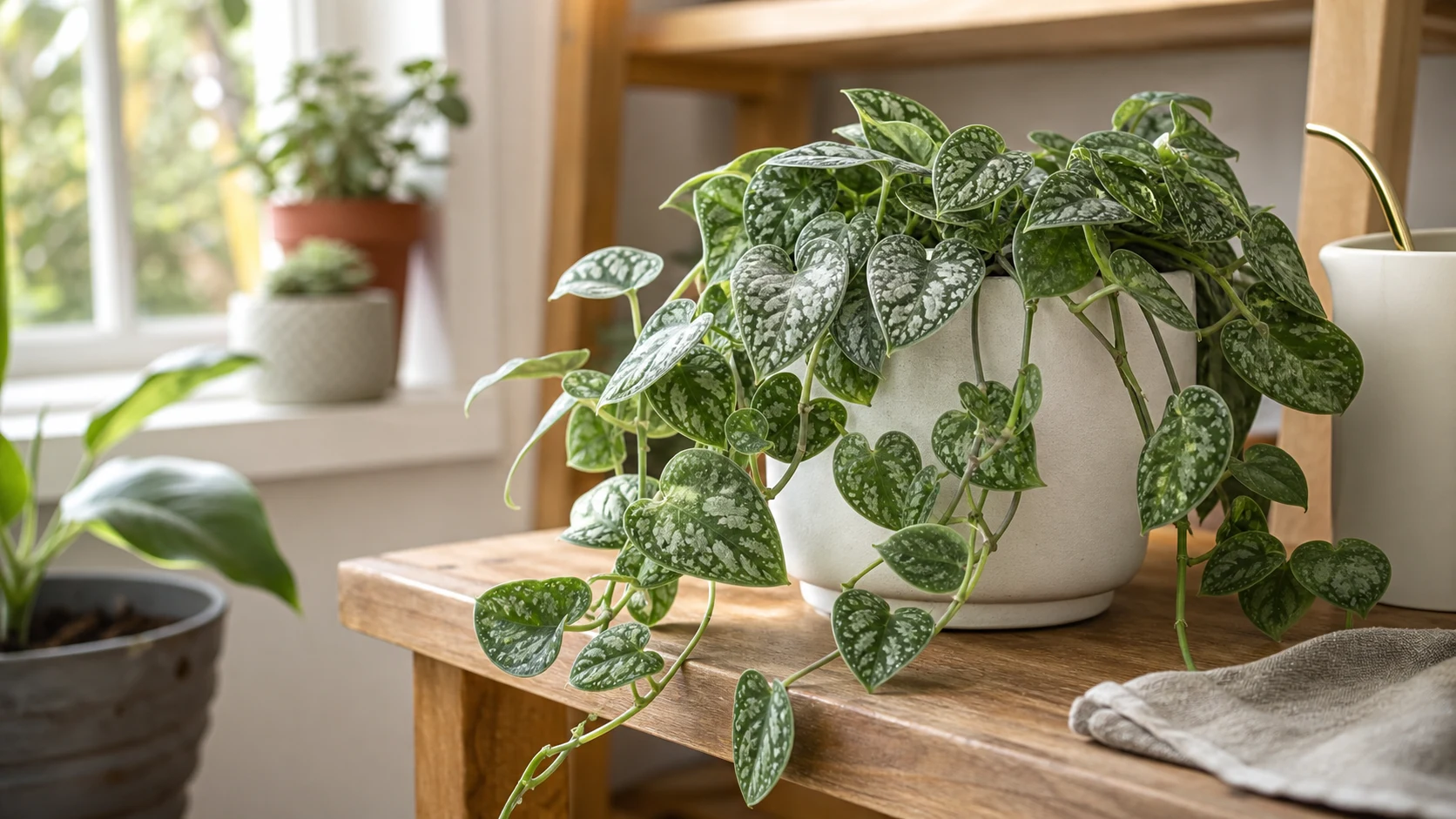
Consistent indirect light, measured dry-down, and seasonal humidity care support years of healthy trailing growth.