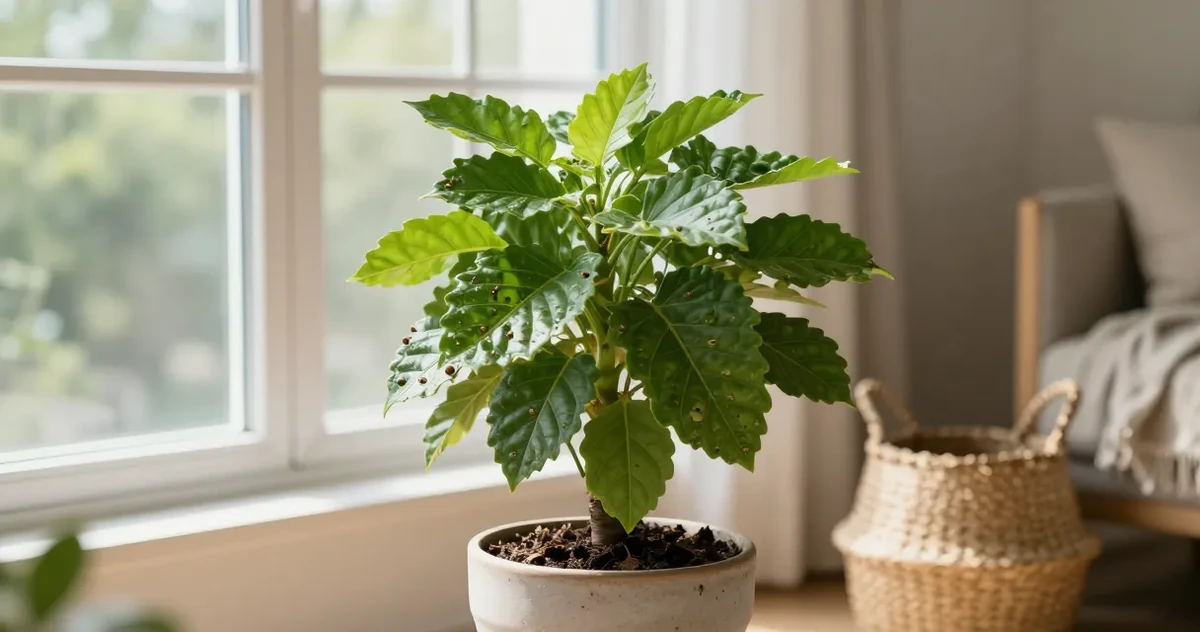
The most common houseplant pests are fungus gnats, spider mites, mealybugs, thrips, and scale insects. Each one hides differently, causes different damage, and responds to a different first treatment. The fastest path to solving any of them is figuring out where the problem is showing up first, not reaching for a product. If nothing is moving and the pattern looks more like spreading spots, mildew, rot, or wilt, switch to the houseplant diseases guide before treating for insects.
Freshness note: This guide was checked against University of Minnesota Extension, Penn State Extension, UC IPM, and University of Maryland Extension sources reviewed on 2026-05-18. The real-owner confusion notes below come from public Gardening Stack Exchange threads and are qualitative signal, not prevalence data.
You notice something small moving on a leaf. Or tiny flies spiral up from the soil every time you water. Or you treated something two weeks ago and it came back. Houseplant pests rarely announce themselves with a dramatic infestation, and they rarely disappear after a single treatment. They start as a small uneasy feeling, and then you look closer, and then you wish you could un-see it.
This guide helps you figure out what you are actually dealing with before you reach for a spray bottle. The fix for fungus gnats is completely different from the fix for spider mites, and treating the wrong pest wastes time while the real problem spreads.
Symptom Diagnosis Card
| If you notice this first | Most likely pest | First move |
|---|---|---|
| Tiny dark flies lifting from wet soil | Fungus gnats | Let the top layer dry, add a sticky card, check drainage |
| Pale stippling or fine webbing on leaf undersides | Spider mites | Isolate the plant and rinse the undersides thoroughly |
| Silvery scars plus black specks on new growth | Thrips | Isolate, inspect buds and leaf folds, then follow the product label |
| White cottony clusters on stems or nodes | Mealybugs | Isolate, remove visible clusters, and inspect nearby plants |
| Sticky residue and fixed brown bumps on stems | Scale insects | Scrape gently, isolate, and inspect every stem joint |
| No visible pest; only holes, yellowing, spots, or wet lesions | A pest lookalike | Compare the leaf damage hub or use the plant disease identifier before spraying |
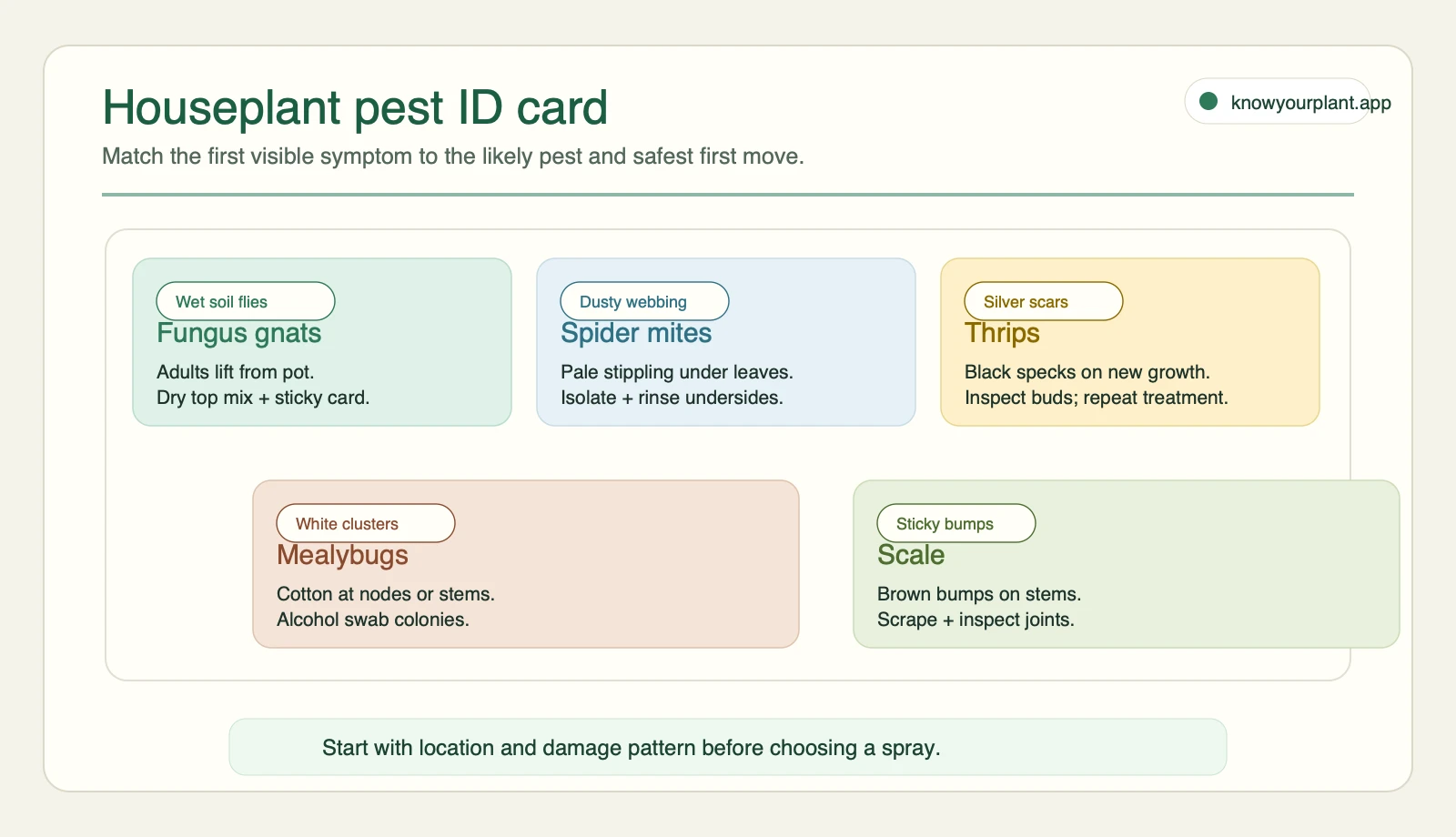
Use the ID card to match the first visible symptom and location to the likely pest before choosing a spray or repotting.
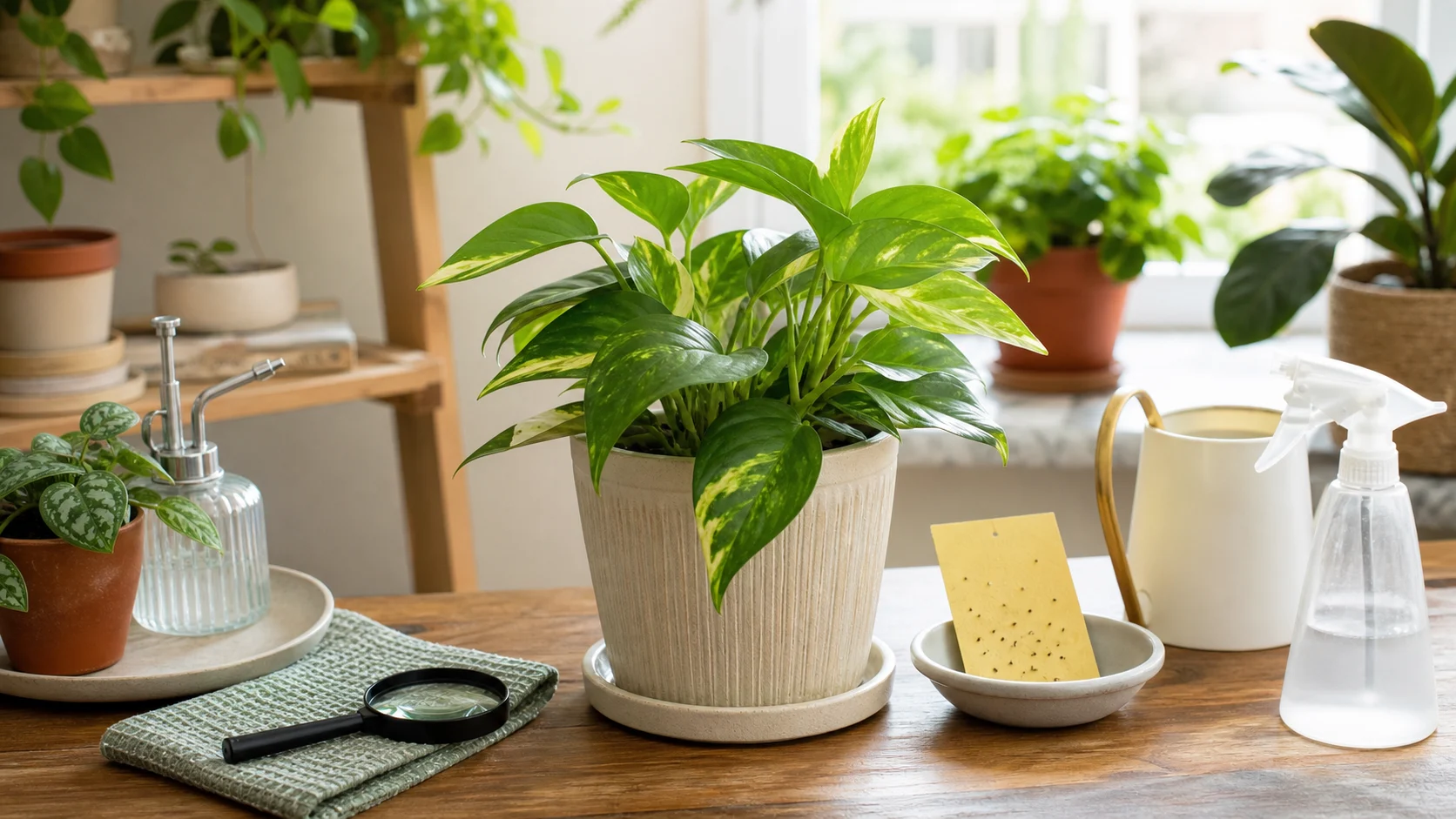
A magnifier, monitoring card, and simple care tools turn the first visible clue into a more reliable pest diagnosis.
What Real Plant Owners Get Stuck On
Public plant-owner threads keep circling around the same pain points:
- Fungus gnats that keep coming back because the adults are easy to see but the wet top layer of soil keeps supporting larvae.
- Thrips that seem to return on fresh growth after one spray because eggs and hidden insects in buds were never interrupted.
- Tiny pale bugs in soil that get treated like a crisis when they are actually springtails or harmless soil mites.
- Several affected plants at once where the real need is triage order, not perfect species identification on day one.
That is why this guide starts with location, damage pattern, and urgency. Most people do not need a longer shopping list. They need to know what deserves immediate isolation, what is mostly a nuisance, and what can wait until the next watering cycle. If the movement is all happening at the soil line and you want a side-by-side breakdown of gnats, springtails, soil mites, and root mealybugs, use the companion guide to tiny bugs in houseplant soil.
What Most Pest Guides Miss
Most houseplant pest content runs the same script: here is a list of six bugs, here is a product for each one. What that approach skips is the part that actually trips people up - figuring out which pest you have when the bugs themselves are nearly invisible, and understanding why it keeps coming back even after treatment.
The most common misdiagnosis is treating gnats when you actually have a harmless soil visitor. Someone sees tiny creatures near the pot, reads that fungus gnats live in moist soil, and starts letting the soil dry out aggressively. Sometimes that works. But springtails, shore flies, and soil mites also live near the soil surface, move similarly, and are not actually harming the plant. Drying the soil to fight a harmless insect can stress the plant more than the pest ever did.
The second common mistake is treating adults without breaking the reproductive cycle. Killing flying gnats does not stop larvae already hatching in the soil. Spraying spider mites once misses eggs on the underside tissue. One round of mealybug treatment leaves newly hatched crawlers alive. This is why most indoor pest problems feel like they come back - they never fully left.
The first check is not “which spray should I buy.” It is where is the problem showing up first? Bugs at the soil surface, bugs on leaf undersides, silvery marks on leaves, sticky residue, or cottony white clusters are all different situations pointing to different culprits.
Start with location. Then look for the secondary clue. That gets you to the right answer faster than any product label.
Start With Where, Not What
When you are trying to identify houseplant pests, your first question is: where did I notice the problem first?
Expert note: University extension and IPM guidance are surprisingly consistent here. Isolate the plant first, inspect the undersides of leaves and stem joints second, then decide whether you are dealing with a mostly visible nuisance adult population, like fungus gnats, or an actively feeding pest, like thrips, spider mites, mealybugs, or scale. That order prevents a lot of bad first treatments.
Flying or crawling near the soil
Tiny dark flies hovering near the pot when you water almost always means fungus gnats. They are drawn to consistently moist soil, where they lay eggs and their larvae feed on organic matter and fine roots. The adults are mostly a nuisance. It is the larvae that can stress young or weak plants.
Penn State Extension notes that fungus gnat larvae live in the top two to three inches of moist potting mix. Letting that surface layer dry between waterings is the most reliable long-term control. Yellow sticky cards help intercept flying adults and give you a visible count of whether the population is growing or declining.
For a more detailed approach to ending a gnat problem, see the full guide to getting rid of fungus gnats.
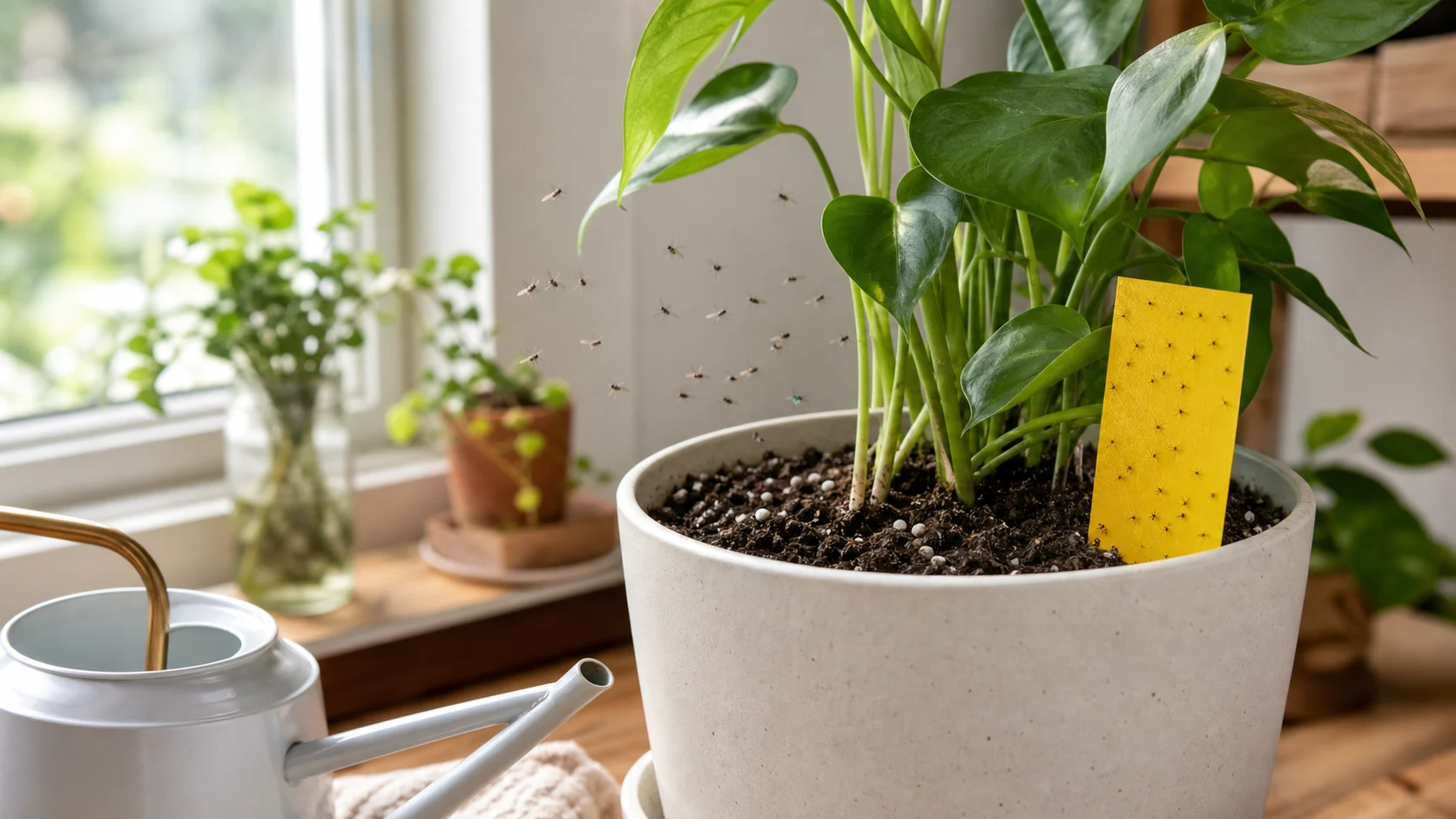
Dark flies above moist mix and adults caught on a yellow card point to a fungus gnat cycle in the pot.
Stippling, dulling, or fine webbing under leaves
If the leaves look faded, speckled, or dusty, especially in the warmest spots on the plant, look closely at the undersides. Spider mites are barely visible to the naked eye, but their damage is distinctive: tiny pale dots across the leaf surface that give it a mottled, bronzed look. Webbing under leaves or along stems confirms them.
UC IPM notes that spider mites thrive in hot, dry conditions and become noticeably worse on water-stressed plants. If your plant has been too dry for too long and you are now seeing stippling, spider mites are a strong first guess. A strong rinse of water under the leaves disrupts them significantly and is often the most useful first step before any spray.
See the full breakdown of how to get rid of spider mites if you have confirmed the webbing.
Silvery streaks with dark specks
Thrips are very small insects that feed on leaf tissue, leaving silvery or tan scarring where the cells have been scraped out. The tiny black specks nearby are their droppings. The damage often appears before the insects are spotted. You might notice the streaky texture and assume it is a watering issue before you find anything moving.
UC IPM confirms that thrips damage may appear before the insects themselves are visible, and that managing them requires a combined approach rather than pesticide-only treatment. Because thrips can shelter in buds and new growth, one application may not end an infestation. Plan repeat inspections, and reapply a product only at the interval on its label.
Use the dedicated thrips on plants treatment guide to confirm the silvering-and-frass pattern, decide whether to isolate or discard, and organize label-directed follow-up.
Cottony white fluff on stems or leaf nodes
Those white fuzzy clusters on stems are not mold. They are mealybugs, covered in a waxy protective coating. They settle in leaf joints, along stems, and on the undersides of thicker leaves. As they feed, they produce sticky honeydew, which can lead to a sooty black mold developing on surfaces below.
University of Maryland Extension notes that mealybugs are among the more difficult indoor pests to control, and heavily infested plants may ultimately need to be discarded. They reproduce quickly, and the waxy coating protects them from sprays that work on other insects. Rubbing alcohol on a cotton swab is the most direct first treatment for small infestations - it cuts through the wax and kills on contact.
The complete mealybug guide covers the full treatment ladder.
Sticky residue or brownish bumps on stems
If you notice shiny sticky patches on stems or leaves and see flat or slightly rounded bumps clinging to bark or petioles, especially on ficus, citrus, or ferns, those bumps are scale insects. They look more like a plant abnormality than a pest, which is why they are often missed until the population is large.
Like mealybugs, scale produces honeydew and can host sooty mold. The bumps are the adults, and they do not move, which makes them easy to mistake for part of the plant’s texture. A thumbnail scrape test helps: if the bump comes off cleanly, it is scale.
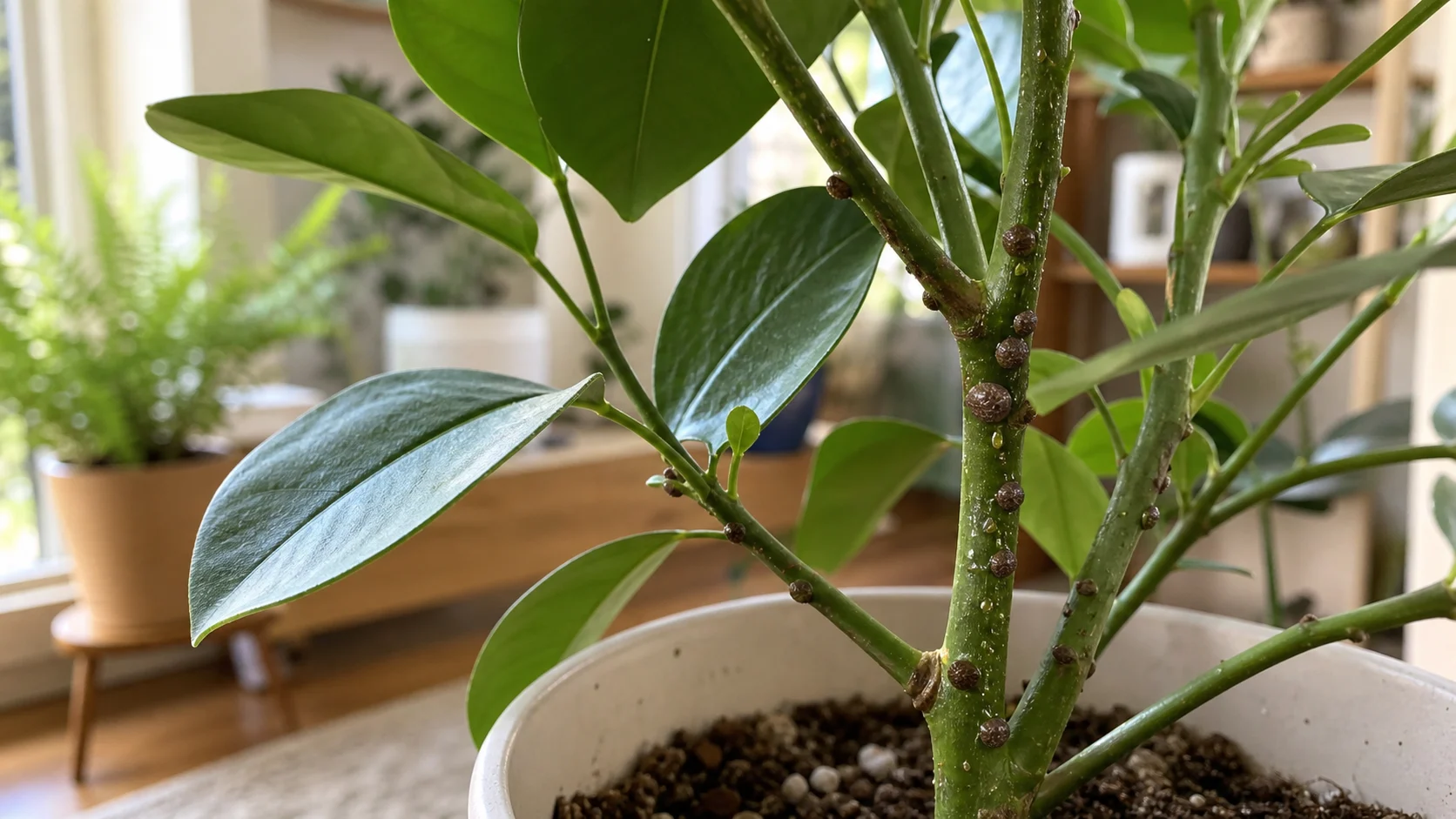
Fixed brown bumps and honeydew droplets along the stem make scale easier to distinguish from normal bark texture.
The Soil Bug Confusion Guide
If you are seeing small creatures near the soil and are not sure whether they are a problem or not, this is where most pest guides leave you stranded. Four very different soil visitors are regularly mistaken for each other, and the right response is completely different depending on which one you have.
| Bug | Size + Color | Movement | Flies? | Harm to Plant |
|---|---|---|---|---|
| Fungus gnats (adults) | Tiny, dark gray-black | Fly erratically, hover near pot | Yes | Adults: none. Larvae: can damage fine roots in moist soil |
| Springtails | Tiny, pale white or gray | Jump suddenly when touched | No | None - they eat decaying organic matter only |
| Shore flies | Tiny, dark, stockier than gnats | Run more than fly, less erratic | Rarely | None - larvae feed on algae, not plant roots |
| Soil mites | Tiny, white or tan, round | Crawl slowly through soil | No | Usually none - most species are harmless decomposers |
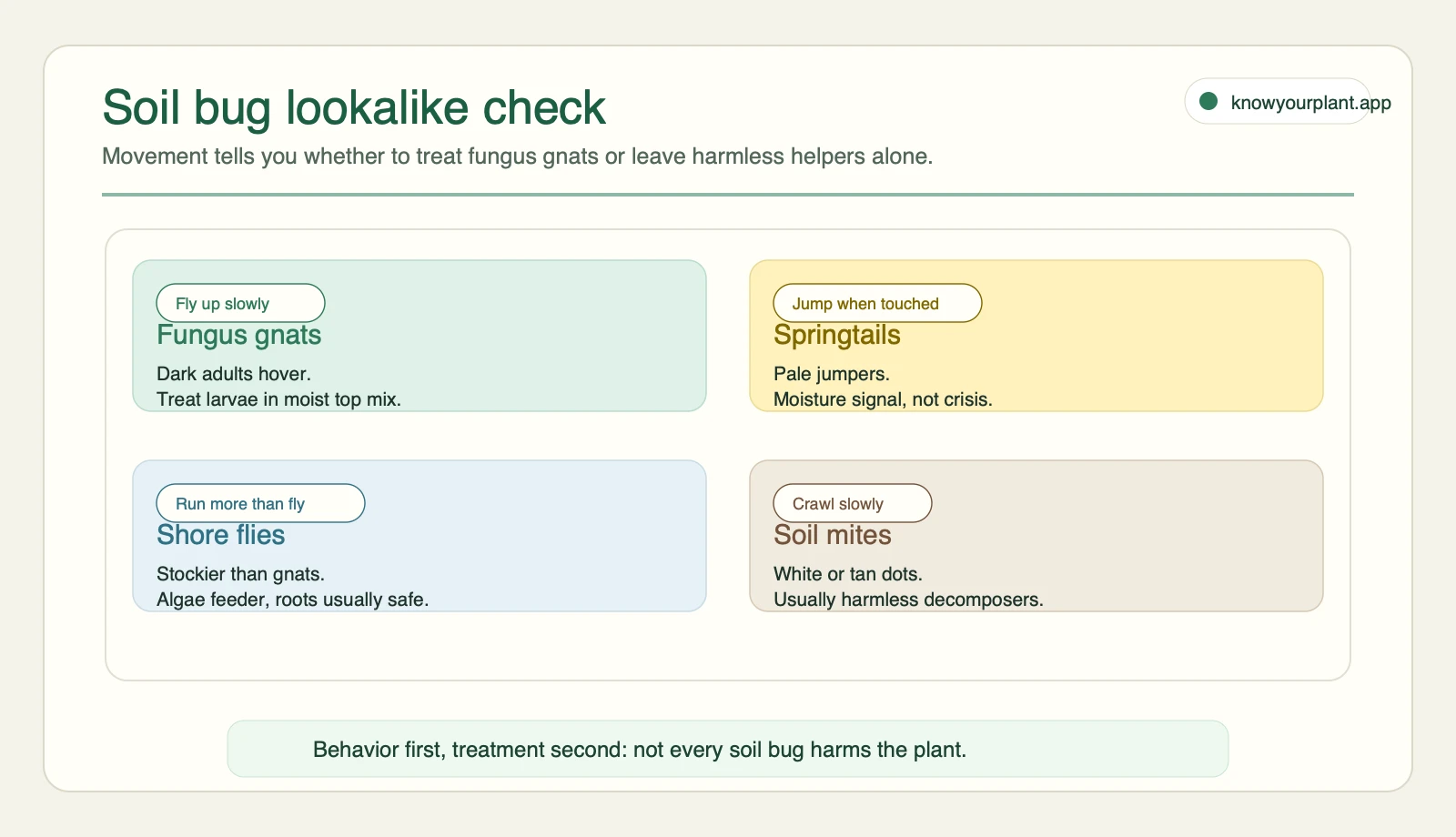
Use the lookalike check to avoid treating harmless soil visitors like an infestation; movement tells you what kind of response is justified.
The practical takeaway: if you see small dark flies hovering and your soil has been consistently moist, treat for fungus gnats. If tiny pale things jump when you touch the soil, that is springtails - they are not harming anything. If you see slow-moving white specks in the mix but no leaf damage, those are likely soil mites going about their business. When you are still unsure whether the pattern points to pests, stress, or disease, compare it against the broader leaf damage identification guide before you spray.
The critical mistake is aggressively drying your soil or repotting based on a harmless soil visitor. Before you change anything, check for actual plant damage, whether the creature flies, and whether you are seeing leaf symptoms.
Decision Tree: What To Do Next
- If bugs fly up from wet soil when you water, start with fungus gnat controls. Dry the top layer, add sticky cards, and look at moisture habits before repotting.
- If tiny soil bugs jump instead of fly, treat them as likely springtails first. Look for actual plant damage before changing care.
- If damage shows up first as pale stippling or webbing under leaves, assume spider mites until proven otherwise and rinse the undersides immediately.
- If the leaf surface looks silvery and you see black specks nearby, treat for thrips and check new growth, buds, and nearby plants the same day.
- If you see cottony clusters or hard bumps on stems, move fast on mealybugs or scale with direct contact removal and follow-up inspections.
- If you still cannot tell after the first check, isolate the plant, set a sticky trap, inspect again in 24 hours, and avoid spraying blindly just because something is moving.
The Triage Table: Which Pest Needs Immediate Action
Not all houseplant pests are equal urgency. Here is how to prioritize your response:
| Pest | Spread Risk | Urgency | First Move |
|---|---|---|---|
| Spider mites | High - can spread on air currents in warm, dry rooms | Immediate | Isolate + rinse leaf undersides thoroughly |
| Thrips | High - spread to buds, cycle continues for weeks | Immediate | Isolate + inspect every nearby plant |
| Mealybugs | Medium-high - fast reproduction | Act within 24 hours | Alcohol swab directly on colonies |
| Scale | Medium - slow but persistent | Within a few days | Scrape manually + inspect all stems |
| Fungus gnats | Low for healthy, established plants | Monitor | Let topsoil dry, add yellow sticky cards |
| Springtails or soil mites | None - usually harmless | No treatment needed | Adjust moisture only if excessive |
University of Minnesota Extension emphasizes early detection as the key advantage with indoor pests. Because plants are in a contained environment, populations can build quickly and spread between pots before you notice them. Checking new plants before they join your collection and inspecting the undersides of leaves regularly catches most problems at “one plant affected” rather than “half the shelf is affected.”
Common Mistakes That Make Houseplant Pest Problems Worse
- Treating before identifying. A gnat fix is not a spider mite fix, and a harmless soil visitor does not need a pesticide.
- Stopping after one round. Thrips, mealybugs, and fungus gnats usually need follow-up timed to the life cycle, not a one-and-done treatment.
- Keeping the plant in the same crowded spot. Isolation buys you time and keeps one bad pot from becoming a shelf-wide problem.
- Repotting too early. Repotting can help with persistent soil pests, but it is a stress event and should follow diagnosis, not replace it.
- Ignoring the condition that helped the pest. Wet soil, dusty dry leaves, and weak airflow often matter as much as the treatment choice.
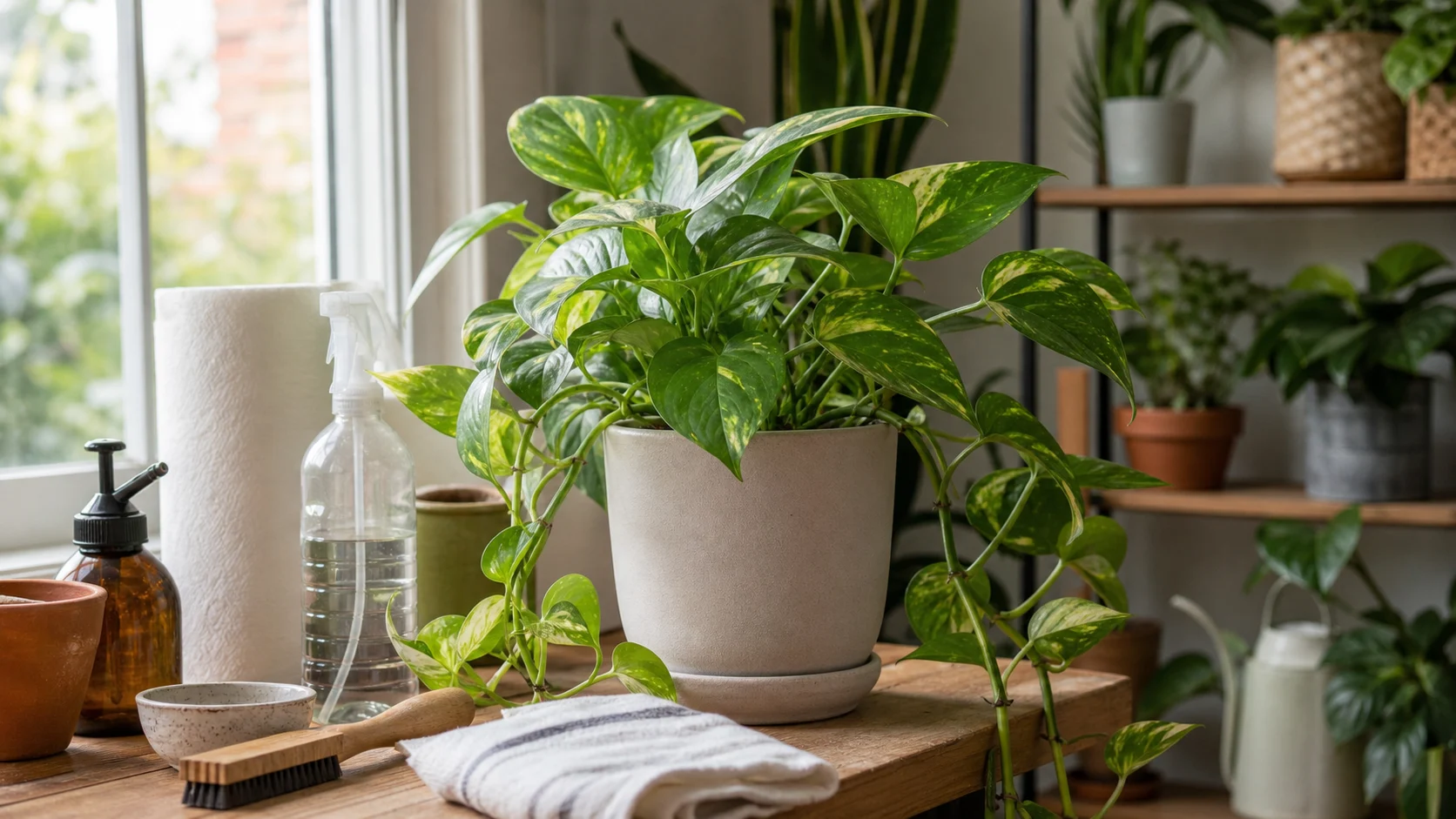
Isolating one affected plant and using a restrained cleaning setup avoids the crowded, product-first response that often worsens outbreaks.
Your First 72 Hours When You Find a Pest
Whatever pest you have identified, these steps apply right away:
- Move the plant away from others. Even a few feet helps. Many pests spread through direct contact or by crawling between pots that touch.
- Inspect both sides of every leaf on the affected plant and every plant nearby. Undersides are where most pests hide first.
- Hold off on watering for now. Many infestations thrive on excess moisture. A brief pause lets the surface dry slightly and removes conditions that favor soil-dwelling pests.
- Set up a yellow sticky card near the pot. This tells you over the next week whether a flying pest population is growing, holding, or declining.
- Plan a follow-up check in 7 days. Single treatments rarely break the cycle completely. The second round is usually as important as the first.
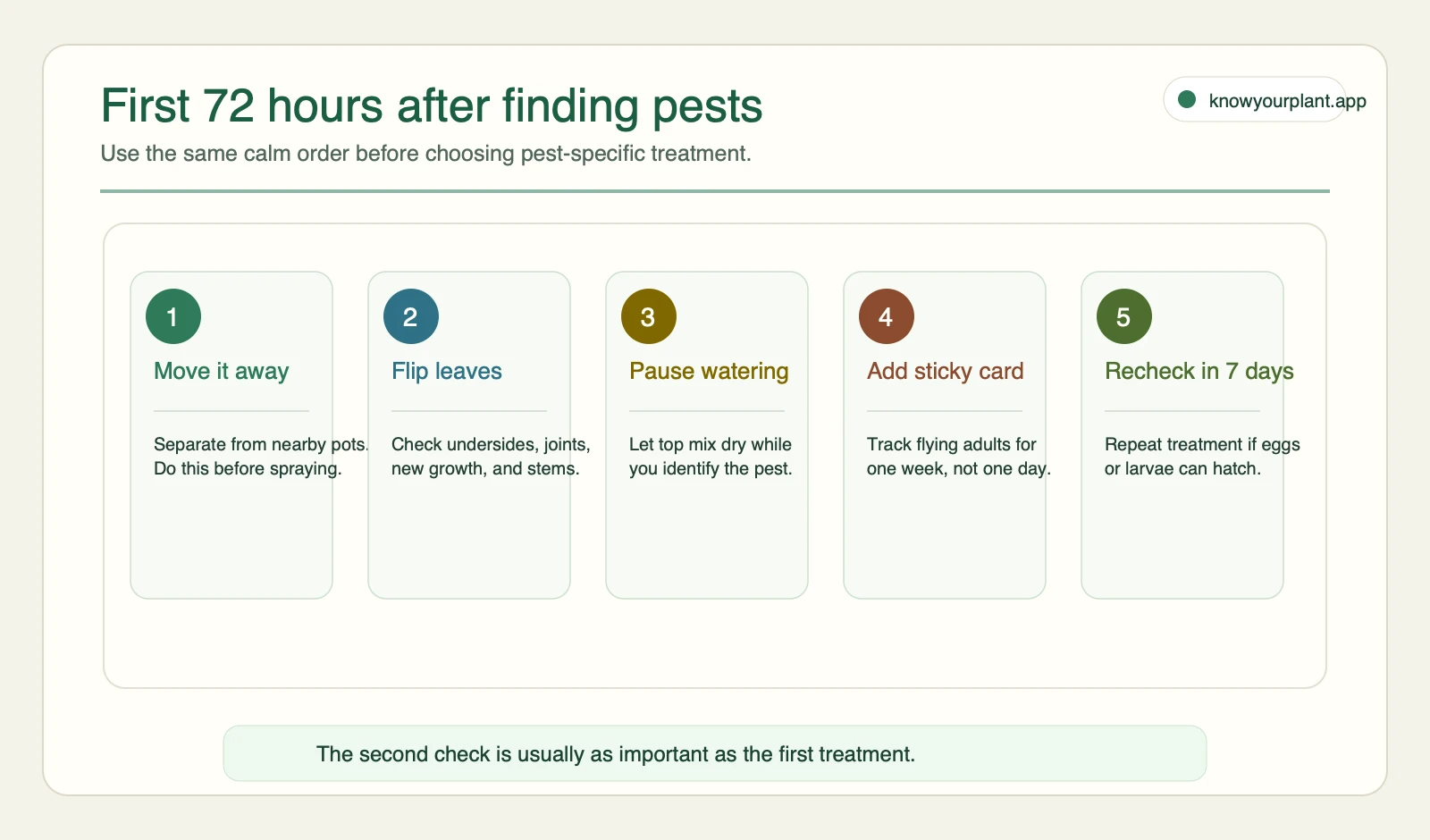
Use the first-response order before pest-specific treatment so one affected plant does not become a shelf-wide problem.
After those steps, treatment depends on what you found. Mealybugs and scale respond to rubbing alcohol on a cotton swab. Spider mites respond to a strong rinse under the leaves. Fungus gnat larvae respond to letting the surface soil dry and, for persistent infestations, a BTi-based soil drench.
For broader management across multiple pests, neem oil is a useful multi-purpose option. See the neem oil guide for dilution rates and the right application method.
Why Pest Treatments Keep Failing
The most common reason a pest returns after treatment is that the treatment targeted adults without breaking the reproductive cycle.
With fungus gnats, killing the flying adults with sticky traps does not stop the next generation from hatching in the soil. The larvae are already in the top few inches of the potting mix, and the cycle from egg to adult takes about three to four weeks. New adults will keep appearing even after you have caught dozens on sticky cards. The fix is the soil moisture level, not just the flying insects. If your sticky card numbers stop dropping after two weeks of letting the surface dry, check whether the soil deeper in the pot is staying wet and whether your drainage is working.
With thrips, a single spray may kill exposed adults but leaves eggs that were laid inside leaf tissue. New adults hatch in one to two weeks, which is why infestations seem to return almost immediately after treatment. Effective control means two to three applications spaced about a week apart, plus pruning any heavily scarred new growth where eggs are likely hiding.
With mealybugs, the waxy coating on adults and egg sacs physically blocks many spray products. Rubbing alcohol penetrates the wax directly, which is why it outperforms most sprays on contact. Even so, for a larger infestation, multiple rounds over two to three weeks are needed to catch newly hatched crawlers before they build their own protective coating.
Pest control on houseplants is rarely a one-time event. If a treatment appears to work but the pest returns within a couple of weeks, the cycle was not fully broken. That is normal, and it does not mean the treatment failed - it means the timing of follow-up matters as much as the first application.
Seasonal Note: Timing Changes Which Pests Win
Spider mites and thrips usually surge faster in warm, dry rooms, especially when indoor heat or direct sun leaves foliage stressed. Fungus gnats tend to linger longer when lower light and cooler indoor conditions keep potting mix wet for too many days in a row. Spring growth also makes sap-feeding pests easier to miss because tender new leaves hide damage until it spreads. If your usual control method suddenly feels less effective, check whether the season changed the conditions that favor the pest.
The Two-Minute Inspection Routine
University of Minnesota Extension ties almost every pest severity outcome to one factor: how early it was caught. A plant you check weekly rarely develops a serious infestation. A plant you ignore for a month can become a problem that spreads to everything near it before you notice.
Two minutes, once a week:
- Flip a few leaves. Pick three to four leaves at random and look at the undersides for any movement, webbing, specks, or discoloration. Pest colonies build up on undersides first, before you see anything on the top of the leaf.
- Check the leaf joints and new growth. Mealybugs, thrips, and scale all prefer soft tissue near new shoots and where the leaf meets the stem. Run your finger along a stem joint - if it feels sticky or you see any powdery residue, look closer.
- Watch the soil surface when you water. Note whether anything moves. Erratic dark flies lifting off are gnats. Pale things that jump are springtails. Slow-moving white specks are soil mites. Knowing which you have takes about fifteen seconds and determines whether you need to act at all.
You do not need a magnifying glass for most of this. You need a regular habit. Catching a mealybug colony at five insects is a cotton swab job. Catching it at five hundred is a repotting decision.
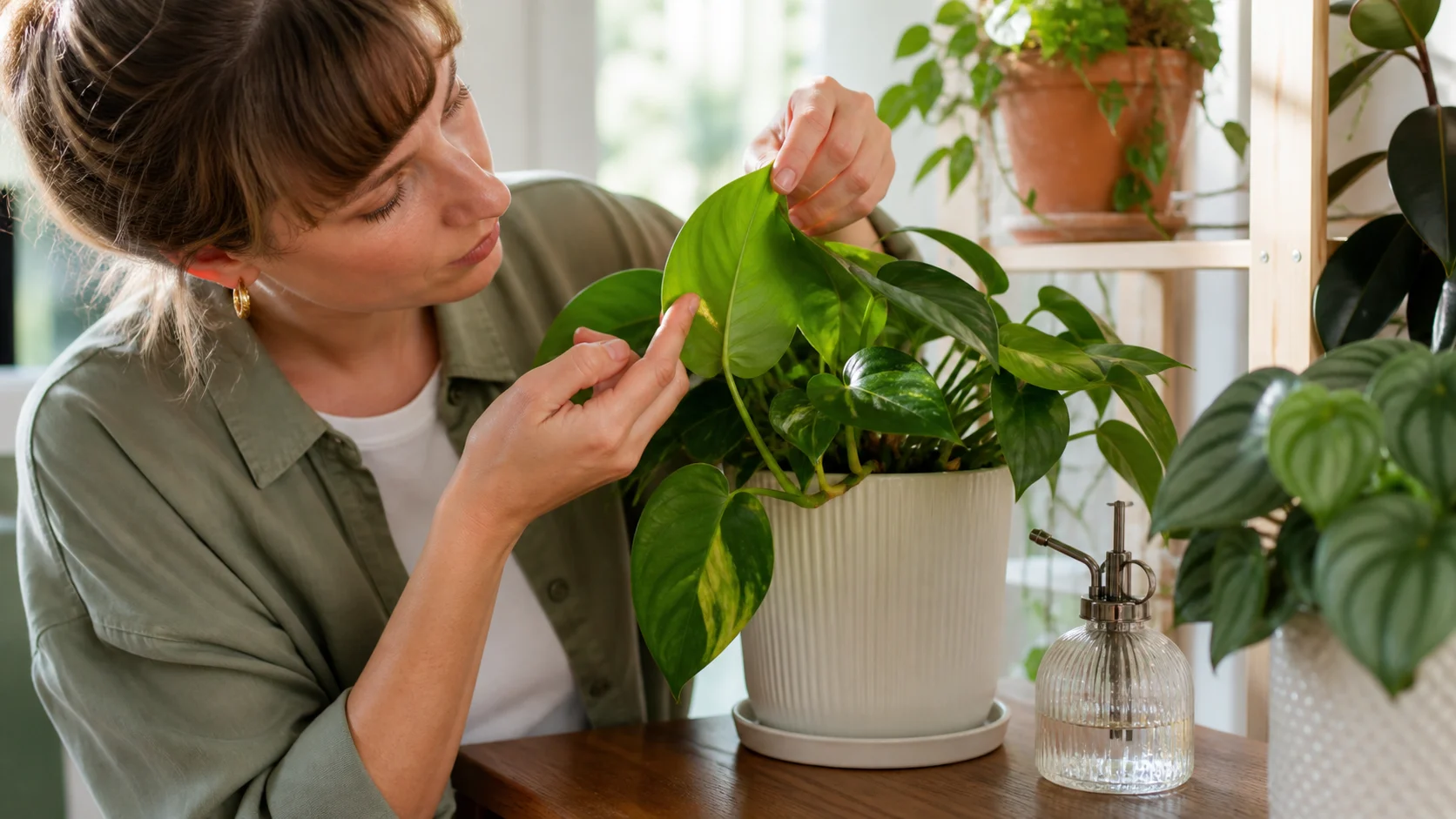
Flipping a few leaves and checking their undersides each week catches small colonies before they spread.
When to Consider Discarding a Plant
This is not the answer anyone wants, but it is worth being direct: if a plant has a severe mealybug or scale infestation, has been treated multiple times without improvement, and is sitting near other healthy plants, removing that one plant may be what protects the rest of your collection.
University of Maryland Extension is direct on this point for mealybugs - heavily infested plants can be nearly impossible to fully clear, and keeping them risks reinfesting everything nearby. The calculation shifts when the plant is rare, large, or sentimental. But for a small propagation or a plant you have only had a few months, the cost of reinfestation spreading across multiple pots is usually higher than the cost of letting one go.
If you are unsure, isolate the worst plant in a separate room, treat it twice more with a week between rounds, and then reassess. You will know within three weeks whether it is clearing or getting worse. At that point the decision is a lot clearer.
A Note on Prevention
Pests do not usually arrive because you are doing something wrong. They come in on new plants, on soil, through open windows, and sometimes just on your clothes. What does reduce outbreak severity is plant health: a well-draining pot, appropriate watering, and enough light for the plant’s needs. Stressed plants are significantly more susceptible to both initial infestation and rapid spread.
Before you bring a new plant home, keep it isolated for two to three weeks. That window catches most stowaways before they reach the rest of your collection - and it is a lot easier than treating six pots instead of one.
Frequently Asked Questions
What are the most common houseplant pests?
The pests you are most likely to encounter on indoor plants are fungus gnats, spider mites, mealybugs, thrips, and scale insects. Fungus gnats are the most commonly seen because the adults are visible and fly when you water. Spider mites and thrips are harder to spot early because the insects themselves are tiny, so the damage usually appears first. Mealybugs and scale tend to build up slowly and are often noticed only after the population is already large.
How do I know if I have spider mites or thrips?
Look at the damage pattern more than the insects themselves. Spider mites leave tiny pale stippled dots across the leaf surface and fine webbing on the undersides and along stems - the leaf looks dusty or bronzed from a distance. Thrips leave silvery or tan streaks and scars where they have scraped the leaf surface, plus black specks of droppings. Spider mite damage tends to spread more evenly across the leaf. Thrips damage often starts on new growth and along leaf edges. Both thrive in warm, dry conditions, so they can appear on the same plant at the same time.
Can fungus gnats hurt my plants?
Adult fungus gnats are mostly a nuisance - they do not feed on plant tissue. The larvae, however, live in the top few inches of moist potting mix and feed on organic matter and fine roots. For healthy, well-established plants, a fungus gnat infestation usually causes minimal damage. For seedlings, young propagations, or plants already weakened by overwatering, larval feeding can slow growth or make the plant more vulnerable to root issues. Penn State Extension notes that the most reliable defense is letting the top layer of soil dry between waterings rather than chasing the adult flies.
What is the white fuzzy stuff on my plant?
White cottony or fuzzy clusters on stems, leaf joints, or leaf undersides are almost always mealybugs. The waxy coating they produce looks like cotton or fine powder. If the white is powdery and spread flat across a leaf surface rather than gathered in a defined cluster, it could be powdery mildew instead - a fungal issue, not an insect. You can tell the difference by touching it: mealybug colonies feel slightly waxy and have a distinct mass; powdery mildew feels dusty and lies flat against the leaf. University of Maryland Extension recommends acting quickly on mealybugs because they reproduce fast and become significantly harder to clear once established.
Why do my houseplant pests keep coming back?
The most common reason is treating adults without breaking the reproductive cycle. With fungus gnats, killing flying adults does not stop larvae already hatching in moist soil. With thrips, a single spray kills exposed adults but leaves eggs inside plant tissue, so a new wave hatches one to two weeks later. Effective control usually means two to three treatment rounds spaced about a week apart, combined with addressing the condition that encouraged the pest - soil moisture for gnats, plant stress for mites.
Is neem oil safe to use on all houseplants?
Neem oil works on a broad range of pests and is generally safe for most houseplants when properly diluted. It works by disrupting the pest’s feeding and reproductive behavior rather than killing on contact, so it is most effective as a preventive or early-infestation tool. Some plants with delicate or waxy leaves can be sensitive to oil-based sprays, so test on one leaf and wait 24 hours before treating the whole plant. Apply in the morning or evening rather than in direct sun to avoid leaf scorch. For heavy mealybug or scale infestations, mechanical removal with rubbing alcohol is usually faster than neem.
How do I stop pests from spreading when I have multiple affected plants?
Isolation is the most important step. Move the affected plant away from the others before you do anything else - not just to a different shelf, but ideally a different room with no direct contact with other pots. Then inspect every nearby plant on the undersides of leaves and along stems. Sticky traps near affected plants help catch flying adults like fungus gnats and thrips before they reach other pots. University of Minnesota Extension notes that early detection and physical separation are the most effective tools in a shared indoor plant collection. Once one plant in a tight grouping has a spreading pest, check all of them.
When should I repot a plant to deal with a pest?
Repotting is most useful for persistent soil-based pests like fungus gnats when other methods have not worked. Removing the old potting mix, washing the roots gently, and starting with fresh soil eliminates larvae and eggs that would otherwise keep hatching. For mealybugs, repotting can also expose root colonies that do not show above the soil surface. Repotting is stressful for the plant though, so treat it as a last resort rather than a first response. If you do repot to address a pest, discard the old soil rather than reusing or composting it.
How This Guide Was Built
This article was reviewed against current university extension and IPM guidance for fungus gnats, thrips, spider mites, mealybugs, and general indoor-plant pest management. Public Gardening Stack Exchange threads were used only to understand where home growers get confused first, especially around recurring fungus gnats, hidden thrips, lookalike soil bugs, and multi-plant triage. Direct treatment guidance comes from the extension and IPM sources, while the owner-confusion examples are qualitative signal only.
Plant-by-plant observations are checked against structured notes so treatment guidance stays grounded in evidence rather than guesswork.