By KnowYourPlant editorial team, last updated June 18, 2026.
If your money tree is dropping leaves, or your peace lily wilts every other week, that is not a minor plant problem. In traditional feng shui, a declining plant in a symbolic corner creates worse energy than an empty corner. The plant you chose to attract abundance is quietly broadcasting decline instead.
That is what most feng shui plant guides skip entirely. They tell you which species to buy and which bagua zone it belongs in. They do not tell you whether the room where that zone sits can keep the plant alive.
A working definition: feng shui plant placement is the practice of choosing specific plants and positioning them in your home to support the flow of chi (life energy) through each room. Not magic. Intentional design with living things, and living things have non-negotiable requirements.
Quick answer: The best feng shui plants for home are money tree (wealth corner), jade (desk or entrance), golden pothos (shelves and corners), peace lily (calm low-light spaces), and snake plant (bedroom, anywhere low-light). The rule that matters more than any placement chart: a plant that is alive and growing in the right conditions does more for a space than a symbolically correct species slowly declining in the wrong corner.
What Most Feng Shui Plant Guides Miss
Most feng shui plant lists focus entirely on which species to buy and where to position them on the bagua map. That is useful as far as it goes, but it skips something more fundamental: a struggling plant creates worse energy than no plant at all.
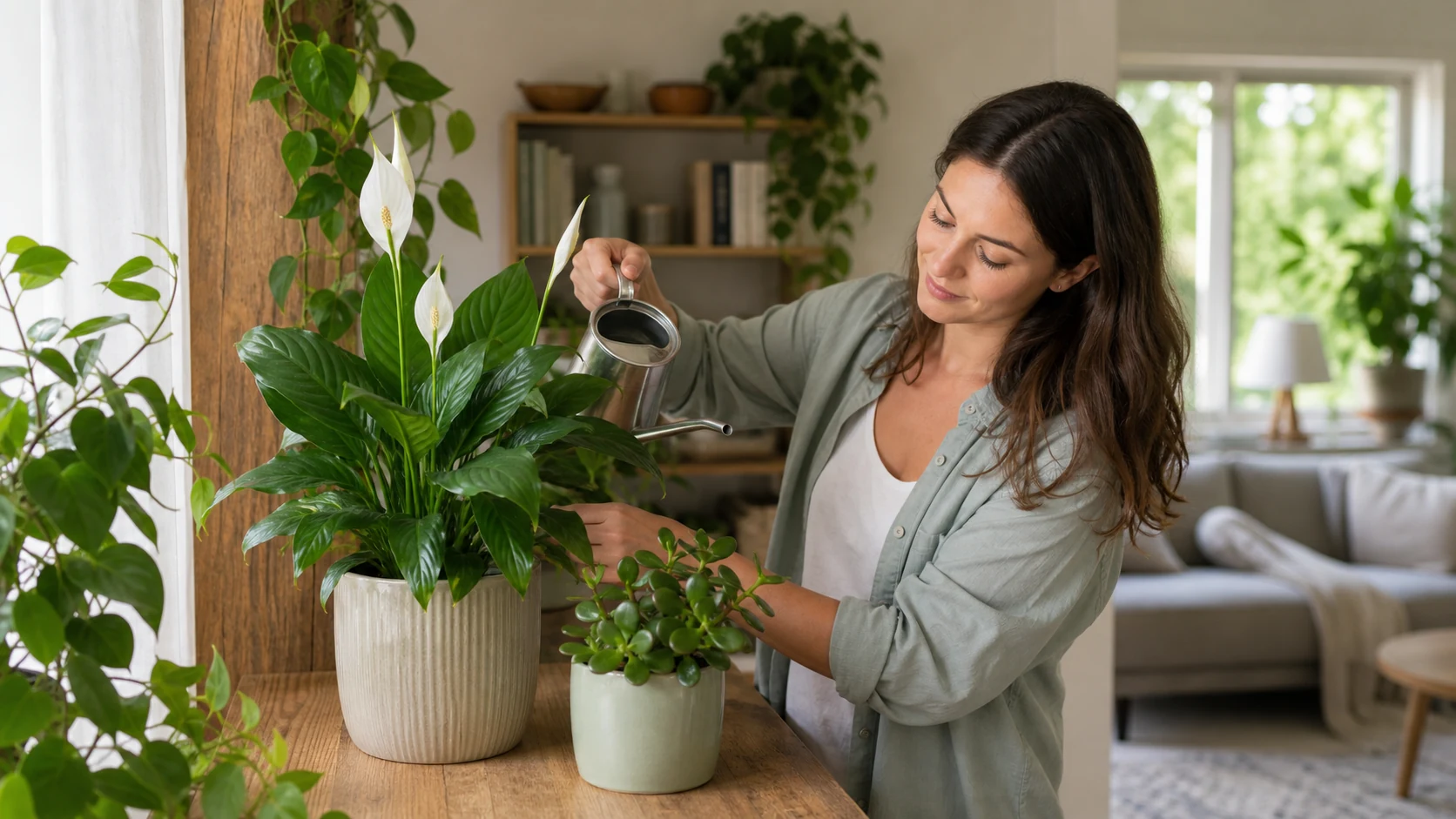
Healthy plants and attentive care matter more than symbolic placement alone.
A jade dropping leaves in a dim corner is not attracting abundance. A peace lily wilting in dry air is not bringing calm. In classical feng shui, living things carry chi precisely because they are alive and actively growing. When a plant is unhealthy, that energy reverses.
The pattern comes up consistently in practitioner communities: the only genuinely bad feng shui around plants is when they are dead or declining, and stagnant water at the roots gets the same concern as a dying plant itself. That signal reappears across discussions about everything from peace lilies to lucky bamboo in water dishes – the plant’s condition matters more than the plant’s name.
Generic guides say “money tree goes in the wealth corner” without asking whether that corner gets enough light. The University of Maryland Extension puts it clearly: success is more likely when you choose a plant that can adapt to your indoor conditions, rather than trying to force the room to match the plant.
The one practical check before any placement decision: stand in the spot where you want to put the plant and hold up your hand. If you can read fine print comfortably without squinting, there is enough light for most tropical houseplants. If you cannot, choose a low-light species or add a grow light before worrying about which corner the bagua map says it should go in.
If you already know the room and want a plant-by-plant placement reference, continue with the room-by-room feng shui plants guide.
Identification Snapshot
Before you match a plant to a bagua zone, match it to the actual room.
- Best for low light: snake plant, golden pothos, and peace lily are usually safer picks than money tree or jade in dim corners.
- Best for pet households: money tree and orchids are the practical shortlist from the classic feng shui list, because several other popular options are ASPCA-listed as toxic.
- Best for forgetful waterers: jade, snake plant, and pothos are more forgiving than peace lily or orchid.
- Most common mismatch: a symbolically “lucky” plant goes into the right corner, but the wrong light or watering pattern makes it decline anyway.
If the room cannot keep the plant healthy, the symbolism is not the problem. The fit is.
Pick Your Plant in 3 Questions
Before the fit matrix, before the bagua map, before you buy anything:
1. What light does the placement spot actually get? Use the hand test above. That answer narrows the list faster than any symbolic chart.
2. Do pets have access to that room? Peace lily, golden pothos, jade, snake plant, and rubber plant are all listed as toxic to cats and dogs by the ASPCA. This eliminates most of the traditional feng shui list in a pet household. Money tree and orchid are the practical alternatives.
3. How often will you realistically water? Be honest. Jade and snake plant forgive a two-week gap. Money tree tolerates occasional neglect but dies in waterlogged soil. Peace lily wilts visibly when thirsty and recovers fast. Choose the plant that fits your actual routine, not an aspirational one.
Once you have answers to those three questions, filter the fit matrix below and you will have a clear answer in under a minute.
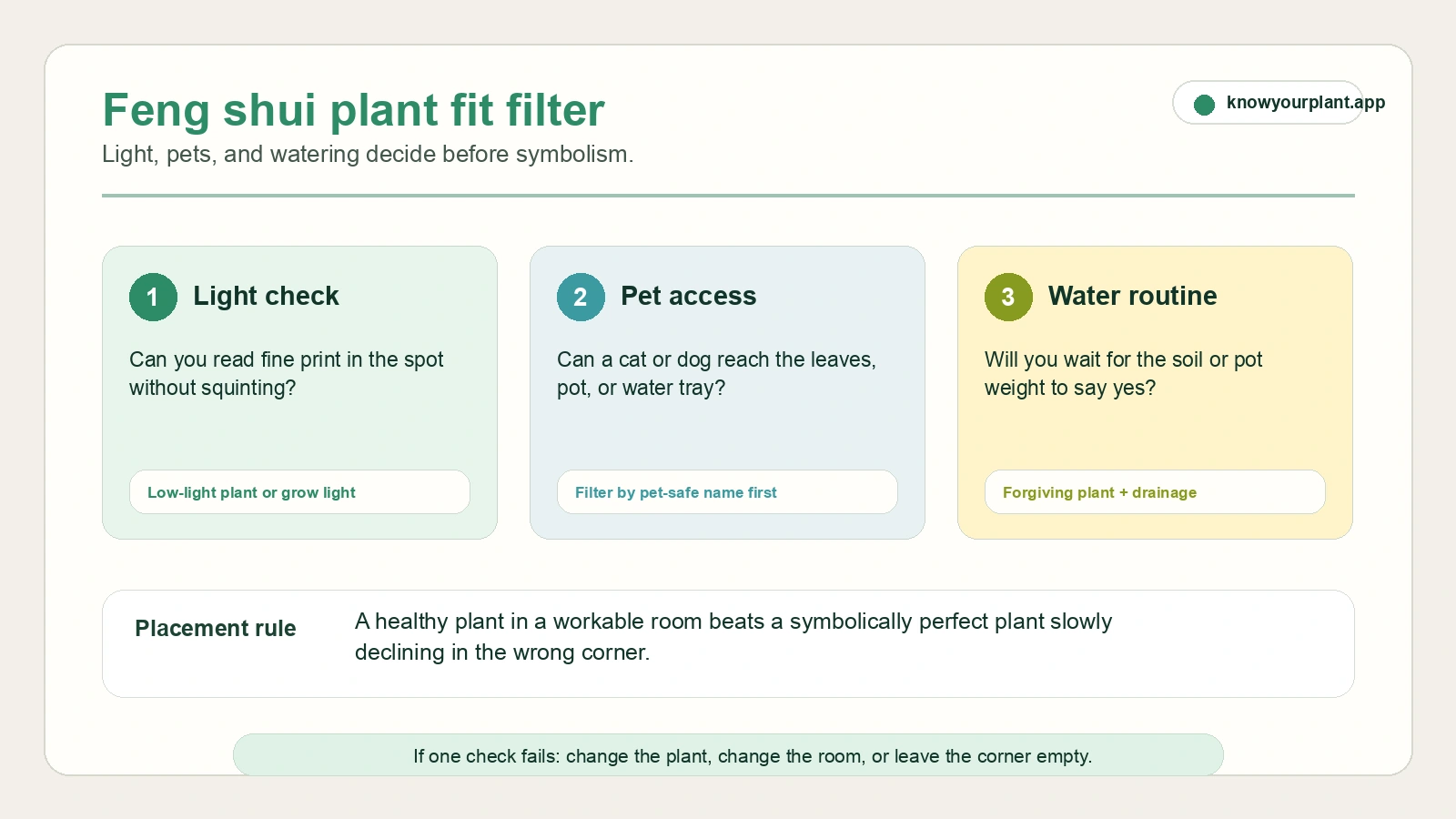
Use the fit filter before the bagua map: a healthy plant in a workable room beats a symbolically perfect plant slowly declining in the wrong corner.
Lookalikes, or Problems Confused With Feng Shui Placement
| What you notice | Easy conclusion | Better first check |
|---|---|---|
| A money tree drops leaves in the wealth corner | “This plant is wrong for the space” | The corner may be too dim, or the soil may be staying wet too long |
| A peace lily wilts in the bedroom | “Bedrooms should never have plants” | Check morning light, dry air, and whether the room is easy enough to maintain |
| A lucky bamboo setup smells stale | “The energy feels bad” | Refresh the water and check for stagnant water or root stress |
| A bedroom full of plants feels busy instead of calming | “All bedroom plants are bad feng shui” | You may need one smaller plant, not a whole collection |
A lot of feng shui confusion is really a plant-health or room-fit problem wearing symbolic language.
Three Placement Patterns That Work Against You
Most feng shui plant problems follow one of three specific patterns. Recognising which one applies to your situation turns a confusing decline into a fixable problem.
Pattern 1: The Dark Corner Trap
The bagua map points to the far-left corner of your living room for wealth energy. You place a money tree there. It holds its leaves for a few weeks, then they start yellowing. You water more, thinking it is stressed from the move. The soil stays wet longer. Root rot begins quietly underground while the leaves continue to go.
What actually happened: that corner is north-facing and gets almost no light. Money tree needs bright indirect light to photosynthesize enough to use what it is given. In low light it reduces water uptake dramatically, so a watering schedule that keeps a money tree thriving on a windowsill drowns it in a dim corner within a season.
The fix is not a new plant. It is a grow light positioned overhead, or a week in a brighter spot to test whether the plant recovers.
Pattern 2: The High-Shelf Safety Assumption
Peace lily, golden pothos, jade, and snake plant are all ASPCA-listed as toxic to cats and dogs. So they get placed on high shelves – the reasoning being that a cat cannot get up there. This logic holds for a while, then does not.
The issue is not the height. It is that cats climb when curious, and popular feng shui plants tend to land in living rooms and bedrooms, the exact spaces where cats spend the most time. “Out of reach” tends to be more optimistic than accurate once a cat has noticed an interesting trailing leaf.
In a home with chewing or climbing pets, money tree and orchids are the only safe choices from the traditional feng shui shortlist per the ASPCA database. Everything else requires genuine room exclusion, not elevation.
Pattern 3: The Overcare Spiral
When a placement feels symbolically significant – a money tree in the wealth corner, a peace lily beside the bed – the plant gets more attention. Attention becomes more frequent watering. More watering than the plant can absorb fills the soil past its drainage capacity. Roots sit in moisture they cannot process and begin to suffocate.
This is the most common cause of money tree death in symbolically placed pots. Money tree, jade, and snake plant all prefer the soil to dry out slightly between waterings. The practical check is not frequency but moisture: push a finger an inch into the soil. If it is still damp, wait two more days regardless of when you last watered.
Feng Shui Plant Fit Matrix
Before buying anything, match the plant to the room’s actual conditions. The matrix below scores the most common feng shui plants across the criteria that determine whether a placement actually works – not just whether it looks right on a list.
| Plant | Symbolic use | Minimum light | Watering forgiveness | Pet risk (ASPCA) | Bedroom suitable | Beginner risk |
|---|---|---|---|---|---|---|
| Money tree | Wealth, abundance | Bright indirect | Moderate (root rot risk if overwatered) | Non-toxic | Cautious: grows vigorously | Low |
| Jade | Wealth, endurance | Bright indirect | High (stores water in leaves) | Toxic to cats and dogs | Yes, if small | Low |
| Golden pothos | Flow, adaptability | Low to bright indirect | Very high | Toxic to cats and dogs | Yes, small specimen only | Very low |
| Peace lily | Calm, purification | Low to medium indirect | Moderate (wilts visibly, recovers fast) | Toxic to cats and dogs | Yes, if no pets | Low |
| Snake plant | Protection, longevity | Low to bright indirect | Very high | Toxic to cats and dogs | Recommended | Very low |
| Rubber plant | Abundance, grounding | Bright indirect | Moderate | Toxic to cats and dogs | Not ideal (grows large, fast) | Low |
| Lucky bamboo | Luck, flexibility | Low to medium indirect | High | Toxic to cats and dogs | Cautious: water tray needed | Low |
| Orchid | Fertility, refinement | Bright indirect, no direct sun | Low (irregular watering is the most common mistake) | Non-toxic to cats and dogs | Yes, if watering is managed | Medium |
Pet toxicity data source: ASPCA Toxic and Non-Toxic Plants database. Always verify before purchase if you have chewing or climbing pets.
University of Minnesota Extension recommends matching plants to available indoor light and considering supplemental grow light when natural light is insufficient. Penn State Extension adds that darker green foliage handles lower light better than variegated or pale green leaves – a variegated money tree or a pale orchid will not thrive in a dim wealth corner without a grow light to back them up.
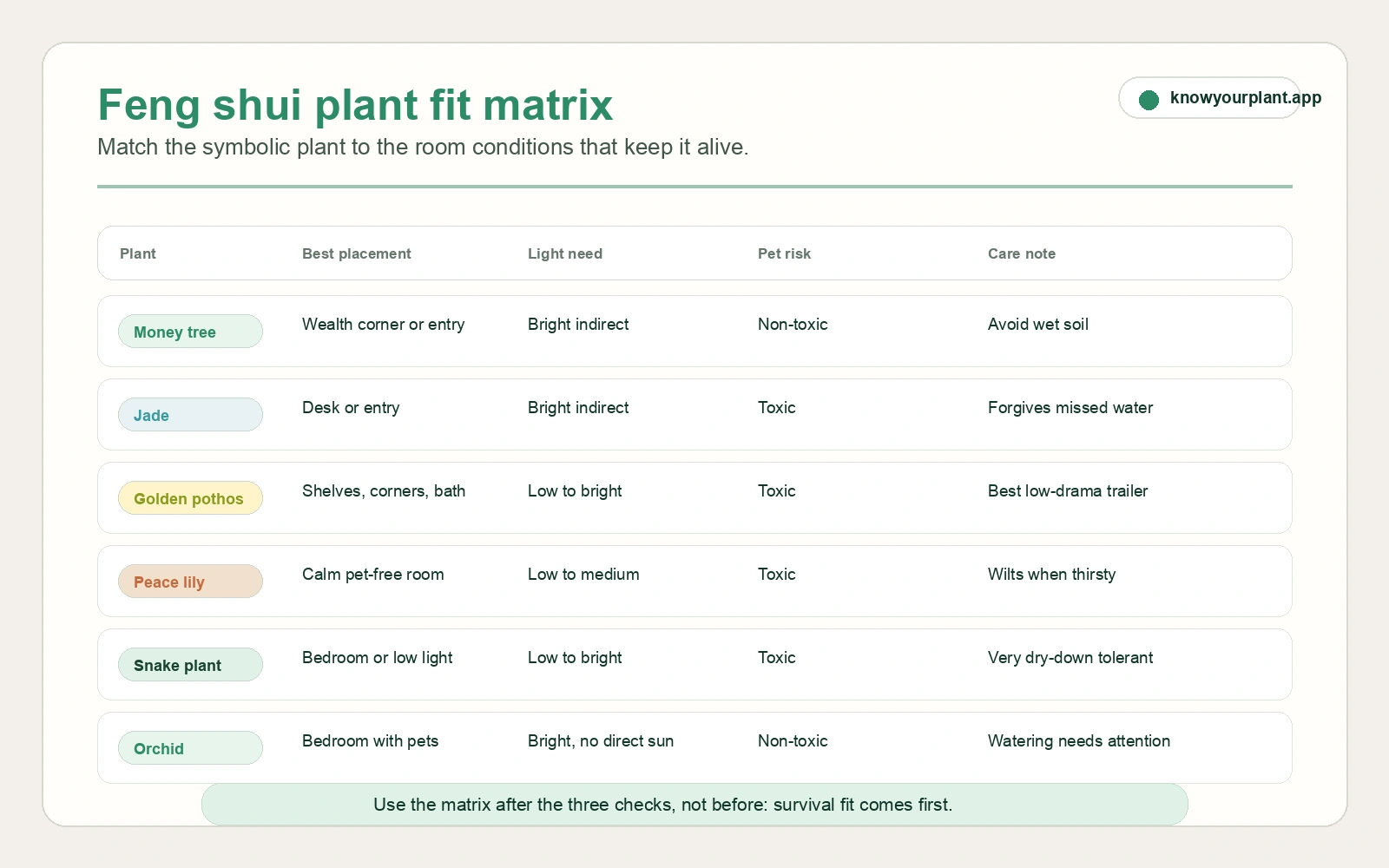
The matrix keeps the symbolic shortlist practical: match the plant to light, pet access, and watering tolerance before treating placement as the main decision.
Care Cards by Room Type
| Room situation | Best practical fit | Why it works | Watch for |
|---|---|---|---|
| Dim bedroom, no pets | Snake plant or peace lily | Calm look, lower-light tolerance | Keep big fast growers out of the room |
| Bright desk or entry, no chewing pets | Jade or money tree | Clear abundance symbolism and manageable care | Do not let pots sit in water |
| Pet-access living room | Money tree or orchid | Safer household fit than pothos, lily, jade, or snake plant | Give money tree bright indirect light |
| Bathroom with humidity and limited floor space | Pothos or lucky bamboo | Handles humidity and softens sharp corners | Recheck toxicity if pets roam the room |
| Low-maintenance beginner setup | Pothos or snake plant | Forgiving when watering is inconsistent | Avoid using “easy” as an excuse to ignore light |
Pick the Room Before the Plant
The bagua map divides your home into nine zones linked to life areas including wealth, relationships, career, and health. Placement matters, but room conditions matter first. A plant positioned in the symbolically correct zone that cannot survive there is not feng shui. It is a slow decline in the wrong corner.
Room-first checklist before choosing a plant:
- What is this room used for? Bedroom (rest), home office (focus), living room (circulation), kitchen (transition), bathroom (high humidity, drainage)?
- What light does this space actually get? North-facing rooms get little direct light. South-facing rooms can burn unshaded plants. East and west-facing rooms offer morning or afternoon light respectively.
- Do pets have access? Several popular feng shui plants are toxic to cats and dogs. This narrows the list before symbolism enters the conversation.
- What is your honest maintenance window? A money tree forgotten for three weeks will develop root rot faster than jade will. Match watering frequency to your actual schedule, not the aspirational one.
- Is the zone near a vent, radiator, or draughty window? Dry heat and cold draughts stress most tropical plants immediately.
Once you have honest answers to those five questions, go back to the fit matrix and filter. The overlap between “symbolic right choice” and “plant that will actually thrive here” is where real feng shui placement happens.
Room Placement Quick Reference
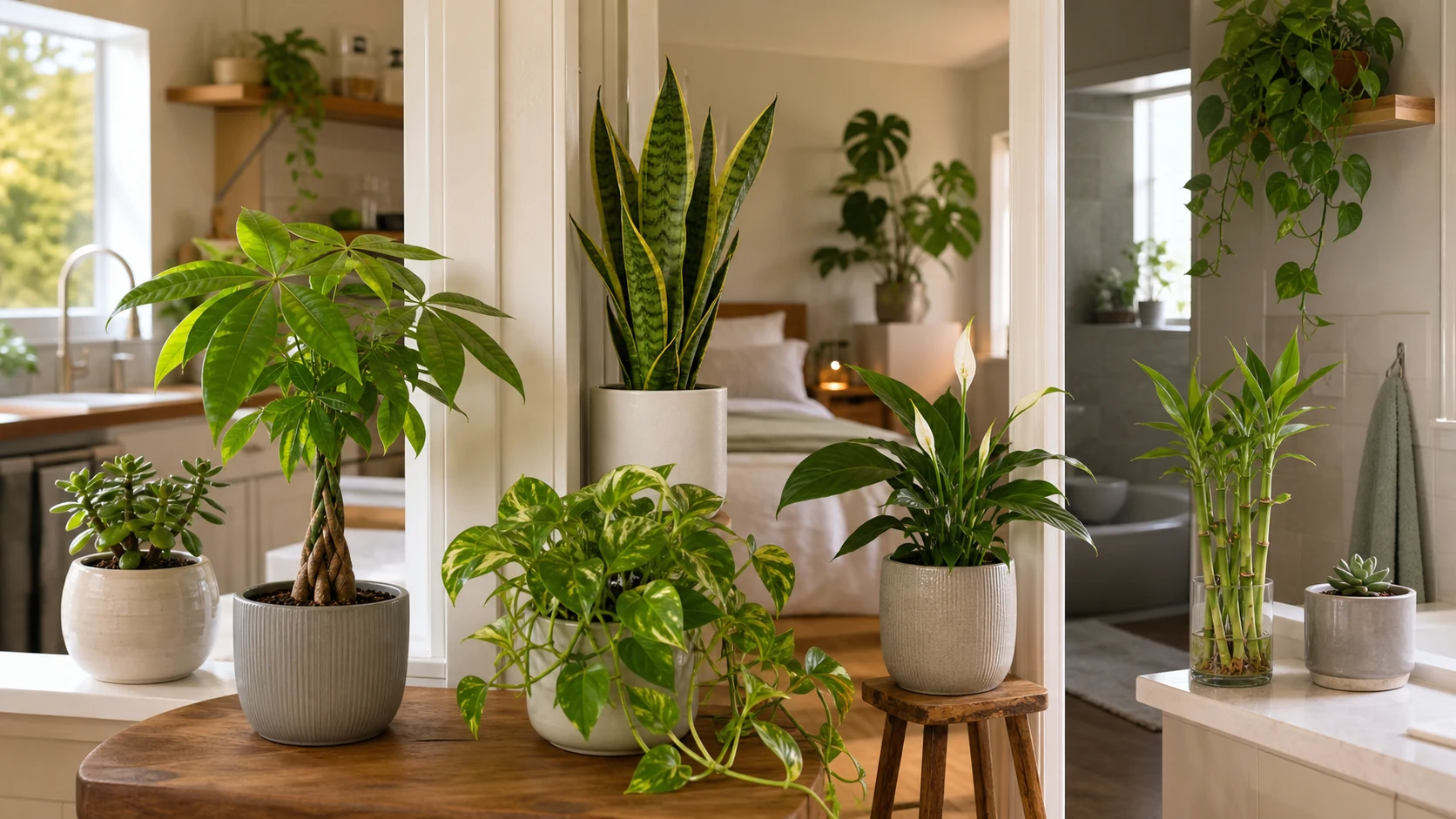
Choose plants by the light, traffic, and care conditions of each room.
| Room | Best practical choice | Cautious choice | Avoid |
|---|---|---|---|
| Entryway | Money tree, jade | Lucky bamboo | Cactus facing inward |
| Living room | Golden pothos, rubber plant | Peace lily (no pets) | Anything already struggling |
| Home office (wealth corner) | Money tree, jade | Snake plant | Fast growers without bright light |
| Kitchen | Herbs (basil, mint) | Small pothos on a high shelf | Large pots in narrow spaces |
| Bedroom | Snake plant | Peace lily (no pets, morning light) | Monstera, fiddle-leaf fig |
| Bathroom | Pothos, lucky bamboo | Peace lily | Cacti, succulents |
Best Feng Shui Plants for Home
Money Tree (Pachira aquatica)
If you have searched for feng shui plants money, this is what keeps coming up. The braided trunk and five-lobed leaves are traditionally linked to the five feng shui elements, with placement tradition putting it in the wealth corner: the far-left area as you stand at the main door looking into the room.
NC State Cooperative Extension notes that money tree prefers indirect sunlight or mixed sun and shade, and warns that standing water causes root rot quickly. That means the wealth corner needs a window nearby and a pot with genuine drainage, not just decorative stones layered over a solid base. Water when the top few centimetres of soil dry out, and let it dry between sessions. For a symptom-first routine, see the dedicated money tree care guide.
Jade Plant (Crassula ovata)
Another classic wealth plant. Jade’s thick, coin-shaped leaves make the symbolic association obvious. What is less often mentioned: jade plants are genuinely long-lived. Well-cared-for specimens have been documented in botanical collections for 70 years or more, which means the symbolism of endurance maps directly to the plant’s actual biology.
It stores water in its leaves, so one missed watering costs you nothing. Keep it in a bright spot and it grows steadily for years. ASPCA lists jade as toxic to cats and dogs – in a pet household, choose money tree instead.
Golden Pothos (Epipremnum aureum)
Pothos is the most forgiving plant on this list by a significant margin. Those trailing, heart-shaped leaves soften sharp corners and fill empty spaces above cabinets or on shelves – exactly the spots where stagnant energy collects. It grows in almost any light, including dim corners where other plants would fail within weeks.
ASPCA lists golden pothos as toxic to cats and dogs. If you have chewing or climbing pets, snake plant or money tree is the safer choice. Full care detail in our Golden Pothos care guide.
Peace Lily (Spathiphyllum)
Peace lilies carry two feng shui elements at once: wood in the foliage, water in the moisture they crave. Their white blooms are associated with calm and purification, and they tolerate lower light than most flowering houseplants. A peace lily wilts visibly when it needs water and recovers quickly once you give it a drink – easier to read than plants that hide stress until it is too late.
ASPCA classifies peace lily as toxic to both cats and dogs. In a pet-free bedroom or a room pets do not access, it is a calm, low-effort choice. Full care guidance in our Peace Lily care guide.
Rubber Plant (Ficus elastica)
Big, rounded leaves and a sturdy upward growth habit make rubber plant a good anchor for a living room or entryway. Often recommended for the wealth corner or near the entrance because of that solid, grounded presence. It needs bright indirect light to grow well – a rubber plant in a genuinely dim corner will hold its leaves for months, then slowly drop them one by one. If the placement zone does not have good light, snake plant is the more honest choice.
NC State Extension notes that Ficus elastica sap is a skin irritant and toxic if ingested, so wash hands after pruning. Detailed care in our Rubber Plant guide.
Snake Plant (Dracaena trifasciata)
Snake plant uses crassulacean acid metabolism (CAM), which means it absorbs carbon dioxide at night and releases oxygen – the opposite of how most plants respire. That is a biological fact, not just a traditional claim, and it is why it appears on so many bedroom plant lists. It tolerates very low light and forgives extended dry periods better than almost any other tropical houseplant.
ASPCA lists snake plant as toxic to cats and dogs. Despite its pointed leaves (usually a feng shui caution for generating cutting energy indoors), it is widely recommended in bedrooms for the nighttime respiration benefit. Care details in our Snake Plant guide.
Feng Shui Plants for Bedroom: A Decision Block
The bedroom is where feng shui gets careful. Too much active yang energy in a sleeping space competes with rest. The online conversation around this is genuinely divided: some practitioners say no plants at all in a bedroom, while others say one calm plant is fine and even helpful.
A useful framing from practitioner communities: the question is less about the plant species and more about whether the bedroom is already working as a rest space. If the room already feels restless, adding an active, fast-growing plant does not help. If the room feels heavy and still, one small, settled plant near a window can shift that.
Both positions are defensible depending on what you want from the space.
Choose no plant if:
- The bedroom has very little natural light and a grow light is not practical
- Pets have access and the plant options you like are on the toxic list
- Plant maintenance already feels stressful and the bedroom is where you recover from that
Choose one small plant if:
- The bedroom gets some morning light (east-facing windows work well here)
- You want a quiet focal point without adding maintenance pressure
- Snake plant (low light tolerant, nighttime oxygen release, forgiving) or peace lily (low light, calm presence, no pets present) are the practical choices for this scenario
Skip large, fast-growing varieties: Monstera and fiddle-leaf fig carry too much active yang energy for most sleeping spaces, and they grow quickly enough to genuinely change the feel of a room within a single season. That is the opposite of what most bedrooms need.
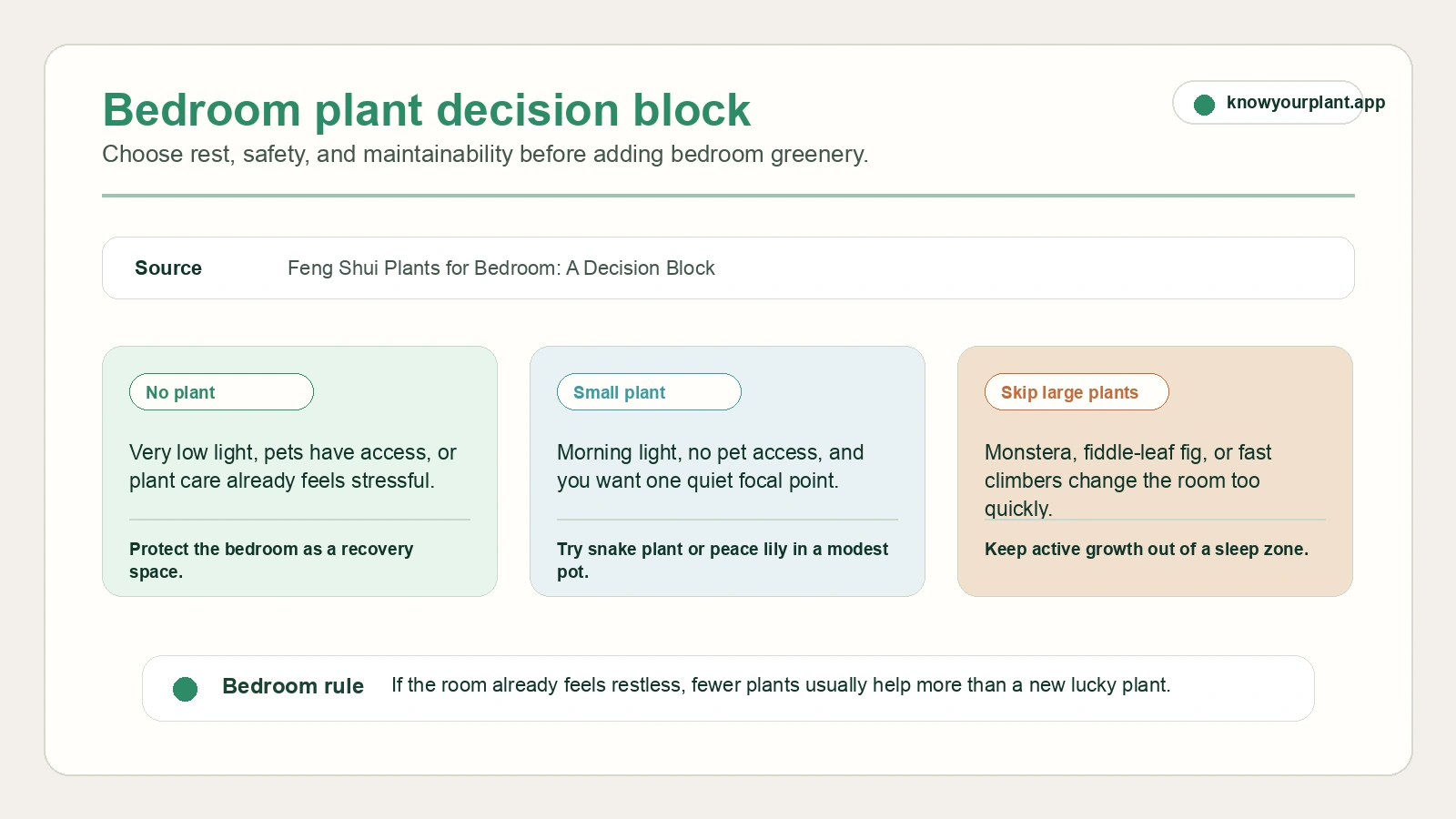
The bedroom decision block keeps the recommendation calm: if the room is dark, pet-accessible, or already restless, fewer plants usually help more than another lucky plant.
For a broader look at what works in sleeping spaces, our Best Plants for Bedroom guide covers light, air quality, and placement in more detail.
Room-by-Room Placement
Entryway
Where chi enters your home. A healthy, upright plant here signals welcome. Money tree, jade, or a trailing pothos on a high shelf. One thriving plant does more than three struggling ones.
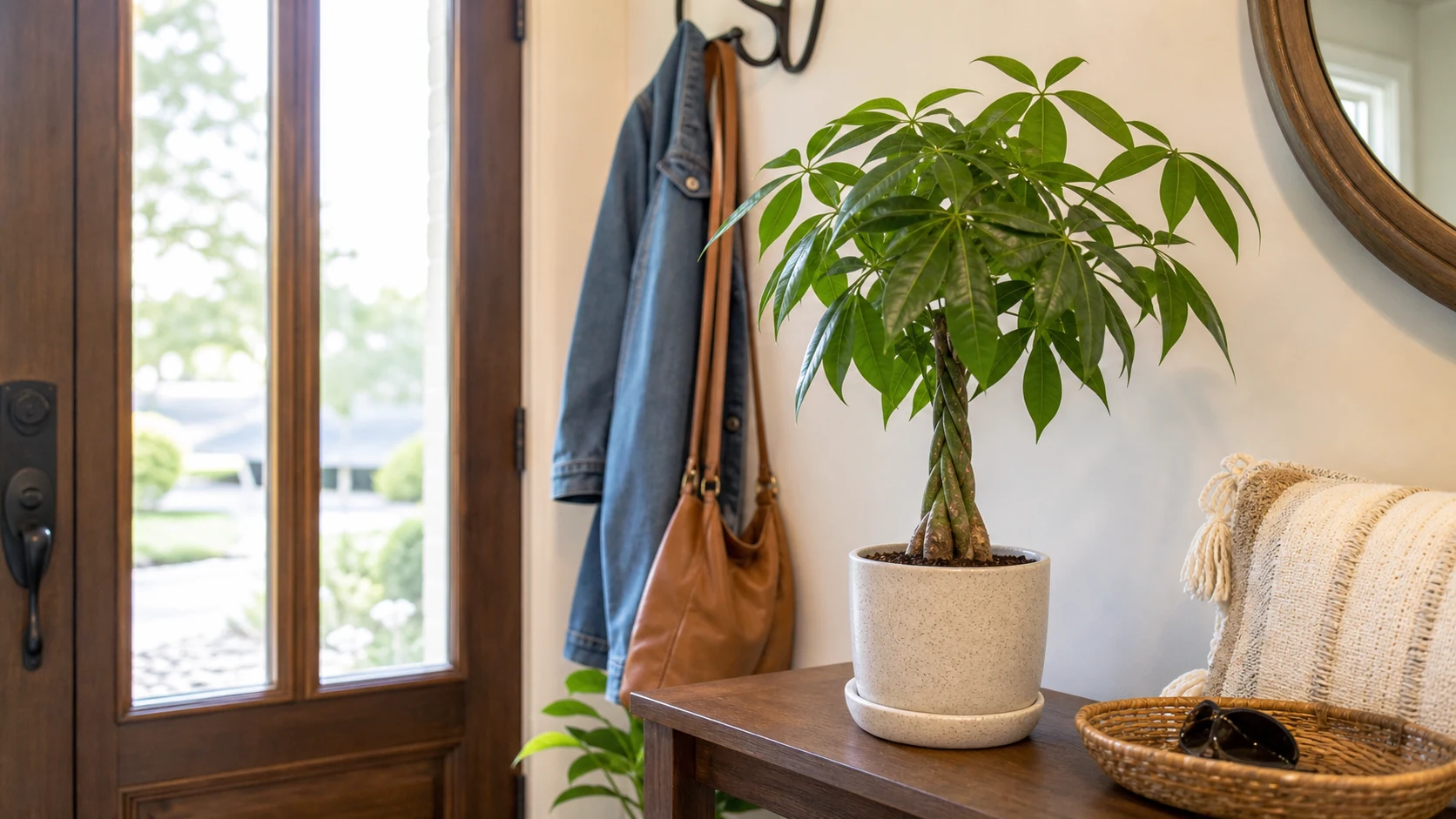
A single thriving money tree creates a welcoming entry without crowding the doorway.
Living Room
Energy should circulate freely here. Rounded-leaf plants fill corners, especially corners where furniture creates sharp angles. A trailing pothos on a bookshelf softens hard lines. Taller plants like rubber plant or bird of paradise anchor a room without closing it off.
Home Office
The wealth corner matters most in a workspace, especially if you work from home. Position a money tree or jade in the far-left corner as you stand at the door looking in. A small jade on the desk is also a traditional placement for career and financial energy, and it is easy to maintain. Create the right light and watering conditions first, then the placement becomes meaningful.
Kitchen
The kitchen already holds strong fire and water elements, so use plants here in small doses. Herbs on a sunny windowsill add the wood element without overwhelming the balance. Basil and mint are both traditional feng shui kitchen choices, and they are genuinely practical ones too.
Bathroom
Where chi drains away, literally. Plants counteract this with upward, living energy. Pothos, lucky bamboo, or a small peace lily on the counter all work well and appreciate the ambient humidity a bathroom provides.
Seasonal Feng Shui Plant Calendar
Seasonal changes affect your feng shui plant placements in ways that most guides ignore entirely. A placement that worked in summer can quietly fail in winter for reasons that have nothing to do with symbolism and everything to do with light hours and heating systems.
Spring (March to May)
This is when most feng shui plants begin active growth after a slow winter period. Resume fertilising jade, money tree, and pothos once you see new leaf buds emerging. If a plant positioned in a symbolic corner produced no new growth at all by late April, that is a reliable signal that the light is insufficient – not that the plant is wrong for the space.
Check: wipe leaves with a damp cloth before new growth begins. Dust accumulated over winter reduces light absorption and makes plants look dull in exactly the rooms you want them to feel alive.
Summer (June to August)
East and south-facing spots that were ideal in spring can become too bright in full summer. Peace lily and orchid leaves will scorch if moved too close to south-facing glass without a light curtain. Move affected plants back 30 to 60 centimetres from the glass rather than relocating them to a completely different zone.
Higher ambient temperatures also mean soil dries faster. Jade and snake plant handle this without adjustment. Money tree, peace lily, and pothos need more frequent checks than they did in spring – not necessarily more water, just more frequent soil tests with your finger.
Autumn (September to November)
Stop fertilising most feng shui plants now. Growth slows and unused fertiliser accumulates as salt in the soil. NC State Extension recommends stopping fertiliser between October and February for most tropical houseplants. Salt buildup causes brown leaf tips on peace lily and pothos – often misread as underwatering.
Reassess bedroom placements before winter heating begins. Central heating dries indoor air significantly, and plants that were thriving in summer humidity may develop brown tips or begin dropping leaves as early as November. A small tray of water near the radiator helps, or move the plant away from the heat source without abandoning the zone entirely.
Winter (December to February)
Low-light months expose weak placements faster than any other season. A money tree that survived in a dim corner through summer – barely growing but holding its leaves – will begin dropping them as daylight hours shorten below the minimum it needs to sustain itself. This is not a watering problem. It is a light problem, and adding a grow light on a timer is the fix.
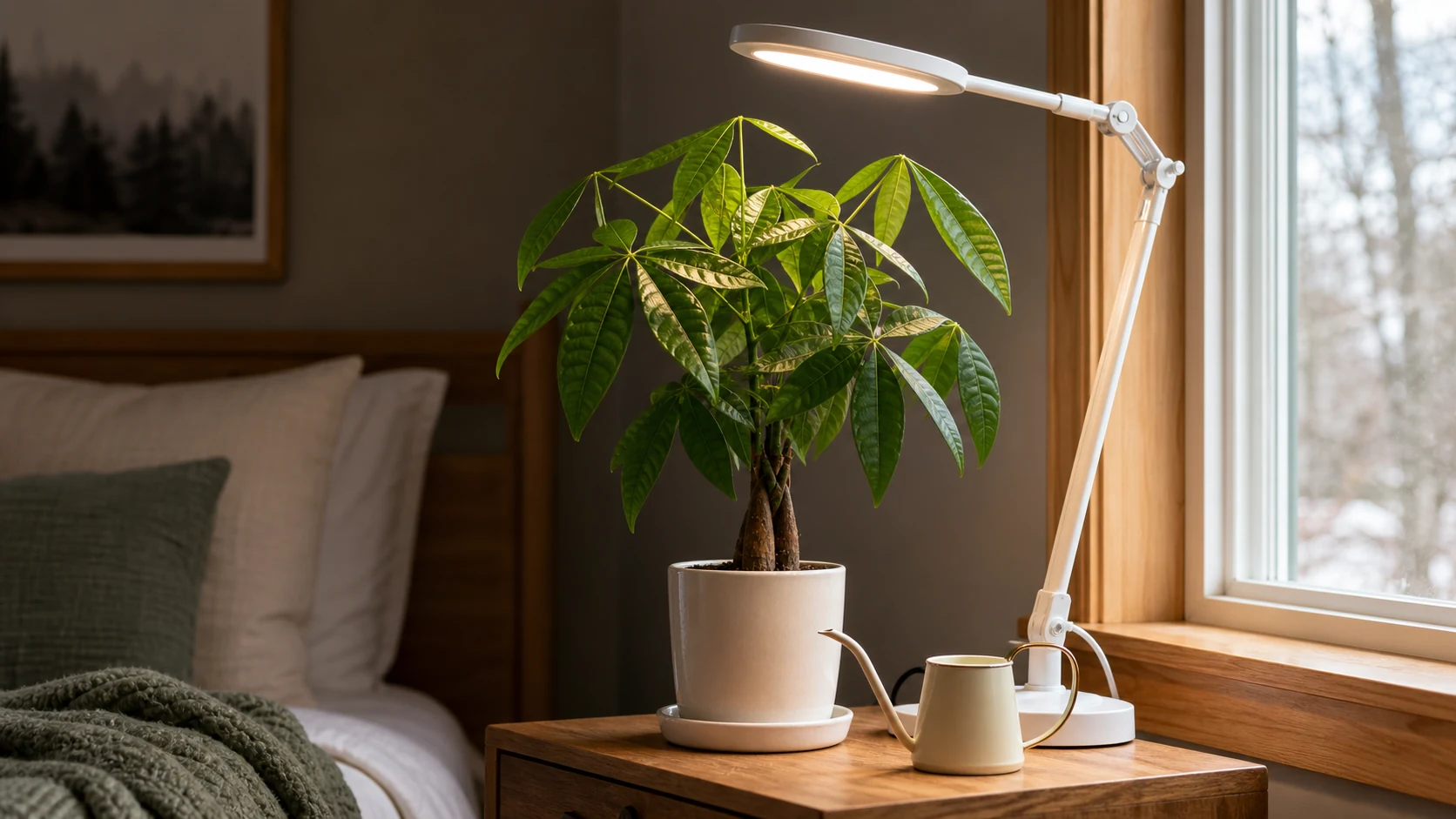
A supplemental grow light helps a money tree through short winter days.
Water all feng shui plants less in winter, not more. Overwatering is at its most dangerous when soil dries slowly in low temperatures and low light. The moisture test still applies: if the top inch of soil is still damp, wait two more days regardless of the last watering date.
When a Lucky Plant Hurts Instead of Helps
A declining plant in the wrong conditions does more harm to a space than no plant at all. Before buying a second plant to fix what the first one started, check the one you already have:
- Yellow leaves: Overwatering, underwatering, too little light, or nutrient depletion are all possibilities. Check soil moisture first. Soggy soil points to water. Bone-dry soil in a pot that has not been repotted in a year points to feeding.
- Stagnant water: Standing water in a saucer or decorative pot without drainage is a root rot risk. In feng shui terms, stagnant water also represents stagnant energy. Empty the saucer after each watering.
- Dusty leaves: Dust blocks light absorption and dulls the plant’s appearance. Wiping large leaves with a damp cloth once a month genuinely helps the plant photosynthesize – it is not just cosmetic.
- Root rot smell: If the potting soil smells musty or sourly earthy, check the roots. Soft, dark roots mean rot has started. Repot into fresh, dry mix and remove damaged roots before the problem spreads.
- Pests on new growth: Mealybugs, spider mites, and fungus gnats show up most often on stressed plants. A pest-ridden plant in a symbolic position does the opposite of what you intended.
Common Problems
The plant is symbolically right but visibly declining
Treat that as a room-fit warning first. Check light, drainage, and watering rhythm before you blame the placement map.
The bedroom advice feels contradictory
That is normal. The practical middle ground is one healthy plant in a room with enough light, not a rule that every bedroom should be plant-free or plant-filled.
The plant is technically lucky but unsafe for pets
Do not force it. Money tree and orchids are the simplest traditional alternatives when cats or dogs actually share the room.
Pet Safety Filter
If you have cats or dogs, several popular feng shui plants need a second look before placement. The ASPCA Toxic and Non-Toxic Plants database is the most reliable source for this decision – more reliable than community guesses about what seems safe.
Non-toxic options (safer for pet households):
- Money tree (Pachira aquatica): Non-toxic to cats and dogs per ASPCA
- Orchids (Orchidaceae family): Non-toxic to cats and dogs per ASPCA
Require elevated placement or a different room:
- Peace lily: Toxic to cats and dogs (insoluble calcium oxalate crystals cause oral irritation, drooling, and vomiting)
- Golden pothos: Toxic to cats and dogs (same oxalate crystals)
- Jade plant: Toxic to cats and dogs (causes vomiting, depression, and slowed heart rate)
- Snake plant: Toxic to cats and dogs (saponins cause vomiting and nausea)
- Rubber plant: Toxic to cats and dogs (irritating sap, toxic if ingested)
- Lucky bamboo: Toxic to cats and dogs
“Keep it out of reach” is more complicated than it sounds with cats who climb. If your pets are active climbers or chewers, money tree and orchids are the safest options from the traditional feng shui list. For a broader view of which indoor plants are actually safe around pets, our cat safe plants guide covers the full list by toxicity level.
Plants to Avoid in Feng Shui
- Cacti and sharp-spined succulents: Pointed shapes are thought to direct sha chi (cutting energy) toward occupants when facing inward. A cactus on an external windowsill, facing outward, is considered more acceptable in traditional practice because it redirects energy from outside rather than toward the room.
- Dying or neglected plants: This matters more than any species choice. A struggling plant pulls energy down more reliably than a bad placement does. If a plant is not thriving, move it to better conditions first. Let it go entirely before it deteriorates further.
- Bonsai trees: Some practitioners view bonsai as representing stunted growth, which contradicts the wood element’s upward, expansive nature. They sit better in spaces meant for reflection than in areas intended for growth.
- Dried flowers and artificial plants: No living chi. A small, thriving real plant beats any artificial substitute at any size.
Real User FAQ
Can I keep a feng shui plant in a bedroom if I want the room to feel restful?
Yes, but keep the choice small, healthy, and easy to maintain. A bedroom that already feels calm usually handles one plant better than a whole collection.
What if the wealth corner is too dark for a money tree or jade?
Use a lower-light plant, add a grow light, or move the symbolic focus elsewhere. A struggling plant does more damage to the feel of the room than an empty corner.
Are pet-safe feng shui plants limited?
Yes. That is why money tree and orchids matter so much in real homes. Many of the classic list favorites are not a good match for chewing pets.
Frequently Asked Questions
Do feng shui plants really work, or is it superstition?
Whether you hold a traditional belief in chi or not, the underlying instincts are sound. Living plants change how a room looks and feels. Rounded leaves soften hard angles. Green foliage adds warmth to empty corners. Some plants like peace lily and snake plant have documented air quality and respiration benefits in enclosed spaces. The feng shui framework gives you a structured way to think about plant placement that most people never bother with. That is useful regardless of metaphysics.
Which plant is best for the wealth corner?
The money tree (Pachira aquatica) is the most traditional choice. Jade (Crassula ovata) is a close second. Both are associated with financial energy and both are manageable houseplants. What matters more than the species: the plant should be healthy, actively growing, and positioned somewhere with appropriate light. NC State Extension confirms money tree thrives in indirect sunlight and struggles with waterlogged soil. A thriving jade in the wealth corner does more than a declining money tree in the symbolically correct spot.
Can I put plants in my bedroom for feng shui?
Yes, with restraint. One or two calm, compact plants are fine. Snake plant is the most recommended because of its nighttime oxygen release. Peace lily works in lower-light bedrooms, provided no pets are present. Avoid large, fast-growing varieties that add active yang energy to a space intended for rest. The question worth asking first: does the bedroom actually have enough light to keep the plant healthy?
Are feng shui plants safe for cats and dogs?
Not all of them. Peace lily, golden pothos, jade, snake plant, and rubber plant are all listed as toxic by the ASPCA. Money tree and orchids are listed as non-toxic, making them the practical choices for pet households. Always check the ASPCA database before adding a new plant, and place any risky species out of reach before the first watering.
What about artificial or fake plants in feng shui?
Traditional feng shui consistently avoids them. Artificial plants carry no chi. A small, thriving real plant in a practical position will do more than a large, flawless fake in the symbolically correct zone. If a room cannot support a real plant, improving conditions with a grow light or a humidity boost is a better investment than substituting plastic.
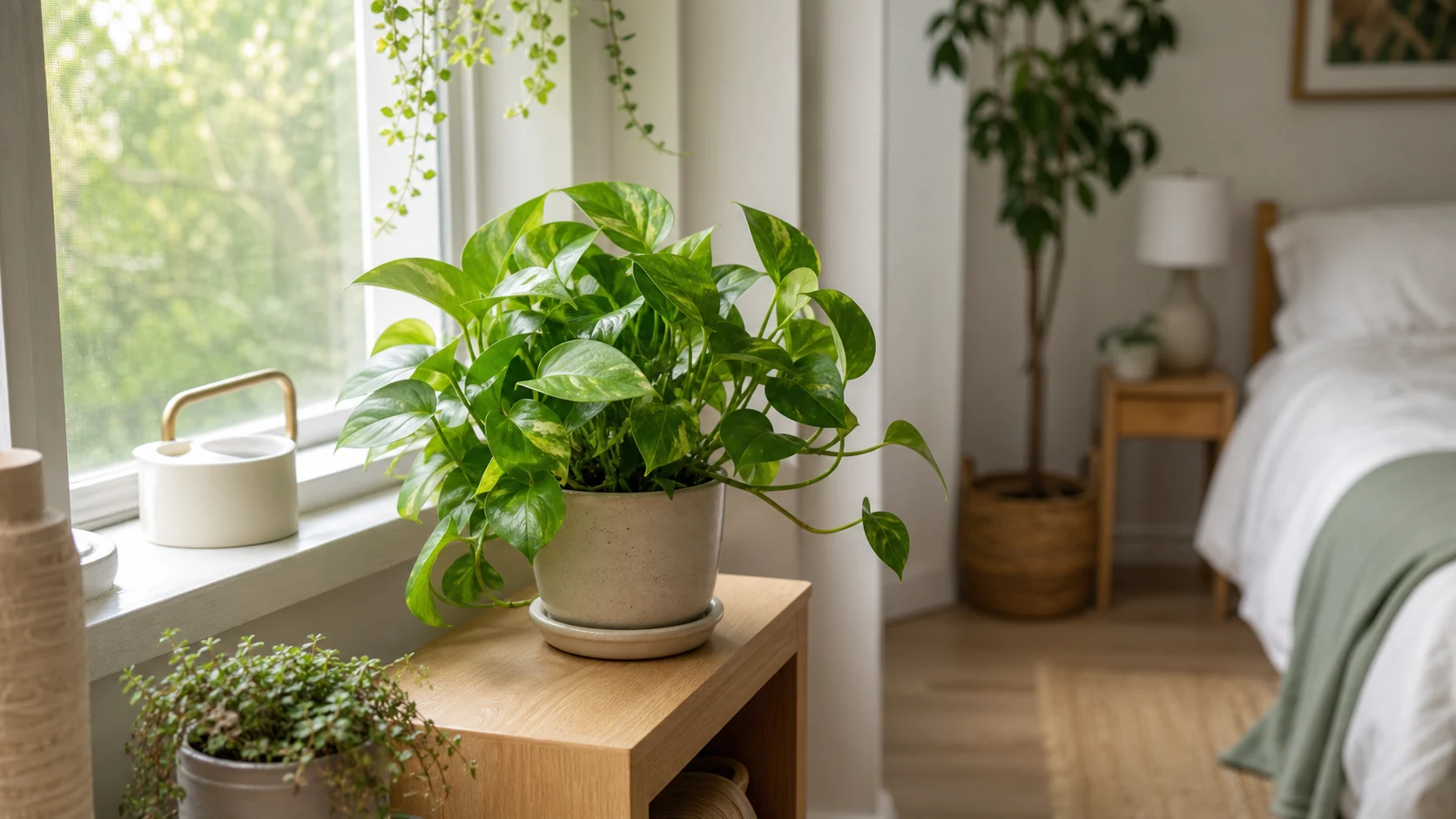
A thriving real pothos in suitable light offers more than flawless plastic décor.
How many feng shui plants do I need?
Fewer healthy plants beat more struggling ones, always. Start with one. Place it somewhere it will genuinely thrive: good light, good airflow, appropriate moisture. Notice how the room feels after a few weeks before adding more. The goal is living energy, not a specific count.
Does the colour of the pot matter?
At the finer levels of practice, yes. Earthy tones like terracotta and brown support grounding energy. Green connects to the wood element. Red and orange activate fire. Black and dark blue relate to water. For most homes, the practical rule is this: choose a pot that complements the plant and the room. A beautifully potted, thriving plant is better feng shui than a sad plant in the correct colour.
What if I do not know anything about the bagua map?
You do not need one to start. The core principle is straightforward: put healthy, living plants in spaces that feel stagnant, empty, or sharp. If you want to go deeper later, the bagua divides your home into nine zones linked to life areas including wealth, relationships, and career. The wealth corner (far left from the front door) and the career zone (centre front of the home) are the most commonly used zones for plant placement. That is a refinement for later, not a prerequisite for beginning.
My feng shui plant keeps dying – what am I doing wrong?
Start with light and water before blaming the placement. The most common pattern: a symbolic spot does not have enough light to keep the plant alive, so it slowly declines. Check whether you can read fine print in that spot without squinting. If not, the location needs a grow light, not a different plant. Second most common: overwatering. Most feng shui plants – jade, money tree, snake plant – prefer to dry out slightly between waterings. Soggy soil kills faster than neglect does. The Three Placement Patterns section above has the specific fix for each scenario.
Does the season affect which feng shui plant I should choose?
Yes, in a practical sense. In winter, low light hours accelerate decline in any plant already in a borderline spot. A money tree holding on through summer in a dim corner will drop leaves by December when daylight drops below the minimum it needs. Snake plant and jade are the most winter-resilient choices if seasonal light is a concern. The Seasonal Feng Shui Plant Calendar above covers what to watch for and adjust across each quarter.
Start Simple
You do not need a compass or a bagua map to begin. A jade on your desk. A pothos on the bare shelf above the bookcase. A snake plant in the corner that always feels a little heavy. Small placements, but they change the texture of a room in ways you feel before you can name them.
The plants do not need to understand feng shui. They need light, water, and enough attention to stay alive. That part is the whole point.
Methodology
This guide was refreshed against live search results and reader-language discussions on June 1, 2026, then checked against University of Minnesota, University of Maryland, Penn State, NC State, and ASPCA guidance for the plant-care and pet-safety claims. Community posts were used to surface recurring confusion around bedroom use, stagnant water, plant decline, and pet safety, not as scientific proof.
Research and Sources
How this article was put together: Care claims were checked against University of Maryland Extension, NC State Cooperative Extension, Penn State Extension, and University of Minnesota Extension guidelines. Pet toxicity data reflects the ASPCA Toxic and Non-Toxic Plants database, accessed June 2026. Community context was drawn from qualitative signals across r/FengShui and r/houseplants discussions, validated through live web search on 2026-06-01, and used as reader-language evidence only – not as horticultural or classical feng shui authority. Social signals are paraphrased, not quoted directly, and are used to surface reader confusion and real decision friction, not as statistical proof of any pattern.
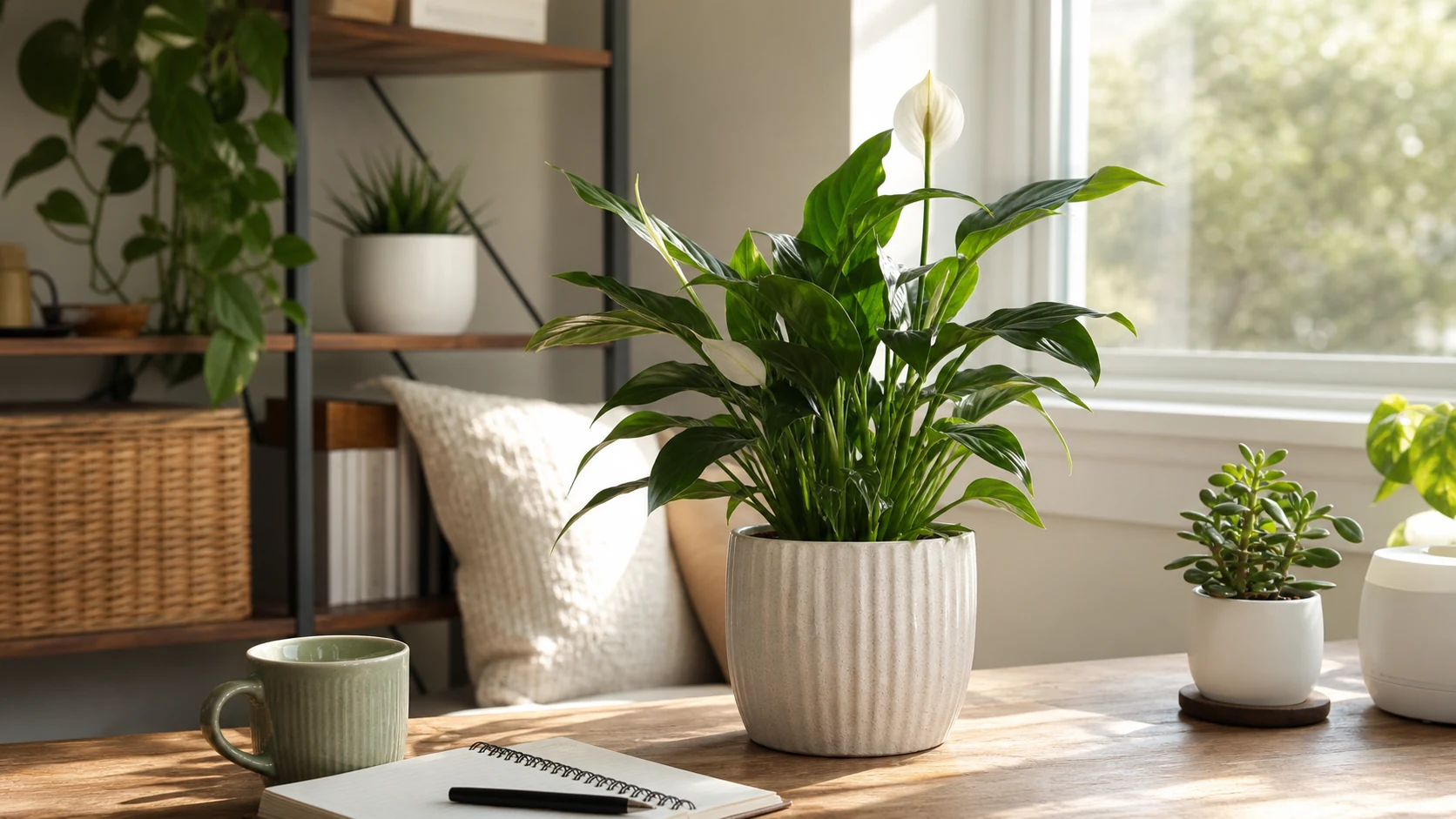
Care and safety recommendations are checked against horticultural research and primary plant databases.
Key sources consulted:
- University of Maryland Extension, Selecting Indoor Plants: success is more likely when a plant adapts to your indoor conditions rather than the reverse
- NC State Cooperative Extension, Pachira aquatica: indirect sunlight preferred; standing water causes root rot; stop fertilising October to February for most tropical houseplants
- Penn State Extension, Low Light Houseplants: darker green foliage handles lower light better than variegated or pale leaves
- University of Minnesota Extension, Lighting for Indoor Plants: match plants to available light; consider supplemental grow light when natural light is insufficient
- ASPCA Toxic and Non-Toxic Plants database: primary source for all pet toxicity data cited (accessed June 2026)