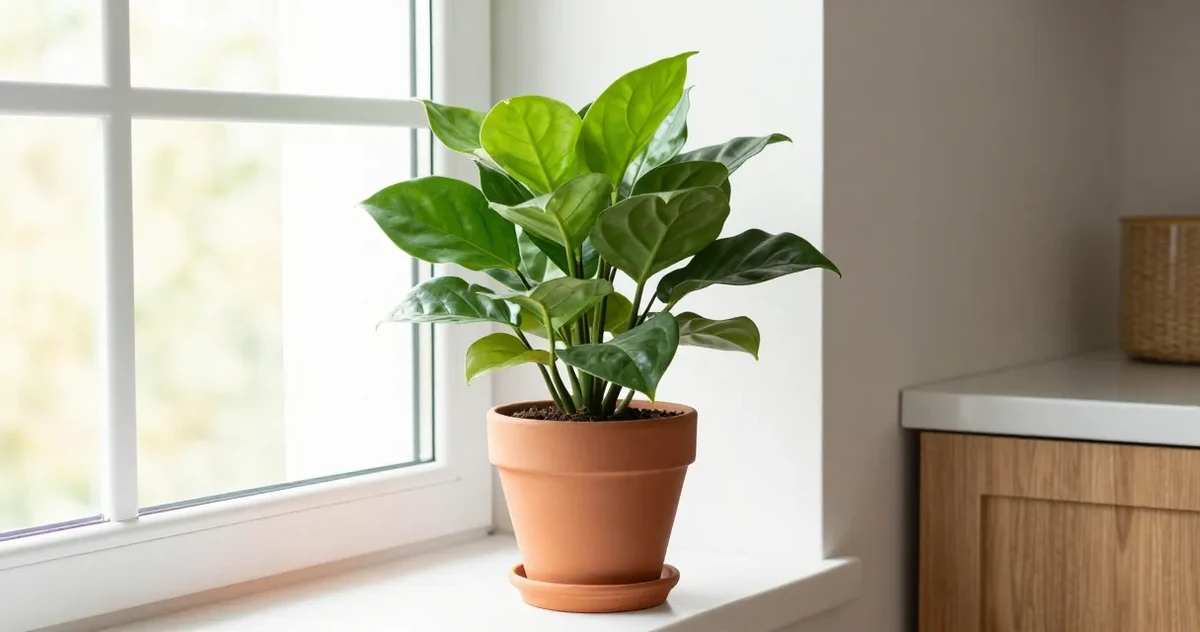
For a fluorescent-only or windowless cubicle, start with a compact ZZ plant or snake plant and add a grow light if the office goes dark for long periods. For a desk with usable window light, pothos, peperomia, and spider plant give you more choices. The best plants for an office are the ones matched to the actual light, desk space, and weekend access.
Generic lists often put succulents next to ZZ plants next to peace lilies, label all of them “low light,” and recommend them equally for a cubicle that has never seen natural sunlight.
They’re not equal. Not even close.
The plants that last on a desk are the ones matched to your actual conditions, not the ones with the best reputation or the most appealing shape. Choosing an office plant and planning its maintenance should be one decision: choose for the desk or cubicle you have, then use a routine that responds to soil, light, and growth instead of the weekday on the calendar.
What Most Office Plant Guides Miss
Here’s the misdiagnosis running through most plant lists: they treat “low light” as a single category.
It isn’t. There’s a meaningful difference between a desk two feet from a north-facing window and a cubicle in the center of a building where the only light is fluorescent during office hours, with nothing from Friday evening to Monday morning. Both technically qualify as “low light” by the standards of most care guides. Only one of them is workable for a wide range of plants without additional help.
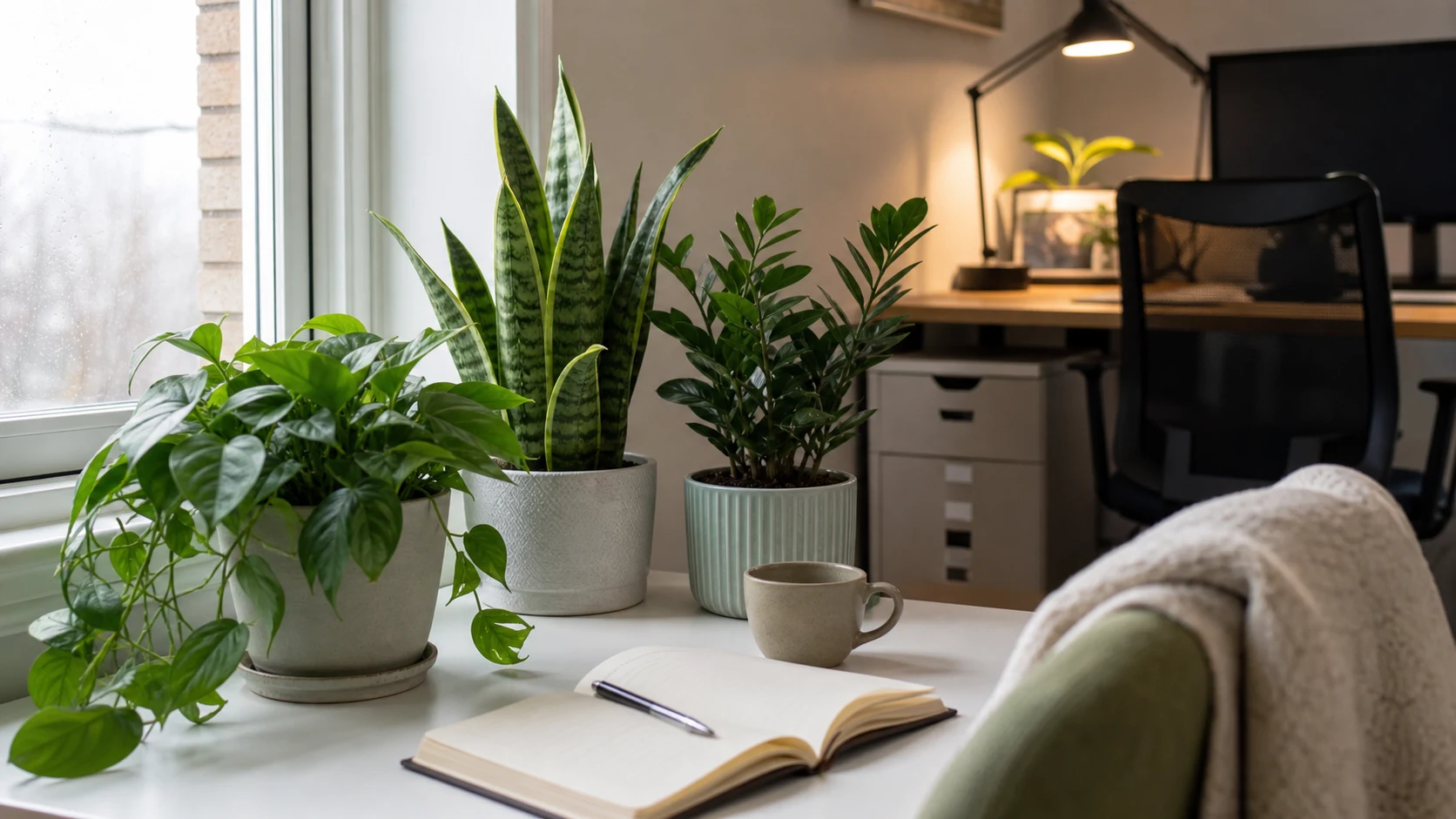
Window daylight and supplemental desk lighting create very different conditions from a fluorescent-only cubicle.
The common misdiagnosis: assuming any plant labeled “low light” will hold up in a fluorescent-only cubicle with 60-plus hours of weekend darkness. Most won’t, not long-term.
A practical first check: look at your workspace around 2 pm on a gray, overcast day with the overhead lights off. Can you read a book comfortably without straining? If yes, you probably have workable ambient light. If it’s noticeably dim even with overhead lights on during the day, you’re in a tougher tier, and your plant shortlist needs to reflect that before you spend money on something that won’t survive the season.
The University of Minnesota Extension makes this point directly: choose a plant whose needs match the light your space actually provides, not the light a care tag assumes you have. They also note that low-light plants grow more slowly and use water more slowly, which matters because it completely changes how often a desk plant actually needs watering.
Most “office plant” roundups are really “adaptable foliage plant” lists. They aren’t wrong, exactly; they just skip the part where they tell you which tier of low light they’re actually recommending for, and they almost never name the plants that look like good desk candidates but aren’t.
What Office Workers Keep Running Into
Public office-plant discussions are repetitive in a useful way. People ask for a plant that can handle a cubicle with no windows, shared watering, dry AC air, and weekend darkness, and the answers usually split into two camps: “just get a ZZ plant or snake plant” and “nothing really thrives there without extra light.” That tension matters because both sides are partly right.
The honest takeaway is that most office buyers are not choosing between good plant and bad plant. They are choosing between a plant that can survive the space, a plant that can actually grow in the space, or a setup change such as a timer grow light or a rotation plan. That is a much more useful framing than another generic “low-light plants” roundup. If the same space and light constraints follow you home, compare this list with the best plants for apartments.
Your Office: Three Real Lighting Tiers
The most useful thing you can do before buying anything is figure out which tier your workspace falls into.
Tier 1, near a window: You sit within four to five feet of a window that receives real daylight, even indirect north-facing light. This is the most forgiving office environment. Most adaptable foliage plants will do well here.
Tier 2, fluorescent only: Overhead lighting during work hours, no window within reach, darkness from Friday evening to Monday morning. This is where the honest shortlist gets genuinely short. Penn State Extension identifies darker-leaved foliage varieties as better suited to lower-light interiors. For Tier 2 offices, that narrowing is real: ZZ plant, snake plant, and the darker varieties of Chinese evergreen are the reliable options. If ZZ is your shortlist winner, the ZZ plant care guide explains the dry-down routine that prevents the usual yellow-leaf problem.
Tier 3, windowless with lights off on weekends: If the building goes completely dark every Friday night, be honest about what you’re asking of a living plant. Very few plants thrive here indefinitely. A small LED grow light on a timer makes more practical difference in this situation than searching for a tougher species. See our guide to grow lights for indoor plants for setup options that work at desk scale.
Find Your Match: A Decision Tree for Office Plant Buyers
Before you buy, route yourself through these four questions. They take about thirty seconds and will narrow your shortlist more reliably than any generic plant ranking.
Step 1: Does your desk receive any natural daylight during the workday?
- Yes, I can see daylight or a window from my desk. Go to Step 2.
- No, it is fluorescent light only during work hours. Go to Step 3.
Step 2: How close are you to the window?
- Within four to five feet. You are in Tier 1. Your realistic shortlist: pothos, heartleaf philodendron, spider plant, ZZ plant, or snake plant. Pick based on desk footprint and how often you’ll remember to water.
- Daylight is visible but not close enough to read by. Treat yourself as Tier 2 and go to Step 3.
Step 3: How often do you realistically interact with your desk plant during the workweek?
- I check it every day or close to it. Chinese evergreen, snake plant, or ZZ plant are all workable. Chinese evergreen tolerates slightly more frequent watering; snake plant and ZZ plant forgive longer gaps.
- I sometimes forget for ten days or two weeks. ZZ plant or snake plant only. Chinese evergreen and pothos accumulate quiet stress during extended dry-and-neglect cycles in fluorescent-only light.
Step 4: Does your office go completely dark on weekends?
- Yes, no light from Friday evening to Monday morning. Even ZZ plants and snake plants benefit from a small clip-on LED grow light on a timer. Match the lamp duration and distance to the fixture and plant, then watch for stretching, smaller new leaves, or persistently wet mix rather than assuming one schedule fits every desk. A grow light is a more honest investment than a more exotic species.
- Some ambient light reaches the space on weekends. ZZ plant or snake plant without supplemental light is a realistic choice. Revisit in January, when that ambient light may be weaker than you think.
Shared workspace note: If your desk is in an open or shared office, prefer ZZ plant or snake plant. Both stay drier between waterings by design, which makes them less hospitable to soil-dwelling insects like fungus gnats. A plant that attracts pests in a shared space is a social problem, not just a care problem.
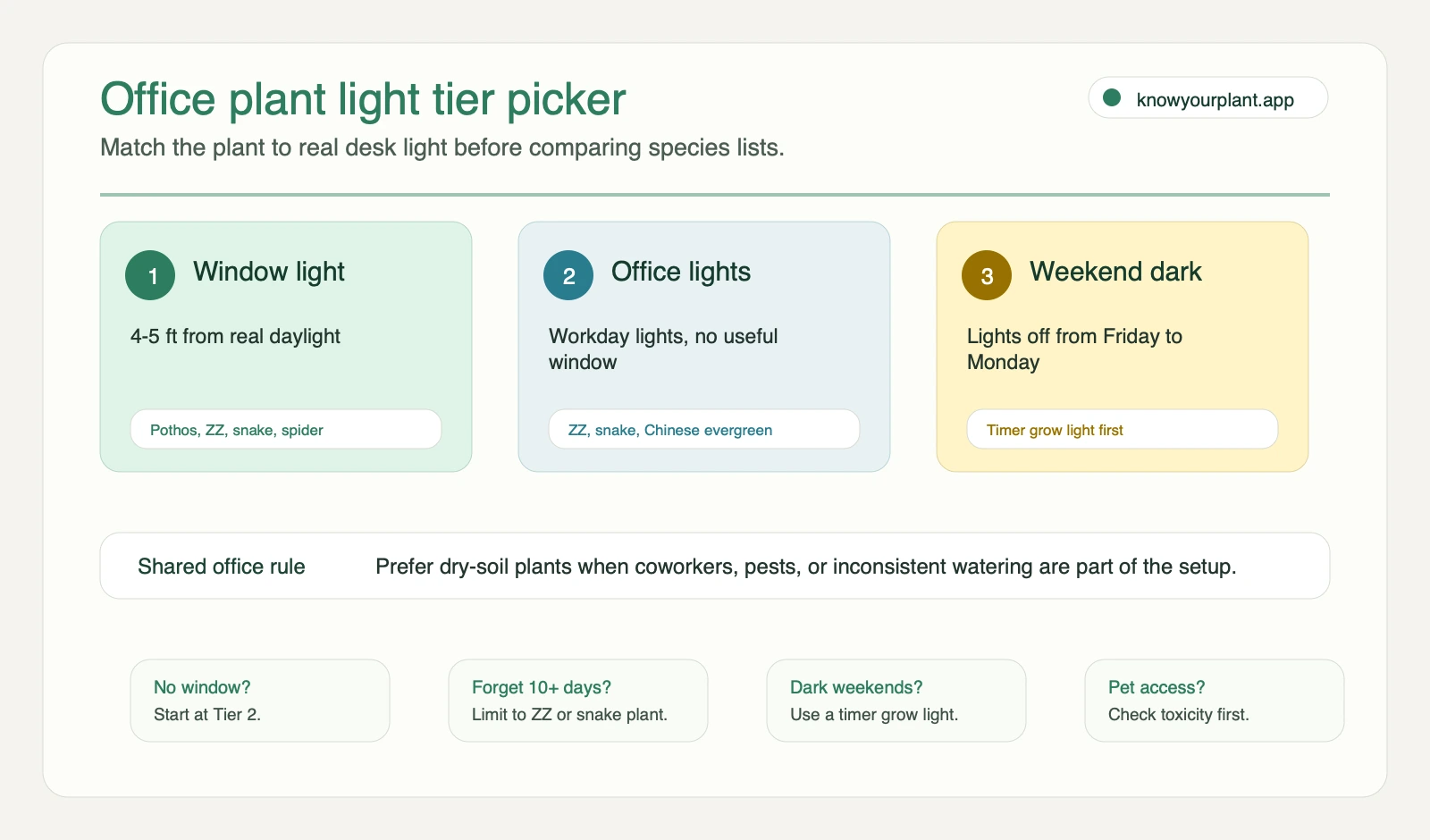
The tier picker keeps the plant choice tied to the light the desk actually receives, not the plant label.
Office Desk and Cubicle Plant Fit Matrix
Use this table before you buy. It is faster than comparing ten plant lists that all recommend the same species for completely different offices.
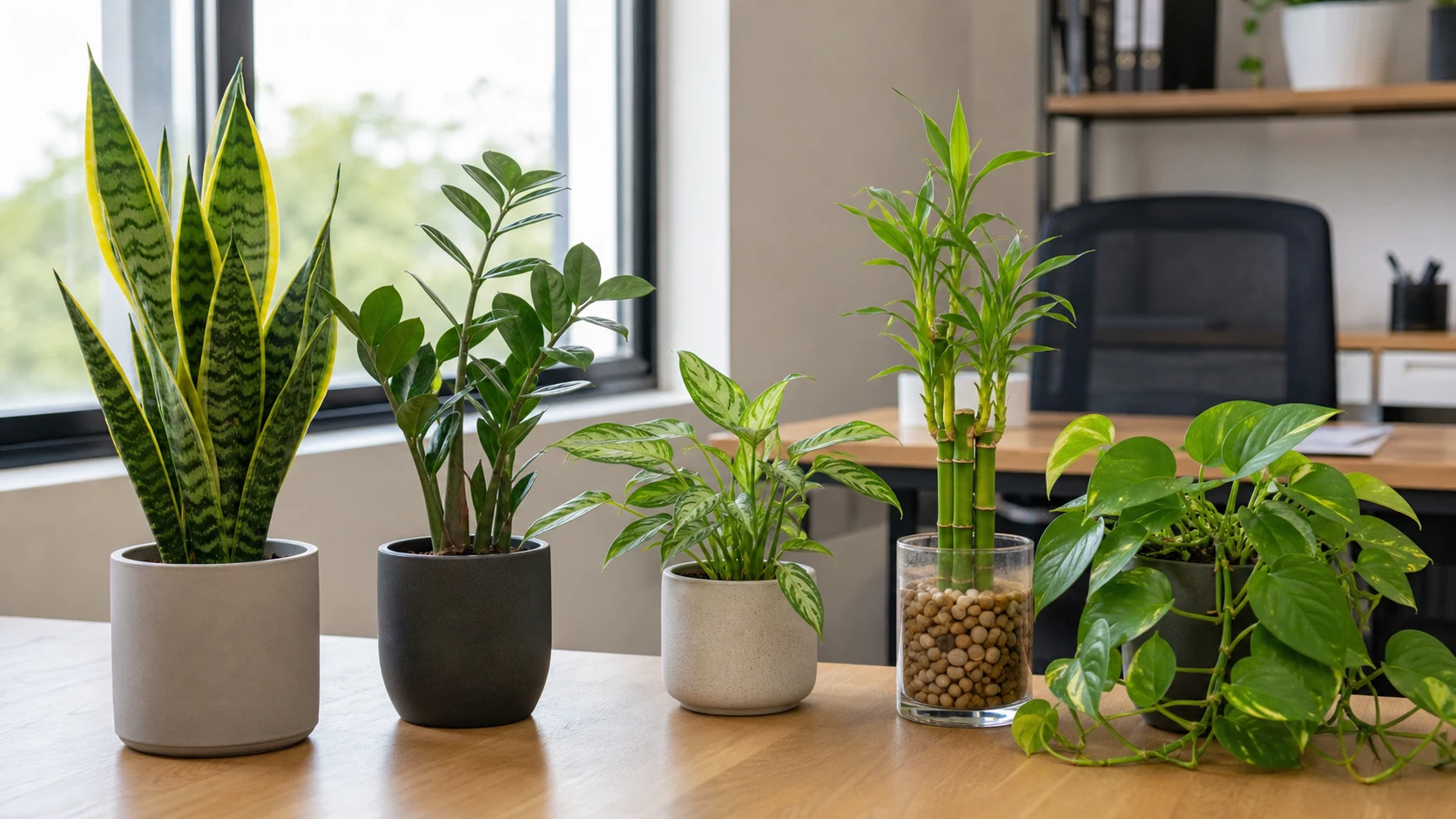
Compact snake plants, ZZ plants, Chinese evergreens, lucky bamboo, and pothos suit different office light and space constraints.
| Office condition | Best first picks | Avoid first | Why this works |
|---|---|---|---|
| Windowless office, lights on during workdays | ZZ plant, snake plant, Chinese evergreen, lucky bamboo | Succulents, fiddle leaf fig, flowering plants | These picks tolerate slower growth and weaker light better than high-light plants do. |
| Tiny desk or cubicle | Snake plant, compact ZZ plant, lucky bamboo | Large palms, sprawling pothos baskets | Upright or compact plants are easier to keep tidy in shared work areas. |
| Shared office with forgetful watering | ZZ plant, snake plant, cast iron plant | Ferns, peace lily, calathea | Drier soil lowers both care stress and fungus gnat risk. |
| Bright desk near a real window | Pothos, heartleaf philodendron, spider plant, peperomia | Low-light plants pushed into harsh direct sun all day | Window access opens up prettier, faster-growing options, but sudden direct sun can still scorch low-light foliage. |
| Pet-conscious or child-accessible office | Spider plant, peperomia, parlor palm after toxicity check | ZZ plant, pothos, snake plant, peace lily if chewing is a real risk | Common office favorites are often mildly toxic, so access matters as much as care ease. |
Evidence note: University of Minnesota and University of Maryland extension guidance lines up on the core reality here: every plant still needs usable light for photosynthesis, and low-light rooms also slow water use. In offices, light problems and watering problems usually show up together.
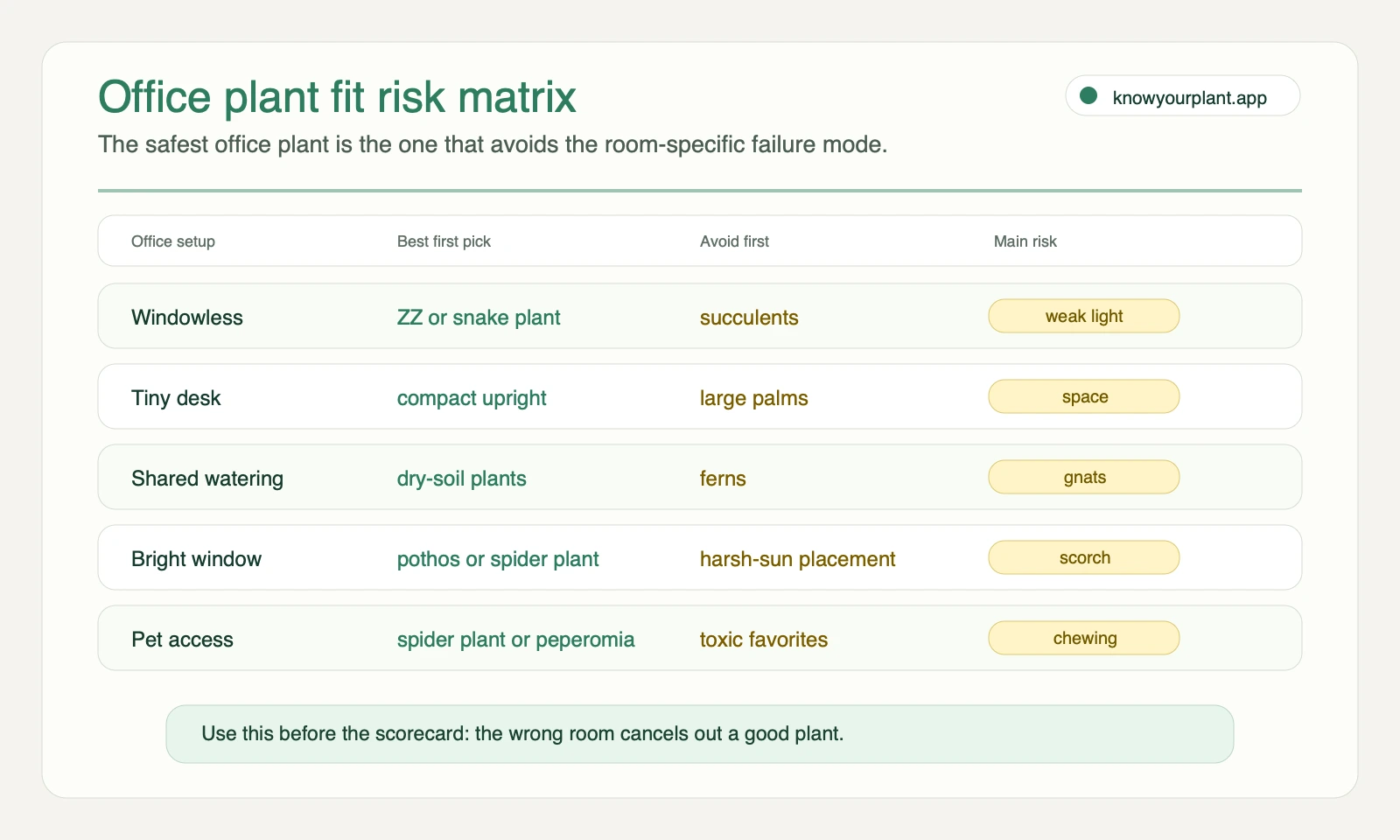
The matrix compresses the office-condition table into the quickest safe first picks and avoid-first traps.
Office Plants and Maintenance: A Practical Routine
Assign one person to the plant, especially in a shared office. Common maintenance failures include several coworkers watering helpfully, nobody emptying the saucer, or the plant sitting unnoticed under an air-conditioning vent.
| When to check | What to do | Act only when |
|---|---|---|
| Each workweek | Look for fallen leaves, leaning growth, damp soil, gnats, and water trapped inside a saucer or decorative pot | Move the plant away from a vent, empty standing water, or isolate it if insects are active |
| Before watering | Test below the surface with a finger or wooden skewer and lift the pot to compare its weight with a freshly watered pot | The depth appropriate for that plant has dried; never water just because it is Monday |
| After watering | Water at a sink until excess drains, then return the plant only after the nursery pot has stopped dripping | The container has a working drainage hole and no water remains in the cachepot |
| Periodically | Wipe broad leaves, inspect both leaf surfaces, turn one-sided growth toward the light, and compare new growth with an earlier baseline photo | Dust coats the leaf surface, pests appear, or growth is stretching consistently toward one side |
| When seasons or office hours change | Recheck daylight, weekend darkness, heating, and air-conditioning exposure | The desk has moved into a lower light tier or the soil now dries much more slowly |
For a small office cubicle, prioritize upright plants that do not spill into the workspace: compact snake plant, compact ZZ plant, or lucky bamboo. A desk with window light can support pothos, peperomia, or spider plant, but allow space for vines or arching leaves. Do not compensate for a darker cubicle by watering more; lower light normally means slower water use.
Office Plant Mistakes That Create Predictable Failures
- Buying succulents for a fluorescent-only desk because they look neat and low-maintenance
- Watering every Monday instead of checking whether the soil is still damp
- Letting multiple coworkers water the same plant without one clear owner
- Parking a plant under a cold AC vent and treating the stress like a watering issue
- Choosing a toxic plant for a pet-friendly or child-accessible office because it topped a generic roundup
- Expecting fast growth in a space that only really supports slow survival
Plants That Fool You: Common Disappointments at the Desk
This section exists because most plant guides only tell you what to buy. Nobody tells you what to skip and why, which means people keep making the same purchase mistakes.
Succulents. The most common office plant mistake. Succulents look ideal: small, structural, low-water. But most common types need much brighter light than an interior cubicle provides. In a fluorescent-only cubicle, a succulent may etiolate: the stem stretches toward the available light, leaves spread farther apart, and the original compact shape gradually weakens. The succulent care guide covers what light a succulent actually needs. It usually is not desk-light level.
Peace lily. The “low light” label on peace lilies is real. They can tolerate lower light than many tropical houseplants, but repeated severe wilting can still stress them. In an office where plant checks are inconsistent, a peace lily is a riskier choice than a ZZ plant or snake plant. The peace lily care guide explains how to read its soil and leaf signals.
Aloe vera. Related to the succulent issue: aloe needs bright light, ideally direct sun for part of the day. In low-light conditions, aloe turns pale, the leaves thin and weaken, and it tends to tip over as the root structure weakens from insufficient light-driven growth. In a Tier 1 office near a south or west window, aloe is possible. Anywhere else, it’s a slow disappointment. The aloe vera care guide covers the light requirements in detail.
Fiddle leaf fig. Listed in some office plant roundups because it looks impressive. Avoid it at a typical interior desk. Fiddle leaf figs need consistent, bright light and can react to abrupt changes in temperature, airflow, or placement with leaf drop. A dim spot under an air-conditioning vent combines several avoidable stresses.
Trailing pothos in Tier 2 or 3. Pothos is often recommended for low-light offices, and in Tier 1 (near a window) it genuinely earns that reputation. But in a fluorescent-only cubicle, pothos does something specific: it stops producing new growth with the full leaf variation and size, and older leaves gradually yellow and drop. It survives longer than a succulent would, but it slowly thins out and loses the lush appearance people buy it for. For a fluorescent-only desk, a ZZ plant holds its appearance better over time.
The Best Plants for Each Tier
Tier 1: You Have Window Light
Pothos: The most adaptable desk plant available. It trails or climbs, handles inconsistent watering without drama, and signals thirst visually before anything goes wrong. When it’s ready to drink, the leaves go slightly soft. It adjusts to a range of light levels and doesn’t hold grudges about skipped watering days.
Heartleaf philodendron: Softer, heart-shaped leaves with nearly identical care needs to pothos. It handles low light well and is forgiving when watering gets irregular, which is almost always in an office environment.
Spider plant: Bolder visually, with arching variegated foliage that looks clean on a shelf where it can spread outward. It likes indirect light and more regular moisture checks than a ZZ plant or snake plant, but it can tolerate an occasional delayed watering.
Tier 2: Fluorescent Only
ZZ plant: Probably the single most office-hardy plant available. It stores water in thick underground rhizomes, which helps it tolerate the slow dry-down pattern of a low-light desk. Growth is naturally slow, but the deep green glossy leaves often retain their appearance longer than faster-growing choices when office light is limited.
Snake plant: Upright, compact, and tolerant of lower light than many foliage plants. Let its potting mix dry deeply before watering again; the actual interval changes with light, pot size, mix, temperature, and season. Its clean vertical shape works well in a small desk footprint, while drainage protects the roots from prolonged wetness.
Chinese evergreen: Less discussed than pothos or snake plants, but one of the better practical choices for fluorescent-only conditions. The darker-leaved varieties, deep green rather than variegated, handle shade particularly well, which Penn State Extension notes specifically for lower-light interior settings. It stays compact, needs infrequent watering, and has a tidier lower-profile look than trailing plants, which matters in shared office settings where a sprawling plant draws the wrong kind of attention.
Tier 3: Windowless and Weekend-Dark
A small clip-on or desk-height LED grow light on a timer is a more honest solution here than any plant choice. It gives a ZZ plant or pothos supplemental light instead of asking it to persist in a space with no dependable daylight. University of Minnesota Extension confirms that supplemental lighting can compensate for insufficient natural light. Set the duration and distance for the fixture and plant rather than assuming one schedule fits every setup.
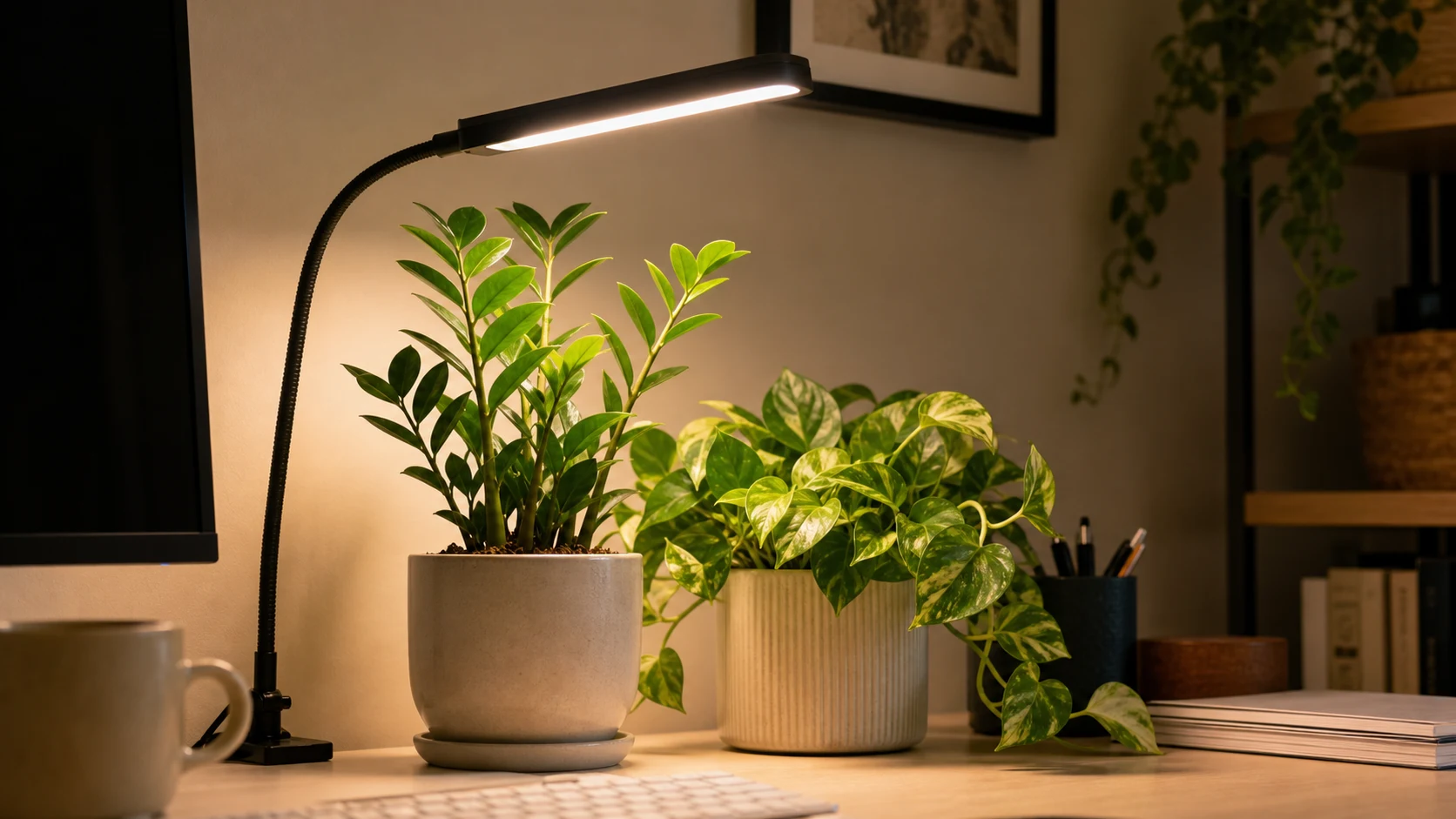
A desk-height LED grow light gives ZZ plants and pothos usable light in a windowless office.
The Scoring Rubric Behind This Shortlist
This shortlist works best when you treat it like an office-use evaluation, not a generic houseplant popularity contest. Each plant was judged on the same six office-specific criteria.
| Criterion | What it answers |
|---|---|
| Light realism | Can this plant hold up in the light people actually have at work? |
| Weekend-dark tolerance | Does it cope with Friday-to-Monday darkness without declining quickly? |
| Watering forgiveness | How badly does it punish an owner who forgets for a week or two? |
| Desk footprint | Does it stay manageable on a desk, shelf, or cubicle edge? |
| Pest-risk management | Does its usual care pattern keep soil drier and cleaner in shared spaces? |
| Appearance retention | Does it still look good under office conditions, or just barely survive? |
The scorecard below rolls those criteria into a practical office ranking. That is why ZZ plant and snake plant rise to the top here even though other plants may be prettier in brighter home conditions.
How They Compare: Office Plant Scorecard
| Plant | Low-Light Tolerance | Weekend-Dark Tolerance | Watering Trigger | Desk Footprint | Pest Risk | Forgiveness |
|---|---|---|---|---|---|---|
| ZZ plant | Excellent | Excellent | Mix dry deeply | Compact | Low | Very high |
| Snake plant | Excellent | Very good | Mix dry throughout | Compact, upright | Low | Very high |
| Chinese evergreen | Very good | Moderate | Upper mix dry; verify below | Compact | Medium | High |
| Pothos | Very good | Moderate | Upper mix dry | Trailing, flexible | Medium | High |
| Heartleaf philodendron | Very good | Moderate | Upper mix dry | Trailing, flexible | Low | High |
| Spider plant | Good | Limited | Upper mix partly dry | Arching | Low | Medium |
Ratings reflect typical performance in fluorescent office conditions with inconsistent weekend light. Watering triggers are intentionally based on the mix, not a calendar; dry-down changes with pot size, soil, light, temperature, airflow, and the plant itself.
How scorecard ratings were derived: Light-tolerance and weekend-dark ratings for ZZ plant, snake plant, and Chinese evergreen are grounded in Penn State Extension’s guidance that darker-leaved foliage plants are better suited to lower-light interiors. Watering-trigger guidance follows University of Minnesota Extension’s finding that plants in lower light use water more slowly than plants in brighter conditions. Pest-risk ratings reflect the relationship between persistently moist soil and fungus gnat habitat. Desk footprint and forgiveness ratings are editorial assessments based on known plant biology and care failure patterns documented in houseplant literature; they are not the result of controlled testing.
Best For, Not For, and the Trade-Offs
ZZ plant
Best for: Fluorescent-only cubicles, inconsistent watering, offices that go dark on weekends, and shared desks where pest risk needs to stay low.
Not for: Someone who wants fast visible growth or a softer trailing look.
Pros:
- Handles low light and missed watering better than almost any common office plant
- Compact, polished shape that works on desks and shelves
- Lower pest pressure because the soil stays drier between waterings
Cons:
- Growth is slow, so it can feel static if you want visible progress
- Mildly toxic if chewed by pets or young children who visit the space
Snake plant
Best for: Small desk footprints, offices with long watering gaps, and people who want a clean upright plant that does not sprawl.
Not for: Heavy-handed waterers or decorative pots with poor drainage.
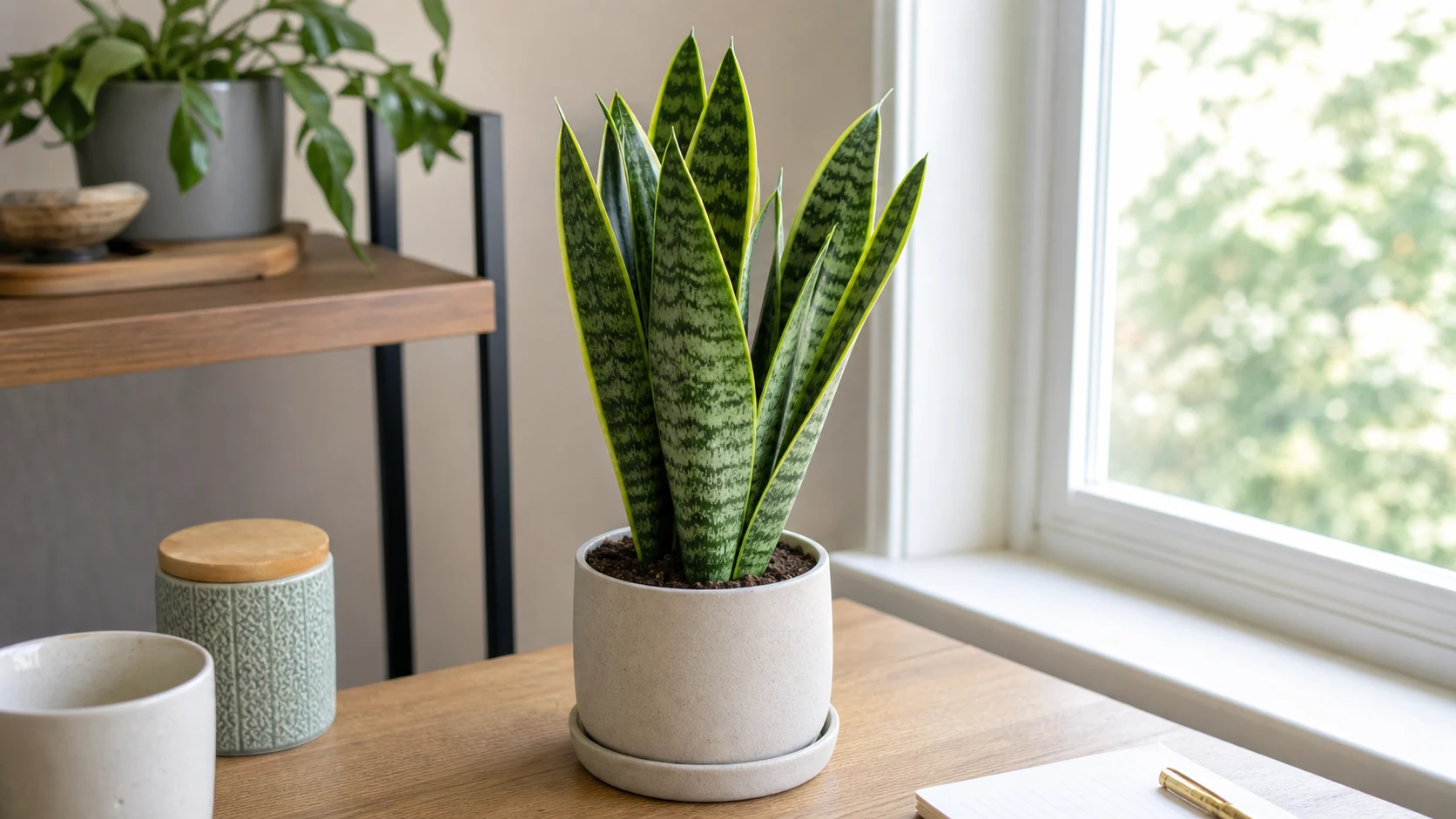
A compact snake plant keeps a clean upright profile while a draining pot and saucer reduce wet-soil risk.
Pros:
- Extremely tolerant of low light and inconsistent care
- Upright shape uses very little desk width
- Usually stays tidy even in shared office setups
Cons:
- Wet soil causes trouble faster than low light does
- Less forgiving if you hide the nursery pot in a cachepot that traps water
Chinese evergreen
Best for: Fluorescent offices where someone checks the plant regularly and wants a fuller, leafier look than a ZZ plant or snake plant.
Not for: Owners who frequently leave the plant unchecked for long stretches or want the driest possible setup.
Pros:
- Better-looking foliage than many true low-light survivors
- Darker varieties handle office shade honestly well
- Compact enough for desks without the trailing habit of pothos
Cons:
- Needs steadier watering than ZZ plant or snake plant
- Medium pest risk if the soil is kept too wet in a low-light cubicle
Pothos
Best for: Tier 1 desks near real daylight and office workers who want a forgiving trailing plant.
Not for: Fluorescent-only cubicles where the goal is long-term looks, not mere survival.
Pros:
- Easy to read visually when it needs water
- Flexible trailing habit works well on shelves or cabinet tops
- Tolerates irregular care better than fussier tropical plants
Cons:
- Loses fullness and leaf quality in deeper office shade
- Can become messy in tight shared workspaces if vines are not managed
The Watering Mistake That Kills Most Desk Plants
Overwatering, specifically watering on a fixed schedule rather than checking whether the plant actually needs it.
University of Maryland Extension addresses this directly: indoor plants should not be watered on a fixed schedule, and many houseplants are lost to overwatering or underwatering precisely because owners are not checking soil moisture before they water. In a low-light office, the same pot can remain damp much longer than it would near a bright window, but there is no universal multiplier or interval.
Water every Monday because it’s Monday, and you’re regularly adding water to soil that’s already wet. That’s how root rot begins on a desk that seemed to be doing fine.
The fix is simple: test below the surface with a finger or wooden skewer before you water. Still damp at the depth relevant to that plant? Wait and check again later. Dry enough for that species? Water thoroughly, let it drain fully, and do not let the pot sit in standing water in the saucer.
The Slow Decline Problem Nobody Talks About
Here’s something most office plant guides don’t mention: chronic desk-plant stress can build gradually while the existing leaves still look mostly fine.
Under inadequate light, a plant may slow growth before it develops obvious yellowing or leaf drop. That makes a single glance less useful than comparing leaf spacing, leaf size, color, soil dry-down, and new growth over repeated checks.
A naturally slow ZZ plant may keep its existing leaves for a long time without producing a new shoot. That alone does not prove the light is adequate, but it is not a failure signal either. Use several observations together before changing care.
The recurring health checkpoint that actually matters:
Most people check leaf color and watering needs. Neither catches slow decline early. Here’s what to check instead:
- Establish a baseline: Photograph the plant when it reaches the desk and note leaf firmness, spacing, color, and how long the mix takes to dry. Do not require a new shoot during its first weeks; relocation alone can pause visible growth.
- Compare trends: New growth is encouraging, but naturally slow plants may pause even when healthy. Stretching, smaller or paler new leaves, repeated leaf loss, or soil that remains wet are stronger reasons to reassess light and roots than a missed growth quota.
- Recheck when conditions change: Shorter daylight, a desk move, altered office hours, heating, or stronger air conditioning can change both light and dry-down. Judge the actual room rather than a fixed month on the calendar.
For ZZ plants, where slow growth is normal even under good conditions, watch leaf quality instead: the existing leaves should stay deep green and firm, not soften or develop a slight pallor at the base. Any yellowing at lower stems while upper growth looks fine is the early signal.
This is also why the recommendation to buy a grow light for Tier 3 offices is not limited to rescuing plants with obvious symptoms. Supplemental light can correct a poor setup before stretching, leaf loss, or persistently wet mix becomes pronounced.
Winter Makes Office Plants Harder to Keep
A note worth adding for anyone who has lost a desk plant between November and February: winter compounds every challenge above.
Shorter days mean offices that were borderline Tier 1 quietly become Tier 2. If your desk was getting four or five hours of reasonable ambient light in September, it might be getting two by December, depending on your building and latitude. The plant doesn’t announce this shift; it just slowly starts drawing on reserves.
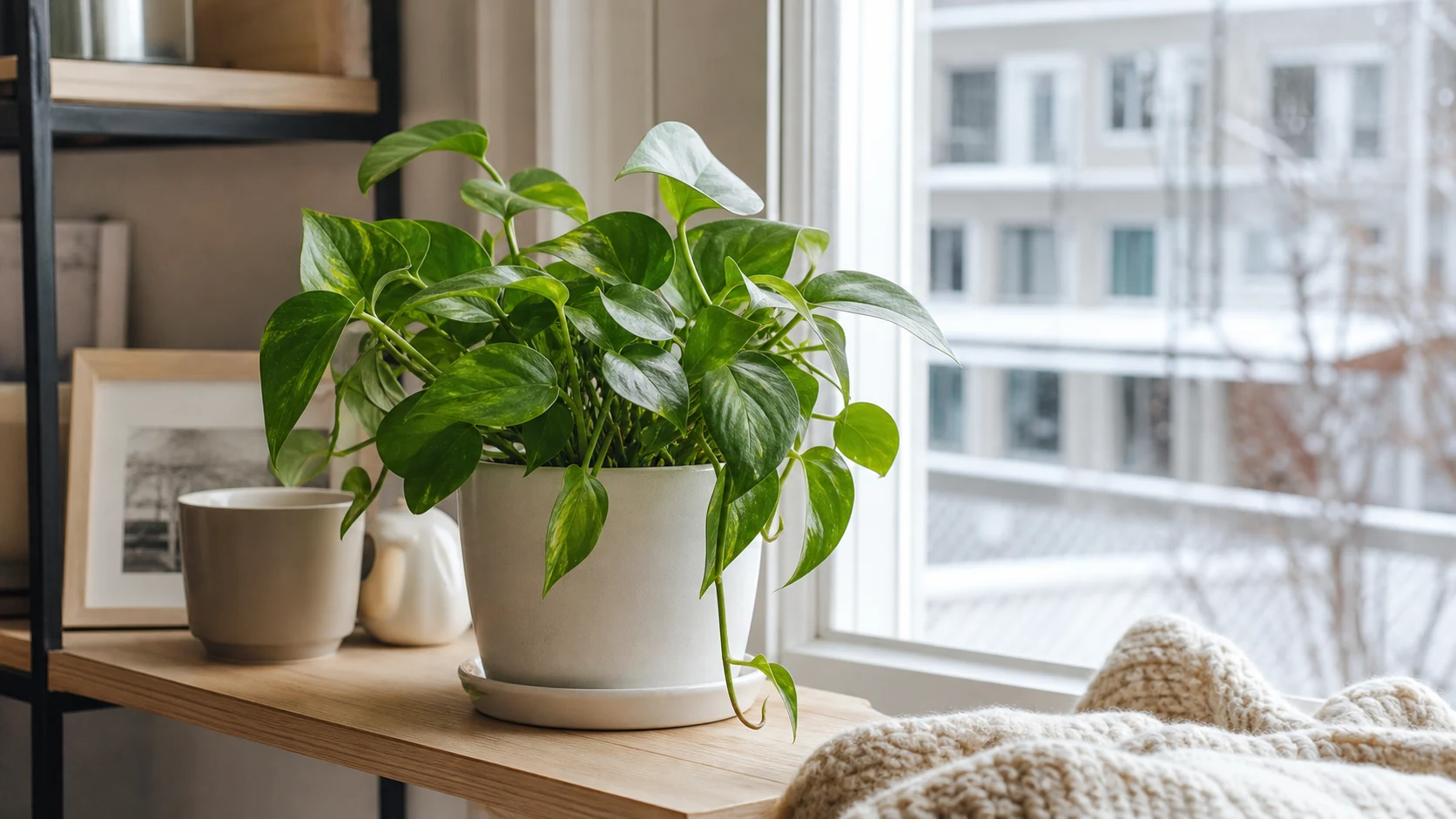
A winter window gives a desk pothos fewer usable daylight hours while its soil dries more slowly.
Heating systems also dry out office air significantly. Most Tier 1 and Tier 2 plants handle low humidity reasonably well, but the combination of less light, drier air, and the plant’s slower winter metabolism means mistakes compound faster. Overwatering becomes a bigger risk because the plant is barely using any water at all. If a plant that was stable in autumn suddenly looks off in January, check how recently you last watered and whether the soil is actually dry before adding more.
The ZZ plant and snake plant hold up through this better than most. Their natural slow growth and water storage give them a buffer that trailing plants like pothos don’t have to the same degree. If you’re buying a desk plant in autumn, it’s worth starting with one of these rather than learning that your window situation changes dramatically over winter.
Pests at Your Desk: Keeping the Risk Low
Most office plant pest problems come down to a single cause: soil that stays wet too long. Fungus gnats are drawn to consistently damp organic soil, and an overwatered desk plant in low-light conditions is close to ideal habitat for them.
Practical prevention habits matter more than species choice:
- Use a pot with drainage and empty the saucer after every watering. Don’t let the plant sit in standing water overnight.
- Check the mix to the depth appropriate for that plant, and water only after it reaches the dry-down stage in the scorecard above.
- Inspect any new plant’s soil and foliage before it lands on your desk near colleagues.
ZZ plants and snake plants are lower-risk in shared spaces partly because they stay drier between waterings by design, which makes the soil less hospitable to soil-dwelling insects. For a broader look at low-light plant options beyond desk-specific picks, that guide covers a wider range of interior spaces and lighting situations.
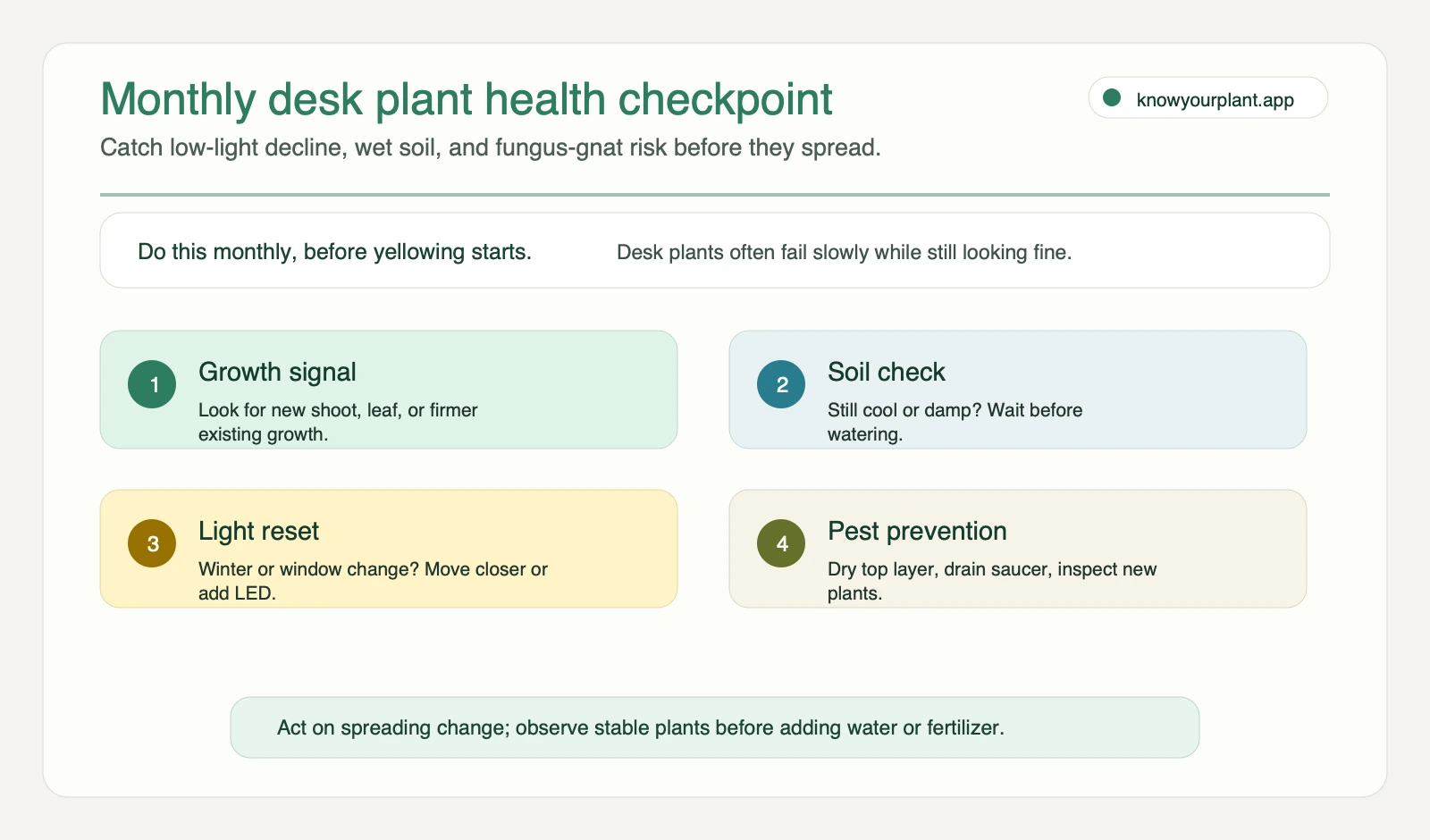
The checkpoint catches slow decline before yellowing or gnats make the desk plant a shared-office problem.
Where to Start
If you want a short list to begin with: a ZZ plant handles the widest range of office neglect and low light, and it’s honest about not growing quickly. A pothos works best if you have at least some window access. A Chinese evergreen is the tidier, lower-maintenance option for a fluorescent-only cubicle.
If your office is genuinely windowless with lights off all weekend, a small LED grow light on a timer is a better first investment than searching for a rarer or supposedly tougher plant. Setting up dependable light is more useful than waiting for gradual decline to become obvious.
And if someone has been gifting you succulents and wondering why they keep failing on your desk, now you have the answer.
Testing and Evaluation Method
This office-plant shortlist was evaluated against four conditions readers actually deal with: a desk near a real window, a fluorescent-only cubicle, a windowless office that goes dark on weekends, and a shared workspace where drainage and pest risk matter. The scoring rubric weighted low-light realism, weekend-dark tolerance, watering forgiveness, desk footprint, pest-risk management, and appearance retention.
For the evidence layer, we used University of Minnesota guidance on indoor lighting, University of Maryland guidance on watering, and Penn State guidance on low-light houseplants. We also used public forum snippets as qualitative office-owner language for recurring frustrations such as weekend darkness, bug anxiety, and overwatering in shared workspaces. That social evidence helps surface failure patterns, but it is not controlled testing or a statistical sample.
Frequently Asked Questions
What is the best plant for a windowless office?
A ZZ plant is the most practical answer for a truly windowless office. It stores water in underground rhizomes, grows slowly, and tolerates the combination of weak fluorescent light and dark weekends better than almost any other common foliage plant. That said, even ZZ plants hold up better with a small LED grow light on a timer if the space genuinely has no natural light at all. Enduring a bad situation is not the same as thriving in a good one.
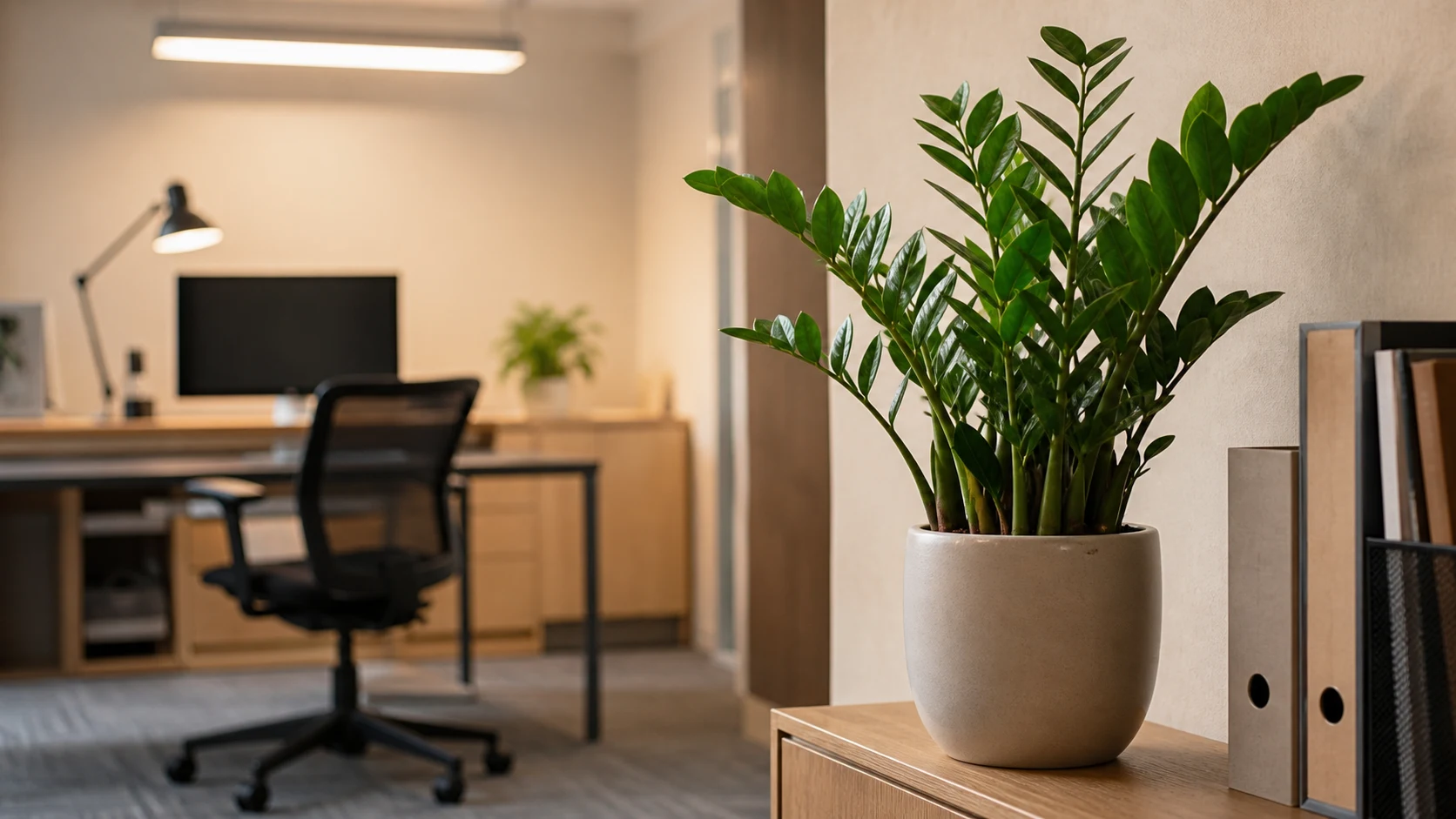
A ZZ plant is the most practical starting point for a windowless office that relies on artificial light.
Can plants survive on fluorescent light only?
Some can, for a while. ZZ plants and snake plants are the most reliable in fluorescent-only conditions; they’ll hold their appearance and maintain root health longer than most alternatives. The honest caveat is that supplemental lighting makes a meaningful difference in truly light-limited spaces. University of Minnesota Extension confirms that supplemental grow lighting can compensate for insufficient natural sunlight, which means a timer-controlled grow light is often a more reliable long-term solution than hunting for a harder plant.
How do I know if my desk plant is actually healthy or just surviving?
Use a trend rather than a leaf quota. New growth is encouraging, but its pace depends on species, light, temperature, season, and recent relocation; a slow ZZ plant or snake plant can pause while remaining stable. Compare leaf spacing and size, firmness, color, soil dry-down, and any repeated leaf loss. Several worsening signals justify a light and root check; lack of one new leaf by a deadline does not.
How often should you water office plants?
There is no reliable office-wide interval. In lower light, plants usually use water more slowly, but pot size, mix, airflow, temperature, and species determine the actual dry-down. University of Maryland Extension recommends checking soil rather than following a calendar. Test below the surface; let ZZ plants and snake plants dry deeply, while following the shallower trigger appropriate for plants such as pothos or spider plant.
What office plants are least likely to attract pests?
ZZ plants and snake plants are lower-risk partly because they stay drier between waterings, and dry soil is less hospitable to fungus gnats and other soil pests. More importantly, how you care for any plant matters more than the species: empty saucers after watering, let soil dry between drinks, and inspect new plants before bringing them into a shared space. Our fungus gnats guide covers the full control cycle if you’re already dealing with an infestation.
Are succulents good for an office desk?
Only if your desk gets strong usable light appropriate for the species. In a fluorescent-only interior cubicle, many common succulents etiolate: stems stretch toward the available light, leaves spread apart, and the plant loses its compact shape. They are common gift plants and a poor fit for many office interiors. A ZZ plant is usually more forgiving when usable light is limited.
Why did my peace lily fail at my desk?
Peace lilies are genuinely lower-light tolerant, but they droop noticeably when dry and repeated severe wilting can stress the plant. They fit a desk where someone checks soil consistently better than a shared space with uncertain ownership. When attention is intermittent, a ZZ plant or snake plant is usually more forgiving.
Is a ZZ plant safe to keep in an office?
ZZ plants are mildly toxic if ingested, which is worth noting if young children visit the space. For standard adult office environments, it’s not a practical concern. If full non-toxicity matters, for a pediatric office or a space with regular child visitors, spider plants and peperomia are non-toxic options with reasonable low-light tolerance and a compact desk footprint. Our cat-safe indoor plants guide covers a broader list of non-toxic options if that’s a priority.
What is the most low-maintenance desk plant overall?
For pure low-maintenance across the widest range of office conditions, ZZ plant and snake plant are the most consistently forgiving. Both tolerate irregular watering, low light, and general neglect without dramatic responses. Between the two, snake plants take up less lateral space on a crowded desk, which makes them the better choice when square inches matter.
Can I keep a plant on my desk if there’s no natural light at all?
You can, but a small LED grow light on a timer can make a real difference. Set its duration and distance according to the lamp output, plant, and any available ambient light; then adjust if growth stretches or the mix stays wet for too long. A suitable clip-on grow light is a more honest investment than hunting for a plant that supposedly needs nothing at all.