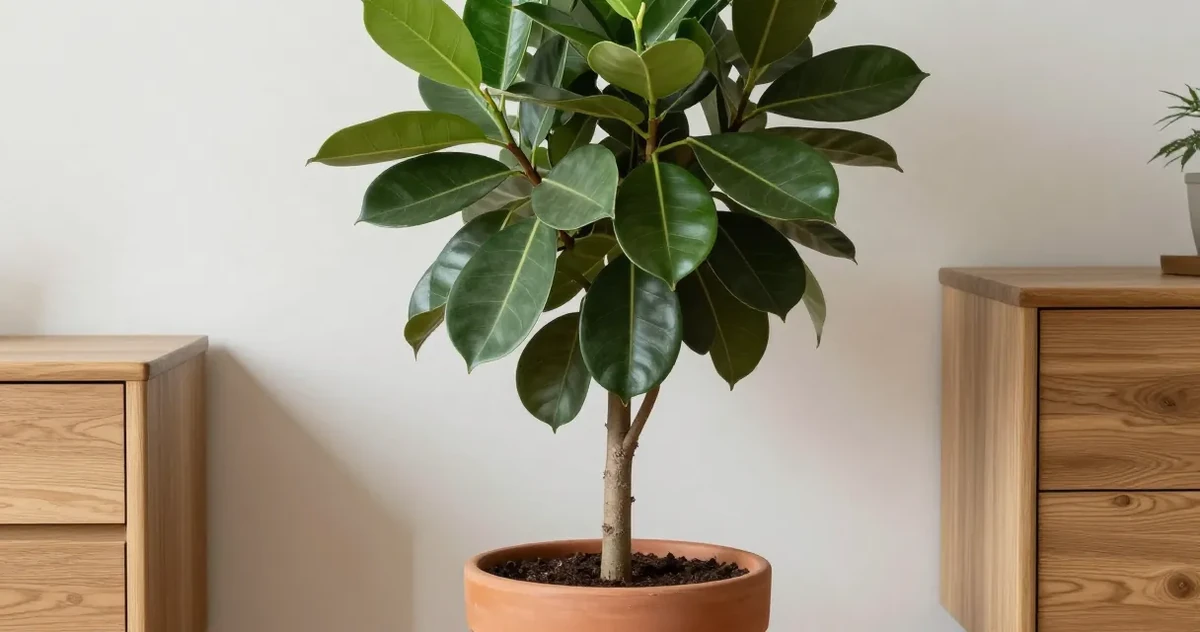
The money tree has a reputation for bringing good luck, but most owners just want to keep it alive. One thing makes that significantly easier: understanding that Pachira aquatica is a tropical wetland native that loves moisture in the air but hates sitting in soggy soil. Get that balance right, and it will stay full, green, and growing for years.
By KnowYourPlant editorial team
Updated June 18, 2026: This guide was checked against NC State Extension, Missouri Botanical Garden, University of Georgia Extension, ASPCA, and live Ask Extension troubleshooting cases. Search-visible owner discussions about braided trunks and root rot were used only as qualitative signal for recurring home-grower problems, not as controlled evidence.
Identification Snapshot
| Detail | What to look for |
|---|---|
| Botanical name | Pachira aquatica |
| Growth habit | Upright tropical tree, usually sold indoors as several young stems braided together |
| Fastest visual clue | Hand-shaped leaf clusters with five to seven leaflets on a woody braided base |
| Best home setup | Bright indirect light, a pot with drainage, and evenly moist soil that never stays swampy |
| Pet safety | ASPCA lists money tree as non-toxic to cats and dogs, but the common name is shared with plants that are not |
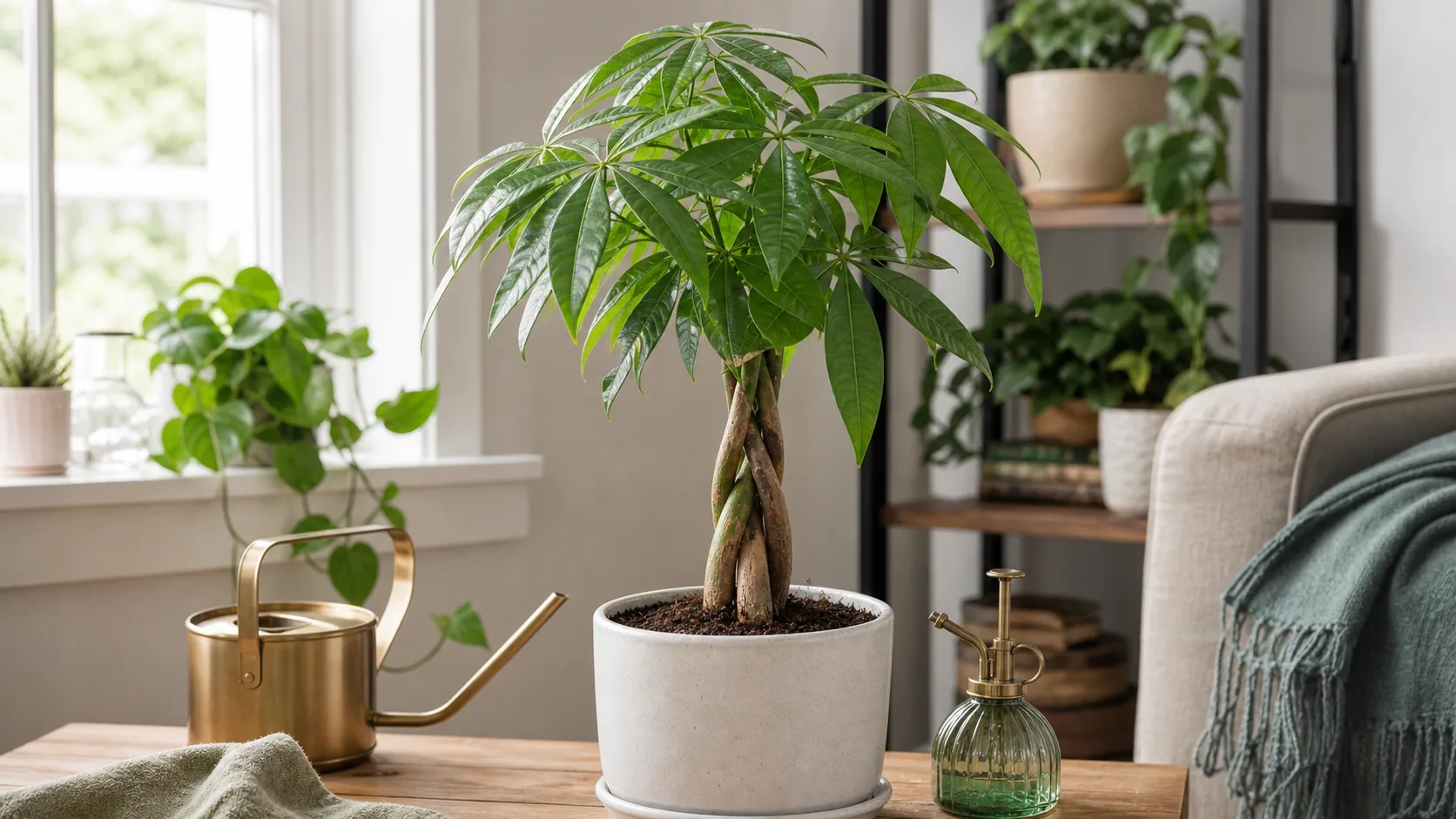
Use the palmate leaf clusters and braided trunk as the fastest identification checks for Pachira aquatica.
Lookalikes and Confused-With
| Plant or label | How to tell it apart |
|---|---|
| Jade plant sold as a money plant | Jade has thick succulent leaves and wants drier care, while Pachira aquatica has thin palmate leaflets and prefers steadier moisture |
| Vining “money plant” labels | Trailing or climbing vines with heart-shaped leaves are not money trees, even if the shop tag uses a similar name |
| Young unbraided Pachira | Same species and same care, but sold without the braided trunk that makes mature nursery plants easier to recognize |
Money Tree Care Cards
| Care card | Practical target |
|---|---|
| Light | Bright indirect light, with hot direct afternoon sun kept off the leaves |
| Water | Let the top two to three centimetres dry, then water deeply and let all excess drain away |
| Pot | Use a draining nursery pot or cache-pot setup, never a sealed decorative pot that traps water |
| Soil | Standard indoor mix with extra perlite or similar drainage support |
| Seasonal shift | Water less and stop feeding in winter, then resume faster checks once spring growth returns |
Social Listening: Where Money Tree Owners Get Stuck
The recurring pattern in owner questions is not simple neglect. People see yellow leaves and assume the fix is to stop watering, when the real issue is often poor drainage, cold placement, a pot that stays wet too long, or one weakened section of roots inside a braided plant. That is why the most useful money tree guide is diagnosis-first, not schedule-first.
What Is a Money Tree?
The money tree you find at garden centers is Pachira aquatica, a tropical tree native to Central and South America where it grows along riverbanks and in swampy lowlands. Indoors, it is almost always sold with its trunks braided together, giving it that distinctive sculptural shape. The Missouri Botanical Garden notes that Pachira aquatica is a wetland-native species that performs best indoors in bright light with moderate, even moisture – which explains both why the plant is so popular and why decorative pots without drainage become a problem so quickly.
One thing worth knowing before you buy: the name “money tree” is shared by a few completely different plants, including jade plants. They are not the same. University of Georgia Extension explicitly warns readers not to confuse Pachira aquatica with jade plants, which are also sometimes called money trees, have different care needs, and are toxic to pets while Pachira is not. The distinction matters most if you have animals in the house. If you are choosing one mainly for symbolism or placement, the feng shui plants guide explains where money trees make the most sense, while the plant-and-room fit matrix helps when light or pet access is the deciding constraint.
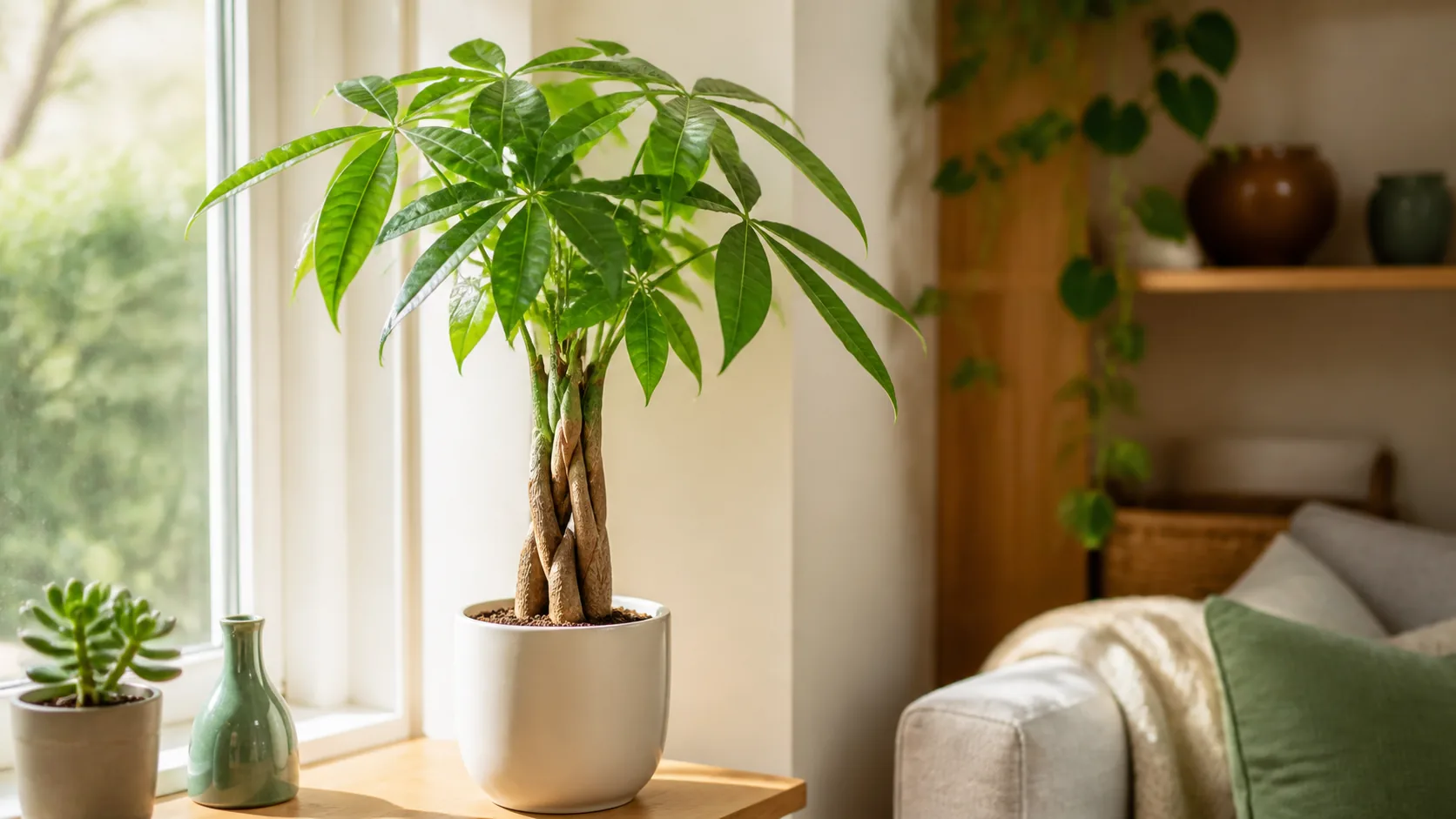
A braided Pachira has thin palmate leaflets, unlike the thick succulent leaves of jade sold under the same money-plant name.
What Most Care Guides Miss
Most money tree care articles focus on two variables: light level and watering frequency. That is a reasonable starting point, but it is not why most money trees struggle indoors.
The real failure pattern is a chain reaction that starts before any watering mistake happens. A money tree arrives in a decorative pot with no drainage. The owner waters it carefully and reasonably. Moisture has nowhere to go. Roots sit in wet soil for days. Leaves begin to yellow. The owner reads “yellow leaves = overwatering” and stops watering entirely. The plant enters drought stress on top of root damage. Now two problems are active instead of one.
What the guides miss: yellow leaves on a money tree rarely have a single cause. An Ask Extension expert reviewing a yellowing money tree case noted that factors including drainage, fertilization, container size, and cold placement all contribute, and specifically cautioned that stopping water entirely is rarely the right response when leaves yellow. The better first question is not “how often did I water?” but “does this pot actually drain?” That single check resolves more money tree problems than any watering schedule.
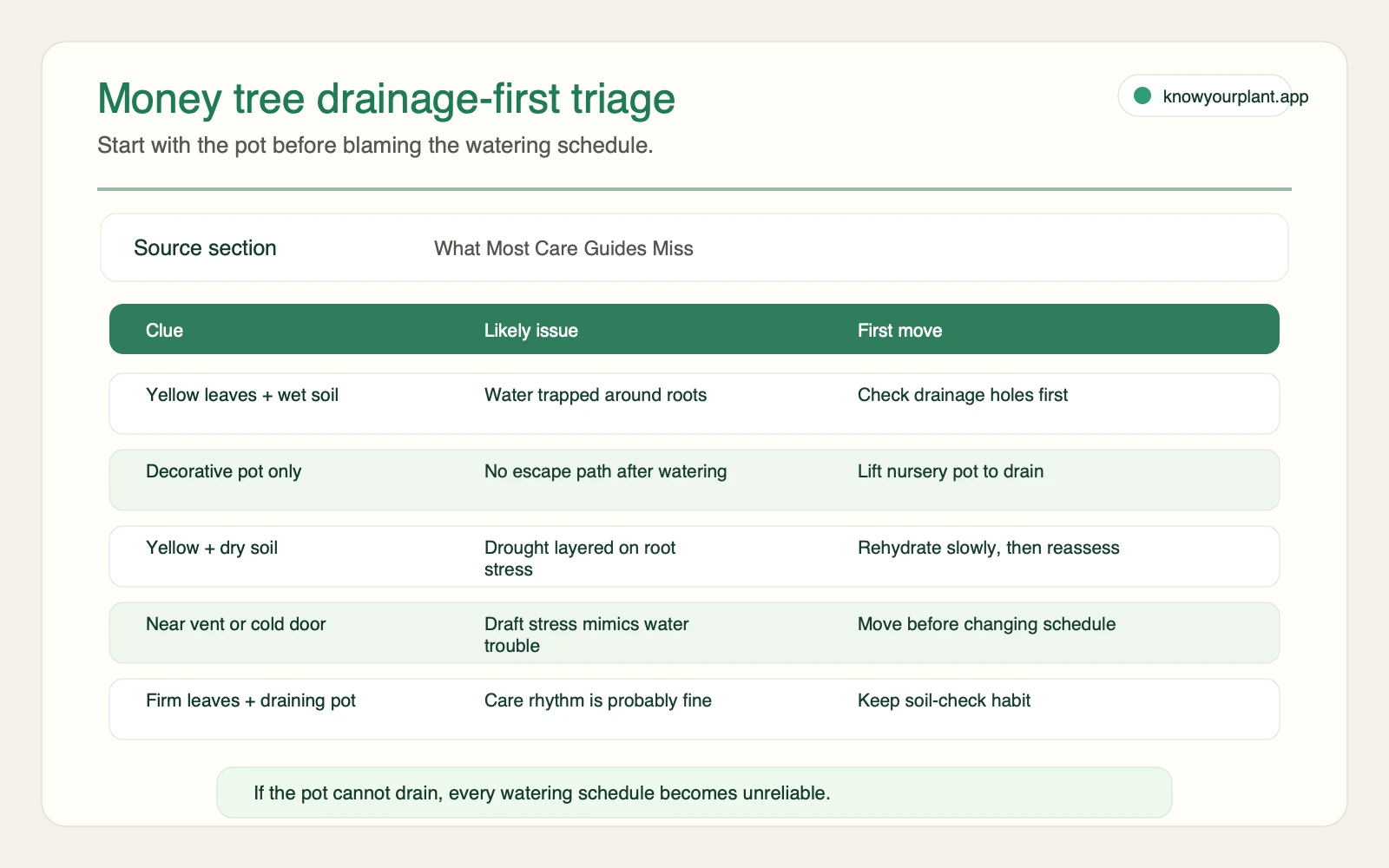
Start money tree troubleshooting with the pot and drainage path before blaming the watering schedule.
Light: Bright and Indirect Is the Target
A money tree does best in bright, indirect light. A spot a few feet back from a south- or east-facing window, where the light is strong but the sun does not hit the leaves directly, is ideal. NC State Extension notes that while the plant tolerates a mix of sun and shade, direct sun exposure causes leaf scorch, leaving brown, papery patches on the edges that do not reverse once they appear.
Lower light is tolerated, but the plant will slow down significantly and become more vulnerable to overwatering problems because soil takes longer to dry in dimmer conditions. If your space is dim, supplementing with a grow light for indoor plants is worth considering.
Rotate the pot a quarter turn every two to three weeks so all sides receive even exposure. This keeps the braided trunk growing symmetrically and prevents the plant from leaning toward the window over time.
Watering: The Biggest Place Things Go Wrong
The practical rule: water thoroughly when the top two to three centimetres of soil feel dry to the touch. Press your finger into the soil up to the first knuckle. Dry? Water deeply until it drains from the bottom, then empty the saucer. Still damp? Wait another day or two and check again.
In spring and summer, you will likely water every seven to ten days. In autumn and winter, when growth slows and light drops, stretch that to every two weeks or longer.
A pot without drainage holes is the fastest route to root rot. If your money tree came in a decorative cache pot, slip the nursery pot out before watering and let it drain fully before setting it back. This one habit resolves the majority of watering-related money tree problems. For more on recognizing the early signs that overwatering has started, the guide to overwatered plant signs and fixes walks through what to look for before roots are damaged.
Humidity and Temperature
Money trees prefer humidity above 50 percent and temperatures between 16 and 27°C (60–80°F). They are sensitive to cold drafts, air conditioning vents, and heating vents. A spot near a frequently opened door in winter, or directly under a ceiling fan, will cause stress that shows up as leaf drop – even when watering and light seem right.
A small humidifier nearby or a pebble tray with water under the pot raises ambient humidity more reliably than misting. Occasional misting does no harm in a well-ventilated room, but leaves that stay wet can develop fungal spots in stagnant air.
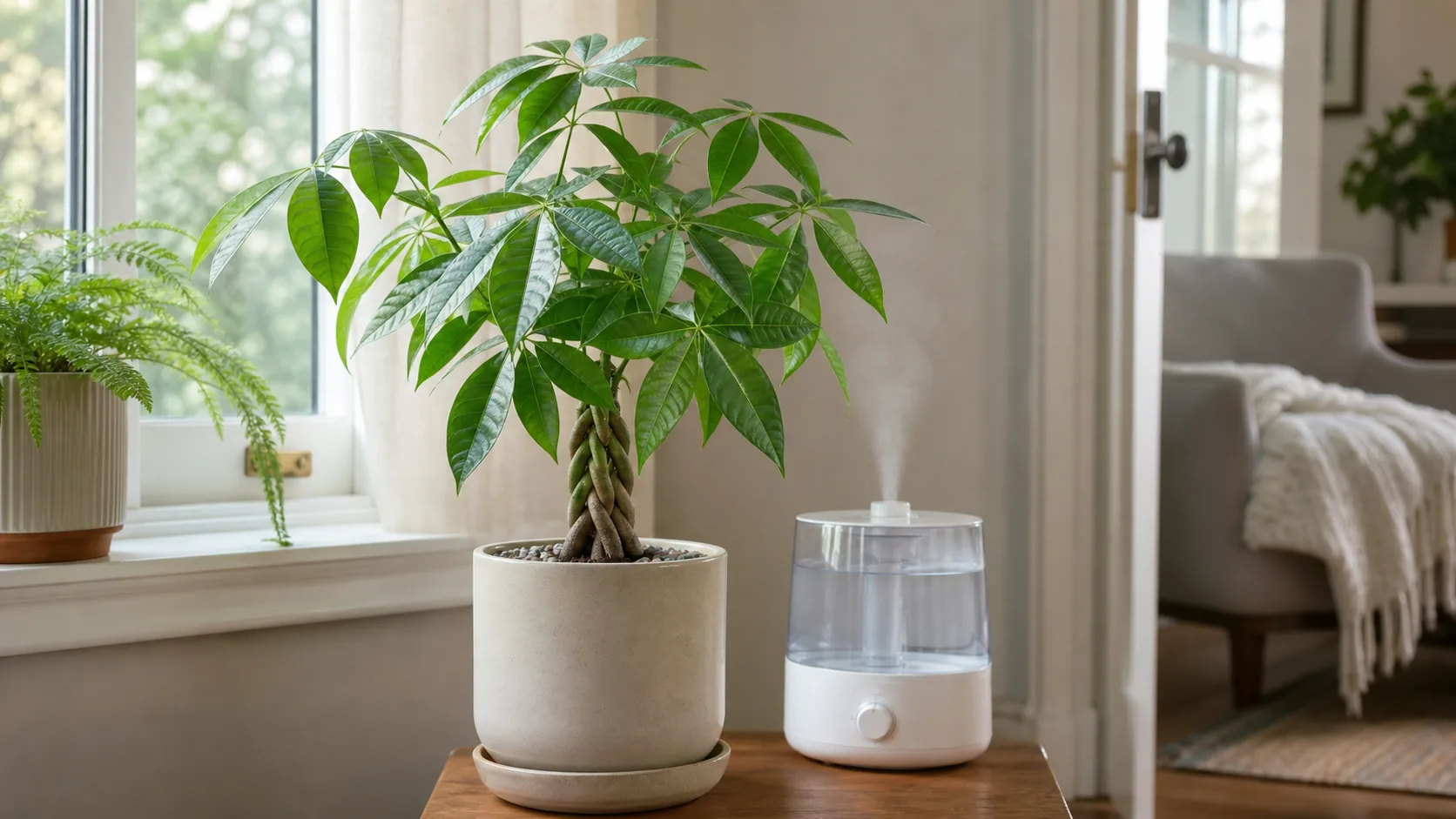
A nearby humidifier supports steady ambient humidity while keeping the money tree away from direct vents and drafts.
Soil and Potting
A well-draining potting mix is non-negotiable. NC State Extension specifies that houseplants should use a moist but well-drained potting mix, because standing water around roots causes rot. A standard houseplant mix works as a base, but adding perlite at roughly one part perlite to three parts mix improves drainage significantly. Avoid heavy outdoor mixes or any mix with moisture-retaining crystals.
Money trees generally prefer being slightly root-bound over being planted in an oversized pot. A pot that is too large holds excess moisture around the roots between waterings, which increases rot risk. When roots are circling the bottom or emerging from drainage holes, move up one pot size. For step-by-step guidance on root inspection, pot sizing, and handling, the how to repot plants guide applies directly to money trees.
The Braided Trunk
The braided trunks sold in nurseries are formed when the individual stems are young and flexible. Once the plant is established, the braid is permanent. Some nurseries use twist ties or wire near the top to hold the braid together. Check that these are not cutting into the bark, especially on plants that have been sitting in stock for a long time.
Each trunk in the braid is its own independent stem with its own root system. If one trunk begins to look soft, shriveled, or discolored near the base while the others look fine, that individual stem may be declining on its own – a pattern often triggered when one section of root was more affected by soggy soil than the others.
A quick inspection to run every few months:
- Press each trunk gently at the base. Firm and springy is healthy; soft or giving is a warning.
- Check the color at the soil line. Uniformly brown-green or gray-brown is normal; anything dark, sunken, or patchy warrants unpotting for a closer look.
- Look for wire or twist ties near the top of the braid. Remove any that have been in place for more than a year.
- If one trunk looks substantially weaker than the others, check whether the soil dried evenly across the pot after the last watering. Uneven drying can point to one root section failing while the rest recovers normally.
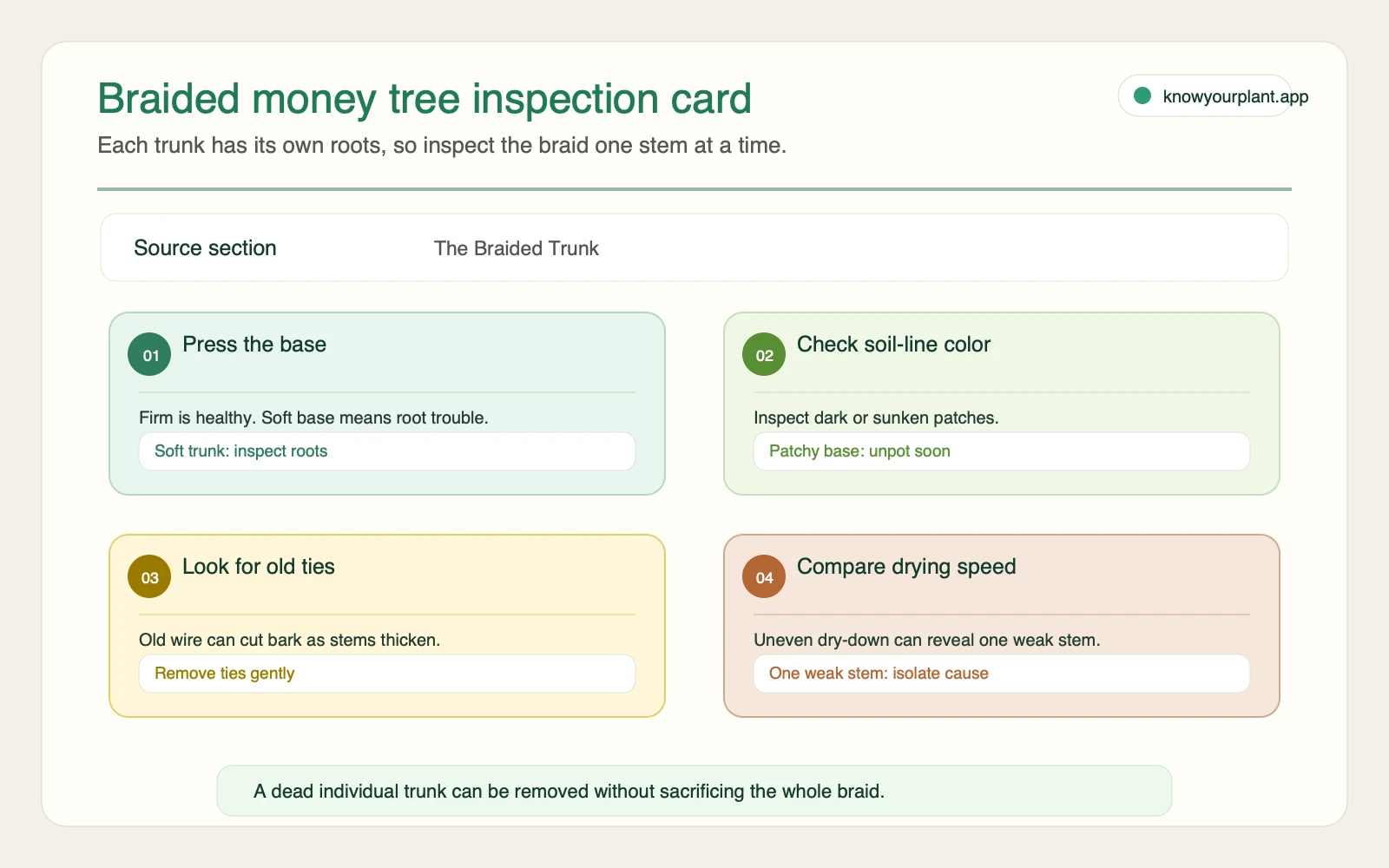
Inspect a braided money tree one stem at a time; one weak trunk can decline while the rest of the braid still looks healthy.
A dead or severely declined individual trunk can be removed at the base without harming the remaining stems. Cut cleanly with sterilized pruning shears as close to the braid base as possible. The braid will look slightly asymmetrical afterward, but the remaining stems continue growing normally.
Fertilizing
Feed monthly during spring and summer with a balanced liquid fertilizer diluted to half the recommended strength. Skip fertilizing entirely from October through February when growth slows. Over-fertilizing forces weak, soft growth and causes salt buildup in the soil, which shows as a white crust on the surface and brown leaf tips. If you suspect buildup, flush the soil thoroughly with plain water once a month to clear accumulated salts.
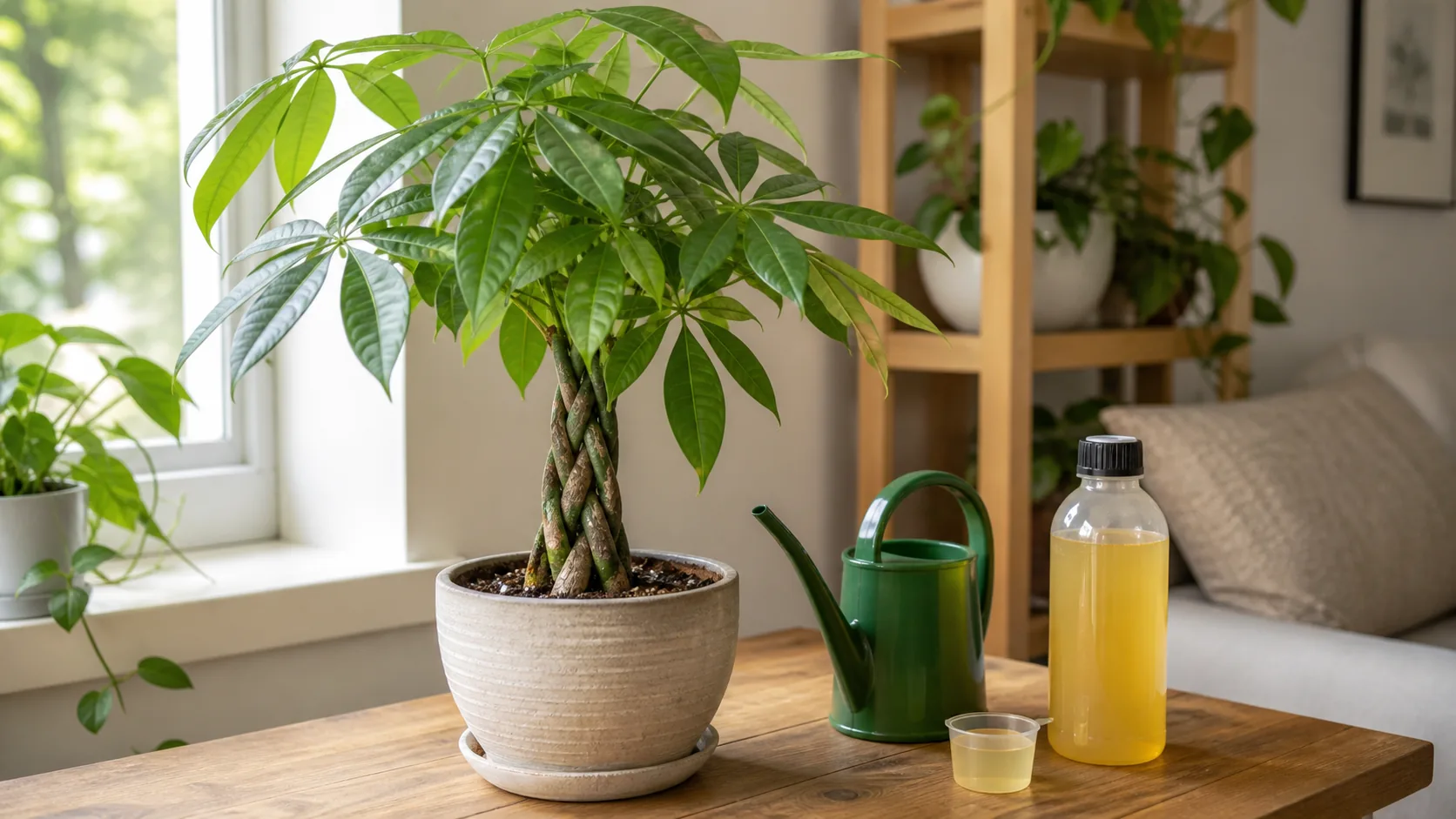
Dilute liquid fertilizer before feeding and apply it only during active spring and summer growth.
Pruning and Propagation
Pruning is mostly maintenance rather than shaping. Money trees grow steadily in good conditions, and the canopy can get top-heavy or uneven over a season. Spring is the best time to cut back, before the main flush of new growth. Remove dead or yellowing leaves cleanly at the stem, cut back any leggy growth that has stretched toward a light source, and trim individual branches to just above a leaf node if you want to encourage bushier growth at that point. Avoid removing more than about a quarter of the canopy at once – the leaves support the root system, and a heavy prune on a plant that is already stressed can stall recovery rather than help it.
Propagation by stem cutting is possible but moderately slow. Take a healthy stem with at least one node and one or two leaves, cut just below the node with clean shears, and let the cut end dry for an hour before placing it in water or moist perlite. Keep it warm and in indirect light, and roots should develop within four to six weeks. One thing to set expectations on: any plant you grow from a cutting will develop as a single-stemmed tree, not a braided form. The braided trunk is created in nursery production while stems are young and pliable – it cannot be replicated at home.
Seasonal Care Calendar
Money trees follow a reliable seasonal rhythm. Adjusting your approach by season prevents most of the common mistakes.
Spring (March–May) Growth picks up noticeably from March onward. Resume monthly fertilizing, start checking soil moisture more frequently than you did in winter, and inspect for pest activity as temperatures rise indoors. If the plant looks root-bound after a slow winter, spring is the best window to repot into a pot one size up. Prune any leggy or damaged growth before the main flush begins.
Summer (June–August) Peak growth. Water every seven to ten days, but check the soil before every decision. High indoor temperatures combined with running air conditioning can stress the plant from two directions at once: heat on one side, cold drafty air on the other. Keep the money tree away from AC vents even when the overall room placement is good. Humidity is often higher in summer, which the plant appreciates.
Autumn (September–November) Taper fertilizing after early September and stop entirely by October. Stretch watering intervals as natural light drops and growth slows. This is also a useful window to check drainage and inspect roots if soil has been staying wet longer than expected. Bring the plant back from windows that get cold overnight.
Winter (December–February) No fertilizing. Water every two to three weeks, always pressing the soil first. Heating systems dry indoor air significantly, so consider adding a pebble tray with water to keep humidity up without effort. Avoid repotting during this period; the plant is not actively growing and does not need the disruption.
Common Problems and the Fastest First Check
| Problem you notice | What usually causes it | First move |
|---|---|---|
| Several leaves yellow at once | Wet soil, poor drainage, cold placement, or a pot that is too large | Check whether water can escape the pot and whether the root zone is still wet days later |
| One trunk in the braid feels soft | Localized root loss or stem decline in that one section | Inspect the base of each trunk separately before treating the whole plant the same way |
| Brown crispy tips | Low humidity, salt buildup, or inconsistent watering | Flush the soil, then review humidity and fertilizer strength |
| Leaf drop after a move | Stress from relocation, airflow, or a sudden light shift | Hold conditions steady for two to three weeks before making another major change |
| Chewed or spotted leaves | Pest pressure or isolated mechanical damage, not always disease | Check undersides of leaves and new growth before spraying or repotting |
Yellow Leaves: A Symptom Table
Yellow leaves are the most common money tree complaint, and they are also the most frequently misread. Rather than defaulting to “I overwatered it,” match the full symptom pattern to a likely cause:
| Symptom | Most likely cause | First check |
|---|---|---|
| Lower leaves yellow, new growth healthy | Natural shedding or low nutrients | Check fertilizing frequency and pot size |
| Multiple leaves yellow, soil feels wet | Drainage problem or true overwatering | Check drainage holes; let soil dry before watering |
| Yellow leaves, soil dry, near vent or door | Cold or heat stress | Move plant away from direct airflow |
| Crispy brown tips, otherwise healthy | Low humidity or salt buildup | Check humidity; flush soil with plain water |
| Soft drooping leaves and yellowing | Root rot starting | Unpot and inspect root zone |
| Spotted or chewed individual leaves | Pest pressure | Inspect undersides of leaves for insects or webbing |
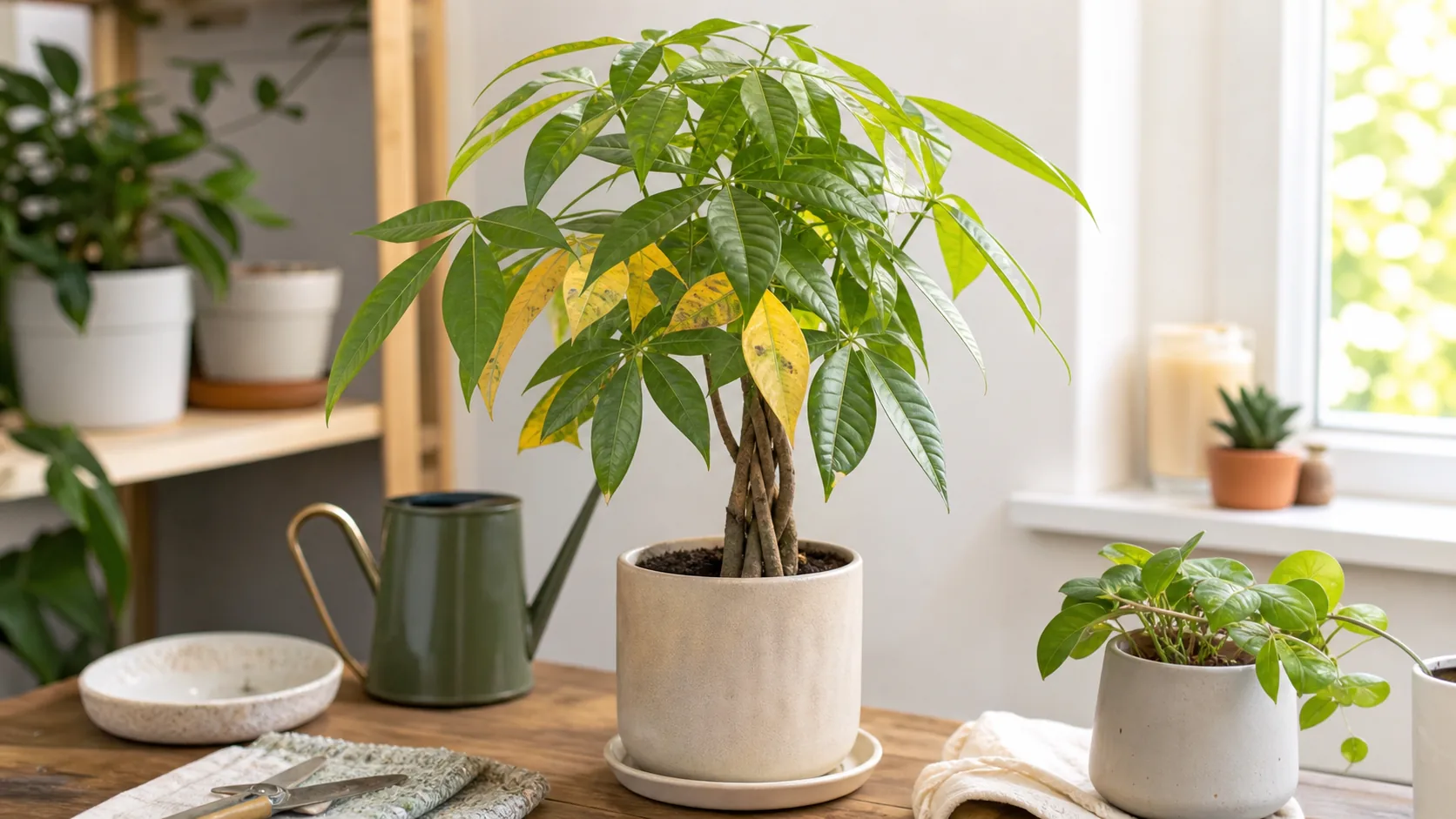
Read yellowing as a pattern: which leaves changed, what the soil feels like, and whether spots or dry edges are present.
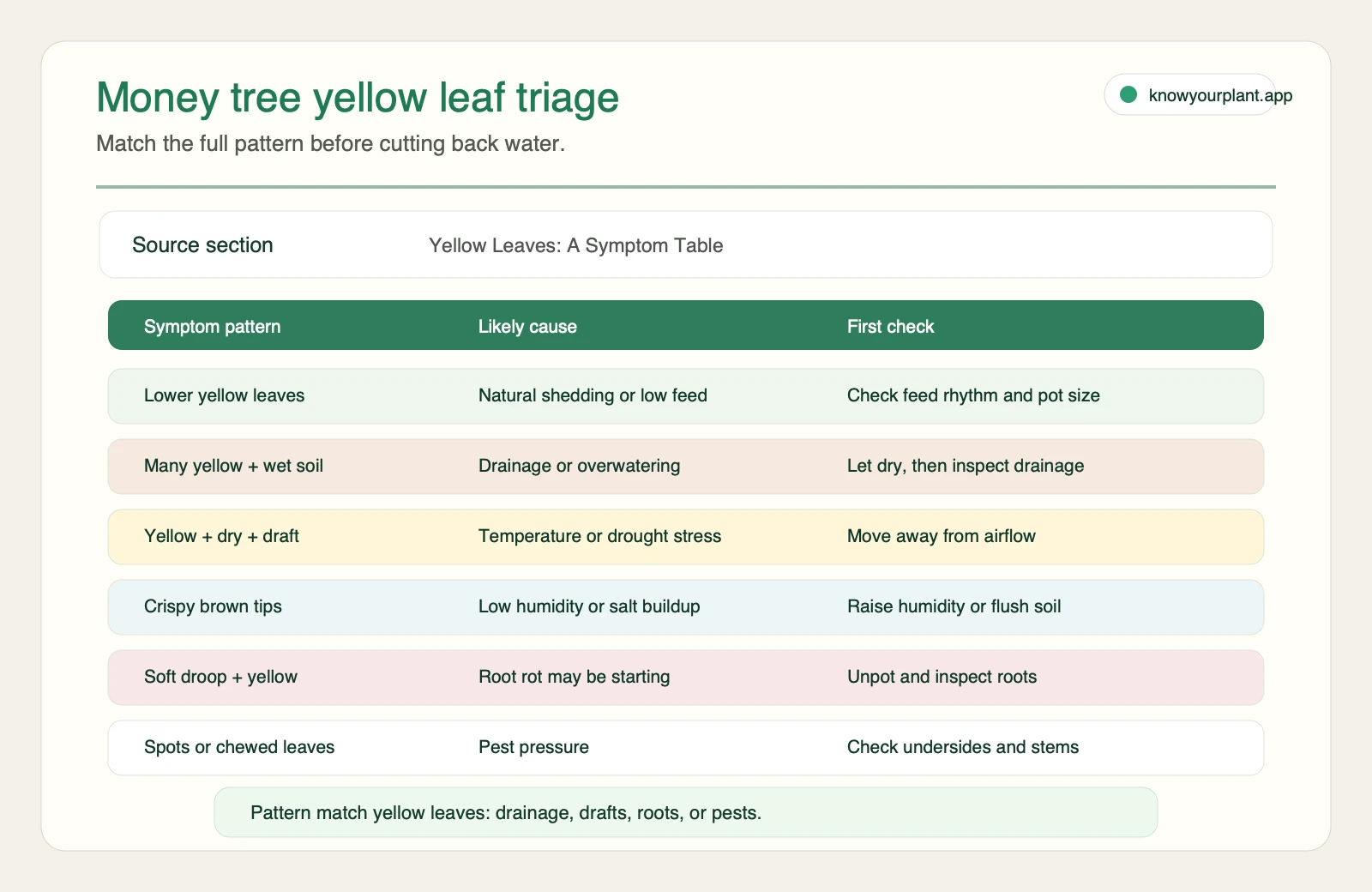
Pattern-match yellow leaves before changing care: drainage, drafts, roots, humidity, and pests can point to different first moves.
Leaf drop with new growth still appearing is usually a stress response to a recent move, temperature change, or watering inconsistency rather than a sign of serious decline. Give the plant two to three weeks to settle before concluding something is structurally wrong.
For a broader framework on diagnosing yellowing across different plant types, why are plant leaves turning yellow covers the full decision path.
Root Rot Recovery
Root rot in a money tree follows a predictable sequence: poor drainage leads to saturated soil, which cuts off oxygen to the roots, which causes roots to die and decay. The damage is often invisible above the soil line until it is advanced.
If the base of any trunk feels soft, if the soil has been wet for more than two weeks without drying, or if leaves droop and do not recover even after watering, unpot the plant and check. Healthy roots are firm and white to light tan. Rotted roots are brown to black, mushy, and may fall apart when touched.
Trim all rotted material back to healthy tissue with clean, sterilized shears. Dust the cuts lightly with powdered cinnamon or activated charcoal. Repot into fresh, well-draining mix in a clean pot with drainage holes. Hold off on heavy watering for the first week post-repot, letting the roots begin recovering in slightly drier conditions before returning to a normal schedule.
For a full recovery walkthrough, the root rot treatment guide covers root inspection, trimming, and preventing recurrence across indoor tropical plants.
Pet Safety
The ASPCA classifies Pachira aquatica as non-toxic to cats, dogs, and horses. If you have been hesitant to bring a money tree home because of a curious pet, it is one of the safer choices available. The important caveat: “money tree” and “money plant” are common names used for several unrelated species. Jade plants, which share those names in some markets, are classified as toxic to pets by the same ASPCA database. Confirm you have Pachira aquatica before assuming the non-toxic classification applies.
For more options organized by toxicity and room, the cat-safe indoor plants guide covers a wide range of houseplants suitable for mixed households.
Is a Money Tree Right for You?
If you have a bright window, a pot with drainage, and a watering habit that leans toward restraint, a money tree is a solid indoor plant. It grows noticeably, stays visually interesting year-round, and communicates clearly when something is off: the leaves will show stress before the roots give up. If you are still learning the basics of soil checks, drainage, and seasonal slowdowns, the indoor plant care guide for beginners gives the broader routine this species builds on.
The challenge is not the care itself. It is the gap between the plant’s native wetland habitat and what a decorative indoor pot actually provides. Close that gap with drainage, appropriate light, and a soil-check habit, and almost everything else follows.
For another practical pet-safety check, see Is Money Tree Toxic to Cats? Chewing, Stomach Upset, and Safety for the risk level and the next steps.
For a related hands-on growing walkthrough, use Money Tree Repotting: Pot Size, Soil, Roots, and Aftercare for the setup and follow-up care.
Methodology
The core care advice in this guide was cross-checked against NC State Extension, Missouri Botanical Garden, University of Georgia Extension, and ASPCA material for Pachira aquatica. Troubleshooting sections were then shaped with live Ask Extension cases about yellowing, drainage, fertilization, container size, pest confusion, and root-rot risk. Search-visible community discussions about dead trunks in braided plants and emergency root-rot rescue were used to surface recurring reader questions, but those examples were treated as qualitative signal rather than proof on their own.
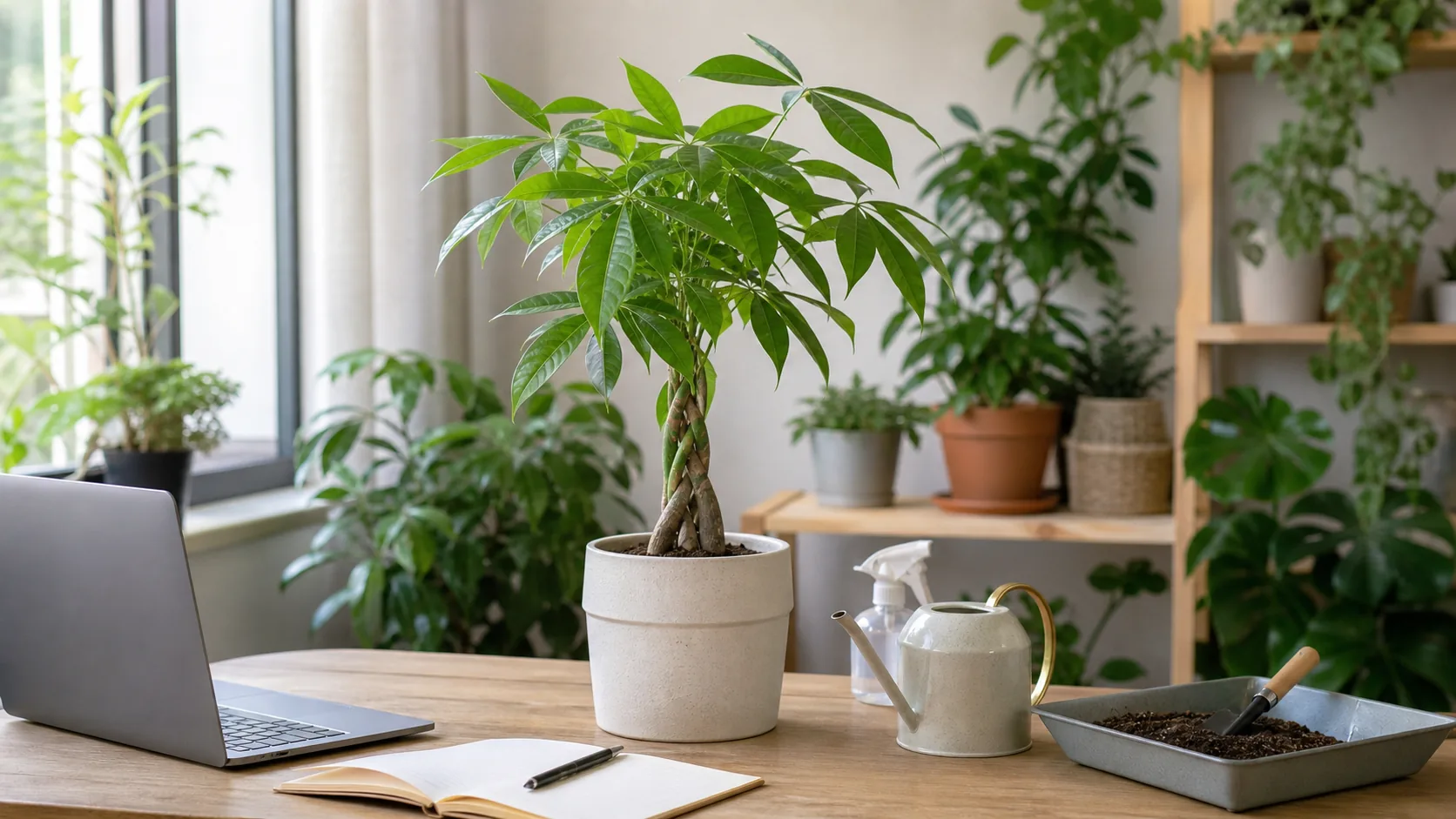
Evidence-based care combines source checking with repeatable observations of the plant, soil, drainage, and tools used.
Real User FAQ
How often should I water a money tree indoors?
Every seven to ten days during spring and summer is a reasonable baseline, but the schedule matters less than the soil check. Press your finger about two centimetres into the soil before every watering decision. Dry at that depth means it is time to water; still damp means wait another day or two. In autumn and winter, stretch the interval to every two weeks or longer as growth slows and light drops. Consistent overwatering is far more damaging than an occasional dry stretch.
Why are my money tree leaves turning yellow?
Yellow leaves are one of the most misread money tree symptoms. Common causes include drainage problems keeping roots wet, cold airflow from a vent or door, a pot too small for the root system, low nutrients, or natural lower-leaf shedding as the plant matures. Overwatering is on that list, but it is not the only possibility. Before cutting back water entirely, verify that the pot drains properly and that the plant is not placed in a cold or drafty spot.
Can a money tree survive in low light?
It can tolerate lower light but will not thrive in it. In dim conditions, growth slows noticeably and the plant becomes more susceptible to overwatering because soil dries much more slowly. If your best placement option is a lower-light space, reduce watering frequency to match and consider supplementing with a grow light positioned at a reasonable distance from the canopy.
Is a money tree safe for cats and dogs?
Yes, the ASPCA lists Pachira aquatica as non-toxic to cats, dogs, and horses. However, this applies specifically to Pachira aquatica. Jade plants share the “money plant” common name in some regions and are toxic to pets. If you are not certain which species you have, photograph the leaf shape and check before assuming the non-toxic classification applies.
What is wrong with the braided trunk on my money tree?
The most common braided trunk problems are nursery ties that have grown into the bark over time, individual stems that have softened due to root rot in one section, and a braid that looks loose as the plant grows because the stems were only temporarily tied near the top. Inspect each trunk at the base individually: firm and uniformly colored means healthy. Soft, sunken, or discolored near the base of one trunk usually means that stem was affected by root damage while the others were not. A dead individual trunk can be removed at the base without harming the remaining ones.
How do I know if my money tree has root rot?
Above-soil warning signs include softness or mushiness near the base of a trunk, leaves that droop and do not recover after watering, and soil with a sour or off smell. To confirm, unpot the plant and inspect the roots directly. Healthy roots are firm and white to light tan. Rotted roots are brown to black, soft, and may fall apart when touched. Catching root rot before it reaches the trunk base gives the plant a realistic recovery path.
How do I prune a money tree?
Prune in spring, before the main flush of new growth. Remove dead or yellowing leaves at the stem, cut back any leggy branches to just above a leaf node, and trim to encourage a fuller shape. Avoid removing more than about a quarter of the canopy at once, especially if the plant is already under stress. Use clean, sterilized shears to avoid introducing infection at the cut site.
Can I propagate a money tree from a cutting?
Yes, though it takes patience. Take a healthy stem cutting with at least one node, let the cut end dry briefly, then place it in water or moist perlite in a warm, indirectly lit spot. Roots typically appear within four to six weeks. The new plant will grow as a single stem rather than a braided trunk – the braided form is produced in nursery conditions while plants are young and pliable, and cannot be replicated at home.
Do money trees need fertilizer?
Yes, during the growing season. A balanced liquid fertilizer at half the recommended concentration, applied once a month from spring through summer, keeps the plant fed without pushing weak growth. Skip fertilizing entirely from October through February. Over-fertilizing shows up as brown leaf tips and a white crust on the soil surface from salt accumulation. Flush the soil with plain water to clear it before resuming a normal feeding schedule.
How do I make my money tree grow faster?
The three factors with the most practical impact are more bright indirect light, consistent watering that avoids both drought and soggy soil, and monthly fertilizing through the growing season. Repotting into a pot one size larger when roots are circling also helps; a root-bound plant in exhausted soil stalls out even when light and water are right. Temperature consistency matters too, because cold spikes slow growth noticeably even when other conditions seem correct.
Download KnowYourPlant for personalized plant care reminders, seasonal watering adjustments, and plant health tracking across every plant in your home.
Sources: NC State Extension Gardener Plant Toolbox, Pachira aquatica; Missouri Botanical Garden Plant Finder, Pachira aquatica; ASPCA Toxic and Non-toxic Plants, Money Tree; University of Georgia Extension, Pet Safe Plants to Grow Indoors; Ask Extension, Pachira leaves yellowing case review.