Something is wrong with your plant and the leaves are telling you, but they’re not speaking plainly. Yellow patches, brown spots, white dust, a stem that suddenly feels soft. You searched “houseplant diseases” hoping for a clear answer and instead found a dozen articles listing every disease in alphabetical order, none of which quite match what’s in front of you.
Here’s a more useful starting point: a houseplant disease is any infectious or environmental condition that damages plant tissue in a repeating pattern – but most indoor plant problems are not infectious at all. They look like disease. They feel like disease. But they’re actually stress responses to watering habits, light levels, or drainage problems that mimic the real thing exactly.
This article helps you figure out which one you’re dealing with before you treat for the wrong thing. If you arrived with a result from a photo app, use the plant disease identifier guide to check its evidence and confidence before acting.
Identification Snapshot
If you only have 30 seconds, sort the problem into one of these buckets before you reach for a spray bottle:
| What you see first | Most likely bucket | Check next |
|---|---|---|
| White or gray fuzz on the leaf surface | Powdery mildew or harmless residue | Wipe one spot clean, then watch whether fuzzy growth returns on new tissue |
| Wilting while the soil is still wet | Root or crown rot | Inspect the roots, then use the root rot treatment guide if they are soft or dark |
| Brown or black spots with a repeated shape | Leaf spot disease or bacterial issue | Compare the pattern in the brown leaf spots and tips guide |
| Yellowing with no obvious lesions | Usually a care problem, not a disease | Start with the yellow leaves decision guide |
| Clean holes, tears, or missing tissue | Natural openings, old damage, disease, or feeding | Use the holes in leaves comparison before treating |
| Silvering, black specks, webbing, or sticky residue | An active pest is more likely | Route through the houseplant pest guide; silvering plus frass points to the thrips guide |
| Several symptoms or an uncertain plant ID | Too broad to name safely from one mark | Use the plant disease identifier workflow, then compare the visible pattern in the leaf damage guide |
This snapshot is meant to slow down the most common mistake: treating the first visible symptom instead of checking the conditions that produced it.
For species-specific patterns, go straight to the pothos yellow leaves decision tree or the spider plant brown tips guide when that is the plant in front of you.
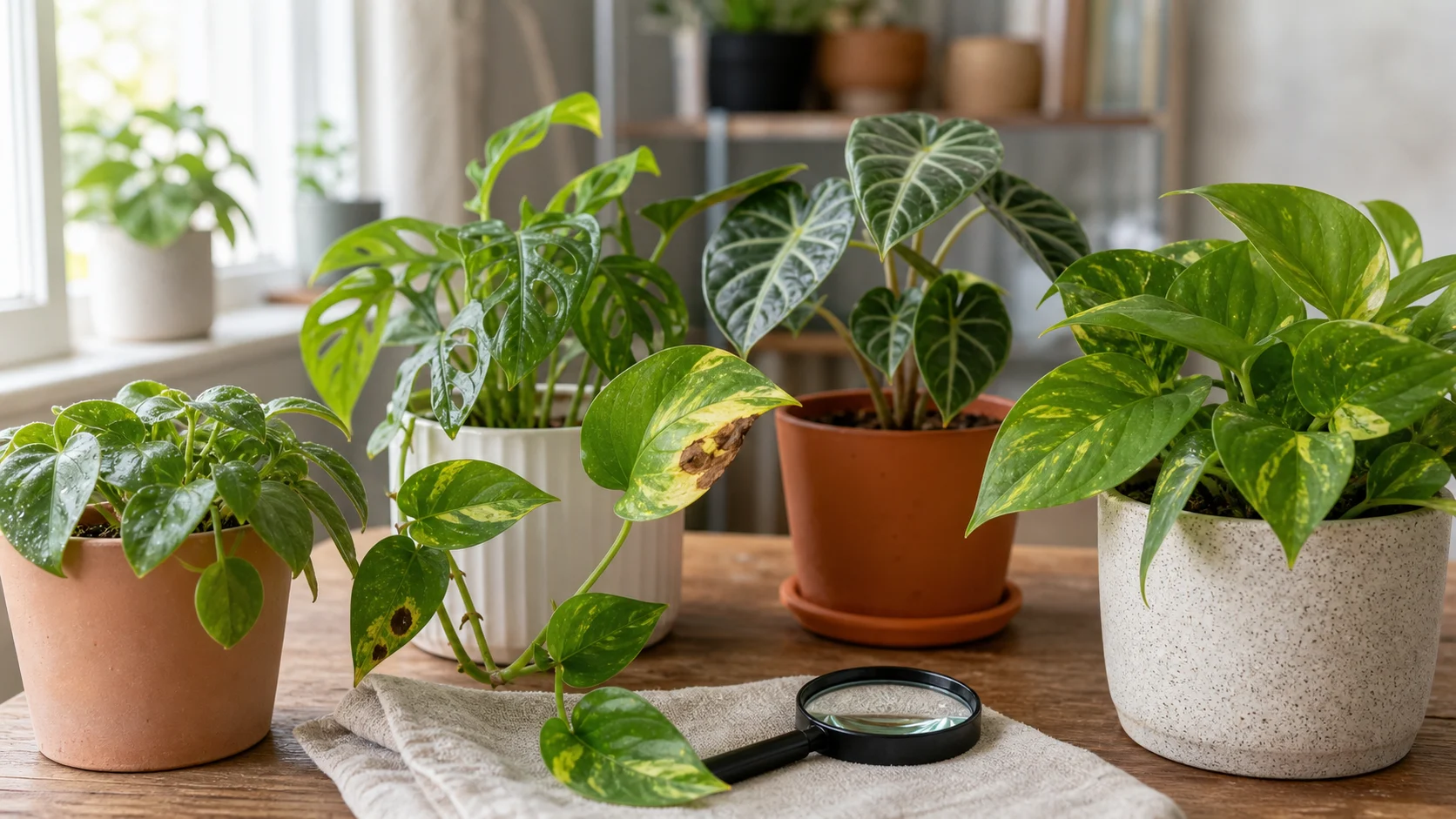
Comparing repeated lesions across nearby houseplants helps separate an isolated blemish from a pattern worth investigating.
What Most Care Guides Miss
The standard approach to houseplant diseases is a catalog: root rot, powdery mildew, leaf spots, gray mold. Each gets its own section. Each section gives the same general treatment advice.
What that approach skips is the part you actually need first: how to tell a real disease from a lookalike before you do anything.
Clemson Home & Garden Information Center notes that the large majority of houseplant problems are environmental or cultural in origin rather than caused by infectious pathogens. This matters because the treatment for a real disease – isolating the plant, removing infected tissue, sometimes applying fungicide – is the opposite of what you’d do for a watering or drainage problem: adjusting moisture, improving soil structure, repotting.
Iowa State University Extension makes the same point from a different angle: common disease problems like gray mold, leaf spots, crown rot, and powdery mildew rarely appear in healthy plants grown under good conditions. They tend to follow cultural stress: crowded leaves, waterlogged soil, poor airflow, low light. The disease often isn’t the root problem; the conditions that allowed it to take hold are.
The misdiagnosis that causes the most damage is treating root-rot wilt as underwatering. The plant looks thirsty. You water more. The roots, already struggling in soggy soil, deteriorate further. A week later the plant is past recovery, and it never needed more water. It needed the water to stop.
The first check: Before anything else, look at the soil and feel the stem at the base. Wet soil plus a wilting plant points toward a root problem. Dry soil plus a wilting plant is a watering problem. That one check changes everything you do next.
Social Listening: Where Owners Get Stuck
The same confusion points show up again and again in public grower questions. One pattern is the wilted plant in already-wet soil: people assume thirst, water again, and only later discover mushy roots. Another is brown spotting that does not match the simple dry-soil or sunburn examples they already know, which leads to fungal panic before the plant has even been checked for drafts, residue, or pest damage.
Community threads also show how often white marks trigger powdery-mildew fear when the real answer is residue or natural patterning. Those examples are useful because they reflect the exact moment readers get stuck. They are qualitative signals, not lab diagnoses, but they help explain why this guide starts with symptom clusters and lookalikes instead of jumping straight to treatment.
Expert note: Clemson and Iowa State both emphasize that most indoor houseplant problems begin with environmental or cultural stress. That is why the fastest diagnosis win is to check conditions first, then decide whether a true disease pattern is still left once the obvious lookalikes are ruled out.
The Framework That Changes Everything: Conditions First, Pathogens Second
Most online searches for “houseplant diseases” return a pathogen list. But in practice, pathogens rarely show up in healthy, well-grown indoor plants. University of Maryland Extension confirms that root and crown rots can cause yellowing, browning, and wilting even when potting mix feels adequately moist – which is why the symptom alone cannot tell you what’s wrong.
The more useful framework is to ask: did the conditions create an opportunity?
- Was the plant overwatered for weeks before the roots started to fail?
- Has humidity been high and airflow low since before the white powder appeared?
- Did a new plant join the collection shortly before others started showing similar symptoms?
If the conditions explain the symptom, start there. Fix the environment first. A disease diagnosis changes the action only when the symptoms keep progressing after you’ve addressed the cultural cause – or when the pattern looks clearly infectious from the start: returning fuzz on new growth, spots with a specific bordered lesion pattern, or rapid spread across multiple plants.
Four Symptom Clusters That Tell Different Stories
Rather than going disease by disease, start with what you can actually see.
Fuzzy White or Gray Growth on Leaves
White fuzz or dusty powder on leaf surfaces is the classic picture of powdery mildew: a fungal disease that spreads in humid, low-airflow conditions. Unusual among fungal diseases, it doesn’t need wet leaves to establish. It often appears on dry surfaces in poorly ventilated rooms.
Not every white mark is powdery mildew, though. Hard-water residue from tap water leaves white or tan spots that look nearly identical at first glance. Natural leaf patterning on certain pothos varieties and prayer plants also catches first-time owners off guard.
The difference: true powdery mildew has a fuzzy, slightly raised texture that spreads to new growth over days. Mineral residue stays flat, doesn’t spread, and wipes cleanly off with a damp cloth.
If you’re unsure, wipe the spot with a damp cloth. Residue comes off completely. Powdery mildew doesn’t, and if the fuzzy patches return on new leaves within a week, you’re dealing with the real thing. At the first small spot, removing the affected leaf and improving airflow is often enough before it reaches other plants.
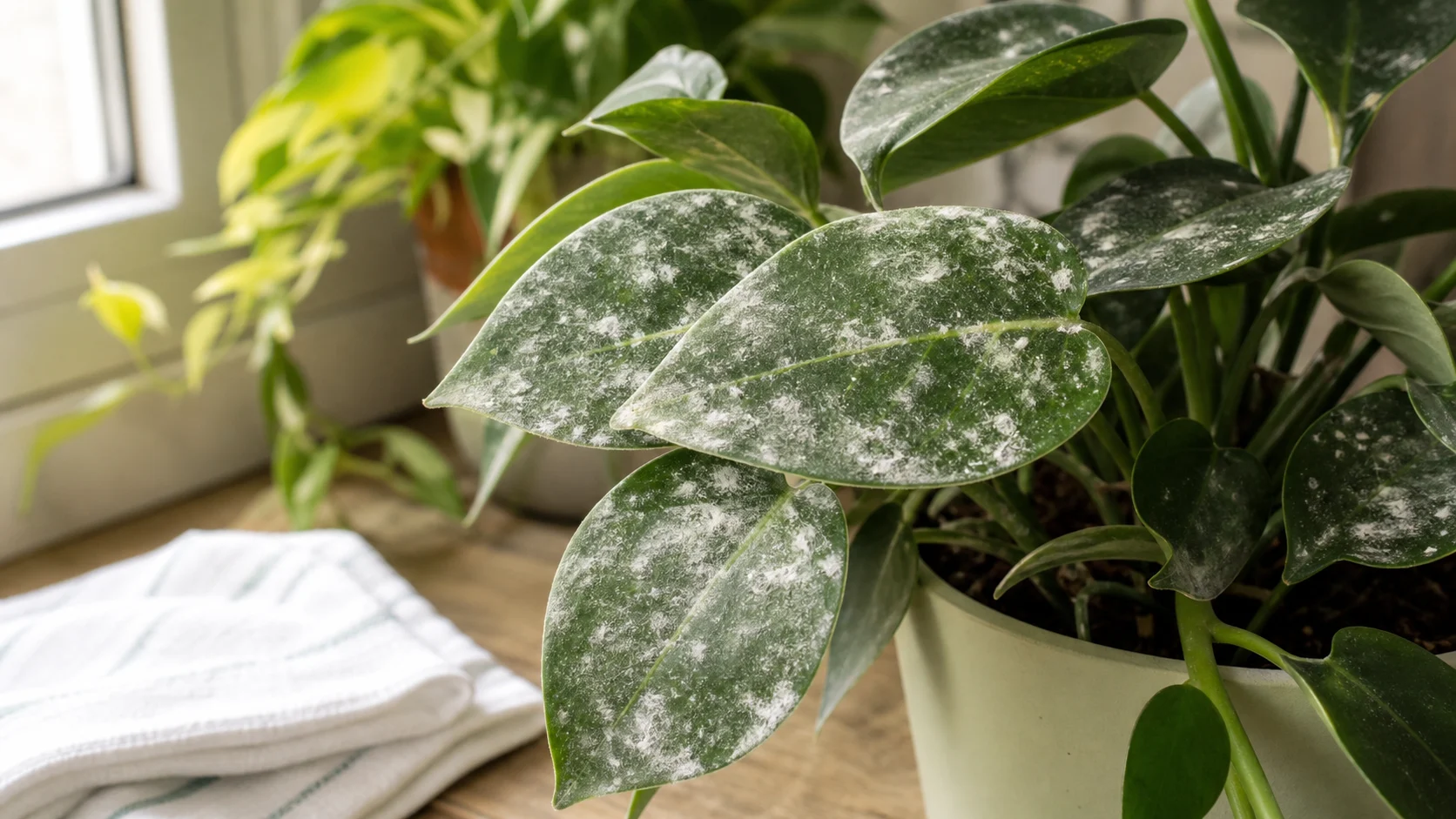
Patchy, raised white growth on several leaves is a stronger mildew clue than flat mineral residue that wipes away cleanly.
Discrete Brown or Dark Spots on Leaves
Spots are the hardest symptom to read because so many things cause them. Fungal leaf spot diseases typically show brown or tan lesions with a darker border and sometimes a yellow halo. Bacterial leaf spots tend to look water-soaked at first, then turn brown or black with irregular, angular edges.
But sun scorch creates brown patches too – usually on the side of the leaf facing the window, with a bleached center. Physical damage from cold drafts, pesticide contact, or leaves pressed against cold glass creates marks that look almost identical to fungal spots.
The pattern matters more than the color. Disease spots usually appear across multiple leaves at different ages in a scattered distribution. Scorch and physical damage affect one area or one side consistently.
For a closer look at how spot shapes and colors map to specific causes, why plant leaves turn brown covers the most common patterns in more detail.
Wilting with Wet Soil and Soft Roots
Wilting that doesn’t resolve after watering is the clearest signal that something is wrong at the root level. Root rot – most often caused by Pythium, Phytophthora, or Fusarium fungi – turns roots brown, soft, and sometimes faintly sour-smelling.
The trap: the roots are too damaged to move water into the plant, so the plant looks like it needs a drink even while sitting in wet soil.
To check: slide the plant gently out of its pot. Healthy roots are white or light tan and feel firm. Rotten roots are brown or black, mushy between your fingers, and may fall apart when touched. If more than a third of the root mass looks damaged, act now: trim rotten roots with clean scissors, let the cuts air-dry briefly, and repot into fresh dry mix in a pot with drainage holes.
For a full step-by-step, see the root rot treatment guide.
General Yellowing with No Clear Lesions
Yellowing that spreads gradually, especially on older lower leaves, is rarely disease. It’s almost always overwatering, low light, or nitrogen depletion in potting mix that hasn’t been refreshed in years. True infectious disease tends to cause yellowing in a random, scattered pattern. Yellowing neatly from the bottom up almost always points somewhere else.
If yellowing is progressing upward from the oldest growth, check watering habits and when the plant was last repotted or fed before assuming disease. Why plant leaves turn yellow walks through the most common causes ranked by likelihood, which helps you narrow it down without trying random fixes.
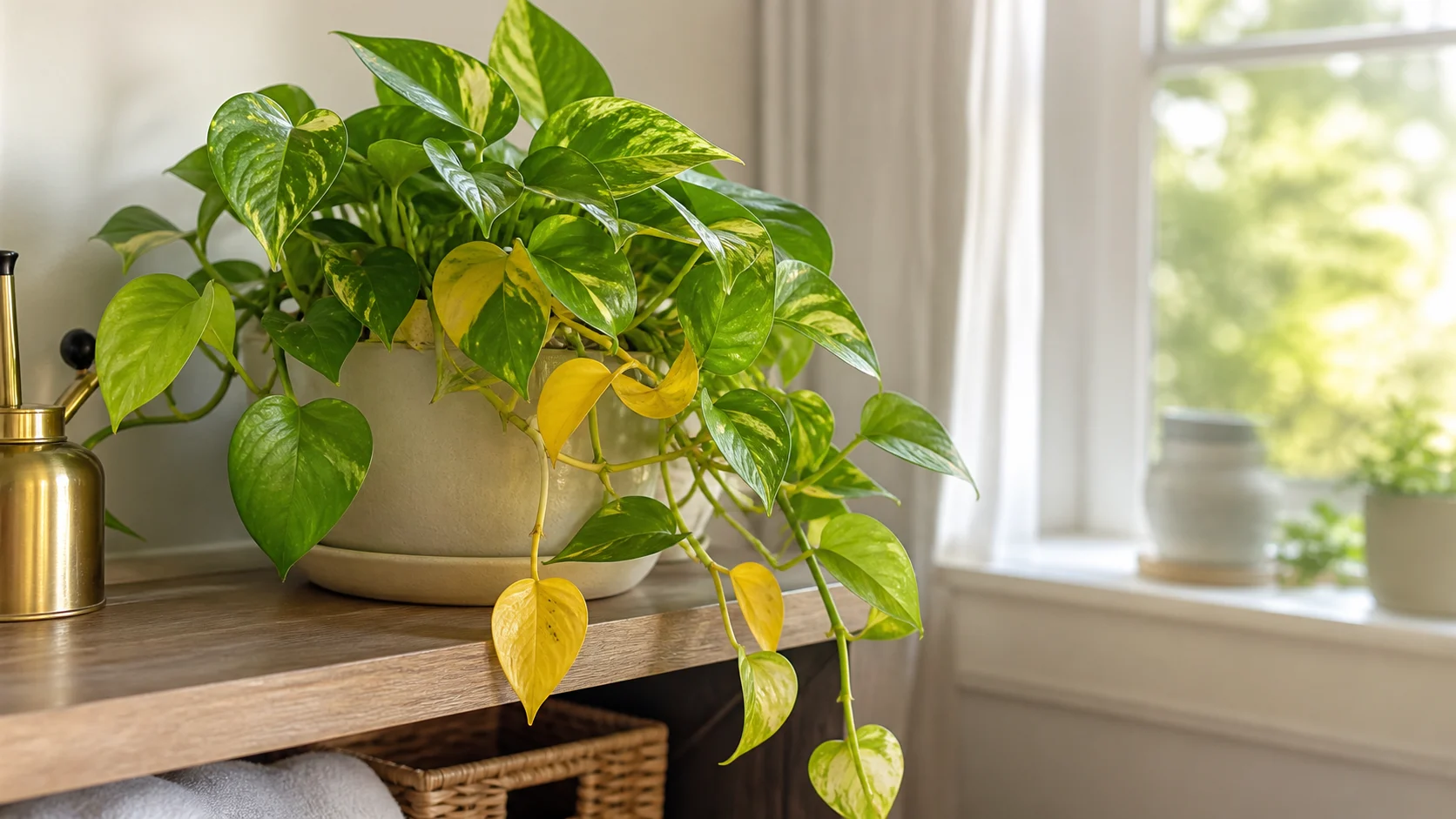
Yellowing that begins on older, lower pothos leaves without distinct spots usually points to care conditions before infection.
Disease vs. Lookalike: Quick Reference
| Symptom | More Likely Disease | More Likely Lookalike |
|---|---|---|
| White powder on leaves | Powdery mildew (fuzzy, spreads to new growth) | Mineral residue (flat, doesn’t spread, wipes off) |
| Brown spots with yellow halo | Fungal leaf spot | Sun scorch (affects sun-facing side only) |
| Water-soaked then dark spots | Bacterial infection | Cold draft or window contact damage |
| Wilting in wet soil | Root rot | Compacted, airless soil restricting water uptake |
| Wilting in dry soil | Unlikely | Underwatering |
| Yellowing from the bottom up | Unlikely | Overwatering, low light, or nutrient depletion |
| Random yellow patches across leaves | Mosaic virus (rare) | Inconsistent light or irregular watering |
| Fuzzy gray coating on stems or flowers | Gray mold (Botrytis) | Dust or residue in low-light corners |
Care Cards: First Move by Symptom
Wet Soil + Wilt
- Isolate the plant from the rest of your collection.
- Check roots before watering again.
- Repot only after trimming obviously mushy roots and switching to a pot with drainage.
White Fuzz or Dusty Patches
- Wipe one test area first.
- If the patch is fuzzy and returns, remove the affected leaf and improve airflow.
- Avoid crowding plants together while you watch for spread.
Repeating Brown or Black Spots
- Compare whether the spots are scattered across leaves of different ages or only on the window-facing side.
- Remove the worst-damaged tissue with clean scissors if the pattern looks infectious.
- Keep leaves dry until you know whether you are dealing with bacteria, fungus, or simple contact damage.
Slow Yellowing with No Lesion Pattern
- Pause all treatments.
- Recheck light, watering frequency, drainage, and how old the potting mix is.
- Treat this as a culture problem first unless a clearer disease signal appears.
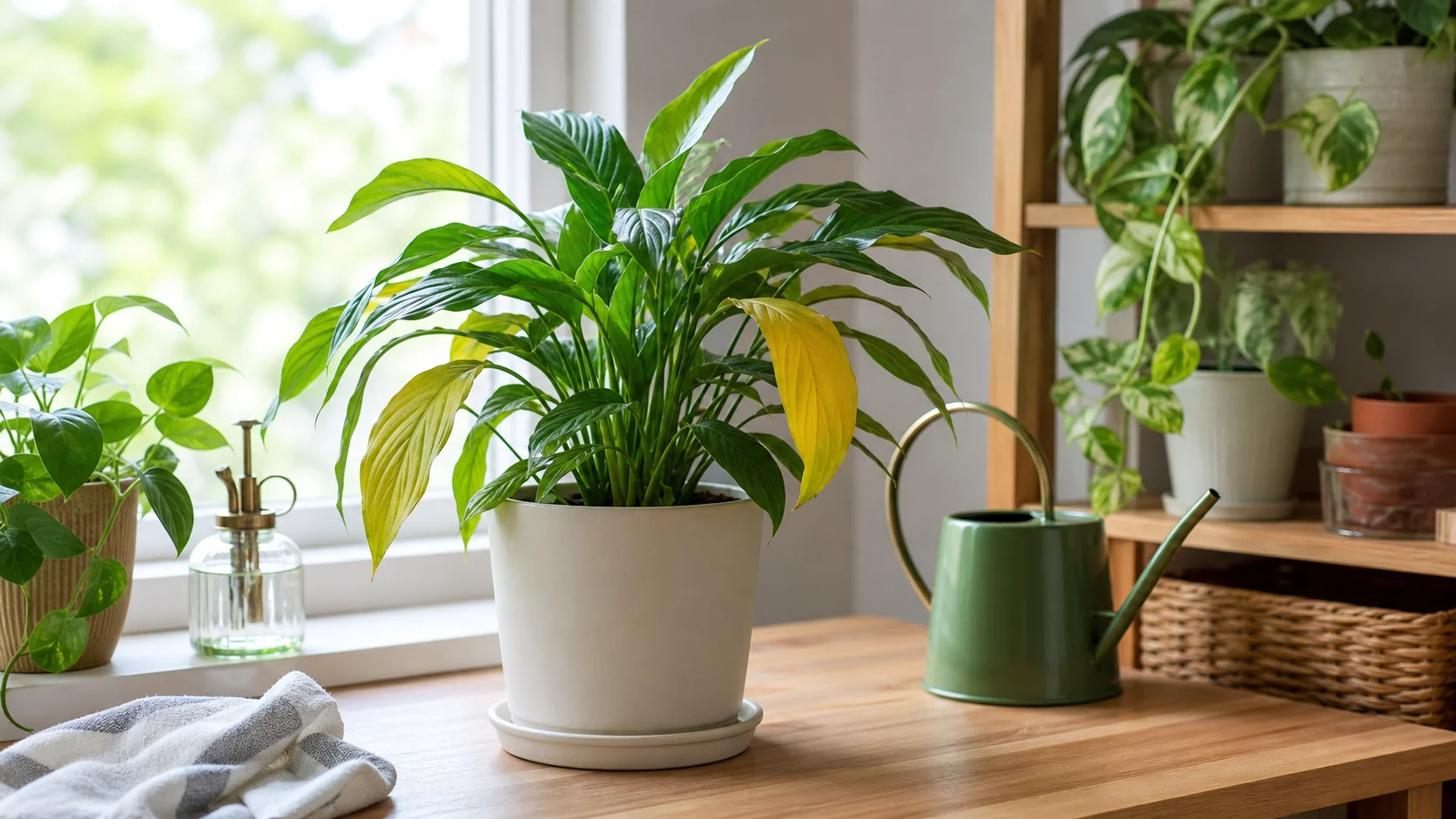
A few gradually yellowing peace-lily leaves call for checking light, drainage, and watering rhythm before reaching for treatment.
Common Problems That Escalate Fast
| Common problem | What it usually looks like | Why it gets misread | First response |
|---|---|---|---|
| Root rot | Wilt plus wet soil, soft stem base, brown mushy roots | Looks like underwatering because the leaves still droop | Stop watering, inspect roots, repot into airy mix if needed |
| Fungal leaf spot | Tan or brown lesions with darker borders, sometimes yellow halos | Often confused with sun scorch or splash damage | Isolate, prune the worst leaves, keep foliage dry |
| Bacterial spotting or soft rot | Water-soaked dark patches, fast collapse, soft tissue | Can look like cold damage at first | Isolate immediately and remove collapsing tissue with cleaned tools |
| Powdery mildew or gray mold | Fuzzy white or gray growth that returns | Often mistaken for dust or mineral residue | Remove affected tissue and improve airflow before escalating |
Non-Disease Lookalikes to Rule Out First
Before treating for any disease, check these:
Overwatering stress: yellowing, softness at the base, soggy soil. The plant looks sick but there’s no infection. It has too much water sitting around its roots.
Mineral residue: white or tan deposits on leaf surfaces from tap water. Harmless and easy to remove with a damp cloth. It will not spread to new leaves.
Sun scorch: bleached or crispy patches near a window, on the light-facing side of leaves, not scattered across both sides at random.
Pest damage: spider mites cause stippling, tiny pale dots across leaf surfaces. Thrips leave silvery streaks. Scale insects appear as bumps along stems. Always check leaf undersides before calling it a disease. How to get rid of spider mites and tiny bugs in houseplant soil cover the most common pest misidentifications.
Cold damage: dark, water-soaked patches after a cold night or a draft from an open window. The plant was fine before that exposure; it was shocked, not infected.
Ruling these out first saves you from treating for a disease that isn’t there, and from applying fungicide or pesticide when better watering or repositioning is all that’s needed.
When It’s Likely Real Disease
Some signs point more clearly toward an actual pathogen:
- New, previously healthy growth shows infection within days of isolating the plant
- Spots or lesions have the same distinct shape and border pattern across multiple leaves at different ages
- A powdery or fuzzy coating returns on new growth after you’ve removed it
- The stem at soil level is soft and brown, roots are mushy, and the soil hasn’t been overwatered
- Nearby plants begin showing similar symptoms after being near the affected plant
At that point, isolating the plant from your collection is the most important first step before any treatment. Fungal spores and some bacterial pathogens spread through water splash, airborne contact, and shared tools.
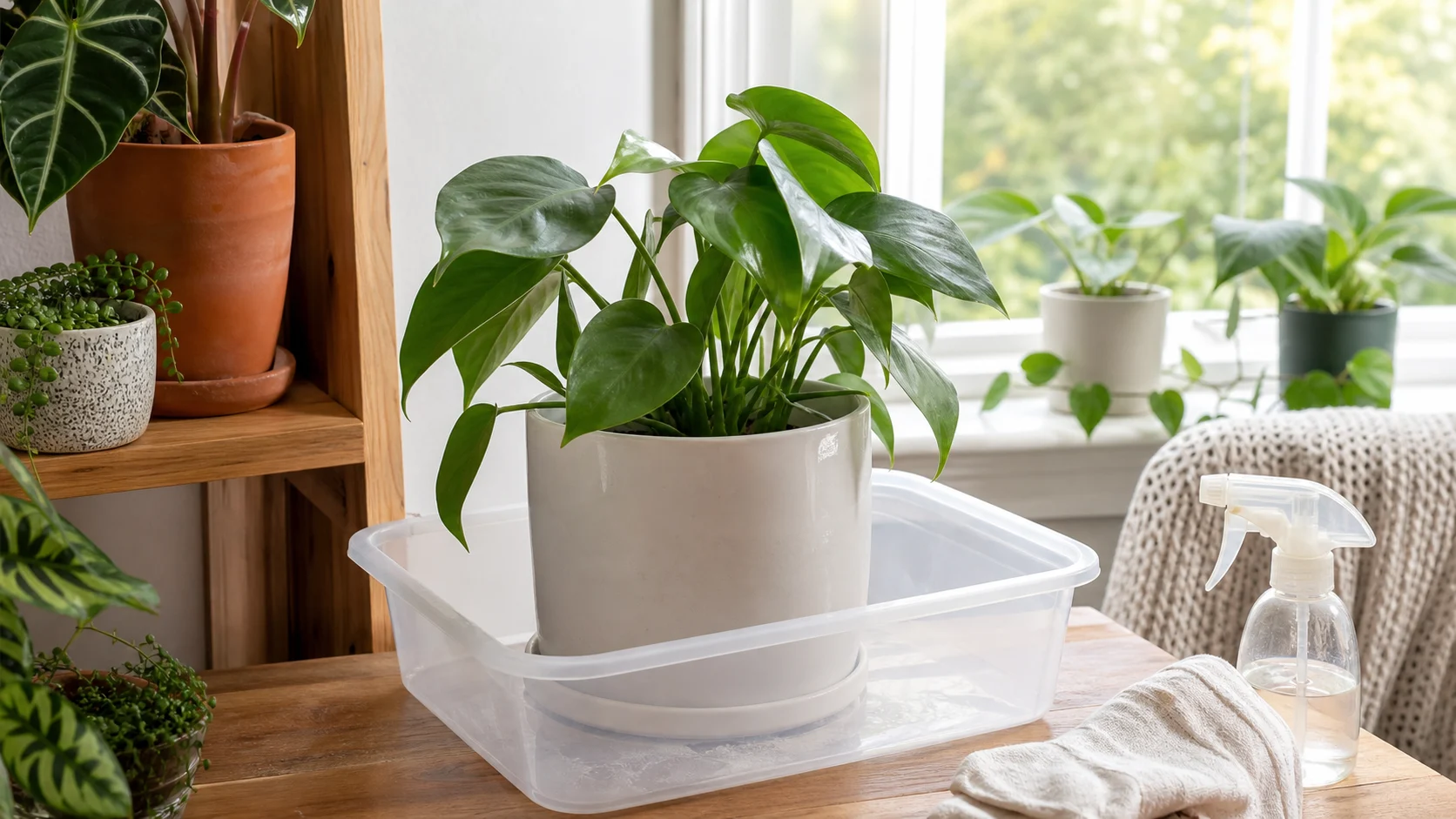
Once an infectious pattern is plausible, isolate the plant and keep its care tools separate before choosing a treatment.
A Seasonal Note on When Disease Pressure Rises
Indoor disease problems aren’t evenly distributed through the year. Two windows matter most:
Winter heating season: Central heating drops indoor humidity sharply, which stresses plants and makes them more vulnerable to pathogens. At the same time, reduced light slows growth, so minor overwatering that would have been fine in summer becomes root rot risk by January. This is when root rot cases and gray mold peak for most indoor gardeners.
Late summer into fall: Higher outdoor humidity bleeds indoors, especially in apartments without strong air conditioning. This is prime season for powdery mildew and fungal leaf spots: the humidity is up, but plants near windows may still be getting inconsistent water. Check for early mildew signs in August and September before the spores get a chance to spread.
Adjusting your watering conservatively in winter and improving airflow in late summer addresses the conditions that make disease possible, not just the symptoms after it appears.
Where to Start Right Now
If you’re looking at a plant right now and something looks wrong:
- Check soil moisture: dry or wet? This splits the possible causes immediately.
- Feel the base of the stem: firm or soft? Soft plus wet soil points toward root rot.
- Look at the pattern of damage: random spots across leaves of all ages, or consistent browning on one side, or yellowing from the bottom up?
- Check the undersides of leaves for small insects, webbing, or sticky residue before assuming disease.
- Note whether nearby plants are affected: if the problem is isolated to one plant, it’s more likely cultural; if it’s spreading to neighbors, isolate first.
For deeper investigation: yellow leaves causes, brown leaf spots and tips, root rot treatment, or soil pest identification – each deserves its own investigation once you’ve identified the category you’re working with.
Pet Safety Note
Disease symptoms do not cancel out the plant’s normal toxicity profile. If you do not know whether the plant species itself is pet safe, treat it as uncertain until you identify it. Keep cats and dogs away from dropped leaves, soft rotting tissue, and any treated foliage while you clean up the plant, especially if you end up using sprays or alcohol wipes as part of the response.
Real User FAQ
How do I know if my houseplant has a disease or just a care problem?
Start with the soil and the stem. Wet soil plus wilting is a root issue, not a watering shortfall. Dry soil plus wilting means water it and watch. True diseases produce distinct lesions: spots with a specific border color, fuzzy coatings that return after you remove them, or rapid spread to new growth. Care problems follow predictable progressions: yellowing from the bottom up, one-sided browning near a window, or a gradual pale-out across the whole plant in low light.
Can I save a houseplant with root rot?
Yes, if you catch it early. Slide the plant out of its pot and trim away any roots that are brown, black, or mushy. Let the trimmed ends air-dry for 30 minutes, then repot into fresh dry potting mix in a clean container with drainage holes. Avoid watering for several days afterward to let the remaining roots recover. If more than two-thirds of the roots are gone, the odds are lower but it’s still worth trying. The root rot treatment guide covers recovery at different stages of severity.
Is powdery mildew dangerous to my other plants?
It can spread, especially in warm rooms with poor airflow. Isolate any plant showing powdery mildew immediately. Remove affected leaves with clean scissors and dispose of them – not in compost. Improving ventilation around your plants is the most effective long-term fix; even a small fan running on low helps. At early stages, removing infected tissue and improving airflow is usually sufficient without any spray treatment.
My plant has brown spots – how do I tell if it’s fungal, bacterial, or sun scorch?
Fungal spots tend to have a well-defined border, often with a darker ring around the edge and sometimes a yellow halo. Bacterial spots start as water-soaked patches that turn brown or black with irregular, angular edges and no clean margin. Sun scorch creates bleached or crispy patches specifically on the leaf surfaces facing the light source: they’re not scattered, they’re always on the same side. If spots appear randomly across leaves at different ages with distinct borders, suspect fungal. If they’re all on one side, suspect environmental.
Why are my plant’s leaves turning yellow if it’s not diseased?
The most common causes are overwatering, low light, and soil depleted of nitrogen after years without repotting or feeding. Yellowing that starts on older, lower leaves and moves upward is almost always a care issue: the plant is shedding its oldest growth because it doesn’t have enough light or nutrients to maintain it all. Sudden yellowing across the whole plant at once is more likely a shock response to being moved or to a sharp temperature change. For a full breakdown ranked by likelihood, why plant leaves turn yellow covers the range.
When should I discard a plant rather than try to save it?
If the entire stem is soft and brown at the base and the roots are completely rotted, recovery is very unlikely. If new growth is coming in deformed, stunted, or with mosaic-style discoloration, suspect a viral infection – there’s no cure for plant viruses, and the plant should be discarded to protect your collection. For fungal and bacterial issues, most plants can recover if you isolate early, remove infected tissue, and improve the underlying conditions. Give the plant two to three weeks after treatment before deciding: a plant that stops getting worse is usually stabilizing, even if it still looks rough.
Can I spread disease between plants on my tools or hands?
Yes. Fungal spores and bacteria travel easily on pruning scissors, stakes, and hands. Clean tools with 70% isopropyl alcohol between uses whenever you’re working around a plant that may be infected. This habit matters most for fungal diseases like powdery mildew, but pest infestations spread the same way, so it’s worth building as a general practice regardless of the specific problem.
Methodology and Freshness
This guide was refreshed on 2026-06-19 using a symptom-first research pack that checked current keyword and close-variant SERPs, reviewed qualitative owner-confusion threads on Gardening Stack Exchange, and verified factual claims against university extension and Ask Extension sources. Community examples were used only as qualitative signal about where growers get confused, not as statistical proof or lab-confirmed diagnoses.
Freshness note: extension references and qualitative confusion examples in this article were rechecked against the pack dated 2026-05-18.
Symptom-first guidance is refreshed by comparing current source material and owner-confusion patterns before updating care advice.
Sources
- Clemson Home & Garden Information Center. Houseplant Diseases & Disorders. Accessed 2026-05-18.
- Iowa State University Extension. Diagnosing Houseplant Problems from Diseases. Accessed 2026-05-18.
- University of Maryland Extension. Root Rots of Indoor Plants. Accessed 2026-05-18.