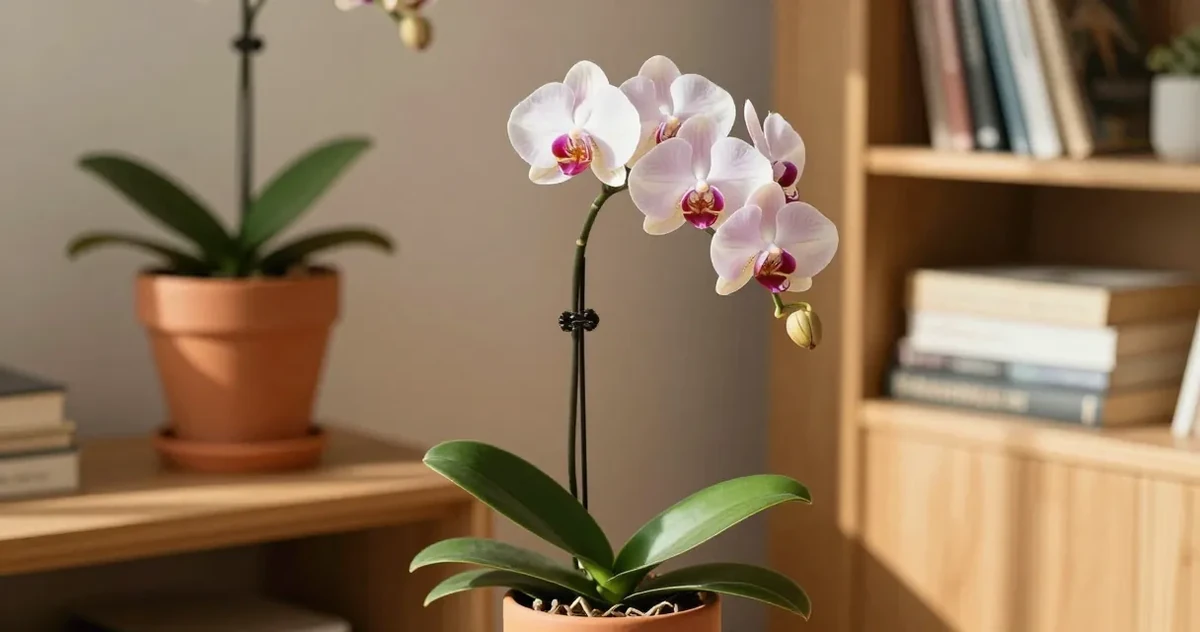
What to Do After Your Orchid Flowers Fall Off
One day your orchid is covered in blooms. A few weeks later the last flower drops, and you are standing in front of a bare green stick wondering whether you killed it or whether it is going to be fine. The honest answer: it is almost certainly fine. But what you do in the next few months is what separates orchids that rebloom reliably from orchids that sit on a windowsill for years – looking completely healthy, never flowering again.
The post-bloom period is not one situation with one answer. It is a branching decision, and taking the wrong branch can cost you months. This guide walks you through the decision clearly: what to do with the spike, how to support recovery without pushing it, and how to set up the one condition most growers miss that determines whether the plant reblooms at all.
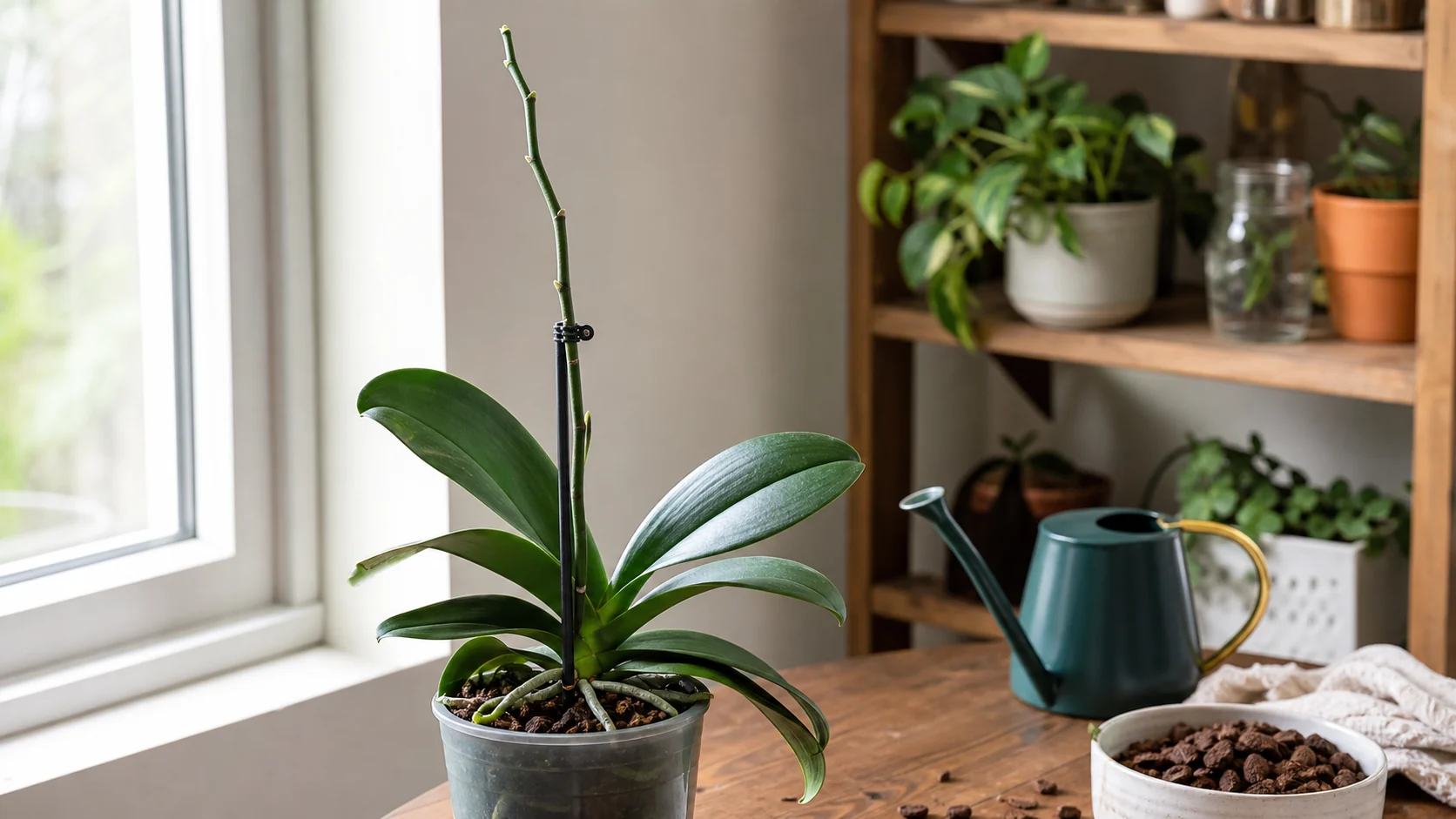
A bare green spike can be normal after blooming when Phalaenopsis leaves and roots remain healthy.
Note if you have a non-Phalaenopsis orchid: Most of this guide is written for Phalaenopsis – the moth orchid most people bring home from grocery stores and garden centers. If you have a Dendrobium, Oncidium, or Cattleya, the post-bloom logic differs enough that following this guide directly could cause problems. Jump to A Note on Other Orchid Types first to confirm this applies to your plant.
Where Are You Right Now?
Find your situation and jump straight to the right section.
| Your situation | Go here |
|---|---|
| Spike is still green | The Spike Decision |
| Spike has turned yellow or brown | Cut to the base (2 cm above the lowest leaf), then The Next 30, 60, and 90 Days |
| Orchid looks healthy but hasn’t rebloomed in months or years | The Temperature Trigger |
| Roots escaping the pot or bark looks soggy | Repotting Signs to Watch For |
Identification Snapshot: Is This the Right Orchid Guide?
Use this guide if your orchid mostly matches this profile:
- Most likely plant: Phalaenopsis, also called the moth orchid
- Leaf shape: broad, fleshy strap leaves growing from a central crown
- Root clue: thick silver-green aerial roots that turn greener after watering
- Post-bloom clue: one tall flower spike, sometimes with branching nodes after flowering
- Less likely match: canes, pseudobulbs, or sprays of many smaller flowers, which usually point to a different orchid group and different after-bloom care
If that does not sound like your plant, read the type-comparison table below before trimming anything.
Lookalikes and Confused-With Cases
| Orchid type | Quick visual clue | What changes after flowering |
|---|---|---|
| Phalaenopsis | Broad leaves, thick exposed roots, one arching spike | A green spike may branch again from a node, but a brown spike gets cut to the base |
| Dendrobium | Cane-like stems, often many leaves along the cane | Some need a drier, cooler rest and should not be handled like a moth orchid |
| Oncidium | Many smaller blooms, visible pseudobulbs | New flowers usually come from new growth rather than reusing the old spike |
| Cattleya | Thick pseudobulbs and leathery leaves | Post-bloom care often includes a more distinct rest period than Phalaenopsis needs |
This is the most common point of confusion: people follow Phalaenopsis spike advice on a non-Phalaenopsis orchid, then assume the plant is failing when it is actually following a different cycle.
What Most Care Guides Miss
Here is the part most orchid guides skip: you can do everything right – trim the spike correctly, water consistently, fertilize on schedule – and still have an orchid that looks completely healthy for years without ever flowering again.
The plant is not sick. It is not dying. It is stuck in recovery mode because it never received the one environmental signal that shifts it into bloom mode: a sustained drop in nighttime temperature during autumn.
Most people assume the fix is more fertilizer, a bigger pot, or a more attentive watering routine. Iowa State University Extension identifies the three main reasons a healthy-looking orchid fails to rebloom as insufficient light, improper fertilization timing, and the absence of a nighttime temperature drop. The plant looks completely fine. Leaves are green. Roots are active. But without the temperature cue in autumn, it will not produce a new spike regardless of how carefully you tend it.
The practical first check: before you change anything about watering or feeding, find out whether your orchid’s spot experiences a meaningful drop between daytime and nighttime temperatures from late summer through autumn. That single variable explains more failed reblooms than almost anything else.
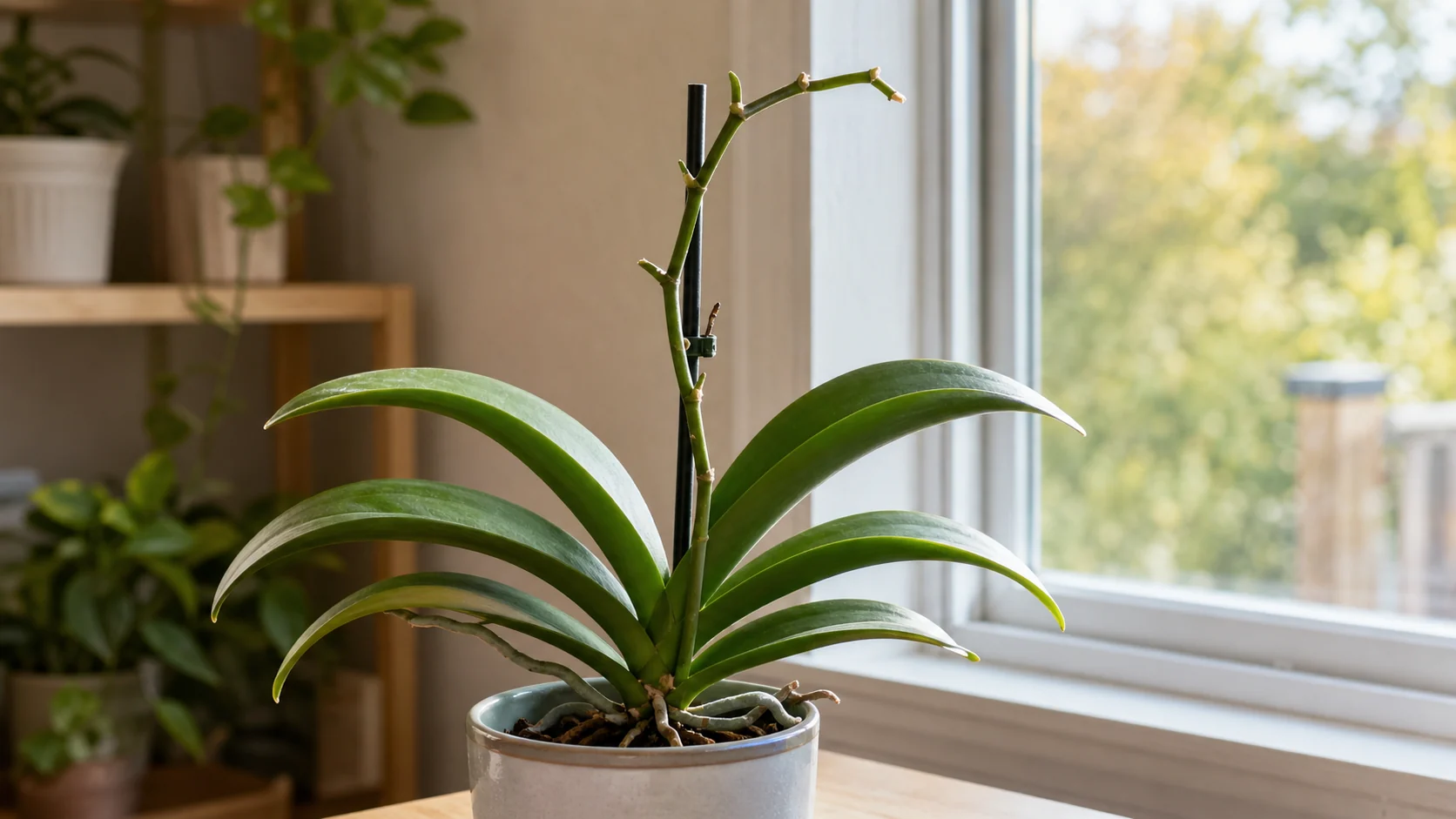
An autumn window can provide the cooler nighttime signal a healthy Phalaenopsis needs to leave recovery mode.
What Growers Keep Getting Stuck On
The same post-bloom questions show up over and over in extension inboxes and grower forums:
- “My spike is still green. Do I leave it, cut above a node, or cut it all the way off?” Ask Extension and the American Orchid Society both point to the same first check: spike color and plant strength.
- “Something new is forming on the old spike. Is it a root, a new flower branch, or a keiki?” That confusion is common enough that it is worth slowing down before trimming anything living.
- “My orchid has leaves and roots for years, but never flowers again.” That pattern usually points back to low light or missing fall temperature drop, not a dead plant.
- “Should I cut blooms or spikes early so the plant can recover faster?” In most cases, let the bloom cycle finish, then decide based on spike color and the plant’s condition.
Treat those as pattern-matching clues, not universal rules. They are useful because they reflect the exact decision points home growers get wrong most often.
The Spike Decision: Cut It or Leave It?
Most people want a single answer. There is not one. But there is a clear decision process.
Is the spike green or yellow/brown?
│
├── GREEN → Look for swelling at any node (bumpy joint) along the spike
│   ├── Node swelling visible → Cut ~1 cm above the lowest swelling node
│   └── No activity after 2 weeks → Cut to the base, 2 cm above the lowest leaf
│
└── YELLOW or BROWN → Cut to the base, 2 cm above the lowest leaf. The spike is spent.
Green spike: the plant may have energy left in it. For Phalaenopsis, a green spike can sometimes produce a secondary bloom from a dormant node lower on the stem. The bumpy joints along the spike are nodes. If one starts swelling, cut about a centimeter above that joint to encourage a possible second flush. Wisconsin Horticulture confirms this approach: cut above the first bud site on the original spike to encourage a secondary bloom.
The American Orchid Society notes the tradeoff directly:
“Large Phalaenopsis orchids can rebloom from an existing spike if cut above an unused node, but the second bloom is usually smaller and may stress the plant.”
– American Orchid Society
Some growers prefer to cut to the base regardless and wait for a full new spike, arguing the bloom will be fuller and the plant less stressed. Both approaches are valid. The more important variable is whether your orchid’s conditions are right for triggering new flower growth – and that comes down to the temperature section below.
Expert note: Treat a green Phalaenopsis spike as an option, not an obligation. If the plant is large and vigorous, cutting above a healthy unused node can encourage a smaller second bloom. If the plant is weak, recently stressed, or you want a stronger next cycle, cutting the spent spike to the base and focusing on root and leaf recovery is usually the better trade.
Brown or yellow spike: it is spent. Cut close to the base, leaving about two centimeters above the lowest leaf. Clean scissors are fine. No sealing paste needed.
Watch for keikis: if a node on a green spike produces a tiny leaf rather than a bud, the plant is making a keiki – a baby orchid growing vegetatively from the spike. Let it develop at least two to three roots of its own before deciding whether to separate it.
The Next 30, 60, and 90 Days
DAYS 1–30 · Rest
──────────────────────────────────────────────────────
• Cut or leave spike based on color and node check above
• Keep the same watering rhythm used during blooming
• Pause fertilizer or continue at half strength -- no push needed
• Do not repot unless roots are escaping or bark is clearly broken down
• Watch for: new root tips (white or pale green, firm, actively extending)

DAYS 30–60 · Active Growth
──────────────────────────────────────────────────────
• New root tips or a new leaf from the crown are normal in this window
• Resume half-strength balanced orchid fertilizer if you paused
• Keep the plant in its current spot unless light was clearly the problem
• Check that bark drains completely when you water

DAYS 60–90 · Set the Rebloom Trigger  ← This phase matters most
──────────────────────────────────────────────────────
• Late summer through early autumn is the critical window
• Position the orchid near a window where the glass gets cool at night
• Avoid heating vents, radiators, and air returns blowing on the plant
• A new spike typically appears within weeks to a couple of months after this window
Everything in the first sixty days is just keeping the plant healthy enough to respond when the temperature cue arrives in that third phase.
Care Cards for the Post-Bloom Phase
| Care card | What to do now | What to avoid |
|---|---|---|
| Spike | Leave a healthy green Phalaenopsis spike alone briefly or cut above a live node if the plant is strong | Keeping a brown spike or cutting live growth in panic |
| Water | Keep the same soak-and-drain rhythm you used during bloom | Watering more often just because the flowers are gone |
| Light | Hold bright indirect light steady | Moving the plant into harsh direct sun or a dim corner |
| Temperature | Set up cooler nights in late summer and fall | Expecting rebloom without a day-to-night temperature drop |
| Fertilizer | Use half-strength balanced feed during active growth, or pause briefly after bloom | Overfeeding to force flowers |
| Repotting | Repot only if bark broke down or roots truly need space | Treating the end of bloom as an automatic repot signal |
When repotting is genuinely necessary, the orchid soil guide explains how to choose bark, moss, or a blended medium for your watering rhythm.
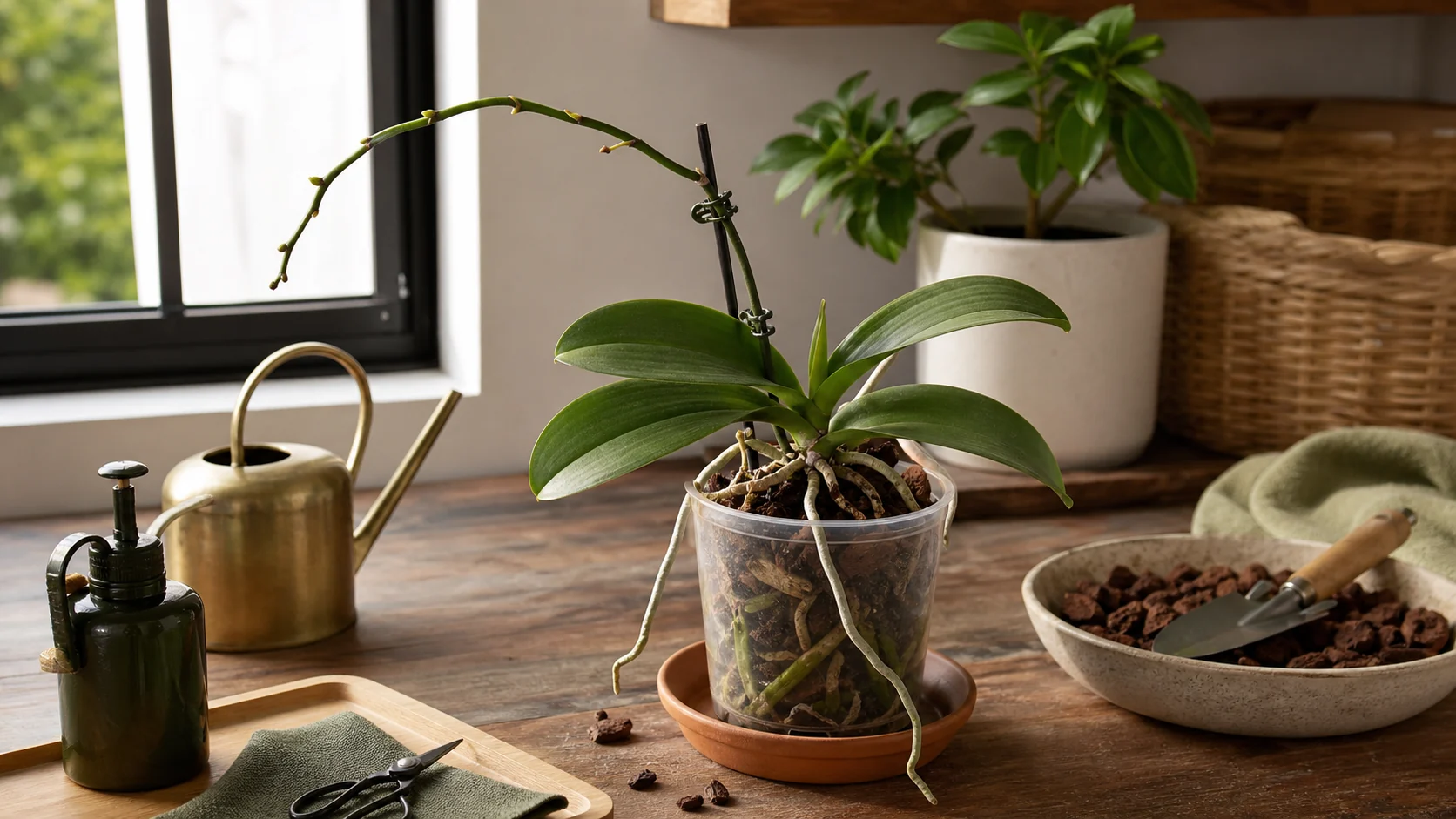
Post-bloom care stays measured: assess the green spike, keep bark draining, and repot only when the roots or medium require it.
Watering and Feeding After Blooming
After flowering, your orchid needs rest more than encouragement.
Watering: keep the same rhythm used during blooming. For most Phalaenopsis in bark mix, that means soaking the pot thoroughly every week or so and letting it drain completely before returning it to its spot. If you have been watering on a fixed schedule, now is a good time to shift to feel: lift the pot. Light means ready to water. Still heavy means wait another day or two. Soggy bark rots roots – the most common accidental harm during this period.
Fertilizer: feed only if the orchid is making active root or leaf growth, and follow the product label rather than using a universal half-strength rule. If growth has paused, roots are damaged, or minerals are building up on the bark or pot, use plain water and reassess the formula, water quality, potting medium, and growth stage first.
For a broader look at timing and formula across houseplants, the guide to fertilizing indoor plants covers what different formulas actually do and when to hold back.
Light After Blooming: Don’t Change a Thing
If your orchid flowered in its current spot, keep it there. Moving the plant after blooming can disrupt conditions that were already working.
Phalaenopsis want bright indirect light: a spot near an east-facing window is ideal, or a few feet back from a south or west window where direct sun does not hit the leaves for extended stretches. Leaves that feel warm to the touch in direct afternoon sun are getting too much. Leaves that have turned very dark green – rather than a medium, healthy green – are often compensating for low light, a common signal the plant is not getting enough.
If your natural light is limited, the guide on grow lights for indoor plants walks through how to supplement effectively without overdoing it.
The Temperature Trigger Most Growers Don’t Know About
This is the section that explains most failed reblooms.
If your Phalaenopsis has healthy leaves, active roots, and adequate light but still refuses to produce a new spike, temperature is almost always the reason. The plant is not broken. It is waiting for an environmental cue it is not receiving.
The University of Connecticut Home and Garden Education Center recommends exposing Phalaenopsis to cooler nighttime temperatures around 55°F (13°C) in autumn to trigger bud initiation. Iowa State University Extension confirms the same requirement, noting that a day-to-night drop of roughly 10 to 15 degrees Fahrenheit is what shifts the plant from vegetative growth into flowering mode.
“Orchids need the right environmental conditions year after year: bright indirect light, balanced feeding during active growth, and cooler nights to trigger blooms.”
– Iowa State University Extension, Yard and Garden
For most home growers, the easiest way to provide this is to position the orchid near a window where the glass gets cool at night during autumn and early winter. A room that stays 68–70°F year-round – especially near a heating vent – will keep the plant alive but suppress blooming indefinitely.
This is also why orchids in offices, heated apartments with no seasonal temperature variation, or rooms with consistent climate control often look perfect for years and never flower again. The plant is not failing. The environment is simply never giving it the instruction to bloom.
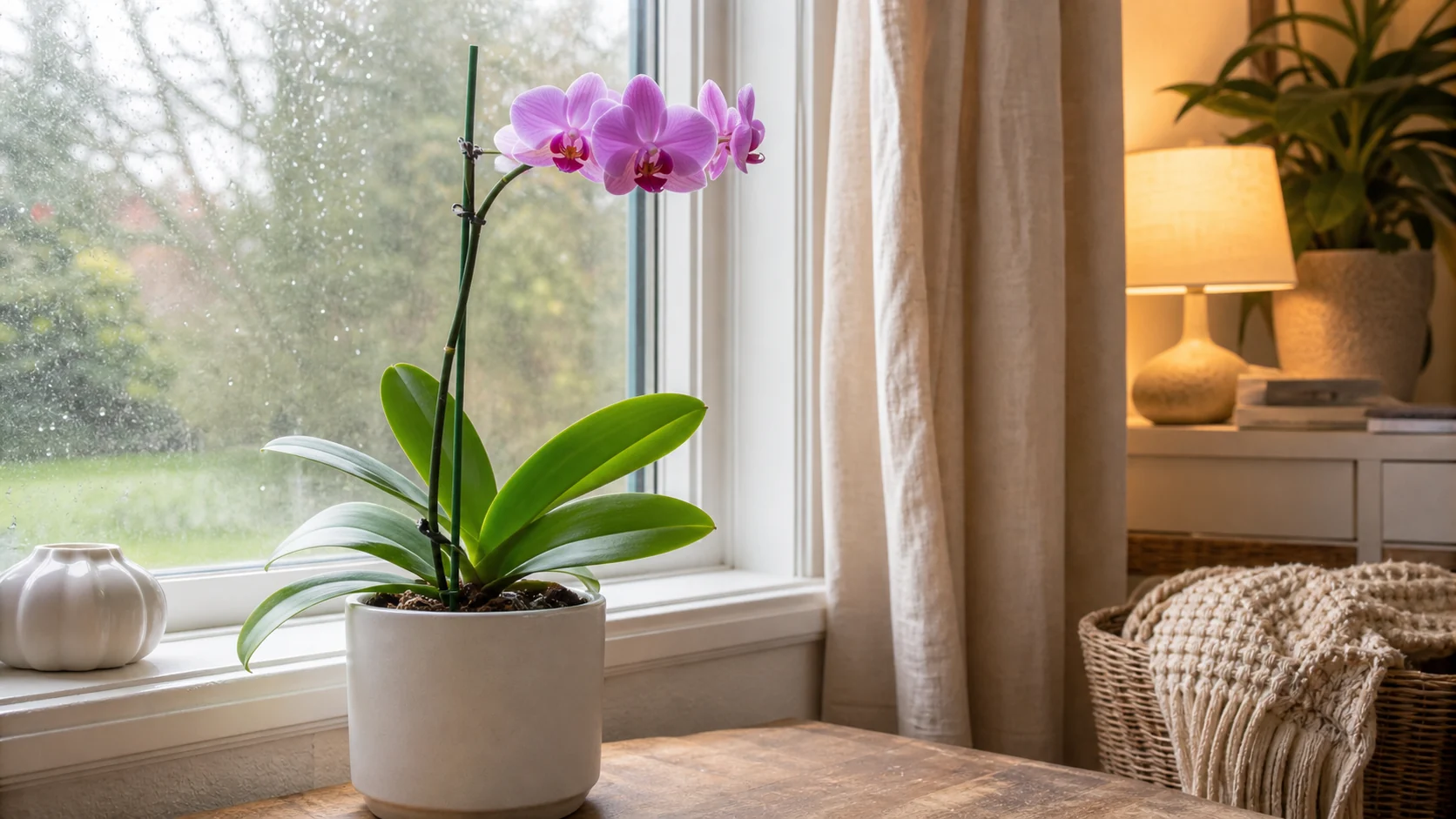
A cooler autumn window can provide the nighttime temperature drop that helps initiate a new Phalaenopsis bloom cycle.
Seasonal Note: Fall Is the Rebloom Window
If you live somewhere with very stable indoor temperatures, the season matters more than the calendar date on your fertilizer bottle. For most Phalaenopsis, late summer into fall is when you want to set up cooler nights, steady bright indirect light, and a low-stress routine. Winter is usually when the new spike becomes obvious. Spring and early summer are more often about root and leaf growth than flowers.
That seasonal rhythm matters because a healthy orchid can look stalled when it is actually just waiting for the right fall cue.
Common Problems After Flowering
Use this quick diagnosis table to match what you see to the next move.
| What you see | Most likely cause | What to do |
|---|---|---|
| Green spike, no new buds after 4 weeks | Temperature too stable, no autumn chill | Move near a cool window at night from late summer through autumn |
| Leafy growth for years, no flowers | Insufficient light or no temperature cue | Check leaf color (very dark green often means too dim), then address nighttime temperature |
| Buds forming but yellowing and drying before opening | Sudden temperature swing, low humidity, or ethylene from nearby ripening fruit | Move away from fruit bowls, heat vents, and cold drafts |
| Spike turned brown after bloom | Normal – spike is spent | Cut to the base, leaving 2 cm above the lowest leaf |
| Roots escaping the pot or bark broken down | Plant needs a new container or fresh medium | Repot after the bloom cycle ends, before a new spike appears |
Most post-bloom problems trace back to temperature, light, or an environmental stress the plant is positioned near.
Common Mistakes After Blooming
- Cutting every green spike to the base immediately. Sometimes that is the right move, but on a strong Phalaenopsis it can also remove the chance for a small side branch from a healthy node.
- Keeping a brown spike because it feels safer to leave it alone. A spent spike will not recover and just keeps the plant carrying dead tissue.
- Repotting automatically after every bloom cycle. Repot because the bark broke down or the roots need room, not because the flowers ended.
- Trying to force rebloom with stronger fertilizer. Extra feed cannot replace the missing light or fall temperature drop the plant actually needs.
- Confusing roots, new spikes, and keikis. When you are unsure, wait and observe for a few days before trimming. New living growth is slower to reveal itself than people expect.
What Your Orchid Is Actually Doing Right Now
After the blooms fall, the plant shifts into recovery before the next bloom cycle can begin. This can look like nothing is happening for weeks. That is completely normal.
Healthy signs to watch for:
- New root tips: white or pale green, firm, actively extending from existing roots
- A new leaf: pushing from the center of the crown
Either of these signals active growth. The absence of visible progress for a month or two after blooming is also normal – roots and foliage develop before anything related to flowering begins. Patience here is not passive. It is the correct move.
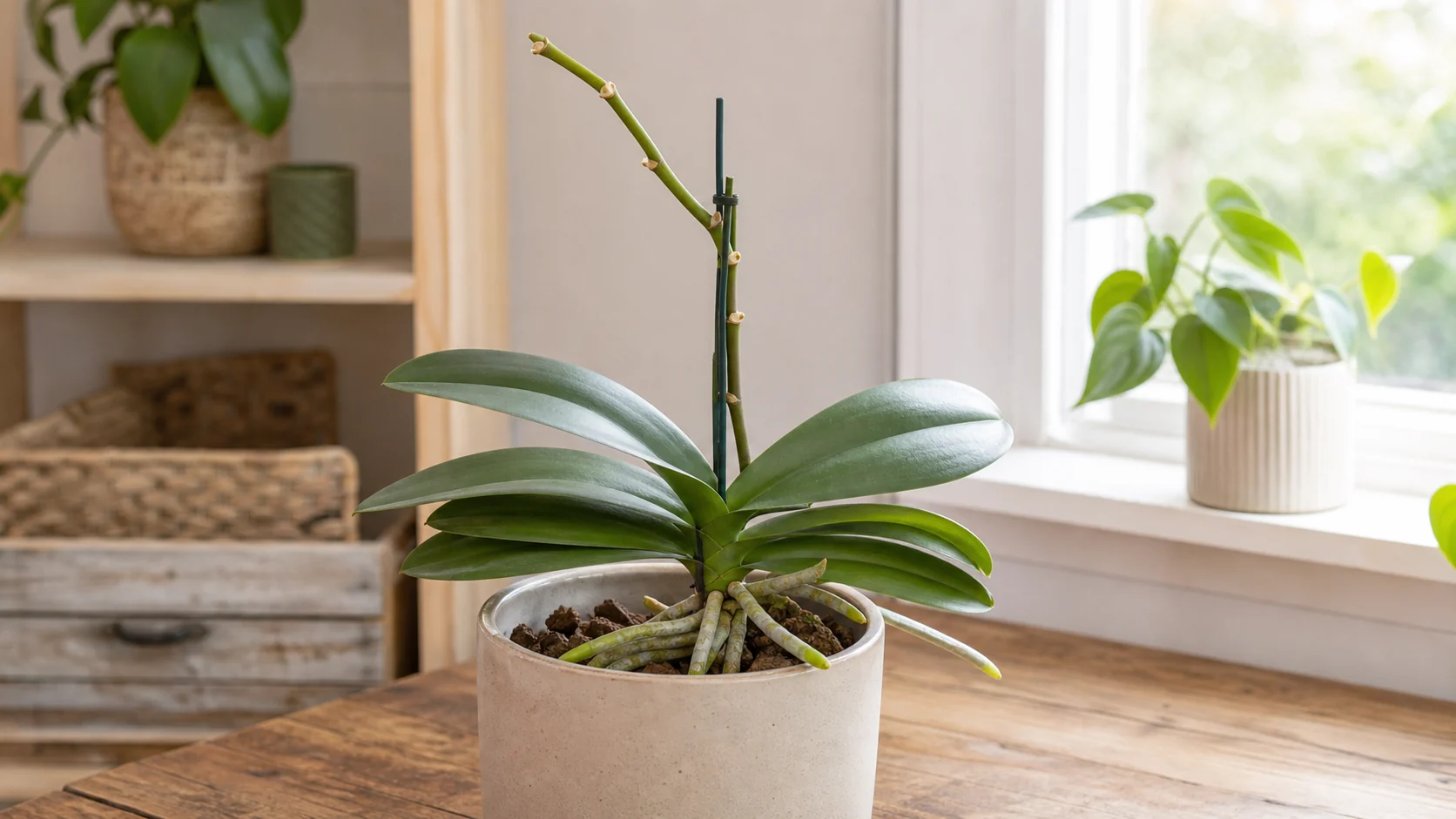
Fresh green root tips show that a flowerless Phalaenopsis is actively rebuilding for its next growth cycle.
Repotting Signs to Watch For
The period just after blooming is a reasonable time to check whether your orchid needs a new container, but only if you see clear signals.
Signs to repot:
- Roots are pushing out of drainage holes or climbing up over the pot rim
- The bark medium has broken down into fine, soggy particles that no longer drain
- The pot is several years old and you cannot remember when the medium was last refreshed
If none of those apply, there is no reason to repot just because flowering ended. Orchids in good bark that are not rootbound do fine staying in the same pot. Repotting when it is not needed stresses the plant and can delay the next bloom cycle.
The guide on when to repot plants covers how to read these signals in detail, and the principles apply well to orchids. Once you have decided it is time, how to repot plants walks through the process step by step.
Pet Safety and Household Placement
The bigger post-bloom household risk is usually not the spent flowers themselves, but everything around the plant: bark pieces, support clips, stakes, and fertilizer water. If you have pets that chew leaves or dig in pots, keep the orchid out of reach and do not leave runoff water sitting where a cat or dog can drink it.
That is especially helpful right after flowering, when people often move the plant, trim the spike, or leave tools and plant debris nearby.
A Note on Other Orchid Types
Most of the advice in this guide is written for Phalaenopsis, the moth orchid. If you have a different genus, the post-bloom care differs in important ways.
Dendrobium: some varieties drop leaves after blooming as part of a natural rest cycle. This can look alarming if you are not expecting it. Many Dendrobium species also need a drier, cooler rest period after blooming – quite different from the Phalaenopsis approach above.
Oncidium: these orchids produce multiple flushes from pseudobulbs and may bloom on new growths rather than old spikes. Post-bloom trimming follows different logic.
Cattleya and related hybrids: these bloom from pseudobulbs and need a distinct dry rest period after flowering. Applying the Phalaenopsis watering rhythm to a Cattleya will likely cause problems.
If you are not sure what type of orchid you have, check the original tag. If that is gone, the complete orchid care guide for beginners covers how to identify the most common types.
Methodology note: This guide was refreshed after reviewing current orchid grower questions from extension and gardening forums, then checking those patterns against the American Orchid Society and university extension guidance from UConn, Iowa State, and Wisconsin. Community questions were used as qualitative signal about where growers get stuck, not as proof on their own.
Freshness note: Reviewed and updated June 19, 2026 to keep the spike-trimming, rebloom, and troubleshooting guidance aligned with the current source set used for this article.
Real User FAQ
How long after blooming will it take my orchid to rebloom?
For most Phalaenopsis, the full cycle from the last bloom to a new spike takes anywhere from 6 to 12 months. Recovery – where the plant grows new roots and sometimes a new leaf – takes 2 to 4 months. After that, the plant needs a temperature cue (cooler autumn nights) to initiate a new spike. Once a spike is visible, buds take another 2 to 3 months to open. A healthy orchid in the right conditions will get there, but it is not a quick process.
My orchid has been alive for years without flowers. What am I missing?
Almost certainly temperature. Does your orchid experience at least a 10°F difference between daytime and nighttime temperatures in autumn? If it lives near a heat vent or in a room with consistent year-round warmth, that alone can prevent reblooming indefinitely. After temperature, check light: medium green leaves in genuinely bright indirect light is what you want. Very dark green leaves often signal the plant is compensating for too little.
Should I water more or less after blooming?
Keep the same rhythm used during blooming. What this period is good for is shifting from a fixed schedule to checking by feel: lift the pot. Light means it is ready. Still heavy means wait another day or two.
Can I move my orchid after the blooms fall off?
Yes, but consider carefully where. If it flowered well in its current spot, staying put is the safest call. If you are moving it specifically to provide cooler nights in autumn for spike initiation, that is a valid reason. Avoid spots near heat vents, radiators, or air conditioning blowing directly on the leaves.
The spike is turning yellow but the leaves look fine. What should I do?
Cut it. A yellowing spike after the blooms have dropped is spent. Trim close to the base, leaving a centimeter or two above the lowest leaf. Healthy leaves alongside a yellowing spike is actually reassuring: the plant finished its bloom cycle with enough reserves to stay strong.
Is it normal for new growths to appear on the old spike?
Yes. Small nubs forming at nodes on a green spike can develop into branching flower stems for a second, smaller bloom. If a nub starts producing a tiny leaf rather than a bud, it is almost certainly a keiki – a baby orchid the plant is producing vegetatively from the spike. Let it develop at least two to three roots of its own before considering whether to separate it.
Do I need a special fertilizer to get my orchid to rebloom?
No. A balanced orchid fertilizer at half strength, applied every two to four weeks during recovery and active growth, is what the plant needs. Bloom booster formulas and high-phosphorus feeds do not trigger reblooming. Temperature cue and light quality matter far more than fertilizer chemistry. What to avoid: high-nitrogen fertilizer applied while the plant is resting, which encourages leafy growth and works against the conditions that lead to flowering. The complete orchid care guide for beginners covers feeding across the full yearly cycle.
The Short Version
Read the spike before you do anything: green means check for node activity, brown or yellow means cut to the base. After that, support recovery without pushing – same watering rhythm, half-strength fertilizer or a brief pause, no repotting unless the roots or bark are clearly telling you it is time. Then, from late summer through autumn, give the plant cooler nights near a window. That temperature drop is the instruction the plant is waiting for. Without it, a healthy, well-tended orchid will stay in recovery mode indefinitely. With it, the next spike usually follows within a few months.
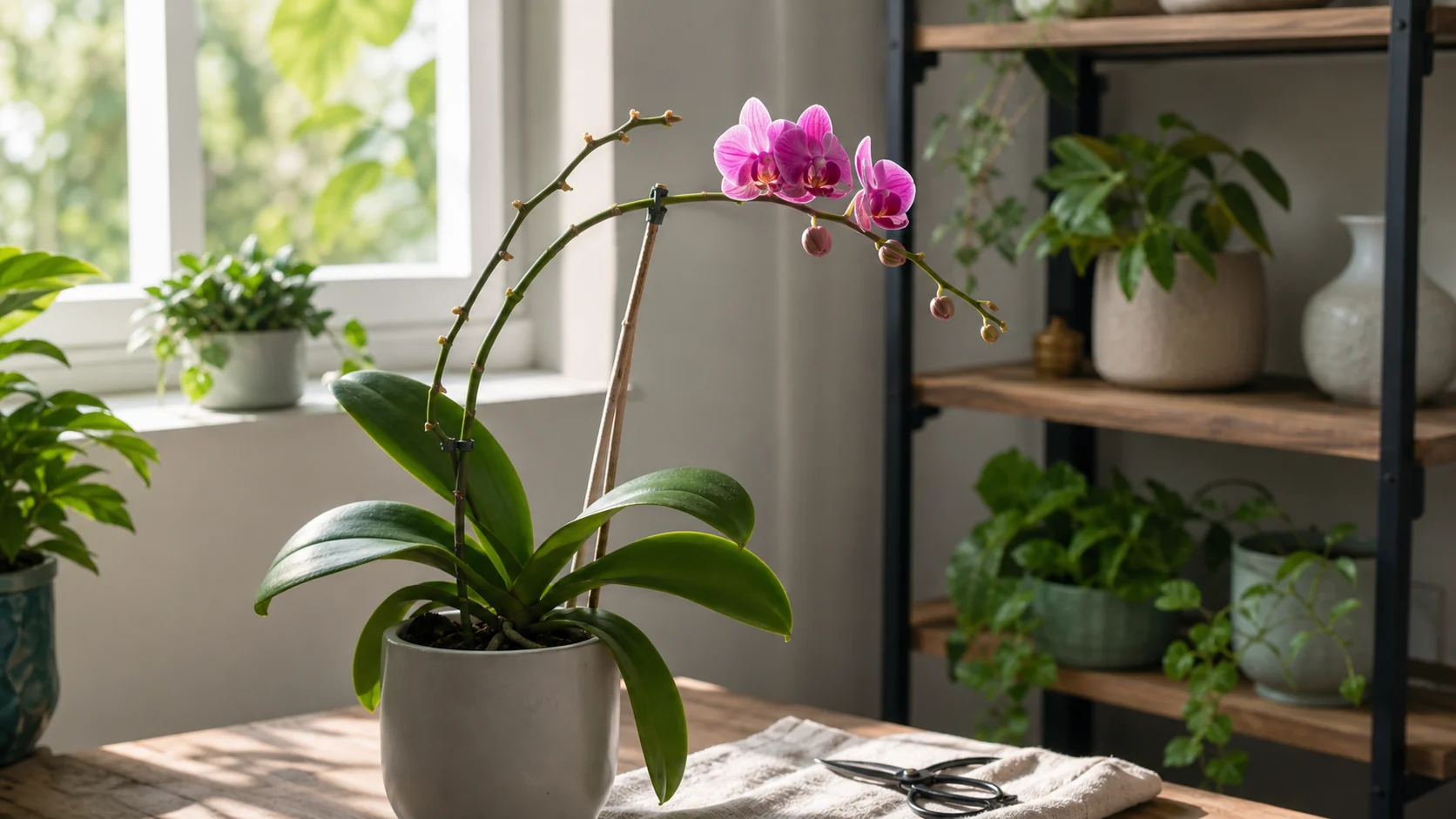
Read the green spike, maintain steady care, and use a bright seasonal window to support the next Phalaenopsis bloom.
For more on keeping your orchid healthy year-round, see the complete orchid care guide for beginners and what to do when orchid leaves turn yellow.
Download KnowYourPlant for personalized plant care reminders, identification, and step-by-step diagnosis when something looks off. Available on the App Store.
Sources reviewed June 2026: American Orchid Society, UConn Home and Garden Education Center, Iowa State University Extension, Wisconsin Horticulture.