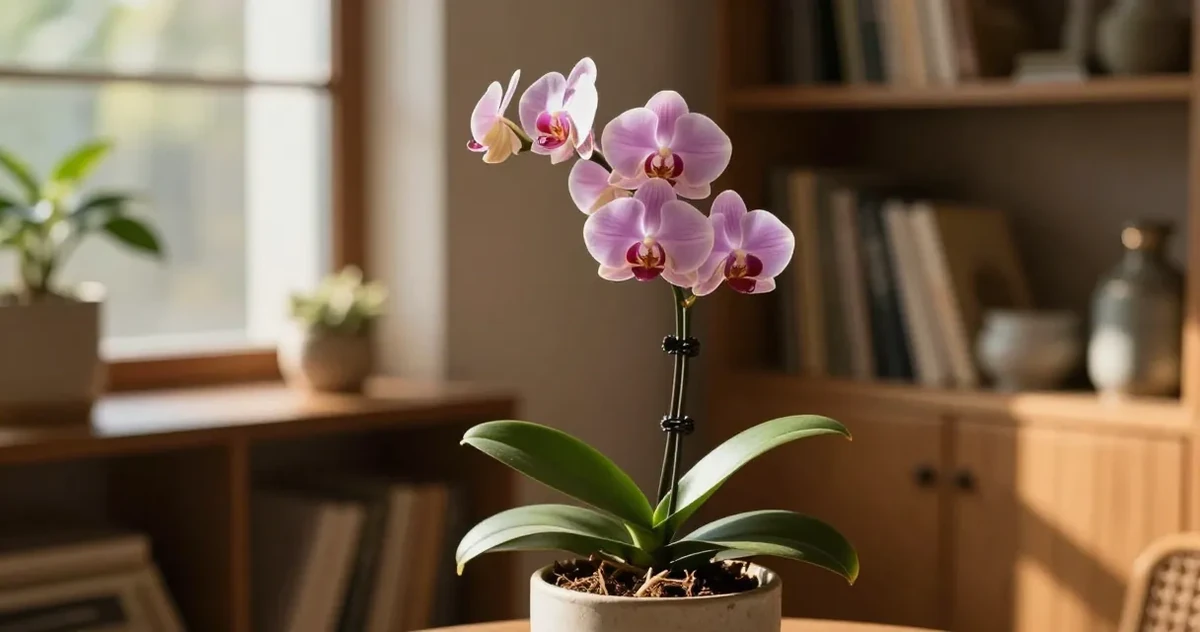
If you’ve ever brought an orchid home and wondered what on earth it was sitting in, you’re not alone. That mix of bark chunks, moss, and sometimes what looks like nothing but a clear plastic cup? That’s not a mistake. Orchid soil is really a drainage and airflow system, not a growing medium in the traditional sense. Orchids don’t live in soil in the wild. They cling to tree bark, and their roots expect light, air, and fast drying between waterings.
That’s the piece most care guides skip. They tell you what orchids need without explaining why, which means when something goes wrong, you have no idea whether to blame the mix, the pot, the watering, or all three. This guide is about understanding the logic behind orchid potting so you can make a sensible choice for your plant and your routine - and know exactly what to look for when things start to go sideways.
Byline: KnowYourPlant editorial team. Last updated: June 19, 2026.
What Most Orchid Potting Guides Miss
Generic orchid advice says: “use orchid bark, not regular soil.” That’s true but incomplete. The part those guides leave out is that the right medium depends on your watering rhythm, not just the plant’s preferences.
The most common misdiagnosis: growers assume yellow or mushy roots mean a disease problem or the wrong mix. Often, the actual issue is that the original retail setup - sphagnum moss packed into a pot with poor drainage - was working fine in a greenhouse environment but slowly became a problem at home, where airflow is lower and watering is irregular. The mix was never wrong for orchids in general; it was wrong for your specific home and schedule.
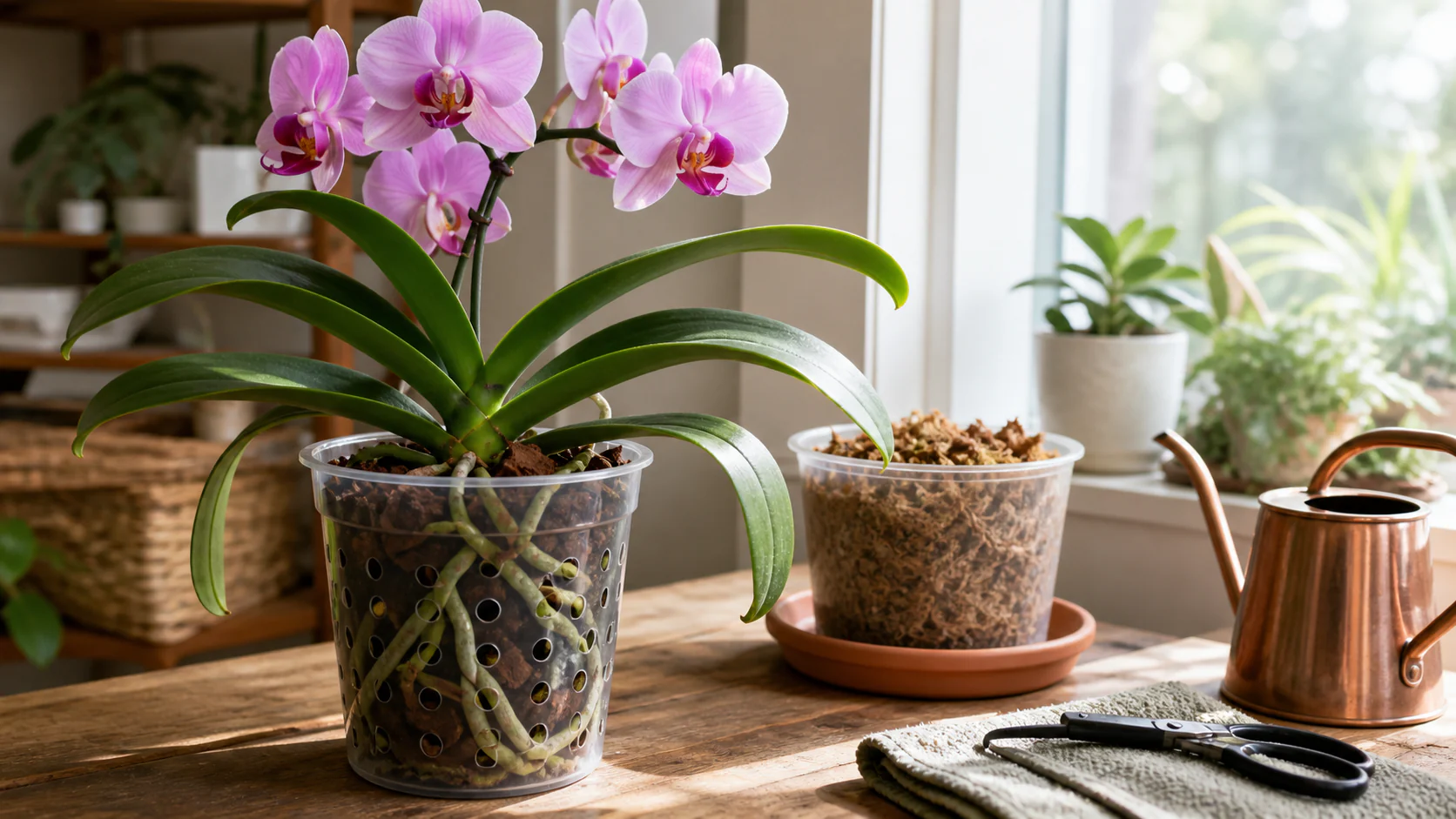
A ventilated bark mix and a moisture-retentive moss setup show why the right medium depends on home airflow and watering rhythm.
The practical first check before you buy any new mix: lift the pot right after watering and again 48 hours later. If it still feels heavy two days out, your drainage or medium has failed regardless of what the bag says. Fix drainage before you fix the recipe. If the flowers simply fell while roots and bark still look healthy, follow the orchid after-flowering guide instead of repotting automatically.
The American Orchid Society puts it plainly: the type of medium you choose should match your cultural practices as a grower, not just the plant’s theoretical preferences. Growers who water more frequently do better with coarser, faster-draining bark. Those who water less often benefit from a more moisture-retentive mix. That single adjustment accounts for more orchid success and failure than almost anything else about the potting medium itself.
What Orchid Owners Keep Getting Stuck On
Live grower questions around orchid potting repeat the same few sticking points:
- whether ordinary bark, cedar mulch, or any bag labeled “bark” is close enough to orchid bark
- whether exposed roots mean the plant must be repotted immediately, even if it is in bloom
- whether yellow roots signal mold or disease when the real problem is stale, soggy retail media
- whether a no-bloom orchid needs a bigger pot when the real issue is medium breakdown, watering, or light
Those patterns matter because they keep pointing back to the same decision logic. Orchid soil problems are usually not solved by buying a fancier bag. They are solved by matching the medium to your watering habits, using orchid-safe materials, and checking whether the current setup is draining the way it should in a normal home.
Identification Snapshot: Which Orchid This Soil Advice Fits Best
This guide is aimed most directly at the common home orchid setup behind many “orchid soil” searches: a grocery-store or garden-center moth orchid (Phalaenopsis) sitting in a clear nursery pot with thick silver-green roots and broad strap-like leaves. That is also the setup reflected in the repotting and drainage guidance from the American Orchid Society, UConn, Wisconsin Horticulture, and Ask Extension.
Use this article with the most confidence when your orchid looks and behaves like that common home setup:
- thick, silvery roots that turn green after watering
- broad leaves growing from one central crown
- bark or moss in a pot with drainage holes
- stress signals showing up as soggy roots, stalled blooms, or media that stay wet too long
Lookalikes and Confused-With Cases
| Orchid situation | What often gets confused | Why the soil advice changes |
|---|---|---|
| Phalaenopsis or moth orchid | Treated like a regular foliage houseplant in potting soil | These roots need more airflow and usually do best in bark-based or balanced orchid media |
| Dendrobium or other cane-form orchid | Assumed to want the exact same moisture level as a moth orchid | The no-bloom frustration can look similar, but watering rhythm and medium tolerance may differ |
| Miniature or very fine-rooted orchid | Put into very chunky bark because “airier is always better” | Some small-rooted orchids need a little more moisture retention than a large phalaenopsis |
If you are unsure which orchid you own, identify the species first before turning a mix recipe into a rule. The medium is only helpful when it matches the orchid type and the home conditions around it.
Why Regular Potting Soil Fails Orchids
Standard houseplant potting mix holds moisture for days. For a peace lily or a pothos, that’s usually fine. For an orchid, it’s a slow disaster. Orchid roots rot when they can’t breathe. Dense, moisture-retentive soil keeps roots wet and airless, and once root rot starts, a plant that looked healthy for months can collapse in a few weeks.
The other problem is compaction. Most potting soil clumps together over time. Orchid roots need space to expand and air pockets around them so they can dry between waterings. Soil eliminates that space and traps moisture right at the root zone. According to the UConn Home and Garden Education Center, root and stem rots are among the most common problems in home-grown orchids - and nearly all of them trace back to poorly drained media.
If you want to understand why potting mix matters so much across indoor plants more broadly, the guide to best potting soil for indoor plants walks through what makes different mixes work for different root systems. Orchids are the most extreme case of that principle.
If you’ve ever noticed that store orchids often sit in a tiny inner plastic cup surrounded by moss, that setup was designed for greenhouse conditions, not your living room. In a greenhouse, airflow, temperature cycling, and watering schedules are controlled precisely. At home, that moss stays wet too long, which is why so many orchids develop root problems within the first year of ownership.
What Orchid Potting Media Actually Contains
Good orchid media has one job: let water drain fast while giving roots something to grip. The most common materials each make a different tradeoff.
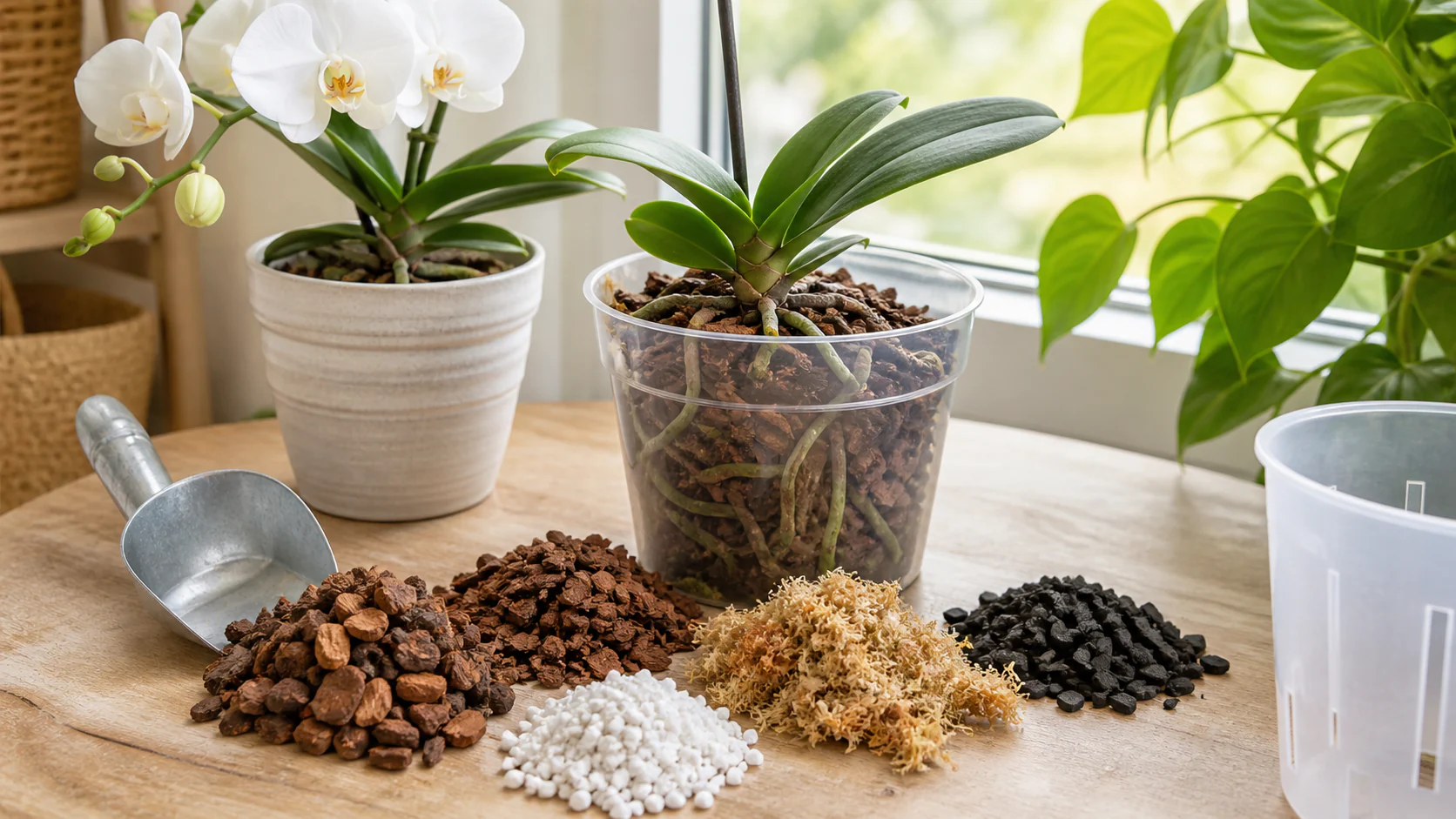
Coarse and fine bark, perlite, sphagnum, and charcoal each change how quickly an orchid pot drains and dries.
| Material | Drainage | Moisture Retention | Beginner-Friendliness | Main Risk |
|---|---|---|---|---|
| Coarse fir bark | Excellent | Low | Good | Dries fast, needs more frequent watering |
| Fine fir bark | Good | Moderate | Good | Can compact faster than coarse |
| Sphagnum moss | Poor-moderate | Very high | Moderate | Easy to keep too wet |
| Perlite | Excellent | Very low | Best as amendment | Too drying on its own |
| Charcoal | Excellent | Very low | Best as amendment | Not a standalone medium |
| Commercial orchid mix | Good | Moderate | Best for beginners | Quality varies by brand |
Orchid Bark
Bark is the backbone of most orchid mixes. It’s usually fir bark, and it comes in fine, medium, and coarse grades. Coarser bark drains faster and dries out more quickly - better for growers who water frequently or live in humid climates. Finer bark holds a little more moisture and suits dry homes or growers who water less often.
One important detail: not all bark is interchangeable. Cedar bark can release compounds that harm orchid roots. This matters because it’s tempting to substitute ordinary garden bark when you run out of orchid-specific product - but species and particle size both affect how your mix behaves in practice. Use bark labeled for orchids.
The American Orchid Society recommends replacing bark-based orchid media every one to two years, because organic materials break down, compact, and lose their drainage properties over time - even when the plant looks fine above the soil line.
Sphagnum Moss
Sphagnum moss can hold up to fifteen to twenty times its dry weight in water, which makes it extremely forgiving when you forget to water. The catch is that same capacity: it’s easy to keep roots too wet for too long, especially in lower-light homes where the plant isn’t actively growing and using that moisture.
Moss isn’t inherently bad. It works well with miniature orchids, in very dry indoor environments, and for growers who water much less frequently. If you’re a patient, light-handed waterer, moss might suit you. If you tend to water on a schedule without checking the medium first, bark is safer.
Perlite, Charcoal, and Other Additions
Many commercial orchid mixes include perlite to improve drainage and charcoal to reduce bacterial buildup. Neither is essential on its own, but both are useful as amendments. Perlite in particular helps keep a mix from compacting too quickly. If a commercial orchid mix feels too fine or stays wet too long for your home, adding extra perlite is usually the simplest fix.
Scoring Rubric
This is the rubric used to compare the three potting routes most home growers actually choose.
| Criterion | What it measures | Weight |
|---|---|---|
| Airflow and drainage | Whether roots get the airy dry-down orchids need between waterings | 30 |
| Moisture reserve | Whether the mix keeps enough moisture for the grower’s real routine | 25 |
| Repot and recovery flexibility | How well the mix supports root recovery after repotting and medium breakdown over time | 15 |
| Beginner error tolerance | How forgiving the mix is if you water a little too early or a little too late | 15 |
| Ingredient clarity | How easy it is to understand what is actually in the bag or recipe | 15 |
Comparison Table: Bark, Moss, or a Balanced Orchid Mix?
| Option | Airflow and drainage (30) | Moisture reserve (25) | Repot and recovery flexibility (15) | Beginner error tolerance (15) | Ingredient clarity (15) | Total score |
|---|---|---|---|---|---|---|
| Bark-heavy orchid mix | 29 | 16 | 13 | 13 | 14 | 85/100 |
| Balanced commercial orchid mix | 24 | 21 | 13 | 14 | 11 | 83/100 |
| Moss-heavy mix | 14 | 24 | 10 | 9 | 10 | 67/100 |
The default winner for most beginners is the balanced orchid mix because it buys some moisture safety without staying wet as long as pure moss. Bark-heavy mixes score highest when the grower tends to overwater or lives in a humid home. Moss-heavy setups make sense mainly when the grower waters lightly, the home is very dry, or the orchid is small and dries too fast in bark alone.
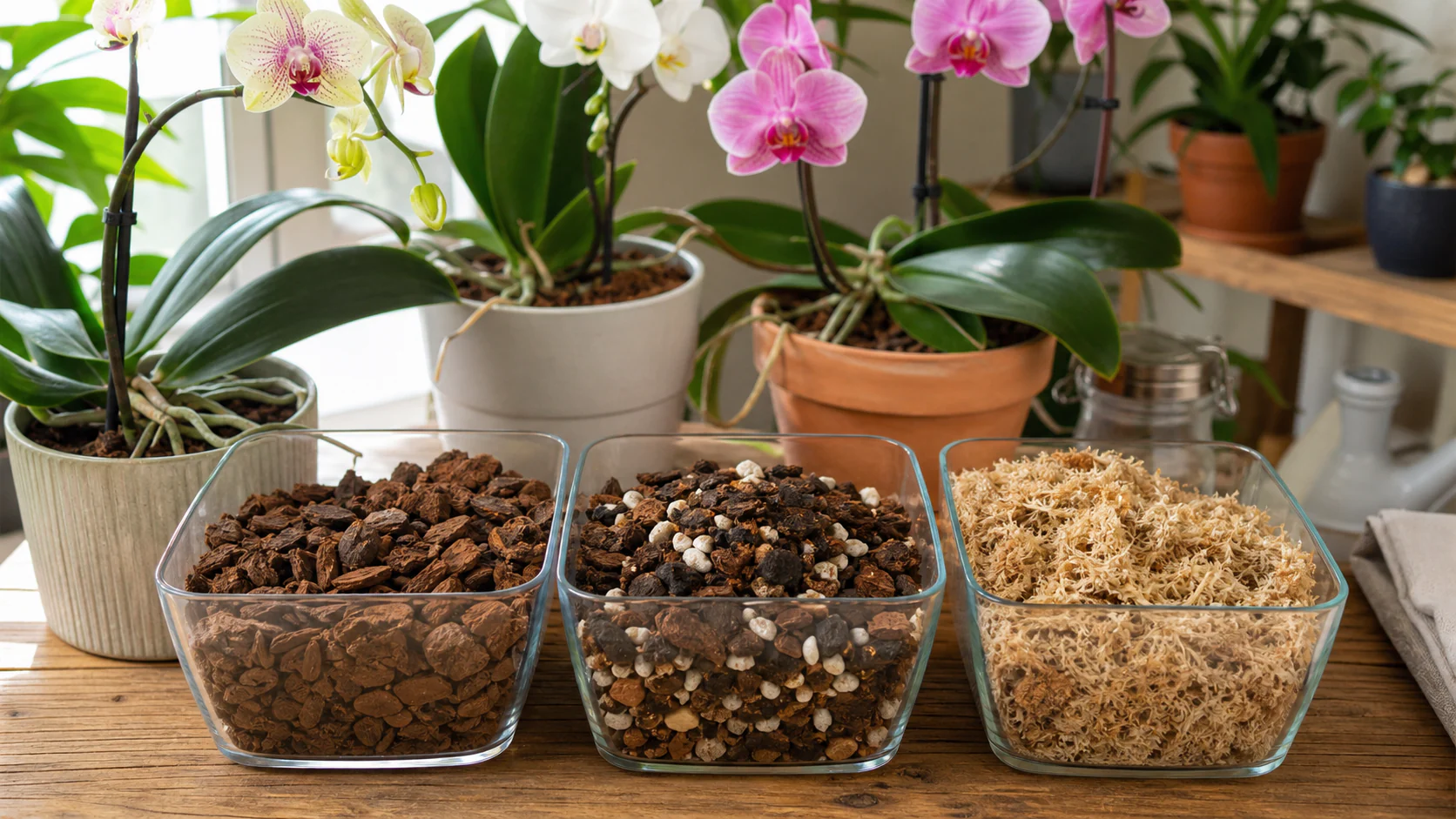
Bark-heavy, balanced, and moss-heavy media trade faster airflow for progressively greater moisture retention.
Pros and Cons
Bark-Heavy Orchid Mix
Pros
- strongest drainage and airflow, especially in plastic pots
- easiest option to rescue orchids that have been sitting in stale, sour media
- makes watering feedback clearer because the pot weight drops quickly
Cons
- can dry too fast in hot, dry rooms
- needs more regular attention from forgetful waterers
- finer-rooted orchids may need extra moisture support
Balanced Commercial Orchid Mix
Pros
- easiest starting point for most growers
- usually combines bark structure with enough moisture retention to smooth out small mistakes
- works well for repotting store-bought orchids into a safer home setup
Cons
- some bags still lean too fine and need extra perlite or bark
- ingredient quality varies more than the label language suggests
- can drift toward soggy if packed tightly into a poorly ventilated pot
Moss-Heavy Mix
Pros
- holds moisture longer for dry homes and light waterers
- can work well for small orchids that dry out too fast in chunky bark
- offers a larger buffer if you cannot check the pot often
Cons
- easiest route to soggy roots in average home conditions
- hides overwatering problems until roots are already stressed
- becomes risky fast in decorative pots or low-airflow corners
Best For / Not For
| Option | Best for | Not for |
|---|---|---|
| Bark-heavy orchid mix | humid homes, frequent waterers, orchids recovering from stale retail moss | growers who forget to water for long stretches or homes that dry plants out quickly |
| Balanced commercial orchid mix | most beginners, grocery-store phalaenopsis repots, average indoor humidity | buyers who want a one-bag answer without checking whether the mix is still too fine |
| Moss-heavy mix | very dry homes, miniature orchids, light waterers who check root health carefully | heavy waterers, decorative cachepots without airflow, or any setup that already stays wet for days |
Care Cards: Match the Mix to the Orchid in Front of You
Care Card 1: Grocery-Store Phalaenopsis in Stale Retail Moss
- safest first move: repot into a balanced orchid mix or bark-heavy mix with strong drainage
- watch for: hidden soggy plugs near the crown and roots that stay yellow or soft
- avoid: jumping straight to a bigger decorative pot
Care Card 2: Dry Home, Light Waterer, Bark Dries Too Fast
- safest first move: keep some sphagnum or use a slightly finer orchid mix
- watch for: shriveled roots, limp leaves between waterings, very light pots after only a day or two
- avoid: assuming the answer is more frequent watering without checking whether the mix is too coarse for the room
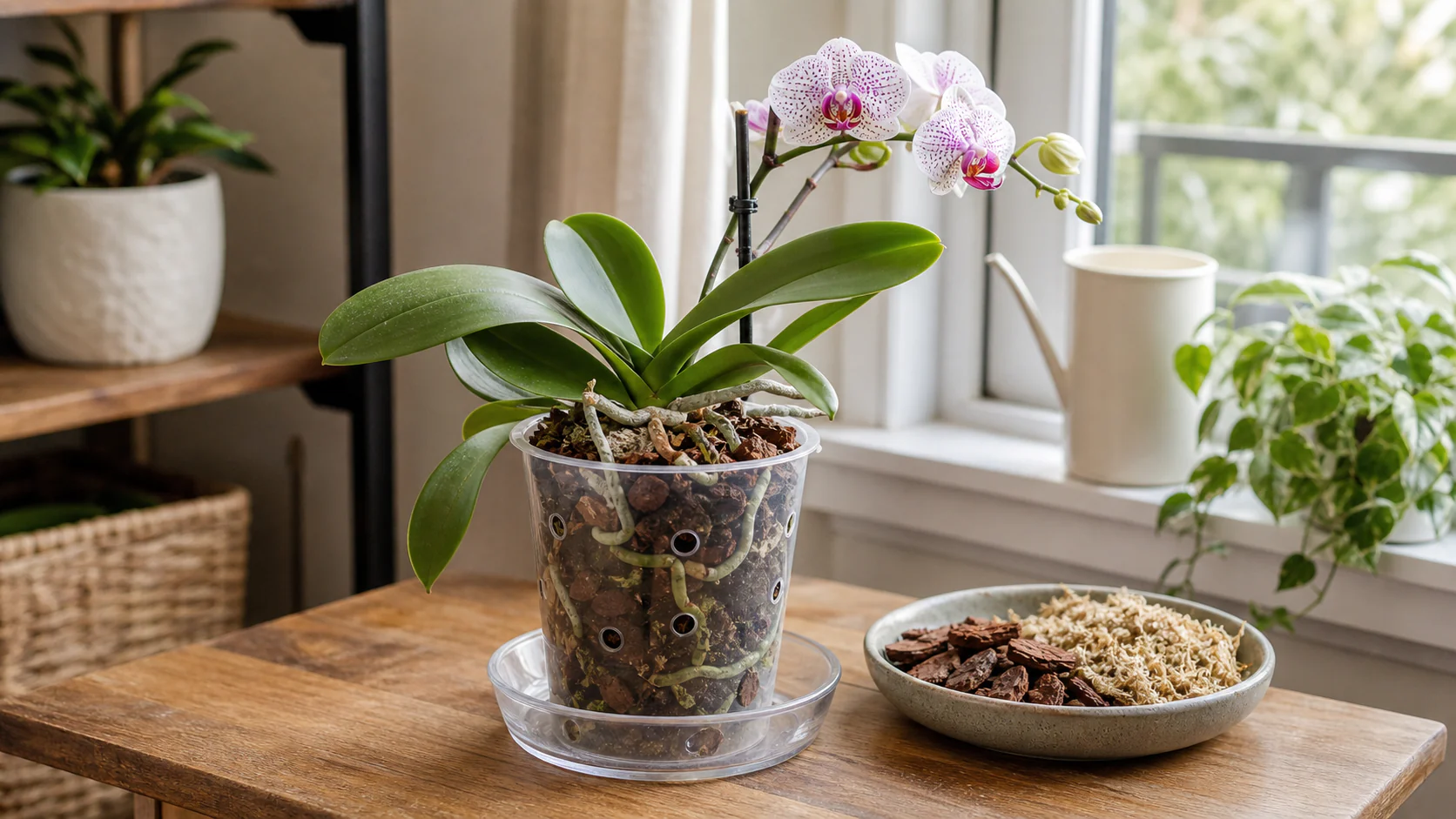
Dry silver roots in a coarse mix signal when a little sphagnum or finer bark may better suit a dry room and light watering habit.
Care Card 3: Humid Room, Heavy Waterer, Repeated Root Rot
- safest first move: move toward bark-heavy media and more pot ventilation
- watch for: sour smell, heavy pot weight after 48 hours, soft brown roots near the base
- avoid: moss-heavy mixes that hide how wet the root zone still is
How to Choose Based on Your Watering Habits
Here’s the honest version: the right mix depends on how you actually water, not on what’s technically optimal.
Wisconsin Horticulture extension recommends using orchid-specific medium with small bark pieces that allow good drainage - and adjusting from there based on the home environment, not just the plant type.
Use this as a starting point:
- You water on a schedule without checking the medium first: coarser bark, and consider switching to checking weight or moisture before every watering
- Your home is warm and dry in winter, and roots shrivel between waterings: mix in some sphagnum or try finer bark to hold moisture longer
- You travel or water irregularly: sphagnum moss buys more time between waterings, but check roots regularly for soft or discolored spots
- You’re a beginner who doesn’t yet know your rhythm: a commercial orchid bark mix is the safest starting point, because it dries out in a predictable way and signals more clearly when it needs water
There’s no single answer that works for every home. The mix is a calibration for your routine - not a fixed prescription.
Common Mistakes When Choosing Orchid Soil
- Treating all bark as interchangeable. Orchid bark is selected for orchid-safe materials and useful particle size. Landscape bark and cedar products can behave very differently in a pot.
- Going up a pot size before fixing drainage. A bigger pot with the same stale medium usually just stays wet longer.
- Packing moss too tightly. Moss works best when it stays springy. Compressed moss cuts airflow and turns into a root-rot trap.
- Watering by calendar after changing the medium. Bark, moss, and mixed media dry at different speeds. The old schedule is often wrong the moment you repot.
- Blaming the mix alone when the setup is the problem. Pot ventilation, light, and home humidity all change how the same medium performs.
Root Health: What the Color Tells You
Orchid roots change color depending on moisture, and learning to read them is more useful than any repotting schedule. New orchid owners sometimes mistake normal root color variation for disease or mold - a very understandable worry when you’ve just brought home a plant you don’t want to lose.
- Silver-white or pale green: dry and healthy, ready for water
- Bright green: recently watered and well-hydrated
- Yellow with soft texture: likely staying too wet, possibly beginning to rot
- Brown, mushy, or hollow: root rot, usually from poor drainage or decomposed medium
- Shriveled and thin: chronically too dry, or roots have lost the ability to absorb water
The texture test matters more than color alone. A firm yellow-green root on an actively growing plant is often fine. A soft, hollow root of any color is a drainage problem. When in doubt, gently press - firm is usually okay, spongy means trouble.
If you’re seeing yellow or mushy roots and aren’t sure whether it’s the medium, the watering, or something else, the guide to orchid leaves turning yellow covers the full range of yellow symptoms including how root problems show up in the leaves before you can see the roots themselves.
Expert Note: What the Orchid Sources Actually Support
The overlap across orchid expert guidance is much tighter than most roundup articles make it sound:
- American Orchid Society: medium choice should match the grower’s habits, with coarser mixes for heavier watering and more moisture-retentive media for lighter watering.
- UConn Home and Garden Education Center: drainage and airflow matter because root and stem rots are common once orchid media stay wet too long.
- Wisconsin Horticulture: specialized orchid media and repotting when roots crowd or media break down are standard care, not advanced rescue tactics.
- Ask Extension: some orchids can stay put for years if they are healthy, which is a useful reminder not to repot only because a bloom cycle ended.
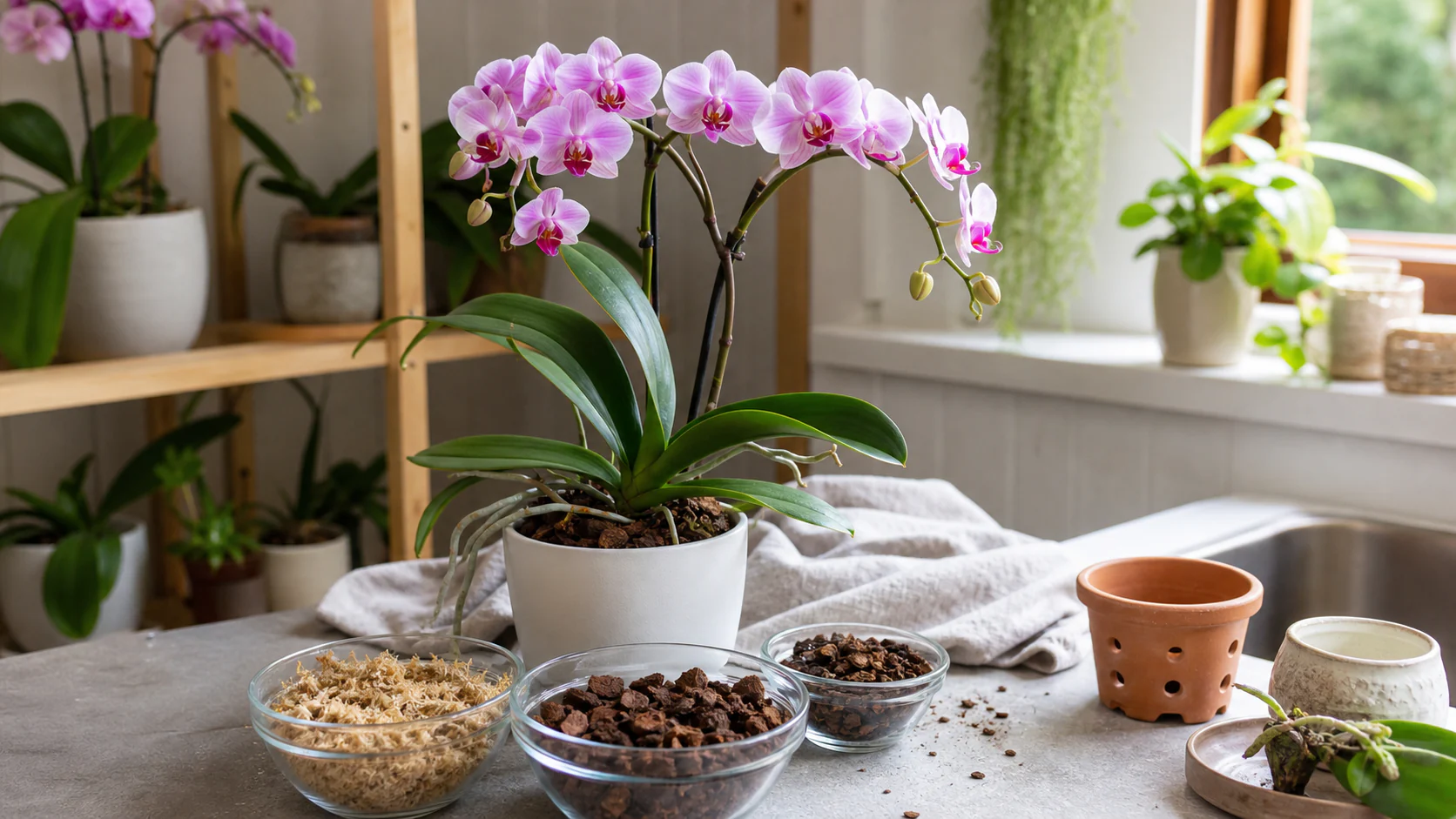
Expert guidance converges on airy roots, appropriate moisture retention, and repotting only when the plant or medium actually needs it.
That combination leads to a simple conclusion: the best orchid soil is not the chunkiest or the wettest option. It is the one that dries at a safe speed in your actual pot, your actual room, and your actual watering rhythm.
Pet Safety Note
This article is about orchid medium selection, not a species-by-species toxicity database. The practical pet-safety takeaway is still simple: keep bark, moss, fertilizer residue, and decorative potting add-ins out of reach of curious pets, and verify species-level toxicity separately before assuming every orchid setup is harmless. The root problem most readers face is usually drainage, but pet access to potting materials can create a different kind of avoidable mess.
Signs Your Orchid Needs New Potting Media
Even the best orchid mix doesn’t last forever. Bark and moss break down over time, and as they do, they compact, hold more moisture, and eventually stop providing the drainage your orchid needs.
The clearest signs it’s time to repot:
- The bark or moss looks dark, slimy, or smells sour
- Water takes a long time to drain through the pot after watering
- Roots are tightly packed and growing out of the drainage holes in every direction
- The plant sits loose in the pot when you gently tug it - the medium has shrunk and the root ball has nothing to grip
Repot Now or Wait Until After Blooming?
This is the question most guides leave unanswered. The general rule is to wait until flowers drop before repotting, because root disturbance during active bloom can cause bud drop. But that rule has a limit: if the medium has visibly failed or roots are clearly rotting, the plant needs help regardless of where it is in its flowering cycle. A plant with rotting roots won’t survive to bloom again anyway.
The decision tree:
- Active bloom spike + medium looks fine + roots have some space: wait until flowers finish
- Active bloom spike + medium is sour or waterlogged + roots look soft: repot now, accept possible bud drop
- No active bloom + roots crowding the pot: repot now, before the next growth cycle starts
- No active bloom + medium compacted but roots okay: can wait one more season if the plant is stable
For the mechanics of repotting itself, the how to repot plants guide covers the step-by-step process including how to handle roots, choose pot size, and help a plant settle in after the move. The when to repot plants guide explains the broader timing signals across houseplant types.
After You Repot
Once you’ve moved your orchid into fresh media, hold off on watering for a day or two. Small root damage from the move heals faster when the roots can dry slightly before their next drink. After that, ease into the watering rhythm that matches your chosen medium: bark usually needs watering more often than moss, and the frequency in a bark mix varies more by season and home humidity than any fixed schedule can capture.
Keep the newly repotted plant out of direct sun for a week or so. Root disturbance is a stress event, and strong light on top of that can tip a recovering plant into leaf drop. Once it looks settled - new root tips appearing is a reliable sign - you can gradually return it to its normal spot.
Most orchid problems - yellowing leaves, soggy bases, slow growth, no flowers - trace back to the medium and drainage combination. Get that right, and the rest tends to follow. For a full picture of what an orchid needs across its whole growing cycle, the orchid care guide for beginners covers light, watering, fertilizing, and what to expect season by season.
For another practical pet-safety check, see Are Orchids Toxic to Cats? What to Check After a Bite for the risk level and the next steps.
For a related hands-on growing walkthrough, use Orchid Propagation: Should You Cut, Wait, or Fix Care First? for the setup and follow-up care.
Evaluation Method and Freshness Note
This is an editorial evaluation, not a sponsored roundup or lab trial. The scoring rubric is grounded in expert guidance on airflow, drainage, repot timing, and root-health risk, then adjusted against the recurring home-grower confusion patterns surfaced in orchid questions about bark substitutions, root color panic, stale retail moss plugs, and bloom-timing repot decisions.
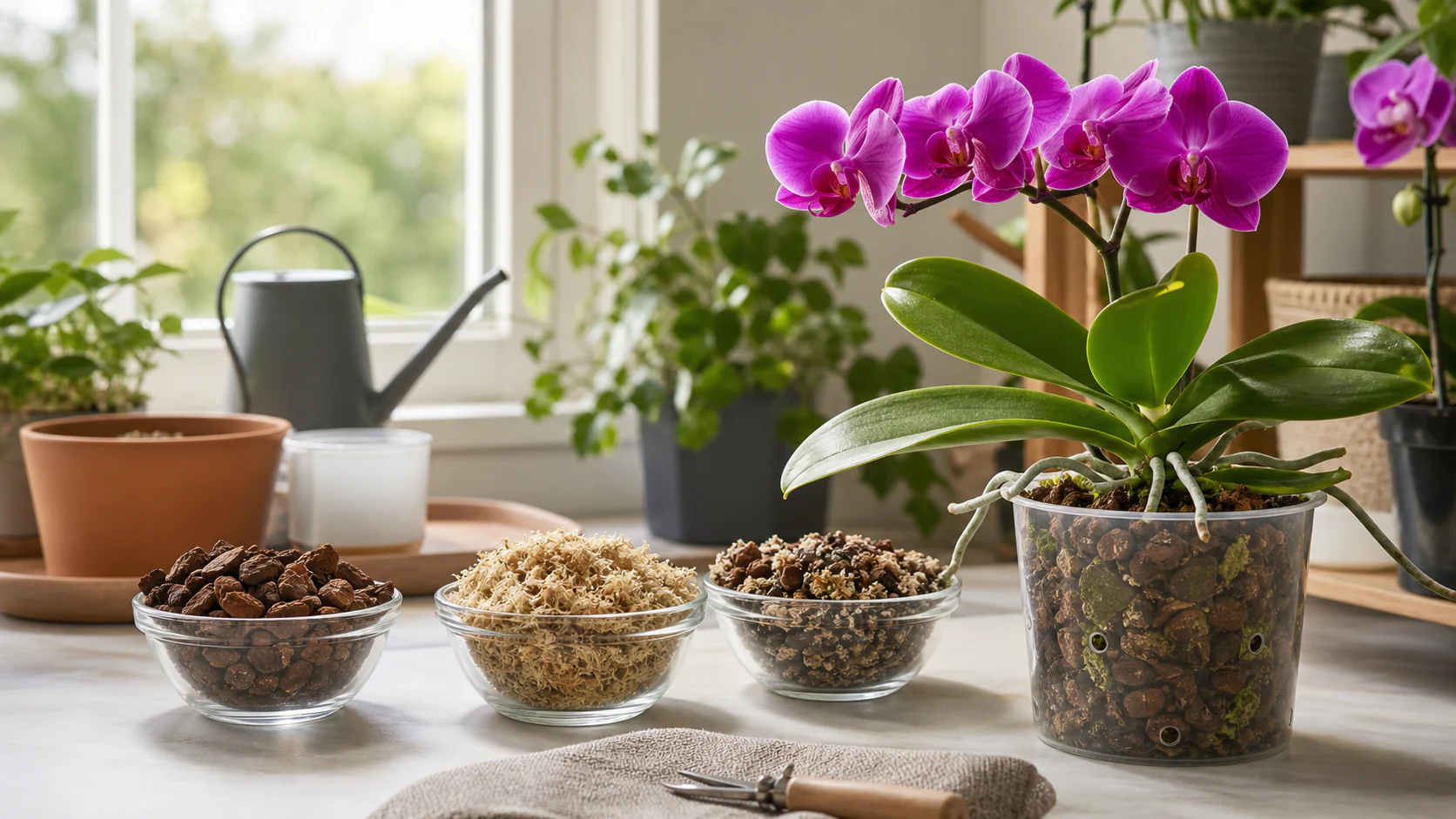
Comparing bark, moss, and a balanced blend beside a healthy orchid keeps the evaluation grounded in observable drainage, moisture, and root conditions.
Freshness note: Updated June 19, 2026. Expert claims were checked against the American Orchid Society, UConn Home and Garden Education Center, Wisconsin Horticulture, and Ask Extension. Community questions were used only as qualitative language and problem-pattern signals, not as controlled testing data.
Methodology: Reviewed live search results and grower question threads to map repeated confusion, then anchored care claims to orchid-specific expert and extension guidance. No social posts, usernames, engagement numbers, or product-test results were invented.
Real User FAQ
Can I use regular potting soil for orchids if I mix it with perlite?
No - even heavily amended with perlite, standard potting soil compacts and retains moisture in ways that orchid roots can’t tolerate. The problem isn’t just drainage; it’s that regular soil stays biologically active and can introduce fungal and bacterial pressure that bark-based mixes don’t. Orchid-specific bark or a commercial orchid mix is worth the investment. It’s one of the few cases in houseplant care where substituting isn’t a safe shortcut.
How do I know if my orchid bark is ready to be replaced?
The clearest signs are smell and texture: old bark smells sour or earthy in a damp, musty way, and the pieces feel soft and break apart easily rather than staying firm. If the medium has turned dark brown throughout and water pools on the surface for more than a few seconds before draining, it’s past its useful life. The American Orchid Society recommends replacing bark media every one to two years regardless of how it looks, because breakdown isn’t always visible from the surface.
Is sphagnum moss better than bark for beginners?
It depends on your watering habit. Moss is more forgiving when you underwater - it holds moisture much longer, so the plant has a buffer if you forget for a week. But it’s less forgiving when you overwater, because it stays wet so effectively that roots get no air break. Most beginners who don’t yet know their own rhythm tend to do better starting with bark, because it sends clearer signals: the pot gets noticeably lighter when it’s time to water, and it dries out predictably rather than holding hidden pockets of moisture.
Why are my orchid’s roots yellow? Is that bad?
Yellow roots with a soft, mushy feel are a warning sign - they’re likely staying too wet, which is an early stage of root rot. Yellow roots that are firm to the touch are a more ambiguous signal; some orchid roots take on a greenish-yellow tone when actively growing, especially in bright light. The test is texture: firm is usually okay, soft or hollow means there’s a problem. If you’re seeing yellowing leaves alongside yellow roots, the issue is almost certainly drainage or a waterlogged medium.
Do I need a clear pot for orchids?
Clear pots let you see root color without disturbing the plant, which is genuinely useful, especially while you’re learning what healthy versus distressed roots look like. But they’re not required. What matters more than transparency is that the pot has adequate drainage holes and allows some airflow to the root zone. Many growers use terracotta or nursery pots with multiple drainage holes and get better results than they did with clear pots in poor-draining setups.
How often should I water an orchid in bark vs. moss?
In a bark-based mix, most home growers find a weekly soak-and-drain approach works well - place the pot in the sink, let water run through thoroughly, and let it drain completely before returning it to its spot. In sphagnum moss, that same schedule often leads to overwatering. With moss, check the top layer before watering: if it still feels damp or the pot feels heavy, skip that week. The weight test - lifting the pot - is the most reliable guide regardless of medium type.
Can I mix my own orchid potting medium?
Yes, and many experienced growers prefer it because they can adjust the mix to their specific home conditions. A simple DIY mix: three parts coarse fir bark, one part perlite, and a small amount of charcoal. Adjust toward more perlite if your home is humid or you tend to overwater; adjust toward finer bark if your home is very dry. The goal is a mix that drains in seconds and dries out within two to four days under your normal conditions. If it takes longer than that, it’s too moisture-retentive for your environment.
My orchid has been in the same pot for three years. Should I repot even if it looks okay?
If the plant is healthy, flowering, and the medium still drains properly, you could wait a little longer - extension guidance from Ask Extension notes that some orchids can stay in place for years when conditions are right. But three years is long enough that the bark is almost certainly breaking down, even if the surface looks intact. Gently check a few pieces from the middle of the pot: if they’re soft and crumble, the medium is ready to be replaced. At that point, repotting before a problem develops is much easier than recovering a plant after root rot sets in.