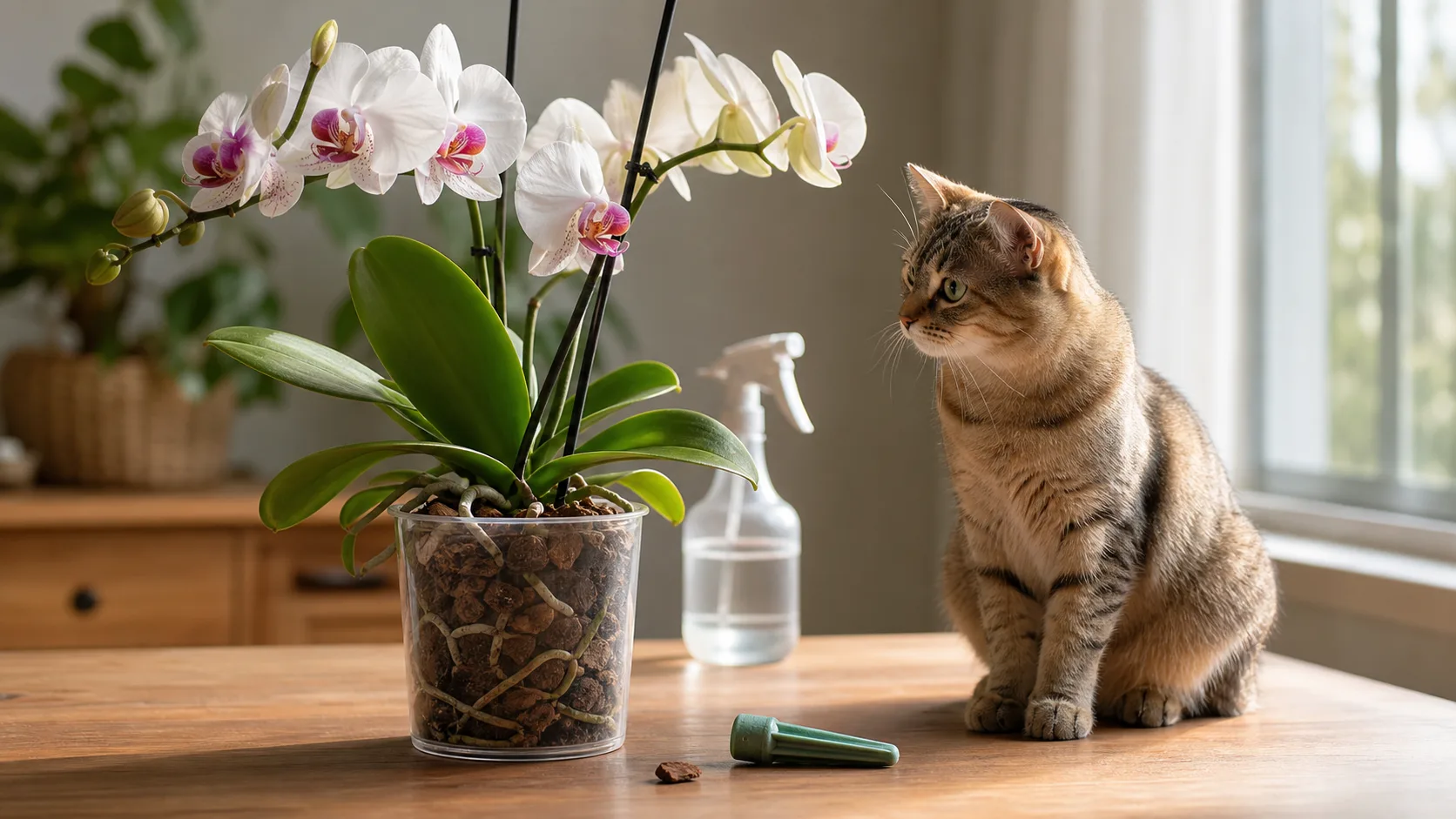
If you searched this because your cat just took a bite out of your orchid, take a breath first. The short answer is reassuring: the common household orchid, the kind you find at a grocery store or garden center, is not considered toxic to cats. But that answer leaves out everything that actually matters when you are standing there watching your cat lick a petal.
The real question is not just is this plant toxic. It is why does my cat look uncomfortable anyway, and what should I do right now.
Identification Snapshot
| Check | What it usually means |
|---|---|
| Common household orchid | Broad waxy leaves, bark-filled nursery pot, arching flower spike, usually a Phalaenopsis |
| Safest documented answer applies to | A potted Phalaenopsis, the common moth orchid on the ASPCA non-toxic list |
| Extra caution trigger | Mixed florist bouquet, unlabeled specialty orchid, or a plant bought very recently |
| Non-plant hazard to check | Fertilizer spikes, pesticide or fungicide residue, plus bark or moss from the pot |
| Best first move after a bite | Remove plant bits, identify the plant, then watch for vomiting, drooling, or repeated chewing |
What Most Orchid Safety Guides Miss
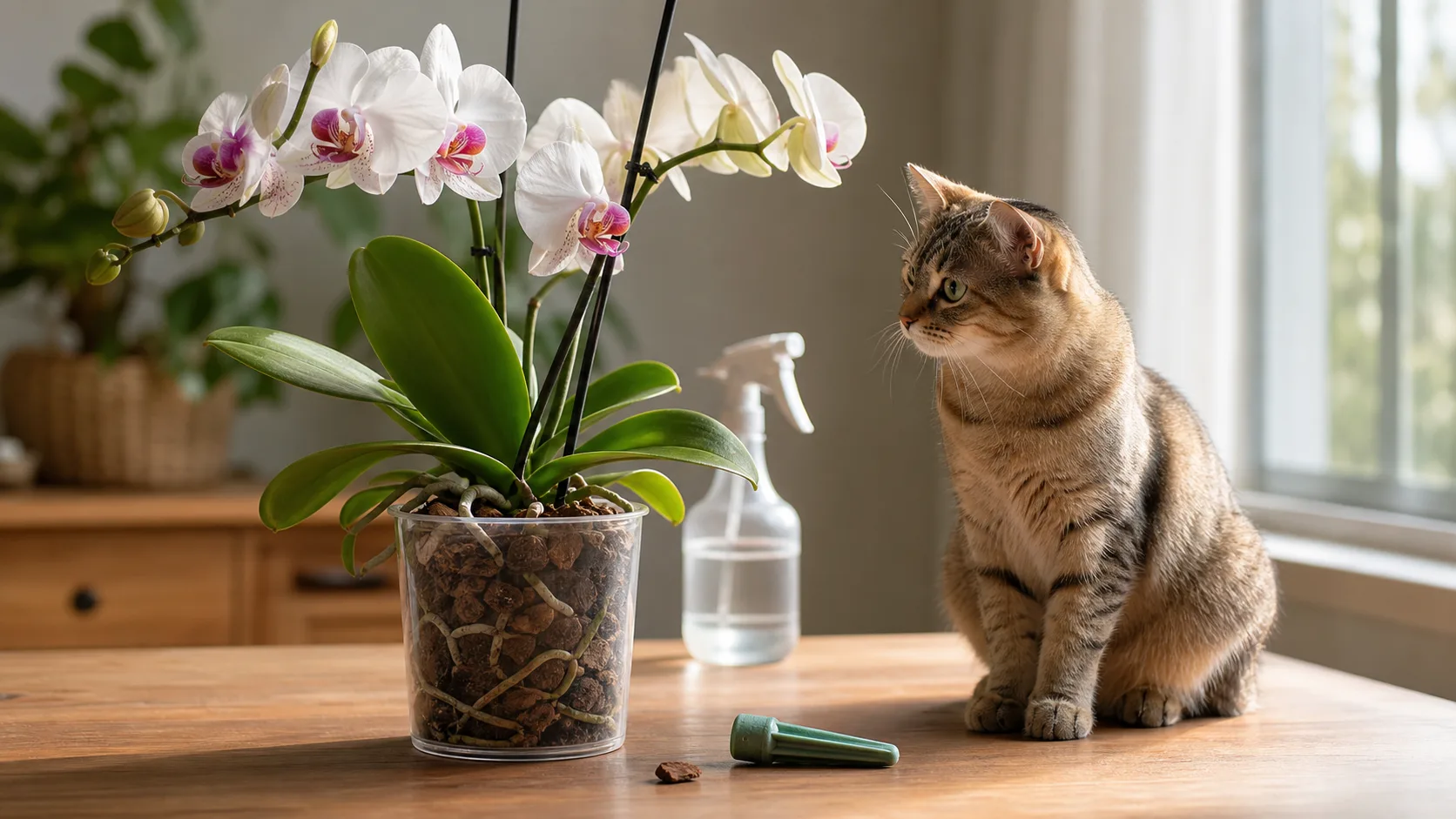
Separate the orchid itself from the amount chewed, bark medium, and any fertilizer or spray residue.
Almost every search result will tell you that orchids are not toxic to cats, then stop there. That answer is technically correct for the most common household orchid, but it leaves out three things that matter once your cat has actually chewed one.
The first gap is species identification. The word “orchid” covers thousands of plants, and the safety record that most guides cite applies specifically to Phalaenopsis, the moth orchid sold at every big-box store and supermarket. If you have a different species, or something from a florist arrangement, the evidence base is thinner.
The second gap is chemical residue. Florist orchids and newly purchased greenhouse plants are frequently treated with pesticides, fungicides, or fertilizer products before they reach you. A cat that chews a treated plant may react to those products, not to the orchid itself. A non-toxic plant plus residue chemicals is a different situation than a non-toxic plant alone.
The third gap is the GI upset explanation. A bite from a non-toxic plant can still cause vomiting. Cat digestive systems are not built for plant material at all, and chewing leaves or petals from safe plants often triggers a mild stomach upset. That is not poisoning; it is a cat’s gut doing exactly what it does with things it was not designed to process.
Understanding those three gaps is what makes the after-bite checklist make sense.
Orchid vs. Lily: Why This Search Causes So Much Panic
This is worth addressing directly, because it drives a lot of the fear behind this search.
True lilies, including Easter lily, Tiger lily, Asiatic lily, and Daylily, are extremely toxic to cats. Even a small amount of pollen, vase water, or a single chewed leaf can trigger acute kidney failure. The ASPCA lists true lilies among the most dangerous plants for cats, full stop.
Orchids and lilies are not related, but they are frequently sold together. A floral arrangement for Mother’s Day or the winter holidays might include both a Phalaenopsis stem and a lily stem side by side. If you are staring at a mixed bouquet and panicking about the “orchid,” check whether there are lily stems in that same arrangement.
If you see long trumpet-shaped flowers, prominent stamens, or leaves that look like elongated flat straps, look harder at what else is in that vase. The orchid may genuinely be the least of your concerns.
The rule for mixed bouquets: identify every stem before deciding how worried to be, not just the one your cat happened to chew.
Which Orchid Do You Actually Have?
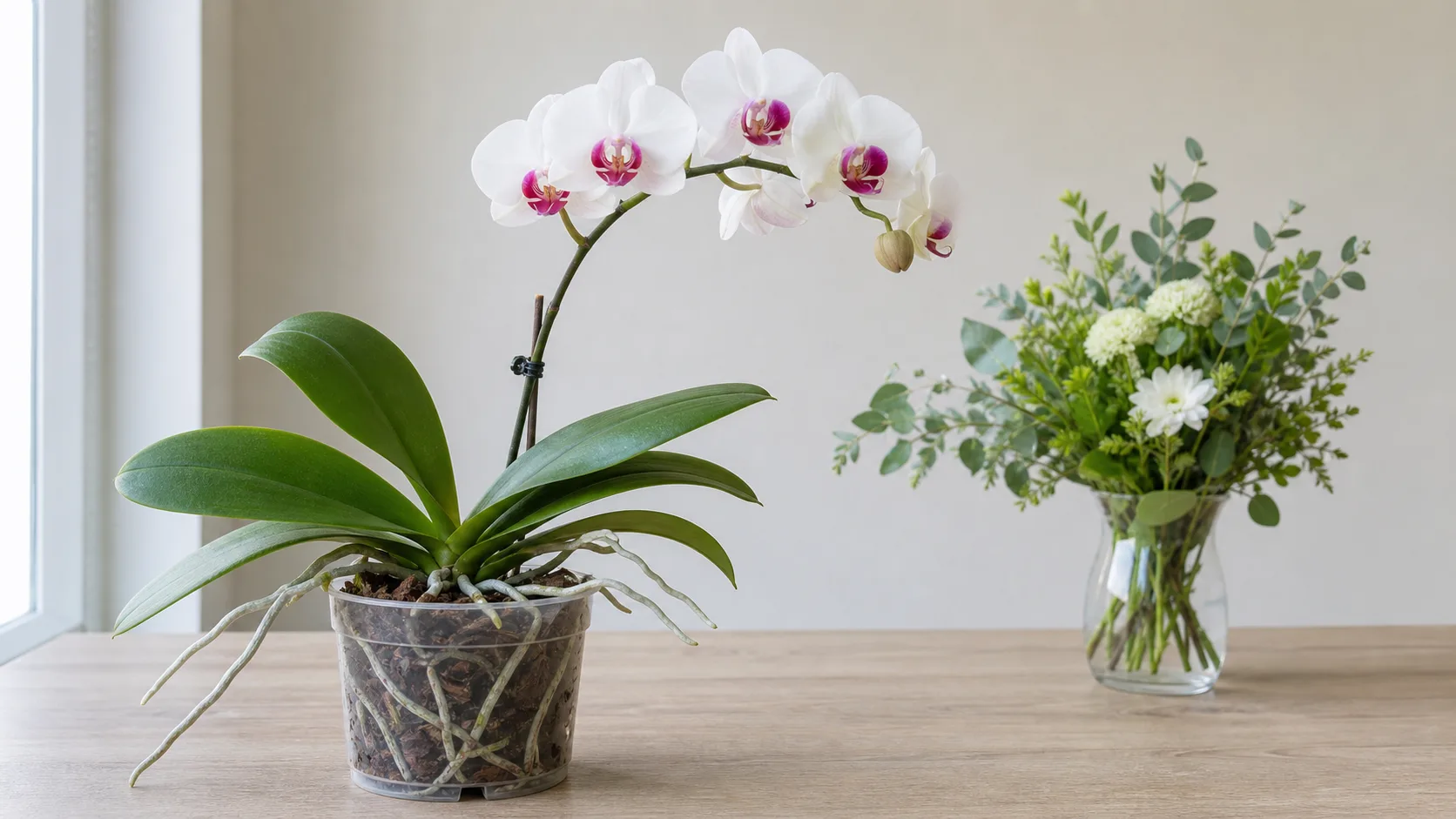
Broad waxy leaves, aerial roots, and a bark-filled nursery pot identify the common moth orchid most safety listings address.
When people ask whether orchids are toxic to cats, they are almost always asking about one specific plant: Phalaenopsis, also called the moth orchid or moon orchid. According to Cornell Cooperative Extension, Phalaenopsis is the easiest orchid to grow indoors and the most widely available at nurseries and big-box stores. It is the one with broad, waxy leaves and arching stems of blooms in white, pink, purple, or yellow. It is the one that shows up in supermarkets in little plastic sleeves.
The ASPCA lists Phalaenopsis orchid as non-toxic to cats, dogs, and horses. That listing covers the species under its common names: moth orchid and moon orchid.
Other orchids sold through specialty nurseries or included in florist arrangements may have less documented safety records. The broader orchid family is enormous, and the ASPCA database does not have individual entries for every genus. If you have something unusual from a specialty vendor or an unlabeled stem in a cut flower arrangement, that is a different situation than the potted grocery-store plant.
The quick rule: if it came in a nursery pot with bark chips and wide flat leaves, it is almost certainly a Phalaenopsis, and its toxicity picture is well-documented. If it came in a mixed bouquet from a florist, treat it as less certain until you can identify it, and check everything else in the arrangement while you are at it.
You can cross-reference your specific plant against the full ASPCA toxic and non-toxic plants database by common or scientific name. Our cat-safe plant guide also covers which popular houseplants earn a clear pass and which ones need more caution.
Lookalikes and Mixed-Bouquet Plants People Confuse With Orchids
| Plant or situation | How to tell it apart | Why the risk changes |
|---|---|---|
| Common moth orchid (Phalaenopsis) | Wide flat leaves, nursery pot with bark, arching bloom spike | This is the best-documented non-toxic answer for cats |
| Unknown florist orchid stem | Loose cut stem in a bouquet, no pot or bark medium to inspect | Harder to identify quickly, so the shortcut answer gets weaker |
| True lily in the same bouquet | Trumpet-shaped flower, visible stamens, often sold in mixed arrangements | This is the high-risk emergency plant for cats, not something to monitor casually |
The word orchid gets used loosely in bouquets and gift arrangements, which is why the species check matters before you rely on a quick yes-or-no answer.
Why a Cat Can Still Feel Sick After Chewing Something “Safe”
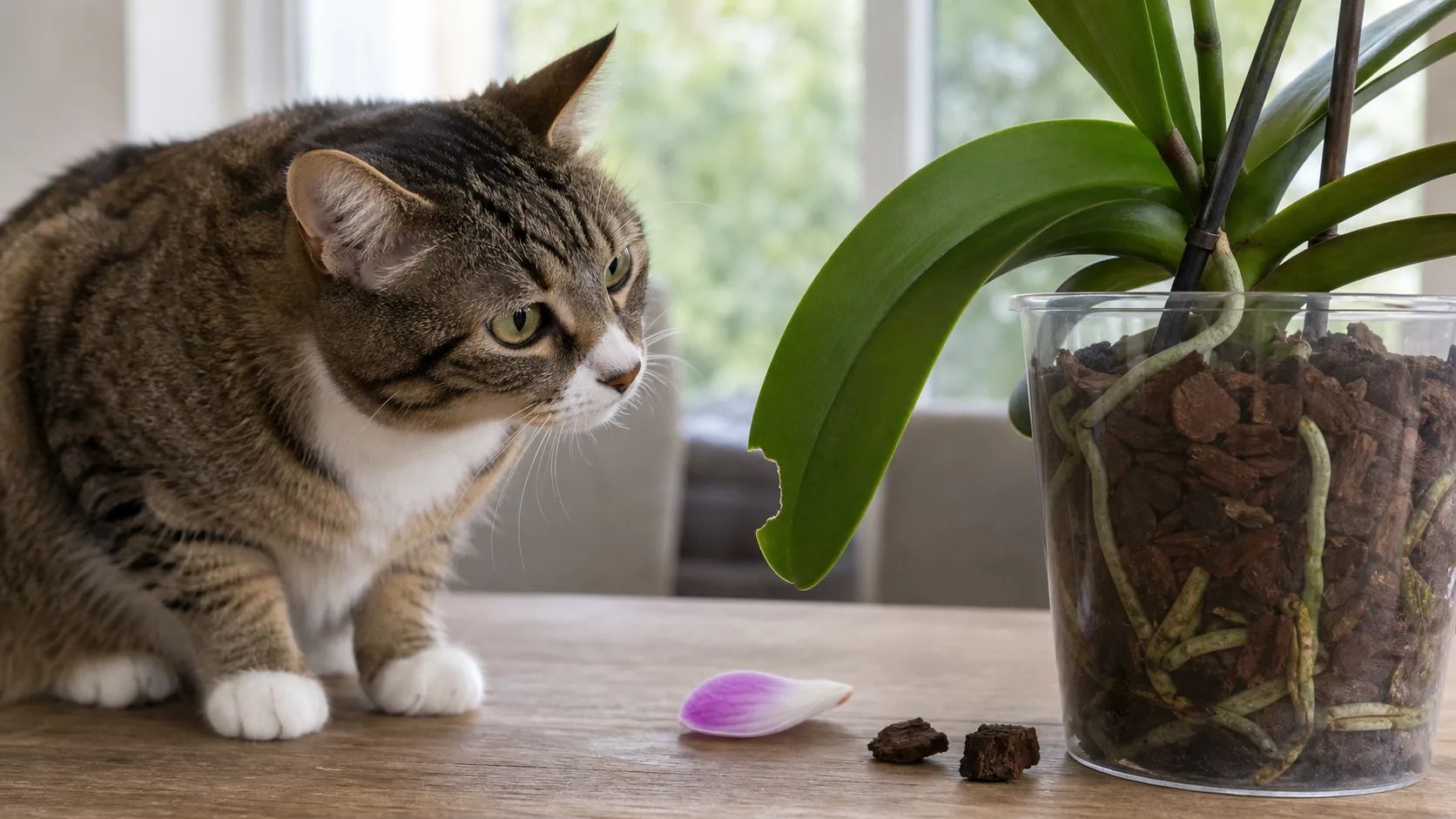
A small bite of non-toxic orchid tissue or bark can still irritate a cat’s digestive system.
This is the piece that catches people off guard. According to the ASPCA, consumption of any plant material can cause vomiting and gastrointestinal upset in cats, even when the plant itself is listed as non-toxic. Cats are obligate carnivores, and their digestive systems are not built to handle plant fiber. Chewing leaves or petals from a perfectly safe plant often triggers a brief stomach upset. That is not poisoning; it is a cat’s gut doing what it does with things it was not designed to process.
There is also a second category of risk that has nothing to do with the orchid itself: what was on the plant.
Orchids sold at florists and grocery stores are commonly treated before sale. Fertilizer spikes pushed into the bark media, pesticide or fungicide sprays to keep them looking pristine on the shelf, or systemic treatments applied at the greenhouse can all be present on a plant that looks completely natural. If your cat chewed a recently purchased or freshly treated orchid, factor that in when deciding whether to monitor at home or call for help.
A seasonal note worth keeping in mind: orchids sold around major gift periods, Mother’s Day, Valentine’s Day, and the winter holidays, are often freshly stocked from the greenhouse and more likely to carry treatment residue than an orchid you have had at home for a year. If a gift orchid was just delivered, treat it like a newly purchased plant until you know its history.
The potting medium is also worth noting. Orchids live in bark chips, moss, or perlite rather than regular soil. A cat that mouths the pot might ingest some of that material, which can cause its own mild GI irritation.
The Four Risks to Separate
| What your cat encountered | Level of concern | Action |
|---|---|---|
| Common moth orchid (Phalaenopsis), no treatments | Low | Monitor for mild GI upset |
| Moth orchid, recently purchased or treated | Moderate | Note product used; call ASPCA Poison Control if unsure |
| Unknown orchid species or florist arrangement | Moderate | Try to identify; call ASPCA Poison Control if you cannot |
| Orchid bark, moss, or potting medium | Low | Watch for mild stomach upset |
Bite Response Care Card
| Scenario | What to do now | Escalate if |
|---|---|---|
| Cat nibbled a known Phalaenopsis leaf or petal | Remove fragments, offer water, and monitor calmly for one-off vomiting or mild GI upset | Vomiting repeats, drooling starts, or your cat looks weak or distressed |
| Plant was recently purchased or treated | Check for fertilizer spikes, spray residue, or fresh greenhouse treatments | You cannot identify the product or symptoms start soon after the bite |
| Bite involved bark, moss, or potting medium | Watch for mild stomach upset and remove loose media from the area | Gagging, repeated vomiting, or refusal to eat or drink follows |
| Plant came from a mixed bouquet or you cannot ID it | Assume the quick “orchids are safe” answer may not be enough | There may be lilies or other toxic stems in the arrangement, so call ASPCA Poison Control or your vet promptly |
What to Check After a Bite
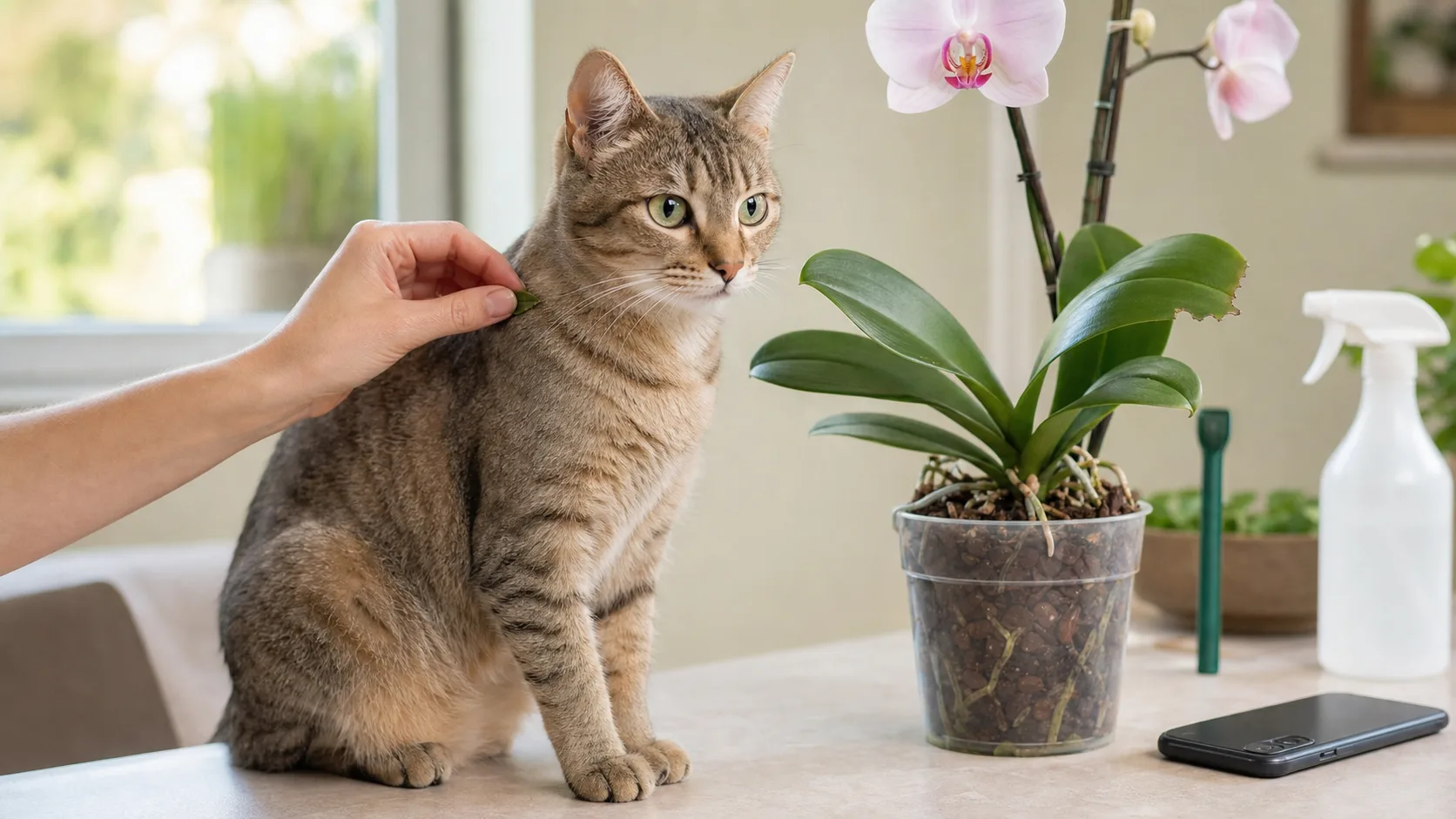
Remove reachable fragments, identify the orchid, and note any fertilizer or spray before deciding what comes next.
When you notice your cat has been at your orchid, here is the sequence that actually helps:
Step 1: Remove any remaining plant material. If there are petals or leaf bits in your cat’s mouth or on their coat, gently clear them. No drama needed; just remove what you can reach.
Step 2: Identify the orchid. Is it a potted Phalaenopsis from a garden center? A stem from a florist arrangement? Part of a mixed bouquet? The grocery-store moth orchid has the clearest safety record. An unidentified florist stem is harder to evaluate quickly, and a mixed bouquet needs every stem checked.
Step 3: Check for treatments. Look at the pot. Is there a fertilizer spike pushed into the bark? Did you recently spray the plant? Did you buy it very recently, meaning it may still carry greenhouse treatment residue? If yes to any of these, note it.
Step 4: Watch your cat. A single episode of vomiting after plant chewing is common and usually resolves on its own. PetMD advises watching for vomiting, diarrhea, drooling, or difficulty swallowing after plant ingestion, and escalating if symptoms continue or worsen rather than settling within an hour.
Common Problems After an Orchid Bite
| Symptom or situation | Most likely explanation | What to do next |
|---|---|---|
| One vomit episode after chewing a petal or leaf | Mild GI upset from plant fiber, even if the orchid itself is non-toxic | Monitor, keep the plant out of reach, and see whether your cat settles quickly |
| Drooling or pawing at the mouth | Irritation from plant material, bark dust, or treatment residue | Remove obvious debris if safe and call for guidance if it continues |
| Repeated vomiting or obvious lethargy | A bigger amount eaten, another toxic stem involved, or chemical residue on the plant | Call ASPCA Poison Control or your veterinarian |
| Panic because the bouquet says “orchid” | The real danger may be a lily or another unlabeled stem in the same arrangement | Identify every stem before assuming the orchid was the only thing chewed |
When to Watch at Home vs. When to Call

An alert cat can often be monitored calmly while you keep veterinary advice and a carrier within reach.
Most cats that chew a common moth orchid will be completely fine, or will have a brief upset stomach that passes on its own. You do not need to rush to an emergency vet every time a cat bats at a flower.
Monitor at home if:
- You are confident it is a Phalaenopsis from a garden center
- The plant has not been recently treated
- Your cat had a small bite, not a full leaf
- Any vomiting was brief and your cat seems otherwise normal
Call for guidance if:
- You cannot identify the plant and are not confident it is a moth orchid
- The plant was recently treated with fertilizer or a pesticide and you are unsure what it was
- Your cat ate a meaningful amount, not just a small nibble
- Symptoms are continuing or worsening after 30 to 60 minutes
- You see drooling, pawing at the mouth, trouble breathing, or trembling
- The orchid came in a mixed floral arrangement and you cannot confirm what else is in it
The ASPCA Animal Poison Control Center (888-426-4435) is the fastest way to get a clear answer for your specific situation. There is a consultation fee, but they can tell you whether what your cat ate warrants a vet visit or whether monitoring at home is appropriate. Keep that number somewhere easy to find; it is useful for any plant ingestion question, not just orchids.
Four Mistakes Owners Make After a Bite
Assuming all orchids have the same evidence base. The ASPCA non-toxic listing applies specifically to Phalaenopsis. Rarer orchid genera or unlabeled stems in florist arrangements have thinner documentation. If you do not know the species, do not rely on the Phalaenopsis entry.
Conflating orchids with lilies. This is the most consequential mistake in this entire topic. True lilies are not remotely in the same risk tier as orchids. If a mixed bouquet is involved, identify every stem, not just the one that caught your eye. A panicked call to poison control over an orchid that sits next to an unnoticed lily stem is the scenario this guide is most trying to prevent.
Assuming non-toxic means symptom-free. As the ASPCA notes across its plant database, non-toxic plants can still cause GI upset in cats. A vomiting cat after an orchid bite is not necessarily in danger, but it is also not a signal to skip the identification and treatment check steps.
Forgetting that gift orchids and florist orchids may be treated. A plant you have grown yourself for a year is very different from a plant that arrived as a gift last week or a stem cut from a commercial arrangement. Greenhouse and florist treatment chemicals are the more realistic concern than the orchid tissue itself in many cases.
Keeping Cats and Orchids Together Long-Term
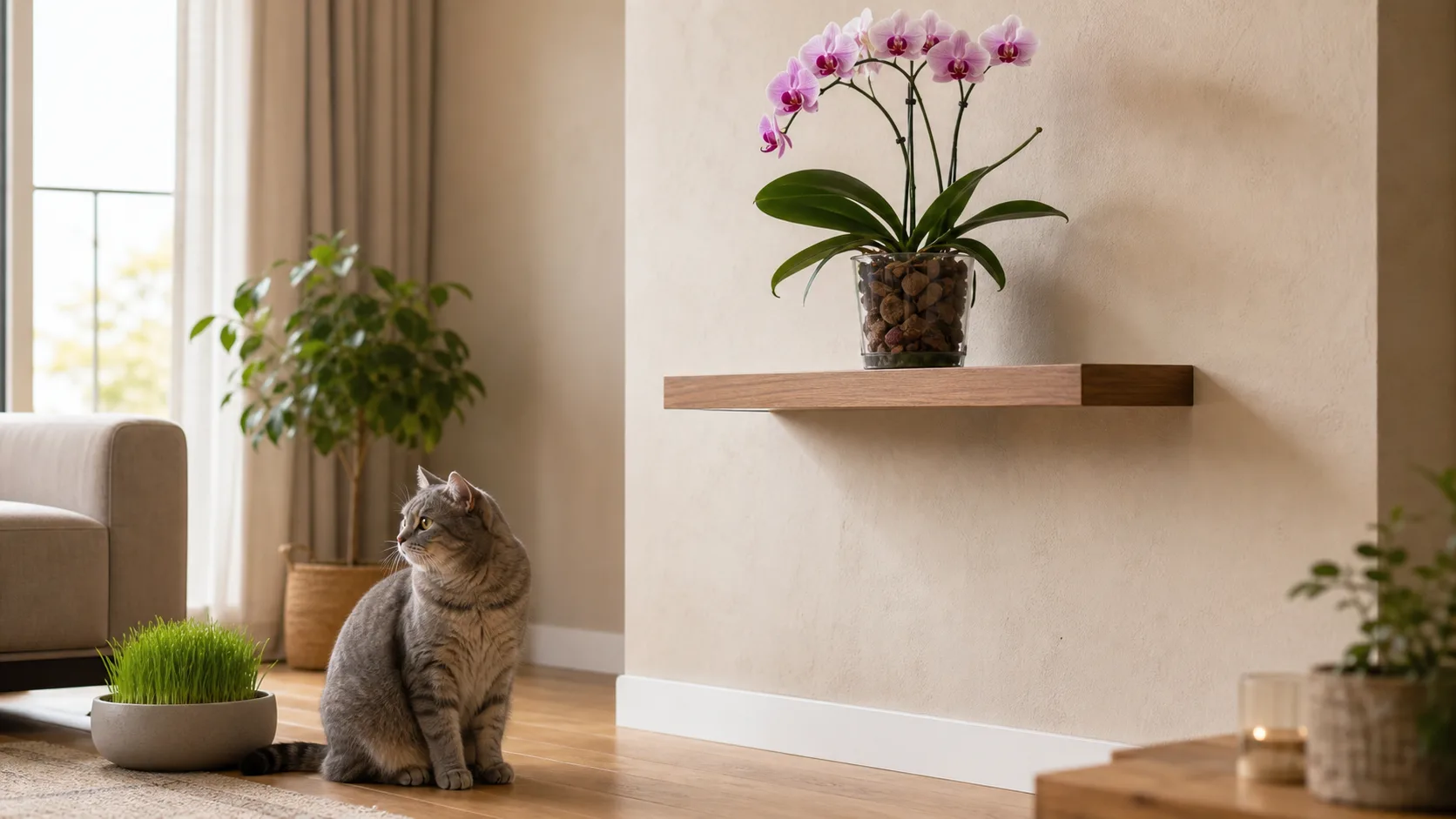
Bright placement on an unreachable shelf, plus an allowed alternative like cat grass, reduces repeat chewing.
Even with the reassuring toxicity picture, “non-toxic” does not mean “fine to let the cat snack on regularly.” Repeated plant chewing causes ongoing GI disruption, and cats that find orchids accessible tend to keep returning to them.
Placement helps more than deterrents. Moth orchids do well on high shelves, windowsills above counters, or in rooms the cat does not spend much time in. They do not need floor space or low surfaces. Getting them off accessible surfaces solves the problem for most cats without any conflict.
If you are looking for plants that can genuinely share a space with your cat without any worry, our cat-safe plant guide covers the species that hold up well in cat households. If the orchid that got chewed now has leaves that are looking off, our orchid leaves turning yellow guide walks through the likely causes and what to check first. And if you are newer to plant care in general and want to feel more confident with your houseplants overall, our indoor plant care guide for beginners covers the fundamentals that apply across most common houseplants.
Orchids and cats can genuinely coexist. Knowing which orchid you have, watching for the right symptoms after a bite, and checking what has been applied to the plant covers most of what you actually need to know.
For another practical pet-safety check, see Is ZZ Plant Toxic to Cats? Symptoms, Sap, and Safer Placement for the risk level and the next steps.
Real User FAQ
Are phalaenopsis orchids toxic to cats? No. The ASPCA lists Phalaenopsis orchid, also known as moth orchid or moon orchid, as non-toxic to cats, dogs, and horses. It is the most common household orchid and the species most people mean when they search this question.
My cat ate an orchid leaf and is now vomiting. Should I be worried? A single vomiting episode after chewing a non-toxic plant is common and usually passes on its own. According to the ASPCA, consumption of any plant material can cause vomiting and GI upset in cats even from non-toxic species, because cats are obligate carnivores and plant fiber does not agree with their digestive systems. Watch for symptoms that continue or worsen. If vomiting keeps going, you see drooling or difficulty swallowing, or you are not confident in the orchid species, call the ASPCA Poison Control line at 888-426-4435.
What if I don’t know what kind of orchid it is? This is when to call ASPCA Poison Control rather than monitoring at home. The safety record is clearly established for Phalaenopsis, but the broader orchid category is too large to rely on a single blanket answer. Identifying the species is the most important first step.
Are true lilies as safe as orchids for cats? No, and this distinction matters a lot if a mixed bouquet is involved. True lilies, including Easter lily, Tiger lily, and Asiatic lily, are extremely toxic to cats and can cause kidney failure even in small amounts. If your cat got into a floral arrangement, identify every stem in it before concluding the orchid was the only concern.
Can orchid fertilizer or pesticides harm my cat? Yes, and most orchid toxicity guides do not mention this. The orchid plant tissue itself may be non-toxic, but treatment chemicals, fertilizer spikes, pesticide sprays, or systemic products applied before sale can be harmful. If you know the plant was recently treated or you are unsure, include that information when you call for guidance.
Is it okay to keep orchids if I have cats? Yes, common moth orchids can coexist with cats, but “non-toxic” does not mean “harmless to chew freely.” Regular chewing causes GI disruption, and cats that find orchids accessible tend to keep returning to them. Placement on high shelves or in rooms the cat does not frequent is more reliable than deterrent sprays for most households.
Are dendrobium orchids safe for cats? Dendrobium orchids appear on the ASPCA non-toxic list. However, dendrobium is often used in cut flower arrangements alongside other stems, so the concern shifts to identifying everything else in the arrangement, not just the orchid stem itself.
What should I have ready before calling a vet or poison control? Have the plant identification if possible, approximately how much your cat chewed, when it happened, what symptoms you are seeing, and whether the plant was recently treated with any fertilizer or pesticide products. That information lets poison control give you a faster, more accurate recommendation.
Methodology Note
We checked the primary keyword and close variants on 2026-07-18, reviewed community discussions in cat-owner and orchid forums for qualitative signals about owner confusion and after-bite concerns, and verified factual claims against ASPCA poison-control listings, PetMD veterinary guidance, Cornell Cooperative Extension, and University of Maryland Extension horticulture resources. Community discussions were used for directional signals about where the real confusion sits, not as statistical evidence. All treatment and escalation guidance reflects the ASPCA Poison Control recommendations.