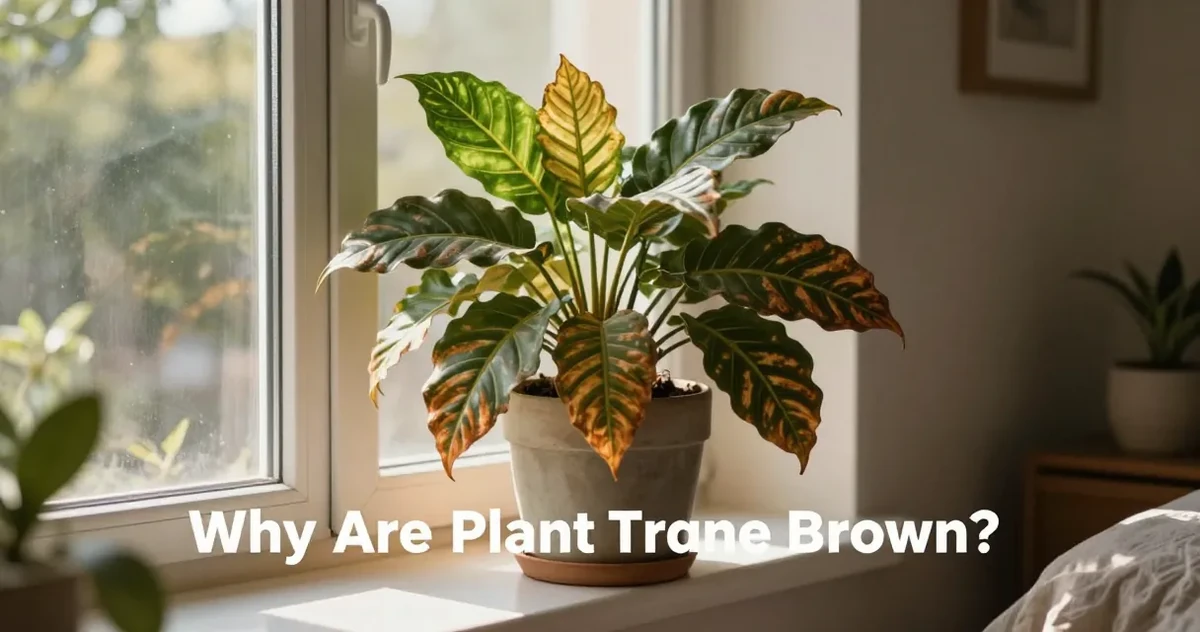
By KnowYourPlant editorial team, updated June 2026. We checked current extension guidance on brown leaf causes, then compared it with real houseplant-owner confusion patterns so this guide helps you diagnose the pattern before you change care.
If you’ve been stressing over your plant’s brown leaves, you’re probably not doing something obviously wrong. Brown leaves are one of the most common plant distress signals, and also one of the most misread.
Here’s what most care guides skip: brown leaves aren’t a diagnosis. They’re a location on the plant, and the pattern of where browning appears tells you far more than the color itself.
Tips, edges, lower leaves, top leaves, scattered patches – each one points in a different direction. This guide walks through ten common causes, what each one looks like, and what to actually check first, along with a quick triage checklist so you’re not guessing in circles.
Symptom Diagnosis Card
Use this quick card when the plant is in front of you and you want the safest first move, not a perfect theory.
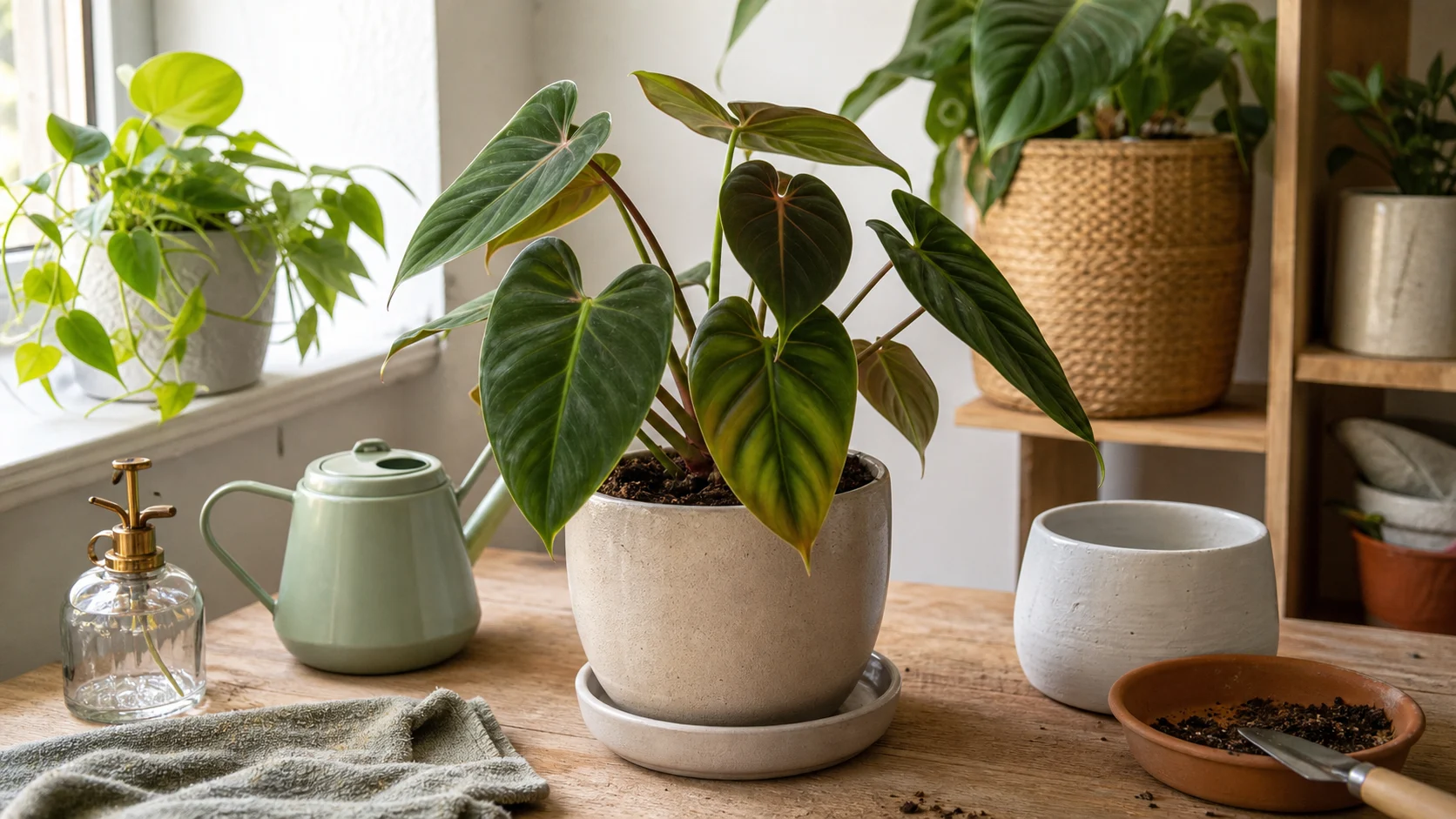
Lower-leaf stress beside practical watering and potting tools gives a useful starting point for brown-leaf triage.
| What you notice first | Most likely direction | Safest next step in the next 24 hours |
|---|---|---|
| Brown tips but the rest of the leaf looks healthy | Low humidity, salt buildup, or tap-water sensitivity | Check humidity, recent fertilizing, and water source before watering again |
| Brown edges and the soil is dry two inches down | Underwatering or dry heat stress | Water deeply, let excess drain, then watch how fast the mix dries |
| Lower leaves yellow first, then go soft brown while the soil stays wet | Overwatering, stalled roots, or early root rot | Stop watering, empty any standing water, and inspect drainage and roots |
| Irregular brown patches on the side facing the window | Sun scorch or heat stress | Move the plant out of direct sun and check for hot glass or vents |
| Browning comes with spots, webbing, stickiness, or random damage | Pest or disease pressure on top of care stress | Isolate the plant and inspect leaves, stems, and roots before treating |
Expert note. Iowa State Extension says brown tips and edges are often linked to low humidity, inconsistent watering, excess fertilizer salts, and water-quality issues. University of Maryland Extension recommends checking soil dryness instead of watering on a fixed schedule, and the Royal Horticultural Society notes that whole brown leaves, brown tips, and brown margins often point to different causes.
What Most Care Guides Miss About Brown Leaves
Most articles list possible causes without telling you which one to rule out first. That’s how people end up fixing the wrong thing – watering more when the real issue is root rot, or adding a humidifier when the soil hasn’t had a proper drink in weeks.
The most common misdiagnosis: blaming light or humidity before checking the roots.
Plant owners frequently assume sun scorch or dry air when experienced responders point straight to the root zone. The soil and root check should come before you blame the environment, almost every time. A plant showing browning lower leaves that also puts out fresh growth at the top can look deceptively healthy – until you tip the pot and find the roots underwater.
And there’s a faster first filter than any cause list: touch the brown tissue.
Crispy and papery? Almost always a moisture or environmental problem. Soft and darkening, sometimes slightly slimy? Water is sitting somewhere it shouldn’t. That single texture observation will eliminate half the causes on this list before you read the rest of it.
For spots, holes, edge damage, and distorted new growth that do not fit a simple brown-tip pattern, compare the symptoms in the leaf damage identification guide.
Before looking at the cause list, run this three-step check:
- Touch the brown tissue – crispy and dry, or soft and mushy?
- Push a finger two inches into the soil – bone dry, or dense and wet?
- Then look at the pattern: tips only, edges, whole lower leaves, or scattered patches?
That sequence will usually narrow ten possible causes down to two or three before you change anything.
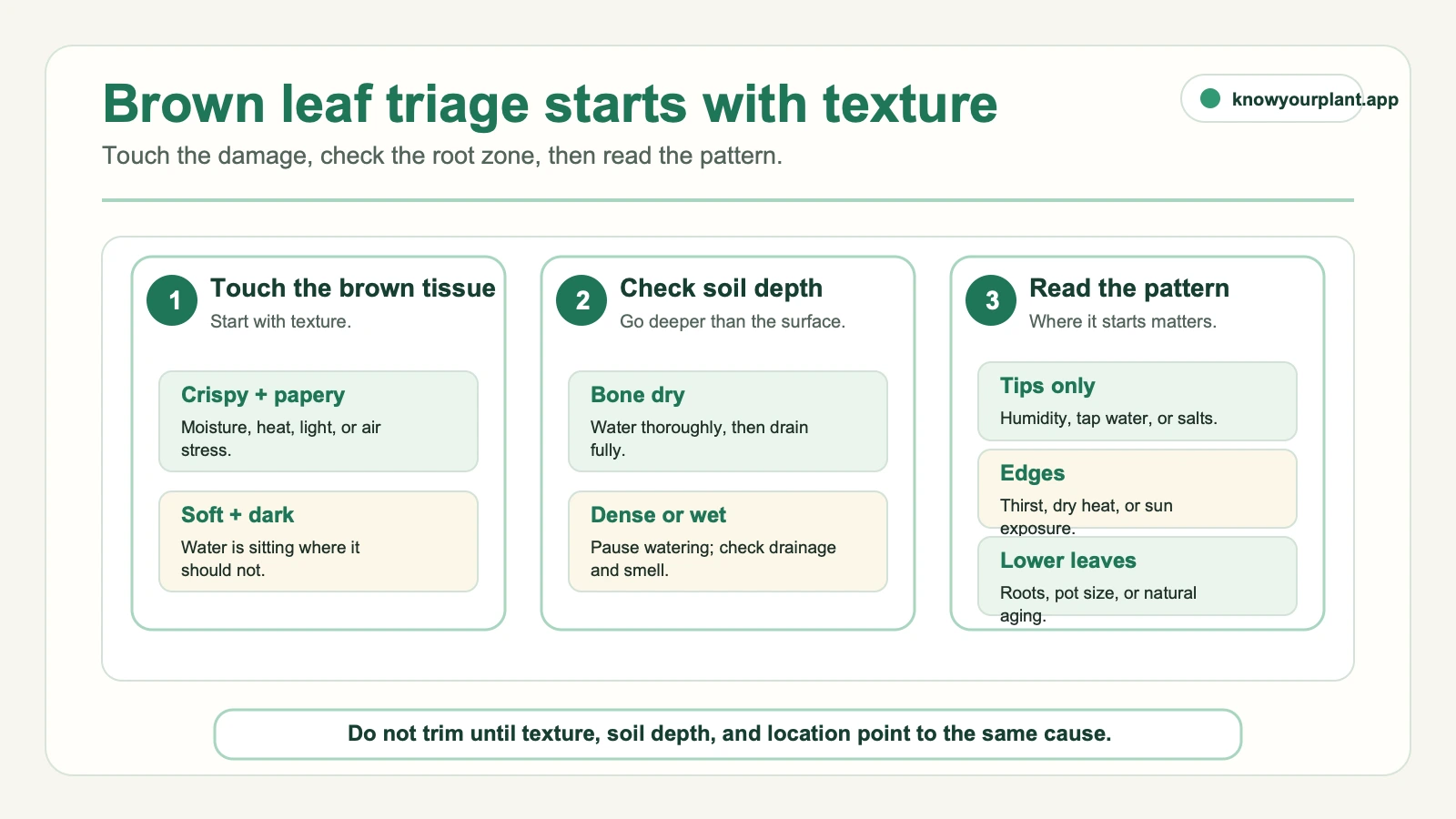
Start with texture, then confirm with soil depth and browning location before watering, trimming, or repotting.
What the Browning Pattern Usually Points To
Before jumping to fixes, take thirty seconds to look at the full picture:
- Where on the leaf – tips, edges, center, or the whole leaf?
- Which leaves – oldest lower leaves, newest growth, or scattered throughout?
- What texture – dry and crispy, or soft and mushy?
- What changed recently – position, watering, fertilizing, or season?
| Browning pattern | Most likely cause | Common lookalike | First safe action |
|---|---|---|---|
| Crispy brown tips only | Low humidity or tap water sensitivity | Fertilizer salt burn | Check humidity; let tap water sit overnight |
| Brown crispy edges, otherwise green | Underwatering or dry heat | Sun scorch | Check soil moisture 2 inches down |
| Soft, yellow-then-brown lower leaves | Overwatering or root rot | Natural aging | Check soil and drainage; inspect roots |
| Irregular brown patches, bleached center | Sun scorch or heat source | Pest damage | Move plant away from direct rays |
| Brown spots with yellow halo, random leaves | Pests or fungal issue | Salt burn | Check undersides of leaves |
| Whole leaf brown, starting from bottom | Natural leaf aging | Underwatering | Check new growth at top – if healthy, trim and move on |
Crispy and dry usually points to a moisture or environmental problem. Soft and dark usually points to water sitting somewhere it shouldn’t. That single texture observation will save you a lot of wrong turns.
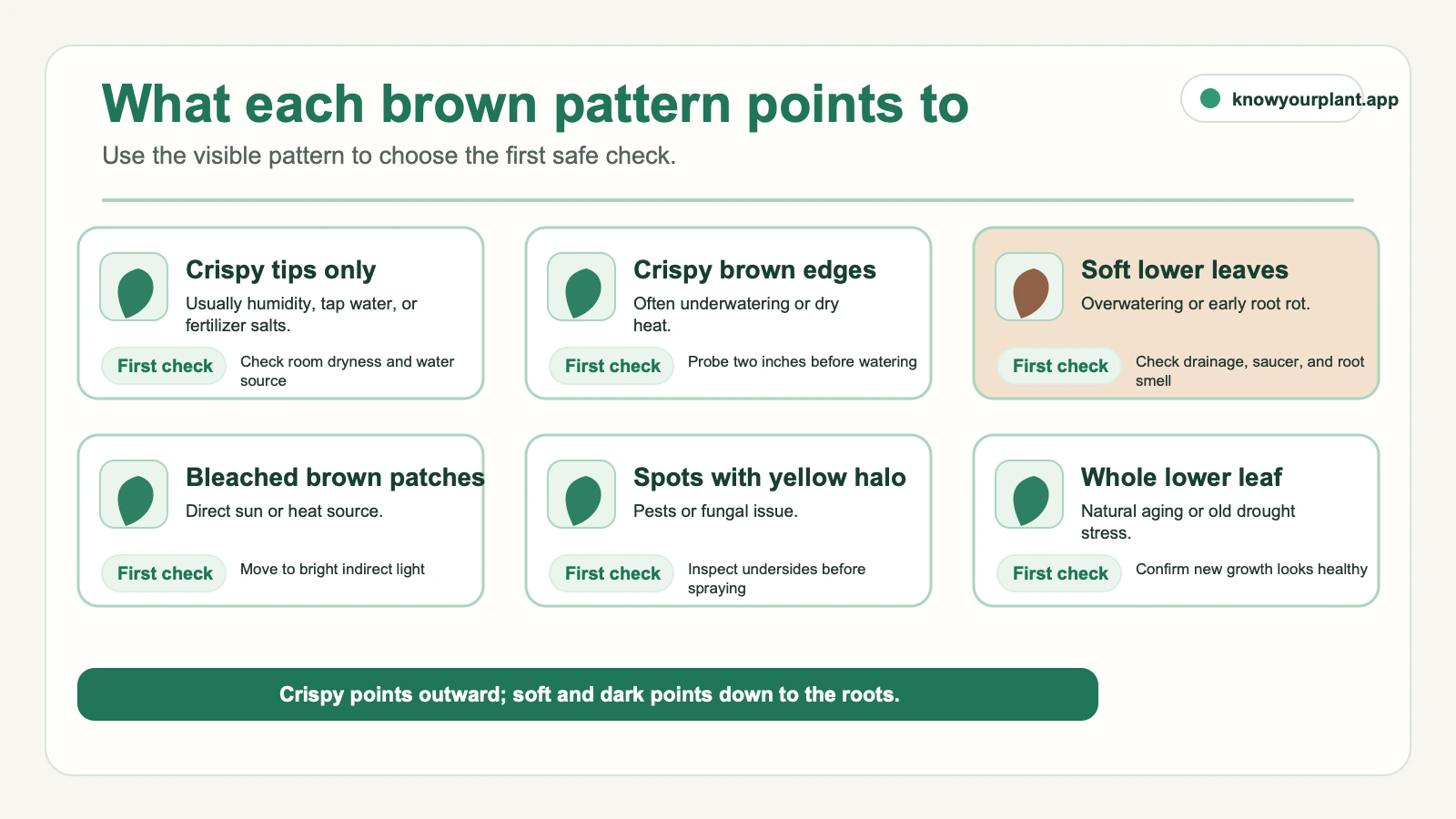
Use the visible pattern as a first safe check: tips, edges, soft lower leaves, bleached patches, and spots each point to a different next step.
Brown-Leaf Decision Tree
Use this order before you prune, repot, or change three things at once:
- If the brown tissue is soft or the leaf yellowed first, check the root zone first. Wet mix, a full saucer, or sour-smelling roots point toward overwatering or early root rot.
- If the tissue is crispy, check soil depth before humidity gadgets. Dry mix two inches down means the plant needs a thorough drink before anything else.
- If only the tips are brown, review fertilizer and water quality next. White crust on the soil or recent feeding points toward salts; spider plants, dracaenas, and peace lilies are also more likely to react to tap water.
- If the browning is patchy and sits on the window-facing side, inspect light and heat exposure. Sun scorch and radiator heat usually damage the most exposed surface first.
- If the pattern is random, spreading, or paired with webbing or sticky residue, inspect for pests before adjusting watering again.
That decision tree will solve most brown-leaf cases faster than reading ten causes in a row and guessing which one feels familiar.
10 Reasons Plant Leaves Turn Brown
1. Underwatering
When a plant doesn’t get enough water, it pulls moisture from the oldest tissues first. You’ll typically see brown, crispy leaves at the very base of the plant, and the soil will feel bone dry when you press a finger two inches in.
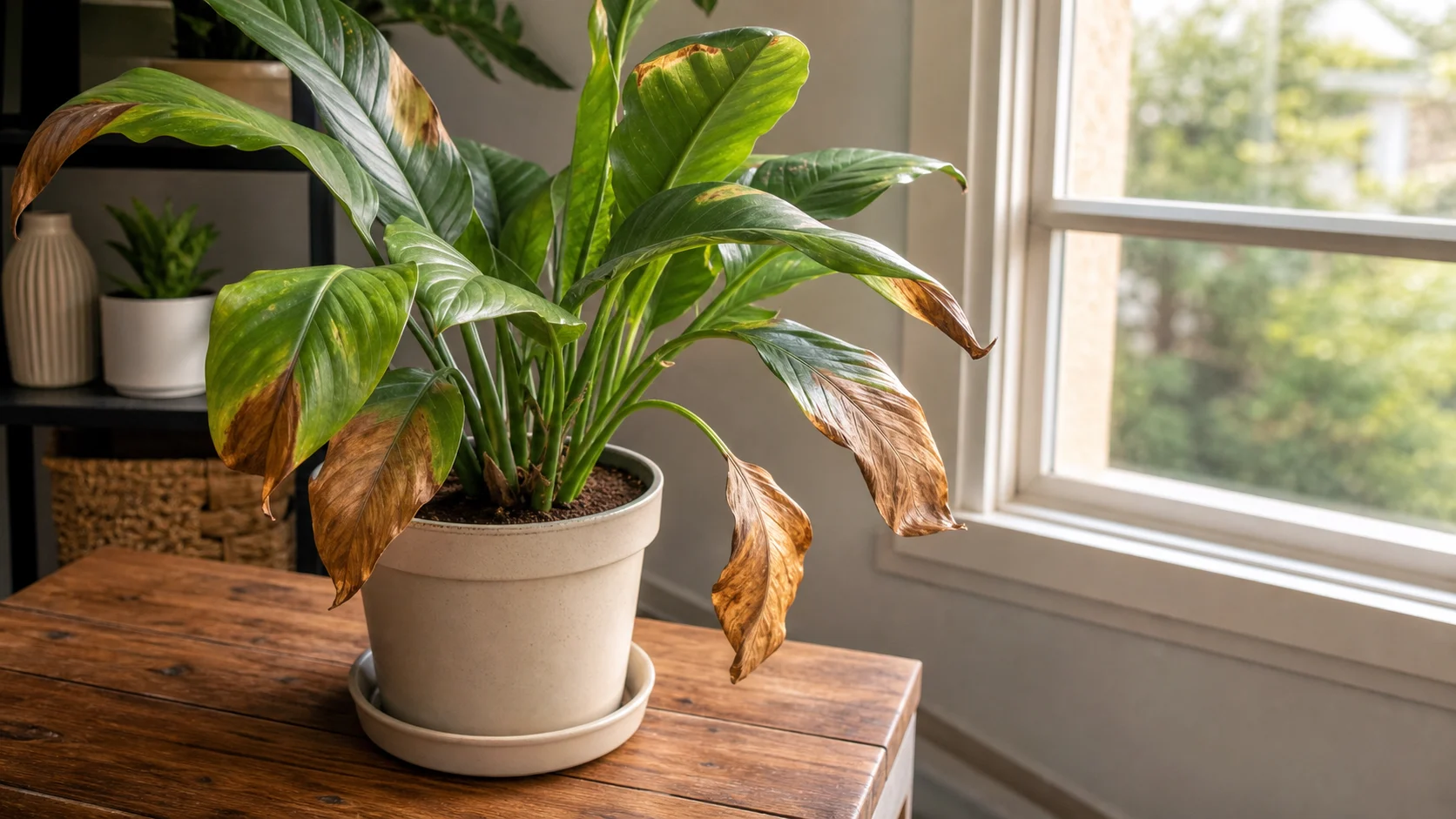
Dry soil and papery lower leaves show the crisp browning pattern typical of an underwatered peace lily.
The Royal Horticultural Society notes that entire brown leaves often indicate underwatering or excessive heat, and that the pattern of browning – whole leaf versus tips only – is a key first diagnostic split.
Fix: Water thoroughly until it drains from the bottom, then let the top portion of soil dry before watering again. Misting the leaves is not a substitute – it doesn’t reach the roots.
Seasonal note: In winter, many plants slow their water uptake as growth pauses for the season. The watering frequency that worked fine in summer can easily become too frequent once temperatures drop. Check the soil before every water, not the calendar.
2. Overwatering and Root Rot
Overwatering is the most common reason houseplants fail, and brown leaves are often how it surfaces first. Unlike underwatering, the browning tends to start with yellowing that then turns brown, and affected leaves feel soft rather than crispy.
If the lower leaves are yellowing and then browning while the soil stays wet for days at a time, check the roots. Healthy roots are white and firm. Rotting roots are dark, soft, and smell sour.
According to University of Maryland Extension, soluble salt buildup from overwatering can cause brown leaf tips, dropped lower leaves, and damaged roots – and it often goes unnoticed until the symptom pattern looks almost identical to underwatering.
Fix: Let the soil dry out more between waterings. If root rot has already started, you may need to repot and trim the damaged roots. Our guide to treating root rot walks through what to do once you tip the pot and see what’s underneath.
3. Low Humidity
Tropical houseplants – pothos, calatheas, monsteras, ferns – evolved in humid environments. Most homes in winter drop to 30 to 40 percent relative humidity. Iowa State University Extension identifies low humidity as one of the most consistent causes of brown tips and edges on houseplants, particularly for tropicals that thrive above 50 percent.
The symptom is very specific: brown tips on otherwise healthy leaves. The rest of the leaf looks fine – no yellowing, no mushiness, just dry crispy tips.
Fix: Group plants together to share humidity, add a humidifier near your plant shelf, or set pots on a tray with damp pebbles. For calatheas and other humidity-sensitive plants, our calathea care guide covers humidity setups that actually make a difference.
4. Direct Sun or Heat Stress
If your plant sits in direct sun and develops brown patches in the middle of leaves – not the tips or edges but irregular bleached patches – that’s sun scorch. Plants near radiators, heating vents, or south-facing windows in summer are especially vulnerable. The damage tends to appear on the side of the leaf facing the light source.
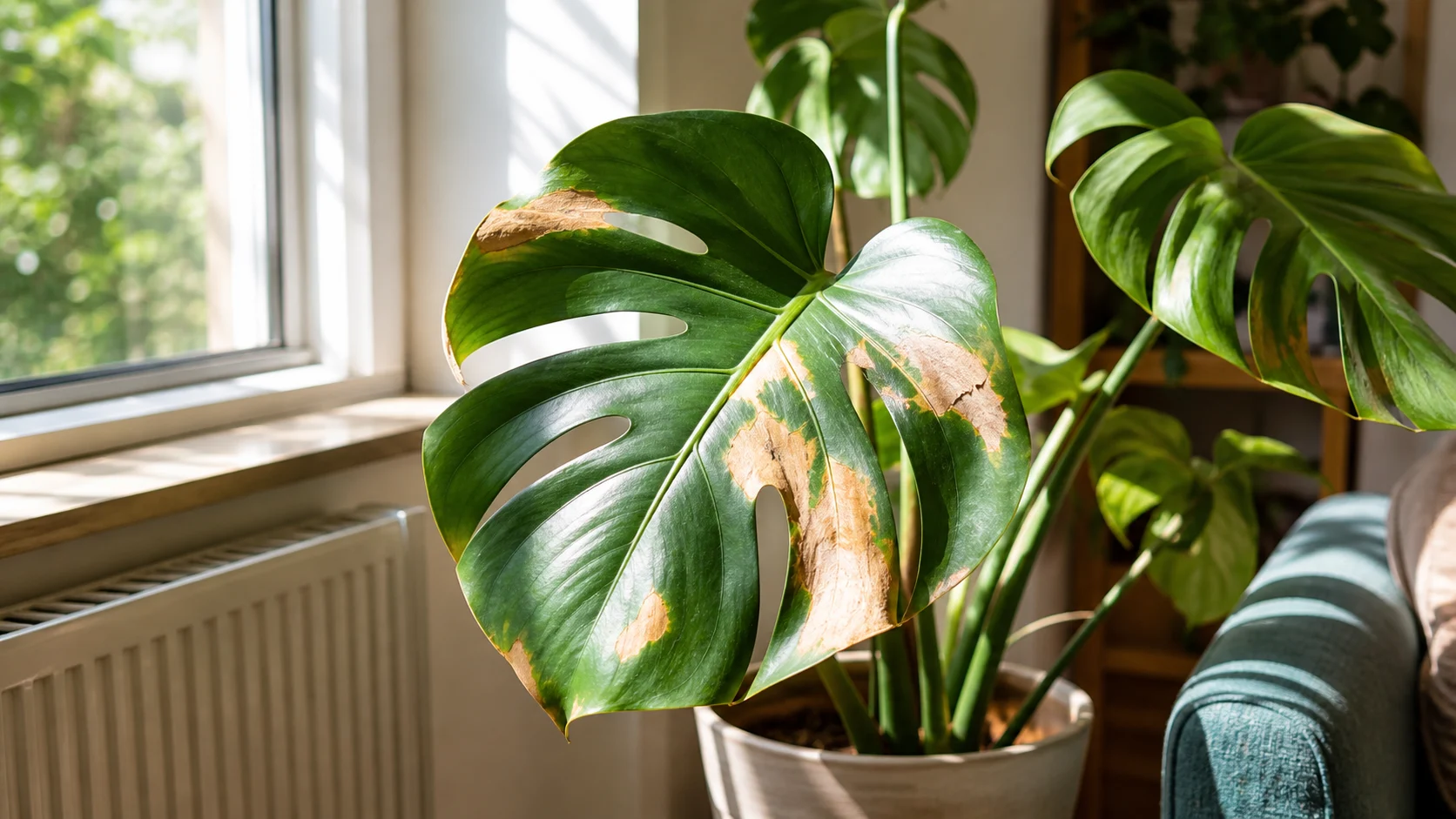
Pale, papery patches on a sun-facing monstera leaf reveal the combined stress of direct rays and nearby heat.
A useful clue: sun scorch damage happens fast after a position change, often appearing within a day or two of moving the plant somewhere sunnier.
Fix: Move the plant away from direct rays. Most tropical houseplants prefer bright indirect light – the kind where the light fills the room but doesn’t hit the leaves directly. If the damage shows up as pale, papery patches on the window-facing side, our plant sunburn guide will help you tell light scorch from watering problems.
5. Fertilizer Burn and Salt Buildup
If you fertilize regularly, salts from the fertilizer accumulate in the soil over time. When the concentration gets too high, it draws water out of the roots rather than letting them absorb it, and you end up with brown tips that look almost identical to low-humidity damage.
Iowa State University Extension and University of Maryland Extension both identify excess fertilizer salts as a cause of brown leaf tips. Maryland’s guidance specifically advises against fixed watering schedules because inconsistent watering accelerates salt buildup over time.
A useful clue: look for a white crust on the soil surface or on the outside of a terracotta pot. That’s accumulated salt.
Fix: Flush the soil thoroughly by watering until a generous amount drains from the bottom, then repeat a few times. Skip fertilizing for four to six weeks after flushing. Our plant fertilizer guide covers the difference between flush-safe liquid formulas and slow-release options.
6. Tap Water Sensitivity
Some plants – spider plants, dracaenas, peace lilies – are sensitive to the chlorine or fluoride in municipal tap water. Over time, this shows up as brown tips even when watering and humidity are otherwise fine. Iowa State Extension specifically flags fluoride sensitivity as a common cause of tip burn in these species.
Fix: If water quality is the strongest match, trial rainwater or distilled water while keeping the rest of the routine stable. Leaving tap water out overnight does not remove fluoride and is not a reliable test for every water system.
For Chlorophytum comosum, the spider plant brown tips guide provides a one-change-at-a-time diagnostic path and explains why old brown tissue is not the right measure of recovery.
7. Cold Drafts or Temperature Shock
Cold air from an open window in winter, an air conditioning vent blowing directly on the plant, or a spot near a drafty door can all cause browning – usually on the leaves closest to the cold source. The damage often appears suddenly after a temperature event rather than gradually.
Most tropical houseplants are comfortable between 15 and 27 degrees Celsius (60 to 80 degrees Fahrenheit). Below that range, cold stress sets in quickly, especially for plants sitting close to a cold glass pane in winter.
Fix: Move the plant away from vents, drafts, and cold glass. If you’re not sure whether the window is the issue, hold your hand near it on a cold night – if you can feel the chill, your plant can too.
8. Pests
Spider mites, thrips, and scale insects can cause stippling, spotting, and browning that doesn’t follow the usual tip-or-edge pattern. Check the undersides of the leaves first – that’s where most pests hide and where the earliest damage appears, often before you’d notice anything on the top surface.
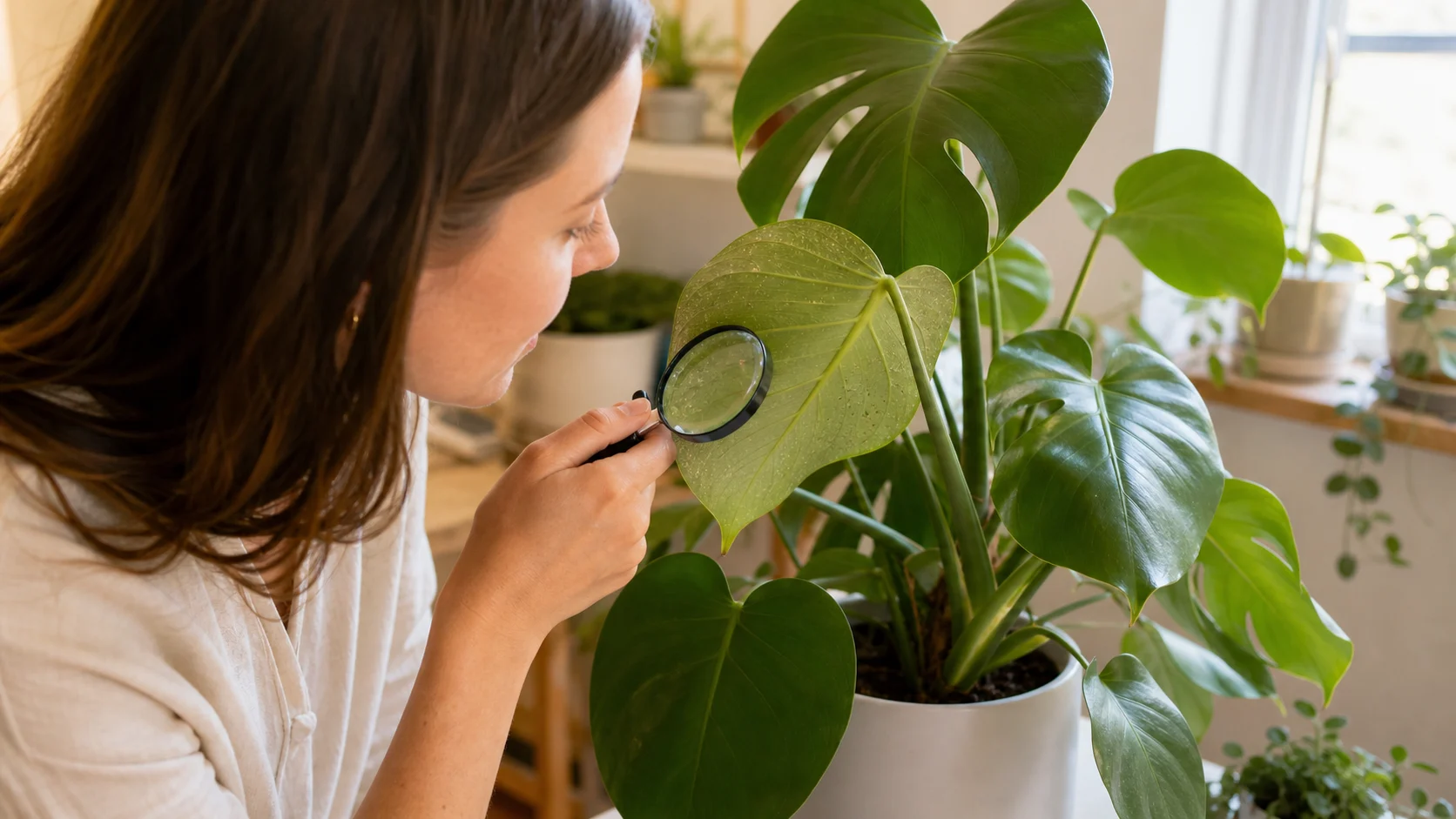
Inspecting the stippled underside of a monstera leaf helps separate pest damage from ordinary tip or edge browning.
Fix: Identify the pest before treating. Our guides on getting rid of spider mites and mealybugs cover treatment steps by pest type. If you’re not sure what you’re looking at, our tiny bugs in houseplant soil guide can help you narrow it down.
9. Root-Bound Stress
When a plant has outgrown its pot, roots circle the inside and eventually run out of room to expand. A root-bound plant often struggles to take up water and nutrients efficiently, which shows up as browning on older leaves – especially combined with soil that dries out much faster than it used to.
One pattern that confuses a lot of people: the plant can still put out new growth at the top while older tissue shows root-zone stress underneath. The new leaves look fine, so the owner assumes the plant is doing well. If you’re seeing ongoing browning on lower leaves despite what looks like active top growth, check the roots and drainage.
Check: Tip the pot and look at the drainage holes. If roots are visibly pushing out, the plant is ready for a larger container.
Fix: Repot into a pot one size up with fresh potting mix. Our guide on how to repot plants covers timing, soil choice, and technique.
10. Natural Leaf Aging
Sometimes brown leaves aren’t a problem at all. Every plant eventually drops its oldest leaves as it redirects energy to new growth. If the browning is limited to a few leaves at the very base, the plant looks otherwise healthy, and new leaves are appearing at the top, this is just normal leaf turnover – not a care failure.
Fix: Trim the old leaves back cleanly with scissors and move on. One or two lower leaves browning while the rest of the plant is doing well is not a warning sign.
5-Minute Brown-Leaf Triage Checklist
Work through this sequence before changing anything:
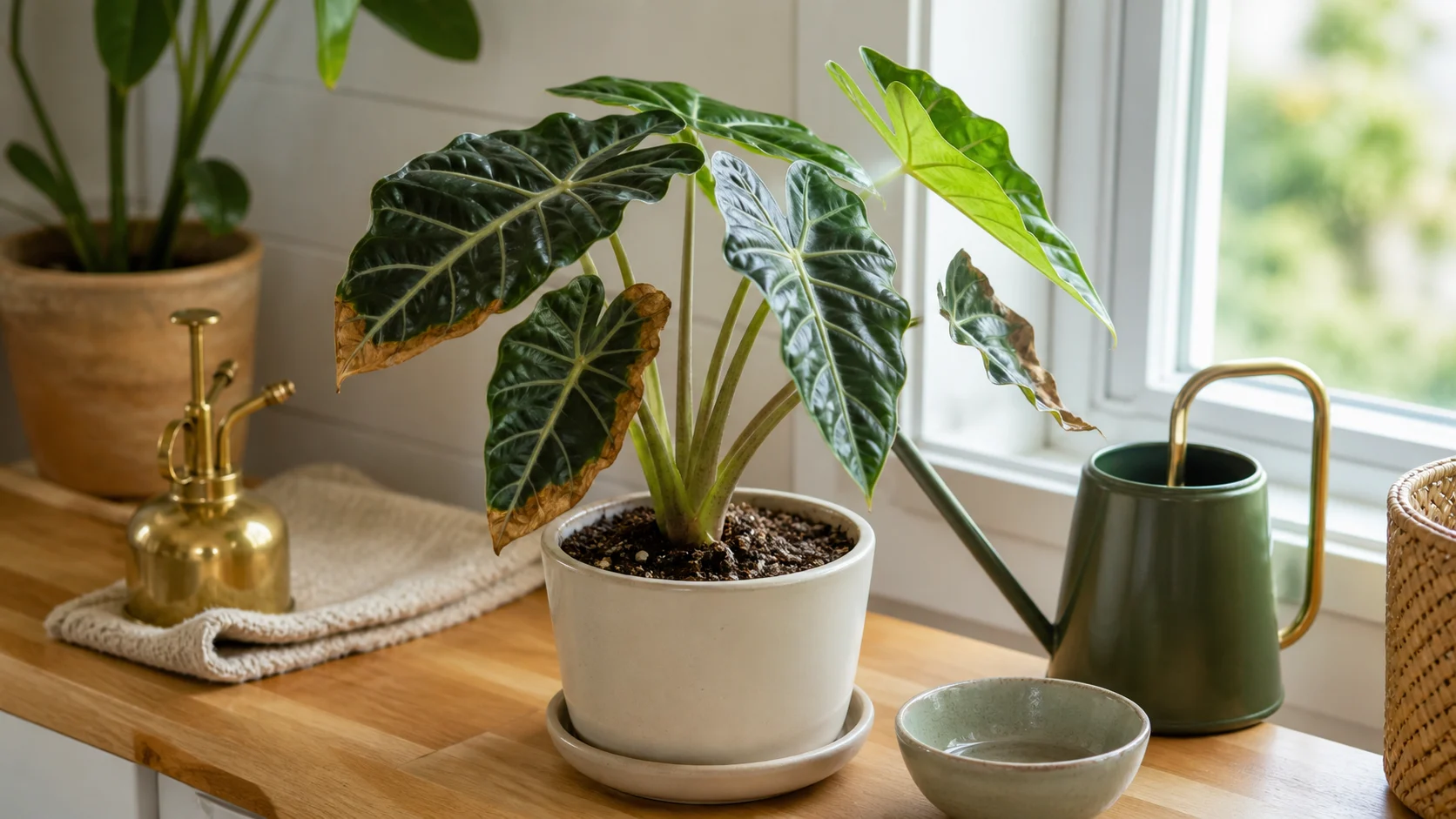
Visible soil, drainage saucer, watering tools, and brown leaf edges frame the first checks in a quick triage.
- Soil moisture at 1 to 2 inches – push a finger in. Wet and dense, or bone dry?
- Drainage and saucer – is water sitting in the saucer? Is the drainage hole blocked?
- Root smell and texture – tip the pot and look at the drainage holes. Do roots smell sour? Are they soft?
- Humidity and heat exposure – is the plant near a vent, radiator, or cold window?
- Recent fertilizing – when did you last fertilize? Any white crust on the soil surface?
- Water quality – is this a fluoride-sensitive species getting straight tap water?
Most situations resolve once you locate the right step in that sequence. If roots are fine and humidity is adequate, work through steps 4 to 6. Only trim brown leaves after you’ve identified the cause – trimming first removes the evidence you need to diagnose.
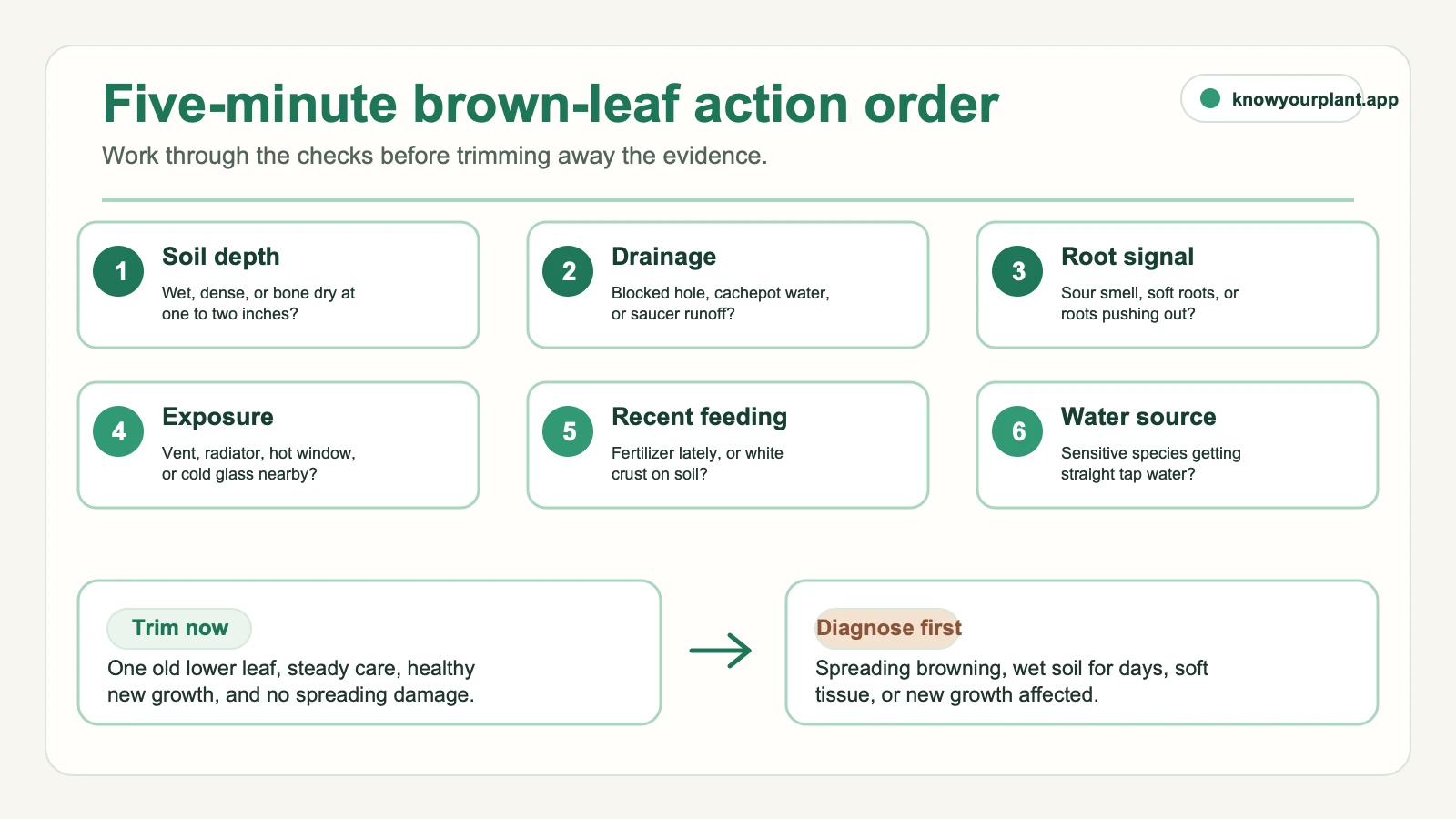
Work through these checks before removing brown leaves, then decide whether a simple trim is enough or a deeper diagnosis comes first.
Common Mistakes That Make Browning Worse
A lot of brown-leaf problems get worse because the first fix is aimed at the wrong cause.
- Watering on autopilot after seeing brown tissue. Brown can mean drought or wet roots, so touching the soil matters more than reacting to the color.
- Trimming every damaged leaf before checking the roots. If the plant is overwatered, the roots tell the real story and the leaf damage is just the visible clue.
- Blaming low humidity for every brown tip. Dry air is common, but fertilizer salts and tap-water sensitivity create nearly identical tip burn.
- Repotting immediately without checking whether the mix is simply staying wet too long. Sometimes the fix is longer dry-back, not a bigger pot.
- Changing light, fertilizer, and watering all at once. When you change everything together, you cannot tell which fix actually worked.
Trim Now or Diagnose First?
Brown tissue can be trimmed cosmetically once you understand what caused it. Removing it won’t slow recovery and often helps the plant redirect energy. But if you’re still unsure what’s going on, don’t prune yet. Those brown leaves are information.
Trim first when: browning is on a single lower leaf, new growth looks healthy, and you’re confident in your watering routine.
Diagnose first when: browning is spreading to multiple leaves, the soil has been wet for several days, new leaves are also showing damage, or the browning is soft and mushy rather than crispy.
Frequently Asked Questions
Why are only the tips of my plant leaves turning brown? Brown tips with the rest of the leaf looking healthy almost always point to low humidity or tap water sensitivity – not a watering problem. Most homes drop to 30 to 40 percent relative humidity in winter, which is noticeably drier than what tropical houseplants prefer. Try grouping plants together, adding a pebble tray with water, or running a humidifier nearby. If humidity is already adequate, let tap water sit overnight before using it. Chlorine and fluoride both cause tip burn in sensitive species like dracaenas, spider plants, and peace lilies.
Can a plant still grow new leaves while other leaves are turning brown? Yes, and it’s one of the most confusing patterns to diagnose. A plant can push out new growth at the top while older leaves fail due to root-zone stress from overwatering, compacted roots, or a pot it has outgrown. New growth doesn’t mean everything is fine underneath. Check the roots and drainage if you’re seeing ongoing browning on lower leaves despite active top growth.
Should I cut off brown leaves or leave them? Once you’ve identified the cause and corrected it, trimming brown leaves is fine. It won’t slow recovery and helps the plant direct energy toward healthier tissue. But if you’re still diagnosing, hold off – brown tissue shows you where the problem is and how it’s progressing. Trim with clean scissors, cutting just inside the brown area to leave a small margin of healthy tissue.
Why are my plant leaves turning brown on the edges but not the tips? Brown edges often point to underwatering, low humidity combined with dry heat, or fertilizer salt buildup. Check the soil moisture two inches down. If it’s dry and the edges are crispy, the plant is likely underwatered or the air around it is very dry. If soil moisture is fine and you’ve fertilized recently, try flushing the soil thoroughly to wash out accumulated salts.
Why are my plant’s lower leaves turning brown while the top looks fine? Lower leaf browning that starts with yellowing and then goes soft and dark points toward overwatering or root rot. Lower leaf browning that’s crispy and dry on an otherwise healthy plant is often just natural aging – the plant is dropping older leaves as it puts energy into new growth. Check whether the brown tissue is soft or crispy, and whether the soil has been staying wet for several days at a time. If the first stage was yellowing and you’re still sorting out the pattern, our yellow leaves guide breaks down how position, texture, and soil moisture change the diagnosis.
Does brown leaf color mean my plant is dying? Rarely. Brown leaves are a signal, not a verdict. Most causes – underwatering, low humidity, fertilizer buildup, tap water sensitivity – are correctable without the plant going into serious decline. Even moderate root rot is recoverable if caught early and damaged roots are trimmed. The only time browning becomes urgent is when it’s spreading rapidly to new growth, or when the stem at the base feels soft and discolored.
Why do my plant leaves turn brown in winter specifically? Two things happen in winter that work against houseplants: indoor heating drops humidity significantly, often to 30 percent or below, and many plants slow their water uptake as growth pauses for the season. The same watering frequency that worked in summer can become overwatering in winter, while the drier air simultaneously causes tip burn. Reduce watering frequency, increase humidity, and check whether the plant is sitting near a heat source or a cold drafty window.
What’s the difference between brown leaves from overwatering and underwatering? The texture tells you almost everything. Underwatering produces crispy, dry, papery browning that feels light. Overwatering produces soft, mushy browning that may have a faint smell. Check the soil: bone dry confirms underwatering, consistently wet or dense soil over several days points to overwatering. If you’re still unsure, tip the pot and check whether roots are white and firm (healthy) or dark and soft (root rot).
Methodology
This guide was updated in June 2026 using extension-led care guidance plus real owner-confusion patterns gathered from public plant forums and Q&A threads. Extension and horticultural sources were used to verify the care claims, while social threads were used only to understand where readers misdiagnose brown leaves most often. That is why this article emphasizes browning pattern, soil texture, and root checks before cosmetic pruning.
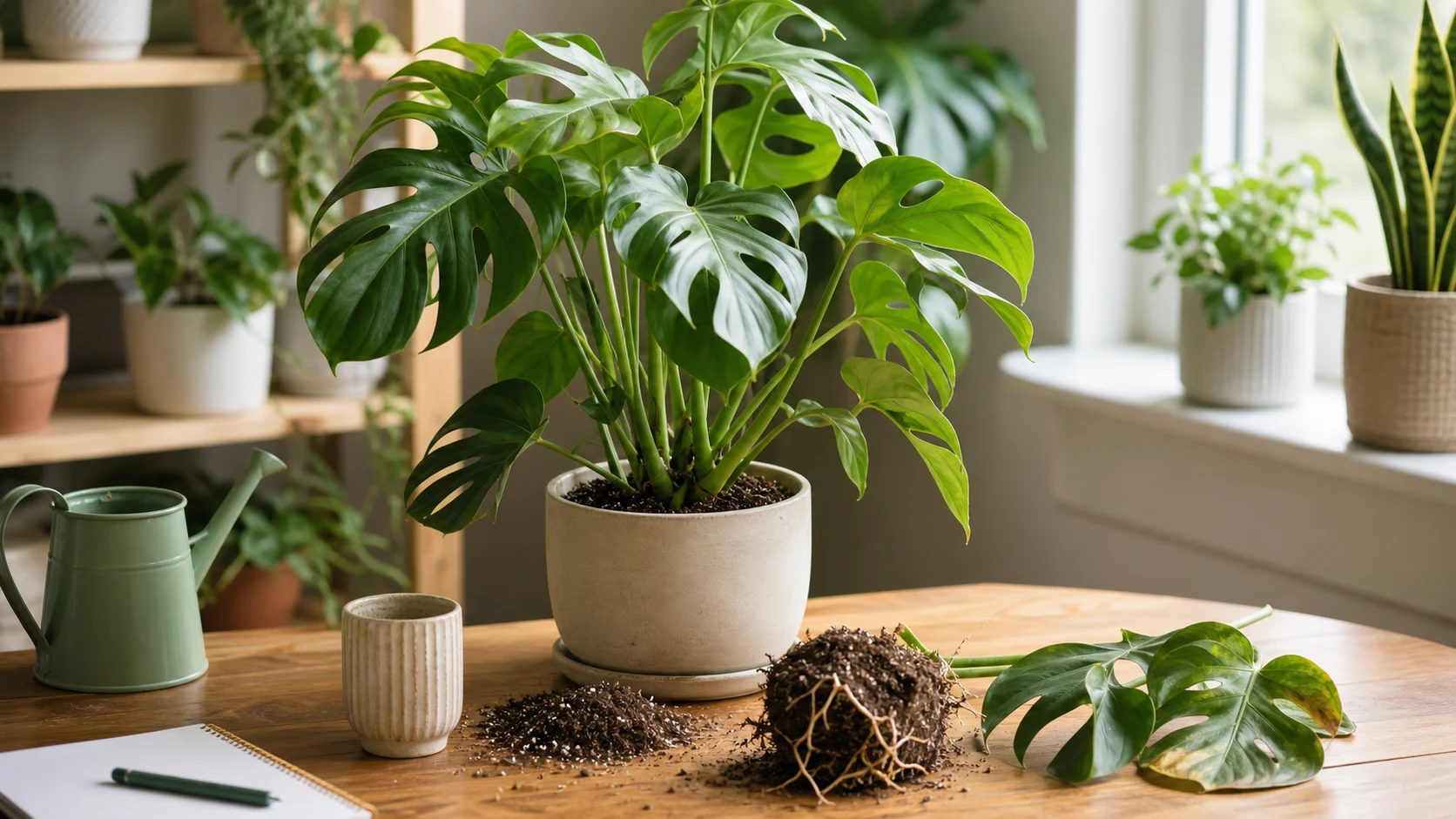
Comparing leaf damage, soil texture, and exposed roots turns brown-leaf advice into an evidence-based care check.
Sources
- Iowa State University Extension, Why does my houseplant have brown leaf tips and edges? – identifies low humidity, inconsistent watering, excess fertilizer salts, and water-quality issues as leading causes of tip and edge browning in houseplants.
- University of Maryland Extension, Watering Indoor Plants – advises checking soil dryness before watering rather than following a fixed schedule, and notes that soluble salt buildup causes brown tips, dropped leaves, and root damage.
- Royal Horticultural Society, Leaf damage on houseplants – notes that entire brown leaves often indicate underwatering or excessive heat, while brown tips or margins point to dry air, poor root health, or inconsistent moisture.