You found a plant you love, looked it up, and your heart sank. Pothos: toxic. Peace lily: toxic. Snake plant: toxic. If you have a dog at home, finding genuinely dog-friendly plants you can keep without anxiety is more work than it should be. This list is the shortcut.
Every plant here is confirmed non-toxic to dogs and grouped by where they’ll fit your actual home: low-light rooms, high shelves, empty floor corners, or small desks. Twenty-five plants, organized by where they live best.
What Most Dog-Safe Plant Guides Miss
Most roundups hand you a list of safe plants, then stop. That leaves three problems unsolved, and the third one is the one that can actually hurt your dog.
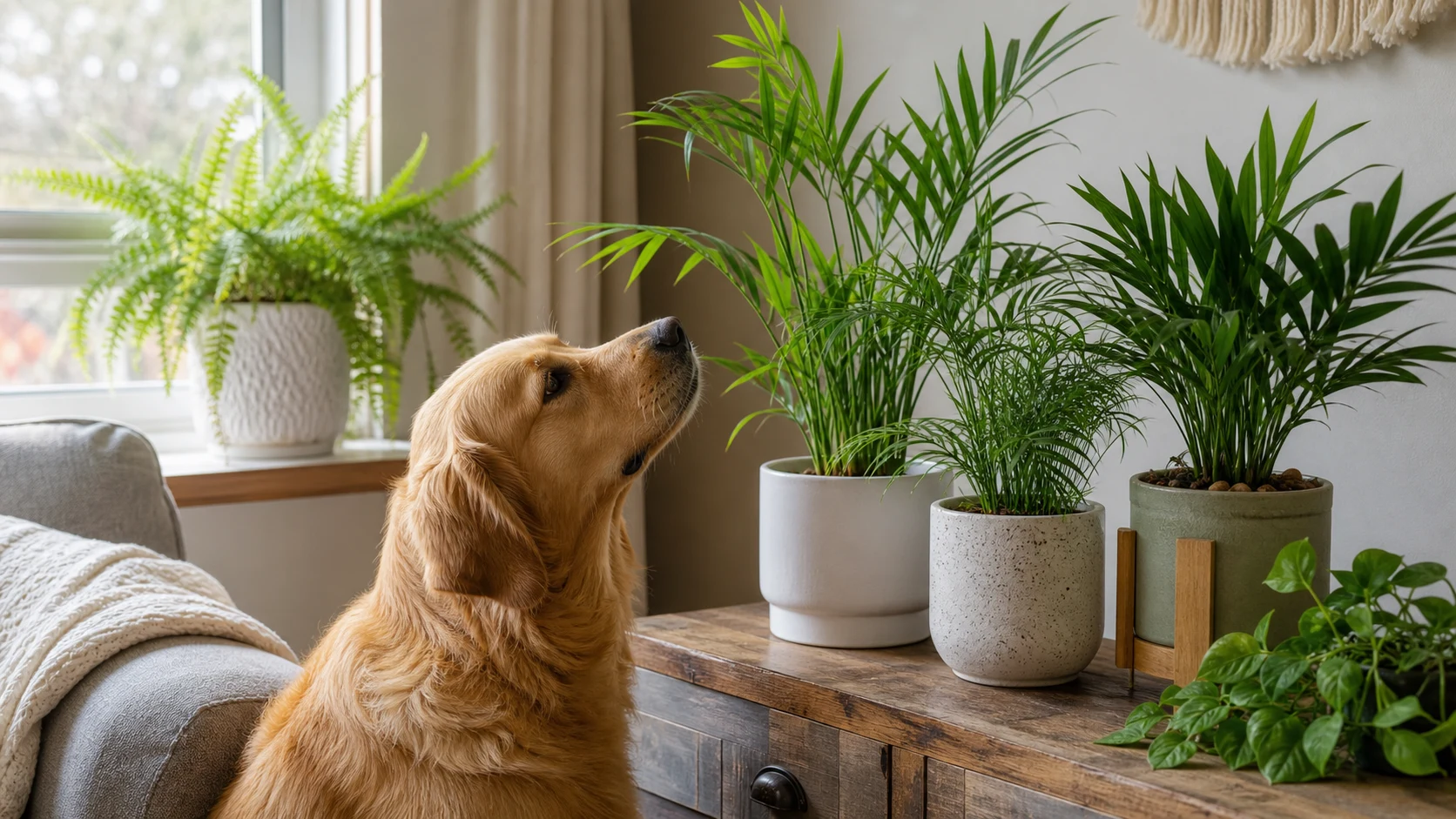
A curious dog beside true indoor palms and a Boston fern shows why plant identity matters more than a common-name shortcut.
The name confusion problem. “Sago palm” shares the word “palm” with areca palm, parlor palm, and kentia palm. All three of those are safe for dogs. Sago palm is among the most toxic plants that exist for dogs, and it looks nothing like the others. Generic lists that use only common names give you false confidence.
The “non-toxic” misread. Non-toxic to dogs means it won’t cause poisoning. It does not mean nothing will happen. According to the American Kennel Club, even non-toxic houseplants can cause mild vomiting, diarrhea, or drooling if a dog eats a large amount – and fertilizer or pesticide residue on the leaves can irritate even when the plant itself is perfectly safe.
The verification gap. The first check before buying any plant labelled “pet-friendly” at a garden center or online shop is to find its scientific name and cross-reference it on the ASPCA’s non-toxic plant list for dogs. Retailer tags are not regulated and can be wrong. The ASPCA database, maintained specifically for veterinary guidance, is the primary publicly available reference professionals actually use.
The one practical check: Before you buy, look up the Latin name on the ASPCA site. If it’s listed as non-toxic for dogs, you’re good. If it’s absent from the non-toxic list, treat that as a warning and verify further before it comes home.
How to Verify Any Plant Is Dog-Safe
“Many nontoxic houseplants are safe for dogs, but nonpoisonous does not guarantee zero reaction, since pets can still have allergies or interact badly with fertilizers and plant products.” – American Kennel Club
The ASPCA Animal Poison Control Center maintains the most detailed freely available reference for pet safety, with hundreds of species categorized as non-toxic to dogs. Clemson Extension HGIC, which reviewed ten of the most commonly available pet-safe houseplants, recommends pairing safety verification with a practical look at care requirements so the plant actually thrives in your home, not just passes the toxicity test.
A quick pre-purchase check:
- Find the scientific name (usually on the plant tag or a quick search)
- Look it up on the ASPCA non-toxic plant list for dogs
- If cats also share your home, verify it appears on the ASPCA cat-safe list too – some plants are safe for dogs but not cats
- Confirm with the shop that the plant hasn’t been recently treated with pesticides
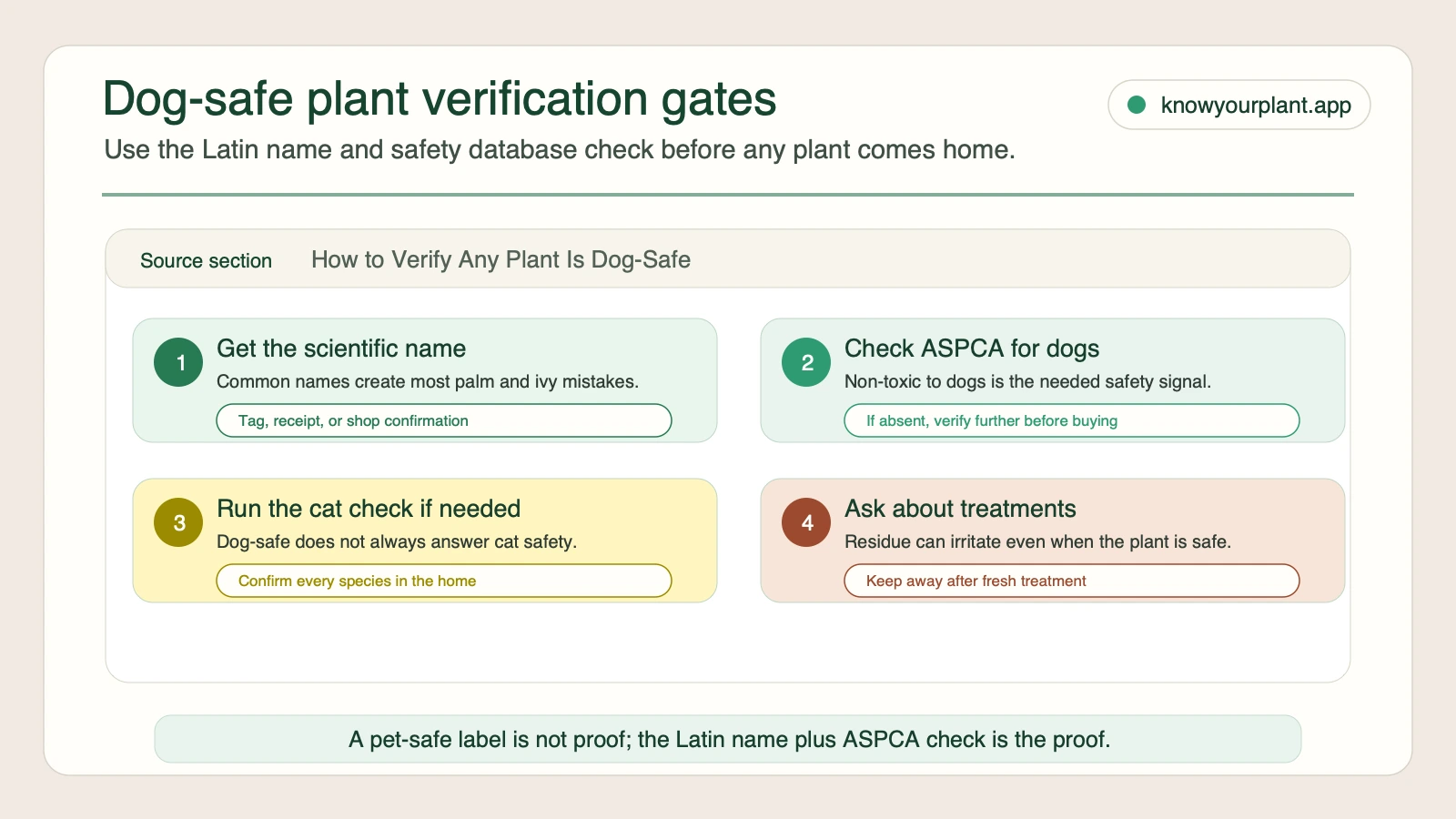
Use these gates before trusting a pet-safe label: the scientific name and ASPCA dog-safety check come first, then cat overlap and recent treatment questions if they apply to your home.
What “Dog Friendly” Really Means
A dog-friendly plant is one that is non-toxic to dogs if chewed or ingested, meaning it won’t cause poisoning or serious harm, even if your dog investigates it more thoroughly than you’d prefer.
That is different from risk-free. Any plant material can cause mild stomach upset if eaten in large quantity. Fertilizer residue on leaves can also cause irritation even when the plant itself is safe. These plants won’t poison your dog, but they’re not snacks either.
Identification Snapshot: What a Reliable Dog-Safe Pick Looks Like
If you want the shortest route to a safe choice, look for these signals before the plant goes in your cart:
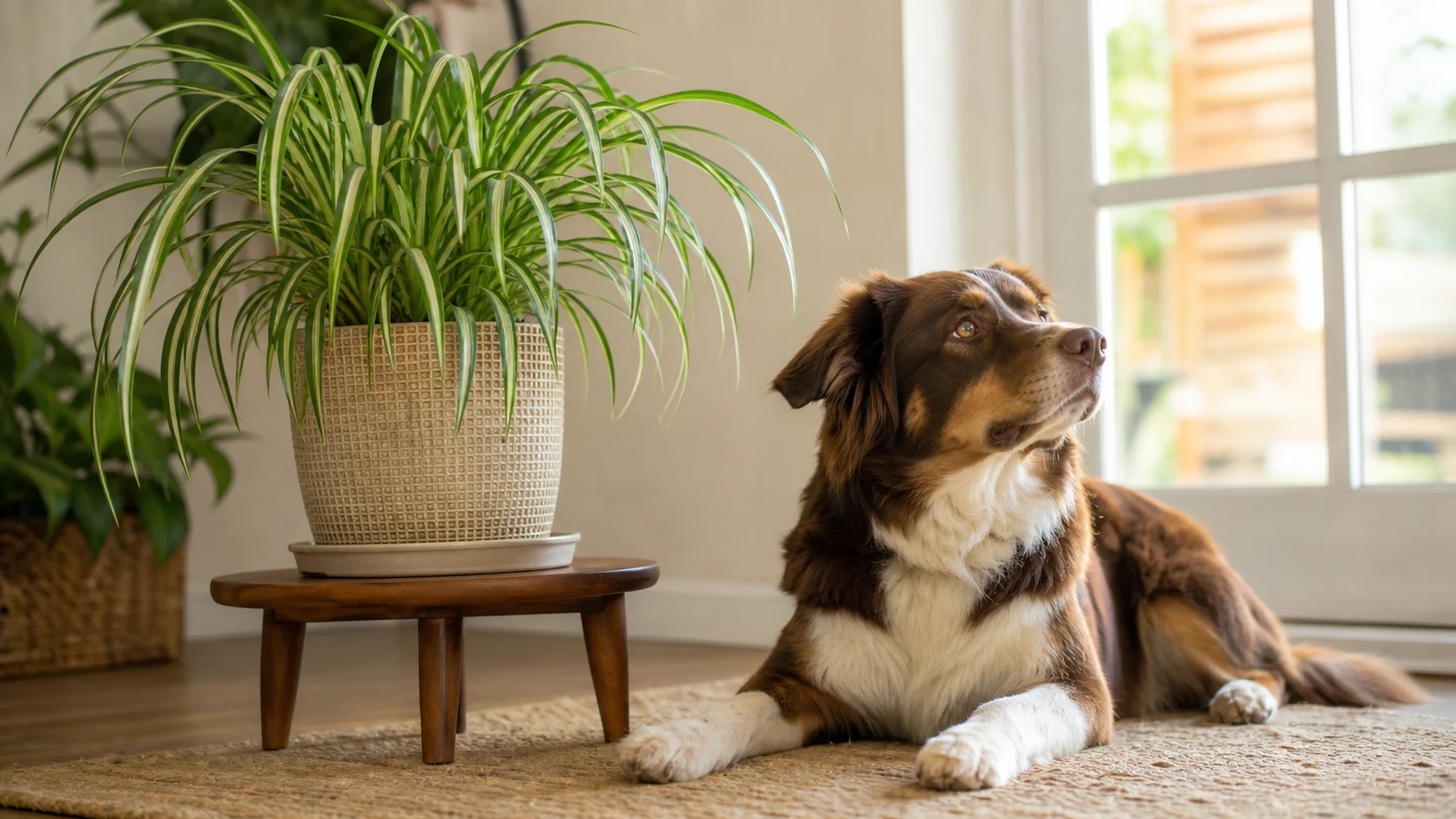
A recognizable spider plant on a sturdy raised stand pairs a dog-safe species with a placement that suits a curious pet.
- Clear scientific name on the label. Common names alone create the most confusion.
- Confirmed as non-toxic to dogs on ASPCA. That is the verification layer that matters most.
- A growth habit that matches your dog. Trailers tempt chewers, while taller floor plants or mounted plants reduce access.
- Care needs you can actually meet. A safe plant that dies in two weeks is still a bad buy.
Safe Groups, Lookalikes, and Easy Confusion Traps
| Safe group | Often confused with | What to check before buying |
|---|---|---|
| Areca, parlor, and kentia palms | Sago palm | Confirm the scientific name. True indoor palms on this list are safe; sago palm is not. |
| Haworthia | Aloe | Haworthia stays compact with chunky striped leaves; aloe is a different genus and is not the same pet-safety call. |
| Swedish ivy | Pothos or trailing philodendron | Ask for the Latin name, because trailing green plants get mislabeled constantly. |
| Christmas cactus | Euphorbia holiday plants | The segmented cactus stems are not the same as spurges sold around the holidays. |
The 25 Dog-Safe Houseplants
Easy Beginner Picks
1. Spider Plant (Chlorophytum comosum) One of the most forgiving plants you can own, and safe for dogs. Spider plants handle low light, irregular watering, and almost any humidity level without complaint. The dangling offshoots are irresistible to some dogs, but chewing them causes no harm. See the full spider plant care guide.
2. Boston Fern (Nephrolepis exaltata) A lush, full plant that’s one of the few ferns confirmed safe for dogs. Boston ferns like humidity and indirect light, so they’re a natural fit for a bathroom with a window. See the full Boston fern care guide.
3. Prayer Plant (Maranta leuconeura) Named for the way its leaves fold up at night. Prayer plants prefer medium to low indirect light, moist but well-draining soil, and consistent warmth. Safe for dogs and cats. More in the prayer plant care guide.
4. Calathea (Calathea spp.) Striking patterned leaves in deep greens, purples, and silvers. Calatheas are more demanding about humidity and water quality than most picks on this list, but they’re completely safe for dogs and reward the attention. Full details in the calathea care guide.
5. African Violet (Saintpaulia ionantha) A small plant that blooms reliably for months in bright indirect light. African violets are non-toxic to dogs and easy to propagate from a single leaf.
Low-Light Choices
6. Cast Iron Plant (Aspidistra elatior) Named for its toughness. The cast iron plant handles deep shade, infrequent watering, and temperature swings that stress most houseplants. Deep green, architectural, and completely safe for dogs. One of the best picks for genuinely low-light rooms.
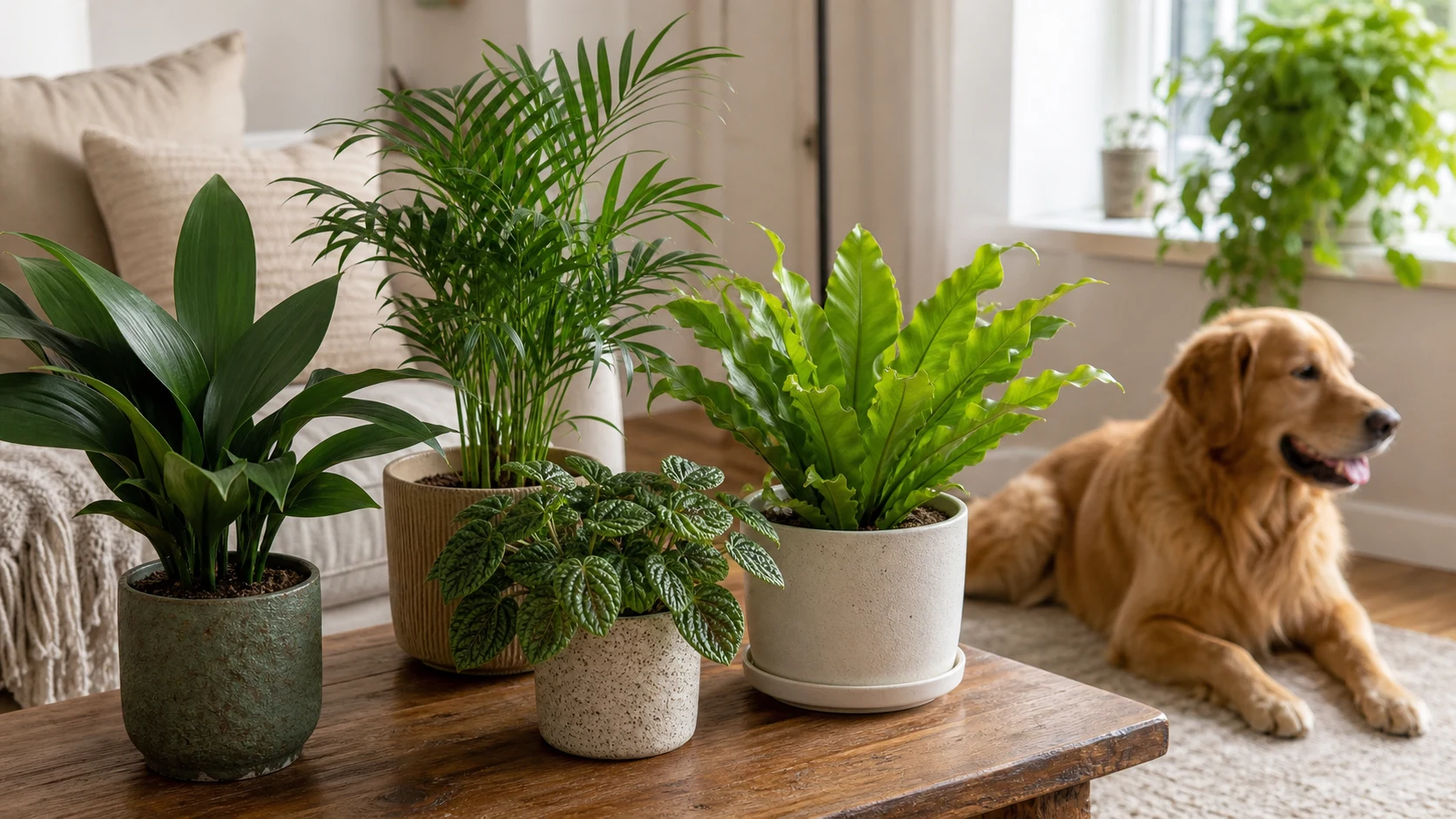
Cast iron plant, parlor palm, friendship plant, and bird’s nest fern form a dog-safe group for lower-light rooms.
7. Parlor Palm (Chamaedorea elegans) A compact palm that grows to around 1.5 metres indoors and tolerates lower light than most palms. Non-toxic to dogs. Worth noting: the sago palm looks nothing like this and is extremely toxic – see the common-mistakes section below before buying any palm.
8. Friendship Plant (Pilea involucrata) Low-growing with deeply textured, quilted leaves. Friendship plants stay small enough for shelves and handle medium to low light. Safe for dogs and easy to propagate by cuttings.
9. Bird’s Nest Fern (Asplenium nidus) Wide, smooth fronds that unfurl from a central rosette. Bird’s nest ferns prefer indirect light and humidity, making them a natural choice for a bathroom. Non-toxic to dogs.
10. Polka Dot Plant (Hypoestes phyllostachya) Spotted leaves in pink, red, or white on a plant that stays compact enough to fit anywhere. Polka dot plants prefer bright indirect light and consistent moisture, and they’re safe for dogs.
Statement Floor Plants
11. Areca Palm (Dypsis lutescens) The most popular large indoor palm, with soft feathery fronds and a warm, tropical presence. Areca palms like bright indirect light and consistent watering. Non-toxic to dogs.
12. Money Tree (Pachira aquatica) The braided trunk and glossy five-lobed leaves make this a popular statement plant for living rooms. Money trees tolerate some inconsistency in watering and are safe for dogs.
13. Ponytail Palm (Beaucarnea recurvata) Not actually a palm, but a succulent tree with a swollen water-storing trunk and long curling leaves. Ponytail palms need very little attention and are safe for dogs and cats.
14. Kentia Palm (Howea forsteriana) A slow-growing palm with elegant arching fronds. Kentia palms tolerate lower light than most palms and are non-toxic to dogs, making them a practical choice for darker living room corners.
15. Staghorn Fern (Platycerium bifurcatum) Usually mounted on a board and hung on the wall, which naturally keeps it out of reach of curious dogs. Non-toxic and dramatic in any space.
Small Shelf and Desk Plants
16. Watermelon Peperomia (Peperomia argyreia) Round leaves striped like watermelon rind on a compact, low-maintenance plant. Watermelon peperomia handles infrequent watering well and is safe for dogs.
17. Haworthia (Haworthia spp.) A small succulent that resembles aloe but without the toxicity concern. Haworthias stay tiny, need very little water, and manage in indirect light where many succulents would struggle.
18. Phalaenopsis Orchid (Phalaenopsis spp.) One of the most common houseplants in the world, and safe for dogs. Orchids bloom for months and need far less water than most people think. See the full orchid care guide.
19. Christmas Cactus (Schlumbergera) Produces colorful tubular flowers reliably in autumn and winter. Christmas cactus is safe for dogs and easier to keep alive than its reputation suggests.
20. Bromeliad (Guzmania or Aechmea spp.) Bromeliads produce a dramatic flower spike that lasts for months. Non-toxic to dogs, they need only indirect light and water through their central cup rather than the soil.
Trailing and Hanging Options
Hanging baskets and high shelves reduce interaction with curious dogs, but all five of these are safe even if a dog does manage to reach one. See the full indoor hanging plants guide for placement ideas.
21. Swedish Ivy (Plectranthus australis) A fast-growing trailer with round scalloped leaves. Easy to propagate, tolerates some neglect, and safe for dogs.
22. Hoya (Hoya carnosa) Waxy leaves and small clusters of star-shaped flowers that appear once the plant matures. Hoyas prefer to dry out between waterings and are non-toxic to dogs and cats. Full care in the hoya care guide.
23. String of Turtles (Peperomia prostrata) Tiny round leaves patterned like a turtle shell on delicate trailing stems. Prefers bright indirect light and dries out quickly in small pots. Non-toxic to dogs.
24. Lipstick Plant (Aeschynanthus radicans) Long trailing stems with dark tubular flowers that emerge from deep red calyxes. Lipstick plants like bright indirect light and humidity, and they’re non-toxic to dogs.
25. Nerve Plant (Fittonia albivenis) Small and ground-hugging, with vivid veined leaves in red, pink, or white. Nerve plants prefer humidity and indirect light and are safe for dogs. A good terrarium plant too.
Quick Chooser: Match the Plant to Your Home
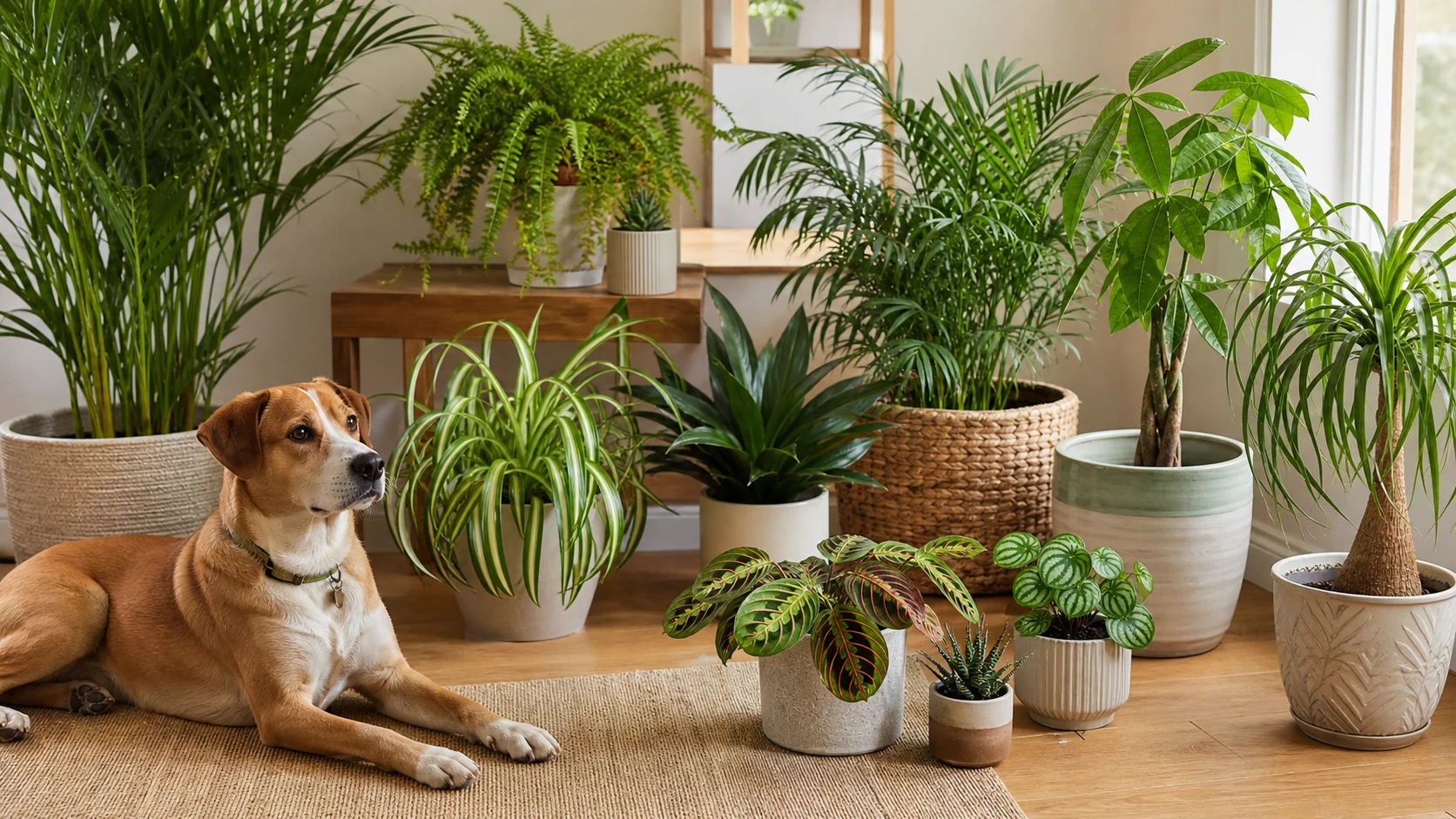
A varied dog-safe collection shows how plant size, light needs, and floor or tabletop placement can fit different rooms.
| Plant | Light | Mature size | Effort | Best for |
|---|---|---|---|---|
| Spider Plant | Low to bright indirect | Small to medium | Very easy | Shelf, hanging basket |
| Boston Fern | Medium indirect | Medium | Moderate | Bathroom, pedestal |
| Cast Iron Plant | Low to deep shade | Medium | Very easy | Dark corner, floor |
| Parlor Palm | Low to medium | Medium (to 1.5m) | Easy | Floor, corner |
| Areca Palm | Bright indirect | Large (to 2m) | Moderate | Living room floor |
| Money Tree | Medium to bright indirect | Medium to large | Easy | Statement floor spot |
| Ponytail Palm | Bright indirect | Large (slow) | Very easy | Statement floor spot |
| Kentia Palm | Low to medium | Large (very slow) | Easy | Dark corner, floor |
| Calathea | Medium indirect | Small to medium | Moderate | Table, shelf |
| Prayer Plant | Low to medium indirect | Small | Easy | Desk, shelf |
| Haworthia | Bright indirect | Very small | Very easy | Windowsill, desk |
| Watermelon Peperomia | Medium indirect | Small | Easy | Desk, shelf |
| Hoya | Bright indirect | Medium, trailing | Easy | Hanging, high shelf |
| String of Turtles | Bright indirect | Small, trailing | Easy | Hanging, small shelf |
| Nerve Plant | Medium to low indirect | Small | Moderate | Terrarium, desk |
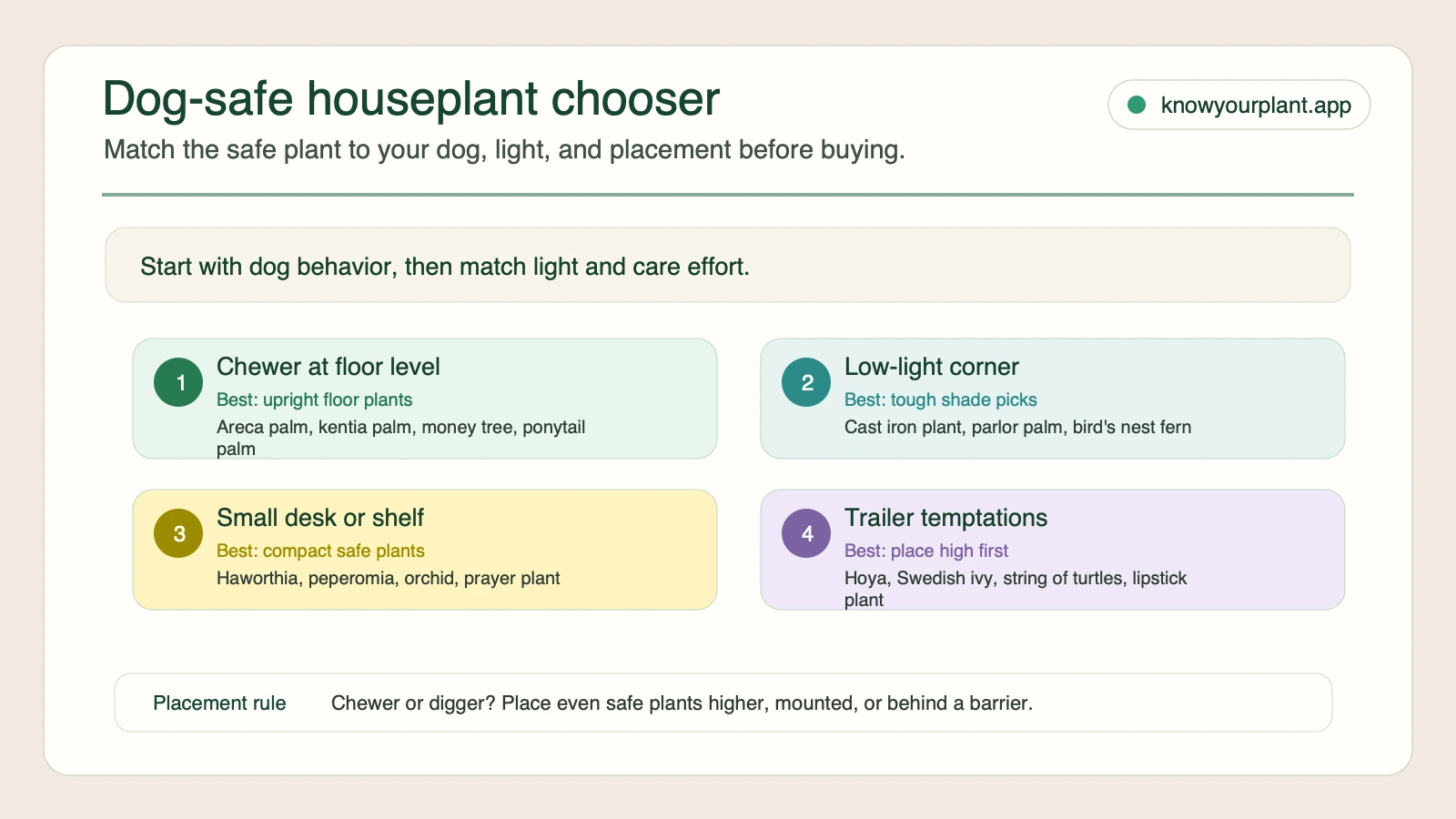
Use this chooser after the plant list to narrow the safe options by dog behavior, room light, and placement instead of choosing only from the toxicity label.
Care Cards for Four Reliable Dog-Safe Picks
| Plant | Light | Water rhythm | Best placement | Why it works for dog homes |
|---|---|---|---|---|
| Spider plant | Low to bright indirect | Water when the top inch dries | Shelf or hanging basket | Forgiving, fast-growing, and easy to replace if a leaf gets chewed |
| Parlor palm | Low to medium indirect | Water when the top 1 to 2 inches dry | Floor corner | Upright growth keeps most foliage above nose level |
| Haworthia | Bright indirect | Let the mix dry well between waterings | Desk or windowsill | Tiny footprint, low maintenance, and safer than aloe-style lookalikes |
| Hoya | Bright indirect | Let the pot dry partway between waterings | High shelf or hanger | Thick leaves, trailing habit, and lower water demand than fussier vines |
These are the safest starting points when you want a plant that is both verified for dogs and realistic for normal indoor care.
Common Problems With Dog-Friendly Houseplants
| Problem you notice | Usually happening underneath | What to do next |
|---|---|---|
| Chewed leaves on spider plant, hoya, or ivy | The plant is safe, but dangling growth is acting like a toy | Move it higher, trim damaged growth, and offer a chew alternative for the dog |
| Brown crispy edges on calathea or fern | Dry air or inconsistent watering | Increase humidity, water more consistently, and keep it out of hot direct sun |
| Yellowing lower leaves on palms or money tree | Usually overwatering or a pot that stays wet too long | Let the mix dry a bit more and check drainage before watering again |
| A plant sold as “pet safe” still makes you uneasy | The label is vague or incomplete | Stop and verify the scientific name on ASPCA before you bring it home |
| Mild vomiting after chewing a safe plant | Plant matter, fertilizer residue, or too much chewing, not poisoning | Remove access, rinse visible residue, and call your vet if symptoms do not settle |
Dog-Safe Swaps for the Most Popular Toxic Plants
This is the section most pet-safe plant guides skip: you already have the toxic ones, or you keep eyeing them at the garden center because they’re everywhere. Here’s what to buy instead.
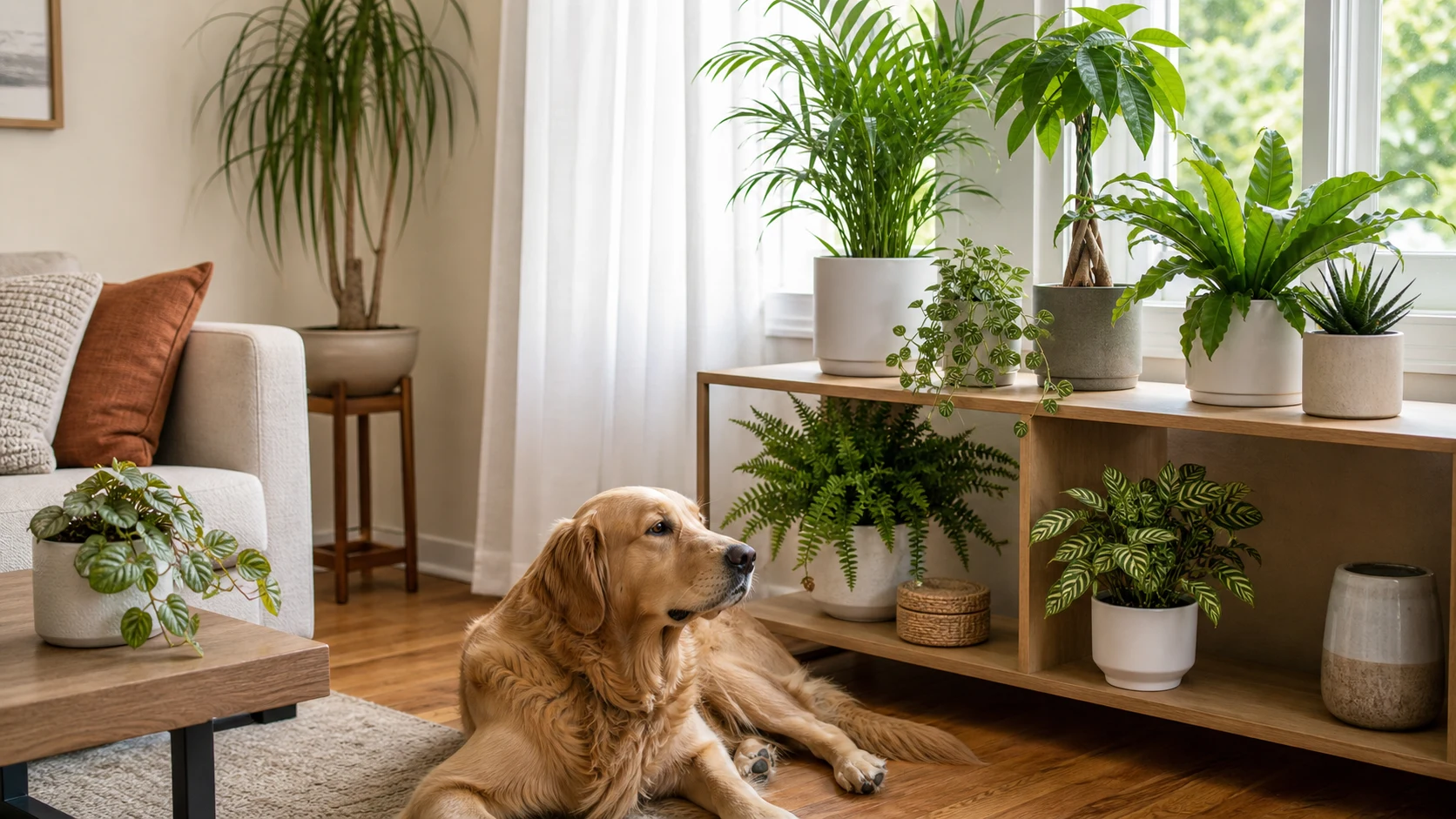
Dog-safe palms, ferns, Haworthia, prayer plants, and compact trailers can replace familiar toxic favorites without losing their practical indoor appeal.
| Toxic plant (avoid) | Why it’s popular | Dog-safe alternative | Same vibe |
|---|---|---|---|
| Pothos | Trailing, fast-growing, forgiving | Swedish ivy or hoya | Trailing, easy, similar leaf shape |
| Snake plant | Upright, structural, very low maintenance | Cast iron plant or ponytail palm | Low-care, tolerates neglect |
| Peace lily | Lush, low-light, white flowers | Boston fern or bird’s nest fern | Lush texture, indirect light |
| ZZ plant | Glossy, near-indestructible | Ponytail palm or haworthia | Low-water, interesting structure |
| Monstera | Large tropical leaves, statement plant | Areca palm or money tree | Large, tropical presence, floor-worthy |
| Philodendron | Heart-shaped leaves, easy care | Prayer plant or calathea | Patterned leaves, medium-light room |
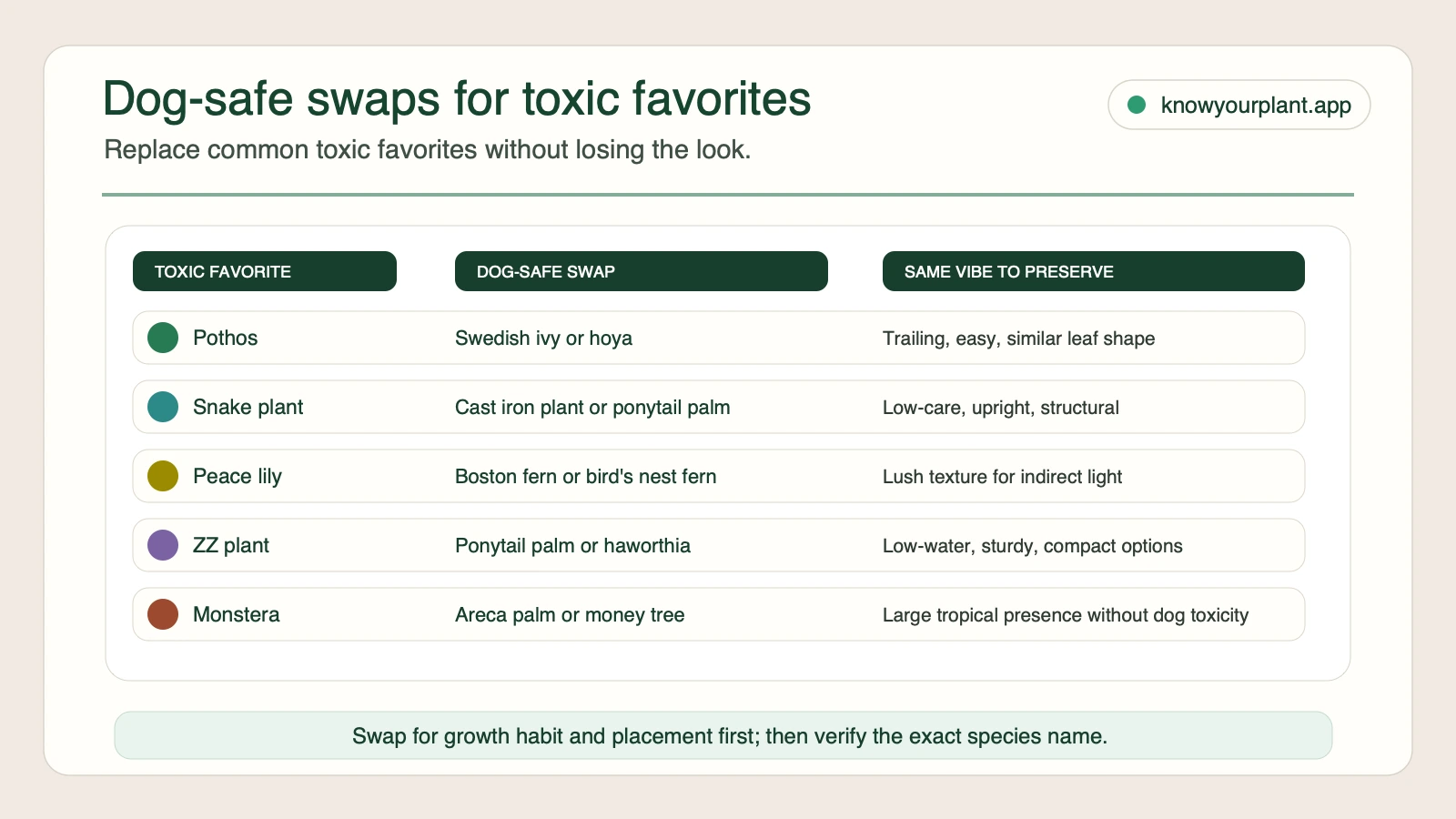
Use the swap map when you already like a toxic plant: preserve the growth habit or room feel, then verify the exact species before buying the safer replacement.
The only genuine care tradeoff here is calathea and prayer plant being slightly more humidity-sensitive than most philodendrons. The rest of the swaps are close to one-for-one on effort level.
Common Mistakes Worth Avoiding
Trusting the label alone. Retailer tags that say “pet-friendly” are not regulated. Some use common names loosely; some are simply wrong. Always cross-check the scientific name on the ASPCA site before the plant comes home.
The palm name trap. Sago palm (Cycas revoluta) is not a true palm – it’s a cycad and one of the most dangerous plants for dogs. Areca, parlor, and kentia palms are confirmed safe. The shared word “palm” tells you nothing useful on its own.
Assuming non-toxic means nothing will happen. A dog that chews through half a bromeliad may still vomit, not because the plant is toxic but because it ate unusual plant matter. Chewing-prone dogs still benefit from placement strategies even around safe plants.
Fertilizing and forgetting. A freshly fertilized plant that a dog chews can cause GI irritation from the product, not the plant itself. Keep dogs away from newly fertilized plants for a few days, or wipe leaves down if residue is visible.
Skipping the cat check. Most plants on this list are safe for both dogs and cats, but not every one. If cats also share your home, run the same ASPCA check on the cat list separately before buying. The cat-safe indoor plants guide covers the overlap in more detail.
Before You Buy: A Quick Decision Checklist
This takes about two minutes and saves you from second-guessing every plant you bring home.
- Do I have the scientific name? (check the tag or ask the shop)
- Is it listed as non-toxic to dogs on the ASPCA site?
- If I have cats too, does it appear on the ASPCA cat-safe list?
- Has the plant been recently treated with fertilizer or pesticides? (ask the shop)
- Does my dog chew or dig? If yes, can I place this plant out of easy reach?
If all five are resolved, buy the plant. If the scientific name is unclear or missing from the ASPCA list, leave it at the shop and find something verified.
If you are comparing care routines for another houseplant, see Christmas Cactus Care: Watering, Light, and Repeat Blooms for a focused step-by-step guide.
If you are comparing care routines for another houseplant, see Ponytail Palm Care: Light, Watering, and a Healthy Caudex for a focused step-by-step guide.
Real User FAQ
Are all 25 of these plants safe for both dogs and cats?
Most are. Spider plants, Boston ferns, prayer plants, calatheas, orchids, hoyas, areca palms, money trees, and most peperomias are confirmed safe for both dogs and cats on the ASPCA list. A handful, including some bromeliads, carry strong non-toxic confirmation for dogs but less comprehensive documentation for cats. For the full overlap, check the cat-safe plants guide and verify anything specific on the ASPCA database for cats separately.
My dog just chewed a spider plant. What should I do?
Spider plants are non-toxic to dogs, so a chewed leaf or dangling offshoot shouldn’t cause serious harm. Some dogs vomit mildly after eating plant material – that’s a digestive reaction to unusual food, not a poisoning. If your dog ate a very large amount, seems unusually unwell, or you’re not certain which plant was involved, call your vet or the ASPCA Animal Poison Control Center (888-426-4435).
Is the parlor palm really safe? I’ve seen conflicting advice.
Yes. Parlor palm (Chamaedorea elegans) is confirmed non-toxic to dogs by ASPCA. The confusion almost always comes from mixing it up with sago palm, which is extremely toxic but is not a true palm at all – it’s a cycad. Sago palm is low-growing and spiky; it looks nothing like the soft feathery fronds of a parlor palm. Checking the scientific name clears this up immediately.
Can I trust a garden center label that says “pet safe”?
Not without cross-checking. Retailer labels are not regulated, and some use common names that could apply to multiple species with different toxicity profiles. The reliable habit is to note the scientific name and confirm it on the ASPCA non-toxic plant list before you buy. Takes about 30 seconds and removes the guesswork entirely.
Which plants here are best for genuinely low-light spots?
Cast iron plant, parlor palm, bird’s nest fern, friendship plant, and kentia palm all handle very low light – a few metres from a window with no direct sun. Spider plants and Boston ferns manage in low light but grow more actively with medium indirect light. The full low-light plant guide covers more options beyond this list.
My dog chews everything at floor level. Which plants are safest to place there?
Taller floor plants with upright growth and leaves well above nose height are the most practical choice: areca palm, kentia palm, money tree, and ponytail palm are all difficult to access from the ground. Staghorn ferns mounted on a wall and hanging baskets are naturally out of reach entirely. Even with safe plants, placement strategy matters for chronic chewers.
What’s the best dog-safe replacement for pothos?
Swedish ivy is the closest visual match – fast-growing, trailing, easy to propagate, and tolerant of some neglect. Hoya is a slower trailing option with thicker leaves and occasional flowers. For the same low-care feel in medium light, spider plants produce a similar hanging-offshoot effect without any toxicity concern.
Methodology: How This Guide Was Checked
This list was cross-checked against the ASPCA dog plant list, Clemson Extension’s pet-safe indoor houseplant guidance, and AKC’s note that non-toxic plants can still cause mild stomach upset or irritation in some situations. Community snippets were used only to surface repeated buyer confusion, especially around palms, labels, and low-maintenance apartment picks.

Checking a spider plant against a trusted digital reference illustrates the species-by-species review behind this dog-safe guide.
Download KnowYourPlant for personalized plant care reminders.