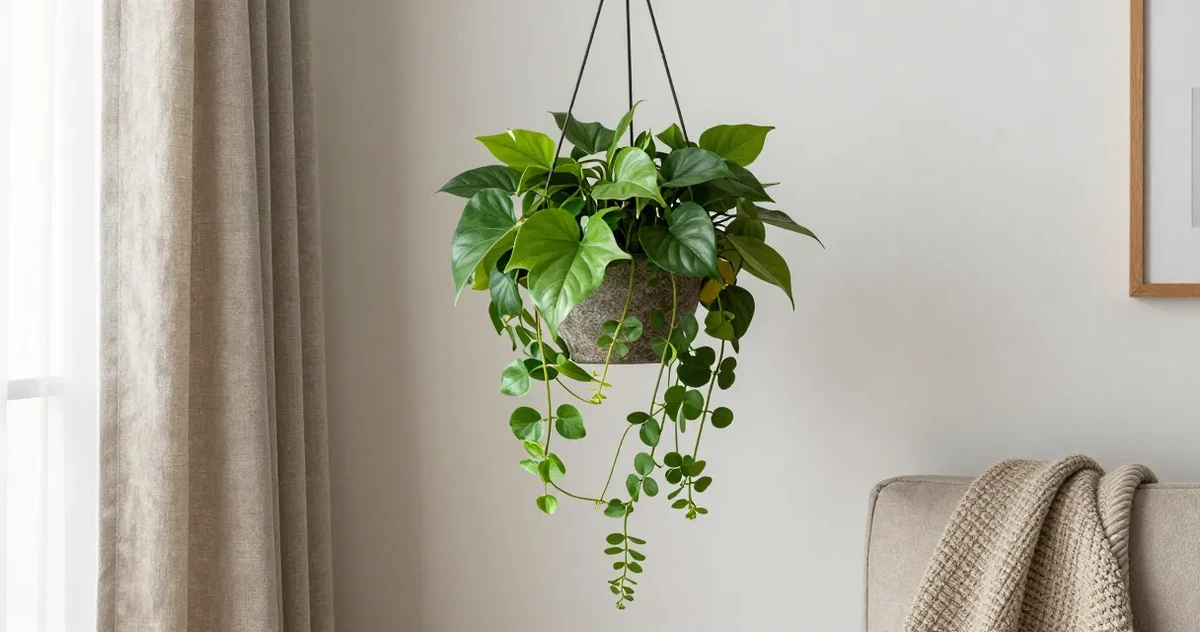
For low-light indoor hanging plants, start with heartleaf philodendron, golden pothos, or spider plant. They handle dimmer rooms better than most string succulents, although all still need usable daylight or a grow light.
You stand in the plant shop, basket in hand, looking at a shelf of trailing plants. They all look lush. The labels say things like “indirect light” and “water regularly,” which is almost entirely useless. What you actually want to know is: will this thing trail long enough to look dramatic, can it handle the shelf in my east-facing bedroom, and will it forgive me during a week away?
The simplest frame to work from: a good hanging plant is one that grows outward or downward by nature, not one you force into a basket and hope survives. Trailing vines, arching fronds, cascading succulents: these are plants doing what they were built to do.
This list covers 20 of them, sorted by how much light your space actually gets.
Best Indoor Hanging Plants by Light Level
Indoor hanging plants are not one plant category so much as three different bets: forgiving trailing vines, bushier basket plants, and bright-light string succulents. Choosing well is mostly about matching that growth habit to your light, watering rhythm, and pet situation.
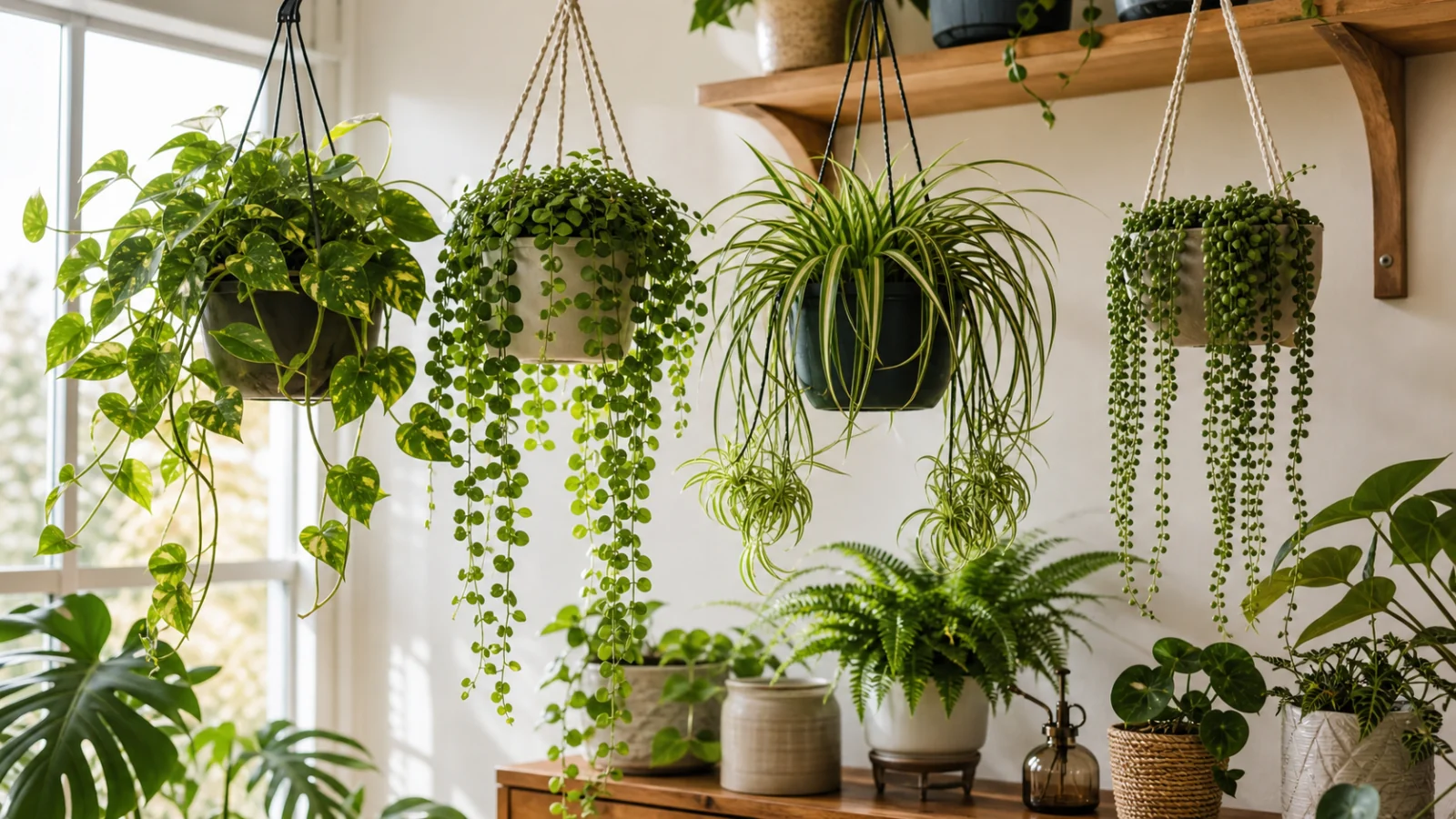
Trailing vines, bushy basket plants, and string succulents each create a different indoor hanging display.
- Best for: shelves, hooks, or window-adjacent corners where you want visible greenery without using floor space.
- Not for: truly windowless rooms, households that need every option to be pet-safe, or anyone hoping one watering rule will fit every plant in this guide.
- Fastest reward: pothos, heartleaf philodendron, and spider plant usually look fuller quickly.
- Higher-maintenance drama: Boston fern, string of pearls, and other bright-light or humidity-hungry picks need a closer match to conditions.
| Need | Strong first picks | What to watch for |
|---|---|---|
| Low-light tolerance | Heartleaf philodendron, golden pothos, spider plant | Growth slows and variegation fades if the room is too dim |
| Bright indirect light | Satin pothos, hoya, string of hearts | These stay prettier with stronger light than many roundup lists admit |
| Direct sun or very bright windows | String of pearls, string of bananas, burro’s tail | Overwatering is usually the failure point, not lack of food |
| Pet-aware homes | Spider plant and many hoyas | Pothos, philodendron, and satin pothos are popular but not pet-safe |
Indoor Hanging Plant Decision Tree
- If the plant will sit more than a few feet from your brightest window, start with heartleaf philodendron, golden pothos, or spider plant.
- If you want the fastest trailing effect with the least stress, choose pothos or heartleaf philodendron before fussier string plants.
- If you forget to water, lean toward hoya, satin pothos, or spider plant rather than Boston fern.
- If you want a pet-safer shortlist, begin with spider plant or many hoyas and treat pothos, philodendron, and satin pothos as riskier picks.
- If you have a bright window and want sculptural drama, move to string of pearls, string of bananas, or burro’s tail.
Hanging Plant Care Cards
| Plant | Light sweet spot | Water rhythm | Pet safety | Best for |
|---|---|---|---|---|
| Golden pothos | Medium to bright indirect, tolerates lower light | Let the top half of the soil dry | Toxic to cats and dogs | Fast trail, easiest starter vine |
| Heartleaf philodendron | Low to medium indirect light | Water when the mix partly dries | Toxic to cats and dogs | Soft trailing look in dimmer rooms |
| Spider plant | Medium light, tolerates lower light | Water when the top inch dries | Non-toxic to cats and dogs | Pet-aware homes and easy propagation |
| Satin pothos | Bright indirect light | Let it dry a bit more between waterings | Toxic to cats and dogs | Textured leaves and lower watering frequency |
| Hoya | Bright indirect light | Dry down well between waterings | Many common hoyas are considered non-toxic | Owners who miss a watering sometimes |
| String of hearts | Bright indirect light | Let the pot dry more fully | Check species-specific safety before buying | Fine trailing texture in small spaces |
| Boston fern | Bright indirect light plus humidity | Keep evenly moist, never soggy | Usually treated as pet-safe, but verify the exact plant | Full, bushy baskets in bathrooms or humid rooms |
| String of pearls | Strong bright light or some direct sun | Let the mix dry deeply | Keep away from pets and children unless safety is confirmed | Dramatic sunny-window trailing display |
Lookalikes and Confused-With Picks
- Golden pothos vs. heartleaf philodendron: both are forgiving trailers, but pothos usually has thicker leaves and louder variegation while heartleaf philodendron reads softer and greener in lower light.
- Satin pothos vs. true pothos: satin pothos is actually a Scindapsus, not an Epipremnum, and it wants brighter indirect light to keep its silver pattern dense.
- Boston fern vs. asparagus fern: both look feathery in a basket, but Boston fern wants more humidity while asparagus fern tolerates drier indoor air better.
- String of pearls vs. string of bananas: both want a sunnier setup and sharp drainage, but string of bananas is usually the easier first attempt if you have lost pearl strings before.
What Most Plant Roundups Miss
Most indoor hanging-plant roundups list attractive options. The better question is which choice will still make sense in your actual room three months from now.
Use this filter before choosing:
- Light reality: what the plant receives on a normal cloudy day, not the brightest hour of the week.
- Care rhythm: whether you prefer weekly attention or a plant that can be ignored longer.
- Space: mature height, spread, trailing habit, and whether leaves will touch walls or pets.
- Failure signal: what the plant does first when the match is wrong: yellowing, stretching, crisping, or dropping leaves.
A good recommendation is not just beautiful. It fits the room, the owner, and the first problem you are likely to notice.
Trailing vs Bushy: Two Different Effects
Before picking, decide what you want the plant to do.
Trailing plants (pothos, string of pearls, heartleaf philodendron) grow long vines that drape down over the edge of the pot. Put them on a high shelf or in a ceiling hook and they will eventually reach toward the floor. That cascading, spilling effect is what most people are after. If you are comparing trailing options and not sure where to start, the pothos varieties guide breaks down the differences in color, growth speed, and light tolerance across the most popular varieties. For a broader look at trailing plants beyond pothos, the trailing plants indoor guide covers more options across different light levels.
Bushy hanging plants (Boston fern, spider plant, asparagus fern) spread outward in all directions. They look lush and fill horizontal space rather than creating a long cascade. Better for baskets hung at eye level or lower, where you see the whole plant at once.
Most people want trailing. Both are worth understanding.
Where You Hang It Changes the Effect
Most plant guides skip this, and it makes a real difference to how the plant looks and whether you keep watering it two years from now.
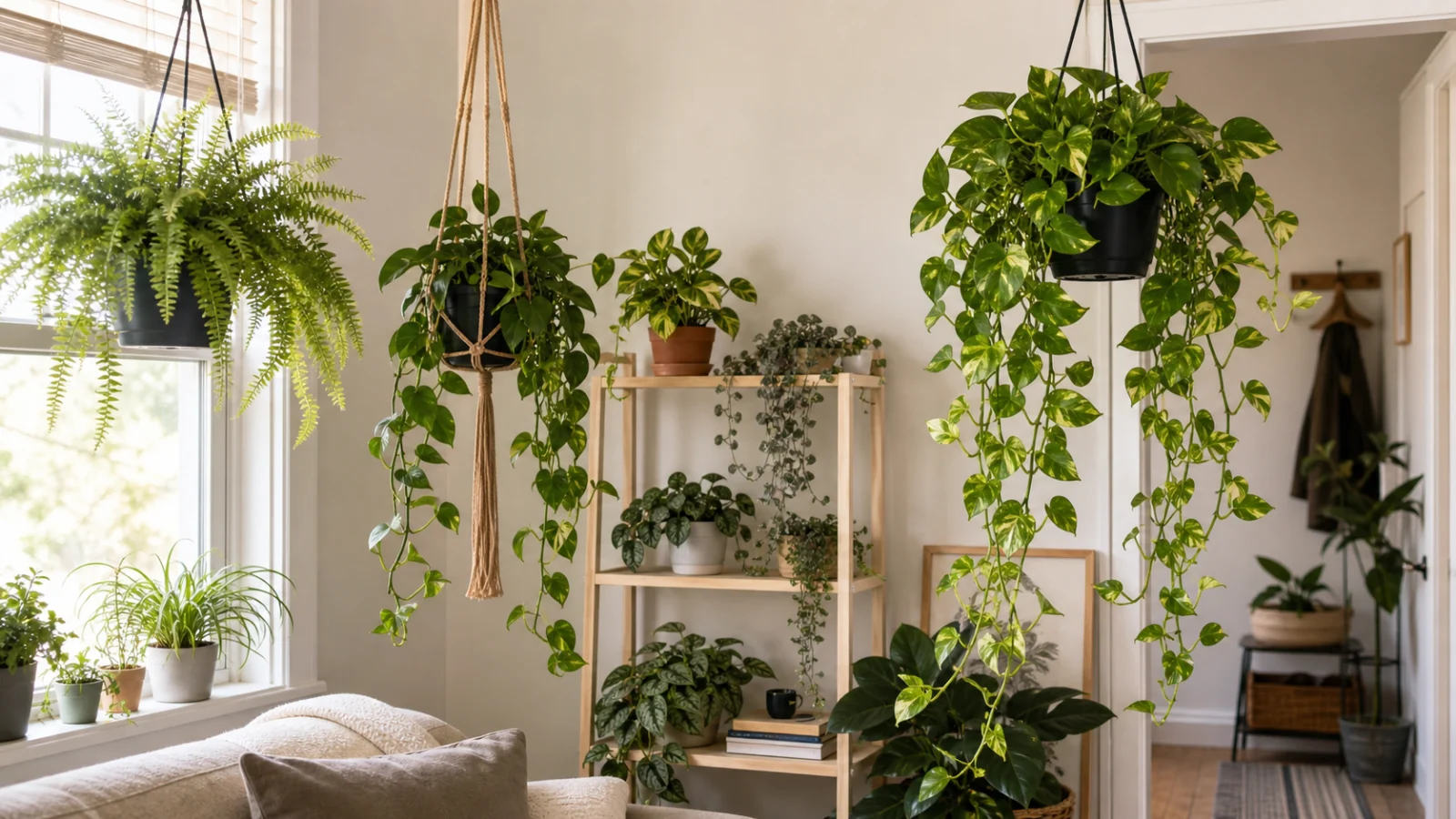
Long pothos vines, fine shelf trailers, and a bushy fern each read best from a different hanging height.
Ceiling hooks at 7 feet or higher give long trailers the room they need to become dramatic. Golden pothos, heartleaf philodendron, and marble queen pothos can trail several feet over time. At eye level, a young plant in a small pot just looks sparse. Give it height and two growing seasons, and the same plant looks like a completely different thing.
High shelves at 5 to 6 feet work well for medium trailers or small-leafed plants like string of hearts, satin pothos, and string of turtles. These have finer stems and smaller leaves that read best at a distance, where you appreciate the texture rather than individual leaf size.
Eye-level baskets suit bushy plants: Boston fern, spider plant, and asparagus fern. You want to see the full form, not just the trailing tips.
One detail worth knowing: when you hang a plant above eye level, you mainly see the underside of the leaves, not the top of the canopy. String of pearls, burro’s tail, and fishbone cactus all have interesting undersides that actually benefit from this angle. Boston ferns with their arching fronds look better from below than from above. Standard pothos varieties show the same face either way, which is part of why they work at almost any height.
Best Indoor Hanging Plants for Low Light
These six tolerate darker corners, shelves away from windows, or rooms with indirect light most of the day.
A note on “low light”: it is not the same as no light. NC State Cooperative Extension notes that even shade-tolerant plants need some usable light. Window size, direction, glass, outdoor obstructions, and distance all change the light that reaches a hanging plant, so judge the actual spot instead of relying on a fixed number of feet. If your space is genuinely dark, a grow light on a simple timer can fill the gap.
1. Heartleaf Philodendron
The classic low-light trailer. Heart-shaped leaves on long, fast-growing vines. Forgiving with watering, tolerant of shade, and one of the easiest plants to keep looking good year-round. The heartleaf philodendron care guide covers propagation, watering rhythm, and what the leaves signal when something is off.
2. Golden Pothos
Probably the most popular hanging plant indoor growers reach for first. Yellow-and-green marbled leaves, nearly indestructible, happy in low light, though the variegation fades without brighter conditions. The golden pothos care guide covers the light-to-variegation relationship in more detail.
3. Neon Pothos
Same easy care as golden pothos, but the chartreuse-yellow color holds better in lower light than you would expect. A good choice if you want something that looks bright without a sunny window. Care details and growth habits are in the neon pothos care guide.
4. Marble Queen Pothos
Cream-and-green variegation that looks more refined than golden. Grows slightly slower, but the contrast in the leaves makes it worth the patience. The marble queen pothos care guide covers what to expect from growth speed and how the variegation shifts depending on your light.
5. Spider Plant
An arching, grass-like plant that produces baby “spiderettes” on long stems, dangling beneath the mother plant. One of the best options for low-light kitchens or bathrooms. Very forgiving with watering, and the spiderettes can be clipped off and rooted in a glass of water.
6. Tradescantia Zebrina (Wandering Dude)
Deep purple-and-silver striped leaves on trailing stems. Grows fast, looks lush, and tolerates low light better than most colorful plants. Pinch the tips back regularly to keep it from getting leggy, or it will stretch thin and sparse within a few months.
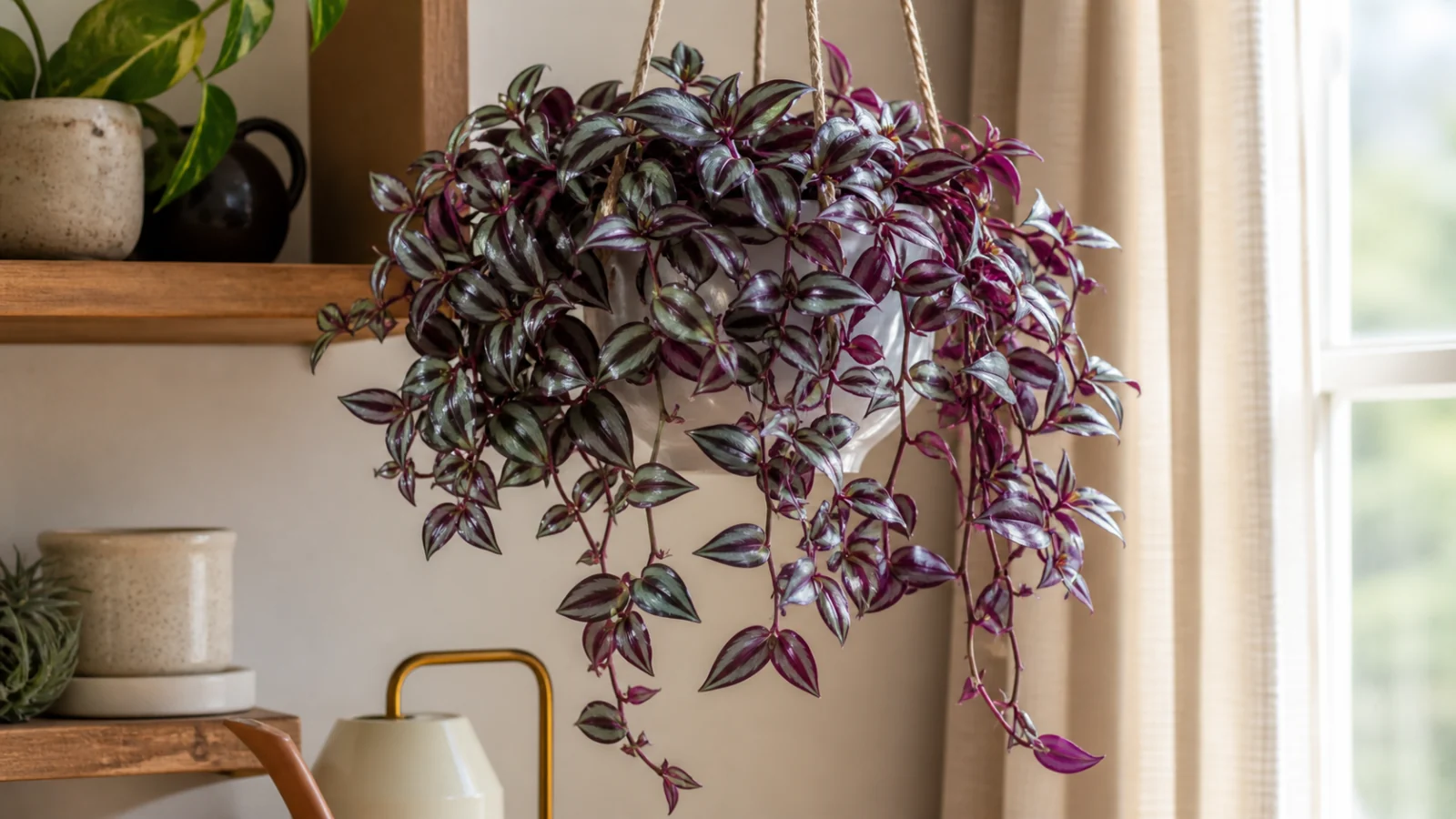
Dense purple-and-silver foliage shows the full trailing habit that regular pinching helps maintain.
Best Hanging Plants for Medium Light (Bright Indirect)
These plants prefer a spot with bright indirect light for most of the day: near a window but not in direct sun, or a few feet back from a south-facing window.
7. Satin Pothos (Scindapsus Pictus)
Thick, matte leaves with silver markings that look almost painted on. Grows slower than regular pothos and the leaves are more interesting up close. Much more drought-tolerant than it looks, which makes it a good choice if your watering schedule is irregular. Full care details are in the satin pothos care guide.
8. String of Hearts
Tiny heart-shaped leaves on delicate trailing vines. The silver marbling on each leaf makes it look more precious than it is to care for. It likes to dry out between waterings and does well in a small pot, which keeps it manageable on a high shelf.
9. Boston Fern
The classic bushy hanging plant with arching fronds. The one real catch: it genuinely needs humidity. The University of Florida IFAS Extension notes that Boston ferns require relative humidity above 50% to stay healthy; below that, frond tips start browning and the plant looks progressively worse. A bathroom with a window is the best location in most homes. A pebble tray with water or regular misting helps if you want to hang it elsewhere.
10. Hoya (Wax Plant)
Dozens of hoya varieties exist, and most trail or climb with thick, waxy leaves that store water well. That means you can underwater and they will recover. Some varieties bloom with clusters of small, fragrant flowers. Give them bright indirect light and let the soil dry out between waterings, and they are genuinely low-maintenance. If this is the plant you are choosing, the hoya plant care guide covers blooming, watering, and the difference between a single-leaf kerrii and a vining plant.
11. String of Turtles (Peperomia Prostrata)
Tiny round leaves with a pattern that genuinely looks like turtle shells. Slow-growing and compact. Better suited to a small hanging pot than a large basket, where the delicate scale of the plant would be lost. Worth placing somewhere you can actually see it up close.
12. Fishbone Cactus (Epiphyllum Anguliger)
One of the most overlooked hanging plants. The flat, zigzag-edged stems are completely unlike anything else available, and it can bloom at night with large fragrant flowers in the right conditions. Treat it somewhere between a cactus and a fern: bright indirect light, let it dry out a little between waterings, but not completely.
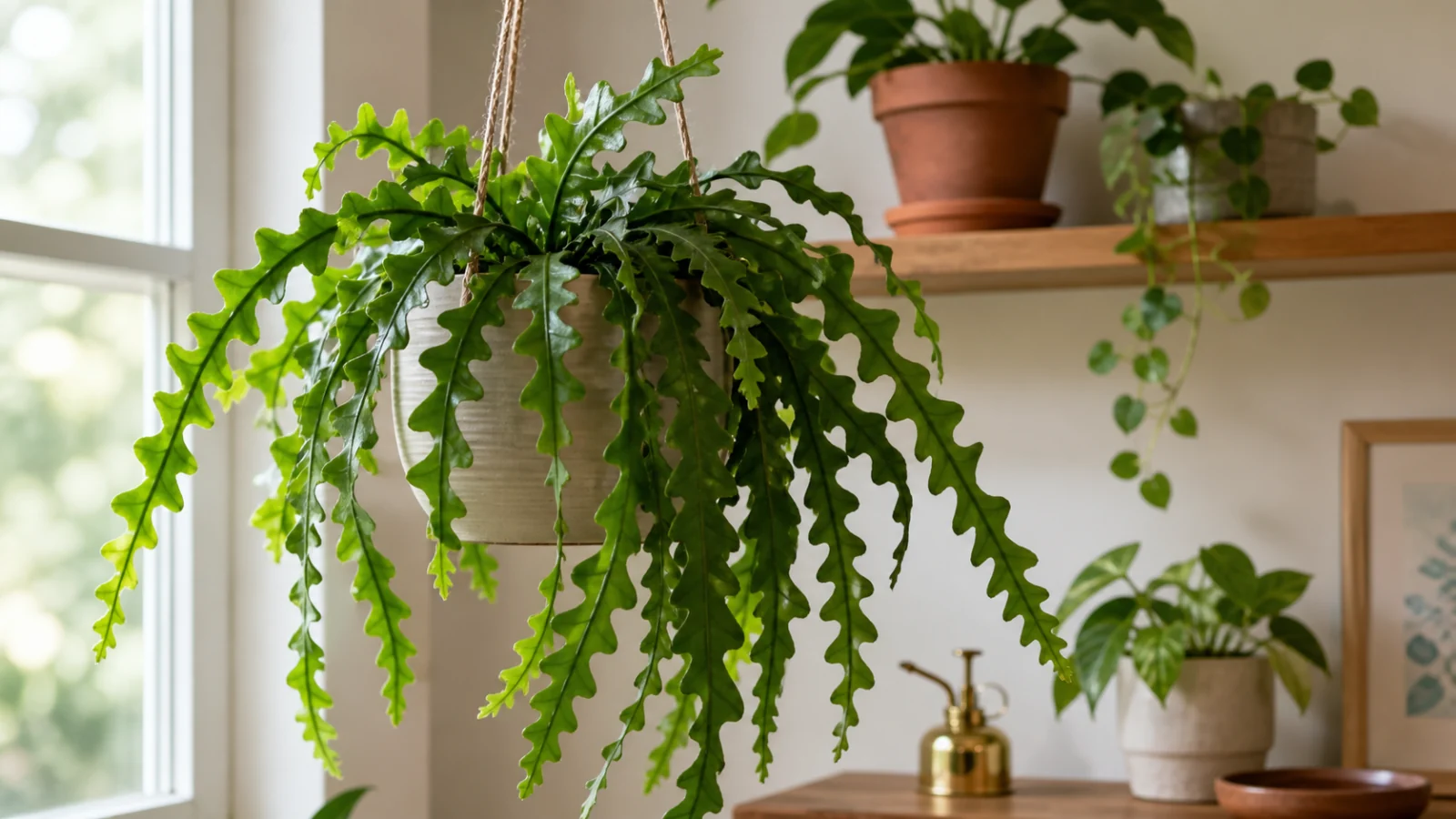
Flat zigzag stems cascade beside a bright window, where this jungle cactus can dry slightly between waterings.
13. Asparagus Fern
Light, feathery texture and bright green color. Not actually a fern, which means it tolerates drier air than Boston ferns do. A good choice when you want something with a soft, airy look rather than bold tropical leaves.
14. Rhipsalis (Mistletoe Cactus)
Long, thread-like or flat-branching stems that cascade dramatically. A jungle cactus rather than a desert one, so it tolerates lower light than most succulents and prefers not to dry out fully between waterings. Unusual and low-maintenance at the same time, which is a rare combination.
Best Hanging Plants for Bright Light
These plants want the sunniest spot you have: a south or west window, a bright balcony, or a windowsill with several hours of direct light.
15. String of Pearls
Round bead-like leaves on long trailing vines. One of the most visually distinct hanging plants, and one of the fussiest: it needs bright light and extremely well-draining soil, and it rots quickly if overwatered. The string of pearls care guide covers the exact watering and soil setup that makes the difference between thriving and rotting. Worth the effort if you can give it the right conditions, but not a forgiving choice for a corner with only a couple of hours of sun.
16. String of Bananas
Similar to string of pearls but with curved, crescent-shaped leaves. Slightly more tolerant of imperfect conditions and faster-growing. A practical starting point if you love the look of string succulents but have struggled with them before. The drainage and watering principles in the succulent care guide apply across this whole group.
17. Burro’s Tail (Sedum Morganianum)
Thick, plump leaves packed tightly along trailing stems. Dense and sculptural, and it looks particularly good viewed from below, where you see the full length of the cascade. Handle it as little as possible because the leaves detach at the slightest touch, though they root easily if you lay them on soil.
18. Trailing Jade (Peperomia Rotundifolia)
Small round leaves on thin, creeping stems. Much easier to keep alive than string of pearls and tolerates slightly lower light. A good option if you want a delicate trailing look without the strict care requirements.
19. String of Nickels (Dischidia Nummularia)
Coin-shaped leaves on vining stems. Similar in feel to string of turtles but faster-growing. Does well in a hanging pot near a bright window and tolerates drying out between waterings.
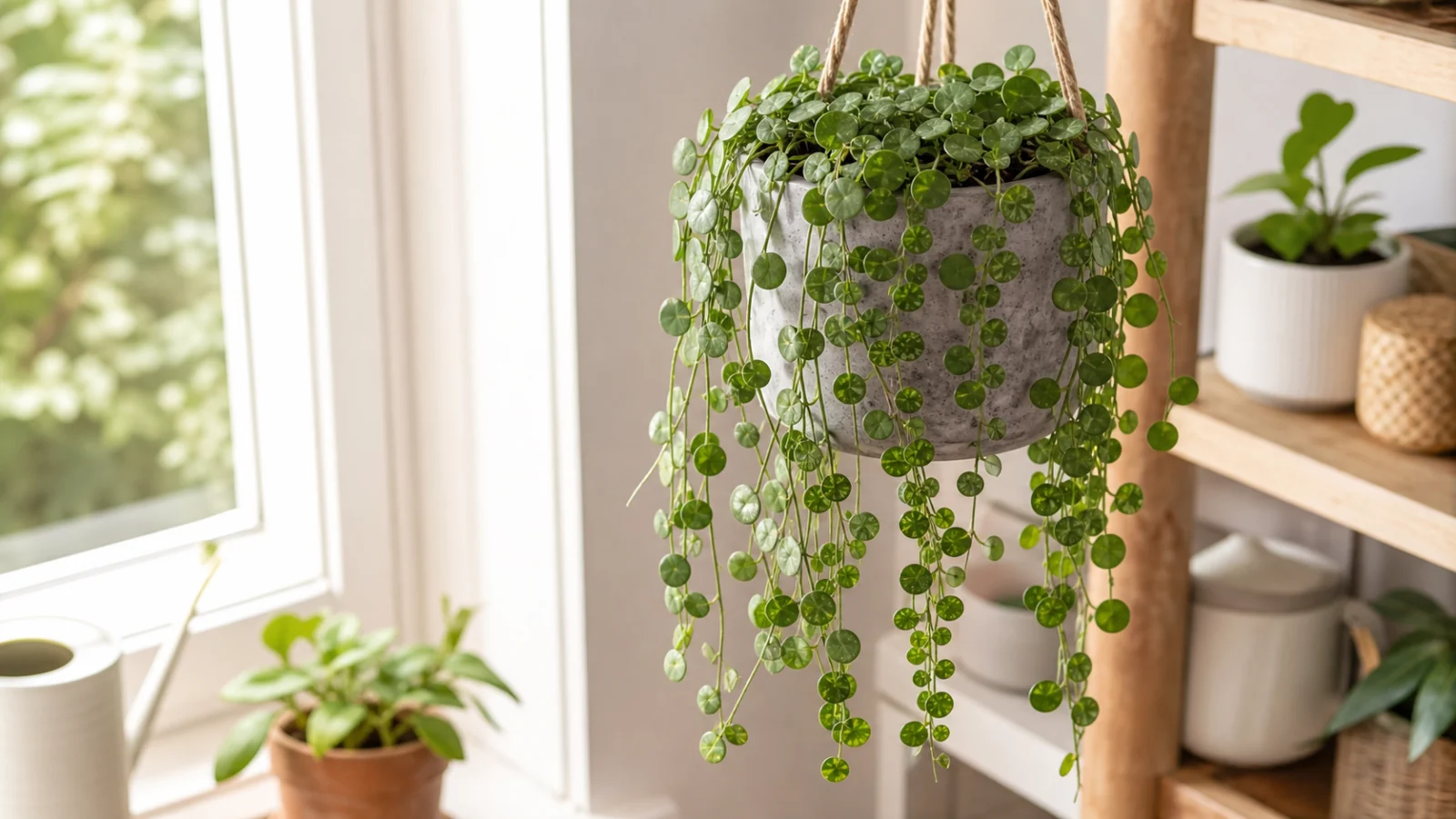
Coin-shaped Dischidia leaves trail from a hanging pot positioned close to a bright window.
20. Tradescantia Pallida (Purple Heart)
Deep purple stems and leaves that get more vibrant with more light. Grows fast, trails readily, and the color is most intense in a bright spot. More heat-tolerant than most trailing plants, which makes it a good choice for a south-facing window that warms up in summer.
Hanging Plant Care: What Changes When You Go Vertical
Hanging containers can dry faster than pots on a shelf, especially when the basket or liner is porous and warm air circulates around it. The size of the pot, liner material, plant, light, and room humidity matter more than any fixed multiplier, so compare the soil directly instead of assuming a hanging plant needs twice as much water.
Check the soil more frequently than you would for a shelved plant. Most trailing plants do best when allowed to dry out at least halfway between waterings. Good drainage matters even more in a basket because waterlogged soil with limited airflow leads to root problems quickly.
Darryl Cheng, author of The New Plant Parent, puts it simply: water in response to what the plant actually needs, not on a fixed schedule. With hanging baskets, that means checking more often during warm months and backing off in winter when growth slows down.
For moss baskets or coco coir liners, a practical approach is to take the whole basket to a sink, water thoroughly, and let it drain completely before hanging it back up. That avoids the drip problem and ensures the root zone is actually wet rather than just the top layer.
Keeping trailers compact: If you want your plants full rather than long and sparse, pinch the growing tips back regularly. That redirects energy into new side shoots, and the plant fills out rather than stretching thin. This works well with pothos, heartleaf philodendron, and tradescantia.
Pot and liner setup: A plastic nursery pot inside a decorative basket is the most practical arrangement because you can swap the liner out easily for watering. Coco coir and moss ball kokedama setups look beautiful but need more frequent watering and more careful attention to drainage.
Pet safety: Several popular hanging plants, including pothos, heartleaf philodendron, and satin pothos, are toxic to cats and dogs. If you have a pet that climbs or investigates plants on shelves, check before buying. The cat-safe indoor plants guide has a full list of which trailing plants are safe and which to keep out of reach.
Common Problems
Symptom Diagnosis Card
| Symptom | Most likely issue | What it usually means | First fix |
|---|---|---|---|
| Yellow leaves on pothos or philodendron | Overwatering or weak drainage | Roots are staying wet too long in a basket | Let the mix dry more between waterings and confirm the pot drains freely |
| Long bare stems with small leaves | Light is too weak | The plant is stretching instead of filling out | Move it closer to a brighter window or add a grow light |
| Brown fern tips | Dry air or missed watering | Boston fern and similar plants lose their lush look quickly in low humidity | Increase humidity, check soil sooner, and trim only the dead tips |
| Mushy string plants | Too much water for the light level | Succulent trailers rot fast when the pot stays cool and wet | Shift to a brighter spot and wait for a deeper dry-down before watering again |
| Variegation fading on pothos | Light is adequate for survival, not for color | The plant is tolerating the spot but not thriving there | Move it closer to bright indirect light |
| Drooping after a missed week | The basket dried out harder than expected | Hanging containers lose moisture faster than shelf pots | Soak thoroughly, let it drain, then shorten the check interval |
A hanging basket changes the care equation because airflow hits the root ball from all sides. When a plant declines, check light and drying speed before you assume fertilizer or pests are the problem.
Seasonal and Growth-Cycle Care
When usable light and active growth increase: Check the soil a little more often, but water only when that plant’s preferred portion of the mix has dried. Feed only actively growing plants according to the product label, and pinch new trailing tips if you want a fuller shape.
When light falls or growth slows: Lengthen the interval between soil checks that lead to watering and pause routine feeding. Do not assume every plant rests in the same calendar months: local climate, indoor lighting, and species all affect the growth cycle.
When heating or air-conditioning changes the room: Watch drying speed, leaf edges, and airflow around the basket. Dry air can crisp fern foliage while cool, weak-light conditions can keep potting mix wet longer. Respond to those observations rather than switching every plant to one seasonal schedule.
Methodology
The title, description, low-light answer, and condition-based seasonal guidance were updated on 2026-09-09. The care and safety source set was last checked in June 2026 against Illinois Extension, Penn State Extension, Wisconsin Horticulture, Missouri Botanical Garden, and ASPCA guidance; those sources were not rechecked during the September editorial update. Community questions around low light, inconsistent watering, and pet safety were used only as reader-language signals.
Frequently Asked Questions
What is the easiest hanging plant for indoors? Golden pothos or heartleaf philodendron. Both tolerate low light, uneven watering, and the occasional forgotten week. They grow fast enough to stay interesting and forgiving enough not to punish you when life gets busy. If you want something more distinctive, neon pothos is equally easy with more unusual coloring.
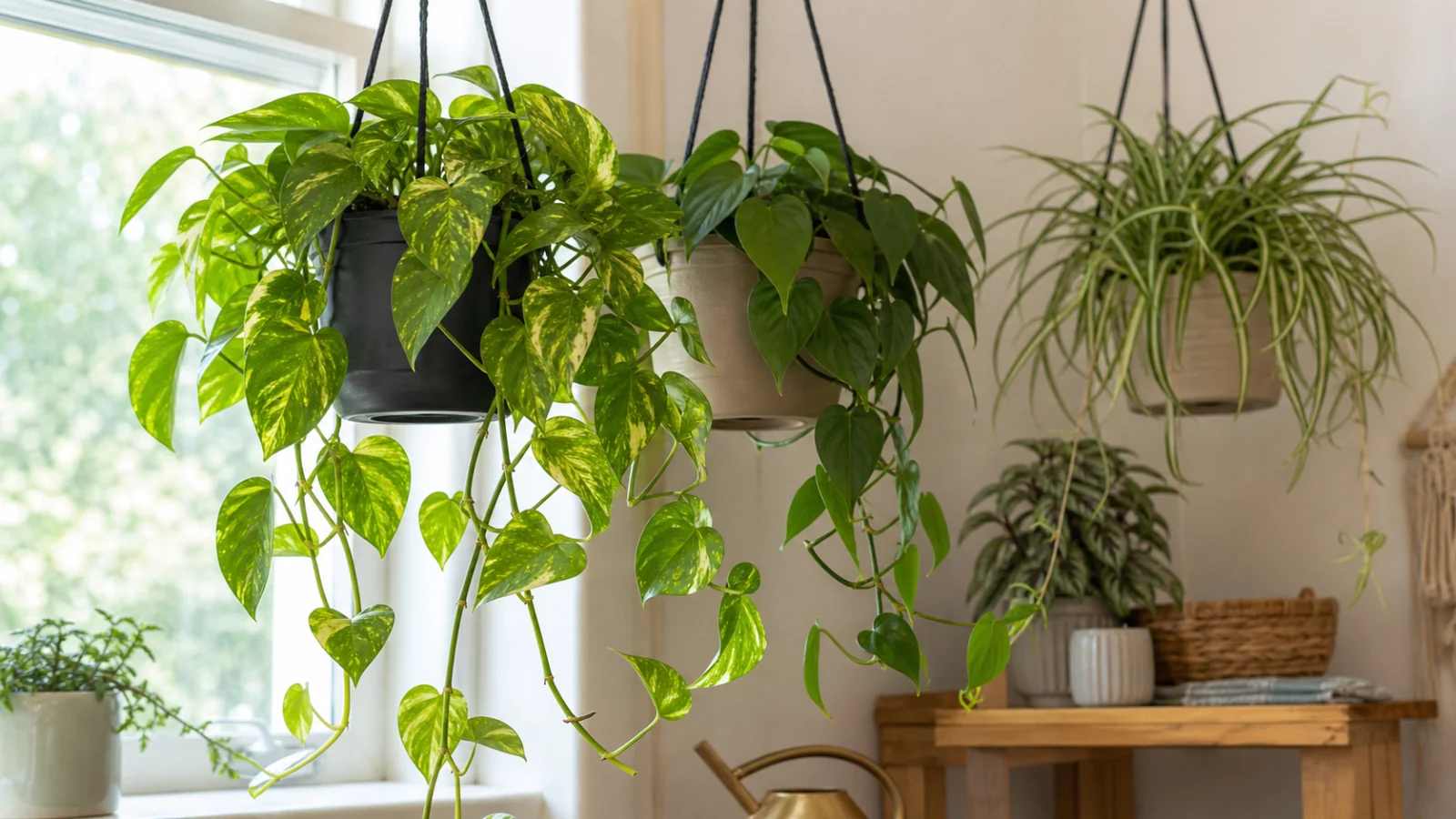
Golden pothos, heartleaf philodendron, and spider plant are forgiving starting points for common indoor conditions.
Can hanging plants survive in low light? Several can. Heartleaf philodendron, golden pothos, neon pothos, spider plant, and tradescantia zebrina all manage well in lower light conditions. They will grow more slowly and less full than they would near a bright window, but they will stay healthy. A room with no windows at all is a different situation; that requires a grow light to keep anything alive long-term.
How often do you water hanging plants indoors? Check often enough at first to learn how quickly that specific basket dries. Porous liners, small pots, strong light, and moving air can shorten the interval, while plastic pots and dim rooms can lengthen it. Water when the mix has dried to the depth that plant prefers rather than following a universal hanging-basket schedule.
Why are the leaves on my hanging plant turning yellow? The most common cause is overwatering: soggy soil that stays wet too long leads to root damage, and the plant shows stress through yellowing leaves. Check whether the soil has had time to dry out at least partway between waterings. If the pot has no drainage hole, that is usually the root cause. Other possibilities are low light (especially for variegated pothos) and root crowding if the plant has been in the same pot for two or more years. If you are not sure what is wrong, snapping a photo in KnowYourPlant will walk you through a diagnosis before it gets worse.
Do hanging plants need direct sunlight? Most do not. The bright-light group (string of pearls, string of bananas, burro’s tail, tradescantia pallida) benefits from a few hours of direct sun. But the majority of popular hanging plants prefer bright indirect light or can manage in lower conditions. Direct afternoon sun through an unfiltered south or west window can scorch the leaves of pothos, ferns, and philodendrons.
Which hanging plants are safe for cats and dogs? Spider plants and most hoyas are considered non-toxic to cats and dogs by the ASPCA. Many of the most popular trailing plants, including pothos and heartleaf philodendron, are toxic if ingested. The cat-safe indoor plants guide covers which trailing plants are safe so you can make an informed choice before hanging anything at paw height.
How do I get my trailing plant to grow longer faster? Light is the biggest lever. Most trailing plants grow noticeably faster in bright indirect light than they do in a darker corner. Moving the basket closer to a window often makes a visible difference within a few weeks. If the room does not have good natural light, a simple grow light on a timer helps considerably and does not need to be expensive.
If you are not sure which of these will work for your specific light and routine, KnowYourPlant can help you match plant to space. Tell it your conditions and it will point you toward the plants most likely to thrive, then send care reminders so the watering rhythm actually sticks. Download KnowYourPlant for personalized plant care reminders.