
Fiddle leaf fig pruning is one of those things that feels irreversible right up until you do it. You stand there with clean scissors, staring at a plant you have spent months, sometimes years, keeping alive, and every instinct says put them down. What if it goes into shock? What if it never branches? What if this is the cut that ends it?
Here is what actually helps: before you decide where to cut, decide what you are trying to accomplish. “I want to prune my fiddle leaf fig” can mean four completely different things, and which one you are actually after changes everything about where to cut, how much to remove, and what you will realistically see afterward.
Most guides skip that step entirely. They show you how to cut above a node and leave you to figure out the rest. What they do not tell you is whether you are topping a tall plant, trying to coax branches out of a single stem, rescuing something leggy and sparse, or doing all of that while also wanting to root the piece you remove. Getting the goal wrong turns a reasonable pruning decision into a long, anxious wait with nothing to show for it.
This guide starts with the goal, not the cut.
Identification Snapshot
| Detail | What to notice before you cut |
|---|---|
| Botanical name | Ficus lyrata, commonly sold as fiddle leaf fig or banjo fig |
| Indoor size | Usually 2 to 10 feet tall as a houseplant, even though it grows much larger outdoors |
| Leaf cue | Large, leathery, lyre-shaped leaves on a woody stem with milky sap |
| Light baseline | Bright indirect light or part shade, with protection from harsh afternoon sun |
| Best pruning window | Spring into early summer, when active growth makes recovery and branching more likely |
| Pet and skin safety | Toxic if chewed by pets or people, and the sap can irritate skin during pruning |
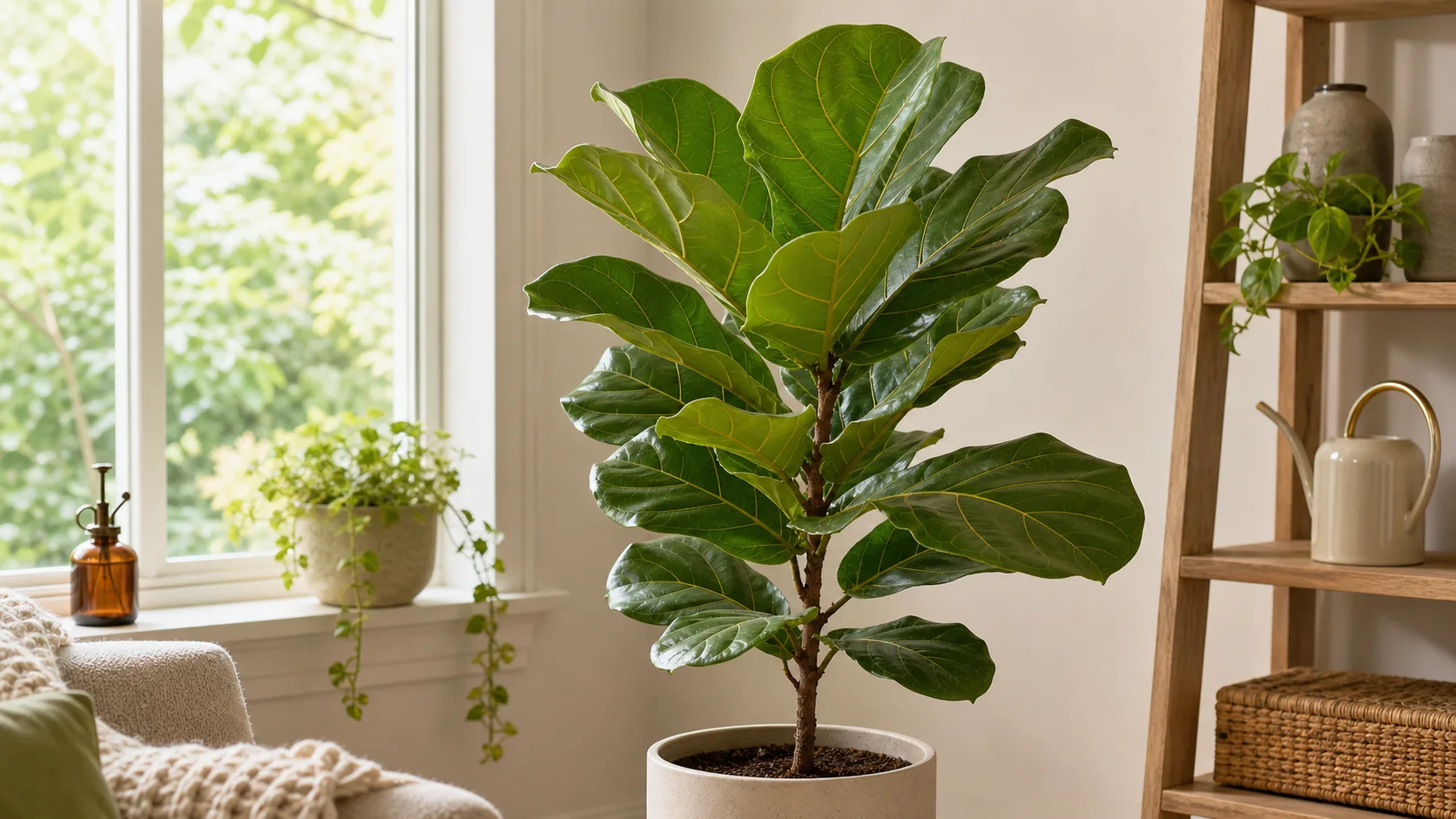
A healthy fiddle leaf fig shows its broad, lyre-shaped leaves in bright indirect light before pruning.
What Most Pruning Guides Miss
Most pruning advice lands somewhere around: cut above a node to encourage branching, remove no more than a third at once, and do it in spring. That is not wrong. It is just incomplete in a way that leaves a lot of owners confused about why their plant did not respond the way they hoped.
The common misdiagnosis is treating pruning as a single technique rather than four different decisions with four different realistic outcomes. Someone who cuts the top off a spindly, low-leaf plant hoping for quick new branches is making a fundamentally different request than someone removing the top of a healthy, well-grown plant. Same cut location, very different situations, very different timelines.
There is also an entire category of technique most how-to guides skip entirely: notching. If you want to encourage a branch at a specific point on the stem without cutting the top off at all, you can score the stem just above a dormant node with a clean knife. Notching disrupts the auxin flow that keeps dormant buds suppressed and can trigger new growth at that exact spot while leaving the rest of the plant untouched. For owners who want branching on a healthy plant but are not ready to commit to a top cut, this is the option most guides never mention.
A second gap: air layering as an alternative to a straight top cut for large plants. When a fiddle leaf fig has grown very tall and the top section is substantial, a simple cut-and-root-in-water approach involves real uncertainty. Air layering – wounding the stem at the desired cut height, wrapping it in moist sphagnum moss until roots form, then severing – lets you guarantee root formation before the top section is ever separated from the plant. It takes longer than water rooting (typically eight to twelve weeks versus four to eight), but for a large cutting or a particularly valued plant, it trades time for certainty. Most fiddle leaf fig pruning guides skip this option entirely, even though it directly answers the question many tall-plant owners are actually asking.
The practical first check before any cut: ask what you actually want the plant to do next. Are you reducing height? Triggering branching? Rescuing something sparse? Planning to propagate? Each goal has its own best approach, its own timing, and its own honest timeline. And when you cut the top off, the removed section can become a new plant – many owners make a height-reduction cut without any plan for the piece they just removed, then realize too late they could have rooted it. This guide pairs those two decisions from the start.
Which Goal Is Yours?
Pruning a fiddle leaf fig is not one action. It is a choice about what the plant needs next.
The four situations most owners are actually in:
- The plant is too tall and needs to be shorter
- The plant is a single stem and you want it to branch into a tree shape
- The plant is leggy, sparse, and needs rescuing
- You want to prune and also take a propagation cutting from what you remove
Each of these leads to a different decision about where to cut, how much to remove, and what to expect afterward.
Quick Cut Guide by Goal
| Goal | Best approach | Expected outcome | Realistic timeline |
|---|---|---|---|
| Reduce height | Top cut just above a node at desired height | May trigger branching near cut | 4 to 12 weeks for buds |
| Encourage branching on healthy plant | Top cut or notching at branching height | 1 to 4 new shoots | 4 to 12 weeks |
| Encourage branching without topping | Notching above a dormant node | One new shoot at that spot | 4 to 10 weeks |
| Rescue a leggy plant | Top cut above any viable node | Slower, modest initial response | Full growing season |
| Propagation cutting | Same as height cut, root the removed top | Roots in 4 to 8 weeks | Water or perlite both work |
| Large cutting, guaranteed rooting | Air layering at desired cut height | Strong-rooted top section | 8 to 12 weeks before severing |
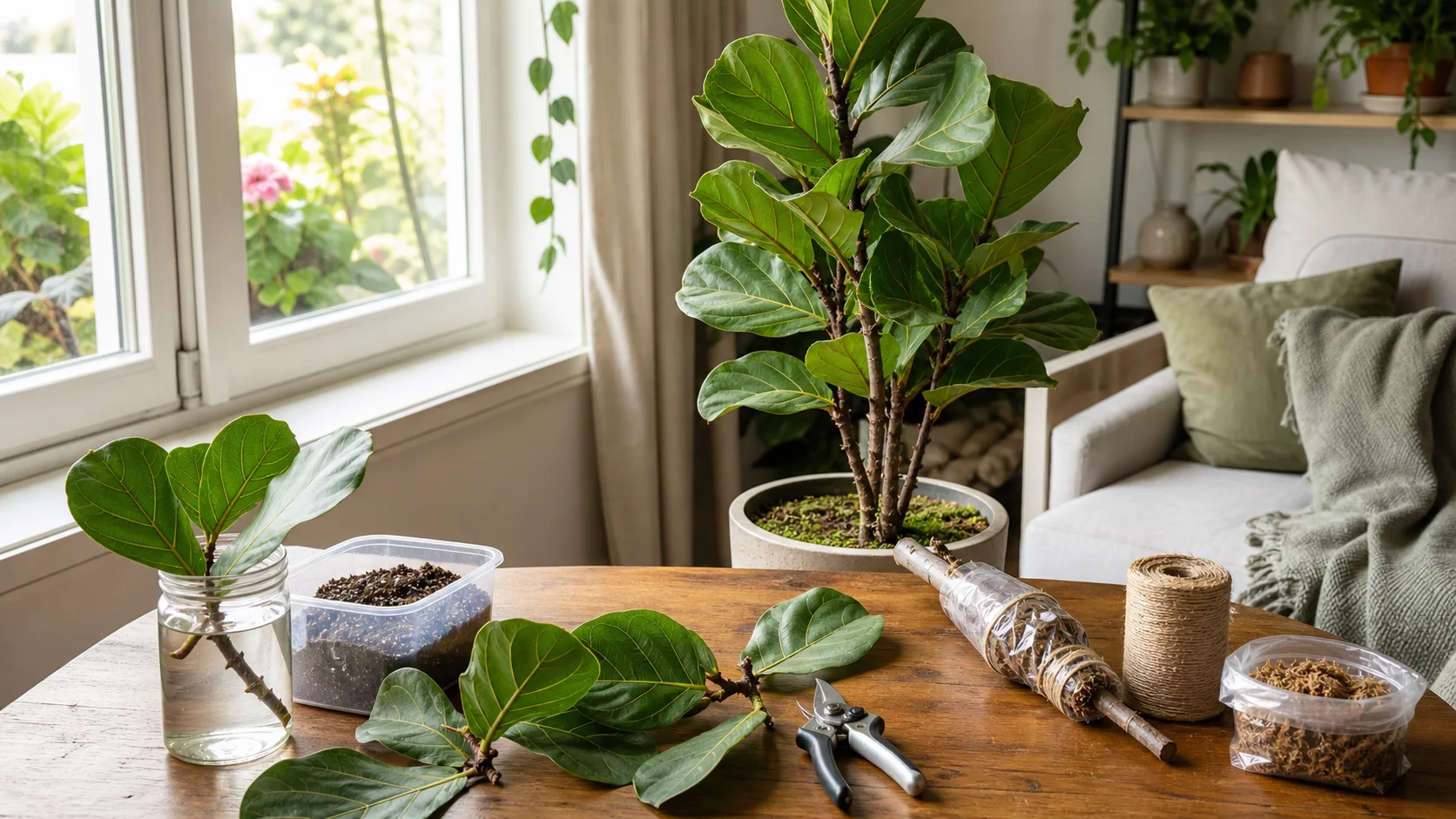
Pruning shears, a water cutting, potting medium, and air-layering supplies represent different goals for the next cut.
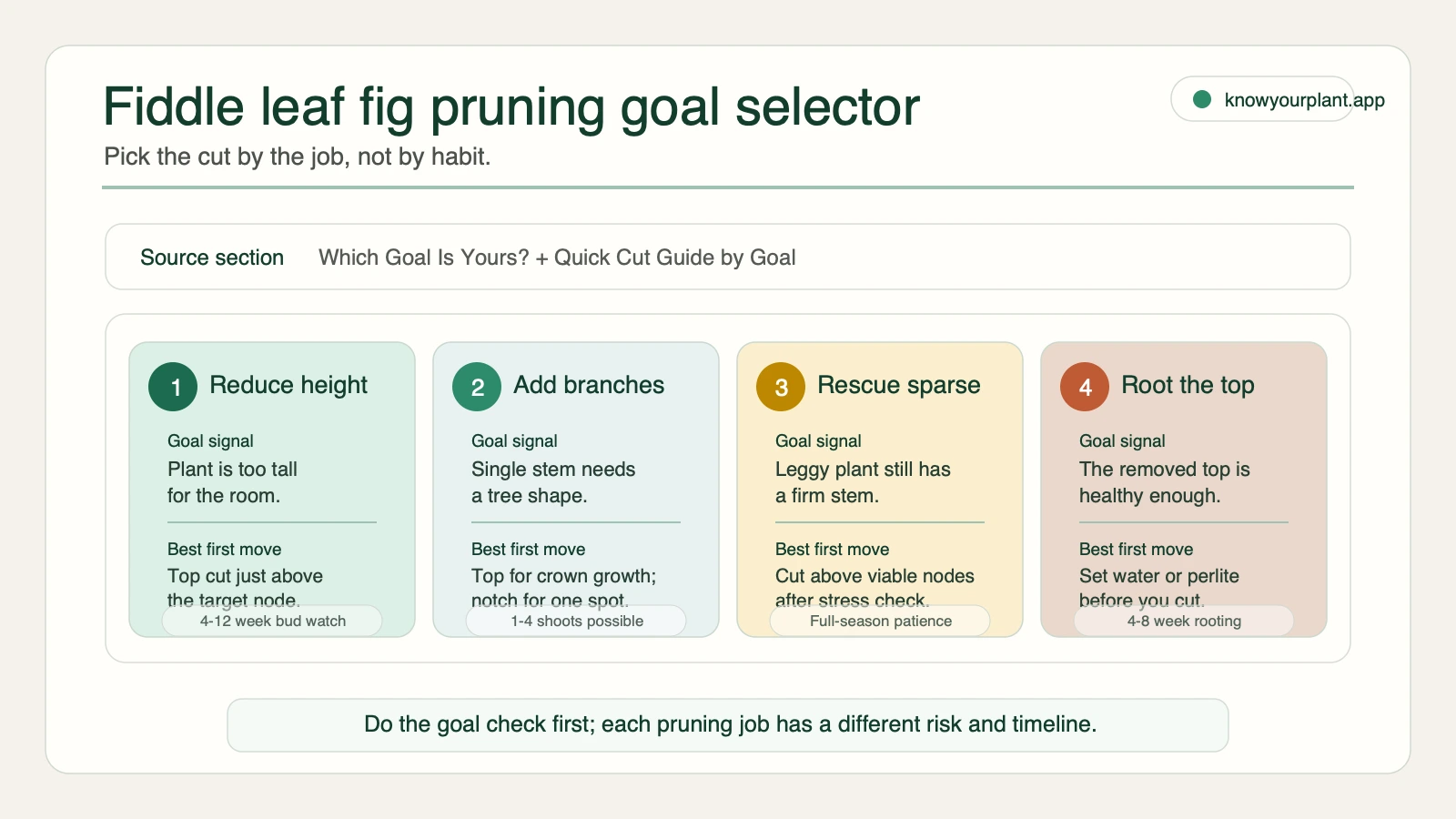
Start with the goal selector so you do not use a top cut, notch, rescue cut, or propagation plan for the wrong pruning job.
Lookalikes and Common Confusions
The biggest confusion trap is not a rare species. It is using advice meant for another ficus or for a generic “tall houseplant” without checking whether the plant in front of you really matches Ficus lyrata. NC State and Missouri Botanical Garden both describe fiddle leaf fig as a woody tropical tree with large lyre-shaped leaves, milky sap, and a typical indoor size of about 2 to 10 feet.
That matters because pruning threads often drift toward rubber tree or general ficus advice, especially when owners are deciding whether to air layer a tall plant. If your plant has much smaller oval leaves, a different branching habit, or no fiddle-shaped blades at all, pause and identify it first. The cut strategy in this guide is written for true fiddle leaf fig, not every ficus sold at a garden center.
Care Cards
| Care card | Fast answer for pruning week |
|---|---|
| Light | Keep the plant in bright indirect light, not direct afternoon sun, so it has energy to heal and push new growth |
| Water | Water normally during active growth, but do not keep the pot soggy just because the plant was cut |
| Timing | Spring and early summer are the easiest windows for topping, notching, and recovery |
| Sap handling | Wear gloves and wipe milky sap off leaves and hands because the sap can irritate skin |
| Aftercare watch | Stable leaves, firm stem, and swelling buds are good signs; soggy soil and soft tissue are not |
When to Prune
Spring and early summer give the plant the best chance to respond well. Fiddle leaf fig is in active growth during these months, which means the dormant buds near the cut are more likely to activate and push out new shoots.
Pruning in autumn or winter will not harm it, but recovery will be slower. Clemson Cooperative Extension notes that many indoor plants “enter a winter resting stage under short days and low light,” and fiddle leaf fig is no exception. A cut made in November will still heal cleanly, but you may wait until the following spring before you see any real movement from the nodes near it.
If the plant is already under stress, wait before reaching for the scissors. A fiddle leaf fig that is actively dropping leaves, recently moved to a new spot, or showing signs of root rot has enough to manage. Give it four to six weeks of stable conditions before adding a pruning cut on top.
The Four Main Approaches
Topping for Height
If the plant has grown taller than you want, you can remove the top by cutting the main stem cleanly just above a leaf node. A node is the raised point on the stem where a leaf is attached. Cutting just above one leaves an active growth point, which increases the chance of new shoots emerging at or below that spot.
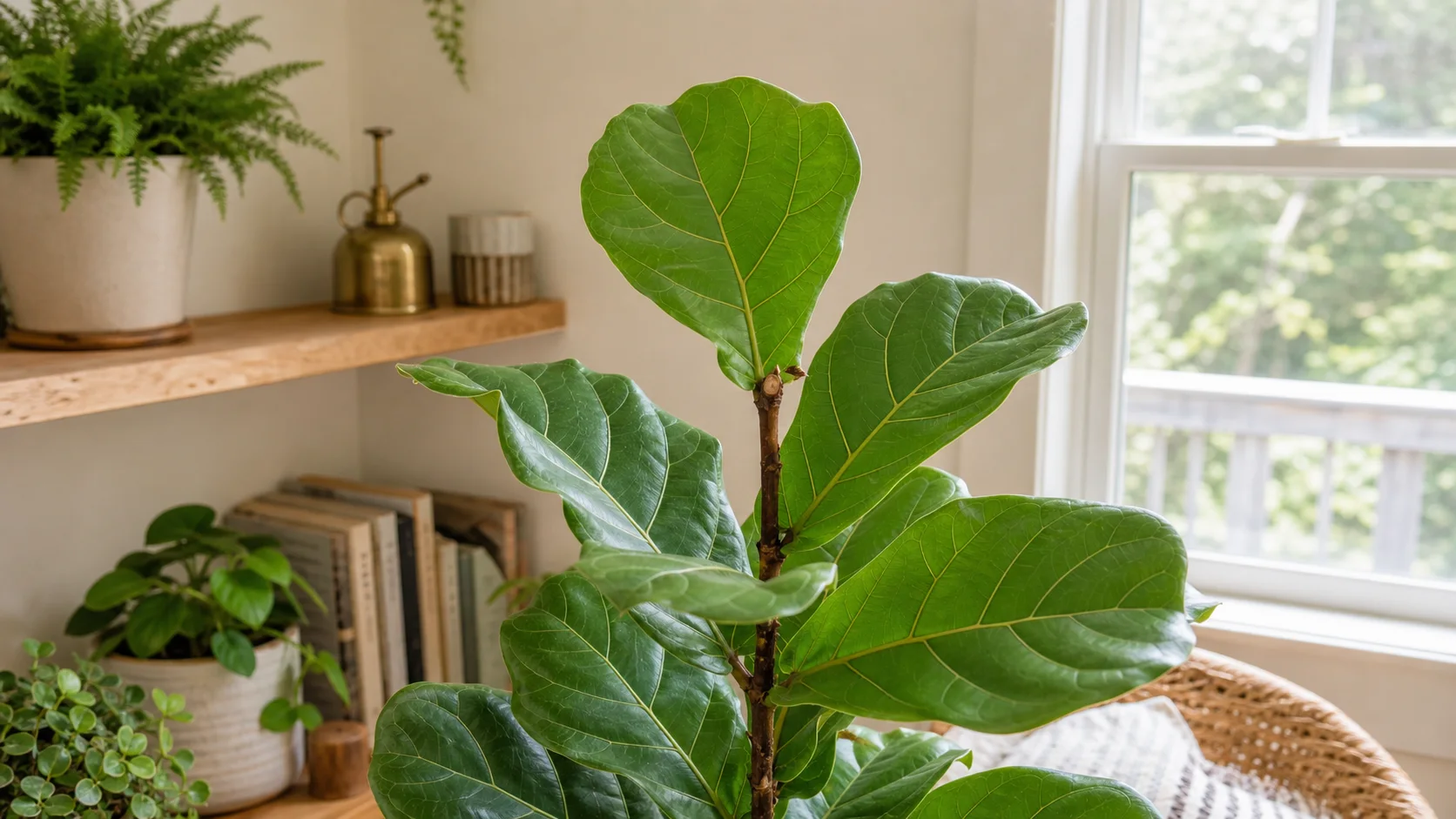
A clean top cut just above a leaf node reduces height while leaving nearby growth points available to branch.
How much to remove depends on how far you need to go. If you need to reduce height dramatically, spreading the work across two growing seasons is gentler on the plant. Cut to an intermediate height in spring, let it stabilize and show new growth, then make the next cut the following year.
For owners with a very large or particularly valued top section, air layering is worth considering before making the cut. You wound the stem at the intended cut height – either by removing a narrow ring of bark or by scoring through to the cambium on two sides – pack moist sphagnum moss around the wound, and wrap it tightly in plastic film to keep it humid. Roots form over eight to twelve weeks and become visible through the plastic. Once they are well established, you sever the stem below the root mass and pot up the rooted top. The advantage over a straight cut-and-root approach is that the top section never experiences the stress of being removed without roots. The disadvantage is time and setup: slower and more hands-on than dropping a cutting in a jar of water. For a very large cutting, a plant you cannot afford to risk, or a top section with only one or two leaves that would struggle to sustain itself during rooting, the tradeoff is worth it.
For context on how sturdy these plants actually are: Ficus lyrata can reach 40 feet in its native tropical West African habitat, according to the Missouri Botanical Garden. The stems are built for growth, not fragility.
Notching to Trigger a Branch Without Topping
Notching is the technique most fiddle leaf fig guides leave out entirely, and it changes the decision completely for owners who want a branch at a specific height without removing the top of the plant.
To notch, use a clean sharp knife to cut a small V-shaped groove into the stem just above a dormant node, going no deeper than about a third of the stem’s diameter. The cut interrupts the downward flow of auxin, the hormone the growing tip produces to keep lower buds dormant. With that suppression disrupted at one point, the dormant bud directly below the notch may activate and push out a new shoot.
A dormant node looks like a slight bump, ring, or pale scar on the stem – the point where a leaf is attached now or was once attached. Nodes on fiddle leaf fig are fairly evenly spaced along the stem, and each one is a potential branching site. When choosing a target for notching, look for a node with a visible bud scar rather than a completely smooth section of stem: you are looking for a site where the bud exists but has been dormant, not a section of stem without any viable growth point.
Notching works best in spring and on nodes that still have a visible bud or leaf scar. It does not guarantee a branch at every site, but it gives you a targeted option that leaves the rest of the plant’s structure completely intact. If you want branching at a specific height and do not want to sacrifice the top of the plant to get it, this is the approach worth trying first.
Encouraging Branching by Topping
A single-trunk fiddle leaf fig will not develop branches on its own. Its natural tendency is to grow straight up, pushing energy into the top growing tip. This is apical dominance: the tip actively suppresses the dormant buds along the stem below it.
When you remove the top, that suppression disappears. The plant redirects energy to nodes lower on the stem, and those dormant buds can activate and eventually become branches. The mechanism is consistent. The timing and number of branches are not: some plants produce two or three branches, others take a full season, and a few produce one strong shoot rather than several. Setting realistic expectations before you cut matters more than the cut technique itself.
The cut for branching is the same as topping: a clean cut just above a node at the height where you want new growth to emerge. Lower cut means branches lower on the plant. Higher cut keeps the plant tall with new growth near the crown.
One detail worth knowing: the position of the node on the stem influences the direction the new branch will grow. Nodes on opposite sides of the stem tend to produce branches that grow in opposite directions. This is why topping a single-stem plant can eventually produce a balanced, tree-like shape – the branches that emerge tend to extend away from each other if they come from nodes at different angles around the stem.
Rescue Pruning for a Leggy Plant
A plant that is very tall, thin, and has lost most of its lower leaves is a different challenge. The question owners dealing with this situation ask most often is whether aggressive pruning is the right rescue move, and the honest answer is: sometimes, but check first.

Check that a leggy fiddle leaf fig still has a firm lower stem and viable nodes before making a rescue cut.
Before cutting a sparse fiddle leaf fig, press the lower stem gently. It should feel firm and solid. Check that there are at least a few viable nodes remaining on the stem even after your planned cut. If the stem is soft at the base, or you notice brown patches or signs of rot near the lower stem, address root health first before asking the plant to recover from both a major pruning cut and root stress at the same time. If the root ball is crowded or the mix has turned stale and compacted, the step-by-step repotting guide is the better first move before you make a rescue cut.
For a genuinely leggy but otherwise healthy plant, the goal is the same as branching: remove the apical tip to redirect energy to dormant nodes. Manage expectations here. A sparse plant may take a full growing season to show meaningful new growth, and the initial response will be modest. That is normal. It is not failing; it is just slow.
Taking a Propagation Cutting
If you are removing the top anyway, the piece you remove does not have to go in the bin. A stem cutting with at least one node and two or three healthy leaves can be rooted in water or moist perlite. This is where most height-reduction cuts waste a real opportunity.
The decision is simple: before you cut, set up a jar of clean water or a small pot of damp perlite. After making the height cut, let the cutting sit for a few minutes so the milky sap starts to harden at the cut end. This step matters more than it sounds: placing the cutting directly into water before the sap hardens can make it harder for roots to emerge from that point. Then place the node end into the water or perlite. Nothing is wasted, and you have a head start on a second plant from a cut you were making anyway.
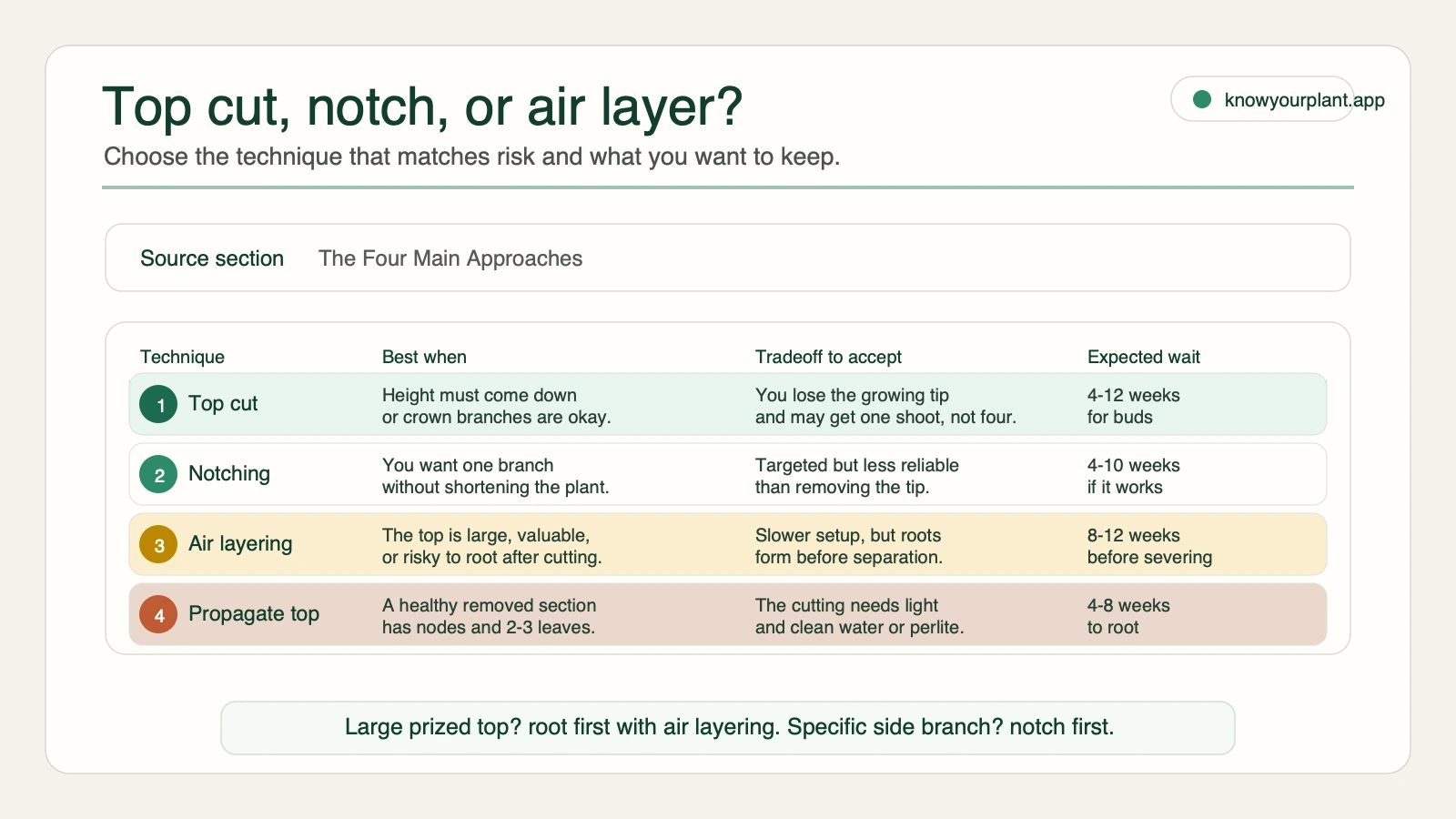
Use the technique map before cutting: notching, topping, air layering, and rooting the removed top solve different problems.
Mistakes That Stall the Response
The cut itself is usually not the problem. What delays or prevents new growth after pruning tends to come down to a handful of predictable errors.
Cutting too far above the node. The stub between your cut and the node below it is dead tissue. The plant has to seal and shed that section before the node beneath can respond. A stub of several centimetres delays the whole process. Cut within about a centimetre of the node, not several inches above it.
Pruning in poor light. Dormant buds need photosynthetic energy to activate. A fiddle leaf fig in a dim corner simply does not have the reserves to push new growth after a cut. If your plant is in lower-than-ideal light, improving light is the most impactful change you can make – before and after pruning, more useful than any adjustment to watering or feeding schedule.
Fertilizing immediately after the cut. The instinct to support recovery with a feed makes sense, but the plant is directing energy to wound healing in the weeks right after a cut, not to leaf production. Fertilizing during this window can stress roots at a moment when the vascular system is already managing the injury. Wait at least four to six weeks after a significant cut before resuming your normal feeding schedule.
Moving the plant right after pruning. Fiddle leaf figs are sensitive to location changes. Pruning and relocating at the same time doubles the adjustment burden. If you need to do both, pick one: move first, wait for the plant to stabilise (no leaf drop, growth resuming), then prune. Or prune, wait for the cut to heal cleanly, then move.
Expecting a sparse plant to branch quickly. A leggy plant with very few leaves has limited photosynthetic capacity. The energy budget for activating dormant buds is genuinely smaller than for a well-leafed plant. The response will come, but a full growing season is a realistic expectation, not a sign that something went wrong.
How to Make the Cut
Use clean, sharp scissors or pruning shears. Wipe the blades with rubbing alcohol before and after. A clean cut heals faster and is easier for the plant to seal over than a ragged tear from dull blades.
Cut at a slight angle just above a leaf node, leaving a short stub of about a centimetre rather than cutting flush against the stem. Too long a stub dries into dead material that has to die back before the node below it responds; too flush a cut can damage the node itself.
“The plant’s sap may be irritating to the skin and eyes,” NC State Extension’s Plant Toolbox entry for Ficus lyrata notes. Wear gloves when making any cut, and wipe the milky sap off the plant’s own leaves if it drips – it can leave marks on the leaf surface if it dries in place. If the leaves are already dusty or streaked, use the guide to cleaning plant leaves after pruning day rather than reaching for leaf-shine products.
Pet Safety
Fiddle leaf fig is not a good chewable plant for pets or small children. NC State says the plant is toxic to humans, cats, and dogs if ingested, and notes that oral irritation, excessive drooling, and vomiting may occur. That does not mean casual contact with a leaf is an emergency, but it does mean you should place the plant where curious pets cannot keep sampling it.

Keep pets separated from fiddle leaf fig foliage, fallen leaves, and fresh pruning cuttings.
The bigger pruning-day issue is the sap. The same milky sap that can irritate your skin can also irritate a pet’s mouth if they mouth a freshly cut stem or fallen leaf. Bag up cuttings promptly, wipe sap from the floor or pot rim, and keep propagation jars out of reach while the cutting is rooting.
What to Expect After Pruning
New growth from a pruning cut does not appear quickly. Plan for several weeks, sometimes six to eight, before you see any sign of budding at the cut site or at nodes lower on the stem.
During that wait, the instinct is to do more: water more, fertilize, move it somewhere brighter. Resist that. More water does not speed up bud activation, and fertilizing a plant that is directing energy toward a wound can stress the roots. The best support you can give is stable conditions: consistent bright indirect light and your normal watering rhythm.
Missouri Botanical Garden’s care guidance for Ficus lyrata recommends watering “regularly during the growing season” and reducing water from fall through late winter. The same seasonal pattern applies after pruning. Keep conditions consistent and give it time.
What to watch for:
- Small reddish or green bumps forming near the cut or along the stem lower down – these are dormant buds activating
- Existing leaves staying firm and holding their colour – a reliable sign the plant is stable
- Yellowing or dropping of older leaves at the base – not always alarming, but worth noting if it continues for more than a week or two
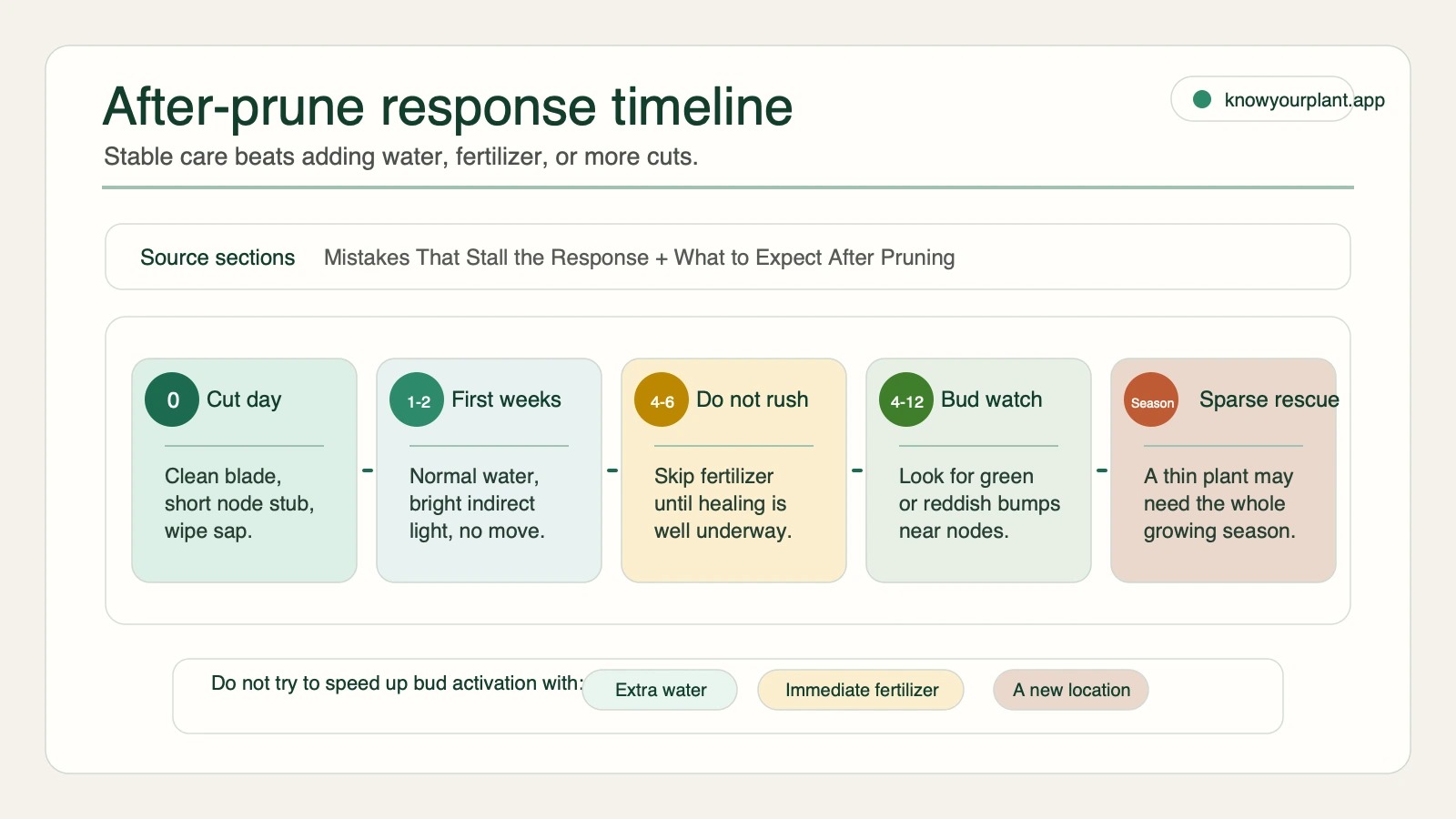
Use the timeline while you wait; stable care is the fix, not extra water, fertilizer, or a second cut.
For general troubleshooting on fiddle leaf fig brown spots and other common symptoms, the diagnosis guide covers what to look for while you are waiting for new growth after a cut.
Propagating the Removed Top
Place the cutting in a jar of clean water so the cut end and at least one node are submerged but the leaves stay dry. Set it in bright indirect light and change the water every week. Roots typically appear in four to eight weeks, and the cutting is ready to pot once they are at least two to three centimetres long.
Water rooting works reliably for fiddle leaf fig cuttings. Some owners prefer starting directly in damp perlite or a light propagation mix, which can produce roots that transition to soil more smoothly. Water roots are sometimes more fragile at the point of potting, so if you are planning to pot into a well-draining indoor mix, perlite propagation can save a step. Either method works. For a broader look at rooting options across different houseplant types, the guide to propagating houseplants covers the practical differences in detail.
Once the cutting is potted and established, it will grow more slowly than the parent plant for the first few months as it builds a root system before focusing on new leaves. That is expected. Give it the same bright indirect light and careful watering schedule as the parent, and it will catch up.
For complete care guidance on the parent plant, including light, watering, humidity, soil, and common problems, the fiddle leaf fig care guide has everything in one place.
If you are troubleshooting another common plant symptom, see Fiddle Leaf Fig Dropping Leaves: Start Where It Fell for a focused diagnosis and recovery plan.
Real User FAQ
My fiddle leaf fig is over six feet tall. Should I just cut the top off or air layer first?
If the top section is large, heavy, or especially valuable to you, air layering is the safer project. It lets roots form before you sever the top. If the plant is healthy, the top is manageable in size, and you are comfortable rooting a cutting in water or perlite, a straight top cut is faster.
My plant is leggy and sparse. Is an aggressive spring cut really the right rescue move?
Sometimes, yes, but only if the stem is still firm and the roots are not already in trouble. A leggy fiddle leaf fig can branch after a top cut, but the response is slower because the plant has fewer leaves to power recovery. Expect a full growing season, not an instant makeover.
If I cut one bare stem, how many branches should I realistically expect?
Pruning can trigger one strong new shoot or several. Owners sometimes report getting multiple branches after a single top cut, but that is not guaranteed. The more realistic expectation is that the plant redirects growth to the strongest viable nodes closest to the cut.
Can I root the removed top, and how long does it usually take?
Yes. That is one of the most practical reasons to plan the cut before you make it. A healthy top cutting with at least one node can root in water or perlite, and four to eight weeks is a common range before roots are ready for potting.
Freshness Note
This pruning guide was checked against NC State Extension, Missouri Botanical Garden, Clemson Cooperative Extension, and live plant-owner discussion patterns on 2026-05-18. Seasonal timing, light, watering, and sap-safety guidance were aligned to those sources before this update.
Methodology Note
This guide was updated using live search review plus direct source checks against NC State Extension, Missouri Botanical Garden, and Clemson Cooperative Extension. Forum and Reddit-style discussion threads were used only to surface the questions owners keep asking, such as whether to top or air layer first, what a leggy rescue cut can realistically do, and how propagation fits into height reduction. Those discussion sources shaped the reader questions here, but the care guidance itself was anchored to horticulture sources.
Frequently Asked Questions
How much can I cut off a fiddle leaf fig at once?
A common guideline is no more than a third of the total height in a single session. If you need to reduce height more dramatically, split the work across two growing seasons: cut to an intermediate height in spring, let the plant stabilize and show new growth, then make the final cut the following year. This is gentler on the plant and gives you time to see where new branches emerge before deciding on the final shape.
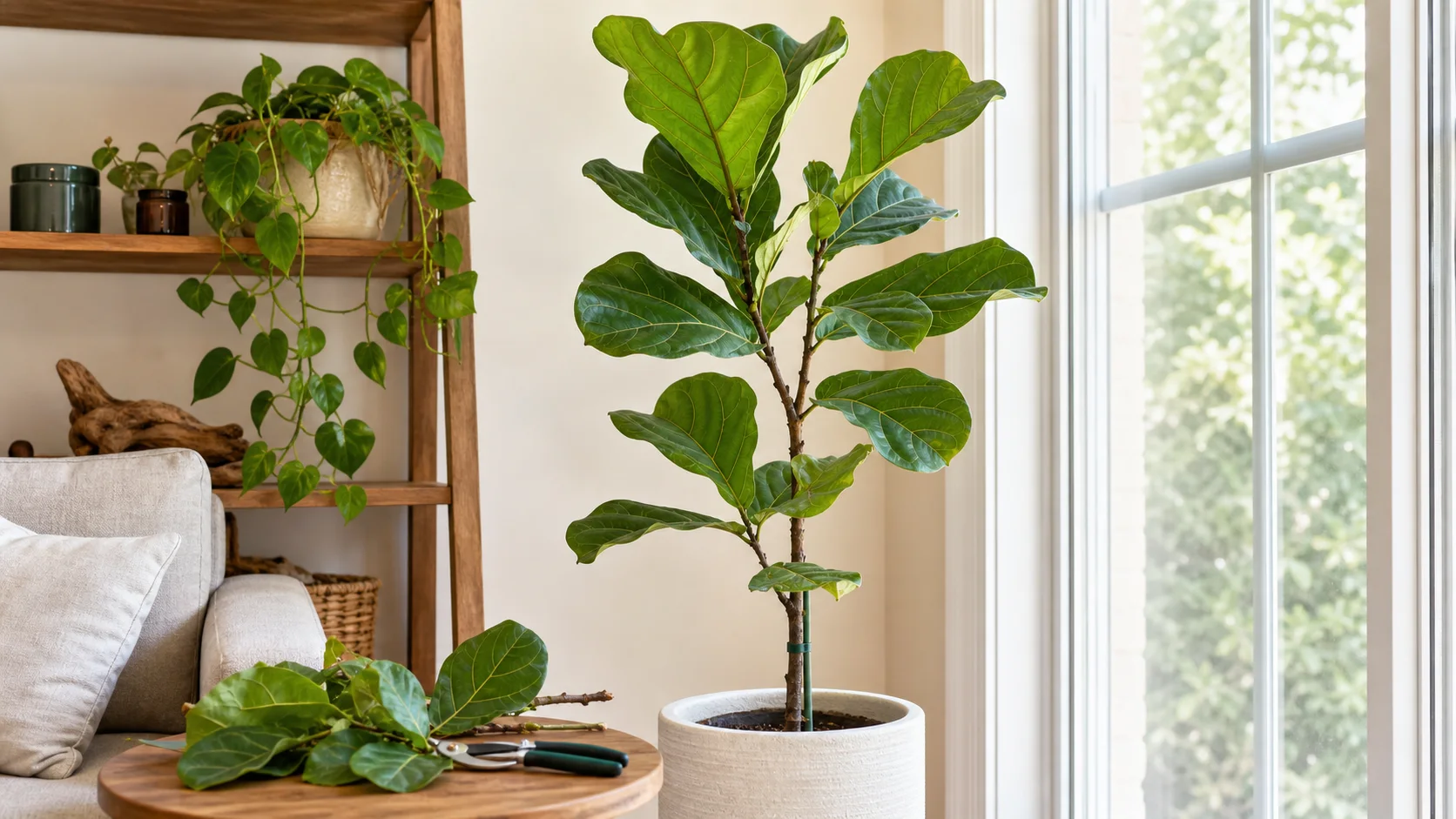
A modest pruning session leaves the fiddle leaf fig well leafed while setting up a balanced branching response.
How long does it take for a fiddle leaf fig to branch after pruning?
Plan for four to twelve weeks before you see visible bud activation near the cut site, and longer before those buds develop into recognizable branches. The timeline depends on the time of year (spring cuts respond faster), available light, and the plant’s overall health. If you pruned in active growing conditions and see nothing after three months, check that the cut was made close to a node and that the plant is getting several hours of bright indirect light daily.
Can I prune a fiddle leaf fig in winter?
Yes, but the response will be slow. Fiddle leaf figs naturally slow down as days shorten in autumn and winter, so new growth from a winter pruning cut may not appear until spring. If the pruning is urgent – the plant is genuinely too tall or a damaged section needs to come off – go ahead. If it is elective, waiting until late winter or early spring will give you a faster, more satisfying result.
Why is my fiddle leaf fig not branching after I pruned it?
A few common reasons: the cut may have been made too far above the nearest node, leaving a long dead stub rather than a clean cut close to an active point. Or the plant was pruned during a slow period and simply needs more time. Check the light situation too. A plant in a dim corner has less energy to push new buds. If the lower stem feels soft or discoloured, root health may be the actual issue rather than anything pruning-related.
What is notching and should I try it instead of cutting?
Notching is a small V-shaped cut made just above a dormant node, going about a third of the way through the stem. It disrupts the auxin flow from the growing tip, which can trigger the bud below the notch to activate without removing any of the plant. It is a good option if you want a branch at a specific spot and the plant is otherwise healthy and well-sized. Notching is lower commitment than topping, but results can be slower and less predictable than a full cut. Do it in spring for the best chance of a response.
Can I prune a stressed or unhealthy fiddle leaf fig?
It depends on what is causing the stress. A plant that is actively dropping leaves, recently repotted, or adjusting to a new location needs time to stabilize first. Give it four to six weeks of consistent conditions before pruning. A plant with confirmed root rot should have that addressed before any significant cutting. If the stress is mild – a few older leaves yellowing naturally while the rest of the plant looks healthy – a light cleanup cut is usually fine. Heavy topping or branching cuts on a plant that is visibly struggling are best saved for when it has recovered.
Where exactly do I cut to encourage branching?
Just above a leaf node at the height where you want branches to emerge. The node is the small raised bump or ring on the stem where a leaf is attached, or where one was previously attached. Cutting close above it, within about a centimetre, is better than leaving a long stub. The height of the cut determines where branches appear: a lower cut means branches lower on the plant, a higher cut keeps the plant tall with new growth near the crown.
Do I need to seal or treat the cut wound?
No. Fiddle leaf figs heal naturally without any sealant. The cut will form a callus on its own, and adding wound paint can trap moisture or slow the natural healing process. The most useful thing you can do is make sure the blade was clean before cutting.
Can I propagate a fiddle leaf fig cutting that already has leaves?
Yes. A cutting with one or more healthy leaves and at least one node is exactly what you want for rooting. The leaves allow the cutting to continue photosynthesising while roots develop. If the leaves are very large, some owners trim them in half to reduce water loss, but that is optional rather than required, and the cutting will often root either way. Let the milky sap dry for a few minutes at the cut end before placing it in water or perlite.
What is air layering and when should I use it instead of a water-rooted cutting?
Air layering is a technique where you encourage roots to form on the stem before severing it. You make a wound at the desired cut height – either removing a narrow ring of bark or scoring the stem – pack the wound with moist sphagnum moss, and wrap the whole section tightly in plastic film to keep it humid. Roots form over eight to twelve weeks and become visible through the plastic. Once established, you cut below the root mass and pot the rooted section. It takes longer than water rooting but is worth considering when the top section is very large and heavy (hard to sustain in water without roots), when the cutting has only one or two leaves that may not hold up during a long rooting wait, or when the plant is particularly valuable and you want to eliminate the uncertainty of a severed-and-rooted cutting. For most standard height-reduction cuts, water or perlite rooting is faster and easier. For a large plant where you are also asking whether you can air layer it like a rubber tree – the answer is yes.